




Abstract
The 2016 Mandopop hit ‘Prague square’ ushered in a new romance for Central and Eastern Europe (CEE) in China. Such infatuation has resonated not only in popular culture, but was mirrored in China’s newfound boldness on the international stage. Drawing on CEE media accounts, the article demonstrates that China’s romance with the CEE countries was never reciprocated. In fact, the CEE region might present a significant outlier in that media accounts of China have been consistently negative in the decade preceding the Covid-19 pandemic. In other words, the pandemic merely accelerated trends that were already set in motion prior to 2020. In this respect, CEE media accounts of both China and the Covid-19 pandemic reveal an interesting ‘localization of the other’. As such, China has been used to validate specific domestic positions of different political formations. Perceptions of China (what it is assumed to stands for) have been deployed domestically in the CEE region to justify particular visions of the state and its international identity.
Introduction
The 2016 Mandopop hit ‘Prague square’ ushered in a new romance for Central and Eastern Europe (CEE) in China. The lyrics eulogize the beauty of the Czech capital and urge listeners to ‘cast their hopes on [Prague’s] wishing fountain’. And many Chinese did; especially, young couples, who have been flocking to Prague for their wedding photos (Kavalski, 2019b; Kirschbaum, 2019). Not only that, it seems that China, itself, was casting its hopes for global prominence by starting an affair with the CEE countries. Just a few months before the release of the song, the city of Suzhou hosted the first China-CEE cooperation summit attended by all the regional heads of state and government. Known as the ‘17+1’ mechanism because it brings together 17 CEE countries and China, this cooperation has grown into the centrepiece of China’s relations with Europe (Kavalski, 2019c). It has also become a significant bone of contention between Brussels and Beijing. In fact, the European Union (EU) went as far as designating China as a ‘systemic rival’ because of it (Mayer & Kavalski, 2019a). The then EU Commissioner for Enlargement and European Neighbourhood Policy, Johannes Hahn, went as far as decrying the 17 CEE states as ‘Trojan horses’ undermining European unity (Mayer & Kavalski, 2019b). Perhaps paradoxically, such tensions might have contributed to elevating the symbolic significance of the China-CEE relationship. This appears to have been confirmed by the surprise announcement in January 2020 that President Xi Jinping will be replacing the Premier Li Keqiang as the host for the ‘17+1’ summits. Until then, it has always been the Chinese Premier who has represented China. The shift to the Chinese President came to recognize the elevated status of the CEE region in China’s global outreach.
However, it quickly became apparent that one pop song and several high-level summits cannot make up for the lack of meaningful Chinese soft power in the CEE region. Already, several years before the start of the Covid-19 pandemic, commentators were noting that China’s loadstone in the CEE countries was waning. The reason was that Beijing’s soft power has been articulated as an aspect of the economic performance of its cooperation initiatives in the region; thus, ‘with the “17+1” not fulfilling expectations, China’s appeal in the CEE region is suffering as well’ (Ondrias, 2018, p. 22). As such, the CEE countries illustrate not only that China can hardly be called ‘a partial cultural power’, but that the very emphasis on economic interactions seeks to conceal Beijing’s profound ‘cultural insecurity and awareness of its lack of soft power’ (Klimes, 2017, pp. 129–135). At the same time, the Covid-19 pandemic has ushered in the region a sense that China is far more preoccupied with ideological propaganda and ensuring regime survival rather than the ‘selfless’ exercise of soft power (Barigazzi, 2019; Jablonska, 2020). Perhaps, paradoxically, the one-sidedness of such cooperation reflects the experience of the late Cold War period, when the communist countries of Eastern Europe functioned as ‘a kind of alternative West [that] may offer a more realistic model’ for China’s development and opening up (Andelman, 1979; Kraus, 1989, p. 323). Yet, China has never held the status of a model for CEE development and the media narratives of Beijing’s cooperation in the region confirms the continuing lack of appeal in the age of competing global connectivity projects (Julienne, 2020; Patey, 2020; Tonchev, 2020a).
It is, therefore, not surprising that it was quite literally in Prague that the one-sidedness of China’s affair with the CEE countries was revealed and began to unravel. In October 2019, the Prague City Council scrapped its sister-city relations with Beijing (Reuters, 2019). The dispute was over the inclusion of the ‘One China’ principle in the agreement. The signing of the sister city agreement had been witnessed by the Chinese President Xi Jinping during his visit to Czechia in March 2016. The newly elected mayor of Prague, Zdeněk Hřib, had demanded the removal of any political conditionality from the arrangement, so that the Czech capital could enter into sister-city relations with Taipei. Consequently, Beijing’s refusal forced Prague’s hand. But the proverbial writing was already on wall. As the March 10 anniversary of the 1959 Tibetan Uprising approached, local councils in Prague decided to revive a practice that had been suspended since 2014 – the flying of Tibetan flags to mark the day (Kavalski, 2016b; Pirodsky, 2020). Mayor Hřib insisted that a Tibetan flag would fly over City Hall for the anniversary, and moreover that he planned to meet with the visiting senior leader of the Tibetan government in exile, Lobsang Sangay (Frankova, 2019).
The Sino-Czech tensions appear only to escalate, as though the actions of a single mayor have encouraged the airing of pent-up frustrations. About a year after scrapping the sister city arrangements, in September 2020, the President of the Czech Senate, Milos Vystrcil, made the emblematic pronouncement that ‘I am Taiwanese’ on the floor of the Taiwanese parliament (Dolejsi, 2020). Echoing the 1963 statement by the US president John F. Kennedy ‘Ich bin ein Berliner [I am a Berliner]’, Vystrcil stressed that Taiwan was a beacon of democracy, freedom and human rights and was being bullied and threatened with occupation by its larger, authoritarian neighbour on the mainland in a way not dissimilar to what the CEE states experienced during the Cold War at the hands of the Soviet Union (Kajnek, 2020).
Vystrcil’s trip to Taiwan was timed perfectly to coincide with the first European trip since the start of the pandemic by the Chinese foreign minister Wang Yi. China’s diplomatic visit aimed to strengthen relations with the EU in the face of growing Sino-American tensions. Yet, this aim seems to have been undermined when Wang threatened that the president of the Czech Senate will pay ‘a heavy price’ for his Taiwanese trip. The German Foreign Minister Heiko Maas, who was standing right next to Wang when he made the threat, immediately condemned the Chinese foreign minister, and stated that threats have no place in the bilateral relationship (Karnitschnig, 2020). Likewise, the French foreign ministry announced that ‘any threat to the EU’s member state is unacceptable’. The Slovak President, Zuzana Čaputová was also quick to denounce Wang’s statement as ‘unacceptable’ and contradicting the very nature of the EU-China partnership (Prague Morning, 2020).
And Czechia is far from the only CEE country to have second thoughts about its relations with China. At the June 2020 high-level Belt and Road International (BRI) Cooperation videoconference, apart from Serbia, Hungary and Greece, no other CEE country agreed to participate (Truchla, 2020). In fact, many have been mulling a freeze in their participation in the China-CEE cooperation. Thus, the CEE countries appear to be an outlier as their representations of China had been overwhelmingly negative well before the Covid-19 pandemic. In this respect, the emergence of pandemic in early 2020 has only accelerated the social distancing of CEE countries from China (Brinza, 2020a). There are many reasons for such rift and the following analysis of the media representation of China will point to some of the most prominent ones. While this article will try to draw conclusions about the CEE region as a whole, owing to data availability and the limitations of space, most of article will focus on the so-called Visegrad group countries – Czechia, Poland, Slovakia and Hungary. The Chinfluence project has been tracking media accounts of China in the Visegrad countries since the start of the China-CEE cooperation in 2012. 1 In this time, the Chinfluence project has collated the most detailed datasets of CEE media accounts of China. At the same time, the article will bring in illustrative accounts from the media reportage of the other CEE states.
Methodologically, the analysis suggests that rather than ‘representing the other’ (as often tends to be the case with Western media narratives of China), CEE media accounts of both China and the Covid-19 pandemic reveal an interesting ‘localization of the other’ (Kavalski, 2007a). As such, China has been used to validate specific domestic positions of different political formations. Thus, perceptions of China (what it is assumed to stands for) have been deployed domestically in the CEE region to justify particular visions of the state and its international identity. The article suggests that the Covid-19 pandemic merely accelerated trends that were already set in motion prior to 2020. In particular, media accounts suggest a growing suspicion and even hostility towards China in much of the region. Most of these misgivings came to light already during 2019 in the context of the protests in Hong Kong against the proposed extradition bill.
Shifting paradigms: from representing the other to localizing the other
It has long been asserted that Western media accounts about China tend to be dominated by the paradigm of ‘representing the other’ (Horesh & Kavalski, 2014; Huang & Leung, 2005). The point is that media representations are rarely unbiased and do not reflect accurately the experiences of non-Western others such as China. Instead, the media denigrates and marginalizes the non-West. Thereby, the ensuing media accounts produce caricatures intent on constructing negative images of the other (Riggins, 1997; Said, 1993). The goal of these representations is to ensure Western dominance in framing the narrative and providing explanation. Such approach has depicted the so-called Oriental/Third World/developing nations as the plaything of Western whims – either as mere observers (at best) or as victims (at worst). In both instances, however, agency (especially, global agency) was not a feature of their international identity. Instead, they were assumed to be passive recipients of the Western gaze/rule/aid as scripted by the templates of colonialism, the Cold War order, and democratization (Cho & Kavalski, 2017; Cudworth et al., 2018). In this respect, Western media accounts have been complicit in such ‘representations of the other’ through the perpetuation of stereotypes and the silencing of non-Western voices.
It seems that there is no shortage of such evidence when it comes to the mediation of the Covid-19 pandemic. The proliferation of labels such as the ‘China virus’, the ‘CCP virus’ and the ‘kung flu’ exhibit xenophobic attitudes both towards China, in particular, and Asia as a whole (Bauomy, 2020; Burton, 2020). Such narratives draw on long established tropes of a ‘yellow fear’ suggesting that Asia will overtake politically, economically and culturally the West and in the process sully its purity. Yet, when it comes to CEE media the frameworks for explanation and understanding provided by the ‘representation of the other’ do not offer a meaningful insight into the encounter with China – both in general and in the context of the Covid-19 pandemic (Bogusz & Jakobowski, 2020; Walton & Kavalski, 2017). This does not mean that CEE media is not prejudiced towards China (or Asia, for that matter), but that the intolerance does not necessarily follow the framework provided by the ‘representation of the other’ paradigm.
To begin with more often than not, the CEE states have themselves been bundled as part of the non-Western others. Historically speaking, a big part of the region has been referred to as Mitteleuropa – the land in-between the West and Russia (Ash,1990; Frazinett, 2008; Kavalski, 2004; Zolkos & Kavalski, 2008); while the South-eastern parts of the region have been labelled either as the Near East or the Balkans – both appellations becoming eponyms of their non-Western character (Kavalski, 2006; Todorova, 1997; Young, 1915). In other words, these designations reflect Western perceptions of the CEE region akin to those informing the representations of China as the other. In this respect, a significant part of CEE identity politics has been the assertion of their European identity – that is, that they are part and parcel of the ‘civilized’ world. Such civilizational discourses were most recently displayed in the context of the CEE accession to the EU and NATO. After the collapse of communism, the CEE countries have sought membership of Western international organizations as a confirmation of their ‘return to Europe’ (Kavalski, 2008a).
At the same time, for most CEE states the other is much closer to home – either Russia, Turkey, or Germany. Such othering reflects the historical experience of occupation and subjugation. Again, these are not that distinct from the Chinese narratives of ‘humiliation’; however, the victimizers in the case of the CEE countries are either Russian/Soviet imperialism, Ottoman oppression and/or German militarism (Kavalski, 2007b). Consequently, the identities of the CEE countries have been articulated largely in response to the encounter with these proximate others rather than those further afield. As a result, both Asia and China have been far too distant geographically, historically and ideationally to have meaningful resonance in the political, cultural and (until very recently) economic imaginaries of the CEE region (Esteban & Otero-Iglesias, 2020; Kavalski, 2016c). Furthermore, the lack of palpable experience and contact has not permitted the coalescing of firm stereotypes or particular attitudes towards either Asia or China – as is for instance the case with countries such as Australia, the United Kingdom, or the United States (Kavalski, 2020g). Even during the Cold War, most of the CEE states (apart from Albania and to an extent Romania) sided with Moscow during the Sino-Soviet split. As a result, during the communist period these countries had little to no contact with Beijing (Kavalski, 2002; Turcsanyi & Qiaoan, 2019).
Such mutual disinterest has informed the better part of the first two decades following the fall of the Berlin Wall. To the extent that they did, most CEE states began to engage with China on an ad hoc basis and invariably motivated by an opportunistic ‘realpolitik’ (Kavalski, 2005). In this respect, it is China’s attention to the CEE region in 2012 that has very much set the stage for its perception in the context of the current pandemic (Brinza, 2019). In this respect, the recent provenance of the relationship between China and the CEE countries makes the ‘representing the other’ paradigm not particularly meaningful in accounting for the CEE perception of China in the context of Covid-19 pandemic. Instead, an alternative framework of ‘localizing the other’ appears to offer a more relevant explanation of CEE reactions (Kavalski, 2019a). Localization, in this setting, refers to the ways in which images and representations of an external other are internalized in domestic discourses. This framework of localization is distinct from the pursuit of a grounded theory in communication studies (Jinghong et al., 2019). The processes of localization are akin to the dynamics of news ‘domestication’ (Gurevitch et al., 1991; Tubilewicz, 1999). Both localization and domestication reveal multidirectional processes that transcend mere local appropriations of the global involving multiple social actors, complex flows and interactions, and polyvalent and ambivalent outcomes (Kavalski, 2009a; Yang, 2012). Yet, the terms of localization and domestication are not synonymous and do not describe overlapping processes.
The main task of domestication is to demonstrate that rather than diminishing the national characteristics of news media, the globalization of media has in fact deepened such idiosyncrasies by relating ‘foreign’ and ‘faraway’ stories in ways that make them more familiar, comprehensible and compatible for consumption by different national audiences (Gurevitch et al., 1991, pp. 206-207; Kavalski, 2010b; Zolkos & Kavalski, 2007). In this setting, domestication draws attention to the role played by journalists as significant gatekeepers in the translation of an external event to a national audience. Likewise, the notion of localization also seeks to trouble the assumptions of unidirectionality and homogenization engendered by globalization. Yet, the focus is on the ways in which normative difference associated with a foreign other gets adapted to the ‘cognitive priors’ of local societies (Acharya, 2004; Kavalski, 2010a). In this respect, localization is oftentimes associated with resistance to and subversion of the agency of external others and using them to validate (particular) positions in local normative contestations (Acharya, 2004, p. 248; Kavalski, 2012a). Localization, thereby, gives priority to domestic normative biases and their reflection in national political (if not always, ideological) debates. In other words, the attention to localization in this study accentuates the ways in which media accounts of external actors impact locally appropriate interactions. The focus is on the deployment of media representations to justify specific normative stances in domestic political debates (Kavalski, 2014).
In this sense, Chinese images are becoming increasingly ‘local’ (and ‘localized’) as they are being adopted, adapted and appropriated to fit the domestic political narratives of CEE states. Such an approach dovetails with the dominant ‘logic of politics over media’ in the region, which frames the CEE media landscape as derivative of the contingent ideological preferences of political formations and ruling elites (Kavalski, 2015a; Surowiec & Stetka, 2020). As such, the logic of politics tends to trump communication in the media systems of the CEE region. In fact, owing to the intersection between politics and media in CEE countries, some have gone as far as labelling their political regimes as ‘hybrid media systems’ (Downey & Mihelj, 2012; Kavalski, 2012b). This suggests that CEE media tends to act neither as a ‘constructive player’ nor a ‘tension-stoker’ in the traditional sense of these terms (Cho & Kavalski, 2015; Conti & Memoli, 2016), but primarily as a vehicle for extending specific normative agendas supported by the ownership of individual media outlets (Twrorzecki & Semetko, 2012). In this respect, the paradigm of localizing the other appears to be the established pattern of CEE countries’ engagement with the dominant others in their neighbourhood (Dimitrova & Kostadinova, 2013; Kavalski, 2003b).
For instance, the division between ‘Russophobe’ and ‘Russophile’ camps reflects such localization of Russia in the domestic discourses of CEE states. Media outlets affiliated with specific political parties and/or economic interests often reflect pro-Russian or anti-Russian stance depending on which side of the ideological/normative division they stand (Kavalski, 2011a; Stanoeva, 2017a). It seems that both media and public attitudes to China reflect a similar template. For instance, the cases of both the Prague city council severing ties with Beijing and the Taiwanese trip of the Czech Senate president reflect domestic political rifts rather than specific actions of China. In both cases, representatives of the opposition have opted for ‘China bashing’ to score electoral points at the expense of the current Czech government, which has been presented as cosying up to Beijing (Safarikova, 2020; Kavalski, 2013b). In Lithuania, such localization of China has already propelled a new ruling coalition to power in the 2020 national election. The first foreign policy pronouncement of the new government has been to pledge its support for ‘those fighting for freedom around the world, from Belarus to Taiwan’ (Systas, 2020). The inference is that bonhomie with China is becoming synonymous with graft and a tilt towards illiberal politics. In this respect, it is not what China does (or intends to do), but how its agency has been localized domestically that permeates media accounts (Kavalski, 2009a; Pan & Kavalski, 2018).
Localizing China
As indicated, the localization of China is a recent phenomenon in the CEE countries (Kavalski, 2019a). More often than not, it is associated with established divisions in the political spectrum of each state. The following sections will outline the main patterns in the perception of China both in the run-up to and in the wake of the pandemic. As has already been stated in the introduction to this study, the perception of China in CEE media reflects trends, which were set in motion in the years preceding the emergence of Covid-19 (Kavalski, 2020c). Such context is crucial to understanding the split in the CEE countries following the pandemic – those siding with China (mainly, Serbia and Hungary) and those suspicious of China (most of the remaining participants in the ‘17+1’ cooperation). The article will draw on data gathered by the Chinfluence project, which has been tracking the perception and images of China in the CEE region through extensive media and social network analysis. The project has engaged in detailed content analysis that tracks the key themes and keywords associated with China – both in its representation as an international actor and in its involvement in the CEE region.
The Chinfluence project has tracked all major ‘old’ CEE media in the Visegrad states – newspapers, TV and radio; as well as ‘new media’ platforms – such as social media, blogs and online advocacy. 2 The Chinfluence project provides detailed content analysis of these outlets and offers an inductive assessment, which simultaneously identifies and classifies the discursive modes through which China has been localized in CEE media. This approach aims to ensure that the assessment of the Chinfluence project is neither prejudiced by any underpinning preferences, nor affected by specific preconceptions about the ways in which China is narrated and discussed in CEE media. Instead, the Chinfluence methodology assists the disclosure of the patterns through which China is localized. At the same time, this study draws on the findings of CEE media analysis and data content provided by other projects to provide a comprehensive account of the media representations of China in the CEE region. In this way, this article deploys a comparative research design, which draws on multiple databases in its endeavour to offer a meaningful assessment of the localization of China in the CEE region. In line with the assumptions of localization, such methodological and analytical approach seeks to demonstrate that discourses can simultaneously be deployed and realized linguistically in texts to constitute both knowledge of and social relations with a distant other (Kavalski, 2015b; Richardson, 2007, pp. 15-36).
At the same time, this study seeks to make a meaningful contribution to the interdisciplinary conversations between the fields of International Communication (IC) studies and International Relations (IR). The realization that we live in an interconnected and hypermediated world points to an underlying ontology informing a notion of communication as potentially global, yet far from transparent and disinterested, which makes it possible to contextualize the critical shifts in world affairs (Constantinou, 2008; Nordin et al., 2019; Kavalski, 2008c). As Tehranian (1997) has argued, the cross-pollination between IC and IR discloses the empowerment of the ‘peripheries of power to progressively engage in the international discourse on the aims and methods of the international system’ by drawing attention to the competing goals of order, liberty, equality, community and identity. At the same time, the theoretical imbrication between IC and IR reveals that the ‘growing gaps and interdependencies, conflicts and cooperation, violence and peace-building’ in world affairs demand recognition for the significant role played by mediation in problem definition and negotiation for solutions (Tehranian, 1997, pp. 44-46; Kavalski, 2008b).
It must be reiterated here that while the Chinfluence database tracks media narratives in the Visegrad states, this investigation makes inferences about the localization of China in the ‘17+1’ region as a whole. Drawing on the principles of qualitative research, the claim of this study is that the sample provided by the Chinfluence database offers evidence that backstops a statistically representative broader pattern of CEE media perceptions that can be generalized from it (Alasuutari, 1995; Deitelhoff & Zimmermann, 2019; Kavalski, 2011b). In this respect, the claim is that the Chinfluence project provides a large enough variation for the ways in which China has been localized in the CEE region. In this setting, the analysis of localization offers an inclusive and interdisciplinary approach for process tracing the uses of an external other in media narratives (Kavalski, 2007c). It also needs to be noted at the outset that CEE media interest in China is far less significant than that in other external actors – such as the EU, Russia, or the United States for instance (Jakubowicz & Sukosd, 2018; Kavalski, 2017a). The number of CEE media accounts of interactions with either Brussels, Moscow, or Washington in the first three quarters of any year tends to be larger than the overall accounts of China in the pre-pandemic decade (Splichal, 2019). This development reflects distinct constructions of proximity in the CEE region, where events in the EU, Russia, or the United States are considered to have immediate bearing rather than those in China (Kavalski, 2018a). While such pattern reflects a general disinterest not just in China, but also in Asia, more generally, it also reveals the failure of Chinese public diplomacy to articulate the country’s significance for the CEE region (Dubravcikova et al., 2019; Kavalski, 2018c).
Before the pandemic (2010–2018): expectations and ambivalence among the 17+1
As can be expected, tracing the representations of China in CEE media reveals a gradual growth in the number of publications and information about China as the relationship intensifies. At the same time, the available data for the Visegrad states demonstrate that for most CEE countries, the peak year of media interest in China has been well before the start of the pandemic (see Table 1). In fact, already in the run up to 2020 for most CEE countries, the number of media accounts of China was decreasing and was well below the average for the period. There are number of explanations for such trend.
Number of reports on China.
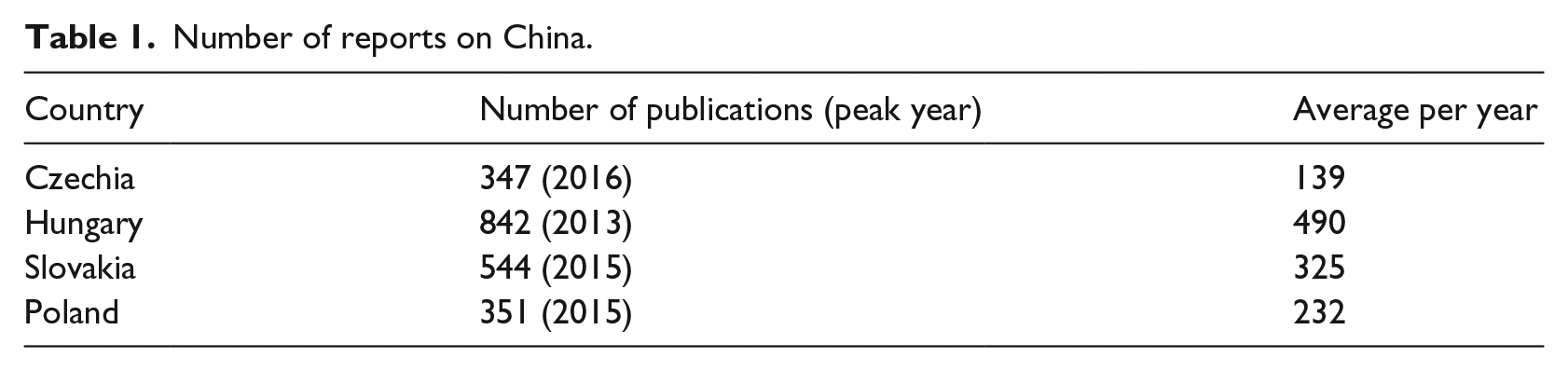
Some have suggested that the decrease in interest in China reflects its declining novelty factor and the attendant expectations-capabilities gap. The lavish promises of large-scale investments generated nearly stratospheric expectations from Beijing among the CEE countries. At the start of the Chine-CEE cooperation, Beijing promised to offer a $10 billion direct credit line which would grow to $100 billion by 2015 (Kavalski, 2016a; Millner, 2012). Yet, these promises were never fulfilled. Poland and Hungary, some of the largest CEE recipients of Chinese investment were receiving only around $450 million per year (CHOICE, 2020). Chinese foreign direct investment in the EU peaked in 2016 at $43 billion and in 2019 it had plummeted back to 2012 levels (MERICS, 2019). Thus, as the relationship evolved, and the Chinese investments failed to materialize, it was a palpable promise fatigue that came to affect CEE attitudes towards Beijing. These developments also revealed a capabilities gap, which backstopped the waning interest in China across the region (Kavalski, 2018d; Kowalski, 2019).
Not only that, after years of ‘17+1’ summits, both CEE policymakers and publics realized that it was the photo-opportunities rather than meaningful discussion that mattered more to their Chinese counterparts. For instance, the frustration of the Czech Prime Minister Babiš about hosting ‘masses of [Chinese] delegations over and over again’ without any tangible results, received wide media coverage (Kavalski, 2018b; Kuchynova, 2019). Likewise, the Czech President Milos Zeman, one of the most pro-Chinese CEE politicians, pointed to the lack of tangible outcomes from his country’s relationship with China as the key reason for shunning the projected 2020 summit of the ‘17+1’ cooperation (Kavalski, 2012d; Lau, 2020). The Prague mayor Hřib (Shotter, 2020) clearly conveyed a sense of constantly disappointed expectations by decrying that bonhomie with Beijing has failed to provide even a single panda that had been promised to the Czech capital zoo in exchange for support of the ‘One China’ policy (Svobodova, 2016). Such statements echoed the sentiments of many participants in the various China-CEE summits who were becoming exasperated that rather than seeking to develop meaningful investments and initiatives in the region, the organizers of these event were using them merely to advance their careers back home in China.
Such trend mimics the overall pattern of perceptions of China in the pre-pandemic period (see Table 2). Based on the available data, in all CEE countries the overwhelming perception tends to be neutral. Such lack of specific value reflects the nature of most accounts, which tend to offer descriptions of historical sights and cultural events in China. In other words, these are accounts of (quasi) documentary nature, which depict specific historical places, natural sites, religious temples, or tourist venues. Most of these accounts present China as a hybrid of ancient and modern curiosities. In this respect, the aim of these mediated representations is to construct a picture of China, which neither glorifies, nor denigrates the country. At the same time, such accounts fail to construct any kind of proximity – cultural, historical, economic, let alone normative – between China and the CEE countries. Instead, China remains largely as a distant and awkward giant on the other end of the Eurasian landmass.
Perceptions of China.

Yet, the second most common trend in the Visegrad countries is the largely negative attitude towards China. Media accounts in Czechia and Slovakia demonstrate the strongest negative feelings, while Hungary trails significantly behind (even though the negative representations there are also twice as many as the positive ones). In this respect, Poland is the sole outlier in the region with a noteworthy majority of reports revealing a positive depiction of China. In all the other CEE countries, positive perceptions of China are significantly lower than the negative and neutral ones. Yet, a pattern that emerges from the available data is the growing negative media depictions of China in the year preceding the coronavirus outbreak.
The localization of China paradigm presents a convincing explanation of CEE perceptions of China. Overwhelmingly, such data reflect the vacillation and vagaries of the political elites in each of the CEE countries. For instance, the overwhelmingly positive response in Polish media reflects the strong desire of representatives of almost all major political parties in the country to attract Chinese investments. Such consensus seems to have facilitated a largely positive account of China in Poland as the media outlets associated with or controlled by any of the major political parties in the country have been pitching favourable stories of Beijing’s relations with Warsaw (Kavalski, 2017b). In other words, the economic opportunism that appears to have informed the near unanimity among the major political parties in Poland coalesced with a general trend of ‘re-nationalising’ the political discourse in the country. In this setting, relations with China seemed to facilitate this trend of emphasizing the independence Poland’s international identity. And such distinction was mainly a reaction to the EU and its criticism of Warsaw’s backsliding towards illiberalism. While Poland was far from the only country in the region to express such sentiments, the consensus on China across the political spectrum distinguished it from the other Visegrad countries.
In all the other CEE states, the perceptions of China tend to reflect a division between governing and opposition parties. As a principle, governing parties have tended to be more pragmatic and favour closer economic relations with China, while opposition formations have tended to be negative. As a result, the negative accounts of China in the Czech, Hungarian and Slovak media reflect dissatisfaction with specific policies of the government rather than the activities of Beijing or Chinese businesses in the country. Yet, as the 2010s progressed, ideology seems to have been playing a more significant role in the perceptions of China across the region. This applies not only to the Visegrad countries, but the CEE region as a whole (Cho & Kavalski, 2018; Kavalski, 2010c). Usually, the parties on the left (that is, the former communist parties of the CEE countries and their socialist descendants) have tended to be more positive of Beijing than the political formations in the centre or the right of the political spectrum.
At the same time, increasingly in countries such as Slovakia – but also in Czechia, Estonia, Lithuania and Romania – norms and values have begun to play a significant role in the division between Sinophile and Sinophobe media accounts of China. In particular, human rights and democratic accountability have been central to framing perceptions of China. For instance, both during the election campaign and after her inauguration as President of Slovakia, Zuzana Čaputová, a human rights lawyer and activist, has been quite vocal in her condemnation of China’s treatment of minorities and dissidents. In fact, media accounts of her taking high-ranking Chinese officials to task might have even increased her electoral appeal (Euronews, 2019). In other words, the image of China has gradually been drawn into domestic political debates about the international identity of CEE states, what each of them stands for, and what should be their role on the world stage. This became particularly prominent in the context provided by the novel coronavirus pandemic.
After the pandemic (2019–present): the end of the 17+1?
The localization of China in the domestic political discourses of the CEE states which had been established since the initiation of the 17+1 cooperation mechanism has only been accelerated by the pandemic. In particular, perceptions of China seem to have intensified trends that were set in motion just before the outbreak of Covid-19. In this respect, the claim here is that 2019 offers a much more appropriate start for explaining CEE media reactions to the pandemic (Mladenov, 2021). The suggestion is that the dynamics, which became prominent in the wake of the pandemic, were set in motion already in the context of the 2019 Hong Kong protests. Coinciding with the thirtieth anniversary of 1989, the Hong Kong protests have triggered memories of the ‘velvet revolutions’ in the CEE countries, whose people power demolished the Berlin Wall and ended communist rule in the region. At the same time, Hongkongers’ use of tactics developed by CEE dissidents – such as the Lennon Wall and the Baltic Way – resonated in the region (Lum, 2019).
In particular, across the Baltic states, commemorations of the anniversary of 1989 involved support for the plight of Hong Kong. The negative Chinese reactions to such support received wide coverage in local media. For instance, in August 2019, Chinese diplomats in Lithuania attacked a gathering for solidarity with Hong Kong (AP, 2019). The public outrage urged the government to censure the Chinese ambassadorial staff in the country. A month later, a group of self-styled ‘Chinese patriots’ defaced the original Lennon Wall in Prague with graffiti celebrating the 70th anniversary of the founding of the People’s Republic of China (Jirous, 2019; Kavalski, 2019d). The outcry in the country only intensified anti-Chinese sentiments in the context Prague’s decision to end sister-city relations with Beijing. In December 2019, a Chinese tourist desecrated Lithuania’s Hill of Crosses pilgrimage site – a symbol of the country’s national independence – by destroying a cross placed there in support of the struggle of the people of Hong Kong (Kavalski, 2020e).
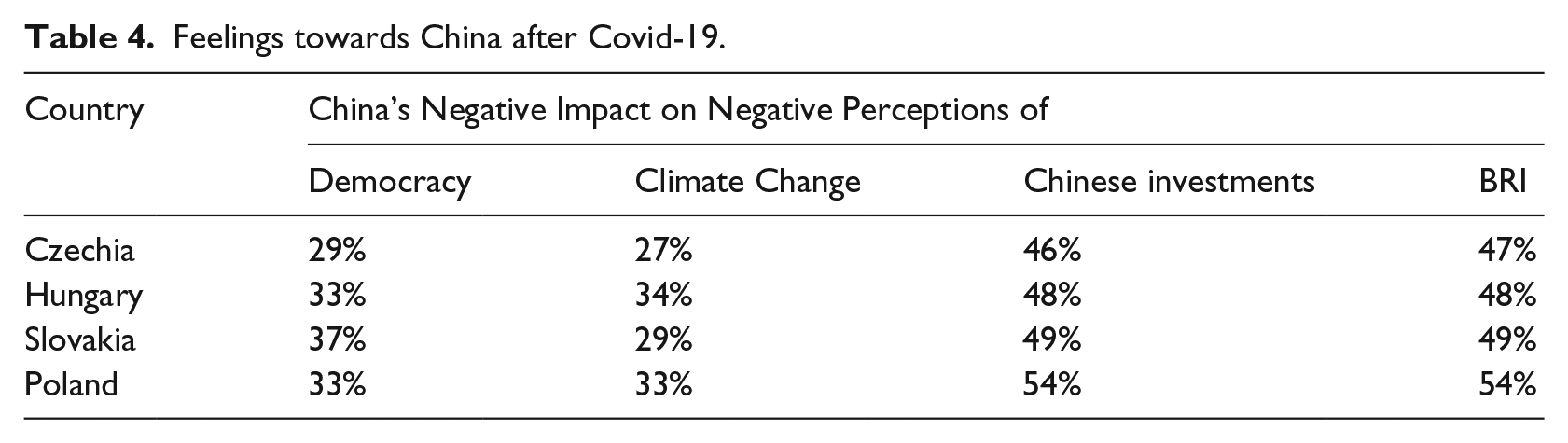
It is the context provided by the Hong Kong protests that has increased the wariness of CEE countries towards China. Equally significantly, it has also intensified the polarization of public attitudes towards China (Filipova & Stefanov, 2021). As Table 3 demonstrates, the number of neutral positions has diminished significantly from the pre-pandemic period, and sentiments have bifurcated between those backing or rejecting relations with China. In this respect, a recent study of the post-pandemic perceptions of China has made conspicuous that for most CEE countries negative perceptions dominate feelings towards Beijing’s impact on issues ranging from climate change to the BRI (see Table 4).
Feelings towards China after Covid-19. a

The most recent update on the Chinfluence/Mapinfluence database is available at: https://mapinfluence.eu/en/european-public-opinion-on-china-in-the-age-of-covid-19/
Feelings towards China after Covid-19.
For some of the CEE countries, such shift was associated with taking sides in the escalating conflict between the United States and China. Much of this has revolved around the ‘technological Cold War’ between Washington and Beijing (Smith, 2020). In particular, the United States has used the Three Seas Initiative – framing the region between the Adriatic, the Black and the Baltic Seas, comprising 12 EU states, chiefly from the CEE region and also members of China’s ‘17+1’ grouping – to garner support for the so-called ‘Clean Network’ initiative (Whyte, 2020), which Chinese diplomats have panned as discriminatory and in fact a ‘dirty network’ (Foreign Ministry Regular Press Conference, 2020). Central to US concerns over Chinese technology has been the tech giant Huawei. As a result, all of the EU member states taking part in the ‘17+1’ platform have indicated to date that they will be banning Huawei equipment from the construction of their 5G networks (Nietsche, 2020; Standish, 2020). Yet, the suggestion that these states merely succumbed to a pressure from Washington offers a simplistic explanation of such decisions. For example, in the case of Poland, the motivation was the espionage charges against the country director for Huawei, who had previously worked as a Chinese diplomat in Poland (TVP, 2019). In a similar way, Slovak media had been rife with commentaries that the security threats posed by Chinese telecommunication companies are far worse than ‘accepting hundred thousand immigrants’ (Schutz, 2020). For Czechia, the trigger appears to have been a personal spat between the Prime Minister Andrej Babiš and the Chinese Ambassador to the country Zhang Jianmin. Babis called Zhang a ‘liar’ for allegedly making up statements that the prime minister never uttered (Williugby, 2020). For other CEE states, such as Latvia, it is the perception of a ‘dragonbear’ alliance between Moscow and Beijing (Tchakarova, 2016) that has led them to declare China as a threat to their national security (Pavlovska, 2020).
Such threat perception evolved in parallel with the ‘wolf warrior diplomacy’ that China unleashed in response to the pro-Hong Kong sentiments in the region. Almost all Chinese embassies in the CEE region established both Facebook and Twitter accounts in the second half of 2019 (Kavalski, 2020f). The aim of these accounts was to engage actively in the promotion of the Chinese version of developments in Hong Kong. In several prominent instances, Chinese embassies bought oped space to ‘correct’ local accounts. However, this social media activism went into overdrive in the context of the pandemic. Chinese embassies across the region posted actively about the medical ‘aid’ provided to CEE countries and targeted Washington for both spreading disinformation about the situation in China and alleging that the United States is the source of coronavirus. Yet, the content of this social networking activism was not customized to CEE audiences. Instead, it appeared to be created for consumption in China. As such, the ‘mask diplomacy’ seems to have backfired. Perhaps, paradoxically, the social activism of Chinese diplomatic missions has turned public opinion in Serbia – probably, Beijing’s closest ally in Europe – among the most suspicious of Chinese initiatives in the continent. A recent comprehensive study of public opinion in the country found that while 57% of Serb respondents have positive feelings towards China (which is by far the most favourable in Europe), a whopping 65% of the same respondents indicated their hostility to the BRI and 64% were disgruntled by what they saw as Beijing’s growing military assertiveness. These developments come to confirm the criticisms that despite nearly a decade-long relationship under the framework of the ‘17+1’, Beijing still ‘does not get’ the CEE countries (Brinza, 2020b).
Thus, it was in a climate of a growing suspicion (and even hostility in countries such as Czechia, Slovakia and the Baltic states) towards China that the novel coronavirus emerged in Wuhan. The initial reaction of most CEE states was to express some form of sympathy and support for the people of Hubei province. Nearly all CEE states sent aid to China. Yet, in the context of a low interest in Asia, in general, the health crisis was deemed sufficiently distant to trigger any consistent coverage in the majority of CEE media. Such development is not surprising and echoes the minimal coverage of the 2002 SARS outbreak in the CEE countries (Smith & Fallon, 2020). Some have suggested that part of the reason is the very low number of Chinese (and other East Asian) diaspora in the region (Kavalski, 2020b; Nyiri, 2003). Yet, this disinterest in the novel coronavirus outbreak quickly gave way to hysteria as the first cases of Covid-19 appeared in Europe and in the individual CEE countries.
The immediate concern was securing access to much-needed personal protective equipment (PPE) and respirators. China quickly emerged as the first port of call for many of the CEE countries. The media was quick to point out that it was the good ‘guanxi’ of Sinophile politicians in the region that secured access to medical supplies. At the same time, a division that has begun to appear between the CEE countries before the pandemic – and especially in the context of the 2019 Hong Kong protests – solidified as a result of the pandemic. The governments of countries such as Serbia and Hungary used the pandemic as an opportunity to entrench authoritarian rule under the guise of emergency health measures. For these countries, China provided a much-needed ideational alternative for framing narratively their independence from the external demands by European institutions to follow the rule of law. For instance, in Hungary, the first act of the government under the newly acquired pandemic emergency powers was to make secret the deal with China for the construction of a €2 billion Budapest to Belgrade rail link (Inotai, 2020). The fact that the deal had nothing to do with the health crisis appeared secondary. The Serbian President Aleksandar Vučić, on the other hand, used the pandemic to stress that ‘European solidarity does not exist. That was a fairy tale on paper. I have sent a special letter to the only ones who can help, and that is China’ (Simic, 2020). As a result, the European Commission specifically singled out Serbia and Hungary in its report criticizing China for using the pandemic to peddle disinformation (Scott, 2020), while Freedom House declared that Serbia and Hungary are no longer democracies, not least thanks to Beijing’s support for authoritarian governance (Gherke, 2020). It seems that Beijing is also aware of such split among the CEE countries. A Chinese financial report from December 2019 acknowledged that apart from Hungary and Serbia, investment in the other CEE countries is not justified (Zhu, 2019).
In the other CEE countries, most media accounts quickly turned on China. Initially, CEE media reports focused on the low quality and high price of the Chinese equipment. For instance, in Bosnia and Herzegovina investigative journalists uncovered that hundreds of ventilators bought from China were ‘useless’ for the treatment of patients with Covid-19 (Cuckic, 2020). At the same time, the media outlets in many CEE countries reported that China has made the sale and delivery of medical supplies conditional on the public expression of praise by high-ranking CEE government officials. Such reports also exposed that China demanded gratitude for China’s ‘aid’, even though such deliveries were acquired through commercial deals and were not part of any Chinese relief efforts. For instance, Czech media blasted as a disgraceful ‘kowtowing’ the welcoming of Chinese medical supplies by the Prime Minister and other government officials (Gurycova, 2020; Kavalski, 2016d; Seaman, 2020 p. 18). Likewise, Polish media revealed that the country’s president was compelled by Chinese diplomats in Warsaw to place a call to President Xi Jinping in mid-March and personally thank him for the supplies as a precondition for their delivery in April (Kruczkowska, 2020).
It is not surprising therefore that some of the CEE reporting focused on the ‘heroic’ efforts of national airlines to deliver the medical supplies (Cozmei, 2020). Other accounts drew attention to the indispensable assistance by the traditional partners of the CEE states – such as the EU and the United States. For instance, a much-publicized report in Romania stated that ‘NATO again helps Romania to bring from South Korea the medical equipment needed to combat the Covid-19 pandemic. . . The transportation costs are covered by the US’ (Pavaluca, 2020; Kavalski, 2021a). Conversely, the use by Estonia and Latvia of a Russian logistics company to deliver Chinese medical supplies to both countries was publicized in Russian media as an instance of Moscow’s assistance to the Baltic states (ERR, 2020). Such developments seem to have strengthened a perception of a hostile alliance between Beijing and Moscow in the region, which in turn has bolstered the unfavourable opinion of China owing to strong anti-Russian sentiments in many CEE states (Brinza, 2020c).
In the context of such growing negative reporting, rather than China most CEE media outlets have tended to point to the examples provided by Germany, South Korea, Taiwan and Japan as appropriate models for tackling the pandemic (Jaks, 2020; Petrova, 2020). In fact, in countries such as Poland and Czechia, commentators were emphasizing that Taiwan and South Korea were much quicker to send medical supplies than China. Across the CEE region, media reports were blaming the failure of the authorities in Wuhan to act when the first cases emerged and the subsequent cover-up by both the provincial and national government for the pandemic (Novinite, 2020). Such accounts drew unfavourable parallels to the recent past of the CEE region, when the communist regimes of these countries demonstrated similar disregard for individual lives in their bungled responses to natural or health disasters (Hutt, 2020). Also, many reports expressed doubt about the accuracy and veracity of Chinese data on morbidity and mortality. Thus, pointing to Taipei’s exceptional record of dealing with the pandemic, the Lithuanian Foreign Minister called on the World Health Organization to allow Taiwan’s participation as observer at the organization’s international assembly in May 2020 (LRT, 2020; Kavalski, 2021b).
Subsequently, the visit to Taiwan by the president of the Czech senate and the support that it garnered from the Baltic states and Slovakia, seems to suggest that some CEE countries are using the pandemic not only to upgrade their relations with Taipei, but also to challenge Beijing. In June 2020, CEE representatives were among a group of European parliamentarians urging the EU to enact reciprocal access to the bloc for Chinese citizens as EU citizens get to Tibet (Euractiv, 2020). Also, the pandemic has urged a number of CEE countries to seek decoupling from China. For instance, in an attempt to strengthen the security and solidarity of the EU, Bulgaria has proposed the development of a ‘small EU China’ by relocating critical medical industries to the CEE countries (Nikolov, 2020). Similar statements were made by Poland, Czechia, Slovakia, Romania and the Baltic states. In May 2020, Romania revealed that it is cancelling a deal with a Chinese company to upgrade a nuclear power plant in the country, which was supposed to be one of the largest Chinese BRI investments in the region (Kavalski, 2018f; Necsutu, 2020). Four months later, adding insult to injury, Romania announced that the contract would be pursued with help from the United States, which is now committing eight billion dollars to the project (Barbera, 2020). Likewise, the newly elected government of Montenegro has indicated that it would be willing to review all Chinese investment deals signed by the previous administration (Radunovac, 2020).
In this respect, the wariness of CEE states about economic relations with Beijing is not distinct from the broader European sense of unease about trade dependence on China (Kavalski, 2012c; Oertel, 2020). The September 2020 EU-China virtual summit clearly demonstrated the differences between Brussels and Beijing. It seems that such disagreement has led to an informal freeze in the relations between China and the CEE countries. Recent media reports from the region suggest that with the exception of Serbia, Hungary and (to an extent) Greece, the other CEE states have expressed unwillingness to participate in another high-level meeting of the ‘17+1’. In this respect, it appears that the China-CEE cooperation has become one of the unintended victims of the pandemic, even though it was already in a comatose state well before the first cases of Covid-19 emerged.
Conclusion
The CEE media accounts of China in the wake of the Covid-19 pandemic reflect a growing vigilance about Beijing’s intentions in the region. Yet, this sense of wariness was not spurred by the pandemic, but merely accelerated by it. The majority of CEE countries were becoming either suspicious or disappointed (or both) of China’s engagement in the region well before the pandemic. In fact, it seems that the 2019 protests in Hong Kong were the real bifurcation point for media representations of China. The resonance of Beijing’s crackdown on the independence of the special administrative region seems to have split the CEE states between those ideationally committed to democracy, human rights and the rule of law and those looking for illiberal alternatives. As has been demonstrated, the pandemic has solidified such split and China has been deployed by both camps to justify their ideational choices.
Thus, it is the contextual localization of China in the domestic narratives of CEE states that informs its media representation – both before and after the pandemic. In other words, it is the ways in which China is drawn in domestic political debates – rather than what China necessarily does in the individual CEE states or globally – that informs how its image is mediated. Such pattern confirms the dominant role of politics – and, especially, the affiliation of individual media outlets with specific political formations – over the ways in which China is mediated in the CEE region (Kavalski, 2018e; Surowiec & Stetka, 2020). Such outcome contributes to the ongoing debate in communication studies on the political developments at the crossroads of politics and media systems in the CEE countries (Polonska & Beckett, 2019). This trend corroborates the dynamics of growing ideological framing of media accounts as well as reflects the idiosyncratic origins of the CEE media landscape in the post–Cold War period (Jakubowicz, 2007). In this respect, as it has been demonstrated by this study, such localization is not unique to China, but is indicative of the ways in which external others are generally treated in the complex politics of CEE media systems (Kavalski, 2003a). Perhaps, one distinguishing feature about the representation of China is that unlike the traditional others for the CEE region, there is both far less knowledge about and interest in China. This seems to render China’s media image more malleable and able to fit different domestic political conversations and debates in the CEE countries (Kavalski, 2020d).
In a time of growing strategic competition with Beijing and an ostensible decline of American power, the media narratives of CEE states demonstrate propensity for the localization of China to effect domestic and foreign policy entrepreneurship. In both these contexts, the representation of China is used to wager a specific vision of appropriateness supported by distinct and increasingly polarized constituencies in the individual CEE countries. As such, the Covid-19 outbreak has made conspicuous how divisive China’s presence has become in the CEE region (Kavalski, 2020h; Tonchev, 2020b). The countries with the most pronounced negative media perception of China in the region appear to be Czechia, Slovakia and the Baltic states, while those with the most positive are Serbia, Hungary and (to a lesser extent) Greece. All the other CEE states are located between these two sets of countries. Since 2019, however, both perceptions and renditions of China in those countries appear to be moving closer to the negative end of the spectrum. Such perception is not unique to the CEE region and reflects a general trend towards pushback against China in Europe.
In this way, this article also reinforces the need for widening and deepening the interdisciplinary engagement between IC and IR. On the one hand, IC infuses the study of world affairs with much needed attunement to the complex interactions between culturally discordant traits, which are amplified by the turbulent dynamics of international politics (Cohen, 1991; Zolkos & Kavalski, 2016). On the other hand, IR evinces the resonance of international political communication on the ways in which the concomitant information and technological revolutions impact media landscapes around the world (Drake & Wilson, 2008; Kavalski, 2013a). Such interdisciplinary cross-pollination offers productive disclosure of the contingent iterations of inter-cultural dissonance in the political ordering of media landscapes. Such approach also promotes a flexible understanding of cultural frontiers and their communication in the constantly shifting political discourses of the CEE media landscape. Thus, while the CEE countries used to be buoyant about benefitting from China’s economic largesse, now – like the EU itself – many now are not only hesitant, but have come to view Beijing as a threat (Kavalski, 2020a). For some of the CEE states, this move mirrors the negative perception of the crudeness of China’s ‘wolf warrior diplomacy’; for others, it reflects Chinese failure to meet their investment commitments; and for still others it is spurred by a normative commitment to the values of a rule-based international order. The uncertainty of this situation makes it difficult to anticipate what the future might hold, but it seems that confrontation rather than cooperation will remain the motif of Sino-CEE relations for some time to come.
Footnotes
Funding
The author acknowledges financial support from the NAWA Profesura Goscinna grant (PPN/PRO/2020/1/00003/DEC/1) and the MoST-ARRS grant (B0109) for the research of this article.
