




Abstract
Restorative interventions can deal with some criminogenic needs. They can address the offenders’ antisocial attitudes, lack of problem-solving strategies, empathy and self-control or, substance use problems (Moraleda et al., 2004; Raynor et al., 2012; Vanstone and Raynor, 2012). At the same time, restorative justice practices offer the possibility to express emotions and feelings, which are essential elements in a transformative process. The purpose of this article is to identify both, criminogenic needs and emotions expression through offenders’ experiences in Victim–Offender mediation (VOM). The research is developed in three phases and include qualitative and quantitative research methods. This article focuses in the second and third phases. The second involves non participant observation of VOM (40); and the third requires a post-analysis of the process (questionnaires 40), which includes an interview (12) occurring six months after VOM. General data give us a variety of results, and qualitative analysis exemplifies the different cases.
Criminogenic needs and emotions in restorative justice
Criminogenic needs are attributes of offenders that are linked to criminal behavior. In other words, they are dynamic factors that are strongly correlated with risk and they can all be targeted for change. These factors can be internal and external obstacles that do not allow adquire primary goods in a pro-social way (Ward et al., 2014). The concept includes factors that offenders are saddled with, such as their attitudes and values; their lack of problem solving skills, empathy and self- control and their substance use (Latessa and Lowenkamp, 2005).
Restorative interventions allow positive, mutually respectful and pro-social interventions and put the focus on moral repair, on how crime should be responded and the responses that should be expected from offenders, vicitms and community (Ward et al., 2014). Restorative justice (RJ) values – such participation, respect, honesty, accountability, empowerment, empathy, mutual understanding – can deal with some criminogenic needs, according to both Risk Need Responsivity (Hamilton et al., 2017) and Good Lives Model models (Ward et al., 2014). This means accepting the possibility of integrating RJ and rehabilitation.
RJ practices can address the offenders’ antisocial attitudes, but especially their lack of problem-solving strategies, empathy and self-control or, in a less intense way, substance use problems, all of which should be taken into account (Moraleda et al., 2004; Raynor et al., 2012; Vanstone and Raynor, 2012). Some studies (Shapland et al., 2011) have shown that when the conferencing or mediation session was focused on the offence and its consequences, it allowed victims and offenders to think about how to deal with the offenders’ criminogenic needs. Some authors (Moraleda et al., 2004; Raynor et al., 2012) consider that problem solving relates to how people, in this case the parties, engage collaboratively in the process of identifying problems, goals and solutions. In fact, Baglivio and Jackowski (2015) show in their findings the ability of victims interventions on having an impact to reduce the risk in criminogenic domains related to offending behavior, it allowed moral development, understanding emotional states of others. Dynamic criminogenic factors were in the end significantly reduced.
RJ practices offer the possibility to express emotions and feelings. Even if emotions are always present, sometimes can be just kept, whereas other occasions can be clearly expressed. Direct contact with victims by meeting them face to face is associated with the emotions of guilt, remorse and shame, sparking in offenders the desire to apologise, make amends make positive changes (Beech and Chauhan, 2012; Van Stokkom, 2002). Meeting the victims can increase the participants’ concern for them and significantly boost their intention to change (Umbreit, 2001).
For the offenders, talking about the offence and their backgrounds or addictions can be charged with emotion. Some authors think that emotion is an essential element in a transformative process. For example, some authors have stressed that it is necessary to feel shame emotionally before being restored (Braithwaite, 1989). Some others have argued that remorse and empathy play a more important role than shame. Harris et al. (2004) think that emotions like remorse, empathy and guilt will involve feelings of shame. Respectful and reintegrative processes enable offenders to feel empathy. Empathy is an important goal for offenders so that they can understand the harm caused by an offence, which is important for genuine remorse and a willingness to repair the harm done (Harris et al., 2004). Some researchers have shown what RJ and, in particular, face-to-face meetings can do to reduce the harm to victims caused by crime. This is possible because through the interactions in the context of RJ, victims can reduce the desire for violence, for revenge against the offenders and self-blame, which can lead to forgiveness, and thus to success. In their review of the literature, Harris et al. (2004) suggest a theoretical ideal sequence by which moral emotions can succeed each other in a conference setting. First, they have identified some emotional starting points, where anger or embarrassment can be expressed. Second, communication with offenders about the harm done would allow them to feel empathy, leading them to feel guilt and remorse. In fact, Jackson and Bonacker (2006) found that offenders reporting higher levels of guilt were more likely to report positive empathy development. Third, taking responsibility and communicating remorse to the victims can be expected after the effects of the offence on the victim have been addressed and the offenders have empathised with the victims by expressing remorse, guilt and shame. Finally, once the emotions of shame have been managed and reparation has been made, the restorative crime prevention objective may help to build the self.
Some authors (Kenney and Clairmont, 2009) explored in their research how shaming emotions were expressed during RJ sessions. Their results show that shaming emotions were mediated by the rhetorical use of victims’ roles. They suggested in their research that shame management was not able to facilitate meaningful outcomes or agreements based on reintegration. Shaming coupled with acceptance may help the resolution of the conflicte and its impact (Kenny and Clairmont, 2006). However, there is an ongoing debate around the sequence of RJ sessions. Disapproval is expressed through the use of emotions. Research has pointed out that feeling ashamed or guilty is correlated with empathy, while unresolved shame and embarrassment-exposure are linked to anger and hostility (Harris, 2006). Remorse is a relevant variable linked to avoiding future reoffending (Braithwaite, 2002; Daly, 2003) According to the literature, it may be difficult to achieve restorative outcomes in the absence of the feelings of remorse or guilt. Jackson and Bonacker (2006) underlined in their research the importance of the interaction with the victims in terms of finding and intense emotional influence on guilt, shame and empathy; as well as in contributing to the goals of the criminal justice process, such as rehabilitation and social order.
Victim–offender mediation
The present research focuses on a mediation programme. Mediation is a problem-solving intervention that emphasises the dialogue between victim and offender in order to work out a solution that can redress and repair the harm caused with the help of a mediator (Shapland, 2012).
Objectives
The aim of this research is to identify whether participation in RJ can be transformative, allowing offender to deal criminogenic needs, as a way to reconcile rehabilitation and restorative paradigms; at the same time they can express some emotions like remorse, empathy and guilt.
Methodology
Research design
The design of the research – the contents of this article belongs to wider research – uses a model inspired in RJ (Shapland et al., 2007) and desistance research (Cid and Marti, 2012). It is developed in three phases and include qualitative and quantitative research methods. The first phase occurs at the beginning of the process (pre-questionnaire-118-), which is not included in this article; the second involves monitoring the process from beginning to end (non participant observation - 40-); and the third requires a post-analysis of the process (post-questionnaire-40-), which includes an interview (12) occurring six months later. 1
Sample
The cases were selected on the basis of the general conditions for taking part in the first stage of the research and the sample was non-representative. The main requirement was having started the Catalan Mediation Programme. Data for the study were collected from mediations held in some of the Catalan Justice Department criminal courts in the province of Barcelona, where the mediation programme was developed.
Participant description
Participants were adult men and women between the ages of 18 and 70, male and female. The offences involved were non-serious offences of violence, shoplifting, public order offences and property offences involving personal victims or companies such as stores.
Data analysis
The data analysis is both qualitative and quantitative. The quantitative component focuses on the descriptive results of the 40 post-questionnaires that the offenders answered after mediation. The qualitative component focuses on the observation of forty different mediation sessions of the Catalan victim-offender mediation programme. From these 40 cases, 12 observations were analysed, according to the 12 offenders that were interviewed once the mediation had ended and the interviews were subsequently analysed.
Results
Results are presented in two parts. Firstly, I analyse every variable separately; offenders’ (40) perceptions after mediation. This part is named ‘general data’. Secondly, I compare the results along the process of the case studies for each group of variables – criminogenic needs and emotions, respectively – using observation results and offenders narratives expressed during the interview. This part can be identified as ‘case studies’.
Criminogenic needs
General data
Problem-solving skills
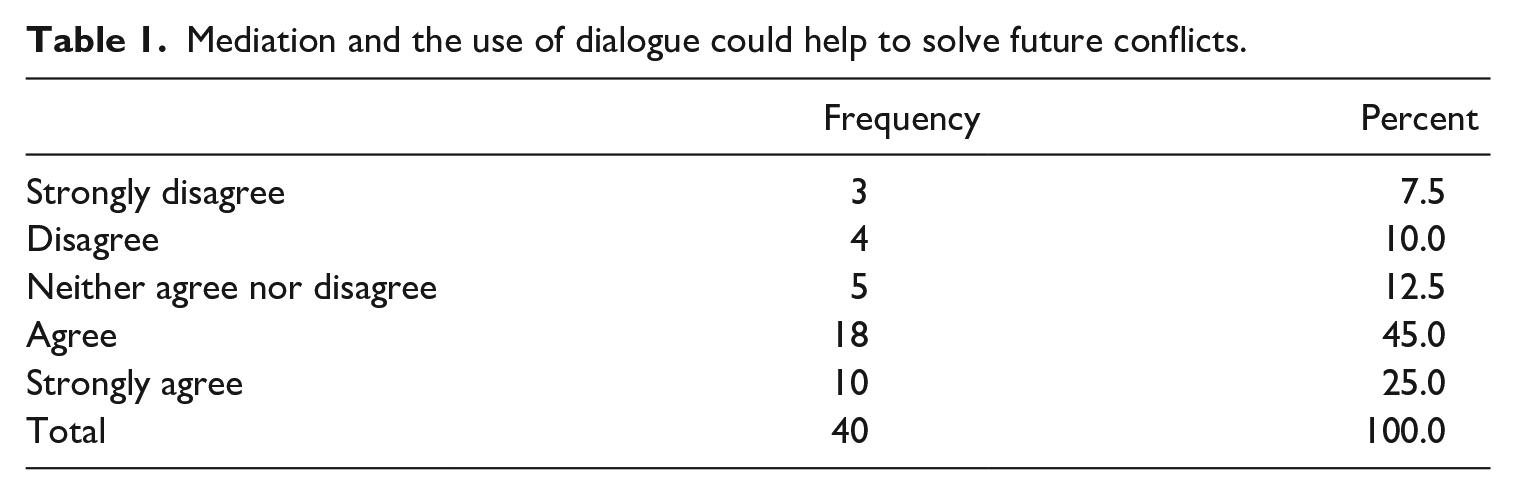
When asked in the post-test survey whether mediation had allowed them to learn problem-solving strategies so that they could use dialogue for solving future conflicts, the vast majority of the offenders felt that it had. Some, however, did not think they were better able to use dialogue to deal with future problems. Others still were unsure as to whether or not they had learnt to do so (see Table 1).
Mediation and the use of dialogue could help to solve future conflicts.
Empathy
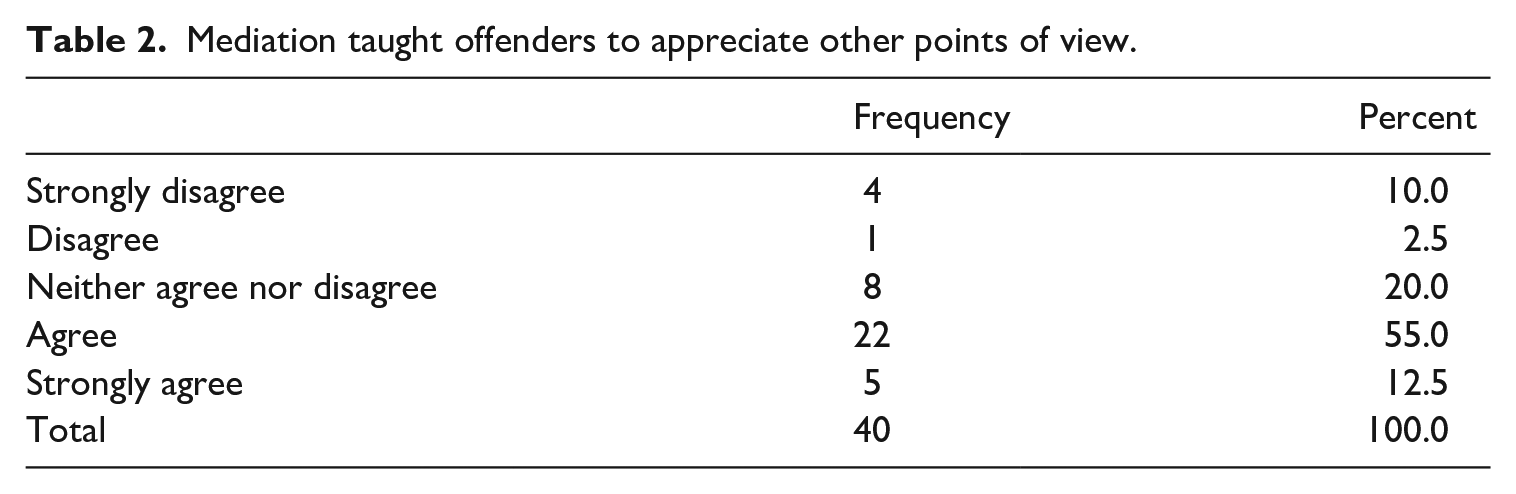
Offenders were asked whether mediation had allowed them to appreciate other points of view, which referred essentially to those explanations and opinions given by their victims during the interaction or through indirect communication. Few offenders felt that it had not and some were unsure, but the vast majority affirm that mediation had indeed allowed them to appreciate other points of view.
An explanation of why some of them did not find that mediation permitted them to appreciate other points of view may lie in their low level of participation in the mediation encounters. It makes sense that someone who is not very active and involved will not be very open to getting other ideas from the other participants.
However, a low degree of participation cannot account for the group of offenders who thought that dialoguing could solve their conflicts. In general, they had the perception that they had participated a great deal and had been very involved, even if an external observer could not discern a high level of participation. A possible explanation for this result can be that they might not be used to explaining their thoughts to other people or expressing their feelings in public. Nonetheless, they were able to explain themselves and express feelings in mediation, which may have represented a considerable challenge for them (see Table 2).
Mediation taught offenders to appreciate other points of view.
Finally, they were asked whether mediation as a restorative intervention had worsened the offenders’ relationships with other people, starting with the victim (in cases where they knew each other before) or with family and friends in a more general sense. The great majority held a very positive view on how relationships had changed and most of them mentioned that meeting the other party was helpful as well as useful. In general, they did not think that the mediation had changed relationships in a negative way. Only a small number of the offenders thought their relationships were worse as a result of mediation (see Table 3).
Mediation worsened offenders’ relationships with other people.

Case studies
The observation schedule used to look at the interaction between the parties during the meeting included some observable elements concerning problem-solving strategies. The literature (Moraleda et al., 2004; Raynor et al., 2012) considers it important to take these into account when looking for the presence of such strategies during the interaction. These elements include reasoning, self-reflection, consequential thinking, informed decision making, means-end thinking, perspective taking, distinguishing fact from opinion and assessing alternative courses of action.
Problem-solving skills was a transversal variable because it could be observed throughout the meeting and in the interactions in the direct mediation processes.
In the 12 cases analysed in depth here, all the participants were able to identify a problem that needed to be solved and reason it out with the other party. While self- reflection was a difficult aim, some managed to achieve it. 2
Sometimes it was difficult for participants to distinguish facts from opinion. However, in most cases the victim was able to help clarify what had happened and together with the offender reconstruct what had actually occurred, independently of their respective opinions. This aim was definitely achieved.
Consequential thinking and assessing, then taking, alternative courses of action were more challenging and were linked to the most difficult one of all, decision making. There were offenders who showed that they did have problem-solving skills and were able to use them in the course of the session. However, most of them had difficulty coming up with alternatives to solve the problem, although they were able to think about the possible consequences of maintaining the same situation. Some could think of at least one alternative option to deal with the situation. Once they were able to focus on one possible solution, some of them could weigh the pros and cons of this option. Some others were able to assess alternative courses of action, but afterwards were not capable of identifying the possible consequences of each option. Even if they did not exhibit problem-solving skills, victims helped in the development of the solution and all the offenders but one achieved an outcome solution to the conflict.
Nonetheless, when asked afterwards in the post-test questionnaire or during the subsequent interview, the vast majority recognised that they had learnt some strategies and found them useful for their daily life, especially in difficult moments when conflicts could make them react violently. Most agreed that expressing themselves and listening to the other party had been a learning experience. Some of them mentioned during the interview that since mediation they tended to self-reflect more in order to diminish violent reactions. They also tended to analyse the situation and put it into perspective in order to consider alternative courses of action and identify their possible consequences. With regard to how mediation had helped to improve relationships, it must be said that none of them considered it something they had achieved. Some of the offenders who had a previous relationship with their victims said that they had at least attained a respectful relationship. However, for others the relationship had worsened. They did not link this to mediation, but they did mention that they had expected from the process an improvement in their relationship and that this had not come about.
Apart from problem solving skills, other criminogenic needs could be identified in some cases through the observations and interviews. Specifically, substance abuse and lack of empathy emerge in some of the case studies.
Identifying substance abuse
In some of the cases related to alcohol addiction, the problem was addressed during the direct mediation and was also incorporated into the outcome agreement.
Carlos identified his alcohol use as an addiction that had a negative impact on his behaviour and he realised that he had to deal with it in the future:
[The victim looks at the participant. The participant is incapable of looking at him and stares at the table].
Victim: I cannot believe you do not remember anything! It got really heated. If you want I’ll tell you how they kicked you out of the club, it was crazy! [He explains]. Swearing, threats, shouting!
Participant: I cannot remember . . .
Victim: Well you were super drunk, wanting to start a fight! All of a sudden I got punched. I was about to fight back but I did not. I washed my face and went back inside the club. I was fuming.
Participant: Not drinking, or well, drinking less.
[The victim looks out the window. He is not taking part in the conversation] Participant: I’m sorry (Says this whilst staring at the table) (. . .)”. (Carlos)
Mohamed admitted being addicted to hashish but said he needed it in order to control his violent reactions. Drugs helped him to keep calm. He did not recognise it as a problem at the moment of the meeting. However, during the interview 6 months later, he was able to identify drugs as something negative that he should stop consuming, despite the pleasure it gave him at the moment. Whenever he weighs the pros and cons, he always decides to continue smoking hashish: [. . .] Participant: About the drugs, well I take loads! If you do not have drugs you are going to rob others, you’re going to do anything! You’re going to do many things, I’m telling you. [. . .] I like to get high, you know? I like to sit down and think! And that’s it! [. . .] it’s not a good thing! I’d like to quit, I promise! (Mohamed)
Jonathan recognised that he drank to excess, which was usual when he went out clubbing; he admitted also having been involved in at least three arguments in the club. However, he did not link his behaviour directly to having drunk too much; he felt it was just complementary. He did not think it was a problem representing a criminogenic need that had to be dealt with in the present because he referred to it as something he had dealt with in the past and that he had now overcome. He did not consider alcohol a drug either: [. . .] Participant: I do not smoke weed or take other stuff. I also gave up cigarettes about a year ago, so nothing. The only thing, well, the state in which I was . . . I can say that I was conscious but did not know what I was doing . . . Well . . .
Participant: Yeah, yeah! I was already drunk. But it hit me when I was feeling a bit . . . my emotional state . . . because I’ve been drunk many times, sometimes it gets me laughing; other times it gets me jumping . . . but that day before punching him something happened with a girl whereby some people tried to hit her, and I had to get involved, two or three of us got involved, and as a result I was quite tense and that plus the alcohol . . .
Participant: It finished! When I was 15 I said ‘enough’ ‘cause my parents caught me and well . . . I could not go on like that. And I said . . . enough [. . .]! (Jonathan)
It can be said that mediation dealt indirectly with criminogenic needs in that it helped offenders to realise they had a problem to face. It must be mentioned as well that in the post-process interviews, drugs and alcohol were identified by the offenders as problems, were discussed and highlighted as a challenge that they had been trying to meet since the end of the mediation programme.
Empathy
Apart from conflict resolution strategies, empathy can be identified in some of the offenders’ discourses, especially during the interview when they were asked to consider what they had learnt from mediation and how useful it had been in their lives. In some cases, the offenders highlighted the importance of listening to their victims because it made them reflect on their behaviour and distinguish between right and wrong:
Participant: Yeah, it’s what I was saying earlier, I’ve liked mediation ‘cause it’s not just going to Court and it’s your word against mine. No, no! I like this stuff where let’s first talk about it, try and see if we can solve it . . . I think this should always be available, you know? I think it’s important! I can get to know the guy, see what he’s got to say, see how it affected him . . . and then, it makes you think, it makes you think about you . . . damn! Was it me that was in the wrong? Was it him? It’s not the case that you go to Court and the judge says a couple of things, it’s your word against his, and he ends up giving his opinion. Both of us have to have our say.
Participant: Yeah! I think this should always be available! [. . .] (Jose)
To sum this section up, the literature has emphasised the difficulty of dealing with all problems, including criminogenic needs, in such a short period of time. The sessions I was able to observe were in general more focused on the future, that is, how issues could be addressed with a view to improvement in the near future. However, sometimes the past and specifically the period of time leading up the offence were not dealt with extensively during the meetings. While it is true that the participants did talk about what had happened during the individual sessions, they tended not to do so very often during the face-to-face meetings. In my opinion, when sessions are more focused on the future, it may be more difficult to deal with criminogenic needs, as they belong to the past – the offender’s background. In order to build a better future it is necessary to learn, even if only indirectly, from past mistakes so as to avoid them in a better and more pro-social life. When the sessions were a bit more focused on the past, sometimes the parties were indeed able to identify some problems linked to their offending behaviour, but only in an indirect way. Dealing with those problems was not a priority or an aim of the mediation session. While some offenders were able to talk about their problems, others were blocked by too much discussion of what had occurred and it was very difficult to move on. The ideal would be to find a balance between past, present and future.
Dealing with emotion and the effects of the offence
General data
This section includes indicators related to the offenders’ feelings. Feelings of remorse, nervousness, tension, guilt or anger are the ones that offenders were asked about. They also had the option of saying that they did not feel anything. They were all asked the same question on the post-test questionnaire and offenders could check more than one feeling if they felt they needed to. Nervousness was not a major concern for the offenders taking part in this study. The great majority were not nervous when they met their victims. However, there were some who did feel restless (see Table 4).
Nervousness on seeing the victim.

After the process, the offenders were also asked if they had felt tense because they had to dialogue with the person they had harmed. Only a few responded affirmatively (see Table 5).
Tension when dialoguing with the victim.
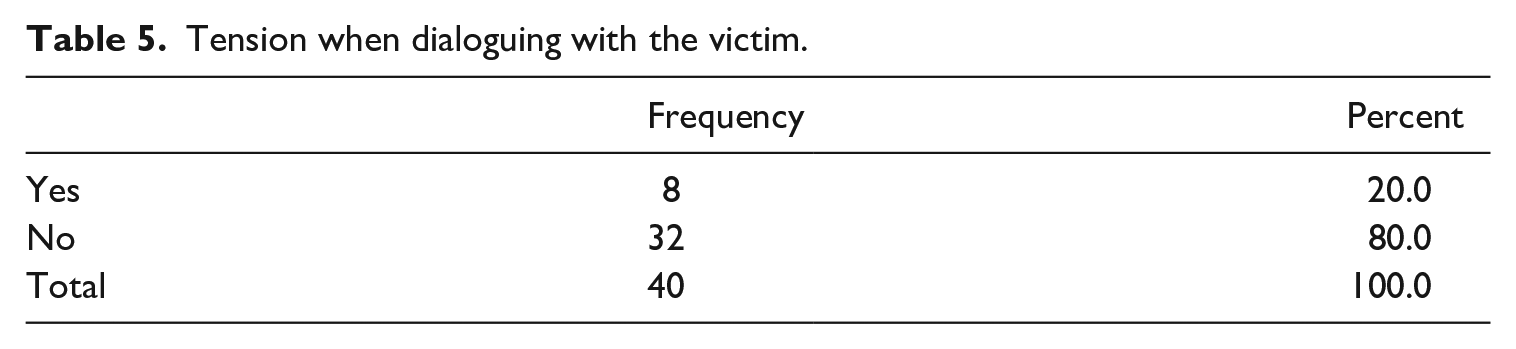
Thus, tension and nervousness when dialoguing with the victim were not generally experienced by the offenders; on the contrary, some of them mentioned during the post-process interview that they had felt relaxed because of the usefulness of the individual sessions and the helpful work of the mediator. Offenders did report having been tense and nervous the first time they met the mediator in the individual sessions because they knew they had a problem to cope with and that they needed the victim so that they could solve it together. This frightened them somewhat, but after working individually, they felt ready to deal with the conflict in a face-to-face meeting.
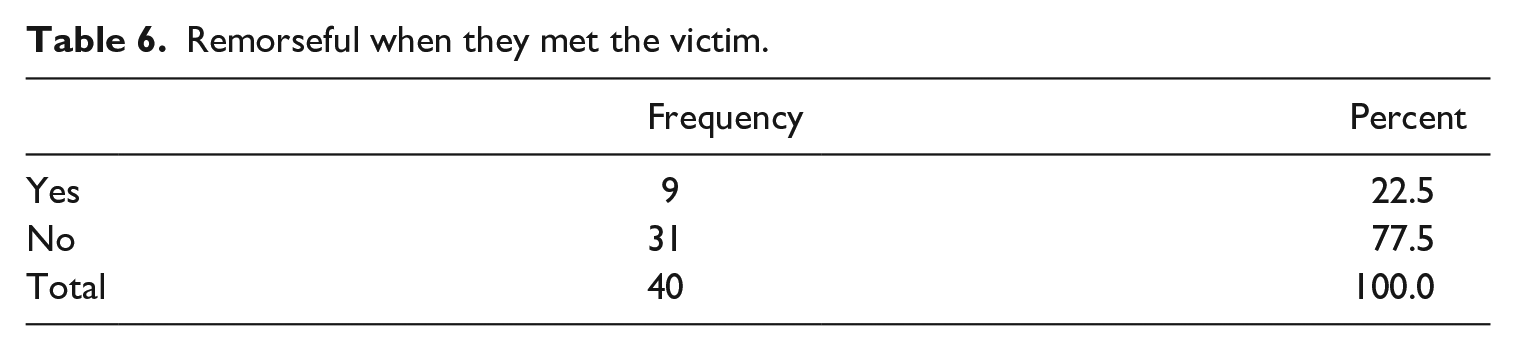
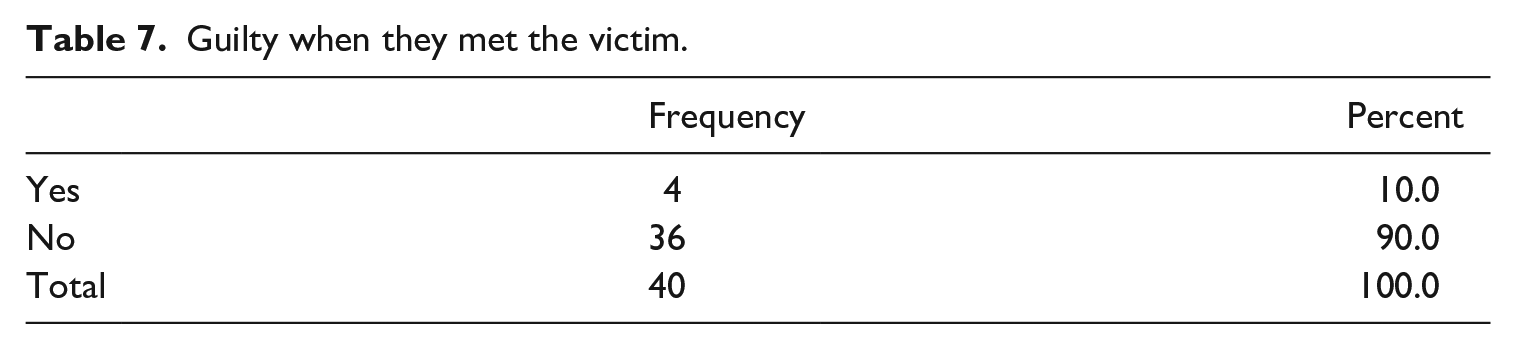
The post-test questionnaire included some questions on the feelings of remorse and upon meeting the other party face to face. A small number of offenders felt remorseful when interacting with the victim and only a few of them felt guilty (see Table 7). These results were unexpected, as according to the literature (see Table 6), the act of meeting the victim should produce remorse and guilt in offenders, but in this sample, it generally did not.
Remorseful when they met the victim.
Guilty when they met the victim.
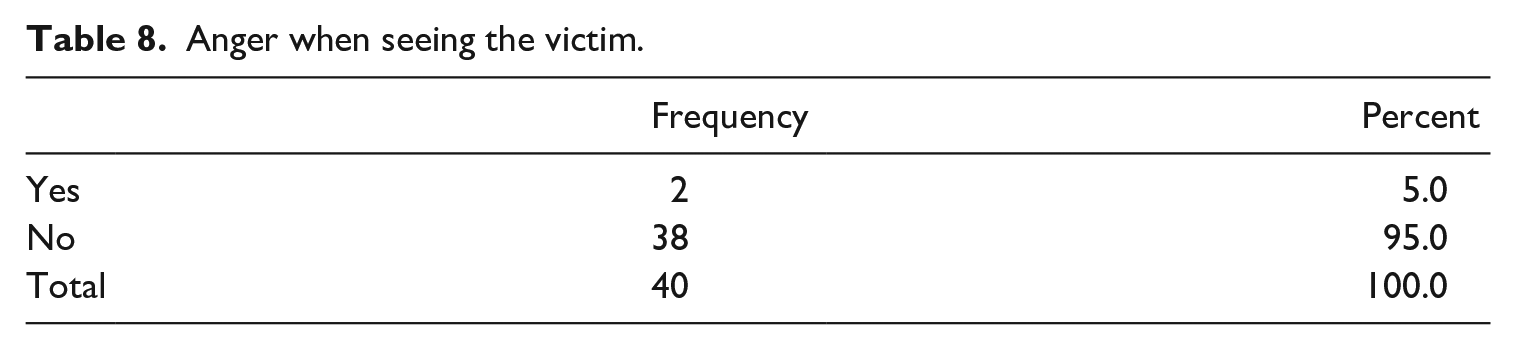
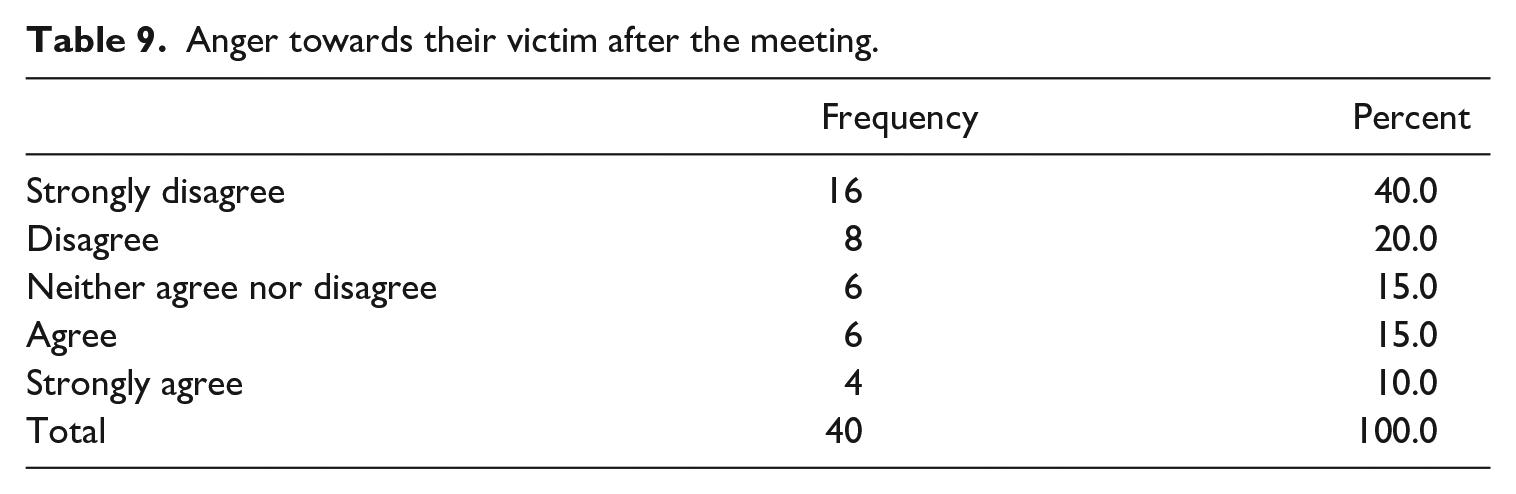
The offenders were asked whether they had been angry with the other party after the meeting. The vast majority had not felt anger at the moment of the encounter with the victim, while only some reported that they had (see Table 8). These offenders said that they felt angrier with their victims after having dialogued with them than when they met at the beginning of the direct session (see Table 9). The negative change to a feeling of greater anger was not an expected result. However, the explanation may lie in the fact that when answering that specific question, the offenders may have been thinking about all the interactions during the common meeting, which had probably not been easy to deal with and in which emotions and feelings had been expressed. When they answered the question, they had to evaluate the highs and lows of the meeting. It must be remembered that the offenders answered the post-test questionnaire a few minutes after the meeting, or after the last session with the facilitator in indirect mediations. The entire process – and the meetings themselves – were very recent.
Anger when seeing the victim.
Anger towards their victim after the meeting.
When offenders were asked in general if meeting their victim had made them feel anything, no clear conclusion emerged: while some had had mixed feelings, others were able to deal with the emotions easily and did not feel anything of note (see Table 10).
Felt something when they met their victims.

Case studies
In my sample it was possible to observe whether feelings or emotions were expressed in the interaction between parties during the direct mediation. There was some feedback in the post-process interview when participants mentioned how they had felt during the meeting with the victim. Usually, it was possible to detect more than one feeling expressed by offenders during the interaction. In order to examine how they managed the situation while at the same time expressing their feelings and emotions, some examples are given below.
It must be mentioned that case studies were diverse; there are some offenders who represent the results of the vast majority in the quantitative analysis, while others represent the minority results shown in the previous section.
Remorse, guilt and shame
In the majority of cases, remorse or shame could not be seen in the offenders’ attitudes. However, there were some exceptions and, even if they represent the minority, according to general data results, it is relevant to present their narratives, as well as the less positive ones.
Mohamed felt remorseful. He showed remorse at the beginning of the session when he apologised. It was quite significant that it was his first intervention in the session – it was something that he really wanted to say. However, he did not express shame in the session or in the interview six months later: [. . .] Participant: I’m sorry, I apologise, it’s my fault. I got nervous because he called me ‘moro’ [despective word to refer to an Arab man], and I punched him.
Participant: Awful! He felt awful! [. . .] (Mohamed)
Jonathan admitted feeling remorseful, tense and ashamed. He showed those feelings by writing a letter to the victim as a way to repair the harm caused by his antisocial behaviour:
Participant: I was tense because I did not know what was gonna happen [. . .] I thought about what was gonna happen, about how this would affect me, I do not know . . . I was like . . . Why am I here? I do not wanna be here! But oh well, I had to and I was able to work things out! [. . .] (Jonathan)
Carlos said during the post-process interview that he felt ashamed, guilty and remorseful about what he had done, especially due to the fact that he could not remember everything: Participant: Well yeah, right now I do, it’s normal ‘cause to get a letter one day saying that you’ve been sued and not knowing why; and later someone telling you you’ve done this and that . . . you feel bad, you feel guilty.
Participant: Yes, very! Although I do not know what I did, but yeah, ‘cause I do not remember.
Participant: Yeah, pretty difficult, much more than before, I mean much more than when I used to do bad things before. I was a grown-up already and all and did not remember what I had done. I do not know what I did, I cannot remember. And I went there thinking ‘What is he gonna say I did to him? What can I do?’ And through all those things that I was going through at the time, I doubt that I could have done something and I went there quite scared. I did not know what to do.
Participant: Yeah.
Participant: A massive fine! [. . .] (Carlos)
Finally, Fatima stated in the post-test questionnaire that she was not ashamed and did not know whether or not she felt remorse. During the post-process interview, she said that she regretted having behaved the way she did, not because of the victim, but because her mother, son, daughter and nephew had witnessed the event. The reason she might not have been able to feel remorse may be that it was an indirect mediation and the parties did not have the opportunity to face each other. The fact of not meeting the other party kept Fatima stuck in the perceptions and impressions she imagined she would have experienced if they had met:
Participant: Yeah.
Participant: No, no ‘cause with that person my whole body gets like goosebumps, it’s weird, no . . . I do not know! Maybe it’s because I’m scared . . .
Participant: No, and I also did not want to.
Participant: Really bad, I felt horrible!
Participant: For everything! For her, for me, for everyone! For everyone involved. I do not know . . .
Participant: To have fought with her then. It’s not because of her, I do not care about her, she is not worth it. It’s because of my mother and for what my mother has gone through, and my children and my nephew. [. . .] (Fatima)
Nervousness and concern
Jose expressed nervousness and concern. He stated that the idea of meeting and seeing the victim again made him very nervous because he was afraid of the victim’s reaction and anxious about how things would go. Jose was worried about the attitude the victim might have during the interaction. The fact that he knew the other party allowed him to foresee how he might react, but Jose later recognised the he had had an exaggerated idea of the victim’s attitude, which in the end had been acceptable from Jose’s perspective. However, he found the meeting very hard, a real challenge that he had been able to deal with successfully:
Participant: Most difficult? Well, feeling nervous every time I had to see the guy, to see how he was going to speak to me, and act . . . It worried me, I felt a bit nervous! But no, I saw that the guy was cool with it, like me [. . .]
Participant: In how he was going to act! Yeah, I was worried in how he was going act, like if he came with bad intentions, or grudges! But no, I saw that the guy was cool, not as narrow-minded as I’d thought! It was OK, it was not that difficult, you guys made it easy for me! [laughs]. [. . .] (Jose)
Anger and tension
For Rosa and Maria the meeting was characterised by an atmosphere of distrust, anger and tension. The parties’ anger during the interaction may have been due to the atmosphere, as the mediator was very directive and this may have caused the parties to be more distant rather than getting closer. Jonathan had been very tense and this prevented him from participating in a natural way. Tension was the feeling he exhibited most during the session:
Participant: So, according to you, the solution is to leave my partner? [Speaking to the victim]
Victim: No, I’m not saying that!
Participant: Then what are we talking about?
Victim: That you two are fighting in front of the children and I’m not having that!
Victim: The thing is she has said many things about me that have hurt me like when you were going around saying that when we were together I had hit you.
[Physically the victim is moving away from the desk and the participant, setting boundaries]
(Rosa) [. . .] Victim: I can see and hear that the offender wants to work things out, but I think that we have not touched on everything and this will not be solved until we discuss everything.
Victim: I feel that this will not be resolved.
Victim: I feel disbelief, distrust. I’m not sure how this is going to end. I think, what does this have to do with me?I think that if we have now decided to sit here it’s because we want to to find a way to work things out.
Participant: Yeah, I want to work things out. That’s all I want. Victim: We all want this because we are all here. Participant: It’s up to us. Since mediation started I have not done a thing but others have done many things against me! [ . . .] I just want to be left alone and live in peace
Participant: Distrust, discouragement, uneasiness . . . I’m not even sure what I’m feeling! I feel hurt.
Participant: To solve this thing which is making me so bitter. I feel scared and anxious. I need to feel secure, trust. I think that we can have a relationship as neighbours. I think that would be the best solution. [. . .] (Maria)
In Maria’s case both parties showed anger and tension. Maria (the offender) showed neither remorse nor shame and in this case in particular, the victim remained entrenched in his position, mentioning all the inconveniencies suffered, the breach of trust involved and the disrespectful attitude shown several times by the offender. All these led the victim to feel the need for revenge.
[. . .] Victim: I feel hopelessness, anger, hate. All I want right now is revenge, but I also feel scared. I’m able to control myself and I choose to get a solicitor who can advise me.
Victim: Security, protection, defense. When I’m scared that is what I need. I need justice, I need for the harm to be repaid somehow. I really want revenge.
Participant: Well, in relation to this case I assume that she wants revenge against me because all that she has said is false. I feel anger, helplessness. I think: Well, is not this ever going to end? I need peace, security and justice. I feel taken back by this. I’ve never had an issue with anyone and I’ve been in this neighbourhood for 34 years! [ . . .] (Maria)
Going through the case studies, I found that the group of offenders who had shown emotions were a minority. It was possible to identify which offenders expressed such emotions as nervousness, tension, guilty, remorse, shame, concern, distrust or anger and how they expressed them. Feelings of anger or failure to feel remorse or guilt were reported by some offenders in the case studies this represented the feelings of the vast majority of the 40 offenders.
Braithwaite (2002), Daly (2003), Harris et al. (2004), Kenny and Clairmont (2006), Jackson and Bonacker (2006) and Harris (2006) have pointed out that guilt and remorse are relevant in RJ practices because they allow offenders to be aware of their behaviour, they can see the wrong and it allow them to restore and repair the victims, as well as it may help them to change to a prosocial life. Research have found different results about the sequence of what comes first and even some results have shown the difficulty of expressing these emotions for offenders (Kenny and Clairmont, 2006).
To sum up, it can be said that restorative processes and especially face-to-face meetings brought out emotions and feelings as well as ideas and opinions. It is part of the process itself to be able to deal with them in order to restore the wrong and to design a peaceful future (Harris et al., 2004). The results from the case studies show that emotions during the meeting follow complex sequential dynamics. These dynamics are different in each meeting and in some cases these factors contributed to successful restoration, while in others they provoked negative feelings that could make restoration more difficult. These different reasons are linked to the nature of the offence and its circumstances, the personalities and roles of the participants, their relationships and social positions or the way in which the sessions are facilitated (Braithwaite, 2002; Daly, 2003; Hoyle et al., 2002; Rossner, 2011). From the results of this research, it can be seen that there cases vary according to what factors are at play in the particular case and how they affect it.
Discussion and conclusions
The Catalan Victim-Offender Mediation Programme is not orientated towards dealing with the offence or criminogenic needs in general, and thus the structure of the sessions was not necessarily based on these issues.
In this article the general data can only show the criminogenic need linked to the lack of problem-solving skills.
Nonetheless, improving problem-solving strategies and empathy or learning to maintain self-control during the sessions were aspects present in the mediations I attended. The dynamics of the session led offenders to use reasoning, self-reflection, consequential thinking, assessment of alternatives and decision-making skills. Some offenders did better than others, but in general they were able to work on improving their problem-solving strategies. Thus, these aspects were implicit in the intervention and taken into account even if they were not the main areas dealt with.
In my sample, none of the offenders needed money for drug consumption, but when they committed the offence they tended to be either under the effects of drugs or experiencing withdrawal symptoms. Drugs, then, were clearly identified as criminogenic needs in some of the offenders and in most of the cases the use of alcohol was accompanied by violent episodes. This use of violence and its consequences helped some offenders to become aware of their need to learn alternative ways to resolve future conflicts. From the 12 case studies, we can see that even if mediation was not orientated towards dealing with these problems of drug or alcohol abuse, it indirectly helped offenders to do so.
The main negative finding in this research has to do with the difficulty of being able to feel guilt or remorse, which only a few of the offenders managed to achieve. In this research, a minority felt remorseful, while others failed to feel it at any point. It would seem that mediation did not allow offenders to regret what had happened – any feelings of regret were not due to the mediation process. Shame was linked to feeling remorse and to the fact of accepting having injured the other party. In general, offenders did not tend to feel ashamed during and after the process. RJ focuses on shaming the act rather than the individual (Braithwaite, 1989); one can admit having behaved wrongfully without the need to see oneself as a bad person. The offender is ashamed of his act rather than of himself as a person. These results raise the question of whether the mediation process, as it is practised in Catalonia, needs to make offenders express those feelings in order to make the process restorative and reintegrative. Perhaps such feelings are managed through the opportunity that RJ offers offenders to apologise and repair the harm caused, which can make the process restorative and reintegrative as well.
Limitations of the study
Even though this study shows a broad cross section of offences, participants and demographic characteristics, the conclusions must be qualified because the study has some limitations.
It is impossible to draw a statistically accurate conclusion about the findings because the sample was too small and not a random one. In fact, the main limitation of this research is the small size of the sample, which does not permit us to generalise the results.
There is also the fundamental problem associated with qualitative research. The cases are reported to illustrate how offenders were able or not to deal with criminogenic needs, but it was not possible to determine whether the change was significant.
Meeting the victim cannot create change on its own. The role of facilitators preparing parties; complexity of some offences types, pre-existing relationships between individuals could be explanatory variables as well and may help researchers to understand better the results.
Future implications
Individual sessions with offenders tended to deal with the conflict itself, and the wish to meet the victim and make reparation or apologise were guaranteed before the meeting with the victim. However, from my observations, I found that offenders’ criminogenic needs had not been worked on in depth before the meeting, even though some offenders did mention a few of them.
I would suggest working on different relevant aspects of criminogenic needs in separate sessions, focusing especially on meeting the challenge of acknowledging the wrong as a step that would enable offenders to project a real and feasible change. Apart from working on this, each offender could propose work on his own particular criminogenic needs, which this may indeed mean that more individual sessions would be needed, I think it would contribute to a productive, restorative and reintegrative meeting with the other party.
If victim–offender mediation does indeed have to make offenders express remorse and shame, we would then need to find the way to generate the expression of these feelings. This would probably require paying greater attention to neutralisation techniques, by working with offenders on the acceptance of responsibility for having caused harm and their awareness of the impact this harm has had on someone who is suffering as a result. Also, giving more relevance to victim interventions, I would suggest a space in the meeting where offenders can be taught in an educational way about the human consequences of crime, contents inspired in the known programmes called victim training impact ( Jackson and Boracker, 2006).
These suggestions aim to reconcile the restorative paradigm with the rehabilitation paradigm. In my opinion, these should not be seen as competing, but rather as compatible with each other, as some authors have already pointed out (Braithwaite, 2002; Cid, 2009; Ward et al., 2014 ).
Footnotes
Author’s note

Funding
The author(s) disclosed receipt of the following financial support for the research, authorship, and/or publication of this article: The author received financial support for the research of this article from the Catalan Government with a Grant ( Agaur-FI-DGR) in the context of a doctoral thesis.