




Abstract
In today’s digital society, individuals’ online activities are often observed by others. When people feel like they are being watched online, they may adjust their behavior to protect their privacy. To measure such perceptions and understand their antecedents and consequences, the Perceived Surveillance Scale (PSS) has been proposed to capture individuals’ perceptions of being watched in digital environments. However, the PSS focuses on surveillance by corporate actors and does not address surveillance by actors such as family members or friends. This is a significant issue, as the literature on vertical and horizontal privacy indicates that distinguishing between corporate and peer actors facilitates more insightful and comprehensive analyses of individuals’ online behavior. Therefore, the present study aimed to develop a version of the PSS that captures individuals’ perceived surveillance in relation to their peers. To this end, the original PSS was adapted to measure perceived peer surveillance, and then both the original and peer PSS were tested on a sample of 1,666 Internet users from Slovenia. Five distinct measurement properties were assessed for each scale: structural validity, internal consistency, convergent and discriminant validity, measurement invariance, and construct validity (15 hypotheses per scale). The results revealed that corporate and peer PSSs measure two distinct types of perceived surveillance. Both scales exhibited excellent psychometric properties, with only minor deviations. Overall, the study provides a valid and reliable version of the PSS for peer contexts and highlights the value of distinguishing between perceived corporate and peer surveillance in digital environments.
Introduction
Digital society is characterized by online platforms and services that enable ubiquitous surveillance of individuals across various online and offline contexts. 1 Online surveillance can occasionally have positive implications for individuals, as in the case of improved personalization of online services2,3 and targeted advertising. 4 However, more often, surveillance undermines individuals’ information privacy on the Internet, thus leading to potential psychological discomfort,5,6 self-censorship, 7 and even tangible negative outcomes, such as discrimination.8–10
Understanding individuals’ reactions to online surveillance requires a valid and reliable survey instrument for measuring their perceptions of surveillance. Recently, Segijn et al.11–13 proposed the Perceived Surveillance Scale (PSS), a four-item instrument for measuring perceived surveillance, which they defined as “the perception of being watched.” The PSS is focused on individuals’ perceptions regarding corporate surveillance practices and asks respondents to rate, on a 7-point response scale, the extent to which they believe companies are watching their every move, checking up on them, looking over their shoulder, and entering their private space. Segijn et al. 13 assessed the reliability and construct validity of the PSS through three separate studies, which included participants from both a student sample and the general population. The studies utilized either a survey method or a scenario-based experiment. To assert construct validity, the relationship between the PSS and several related measures (e.g., privacy and surveillance concerns, trust, and privacy risk perception) was tested. The PSS showed satisfactory reliability (Cronbach’s α = 0.92–0.97) and construct validity in all the studies. 13 The scale has been used in subsequent studies examining the role of perceived surveillance in online environments.14–22
While understanding perceived surveillance in the context of companies is important, scholars have suggested that surveillance on the Internet can also come from other actors. 23 Manokha 24 highlighted that self-censorship by Internet users is largely a result of concerns regarding peer surveillance as opposed to corporate surveillance. Such a distinction is also important in broader research on information privacy, which distinguishes between vertical and horizontal privacy.25,26 The former describes privacy relationships between an individual and institutions, and the latter privacy relationships among individuals. 25 Differentiating between the two highlights power imbalances tied to specific relationships and provides a deeper understanding of individuals’ privacy-related perceptions and behavior.25–27 In fact, in many online contexts, such as social network sites (SNSs), the manner in which individuals manage their information privacy is shaped by the interplay between vertical and horizontal privacy.27–29
Currently, because of its focus on vertical privacy, the PSS does not permit scholars to empirically study the double-layered nature of perceived surveillance on SNSs. 25 The current study fills this gap by developing a version of the PSS that captures horizontal privacy. In doing so, we rely on Segijn et al.’s 13 understanding of perceived surveillance as the perception of being watched but change the surveilling actor from corporations to peers. We adopt this understanding of perceived surveillance for both types, as surveillance primarily concerns the monitoring of others’ activities.30,31 We specifically focus on companies (i.e., advertisers, businesses, and online platforms) as corporate actors and on acquaintances (i.e., people personally known to the individual) as peers. This approach ensures the intelligibility of the actors while making the scales applicable across online contexts. 25 We term the peer-oriented PSS as PSS-P, while the original scale aimed toward corporate surveillance is called PSS-C. In developing and validating the PSS-P, we conducted a scale validation study on a sample of 1,666 Internet users from Slovenia. A single sample was used due to strong expectations about the dimensional structure of the scale. We first translated the PSS-C, adapted it to measure perceived surveillance in relation to peers (i.e., PSS-P), and tested the psychometric properties of both scales in two steps.
First, we examined the internal structure of each scale, including its structural validity, internal consistency, convergent and discriminant validity, and measurement invariance. 32 By assessing these aspects, we determined whether the items measure the intended construct validly and reliably and whether these measurements are comparable across different population groups. Second, we evaluated the construct validity of the scales to assess whether they measure what they are supposed to measure. 33 To this end, we proposed and tested four hypotheses regarding group differences and 11 hypotheses regarding construct correlations for each PSS scale.
In case of group differences, we expected males to have higher scores on the PSS-C (H1a) but lower scores on the PSS-P (H1b).34,35 Moreover, we hypothesized that younger (H2a and H2b), more educated (H3a and H3b), and lower-income (H4a and H4b) Internet users would likely have higher scores on both PSS-C and PSS-P.35,36
For construct correlations, we measured individuals’ willingness to disclose their personal information in three distinct online contexts. We also measured privacy concerns, perceived privacy control, perceived benefits of self-disclosure, and trust, each of which was distinguished according to vertical and horizontal privacy. We hypothesized that privacy concerns would be positively associated with both the PSS-C and the PSS-P, 13 and that the other constructs would be negatively associated with the PSS-C and PSS-P.7,13,21,22 Furthermore, we assumed that the PSS-C would correlate more strongly with constructs related to vertical privacy and the PSS-P with constructs related to horizontal privacy. The construct definitions and hypotheses are shown in Table 1.
Overview of the Tested Constructs and Their Hypothesized Relationships with Perceived Corporate and Peer Surveillance
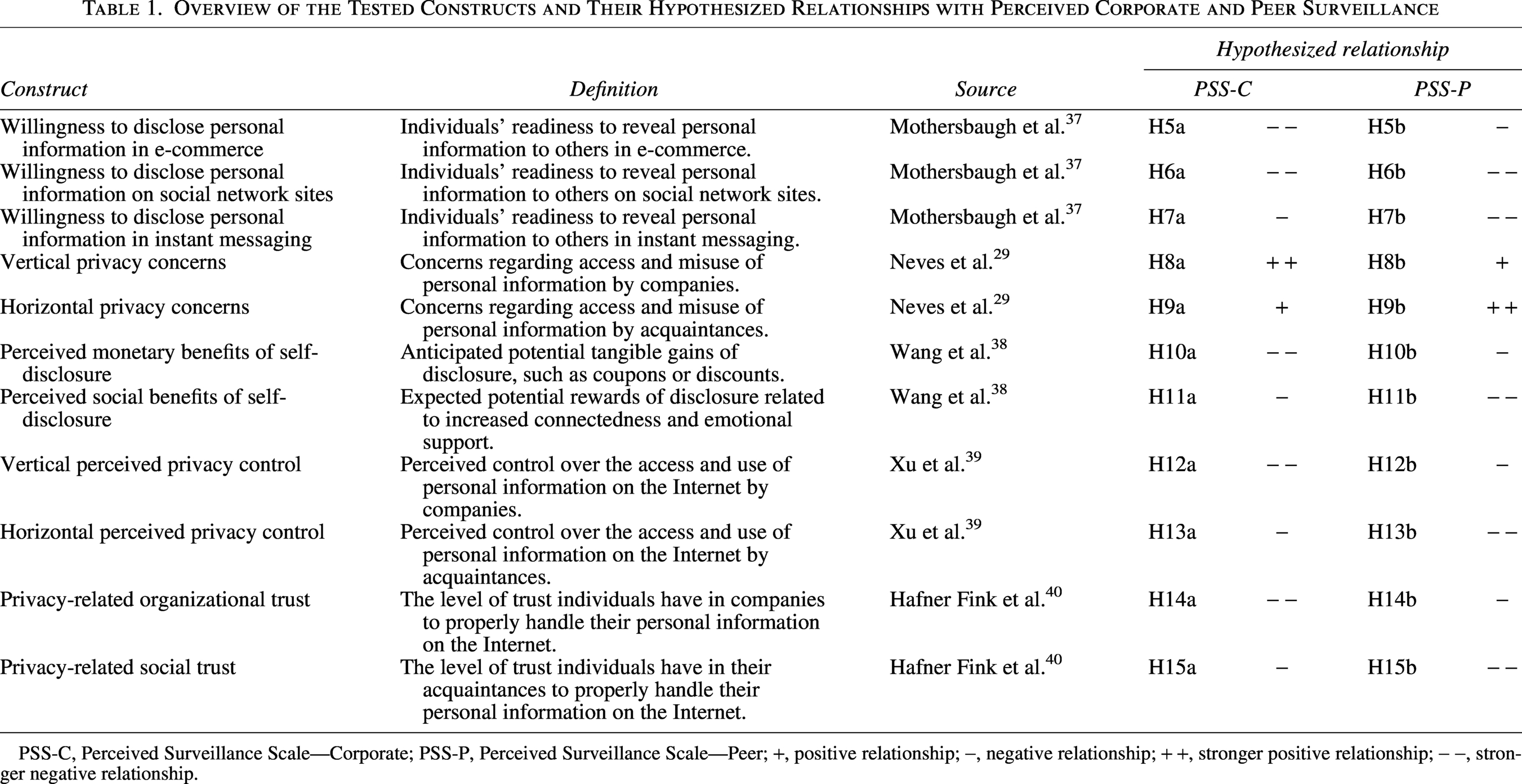
PSS-C, Perceived Surveillance Scale—Corporate; PSS-P, Perceived Surveillance Scale—Peer; +, positive relationship; −, negative relationship; + +, stronger positive relationship; − −, stronger negative relationship.
Materials and Methods
Data collection and procedure
Data were collected between November and December 2023. Participants were recruited from the Opinia.Club,
41
the largest Slovenian online access panel. A sample of 5,075 Internet users aged 18 years or older residing in Slovenia was selected using quota sampling based on gender, age, and region. Among them, 1,871 accepted the invitation and started the survey (participation rate: 36.9 percent). We excluded 8.4 percent of participants for 50 percent or more missing responses, and from the remaining 1,713 participants, 2.7 percent for violating at least two of the following criteria:
very short participation times (<1/2 of the median; 3.1 percent), uniformity of responses (>70 percent; 1.9 percent), inconsistency in responses (i.e., scale with reverse-coded items; 21.2 percent), or failure on two or more attention checks (2.2 percent).
In total, 205 participants were excluded. The final dataset included answers from 1,666 respondents. The sociodemographic characteristics of the final sample are presented in Table 2.
Sociodemographic Characteristics of the Sample
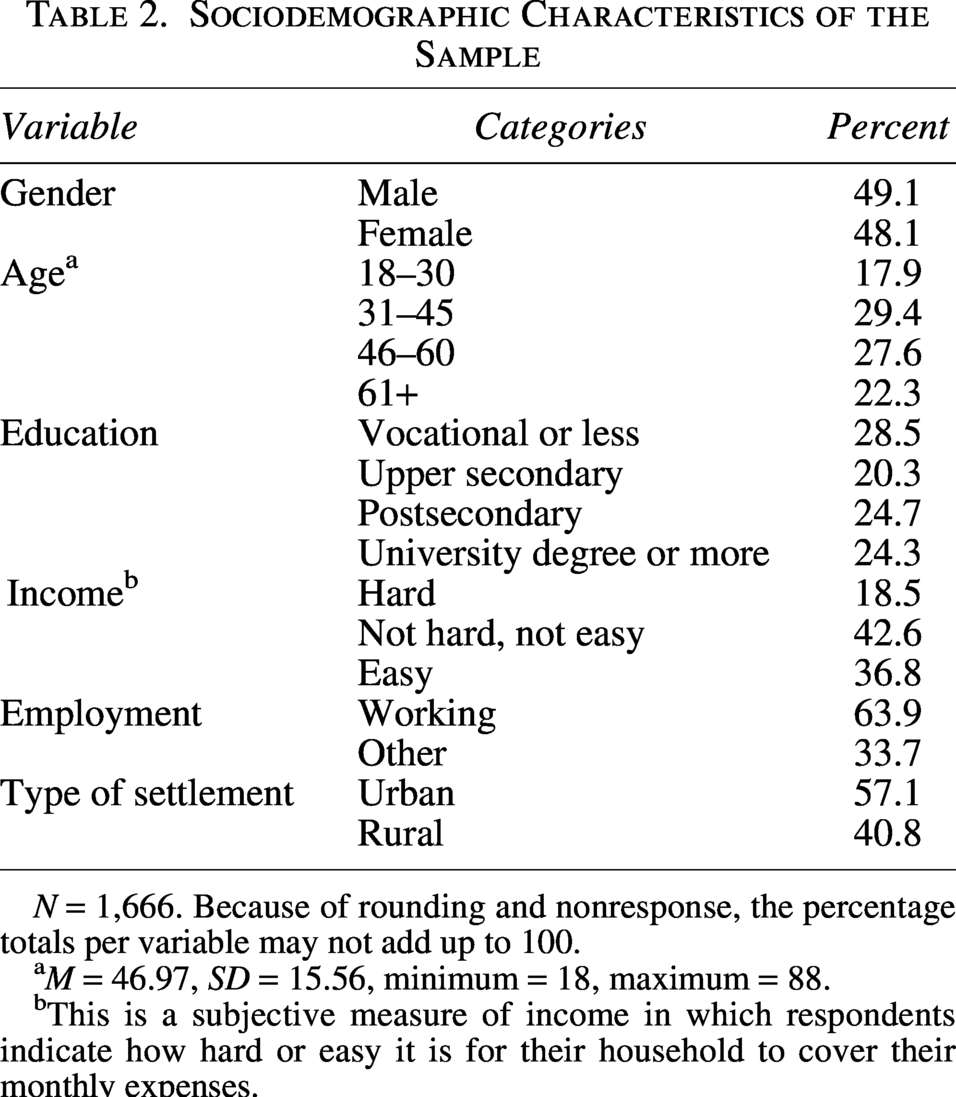
N = 1,666. Because of rounding and nonresponse, the percentage totals per variable may not add up to 100.
M = 46.97, SD = 15.56, minimum = 18, maximum = 88.
This is a subjective measure of income in which respondents indicate how hard or easy it is for their household to cover their monthly expenses.
The study received ethical approval from the Ethics Commission of the Faculty of Arts, University of Ljubljana (January 18, 2022; ref. no. 252-2021). Relevant laws and institutional guidelines were followed for all procedures, with written informed consent obtained from all participants. The data are available from the ADP—Social Science Data Archives at https://doi.org/10.17898/ADP_IZIA23_V1.
Measures
All measures used in this study were adopted from previous literature and translated into Slovenian by following the Translation, Review, Adjudication, Pretesting and Documentation (TRAPD) procedure. 42 The items and their descriptive statistics are presented in the Supplementary Data.
Perceived corporate and peer surveillance
Following the original scale, 13 PSS-C was assessed by asking participants to rate the extent to which they believe that companies are (a) watching their every move, (b) checking up on them, (c) looking over their shoulder, and (d) entering their private space when using the Internet. To assess the PSS-P, we retained the same items but modified the wording of the instruction to refer to acquaintances instead of companies. All items were measured on a 7-point Likert-type scale, ranging from 1 (completely disagree) to 7 (completely agree). We do not report descriptives or reliability here, as this study aimed to validate these scales.
Willingness to disclose personal information
Respondents were asked about their willingness to disclose six types of information on a 7-point scale (1 = not at all willing, 7 = definitely willing) for each of the three contexts.37,43 The willingness to disclose personal information in each context was modeled as an index, thus representing the average of the corresponding items. 37 The following are the means (Ms) and standard deviations (SDs): e-commerce M = 3.25, SD = 1.48; SNSs M = 2.48, SD = 1.35; instant messaging M = 3.17, SD = 1.67.
Vertical and horizontal privacy concerns
Respondents were asked to assess their concerns regarding the access and misuse of their information by companies (M = 5.38, SD = 1.48, α = 0.95) and acquaintances 29 (M = 4.40, SD = 1.68, α = 0.96). The scales included seven items each, with ratings ranging from 1 = completely disagree to 7 = completely agree.
Perceived monetary and social benefits of self-disclosure
Monetary benefits (M = 3.14, SD = 1.72, α = 0.91) refer to potential tangible gains of disclosure, while social benefits (M = 3.11, SD = 1.60, α = 0.87) include rewards related to increased connectedness and emotional support. Each type of benefit was measured with three items, rated from 1 = completely disagree to 7 = completely agree. 38
Perceived vertical and horizontal privacy control
Two four-item scales (1 = completely disagree, 7 = completely agree) were used to assesses perceived control over the access and use of personal information on the Internet, 39 with one scale related to companies (M = 3.79, SD = 1.50, α = 0.90) and the other to acquaintances (M = 4.42, SD = 1.46, α = 0.91).
Privacy-related organizational and social trust
Respondents were asked to rate their level of trust in companies (M = 2.97, SD = 1.79) and their acquaintances (M = 4.07, SD = 2.04) to appropriately handle their personal information on the Internet on a 7-point scale (1 = one must be very careful, 7 = most [companies/acquaintances] can be trusted). 40
Demographics
Items measuring demographic variables were taken from the Slovenian Public Opinion Survey questionnaire40,44 and recoded for this study as shown in Table 2 (see the Supplementary Data for original response options).
Analytic strategy
All analyses were conducted in R. 45 The lavaan package 46 was used for confirmatory factor analysis (CFA). As 13.0 percent of respondents had some missing data, we followed Newman’s guidelines 47 and used the full information maximum likelihood procedure. We also used the robust maximum likelihood estimator, as the distributions of some observed variables deviated from normality. 48
The structural validity of the PSS-C and PSS-P scales was assessed through CFA. To evaluate model fit, we followed Kline’s guidelines 48 and inspected the χ2 exact-fit test and the local fit. If the model failed the exact fit test, we retained the model if all correlation residuals were below |.10|. We also observed three approximate fit indices: comparative fit index (CFI), root mean square error of approximation (RMSEA), and standardized root mean square residual (SRMR).49,50 After separately testing each scale, we assessed both a two-factor and a single-factor model. In the latter, we combined all eight items in a single dimension to eliminate the option that corporate and peer surveillance are a one-dimensional construct.
We assessed internal consistency by calculating Cronbach’s α and McDonald’s ω for each scale. Moreover, we examined convergent and discriminant validity based on the procedures suggested by Fornell and Larcker. 51
Measurement invariance was assessed for each scale through multigroup CFA using a series of increasingly stringent models in which between-group restrictions constrained different elements of the model. 50 We examined configural (equivalence of model form), metric (equivalence of factor loadings), scalar (equivalence of item intercepts), and strict (equivalence of item residuals) invariance. 52 We deemed the measure to be invariant if adding constraints did not significantly worsen the fit of the model, as determined by the nonsignificant χ2-difference test.
To assess construct validity, we first compared the latent means of PSS-C and PSS-P across gender, age, educational, and income groups. The means were constrained to be zero for males, younger (18–30 years), individuals with vocational education, and individuals with lower income, while freely estimated for the other groups. Second, we conducted a CFA, which, alongside PSS-C and PSS-P, included measures for willingness to disclose personal information in e-commerce, SNS, and instant messaging; vertical and horizontal privacy concerns; perceived monetary and social benefits of self-disclosure; perceived vertical and horizontal privacy control; and privacy-related organizational and social trust. We examined the fit of the model and the correlations between PSS-C and PSS-P and the remaining constructs.
In all analyses, we followed the standard criterion of p < 0.05 to determine statistically significant results.
Results
The CFA revealed good model fit for both the PSS-C, χ2(df) = 6.575(2), p = 0.037, and PSS-P, χ2(df) = 1.370(2), p = 0.504, scales. Correlation residuals were small, and the approximate fit indices did not indicate problems (Table 3). For both scales, all items had high standardized factor loadings (>0.80), thereby implying that they are strongly correlated with the corresponding latent factor (Table 4). Thus, we established that both scales are good measures of their respective constructs. Testing them together, the two-dimensional model was much better supported than the unidimensional one (Tables 3 and 4).
Model Fit
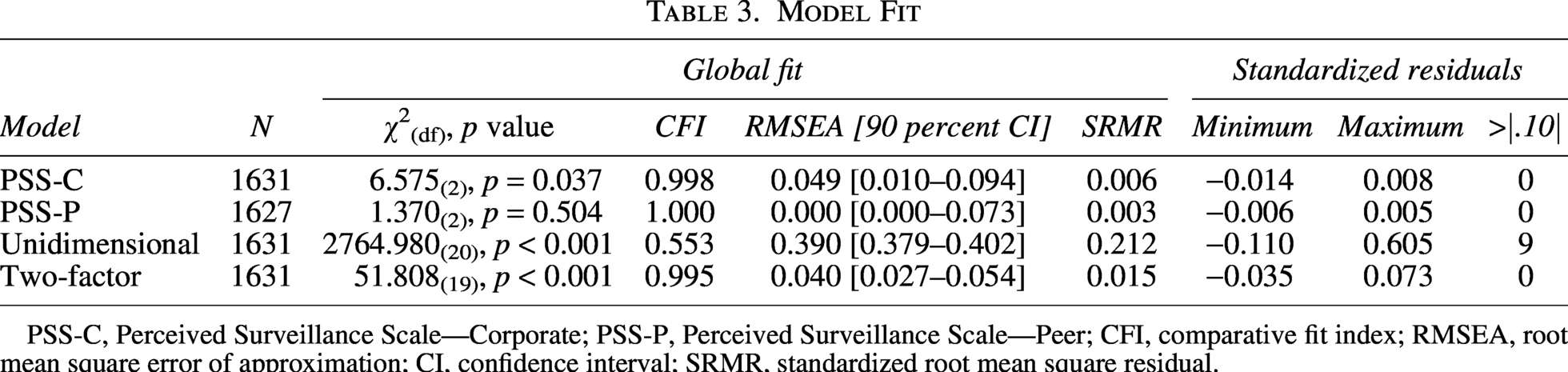
PSS-C, Perceived Surveillance Scale—Corporate; PSS-P, Perceived Surveillance Scale—Peer; CFI, comparative fit index; RMSEA, root mean square error of approximation; CI, confidence interval; SRMR, standardized root mean square residual.
Standardized Factor Loadings
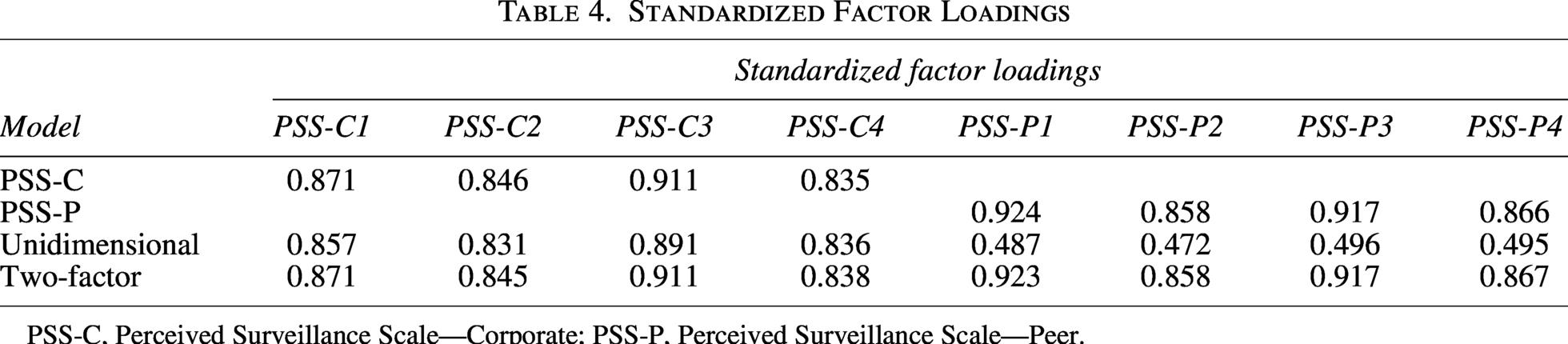
PSS-C, Perceived Surveillance Scale—Corporate; PSS-P, Perceived Surveillance Scale—Peer.
The high values of Cronbach’s α and McDonald’s ω (Table 5) indicate excellent internal consistency of the scales, meaning that the scales reliably measure the respective construct. In addition, average variance extracted (AVE) values for both scales are well above 0.50, which indicates high convergent validity, whereas the correlation between the two scales—while moderate and positive—is below the square root of each scale’s AVE, thus confirming discriminant validity.
Reliability and Convergent and Discriminant Validity a
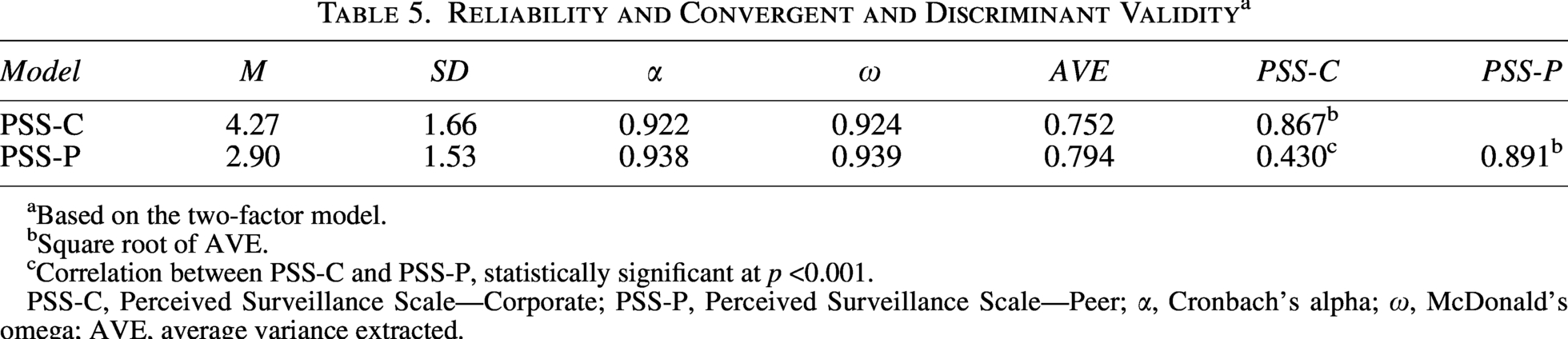
Based on the two-factor model.
Square root of AVE.
Correlation between PSS-C and PSS-P, statistically significant at p <0.001.
PSS-C, Perceived Surveillance Scale—Corporate; PSS-P, Perceived Surveillance Scale—Peer; α, Cronbach’s alpha; ω, McDonald’s omega; AVE, average variance extracted.
When testing for measurement invariance, we confirmed configural, metric, scalar, and strict invariance for both scales across gender, age, education, and income groups, with three exceptions where only partial invariance was supported (Table 6). Partial invariance is less conservative than full invariance but still permits cross-group comparisons. 50
Measurement Invariance for Perceived Corporate and Peer Surveillance Scales

Intercepts of item PSS-C2 “… checking up on me.” are not invariant.
Intercepts of item PSS-C4 “… entering my private space.” are not invariant.
Residuals of item PSS-P1 “… watching my every move.” are not invariant.
PSS-C, Perceived Surveillance Scale—Corporate; PSS-P, Perceived Surveillance Scale—Peer; ✓, invariant; (✓), partially invariant.
Since at least partial scalar invariance was confirmed in all cases, we compared the latent means of the PSS-C and PSS-P across the sociodemographic groups (Table 7). Hypotheses regarding group differences were only partially confirmed. We found clear differences between gender groups for both scales, only between some age and education groups for PSS-C, and only among income groups for PSS-P.
Hypothesis Testing for Group Differences
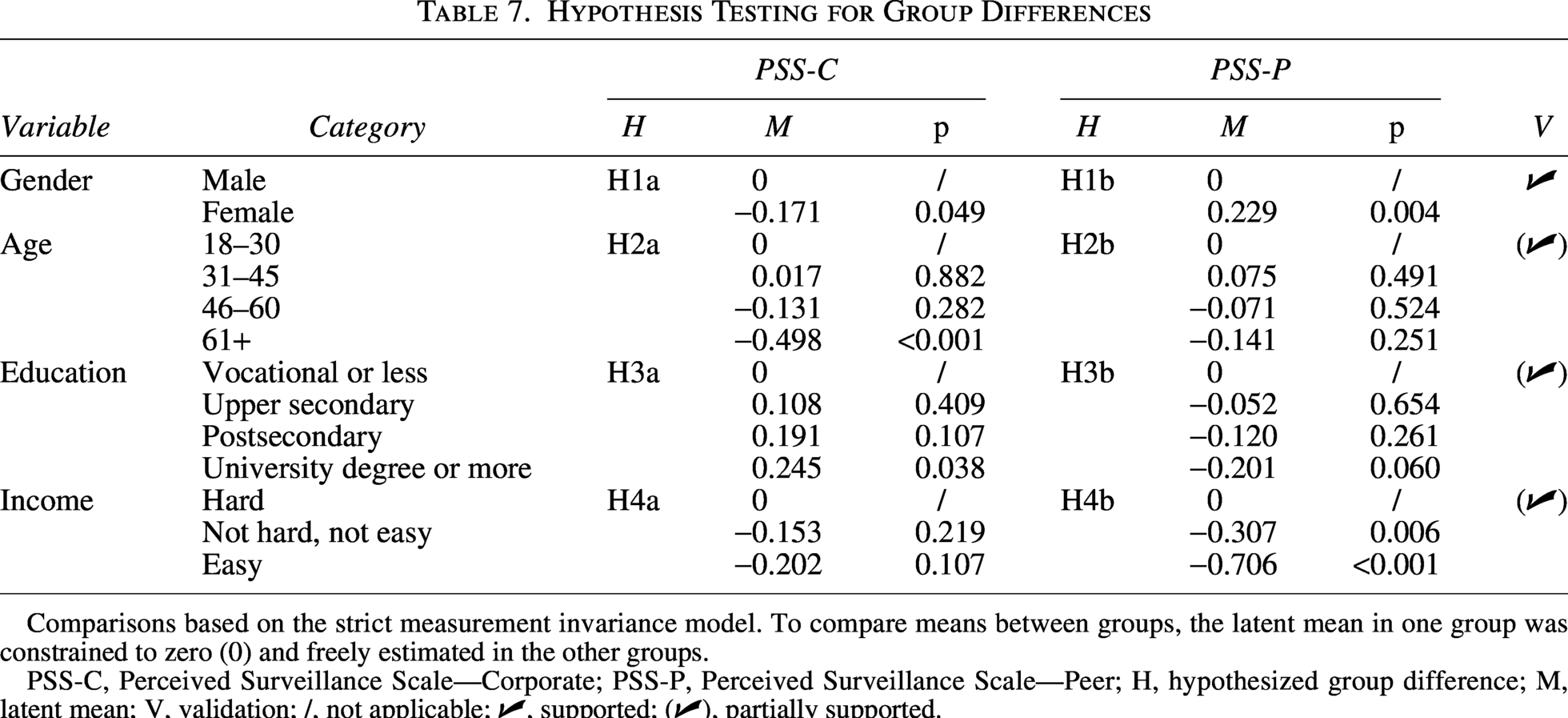
Comparisons based on the strict measurement invariance model. To compare means between groups, the latent mean in one group was constrained to zero (0) and freely estimated in the other groups.
PSS-C, Perceived Surveillance Scale—Corporate; PSS-P, Perceived Surveillance Scale—Peer; H, hypothesized group difference; M, latent mean; V, validation; /, not applicable; ✓, supported; (✓), partially supported.
To further assess construct validity, we conducted a CFA with additional constructs. In line with Kline’s guidelines, 48 we retained the model even though it failed the exact fit test, χ2(df) = 1223.928(706), p < 0.001, as all correlation residuals were below |.10|. Fit indices also indicated acceptable fit (CFI = 0.987; RMSEA = 0.024 [0.022–0.027]; SRMR = 0.022).
PSS-C was significantly correlated with all variables in the expected direction, apart from the perceived monetary benefits of self-disclosure, for which the correlation was not significant (Table 8). Conversely, PSS-P was positively rather than negatively correlated with willingness to disclose in SNS and with perceived monetary and social benefits. Interestingly, willingness to disclose in e-commerce and instant messaging, as well as vertical perceived privacy control, had no significant relationship with PSS-P. Finally, PSS-C was generally more strongly correlated with constructs related to vertical privacy, while PSS-P was more strongly correlated with constructs related to horizontal privacy. These results support the construct validity of both scales, while the observed discrepancies from our initial expectations indicate substantive differences between perceived corporate and peer surveillance.
Hypothesis Testing for Construct Correlations
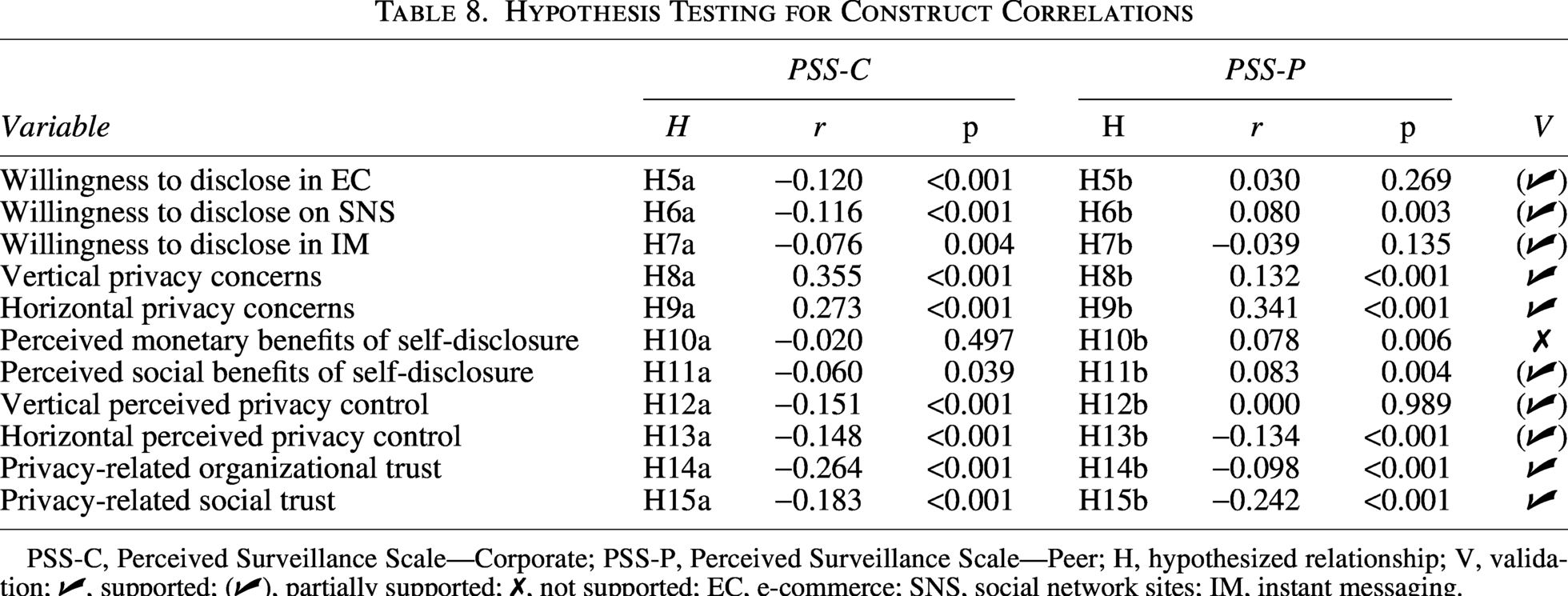
PSS-C, Perceived Surveillance Scale—Corporate; PSS-P, Perceived Surveillance Scale—Peer; H, hypothesized relationship; V, validation; ✓, supported; (✓), partially supported; ✗, not supported; EC, e-commerce; SNS, social network sites; IM, instant messaging.
Discussion
Drawing on the conceptual distinction between vertical and horizontal privacy, the key contribution of this study to the field of online information privacy is the development and validation of a scale measuring individuals’ perceptions of peer surveillance on the Internet. Building on Segijn et al.’s 13 understanding of perceived surveillance as the perception of being watched and their original PSS-C, we proposed the PSS-P, translated both scales, and tested their psychometric properties on a large sample of Internet users from Slovenia.
Using CFA, we confirmed the distinction between the two scales, which indicates the existence of two different types of perceived surveillance. The scales were valid and reliable, showing their suitability for use in empirical research. Confirmation of measurement invariance for both scales indicates that the level of perceived corporate and peer surveillance can be directly compared across gender, age, education, and income groups. The results of construct validity for the PSS-C were largely in line with theoretical expectations.7,13,21,22 Conversely, for the PSS-P, we observed a few deviations from the hypothesized group differences and construct correlations. We believe that rather than indicating issues with the validity of PSS-P, these results indicate important substantive differences in PSS-C and PSS-P among specific population groups and in relation to other constructs.
With reference to sociodemographic groups, the hypothesized gender differences were confirmed for both scales. 34 We also demonstrated that younger and highly educated individuals perceive greater corporate surveillance. This is most likely due to their more advanced Internet skills, which increase their awareness of corporate surveillance practices. 36 Conversely, in the case of PSS-P, no significant differences based on age and education were found, likely because peer surveillance is easier to perceive and requires fewer skills. Moreover, respondents with lower income perceived greater surveillance from their peers, but there were no group differences when it came to corporate surveillance. As the social and economic background that comes from higher income protects well-off individuals from the negative consequences of peer surveillance, 53 they appear to be less attentive to such practices, whereas corporate surveillance is more universal and less affected by socioeconomic status.1,54
In case of construct correlations, PSS-P was positively, rather than negatively, correlated with willingness to disclose on SNS as well as with perceived monetary and social benefits of self-disclosure. These results, although unexpected, appear plausible. In fact, individuals may desire visibility of their personal information on SNS, as this can enable them to share important announcements, receive support, collect feedback, and so on. Occasionally, visibility is a goal in itself, as it can grant greater social status 55 or even economic benefits, as in the case of online influencers. 56 In such cases, individuals are aware that being observed by others on SNS is the key to these benefits. Furthermore, correlations between PSS-P and willingness to disclose in e-commerce and instant messaging were not significant, suggesting that perceived peer surveillance is less important in such contexts.
This study is not without limitations. First, although the study validates the original PSS-C and develops a version to capture the perceptions of peer surveillance, the scales are nevertheless focused only on surveillance by companies and acquaintances. To address this, additional scales encompassing surveillance by other types of entities, such as governmental institutions 57 or strangers, could be developed in future research. 27 Second, the assessment of construct validity was limited to demographic variables and privacy-related attitudes. Future studies could extend construct validation to individuals’ impression management behaviors 58 and psychological characteristics. 59 Last, the scales were validated in only one country (i.e., Slovenia); thus, further cross-cultural validation of the instruments is warranted. Relatedly, the scales should be revalidated in the future to ensure their continued validity in light of technological advancements. 60 Regardless, by validating the original PSS-C and developing a measure to assess perceived peer surveillance, this study highlights the importance of differentiating between perceived corporate and peer surveillance in understanding the contemporary surveillance experiences of individuals on the Internet.
Authors’ Contributions
J.B.: Conceptualization (lead), data curation (equal), formal analysis (lead), funding acquisition (equal), methodology (equal), project administration (lead), validation (equal), and writing—review and editing (equal). L.F.: Data curation (equal), formal analysis (supporting), visualization (lead), validation (equal), writing—original draft (lead), and writing—review and editing (equal). A.P.: Funding acquisition (equal), methodology (equal), supervision (lead), and writing—review and editing (equal).
Footnotes
Ethical Considerations
The study received ethical approval from the Ethics Commission of the Faculty of Arts, University of Ljubljana (ref. no. 252-2021) on January 18, 2022. Respondents gave written informed consent for participation and publication before starting the survey questionnaire.
Data Availability
The data are available from the ADP—Social Science Data Archives at https://doi.org/10.17898/ADP_IZIA23_V1.
Author Disclosure Statement
No competing financial interests exist.
Funding Information
This research received public financial support from research grants (nos. P5-0399 and J5-60096) administered through the Slovenian Research and Innovation Agency.
Supplemental Material
References
Supplementary Material
Please find the following supplemental material available below.
For Open Access articles published under a Creative Commons License, all supplemental material carries the same license as the article it is associated with.
For non-Open Access articles published, all supplemental material carries a non-exclusive license, and permission requests for re-use of supplemental material or any part of supplemental material shall be sent directly to the copyright owner as specified in the copyright notice associated with the article.
