



Abstract
There is both speculation and debate surrounding the prevalence of racial profiling in the United States. Since most people do not directly experience this problem themselves, many rely on information provided to them by various media sources (including newspapers). This study investigates trends in the presentation of racial profiling by three major American newspapers. A content analysis of newspaper articles from 1986 to 2010 reveals the frequency and context of the reporting of racial profiling, the extent to which it is presented as a problem for all racial minority groups as opposed to a select few, and the identification of the “primary definers” of the problem of racial profiling.
Keywords
Historically, some of the practices of the American criminal justice system have used racial characteristics as an indicator of criminality. The “war on drugs” which began in the early 1980s and continues on today is just one example of how criminal justice agents use race as a proxy for perceived danger and criminality (Kennedy, 1997). Law enforcement officials use profiles or “cumulative similarities” of drug couriers that include race as one of several indicators (Harris, 2002). Racial minority groups continue to feel the negative effects of the “war on drugs” more than three decades later (Kennedy, 1997; Tonry, 1995).
Racial profiling, in general, is the targeting of racial minorities by law enforcement officials based on racial characteristics instead of legitimate suspicions or evidence of criminal activity (Walker, 2001). Racial profiling is similar to other types of criminal profiling (such as the profiling of serial killers or hijackers), as it focuses on specific characteristics that are believed to be present in individuals who have a higher propensity of becoming involved in criminal activities.
Some people use the phrases “driving while black” and “driving while brown” in place of the phrase “racial profiling.” Using one phrase for the other creates two problems: First, it creates the illusion that racial profiling only occurs during traffic stops. Racial profiling occurs in a variety of settings including retail shopping (Gabbidon & Higgins, 2009), airports (Gabbidon, Penn, Jordan, & Higgins, 2009) at the U.S. borders (Higgins, Gabbidon, & Martin, 2010), and during other police–citizen encounters such as searches (Higgins, Jennings, Jordan, & Gabbidon, 2011). Second, using the phrases “driving while black” and “driving while brown” instead of racial profiling suggests that this is a problem specific to only one or a few racial minority groups, when in reality this is a problem for people of all racial minority groups (Harris, 2002). It is important to recognize the intricate differences in the meaning of these phrases, as racial profiling has become a topic for debate and discussion by the media in recent years. When media outlets present inaccurate information about racial profiling to consumers of media, the consumers will not fully understand the complexities of this problem. As a result, it is unlikely that the public will apply pressure to political leaders and law enforcement officials to make changes to stop this unlawful practice.
The study featured in this article explores how newspapers contribute to the social construction of racial profiling. Specifically, this study examines the frequency and context of the presentation of racial profiling by newspapers circulated in three large American cities. This study also identifies the “primary definers” in newspaper articles who contribute to the social construction of racial profiling, and determines if newspapers present racial profiling as a problem experienced by all racial minority groups or only a select few.
Newspapers, Primary Definers, and the Social Construction of Reality
Many Americans rely on news media for information regarding the world around them. A 2011 study by the Pew Research Center for Excellence in Journalism found that people identified newspapers as one of their leading sources for information on crime and other events taking place in their community (Journalism.org, 2011). This means that newspapers are in a position to influence public perception of what is important as it chooses which stories to present to its readers. When newspapers provide concentrated attention to an issue, it becomes viewed as “the pressing issue of the day” leaving the public to assume that it is a matter of primary concern.
Newspapers provide contexts for events and issues, which ultimately contribute to the construction of reality in our social world (Hall, Critcher, Jefferson, Clarke, & Roberts, 1978). Journalists frequently rely on “primary definers” to provide information (in the form of quotes) related to specific issues or problems featured in newspaper articles. Primary definers are usually in positions of power, which allows them to establish initial definitions and primary interpretations of the topic (Hall et al., 1978). After primary definers provide their interpretations of a topic, their interpretations frame all future discussions of that topic (Hall et al., 1978). People view primary definers as accredited sources of information, who are often in critical positions to provide information to media outlets. Some examples of primary definers include politicians, lawyers, police officers, religious leaders, and social activists/groups.
There is debate regarding the role that the media plays in the construction of social problems. Some researchers argue that media outlets are primary definers, as they control the presentation of social problems to the public (Barak, 1994; Chermak, 1997). Hall, Critcher, Jefferson, Clarke, and Roberts (1978) suggest that media sources are not primary definers as they do not create news stories, but instead, play a secondary role to the people and groups (primary definers) who supply the information for news stories. Alternatively, media sources serve as conduits between primary definers and the public.
Media sources present interpretations of events and frame stories around definitions provided by primary definers, not the views of people or groups involved in such events. This occurs due to a power differential between people/groups who are not primary definers and primary definers who are often in positions to set public policy agendas (Schnieder & Ingram, 1993). The power differential between these two groups is contingent on political and social prominence, as well as access to the media. Chermak (1997, p. 689) asserts, “Political and economic elites have preferential access to the media because of their hierarchic position in society. They use this access to define the social order, maintain cultural boundaries, and reaffirm the status quo.”
The various news outlets available today make it easy for primary definers to influence public policy agendas and construct what they believe are important issues for the public. Twenty-four-hour television news channels, political and social blogs available on the Internet, text messages containing the latest breaking news stories, news updates found on social media websites, and continuous news updates scrolling along the bottom of most television channels are some of the ways that media sources contribute to the social construction of our reality.
Newspaper Presentation of Race and Crime
Dating as far back as the 1960s, there have been several studies that have examined the presentation of race and crime by newspapers. In 2001, Lori Dorfman and Vincent Schiraldi conducted a meta-analysis of research on media presentation of crime, crime victims, and race. They discovered that some of the studies that had analyzed newspaper articles found that racial minorities were overrepresented as criminals/perpetrators in newspaper stories (Dulaney 1969; Gilliam & Iyengar, 2000), while other studies did not (Fedler & Jordan, 1996; Rodgers & Thorson, 2000; Sorenson, Manz, & Berk, 1998).
Some of the studies analyzed by Dorfman and Schiraldi (2001) also revealed that newspapers are less likely to present stories where racial minorities are crime victims (Johnstone, Hawkins, & Michener, 1994; Sorenson et al., 1998; Weiss & Chermak, 1998). In one study, newsworthiness actually increased when crime victims were White (Pritchard & Hughes, 1997). Studies conducted after the Dorfman and Schiraldi meta-analysis revealed similar findings. Some studies found that White crime victims are a significant predictor of the level of coverage stories are likely to receive in newspapers (Buckler & Travis, 2005; Gruenewald, Pizarro, & Chermak, 2009; Pritchard & Hughes, 1997; Weiss & Chermak, 1998). Other studies did not find a significant difference in newspaper coverage based on the race of crime victims (Schildkraut & Donley, 2012).
Since most of the public does not directly experience crime themselves, they glean information about crime from a variety of media sources. A recent survey revealed that most people identified newspapers as one of their leading sources for information on crime (Journalism.org, 2011). This means that a large segment of the population in the United States relies on newspapers to provide them accurate information about crime.
Sheley and Ashkins (1981) compared official crime statistics, newspaper and television accounts of crime, and public perceptions of crime in New Orleans, LA. This study focused on perceptions of the frequency of crime as well as characteristics of people believed to be committing crime. The findings of this study revealed that overall, public perceptions of crime more closely match the presentation of crime by media sources than it does official crime statistics generated by the police. When comparing specific types of media, public perceptions of crime are more similar to newspaper presentations of crime than it is to the presentation of crime by television (Sheley & Ashkins, 1981). The findings from the Sheley and Ashkin study suggest that newspapers may have some influence on public perceptions of crime.
Media Presentation of Racial Profiling
There are only a few published studies on media presentation of racial profiling. The most recent published studies appeared within the last decade. Despite the limited size of this body of research, several important findings have emerged from these studies.
Using a critical race theory perspective, Baynes (2002) describes how there are differences in media presentation of racial profiling before and after 9/11. Using examples from both print and television-based media, Baynes (2002, p. 13) asserts that prior to September 11 media sources presented racial profiling as a “pervasive and ineffective” approach to policing. In contrast, after 9/11, media sources presented racial profiling in ways that appeared to justify its use; specifically, that it is a tool to help prevent any additional terrorist attacks.
Baynes (2002) suggests that the media has changed its presentation of people of Arab/Middle Eastern descent after 9/11. Before 9/11, the news media stereotyped this group of people in two ways: as people who are religious fanatics or as members of royal families who earn millions from oil (Baynes, 2002). After 9/11, media outlets were more likely to present Arab/Middle Eastern people as terrorists than oil millionaires. Baynes (p. 22) suggests that people of Arab/Middle Eastern descent would be more likely subjected to racial profiling after 9/11 because this group has “darkened in the minds of the American public.” It is important to point out that this is not the first time that people of Middle Eastern descent have been stereotyped or criminalized in the United States. Arab and Muslim activists identify the 1973 Arab–Israeli war and oil embargo as a time when increased discrimination and hostility against their communities began in the United States (Lamb, 1987). The hostility intensified even more during the Iran hostage crisis in 1979 (Mokhiber, 1992). The terrorist attacks on 9/11 stirred up dormant stereotypes of Arab Americans as terrorists in the minds of some Americans.
Baynes (2002) presents several cases that challenged the stereotypical profile of terrorists that emerged immediately after 9/11. One case he described was the John Walker Lindh case. When John Lindh first appeared as a ragged Afghan fighter in initial media reports, he drew little sympathy from the media. After Lindh was physically cleaned up and information on his personal backstory became known, media coverage of Lindh became less negative compared to initial media coverage of the case. Media sources presented Lindh as a misguided American youth, while other darker skinned terrorists received coverage that are more negative by news media outlets (Baynes, 2002).
David Domke and his colleagues also studied changes in media reporting of racial profiling after the terrorist attacks on 9/11. Specifically, this study examined who was quoted or referenced in newspaper accounts of racial profiling; the extent to which racial and ethnic groups were granted opportunities to speak about racial profiling in newspaper articles, and whether the perspectives of the sources who discussed racial profiling in newspaper articles changed after 9/11 (Domke, Garland, Billeaudaeux, & Hutcheson, 2003). Using content analysis to explore these topics, Domke analyzed 345 articles from 27 national, regional, and local newspapers. The final sample included 177 newspaper articles published within the 5 months before 9/11 and 168 newspaper articles published within 5 months after 9/11 (Domke et al., 2003, pp. 611–612).
Domke et al. (2003) uncovered some interesting findings. First, the focus of news coverage on racial profiling changed after 9/11. Before 9/11, most (82%) of the newspaper articles discussed racial profiling in the context of police behavior, 2% in the context of terrorism, 15% in contexts that were neither police behavior nor terrorism, and 1% in the context of both terrorism and police behavior. After 9/11, 33% of the newspaper articles discussed racial profiling in the context of terrorism, 27% in the context of police behavior, and 35% in the context of both terrorism and police behavior (Domke et al., 2003, p. 614). This finding suggests that terrorism became part of the racial profiling discussion more frequently in these newspapers after 9/11.
There was also a shift in perspective by the groups of sources used in the racial profiling newspaper articles. Overall, support for racial profiling increased for all categories of sources (regardless of race) after 9/11 (Domke et al., 2003, p. 620). The strongest support for racial profiling after 9/11 was among White sources, with lower levels of support by Arab Americans and then African Americans. The race of the sources mentioned in the racial profiling newspaper articles also changed after the terrorist attacks on 9/11. Before 9/11, African American sources were most common in the racial profiling newspaper articles, followed by Hispanics and then Whites. After 9/11, Arab American sources were the most common in the newspaper articles, followed by African Americans, Whites, and Hispanics (Domke et al., 2003, p. 616). It was not until after 9/11 that Arab Americans became a dominant source of information for the newspapers in this study.
Domke and his colleagues also examined official sources in racial profiling newspaper articles before and after 9/11. Before 9/11, government officials (such as city council members, police chiefs, and other government employees) were the most common source of information in the racial profiling articles, while opinions of citizens were less common (Domke et al., 2003). After 9/11, the newspaper articles contained the opinions of citizens more frequently (35.8%) than government officials (21%). It is important to point out that there was racial variation among the categories of sources. For example, sources categorized as government officials were mostly White, while sources categorized as citizens were most likely African American before 9/11. After 9/11, sources categorized as government officials were mostly White, citizen sources included both African Americans and Arab Americans, and sources categorized as political interest groups were most likely Arab Americans. African Americans were in a lower status source category (citizens) both before and after 9/11.
Domke and colleagues posit that the positioning of African Americans in the lower status source category (citizens) both before and after 9/11, and the presentation of government official sources primarily being White is an example of how the news media creates a “racial hierarchy.” A “racial hierarchy” is the arrangement or ordering of racial minority groups based on “their value, their attractiveness, and the legitimacy of their claims” (Domke et al., 2003, p. 608). The racial hierarchy in the United States has been described as White Americans holding the top position in the hierarchy, African Americans positioned at the bottom of the hierarchy, and all other racial/ethnic groups are positioned somewhere in between those two groups (Song, 2004).
The general theme that emerged from the findings of the Domke et al. study is that the terrorist attacks of 9/11 triggered significant change. Media outlets changed the context in which they presented racial profiling to the public. The level of support for the use of racial profiling changed. Finally, the position of Arab Americans changed within the racial hierarchy after 9/11.
The most recent study of media presentation of racial profiling focuses on public perceptions of racial profiling. Graziano, Schuck, and Martin (2010) conducted a study in Chicago, which assessed the impact of a highly publicized incident of racial profiling on public attitudes toward racial profiling. This study also looked at how exposure to a video clip containing two competing perspectives on the publicized incident influenced public perception of racial profiling.
A sample of 1,976 Chicago residents participated in telephone interviews for this study. Interviews included questions about how often citizens thought that Chicago police officers considered race when determining which cars to stop, which people to stop and search, which people to arrest and take to jail, and how quickly they respond to calls for service from citizens. Data analysis revealed that non-White citizens were more likely to believe that Chicago police officers considered race when making decisions than White citizens (Graziano, Schuck, & Martin, 2010, pp. 61–62).
To determine the influence of media content on perceptions of racial profiling, Graziano and her colleagues presented video footage containing two competing constructions of the publicized racial profiling incident to a sample of Chicago residents. In the video, police representatives highlight the level of danger that police officers face during routine traffic stops in an effort to explain officer behavior and to deflect attention away from the publicized incident of racial profiling. The second construction of the racial profiling incident presented in the video directly challenged the statements made by police representatives, and suggests that the racial profiling incident is the result of a much larger social problem.
Residents who viewed the video footage expressed greater support for the officers compared to the people who did not view the video. This suggests that media construction and presentation of police practices can influence resident’s beliefs about police practices (Graziano et al., 2010, p. 71). Graziano and her colleagues highlight the powerful position of the media when they demonstrated how it was possible to frame competing constructions of an incident and offer legitimacy to one position with the help of a primary definer (in this case, police representatives) while marginalizing the other position that was not supported by a primary definer.
After reviewing the existing research on media presentation of racial profiling, it is clear that limited research has focused on this topic. The study presented in this article is different from previous studies in two ways: First, the current study examines the presentation of racial profiling over a long period (from 1986 to 2010). Previous studies have used data restricted to shorter, more limited periods. Second, the current study examines the myriad ways newspapers present racial profiling to the public. Previous studies had a narrow focus as they examined perceptions of racial profiling as it relates to police misconduct, and how media presentation of racial profiling changed after the terrorist attacks on 9/11. The current study answers the following research questions:
Method
The primary data source in this study includes newspaper articles from the Los Angeles Times, Chicago Sun-Times, and the Houston Chronicle from 1986 to 2010. These newspapers are appropriate for this study because they are located in cities that have diverse populations. The 2010 Census reports that the population in Los Angeles California is comprised of 28.7% White (non-Hispanic), 48.5% Hispanic/Latino, 9.6% Black, 11.3% Asian, and 1.9% “other” races. In Houston, Texas, the population includes 25.6% White (non-Hispanic), 23.7% Black, 43.8% Hispanic/Latino, 6% Asian, and .09% “other” races. And in Chicago, Illinois, the population is comprised of 31.7% White (non-Hispanic), 32.9% Black, 28.9% Hispanic/Latino, 5.5% Asian, and 1% “other” races.
The newspaper articles were collected by conducting three separate searches using the ProQuest newspaper search engine using the phrases “racial profiling,” “driving while black,” and “driving while brown.” The date range was open for each of the searches, so that articles spanning several decades could provide a historical look at the reporting of racial profiling in all three newspapers. The searches resulted in 3,033 newspaper articles.
The analysis for this study did not include 3,033 newspaper articles. There were a number of duplicate articles resulting from the three searches. Some of the duplication of articles was a result of using three search phrases closely related in meaning. There was also duplication of articles when newspapers would run the same story in the morning and evening editions of the newspaper. When several copies of the same article appeared during the searches, only one copy of the article was included in the data set. Any articles categorized as opinion pieces or letters to the editor from citizens were also not included in the data set. The scope of the data set only includes articles written by journalists. After discarding all of the articles using the previously described criteria, the final data set used in the analyses includes 940 newspaper articles.
Next, the articles were categorized in sequential order, first according to each newspaper and then by the year of each article. Five people coded the newspaper articles using key words and phrases derived from the three research questions. For example, the first research question centers on the frequency and context of the presentation of racial profiling in the newspaper articles. Vasterman (2005) asserts that the manner of presentation by media sources (including newspapers) reflects the level of importance of socially constructed events. Specifically, media sources can make an issue or event seem more important than it is by discussing and presenting it to the public on a frequent basis. Frequent presentation and discussion of topics by media sources feeds into the public assumption that “the amount of coverage indicates the importance of the events and that the number of reports reflects the actual frequency of events” (Vasterman, 2005, p. 510). The frequency and manner in which the media presents and discusses a topic contributes to the social construction of that issue. Multiple coders examined the presentation of the context of racial profiling in this study. Specifically, each person coding the newspapers articles provided a brief summary (one or two sentences) of the context of the presentation of racial profiling in each of the newspaper articles.
The second research question focuses on the identification of primary definers of racial profiling in the newspaper articles. Primary definers play an important role in the construction of social problems (Welch, Fenwick, & Roberts, 1997). According to Hall et al. (1978), primary definers are people and/or groups that are considered to be accredited sources of information and are usually in critical positions to provide information to the media (this includes politicians, lawyers, police officers, religious leaders, and social activists/groups). First, the coders created a list of all individuals and/or groups quoted or referenced in each of the newspaper articles. Next, the coders went through the list and identified all individuals and groups that matched Hall et al.’s definition of primary definers. Coders also tallied the number of citizens quoted or referenced in the articles to allow for a comparison of primary definers and nonprimary definers.
Finally, the third research question inquires about whether newspaper articles present racial profiling as a problem for all racial minority groups or only a select few. The construction of social problems is largely shaped by media presentation and one or more primary definers (Beckett, 1995). These groups influence the degree of importance placed on social problems and identify the individuals or groups affected by social problems (Chermak, 1997). To determine whether newspapers present racial profiling as a problem for one or several racial minority groups, the coders recorded and tallied all racial minority groups mentioned in each of the newspaper articles.
All of the coders then entered the coded data into a Microsoft Excel spreadsheet. Excel is appropriate for the analysis of the data, as it allows for basic queries and counts using key words and phrases related to each of the research questions. Conceptual analysis (a specific content analysis technique) established the existence or frequency of words/concepts related to all three of the research questions in this study. Conceptual analysis involves searching through textual data for key words related to the research question, and then tallying the presence of those key words (Busch et al., 2012). Busch et al (2012, p. 3) states, “the process of coding is basically one of selective reduction. By reducing the text to categories consisting of a word, set of words or phrases, the researcher can focus on, and code for, specific words or patterns that are indicative of the research question.”
Findings
Frequency of Presentation of Racial Profiling by Newspapers
From 1986 to 2010, 940 newspaper articles featured discussions of racial profiling. Half of the articles (469 or 49.9%) come from the Los Angeles Times, while the remaining articles come from the Chicago Sun-Times (222 or 23.6%) and the Houston Chronicle (249 or 26.5%). The phrase “racial profiling” was used in most (93% or 875) of the newspaper articles. The phrase “racial profiling” did not appear in any of the newspapers until 1986 (the Los Angeles Times featured three articles using the phrase “racial profiling”). “Racial profiling” did not appear in the Houston Chronicle or the Chicago Sun-Times until 1992.
The phrase “driving while black” was used in 6% (or 60) of the articles and “driving while brown” was used in approximately 1% (or 5) of the articles. “Driving while black” first appeared in an article in the Los Angeles Times in 1996, in the Houston Chronicle in 1997, and in the Chicago Sun-Times in 2007. “Driving while brown” first appeared in the Houston Chronicle (one article) and the Los Angeles Times (one article) in 1999, and it only appeared again in the Los Angeles Times (three articles) in 2000.
From 1986 to 2010, there was a distinct pattern in the frequency of reporting on racial profiling (see Figure 1). The presentation of racial profiling by all three newspapers was infrequent from 1986 to 1998 (only 163 articles appeared in the three newspapers during that time). The three newspapers began to increase the presentation of racial profiling stories in 1999 (88 articles) and then significantly more in 2000 (262 articles). Slightly more than half of all of the racial profiling newspaper articles (52.9% or 497) were published between 2000 (262 or 52.7%) and 2001 (235 or 47.3%). There was a significant drop in the reporting of racial profiling from 2002 to 2005; specifically, there were 100 articles published in 2002, 19 in 2003, 1 in 2004, and 2 in 2005. An interesting trend in the newspaper articles from 2005 to 2010 is that the reporting on racial profiling began to decrease to the level it once was before the terrorist attacks on 9/11 (specifically 1986–1997).
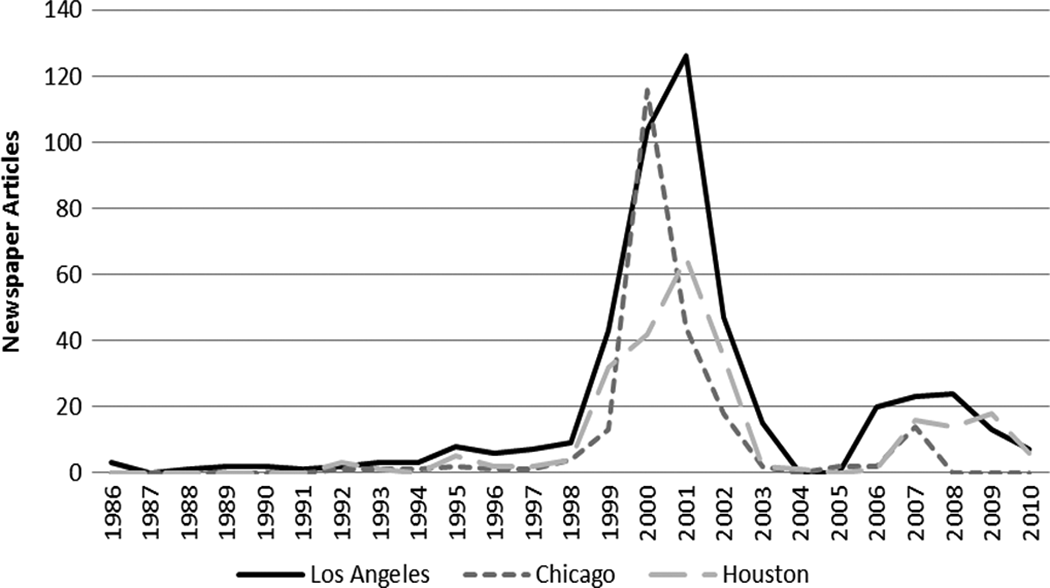
Newspaper reporting of racial profiling 1986–2010.
Context of the Presentation of Racial Profiling by Newspapers
Newspapers present racial profiling to the public in a variety of contexts. Content analysis revealed five broad categories of presentation: The first category includes articles that center on local incidents or allegations of racial profiling in Chicago, Houston, and Los Angeles. The second category includes articles that discuss incidents or allegations of racial profiling in all other cities across the United States (excluding Chicago, Houston, and Los Angeles). This category also includes national articles that discuss racial profiling in a political context. The third category includes articles focused on national, state, or local level laws, policies, consent decrees, or senate bills that reduce the use of racial profiling. Included in this category are discussions about the impact of immigration laws, federally mandated consent decrees that require law enforcement agencies to comply with guidelines to reduce racial profiling, and the adoption of new policies by law enforcement agencies to eradicate the use of racial profiling. The fourth category consists of articles where special interest groups, activists, and/or minority citizens speak out against the use of racial profiling by the police. These groups were reacting to specific local or national incidents, or they expressed the need to eliminate the use of racial profiling by the police. Finally, the fifth category includes all articles that did not fit into any of the first four categories.
Slightly less than one third of the articles (30% or 276) feature incidents or allegations of racial profiling on a national level (Category 2) and 24% (223) of the articles present local stories of allegations or incidents of racial profiling in Los Angeles, Chicago, and Houston (Category 1). Just less than 20% (182) of the articles feature stories about people speaking out against racial profiling (Category 4). Articles discussing legislation, consent decrees, and changes to policy on police use of racial profiling (Category 3) appeared in 13% (126) of the articles, while the remaining 14% (133) of the articles contain information that did not fit into the first four categories (Category 5).
Over half (54%) of the newspaper articles feature stories of allegations or incidents of racial profiling at the local and national level. The most common context in which racial profiling is presented by the three newspapers from 1986 to 2010 centers on allegations of discrimination by police officers or police misuse/abuse of discretion. Articles about people speaking out against racial profiling (Category 4) were most frequently presented in the three newspapers from 1999 to 2002. There was little attention paid to the reaction of racial profiling by citizens prior to 1999 and after 2002. Most of the newspaper articles that featured discussions of legislation, policies, and other forms of regulation of the use of racial profiling by the police (Category 3) appeared in 1999–2002.
Primary Definers of Racial Profiling
Seven broad categories of primary definers emerged from the newspaper articles analyzed for this study: (1) American Civil Liberties Union (ACLU) and National Association for the Advancement of Colored People (NAACP); (2) legal professionals; (3) academics/researchers; (4) social activists/groups; (5) politicians at the federal, state, county, and local levels; (6) religious leaders/groups; and (7) law enforcement officials at the federal, state, county, and local levels. Hall et al. (1978) did not consider citizens primary definers. However, the creation of a separate category for citizens allowed for a comparison of primary definers and nonprimary definers in the newspaper articles.
Less than half (44% or 414) of all of the newspaper articles in this study contain quotes or references to primary definers. Political leaders were quoted or referenced the most (29% or 120) out of all of the groups of primary definers. Many of the newspaper articles specifically reference racial profiling and the 2000 presidential campaign (both President George W. Bush and Al Gore are quoted in the many of the newspaper articles). The most common theme in these newspaper articles focus on political leaders as advocates of legislation centered on the topic of racial profiling. Prior to 9/11, the proposed legislation aimed at eradicating the use of racial profiling by the police. After 9/11, newspaper articles shifted the presentation of racial profiling into a broader discussion of terrorism and homeland security. These articles featured discussions related to U.S. Attorney General John Ashcroft, the Patriot Act, and the identification and detainment of terrorists.
Newspaper articles featuring stories of racial profiling also referenced law enforcement officials (21% or 90) and legal professionals (19% or 78). In most articles, legal professionals (attorneys) were representing racial minority citizens or groups that alleged that the police targeted them. Attorneys describe racial profiling incidents based on their clients’ (citizens) accounts and argue that racial profiling is a harmful police practice. In contrast, law enforcement officials featured in the newspaper articles defended their organizations, officers accused of racial profiling, or they described the steps that they are taking to reduce the use of profiling by police officers.
Civil rights groups and advocates appear in some of the newspaper articles featuring stories about racial profiling. The ACLU and the NAACP appeared in 10% (42) of the articles. This finding makes sense, given that racial profiling is a problem focused on the targeting of racial minority citizens and groups in particular, and these two national level groups have greater name recognition and social/political power than the smaller, less known local social activists/groups. Religious leaders/groups (7% or 29) and local/community-based social activists (7% or 29) comprised 14% of the newspaper articles that contained primary definers. These groups were calling for police reform focused on stopping the practice of racial profiling by the police.
Academics/researchers were the least (6% or 26) quoted or referenced group of primary definers. All of the newspaper articles that featured academics/researchers focused on the results of studies on traffic stops and racial profiling. Seven of the 26 newspaper articles (27%) featuring academics/researchers discussing studies on racial profiling also included statements from law enforcement officials. The statements made by law enforcement officials usually conflicted with the research on racial profiling presented by academics/researchers.
Only a small percentage of the newspaper articles (6% or 26) featured quotes or references to citizens (nonprimary definers). Quotes or references to citizens appear far less frequently than most primary definer groups, with the exception of academics/researchers (6% or 26). There was an even distribution of newspaper articles each year from 1986 to 2010, which featured quotes or references from citizens.
Is Racial Profiling a Problem for All Racial Minority Groups or Only a Few?
Nearly three quarters (73% or 685) of the newspaper articles mentioned a specific race or multiple races when discussing the issue of racial profiling. The Los Angeles Times mentioned specific races in nearly half (47.3%) of all of the articles that specified race/races, followed by the Houston Chronicle (26.5%), and then the Chicago Sun-Times (26.3%). Over half (62% or 425) of the articles mentioned only one race, while the remaining 38% of the articles identified two or more races.
There were some interesting trends in the diversity of races presented by the three newspapers in this study. The Chicago Sun-Times and the Houston Chronicle typically mentioned only one race (African Americans) in the articles that discussed racial profiling from 1986 to 1998, then began to report multiple races in the articles from 1999 to 2002, and then went back to typically only reporting one race from 2003 to 2010. African American was the race most commonly identified in the newspaper articles that identified only one race. In contrast, the Los Angeles Times reported more than one race nearly every year from 1986 to 2010 (the only years that were exceptions include 2004, 2005, and 2010). The high degree of racial diversity presented in the newspaper articles could be a result of the high degree of diversity in the population of Los Angeles (see the Method section for the racial composition of this community).
The newspaper articles that discuss racial profiling from 1986 to 2010 mention a wide range of racial minority groups. In order to get a more concise picture, the racial groups were condensed into four categories: (1) African American/Black (Haitian/Sudanese); (2) Hispanic (Latino/Mexican/Puerto Rican); (3) Asian (Vietnamese, Korean, Chinese, Japanese); and (4) Middle Eastern (Iranian, Iraqi, Arab, Pakistani, Lebanese, Georgian, Syrian).
Of all the racial minority groups mentioned in the newspaper stories focused on racial profiling, African Americans were the most frequently mentioned group (73.2% or 502), followed by Hispanics (43.7% or 300), Middle Eastern/Arab American (11.8% or 81), and Asians (8.9% or 61). The percentage of all four groups equals more than 100% (or 685) because more than one race appeared in some of the articles. Of the 425 newspaper articles that only mentioned one race when discussing racial profiling, 62% (or 266) of the articles identified African Americans, 18% (or 75) articles identified Hispanics, 15% (or 64) Middle Eastern/Arab American, and 5% (or 20) Asian. In general, reporting patterns of the three newspapers in this study present racial profiling as a problem most frequently associated with African Americans (see Figure 2).
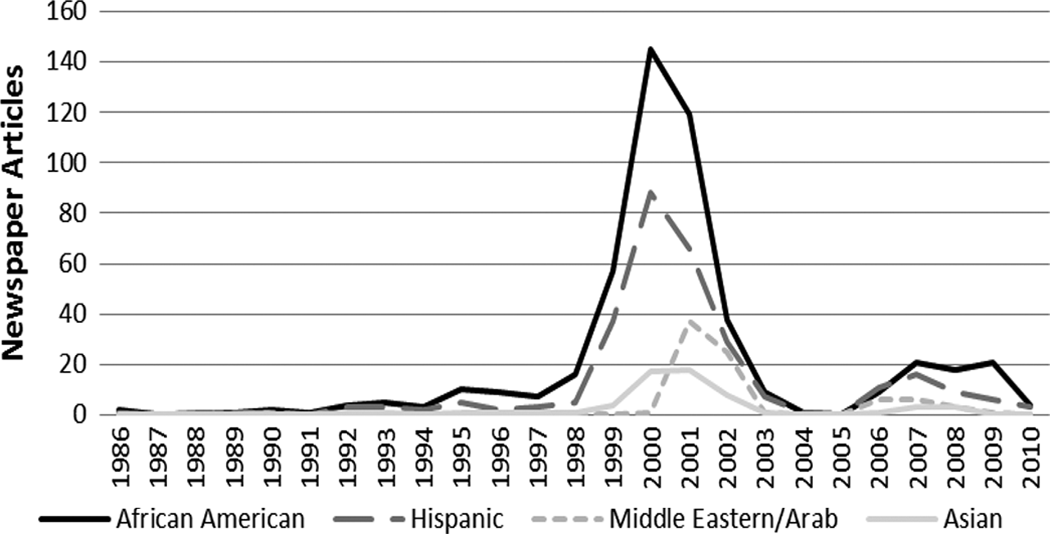
Reports of racial profiling by year and race.
There was some variation in the identification of racial minority groups among individual newspapers. For example, the Chicago Sun-Times and the Houston Chronicle only identify African Americans (and to a much lesser extent Hispanics) when racial profiling is presented from 1986 to 1998. From 1999 to 2002, these newspapers identify multiple races, but then go back to reporting individual races in articles that discuss racial profiling from 2003 to 2010 (again predominantly African American). In contrast, the Los Angeles Times reports multiple races when discussing racial profiling from 1986 to 2010. There is a striking increase in the reporting of multiple races from 1999 to 2002; however, overall, the Los Angeles Times presents racial profiling as a problem for many races across most of the years from 1986 to 2010.
When examining the newspaper articles by year, an interesting pattern emerges regarding the reporting of multiple races within the articles. From 1986 to 1999, the newspapers most frequently identify African Americans (and to a less extent Hispanics) when reporting on racial profiling. Beginning in 2000 through 2002, multiple races appear in the newspaper articles featuring stories about racial profiling. In fact, Middle Eastern/Arab Americans are identified in the articles most frequently during the years 2001 and 2002, while Asians are most frequently identified in the articles in 2000 and 2001. Outside of 2000–2002, both Asians and Middle Eastern/Arab Americans only rarely appeared in racial profiling newspaper articles.
The terrorist attacks of 9/11 increased newspaper presentation of Middle Eastern/Arab Americans when discussing the issue of racial profiling as all of the terrorists were of Middle Eastern descent. It is important to note that the reporting of this group faded just as quickly as it appeared. Middle Eastern/Arab Americans appear in 37 articles in 2001, 25 articles in 2002, 1 in 2003, and 0 in 2004. Since 2004, less than six articles per year mention Middle Eastern/Arab American when discussing racial profiling.
Discussion
This study produced several important findings regarding the presentation of racial profiling by newspapers. The first research question inquired about the frequency and context of the presentation of racial profiling by newspapers. The frequency and context of the presentation of racial profiling varied significantly from 1986 to 2010. From 1986 to 1999, the presentation of racial profiling by all three of the newspapers was infrequent. This is surprising given that the Rodney King beating occurred in Los Angeles in 1991 and that the beating incident received a considerable amount of news coverage at the local, state, national, and international levels. The total number of newspaper articles reporting on racial profiling during this 14-year period was 163 articles (this represents 17% of all of the newspaper articles included in this study). This finding mirrors the assertion by Baynes (2002) that “ …. before September 11 …. coverage of racial profiling [by the media] was often sporadic and failed to fully counteract with other news coverage contributing to the creation of racial stereotypes.”
Racial profiling began to appear in the three newspapers more frequently beginning in 1999 (88 articles). All three newspapers began to present more stories focused on racial profiling after political figures began to call for the collection of data on the race of people who encounter federal and state law enforcement in the late 1990s. The highly publicized cases of police brutality in New York City involving Abner Louima in 1997 and Amadou Diallo in 1999 also likely had an influence on racial profiling getting the media’s attention at this time. This trend in reporting by newspapers was in a study conducted by Warren and Tomaskovic-Devey (2009). Specifically, Warren and Tomaskovic (p. 348) found that “racial profiling was not on the media’s radar until the second quarter of 1998. By the fourth quarter of 1998 and through 2000, stories about racial profiling appeared frequently in both the New York Times and the two North Carolina newspapers … Ultimately, media accounts of gratuitous treatment of minority citizens led many state governments to enact legislation that would ban racial profiling … ” Warren and Tomaskovic concluded that “the media was an important mechanism in the politicization of racial profiling” and that the politicization of racial profiling ultimately “led to the de-legitimation of racial profiling as a viable policing strategy.”
Coverage of racial profiling by all three newspapers continued to increase in 2000. Most of the newspaper articles in 2000 centered on racial profiling and the presidential election. Both George W. Bush and Al Gore were in the articles, as they both proposed strict legislation that would ban the use of racial profiling by law enforcement officials in the United States. This finding supports the argument that racial profiling is a highly politicized topic and that media sources facilitate in the politicization process.
The newspaper articles in 2000 also described highly publicized cases of racial profiling. Baynes (2002) reported similar trends in national news coverage of racial profiling prior to 9/11. He noted that media coverage focused on allegations of racial profiling by prominent individuals (such as Harvard Law professor Charles Ogletree, Associate Attorney General of the U.S. Wayne Budd, and Dee Brown of the Boston Celtics to name a few), while neglecting the profiling of racial minorities living in urban areas (Baynes, 2002).
Nearly all of the newspaper articles centered on racial profiling in 2001 related to homeland security and terrorism. The words “terrorist” and “terrorism” did not appear in any of the racial profiling newspaper articles until after the terrorist attacks on September 11, 2001. The context of the newspaper presentation of racial profiling clearly shifted after 9/11. The newspaper articles went from discussions of racial profiling as it relates to politics and also specific incidents or allegations of racial profiling (pre 9/11), to racial profiling being discussed within the contexts of terrorism and homeland security (post 9/11). Baynes (2002) and Domke et al. (2003) also found this shift in the context of the presentation of racial profiling after 9/11.
In 2002, newspaper coverage of racial profiling began to decrease in frequency. The presentation of racial profiling within the context of Arab/Middle Eastern people, terrorism, and homeland security was also less common in 2002. This context continued to be the most common in the racial profiling newspaper articles from 2003 to 2010. The presentation of racial profiling by newspapers shifted back to contexts that were prevalent prior to 9/11.
The decline in the presentation of racial profiling by the three newspapers continued in 2003–2005. There was an increase in reporting from 2006 to 2009, but then a decrease again in 2010. This reporting trend suggests that racial profiling is no different from any other topic covered by newspapers—one day it is the “pressing issue of the day” and the next day it falls by the wayside when another topic becomes the “pressing issue of the day.” This trend is problematic as it gives the impression to the public that racial profiling is no longer a pressing problem in this country (out of sight out of mind), when in fact, racial profiling is still a very real problem today.
The second research question inquires about primary definers identified in the racial profiling newspaper articles. Politicians are the most common group of primary definers found in the racial profiling newspaper articles (29%). Many of the newspaper articles featuring politicians appear in 2000 (the months before the Presidential election). Politicians used racial profiling as part of their political campaign (whether they were running for political office or trying to keep their political position). George W. Bush and/or Al Gore were in most of the articles discussing racial profiling in 2000. Racial profiling was in newspaper articles describing public policy. Federal and state political leaders were in the newspaper articles as they were responsible for creating and/or advocating policies related to racial profiling. In some instances, the creation and implementation of policies regarding racial profiling was a good thing (such as the mandatory collection of race data during police–citizens interactions, as this provides a layer of police accountability). In contrast, the adoption of strict immigration policies in Arizona in 2010 resulted in reported incidents and allegations of racial profiling.
Law enforcement officials were primary definers in several (21%) of the newspaper articles. They often discredited or downplayed any allegations or incidents of the use of racial profiling by the police. Law enforcement officials also provided information to the newspapers that presented them in a positive light. It was common for law enforcement officials to state that their organizations do not use racial profiling or that they have recently taken steps to reduce the use of racial profiling by adopting policies that require mandatory reporting of citizens’ race during police/citizen interactions. The “deflection technique” used by law enforcement officials in some of the newspaper articles echoes the findings in the Graziano et al. (2010) study. Graziano and her colleagues demonstrated how it was possible to frame competing constructions of an incident of racial profiling, and offer legitimacy to one construction with the help of primary definers (in this case, law enforcement officials) while marginalizing other positions that may not be supported by a primary definer. The findings from the Graziano study suggest that media presentation of police practices can influence public perceptions of those practices (Graziano et al., 2010, p. 71).
Academics/researchers were the least quoted or referenced (6%) primary definer group in this study. This finding is similar to the findings of previous studies where print journalists frequently use government sources (such as law enforcement officials and politicians) as “credible” sources for their news stories, and are less likely to quote or reference academics (Ericson, Baranek, & Chan, 1989; Welch, Fenwick, & Roberts, 1998). It has been suggested that “print journalists search for quotes from sources that support their perspective on news stories, while others suggest that academics/researchers are not frequently mentioned by the news media because they have not bothered to use their professional knowledge for popular consumption” (Barak, 1994, p. 250).
The third research question focuses on the extent to which newspapers present racial profiling as a problem for all racial minority groups or just a select few. The findings from this study suggest that newspapers perpetuate the myth that racial profiling is largely a problem experienced by African American citizens. African Americans are the group that was the most frequently mentioned, followed by Hispanics, Middle Eastern/Arab American, and Asians. In newspaper articles that only mention one race, more than half of the time the newspaper articles identified African Americans. When African Americans appear in conjunction with the topic of racial profiling in three of the every four newspaper articles, it gives the impression to readers that this is primarily a problem for one race. This is problematic (and a myth) as citizens from many race/ethnic minority groups are vulnerable to becoming the targets of profiling by the police.
Baynes (2002) and Domke et al. (2003) assert that the linkage of Arab/Middle Eastern citizens to racial profiling occurred after the terrorist attacks on 9/11. The current study found similar results as only two newspaper articles linked racial profiling to Middle Eastern/Arab Americans from 1986 to 2000. Of the 235 articles published in 2001, 37 articles (or 16%) mention Arab or Middle Eastern Americans being associated with racial profiling (all of which are published after the terrorist attacks on September 11, 2001). Racial profiling appeared in 100 articles in 2002 (25 of those articles discussed racial profiling of Arab/Middle Eastern people) and 19 articles in 2003 (only 1 article mentions racial profiling of Arab Americans).
Despite the evidence that September 11, 2001, broadened the scope of racial profiling to include a new group of people (Middle Eastern/Arab Americans), it was only temporary. The association of Middle Eastern/Arab Americans with racial profiling was at its highest level of reporting in 2001 (37 articles) and 2002 (25 articles), but then quickly diminished in 2003 (1 article) and 2004 (0 articles). It is important to note that African Americans were still three times more likely to be the subject of a racial profiling story in 2001 and 2002 than people of Middle Eastern descent were. This finding reinforces the idea that a racial hierarchy exists in the media coverage of racial profiling found in previous research (Domke et al., 2003).
The findings from this study are important because many Americans use newspapers as their primary source of information about crime and other events in their communities (Journalism.org, 2011). Recent statistics on the prevalence of racial profiling (in this case, during stop and frisks) indicate that racial profiling is still a problem for people of all racial minority groups (New York City Police Department, 2013). Thus, if newspapers are only reporting on racial profiling sporadically, and in a way defined primarily by politicians and law enforcement officials, and as a problem faced primarily by one racial minority group (African Americans), they are not providing an accurate portrayal of racial profiling to the public. That means that the segment of the public that relies on newspapers for information about crime is left grossly misinformed.
This study reveals several important findings regarding the presentation of racial profiling by newspapers; however, it is not without limitations. For example, only three newspapers served as sources of data for this study. While the three newspapers are well suited for the purpose of this study, adding newspapers from other regions or with less diverse populations could change the frequency and context of the presentation of racial profiling. There are several problems that come along with using newspapers as a data source including the issue of selective reporting (Archbold, 2006). The media engages in selective reporting when they decide which stories to present to the public. The variables that determine the presentation of stories to the public varies across media organizations. How and why stories about racial profiling appear in the three newspapers featured in this study is unknown. An unfortunate result of selective reporting is that we cannot be certain that the reporting of racial profiling accurately reflects all of the incidents of racial profiling that have occurred, or the level of accuracy of the information presented about racial profiling. It may also be the case that newspapers only report on racial profiling when it involves the most egregious cases or when there are no other news stories to fill the space within newspapers. The articles analyzed in this study were collected using three search phrases. It is possible that other related search terms could have produced articles that might change the findings of the study.
Despite these limitations, this study reaffirms the need for continued research of newspaper coverage of racial profiling. Future research should consider how changes in media formats might affect this discussion. As newspapers fade in importance, bloggers and 24-hr news networks have taken center stage. How will these changes affect news coverage? Will changes in media formats affect the coverage of topics like racial profiling? Only additional research on this topic in the future will answer these important questions.
Footnotes
Declaration of Conflicting Interests
The author(s) declared no potential conflicts of interest with respect to the research, authorship, and/or publication of this article.
Funding
The author(s) received no financial support for the research, authorship, and/or publication of this article.