



Abstract
Do the intersections between officer race and driver race/ethnicity influence the frequency in citizens’ reports of receiving a traffic ticket during a routine traffic stop in 1999 and 2008? To fully grasp the importance of traffic ticket outcomes, we must first understand how extralegal factors, particularly the intersections between officer race–driver race/ethnicity and the number of vehicle occupants, impact these outcomes. Thus, the current study utilizes the 1999 and 2008 Police–Public Contact Survey to assess the relationship between extralegal factors and traffic ticket receipt during routine traffic stops. Findings illustrate that according to citizens’ reports, extralegal factors, including the intersections between officer race–driver race/ethnicity and the number of vehicle occupants, differentially impact traffic ticket receipt in both the years.
Introduction
Research examining the influence of extralegal factors on police decisions is not new (Black, 1980; Geller & Scott, 1992; Goldman, 1963; Lundman, 1979; Lundman & Kaufman, 2003; Meehan & Ponder, 2002; Westley, 1951, 1953). Extralegal factors can influence police outcomes; are distinct from legal reasons; and include social, political, and situational dynamics. Historically, factors like race, nationality, social class, colleague approval, and deference impacted police decisions (Goldman, 1963; Westley, 1951, 1953). Although some studies found a relationship between factors like race/ethnicity and police decisions to stop (Gaines, 2006), search (Weatherspoon, 2004-2005), and ticket (Gilliard-Matthews, Kowalski, & Lundman, 2008) citizens, other studies conclude that these factors do not impact police officer decisions (Black & Reiss, 1970; Engel, Sobol, & Worden, 2000).
However, in the late 1990s, a disproportionate number of African American and Latino drivers were targeted by police officers for routine traffic stops. Spurred by civil rights organizations (Harris, 1999), government reports (Ramirez, McDevitt, & Farrell, 2000), and the media (Meeks, 2000; Ruderman, 2000), racial profiling, also known as Driving While Black or Brown (DWB), 1 was catapulted onto the national stage. According to court records, police officers were utilizing pretextual reasons to stop, detain, and search individuals who they deemed suspicious (see Whren v. United States, 1996). Their suspicions were predicated on the belief system that minorities (especially Black and Brown males) were more likely than Whites to engage in criminal activity (especially as drug couriers). Thus, the traffic stop served as a way for police officers to gain access and closely examine the occupant and their vehicle (Davis, 1996; LaFave, 2004).
Several studies have substantiated that police officers utilized reasons external to traffic laws to stop and search vehicles and their occupants (Gaines, 2006; Weatherspoon, 2004-2005) and/or ticket drivers (Gilliard-Matthews et al., 2008). However, the National Academy of Sciences report concluded that there was no evidence that police officers of varying racial or ethnic backgrounds exercised their discretion differently when interacting with citizens solely because of race or ethnicity (National Research Council, 2004). The report failed to elaborate on pretextual traffic stops whereby police officers are motivated to stop vehicles based on some other observation aside from an actual legal reason (e.g., traffic law violation), which was the cusp of the original debate. In addition to pretext, research supported that there were disparate outcomes among White, Black, and Latino drivers irrespective of the legal reason for the traffic stop (Gaines, 2006; Terrill & Paoline, 2007; Tomaskovic-Devey, Mason, & Zingraff, 2004). According to these studies, driver race/ethnicity increased the likelihood of being detained, searched, or ticketed during routine traffic stops.
Thus, pretext is connected to outcomes as illustrated in the following example. A police officer pulls over a Black driver whom he/she suspects is a drug courier, yet provides them with a codified legal reason for the stop. 2 During the course of the traffic stop, however, the police officer discovers no signs of criminal wrongdoing on the part of the driver. The police officer must then decide the outcome of the traffic stop (i.e., detain driver longer, search vehicle/driver, and/or issue traffic ticket). However, if the Black driver had not been originally flagged for a traffic stop based on race/ethnicity, then the outcome (that by default) is also based on race/ethnicity would not have occurred.
Prompted by court cases, media attention, and public outcry concerning racial profiling and the police, Congress mandated data collection on police–public contact (Lewis, Creighton, Kinderman, & DeBerry, 1999). During a massive redesign, the Bureau of Justice Statistics (BJS) amended the National Crime Victimization Survey to capture citizens’ reports of their contact with the police. Collected every 3 years, these data provide a comprehensive overview of police–public contact on a national scale (Eith & Durose, 2011). This study builds upon previous research on the effects of extralegal factors on police decisions (Gaines, 2006; Gilliard-Matthews et al., 2008; Lundman & Kaufman, 2003; Terrill & Paoline, 2007; Tomaskovic-Devey et al., 2004; Weatherspoon, 2004-2005).
Particularly, it adds to the Gilliard-Matthews, Kowalski, and Lundman’s (2008) article in two essential ways. First, it measures citizens’ reports of police ticketing outcomes utilizing two waves of data collected 10 years apart (1999 and 2008). Allowing for a longer time period between Time 1 and 2 can possibly point to differences in police ticketing practices. Second, it measures how the number of vehicle occupants impacts citizens’ reports of police ticketing outcomes. Although research exploring the effects of bystanders, other officers, and vehicle occupants is not new (Black, 1980; Felson, 1982; Klinger, 1996), it is increasingly important to understand the impact of human surveillance on police actions (Brown & Frank, 2006; Engel & Calnon, 2004), especially utilizing a national survey.
A Brief History of Race and the Police
The relationship between law enforcement and Blacks in the United States has always been tenuous. After all from slavery to postemancipation, civil rights movements, and thereafter Blacks, have been overwhelmingly the group that the government has sought to regulate and control through law enforcement (Alexander, 2010). In colonial America, the criminal justice system was integral in legitimizing the victimization of slaves and maintaining the powerlessness of Blacks (Genovese, 1970). Utilizing law enforcement for slave patrols and the enforcement of racially biased laws was common practice (Bass, 2001; Hawkins & Thomas, 1991).
Latinos in the United States have also experienced charged relationships with U.S. law enforcement. During the early 1900s, Mexicans increasingly immigrated to Arizona, California, and Texas. As a result, the U.S. government sought to control their influx through deportation (Johnson, 2004), residential segregation (Massey, 1981), and harassment and brutality (Escobar, 1999). By the 1940s, White soldiers challenging Mexican Americans existence in the military and society resulted in the infamous zoot suit riots (Bruns, 2014). By the 1960s, growing social problems in Latino communities continued sparking civil unrest and riots among subjugated and marginalized communities.
This challenging history between law enforcement and Blacks and Latinos is embedded within the U.S. social fabric and not easily eradicated. This is why by the 1990s law enforcement officers use of race and ethnicity to target individuals for suspicion of committing drug crimes was concerning but not necessarily surprising in light of the nations’ history. Initiated in the 1970s, certain drug policies irrevocably linked the illicit drug trade (of crack cocaine and marijuana) to Blacks and Latinos, especially young males (Solis, Portillos, & Brunson, 2009; Welch, 2007). Thus, the declaration of a “war on drugs” resulted not only in the hypercriminalization of Black and Latino male youths but also informal racial profiling practices by the police (Alexander, 2010; Rios, 2011). Aided by our nation’s drug laws, police officers utilized overtly race-based profiles in conjunction with minor traffic infractions as justification to stop, detain, and search certain drivers and their vehicles. For example, in 1985, the Florida Department of Highway Safety and Motor Vehicles issued guidelines to police officers that characterized drug couriers as “ethnic groups associated with the drug trade,” who wear “lots of gold,” and do not “fit the vehicle” (Harris, 1999, p. 6).
For some departments, public knowledge that it was a common practice of police officers to criminalize Black and Latino drivers resulted in changes to policing policies and state laws or a reaffirmation of these policies and laws. Additionally, several lawsuits against police departments charged with pretextual racial profiling (most notably, Maryland State Police and New Jersey State Police) were settled in favor of the plaintiffs (American Civil Liberties Union, 2003, 2008). Regardless, the Supreme Court upheld the use of pretextual traffic stops in Whren v. United States (1998). The high courts’ opinion was that any traffic infraction offense committed by the driver is a legitimate reason for a stop regardless of the officer’s subjective state of mind (Whren v. United States, 1998). Scholars, however, continued to report that the rate at which non-White drivers were profiled by police officers for traffic stops (Gaines, 2006), searches (Weatherspoon, 2004-2005), and tickets (Gilliard-Matthews et al., 2008) far exceeded that of White drivers and were no more likely to result in seizure of illegal contraband or arrest (Meehan & Ponder, 2002).
Other departments attempted to effect change in racially biased policies by increasing the number of non-White police officers in their respective departments. Across the country, however, non-White police officers are still underrepresented (Rojek, Rosenfeld, & Decker, 2012); and when represented, they are concentrated in lower level positions (Gustafson, 2013). Nevertheless, there are higher percentages of police officers in agencies serving large populations, and Black officers outnumber White officers in jurisdictions (e.g., Detroit, Washington DC), where the population majority is Black (Hickman & Reeves, 2006; Sklansky, 2006). According to Reaves (2011) among local law enforcement agencies, one in every four police officers is a racial or ethnic minority, with the number of Latino officers increasing by 16% between 2003 and 2007. The most recent comprehensive data available indicated that police officers were 11.9% Black, 10.3% Latino, and 2.7% Other (Asian, Pacific Islander, and American Indian) in 2007 (Reaves, 2011). Still, the percentage of White police officers in departments is higher than the communities they serve (Ashkenas & Park, 2014).
Extralegal Factors and Police Discretion
Police officers often encounter the public in private places and exercise high levels of discretion (Goldstein, 1997; Reiss, 1968). For example, Goldman (1963) examined police officers’ decisions to refer juvenile offenders to court. He concluded that police officers considered race, nationality, social class, parental cooperation, community attitudes, and their personal attitudes and experiences in deciding how to handle calls involving juvenile offenders. Further, the responding officer not only defined delinquency but also through his actions determined who would be considered delinquent (Goldman, 1963). In studying police officer’s discretionary use of violence, Westley (1951, 1953, 1970) also observed that extralegal factors were influential on police officer decisions. He found that “occupational experience,” approval from colleagues, and suspects’ respect and compliance were related to police officers use of force (Westley, 1970).
Race/Ethnicity and Place
The most common method by which people come into contact with police officers is as a driver in a traffic stop (Eith & Durose, 2011). While the overall justification for the stop can easily be attributed to any number of traffic code violations; officers are also determining whether there is any reasonable suspicion to believe that the vehicles’ occupant(s) may be violating criminal codes. Scholars argue that for officers using pretext, the latter may precede the actual traffic law violation provided as justification for the stop. Extralegal factors like driver race/ethnicity, gender, and social class impact police decisions (Gaines, 2006; Schafer, Carter, Katz-Bannister, & Wells, 2006; Terrill & Paoline, 2007; Tomaskovic-Devey et al., 2004). Even the most rudimentary, mundane, routine traffic stop occurs before the officer flags a vehicle since it begins with the external situational contexts surrounding the stop. For instance, research indicates that profiling by the police is interconnected with race and place (Ingram, 2007; Meehan & Ponder, 2002; Novak & Chamlin, 2012). Thus, where a traffic stop takes place is connected to who is being stopped since the location provides officers with context surrounding what and who is acceptable for that neighborhood.
Because police officers are informed about the places and people within their patrol areas (Novak & Chamlin, 2012; Smith, 1986), it is highly plausible that (some level of) pretext precipitates every routine traffic stop. The reality is that if each and every traffic stop was only about a traffic violation(s), then everyone pulled over would obtain a traffic ticket. However, this is not the case, police officers have the discretion to abort contact at anytime during the traffic stop and they can use other factors external to the legal reason for the traffic stop to ticket or not ticket drivers. Research examining the effects of police officer race on discretion typically has mixed results, with some studies indicating that “police blue” trumps police officer race effects (Fyfe, 1981; Reiss, 1968; Wilkins & Williams, 2009), while others highlight the effects of police officer race on attitudes (Rossi & Henry, 1974; Weisburd & Greenspan, 2000) and actions (Brown & Frank, 2006; Schafer et al., 2006).
Race/Ethnicity and Other Factors
There is a long trajectory of research that demonstrates police officers use driver demographics and situational factors in their decisions (Black, 1980; Ross, 1960; Skolnick, 1966). According to this research, factors like gender (Gilliard-Matthews et al., 2008; Lundman & Kaufman, 2003), age (Lundman, 1994; Schafer et al., 2006; Tillyer & Engel, 2013), and number of vehicle occupants (Black, 1980; Tillyer & Klahm, 2015) have all impacted police discretion during routine traffic stops. For example, Lundman and Kaufman (2003) utilized the Police–Public Contact Survey (PPCS) and found that driver race and gender impacted traffic ticket receipt. Particularly, females were less likely than males to receive a traffic ticket during routine traffic stops (Lundman & Kaufman, 2003). Utilizing police officer records, Tillyer and Engel (2013) examined the effects of other driver demographics on police outcomes, finding that young Black males are differentially issued warnings and citations. Other studies have also found an impact of age on police decisions to search and tickets drivers (Gilliard-Matthews et al., 2008; Lundman, 1994; Rojek et al., 2012). Age effects, however, are more prevalent when considered alongside other extralegal factors like race/ethnicity and gender (Tillyer & Engel, 2013).
In addition to driver demographics, there are other factors specific to the traffic stop that impact police discretion. For instance, Tillyer and Klahm (2015) analyzed police records and concluded that police officers were more likely to search vehicles when other vehicle occupants were present. Similarly, other studies have argued that police officers are more likely to assert their situational power when “an audience” was present (Felson, 1982; Klinger, 1996). In contrast, some studies indicate that vehicle occupants decrease formal police actions during routine traffic stops (Black, 1980; Tillyer & Engel, 2013). These variations in findings concerning the differential impact of vehicle occupants on police discretion may be a factor of the number and/or status (i.e., driver’s child, driver’s peer, and other police officer) of occupants.
Intersections Between Driver and Officer Race/Ethnicity
Although this study is not a direct test of any particular theory, research has broadened our understanding of the relationship between race/ethnicity and police discretion during routine traffic stops (Alpert, MacDonald, & Dunham, 2005; Petrocelli, Piquero, & Smith, 2003; Wilkins & Williams, 2009). For instance, sociological perspectives have postulated that police behavior is a factor of some aspect of their social environment (Chambliss & Seidman, 1971; Wilkins & Williams, 2009; Zingraff et al., 2000). These perspectives include conflict theory (Chambliss & Seidman, 1971; Zingraff et al., 2000), critical race theory (Bell, 1976; Freeman, 1978), and the police blue hypothesis (Wilkins & Williams, 2009). Differences in theoretical explanations however are embedded in whether police officer race (i.e., conflict or critical race theories) or police culture (i.e., police blue hypothesis) attribute to police discretion.
Conflict theory proposes that social order is produced through power and coercion. Within the context of policing, it argues that police target minorities because they are a potential threat to the hegemony of the White elite (Chambliss & Seidman, 1971). Petrocelli, Piquero, and Smith (2003) utilized Richmond police stop data to assess the impact of individuals and neighborhoods on police decisions to stop, search, and arrest. They concluded that the percentage of Blacks in the neighborhood affected searches during those traffic stops; however, the neighborhoods’ crime rate and percent Black population decreased the percentage of traffic stops that ended in arrest/summons (Petrocelli et al., 2003). Thus, police decisions to stop and search these vehicles may have been unsubstantiated or did not warrant enough information for a summons. Borne from conflict theory, racial threat hypothesis has also been used in police traffic stop research and similarly concluded that the racial composition of a neighborhood can increase police stops and searches (Novak & Chamlin, 2012).
Borne from legal scholarship, critical race theory explores how existing power structures impact and oppress people of color at the intersections of race, sex, class, and so forth (Bell, 1976; Freeman, 1978). Within police research, it has been used as a lens to explore police–public contact. For instance, Baynes (2002) found that police officers stopped and searched Black men driving luxury vehicles on the pretext of violating a traffic law that other drivers violated but were not stopped. Similarly, analyzing observational data of citizen stops, Alpert, MacDonald, and Dunham (2005) determined that nonbehavioral cues heightened police suspicions of minorities; however, they were not more likely to stop and question people based on minority status alone. Romero (2006) also concluded that police officers utilized racial and ethnic biases to stop and search people they suspected were illegal immigrants. Thus, racial and ethnic identity precipitated police officers contact with minorities (Alpert et al., 2005; Baynes, 2002; Romero, 2006).
The police blue hypothesis examines how police officers are informally and formally socialized to learn the required organizational behaviors and attitudes (Wilkins & Williams, 2009). Therefore, it examines police actions during traffic stops from an organizational standpoint. For instance, Paoline and Terrill (2007) found that police officers who adhered to organizational culture were more likely to engage in traffic stop searches than police officers who resisted police cultural attitudes. Interestingly, increases in minority officers have led to researchers examining the effects of the police blue hypothesis on minority police actions. Wilkins and Williams (2009) examined whether the presence of Latino officers “reduced the racial disparity in traffic stops” (p. 775). They concluded that their presence increased racial disparity in traffic stops, as Latino officers were socialized into the police blue culture (Wilkins & Williams, 2009). Other studies conclude similar findings, as it relates to minority officers’ professional socialization into the police culture and how it affects their contacts with the public (Gilliard-Matthews et al., 2008; Paoline & Terrill, 2007; Terrill, Paoline, & Manning, 2003).
Whether it is police officer race or police culture, previous research is clear: White drivers fair better than non-White drivers in their contacts with police officers. Unlike their counterparts, non-White drivers are disproportionately targeted for stops, searches, and other negative outcomes (Gaines, 2006; Terrill & Paoline, 2007; Tomaskovic-Devey et al., 2004). Thus, we know that police officers are granted extreme discretion in their contacts with the public and hold the ultimate situational power during routine traffic stops. Further, the history between police officers, Blacks, and Latinos in the United States is tenuous, since police officers have been systematically used to regulate and control them (Alexander, 2010; Bass, 2001; Bruns, 2014; Johnson, 2004). Therefore, this study will test the effects of extralegal factors, particularly the intersection between officer race and driver race/ethnicity and number of vehicle occupants, on citizens’ reports of traffic ticket receipt in 1999 and 2008.
Study Description
Data and Cases
The present study utilizes citizen’s reports of their contacts with police officers to examine how extralegal factors impact traffic ticket receipt, while controlling for the legal reason for the traffic stop. Data are drawn from the 1999 and 2008 PPCS (Eith & Durose, 2011; Langan, Greenfield, Smith, Durose, & Levin, 2001). Both data collection instruments are supplements to the annual National Crime Victimization Survey (Eith & Durose, 2011; Langan et al., 2001). To be included in the surveys, respondents had to be 16 years or older and answer a series of questions about personal crime victimization and contacts they had with police in the previous 12 months. Of the 80,543 randomly selected respondents in 1999, 5,354 reported at least one traffic stop where they were the driver, pulled over for a routine traffic stop in which there were no drugs, alcohol, or guns involved; no arrest made; and the vehicle was not stopped because of a roadside check or other suspicion. Of approximately 60,000 respondents in 2008, 3,855 met the aforementioned criteria to be included in the analysis. These are the data under examination in the present study.
Although police come into contact with the public every day, the PPCS is only collected every 3 years. Unlike the Gilliard-Matthews et al. (2008) article, I examined data that were collected 10 years apart for two important reasons. First, 1999 and 2008 were chosen to allow for a substantial time difference between the heightened attention to DWB and its aftermath. Long-term organizational level and/or within-group behavioral changes are not always sustainable. Thus, time periods that allow for a 10-year time difference would better capture these differences. Second, there needed to be consistency in the variables measured in the two time periods. With every wave of the PPCS, changes occur in questions and response options. Thus, I have chosen two waves of survey data, where every variable under analysis is included and similarly measured.
Traffic Ticket Dependent Measure and Estimation
The traffic ticket dependent measure is dichotomous (yes = 1, no = 0); therefore, I estimate the models using logistic regression (Kaufman, 1996; Long, 1997). Both iterations of the PPCS have complex cluster designs and weighting of cases (Durose et al., 2007; Langan et al., 2001). BJS researchers utilize a complex cluster design because it is economically practical for the following reasons. First, it allows them to randomly select a subset of the population as opposed to interviewing the entire U.S. population. Second, because the U.S. population is naturally concentrated in certain areas of the country, it allows BJS researchers to sample (or even oversample) certain areas of the country as needed. BJS statisticians weight cases to approximate a nationally representative sample.
Therefore, I adjust for this complex cluster design and weighted samples using Taylor series expansion in STATA (StataCorp, 2013). Analyses that do not account for the complex cluster design and weighted cases will yield biased perimeter estimates (Engel, 2005; Lohr, 1999). Taylor series expansion postulates the exact value of a function for all values of x, where that series converges. Therefore, “for any value of x on its interval of convergence, a Taylor series converges to f(x)” (Dienes, 1957). It is denoted by the following formula:
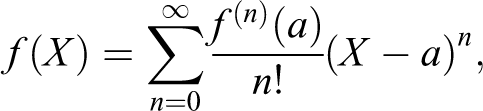
where n! is denoted by the factorial of n and f(n)(a) is denoted by the nth derivative of f which is calculated at the point a. Due to the complex cluster design and weighted samples, Taylor series expansion will yield more precise estimates than other analyses (Perera, Sooriyarachchi, & Wickramasuriya, 2014). Therefore, analyses presented are grounded in weighted samples. 3
Because I utilize this type of analysis, I cannot apply Wald or χ2 test to compare the differences between the two time periods (Allison, 1999; Mood, 2010). These tests would produce biased results since they would not account for the unobserved heterogeneity in the binary regression models (Allison, 1999). Therefore, to assess differences in the two time periods, I conduct predicted probabilities for traffic ticket receipt. It is useful to calculate the probability of “x” causing “y” when all other variables are held constant at their means.
Control Measures
Research has consistently shown that police officers exercise high levels of discretion in their contacts with the public. Thus, police officers utilize extralegal factors alongside legal reasons in their handling of the public, as it relates to adjudicating juveniles (Goldman, 1963; Lundman, 1994), arrest decisions (Kochel, Wilson, & Mastrofski, 2011; Piliavin & Briar, 1964), and use of force (Gau, Mosher, & Pratt, 2010; Westley, 1970). To assess citizen’s reports of traffic ticket receipt, I control for both legal and extralegal factors, presenting them below in the approximate order, in which they unfold during the course of a routine traffic stop (see Table 1 for distribution of these independent measures).
Control and Explanatory Measures by n and Percentage Traffic Ticket: PPCS 1999 (Unweighted n = 5,354) and PPCS 2008 (Unweighted n = 3,855).

Note. PPCS = Police Public Contact Survey; MSA = metropolitan statistical areas.
aWith the exception of driver age (see immediately below), first explanatory measure in each group is the reference category in the multivariate models.
bContinuous explanatory measure in the multivariate models. Mean age in 1999 was 39.00. Mean age in 2008 was 40.00.
Size of place
PPCS 1999 and PPCS 2008 (Eith & Durose, 2011; Langan et al., 2001) provide size of place information by coupling census data with respondent’s reported addresses. I use these data to construct size of place dummy measures from metropolitan statistical areas (MSAs). The data are coded as follows: “MSA central city” (yes = 1, else = 0) and “in MSA” (yes = 1, else = 0). The reference category is “not in MSA.” The size of place measure is included because research has concluded that people are more likely to drive places close to where they live (U.S. Bureau of the Census, 2001), thus traffic stop encounters will also be more likely to occur close to where they live (Lundman & Kaufman, 2003). Additionally, police officers in high-population jurisdictions are more likely to issue traffic tickets in these jurisdictions (Gilliard-Matthews et al., 2008; Lundman & Kaufman, 2003). I expect traffic stops in high-population areas to increase the likelihood of a traffic ticket being issued.
Legal reason for stop
I use the police-reported legal reason for their traffic stop as understood by the respondent to construct a control measure for why they were stopped. It is coded as speeding (yes = 1, else = 0). The reference category is stops for other traffic violations (i.e., stop light/sign violation, seatbelt violation, expired plates, vehicle defect, record check, and illegal turn or illegal lane change). Previous research has indicated that police decisions are made within the context of the law (Lundman, 1996). I expect speeding violations to increase the likelihood of a traffic ticket being issued.
Driver sex
I represent sex as a dichotomous dummy measure according to how the respondent self-identified. It is coded as female (yes = 1, else = 0). The reference category is male. Previous research has found females to be the recipient of more favorable and lenient police treatment than males (Reiner, 1992), especially as it relates to traffic ticket receipt (Gilliard-Matthews et al., 2008) attributing to traditional gender role expectations that place women and girls in deferent roles in need of protection. I expect females to be ticketed less often than males.
Driver age
Respondents reported their age in years, so I construct dummy measures around the mean (above the mean/below the mean) to illustrate relative percentages. However, in the models, age is reported as a continuous measure. Age effects on police decisions research have been mixed (Black, 1980; Lundman, 1994); however, some indicated that police officer leniency increases as driver age increases (Weidner & Terrill, 2005). I expect older drivers to be ticketed less often than younger drivers.
Vehicle occupants
Respondents reported whether passengers were in their vehicle at the time of the traffic stop. I construct a dichotomous dummy measure that is coded as passenger (yes = 1, else = 0). The reference category is no passenger. Previous research has indicated that situational factors like the existence and/or number of passengers has influenced police decisions (Schafer et al., 2006). I expect drivers with passengers to be ticketed less often than drivers who are alone.
Explanatory Measures (Intersectional Effects)
When a police officer pulls someone over for a traffic stop, they see the driver as not just a Black driver or a female driver but as a multidimensional entity (e.g., a young Black female driver). Further, they approach the situation not only with respect to their position as a police officer but also within their own socially constructed context (e.g., a young White male police officer). 4 Thus, the intersectional effects between “officer race and driver race/ethnicity” on police decisions to issue traffic tickets is also the focus of this study.
Officer race
I construct an explanatory measure for officer race based upon respondents’ classification of officers as Black, Other, or unknown. It is non-White officers (yes = 1, else = 0). The reference category is White officer. The decision to group non-White police officers is driven by the historical data, which indicates that although there has been consistent growth in non-White police officers over the past decade (Reaves, 2012), their numbers in police departments across the country are still relatively small (Reaves, 2011).
Driver race and ethnicity
Respondents’ self-identify as “Black,” “Latino,” “Other,” or “White,” and I use their classifications to construct dummy measures. The “Other” category was created to collapse several racial categories (including “Asian,” “Middle Eastern,” “Native American,” and “Mixed”) into one category because of the low number of survey respondents identifying in these race/ethnicity categories. The measures are coded as follows: Black (yes = 1, else = 0), Latino (yes = 1, else = 0), and Other (yes = 1, else = 0). “White” drivers form the reference category.
Officer race and driver race/ethnicity
Intersectional effects between officer race and driver race/ethnicity are estimated using seven dummy measures. They are White officer–Black driver, White officer–Latino driver, White officer–Other driver, non-White officer–White driver, non-White officer–Black driver, non-White officer–Latino driver, and non-White officer–Other driver. White officer–White driver is the reference category.
Models
Two distinct models are presented to illustrate the relationship between extralegal factors and traffic ticket receipt. In both models, I manipulate the entry of the control and explanatory measures. In Model 1, I estimate officer race and driver race/ethnicity independent of each other alongside the control and explanatory measures. In Model 2, I estimate the intersections between officer race and driver race/ethnicity alongside the control and explanatory measures, omitting the independent measures for officer race and driver race/ethnicity.
Results
The results support that extralegal factors influence police officer ticketing decisions in 1999 and 2008. Table 2 illustrates that in 1999 and 2008, traffic ticket receipt is more likely to occur in places with higher populations, consistent with research that illustrates the relationship between police decisions and place (Meehan & Ponder, 2002). Additionally, speeding was the strongest predictor of traffic ticket receipt in both 1999 and 2008. Consistent with research observing police deference to females (Gilliard-Matthews et al., 2008), they were ticketed less often in both 1999 and 2008, although it is only statistically significant in 1999. Older drivers were also ticketed less often than younger drivers in 1999 and 2008, which supports previous research on age and police decisions (Weidner & Terrill, 2005). Finally, drivers with passengers are ticketed less often than drivers who are alone during the traffic stop (Schafer et al., 2006).
Logistic Regression Models of Traffic Ticket on Control and Explanatory Measures: PPCS 1999 (Weighted n = 14,329,722) and PPCS 2008 (Weighted n = 16,334,211).

Note. CBPP = contacts between police and the public; MSA = metropolitan statistical areas.
aModels adjusted for complex cluster design using Taylor-series expansion.
*p < .05. **p < .01. ***p < .001. One tailed.
Some of the most intriguing findings in Table 2, however, relate to officer race and driver race/ethnicity. In 1999 and 2008, Black, Latino, and Other drivers are more likely to report receiving traffic tickets than White drivers, similar to previous research (Gilliard-Matthews et al., 2008; Lundman & Kaufman, 2003). Among driver race/ethnicity, Latino drivers are the strongest predictor of traffic ticket receipt in 1999. However, in 2008, Other drivers are the strongest predictor of traffic ticket receipt. In both 1999 and 2008, non-White officers are significantly more likely to issue traffic tickets than White officers. This finding may support the notion that police blue (or assimilation into the traditional police subculture) trumps the officers’ race/ethnicity (Weitzer, 2000; Wilkins & Williams, 2009).
Table 3 illustrates the intersection effects model in which I manipulated the entry of police officer race and driver race/ethnicity alongside the other control measures. Although the control variables are included, it is only for illustrative purposes, as the magnitude, direction, and significance remain unchanged from Table 2. The intersection effects model shows a comprehensive picture of the relationship between officer race–driver race/ethnicity and traffic ticket receipt. In 1999, White police officers are significantly more likely to ticket Black, Latino, and Other drivers, while non-White police officers are significantly more likely to ticket Black drivers. In 2008, White officer–Black driver ticket receipt is indistinguishable from that of White officer–White driver ticket receipt. Rather White officers ticket Latino and Other drivers significantly more often, while non-White officers significantly ticket White, Black, and Latino drivers. In both 1999 and 2008, non-White officer–Other driver have ticketing that is indistinguishable from White officer–White driver.
Logistic Regression Models of Traffic Ticket on Control and Explanatory Measures: PPCS 1999 (Weighted n = 14,329,722) and PPCS 2008 (Weighted n = 16,334,211).
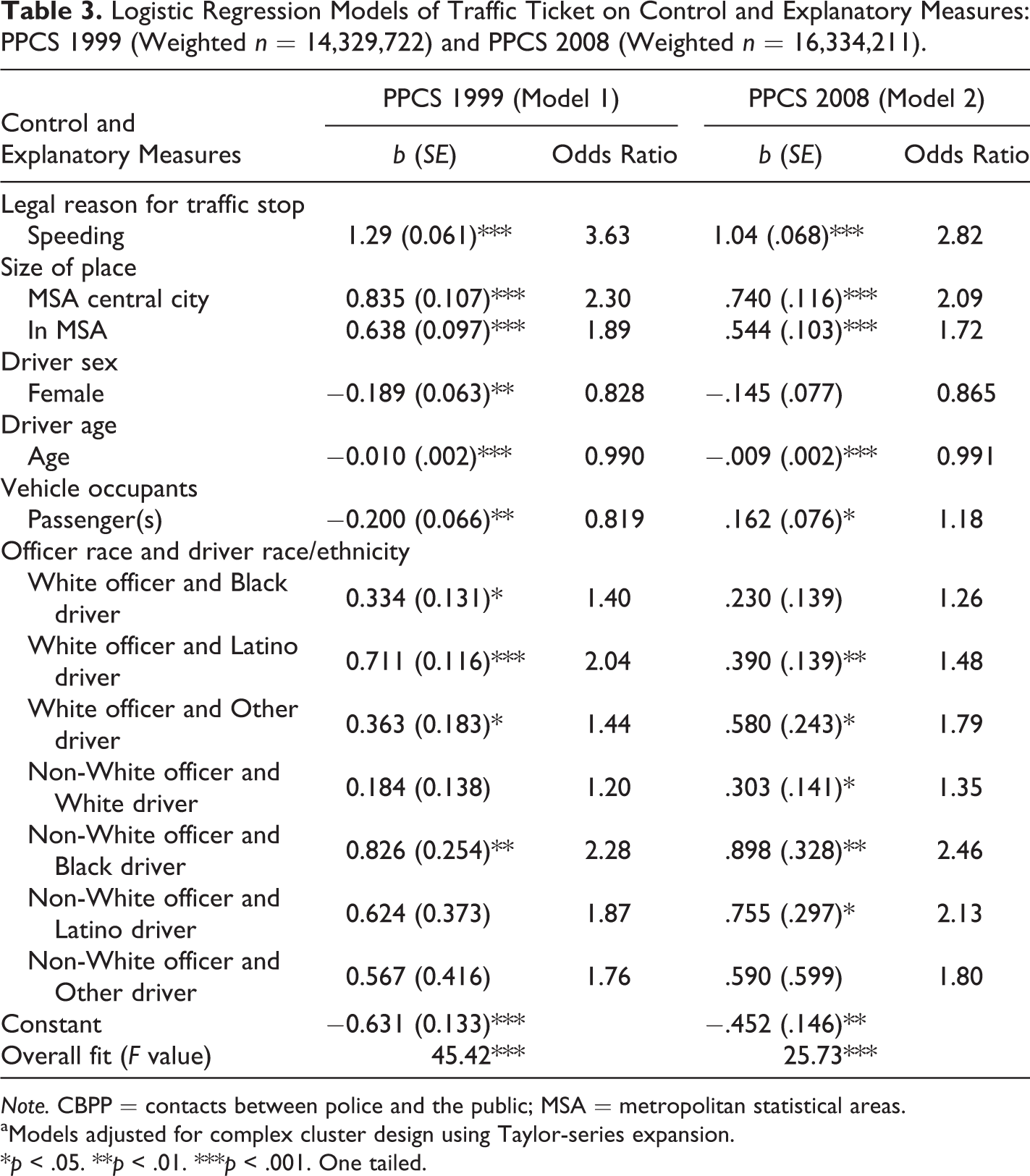
Note. CBPP = contacts between police and the public; MSA = metropolitan statistical areas.
aModels adjusted for complex cluster design using Taylor-series expansion.
*p < .05. **p < .01. ***p < .001. One tailed.
Table 4 depicts the predicted probability of traffic ticket receipt for the race/ethnicity and vehicle occupant measures. 5 Across the board, there is not much variation in predicted probabilities between the two time periods, with the exception of a few measures, namely, non-White officer, Other driver, White officer–Other driver, and vehicle passengers. For instance, when all other extralegal factors are set at their means, non-White officers in 1999 have a 61% chance of issuing a traffic ticket relative to 67% chance of issuing a traffic ticket in 2008. Additionally, Other drivers in 1999 have a 67% chance of traffic ticket receipt relative to a 72% chance of traffic ticket receipt in 2008. When this relationship is further teased out, we learn that White officer–Other driver in 1999 have a 64% chance of receiving a traffic ticket relative to a 72% chance of traffic ticket receipt in 2008. Last, vehicles with passengers in 1999 have a 52% chance of nontraffic ticket receipt relative to a 62% chance of traffic ticket receipt in 2008.
Predicted Probability for Traffic Ticket Receipt and Selected Measures.

Note. Standard errors in parentheses.
aAll predictors held at their mean value.
bPredicted probabilities cannot be calculated for data that are not statistically significant in the logistic regression.
*p < .05. **p < .01. ***p < .001.
Discussion
This analysis examines the intersectional effects of officer race and driver race/ethnicity on citizens’ reports of traffic ticket receipt during their traffic stop encounters with police officers. It advances previous research on police officer discretion by accounting for the time between the heightened attention to DWB and its aftermath. It focuses on the intersections of officer race and driver race/ethnicity on traffic ticket receipt, utilizing national survey data obtained from citizens in 1999 and 2008 from which to assess these experiences.
The results indicate that White police officers ticketed drivers of color more so than White drivers in both the years. In 1999, they were more likely to ticket Black, Latino, and Other drivers. In 2008, their ticketing of Latino and Other drivers remained, while their ticketing of Black drivers was indistinguishable from their ticketing of White drivers. Non-White police officers, however, ticketed White, Black, and Latino drivers consistently in both 1999 and 2008. However, their ticketing of Other drivers remained insignificant in both 1999 and 2008. In 1999 and 2008, Latino drivers receiving tickets from White and non-White officers remained consistent, while Other drivers were more likely to receive tickets from White officers only. Predicted probability analyses revealed that there was no difference in traffic ticket receipt for Black drivers between 1999 and 2008. However, Latino and Other drivers had marginal changes in traffic ticket receipt between 1999 and 2008. That is, the chance of Latino drivers receiving a traffic ticket slightly decreased, while it increased for Other drivers between the two time periods.
In both 1999 and 2008, people of color report receiving traffic tickets at higher rates than White drivers. If all drivers were stopped because they violated a traffic law, then all drivers would receive tickets. However, this is not the case because police officers exercise discretion. Thus, Black, Latino, and Other drivers report traffic ticket receipt at a higher percentage than Whites. Further, when accounting for the legal reason for the traffic stop, non-Whites are ticketed more so than Whites by all officers. Thus, my findings suggest that people of color are being negatively impacted by the power structure (i.e., law enforcement) that uses not only driver race/ethnicity but also the intersections between their race and the driver’s race/ethnicity to stop (and subsequently ticket) drivers. If officer race were not an issue, marked difference between citizen’s reports of traffic ticket receipt from White and non-White officers would not have been uncovered. These findings align with previous research that applied critical race theory to discretionary outcomes of police actions (Baynes, 2002). Additionally, the consistent ticketing by non-White officers regardless of driver race/ethnicity may point to the relevance of the police-blue hypothesis (Paoline & Terrill, 2007). That is, it is plausible that the police culture prevails as non-White officers work to assert their situational power and ascription to the police organizational structure during police–citizen interactions.
Finally, there is a relationship between vehicle occupants and traffic ticket receipt in both the years. In 1999, drivers with vehicle occupants were less likely to be ticketed than drivers who were alone at the time of the traffic stop, aligned with previous research (Black, 1980; Tillyer & Engel, 2013). However, in 2008, drivers with vehicle occupants were more likely to be ticketed than drivers who were alone at the time of the traffic stop also aligned with research (Felson, 1982; Klinger, 1996). The differences in 1999 and 2008 findings may be attributed to the number and/or status of occupants; however, it is noteworthy that during a time when there was heightened attention to DWB, officers were least likely to ticket drivers. However, in 2008, officers ticketed drivers with passengers more, presumably due to a number of factors that may have included increased surveillance, demonstrations of situational power, or other situational contexts specific to the nature of the interaction.
DWB: 10 Years Later
Gilliard-Matthews et al. (2008) found that Black officers changed the frequency with which they ticketed Black drivers between 1999 and 2002, while White officers ticketed Black drivers at high frequencies in both 1999 and 2002. Several factors were provided as justifications for these findings including the increase of Black citizenry to police careers, the experiences of Black police officers as “outsiders” to the traditional police culture, and the increased attention to DWB (Gilliard-Matthews et al., 2008). However, the current analysis (which allows for a 10-year time difference between Time 1 and Time 2) demonstrates that the probability of White officers ticketing Latino drivers slightly decreased, while the probability of them ticketing Other drivers increased between 1999 and 2008. Further, the probability of non-White officers ticketing Black drivers also slightly increased between the two time periods. There are (at minimum) three provisional explanations for these findings.
First, in the aftermath of DWB, and the legislation, settlements, and police policies that ensued, it became clear that the war on drugs (primarily) impacted police decisions to utilize pretextual reasons (i.e., race and place) to facilitate traffic stops. However, 10 years separates the first wave of data from the 2008 wave of data, and in that time, Americans have lived through the events of September 11, two wars, and debates over illegal immigration. These events and debates have awakened a focus on Latino and the racial Other (not including Black). Thus, the increased chance of Other drivers receiving traffic tickets particularly from White officers in 2008 (compared to 1999) could have been fueled by the war on terrorism and debates over immigration policies. Similar to the way that the war on drugs facilitated DWB incidents. Thus, these changes have facilitated White police officers to use pretextual reasons to stop and subsequently ticket Other (and to a lesser degree Latino) drivers in 2008 (Harris, 2002; Johnson, 2004; Kobach, 2005; Wishnie, 2004).
Second, although there have been substantial efforts to increase the number of minority (e.g., race and sex) police officers, the reality is that the policing field is still largely dominated by White males, especially in supervisory positions (Rojek et al., 2012). Regardless of race, these police officers are subject to the same social world as the rest of us. Thus, if society constructs illegal immigration as a social problem, then police officers may focus on people who looks appear to be of Latino/a descent. Similarly, a social construct of terrorism as a social problem will focus police officers’ attention to people whose looks appear to be that of Middle Eastern descent. Additionally, their experiences as a White male (or non-White male) in the United States do not vanish once they become a police officer. They are by-products of the environment, and the research has illustrated that race relations, cultural sensitivity, and building effective police–community partnerships are absent from many recruitment, selection, and training phases of police departments (U.S. Commission on Civil Rights, 1981, 2000). Additionally, many law enforcement preemployment screeners and psychological evaluations do not ask one single question to garner race/ethnicity or class biases.
Third, aside from historical contexts and social constructs, police officers are given mandates to indirectly or directly target certain groups of people under the auspices of preserving public safety. Legislation like the U.S. Patriot Act provided the foundation with which to target individuals based on their dress, behavior, and apparent ethnicity. Even if the original reason for such legislation was not race based, it has become apparent over the past decade that many police officers at every level are utilizing biased practices in targeting individuals for stops, searches, and detainments (Akram & Johnson, 2002; Muller, 2003; Nafziger, 2009). Thus, law not only creates and defines crime but it also creates and defines criminals (Hagan, 2012). As legal actors, police officers are carrying out their duties within the legal prescription, possibly without conscious aforethought given to the hidden biases within the laws.
Explanations for the data presented here are provisional in that it illustrates police officer ticketing practices without being able to demonstrate a direct linkage between historical contexts and police decisions. Doing so is beyond the scope of the present research. Instead, this research demonstrates police officer ticketing practices in 1999 and 2008 and suggests that contrary to the 2004 National Academy of Sciences Report, police officers do use contextual factors distinguishable from the legal reason for the traffic stop in their ticketing decisions.
Limitations and Future Directions
There are a few limitations to the current study. First, I am unable to capture how the intersections between race/ethnicity and sex and officer race impact traffic ticket. Although the variables and responses exist in both waves of the survey, the relatively small number of respondents in each race/ethnicity–sex category (once the data are disaggregated to this level) makes those interpretations arduous. Second, my data rely upon respondents’ memories of their contacts with the police and therefore may be subject to recall error. However, the majority of what we know about crime and victimization relies on citizens’ reports (i.e., National Crime Victimization Survey). Additionally, the recall time period was within 1 year (prior to the survey) and arguably memorable since police–public contact is not an ordinary event in the lives of most people. Third, there are other factors that can impact police officer decisions during the routine traffic stop, which may include neighborhood safety, weather conditions, and citizen deference. Understanding the impact of situational contexts surrounding police–citizen interactions would be useful.
Future research should attend primarily to three foci to further advance our understanding on police discretion during routine traffic stops. First, the current study suggests that for some drivers, the chance of receiving a traffic ticket were higher in 2008 than in 1999. Specifically, Other drivers had an increased chance of receiving a traffic ticket particularly from White officers. Although Black drivers traffic ticket receipt remained unchanged between the two time periods, the chance of non-White officers ticketing them in 2008 was slightly higher than 1999. Drivers with passengers also had a higher chance of receiving a traffic ticket in 2008. Gilliard-Matthews et al. (2008) found differences in police ticketing decisions as well; however, they reported that Black police officers changed their ticketing of Black drivers within a 3-year period. The substantial difference between the two studies is the time frame. Therefore, what the present research suggests is that a longitudinal analysis of police ticketing decisions is warranted because neither a 3-year nor 10-year time frame can truly ascertain the comprehensive and historical effects on police decisions to issue traffic tickets during routine traffic stops.
Second, like drivers, police officers not only have a race/ethnicity but also a sex and age. Understandably, PPCS relies upon citizen accounts of their encounters with police officers. However, citizen accounts have been used for decades and are considered to be reliable and valid; their recollection has become the foundation for data in the uniform crime reports, victimization surveys, and self-report surveys. Therefore, it is essential that police officer sex and age data are collected as well because just as police officers’ interaction with drivers is dependent on the drivers’ race, sex, and age (in addition to other extralegal factors), so is their own sex and age influential on their contacts with the public. For it is through this lens that they experience the social world.
Third, the present research asserts that due to their frequency, traffic stop encounters are a valid arena to measure police–public contact (Durose, Smith, & Langan, 2007; Langan et al., 2001). However, stop and frisk as well as detainment practices are also ways with which the public (especially those living in urban areas) come into contact with the police. Terry v. Ohio (1968) provided the legal authority for police officers to utilize criminal search and seizure practices without probable cause, a practice that placed minorities and the poor at the impulse of police officer discretion (Harris, 1994). This landmark case, however, marked another point in history, where the application of the law is racially biased although the law itself is seemingly race neutral. Gelman, Fagan, and Kiss (2007) found that New York City police officers stop and frisked “persons of African and Latino descent” more than Whites. Similarly, after the September 11 terrorist attacks, laws were enacted that placed Arabs and Muslims (even those who appeared to be) at a disadvantage because they could be stopped, searched, and detained by police officers under the auspices of public safety (Akram & Johnson, 2002). The recession that ensued following two wars and an economic meltdown only further isolated already marginalized ethnic groups (i.e., Latinos) under the auspices of targeting illegal immigrants (particularly of Mexican descent) to preserve American jobs. Thus, a nationwide measurement of these additional police practices would only add value to a discussion of how extralegal factors influence police discretion set within historical contexts. Further longitudinal research into the intersectional effects on police discretion in all facets of their contacts with the public is necessary. 6
The present study offers a clear (albeit provisional) illustration of police discretion during routine traffic stops set in the aftermath of the heightened attention to DWB. Based on citizen’s reports, findings illustrate that certain extralegal factors did impact traffic ticket receipt in both the years. Overall, people of color were still more likely to be ticketed than White drivers. Additionally, the chance of White officers ticketing Other drivers increased between the two time periods, while White officers ticketing of Latino drivers slightly decreased. The chance of non-White Officers ticketing Black drivers also slightly increased. These findings indicate that police blue may trump non-White officer race effects or challenge the underlying assumption that non-White officers do not racially profile. Additionally, findings that Black, Latino, and Other drivers are more likely than Whites to be ticketed in both the years are indicative that race/ethnicity dynamics are prevalent in police–citizen interactions as proposed by critical race theory. In both instances, skin color is at the center of police decisions to ticket citizens during routine traffic stops.
Footnotes
Declaration of Conflicting Interests
The author(s) declared no potential conflicts of interest with respect to the research, authorship, and/or publication of this article.
Funding
The author(s) received no financial support for the research, authorship, and/or publication of this article.