



Abstract
The gap between citizen perceptions and the realities of police work is most pronounced among detective work: Little, for example, is known about how detectives use their investigative discretion. To overcome this issue within the context of race/ethnicity, detectives reported the amount of time they worked assigned cases. These data were paired with case file information containing the complainant and suspect’s racial and ethnic identity. Dyads of complainant and suspect racial/ethnic arrangements were explored to see whether there was a difference in the likelihood that a case would be worked and for how long it was worked. The results were mixed: There was no difference in the likelihood that a case would be worked or how long it was worked across differing complainant racial/ethnic identities. Cases with a minority suspect, however, were more likely to be worked and for longer periods of time. The implications for these findings are discussed.
Keywords
Since only one in four citizens will come into contact with a police officer in any given year, according to the Bureau of Justice Statistics (Langton & Durose, 2013), most citizen insights into policing are derived elsewhere. In fact, among 505 interviews with Chicago residents in 2001, television programming, news media coverage, and social media postings are where most people formulated their opinions about law enforcement (Rosenbaum, Schuck, Costello, Hawkins, & Ring, 2005). These information outlets can be somewhat problematic because they are often based on nonsystematic methodologies and/or nonempirically based standards. The saying in journalism, for example, “if it bleeds, it leads” may unfairly represent the prevalence of more violent occurrences. Nowhere is this more evident than the news media coverage given to officer-involved shootings of unarmed Black men. Although the disparity of racial and ethnic minorities at every stage of the criminal justice system is well-documented in the extant literature (see DeLisi & Regoli, 2005; Peffley & Hurwitz, 2010; Sampson & Lauritsen, 1997), police use-of-force statics are much more modest (e.g., Engel, Sobol, & Worden, 2000; Lawton, 2007; McCluskey & Terrill, 2005; Phillips & Smith, 2000; Sun & Payne, 2004).
Nevertheless, the vicarious experiences of citizens in these events have caused a crisis of legitimacy in law enforcement, which has been observed in several nationally representative studies (La Vigne, Fontaine, & Dwivedi, 2017; Newport, 2016). The gap between citizen perceptions and the realities of policing is perhaps greatest for criminal investigations. This part of the policing profession is often overlooked and, when coupled with widely disseminated sensationalized and fictional accounts of detective work, has contributed to several public and empirically documented misunderstandings. Although a number of recent studies have begun to explore detective work, none have done so within the context of race and/or ethnicity. This is surprising given the contemporary discourse on race, policing, and procedural justice in American society.
To address this issue, the current study explores race and ethnicity among detective case processing times. In doing so, detectives (n = 184) from the Houston (TX) police department (HPD) voluntarily provided information about the cases they were working and the time they spent working them over a 60-day period. The criminal investigations under review (n = 524) were disaggregated into racial and ethnic identity dyads for the complainant and suspect in each case. 1 Chi-square analyses and paired sample t tests from these subsets of data were estimated to observe whether a cases’ likelihood of being worked and how long it was worked was significantly different than would be expected among other complainant–suspect racial/ethnic arrangements. Prior to exploring the data, this article begins by discussing the extant literature on racial disparity in police–citizen contacts, detective discretion, investigative effort hypotheses, and the empirical limits of our existing knowledge.
Racial Disparity in Police–Citizen Contacts
Racial disparity in the criminal justice system has been explored in a number of ways, but policing scholars have been primarily drawn to bias that may exist in traffic enforcement. Engel and Calnon (2004), in their analysis of 7,054 traffic stops with police during a 6-month period, reported that queries of this nature are rooted in a belief that targeting minorities for routine traffic stops is an “effective policing tactic” to uncover drug crimes (p. 50). The “War on Drugs,” in many ways, prompted this belief, which explains why research finds that racial and ethnic minorities are more likely to be stopped by law enforcement during their traffic encounters with police (Lamberth, 1994; Novak, 2004; Weisel, 2012). Several researchers, however, have been critical of studies evaluating automobile stop outcomes because officers can rarely identify the racial identity of the driver prior to initiating a stop (Alpert, Dunham, & Smith, 2007; Fallik, 2018; Warren, Tomaskovic-Devey, Smith, Zingraff, & Mason, 2006).
In an exploration of a poststop disposition (where the race/ethnicity of the driver would be known to the officer), Lundman (2004) explored how driver race and ethnicity related to vehicle searches using national data from the Bureau of Justice Statistics on Contacts Between Police and the Public. He observed that officers are significantly more likely to conduct a search when a vehicle is driven by a minority but found no difference in the likelihood of an officer uncovering illegal activities. Lundman (2004) concluded from these results that the use of race and/or ethnicity by police to search the driver, passenger, vehicle, or a combination of some or all three entities is “unproductive” (p. 337). Similarly, Kochel, Wilson, and Mastrofski (2011) conducted a meta-analysis of arrest dispositional research and reported that minority suspects were 30% more likely to be arrested than White suspects. Kochel et al., however, were quick to note the limitations of meta-analyses, which include publication selection bias.
In addition to being stopped, searched, and sanctioned during automobile encounters, several studies have found racial and ethnic minorities to be disproportionately stopped, questioned, and frisked (SQF) in street-level contacts. In New York City, for example, Blacks were SQF by police at a rate more than 10 times the rate of Whites (Rosenfeld & Fornango, 2014; see also Main, 2015). Furthermore, this disproportionality, according to the researchers, had no effect on burglaries or robberies, which called into question the efficacy of targeting minorities for additional police scrutiny (see Weisburd, Wooditch, Weisburd, & Yang, 2016, for contrary results).
Researchers believe that disparities are influenced by a constellation of factors, only one of which is individual officer racial animus (see Fallik, 2018, for a complete list of potential exogenous influences). In a 2009 study of the Washington State Patrol, for example, Pickerill, Mosher, and Pratt suggested that racial disparities are grounded in the legal circumstances of the encounter (see also Fallik & Novak, 2012). There may be behavioral difference, they proffered, in the driving activities of racial and ethnic groups that result in disproportionate contacts and poststop dispositional outcomes. Officer decision-making, therefore, in many police–citizen encounters may not be intentionally biased but confounded in legal factors.
Other research finds that officers may be motivated by extralegal influences such as departmental, environmental, and situational aspects of the stop. Relating to the former, Antonovics and Knight (2009), in their 2-year analysis of the Boston (MA) police department, indicated that officers are more likely to conduct an automobile search when the driver’s racial identity differs from their own. To this point, Tillyer, Klahm, and Engel (2011), in a hierarchical model assessing the relationship between officer discretion and 857 vehicle searches, speculated that law enforcement decision-making during traffic encounters may be rooted in an officers’ experiences. Experiential social conditioning and preconceived biases, of this sort, are equally likely to exist in other aspects of policing including detective work.
In any case, racial profiling and racial disparities in police–citizen encounters are inconsistent with the tenants of procedural justice. This philosophy of fairness encourages law enforcement to treat people with dignity and respect, give voice to citizens during their encounters, be neutral in their decision-making, and conveying honest motives (Bradford, 2014). Research reports that these principles are associated with community trust and confidence in the police (Myhill & Bradford, 2012), an obligation to follow the law and orders from law enforcement (Tyler & Fagan, 2008), and a sense that the community, whereby the public and police have common interests and values (Kochel, 2012). Substantively, procedural justice finds that the differential treatment of racial and ethnic minorities in any setting is inconsistent with American democratic values.
Detective Discretion
Although the impact of citizen race and ethnicity is well-documented among traffic stop dispositions, very little is known about its impact on criminal investigations. What is known is that investigations are often self-directed, and detective autonomy is often not scrutinized by internal or external oversight (Eck, 1983; Greenwood, Chaiken, & Petersilia, 1977; Waegel, 1981, 1982). In fact, detective activities are typically only monitored through informal contact with investigative administrators whose primary interests are on the timeliness and completeness of investigative reports (Horvath, Meesig, & Lee, 2001; Waegel, 1982). Detective discretion, however, is not unabridged, as they often must balance heavy caseloads. In a nationwide survey of investigative units, Ward (1971) found that detectives were given 51 cases per month, which amounted to one case every two “working” hours. Furthermore, the number of cases detectives work is different from the number of cases assigned. Greenwood, Chaiken, and Petersilia (1977), for example, noted that “although most investigators will have twenty or thirty open cases on their desk at any time, only two or three are really considered active” (p. 10). Liederbach, Fritsch, and Womack (2011), in their analysis of 351 cases worked by 21 detectives with the Richardson (TX) police department, suggested that detectives could become more efficient and productive if their agencies better managed how cases are assigned, allowing detectives the time they need to investigate crimes.
Unfortunately, detective work has remained relatively unchanged since the 1970s, according to a nationally representative survey of 3,123 law enforcement agencies (Horvath et al., 2001), causing the initiation of many criminal investigations to be delayed. Fallik (2017), in his analysis of criminal cases assigned to detectives in the HPD, estimated that detectives are 3–5 days delayed in working index crimes once they were assigned. Perhaps even more concerning is the number of cases that never receive investigative attention. Of all the assigned cases with the Kansas City (MO) police department during a year period of observation (n = 5,647), only 32% of cases were actually worked (Greenwood et al., 1977). More recently, Fallik (2016), in his analysis of 564 index crimes, observed that 25% of cases did not receive any investigative attention from detectives during a 30-day observational period. The cases that are worked by detectives, therefore, often do not receive the attention they need to be solved. Bynum, Cordner, and Green (1982), for example, found that reviewing the initial report and making a few phone calls was done in 82% of 1,688 burglary and larceny cases that were assigned in a medium-sized Midwestern police department. Likewise, 73% of investigations were suspended after 1 day according to Greenwood et al. (1977; see also Fallik & Victory, 2018). Essentially, detectives do not have the time necessary to dedicate the amount of effort needed to fully investigate the cases that are assigned to them.
This has not stopped citizens, however, from overestimating the abilities of detectives. In fact, the crime scene investigation (CSI) effect, as it is more commonly known, has created several empirically documented issues in the criminal justice system. Derived from the popular television series (CSI: Crime Scene Investigation on CBS and various spin-off and similar imitation shows), the CSI effect inflates public expectations of law enforcement’s ability to solve crimes (Schweiter & Saks, 2007). For detective work, this includes the overestimation of the utility of forensic evidence in criminal investigations and promptness of detective work. The overconsumption of CSI-type shows has created somewhat impossible expectations from the public that often lead to citizen perceptions that police are underperforming or even incompetent (Reiner, 2008). Overlaid against the aforementioned procedural justice issues, the CSI effect has also contributed to a crisis of legitimacy for law enforcement (La Vigne et al., 2017; Newport, 2016).
Investigative Effort Hypotheses and the Empirical Limits to Our Existing Knowledge
The reality of where detective effort is prioritized has been theorized by two scholars. The first, the “skimming” hypothesis, was proposed by Waegel (1981, 1982). It suggests that detective decision-making is rooted in potential case outcomes, whereby detectives only work cases that require the least amount of effort to be resolved. Waegel (1981, 1982) indicated that investigative administrators support this skimming approach to caseload management “even though they recognize that it ensures that a majority of ordinary cases will never receive a thorough investigation” (pp. 267, 268). A few years prior to Waegel’s (1981) publications, Greenwood et al. (1977) found support for the assertion. They wrote that the “cases that get cleared are primarily the easy ones to solve, and that most of a detective’s work is a consequence of the fact that an arrest has been made” during the patrol officer’s preliminary investigation (p. 112). Investigative outcomes, according to the skimming hypothesis, can be ascribed to the complexity of a case rather than the prospect of an arrest or prosecution.
As an alternative, Eck (1983) put for the “triage” hypothesis. In his analysis of 149 burglary and robbery detectives in DeKalb County (GA), St. Petersburg (FL), and Wichita (KS), he pointed out that detectives generally start their investigations with a number of routine activities such as reading the responding patrol officer’s account of the incident and contacting people named in the preliminary report (see also Bynum, Cordner, & Green, 1982). Subsequent investigative activities tend to be less predictable and more complainant oriented at the onset of a case, with the focus on getting information that is outside of the agencies control. As investigations advance, they shift toward a more suspect-oriented approach that is directed at internal sources of information, Eck (1983) reported. This occurs, in part, as new leads are developed and old leads are exhausted. Determining which investigations will be pursued, according to Eck (1983), is based on a detective’s subjective evaluations of cases into three categories: (1) easily solvable cases, (2) unsolvable cases, and (3) potentially solvable cases requiring great detective effort. Eck (1983) indicated that easy to solve cases are afforded the most investigative attention, whereas all other cases are wholly abandoned. According to Fallik (2016), a lack of attention to potentially solvable cases (i.e., the third category of cases) is problematic because their outcomes are principally dependent on a detective’s investigative effort, whereas Greenwood et al. (1977) found that easy to solve cases will likely be solved regardless of the detective’s effort. Although functionally similar, Eck’s (1983) triage hypothesis differs from Waegel’s (1981, 1982) skimming hypothesis because detective effort is guided by practical constraints as opposed to self-interest.
For more than three decades, the skimming and triage hypotheses have guided our thinking about how detectives direct their investigative efforts. The empirical limits of these hypotheses have been challenged by several studies. Concurrent with the triage approach, for example, Eck (1983) proposed that there are “chance events” outside the control of a detective that could have some bearing on investigative outcomes (p. 16). The circumstances of a case, as it has been discussed in the extant literature, have received a lot of attention from researchers. Similar to racial profiling research, extralegal factors, such as the complainant and suspect’s race, age, and gender (when known), have drawn close scrutiny from scholars as they predict investigative outcomes. Among these studies, however, race has been found to have mixed results. As it relates to homicides, for example, Puckett and Lundman (2003) reported that homicides in African American neighborhoods have the lowest chance of being cleared in their multivariate analysis of 802 homicides in Columbus (OH) between 1984 and 1992. Alternatively, Regoeczi, Kennedy, and Silverman (2000) reported that minority complainants’ cases were more likely to be cleared in their comparison of American and Canadian homicide investigations. In yet another exploration, Wellford et al. (1999) in their analysis of 789 homicides in 1994 and 1995 in four large cities found that the complainant’s race had no effect on clearance rates. Similar inconsistencies are common among other offenses and case dispositions.
Substantively, circumstance-centric research has resulted in little knowledge of the investigative process or how case circumstances impact detective efforts. To the latter point, Fallik and Victory (2018) explored the order of investigative activities in burglaries and robberies across varying periods of investigations but failed to observe an activity pattern among cases. This finding prompted them to conclude that criminal investigations are “much more nuanced than prior empirical research has suggested” and encouraged future research to explore unobserved but “important within-case difference” (p. 19 and 18, respectively). Research finds, for example, that cases with an identified suspect are more likely to be solved (Brandl & Frank, 1994; Greenwood et al., 1977; Waegel, 1981). Brandl and Frank (1994) exemplified this conclusion in their analysis of 609 burglary and robbery cases investigated in a Midwestern police department when they found that cases with a moderate amount of suspect information benefited the most from greater investigative effort (see also Fallik, 2016).
From this research, we can deduce that some case outcomes are beyond a detectives control; however, investigations are not purely chance events as Eck (1983) reported. In fact, investigative outcomes are likely mediated by detective effort, especially as it relates to extralegal influences such as race or ethnicity. This supposition is inconsistent with circumstance-centric research and the skimming and triage hypotheses. Nevertheless, race is at the forefront of American discourse, especially in policing, and detective work is not exempt from scrutiny within a procedural justice framework. Accordingly, these analyses seek to explore whether detectives are racially and ethnically neutral in their decision-making to work the cases they are assigned. Likewise, these analyses seek to understand where (if anywhere) detective efforts are prioritized among complaint and suspect racial/ethnic dyads.
Method
The data for the present study were gathered from the HPD. HPD employs approximately 5,300 sworn officers, servicing the fourth largest city in the United States, and investigates crimes within three subcommand branches: technology services, criminal investigations, and special investigations. Within the two investigative branches, there are 12 investigative divisions housing detectives and support staff who concentrate on complainants, suspects, and individual crimes. One hundred and eighty-four detectives voluntarily contributed to this study, representing HPD’s reactive investigative divisions and 36.5% of all investigative personnel (see Table 1). Detectives were asked to participate in the study via an e-mail listserv provided by the HPD. Participants were able to pull out of the study at any time and for any reason without penalty, though none of the detectives withdrew from the research. Detectives working in the proactive investigative divisions of the HPD were not included in this study, as their caseload is self-initiated. Over the course of the 60-day period of analysis (April 22, 2013, to June 20, 2013), participating detectives submitted, daily in an Excel file, information about the cases they were assigned and worked. “Worked,” in these analyses, means any detective effort in a case greater than 0 min and that effort was subsequently linked to individual cases in the data.
Detective Representation Among Investigative Divisions During the Period of Analysis.

This study combined detective self-report data with case file information provided by HPD. As expected, many crimes that detectives worked were assigned or occurred prior to the data collection period (April 22, 2013, to May 21, 2013). Instances where the case assignment or offense occurred outside of the observational period were excluded from the current analyses to provide observational parity and to avoid potential bias. Detective activities were also not measured once an arrest occurred in order to guarantee that these results are temporally consistent. This sample also focuses on index crimes, as these offenses typically receive greater attention and scrutiny from investigative administrators, news media, citizens, and complainants. These sampling procedures follow Liederbach et al. (2011) and guarantee that 30+ (up to 60) days of detective data are available in this study.
To explore how long cases were worked by detectives upon assignment, six measures were procured from the case file data. The offense type and date were collected for data disaggregation and screening purposes. Whether an arrest was made in the case during the period of analysis (0 = no and 1 = yes) and the date of the arrest were also collected for data disaggregation and screening purposes. Additionally, the racial and ethnic identities of the complainant and suspect in the case (when reported) were collected from the case files. This information was collapsed into four categories: (1) White suspect/White complainant, (2) minority suspect/White complainant, (3) White suspect/minority complainant, and (4) minority suspect/minority complainant. Although parsimony is preferred when operationalizing race and ethnicity, separate analyses found that analytical strategy to confound these effects in other historically marginalized populations. To overcome this issue, Asian, Black, Indian, and Hispanic racial and ethnic groups were collapsed into a single variable, whereas “minority,” in these analyses, refers to all non-White and non-Hispanic complainants and suspects.
Five-hundred sixty-four cases were identified through these sampling procedures. Upon further review, it was discovered that a fraction of these cases (n = 40, 7.1%) were worked by detectives but did not contain the necessary complainant racial and/or ethnic information needed for these analyses. Statistical diagnostics suggest that this issue was a random anomaly in the data but were primarily concentrated among offenses committed against businesses as opposed to people. Accordingly, all of these instances were excluded from these analyses, leaving a final sample size of 524 index crimes. Descriptive data are initially presented, then two bivariate comparisons of time spent investigating the case across each of the complainant–suspect and racial–ethnic dyads follow.
Results
The distribution of minority complainant and suspect status across offense types found in these data is displayed in Table 2. Although there is great variation among individual offenses, nearly half of these cases were from violent index crimes (n = 255, 48.7%), while the remaining were from property index crimes (n = 269, 51.3%). Additionally, the proportion of offenses sampled generally follows the rate in which they are perpetrated when the proportion of detectives sampled from each division is considered (please refer back to Table 1). Finally, relating to the sampling of cases found in these analyses, the proportion of minority suspects and complainants remains relatively consistent across each offense. This suggests the absence of minority complainant and suspect within unit heterogeneity across offense types and lends credibility to the sampling technique.
Index Crimes Observed During the Period of Analysis Broken Down by Minority, Complainant, and Suspect Status.

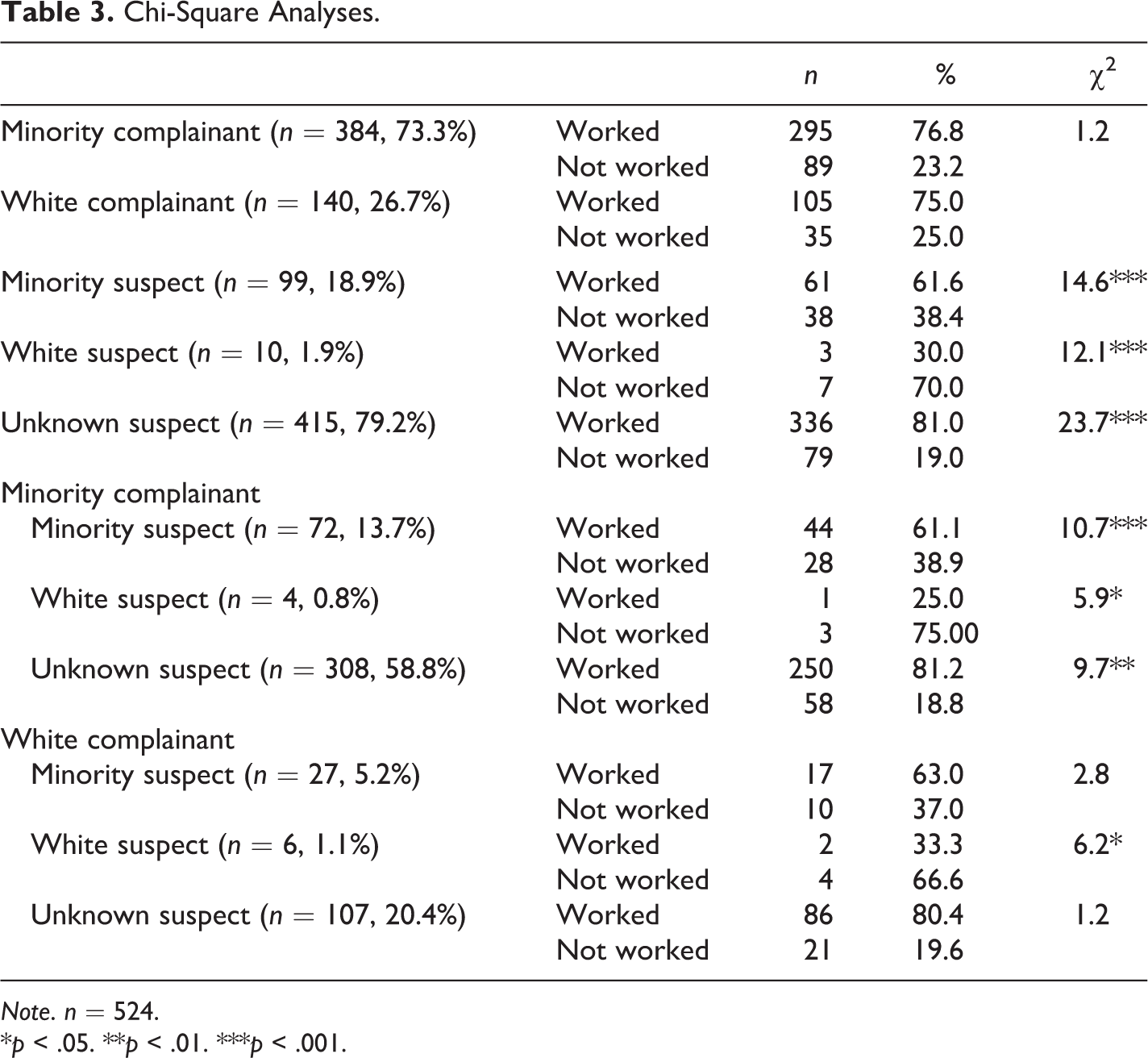
Table 3 displays the frequency and proportion of cases worked by detectives across the differing complainant and suspect racial and ethnic identities in these data. Likewise, χ2 analyses are presented in Table 3 and estimate whether the observed differences in the likelihood that a case was worked are expected. Cases with a minority complainant were worked at roughly the same rate as cases with a White complainant (n = 295 [76.8%] vs. n = 105 [75.0%]), and differences, according to the χ2 analysis, are attributable to chance. More substantial differences are observed across differing suspect racial identities. When a case had a minority suspect, it was nearly twice as likely to be worked (n = 61, 61.6%), and this difference was significantly greater than expected (χ2 = 14.6, p < .001). Alternatively, cases with a White suspect were significantly less likely to be worked (χ2 = 12.1, p < .001), though infrequently found in these data (n = 10, 1.9%). Cases with an unknown suspect, however, were observed at the greatest rate among these data (n = 415, 79.2%) and were significantly more likely to be worked by detectives (χ2 = 9.7, p < .01).
Chi-Square Analyses.
Note. n = 524.
*p < .05. **p < .01. ***p < .001.
Within-unit estimates of the suspect’s racial and/or ethnic identity across differing complainant racial and/or ethnic identities are also presented in Table 3. In comparison to all other cases, when the complainant and suspect in a case were minorities (n = 72, 13.7%), it was significantly more likely to be worked (χ2 = 10.7, p < .001). Alternatively, cases were significantly less likely to be worked when the complainant in the case was a minority and the suspect was White (χ2 = 5.9, p < .05), though this was a rare occurrence in the data (n = 4, 0.8%). It was far more common for a case to have a minority complainant and an unknown suspect (n = 308, 58.8%). These cases were more likely to be worked by detectives when compared to all other complainant and suspect racial and/or ethnic identity arrangements (χ2 = 9.7, p < .01).
Approximately 1 in 20 cases in these data had a White complainant and a minority suspect (n = 27, 5.2%). Although the bulk of these cases were worked by detectives (n = 17 [63.0%] vs. n = 10 [37.0%], respectively), the χ2 analysis suggests that the observed differences are attributable to chance. Alternatively, cases in which the complainant and suspect are White were significantly less likely to be worked (χ2 = 6.2, p < .05), but this rarely occurred among these records (n = 6, 1.1%). Cases with White complainants and unknown suspects were far more frequently observed in these analyses (n = 107, 20.4%); however, the likelihood that these cases would be worked was similarly found to be attributable to chance.
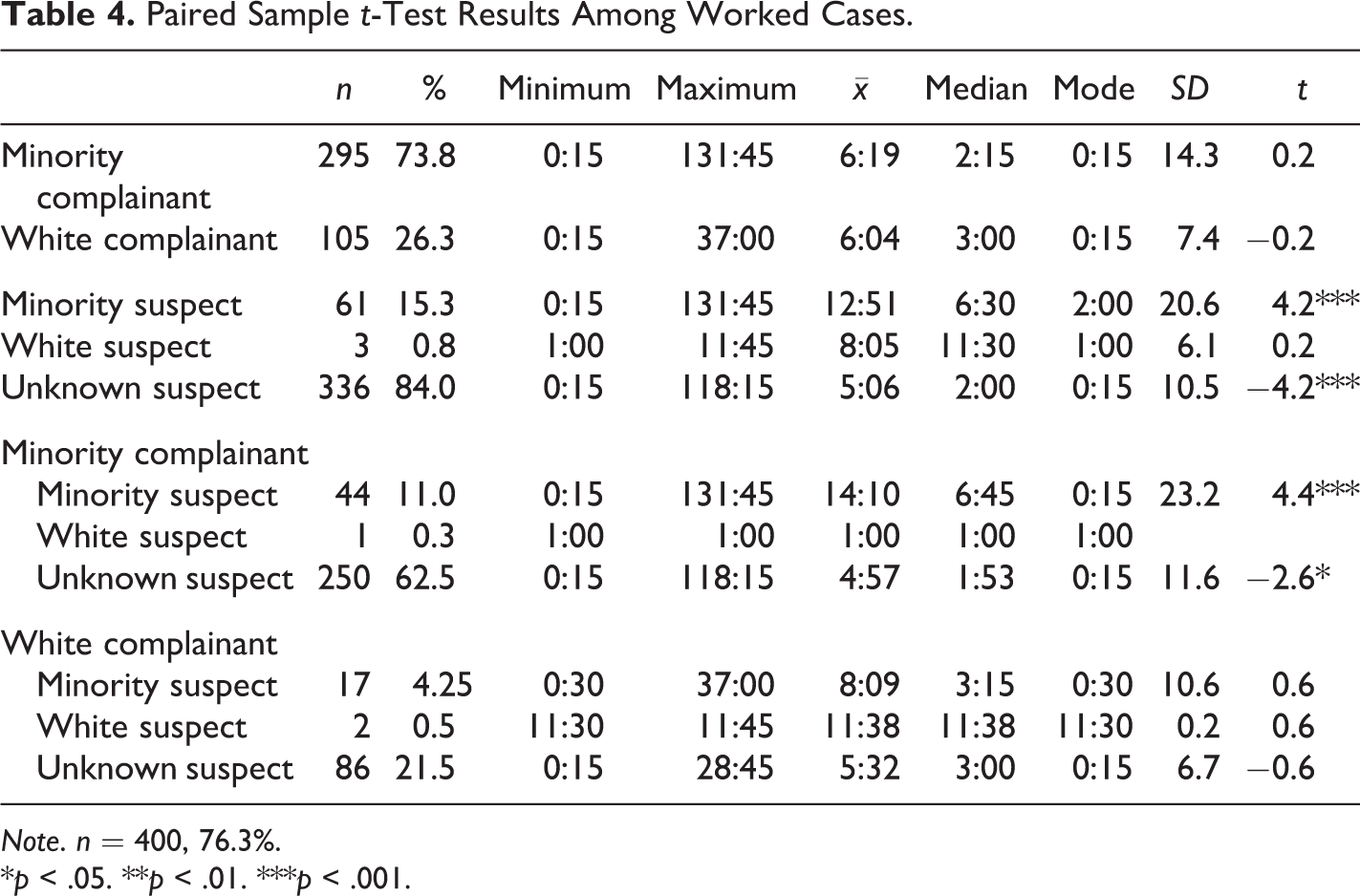
In Table 4, descriptive statistics and paired sample t-test results for the average time spent investigating a case are presented for the cases that were worked by detectives (n = 400, 76.3%). Cases with a minority complainant were worked, on average, 15 min longer than cases with a White complainant (
Paired Sample t-Test Results Among Worked Cases.
Note. n = 400, 76.3%.
*p < .05. **p < .01. ***p < .001.
Among the within-unit estimates, cases in which both the complainant and suspect were minorities were worked by detectives, on average, for 14 hr and 10 min. This was exponentially greater than most other complainant and suspect racial and/or ethnic arrangements and significantly different than expected (t = 4.4, p < .001). Alternatively, cases with a minority complainant but unknown suspect were worked significantly less than all other complainant and suspect racial and/or ethnic identity arrangements (
Discussion
With the recent news and social media attention given to police (ab)use-of-force situations, faith in police has faltered. This “crisis of legitimacy,” is can be argued, exists because there is a gulf between citizen perceptions and the realities of police work (La Vigne et al., 2017; Newport, 2016). Citizen knowledge of detective work, for example, is often based on sensationalized and fictional accounts. Nevertheless, against the backdrop of racial profiling and detective autonomy, citizen concern is understandable. Unfortunately, little is known about detective work beyond their exercise of discretion and limited time to investigate cases. In fact, the existing framework that seeks to explain detective decision-making (i.e., the skimming and triage hypotheses) is not contextualized within the broader landscape of race/ethnicity in America. This gap presented an opportunity for this study to explore whether detectives are making racially and ethnically neutral decisions about the cases they work and how long they work them in a procedural justice approach to detective effort.
In doing so, 184 detectives with the HPD reported the amount of time they spent working the cases they were assigned during a 60-day period. Case file data containing the complainant–suspect and racial–ethnic information were paired with each of the 524 cases detectives were assigned for these analyses. Chi-square analyses and paired sample t tests from differing racial/ethnic complainant–suspect dyads were estimated to see whether a cases’ likelihood of being worked and how long a case was worked significantly differed from what would be expected among other complainant–suspect racial/ethnic arrangements. From this methodology, we observed little difference in the likelihood that a case would be worked and how long it would be worked based on the complainant racial/ethnic identity. This effect even held among within-unit suspect variations. The racial/ethnic identity of the suspect, however, differed. Cases with a minority and unknown suspect were twice as likely to be worked by detectives. The likelihood that a case would be worked grew when the complainant in the case was a minority but dissipated when the complainant was White. Similarly, cases with a minority suspect received 59% and 251% more investigation attention than White and unknown suspect cases, respectively. The amount of time dedicated to a case grew and remained statistically significant among minority complainant cases. Cases with a minority complainant and suspect, for example, were worked 2.8 times longer than cases with a minority complainant and unknown suspect.
Policy and Theoretical Implications
These results lend mixed credibility to perceptions that racial and ethnic minorities are disproportionately targeted by police. That is not to say that agencies would not benefit from fairness, diversity, and cultural sensitivity training. Moreover, this type of education should be continuous, throughout an officer’s career, and be mandatory for personnel assigned to specialized, administrative, and patrol alike. The HPD, for example, receives 40 hr of training biennially, which includes legislatively mandated courses on racial profiling, cultural diversity, and civilian interactions. This may indirectly be responsible for the race/ethnicity neutrality observed at the front end of an investigation among complainants but shows room for improvement with the disparity observed among suspect-related outcomes. Research, for example, has found that classroom training in procedural justice can have lasting positive effects on officers giving voice, granting dignity/respect, and demonstrating neutrality in in their decision-making (Skogan, Van Craen, & Hennessy, 2015).
The front line to overseeing these changes should be investigative administrators who should seek greater involvement in the cases they assign to the detectives under their leadership. Although this will likely encroach on detective autonomy, research has suggested that case clearances may be associated with greater investigative supervision (Bloch & Bell, 1976; Eck, 1983). This can be formalized by adopting process-related measures as part of audits, early warning systems, or annual evaluations. Furthermore, neutral decision-making can be reinforced with incentives and adopted as part of promotional criteria (i.e., the carrot rather than the stick approach). Likewise, law enforcement agencies can do themselves a favor at the front end of the hiring process by seeking candidates into the agency who embrace procedural justice tenants. These analyses, for example, suggest a lack of fairness in attention given to cases with a minority suspect. If this disparity is motivated by biases, it can and should be screened for during the hiring process. In doing so, the matriculation of procedural justice ideals into specialized units and leadership positions will be a foregone conclusion.
It is equally important, however, for agencies to mold their public image based on the realities of police work, especially in a society with waning public support. For too long, law enforcement has modestly concealed their accomplishments behind sentiments like “it’s part of the job” and only sought to prompt their positive impact during crisis events. This humility has likely contributed to the previously discussed misunderstandings of detective work. In the age of social media and the 24-hr news cycle, there is no need for law enforcement agencies to feel as though they should wait to communicate with their constituents. Public relations specialists are nice in the post–Ferguson era (see Deuchar, Fallik, & Crichlow, 2018), but law enforcement agencies can cheaply and easily prompt their positive impact through other means. Agency-sponsored Facebook, Instagram, and Twitter pages, for example, are important and free information platforms law enforcement agencies should be including in their community engagement portfolios.
Finally, to advance our understandings of detective work, the broader landscape of American socioculture discourse needs to be adopted into our theoretical understandings of detective decision-making. This is not to say that the skimming or triage hypotheses are wrong, but they certainly need to be expanded. These theories, in light of current data, seem to be underdeveloped with regard to how prioritizing a suspect based on their race or ethnicity serves a detectives investigative self-interests or informs a cases’ practical constraints (as our existing theoretical framework proposes). Fallik (2016) and Fallik and Victory (2018), for example, suggest that detective effort may mediate case outcomes and that case features have a direct impact on detective effort and case outcomes. These analyses lend credibility to the importance of parsing the relationship between case features and detective effort in developing a theoretical understanding of detective decision-making.
Limitations and Areas of Future Research
Nevertheless, it is important to note the limits of these suppositions and, in doing so, guide the next generation of scholarship in this area. First, the confounding influence of within-unit differences is not observed in these analyses. To this point, Withrow (2006) noted that bivariate analyses, such as these, “cannot be used to infer or predict and generally cannot account for intervening causes of police behavior” (p. 193). As it relates to detective work, there are several potentially exogenous factors that subsequent research should look to explore, such as impact of detective experience and training, the legal features of cases (e.g., suspect prior record and seriousness of the crime), and other demographic characteristics of the complainant and suspect. Evidence of these omissions can be found in the nonnormal standard deviation observed in Table 4, indicating that these results may be sensitive to outliers. A larger sample drawn from a wider variety of measures will likely overcome this issue in subsequent studies.
Additionally, replication research should look to address unobserved between-unit difference in these analyses. The exclusion of nonindex-related crimes and proactive criminal investigations limits the generalizability of these findings to those phenomenon. Similarly, the HPD likely varies in investigative procedures, processing, and prioritization from other agencies. This underlies the importance for empirically based research to guide detectives and investigative administrators toward evidence-based practices. In doing so, future scholarship should explore multiple sites and/or nationally representative samples to increase external validity. Additionally, researchers should model the mediating and direct effects of case features and detective efforts on a verity of investigative dispositions including the execution of warrants. These types of endeavors will give a clearer understanding of detective decision-making on the criminal justice system.
Conclusion
In spite of these issues, this study explored the influence of complainant and suspect race/ethnicity on the likelihood that a case would be worked and how long it was worked by detectives. Just as in the extant literature on race and policing, we observed mixed support for the perception that racial and ethnic minorities receive greater scrutiny from police. This prompted a discussion that informed policy recommendations and theoretical debates on detective decision-making. These dialogues, however, are the initial steps to a much needed larger body of research on this critically important topic.
Footnotes
Declaration of Conflicting Interests
The authors declared no potential conflicts of interest with respect to the research, authorship, and/or publication of this article.
Funding
The authors received no financial support for the research, authorship, and/or publication of this article.
