




Abstract
Due to ongoing inequities, discrimination, and injustice, the antiracist movement has gained momentum in all parts of society, including education and school counseling. A foundational aspect of antiracism is self-reflection to increase awareness, identify biases, and build cultural proficiency. Multitiered systems of support (MTSS) is an evidence-based framework widely used throughout K–12 education in the United States to assist with every student’s school-related success. In this article, we propose an antiracist approach to the MTSS framework, in which reflection serves as the foundation. We provide practical activities and reflections to facilitate growth and promote antiracism within MTSS.
Callouts
Many of our Black students live with an understanding that society sees and treats them differently every single day. This understanding has social and emotional effects that can be hard to live with and nearly unexplainable. To be sure, racism and discrimination have psychological impacts on students.
We propose a culturally sustaining and antiracist approach in which reflection serves as the basis of the Multitiered systems of support (MTSS) framework for school counselors. School counselors can lead efforts to create antiracist MTSS by engaging in (a) introspection of self; (b) interrogation of school, district, community, and environment; and (c) action that changes systems, practices, and policies.
The microaggression activity is an example of an intervention that can help raise school counselors’ understanding. It may be especially useful for White school counselors, but we contend that the activity also allows school counselors of color to respond and share their own experiences.
School counselors must do something with the new knowledge of self and systems to consciously act to create change, whether through critically analyzing disaggregated data, engaging in thoughtful partnership and engagement with families and community, or facilitating self-awareness among other staff.
What do you do when you find a pebble in your shoe? Likely, you remove that shoe and immediately take out the pebble. Being a Black student can often feel like having a pebble in your shoe without the ability or opportunity to remove it. After a while, Black students may get used to that pebble. They become numb to it. That pebble has been so constant and such a reminder of hate that Black students may lose interest in school which may affect at least one of three indicators—attendance, behavior, or course passing.
That pebble represents race-based stress and trauma, discrimination, bias, and microaggressions. Imagine, when you open social media or watch TV, hearing about the deaths or murders of people that share your lived experience and identities. You are saddened by what’s happened to the victims and can’t stop thinking about how this will affect their families. You begin wondering, with absolute fear, if you, a family member, a friend, a classmate, or an acquaintance will be next. Your heart starts beating. One beat. Two beats. Three, four, five beats. Even faster. Six, seven, eight beats. You don’t know whether to fight, run, or freeze. Your dreams put you or someone you know in the place of death for the latest victim, and you just can’t seem to shake it.
You wake up, throw some clothes on, and head to school. After yet another tragic event, nobody at school says a word about what happened. You are trying to reconcile what happened on your own.
Recent events in society, including the murders of Breonna Taylor and George Floyd, and the increased momentum behind the Black Lives Matter movement have emphasized the importance of culturally sustaining and antiracist practices in society, education, school counseling, and beyond. According to recent data from the Office for Civil Rights, Black students are expelled and suspended at rates twice the proportion of their enrollment (U.S. Department of Education, Office for Civil Rights, 2021). During the 2015–2016 school year, Black students represented 15% of the total student enrollment and 31% of students referred to law enforcement or arrested; 23% of these allegations involved harassment or bullying based on race (U.S. Department of Education, Office for Civil Rights, 2018).
We acknowledge that race-based stress and trauma is much more significant than a pebble, but we use that example to highlight that many of our Black students live with an understanding that society sees and treats them differently every single day. This understanding has social and emotional effects that can be hard to live with and nearly unexplainable. To be sure, racism and discrimination have psychological impacts on students. Empirical evidence has shown that experiences with racism are associated with a range of psychological outcomes including traumatic stress symptoms, depression, anxiety, and a general sense of psychological distress (Pieterse et al., 2016). Now more than ever, school counselors must integrate and implement culturally sustaining and antiracist ideals into their work—to help students see the pebble, recognize and overcome the impact, and ultimately remove the pebbles from our students’ lives through antiracist school counseling. The American School Counselor Association (ASCA) noted that school counselors have a “unique opportunity” to be part of the solution to eliminate bias and racism in schools (ASCA, 2020, p. 1); similarly, scholars have highlighted new opportunities for school counselor leadership and advocacy in antiracist work (Leibowitz-Nelson et al., 2020; Mason et al., 2021; Moss & Singh, 2015; Shell, 2021).
One promising method school counselors can use to integrate antiracism into their work is the framework of multitiered systems of support (MTSS). MTSS is an evidence-based framework widely implemented in K–12 schools across the United States, with the aim of preventative, data-driven practices within a systems perspective (McIntosh & Goodman, 2016). The interconnection between MTSS and comprehensive school counseling programs is well documented, highlighting how MTSS helps prioritize and organize school counseling interventions and supports (e.g., Goodman-Scott et al., 2018; Goodman-Scott et al., 2020; Ziomek-Daigle et al., 2016).
Evidence-based practices (EBPs) are an essential component of MTSS. EBPs are defined as “the intentional use of the best available evidence in planning, implementing, and evaluating … interventions and programs” (Dimmitt et al., 2007, p. ix). EBPs are woven throughout MTSS in the interventions and practices educators use across the tiered supports provided to students. The foundational tenets of EBP involve using evidence to determine the needs of students and intervene accordingly (Dimmitt et al., 2007; Zyromski & Mariani, 2016), but we contend that educators who are implementing practices and intervention must do so from a healing-centered and antiracist vantage point, similar to previous calls that EBP be theoretically sound (Lemberger-Truelove et al., 2020) and social justice focused (Novakovic et al., 2020).
In this conceptual article, we propose a culturally sustaining and antiracist approach, in which school counselor awareness serves as the basis to the implementation of evidence-based MTSS. First, we describe antiracism, MTSS, and the integration of antiracism and culturally sustaining practices within MTSS. Second, we outline four non-linear steps that situate school counselor critical self-awareness as the basis of MTSS. Throughout, we provide specific reflections and activities focused on the self and systems to ensure MTSS is culturally sustaining and antiracist.
Antiracism
Antiracism is the commitment to interrupting the systems of racism prevalent in society and to affirming students, families, and communities of color (Kishimoto, 2018; Love, 2020). It includes the active interrogation and dismantling of racist practices, policies, and systems that focus on privilege and power in education and society (Corneau & Stergiopoulos, 2012; Edirmanasinghe et al., 2020; Singh et al., 2020). Antiracism differs from culturally responsive or sustaining systems in the inherent acknowledgement of the racist systems in our schools and communities, and taking action against the impact of racism in those systems.
Systemic racism, which includes policies and practices that oppress individuals of color, is built into the fabric of our society, including educational systems (Safir & Dugan, 2021). Given the prevalence of MTSS nationwide (McIntosh & Goodman, 2016), and school counselors’ roles as antiracist advocates (Holcomb-McCoy, 2021) and culturally sustaining leaders within MTSS (Edirmanasinghe et al., 2020), school counselors are ideal educators to be involved in their school’s antiracist MTSS efforts.
The basis of antiracist work relies on continuous self-reflection (Ladhani & Sitter, 2020; Love et al., 2016). In this vein, to create antiracist systems, the first step is for school counselors to engage in critical reflection to increase their awareness, identify biases, and build cultural proficiency. Recent research has focused on the interrogation of systems within MTSS (e.g., Bal et al., 2021) and increased emphasis on antiracist school counseling (Atkins & Oglesby, 2018; Mayes and Byrd, 2022), but few models exist to help school counselors engage in necessary critical self-reflection and subsequent interrogation of the systems from an antiracist lens.
Multitiered Systems of Support
As a framework widely used in schools, MTSS integrates academic (e.g., Response to Intervention [RTI]) and behavioral support systems (e.g., Positive Behavioral Interventions and Supports [PBIS]) to improve student outcomes (McIntosh & Goodman, 2016), focusing on practices to meet the needs of all students (Tier 1), some students (Tier 2), and a few students (Tier 3). Within successful MTSS implementation, the MTSS team utilizes a variety of data (e.g., behavioral and academic benchmark data), creates systems that support staff and students (e.g., discipline procedures for staff and school-wide expectations), and incorporates evidence-based practices and interventions (e.g., Tier 1 curricula such as Second Step and Tier 2 interventions such as Check In/Check Out; Stoiber & Gettinger, 2016). A plethora of studies demonstrate positive student outcomes as a result of MTSS implementation, including lower suspension and truancy rates, increased reading and math proficiency with PBIS implementation (Pas et al., 2019), and decreased referrals to special education with academic RTI (VanDerHeyden et al., 2007). Other studies have documented economic benefits (Bradshaw et al., 2020) and increased teacher self-efficacy in schools implementing MTSS (Lane et al., 2020; Oakes et al., 2021). Despite this research, researchers and practitioners have criticized MTSS as not being culturally responsive. For example, researchers have noted it as being ineffective for English language learners (Hoover & Soltero-González, 2018), and Black youth remain more likely to be suspended, expelled, and referred to the office for behavioral reasons (e.g., Ksinan et al., 2019; McIntosh et al., 2020). Others have cited lack of family voice (Bal, 2018) and the inability of MTSS to address the root causes of discipline disproportionality due in part to the “race neutral” and behaviorist roots (Fallon et al., 2021b, p.2).
Culturally Responsive Multitiered Systems of Support
Recent MTSS research has acknowledged a need to integrate culturally responsive elements into MTSS (e.g., Vincent et al., 2011). For example, McIntosh and colleagues (2021) highlighted explicitly teaching about implicit bias, vulnerable decision points, and root cause analysis throughout MTSS. Leverson et al. (2021) created a field guide focused on culturally responsive approaches within PBIS implementation. Others have focused on the integration of multiple voices into school-based decisions through learning labs, with school staff, community members, caregivers, and researchers meeting regularly to discuss data and current systems and practices within school discipline (Bal, et al., 2021; Ko et al., 2021). Similarly, scholars have used a culturally responsive lens to examine school counselors’ roles in MTSS (e.g., Belser et al., 2016; Betters-Bubon et al., 2016; Betters-Bubon et al., 2019) and created guidance documents on culturally sustaining school counseling (Grothaus et al., 2020). In recent years, scholars have increasingly prioritized culturally responsive or sustaining educational initiatives by ensuring that all cultural identities are valued and represented, focusing on student/family cultural strengths rather than deficits, and including multiple voices in school-wide decisions (Bal, 2018; Jones & Neblett, 2017). Despite the increased support for culturally responsive practices within the evidence-based MTSS framework, there remains a need for MTSS to be antiracist. A recent article by Fallon et al., 2021b described an antiracist model of MTSS for Behavior (MTSS-B) implementation for school psychologists. We propose a culturally sustaining and antiracist approach in which reflection serves as the basis of the MTSS framework for school counselors. School counselors can lead efforts to create antiracist MTSS by engaging in (a) introspection of self; (b) interrogation of school, district, community, and environment; and (c) action that changes systems, practices, and policies.
An Evidence-Based, Antiracist Approach to Multitiered Systems of Support
To create antiracist systems, individuals who are cocreating those systems must engage in critical self-examination. We contend that self-awareness is the basis of antiracist MTSS, as grounded in transformative learning (Figure 1) while acknowledging that antiracist self-awareness may look different for individuals based on their backgrounds. For White individuals, self-awareness may require an examination of racial identity, understanding privilege, and working to change internalized racism, while for people of color, self-awareness may require the recognition of how race has impacted their lives and consideration of their own intersectionality and privilege within multiple identities (National Museum of African American History and Culture, n.d.). Thus, in this article, we present an antiracist approach to MTSS, integrating self-examination activities and reflections throughout the MTSS processes. An antiracist approach to the multitiered systems of support framework.
This antiracist MTSS approach is guided conceptually by theory, specifically by principles of transformative change (Mezirow, 1997; Taylor & Cranton, 2012) in which learners participate in a process of constructing meaning that helps them question and reframe unconscious attitudes and values (Baumgartner, 2001). Because transformative learning challenges preconceptions and facilitates a more inclusive, reflective, and integrative frame of reference (Cranton, 2006), it is well suited to ground educator work related to antiracist and culturally sustaining practice. We provide an overview of the approach, followed by specific activities within each step for school counselors and educators. These four steps are non-linear; school counselors may move back and forth between steps, rather than solely moving forward through them.
As we describe this approach, we acknowledge our positionality. The first author is an associate professor in counselor education who identifies as a White, cisgender woman of European descent. As a former school counselor, she engaged in PBIS implementation and focuses her writing on MTSS alignment and culturally responsive systems change. The second author is a coordinator of college and career readiness who identifies as a Black, cisgender woman of African descent. As an administrator, her interests include antiracism and culturally sustaining MTSS. The third author identifies as a Black, cisgender man of African descent. As a state agency official, his interest is diversity, equity, and inclusion. The fourth author also identifies as a White, cisgender woman of European descent. Each of our backgrounds influences how we approach this topic and our understandings of antiracism within school counseling and MTSS.
Step 1: Introspection of Self
Our approach begins with the introspection of self, grounded in transformative learning, a theory positing that the way learners interpret and reinterpret their experience is central to making meaning and subsequent learning (Mezirow, 1997). Within transformative learning, educators engage in a participatory process of constructing meaning while questioning and reframing unconscious attitudes and values (Baumgartner, 2001). Researchers have found that counselor multicultural and social justice competency begins with a process of self-reflection and identification of positions and biases (Black & Stone, 2005; Pester et al., 2020; Ratts et al., 2016). We describe activities that facilitate educator examination of implicit bias, privilege, microaggressions, and coconspiratorship; this examination starts with cultural proficiency and may be different for individuals from nondominant and dominant cultures. Throughout, we describe activities that school counselors should engage in prior to facilitating with staff, families, and community members.
Cultural Proficiency
When implementing MTSS, school counselors must be culturally proficient to combat racism and support students. Becoming culturally proficient requires an inside-out approach: being aware of how we—as individuals and as organizations—work with others, understanding how we respond to those different from us, understanding the visible and not so visible differences, and preparing to live in a diverse world (Lindsey et al., 2019). The journey toward cultural proficiency requires reflection and dialogue about long-held beliefs, values, biases, and privileges, and understanding their impact. School counselors on the journey toward cultural proficiency should first identify where they fall on the cultural proficiency continuum (Figure 2). For example, a school counselor may identify their position as within the cultural pre-competence level, recognizing a need to engage in further reflective activities to move toward proficiency. Cultural proficiency: The continuum (Lindsey et al., 2019).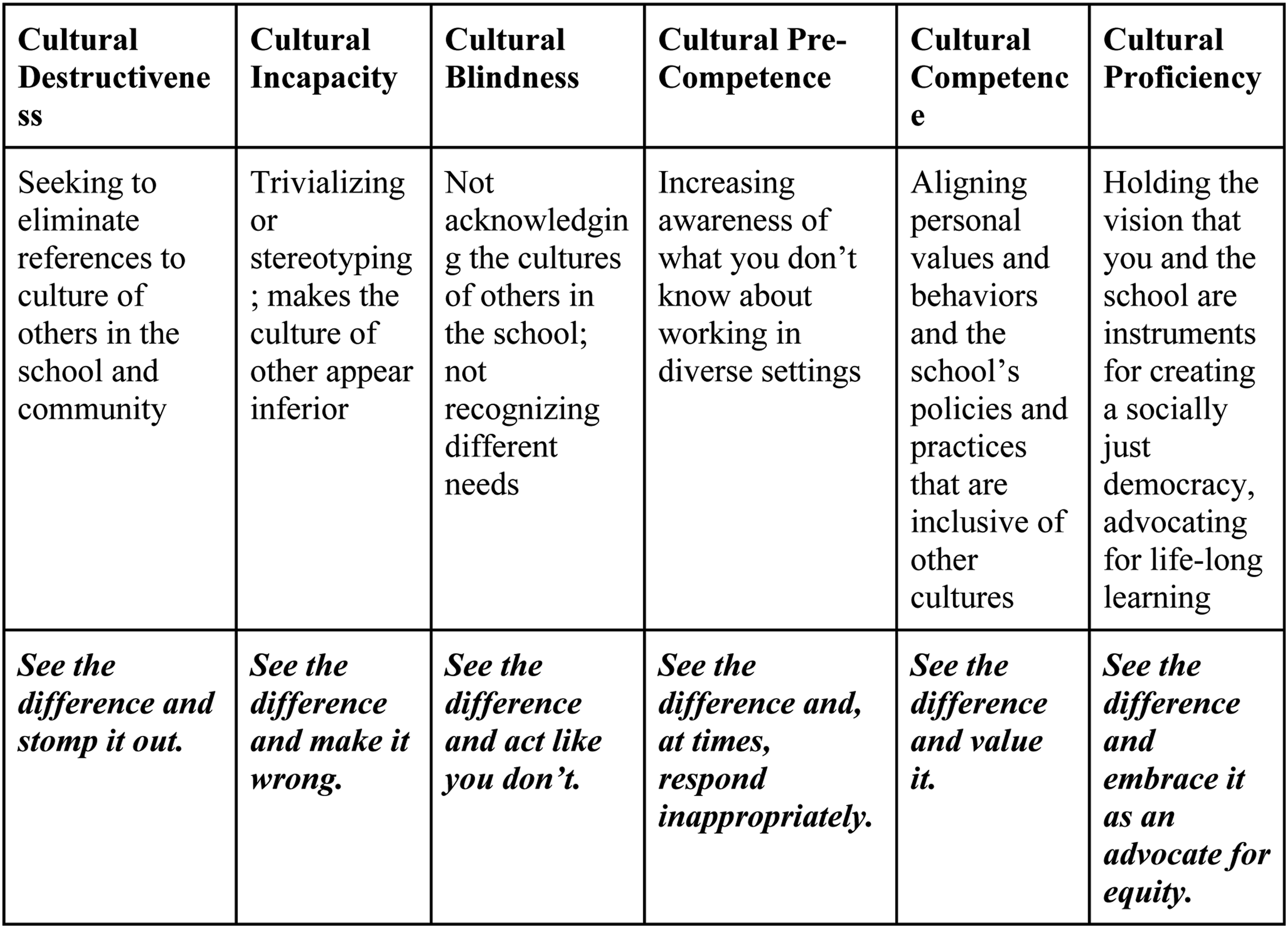
Bias
School counselors need to reflect on their biases to prevent harming students and to better assist educators in their own bias work. Biases can be explicit, including conscious and intentional negative beliefs and stereotypes, and implicit, including those negative judgments that occur without conscious intention. Research from the Implicit Association Test (IAT) found that implicit bias can affect individuals’ perceptions of emotions (Hugenberg & Bodenhausen, 2003) and the quality of one-on-one interactions with targets of bias. Further, the effects of subtle forms of bias on minorities include increased negative affect and reduced cognitive ability (Devine et al., 2012). Individuals who self-reported high cultural proficiency still exhibited implicit bias (Devine et al., 2012).
School counselors who want to assess implicit bias can use the IAT (Greenwald et al., 1998), which has been shown to have high validity (Greenwald et al., 2009) and provides immediate results. School counselors engaging in implicit bias work should recognize the potential impact in advance and with care. Cognitive dissonance occurs when individuals who explicitly believe they are unbiased are provided with evidence that they have implicit bias; specifically, learning about one’s biases can lead to negative emotions (Czopp et al., 2006). Research suggests that biases can be changed over time, and that implicit associations can be unlearned (Staats, et al., 2017). One of the ways to lessen biases is through intergroup contact: sustained and meaningful interaction with people from groups other than one’s own (Devine et al., 2012).
Privilege
Research also suggests that exploring privilege increases school counselors' cultural proficiency (Hays et al., 2007). Not understanding one’s privileges could negatively impact the counseling relationship, cause race-based trauma, and harm students' identity, ultimately leading to misunderstanding or misinterpretation of the students' perspectives and actions (Hays et al., 2007) and to avoidance, distancing, and detachment in the counselor/client relationship (Vodde, 2001). The use of videos, case vignettes, guest speakers, and reading assignments can be valuable in building school counselors' cultural competence. Experiential activities such as the Power/Privilge Wheel (Activity 1; Figure 3) with diverse groups can also help school counselors gain knowledge and awareness of privileges and different forms of oppression, acknowledging differences among individuals from dominant and nondominant cultures. Power/privilege wheel (Canadian Council for Refugees, n.d).
Activity 1: Power/Privilege Wheel
1. Participants begin by first identifying their different identities within the Wheel of Power/Privilege. 2. Next, participants identify which of their identities has power/privilege and which part of their identity has been marginalized. It is helpful to start with an understanding that most people have experienced being marginalized at some point in their lives. This builds empathy and helps create a dialogue of understanding. 3. Next, engage in dialogue about how participants can utilize the identities that hold privilege to help those that have been marginalized based on their identities.
Microaggression
Microaggression refers to insults, putdowns, invalidations, and offensive behaviors containing negative stereotypes that people from racial and ethnic minority groups experience in their everyday lives; these vary on a continuum from being overt, intentional, and explicit to subtle, unintentional, and implicit (Forrest-Bank & Cuellar, 2018; Sue et al., 2019). Microaggressions include microinsult, the unintentional behaviors or verbal comments that convey rudeness, insensitivity, or demean a person’s culture; microinvalidation, verbal comments or behaviors that exclude, negate, or dismiss the target group’s thoughts, feelings, or experiences; and microassaults, which are blatant verbal, nonverbal, or environmental attacks intended to be discriminatory and biased. Researchers have found that microaggression has a significant positive association with psychological distress and poor health (Forrest-Bank & Cuellar, 2018; Liu et al., 2019; Sue et al., 2019). The microaggression activity, Activity 2, is an example of an intervention that can help raise school counselors' understanding. It may be especially useful for White school counselors, but we contend that the activity also allows school counselors of color to respond and share their own experiences. In sum, increasing school counselors' awareness of the different types of microaggressions can help them recognize and address these actions.
Activity 2: Microaggression
MTV, with input from the Anti-Defamation League’s education department, produced 30-second videos as part of their MTV Look Different campaign, which aims to erase hidden racial, gender, and anti-LGBT bias. 1. Explain to educators that they are going to watch seven short videos from MTV’s Look Different public service announcement (PSA) campaign: https://bit.ly/ADLMicroagression 2. As participants watch each video, instruct them to jot down notes, responding to these questions: “How do you feel?”, “What’s the message?”, and “Can you relate?” They can also add any other thoughts about each video. At the end of each video, give them a minute to complete their notes on the video they just watched. 3. After watching all the videos, have participants turn to a person sitting next to them and discuss their thoughts and feelings about the videos, sharing their notes with each other. 4. After a few minutes of partner discussion, have a group discussion using the following questions: • How did you feel while watching the videos? • Did any of the videos really stand out for you? • Have you experienced a similar microaggression, and if so, what happened? • Have you experienced a different kind of microaggression, and if so, what happened? • What can we do about microaggressions?
Being a Coconspirator
To dismantle racism, school counselors must be coconspirators. Coconspirators understand where they stand in relation to systems of privilege and oppression and work toward unlearning the habits and practices that protect those systems (Love, 2020). They move beyond allyship to stand in solidarity with those marginalized regardless of their racial identity. Coconspirators recognize that their collective well-being is interwoven with those marginalized. They acknowledge the destructiveness of White supremacy to all of humanity and work toward confronting the imbalances of power by actively seeking to create social change through collaboration, humility, and accountability (Grant, 2017). Rather than performative allyship, which can be loud and attention-seeking, those working in solidarity often do so quietly and behind the scenes. They focus on actions that aim to dismantle oppressive structures and actively work to educate themselves because they see their role as a responsibility. Coconspirators do not seek recognition from others for their efforts. Their reward is the opportunity to confront the difficult truths of White supremacy to redistribute the ill-gotten gains of racism (Grant, 2017). It is through coconspiratorship that educators move from culturally proficient to antiracist, which we describe more fully in Step 2.
Step 2: Interrogation of School, District, Community, and the Environment
As individual awareness increases, so does the ability to engage in interrogation of the school, district, community, and environment. Interrogation of systems within MTSS is necessary because far too often, individuals create systems, sometimes unintentionally, with inherent qualities that fight against equity. For example, systems often privilege certain identities (e.g., White, middle class.; see Vincent et al., 2011) by dress codes, zero tolerance policies, and so forth; privileges can extend to the practices designed for students, including school-wide expectations focused on Eurocentric values, homework, and grades (e.g., Wilson, 2015).
The interrogation process starts with school counselors examining data from a culturally proficient and antiracist lens. In our approach, we highlight an expansive view of data that moves beyond typical school data (e.g., outcome data) to data focused on equity and the inclusion of multiple voices. We start with student, family, and community voice, because too often MTSS systems and practices are created and implemented with primarily staff voices.
Student, Family, and Community Voice
Student Voice
School counselors can incorporate student voice to better understand student lived experiences and the impact of the school’s culture and climate on student well-being. Within MTSS, storytelling and empathy interviews are Tier 1 practices that empower students. For example, storytelling might be integrated within Tier 1 MTSS/school counseling lessons to assess student perception and needs (see Activity 3). School counselors and other school staff can conduct empathy interviews, which include questions that elicit stories about specific experiences and uncover unacknowledged needs (Nelsestuen & Smith, 2021) or engage students in activities that allow them to express themselves (e.g., photovoice; see Stickl Haugen et al., 2021). In this way, school staff can understand and respond to students’ race-based stress and trauma. Finally, school counselors can ask students to serve on their advisory council, creating a specific student group that reports to the MTSS Tier 1 team to coconstruct school policies and practices.
Activity 3: Empowering Student Voice by Reimagining School
School counselors can use this series of questions with students in a Tier 1 format to elicit stories and understand student perceptions and needs. 1. Let’s have some fun and rebuild our school. We want the most ideal, exciting, and supportive school in the district/state/country. You tell me, what are some characteristics of the school? 2. What do you want to name our school? Remember, no other schools exist like ours. We are the pacesetters. 3. At our school, it doesn’t matter what color you are, your gender identity, religion, or how much money you have. Everyone is made to feel absolutely welcome and like they belong. How do we achieve this? 4. What messages are students hearing from school leadership and your teachers that help students know they are not only welcome but also appreciated every single day? 5. The learning is out of this world. Kids know that they are growing and learning exponentially but they also know that this is not traditional learning like you’d normally find outside of our school. What is happening to create such learning? 6. Families come and support schools not just for sports, but for everything! They want to be part of the school and offer their support and voice. What have we done to make sure families feel welcome and like they are valued members of our amazing new school? 7. Kids can join or create clubs or play varsity or intramural sports and everyone has a chance to do something they like or love during the school day. What would we see kids choose to do if they had 45 minutes per school day to choose, and how would this add value to their education? 8. Before you got to our school, you experienced something negative in previous schools. Because you are a founder of our school, you get to share your voice on things that have no place in our school. What are they? 9. Finally, if you got to name them, what would the top two priorities of our school be during this time?
Giving students an opportunity to reimagine the school and discuss important characteristics that they want or need can give action steps that allow the school counselor to transform the school to be more just and equitable while responding to the needs of its students.
Family and Community Voice
We know family engagement impacts student achievement (Epstein, 2018; Sheldon & Turner-Vorbeck, 2019); as such, when interrogating systems, school counselors are encouraged to reinvent the ways they interact and connect with families, especially families who have been traditionally underrepresented in education. By valuing the voices of families, school counselors can collect powerful data and become coconspirators with families to create more equitable schools. In a similar way, school counselors should reinvent how they connect with community stakeholders. For example, Activity 4 highlights important questions school counselors might ask about how or whether relationships with families and community organizations are present and reciprocal.
Activity 4: Who’s at the Table?
What might a school look like that has created a genuine culture of school–family–community partnership, and that has made real progress toward high social and academic achievement for all students?With your family partnerships, do you: • Have a school counseling advisory council that includes families and members of the community? • Offer coffee with a counselor? • Offer workshops/family nights that are two-way, reciprocal, and encourage family/parent/caregiver voice? • Include families in classroom potlucks/celebrations/parties? • Design PBIS/MTSS expectations with input of families and caregivers? • Engage in regular, personalized communication? • Encourage parent-teacher conferences for goal settings? (See Wisconsin RTI Center, 2021, for additional ideas) • Partner with organizations that represent a diverse array of people? • Work with partner organizations that associate themselves with political ideology or themes that can be hurtful to some? • Offer unique ways for involvement? • Offer events that uniquely allow for community members to share their voices, expertise, solutions, and concerns?
With your community partnership, do you:
By examining these ideas, school counselors may see the need to reassess family and community voice to (a) ensure partnerships are reciprocal and (b) empower partners to be involved in the systems of the school.
Data Interrogation
As school counselors ensure that voices are represented, they can integrate qualitative (e.g., focus groups) or quantitative (e.g., survey results) data, incorporating the voices of students, families, communities, and staff members. Perception data should be examined alongside existing outcome data, including disaggregated academic, behavior, and college/career data (e.g., SAT/ACT scores, graduation rates, and suspension rates). The primary goals of gathering additional perception data are to determine (a) what systems and practices are working with our traditionally underrepresented students and families, and (b) what systems and practices are not going well and need to change (e.g., the way we enroll students in gifted and talented, Advanced Placement, or dual-credit programs). This extends to any evidence-based practice utilized within and across tiers.
School counselors can gather perception data from existing school climate or equity surveys (La Salle et al., 2018; Panorama Education, 2019) or create their own focused on topics such as safety, belonging/connectedness, and equity. Survey data will provide school counselors with a better sense of how the school community perceives the practices and policies of the school. It will also prevent scientific colonialism, which “occurs when the center of gravity for the acquisition of knowledge about a people is located outside of that people’s lived reality” (Safir & Dugan, 2021, p 15). Activity 5 highlights the starting points for this important work.
Activity 5: Survey Students, Families, and Stakeholders
Combine qualitative data from focus groups with the quantitative data from surveys. 1. Examine existing surveys (La Salle et al., 2018) with students, families, and stakeholders and choose up to 10 items that are of interest to the school site (e.g., school safety, perceptions of equity in discipline). 2. Choose a population to complete the survey (e.g., all ninth-grade students, all parents of ninth-grade students, teachers, and community members). 3. Analyze quantitative data results, including disaggregated data across student groups. 4. Delve further into the data with a focus group (e.g., a small group of ninth-grade students).
Next, school counselors need to interrogate their school and district data alongside the stakeholders mentioned previously. One effective way to interrogate data is through root cause analysis. According to the National Implementation Research Network (n.d.):
Root cause analysis (RCA) is a process used to investigate and categorize the root cause of community needs. The root cause is the highest-level cause of a problem, or the factor that should be permanently eliminated to see improvement. RCA gives teams the opportunity to look more deeply at identified challenges and investigate precursors that could be addressed to prevent the need from resurfacing. As with a weed, the challenge must be “rooted out” to prevent it from reappearing in the future. In particular, RCA helps identify systems level factors related to identified needs. (p. 1)
RCA allows school counselors and educators to use the following questions as a starting place: • Who has access to opportunities? Who doesn’t? • Who is participating in programs? Who isn’t? • Who is regularly attending school? Who isn’t? • Who is receiving office referrals, in-school suspension, or out-of-school suspension? Who isn’t? • Who is being identified for special education? Is there disproportionality? Do we truly seek to find the least restrictive environment for our students? • Who is achieving in our school and successfully transitioning to the next grade level or from elementary to middle school, middle to high school, or high school to postsecondary? Who isn’t?
One effective way to engage in RCA is by doing a data equity walk (see Activity 6) with members of the MTSS team and members of the school community (e.g., community members, families/caregivers, students, teachers, district leaders).
Activity 6: Data Equity Walks
The Education Trust–West (2021) defines a data equity walk as:
A 45–90-minute activity for any size audience to engage with education data and discuss equity issues. Participants dive into data that shows education outcomes and exposes gaps between groups of students. The data usually show district or school performance across different measures like student achievement and school climate. (Para. 1)
Equity walks can be facilitated by school leaders, including the school counselor, and should include time for individuals to discuss the following: • What are responses to access, behavior, or achievement data? What questions do we have? What are some patterns we notice? • How does the school data compare to the district’s data? State data?
Data equity walks should end with reflection in which participants can begin to analyze the data through an equity lens and brainstorm possible next steps (for additional information, see Roegman et al., 2019; Safir & Dugan, 2021; Taylor & Burgess, 2019).
When the RCA or data walk shows disparities regarding who has access and who does not, conversations with school and district leadership should take place, with work toward actionable steps to address these disparities and improve outcomes. We next expand on these steps.
Step 3: Action
Reflection on how privilege impacts individuals, practices, and the system itself is not enough—action must follow, specifically related to altering the practices and systems within MTSS (Ladhani & Sitter, 2020; Love et al., 2016). Action requires school counselors and educators to examine policies, practices, and systems for biases and replace them with more equitable ones, which is successful only when individuals within the system have done their own critical self-awareness work. Researchers have highlighted action within the context of MTSS (e.g., Edirmanasinghe et al., 2020) and school counseling (Hernandez et al., 2021), so in this section we provide further considerations related to the integration of action from an antiracist and evidence-based counseling lens.
For example, through the interrogation of data, including surveys and focus groups with ninth-grade students and families (see Activity 6), a school counselor might find that microaggressions are common within the school. With that data, school counselors can collaborate with school administrators and other stakeholders to evaluate microaggressions, and then change school policies and practices within MTSS. Specifically, microinterventions are needed to combat microaggression. Microinterventions communicate to targets of microaggressions (a) validation of their experiential reality, (b) their value as a person, (c) affirmation of their racial or group identity, (d) support and encouragement, and (e) reassurance that they are not alone (Sue et al., 2019). A direct way of dealing with microaggressions is to disarm them by stopping or deflecting the comments or actions through naming the problem and expressing disagreement, challenging what was said or done, or pointing out its harmful impact.
In light of this, the school counselor and MTSS team might implement a number of school initiatives using an antiracist and evidence-based lens: (a) implement Tier 1 lessons on microaggressions grounded in current research (e.g., Williams, 2020) to students and staff in all language arts classes; (b) create a student group to utilize photovoice to document experiences of microaggressions and ways to combat them (e.g., interrupt the communication and redirect it; Stickl Haugen et al., 2021); (c) conduct empathy interviews (Nelsestuen & Smith, 2021) with students who have experienced microaggressions to uncover needs and invite them to an optional Tier 2 group to engage in self-care strategies; and (d) write explicit policy changes related to how microaggressions will be handled in the disciplinary process, including integration of restorative practices, grounded in current research (Gomez et al., 2020). Throughout this process, the school counselors and MTSS team take an evidence-based approach, utilizing current research to inform the practices across tiers.
Step 4: Evaluation
Finally, our approach includes evaluation, recognizing that change happens incrementally and individually, and must be assessed throughout the process to examine actions, systems, and procedures related to antiracist tenets and approaches. As such, evaluation happens throughout and across the different points of our approach. For example, school counselors who lead self-awareness professional development would assess individual and group progress, tailoring subsequent presentations to further educator growth. Similarly, school counselors would evaluate how well their data analysis is facilitating antiracist and culturally responsive action. Finally, school counselors in the action stage would assess the effectiveness of the Tier 1 lessons through surveys, focus groups, and stakeholder input.
Implications for Research and Practice
The implications of this antiracist approach to MTSS for school counselors and other educators are grounded in practice and research. In terms of practice, we recommend that school counselors become experts in the areas of antiracism and anti-oppression. This requires school counselors to first examine their own histories, backgrounds, and biases to better understand their own positionality. Second, as previous research has demonstrated, awareness is not enough (e.g., McIntosh et al., 2020). School counselors must do something with the new knowledge of self and systems to consciously act to create change, whether through critically analyzing disaggregated data, engaging in thoughtful partnership and engagement with families and community, or facilitating self-awareness among other staff. To that end, additional research into this approach in action is warranted. First and foremost, we suggest qualitative studies that capture the voices of school counselors engaged in this antiracist and healing-centered work; these will add contextual understanding and provide the how related to antiracist MTSS. Similarly, research must explore how and whether professional development focused on self-awareness and antiracism is effective in dismantling racist policies, practices, and systems, and affirming students' culture (e.g., Carter et al., 2020). Research that incorporates instruments that measure school staff beliefs and practices (e.g., the Assessment of Culturally and Contextually Relevant Supports, Fallon et al., 2021) and qualitative research that captures the voices of those engaged in the change process, including school staff, families, and students, will add value to the field. Finally, we suggest extending research on what constitutes an evidence-based practice within MTSS. Promising studies focused on action research that incorporates family voice (e.g., Betters-Bubon & Schultz, 2018) and youth participatory action research (e.g., Edirmanasinghe & Blaginin, 2019; Levy et al., 2018) may be used as models for expanding how we incorporate voice in the intervention process within antiracist MTSS.
Conclusion
The foundational tenets of EBP involve using evidence to determine the needs of students and intervene accordingly (Dimmitt et al., 2007; Zyromski & Mariani, 2016). MTSS is a widely used, evidence-based educational framework, and school counselors are called to be leaders in aligning MTSS with their comprehensive school counseling programs. Through this alignment, school counselors advocate for systemic change. In our article, we reinforce that school counselors’ practices must originate from a healing-centered and antiracist vantage point, similar to calls to integrate theory (Lemberger-Truelove et al., 2020) and social justice (Novakovic et al., 2020). Thus, we contend that, in addition to being leaders and social justice advocates, school counselors must take this work one step further. They must include antiracism in their MTSS–school counseling program alignment and their leadership, advocacy, and social justice efforts: emphasizing self-reflection and interrogating “assumptions about knowledge, measurement, and what really matters when it comes to educating young people” (Safir & Dugan, 2021, p. 16). Our antiracist approach to MTSS aims to do just that: embed reflection and interrogation of systems in all aspects of the MTSS framework. Only when we school counselors look inward and reflectively begin our own antiracist work can we begin to chip away at the pebbles in our students’ shoes and, ultimately, provide schools free of pebbles for all students.
Footnotes
Declaration of Conflicting Interests
The author(s) declared no potential conflicts of interest with respect to the research, authorship, and/or publication of this article.
Funding
The author(s) received no financial support for the research, authorship, and/or publication of this article.