




Abstract
The authors present a tool teachers can use to modify their instruction so that it is based on universal design and includes secondary transition topics and skills. This checklist includes Universal Design for Learning (UDL) checkpoints and prompts teachers to go through a set of guiding questions that focus on both UDL and secondary transition. Also included in the article are examples of how a general education teacher can use the checklist to design inclusive instruction around secondary transition topics.
Ms. Grady, an eighth-grade science teacher, teaches a wide variety of students and her classes are typically made up of many different interests and academic levels. Ms. Grady is often commended for her engaging and accessible science instruction but she has been noticing many of her students do not seem prepared with basic life skills such as knowing their strengths and areas of weaknesses, self-regulation, and goal setting. Ms. Grady knows these skills are important for students, as they get ready to enter high school and potentially face rising expectations around independence. Ms. Grady is not sure where to start because she has a lot of science content to cover and is afraid to set time aside to teach students these independence skills.
Research has indicated students with disabilities experience poor postschool outcomes when compared with their peers without disabilities (Newman et al., 2011). However, there is research suggesting that students with disabilities who participate in general education while in school experience better postschool outcomes compared with other students with disabilities who do not participate in general education (Test, Fowler et al., 2009). Despite this, teachers continue to report struggling with effectively including students in general education settings (Lalvani, 2013; Scruggs & Mastropieri, 1996; Sze, 2009). One possible framework suggested for designing inclusive instruction is Universal Design for Learning (UDL). UDL has been defined as
a set of principles for curriculum development that give all individuals equal opportunities to learn. UDL provides a blueprint for creating instructional goals, methods, materials, and assessments that work for everyone—not a single, one-size-fits-all solution but rather flexible approaches that can be customized and adjusted for individual needs. (National Center on Universal Design for Learning, 2014)
The goal of UDL is to provide access to the curriculum, including general education curriculum standards. Access is designed to be widened through multiple methods of representation, expression, and engagement. These three primary principles were developed based on a review of literature in multiple domains—including education, developmental psychology, cognitive science, and cognitive neuroscience—and were chosen based on critical features of an instructional environment (Rose & Gravel, 2010). Further research was reviewed to identify more specific guidelines (e.g., “provide options for perceptions,” “provide options for physical action”) within each principle and, finally, an even further review of research identified specific practices associated with each guideline, called checkpoints (e.g., “offer ways to customize the display of information,” “clarify vocabulary and symbols”). This final review was conducted with experimental and quantitative research along with scholarly reviews and expert opinions. While each checkpoint has supporting research, this research has been identified because it fits within the UDL framework but has not necessarily been conducted with the goal of providing access to the curriculum. For example, as part of a larger study with multiple purposes, Fuchs et al. (2000) explored the effectiveness of large print as a test accommodation for students with a reading disability. This research is included in the supporting literature for the checkpoint, “Offer ways of customizing the display of information.” The description of the literature reviews, each practice, and the supporting research can be found at the National Center on Universal Design for Learning’s website (udlcenter.org). Along with this information, this website also houses a variety of resources to assist teachers in developing universally designed instruction, including a checklist made up of the principles, guidelines, and checkpoints.
Many of these checkpoints are used to provide support in academic skills (e.g., “activate or supply background knowledge”), but they also include an emphasis on secondary transition skills (e.g., “guide appropriate goal setting”). Additional checkpoints from the UDL checklist related to secondary transition include (a) strategy planning and development, (b) choice making, (c) optimizing instructional relevance, (d) fostering collaboration and community, (e) encouraging effort and perseverance, (f) promoting beliefs that optimize motivation, (g) developing coping skills, and (h) employing self-assessment strategies. Instruction using these checkpoints has the potential to promote both academic and secondary transition skills simultaneously. This area of research has been indicated as important for teachers to focus on (Bartholomew, Test, Cooke, & Cease-Cook, 2015; Collins, Evans, Creech-Galloway, Karl, & Miller, 2007; Cuenca-Carlino & Mustian, 2013; Konrad & Test, 2007) because research has suggested that curricula for students with disabilities have shifted toward a general education focus, often eliminating critical secondary transition instruction (Ayres, Lowrey, Douglas, & Sievers, 2011; Bouck, 2010).
Teachers wanting to provide secondary transition instruction along with academic skills can use the UDL checkpoints overlapping with secondary transition to help guide their planning. For example, traditional instruction in a high school biology class typically includes learning content-specific vocabulary. When applying secondary transition UDL checkpoints to this instruction, a teacher could opt to offer additional instruction in goal setting (e.g., how many words a student can identify) and progress monitoring (e.g., each week a student can monitor progress on formative assessments). To ensure these skills will maintain and generalize, the teacher could continue having students practice them across different academic areas and apply them to postschool life (e.g., set a goal around being prepared for class, self-monitor how many times he or she requests assistance when needed).
Using these checkpoints as a framework for delivering secondary transition instruction has multiple benefits. First, classroom time is maximized by providing students with instruction (a) on secondary transition topics and (b) in general education settings, both of which are predictors of postschool success (Newman et al., 2011). Second, many of the checkpoints—such as fostering collaboration and encouraging effort and perseverance—may encourage students to increase their independence in the classroom, thereby allowing the classroom teacher to employ flexible grouping arrangements. Third, many of these checkpoints are considered habits of work and character and are now being encouraged as valuable skills for all students to learn (Krovetz, 2016). Teachers thus would be able to provide instruction in many of these skills to the whole class. Although some literature on providing teachers with guidance on merging UDL and secondary transition has been published (Thoma & Bartholomew, 2009), teachers continue to need more tools and strategies, especially one that will help them connect the practices with their current instruction. Therefore, the purposes of this article are to provide (a) an overview of how the original UDL checklist was adapted to include a focus on secondary transition, (b) an overview of how a teacher would complete the checklist, and (c) an example using Ms. Grady, an eighth-grade science teacher.
UDL Secondary Transition Checklist
Checklist Development
This UDL Secondary Transition Checklist was created by adapting the original UDL checklist to include reflective questions on secondary transition. The process consisted of two steps. First, a review of all checkpoints on the original checklist was completed and compared with published literature in secondary transition practices (Landmark, Ju, & Zhang, 2010; Test et al., 2009). Checkpoints related to secondary transition were selected. Second, a set of reflective questions were created for each of those checkpoints. The checklist is provided in Figure 1 and can be downloaded (http://goo.gl/2TiBni).
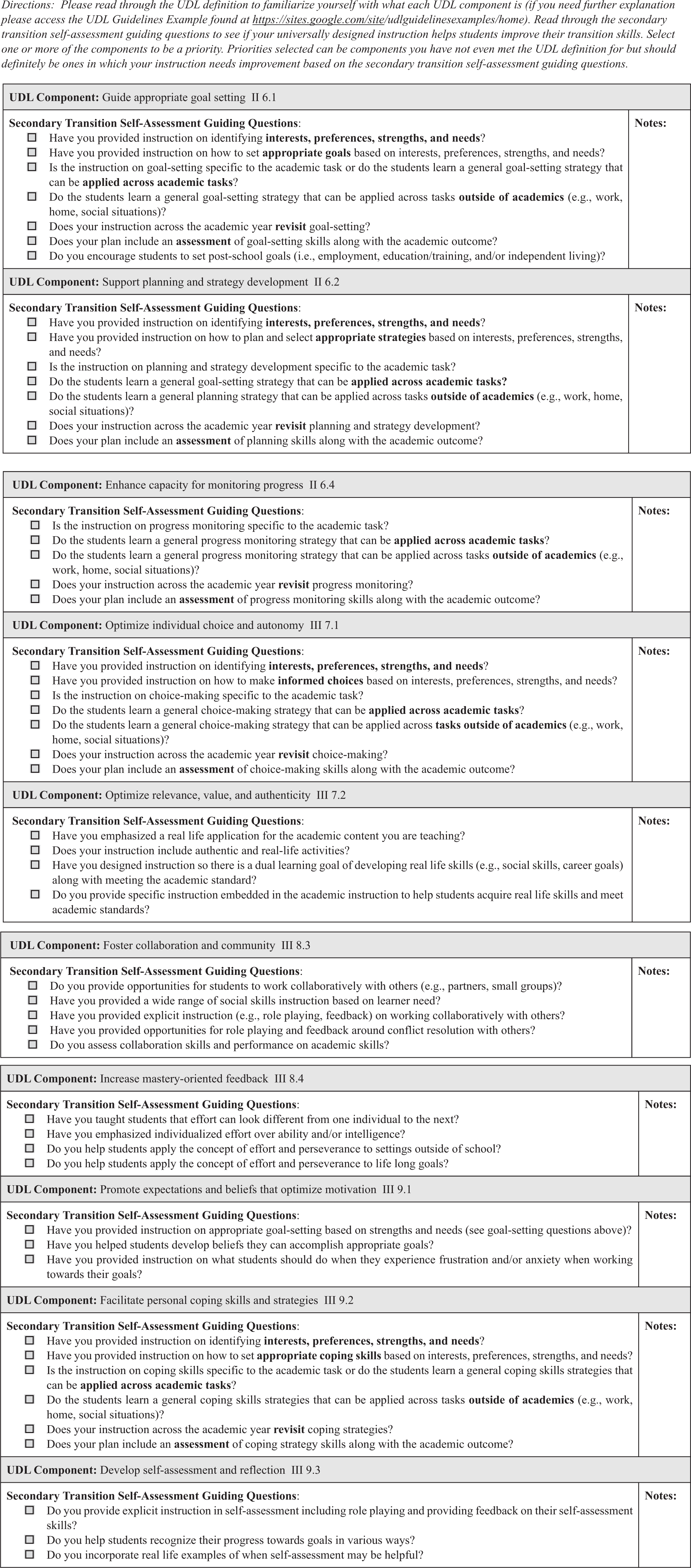
The UDL Secondary Transition Checklist.
Many of the similar checkpoints, generally the skill-based checkpoints (i.e., goal setting, planning and strategy development, monitoring progress, individual choice making and autonomy, facilitating personal coping skills and strategies), have a similar set of questions. These questions were designed to encourage teachers to reflect on whether they provide instruction in the checkpoint but with an emphasis on student-centered instruction. For example, many of the checkpoints’ questions begin with “Have you provided instruction on identifying interests, preferences, strengths, and needs?” This is an important first step in teaching students many of these checkpoints because students need to use their knowledge of their abilities and interests to help guide them. Teachers are then asked whether they teach the checkpoint based on identified interests and abilities (e.g., not just “Have you taught goal-setting?” but “Have you taught students how to set goals based on their preferences, interests, strengths, and needs?” Guide appropriate goal setting, II 6.2). Teachers are then asked to reflect on whether they provide instruction to allow for generalization, including postschool settings (i.e., across academic tasks, outside of academic settings) and maintenance (i.e., revisit instruction in the checkpoint later in the year). Finally, teachers are asked whether they also assess progress in this skill.
For the remaining checkpoints that do not fit the general set of questions, we developed questions specific to the skill, encouraging teachers to consider the secondary transition application. For example, when asked about optimizing relevance, value, and authenticity, teachers are asked, “Have you emphasized a real life application for the academic content you are teaching?” (Optimize relevance, value, and authenticity, III 7.2), and are asked additional questions that encourage the teacher to think more deeply about the secondary transition connection (e.g., “Have you designed instruction so there is a dual learning goal of developing real-life skills along with meeting the academic standard?”). The final step to the development of the checklist provides teachers with a brief space for them to record their goal based on their analysis.
Teacher Directions
Directions on how to complete the checklist are included for teachers at the beginning. Teachers are provided with a link to the original UDL checklist in case they need further clarification on the checkpoints. Steps to completing the checklist process are as follows:
Answer the reflective questions for each checkpoint.
Identify an instructional goal.
Step 1: Answer the reflective questions for each checkpoint
Teachers who are new to the checklist should answer each question for each checkpoint because this will help them consider the full overlap between UDL and transition. However, teachers who have a specific focus or who are returning to the checklist may want to focus on one or few checkpoints. When answering the questions, teachers should attend to the key words, which are printed in bold. These words are designed to help teachers identify the intent of the question; for example, “Does your instruction across the academic year
To help illustrate this process, an example is provided describing how Ms. Grady answered the questions. Thinking about UDL with secondary transition was new to Ms. Grady, so she chose to answer all the questions for each checkpoint. As she answered the questions, she found she met many of the initial questions under each checkpoint, indicating she does implement UDL. However, as the questions became more secondary transition focused, she found herself not being able to answer “yes” even though she did recognize the importance of the checkpoint in postschool life.
For example, from a universal design perspective, Ms. Grady does feel she fosters self-assessment and reflection activities in class (Develop self-assessment and reflection, III 9.3). She creates surveys with a Likert-type scale and asks students to reflect on their progress and identify strengths and areas needing improvement. However, reading through the questions on the secondary transition UDL checklist, Ms. Grady realized she is missing opportunities to extend self-assessment to real-life situations. For example, she has not attempted to encourage self-assessment on being prepared or self-assessment of student effort. So, while students are given opportunities to self-assess themselves on academic progress, she does not “incorporate real-life examples of when self-assessment may be helpful.”
Another UDL component from the checklist Ms. Grady uses in her classroom is fostering collaboration and community (Foster collaboration and community, III 8.3). She provides explicit instruction on how to work together effectively through problem-solving activities, including roles students can choose from to be active participants. Similar to self-assessment, the checklist helped Ms. Grady realize she is promoting collaboration and community but is limiting instruction to classroom-related tasks. In addition, reading through the checklist made her realize while she does emphasize the importance of the collaboration skills, she actually only assesses the academic skills taught so she does not know if the instruction she is providing is actually helping improve collaboration skills.
Step 2. Identify an instructional goal
Teachers should identify an instructional goal based on their answers to the questions. Along with helping teachers establish their current instructional status with the checkpoints in the first step, the questions may also provide teachers with ideas concerning developing a goal. The choice of which instructional goal to develop is up to the individual teacher. For example, a teacher may choose instruction regarding identifying preferences, interests, strengths, and needs because he or she may have answering no to that question for multiple checkpoints. This teacher may also want to include additional instruction specific to goal setting or choice making, depending on the answers to the questions. He or she may also want to build in maintenance, generalization, and/or assessment based on answers to additional questions.
For example, after reviewing her answers, Ms. Grady chose “Optimize relevance, value, and authenticity” as her goal for a few reasons. First, reading through the questions helped her realize this is not something she emphasizes at all. Second, the questions—particularly “Does your instruction include authentic and real-life activities?”—helped her think about upcoming topics and some ways to do this. She initially set this as a short-term goal and focused on one instructional topic with the idea she could keep doing this as she planned throughout the year.
Implementation
This checklist identifies starting points for infusing secondary transition instruction; it does not include specific ideas on how to design that instruction. We do recommend that teachers take the next step and actually implement their particular goal or goals. While teachers are encouraged to think broadly about their instruction in its entirety, it may be helpful to revisit the checklist throughout the year or at the beginning of the year as the teacher offers instruction in different academic content areas.
For example, once Ms. Grady decided on her goal of bringing real-world relevance into instruction, she had to think about how she could put that into action. Ms. Grady decided to invite an engineer to come into her classroom. Leading up to the visit, she provided instruction on basic building principles and held a discussion around engineering careers. The visit with the engineer engaged the students in both a hands-on building activity using design principles and discussion of engineering careers. In addition, Ms. Grady followed up the activity with further discussion and questions on careers in general. While there are no questions specific to employment under the relevance checkpoint, overall the checklist emphasizes students knowing what they like and where their abilities lie, so Ms. Grady facilitated a discussion as to whether students were able to relate the visit with their own opinions on future careers.
Once she was able to reflect on the experience, Ms. Grady realized going through the reflective questions on the checklist gave her the opportunity to think about how to integrate real-life topics into her instruction in an accessible and hands-on way. Because she saw the benefit after just one activity, she would like to continue to focus on this same goal.
Final Thoughts
The UDL Secondary Transition Checklist can provide teachers with a reflective process on how to integrate academic content enhanced with secondary transition application, such as Ms. Grady did. Ms. Grady used the questions to reflect on her own teaching and found she was implementing some UDL practices such as self-assessment and facilitating cooperative learning but was not helping her students make a connection between these skills and real life.
Having this glimpse into the reflective process can help other teachers see that the checklist is not an all-or-nothing process. Many teachers may find they are already fulfilling parts of the checklist, especially the questions focused more on universal design. Teachers like Ms. Grady may already be delivering universally designed instruction; the checklist can help them take that instruction and add even more relevance by relating it to real-life situations.
While Ms. Grady ultimately identified a goal that fit well with her upcoming instruction, there are additional considerations teachers can think about, including student need, Individualized Education Program goals, and student interest. The checklist can also help teachers such as Ms. Grady frame follow-up activities with the students in discussions on careers. These kinds of activities are critical to help all students, not just those with transition-focused educational plans, achieve positive postschool outcomes.
Researchers in the field have identified instruction in both general education and secondary transition as valuable for students with disabilities, but it is not always clear how to do this with the limited time students are in school (Ayres et al., 2011; Bouck, 2010). Using the overlap UDL has with secondary transition presents a unique opportunity for teachers to develop accessible materials and instruction while also teaching valuable lifelong skills (Thoma, Bartholomew, & Scott, 2009). The UDL Secondary Transition Checklist can help teachers reflect on their instruction of these lifelong skills and identify how to teach these skills so they generalize to postschool success.
Footnotes
Declaration of Conflicting Interests
The author(s) declared no potential conflicts of interest with respect to the research, authorship, and/or publication of this article.
Funding
The author(s) received no financial support for the research, authorship, and/or publication of this article.