



Abstract
The Transition and Postsecondary Program for Students with Intellectual Disabilities (TPSID) model demonstration program, funded by the U.S. Department of Education’s Office of Postsecondary Education was implemented initially from 2010 to 2015. During this time, 27 institutions of higher education were awarded grants to develop programs for students with intellectual and developmental disabilities (IDD) to access higher education. TPSID programs were charged with developing model demonstration programs that would lead to gainful employment. In this article, we identify predictors of employment while in the program and at exit for students who completed a TPSID program between 2010 and 2015. Results identified several predictors of employment for students with IDD. Authors share implications for future research and practice gleaned from the analysis.
Postsecondary education has long been recognized as a pathway to employment, with higher levels of education correlating with lower rates of unemployment and higher earnings (Vilorio, 2016). Positive relationships between enrollment in postsecondary education and employment have also been found for youth and adults with intellectual and developmental disabilities (IDD; Smith, Grigal, & Shepard, 2018; Smith, Grigal, & Sulewski, 2012). For example, in looking at employment outcomes of youth with IDD who received vocational rehabilitation (VR) services using the RSA 911 data set, Smith et al. (2018) found those who received postsecondary education services as part of their VR plans had higher employment rates and, in some cases, up to 51% higher wages than youth with IDD who did not receive postsecondary education services.
These initial findings suggest that access to higher education has the capacity to impact employment outcomes for people with IDD. However, support to access higher education from state agencies such as VR varies from state to state (Grigal, Migliore, & Hart, 2014) and higher education is seldom identified as a goal for students with IDD on their transition plans (Grigal, Hart, & Migliore, 2011). The emergence of new federal guidance and expansion of existing higher education program options in the past decade has created some promising advancements regarding access to higher education for students with IDD.
The catalyst for many of these advancements was the passage of the Higher Education Opportunity Act (HEOA) of 2008 (PL 110- 315), which reauthorized the Higher Education Act of 1965 (PL 89-329). The HEOA defined for the first time components that should be present in postsecondary education programs serving students with IDD. The legislation also indicated programs should emphasize inclusive academic access and result in competitive employment.
In 2010, funds were appropriated under the HEOA to create model demonstration projects, referred to as Transition and Postsecondary Programs for Students with Intellectual Disabilities (TPSID). The intent of the TPSID projects was to enable institutions of higher education (IHEs) to create or expand high-quality inclusive model comprehensive transition and postsecondary programs for students with intellectual disability. Over a 5-year funding period, the first cohort of TPSID grantees enrolled 2,245 students at 58 college campuses in 23 states (Grigal, Hart, Smith, Domin, & Weir, 2016). Although TPSID projects targeted students with intellectual disability specifically, many programs also served students with autism and other developmental disabilities. Thus, we will subsequently use the term IDD to describe the disability status of the students enrolled in TPSID programs.
The TPSID grantees had a broad charge to establish model postsecondary programs that focused on academic enrichment, socialization, independent living skills, and integrated work experiences that lead to gainful employment. A national coordinating center (NCC), also created under the HEOA, was charged with evaluating the TPSID programs. The NCC created an evaluation protocol to gather data on programs and students each year. Using the descriptive data entered by TPSID faculty and staff each year, the NCC compiled aggregate summaries into annual reports reflecting the provision of academic and other services in the IHEs hosting TPSID programs. Certain student experiences were particularly relevant to determine if the TPSID program was meeting their performance measures, including student status (high school or adult); student access to college courses, residential experiences, and career development and employment activities both during and at exit from the program; and student attainment of meaningful credentials (e.g., Grigal et al., 2016).
The NCC annual reports on the TPSID provided snapshots of services provided in a particular funding year. For example, the report detailing activities in the fifth year of funding, indicated 888 students attended TPSID programs at 52 IHEs (Grigal et al., 2016). Of these, one-quarter were high school students, receiving transition services in the TPSID program primarily through partnerships with local education agencies. The remaining students were adults with IDD, no longer receiving special education services under Individuals With Disabilities Education Act (IDEA). Students enrolled in 5,775 college courses; 45% of these courses were inclusive, meaning that they were typical college courses attended by students without IDD. The remaining 55% of course enrollments were in specialized courses that were designed for, and offered only to, students with IDD.
Capturing the type of courses (inclusive vs. specialized) students in TPSIDs enrolled in was especially pertinent as one of the hallmarks of the TPSID program was to create inclusive programs, meaning students would be able to access existing college courses and participate in campus organizations and activities. Accessing typical college courses provides students with access to a greater array of course content, exposure to college peers without or with other disabilities, and provides them with the potential, in some cases, to earn college credits (Papay et al., in press). Although TPSIDs were not required to offer housing, many grantees provided students with IDD access to on- and off-campus living experiences. One quarter of students lived in housing that was provided by the IHE or TPSID (Grigal et al., 2016).
The TPSID Cohort 1 programs were also required to create and offer “meaningful” credentials to students with ID who completed a program. The nature and structure of these credentials was left to the discretion of the host IHE, as the federal guidance offered no definition for the term “meaningful.” Most students with IDD who attend postsecondary education programs were not seeking a degree and instead were seeking nondegree credentials or certificates (Shanley, Weir, & Grigal, 2014). By the fifth year of funding, 48 of the 52 TPSID programs offered some type of credential, most being general postsecondary education certificates (e.g., Certificate of Academic and Career Studies). Nondegree credentials such as certificates have been found to be of value for workers, with individuals holding certificates earning more than those with only high school education (Carnevale, Rose, & Hanson, 2012). In 2016, 27% of adults in the United States held nondegree credentials (Cronen, McQuiggan, & Isenberg, 2017) and data from 2009 show that more than 1 in 10 American workers report a certificate as their highest educational credential (Carnevale et al., 2012). Presumably, the credentials issued by the TPSIDs or host IHEs were intended to provide similar benefits for students with IDD in terms of supporting positive employment outcomes.
The credentials offered by TPSIDs varied in terms of their format and structure and the extent to which they were approved by the host IHE (Shanley et al., 2014). Some TPSIDs provided their students with pathways toward existing IHE credentials; others developed new credentials. Some of the newly developed credentials were established via the typical IHE credential development process and were available to all students at the IHE, including students with IDD. Other newly developed credentials were established internally in the TPSID program and offered only to students attending the TPSID program. These TPSID-specific credentials were not awarded or recognized by the host IHE.
To prepare for employment in early adulthood, individuals with IDD require work experiences during high school in real work settings followed by a combination of training, close supervision, and support from employers, coworkers, and job coaches once they enter the workforce (Lindstrom, Hirano, McCarthy, & Alverson, 2014). Early paid work experience has been shown repeatedly to be a strong predictor of postschool employment (Gold, Fabian, & Luecking, 2013; Test et al., 2009; Wehman et al., 2015). To prepare students to engage in gainful employment, TPSID programs offered an array of career development and employment activities. For example, in the 2014–2015 academic year, 60% of students participated in career development activities, including internships, unpaid job training, or service learning. More than a third of students held a paid job and some held more than one job (Grigal et al., 2016). The data on the experiences of students attending TPSID programs provided an opportunity to discern if the program priorities of academic inclusion, residential access, credential attainment and employment preparation have been effective in guiding students toward the targeted outcome of paid employment.
Studies have examined outcomes of individuals with IDD who enroll in postsecondary education through data collected from single programs or from a small number of programs. For example, Butler, Sheppard-Jones, Whaley, Harrison, and Osness (2016) surveyed 19 students with IDD who had participated in two semesters of college in Kentucky about a variety of life outcomes including health, employment, and relationships using the National Core Indicators (NCI), Adult Consumer Survey. In comparing their responses to a randomly selected group of similar age respondents with IDD from the same state, they found higher education positively impacted life outcomes across a variety of domains including employment. Individuals in the college student group were almost three times more likely to be employed in the community than those in the comparison group. These authors reported a need to further explore the impact of higher education on adult outcomes and further studies using larger samples.
In addition, Moore and Schelling (2015) surveyed 34 graduates with IDD from two higher education programs, one specialized and one integrated, regarding current and desired employment status. Employment outcomes of graduates from each postsecondary program were compared to the other, as well as to data from students with IDD who had not attended a postsecondary program (utilizing the National Longitudinal Transition Study-2). Significantly more positive employment outcomes were found for individuals with IDD who attended postsecondary programs compared to those who did not attend such programs. Little difference was found in the level of positive benefit between the integrated and specialized program models. Moore and Schelling selected the programs involved in the study which reduced potential for generalizing the results to other postsecondary programs.
Studies have also begun to examine the practices used at TPSID programs to address preparation for employment. For example, Petcu, Chezan, and Van Horn (2015) conducted a survey of higher education programs serving students with IDD in the United States (both TPSID and non-TPSID), finding the majority of students were receiving numerous employment preparation supports but little access to paid work experiences. A study by Qian, Johnson, Smith, and Papay (2018) examined predictors of paid employment for students with IDD who were attending two community and technical colleges in one midwestern state funded by a TPSID grant. They found students who took only inclusive courses, participated in campus events, had work experience before entering the program, and volunteered or did community service were more likely to have a paid job at or above minimum wage during 1 year of attendance at a TPSID program.
It is clear from emerging research that higher education can have a positive impact on the employment outcomes of students with IDD. However, much of the previous research has been limited to small samples sizes representing one or a small number of higher education programs. The TPSID data set offers the opportunity to examine some of these same variables using a substantially larger data set. Although it is not a representative sample of all of the existing higher education programs enrolling students with IDD in the United States, it is the most comprehensive longitudinal data set available on college students with IDD. Given our knowledge of the primary focal areas of the TPSID programs, and the intended purpose of the program to prepare students for gainful employment, the current study sought to conduct a secondary analysis of the TPSID Cohort 1 data to determine which student characteristics and experiences predicted student employment, both during and at the end of their college experience. The following research questions were examined:
Method
Data Source
We conducted secondary analysis of data collected from Cohort 1 TPSID programs by the NCC between 2010 and 2015. Data were collected annually from all sites that received TPSID funding and were entered by faculty and staff at the TPSID program. The NCC developed a web-based data management system on a secure online platform (Quickbase) to capture program and student data each year of implementation. TPSID staff were required by their funder to report key program and student information to the NCC using the web-based system. The evaluation protocol captured both program level data (e.g., staffing, funding, collaboration, access to IHE systems), as well as required student level data (e.g., enrollment in courses, engagement in internships, work study, paid/unpaid employment). For the present analysis, a record was created for each student including student demographics, experiences across their entire postsecondary education program, and exit information.
Sample
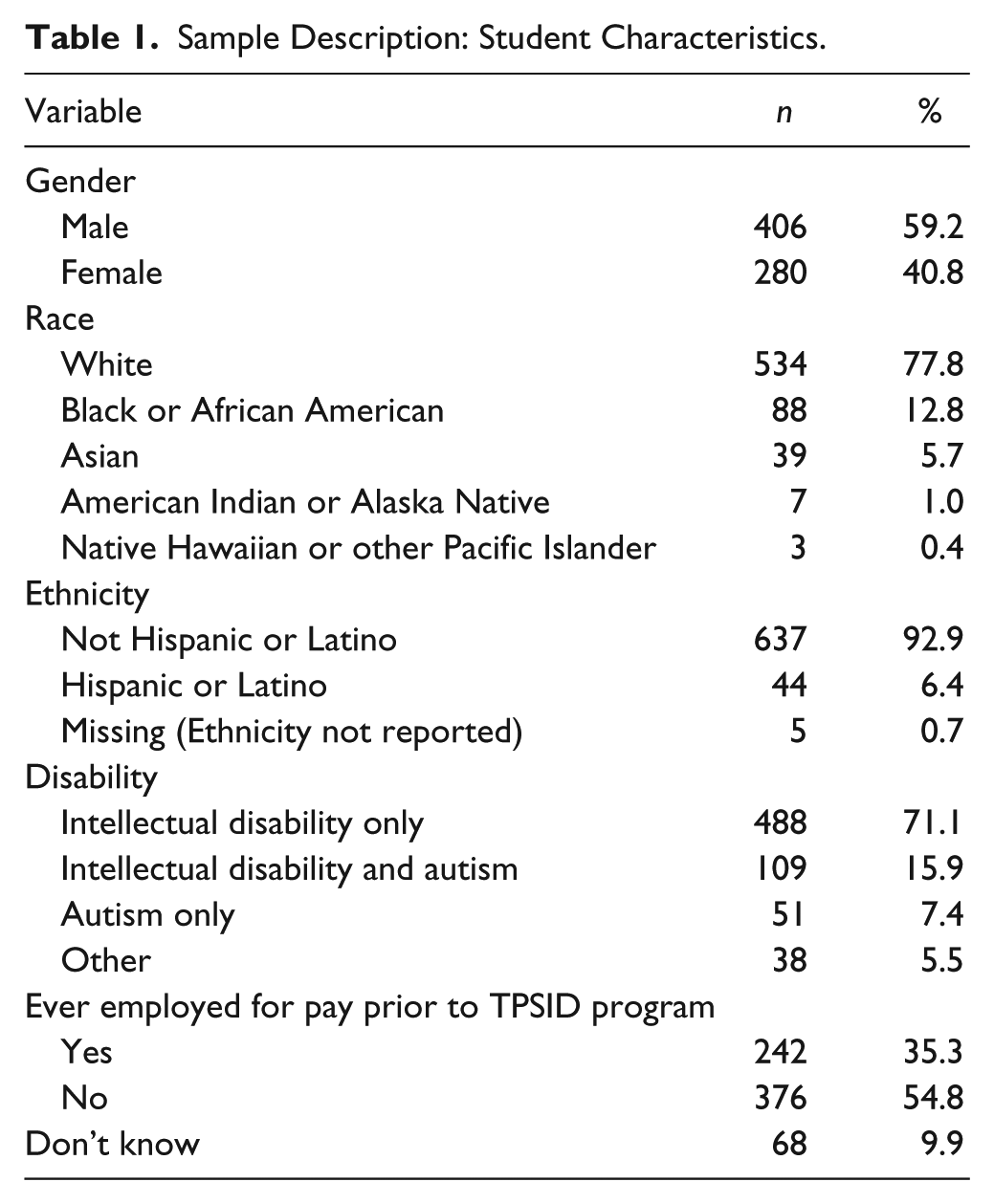
We applied several selection criteria to obtain the sample for the present analysis. First, we selected only those students who had completed a TPSID program and excluded those who had exited prior to program completion. This ensured the data reflected the entirety of a students’ experiences in a higher education program and that they were not skewed by the experiences of students who dropped out prior to completing a program. Second, students who had not enrolled in at least one inclusive college course were excluded from the sample. Although TPSIDs were charged with providing supports for the inclusion of students with intellectual disability in academic courses, two programs did not enroll any students in inclusive coursework and were therefore atypical. Students who attended these two programs (n = 67) were removed from the analysis. An additional 161 students who had no inclusive course enrollments reported (100 who attended a highly specialized program and another 61 due to missing data) were removed from the sample because we could not determine if the lack of course enrollment data was due to missing data and we wanted to ensure a consistent sample of students who had all access higher education, including coursework. The final sample size was 686 who attended a total of 43 programs. A description of the sample is provided in Table 1. The mean age of students was 21.8 years old (SD = 3.3), median and mode were 21 years old, and the range was 17 to 51.
Sample Description: Student Characteristics.
Variables
Predictor variables
Two types of variables were entered into the analysis of predictors of employment: student characteristics and student experiences. Student characteristic variables were age, gender, race, ethnicity, disability, and ever employed for pay at or above minimum wage prior to the TPSID program. See Table 1 for data on student characteristic variables. Although the purpose of the TPSID model demonstration program was to serve students with ID, some programs served students with autism only or autism plus ID. A minority of students in the sample (n = 39) attending these programs were reported to have other developmental disabilities.
The following aspects of students’ experiences while enrolled in an inclusive higher education program were examined as predictors of employment: (a) If a student attended a 2- or 4-year IHE. Programs were located at either 2-year (i.e., community or junior colleges) or 4-year (e.g., universities) IHEs. Note that the type of institution (2- or 4-year) was not synonymous with the length of the program a student attended. Students who attended both 2- and 4-year IHEs were enrolled from between 1 and 4 years; (b) If a student was dually enrolled at any point during the TPSID program. Dual enrollment refers to enrollment in higher education during the final years of high school while continuing to receive special education services; (c) The number of inclusive course enrollments for a student. Inclusive courses are typical college courses attended by students without IDD. This variable examined the amount of inclusive coursework taken by a student; (d) The number of specialized course enrollments for a student. Specialized courses are courses designed for, and offered only to, students with IDD, often focusing on topics such as life or social skills or career development. This variable examined the amount of specialized coursework taken by a student; (e) If a student took any specialized courses. This variable examined whether students took either any or no specialized courses. We included this binary variable as a similar binary variable was found to be a significant predictor of employment by Qian et al. (2018); (f) If a student lived in IHE housing at any point during their program. Some TPSID programs were located at campuses that offered housing to all students and some created access to IHE housing for students in the TPSID program. This variable examined whether students lived in IHE housing at any point during their program; (g) If the student engaged in any career development experience during the program. Career development was any preparation for employment that is unpaid (e.g., internships, volunteering, or service learning); (h) If the student earned a credential that was available to all students. A credential is a document that proves a person’s achievements at an IHE education (e.g., transcripts or diplomas) or competence/skills in a particular field (e.g., certificates). Available to all students means that the credential is available for both students in a TPSID program and non-TPSID initiatives to earn. This was a binary variable: 1 = student earned a credential that was available to all students or 0 = they did not earn a credential that was available to all students (i.e., 0 = either they did not earn a credential, or they earned a credential that was not available to non-TPSID students); (i) If a student earned a credential that was awarded by the IHE. A credential awarded by the IHE likely means that the credential has been approved through the IHE’s governance structure and is an official offering of the IHE. This was also a binary variable: 1 = student earned a credential that was awarded by the IHE or 0 = they did not earn a credential awarded by the IHE (i.e., 0 = either they did not earn a credential, or they earned a credential awarded by an entity other than the IHE, for example the TPSID program or local educational agency); (j) Obtained a paid job while enrolled in the program. A student was deemed to have obtained a paid job while enrolled in the program if a record was created for a paid job with a start date on or after the date they began the TPSID program. This variable was the criterion variable for research question one and became a predictor variable in research question two due to prior research documenting the predictive relationship between early paid work experience and later work (see Test et al., 2009); (k) The number of years a student attended the TPSID program. This was calculated based on the number of annual records entered for each student; and (l) The year the student exited from the TPSID program. This was determined by the date of exit entered for the student. See Table 2 for data on the binary or categorical variables. Students enrolled in a median of 13.0 courses across their whole program (M = 17.0, SD = 14.2, mode = 4.0, range = 1–67): a median of 4.0 total inclusive courses (M = 6.0, SD = 4.9, mode = 2.0, range = 1–34) and a median of 7.0 specialized courses (M = 11.0, SD = 13.8, mode = 0, range = 0–58). On average each year, students enrolled in a median of 7.5 courses (M = 8.7, SD = 6.2, mode = 2.0, range = .33–17): a median of 2.0 inclusive courses (M= 3.1, SD = 2.5, mode = 1.0, range = .33–17) and a median of 3.5 specialized courses (M = 5.6, SD = 6.1, mode = 0, range = 0–22.5).
Sample Description: Program Experiences of Students.

Note. IHE = institution of higher education.
Criterion variables
The two criterion variables were obtaining a paid job while in the program and having a paid job at or within 90 days of exit. A paid job was defined as any type of employment for which the individual was paid. A paid job while in the program was defined as obtaining paid employment on or after the date on which the student began the program. A paid job within 90 days of exit was defined as having a paid job at any point between the date of exit and 90 days thereafter.
Analysis
Multiple logistic regression was performed using SPSS Version 24. We followed procedures for reduction of a large number of variables in a logistic regression by Hosmer, Lemeshow, and Sturdivant (2013). We conducted univariate analyses (logistic regression) between each of predictor variables and the two dichotomous criterion variables. Independent variables were retained for further analysis when a Wald test from univariate analysis was significant at p ⩽ .25 with either of the criterion variables (Hosmer et al., 2013). One additional variable, preprogram employment, that was not significant at p ⩽ .25 was retained for RQ2 because of known practical importance to the outcome. In logistic regression, we examined the Nagelkerke R2 to assess the overall strength of the association of the models and the Wald test statistic and the odds ratios (OR) to analyze the significance of the predictor variables. A significance level of p < .05 was used to identify predictors in the logistic regression models. Missing data ranged from 0% to 9.9% for the criterion variables. Because logistic regression analysis uses complete cases analysis, the number of cases used for RQ1 was 618 and for RQ2 was 614.
Results
Predictors of Paid Job While in Program
The results of multiple logistic regression for the criterion variable obtaining paid employment while in the program are shown in Table 3. The logistic regression model was statistically significant, χ2(9, N = 618) = 111.806, p < .001. Nagelkerke pseudo R2 was .221 and the model correctly classified 69.6% of cases. Sensitivity was 70.4%, specificity 68.8%, positive predictive value 69.0% and negative predictive value 70.2%. Two of the nine student experience predictor variables were statistically significant: number of years attended and total number of specialized course enrollments. A higher number of specialized courses taken was associated with slight reduction in the likelihood of obtaining a paid job at some point while attending a TPSID program (OR = .946, p < .001). A higher total number of years attended was associated with higher odds of obtaining a paid job at some point while attending a program (OR = 2.063, p < .001). No student characteristics predictor variables were significant.
Logistic Regression Model for Obtaining Paid Employment During Enrollment.

Note. N = 618. Comparisons are to reference group “0.” CI = confidence interval; IHE = institution of higher education.
p < .05.
Predictors of Paid Job at Exit
The results of multiple logistic regression for the criterion variable paid employment at exit are shown in Table 4. The logistic regression model was statistically significant, χ2(13, N = 614) = 256.888, p < .001. Nagelkerke pseudo R2 was .465 and the model correctly classified 76.7% of cases. Sensitivity was 70.9%, specificity 80.3%, positive predictive value 68.9% and negative predictive value 81.8%. Of the 13 predictor variables four student experience predictor variables were statistically significant: type of IHE, obtaining a paid job while in the program, living in IHE housing, and earning a credential from the IHE. Attending a 4-year IHE increased the odds of having a paid job within 90 days of exit over attending a 2-year IHE (OR = 1.845, p = .04). Obtaining a paid job while enrolled in higher education (OR = 14.841, p < .001) increased the odds of having a paid job within 90 days of exiting the program. Earning a credential awarded by the IHE increased the odds of having a paid job within 90 days of exit (OR = 1.830, p = .025). Living in IHE housing at some point while a student was enrolled in a TPSID reduced the odds of having a paid job within 90 days of exit (OR = .235, p < .001). One student characteristic predictor variable was significant: preprogram employment status. Having a paid job prior to entering a TPSID (OR = 2.803, p < .001) increased the odds of having a paid job within 90 days of exiting the program.
Logistic Regression Model for Paid Employment at or Within 90 Days of Exit.
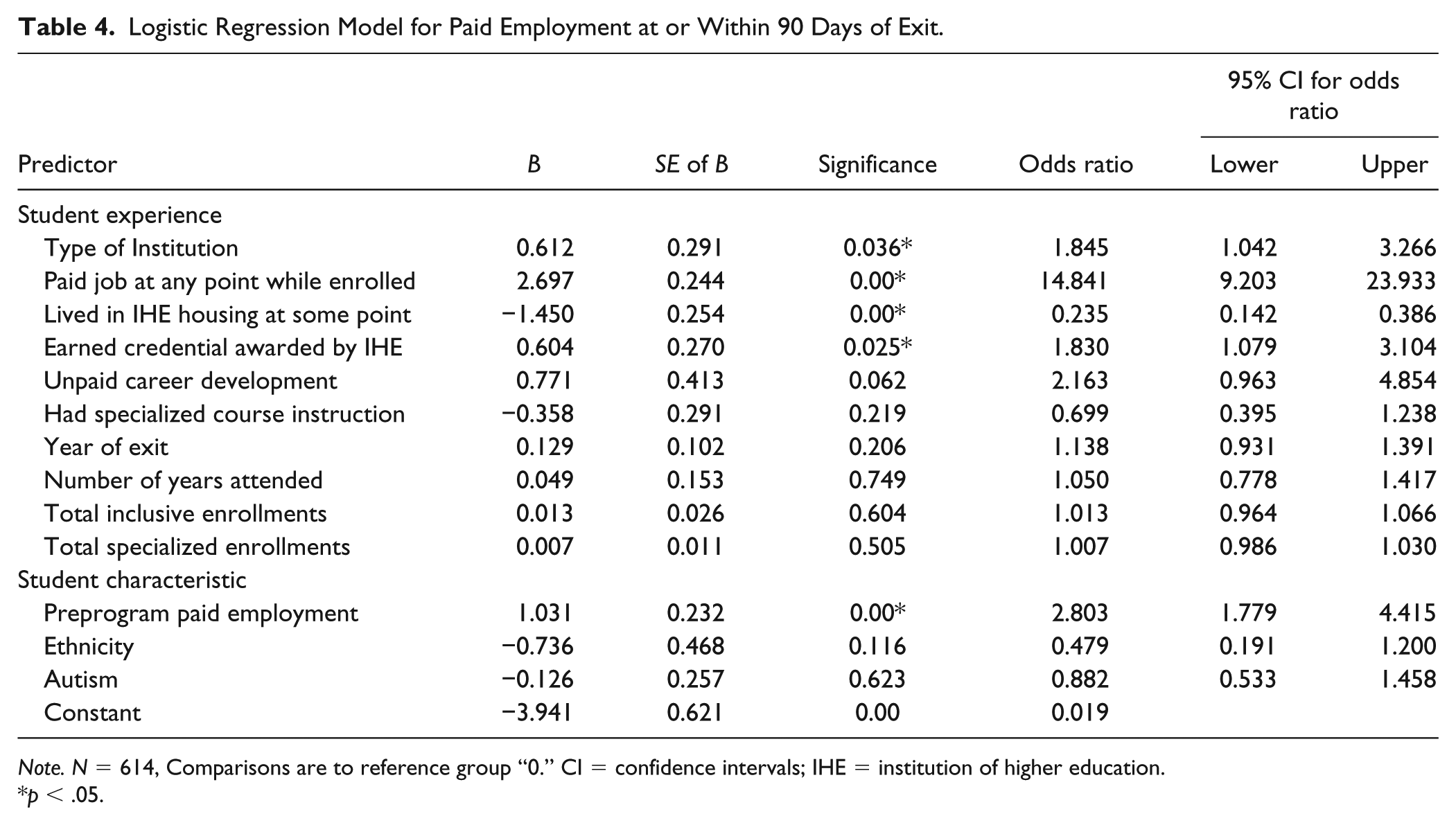
Note. N = 614, Comparisons are to reference group “0.” CI = confidence intervals; IHE = institution of higher education.
p < .05.
Discussion
While various employment initiatives in the United States such as Employment First (Niemiec, Lavin, & Owens, 2009) and new provisions outlined in the Workforce Innovation and Opportunity Act (2014) reemphasize the importance of competitive integrated employment for people with IDD, employment outcomes for young adults with IDD have remained poor. A report from the NCI project showed that in 2014–2015, only 16% of working-age adults supported by state IDD agencies were employed in a paid job in the community (Hiersteiner, Bershadsky, Bonardi, & Butterworth, 2016). The TPSID model demonstration projects offer a potential new approach to improving employment outcomes via higher education pathways for youth and adults with IDD. Given the importance of employment preparation as a central focus for the TPSID programs, determining components of practices that predict student employment during and after enrollment provides insights about the characteristics of effective program practices.
Predictors of Paid Employment While Enrolled in TPSID
Almost half of the students (49.1%) obtained a paid job while enrolled in a TPSID program. This is similar to the percentage of full-time 16- to 24-year-old undergraduate students who were employed in 2015 (43%; National Center for Education Statistics, 2017). This demonstrates that employment is a tenable experience in college for youth and adults with IDD. Of the programmatic elements examined, two were found to be statistically significant predictors of obtaining paid employment while enrolled: the number of years attended was a positive predictor which increased the likelihood of employment and total number of specialized course enrollments a negative predictor which reduced the likelihood of employment.
Years attended
A higher total number of years attending a TPSID was associated with higher odds of obtaining a paid job at some point while attending a program. This could be because the longer students were enrolled, the more preparation they received and thus they were better prepared to obtain paid employment. Yet, the majority of students attended programs for 2 years or less, and it is not clear the optimal length of attendance that is needed to secure employment. More likely the impact of time in program may have been connected to the kinds of employment activities (unpaid vs. paid) that comprised the students’ early career experiences.
Specialized courses
Specialized courses were found to be a negative predictor of employment during enrollment, as students enrolled in higher numbers of specialized courses had a slight reduction in the likelihood of obtaining a paid job at some point while attending a TPSID program. There are potentially two explanations for this. First, this could be evidence of a bias presented by programs that have higher enrollment in specialized courses. If higher enrollments in specialized classes are due to a belief that students with IDD need special instruction before they are ready for obtaining paid employment, then it is possible that there could be a corresponding lower expectation for paid employment. Second, it is possible that programs enrolling students in a higher number of specialized courses are prioritizing this instruction over time spent supporting students to find paid employment. A greater devotion of staff time to specialized instruction could mean less staff time targeting employment supports such as job development and establishing employer networks.
The continued use of specialized courses in the TPSIDs runs counter to the expressed purpose of the TPSID model demonstration projects which were funded to create inclusive postsecondary experiences. The finding that specialized courses are a negative predictor of another critical TPSID priority, paid employment for students while in college, should lead to some reflection regarding the nature and use of specialized coursework in these programs. Given the use of specialized coursework is prevalent in the TPSID model demonstration projects, further study is needed to ascertain the evidence base for specialized courses, why they are developed, and their impact on other college outcomes.
Predictors of Paid Employment at Exit
Of the variables examined, five were significant predictors of paid employment at exit including: earning a credential that was awarded by the IHE, attending a 4-year IHE, paid work either prior to enrolling in the TPSID program or obtained while in the TPSID program, and living in IHE housing. Earning a credential that was awarded by the IHE almost doubled the odds of having a paid job at exit and attending a 4-year IHE increased the odds of having a paid job within 90 days of exit over attending a 2-year IHE. Paid work either prior to enrolling in the TPSID program or obtained while in the TPSID program were significant positive predictors of students having a paid job at exit. Finally, living in IHE housing at some point reduced the likelihood of having a paid job within 90 days of exit.
Credential awarded by the IHE
As mentioned previously, credentials awarded by the TPSIDs varied significantly in terms of who they were offered to and their level of recognition by the IHE. Some of the credentials offered were program-specific, awarded only to students in the TPSID program and not recognized by the host college or university. Other credentials were available both to students within and outside of the TPSID program. A credential that was designated as “awarded by the IHE” meant that the credential likely had been approved through the IHE’s governance structure and was officially recognized as a credential offered by that educational institution. The finding that credentials that were awarded by the IHE were found to be a predictor of employment at exit could demonstrate that such credentials are more effective in helping students with IDD in the job search process or are more widely recognized by employers than TPSID-specific credentials. Employers may be more familiar with the name of the college or university issuing the credential than they are with the name of a TPSID program. This finding suggests current and emerging higher education programs seeking to support postschool employment would benefit from focusing on developing and implementing credentials that are formally awarded and recognized by the issuing IHE.
Type of institution attended
Attending a 4-year IHE increased the odds of having a paid job within 90 days of exit over attending a 2-year IHE. This finding requires some additional explanation about the structure of the TPSID programs. The length of the TPSID program did not always correspond with the type of college or university that hosted the program. Furthermore, the stated length of the TPSID program did not always correspond with the amount of time students were enrolled. Therefore, students attending a 4-year college may have been enrolled in a 2-year TPSID program at that college and may in reality have been enrolled for a different length of time. In fact, of the 441 students in the sample who attended TPSID programs at a 4-year IHE, 312 (71%) attended for 2 years or less. Almost half (48%) of the students attending programs at 2-year colleges attended for only 1 year. It is likely that the type of institution predictor is influenced both by the length of program, as well as the length of student program attendance. Future studies could examine these variables to identify how these factors interact to influence employment outcomes.
Preenrollment paid employment
Early paid work predicting future paid work for young adults with IDD has been documented by a variety of studies (Gold et al., 2013; Test et al., 2009; Wehman et al., 2015). Our findings extend support for this experience into a college setting for students with IDD, demonstrating that both preprogram paid work experience and paid employment experience during enrollment were positive predictors of paid employment at exit. Students entering TPSID programs with paid employment experience were more likely to exit their program with paid employment. However, employment prior to enrollment was not found to be a predictor of employment while enrolled (see Table 3). Therefore, there must be some characteristic of the preprogram employment experiences that later influences student employability.
It is possible that previously held paid employment may have afforded students greater knowledge about their career interests and this knowledge may have influenced the types of career exploration activities and/or related coursework that comprised the student’s course of study. It is also possible that having additional employment experiences on their resume made these students more desirable to employers at exit. However, only 35% of students entering the TPSID had engaged in paid work prior to enrollment, so the majority of students entering TPSIDs had no prior paid work experience. This may be a reflection that paid employment in high school, although consistently cited as an evidence-based predictor of postschool outcomes (Mazzotti et al., 2016; Test et al., 2009) is not consistently prioritized by transition professionals in high school for students with IDD.
Paid employment while enrolled predicting paid employment at exit
Students who obtained a paid job while enrolled in the TPSID program were almost 15 times more likely to have a paid job at exit than those who did not obtain a paid job while enrolled. This finding again supports findings from previous studies that document that paid work experiences predict future paid work experiences (Carter, Austin, & Trainor, 2012; Gold et al., 2013; Wehman et al., 2015). However, this finding also requires some additional exploration as it is not clear the extent of overlap between the paid jobs held by students during enrollment and the paid jobs held by students at exit. We know that a number of students who were employed during their college program retained those jobs after exit. In reviewing the data, we found that of the 252 students who held a paid job within 90 days of exit, 153 (60.7%) continued working in a job they had obtained while enrolled in the TPSID program and these students did not obtain additional employment beyond this previously held job. About 76 students (30.2%) who were not employed on the day of exit obtained employment within 90 days after exiting. The remaining 23 students (9.1%) both continued in jobs they had while enrolled and secured additional jobs after exiting the TPSID program.
Therefore, the predictor of “employment while enrolled” does not necessarily predict a different employment experience post enrollment. This same dynamic could be said of research conducted on other data sets such as NLTS2 that conducted surveys asking about both high school and postschool employment but did not confirm whether any of the post school jobs were in fact acquired after school (Cameto, Wagner, Newman, Blackorby, & Javitz, 2000). Regardless, it is a promising finding that students with IDD who obtained paid employment while enrolled in a TPSID program were able to maintain that employment beyond the point of exit. The exact timing of when those jobs were obtained and the role the TPSID program played in supporting students to obtain or retain those jobs were beyond the scope of this study and remain to be examined.
Why is employment during the program so impactful? Gold et al. (2013) found that offering paid competitive employment to high school youth enrolled in special education programs prior to school exit addressed obstacles related to labor market participation and led to universally high job placement rates of a large sample of youth with disabilities. The authors suggested that the earlier that work opportunities are offered, the more likely it is that youth with disabilities will exit school with a job. Extrapolating this dynamic to college implies that students should be offered the opportunity for paid work as early as possible in their postsecondary program. However, we also found the longer a student was in the program the more likely they would be employed. Given the high rate of engagement in career development and the lower rate of engagement in paid employment, not all TPSIDs prioritized paid employment to the same extent in students’ college experience.
Access to campus housing
On- and off-campus living contributes to a myriad of positive outcomes for college students, enhancing both academic performance and personal and social development (de Araujo & Murray, 2010). Our findings reflect that about a third of students attending TPSIDs lived on campus at some point in their program. Previous reports have reflected that students who accessed housing had higher levels of participation in social activities, such as going out with friends, attending organized events on campus, and attending sporting events; suggesting that housing fosters socialization with peers (Grigal et al., 2016).
In the current study, access to housing was shown to be a negative predictor of employment at exit. Students who accessed campus housing during their TPSID experience were less likely to have paid employment at exit than those who did not access housing. It is also possible that students who were using campus housing were more likely to be from out-of-state or from regions within the state that were further away from the IHE. The necessity of moving back to their home location after completing the program and the time needed to access employment supports after relocating may have been a factor. Given that the 90-day exit data is a very short window of time after exiting a program, this finding may simply reflect the transition period many students leaving college face as they exit and begin their job search. Further exploration of students’ experiences in housing is needed to understand the long-term impact of living on campus for students with IDD in higher education.
Limitations
Several limitations must be acknowledged. First, although both models were statistically significant, there was unexplained variance. Therefore, there were factors that went beyond the scope of this study that remain to be identified and examined, including interactions between variables and mediation of the relationship between the predictors and criterion variables. Second, although TPSID programs were examined together in the present study, there was substantial variation in the experiences offered to students and program structure. It is likely that there are underlying models within the TPSID programs. For example, there are programs where students take no specialized classes at all. The present analysis did not attempt to identify or consider nested models. Third, data were self-reported by TPSID program staff. In some instances, it is possible that missing data may have led us to believe that a student was not participating in a particular activity or did not have a paid job. However, steps were taken by the NCC each year to encourage and support TPSID program staff to enter complete and accurate data. This secondary analysis was also limited to a list of predetermined variables that may have limited some analyses. For instance, student employment outcomes reflected their status within 90 days of exit from their program. Data reflecting employment status longer after exit would have been preferable, but those data were not available. Finally, the present analysis was of a sample of grant-funded programs and results may not be generalizable to programs that have not received grant funding.
Implications for Research
The present study identified a number of implications for future research. While the current study offered an opportunity to review employment outcomes and associated predictors of those outcomes, these data only reflected the students’ status within 90 days of exit from their IHE program. Given that many of the jobs held at exit were obtained during the program, future efforts must focus on capturing longer term outcomes, further than 90 days out (e.g., 1 year and beyond) to ascertain if the higher education programs have created a sustained employment pathway for students with IDD. Initial data from the TPSID NCC suggest promising results: 61% of students who completed TPSID Cohort 2 programs in 2015–2016 were employed 1 year after exit (Papay, Trivedi, Smith, & Grigal, 2017). Follow-up data collection efforts should attempt to address the extent to which in program employment experiences continue or lead to different employment experience post enrollment. Given a longer viewpoint, we may see differing relationships between program experiences such as living in campus housing and course enrollments than were evident in the present, short-term analyses.
Second, given the substantial reliance on specialized courses and career development activities by IHEs implementing TPSID projects, it is important that further research is conducted to verify, or disprove, that these practices are effective in a higher education setting. The current study seems to suggest that specialized college coursework, in which students are segregated from other colleges students, may have a negative impact on one outcome indicator, paid employment. Further exploration of these predictors on other outcomes, such as independent living and further education is warranted. Targeted studies are also needed to discern if segregated instruction and unpaid career development activities in higher education are necessary and effective or are merely practices that have been carried forward from a special education model of service.
Finally, there is a need to identify program models and subsequently establish which of those models are more or less effective in helping students achieve desired education, employment, and independent living outcomes. Deepening our understanding of the existing postsecondary education models being used and their respective effectiveness would have significant impact on future program development and evaluation.
Implications for Practice
Though the TPSIDs were not specifically designated as “employment programs,” employment-related services comprised a substantial portion of the activities conducted in these programs and demonstrated potentially promising employment outcomes. These programs offer an alternative to more common postschool options that are frequently provided by state agencies for students with IDD. Recent data from the NCI indicate that, in 2017, of individuals aged 18 or over with IDD who were receiving services from a state developmental disability agency, 81% of adults with IDD did not have a community job and 59% of were attending either an adult day program or sheltered workshop (NCI, 2018). Only 19% of individuals were reported to have a paid job in the community (this included both individual and group placements such as sheltered work). Compared to these outcomes, the student with IDD enrolled in the TPSIDs fared better, with 36.7% of exiting students in the present sample in paid employment. Viewing high education as a pathway to employment has long been standard practice for youth and adults without disability and with other disabilities. As new higher education options emerge for students with IDD, secondary special education and transition professionals can and should become more aware of these options and incorporate them into transition planning activities. Although a college pathway may not be desired by every student with IDD, ensuring that it is considered as a postschool option provides a wider array of choices than have been available in the past and may lead to better short-term employment outcomes for these young adults.
The employment services in TPSIDs hold promise, yet there was variability in how TPSIDs addressed the domain of employment, and almost two thirds of the students in the present sample exited from their program unemployed. The primary and most consistently used employment preparation practice was to provide unpaid career development experiences such as unpaid internships and volunteer activities; 87% of students in the TPSIDs engaged in these experiences. However, unpaid career development activities were not found to be a predictor of employment during or after enrollment in the present study. The prioritization of career development experiences over the cultivation of paid employment experiences has been noted in previous reports about the TPSIDs as a potential issue (Grigal et al., 2016) and this dynamic is not limited only to TPSID programs (Petcu et al., 2015).
Given only 35% of the students entering TPSIDs had ever worked for pay at or above minimum wage prior to enrollment, it would be expected that TPSIDs allocate some effort initially into helping incoming students establish career interests via situational assessment, job shadowing, and time-limited job tryouts. However, if too great a focus is placed on getting students “ready” to work via unpaid career development experiences, this might inhibit the amount of time spent on cultivating and supporting paid work experience. As TPSIDs continue to reflect on the effectiveness of their programs, it will be important for each college and university to strategically examine their use of career development experiences and consider changing the balance from employment preparation to engaging students in paid employment.
Conclusion
This study demonstrated that TPSID programs have been successful in creating access to higher education for youth and adults with IDD, and this access had an impact on students’ employment outcomes. Some of the variability reflected in this study may be attributed to both the newness of these programs, as well as to the foundations of special education practice that have influenced their development. However, the data also suggest when given the opportunity and necessary supports, students with IDD can use higher education as a place to expand their minds and skills and as a launching pad to become employed adults. The opportunities TPSID programs provided allowed thousands of students with IDD the chance to do what other students without disability have done for years; go to college to pursue their dreams. We can and must continue to offer these opportunities, and critically reflect on their composition and impact, to ensure that students with IDD have the best chance of achieving success after high school.
Footnotes
Declaration of Conflicting Interests
The author(s) declared no potential conflicts of interest with respect to the research, authorship, and/or publication of this article.
Funding
The author(s) disclosed receipt of the following financial support for the research, authorship, and/or publication of this article: Funds for this project were provided in part by a grant from the Office of Postsecondary Education, U.S. Department of Education Award Number P407B100002