



Abstract
In the decade 2005–2015, National Rugby League players were implicated in a variety of off-field instances of violence against women. These incidents have been covered heavily by the Australian media and have facilitated commentary on violence and sport, rugby league culture, and whether rugby league players have a propensity for violence. From a total corpus of 933 articles, we critically engage with 190 news reports of domestic violence and focus on the way players and others contribute to media commentary about the incidence of domestic violence allegedly perpetrated by their teammates. Our guiding research question is: What is the character of public commentary expressed by rugby league players about incidents of domestic violence involving teammates? We identify four modes of reflexive commentary involving teammate representation that occur in the reporting of rugby league players accused of domestic violence offences. We argue that these four modes of representation articulate greater or lesser degrees of support or criticism between teammates about domestic violence and, even when critical, these discourses work to rearticulate the normative diminished reflexivity afforded men to publicly comment on and about other men.
At its best, rugby league showcases values that most Australians hold dear—the value of discipline and teamwork; courage under pressure; healthy living; standing up for your mates.
In the decade 2005–2015, NRL players were implicated in a variety of off-field instances of violence against women. These incidents were covered heavily by the Australian media, which resulted in an opportunity for critical commentary on violence and sport, rugby league culture, and whether rugby league players have a propensity for violence. Media representations of professional rugby league players are indeed marked by an association with violence against women (Albury, Carmody, Evers, & Lumby, 2011; Cover, 2013; Toffoletti, 2007). Flood and Dyson (2007) acknowledge that the male bonding found in homosocial environments of contact-based team sports like rugby league is a factor in male players’ perpetration of violence against women: The codes of mateship and loyalty in tightly knit male groups in some sports, although valuable for teamwork, may both intensify sexism and encourage individuals to allow group loyalties to override their personal integrity. (p. 40) Understanding team sports from the perspective of homosociality highlights the structure of the team and its off-field behaviour through the relationality of gender, which subsequently governs the ways in which off-field bonding behaviours are performed and the ways in which scandals erupting over those behaviours are discussed publicly. (p. 305)
This article aims to better understand the normative social values expressed by teammates’ commentary within a homosocially bonded environment. We have focused on the way players and former players contribute to media commentary about the incidence of domestic violence allegedly perpetrated by their teammates. In her study of sporting news coverage of the Australian Football League’s rape allegations, Toffoletti (2007) argues that examining the media’s discussion of gender-based violence allows for a consideration of how the media “may transform dominant value systems informing the sport/gender nexus” (p. 429). We argue that the discourses identified in the representations of rugby league teammates that we study here reflect sociocultural understandings about the gendered character of reflexivity available to nonviolent players during domestic violence allegations. As a work of critical discourse analysis, we have an explicitly political research agenda, being deliberate in our attempts to uncover the ways in which unequal relations of power inform ways of using discourse (Wodak & Meyer, 2015, p. 4). Furthermore, like Michelle and Weaver (2003, p. 286) who consider the New Zealand documentaries on domestic violence they study as “active participants in a wider struggle to assert particular discursive understandings within the public domain,” the articles examined here suggest particular discursive constructions of domestic violence, as they simultaneously indicate the (constrained) reflexive positions available to nonviolent bystanding men. Our guiding research question is: What is the character of public commentary expressed by rugby league players about incidents of domestic violence involving teammates? We argue that the four modes of representation we have identified articulate greater or lesser degrees of support or criticism between teammates about domestic violence and, even when critical, that these discourses work to rearticulate the normative constrained reflexivity afforded men to publicly comment on and about other men.
Rugby League and Violence Prevention
Following the highly publicised 2004 Coffs Harbour gang rape allegations made against multiple Canterbury Bulldogs players, the NRL commissioned the Playing By the Rules research to investigate whether there were “any aspects of rugby league culture that encouraged or condoned violence or disrespect towards women” (Albury et al., 2011, pp. 339–340; Lumby, 2005). Off the back of this research, the NRL commissioned the development of an in-house sexual ethics/violence prevention programme (Albury et al., 2011). This programme, similarly titled “Playing By the Rules,” sought to locate sexual assault prevention within a framework of sexual ethics (Albury et al., 2011, p. 342). A significant aspect of this framework was bystander education whereby men were framed as supporters and allies against unethical sexual behaviour, and risky situations were de-escalated through “a model based on the mobilization of prosocial behaviour on the part of potential bystanders” (Banyard, Plante, & Moynihan, 2004, p. 61). That is, the programme addressed players as ethical bystanders and as being able to intervene in potentially abusive situations.
That nonviolent men have a significant role to play in violence prevention is increasingly acknowledged worldwide (Flood, 2006, 2011; Kaufman, 2001; Pease, 2008; White Ribbon, 2016). Many argue that ending men’s violence against women will only be successful if men are included in addressing the issue (Flood, 2011; Kaufman, 2001). Flood (2006) offers a three-part rationale for the necessity of men’s involvement in violence prevention efforts, two aspects of which are particularly pertinent to examining the media commentary of male teammates. The first element of Flood’s argument acknowledges that although the majority of men are not violent, men largely perpetrate violence against women (Australia’s National Research Organisation for Women’s Safety, 2014), and thus, men should take responsibility for preventing violence against women.
Flood’s second point is that constructions of masculinity play significant roles in shaping violence against women. Moreover, since men’s attitudes and behaviours are shaped by their male peers (Connell, 2005; Flood, 2006), using nonviolent men to question the configurations of practice that comprise violent masculinities makes sense because, as Kaufman (2001, pp. 44–45) puts it: [M]asculinity is created in the eyes of men. In other words, if one’s manhood is most critically assessed in a homosocial environment […], then it is this environment that can most readily deconstruct and reshape the dominant discourse on masculinity.
We decided early in the research to only examine representations of teammates in instances of domestic violence, 1 that is, in cases where the victim or alleged victim was named in the media reports as a current or former partner of the player involved. This meant we excluded incidents where the victim was not identified as a long-term intimate partner of the player nor did we examine the widely publicised (and studied) sexual assault allegations involving professional footballers. This focus on domestic violence clarified the research—although gang rape, sexual assault, and domestic violence all fall within a broad understanding of “violence against women,” cultural understandings and tolerances for each form of violence are subtly different (Easteal, Bartels, & Bradford, 2012). By looking only at one specific type of violence, we aim to ensure that we do not conflate the different representations of violence or our analysis of them.
Method
We identified the spectrum of representations of teammates in the reporting of rugby league players accused of domestic violence offences through a process of multiple refined searches of the Factiva newspaper database. Newspaper stories were located using various configurations of the search terms “NRL,” “National Rugby League,” “rugby league,” “domestic violence,” “domestic incident,” “assault,” “domestic assault,” “woman,” and “violence against women” and were restricted to Australian publications 2005–2015. From these results, a list of NRL players who had been accused of domestic violence, charged with domestic violence, or found guilty of domestic violence offences was assembled—19 players or former players in total. Two players who were retired from professional rugby league at the time of domestic violence charges being brought against them were excluded. Additional Factiva searches were undertaken using the names of the 17 players as key words in conjunction with the terms used above to create an archive of 933 articles for analysis. This method of data collection provides only the written content of each article, and thus, the research does not discuss the placement of the article on the page nor any accompanying images or text boxes.
The next level of analysis involved searching for the terms “team” and “players” within this corpus of 933 articles. These searches allowed us to broadly identify 190 articles where there was some commentary of teammates by other teammates. We examined the relation of “commentary” in the sense of being one of the “internal rules” of discourse that works with and against the composition of power relations in a given disciplinary field (Foucault, 1972, pp. 220–224). Rather than text-based commentary belonging to a more or less formalised field of knowledge, media commentary by teammates circulates in a field of sport-based cultural practice defined by relations of belonging; through commentary, we can see what Pringle (2005, p. 272) has described in a sporting context as the “power effects of discourse.” Importantly, the reflexive posture of teammates towards circulation of their media commentary begins with not only the social group but also the team as a function of discourse. In many articles examined here, there appears to be slippage between the terms “team” and “club”; sometimes, the two are used interchangeably. Although seemingly similar, the two terms signify differently: club is an impersonal social institution that refers to a social grouping, while team is a more personalised social group and lived experience shared with teammates. In this context, the team is an example of the “participatory logics of homosocial relations […] premised on a willing territorialisation by men on and through each other” (Fuller & Page Jeffery, 2016, p. 9). The gendered homosocial discourse of the team serves as the conditions of possibility for teammates and their performance of commentary in the media. Waterhouse-Watson (2013, p. 8) argues that the narratives produced during footballer sexual assault allegations “intersect with both the footballer sexual assault discourse and football discourse generally” and are part of “a system of representation that classifies, regulates and controls.” We have taken a similar approach that allows us to see that players’ commentaries do not occur in isolation but within an interconnected system of discourses of rugby league, masculinity, and team mateship that are employed to represent, explain, and regulate allegations of domestic violence.
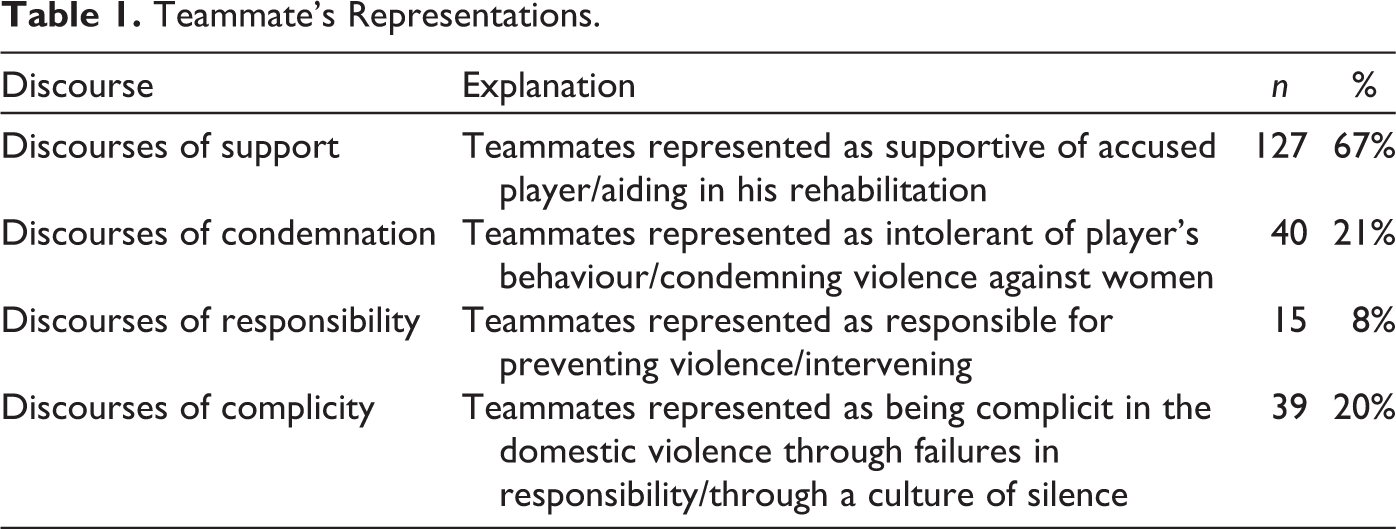
In our analysis, explicit and embedded discourses (McDonald & Charlesworth, 2013) were identified, and early analysis revealed a large number of recurring discourses in regard to teammate representation—and their representational absence. These recurring discourses are grouped into four major discourses and were identified in 190 articles:
Discourses of Support
Of the four major discourses identified, what we have termed “discourses of support” were the most prevalent occurring in two thirds of articles (Table 1). Articles that employed discourses of support positioned teammates as sympathetic toward the player and typically depicted them as standing by the player regardless of any allegations, charges, or court rulings. In these texts, “support” was articulated through a number of reflexive discursive framings that included themes of rehabilitation, mateship, and the significance of the team environment. We argue that domestic violence and other social issues are framed through a football discourse, rather than a discourse of domestic violence, and valued in terms of the impact of the incident in terms of sport.
Teammate’s Representations.
A significant aspect of discourses of support was the team’s role in the care and rehabilitation of the player. The character of “rehabilitation” in these texts is almost entirely rugby league focused. References are, on occasion, made to the player receiving “counselling” and completing “courses,” indicating the medicalisation and pathologisation of domestic violence (M. G. McDonald, 1999; Michelle & Weaver, 2003), but the primary rehabilitation role and goal of the teammates utilising discourses of support is ensuring their teammate plays professional first-grade football. Returning to training, being with the “boys,” and playing footy are invoked as the best ways for a player to “heal.” Being in a “footy environment” is reported by teammate Blake Ferguson as the “best thing” for Shaun Kenny-Dowall after Kenny-Dowall was charged with 11 counts of domestic violence against his ex-partner, Jessica Peris (Marcuson, 2015). The supportive discourse often positions the allegedly violent player as the victim. Toffoletti (2007, p. 432) notes that while being positioned as “victim” may appear to undermine the typical power, strength, and authority granted to successful male athletes, claiming “victimhood” discursively displaces the legitimacy of the female assault victims and their experiences. Players stood down following domestic violence allegations, charges, or convictions are also discursively constructed by teammates engaging supportive discourses as victims of unfair judicial decisions as the teammates question the fairness of suspensions and other “punishments.”
By focusing on playing rugby, teammates who invoked supportive discourses also elided domestic violence, minimising or ignoring the player’s violence. The term “domestic violence” itself was often not used, a finding consistent with Pepin’s (2015) study of the reporting of male celebrities charged with domestic violence. For example, Robert Lui’s conviction for assaulting his then-pregnant partner is (not) referred to in a myriad of ways: “personal issues” (Hemming, 2012), a general “assault” of a bodiless, textually absent victim (Balym, 2012), and by Lui’s senior teammate, Matt Bowen, as what Lui “did or didn’t do” (Dorries, 2012). Bowen’s response is typical in that he renders his teammate’s violence as ambiguous before turning the focus back to rugby, positioning Lui as being victimised through not being allowed to play: “[Lui] is a rugby league player and I think it’s important that he be allowed to do his job,” Bowen said. “Hopefully, he can be allowed to come back to football sometime soon” (Dorries, 2012, p. 106).
Teammates’ supportive commentary also mobilised mateship discourses, emphasising their loyalty to the player (e.g., Massoud, 2011). Towns and Terry (2014) argue that when mateship discourses are invoked by men discussing domestic violence, such discourses often function to prevent men from challenging other men about their violence. Certainly, when “mateship” is cited in teammates’ commentary, the effect refocuses attention onto the homosocial relationships between the players and forecloses discussion of violence.
There was evidence, however, of a critical awareness by some female sports journalists of what we are calling “discourses of support.” Rebecca Wilson (2009) and Jacqueline Maley (2007) both wrote articles that critiqued the prevalent supportive discursive position undertaken by bystanding teammates. Wilson (2009) is highly critical of the way teammates frame domestic violence through a sporting discourse: One idiotic former teammate said this week that Bird would be handed a State of Origin jersey if he had been allowed to play this year. That sadly is the calibre of many professional league players —they really believe being a good footballer excuses everything.
Discourses of Condemnation
The inverse of the supportive discourse is a discourse of intolerance; in these articles, teammates discursively condemn the player’s violence. This is distinct to Wilson and Maley’s critical responses because discourses of condemnation are instances of reflexive commentary made by ex-teammates and ex-players
2
who speak about violence once the homosocial bond has reached critical distance. Discourses of condemnation are only evident in those circumstances where a speaker has a privileged insider–outsider status as an ex-teammate of those specifically involved in domestic violence incidents; current teammates do not comment critically. That is, the strength of the teammate bond is evident, as players do not comment disapprovingly on incidents of domestic violence committed by their teammates; only when the violent players move outside of the team homosocial environment (typically by moving to a new club) are players afforded the critical distance to engage in condemnatory discourses. This is illustrated in the case of Robert Lui and the West Tigers. Prior to his departure, representations of his teammates are framed by discourses of support: “When it [the first domestic violence charges brought against him] all happened I was in my shell,” said Lui, who’s paid tribute to teammates for their support after he was charged over an incident relating to his partner Taleah Backo this time last year. They are a good bunch of blokes and I want to repay the boys for sticking by me and trusting me to lead a team around. (Molihan, 2011, p. 68) Senior Wests Tigers players are fed up with Robert Lui’s ongoing off-field issues and want him removed from the club. Players have spoken to me privately and find it impossible to justify or tolerate Lui’s alleged actions from last week’s Mad Monday festivities—a second domestic incident with his partner Taleah Backo within the space of 12 months. No matter how good a player the halfback is, his Tigers teammates believe there can be no excuse for hitting a woman. (Weidler, 2011, p. 78)
Discourses of intolerance are more common with retired players than with ex-teammates. Although their responses are outside the scope of this study, it is worth noting that the critiques made by ex-players seem more likely to both condemn the violent (or allegedly violent) player’s actions and connecting that violence to a broader societal problem of violence against women. Ex-player David Peachey, speaking about Issac Gordon’s suspension for nine matches after pleading guilty to assaulting his pregnant girlfriend, illustrates this: “For Isaac, it was totally out of character. At the end of the day, it’s violence against women and…cousin or not [Gordon is Peachey’s cousin], you don’t want that in our society” (Peachey in Read, 2012, p. 34). Peachey’s comment that Gordon’s violence was an aberrant one-off occurrence reflects the hegemonic discursive minimisation of domestic violence noted by others (e.g., Easteal et al., 2012). By framing the violence as “out of character,” Peachey discursively weakens both his condemnation and simultaneously undercuts his linking of the incident to a larger societal problem of men’s violence against women.
Former teammates also use discourses of intolerance when they advocate the need for antiviolence education and prevention. The NRL and its clubs have a well-publicised relationship with government and nongovernment antiviolence programmes, particularly the non-governmental organisation White Ribbon. White Ribbon (2016) is an Australian nation-wide male-led campaign for violence against women that focuses on primary prevention; many high-profile NRL players are White Ribbon “ambassadors.” However, when nonviolent players condemn violence, like Peachey above, they often end up undermining their censures. Aiden Tolman, a player at the Bulldogs when allegations of domestic violence were made against Ben Barba, undertakes some tricky discursive manoeuvres to avoid connecting Barba to violent acts, even as he decries domestic violence: “This club had allegations of domestic violence before, and as a playing group, we stood up and said that even one incident isn’t good enough,” Tolman said. “They turned out to be only allegations, but as men we should be able to stand up and say it’s not on and enough is enough. Every time something happens to rugby league, players do get painted with the same brush.” (Tolman, in Chammas, 2014, p. 30)
Discourses of Responsibility
Tolman’s speech also reveals the third significant discourse operating in media texts’ representations of teammates—a discourse of responsibility. In these representations, teammates are discursively positioned as being responsible for preventing their teammates from being violent. Discourses of responsibility rely on the homosocial bond between teammates but shift the burden of responsibility to before an incident occurs, locating nonviolent players in the role of “ethical bystanders.” Similar to the way the mainstream media reports domestic violence (Berns, 2004; Meyers, 1997), discourses of responsibility neglect a structural focus and instead assume that individuals prevent other individuals from indiscretions. This is despite discourses of responsibility framing players as having individual responsibility for maintaining collective club- or code-based social values and identity.
After domestic violence allegations made against Ben Barba became public journalist Paul Kent echoes Tolman’s point as he makes a direct address to players “unhappy about being labelled” (Kent, 2013, p. 79). Kent instructs them to: do something about it. Grab the teammate stepping over the line. Raise the standards of what’s acceptable at your club. Don’t tolerate anything you would be embarrassed to tell your mum about (2013, p. 79).
However, the discourse of responsibility often fails to address domestic violence and focuses instead on the widely publicised gang rape allegations that have plagued league clubs previously where individual intervention appears more plausible. This focus illustrates the influence of the Playing By the Rules programme in that the suggestions typically address scenarios like the gang rape scandals foregrounded in the research and in the sexual education workshops (Albury et al., 2011, p. 340). While the influence of sexual ethics programmes is encouraging, its content appears narrowly applied, that is, suggestions are not made in these texts to address how a teammate should intervene in violence that they have not witnessed or address domestic violence that has normatively been understood as “private.”
While teammates are represented as responsible for helping prevent violence, they are also sometimes represented as having failed in their responsibility. In the instance of Wes Naiqama who was alleged to have abused his then-girlfriend Paulini Curuenavuli, Foster (2009) reports that Curuenavuli’s family “complain[ed] to Naiqama’s team about the couple’s ‘personal issues.’” Likewise Ainslie Currie and Jessica Peris complained to the Bulldogs (Phelps, 2013) and the Roosters (Harris & Hooper, 2015), respectively—not the police—about alleged domestic assaults perpetrated by their partners against them. Currie and Peris’ actions bespeak a perception that the rugby league teams are responsible for their players’ behaviours, a point echoed in the media texts. That the violent players themselves are rarely, if ever, held responsible for their violence is worth noting; it speaks to an ongoing discursive minimisation of individual responsibility (Coates & Wade, 2007). Like in Michelle and Weaver’s study (original emphasis, 2003, p. 296), the articles examined here often privilege discourses that “effectively silence the roles of both abusers and society in perpetuating male violence.”
Discourses of Complicity
While teammates and clubs are sometimes represented as responsible for stopping domestic violence, teammates are also represented as part of the “problem” that enables domestic violence. Here, we see the fourth discourse—discourses of complicity. Critiques of rugby league culture and the homosocial practices within it illustrate how players embedded within the homosocial environment are represented as complicit in perpetuating violence, through “victim blaming” (Harris, 2015), “denigration of women” (Hinds, 2014; The Canberra Times, 2010), “binge drinking” (Colman, 2009), and collective tolerance of violence—gendered or otherwise (Conway, 2009). That is, teammates are represented as part of a broad club-wide conspiracy of silence and, through their silence, as part of a culture that implicitly tolerates domestic violence. While the discourse of responsibility sometimes represents teammates as being able to proactively shape team culture, in the articles that contain discourses of complicity, the team, teammates, and the bond between teammates are discursively rendered complicit in the acts of violence.
The following excerpt demonstrates an aspect of the complicity discourse that explores how pressure from the player’s teammates can encourage player’s female partners not to report domestic violence: For many women, tearing down the local sporting hero can mean ostracism from the club—her surrogate family as well as his—when members, teammates and girlfriends unite against the snitch. (Horin, 2009, p. 9)
Discussion
The homosocial bond was pervasive and clearly expressed in the first of our discourses, discourses of support, through the ways teammates “closed ranks” to protect and insulate their teammate from critique. These supportive discourses were identified in 67% of articles, illustrating that team loyalty and the commitment of teammates receive significant discursive buttressing. In most of the articles where teammates were represented as supportive, the teammates gave rugby league discourse primacy; little attention was paid by them to the prevalence of domestic violence in Australian society, nor to the unequal gender social relations that foster domestic violence nor to the NRL’s well-publicised commitments to programmes designed to prevent men’s violence against women. Instead, the logic of the homosocial bond saw discourses of domestic violence subsumed into a sporting discourse in which the teammate relationship located within a sporting milieu had priority. As suggested above, such loyalty perhaps influenced the representational lack of current teammates in the second discourse, that of condemnation. Although these discourses were found in 21% of articles, they overwhelmingly occurred in representations of former teammates or former players. Such a representational absence points to the “reproduction of codes of silence around certain behaviours or practices” (Corboz et al., 2016, p. 328) common in the way homosociality is experienced in certain male sporting environments. Although the representations of teammates within discourses of intolerance often pointed to a broad intolerance for violence against women inside or outside of rugby league, rarely did current teammates discuss domestic violence as a broader social problem.
The third discourse, that of responsibility (found in 8% of articles), similarly fell short of critical engagement with domestic violence as a social problem, as they assumed that the homosocial bond makes teammates accountable for the behaviours of those in their team. These texts included aspects of ethical bystander intervention, highlighting ways that nonviolent teammates could help in violence prevention. However, these suggestions primarily addressed interventions in potential gang rapes and rarely addressed teammates’ ability to shape cultural attitudes or how to intervene in the historically private issue of domestic violence. Without exploring the total 933 articles of the original corpus and then further searches on reports of all forms of “bad behavior” by rugby league players, however, it would be difficult to find comprehensive discursive evidence of whether or not the message of “bystander ethics” from the sexual education workshops has successfully permeated the culture of rugby league players more generally.
The final discourse, discourses of complicity (found in 20% of articles), similarly illustrated the influence of the homosocial bond in structuring teammate representations. Although homosocial bonding practices were identified as examples of problematic “club cultures,” these articles typically focused on the behaviours of individuals and failed to critically engage with how homosocial bonding practices in team sports serve to facilitate nonviolent players’ complicity. Furthermore, while discourses of teammates’ complicity in domestic violence had the potential to undertake an incisive critique of the way structurally unequal gender relations found in homosocial environments like rugby league can implicitly or inadvertently tolerate or foster abuse, the discourses employed instead pointed to factors external to the abusive player to explain their violence (e.g., drinking alcohol with teammates).
Conclusion
The four modes of discursive commentary illustrate the significance of the homosocial bond that shapes the ways that off-field scandals are navigated. The primary finding of this research is that the homosocial bond between players and even ex-players never ceases to have a social efficacy. The logic of homosociality may prevent players from speaking out against their teammate’s violence; only in cases where the teammate was an “ex” one, did the homosocial bond reach a critical distance that enabled representations of players to engage condemnatory discourses. We suggest that the homosocial bond amongst players serves as a normative constraint to the reflexivity afforded to them when they offer commentary about teammates. It is one way, as Michael Messner (2013, p. 118) has suggested, that “sports media continues to play a largely reproductive—rather than critical or disruptive—role in the politics of sport and problems grounded in social inequalities.” We suspect the first step towards a progressive alternative to the normative homosocial constraints on reflexive commentary outlined here is a form of commentary that holds the legitimacy of the assault victims and their experiences as paramount and draws upon the team as an enabler of critical commentary rather than a normative constraint.
The next stage in this research is to undertake a close reading of one episode of domestic violence to explore the ways in which these contradictory and often competing discourses occur within a single event. Undertaking a case study also allows for an examination of teammates’ use of social media and facilitates a closer examination of the interwoven and often contradictory positions taken up across multiple media channels. Research of this kind would also address one of the limitations of this study; by only looking at newspaper reports, we did not address the way teammates are represented in any television, radio, or online and social media texts. Furthermore, by focusing on a single case, it would be possible to sample social media communications of the participatory publics formed through the circulation of reflexive commentary of sporting fans to see whether these four modes of discursive commentary are also rearticulated by fans.
Footnotes
Declaration of Conflicting Interests
The author(s) declared no potential conflicts of interest with respect to the research, authorship, and/or publication of this article.
Funding
The author(s) received no financial support for the research, authorship, and/or publication of this article.