




Abstract
The global football industry is changing clubs’ corporate identities. Historically, European football had strong local roots; sport organizations represented local values and fandom were regionally based. However, sporting competitiveness pushes clubs to search for new investors, and foreign investors in Europe are attracted by the popularity of European football. In this article, we analyse how Chinese capital and brands arrived in Barcelona, through the negotiations of a football club in 2016: the Reial Club Deportiu Espanyol (RCDE). RCDE is the club that has received the second most trophies in Catalonia, after FC Barcelona, since the beginning of the 20th century. Today, it has one of the most modern stadiums in Spain, designed using a business approach, and has become a corporate ambassador for the Chinese government’s strategy of becoming a “world football superpower” by 2050. Using a case study approach, this article analyses management and corporate identity changes in the organization due to the new Chinese owner: the Rastar Group.
In 20 years, between 1997 and 2017, football clubs that wanted to enter the select group of the 20 richest on the planet had to increase their annual income from 36.2 million to at least 199.2 million euros (Jones, 2017). Consequently, in two decades, the money a club needs to be competitive at the international level has multiplied by almost six. In the last 20 years, Manchester United, followed by Real Madrid and then FC Barcelona, have become global brands to increase their competitiveness mainly at European scale (Ginesta, 2011a). Global stars have emerged, starting with the English player David Beckham and also including the Argentine Lionel Messi and Portuguese Cristiano Ronaldo. Above all, the internationalization of football has played a crucial role in some countries’ strategy of country branding, including China, Russia, and Qatar (Ginesta & San Eugenio, 2014).
Hence, the 21st century has seen the emergence of new actors in the football market, whose investments go far beyond the speculative capital that American investors brought to the Premier League (Ginesta, 2011b). Today, the Governments of Qatar and China have made it clear that their soft power (Nye, 2004) depends not only on their economic influence but also on their ambition to be sporting powers (Connell, 2018; Ginesta & San Eugenio, 2014). In fact, Rein and Shields (2007) already pointed out that sport is an active form of geopolitical positioning of growing importance for many states. Investments in mega-events, in infrastructure, and in taking control over sports organizations are three actions that, combined, allow the preparation of strategies for redefining country brands.
Based on these premises, the aim of this article is to analyse how Chinese capital has penetrated the football industry in Spain. More specifically, we present a case study to understand and query why a Chinese holding company (the Rastar Group) decided to invest in a football club in Barcelona, and we discuss how the new owner of Reial Club Deportiu Espanyol (RCDE) could change the corporate identity and the working routines of the club. Historically, RCDE was the second most important football club in Catalonia, after FC Barcelona, both in terms of number of followers (28,745) and trophies that it has won. In addition, it has one of the newest and most modern stadiums in the Spanish First Division Liga de Fútbol Profesional (LFP), which was built in 2009.
Literature Review
The Football Industry in the 21st Century: The Rise of New Entertainment Multinationals
In the 21st century, the football industry has gone beyond simple entertainment to becoming a fundamental component of the economy and politics of many communities. The main football clubs have undergone a process of business transformation that has led them closer to the concept of “entertainment multinationals” (Ginesta, 2011a). This transformation is the result of the need to expand markets and obtain new sources of revenue that are not just linked to broadcasting rights, to ensure their local and international competitiveness.
Manchester United is considered a pioneer in this process of transformation. The British club consolidated its international position through four actions that inspired the internationalization plans of most large European clubs (Rosaaen & Amis, 2004): global sponsorship contracts (Vodafone), collaboration agreements with leading sports organizations in other nonfootball markets (such as Major League Baseball), global corporate social responsibility actions, and finally agreements with communication companies to broadcast corporate contents (Terra Lycos). In fact, the professionalization of the communications departments of these clubs, and their conversion into content producers as a result of digitalization, has led to distancing in their media relations (Ginesta, 2010), in a process of disintermediation (Price, Farrington, & Hall, 2013). This generates a complex relationship with other stakeholders, which is sometimes tense, according to some authors (Junghagen, 2018; Welch-Suggs, 2015).
The success of this management model can be seen in the English club’s change in revenue in the decade 1993–2002 in comparison with that of FC Barcelona, for example. In financial year 1995–1996, both clubs had similar income (58 million euros in the Catalan club and 62 million in the English). However, by the end of the 2002–2003 season, United had revenue of 251 million euros and FC Barcelona only 123 million (Soriano, 2009, p. 31). In fact, we are now at a stage in which club management based on “performance maximization,” that is, achieving sporting success within a system of promotions and relegation (Sloane, 1971, p. 133), has shifted to prioritization of revenue increase, or what is known as “profit maximization” (Szymanski & Kuypers, 1999; Szymanski & Zimbalist, 2005), as the basis of the organization’s competitiveness.
With the internationalization of the main football clubs’ business, the industry began to split: A gap emerged between the clubs that would become “suppliers of entertainment, with global brands, and clubs that would be limited to more local markets” (Soriano, 2009, p. 27). In this context, the main European clubs compete and form alliances with other organizations in the leisure sector or the media industry (e.g., the News Corporation, Time Warner, and Disney) to attract new consumers, who are willing to purchase and live new experiences 24 hr a day, 7 days a week. Therefore, at the start of the 21st century, the football industry has definitely been integrated into the “media sports cultural complex” (Harvey, Law & Cantelon, 2001; Helland, 2007; Rowe, 2003).
For clubs, the live game has become just one more product in an offering of products and services that include the use of the facilities by companies and individuals (business approach stadiums), hospitality services, tours and interactive visits of the stadiums and museums, and even the establishment of theme parks or members’ cities. We are faced with a time of disneyfication of contemporary football (Ginesta, 2017); a phenomenon associated with the logic of a cultural industry that is dominated worldwide by large entertainment conglomerates that seek daily to gain the loyalty of new consumers through a multichannel strategy, which ends up altering local forms of culture and sports forms to meet the demands of the global market.
Football and Global Geopolitics: Soft Power and Sport Diplomacy
However, international recognition of the main football brands has not just placed clubs within the entertainment industry; it has also made them into geopolitical agents (Giulianotti, 2011; Rein & Shields, 2007). The big football clubs are valuable partners in place branding campaigns (Ginesta, 2016). Anholt (2010) states that in place branding, the aim of the brand is to obtain economic performance as well as a good reputation for the region, which, logically, will have an impact on its economic prosperity.
In addition, sports organizations (including football clubs) increasingly collaborate to meet the geopolitical positioning needs of certain states or regions (Ginesta & San Eugenio, 2014; San Eugenio, Ginesta, & Xifra, 2017). To define the phenomenon, in the framework of soft power (Nye, 2004) and public diplomacy (Cull, 2008) studies, Murray (2012, p. 576) developed the concept of “sports diplomacy”: It involves representative and diplomatic activities undertaken by sports people on behalf of and in conjunction with their governments. The practice is facilitated by traditional diplomacy and uses sports people and sporting events to engage, inform and create a favourable image among foreign publics and organizations, to shape their perceptions in a way that is (more) conducive to the sending government’s foreign policy goals.
However, the Westernization of football in China, as well as the increase in its followers, has not been free of obstacles. Despite the creation of the Chinese Super League (CSL) and its consolidation as a driver of state television (CCTV), China could not use professional football as a geopolitical positioning tool until firm action was taken to end corruption in the sport (Hong & Zhouxiang, 2013; Van Wyk, 2016). In addition, time has shown that investing in coaches and players from abroad does not improve the quality of Chinese football. Connell (2018) stated this clearly: Although signing foreign stars is important to build football culture among fans, this may be at the expense of young Chinese players’ training. For this reason, following state policy, only three foreign players are currently allowed in each franchise of the CSL. In addition, football infrastructure has been planned and the practice of this sport has been included in the school curriculum (Liu, Mao, & Zha, 2016).
Football in China: A Matter of State
The appointment of Xi Jinping as the President of China in 2012 marked a new impetus for the consolidation of football in Chinese society. “Early in his presidency, Xi instigated a purge of corrupt football officials and stated in 2011 that he had three dreams for Chinese football: to qualify for, to host, and to win the World Cup” (Connell, 2018, p. 5). However, China’s team did not classify for the 2014 World Cup and has a low position in the FIFA ranking (109th position in 2014). This has resulted in a new wave of government intervention.
In 2014, the Chinese Government published a document entitled Chinese Football Reform and Development Program, “a 50-point plan that gave financial and bureaucratic independence to the Chinese Football Association [CFA] and encouraged investments in football for civil society (in practice from large corporations)” (Connell, 2018, pp. 5–6). Therefore, football in China has become an extension of the Beijing 2008 Olympic diplomacy: a new cultural asset for geopolitical positioning after hosting the Olympic Games. Campbell (2016, p. 1) stated: “For the Chinese government, soccer prowess has become paramount to the nation’s resurgence on the world stage—and will hopefully distract China’s teeming population from looming economic downturn.” The argument is linked to the concept of soft power: “The ability to get what you want through attraction rather than coercion or payments” (Nye, 2004, p. x). Hence, countries attract and persuade others through the soft power of geographical representation rather than the hard power derived from the use of weapons (Van Ham, 2008; Ginesta & San Eugenio, 2014).
In China, a superpower that can aspire to host the FIFA World Cup has been constructed on the basis of a triple action plan, for the short-, medium-, and long term, following the guidelines of the 2014 strategic plan. In the short term, the Chinese government asked to optimize the football management system to create a structure in which the football industry and professional football develop together. In the midterm, a significant increase in youth football is required, as well as improved performance of the male and female national teams. Finally, in the long term, Chinese football should become a sport that is universally participated in by the masses and the professional CSL should gain a position as a global forerunner (Wilson, 2016).
Some significant data can be highlighted in relation to this official strategic plan. The Chinese government aims to have “at least 20,000 football training centres and 70,000 pitches in place by 2020” (Campbell, 2016, p. 1). By then, 50 million Chinese, including 30 million students, will regularly play soccer (Buckley, 2017, p. 4). Secondly, in the 2015–2016 season, the 16 CSL elite clubs spent 300 million dollars enrolling new players, while the Premier League only spent 120 million (Buckley, 2017, p. 4). Finally, “by mid-2017, over a period of three years, Chinese investors had spent €2.1 bn acquiring football assets elsewhere, far in excess of any other country during a period of overall global investment downturn” (Connell, 2018, p. 8). The following European clubs have received Chinese capital in recent years: Manchester City, Wolverhampton Wonderers, Aston Villa, West Bromwich Albion, and Reading in Britain; AC Milan, Parma, and Inter Milan in Italy; ADO Den Haag in the Netherlands; Slavia Prague in the Czech Republic; Lyon and Sochaux in France; and RCDE, Granada CF, and Atlético de Madrid in Spain.
Chinese Capital in the Spanish La Liga
Revenues of the Spanish football industry in 2013 were 7.6 billion euros, corresponding to 0.75% of state GDP (KPMG, 2015, p. 10). Furthermore, the first division of La Liga (LFP) is one of the sports competitions that is followed the most, and the most regularly, in the world (Ginesta, 2017).
Global brands such as FC Barcelona or Real Madrid help the positioning of a competition that, in recent years, has seen new investors injecting capital into the clubs. These brands have become multinational entertainment companies with investments in foreign markets (Ginesta, 2011a) such as America, the Middle East, and China. The process of disneyfication of football led to Real Madrid considering the opening of a theme park in the United Arab Emirates that fell through due to the apathy of local investors, the FC Barcelona player Lionel Messi and the media conglomerate Mediapro opening a theme park in Nanjing, and FC Barcelona and Mission Hills Group creating a football academy and place for experiences along with the Chinese Football Federation facilities on the island of Hainan (Ginesta, 2017). At the same time, Chinese holding companies have entered the market of Spanish professional football. In the 2017–2018 season, Atlético Madrid, RCDE, and Granada CF were the three clubs that received Chinese capital in the first division, while Girona FC has an owner (the City Football Group) who is also part of a Chinese holding company.
A few months before the Rastar Group became the biggest shareholder of RCDE, which is the subject of the case study in this article, the first Chinese investment group entered the LFP. It was the Wanda Group, which invested 50 million euros to buy 20% of Atlético de Madrid in January 2015. The 50 million euros were invested through a capital increase to strengthen the resources of the club, which had a debt of 200 million euros with the Spanish Ministry of Finance (Marco, 2014).
In 2017, the Wanda Group announced trade agreements worth more than 16.5 billion euros, which made Atlético Madrid part of a veritable entertainment conglomerate, with global investments in film producers and distributors and the organization of international sporting events (Fernández, 2017). However, Wanda announced in February 2018 that the Atletico de Madrid shareholders would sell their shares to the Israeli Quantum Pacific Group, which would end up holding 32% of the share capital. Wanda will only maintain the naming rights to the stadium, Wanda Metropolitano, for 5 years at a rate of 10 million euros a year. Wanda stated that this disinvestment was due to its high level of debt, the Chinese state policy of disinvestment in nonstrategic sectors (including entertainment), and the difficult penetration of the Atlético de Madrid brand in the Chinese market (Palco23, 2018).
In May 2016, it was publicly announced that Wuhan Double Group had bought 100% of Granada CF from the Pozzo family (also owner of Udinese in Italy and Watford FC in Britain) for 37 million euros. Unlike the two 2015 purchases, Wuhan Double acquired a sanitised Club, with figures for ordinary business at the end of the 2015–2016 season of 28.7 million euros, 6% higher than the previous year (Palco23, 2016). However, in this operation, Wuhan Double kept another foot in the Spanish football market, to control 46% of the shares of the Media Base Sports (MBS) agency, also owned by Peter Piggy Bank (27%) and the media conglomerate Mediapro (27%; Nicholson, 2016).
At the same time, MBS and the City Football Group took control of Girona FC (96%). The City Football Group is owned by Abu Dhabi United Group, a private investment firm owned by Sheikh Mansour bin Zayed al-Nahyan, although 13% of the capital is owned by China Media Capital (Jackson, 2015). The City Football Group controls Manchester City (England), Melbourne City FC (Australia), and New York City FC (the United States). As a minority shareholder, it is also present in Yokohama Marinos (Japan) and CA Torque (Uruguay; Ginesta, 2017, pp. 14–15).
Chinese investments abroad suffered a setback during the summer of 2017. Xi Jinping’s Government decided to curb the generous foreign investment, which in the year 2016 had reached a new record of 87 billion euros (Fernández, 2017). The analyst Julian Evans-Pritchard summarized the situation as follows: After watching some of the company’s investments in football clubs, Hollywood studios or other dubious decisions, there is the feeling that they have gone too far and may be paying too much for certain assets or have been away from their area of expertise. (Fernández, 2017, p. 1)
Method
This article follows a case study methodology, which is understood as an “empirical investigation of a contemporary phenomenon, taking into account its context, especially when the boundaries between phenomenon and context are not evident” (Yin, 1994, p. 13). As pointed out by Escudero, Delfín, and Gutierrez (2008, p. 7), “the case study as research strategy has been used in many situations that have helped to generate awareness of a phenomenon that is an individual, group, political and/or complex phenomena.”
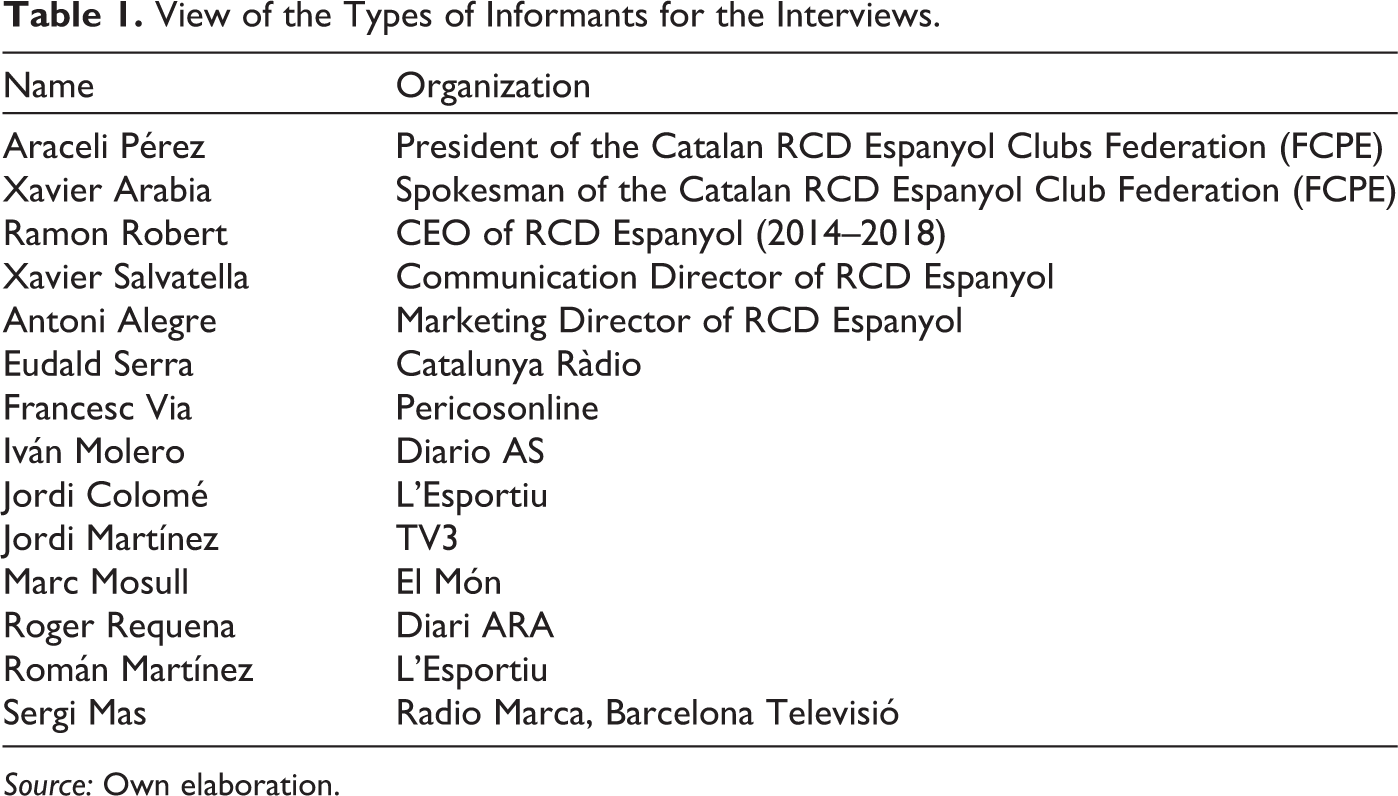
To carry out the case study, qualitative research based on semistructured interviews (Table 1) was designed to deepen knowledge of the case of RCDE and its owner, the Rastar Group. Researchers carried out these interviews during 2017–2018 Spanish football season. Semistructured interviews were carried out (Wimmer & Dominick, 1987) with journalists covering the daily activity of the institution. At the same time, in-depth interviews were held with representatives of the Catalan RCD Espanyol Fan Clubs Federation (FCPE) and with the first Chief Executive Officer (CEO) of the Club, Ramon Robert, who was in charge of the management of the institution after the arrival of the new owner Chen Yansheng (Season 2016–2017), as well as with the organization’s Marketing Director, Antoni Alegre, and Communication Director (DirCom), Xavier Salvatella.
View of the Types of Informants for the Interviews.
Source: Own elaboration.
Case Study
The Chinese businessman Chen Yansheng became a shareholder of RCDE, Barcelona, at the end of 2015. This move occurred in the context of China’s aforementioned commitment to football, with the programme launched in 2014 by Xi Jinping as a guide and 2 years before the Chinese Government put a damper on capital fleeing to foreign clubs. Ramon Robert, CEO of the Club (2014–2018), points out: “In China, when the Government moves something, everybody follows it; some because they see clearly and others because they want to be part of the trend” (personal communication, February 14, 2018).
Chen Yansheng is a Chinese businessman, President, and CEO of the Rastar Group, a holding company with headquarters in Guangzhou dedicated to the manufacture of toys and video games, but with progressive diversification of business in the field of digital entertainment. In 2016, he was ranked as the 254th richest man in China according to Forbes Magazine, with a capital of about 1.2 billion dollars (Corpas, 2016). From the time when it became a shareholder of RCDE until it bought the maximum share package (99.35%), Rastar managed to liquidate the club’s historic debt with the Spanish Tax Office, with a global injection of over 140 million euros (Torres, 2016).
In this section, we present and discuss the results of the fieldwork that was carried out. It is divided into three blocks to address why Cheng Yansheng purchased shares in RCDE and the impact of the incorporation of his group on the stakeholders.
Barcelona as a Brand: An Opportunity for the Rastar Group
The Rastar Group’s purchase of shares in RCDE is part of its strategy of business diversification. Several factors attracted the Rastar Group’s owner to RCDE. As the Marketing Director of the club, Antoni Alegre, stated, these were the history of the club, its location in Barcelona, participation in the same competition as FC Barcelona and Real Madrid, its stadium business approach, and its academy (personal communication, July 18, 2018).
Barcelona is a crucial element: It is a cosmopolitan city, with a good quality of life and an international reputation for tourism and investments. The city of Barcelona is associated with another brand with a global impact: FC Barcelona (Shobe, 2006; Ginesta & San Eugenio, 2014). For Chen Yansheng, the fact that RCDE is a club located in the same city as Barça is a positive aspect to consider. However, this perspective contrasts with that of RCDE fans: While fans see Barça as a threat, Chen Yansheng considers that it provides a chance for international recognition, as it is the local rival of FC Barcelona. In addition, the city of Barcelona offers many possibilities for tourism, especially those linked to football. An average of 0.33% of tourists in Spain come from China. Most of these come to Catalonia (51%) and are here for leisure (80%). They are upper middle-class tourists with capital who want experiences related to the entertainment business (Ministerio de Turismo, Energia y Agenda Digital, 2017). Therefore, football clubs have the opportunity to generate packages that may include going to see a match and other activities. Due to its location in the Barcelona area, RCDE can generate this type of offer.
The RCDE Stadium is another of the club’s strengths that explains Chen Yansheng’s decision. This stadium opened on August 2, 2009, has a capacity of 41,000 spectators and is designed in accordance with the criteria of the new European stadiums, following the “business approach” architectural philosophy (Ginesta, 2017), with the inclusion of a leisure centre and a few facilities that go beyond the sports venue. The stadium includes spaces for companies (RCDE Business Program) and the possibility of using the facilities for events or corporate activities (RCDE Events Program).
The club also has the Dani Jarque sports city/academy in the metropolitan area of Barcelona: a 60,000 m2 space for workouts and football. Both the stadium and the sports city offer a tourist sports package, called the RCDE Experience, which includes: match day, RCDE Stadium tour, academy tour, training session at the sports city with a coach from the club using its football methodology, attendance of teams’ training sessions, photographs with first team players, friendly matches, tactical training for coaches and players, a video of the experience, accommodation in hotels and collaborating residences, a tour with an operator trusted by the club, and discounts on leisure activities in Barcelona (RCDE, 2017). The RCD Stadium also opens the door to new types of business. A Wind Tunnel will be installed in one of the corners of the stadium. The project foresees the installation of a giant LED screen, in collaboration with the company Powerpixxel, on which advertising will be shown that will be visible from great distances and from the major network of motorways in the area (Recio, 2015).
In this context, the Rastar Group opted for RCDE despite the weak financial situation. However, this apparent difficulty was also seen by Rastar as an opportunity: Buying shares in a Spanish club was cheaper than doing so in a club in the Premier League or the Bundesliga. The Rastar Group’s business plan for the club has two steps. Firstly, the new owner must stabilize it economically. Then, the board of directors will explore new business opportunities, such as the installation of training academies in China, the commercial exploitation of the stadium, or the monetization of the brand using B2C channels. In other words, the current activity of the club will evolve to transform it into an “entertainment multinational” (Ginesta, 2011a). As Antoni Alegre concludes: Stability has enabled us to be more focused on our objective, which is doing business for l’Espanyol. The fact that our doors are open to a market as important as the Chinese, with 1.2 billion people and an increasing interest in football, generates synergies and expectations among our partners that is very positive. (personal communication, July 18, 2018)
Managing Projects Across Cultures
RCDE was founded on October 28, 1900. In 1992, it became a Sports Limited Company, in accordance with the new legislative framework regulating football in Spain. Historically, RCDE has been characterized for being a club rooted in local society with a strong president. However, the entry of the Rastar Group means a shift “from a football club to a football company” (R. Robert, personal communication, February 14, 2018). The club has experienced changes linked to what some authors considered the process of commodification of sport (Maguire, 1999). In addition, the change involves a new owner who is culturally different from the club’s identity to date.
RCDE is one of the oldest clubs in Spain and one of the founding members of La Liga. In the various interviews carried out for this research, the historical legacy and tradition of the club were frequently mentioned as attractive to Chen Yansheng. China has no football tradition, and investments in European football are also motivated by the fact that Europe is the cradle of this sport. This historical legacy is part of the corporate philosophy of the institution, which defines its vision as “a club and a football that articulates a feeling and a differential militancy, constructed in 115 years of appreciation for the sport, leisure and social progress” (RCD Espanyol, 2016, p. 11). The mission of the company is to make this feeling grow, “through a firm commitment by the sports and business talent and economic rigour, international expansion, and the spread of a way of being and doing attached to our unique traits” (RCD Spanish, 2016, p. 11). The values that inspire are those of perseverance, innovation, pride of ownership, resilience, and dedication to sport.
The philosophy that supports the corporate identity of RCDE is shared by its fan base. Araceli Pérez, President of the Catalan Federation of Fan Clubs of RCD Espanyol (FCPE), argues that “RCD Espanyol is a feeling, which goes from generation to generation,” linked to some characteristics: “resistance, nonconformist, and a rebel spirit…We are football romantics” (personal communication, March 15, 2018). According to Xavier Arabia, spokesman of the FCPE, this feeling is also associated with a specific character and a way of life: “To be a supporter of RCD Espanyol helps to overcome many things, in our personal life it helps you to be a certain way, to be able to overcome difficulties. It creates a strong character” (personal communication, March 15, 2018).
With the arrival of a new owner, one of the fears of the fan base was loss of identity. However, the club coordinated President Chen Yansheng’s arrival through a reception procedure involving three fronts: institutional (political and sporting institutions), business (business associations, sponsors, and partners), and social (FCPE and social events). According to Ramon Robert, “Chen Yansheng understands the philosophy of RCD Espanyol and considers it important” (personal communication, February 14, 2018). This is because RCDE has a historical legacy that cannot be found in Chinese football. From a cultural perspective, the Chinese can understand and share the values associated with RCDE such as perseverance, effort, family, resilience, and pride of belonging. This interest and understanding translates into a cordial relationship between the board of directors and the fan clubs’ representatives, which confirms that the new ownership has not affected the club’s presence at social events and in the dialogue with fans.
In relation to corporate identity, RCDE plays a crucial role in football training and is internationally recognized for its football and human training model (RCDE, 2017). This is another strength of the organization, which Chen Yansheng sees as exportable to China according to the roadmap established in 2014 (Connell, 2018; Wilson, 2016). In fact, within the framework of its policy of international expansion and football youth promotion (Liu et al., 2016), the club opened its first academy in the Asian country, located in Guangzhou, in collaboration with the Guangzhou Panyu Zhixin School (Yang, 2016). The club will implement its training model with a dual purpose: to train young Chinese players and to attract talent that can make the jump to Europe. This approach fits the roadmap of Xi Jinping’s Government (Campbell, 2016; Wilson, 2016). The project is part of the RCDE Academy program that aims to export, via franchises of its academy, RCDE’s brand and knowledge at international level, with an organizational model based on comprehensive training, professionalism, and the success of the clubs’ youth football teams’ training methods.
The evolution of the football club into a football company has an impact on the organizational culture as well as on social aspects. Firstly, RCDE has had to implement a method of dual management, in such a way that the Rastar Group has the same information in Guangzhou as in Barcelona, considering the time difference between Spain and China. The system is based on Oracle Management software (Oracle Financials Cloud ERP), with a dual version in English and Chinese that allows integrated management of the club. At the same time, the club has incorporated Chinese staff into the most sensitive departments, such as finance, marketing, and communication, to respond to the immediate demands for information from the central headquarters (R. Robert, personal communication, February 14, 2018). As Xavier Salvatella illustrates in the Communication Department: In Raster’s sports division, four people work on marketing and communication relating to RCD Espanyol in China. In Barcelona, there is one person in the Communication department and another in the international expansion area focused on the Asian and Chinese market. (personal communication, July 18, 2018)
The difficulties of integrating management cultures are also related to the labour rights of RCDE employees. In this respect, the new club owner has had to understand the realities of the labour market including trade unions, trade union representatives, work schedules, and weekly rest. Ultimately, “the correlation is that we immediately installed this system to coordinate differences and learn from each other. In the end, you compare. And I’m very happy, because we have found the balance point” (R. Robert, personal communication, February 14, 2018).
For the Rastar Group, the management of RCDE also involves a new experience, which is unique in comparison with the other companies in the holding company. Rastar’s first objective was to wipe out the deficit and clean up the club economically. Subsequently, it could be a self-sufficient company, with a commitment to business diversification and focused on “profit maximization” (Szymanski & Zimbalist, 2005). However, Spanish football clubs participate in open leagues, in which the final classification determines whether a club is relegated to a lower category or participates in European competitions. Historically, sports organizations have been governed by a management model based on “performance maximization,” in which even the random factor plays a role, and this may affect the process of decision making (Sloane, 1971).
New Media Relations for a New Football Company
The transformation of RCDE from a football club to a football company has had an impact on its media relations, as other football organizations noted in the past (Manchester United, FC Barcelona, and Real Madrid; Junghagen, 2018; Price et al., 2013). The fieldwork that was carried out shows that the journalists who cover RCDE have experienced changes in their professional relationship with the club.
However, this impact is not reflected in the organization’s daily news coverage routines, but in the opportunities to access managers and facilities to obtain news scoops outside the official agenda of the club. The issue is not so much a lack of transparency because members and shareholders can access essential information, but media professionals finding it harder to access relevant information and sources. Journalists describe this as a certain “opacity and difficulty in accessing managers” (R. Requena, personal communication, February 8, 2018), as “hermetism, in that it is difficult to communicate with the club” (F. Via, personal communication, February 8, 2018), or that the club “has become a bunker” (I. Molero, personal communication, February 9, 2018). This new context is due to greater professionalization in all areas, which affects the ability of journalists to access managers easily. The traditional club with a charismatic president is disappearing. This old model used to lead to a close relationship between managers and the media, especially with former presidents Daniel Sánchez-Llibre, Ramon Condal, and Joan Collet.
We should bear in mind that a large proportion of the new executives are Chinese, and some, like President Chen Yansheng, spend just short periods in Barcelona. This situation is a first barrier. To it, we should add the distancing of the board of directors from the media. This is due to a change in mentality, that is, the shift from a football club to a football company. This does not mean that journalists do not have access to the sources, but tempos and filters are greater: “Since the arrival of Chinese capital, we have to take ten or twenty steps to accomplish what we did before with two or three; and sometimes, it is not enough” (I. Molero, personal communication, February 9, 2018).
In previous periods, the strong role of the club’s president in its everyday life meant that he was the voice of the organization. According to the journalists who were interviewed, one of the negative effects of the new ownership is the lack of a clearly and publicly identified figure as the spokesperson. The club’s Communication Director, Xavi Salvatella, is responsible for strategic management of communication and media relations, but he does not act as a spokesman. This role has been played by several managers but nobody has been clearly designated. “We have lost a voice: that of the President or the board of directors. Before, there was an informal relationship between media and managers that has faded” (J. Colomé, personal communication, February 8, 2018). Therefore, Xavier Salvatella recognizes: “Finding a unique spokesman is a challenge for the future. We are working to employ a new professional in this area with the help of a head-hunter’s agency” (personal communication, July 18, 2018).
According to Ramon Robert, this dissonance is a consequence of the nature of the media. Journalists were used to a personal relationship with managers that is changing with the professionalization of the organization (personal communication, February 14, 2018). Robert points out that the club’s new management models upset the practice of journalism because of journalists’ perceptions of the football world. Despite the professionalization of the Communication Department, and the fact that the club is developing its own corporate media (website, social networks, and online television), Xavier Salvatella assumes that the club still needs to nurture its relationship with sport journalists: “We balance the content creation for our corporate media and the stories we provide for the media” (personal communication, July 18, 2018).
Finally, there is a certain contradiction between the media’s agenda, which is still very much centred on sports news, results, signings, and so on, and the reality of the club, which can be considered a new “entertainment multinational” (Ginesta, 2011a) with multiple areas of business and a wide range of possible information focuses. The research conducted among journalists shows that only a minority have expanded their agenda towards issues related to the Rastar Group, such as the business and political reality of China or the analysis of the Chinese Football Reform and Development Program of 2014 (Campbell, 2016; Connell, 2018).
Conclusions and Future Research
The 21st century has seen the emergence of new actors in the football market, who are not limited to speculative investments but see this sport as an opportunity to increase soft power in global geopolitics: This is the case of China and its governmental plan 2014–2020. In this context, in recent years, Chinese capital has been injected into European football clubs. As we saw in our case study about the Rastar Group and RCDE, Chinese football investments in Europe must take into account different management and fan cultures. In a historic club like RCDE, new Chinese owners find a football culture, legacy, and tradition that Chinese football does not have due to its recent professionalization and commodification.
The Rastar Group took a strategic decision as it saw a market opportunity in a popular organization rooted in the country, with a critical fan base that has growth potential and is linked to the Barcelona brand. Raster had two main objectives: to expand the business of the holding company in Europe, and, above all, to obtain returns in China. Raster’s reputation in China should increase due to its association with FC Barcelona’s main competitor, which is a successful global city brand. In fact, football, as a basic asset of the current Barcelona brand, explains basically why Rastar purchased RCDE.
The new Chinese ownership of RCDE has an impact on the various internal and external stakeholders. Chen Yansheng’s Presidency has not led to major changes for fans: The new owner tries to understand and adopt the company’s corporate culture. However, the unsuccessful performance of the team during the 2017–2018 season, as well as the Chinese government’s limitation on foreign investment in sport since 2017, has created a feeling of restlessness among the fans. Media relations and the internal dynamics of management are two areas that require more adjustments, as a result of a process of professionalization of various departments in the organization. RCDE and its stakeholders experience tensions as a result of the transformation from football club to football company, from further performance maximization goals to profit maximization routines. This is a global trend in the football industry. However, as we have demonstrated, these transformations have some specific characteristics in clubs with deep local roots and historical values, such as RCDE.
This article is based on a single case study, done during 2017–2018 season. However, further research can be undertaken in this field. Changes in the shareholding of European football clubs (e.g., those in the Spanish LFP) need to be researched in depth, as the globalization process is challenging those that want to maintain their local characteristics, whilst taking part in the global football market. However, the professionalization of Chinese football is still a new phenomenon. Researchers will have a new opportunity to analyse the consequences of the 2014 strategic plan in the coming years.
Footnotes
Declaration of Conflicting Interests
The author(s) declared no potential conflicts of interest with respect to the research, authorship, and/or publication of this article.
Funding
The author(s) received no financial support for the research, authorship, and/or publication of this article.