




Abstract
The professional role and responsibilities for sports journalists have evolved to now include using social media. In this study, we explore how male and female print sports journalists use Twitter to communicate with their followers about sports. Relying on previous research showing disparities in sports coverage and gender as well as assertive and affiliative language theory, we employ a content analysis of tweets from 57 sports journalists (N = 4,897). We find that male and female sports journalists tweet at statistically the same rate, but male sports journalists are more likely to tweet about sports than female sports journalists, less likely to tweet about women sports and athletes, and more likely to use assertive language in their tweets. Findings are discussed with suggestions for future research.
The remarkable evolution of social media has changed the way in which sports are communicated with audiences across the world (Pegoraro, 2013; Sanderson, 2011; Walden, 2015). Sports clubs, leagues and federations, and even professional athletes have invested heavily in communication strategies involving social media to connect directly with fans (Abeza, O’Reilly, & Seguin, 2019; Armstrong, Delia, & Giardina, 2016; Ballouli & Hutchinson, 2010; Frederick, Lim, Clavio, Pedersen, & Burch, 2012; Hambrick, Simmons, Greenhalgh, & Greenwell, 2010; Li, Stokowski, Dittmore, Malmo, & Rolfe, 2016; Pegoraro, 2010; Thompson, Martin, Gee, & Guerin, 2017). The interactive nature of social media has also given sports fans a sundry of social media venues to analyze, discuss, debate, and critique sports (Bowman & Cranmer, 2014; Gibbs, O’Reilly, & Brunette, 2014; Phua, 2012).
This new environment for sports has also changed the way in which sports are covered and reported on by journalists (Li, Stokowski, Dittmore, & Scott, 2017; Reed, 2011). Unlike traditional sports media that make use of editors to select content and enforce the rigid rules of objectivity in reporting (Shoemaker & Reese, 2013), social media allows for a freer and laxer style of communicating by journalists (Santana & Hopp, 2016). Among the most popular social media platforms available to journalists is Twitter. Sports journalists are increasingly moving towards Twitter as a medium for sports coverage (Schultz & Sheffer, 2010). Twitter enables sports journalists to break news, comment on games, praise and criticize athletes, offer personal opinions, and promote their own work all in real time. Clearly, Twitter has emerged has a very valuable platform for sports journalists.
What is less clear, however, is how female and male sports journalists use Twitter. How might male and female sports journalists use the social medium to tweet about sports with those that follow them? To date, much academic research has been done examining sports and gender in a variety of different important contexts. Less research has examined sports journalism, social media, and gender (Schmidt, 2013), and only a single study to our knowledge has directly examined print sports journalist gender and tweets (Kaiser, 2016). This is especially important for many reasons. First, an increasing number of people now rely on news through social media. Pew Research (2018a) reports that more than two thirds of U.S. adults receive at least some news on social media with Twitter being among the most popular sites available for social media users. Furthermore, social media has now surpassed print as a source of news for Americans (Pew Research, 2018b). Second, there are virtually no barriers or restrictions for using Twitter. Nearly all sports journalists now have a Twitter account that they use to communicate. Tweets offer a real-time look at how sports journalists process sports-oriented information and share it with audiences. Third, even as some news organizations monitor and place organizational guidelines on what is tweeted by journalists, tweets remain relatively unfiltered by editors, especially when compared with sports content that appears in print and broadcast media and even on online blogs (Hardin, Zhong, & Corrigan, 2012). Finally, as sports newsrooms across the country stress gender diversity as a cornerstone of the workplace environment, women should continue to make gains in a field traditionally dominated by men (Laucella, Hardin, Bien-Aime, & Antunovic, 2017). We should expect to see more female sports journalists tweeting with the passage of time. This may provide an important clue as to how the world of sports will be covered in the future.
Sports media theorists have called on researchers to focus their attention on examining tweets of specific influential groups such as sports journalists and to do so across time (Billings, 2014). The current study represents an initial exploratory effort to better understand how Twitter may be used differently by male and female sports journalists when communicating with their followers across an entire sports year. Through a content analysis of sports journalists’ tweets, this study seeks to explore sports journalists’ tweets, sports coverage, and language style. Given that gender has been linked with reporting style as well as with disparities in sports coverage, it is important to consider how female and male sports journalists use Twitter to communicate with followers about the world of sports.
Review of the Literature
Sports Journalism and Gender
For most of its history, sports journalism as a professional field can be characterized as a decidedly male enterprise. As sports accelerated in popularity in the late 19th century and into the early 20th century, male (and overwhelmingly White) perspectives served as the primary and often only voice in sports reporting (Bryant & Holt, 2006). The lack of gender diversity in sports journalism is surprising given that women have been participating as athletes and in sports leagues as long as there have been sports journalists to cover sports. The historical absence of female voices in sports journalism has led to serious interest among sports communication theorists and researchers about the way in which the world of sports is constructed and communicated by sports journalists. Scholars have identified two overarching criticisms related to modern day sports journalism. First, in spite of modest improvements, the majority of sports journalists continue to be overwhelmingly male and second sports coverage is disproportionately geared towards male sports and male athletes.
Like nearly all aspects of the sports media industrial complex, women have struggled to attain equal footing with men as sports journalists. Back in the early 1970s, only 25 female sportswriters were recruited as full-time employees at American daily newspapers (Creedon, 1994). The advancement of Title IX along with more progressive attitudes towards gender across society ushered in an era in which women were able to make gains and enter a space traditionally dominated by men (Antunovic, 2017). Despite their professional acceptance, women remain underrepresented at all levels of sports journalism. The Institute of Diversity and Ethics in Sports issued a grade of F for the Associated Press Sports Editors for the lack diversity in gender hiring for sports editors, columnists, reporters, and a grade of C for assistant sports editors (Lapchick, 2018). A recent 2017 report by the Women’s Media Center (2017) found that only 11.4% of sports story bylines were written by women. In their analysis of the 2012 Summer Olympics, Franks and O’Neill (2016) noted that only 3% of articles published on national sports pages were written by female journalists, which is surprising given that the Olympics is one of the few sporting events that has taken women sports and athletes seriously (Delorme, 2014).
Some scholars theorize that the lack of an equal and strong female presence in sports newsrooms is directly related to the critical disparities in the amount of coverage male and female sports receive and how the athletes themselves are covered (Adams & Tuggle, 2004; Duncan & Messner, 2005; Eastman & Billings, 2000; Gee & Leberman, 2011; Shifflet, Murphy, Ghiasvand, Carlton, & Cuevas, 2016; Tuggle, 1997). The general consensus from this body of research has been that sport media has dedicated significantly more attention towards male sports than female sports. In their widely cited series of longitudinal studies across broadcast television news and cable sports highlight shows, Messner, Duncan, and Cooky (2003), Cooky, Messner, and Hextrum (2013), and Cooky, Messner, and Musto (2015) found embarrassingly low amounts of coverage for women’s sports with male sports even dominating news coverage during parts of the year in which they were not in season. Similarly, a 10-year longitudinal analysis of ESPN’s Sportscenter by Turner (2014) found women sports coverage “difficult to find” and nearly invisible with additional marginalization of women sports coverage occurring in the lack of in-depth interpretative analysis and journalistic information that characterized men’s sports coverage. Research also reveals that as new sports programming providers emerge, they tend to offer the same imbalance of men’s and women’s sports programming content (Billings & Young, 2015). The discrepant coverage in sports is inconsistent with national trends showing girls and women participating in sports at historically high levels and at all levels of sports (Acosta & Carpenter, 2014; National Federation of High Schools, 2018). Furthermore, a recent Nielsen’s (2018) study looked at general sports fans in eight major markets across the world and found that 84% of respondents indicated an interest in women sports with males even indicating slightly more interest than females. Often, theories of hegemonic masculinity (Connell, 1987; Hardin, Kuehn, Jones, Genovese, & Balaji, 2009), gender-role socialization (Hardin & Greer, 2009), and social identity theory (Hull, 2017) are invoked as ways to explain and make sense of the uneven sports coverage.
One line of thought that has emerged is that by elevating women into editorial and other power positions in the field of sports journalism, we might see more balanced coverage (Laucella et al., 2017). It is believed that women and men cover sports in different ways (Hardin, Simpson, Whiteside, & Garris, 2007). Evidence appears, at best, to be mixed regarding just what type of impact gender diversity might have at the highest levels of the field. Through telephone surveys with actual sports editors, Hardin (2005) found that female editors were more likely than male editors to estimate that readers would be interested in women sports. However, all but 4 of the editors in the sample of 285 were male, suggesting that the more pressing problem for females in sports journalism is actually getting to become editor. In looking at the sports sections of multiple papers in two major metropolitan areas that featured both male and female editors, Everbach (2008) found no differences in coverage of the female-edited papers and the male-edited papers. More than a decade after Hardin’s (2005) seminal study on the issue, Laucella et al. (2017) found newspaper sports editors believed that they had a greater ethical obligation to hire and cover women sports, but they still estimated readers’ interest to be quite low towards women’s sports. Whether female sports journalists, when given control of content decisions, elect to cover women sports at higher rates remains an open question.
Yet not all the news is negative regarding gender and sports coverage. Some studies have found coverage to be trending upwards in both amount and depth. In their latest iteration of their longitudinal studies, Musto, Cooky, and Messner (2017) find that although women’s sports coverage remains depressingly low, the tone of coverage has shifted from degrading to more respectful. Similarly, Whiteside and Rightler-McDaniels (2013) observed a smaller gap in high school basketball coverage for boys and girls, but most notable was the absence of overt gender stereotyping of girl athletes. The authors conclude, unlike commercial journalism that is driven by market forces, community journalism represents a more positive model for what sports journalism should strive to be like. Wolter (2015) examined photographs and articles that appeared on ESPNW. Contrary to traditional representations and narratives of female sports and athletes as subordinate and passive, female athletes were presented as serious and capable competitors. Wolter’s findings suggest that female sports can and should be taken seriously by sports journalists and that there exists an audience for them.
Gender and Sports Reporting on Twitter
Launched in 2006, Twitter was originally conceived as a mobile-only platform application. It grew exponentially in its first few years and became a global sensation for its role in the Arab Spring (Bruns, Highfield, & Burgess, 2013). Twitter is considered a microblogging social media site that enables users to send messages known as tweets of no greater than 280 characters to self-selected followers. Users can access Twitter through their phone or computer or can customize their Twitter experience through the TweetDeck feature. It is estimated that 67 million Americans have a Twitter account with nearly half of them reporting that they go on Twitter at least once a day with younger audiences using the site more than older ones (Pew Research, 2018c).
The professional role of journalists has evolved to include expectations that they use social media to communicate with audiences (Weaver, Wilnat, & Wilhoit, 2018). Laucella (2014) indicates that sports journalists are now working in a digital age with the greatest focus being on interactive media. In particular, Twitter has emerged as the preferred social media site for the journalistic elite in American society (Klein, 2013; Reed, 2011). For sports journalists, Twitter has overtaken and replaced traditional print and broadcast media as a primary source for communicating about sports (Hull & Lewis, 2014; Whiteside, Yu, & Hardin, 2012). Twitter has been recognized by not just sports journalists as a “powerful revolutionary tool” for communication but also by leagues and players (Schultz & Sheffer, 2010).
Schultz and Sheffer (2010) were among the earliest scholars to investigate how Twitter has been integrated into sport journalists’ daily routines. Previous literature suggested that social media, particularly Twitter, has been utilized by sport journalists as a platform to search information (Bowman & Cranmer, 2014), break news (Sherwood & Nicholson, 2013), express opinion and commentary (Schultz & Sheffer, 2010), and self-promotion (Li et al., 2017). However, sports journalists in different markets use Twitter for different purposes. Australian sports journalists, for instance, engage with Twitter for obtaining information (Sherwood & Nicholson, 2013); while British soccer reporters are often required by their news outlets to use Twitter for promoting their works and news (Price, Farrington, & Hall, 2012). In addition, Canter and Brookes (2016) revealed there was a relationship between journalists’ job roles and types of tweets posted on their Twitter accounts. Media professionals in managerial positions were found to often use Twitter as a promotional tool while sports journalists used it as a live reporting tool.
Scholars have investigated how gender shapes sport journalists’ social media usage, specifically with Twitter. Kaiser (2016) developed a coding scheme that examined sports coverage and gender language markers of male and female sports journalists’ tweets during the 2015 Men’s and Women’s NCAA Final Four. He found that almost all tweets by male sports journalists were about the Men’s Final Four, while female sports journalists showed a greater balance in their tweeting about the Men’s and Women’s Final Fours. In terms of language style, female sports journalists were more likely to adopt traditional feminine language features such as posting photographic links, use of exclamation points, ellipses, puzzled punctuation, expression of emoticons, expressions of gratitude, and discussion of fashion and looks. In addition, female sports journalists were just as likely to use masculine language features as their male counterparts on almost all the measures that were coded for.
Hull (2017) found a relationship between gender and market size in what was being tweeted about by local sports broadcasters. Consistent with previous research, women's sports coverage was lacking in the tweets that were examined across the 2-week constructed time period with less than 5% of all tweets mentioning women’s sports. Somewhat surprising though, local male sports broadcasters were more likely to tweet about women’s sports than were local female sports broadcasters. Broadcasters in smaller markets were more likely to tweet about women’s sports than those in bigger markets suggesting that the bigger the city, the more likely broadcasters were to emulate national sports shows that focus almost exclusively on men’s sports while those broadcasters in smaller markets were more likely to showcase more diverse coverage in their tweets between women’s and men’s sports (i.e., Whiteside & Rightler-McDaniels, 2013).
In examining the tweets of two well-known college football sports personalities, Erin Andrews and Kirk Herbstreit, Weathers et al. (2014) found that both personalities conformed to very traditional gender stereotyped roles in their self-presentation with Andrews discussing personal issues in her tweets and Herbstreit providing sports-related commentary in his tweets. However, the comparison between Erin Andrews and Kirk Herbstreit may be unfair because of their disparate roles in the field of sports journalism. Andrews covers many different sports as a sideline reporter and is not noted for her analysis of games whereas Herbstreit covers a single sport as a commentator and is specifically tasked with breaking down games and discussing college football. In addition, Andrews herself is much more of a celebrity than Herbstreit as evidenced by her public appearances on Dancing with the Stars and cohosting the CMT (Country Music Television) Music Awards.
Even as users have complete control over content and visual imagery on Twitter, female users may reinforce gender stereotypes on their own. Coche (2017) found that female athletes overwhelmingly rejected traditional gender roles of femininity by presenting themselves as athletes in their biographies but were less likely to present themselves as athletes in their profile pictures, instead opting for professional photographs rather than photos taken in a sports context.
Gender Differences in Assertive and Affiliative Language Theory
One possibility for exploration is how sports journalists use Twitter to assert themselves through their tweets. Articles that appear in print platforms are shaped by editors who oversee content decisions and styles, leaving little room for sports journalists to express themselves in natural ways. The world of Twitter presents new terrain in which sports journalists have significant and unprecedented control in how they report on sports. How sports journalists communicate with followers is important to understand given that Twitter allows for a variety of communication styles. How might female and male sports journalists differ in this regard? One framework in which to consider this question is through assertive and affiliative language.
Critical approaches to gender and language focus on the inherent unevenness in power between women and men within society and how such imbalance results in a specific type of gender socialization that lead women to adopt more passive and polite language strategies while men adopt more forceful language that allows them to assert their dominance (Lakoff, 1975; Leaper, 2000; Maccoby, 1998). This logic is manifested in the belief that language by men and women can be categorized as being either assertive or affiliative in nature.
According to Leaper (2014), assertive language is strong, decisive, and compelling language that is used to control the situation. Examples include disagreements and criticisms of others, offering advice, providing information and updates, and issuing directives. Affiliative language, on the other hand, is the weaker of the two and is language that is used to affirm and maintain relationships with others. Examples include agreeing with others, praising others, displaying support, acknowledging others, and demonstrating understanding. A meta-analytic review by Leaper and Ayres (2007) found confirmation that men and women use assertive and affiliative language at significantly different rates with men using more assertive language than women but women using more affiliative language. However, these findings were moderated by an assortment of different interactive and publishing contexts that either enhanced or minimized the size of the finding including such factors as the operational definition used in the study, use of undergraduate students, research setting, and whether the topic was personal or nonpersonal. Research has yet to thoroughly examine assertive and affiliative language in social media nor has any research examined the use of assertive and affiliative language with sports journalists.
Research Questions
With a new medium for communicating about sports comes new questions that need to be asked by sports media scholars. The emergence of Twitter suggests the very real possibility that differences that have come to define sports journalism could be minimized by virtue of the medium itself. The most promising aspect of Twitter is that female and male sports journalists now have an equal platform from which to communicate and assert themselves. No longer are sports journalists dependent on the whims of editors and other gatekeeping forces (Hardin et al., 2012). Moreover, previous explanations that have been put forth to explain differences in sports coverage such as editorial decision-making, lack of space or time considerations, or market-driving forces are much less plausible for a medium like Twitter with its open, free, and unlimited tweeting potential. With the influx of sports journalists adopting Twitter as part of their professional responsibilities coupled with a majority of Americans now relying on social media to get news, it is crucial to explore how and what female and male sports journalists communicate with audiences. Drawing on the review of the literature above, we propose the following four research questions:
Method
To investigate sports journalists’ tweets, we relied on a content analysis methodology. Content analysis allows researchers to categorize messages in a systematic and objective fashion. The use of content analysis to examine tweets is commonplace among scholars studying social media (i.e., Hambrick et al., 2010; Hull, 2014) and is recommended by content analysis authorities (e.g., Neuendorf, 2017).
Our first step was to identify a sufficient number of print sports journalists. We began by randomly sampling 20 newspapers from the top 50 United States daily newspapers in circulation based on the 2017 list from Editor & Publisher International Data Book (see Table 1 for a list of newspapers used in the study). From there, each newspaper was searched to identify sports journalists. Conveniently, most newspapers included a complete list of sports room staff with titles in their online employee directory. For those that did not, we went through each one, page by page, to extract a list of sports journalists. Although we use the more common and generic term “sports journalist,” to refer to those individuals who write about sports, sports journalists were referred to by a bevy of different titles including “editor,” “beat writer,” “correspondent,” “reporter,” “columnist,” “content producer,” and “digital sports producer.” For purposes of this study, we defined a “sports journalist” as anyone who had written multiple articles about sports that appeared in the sports section of that paper during the 2017 calendar year (see Reinardy & Wanta, 2009). Even though we were able to identify sports journalists through their titles and writings, we were unable to secure any other meaningful demographic information about each journalist besides gender, as information such as age, race, education level, and marital status were not publicly available and any attempt on our part to assess these variables would be unreliable at best.
Newspapers Sports Journalists Were Selected From.

Note. Circulation size in parentheses is based on the 2017 Editor and Publisher International Data Book.
A total of 379 sports journalists were identified with 32 being female. This ratio of male and female sports journalists is consistent with previous research showing a heavy imbalance in favor of male sports journalists across sports news rooms (Hardin, 2005; Kian, 2007; Pedersen, Whisenant, & Schneider, 2003). Since the total number of female sports journalists was fairly low, we used all 32 for our analysis. However, one female sports journalist had an inactive Twitter account and was therefore excluded from all analyses.
For the male sports journalists, we adopted a systematic random sampling strategy where we placed all 347 male sports journalists abecedarian and selected every 10th person on the list. This gave us a total of 34 male sports journalists. Two male sports journalists did not have a Twitter account, and we therefore used the journalist directly above them alphabetically. Two other sports journalist had Twitter accounts but were inactive. We elected to exclude them from our study similar to the single female sports journalist who had an inactive Twitter account. This gave us a total of 32 male sports journalists and 31 female sports journalists. To make certain that we were using professional accounts rather than personal accounts, all Twitter accounts were verified to make certain that each sports journalist self-identified himself or herself as a sports journalist and the specific print publication they were associated with. All 63 sports journalists identified themselves as such.
The sports journalists used in this study came from 20 different newspapers ranging in circulation size from 113,557 (Baltimore Sun) to 3,981,877 (USA Today) with the average circulation size being 393,137. Although the United States has no official national newspaper of record, at least four of the newspapers in this study can plausibly be said to have widespread national appeal and influence: The Boston Globe, Chicago Tribune, New York Post, and USA Today. The remainder of the newspapers would be considered more for city or regional markets. The geographic representation of the newspapers used in the study was diverse. All four statistical U.S. Census Bureau regions were represented in the study (Northeast, Midwest, South, and West) as well as all 10 official standard federal regions as established by the Office of Management and Budget. Moreover, with the exception of Alaska time, all time zones were covered by the sports journalists examined in this study.
A decision was made to select two random numerical days in each month across the 2017 year. This was done for two purposes. First, this guaranteed that certain sports were not over represented more than others in our analyses thus potentially biasing our results. Since we looked at the entire year, we were able to capture the entire longitude of a single sports year. Second, multiple days were selected to guard against possibly selecting a unique day (e.g., Kentucky Derby race day, Major League Baseball All-Star game, NBA draft night) or even a unique week (e.g., week preceding the Super Bowl) as might happen when selecting randomly constructed time periods. The numbers randomly selected through a random number generator were 6 and 24. Hence, each day in that month was examined (i.e., January 6, January 24, February 6, February 24, etc.). This gave us 24 unique data time points during the 2017 calendar year, or approximately 6.6% of the year. Additionally, the year 2017 represented one of the best possible years to examine sports tweets since neither the Summer nor Winter Olympics were taking place and neither the Men’s nor Women’s World Cup (FIFA) were held, all of which are major international sporting events that capture the world’s collective attention and potentially misrepresent how sports journalists might tweet on a normal day-to-day basis.
Tweets were retrieved using a combination of R programming language, Twitter advanced search, and Twitter’s application programming interface. This yielded a total of 6,765 unique tweets generated by the 63 sports journalists. We decided not to use tweets that were replies for our study since such tweets were in reply to a specific user and were not intended for all followers. This reduced the total number of codable tweets to 4,922. An additional 25 tweets were removed because they were deemed not codable (i.e., tweets that included links to pages that no longer existed) thus bringing the final tally of codable tweets to 4,897.
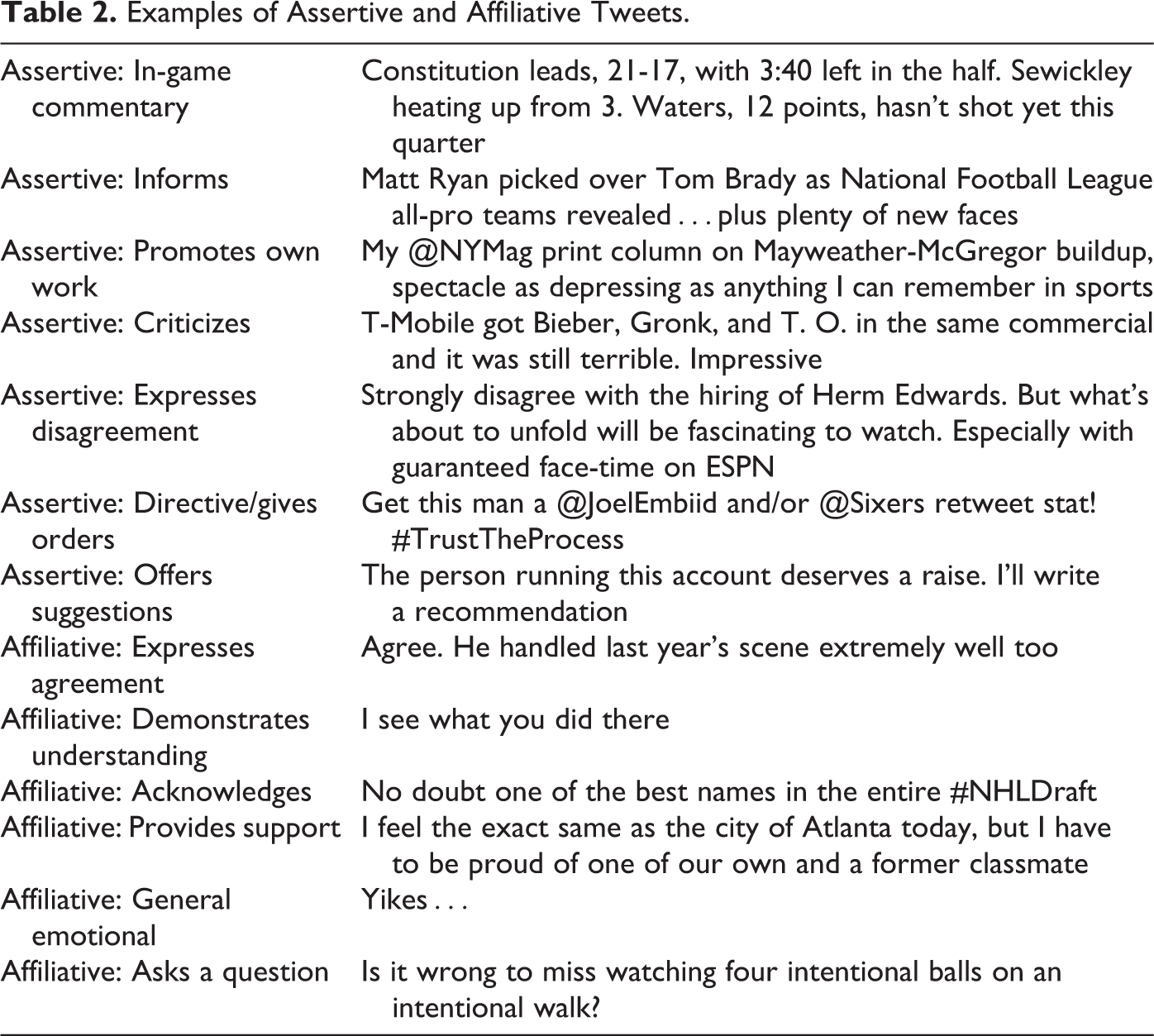
The unit of analysis was each individual tweet. A coding scheme was developed to identify the nature of each tweet. Tweets were coded along three dimensions. The first dimension focused on the actual content of the tweets. Tweets were coded as either “sports related” or “nonsports related.” The second coding dimension was sports coverage. Tweets were coded as either “men’s sports/athletes” or “women’s sports/athletes.” A separate category was created for sports that were gender neutral which included figure skating, horse racing, and rodeo. All tweets about the Olympic games were coded as gender neutral as were tweets about stadiums or weather. The third coding dimension focused on the language style of the tweet. Coders were asked to make judgments regarding whether the tweet was considered assertive or affiliative in nature. Categories for assertive and affiliative language style were developed based on the existing research literature and adjusted to reflect the sports context in which they were analyzed. Assertive tweets were those that (a) promoted one’s own work/linked to work, (b) criticized someone/something, (c) expressed disagreement with someone/something, (d) in-game updates/game commentary, (e) informed, (f) directive in nature, or (g) offered suggestion. Affiliative tweets were those that (a) expressed agreement with someone/something, (b) demonstrated understanding of something, (c) provided acknowledgment of someone/something, (d) showed support for someone/something, (e) asked a question, or (f) were general emotional in nature. Coders were given the option of “other” for both assertive and affiliative tweets if they felt the tweet did not fit into one of the categories (see Table 2 for examples of assertive and affiliative tweets).
Examples of Assertive and Affiliative Tweets.
Two undergraduate student coders were recruited to help out with the study. Coders were blind to the source and gender for each individual tweet. Coders met multiple times with the lead researcher and underwent rigorous training to learn the coding scheme. Coder training lasted approximately 8 hr. As recommended by Rife, Lacy, and Fico (2013), a reliability sample of tweets was taken to ensure that the coders could achieve a high degree of reliability. Once it was determined that coders could achieve a high degree of reliability, coders coded the remaining tweets on their own. Using Holsti’s (1969) formula for intercoder reliability, the level of agreement was .94 for whether the tweet was sports or nonsports and .84 as to whether the tweet employed an assertive or affiliative language style. This represented an acceptable degree of reliability for this study. All disagreements were settled between the two coders.
Results
Of the 63 sports journalists who were originally identified for this study, 6 of them (N = 3 males and 3 females) were not included in the data analysis since they did not tweet on any of the 24 unique days that we collected data on. This left the final tally of sports journalists at 57 (N = 29 males, 28 females).
Research Question 1 examined whether male or female sports journalists would tweet more irrespective of what they tweeted about. An independent samples t test revealed that male (M = 105.48, SD = 115.10) and female sports journalists (M = 65.64, SD = 75.19) tweeted at approximately the same rate, t(55) = 1.54, p = .13.
Research Question 2 examined whether there was any relationship between sports journalist gender and sports tweets. A χ2 test of independence was performed to examine the relationship between sports journalist gender and what was tweeted about. Results revealed a significant relationship between these variables, χ2(1, N = 4,897) = 138.07, p < .001. Specifically, male sports journalists made 65.6% of all tweets about sports compared to 34.4% for female sports journalists. The relationship reversed itself for tweets that were not about sports. Female sports journalists made 58.8% of nonsports tweets compared to 41.2% for male sports journalists (see Figure 1).

Sports and nonsports tweets by male and female sports journalists.
Research Question 3 examined who would tweet more about women’s sports, male or female sports journalists. Only tweets that were coded as “sports tweets” were used in the analysis which left us with a total of 4,165 tweets. A total of 97 tweets were coded as women’s, sports which accounted for 2.3% of all sports tweets by sports journalists. Results revealed a significant relationship between sports journalist gender and sports coverage, χ2(1, N = 4,165) = 36.76, p < .001. Although neither male nor female sports journalists tweeted much about women’s sports, female sports journalists were more likely to do so with 60 tweets (4.3% of total sports tweets by all female sports journalists) compared with male sports journalists who tweeted 37 times about women’s sports (1.3% of total sports tweets by male sports journalists).
Research Question 4 examined whether there was any relationship between sports journalist gender and language style. For data analysis purposes, five tweets were not coded in the language style category since they were indeterminable. This left the respective count at 4,892 tweets. Once again, a χ2 test of independence was conducted to examine the relationship between sports journalist gender and language style. Results showed a significant relationship between these variables, χ2(1, N = 4,892) = 38.76, p < .001. Male and female sports journalists used affiliative language style in their tweets at near identical rates with males at 52.6% and females at 47.4%. The major differences in language styles were observed with tweets that contained assertive language. Male sports journalists made 64.3% of all assertive tweets compared to 35.7% by female sports journalists.
Assertive tweets (N = 4,107) outnumbered affiliative tweets (N = 785) by a healthy margin. Both male and female sports journalists were more likely to make use of assertive language when tweeting than affiliative language (86.5% for all tweets by males and 79.7% for all tweets by females). Within the assertive language categories that were coded for, male sports journalists used assertive language more so on every category with in-game commentary (80.23% vs. 19.77%), criticizing (75.25% vs. 24.75%), expressing disagreement (26% vs. 74%), promoting their own work (61.98% vs. 38.02%), and informing (57.17% vs. 42.83%) containing the biggest discrepancies (see Figure 2). Affiliative language categories were far more even with the only major observed difference occurring for males who acknowledged more in their tweets than females (57.40% vs. 42.60%; see Figure 3).
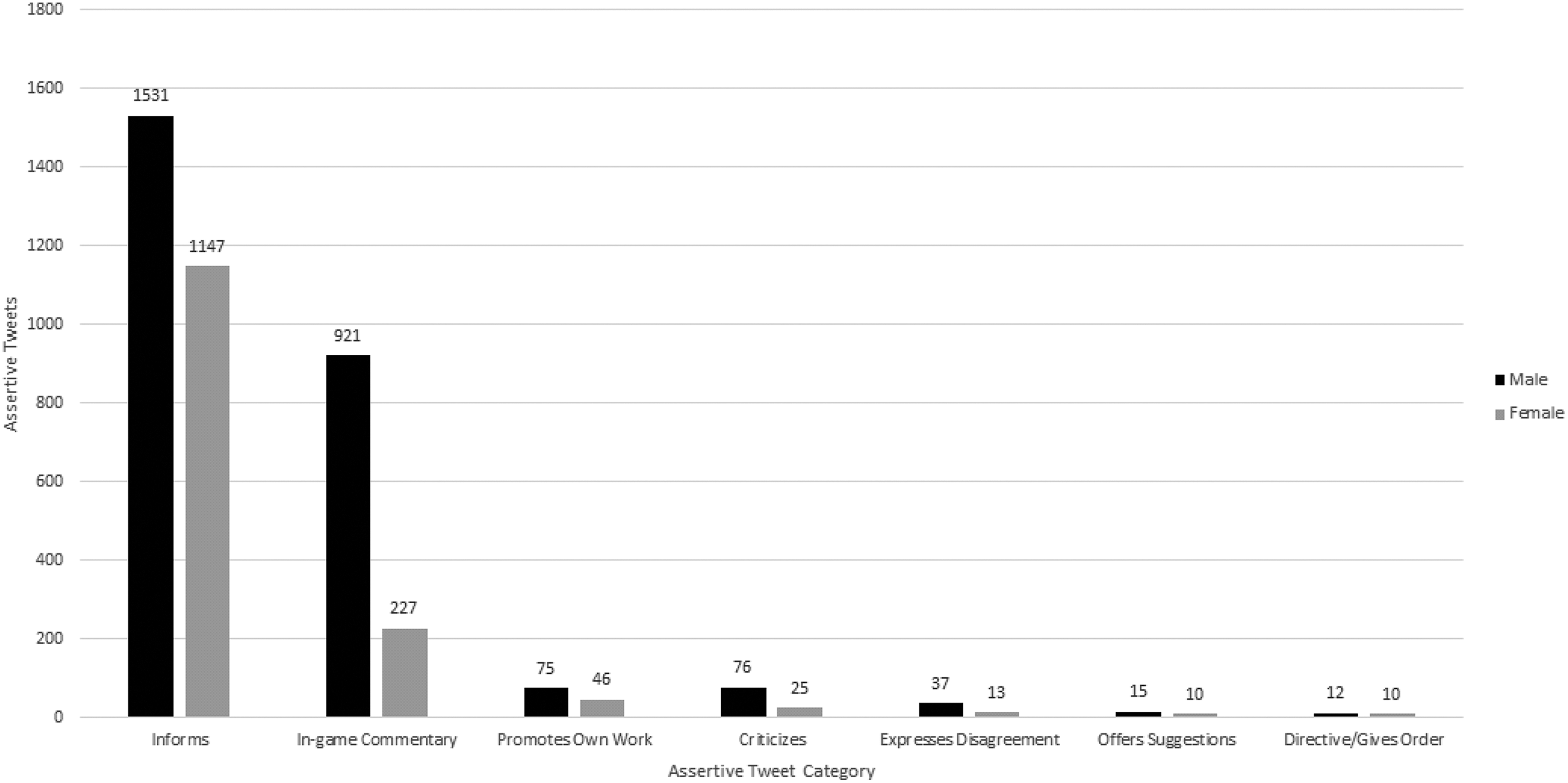
Assertive language in tweets by male and female sports journalists.
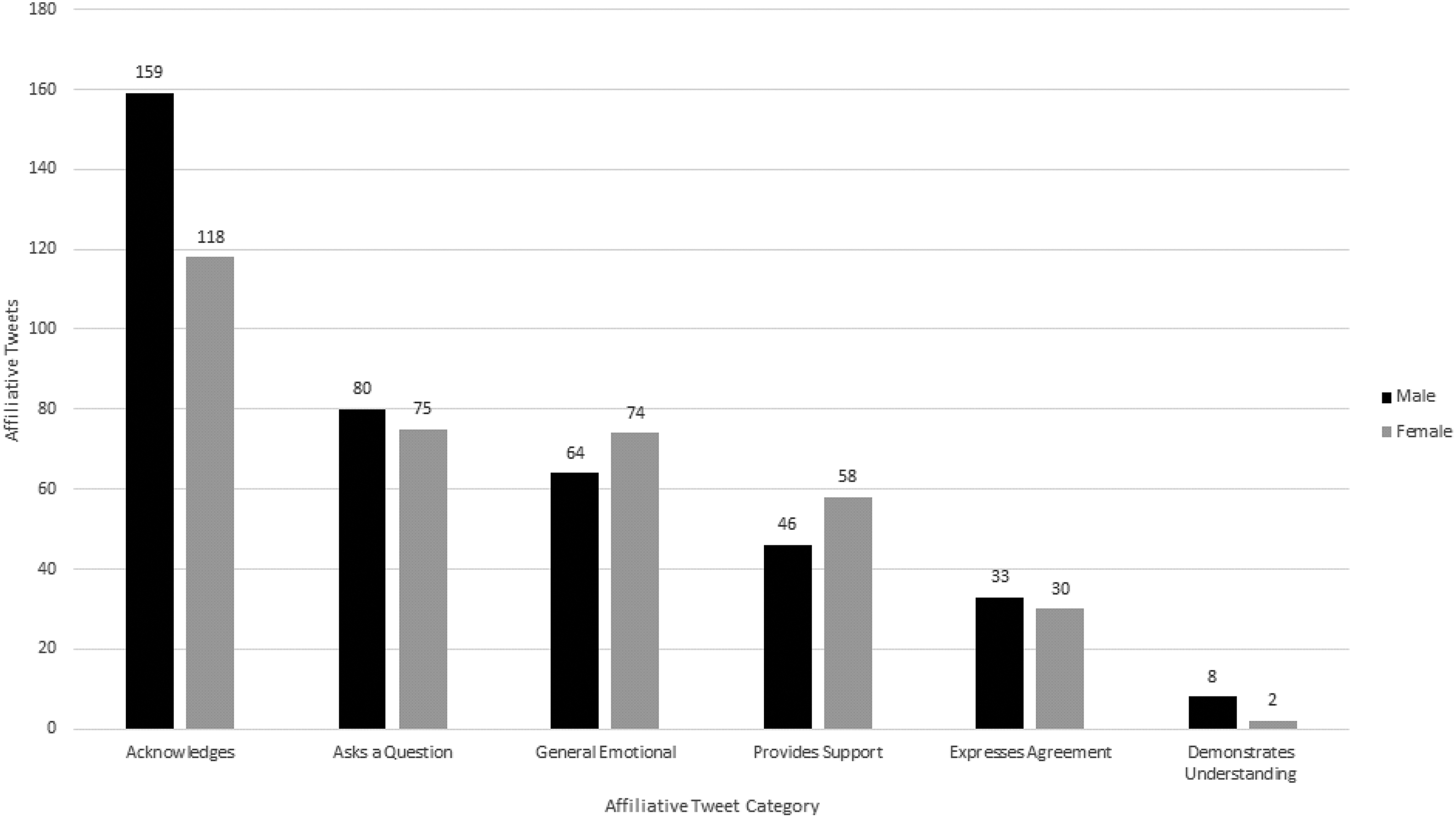
Affiliative language in tweets by male and female sports journalists.
Discussion
This research investigated how male and female print sports journalists used Twitter to communicate with audiences. Overall, our findings show that male sports journalists were significantly more likely to tweet about sports, less likely to tweet about women’s sports, and to do so with an assertive language style. Male sports and athletes were extremely overrepresented in sports tweets by sports journalists, a finding that parallels other research that has documented similar results. The results are made even more meaningful by the fact that male and female sports journalists both tweet at statistically the same rate. Thus, the absence of editorial and gatekeeping forces that have historically privileged male voices and perspectives to report on sports can no longer be attributed as the driving factor for the discrepancy since sports journalists maintain control of their own Twitter accounts.
In theoretical terms, this research provides evidence that male and female print sports journalists use Twitter in different ways in their sports reporting routines. This is surprising since the professional role of sports journalist should not vary in significantly meaningful ways between women and men since presumably sports journalists of all backgrounds have equivalent levels of training and similar work expectations (Murray, McGuire, Ketterer, & Sowell, 2011). In practical terms, the findings suggest that who you follow on Twitter for your sports news makes a difference in what type of information you can expect to come across. This is likely to impact not just your understanding of sports but also how you experience sports. In considering these findings, a number of explanations can be proposed to better help make sense of the results.
First, our finding that male sports journalists were more likely to tweet about sports than female sports journalists deserves serious consideration. The most intuitive explanation that can be put forth is that sports are a domain that are heavily skewed towards men and for men despite the professional and athletic gains that women have made across the sports media landscape. Male sports journalists may simply derive greater satisfaction tweeting about sports where men are the primary athletes compared with female sports journalists. Might we expect the finding to reverse itself if the universe of sports was built around women sports and athletes and their achievements? Female sports journalists may look at the broader landscape of sports and not see themselves represented in meaningful and dignified ways and therefore consciously choose not to tweet about sports as much as their male sports journalists’ colleagues.
Likewise, as part of the hegemonic masculine culture that permeate sports, male and female sports journalists may receive different levels of support from their editors and other supervisors at work. Even though female journalists have made substantial gains, they remain disproportionately underrepresented in sports rooms across the country. Male sports journalists may be unconsciously elevated by their superiors and asked to take on more visible roles that include building their presence through regular sports tweeting on Twitter. Female sports journalists may feel less valued and see less incentive to tweet about sports.
Another plausible explanation for our finding is that female sports journalists tweet less about sports to avoid unnecessary harassment from followers and the so-called online trolls. Twitter, for all its possibilities, has rapidly devolved into a cesspool of vulgarities, especially towards women. A study by Pew Research Center (2017) found that women were significantly more likely than men to experience severe forms of sexual harassment online (i.e., physical and personal threats) and receive explicit images that they did not request. Women have universally reported negative experiences online when speaking including threats of sexual violence, receiving death threats, cyber bullying, and routine harassment due to their gender (Cole, 2015; Harp, Loke, & Bachmann, 2014). In the field of journalism, women’s experiences are no less difficult (North, 2016). According to a United Kingdom think tank, female journalists are 3 times more likely to receive abuse on Twitter than their male colleagues (Demos, 2014). A recent study by Chen et al. (2020) found through in-depth interviews with female journalists across the globe that attacks on their gender were rampant with many of the journalists forced to either limit what they discuss online, change the topics they write about, and/or incorporate special technological tools that prevent certain offensive words from being posted. Such routine harassment may understandably give female sports journalists pause before tweeting about sports since discussions about sports often contain heavy emotion coupled with irrational bravado from fans from different sports teams. Rather than subject themselves to unwanted harassment, female sports journalists may find it more prudent to limit the number of tweets about sports in favor of safer nonsports tweets that are likely to receive less criticism and pushback from followers.
Next, our second main finding that women's sports and athletes received substantially less coverage in the tweets of sports journalists should not come as a surprise. Decades of research in sports communication have routinely found this to be the case. With only 2.3% of all sports tweets devoted towards women sports and athletes, our finding is on par with other studies that have found similar quantities of coverage across different media. One of the most promising and touted features of social media is its potential to democratize information to the masses. In the case of sports journalism, this would mean that women’s sports would be given equal consideration with men’s sports. This has proven not to be the case. If anything, Twitter appears to reinforce existing sports coverage disparities rather than challenge the prevailing status quo of sports coverage.
What might come most as a surprise is that although female sports journalists were statistically more likely to tweet about women’s sports and female athletes than their male sports journalist colleagues, they too rarely discussed women sports or female athletes in their tweets. This is surprising since Twitter enables sports journalists to select whatever content they want without worrying about time and space considerations as is the case with traditional media platforms for sports reporting. It may be that female sports journalists desire to tweet more about women sports but know that doing so carries professional risks like losing followers, inability to attract more followers, lack of employer recognition, absence of replies and discussion from followers, ridicule from followers and online trolls, or even being reassigned to cover women sports which seldom draw the same level of commercial interest among sports fans. Such concerns may prevent female sports journalists from tweeting more about sports than they otherwise might. In an era where professional success is measured by number of followers, likes, retweets, and replies, most sports journalists may be looking to tweet content that can generate the most interest among followers, and not what they might find personally interesting.
Moreover, our third finding that male sports journalists used assertive language in their tweets more so than female sports journalists adds another important layer to our results. Perhaps it is not surprising that both female and male sports journalists made use of assertive language in their tweets more often than affiliative language since the medium of Twitter is designed in a way for users to be assertive: short, concise, and direct statements to self-selected followers who are looking for you to provide information. Normatively speaking, when tweeting about sports, assertive language strategies should be the preferred form of communication. Yet, in spite of these built-in features and the topic itself, male sports journalists appear to place more value on using Twitter for this exact purpose than do female sports journalists. Male sports journalists overwhelmingly used Twitter to provide in-game updates and commentary, a clear sign that male sports journalists see themselves as part of the game action which they cover, whereas female sports journalists do not.
This finding is also in line with previous literature (i.e., Park et al., 2016) where a disproportionate allocation of men and women in their social roles may influence gender specific behaviors. In all media including newspapers, the percentage of female sports journalists drops at the highest ranks of sports journalism (Hardin, 2005) which means that men were more likely to hold supervisory positions while women were more likely to hold supervisee positions. Therefore, it may not be all that unexpected that male sports journalists were more likely to use assertive language on Twitter than their female counterparts since women are severely underrepresented at nearly all levels within the sports media industry.
Most importantly, these results continue to demonstrate critical discrepancies between women and men within the sports media industry. This has a number of potential consequences. First, since we examined professional accounts, it reinforces the unfortunate stereotype that female sports journalists are less knowledgeable about sports and even less dedicated to their job than their male sports journalist colleagues. It also signals to sports news organizations that they can count more on male sports journalists to continue to report on sports even while not officially “working.” This may prove to be a key factor in deciding who stays and who leaves as news organizations continue to shrink their newsrooms and move content online and onto social media. Second, the results here may suggest to aspiring female journalists that a career in sports journalism may not be the career for them. Women wanting to enter the field of sports journalism may look at these results and believe that female sports journalists are less enthusiastic about their job or that the job itself is not rewarding in the way it is for male sports journalists. Third, our results suggest that sports news organizations may need to begin to seriously think about setting realistic parameters for how much they expect sports journalists to tweet. Given that some sports journalists may require more balance between their professional career and family life compared with others, a formal understanding between sports organizations and sports journalists about social media expectations may be the next logical move.
Limitations and Directions for Future Research
As with all studies, this study contains limitations that need to be addressed. First, one of the major limitations that stand out is our investigation of gender as an isolating factor in the tweets that we examined. An increasing number of scholars across many academic fields now recognize that gender often intersects with other important variables such as race, political orientation, sexual orientation, celebrity, and social class (Andrews, 2012; Shields, 2008; Walker & Melton, 2015; Whiteside & Roessner, 2018). Demographic and attitudinal information was difficult, if not impossible, for us to retrieve given the personal nature of such information. Nevertheless, it is important to recognize and acknowledge that there is more than just gender that needs to be considered with each tweet. Sports and sports journalism remain a complex endeavor that cut across many unique and independent identities (McCall, 2005). For example, even as 2017 was a fairly nondescript year as far as sports and sporting events go, one story that dominated throughout the year was the National Football League national anthem protests and boycotts. It is not difficult for one to imagine how other variables besides gender, like those aforementioned for instance, might influence conversation about the topic. Future studies involving sports journalists should consider research designs that involve more than just gender as the principal factor whenever possible.
Second, although this study provides new insight into the content and language strategy of sports journalists, it is impossible to say why sports journalists tweeted about what they did. It is not obvious why male sports journalists tweeted more about sports compared with female sports journalists or why sports journalists do not tweet more about women's sports nor is it entirely clear why male sports journalists used more assertive language in their tweets compared with female sports journalists. Research studies that make use of surveys and/or in-depth interviews are likely to provide more clues as to the psychology behind what a sports journalist is tweeting.
Moreover, our decision not to code tweets that were replies was made with theoretical consideration to the fact that almost all replies are intended for a single person. Such tweets are more personal and intimate to that particular individual receiving the response and even though such tweets can be seen by all, they are not meant for the broader audience of followers. This of course meant that we overlooked nearly 1,800 tweets. Nevertheless, we feel confident that the nearly 5,000 tweets we looked at were more authentic and representative of how sports journalists use Twitter in their day-to-day tweets. Future studies may want to consider differences in replies by female and male sports journalists.
Next, our study was limited by our examination of only print sports journalists working in the United States. There exist many more sports journalists working across the globe and through different mediums such as broadcast television, online-only sites like The Athletic or Bleacher Report, sports talk radio, or even podcasters. It would be interesting to see how tweets from sports journalists not working in print compare with those working in the medium of print from around the world. Furthermore, there are several other important actors in the sports media industrial complex who have yet to be fully explored by sports communication scholars who possess large audiences with whom they interact and communicate with on Twitter. This might include groups such as sideline reporters, tournament organizers, sports hosts and analysts, owners, front office members, coaches, and even gamblers who now have a large stake in the games.
Finally, as sports journalists rely more and more on Twitter (and other social media) to communicate with audiences, the level of depth of each tweet should be considered as a factor. With Twitter increasing its character allowance from 140 to 280, the opportunity to include more information in each tweet is now possible. Undoubtedly, the expectation that sports journalists make use of Twitter signals a further professionalization of the social medium as a tool for sports journalists. Determining whether tweets begin to contain the same level of depth as other mediums, especially print mediums, may be the next logical step in assessing the role of Twitter in a media environment saturated with different sports media options.
Conclusion
In some ways, Twitter has leveled the playing field for female sports journalists as evidenced by the comparable amount of tweeting they do with male sports journalists. It has provided an outlet free from the traditional constraints that have historically stifled females from speaking about sports. Yet it appears that female sports journalists are much more reluctant to tweet about sports and are less likely to present their tweets using assertive language strategies compared with males. Moreover, our finding that women's sports are barely tweeted about adds to a growing list of studies that arrive at a similar bleak conclusion about the state of women’s sports coverage. The findings here suggest that as sports journalism has evolved and moved into the social media era of sports reporting, male voices and perspectives continue to provide the majority of sports coverage, not unlike the eras of broadcast, audio, and print that preceded it.
Footnotes
Acknowledgments
The authors would like to thank Phylisha Drayton and Jace Paupert for their help with coding.
Declaration of Conflicting Interests
The author(s) declared no potential conflicts of interest with respect to the research, authorship, and/or publication of this article.
Funding
The author(s) disclosed receipt of the following financial support for the research, authorship and/or publication of this article: Internal grant was received from Women and Gender Studies Feminist Scholarship Grant from the University of Detroit Mercy.
