




Abstract
Both game-based trolling and hooliganism have existed in some form since the inception of online gaming and professional sports respectively. The two share many characteristics: provocation of an opposing entity, the tendency to taunt or trash-talk others based on their social or individual identity, and disruptive and/or destructive behaviour. However, despite this and the increasing similarity between the worlds of traditional sports and esports, research on the two negatively perceived phenomena has remained largely separate. The present article aims to both link and distinguish the two types of behaviour in terms of what motivates them, the agents involved, and the spaces in which they take place. By drawing from communication theories and cases described as both hooliganism and trolling in professional sports and esports settings, we (a) refine the definition of trolling in light of hooliganism, (b) discuss practical implications for the future health of esports communities, and (c) explore deviance as inherent entertainment in mediatised sporting events. Suggestions for future collaborative research between trolling and hooliganism specialists are also included.
Introduction
Research on trolling behavior has grown exponentially over the past 10 years (e.g., Cook et al., 2019; Thacker & Griffiths, 2012) across multiple disciplines as diverse as feminist and gender studies (e.g., Shaw, 2014), computer science (e.g., Blackburn & Kwak, 2014), and personality psychology (e.g., March, 2019b). However, advances in our understanding of the phenomenon have been largely descriptive. We know that trolls are part of a potentially dangerous (e.g., Buck et al., 2020; Klempka & Stimson, 2014) and benign (e.g., Paul et al., 2015), largely male online subculture, but there has been little concrete action on the part of policymakers to curb the tide of this deviant phenomenon. This stands in direct contrast to a similar offline phenomenon: hooliganism. The extant hooliganism literature includes references to a mostly male subculture of fandom (Free & Hughson, 2003), characterized by violence (Cleland & Cashmore, 2016) and gatekeeping behavior (Bodin et al., 2012; Giulianotti & Armstrong, 2002), all of which are also significant parts of trolling literature (e.g., Cook et al., 2018; Thacker & Griffiths, 2012). The most essential resemblance, however, is the concept of both trolling and hooliganism as core parts of their adherents’ identity (Bodin et al., 2012; Cleland & Cashmore, 2016; Cook et al., 2018; Giulianotti & Armstrong, 2002; Thacker & Griffiths, 2012). Although the two phenomena have many core similarities, trolling is dismissed as an inevitable part of gaming culture (Cook et al., 2018), while hooliganism receives legislative attention (e.g., Testa, 2013).
The goal of this conceptual article is to explore this overlap and see how the combination of these two fields of study could advance our understanding of trolling to the level of hooliganism, rectifying the practical gap between the two. It is important to note that we will only discuss trolling in the context of online games and gaming, as trolling is extremely broad, and occurs across multiple platforms with different affordances (see Cook, 2019; Harrison, 2021). We start by reviewing the conceptual similarities between trolling and hooliganism through the history of their respective literature, followed by behavioral and identity related comparisons. Ultimately, we propose a three-dimensional overlap perspective on trolling and hooliganism, which we hope will contribute to the cross-disciplinary conceptual understanding of both.
Conceptual Definitions
Trolling
As noted by Hardaker (2010), the verb “trolling” has a multitude of definitions, and these are dispersed across many fields of research and platforms upon which trolls operate (Buckels et al., 2014; Cook et al., 2018, 2019). However, in the present article, we are focusing specifically on trolling that occurs within the context of gaming culture. To that end, we will adopt Cook’s (2021) definition of trolling as “the instrumental exploitation of website, game, or chat mechanics at another person’s expense” (p. 198). Exploitation refers here to use that is often not the intended use of a mechanic (e.g., disabling the ability for avatars to move through one another was not made for the purpose of trapping other player characters in corners during games), and benefits one person while at least inconveniencing another person, whether this be a singular person or a group (i.e., corporate entity). This definition neatly encompasses most of the behaviors associated with trolling in games (see Thacker & Griffiths, 2012), while being inclusive of possible trolling on game-related fora and video game streaming services. This could possibly include more verbal trolling, like spamming or trash-talking (see Lin et al., 2019), or other behavioral trolling, such as Rick-rolling (a bait-and-switch technique popular on YouTube) or inhibiting your own team for your own enjoyment when they strive to win (see Cook et al., 2018). However, it is important to note here that trolling can be both benign and malevolent; in the previous example, Rick-rolling will seldom seriously offend or hurt anyone, while inhibiting one’s team can completely ruin a game, particularly in competitive games like League of Legends (see Paul et al., 2015).
Hooliganism
Interestingly, hooliganism is seldom formally defined in its own literature, as authors tend toward describing aspects of hooliganism such as power, honour, masculinity, and identity, that are common across hooligan groups internationally (King, 2001; Tsoukala, 2011; Stott et al., 2012; Spaaij, 2008; van Hiel et al., 2007). This lack of a concrete definition is noted by several authors (Joern, 2009; Piquero et al., 2015). In fact, this is true in both an academic/conceptual sense as well as a legal sense (see Mastrogiannakis & Dorville, 2013). However, Rookwood and Pearson (2010) offer the definition of a hooligan: “an individual who attended matches with the intention of becoming involved in violence with rival supporters (whether or not they achieved that aim) or a fan who became involved in physical violence (but not other disorder or criminal activity) even if this was not [their] initial aim” (p. 151). Boiled down to its key features, this definition suggests that hooligans are physically aggressive and intentionally so. Next, we explicitly reflect on how the above definition of “trolling”, as behavior, and the “hooligan”, as an individual, can be usefully interpreted as parts of an overlapping discourse.
Reflecting Literature
Despite their local relevance in the respective academic domains of games and sports studies, both of these definitions - Cook’s (2021) and Rookwood and Pearson’s (2010) - are narrower than the ways trolling and hooliganism are used colloquially. For instance, according to Cook’s (2021) definition, trolling is a type of behavior in which trolls engage, yet in the media trolling is often conceptualized beyond such calculated acts; for instance, as a social phenomenon in which strangers spontaneously engage in annoying but funny behavior (Smarty, 2012), or in malicious behavior online with the goal of provoking a response of some kind (March, 2019a). The same is true of hooliganism: while Merriam Webster defines it as “rowdy, violent, or destructive behavior”, the media present it as a phenomenon among sports fans that must be policed and contained in order to ensure the safety of non-hooligan spectators (Kamali, 2008; Lepeltier, 2022). In short, the world’s understanding of these two as social phenomena goes deeper than academia’s definitions currently allow.
After a careful reading of the relevant literature, as well as an examination of media perspectives on both trolling and hooliganism, we propose through this paper an amendment to our understanding of both hooliganism and trolling. Rather than considering them as behaviors, or even as phenomena, we propose that they be considered twin social identity particles, in the vein of Turner and Tajfel’s (1986) theory of social identity. In other words, hooligans and trolls see themselves at least partly as hooligans and trolls (Cook et al., 2018; van Hiel et al., 2007), and the collective actions of hooligans and trolls that form hooliganism and trolling as phenomena are performed through the lens of the hooligan/troll social identity. To be clear, this is not a social identity theory study. Instead, for the purposes of conceptualizing trolling alongside hooliganism, we propose viewing trolls and hooligans as in-group identities. As Turner and Tajfel (1986) suggest, the individual members within these groups are constantly working to prove their identities superior to out-groups or, at the very least, improve perceptions of their in-groups (by force or intimidation, in this case). By comparing and contrasting the behaviors, identity components, and spaces in which trolls and hooligans operate, we aim to show how seeing these two concepts (trolling and hooliganism) as contributors to social identities (troll and hooligan) can advance our understanding of trolling by drawing on the deep well of hooliganism literature.
Trolling and Hooliganism Behaviors
The clearest parallel between trolling and hooliganism is in the instrumentality of their behaviors. Practically, both trolls and hooligans are people who enter a gaming or sporting space with the intent to act deviantly for their own benefit. This idea of a gaming space, perhaps most clearly articulated by Giulianotti and Armstrong (2002), is shared by both hooligans and trolls. Just as hooligans can operate at sporting events and stadia, as well as in pubs and on buses and other venues related to their sports team of choice (Bodin et al., 2012), trolls can troll in-game (Cook et al., 2018, 2019), on game-related fora (Thacker & Griffiths, 2012), or in chat channels, like Twitch.tv (Wohn, 2019). In all cases, the hooligan or troll takes command of the space in which they are operating, affecting everyone else in attendance (Cook et al., 2019; Giulianotti & Armstrong, 2002).
Unlike in trolling literature (e.g., Hardaker, 2010; Herring et al., 2002), there are few articles about hooliganism that list specific behaviors hooligans engage in; most hooliganism articles instead describe patterns of behavior, such as generally anti-social behaviors (e.g., Joern, 2009), physical violence (e.g., Mastrogiannakis & Dorville, 2013), and sensationalism (e.g., Steen, 2016), with sensationalism referring here to the idea of either overreacting to an event or provoking an overreaction from someone else to one’s own behavior. Specific hooligan behaviors that are frequently mentioned are taunting (Giulianotti & Armstrong, 2002; King, 2001), fighting or provoking fights (Free & Hughson, 2003; Joern, 2009), damaging property (Kerr & de Kock, 2002), and disrupting the game by throwing things onto or invading the pitch or field (Bodin et al., 2012; Giulianotti & Armstrong, 2002) or by starting riots amongst the spectators (Newson et al., 2018; Rookwood & Pearson, 2010).
However, the two overarching themes in most articles discussing hooliganism is that the behavior is usually criminal and needs to be controlled (Stott et al., 2012). At first glance, there seems to be only limited overlap with trolling behavior. Although negative, trolling behavior is not usually considered criminal (Cook, 2021), and physical violence is not typically considered to be a form of trolling (for an exception to this, see Karhulahti, 2016 on SWATting). In fact, March (2019a) argues for a distinction between the words “trolling” and “cyberabuse”, as she affirms that the term “trolling” does not carry enough weight with legislators and policy-makers, despite trolling’s potential damage to online communities.
At the specific behavioral level, taunting and insults are common for both (Cook et al., 2018; King, 2001). Like hooliganism (Steen, 2016), trolling has a strong element of provocation and exaggeration (Herring et al., 2002; Thacker & Griffiths, 2012). Both hooligans and trolls often aim to get some kind of over-the-top reaction out of their victims. In the case of hooligans, this is usually achieved by provoking rival gangs into a physical fight through taunting or the defacing and/or destruction of property (Spaaij, 2008; Tsoukala, 2011). For trolls, the provocation tends to center on embarrassing the victim in front of others, either by tricking them into revealing their lack of knowledge about the game at hand, or by enraging them to the point of a verbal explosion (Cook et al., 2018; Thacker & Griffiths, 2012). Both trolls and hooligans often want to cause a scene, and one of the key ways they will make that happen is through verbal insults and taunting. Lin et al. (2019) discuss this through the lens of the carnivalesque (Bakhtin, 1984), in which the environments common to esports (and sports; Turner, 2013) support and even encourage behaviors that would be otherwise discouraged or even punished elsewhere.
The primary difference between the origins of trolling and hooliganism is their dependence on technology. While technology has always been intrinsic to trolling (Buckels et al., 2014), hooliganism originates from a purely physical space. Contemporary hooligans, whether online or offline, generally operate as a group supporting a given team (e.g., Giulianotti & Armstrong, 2002; Newson et al., 2018). Extant literature rarely discusses a single hooligan disrupting sporting events, but rather how individual hooligans can operate within their groups (e.g., Bodin et al., 2012; Piquero et al., 2015). This is not the case for trolls, where most of the research refers to trolls having operated mainly individually (e.g., Dibbell, 1993; Thacker & Griffiths, 2012).
However, in more recent instances, trolls also operate in packs, the most notable being in the esports context. At the time of writing (November 2021), the World Championships of the popular esport League of Legends are underway, and there is ample evidence of inter-regional taunting between fans of different teams and leagues on Twitter alone. There are also entire websites dedicated to fuelling inter-regional taunting on streaming website Twitch.tv, listing ‘quotes’ that fans can spam in major esport streams’ chat boxes to taunt their preferred region’s opponents (TwitchQuotes, 2021). We can even see examples of property destruction, with hackers defacing the websites of esports teams (e.g., Turton, 2014). In all these cases, groups of trolls are acting together either in support of one team or region or antagonistically against another. Although some researchers have called this kind of behavior online hooliganism (see Jeong, 2021), much of the extant literature calls this kind of behavior trolling (Cook et al., 2018), despite the collective nature of the actions and the fact that it mirrors the ‘ultras’ of the traditional sports world (a pejorative term often used to describe hooligans in European football culture; see Ruthven, 2018). Through these behaviors, both trolls and hooligans are expressing their belonging; they are expressing their in-group social identities as trolls and hooligans who support their favorite teams while also attempting to demonstrate their superiority to their out-group rivals.
Identity as Common to Trolling and Hooliganism
Identity has been at the heart of both trolling (Buckels et al., 2014) and hooliganism (van Hiel et al., 2007) research for many years. Several articles have already grouped trolls together into specific subcultures, inferring a shared identity similar to that of hooligans’ fan clubs (Buck et al., 2020; Klempka & Stimson, 2014). Recent research in trolling has even suggested that the troll identity transcends platform, crossing games and general internet use (Kowert & Cook, 2022). In other words, being a troll can and does define how a person acts in gaming and other spaces. Although the majority of this research takes place in a personality psychology context (e.g., March, 2019b), which examines individuals as opposed to groups, other approaches have recently emerged as well. For instance, there is growing evidence to suggest that trolling behavior operates in a cycle, with victims becoming trolls themselves after a single exposure to trolling (Cook et al., 2018, 2019). In essence, at this stage of research in trolling, it would seem that some victims adopt the troll identity after being victimized or witnessing trolling consistently in the game space. Whether they adopt this identity in order to protect themselves from future trolling or because they see it as a social norm (similar to social deindividuation effects; see Lea & Spears, 1992) remains to be seen, but both are plausible options.
For hooliganism, researchers have thoroughly explored its roots and have several explanations for its existence, many directly or indirectly tied to identity. Many articles cite racism as a motivation for hooliganism (Cleland & Cashmore, 2016; see Hanén & Kilpeläinen, 2004); other articles focus more on nationalism or patriotism as the driving force behind hooliganism, with or without elements of race involved (Kossakowski, 2017; Kerr & de Kock, 2002). Still others find masculinity, or at least toxic manifestations of masculinity, at the heart of hooliganism (Spaaij, 2008). Some researchers have even found relationships between age, team identification, and self-reported acts of aggression, such that younger fans have exhibited higher levels of fan identification, instances of hooliganism and the acceptance thereof (Toder-Alon et al., 2019).
Though trolling researchers have also documented trolling based on identity as well, race (e.g., Gray, 2012) and gender (Paananen & Reichl, 2019) notably, these do not specify trolls acting in groups the way hooliganism literature does. Hooliganism literature, by contrast, is clear that hooligans identify as a member of a fandom, be it at a national or team level, and that their actions are motivated by this identity (van Hiel et al., 2007; Spaaij, 2008). Like trolls (Cook et al., 2018), hooligans define themselves as such (Bodin et al., 2012). The critical difference is that while trolls can identify themselves as fans of a particular game or team, thus motivating their destructive or disruptive behavior (see Cook et al., 2018), hooligans are consistently motivated by their social identity as a fan when it comes to carrying out their hooliganism (see van Hiel et al., 2007). Both can be motivated by frustration—hooligans by their team’s loss and the subsequent threat of losing face to other teams’ supporters (Joern, 2009; King, 2001), trolls by frustration at repeatedly losing their own games (Cook et al., 2018; Karhulahti, 2020)—but the collective frustration among hooligans is only sporadically collective among trolls, and to our knowledge, more commonly individual. Putting it into a social identity (Turner & Tajfel, 1986) perspective, while the troll in-group identity is largely forged through shared individual experiences of frustration or boredom, the hooligan in-group identity is a subset of a fandom, and is actually an identity particle within an identity. To better understand the nuance this motivation and identity brings to the overlap and gaps between trolls and hooligans, we will present a specific set of contexts where behaviors associated with trolling and hooliganism are particularly difficult to tease apart: esports and traditional sports.
Trolls and Hooligans in Professional Sports and Esports
Because hooliganism usually takes place at physical sporting events, the competitive domain of gaming—esports—serves as a useful comparison point where trolling occurs systematically. As the above conceptual definitions of the two terms imply, perhaps the most significant differences in their usage are spatial: hooliganism in sports is essentially tied to physical competitive events, whereas trolling in esports happens in virtual competitive arenas. Although we acknowledge that the conceptual, physical, and social lines delineating game spaces can be blurred and form debatable “magic circles” (e.g., Consalvo, 2009; Stenros, 2014), the distinctions also carry pragmatic value that is highly beneficial in illustrating the below differences. We further add that sports hooligans are typically in the role of a spectator in live professional games, usually (but not always) for a team-based sport, whereas esports trolls are typically in the role of a player, outside professional games. Some of the examples below fall far from these typical cases as we attempt to systematically present each possible scenario, while being aware of possible arguments over conceptual adequacy in some instances. In addition, the examples we provide below are purely meant to illustrate some of the overlap and gaps between trolling and hooliganism and should not be understood as equal in frequency or in effect. Figure 1 summarizes these differences, which we next discuss in more detail. A comparison of trolling and hooliganism according to agent and space.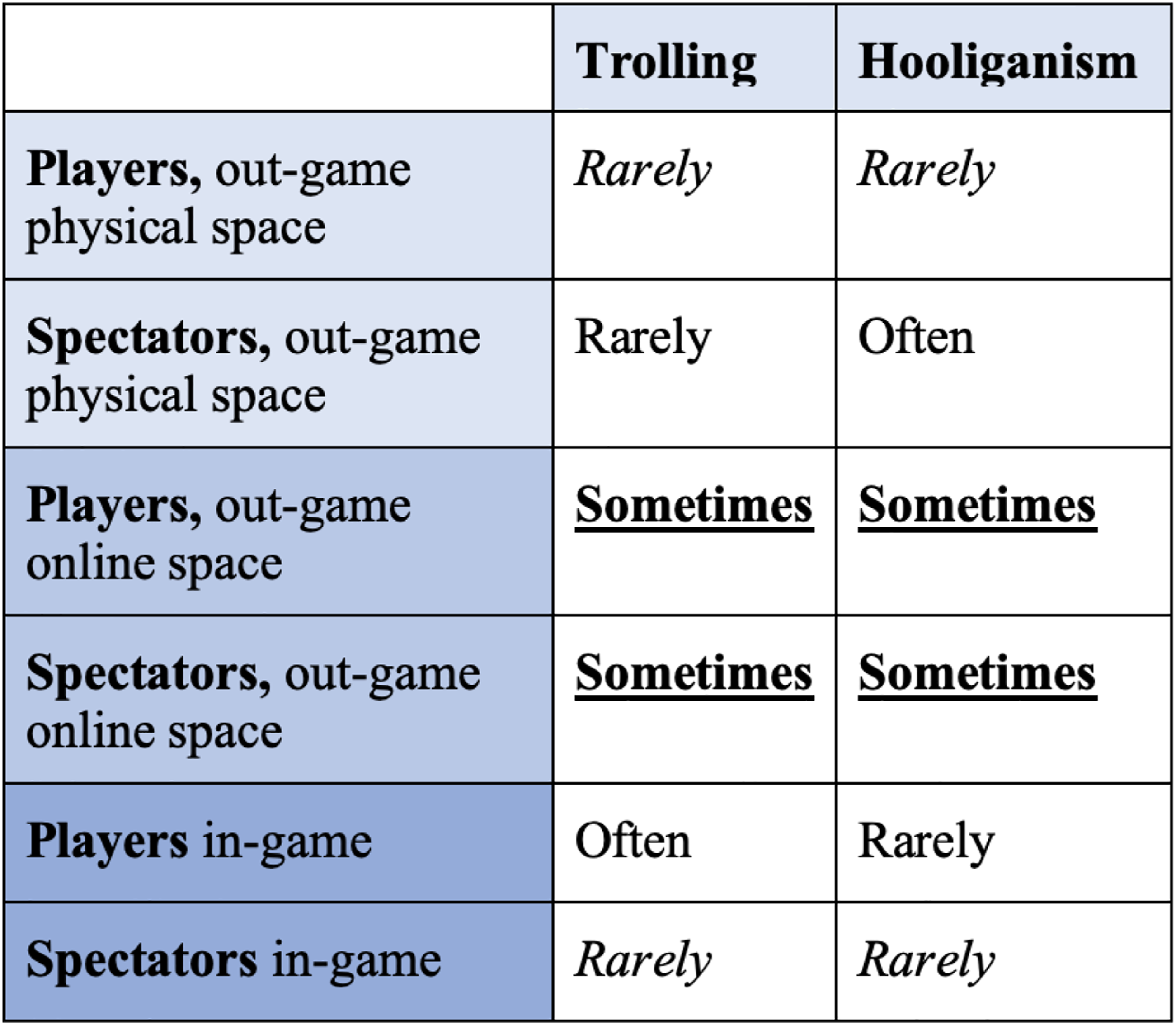
Out-Game Physical Space
Players
In professional play, whether sports or esports, players rarely participate in acts of physical or in-person verbal hooliganism or trolling outside the game environment. For trolling in such spaces, one of the few examples could be trash-taking, if considered to be an analog variation of trolling (Ortiz, 2019). Professional athletes may use verbal (and non-verbal) acts while not playing (i.e., from the bench area or in a press conference) to intimidate their opponents in a trolling-like manner. An infamous example can be found with professional boxer Mike Tyson, who after scoring a decisive victory spoke of his upcoming opponent Lennox Lewis with ringside reporters: “… I’m just ferocious. I want [his] heart. I want to eat his children” (Linneweber, 2010). In esports, extreme trash-taking is arguably less common due to the regulating game companies strongly controlling professional player behavior outside the arenas (Chee & Karhulahti, 2020). That said, mildly provoking comments such as that of Tian (Gao Tian-Liang), taking place in a pre-match interview (“I want G2 to win against T1 so that when we beat them in the finals, the crowd will be silent”) (TL, 2021), sometimes occur.
With respect to hooliganism, there are infamous reports of professional athletes entering the out-game physical space and thus recasting themselves as hooligans. Such events include the National Basketball Association’s “Malice at the Palace” (Lupica, 2004) and English football’s Eric Cantona kicking a fan in 1995 (Smyth, 2020). In the former, an on-court shoving match between members of the NBA’s Indiana Pacers and Detroit Pistons spilled into the crowd when a spectator, a Pistons fan, hit Pacer Ron Artest with a beverage. Artest jumped into the stands to chase who he thought was the offending spectator and was joined by teammate Stephen Jackson in throwing punches at nearby spectators. In the Cantona incident, the Manchester United footballer had just been sent off for poor conduct on the pitch. Before Cantona entered the tunnel to the locker room, an opposing fan allegedly insulted Cantona’s nationality (French) and the footballer responded by landing a kung-fu style kick and a series of punches on the fan, who was standing in the front row of seats. Such instances are historically unique, however, as in both aforementioned events, the athletes involved were responding to unruly fan behavior. Indeed, the events were so rare that they drew unprecedented media attention and resulted in steep fines and legal prosecution—for example, NBA players involved in the “Malice at the Palace'' forfeited more than $12M in fines (Lawrence, 2021), and the league updated its security policies in all arenas for the following season (Lage, 2005).
Spectators
For spectator hooligans, although there are exceptions (see below), out-game physical spaces tied to team-based sports are the main arena for their behaviors. Before, during, and after sports events, acts of hooliganism have historically occurred in stadia and the locations around them. In recent years, hooliganism has become increasingly less common at sporting venues due to the gentrification of the areas surrounding them (Jewell et al., 2014) and, therefore, perhaps to tighter security and stricter policies at newer venues. In response, hooligans have moved away from these locations and have instead taken up areas specifically set aside (either implicitly or explicitly) for hooliganism, such as, in the case of Poland, nearby forests and other remote areas (Kossakowski, 2017).
In esports, on the other hand, very few (if any) acts of hooliganism have been reported in the venues themselves. Despite the increasing number and size of onsite esports tournaments, the culture of esport spectating does not (yet) include notable hooligan behaviors. One possible reason for this could be that with more traditional sports, hooliganism is often tied to broader issues of civic or regional identity (Kennedy, 2001) that are problematically tied up in group dynamics such as xenophobia (Llopis-Goig, 2013; Smolik & Đorđević, 2021). By contrast, these same dynamics may not be as readily apparent in esports given their relative novelty and lack of a civic or regional anchor, although at least three studies imply otherwise. Brookey and Ecenbarger (2016) wrote about a rise in xenophobic and racist discourse directed at esports rosters, and Bae (2021) spoke specifically about hate speech directed at Korean competitors (in one case, referred to as “termites” infesting esports; p. 224). Zhu (2018), in turn, analyzed the events of a Chinese esports team, LMQ, moving to compete professionally in the US, during which “North America displayed a disproportionate discomfort toward East Asian player presence (as opposed to European presence)” (p. 242).
Trolling-like behaviors among spectators in out-game physical spaces are likewise extremely rare, but there are some exceptions. In one instance, perhaps the most famous troll in esports history, Tyler1 (see later sections) had been recently given an indefinite ban by Riot Games, the regulating game company for games such as League of Legends (their own property). As a response to this, numerous Tyler1 fans started bringing “Free Tyler1” posters to the matches of professional Riot Games tournaments, eventually leading to the company’s decision to prohibit banners and posters in the audience referencing Tyler1 (Reddit, 2017). Smuggling and waving such materials (in front of cameras in particular) thus become a form of trolling-like behavior in out-game physical spaces. In South Korea, esports have also recently witnessed a phenomenon where fans drive physical trucks with large display screens to gaming venues in order to protest or otherwise communicate their thoughts about organizations and teams (e.g., Geddes, 2020). Such events interestingly align with both hooligan and trolling behaviors.
Out-Game Online Space
Players
Today, both sports and esports professionals are active users of social media such as Instagram and Twitter. These online platforms have become spaces for various trolling behaviors, which the players participate in as well. Tactical trolling, for instance, by pranking or provoking fans and stakeholders can be used to gain attention that, again, may transform into market value. Such trolling behavior is especially common in combat sports such as boxing and ultimate fighting in which athletes turn to online media to trash-talk in advance of events (Bowman & Cranmer, 2014). For example, mixed martial artist Conor McGregor has developed a reputation for trolling his opponents via social media in the days leading up to major fights (Stonehouse, 2021). Such intimidation strategies have become a standard in esports as well (East, 2016).
An example where trolling and hooliganism overlap in esports players’ out-game online behavior is the case of “Ellie” in Overwatch (Friman & Ruotsalainen, 2022). In this self-titled “social experiment,” a high-level man player pretended to be a woman (utilizing the anonymity afforded by the online space) while reaching the fourth rank on the North American competitive ladder. As he was soon scouted for a contract with the team Second Wind, the hoax was eventually uncovered, wreaking havoc in the media with implications typical to both trolling and hooliganism—having “wanted to prove a point of some kind, apparently somehow related to women in esports” (p. 144). Misogynistic trolling and/or hooliganism tend to be a recurring element of esports, as similar events have also been documented in other titles, for instance, when male Counter Strike players tried to enter a women-only tournament as transgender players “for laughs” (Sainty, 2017).
Spectators
These actions largely define online trolling and hooliganism behaviors, and were already discussed in the previous sections. Professional sports and esports events, despite being organized in onsite physical spaces, are also broadcast online, which allows spectators to carry out various actions defined by trolling and hooliganism terms. For instance, many live-streaming platforms provide the option for the spectators to type comments in a chat, allowing for sport and esport specific memes to be “spammed” and otherwise misused (see TwitchQuotes). Other remote interaction options, such as live donations and studio calls, form a space where trolling and hooliganism merge. Lastly, social media users sometimes interact directly with professional athletes to express their displeasure with that athlete’s performance, among other shortcomings (MacPherson & Kerr, 2021), especially if that performance has negatively impacted a result for the user’s favorite sports team, a fantasy team, or a sports bet. In these instances, athletes usually do not see these interactions until after their performance. Esports players, though, may see such online trolling or hooligan behavior during their performance.
Spaaij’s (2008) interviews with hooligans revealed that hooligans now take full advantage of web pages dedicated to hooliganism. Much like trolls (e.g., Herring et al., 2002), hooligans also use forums to keep in touch, share information, and plan future hooliganism (Spaaij, 2008). In fact, hooligan websites are, according to Spaaij (2008), critical in maintaining network ties across the globe between individual hooligans and groups supporting the same teams. Some of these activities also continue over public online spaces, thus merging with the parallel trolling behaviors.
In-Game
Players
As noted previously, players’ in-game actions represent the standard of trolling in gaming. This applies to esports with the caveat that esports players actively participate in two different playfields: those of professional tournaments and leagues, and those of personally ranked virtual tiers (Karhulahti, 2020). While typically trolling takes place in the latter, trolling in the former—as in professional real-life sports—is generally dedicated to the pursuit of winning, which discourages the sort of trolling behaviors typically found in mainstream gaming (i.e., losing on purpose). Therefore, trolling in professional esports tournaments and leagues, as well as in professional real-life sports, is usually confined to trash-talk or instances where a team is winning by such a great margin that it allows them to “play with their food” (i.e., not play seriously or “run out the clock”).
Hooliganism, in turn, rarely takes place on the playing field, between athletes. One might argue that the most prominent form of hooliganism among athletes is fisticuffs in North American men’s professional ice hockey. These fights are usually intentional and violent but, as North American men’s ice hockey is the only professional real-life, non-combat sport where hooliganism qua fighting regularly occurs and is considered an acceptable part of the sport’s culture, we argue this behavior among in-game athletes is relatively rare for professional sports broadly. Even in professional hockey, fighting is technically illegal (i.e., against the rules) and debates rage as to whether it should result in stiffer penalties or be removed altogether (see Reppucci, 2021), and some leagues (such as collegiate hockey and Canadian junior leagues) do not allow fighting in any form (players are immediately ejected from the game and cannot return). That said, a hockey fight can also be seen as an act of trolling meant to help a team win by way of intimidating an opponent or motivating the fighter’s team.
In-game hooliganism is even rarer in esports amongst players, with the lone exception being the 2018 shooting at a Madden NFL 19 video game tournament in Jacksonville, Florida. Perpetrator David Katz, one of the tournament’s competitors, killed two and wounded nine others during the event before turning his gun on himself. While some of the attention in the news turned toward the need for increased security at esports events (Smith, 2018), the shooting was also covered as part of a larger, ongoing trend of gun violence in the US (Farzan et al., 2018), in effect minimizing the newsworthiness of violence at esports competitions overall. Given these contexts, it could be argued that the Jacksonville shooting transcended hooliganism.
Spectators
Spectators generally have scarce access to in-game space, which makes both trolling and hooliganism there unlikely. Real-life acts, such as invading the field, are exceptions, which can be interpreted in both trolling and hooliganism terms, depending on the specific act. For instance, “streaking” (running naked) is best interpreted as trolling, whereas hostile attacks against participants, such as the 1993 on-court stabbing of tennis star Monica Seles (Owens, 2020) or the 2002 on-field mugging of baseball first base coach Tom Gamboa by a father-and-son duo in Chicago (Kaduk, 2012), are closer to hooliganism.
In esports, spectators interrupting in-game play almost never happens physically but rather remotely. Perhaps the most known instance of these events are DDoS attacks (Distributed Denial of Service), which have been carried out by spectators in esports such as Hearthstone and Dota 2 (Pohle, 2018). In such cases, the organizer’s servers are overloaded, usually resulting in pausing or canceling the competitive event. Some cases of esports audience members entering the stage uninvited have been reported, too, such as an unknown fan jumping to the stage at the StarSeries iLeague victory of the team NAVI in 2018 (Reddit, 2018). To the best of our knowledge, none of these instances have involved violence.
Implications for the Tandem Study of Trolling and Hooliganism in Esports
By connecting the trolling and hooliganism literature conceptually, we aim to open both fields to increased collaboration between researchers and new theoretical pathways that both distinguish and align the phenomena as they continue to change and evolve over time. For trolling in particular, a field of study that has historically lacked both a unified conceptual definition (see Cook, 2021) and the strong theoretical backbone of its better-known cousin - cyberbullying (see Vandebosch & van Cleemput, 2008) - an additional well of literature from which to draw potential insight and inspiration is extremely beneficial. In comparing and contrasting the hooligan and troll social identities - their associated behaviors, motivations, and spaces - we can further refine the concepts within sports and esports contexts, where the distinction between the two has been particularly nebulous in the past. In this way, we also give the more recently emerged esports a chance to potentially avoid some of the pitfalls that traditional sports, especially European football, faced when it comes to policing matches and generally maintaining order among spectators (Mastrogiannakis & Dorville, 2013; Testa, 2013).
Hooliganism as a Calibration Point for Refining Trolling in Esports
As esports has evolved, so has its understanding of “trolling” and what makes a troll. We posit that some of those changes are implicitly connected to conflating trolling behavior with hooliganism behavior. Historically, in the multiplayer gaming context, trolling was a term used to describe intentional loss (see Cook et al., 2018). Consequently, both the amateur and professional communities (including official shoutcasters) today systematically speak of trolling whenever a player underperforms or diverges from their conventional play style. This labels the “troll” as someone who is not taking the game “seriously,” but rather chooses unreasonable risks or prefers a personally satisfying strategy over those that would most benefit the team. The above highlights how in-game trolling in esports is specifically related to winning (or intentionally losing), whereas trolling in other environments may have a variety of disruptive goals. That is not to say that various forms of “inting” (intentionally losing) are not trolling, such as: “feeding” (playing without resistance to make the opponent stronger), or “troll building” or “troll picking” (deliberately using sub-optimal playable characters). However, such labels are unlikely to be useful in describing player behaviors in major esports events (in which professional esports players are unlikely to forfeit earnings) or spectators of those events (as they are not actively on the playing field). In other words, as esports continue to resemble sports broadly (see Bowman & Cranmer, 2019), we as scholars must continue to refine our constructs to ensure that we are describing and explaining the phenomenon in front of us.
Following the above, trolling surfaces in esport broadcasts and live-streams in many ways. In professional esports, the official broadcasts conventionally include chat features that enable people to wreak havoc by using unaccepted language, memes, and or simply flooding the chat. Unlike in-game trolling, out-game trolling is mostly unrelated to either team winning, but rather it pursues disruption of the broadcast in general, having led to various kinds of moderation strategies (see Taylor 2018). It is this out-game trolling that more closely resembles hooliganism, with spectators engaging in the trash-talking and taunting shared by both (Giulianotti & Armstrong, 2002; Thacker & Griffiths, 2012). Instead of the player themselves losing and their identity as a player being put at risk (Cook et al., 2018), it is their identity as a fan that is being threatened by a loss of face, as described extensively in hooliganism literature (i.e., Joern, 2009; King, 2001). Recognizing this connection leads to testable hypotheses that researchers in both fields can explore, and allows us to refine and redefine what we call ‘trolling’.
Much like March (2019a) argues for trolling to be separated from similar terms, we would argue that trolling should be defined as a particle of social identity with the understanding that hooligans also exist and that their identity is similar. We therefore propose a new conceptual understanding of esports trolling, inspired by Cook’s (2021) initial definition, as the instrumental exploitation of game or service at another person’s expense without destruction or violence. Esports trolling that does pursue destruction or violence, online or offline, would then be better referred to as hooliganism. Our hope is that this distinction can further trolling research, while inspiring new work comparing and contrasting hooligans and trolls and their behaviors.
Policing Trolling and (Online) Hooliganism
In calling destructive or violent spectator behavior ‘hooliganism’ instead of trolling, we also open practical doors to dealing with it before it escalates to the levels of violence experienced in European football matches (see Kerr & de Kock, 2002). For traditional sports, hooliganism has nearly always had a negative connotation, with several countries around the world enacting legislation to curb its impact on the sport and its fans (e.g., Mastrogiannakis & Dorville, 2013; Testa, 2013). In the world of esports, however, the term ‘hooligan’ is taken lightly (see ESL Play, 2021), while the term ‘trolling’ is heavily vilified in media (see Ditch the Label, 2021). As we have demonstrated in this paper, there is considerable overlap between the two in terms of social identities, to the point where in conversation and even academic work, they are often conflated. The major difference appears to be that when we call something hooliganism, governments and organizations step in to deal with it (Kerr & de Kock, 2002; Mastrogiannakis & Dorville, 2013), while if we call it trolling, players feel as though there is no real recourse and are forced to just treat it as an inevitable part of being involved in gaming communities (Cook et al., 2018; Thacker & Griffiths, 2012).
It is also important to note that what we call ‘trolling’ often transcends the basic taunting and trash-talk common to hooligans and trolls. In the personal live-streams of individual esport players, for instance, trolling can be a brand or identity in- and out-of-game (Consalvo, 2018), and seems to be strongly related to gender, with women being consistent harassment targets over men (Todd & Melancon, 2019). Trolling can also escalate into DDoSing (shutting down the live-streamer’s internet connection) and SWATting (deceiving an emergency service into sending police to the live-stream location) (Karhulahti, 2016). By introducing the idea that this can also be hooliganism and extends beyond our old ideas of trolls just trying to lose a game, we can help sports specialists, esports professionals, academics, platform owners, and policy-makers to better understand each other and build collaborative approaches to deciding what is and is not acceptable in the esports context.
Trolling and Hooliganism as Entertainment
We have mostly focused on trolling and hooliganism as deviant and harmful identities leading to behaviors that threaten the integrity of sports and esports as well as that which causes implied and actual harm to players and spectators. However, it is worth noting that hooliganism and trolling can be sources of entertainment and even endorsed by non-troll/hooligan spectators as well (Cook et al., 2018; Rookwood & Pearson, 2010). For both the hooligan and the troll, trolling and hooliganism are intrinsically enjoyable activities (Paul et al., 2015), but there is growing evidence that they can be perceived as much a part of the show as the actual sport or esport. For trolling, there are many successful YouTube channels dedicated to trolling for others’ entertainment, one of the most famous recent examples being Tyler1, whose in-game toxicity in esports titles has led to millions of online followers (Goslin, 2018).
Although a minority group among trolls, research has also found trolls who use trolling behavior as an unorthodox strategy to engage other players in conversation and subsequently build friendships (Cook et al., 2018). That said, we have yet to determine whether or not these troll-based friendships and troll subscribers and supporters are built on a shared identity, as in the case of hooligans (see Rookwood & Pearson, 2010). As previously mentioned, hooligan-like behavior from athletes in the case of the National Hockey League (NHL) are an anticipated part of the evening’s events (see Goff, 2011), and Rookwood and Pearson (2010) found in their research that fans often support hooliganism because it shows off the strength of their team and the passion they feel as fans; this sentiment is echoed by Newson et al. (2018) when they describe hooligans as being modern-day warriors fighting for their team’s honor. This, too, connects hooliganism and trolling as a seemingly inextricable part of the spectacle of sport. As noted by Lin et al. (2019), observed hooliganism in esports is likely a byproduct of the carnivalesque encouraged by these environments, in which behaviors that make little sense outside the domain of competition became accepted and even anticipated – long known as “play in the magic circle” in game studies (Huizinga, 1938).
Limitations and Future Directions
Though we have aimed to advance the understanding of both hooliganism and trolling in this piece, our contribution remains limited. The bulk of our cited research and other sources comes from North America and Europe. This means that our understanding of trolling and hooliganism as phenomena is also rooted in these cultural contexts. Future work tying these concepts together and teasing them apart should therefore take cultural context into consideration even more and examine the analogues for “troll” and “hooligan” in non-English languages for additional nuance. Future work should also begin to test some of these assertions empirically. For instance, do trolls and hooligans score similarly on trolling scales such as those employed by Buckels et al. (2014), suggesting a personality component to social identity? Do trolls follow a similar longitudinal trajectory over their ‘careers’ as hooligans appear to? These and other questions should be examined to test the veracity of our theoretical connections and advance the study of both phenomena in tandem.
Footnotes
Declaration of Conflicting Interests
The author(s) declared no potential conflicts of interest with respect to the research, authorship, and/or publication of this article.
Funding
The author(s) disclosed receipt of the following financial support for the research, authorship, and/or publication of this article: This work was supported by the Ministry of Science and Technology, Taiwan (#109-2423-H-004 -004 -SS4 and #111-2811-H-004-006) and Academy of Finland (353267).
