




Abstract
Sports journalism has long been derided as the newsroom’s “toy department”, characterized by emotionalized storytelling, boosterism, and limited critical scrutiny. Although recent research challenges this stereotype, comprehensive cross-national evidence has been scarce. This study provides the first large-scale internationally comparative test of these claims using the Journalistic Role Performance framework to analyze four roles—Interventionist, Watchdog, Loyal-Facilitator, and Infotainment—in comparison to non-sports news. Drawing on a content analysis of 14,676 sports stories from 341 outlets across 36 countries, we find a clear dominance of interventionist and infotainment roles, shaped by frequent use of opinion, adjectives, emotion, sensationalism, and personalization. Watchdog performance is notably low and displays minimal variation across political and media systems, despite a slightly higher presence in established democracies. While these findings may confirm certain stereotypes of sports journalists, there is limited evidence that they are merely cheerleaders for the sporting elites (the loyal-facilitator role). Multilevel analyses reveal that these role patterns are strikingly stable across socio-political, organizational, and story-level contexts. Taken together, the findings show that sports journalism constitutes a unique, resilient and globally distinctive news beat whose role performance remains shaped by entertainment-oriented and interventionist tendencies.
Keywords
Introduction
Despite generating popular and profitable content, the sports news beat is often denigrated as the “toy department” of newsrooms (Rowe, 2007); valued for its economic capital but criticized for low cultural capital (English, 2016). Sports journalism is frequently contrasted negatively with the democratically normative roles of “hard news,” being primarily associated with infotainment, emotion, and personalization over substance (Kunert & Kuni, 2023; Rowe, 2017). McEnnis (2017) and Moscowitz et al. (2019) highlight how interpretation, commentary, opinions, and rumors are prioritized over objectivity. Consequently, sports journalists are viewed as loyal “fans with typewriters” (McEnnis, 2017), or cheerleaders (English, 2017; Hardin, 2005; Reed, 2020), who lack critical distance (Grimmer, 2017). Related issues such as corruption and social politics are thus compromised or underreported (Vimieiro, 2017).
As a mode of journalistic role performance characteristic of the sports news beat, the “toy department” ethos typically features high interventionism, infotainment, and boosterism, with low watchdog reporting. Yet, amid transformations in journalism, it remains unclear whether this ethos is homogeneous or varies across cultures, outlets, or platforms, and what factors reinforce or weaken it.
Previous research has identified variations across national contexts (English, 2017; Horky et al., 2025), platforms (Cassidy, 2017; McEnnis, 2020; Perreault & Bell, 2022), and outlet types (Hardin, 2005; Hardin et al., 2009; Reed, 2020), suggesting the sports beat may not be homogenously practiced. At the level of journalistic role perception, journalists do not appear to endorse the toy department thesis (English, 2017; Ferrucci & Figueroa, 2025; Hardin et al., 2009; Reed, 2018, 2020), opening significant knowledge gaps. There is limited evidence on how journalists’ perceptions have materialized in the content produced, or whether a distinct pattern of role performance defines sports journalism within mainstream media. Furthermore, there is scarce systematic evidence comparing sports and non-sports news beyond single (particularly Western) nations, or of models explaining the social, organizational, and content-based factors that determine the (in)stability of the beat.
This article examines the performance of interventionist, loyal-facilitator, watchdog, and infotainment roles in sports news compared with other topics, and their variation across national journalistic cultures, identifying the factors that influence them. Using the Journalistic Role Performance theoretical framework (Mellado, 2015, 2021), we analyze 14,676 sports stories from 36 countries and 341 print, online, TV, and radio outlets in 2020, amid the disruptions of the COVID-19 pandemic.
From Journalistic Role Perception to Role Performance
Surveys of sports journalists suggest they at least partially endorse normative roles aligned with the profession (English, 2017; Hardin et al., 2009; Reed, 2018, 2020). However, the gap between rhetoric and practice (Mellado & Van Dalen, 2014) is common, revealing a significant divide between journalists’ intentions and outputs (Mellado et al., 2020). Focusing on news content rather than surveying journalists, therefore, enables a systematic evaluation of the performance of journalistic roles in sports news.
Mellado’s (2015) framework operationalizes six roles through specific indicators across three domains. The ‘journalistic voice’ domain emphasizes journalists’ active participation (interventionism) in interpreting reality rather than simply disseminating facts. The ‘power relations’ domain examines the watchdog role, which holds power accountable, versus the loyal-facilitator role, which aligns with or facilitates elite power. Lastly, the ‘audience approach’ domain outlines how journalists engage with audiences: as citizens to be heard (civic role), consumers to be advised (service role), or spectators to be entertained (infotainment role).
Based on this framework, studies of role performance in sports news compared to other topics (Mellado et al., 2024a) or national contexts (Humanes, 2023; Kozman & Liu, 2025) support the contention that sports news displays low watchdog, high interventionism, loyalty, and infotainment. Based on this evidence, we hypothesize that:
Sports news is characterized by high interventionism, loyalty, and infotainment, with a weaker watchdog orientation than non-sports news.
However, since there is less clarity on the specific role characteristics that are unique to sports reporting and role variation across countries, we pose two primary questions.
What are the role indicators that differ the most between sports and non-sports news?
How stable is the performance of the interventionist, watchdog, loyal-facilitator, and infotainment roles in sports news across 36 societal contexts?
Role Performance and Newsbeat ‘Particularism’ in Sports
The structuration of journalistic labor across thematic beats enables differentiation and specialization. Beats function as ‘particularist’ domains (Reich, 2012) and ‘communit[ies] of practice’ (Hutchins & Boyle, 2017). This newsbeat particularism is linked to sourcing patterns, shared routines, and the performance of roles that reinforce these boundaries. Thus, news beat stability arises when the newsbeat-role performance relation is consistently maintained across contexts (Mellado et al., 2024a), unaffected by major external or internal influences. Conversely, the performance of certain roles can transcend specific beats and align with journalism’s broader professional identity rather than with beats (English, 2017; Ferrucci & Figueroa, 2025), thereby destabilizing particularism (Reich, 2012). Role performance can thus reinforce or destabilize the sports beat—and the toy department thesis —and is contingent on various factors.
Cyclical events and matches in sports foster event-dependent stability (Hutchins & Boyle, 2017), but routines continuously evolve through digital transformation (Moritz, 2015; Daum & Scherer, 2018) and media convergence (Hutchins & Rowe, 2012). The rise of ‘networked media sports’ (Hutchins & Rowe, 2012) and associated market pressures (Ferrucci, 2022), along with the expectation to comment on social and political issues involving sports figures (Broussard, 2020) trigger new professional expectations (English, 2016; Ferrucci & Figueroa, 2025; Reed, 2020) that influence the stability of sports as a news beat.
Societal factors that can impact the performance of roles in sports news include democratic contexts and journalistic autonomy (Berstein, 2024); national sports performance and perceived power (Hong & Oh, 2020); and geopolitical interests (Daoudi et al., 2026; Kim, 2024). Organizational factors like platforms (English, 2016; McEnnis, 2017; Moscowitz et al., 2019), resource availability (Daum & Scherer, 2018), circulation (Reed, 2018, 2020), or staff size (Ferrucci, 2022) can impact role performance. Sports broadcasting rights (Vimieiro, 2017) and the institutional identity of the outlet—corporate (Burroughs et al., 2023; Rowe, 2017), for-profit (Ferrucci, 2022), public service (Ramon & Rojas-Torrijos, 2022), or state-run (Latififard et al., 2024) — can also be factors.
Ethical codes (Hardin et al., 2009; Ramón & Rojas-Torrijos, 2018) and regulations (Kunert & Kuni, 2023; McEnnis, 2018) also shape sports journalism. Context-based crises that disrupt sports, source access, or networking routines, such as the COVID-19 pandemic (Ferrucci, 2022; Perreault & Nölleke, 2022), can further affect role performance. Moreover, the story’s international or domestic focus is another factor (Daum & Scherer, 2018; Kingsbury, 2011).
Unpacking Journalistic Roles in Sports News
The Use of Interpretation and Opinion: High Interventionism
In journalism, interventionism—defined by the prominence of opinion, interpretation, adjectives, or analysis (Mellado, 2015)—contrasts with traditional objectivity and fact-based reporting. High intervention is typical in sports news, where journalists act as active agents, using voice, language, and emotion to engage audiences, particularly during live events (Kunert & Kuni, 2023).
Several factors can reinforce this interventionism. Legacy TV and newspapers emphasize context, analysis, and informed opinion (Hardin & Ash, 2011) to distinguish themselves from digital provocateurs (Ferrucci & Figueroa, 2025). Personalized, narrative-driven accounts are valued for their quality and depth (Tulloch & Ramon, 2017), and senior writers gain professional capital from the perceived respect their opinion columns generate (English, 2016).
The rise of digital and broadcast media has also led to a broader shift in journalism from descriptive reporting based on source quotes to an interpretive role, explaining either the “why” behind events or focusing on “trivia, quick speculation, and rumour” (Daum & Scherer, 2018). This change is evident even in traditional media as newspapers adopt longer, analytical formats to stand out in an information-saturated environment (Horky et al., 2025). The 24/7 news cycle on digital platforms also promotes opinion-driven stories, blurring the line between professional analysis and fan emotion (Ferrucci & Figueroa, 2025; Moritz, 2015), especially when traditional newsroom-codified rules and ethical safeguards are absent (Ramón & Rojas-Torrijos, 2018). Competition from fan bloggers, influencers, and alternative outlets (McEnnis, 2017) further motivates sports journalists to pursue interventionism, seeking legitimacy, and challenging the “toy department” stereotype (Burroughs et al., 2023).
Socio-political factors also drive interventionism in sports journalism (Broussard, 2020). Journalists’ active voice shapes public responses to major sports scandals and corruption cases (Denham, 2019; Rowe, 2017) or to social controversies (Broussard, 2020; Cassidy, 2017; Moscowitz et al., 2019). Journalists are compelled to frame events in moral and ethical terms and contribute to social change (Bernstein, 2024). We therefore expect.
The performance of the interventionist role is predicted at the societal level by higher levels of corruption and sociopolitical problems, at the organizational level by multiple platforms, larger and converged newsrooms, and the absence of codified rules.
Boosting the Elites and the Nation: the Loyal-Facilitator Role
The loyal-facilitator role reflects uncritical support for elites, policies, and the nation (Mellado, 2015). Sports journalists have faced accusations of bias and of boosting athletes, teams, and the sports industry (English, 2017). Although some reject this stereotype (Reed, 2018), terms such as “fandom” and “boosterism” indicate an ethically compromised relationship that often reduces critical scrutiny of elites (Boyle, 2006; Hardin, 2005; Rowe, 2007).
Several factors drive these patterns of interdependence. At the routine level, constant news demand makes journalists reliant on information subsidies from PR teams, leagues, and other elite sources (Sherwood et al., 2017; Suggs, 2016), diminishing source diversity. Economically, media outlets have historically depended on major sports to attract lucrative male audiences for advertisers, especially during mega-events (Rowe, 2017). Events such as the Olympics and World Cups, for which large corporations hold broadcasting rights, are frequently filtered through patriotic and nationalistic lenses (Kim, 2024). Coverage favors national (‘home’) agendas, teams, and athletes (Kim, 2024; Kobayashi et al., 2023; Pullen et al., 2020), as well as countries with sports and geopolitical power, seen in elite nations’ dominance in Olympic coverage (Hong & Oh, 2020). Sports news often sacralizes patriotic, militaristic, and nationalistic values (Knoester & Davis, 2022), validating in-group identities (Kim & Billings, 2017), especially among audiences that perceive their country as superior (Knoester & Davis, 2022). These tensions intensify in contexts of state control over sports information (Latififard et al., 2024; Kozman & Liu, 2025).
At the sports desk, the relative absence of ethical codes normalizes practices such as freebies and boosterism, particularly among younger editors at smaller outlets (Hardin, 2005), although larger newspapers often discourage such behaviours through codified ethical guidelines (Hardin et al., 2009; Ramón & Rojas-Torrijos, 2018). This divergence helps explain traditional print journalists’ skepticism toward television and online counterparts, whom they associate with higher levels of fandom and boosterism (McEnnis, 2020; Whiteside et al., 2012).
Small, single-platform outlets often lack resources for in-depth reporting. This scarcity has worsened in recent years, amid the COVID-19 pandemic (Sadri et al., 2022), conditions of democratic backsliding and diminished freedoms (Pajnik & Hrženjak, 2024), and layoffs that reduce investigative capacity and increase dependence on official sources (Velloso, 2022). Journalists’ pandemic reporting experiences reveal overlaps between health, political, and media crises (Pajnik & Hrženjak, 2024), potentially increasing state control and reducing autonomy, thereby reinforcing traditional source imbalances in sports news (Ramon & Rojas-Torrijos, 2022). These previous findings inform the following hypothesis:
The performance of the loyal-facilitator role is shaped at the societal level by greater national sports power and a national context of democratic backsliding; at the organizational level by state ownership and corporate ownership (typically holding broadcasting rights), by smaller outlet size, by the absence of codified newsroom rules, and at the story level by fewer sources and a domestic focus of a news story.
Do Not Bite the Hand that Feeds You: Low Watchdog Role
The watchdog role of the press is vital for holding power accountable through questioning, criticism, and uncovering wrongdoing (Mellado, 2015). Historic analysis of news content suggests journalists often fail to fulfill the role effectively (Boyle, 2006; Hardin et al., 2009; Rowe, 2007). Nevertheless, recent evidence points to modest progress. Here, sports journalists appear to endorse the watchdog role when interviewed or surveyed (English, 2017; Ferrucci & Figueroa, 2025; Reed, 2020). Studies report greater source diversity in sports journalism (Horky et al., 2025) and accountability narratives in the face of team defeat (Spiliopoulos et al., 2022). The rise of athlete activism has encouraged sports journalists to engage more critically with socio-political issues (Bernstein, 2024; Broussard, 2020), adopting a “moral watchdog” approach (Oates & Pauly, 2007) and exposing institutional failures (Cassidy, 2017).
Availability of time and resources (Broussard, 2020) in larger, ethically guided print newsrooms can significantly improve coverage of corruption stories such as ‘FIFA-gate’ by El País (Márquez-Ramírez et al., 2017), the Russian doping scandals by The New York Times (Denham, 2019), or human rights abuses during the Qatar World Cup by The Guardian (Daoudi et al., 2026). Conversely, in more restrictive contexts, national sports interests can hinder critical coverage, as demonstrated by Al-Jazeera in Qatar (Daoudi et al., 2026) and by Iran’s state media’s coverage of exiled athletes (Latififard et al., 2024).
Commercialism also impedes watchdog role performance, with a prevalent “stick to sports” policy prioritizing apolitical branding (Burroughs et al., 2023). Corporate media is hesitant to criticize partners and sponsors, while organizations with broadcasting rights may misreport wrongdoing (Vimieiro, 2017) since sports organizations still reward compliant journalists (Grimmer, 2017; Suggs, 2016).
There is no consensus on other organizational factors affecting the watchdog role. Newsrooms’ 24/7 cycles (Moritz, 2015) often prioritize speed over rigor, with independent sports blogs sometimes performing the watchdog role more effectively than traditional newspapers (Whiteside et al., 2012). The COVID-19 pandemic may have reduced opportunities for watchdog reporting, especially amid democratic backsliding (Pajnik & Hrženjak, 2024). However, suspending live games sometimes enabled collaborative investigations and more diverse sourcing (Ferrucci, 2022) or the coverage of social issues (Sadri et al., 2022), while some outlets maintained their usual operations (Velloso, 2022). In line with this literature, we hypothesize.
Watchdog journalism is predicted at the societal level by higher corruption, reduced pandemic backsliding, and lower support for people during the pandemic; at the organizational level, by newspaper outlets, public service over corporate media, outlets with codified editorial rules, and larger, integrated newsrooms; and at the story level by higher sourcing.
The Pressure to Engage the Audience: High Infotainment
The infotainment role focuses on personalization, private lives, emotions, and sensationalism (Mellado, 2015). In sports journalism, infotainment is influenced by commercial imperatives, platform affordances, and sports’ inherent narrative drama, often depicted through epic storytelling and heroism. Sports coverage employs spectacle when competition alone fails to sustain audience interest (Pullen et al., 2020). Major events deploy dramatization, emphasizing athletes’ private lives and hardships (Rees et al., 2018), or rallying the nation to cope with traumatic memories (Serazio, 2010), especially in contexts of health crises and the sense of loss. In television, “hero shots” capture the drama and excitement of athletes’ successful moments (Reed & Forbes, 2024). Scandals are similarly dramatized, with salacious details (Gottschalk, 2024; Oates & Pauly, 2007) and personalized narratives that translate systemic corruption into compelling human-interest stories (Denham, 2019; Rowe, 2017). While often criticized for trivializing sports, infotainment remains a potent engagement strategy, with effects ranging from “dumbing down” coverage to crafting sophisticated narratives (Tulloch & Ramon, 2017).
Rising digital media and commercial pressures (Daum & Scherer, 2018; McEnnis, 2020), channel fragmentation (Kunert & Kuni, 2023), and shrinking resources in smaller newsrooms have further entrenched infotainment. The demands of constant digital streams favor “bite-sized” content over complex narratives (Moritz, 2015). Within the large sports-media-business complex, corporate media networks treat major events primarily as entertainment (Rees et al., 2018), with pre- and post-game coverage focusing on individual players’ stories (Kunert & Kuni, 2023).
By contrast, sports journalists at public service broadcasters tend to view themselves as objective mediators rather than entertainers (Kunert & Kuni, 2023). Meanwhile, legacy outlets—both public and for-profit—use engaging human-interest stories (Tulloch & Ramon, 2017) or innovative infotainment features, such as gamification (Rojas-Torrijos, 2020), to enrich coverage during major sports events like the Olympics and FIFA World Cup. These infotainment-related findings inform the following hypothesis.
The infotainment role is predicted at the societal level by national sports power and higher corruption; at the organizational level by corporate ownership, TV and digital platforms, newsroom size, convergent newsrooms, and a lack of codified rules; and at the story level by a story’s pandemic focus.
Method
To address our research questions and hypotheses, we draw on a global dataset resulting from a systematic content analysis of news stories from 2020 across 341 outlets in 36 countries, using the Journalistic Role Performance (JRP) theoretical framework and a collaborative research protocol. In an effort to obtain an intentionally heterogeneous sample, we selected countries that represent a variety of political regimes, geographic regions, sporting cultures and media systems classifications. Our study includes countries from North America, Latin America, Western Europe, Eastern Europe, Asia, Africa, the Middle East, and Oceania.
Sample Structure
This study focused on a subset of sports news from general news outlets across four platforms: television, radio, newspapers, and online. This subsample comprised only stories coded as “sports” from a total of 17 possible topics analyzed elsewhere (Mellado et al., 2024a). The media outlets were selected based on audience size, reach, political leaning, and agenda-setting influence. Preference was given to nationally focused outlets, though important regional and local outlets were also included where relevant. Because the project spans all types of news topics including but not defined by sport, the sample did not include specialist sports publications such as L’Equipe or The Athletic.
We applied weighting by medium for each country to ensure that TV, radio, online news, and newspapers carried equal weight in the overall results. A summary of news media and sampled sports news items by country and type of platform is presented in Supplemental Files 1.1 and 1.2 and developed in related work (Mellado et al., 2024a, 2024b).
Using the constructed week method, we selected a stratified systematic sample of two weeks from January 2 to December 31, 2020, comprising seven days in each of the six-month periods, for a total of 14 days (Mellado et al., 2024b). The same days were analyzed across all countries involved. Our sample period covers the first wave of the COVID-19 pandemic, during which sporting events were suspended and then resumed, and the postponement of the Tokyo Olympics.
The sampling unit included the most-watched newscast from each television channel, the most-listened-to radio news program, the whole print issue (or PDF version) of each newspaper, and stories from the homepage of each news website at two selected times per day, including all accompanying audiovisual material. The unit of analysis was the news item, excluding opinion articles, reviews, and non-journalist-produced stories (Mellado et al., 2024b).
The dataset of stories (unweighted n = 147,048) features both hard and soft news (Mellado et al., 2024a). The unweighted sub-sample of sports-related news comprised 14,676 items from 97 newspapers (34.7%), 85 TV newscasts (21.1%), 70 radio programs (17.3%), and 88 websites (27%), representing 9.8% of all coded topics. National sample differences may stem from cultural factors and the impact of COVID-19, affecting the coverage that news outlets allocated to sports. In countries with fewer sports stories, broadcast outlets typically prioritize hard news, and digital and print media often syndicate sports stories, leading to exclusions from our sample, such as Ethiopia.
Measures
We adopted Mellado’s (2015, 2021) operationalization and validation to measure role performance, only using the watchdog, interventionist, loyal-facilitator, and infotainment roles for sports content. The interventionist role includes five indicators (See Supplemental File 1.3): journalists’ point of view; interpretation; call for action; use of qualifying adjectives; and use of the first person. The watchdog role consists of nine: Information on Judicial or Administrative Processes; Doubting by journalists and third parties; Criticism by journalists and third parties; Denunciation by journalists or third parties; External investigation; and Investigative reporting. The loyal-facilitator role consists of eight indicators: Defense/support of activities; Defense or support for policies; Positive image of the elite; Emphasis on national progress or success; Comparison to other countries; Highlight of national triumphs; Promotion of the country’s image, and Patriotism. The infotainment role encompasses five indicators: Personalization, Private life, Sensationalism, Emotions, and Morbidity.
All teams utilized the codebook in English, measuring each indicator as present (1) or absent (0), with non-mutually exclusive measures. Before our primary analyses, we performed confirmatory factor analyses (CFAs) for each role domain to evaluate scale consistency (see Supplemental File 1.4). Based on CFA results, indicators were combined to yield final role scores. Raw scores were calculated for descriptive purposes, while factor scores served as dependent variables for regression analysis.
Coding
Native speakers in each country conducted the sample search and news coding. National teams received extensive training to ensure a thorough understanding of the codebook, including operational definitions for each variable. Team members coded stories directly into an online interface designed for that purpose. Based on Krippendorff’s alpha (Ka), the intercoder reliability was 0.77 for the interventionist role, .079 for the watchdog role, 0.86 for the loyal role, and 0.78 for the infotainment role. The variation across countries ranged from .72 to .91 (See Supplemental File 1.4).
Analytical Strategy
Our analytical approach follows a three-stage progression: we first establish ‘newsbeat particularism’ by comparing sports and non-sports news through descriptive data and frequency counts; we then test the cross-national stability of these patterns across 36 countries using analysis of variance (ANOVA); and finally, we identify the specific societal, organizational, and story-level predictors of role performance through multilevel modeling (MLM), a regression-based statistical method for analyzing nested data that are organized into more than one level and estimate the effects of each predictor to account for our four hypotheses (H2 to H5).
Societal, Organizational, and Content-Based Independent Variables

Findings
Journalistic Role Performance in Sports and Non-sports News
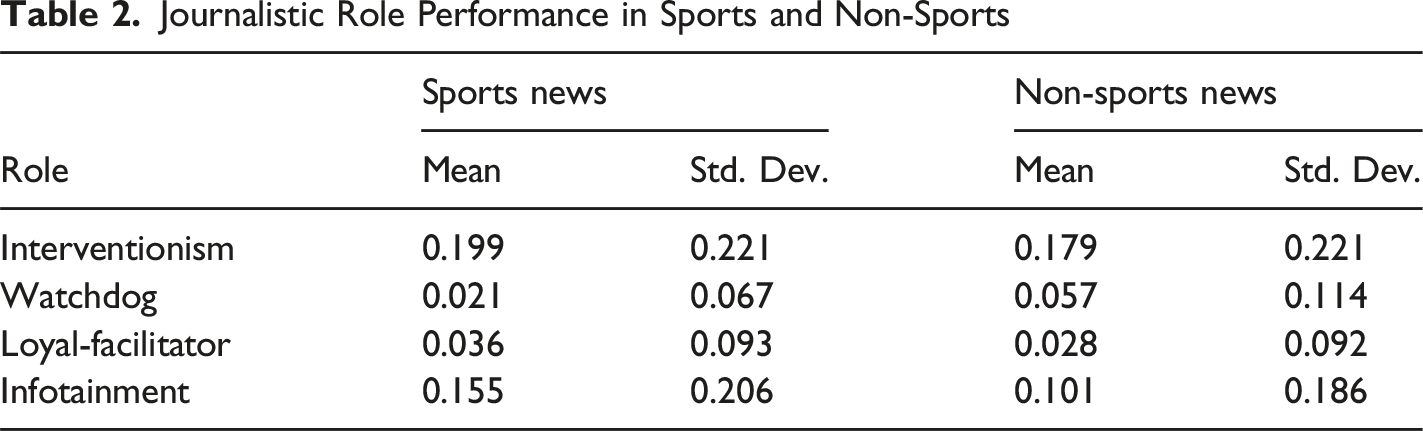
Journalistic Role Performance in Sports and Non-Sports
Selected Indicators of Journalistic Roles in Sports and Non-sports News
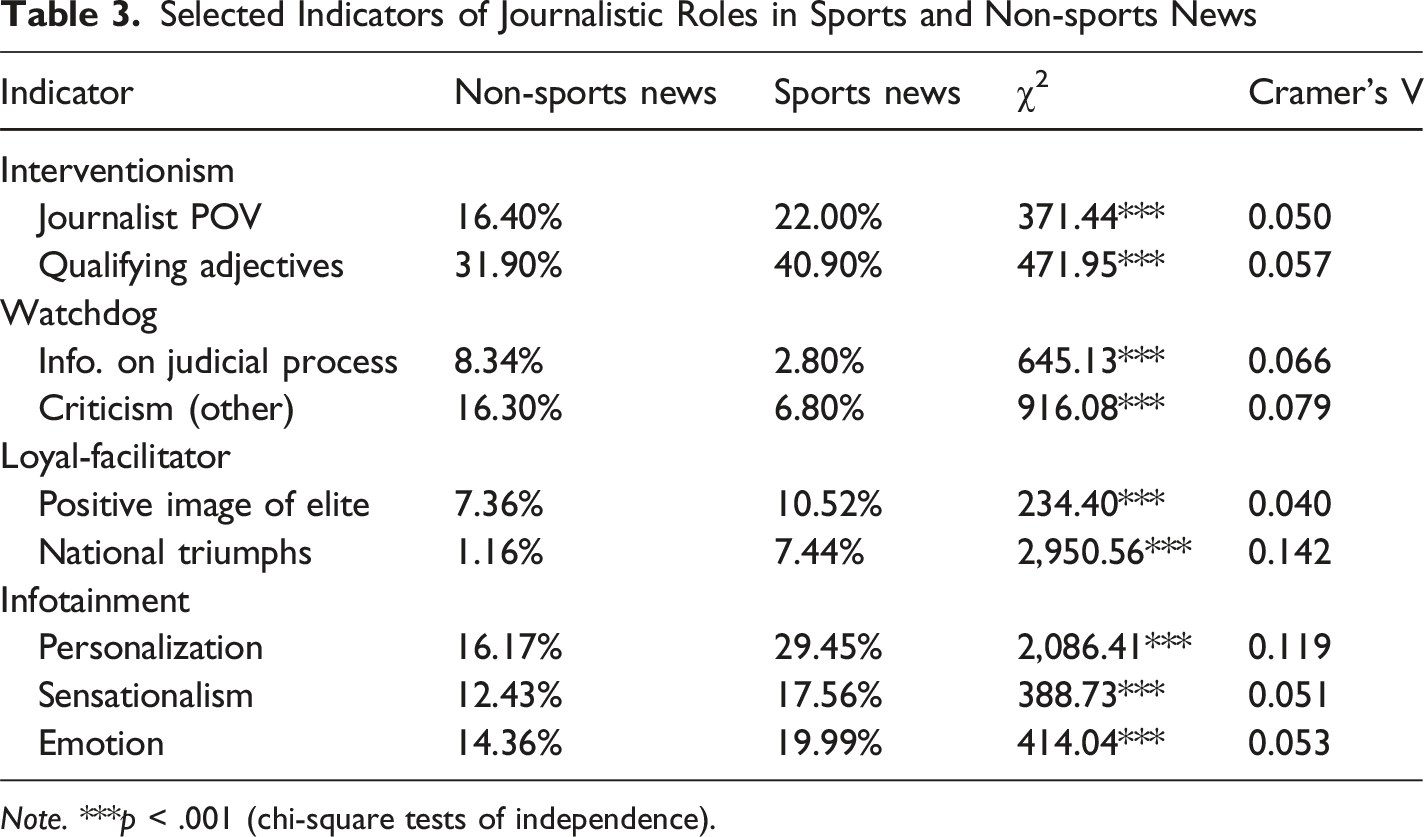
Note. ***p < .001 (chi-square tests of independence).
Levels of watchdog role performance in sports news output are notably weaker, reflecting its lower incidence on sports desks. Third-party criticism, present in 6.8% of sports stories, is the highest watchdog indicator but remains lower than 16.3% in non-sports. Investigative journalism is minimal, found in only 0.25% of sports stories compared to 0.83% in non-sports news, while coverage of external investigations is at 0.67% versus 3.27%. Sports journalists are more likely than other journalists to act as loyal-facilitators, though this role is still rarely invoked. Positive image of the elite (including athletes, coaches, sports teams and governing bodies) is the most common indicator but the one with the smallest effect size, followed by national triumphs, which, in contrast, showed the largest effect size among all role indicators, suggesting that the newsbeat focusing on national victories is the most particularist feature of the toy department. Interestingly, other patriotic indicators expected in sports coverage show minimal differences, including national progress/success (2% for sport vs. 3.05% for other topics), comparison to other countries (1.44% vs. 1.41%), promotion of the country (2.57% vs. 2.66%), and patriotism (1.26% vs. 0.83%), suggesting boosterism is the least prominent feature of sports news.
Sport Beat Stability Across Different Contexts
Journalistic Role Performance in Sports News. Variation Across National Contexts

Sports news in Western democracies (the UK, Switzerland, and Estonia) is slightly more critical than in top-down, less democratic countries like Cuba and Egypt. The United Arab Emirates exhibits the highest levels of loyal-facilitator, while Hungary and the United States score the lowest.
National differences are primarily found in the two most correlated roles: interventionism and infotainment (r = .300, p < .001). Both show higher standard deviations and variance: 13% for interventionism and 11% for infotainment, indicating that specific national factors influence these roles without clear patterns. A heterogeneous group—Germany, Israel, Cuba, Switzerland, Poland, and Venezuela—demonstrates a stronger interventionist role, with 14 countries above the global mean. Conversely, Australia, Serbia, and Rwanda rank the lowest, with 16 others below the international mean. Germany leads significantly in infotainment, followed by Chile and Argentina, while it is nearly absent in Ireland and Lebanon. Ultimately, only 12 countries surpassed the global average of infotainment, with no discernible geographical or media system pattern.
Predictors of Journalistic Roles in Sports News
Multilevel Regressions of Individual, Organizational, and Societal-Level Variables on Journalistic Role Performance in Sports News (Estimates of Fixed Effects)

Baseline variables: Platform: print; ownership: public service; size: large; convergence level: no-integration.
For the watchdog role model, only greater source usage (b = .041, p ≤ .001) was a positive predictor, while other non-significant factors suggest relations to the role that align with the hypotheses.
The loyal-facilitator role model identified five significant predictors, four of which were negative. Higher newsroom convergence (fully integrated b = −.076, p ≤ .001; cross-media b = −.070, p ≤ .05) reduced loyalty/boosterism, as did COVID-related content (b = −.061, p ≤ .001), but higher governmental support during COVID (b = −.016, p ≤ .001) reduces loyalty. Conversely, greater democratic backsliding increases it (b = .030, p ≤ .001).
Lastly, the infotainment role model was shaped by seven mostly negative, statistically significant factors. Radio (b = −0.175, p ≤ .001) had the lowest infotainment levels compared to print news. COVID-related content (b = −0.93, p ≤ .001), higher pandemic support to people (b = −0.45, p ≤ .001), and a story’s domestic focus (b = −.029, p ≤ .001) decreased infotainment. Positive predictors included corporate ownership (b = .139, p ≤ .001), lower corruption (b = .062, p ≤ .05), and more sources (b = .048, p ≤ .001).
Discussion and Conclusion
While the “toy department” thesis is a long-standing conceptual trope, our study provides the first multi-language empirical evidence that transforms this trope into a statistically verified global subculture. The significance of our findings lies not just in the confirmation of stability, but in the granularity of its nuances. By identifying specific structural drivers such as corporate ownership and newsroom convergence, this research moves the debate from ‘what’ sports journalism is to ‘why’ it remains so resilient. We suggest that the beat’s particularism is not a result of professional failure, but a conscious, self-regulating response to market imperatives that persists even under the extreme ‘stress test’ of a global pandemic.
In answering the ‘what’ question first, our results strongly support the existence of a stable and relatively homogeneous global sports newsbeat aligned with a particularistic “toy department” ethos. Findings confirm H1: sports news shows significantly higher levels of interventionism and infotainment, along with a slightly elevated loyal-facilitator role, compared to non-sports news, while the watchdog role in sports journalism is considerably lower.
Notably, interventionism dominates sports news coverage, particularly evident in the use of qualifying adjectives and journalists’ viewpoints. This reinforces the image of sports journalists as active agents who prioritize opinion and interpretation over strict objectivity, echoing criticism of them as “fans with typewriters” or “cheerleaders” (English, 2017; McEnnis, 2017). However, the marginal difference in interpretation compared to non-sports news suggests that analytical depth (or lack of) is not a unique trait of sports.
Infotainment is also pervasive, evidenced by high levels of personalization, emotion, and sensationalism. Together, these finding suggest the sports beat is defined by a unique ‘interventionist-infotainment’ nexus where analytical depth is not absent, but is instead repurposed toward dramatic, personality-driven narratives. While the prevalence of infotainment in sports news may seem intuitive given the nature of the beat, its striking cross-national stability across 36 highly diverse political and media systems—ranging from advanced democracies like Switzerland to restricted environments like Cuba—represents a rare and significant finding in comparative research, where role performance typically varies across national contexts and newsbeats (Mellado et al., 2024a, 2024b).
The suspected weak performance of the watchdog role is confirmed globally. This finding suggests that despite some high-profile examples of investigative and watchdog journalism (Cassidy, 2017; Daoudi et al., 2026; Denham, 2019; Márquez-Ramírez & Rojas-Torrijos, 2017), when everyday sports news is systematically analysed over time, critical scrutiny and accountability functions are markedly less pronounced in sports journalism than other topics. This underscores the gap between some journalists stated self-conceptions (English, 2017; Ferrucci & Figueroa, 2025; Reed, 2020) and their actual practices concerning power scrutiny.
While sports journalists rarely invoke the watchdog role, they are not merely cheerleaders for sporting elites – an important nuance to the “toy department” thesis. While the “boosterist”, loyal-facilitator role is higher in sports than in non-sports news, it is more moderate than anticipated, given the commercial (Rowe, 2017) and nationalistic (Kim, 2024; Pullen et al., 2020) imperatives that seemingly drive it, alongside asymmetrical power relationships with sporting elites (Latififard et al., 2024; Suggs, 2016). Lower levels of patriotic indicators suggest that “boosterism” manifests more as uncritical support for elite figures than as generalized national promotion or patriotism. However, given that there were significant periods in 2020 without international sporting competitions, we should exercise caution before generalizing this finding.
While the first part of our study contributes new empirical evidence to a well-established debate in sports journalism (the ‘what’ of the “toy department” thesis), the second explores new ground by examining the extent to which role performance in sports news remains stable across socio-political and organizational contexts (RQ2), shedding light on the ‘why’ of its resilience. With respect to national variations, while our model accounts for varying levels of national sporting success and geopolitical influence through the World Sports Power Index, the findings reveal that the core features of the “toy department” — weak watchdog performance and moderate loyalty — are remarkably stable and homogeneous across national contexts. While democratic nations with greater press freedom exhibit slightly stronger watchdog performance than those with restricted media environments, these national differences are insignificant in the grand scheme of things. Stability is slightly challenged in the interventionist and infotainment roles, which show greater variability across countries. This suggests that while the drive to interpret and entertain is intrinsic to sports news, its intensity is modulated by national journalistic cultures and local specifics which future research should explore. Still, such variations operate within the established boundaries of the “toy department” ethos, without fundamentally altering its core, since both roles vary much more across other non-sports beats (Mellado et al., 2024b).
We also examined factors influencing role performance at the societal, organizational, and story levels. Overall, low regression coefficients indicate that these factors exert a moderate influence on stability, supporting sports journalism’s particularism and resilience. Nevertheless, there are nuances to this.
In the interventionism model, H2 is partially refuted. Contrary to accounts that attribute growing interpretive tendencies primarily to the digital transformation of sports journalism (Daum & Scherer, 2018; Horky et al., 2025), none of the TV, online platforms, or newsroom convergence were significant positive predictors. Instead, newspapers emerged as the most opinionated outlets, aligning with studies that associate legacy print journalism with analytical depth, informed commentary, and professional prestige (English, 2016; Ferrucci & Figueroa, 2025; Hardin & Ash, 2011; Tulloch & Ramon, 2017). Importantly, greater government support during COVID-19 and pandemic-related content were negative predictors, indicating that interpretation diminishes during a volatile crisis — even in relatively safe conditions — favoring factual reporting or the ‘sticks to sports’ mantra (Burroughs et al., 2023). Conversely, a higher number of sources correlating with increased interventionism may indicate that richer information can sometimes foster commentary rather than just rumor or controversy. This extends previous literature by indicating that interventionism is a complex role that can both diminish and promote quality journalism in sports news (see Ferrucci & Figueroa, 2025).
For the watchdog model, H4 is partially supported. The strongest positive predictor is greater source usage, underscoring that accountability journalism depends on the resource-intensive process of information gathering (Broussard, 2020; Ferrucci, 2022; Horky et al., 2025). Notably, variables such as democratic backsliding, corruption levels, newsroom size, convergence, codified rules, and public service ownership were not statistically significant predictors, even though they were positively associated with the watchdog role in the regression model. This pattern challenges assumptions that structural or organizational advantages alone necessarily foster greater scrutiny (Broussard, 2020; Daoudi et al., 2026; Márquez-Ramírez & Rojas-Torrijos, 2017). Instead, the findings suggest that the enduring weakness of the watchdog role stems from ingrained professional subcultures within sports journalism—where close ties to sources, commercial interests, and the “stick to sports” ethos limit adversarial reporting (Burroughs et al., 2023; Grimmer, 2017; Suggs, 2016).
The loyal-facilitator model was also partially corroborated. In H3, increased pandemic backsliding — marked by reduced democratic quality and press freedom — was associated with stronger loyalism, confirming that a constrained press environment fosters uncritical collaboration with elites (Pajnik & Hrženjak, 2024). At the same time, a good governmental response to the pandemic was associated with reduced loyalty, confirming that sports boosterism is not necessarily aligned with the type of political support for or approval of government policies found in other newsbeats. At the organizational level, greater newsroom convergence significantly reduced loyalty/boosterism. This suggests that integrating sports desks into larger news operations introduces a broader, more professional logic, which can mitigate localism and cheerleading often found in isolated sports departments. This finding challenges accounts framing convergence primarily as a cost-cutting or ‘deprofessionalizing’ process (Daum & Scherer, 2018) and instead aligns with evidence that codified ethical rules and editorial oversight in larger outlets discourage boosterism (Hardin et al., 2009; Ramón & Rojas-Torrijos, 2018).
Lastly, this study moves beyond simply confirming the existence of infotainment to identifying its structural drivers through multilevel analysis, which demonstrates that the role is propelled by corporate ownership and market-driven audience demand as our hypothesis (H5) is partially corroborated. Commercial interests shape entertainment-oriented narratives amongst those who typically hold sports broadcasting rights for national and international events (Rees et al., 2018; Kunert & Kuni, 2023), given that domestic content showed less infotainment. Surprisingly, greater sourcing was a positive predictor of infotainment, confirming that this role and in-depth reporting can coexist (Tulloch & Ramon, 2017). Among platforms, radio registers the lowest levels of infotainment, reflecting its informational tone and limited visual affordances compared with television and digital formats (Pullen et al., 2020; Reed & Forbes, 2024). Finally, infotainment was higher in contexts of lower corruption and lower governmental support for citizens during the pandemic. This pattern suggests that infotainment thrives less under political control than within competitive, market-driven systems where audience demand and commercial logic drive the fusion of news and entertainment (Rowe, 2017), especially when the dramatic effects of health crises are more apparent. These results complexify the ‘toy department’ stereotype by showing that infotainment can actually coexist with in-depth reporting, as evidenced by more frequent sourcing positively predicting infotainment levels. These findings suggest that infotainment might be a conscious strategy used by legacy media to provide human-interest context, rather than a mere trivialization of the beat.
Together, this research provides robust cross-national evidence of the universality of the “toy department” phenomenon within and beyond Western contexts, suggesting sport journalism is a relatively stable, self-regulating subculture within news organizations. Its core identity — high interventionism and infotainment, coupled with relatively high loyalty, and decisively low watchdog scrutiny — has proven resilient amid societal, political, and organizational pressures. National journalistic cultures often exert a strong ‘country effect’ on role performance, where societal factors like press freedom or political systems shift the baseline for all journalists in a given nation (Mellado et al., 2024b). In fact, previous analyses of newsbeat fluidity demonstrate that while beats like health or culture often pivot to behave like ‘hard news’ during crises (Mellado et al., 2024a), sports journalism maintains a highly stable and distinctive profile. This confirms that the “toy department” is not merely a byproduct of specific national traditions, but more of a global ‘community of practice’ whose internal routines and commercial logic often override the broader professional norms of the country in which it is practiced. It is worth emphasizing here, how unusual such universal patterns are in comparative journalism research, a field in which cross-national variation typically resists simple typologies or global models of practice.
There are, however, three broader questions that our study cannot resolve. The first is how generalizable the findings are considering the context of the COVID-19 pandemic, which affected sport throughout the world during 2020. Our coding accounted for whether sports stories were explicitly about the pandemic, finding that COVID-related stories significantly decreased infotainment, loyal-facilitator and interventionist roles (with watchdog unaffected), which mirror some of the findings of studies across all news topics (Hallin et al., 2023). But only a longitudinal lens would tell us whether our 2020 findings produce outcomes comparable to more ‘typical’ sporting years.
Second, our sample was designed to best represent the media system of each sampled country across TV, radio, press and online news, whose inclusion criteria inherently leans towards more mainstream and legacy media outlets. However, digital media has significantly altered the sports media landscape, introducing a hybridization of platforms and actors that complicates traditional media system models. Sports journalism now operates within a networked media sport environment where professional boundaries are increasingly porous, challenged by peripheral non-journalistic actors—such as fan influencers, athletes, and bloggers—some of whome reach far bigger audiences than those in the traditional mainstream. This prompts a rethinking of the beat, as traditional practitioners must navigate a space where the distinction between professional reporting and fan-centric content is increasingly blurred (Maares & Hanusch, 2023; Rojas-Torrijos & Nölleke, 2023). While our study tells an important global story about the “toy department” ethos in mainstream and generalist news outlets, future research should pay attention to what constitutes the ‘peripheral’ and ‘mainstream’ itself in sports media.
Finally, as media systems are increasingly hybrid, sports journalism may reflect a broader normative conflict between traditional beat-based routines and issue-oriented approaches that address the intersection of sports with social and political crises. Researchers should also explore the normative conflict between the traditional ‘stick-to-sports’ model—which focuses on events and results—and the emerging ‘issue-based approach’ that may intersect with politics and social justice. Our study did not sufficiently explore that avenue as it focused on general news outlets where these two models may coexist or clash, hence further investigation should determine how this tension influences role performance differently across legacy sports desks versus specialized, issue-driven platforms. This would also allow us to assess whether the toy department ethos arises from being part of a larger newsroom or is an inherent feature of all sports journalism.
Supplemental Material
Supplemental Material - Journalistic Role Performance in Global Sports News: Comparing the Stability and Scope of the “Toy Department” Thesis in 36 Countries
Supplemental Material for Journalistic Role Performance in Global Sports News: Comparing the Stability and Scope of the “Toy Department” Thesis in 36 Countries by Mireya Márquez-Ramírez, Daniel Jackson, Claudia Mellado, David Nolan, Jamie Matthews, Fergal Quinn, Xin Zhao in Communication & Sport
Footnotes
Acknowledgments
The authors wish to thank all the coders from the participating countries.
ORCID iDs

Funding
The authors disclosed receipt of the following financial support for the research, authorship, and/or publication of this article: This work was supported by the Conselho Nacional de Desenvolvimento Cientifico e Tecnologico (CNPq), Brazil; 422609/2021-8 and 316093/2021-1, National Research Development and Research Office, Hungary; No. 131990, Spanish Ministry of Economy, Industry, and Competitiveness; CSO2017-82816-P, 10.13039/501100007776; Chile’s National Fund for Scientific and Technological Development (FONDECYT No. 1220698); Pontificia Universidad Catolica de Valparaiso, Chile; VCU College of Humanities and Sciences; SEED Award, Universidad Iberoamericana Mexico City; Excepcional Standard Grant 2019-2022, Northwestern University in Qatar; Institute of Applied Media Studies (IAM), Zurich University of Applied Studies; Mitacs, Centre d’études sur les médias, the Journalism Research Centre at Toronto Metropolitan University, the Creative School at Toronto Metropolitan University, and Toronto Metropolitan University in Canada.
Declaration of Conflicting Interests
The authors declared no potential conflicts of interest with respect to the research, authorship, and/or publication of this article.
Supplemental Material
Supplemental material for this article is available online.