




Abstract
Political satire has emerged as a hybrid genre that combines entertainment, information, and critique. While its societal relevance is well established in U.S. contexts, comparative research across cultural settings remains limited. This study examines the communicative functions and journalistic role performance (JRP) of weekly news satire across three countries: the United States (Last Week Tonight), Germany (ZDF Magazin Royale), and Austria (Gute Nacht Österreich). Drawing on the concepts of discursive integration and journalistic role performance in satire, the paper employs a Large Language Model-Assisted Content Analysis (LACA) approach to code 6356 sentences across 30 segments. Results show that while all programmes share a core reliance on the “comedic interlocutor” role and hybrid communicative strategies, significant cross-national differences emerge. U.S. satire exhibits stronger civic educator traits, German satire performs a pronounced watchdog function, and Austrian satire leans toward informative delivery with fewer evaluative or activist tones. These findings suggest the importance of media-systemic context in shaping satire’s journalistic behavior. The study also demonstrates the viability of LLM-assisted content analysis in journalism and communication research.
Keywords
Introduction
Political satire has evolved into a significant form of journalistic communication, bridging entertainment and public discourse (Baym and Jones, 2012; Becker, 2020; Becker and Bode, 2018). This evolution occured within the broader context of journalism’s legitimacy crisis, characterized by declining public trust, widespread news avoidance, and challenges to traditional journalism’s authority (de Bruin et al., 2025; Gao et al., 2025; Skovsgaard and Andersen, 2020). As traditional news media grapple with these challenges, satirical news formats have emerged not merely as entertainment alternatives, but as a potent response to journalism’s struggle to maintain relevance and credibility in contemporary media landscapes (Djerf-Pierre and Ekström, 2025), demonstrating their capacity to blur traditional genre boundaries by combining humour, information, and political commentary (Baym, 2005; Burgers and Brugman, 2022; Gao et al., 2025; Nicolaï and Maeseele, 2024). This hybridity raises important questions about their communicative functions – the underlying aim of a given act of speech – and their journalistic role performance – the presence of archetypical journalistic ideals in real-world news broadcasting – particularly as satirical formats find increasing success across different cultural contexts (Baym and Jeffrey, 2013; Boukes et al., 2022, 2024). Utilizing pre-existing codebooks for journalistic role performance (Ödmark and Nicolaï, 2024) and a newly developed framework for communicative functions based on Baym’s typology (Baym, 2005) while employing an LLM-Assisted Content Analysis (LACA) approach (Chew et al., 2023), this study comparatively examines weekly news satire from three cultural contexts – the United States (Last Week Tonight with John Oliver), Germany (ZDF Magazin Royale), and Austria (Gute Nacht Österreich) – aiming to answer the following research question: How do the communicative functions (CF) and journalistic role performances (JRP) in weekly political satire differ across cultural contexts?
This research intersects with ongoing debates in the field of journalism studies about truth construction and professional authority (Gao et al., 2025; Mellado and Mothes, 2025). Satirical news formats challenge journalistic conventions by openly embracing subjectivity and advocacy while fulfilling core journalistic functions (Ödmark and Nicolaï, 2024). As the profession seeks alternative approaches to maintain public engagement and fulfil journalism’s normative democratic functions (Djerf-Pierre and Ekström, 2025), understanding how news satire both performs journalistic and entertainment functions across cultural contexts becomes crucial. This paper aims to mitigate the lack of comparative literature on the topic (Boukes et al., 2024; Lichtenstein and Nitsch, 2023), since it remains unclear to what extent U.S. weekly news satire findings translate across cultural contexts (Boukes et al., 2024; Feldman, 2024). Early comparative work by Baym and Jeffrey (2013) compiled international case studies (Day and Thompson, 2013; Kleinen-von Königslöw and Keel, 2012) but lacked cross-cutting analysis. Since, initial cross-cultural research has examined online engagement with satire (Boukes et al., 2022; Boukes and Hameleers, 2020), framing and journalistic role performance (Ödmark, 2021, 2023; Ödmark and Nicolaï, 2024), and production contexts (Garcia-Navarro, 2024; Koivukoski and Ödmark, 2020; Lichtenstein et al., 2021; Rainer, 2022). Analyses show that (Dutch) satire can hold politicians to account (Boukes and Hameleers, 2020) and boost engagement on social media (Boukes et al., 2022). A comparative analysis of Nordic news satire found that it performs strong advocate, watchdog, and civic-informer roles (Nicolaï, 2023; Ödmark, 2021; Ödmark and Nicolaï, 2024). Thus, while initial findings suggest news satire transcends cultural contexts, exhibiting significant programme-specific variation in the blend of humour, information and opinion to perform its journalistic roles (Ödmark and Nicolaï, 2024), further research is needed to enhance the field’s understanding of the cross-cultural dynamics of political satire.
Literature review
Terminology and literature overview
Before proceeding, note that terms such as news parody (Leicht, 2023), news satire (Holm, 2023), and political comedy (Becker, 2011) are often used interchangeably, despite subtle distinctions that have shifted since the flourishing of literature on the topic in the early 2000s (Baum, 2002; Niven et al., 2003). Even within televised political satire, terminology remains inconsistent (Boukes et al., 2024). For clarity, this paper uses political satire while acknowledging criticisms of its implicit moral stance (Holm, 2023). The focus herein lies on weekly comedy programmes decoupled from daily news cycles, offering in-depth analyses of less well-covered issues (Droog and Burgers, 2023: 287). More precisely, these programmes fit the label “weekly news satire” (Ödmark and Nicolaï, 2024), or “investigative comedy” (Nicolai et al., 2022), as all three cases draw on investigative journalistic practices in style and substance.
In the literature, political satire’s role within journalism is debated across five key dimensions. First, journalistic practice: Nicolaï (2023) shows satirical programmes navigate an “ongoing definitional negotiation” between journalistic and comedic roles, evidenced by collaborative editing and fact-checking practices (Nicolaï and Maeseele, 2024). Similar structures appear in Nordic, German, and Anglo-American weekly news satire (Garcia-Navarro, 2024; Koivukoski and Ödmark, 2020; Lichtenstein et al., 2021; Rainer, 2022). This reflects the format’s “investigative comedy” model (Boukes et al., 2024), wherein humour is paired with journalistic values of scrutiny, documentation, and civic responsibility. Second, authority- and truth-construction. Gao et al. (2025) identify three key components of “discourse truth” in traditional journalism: authenticity (constructed through evidential markers like quotations and data), neutrality (signaled via third-party attribution and tentative language), and authority (established through institutional affiliations or personalization). Satirical news programmes often retain journalistic conventions such as source citation and evidential references – in an effort to base their humour on factual information (Garcia-Navarro, 2024) – allowing satire to maintain a semblance of authenticity and authority while suspending claims to objectivity under the guise of “comedic licence” (Nicolai et al., 2022: 2065). This enables more freely voiced critique, increased displays of emotionality, and the consideration of taboo or underreported topics (Davisson et al., 2019; Gehrke, 2024; Kraxberger and Prakken, 2025; Meier and Berg, 2024; Nicolai et al., 2022). Third, satire’s agenda setting capacity. Research demonstrates satire’s capacity to raise issue salience (Boukes, 2019; Meier and Berg, 2024) and engage in attribute agenda setting by reframing existing issues through emotional and personal dimensions (Ödmark, 2021). Fourth, as trust in legacy media declines and news avoidance rises (Skovsgaard and Andersen, 2020), news satire may serve as a re-entry point (Becker, 2024), offering both hedonic and eudaimonic satsfaction. This fosters the “gateway effect” (Xenos and Becker, 2009), wherein satirical content can lead to sustained news engagement. Fifth, audience evaluations reveal satire’s epistemic ambiguity: consumed as entertainment, it nonetheless informs and persuades (Becker, 2011; Boukes et al., 2024), though persuasive impact is often impressionistic rather than recall-based (Becker, 2022b). Furthermore, political alignment and age may mediate credibility, with left-leaning audiences being more receptive (Becker, 2023; LaMarre et al., 2009). Arguably, Satire’s embrace of subjectivity mirrors broader audience preference shifts toward interpretive, affective news (Kraxberger and Prakken, 2025; Newman and Gallo, 2019; Wojcieszak et al., 2024; Ödmark, 2021). Thus, political satire constitutes an extension of traditional journalism (Ödmark and Nicolaï, 2024), rather than a genuine alternative.
Communicative functions and journalistic role performance in weekly news satire
This paper makes use of two key theoretical concepts. First, communicative functions (Baym, 2005). Political satire is aptly described as “a hybrid blend of comedy, news, and political conversation” (Baym, 2005: 259). Consequently, Baym (2005) identified three core communicative functions (CFs) of satire: humour, explanation/education, and critique/evaluation, whose alternation he termed “discursive integration.” While entertainment is the primary intent, i.e. humour serves as the “hook” that “assembles the audience” (Baym, 2005: 273), the format’s hybrid nature enables information and critique to be delivered alongside mirth (Becker and Goldberg, 2017; Boukes et al., 2024; Kraxberger and Prakken, 2025).
This study applies Baym’s framework to international satire, assuming each sentence primarily fulfills one of the three communicative functions. To capture frequent overlap of humour with fact or opinion, a fourth Complex category is added, covering cases where factual or evaluative elements are mixed or they are integrated into the joke (Brugman et al., 2021; Droog and Burgers, 2023). This operationalization enables easier cross-lingual comparison via large-language-model assisted content analysis (Chew et al., 2023). The underlying assumption of political satire as a hybrid form of media extends to non-anglophone programmes – though this assumption has not been rigorously tested. Initial findings suggest that while the hybrid nature of news satire generally persists across cultural and programme contexts (Droog and Burgers, 2023; Droog et al., 2020; Ödmark and Nicolaï, 2024) there exist significant differences in the blend of communicative functions across cultural contexts (H1a).
Second, journalistic role performance. A key debate in the literature is the extent to which satirical news programmes function as journalistic entities – despite satirists’ insistence that they are not journalists (Baym, 2005; Boukes et al., 2024). Early work found similar informational content between traditional and satirical news (Becker and Bode, 2018; Fox et al., 2007). More recent research applies journalistic role performance (JRP) theory (Mellado and Lagos, 2014) to satire (Ödmark and Nicolaï, 2024), categorizing observable journalistic ideals across three axes: (a) stance toward power – Watchdog versus Loyalist; (b) presence of satirist’s voice – Advocate versus Reporter; and (c) approach to serving the audience – Comedic Interlocutor versus Civic Educator. Satire typically favours watchdog scrutiny over loyalist roles and skews toward advocacy (Kraxberger and Prakken, 2025; Ödmark and Nicolaï, 2024). The “Comedic Interlocutor” role includes ridicule, metaphor, and fourth-wall-breaking, making it particularly genre-typical (Ödmark and Nicolaï, 2024).
As outlined above, initial evidence suggests media environments shape satirical role performance, occupying a space as oppositional or alternative news due to sensational or partisan news contexts and a long tradition of oppositional journalism (Hallin, 1984), while German and Austrian public broadcasters may preserve clearer information-entertainment divisions (Lichtenstein et al., 2021). However, available literature suggests no significant differences in role performance distribution across cultural contexts (H1b), with the dominant role being comedic interlocutor (H1c) and the loyalist role being least prominent (H1d) (Ödmark and Nicolaï, 2024).
Data & methodology
Case selection and data collection
The dataset includes the programmes Last Week Tonight with John Oliver (LWT), Germany’s ZDF Magazin Royal (ZMR) and Austria’s Gute Nacht Österreich (GNÖ). Three factors informed the case selection. First, comparability across programmes: all provide weekly in-depth satirical analyses of less mainstream topics (Boukes et al., 2024; Davisson et al., 2019) and are comparable in respective reach and genre relevance (Ehrenberg, 2020; Fidler, 2020; Müller, 2025). On YouTube (LWT: 10.1M subscribers, 8M average views per video; ZMR: 1.45M subscribers, 1.23M average views; GNÖ: 65,000 subscribers, 52,000 average views), their average video viewership represents 2.4%, 1.4%, and 0.58% of respective national populations. The programmes are also similar in their satirical impact, as evidenced by documented media controversies, with all three featuring dedicated “Controversies” sections on Wikipedia.1,2, 3 A review of recent media coverage concerning each programme also suggests outsized cultural, journalistic and political relevance (Fidler, 2020; Preach, 2025; Rottmann, 2025). In sum, all three are preeminent examples of weekly news satire (Ödmark and Nicolaï, 2024) in their respective media markets and as such inherently comparable.
Second, the German and Austrian cases address the dominance of U.S. examples in Late-Night research and the lack of German-language satirical news programme analysis (Kleinen-von Königslöw and Keel, 2012; Sitz, 2021). Finally, the case selection spans diverse media systems and political cultures, lending credence to a comparative approach. In terms of media systems, Hallin and Mancini (2004) classify the U.S. as a liberal media model, Germany as democratic corporatist, and Austria as formally democratic corporatist but trending toward polarized pluralist (Bleyer-Simon et al., 2024; Blum, 2005; Hayek, 2024). These differences manifest in public broadcasting strength, press freedom and media trust levels (Newman et al., 2024; Reuters Digital News Report, 2024; Steindl et al., 2024). This is evident in the traditional ratings metrics for the three programmes, which reveal that both European programmes achieve approximately 20% market share in key demographics, whereas LWT averages 0.11–0.3 ratings in the 18–49 demographic, reflecting the U.S. media system’s fragmentation.4,5, 6 The cases also represent distinct political cultures: the U.S. emphasizes individual civic responsibility and valorises protest (Fitzgerald et al., 2021; Hook and Markus, 2020), while Germany and Austria favour institutionalized, consensus-oriented engagement (D’Amato and Schwenken, 2018; Filzmaier, 2002).
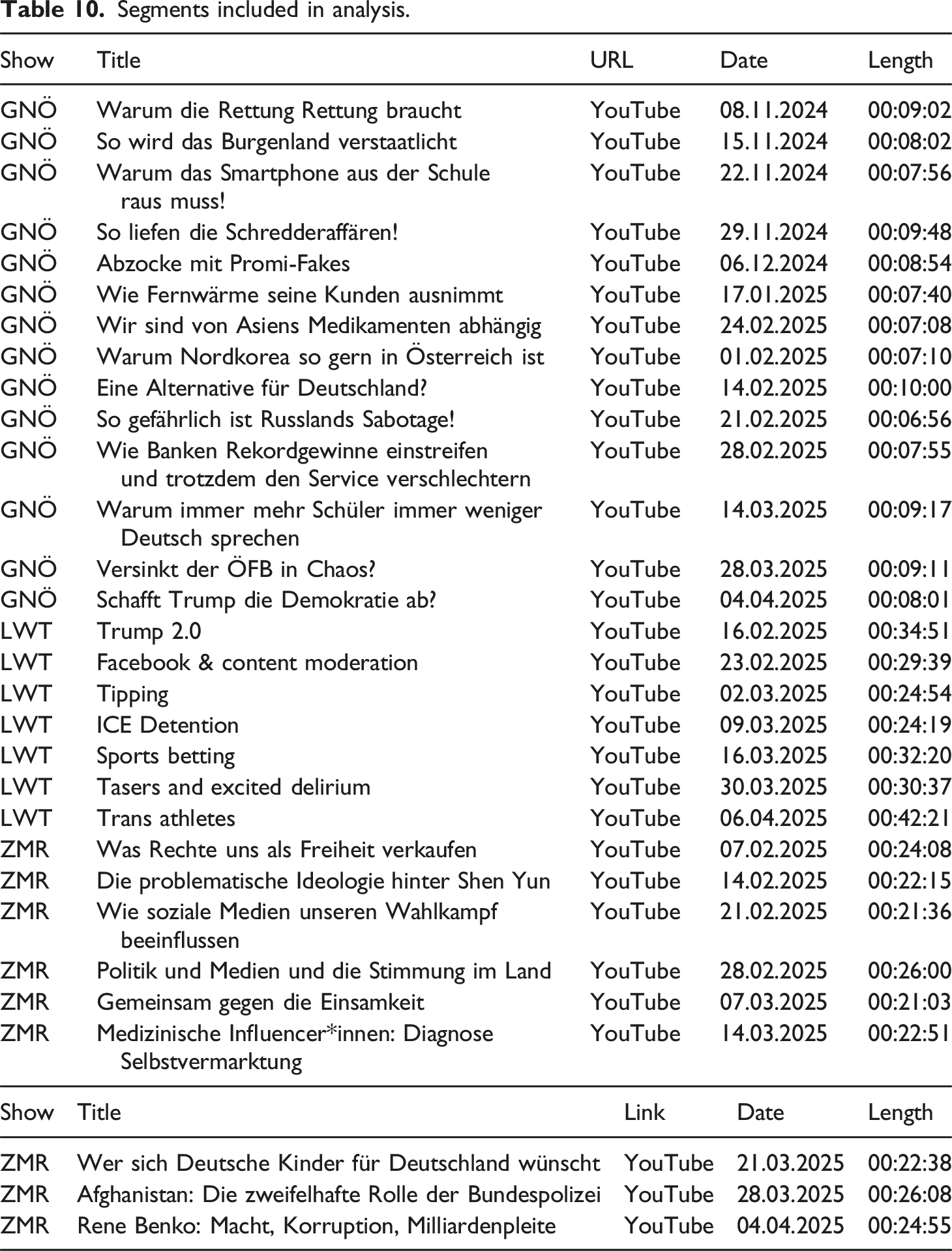
Only main segments were analysed – sections concerned with in-depth analysis of one topic (Ödmark and Nicolaï, 2024) – excluding guest appearances, musical performances, or headline recaps. This further increased cross-case-comparability, since all three monologues are remarkably similar in their format and conception. All three are distinct from the rest of the programme, in that they more seriously concern themselves with one topic in-depth, feature the host behind a desk with over-the-shoulder graphics and news clips as visual aids. The German and US programmes frequently employ “investigative comedy” (Nicolai et al., 2022), presenting results from in-house journalistic investigations. Other than the monologue, all three programmes include a short headline-recap at the top of the show, similar in style to SNL’s “Weekend Update.” The German programme additionally stands out by using in-house actors and comedians to sometimes inhabit fictional parody characters for entire separate segments, an approach the Austrian programme has adapted in recent years. Neither programme features celebrity guests on a regular basis.
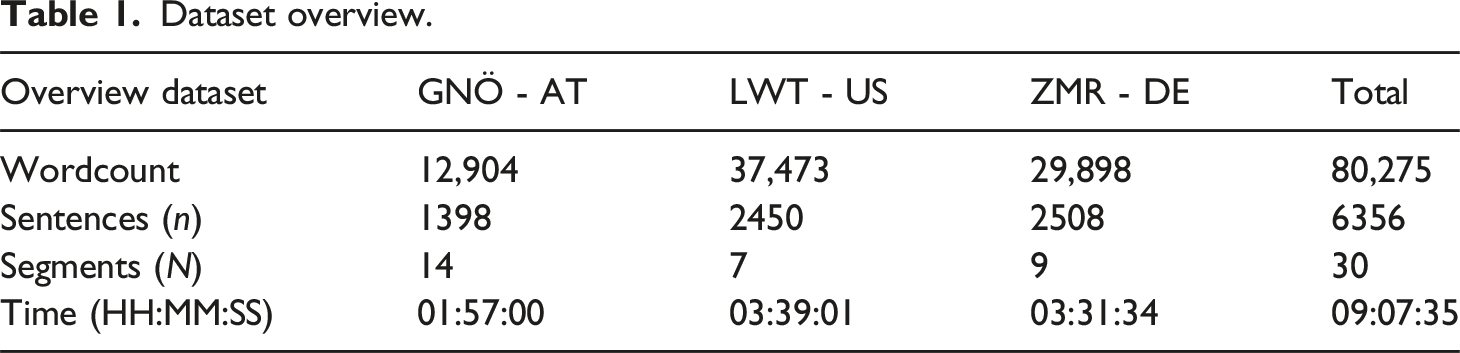
Dataset overview.
Codebook co-creation and initial tests
This study employs the novel Large-Language-Model (LLM) Assisted Content Analysis approach (LACA) outlined by Chew et al. (2023), which involves specially customized LLMs across every step of the quantitative analysis process from creating and refining the codebook to the final data analysis. The process of codebook and LLM-coder creation differed across concepts.
For journalistic role performance, existing codebooks (Ödmark, 2021; Ödmark and Nicolaï, 2024) were used to customize an LLM using OpenAI’s customization options. This involved prompting a customizable AI model (GPT-4o) to act as a qualitative coder based on a thorough read of said codebook, which was provided to the model as a PDF. The LLM was then provided with the transcripts and asked to code variables V4 through V30 from the JRP codebook for each transcript separately.
For the coding of communicative functions, since there is no agreed-upon codebook available, I followed the process outlined by Chew et al. (2023), co-creating a codebook in cooperation with the LLM in a multi-step process which involved first, describing the necessary categories to the LLM, making use of relevant literature as a reference point (Baym, 2005; Droog et al., 2020), beginning with the operationalization as outlined above. Second, a previously human-coded subsample of Late-Night Show transcript data not included in the final dataset was test-coded by the LLM and inter-coder reliability scores were calculated. Differing coding choices were examined and fed back into the LLM, asking the model to update its internal codebook to account for these disparate coding decisions. This process was repeated several times – each time with a different subsample of data – until sufficient levels of inter-coder-reliability were achieved (see below). The finalized codebook for the concept of communicative function can be found in the form of the LLM-internal instructions for the “Communicative Functions LLM” linked in the notes. The calibrated LLM-coder was then tasked with coding the dataset sentence by sentence and output the CF for each sentence separately. To ensure oversight and limit hallucinations, first, both LLMs were prompted to give brief justifications of each coding decision as part of their output, allowing for a human-in-the-loop design and increasing reliability and transparency. Second, to limit hallucinations due to memory overload, no more than 50 sentences were fed into the communicative functions LLM at a time and the output included the respective sentence it was supposed to code as well as the corresponding sentence ID. Taken together, these measures allowed the author insight into and oversight of the LLMs' coding process. The LLM outputs were manually transferred into a spreadsheet. The exact LLMs used for the analysis are publicly available via OpenAI’s custom-GPT programme. 7
LLM-assisted content analysis: inter-coder reliability and LLM coding performance
To evaluate the consistency of automated coding in political comedy analysis, multiple large language models (LLMs) were tested as independent coders. Using the LLM-created codebook, a separate sample of Late Night transcripts’ communicative functions and journalistic role performance – this subsample was not used for the final analysis and comprised around 10% of the final dataset’s scope – were coded by a human coder with expertise in content analysis of political communication and satire research as well as four different LLMs: GPT-4o (customized), Claude 3.7, Gemini 2.0, and DeepSeek.
Inter-coder reliability was measured using Cohen’s Kappa, which is better suited for nominal and binary variables and accounts for agreement occurring by chance, thus pre-empting the criticism that LLMs merely hallucinate their output (Cesario, 2023). Regarding coding of communicative functions, the results showed that the customized LLM using GPT-4o achieved the highest agreement (0.81) with the human coder, followed by Claude 3.7 (0.69), DeepSeek (0.68), and Gemini 2.0 (0.65). These findings indicate that GPT-4o’s coding decisions were the most consistent with expert judgment, exhibiting almost perfect agreement, thus GPT-4o was used as the base model going forward, though it is notable that the remaining models still performed at a substantial to moderate level. To assess the consistency of the LLM-coder, the same set of sentences was coded twice, which, for the highest-performing model (GPT-4o), yielded a Cohen’s Kappa of 0.88, confirming that the LLM applied the coding scheme systematically and consistently over multiple rounds.
The LLM-coder for journalistic role performance, given a representative subset of Late Night transcripts from all three programmes included herein that were previously coded by a human expert, reached a Cohen’s Kappa of 0.85 across segments. Last Week Tonight was coded with perfect agreement, whereas for Austria’s GNÖ, the average Cohen’s Kappa was 0.79. A visual analysis of coding disagreements, however, revealed generally minimal disagreement.
Results
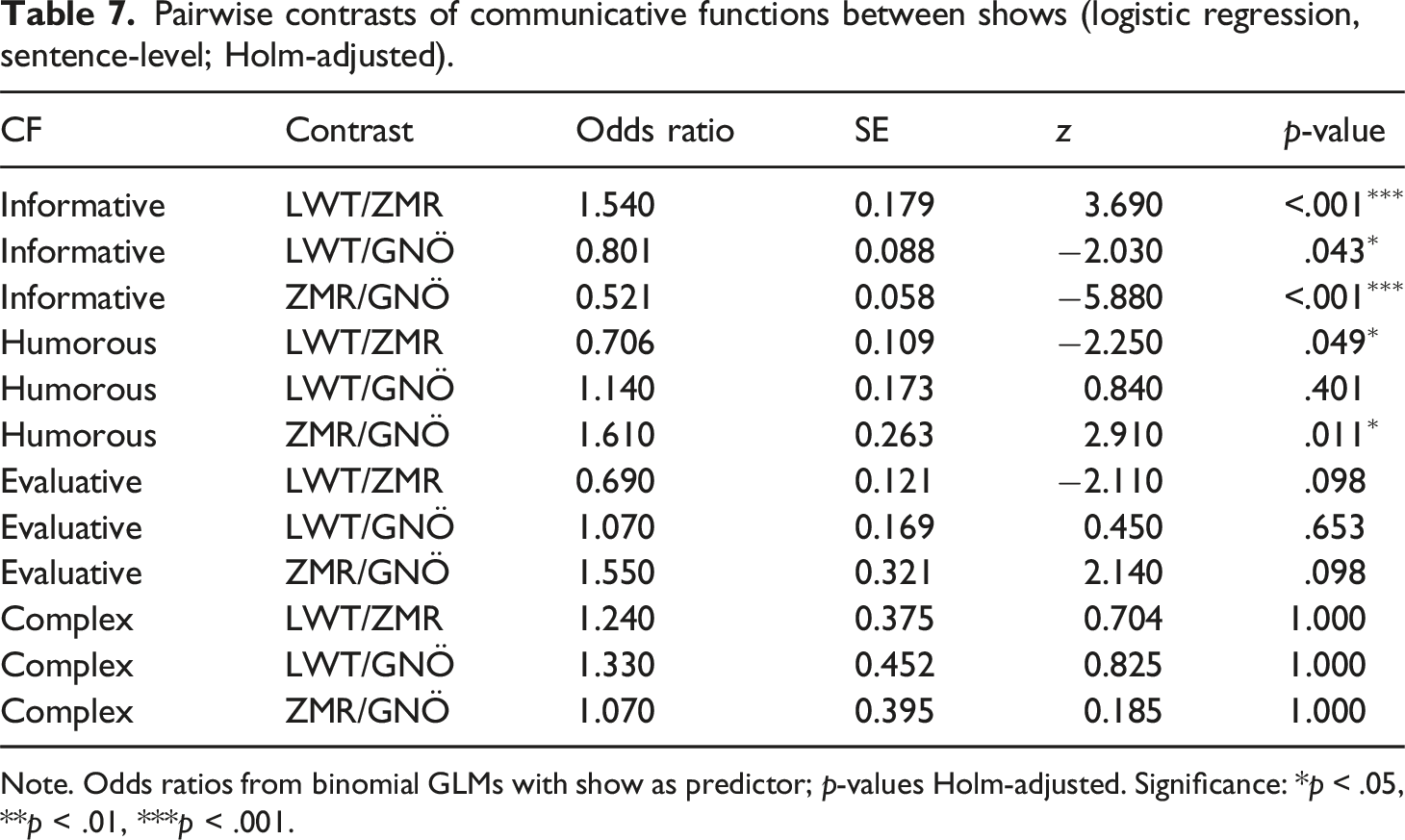
To test H1a, a Pearson’s chi-square test of independence was performed on the sentence level coded distribution of communicative functions (CFs) across satire programmes (see Table 5). The test yielded highly significant results (χ2 = 129.69, df = 6, p < .001), indicating that CF usage varies systematically between shows. A Monte Carlo simulation (10,000 replicates) confirmed the robustness of this result (p = .0001). The strength of association, measured by Cramér’s V = 0.101, indicates a small but consistent effect, suggesting distinct rhetorical profiles for each programme.
Model-based estimated marginal means for communicative functions (logistic regression, sentence-level).
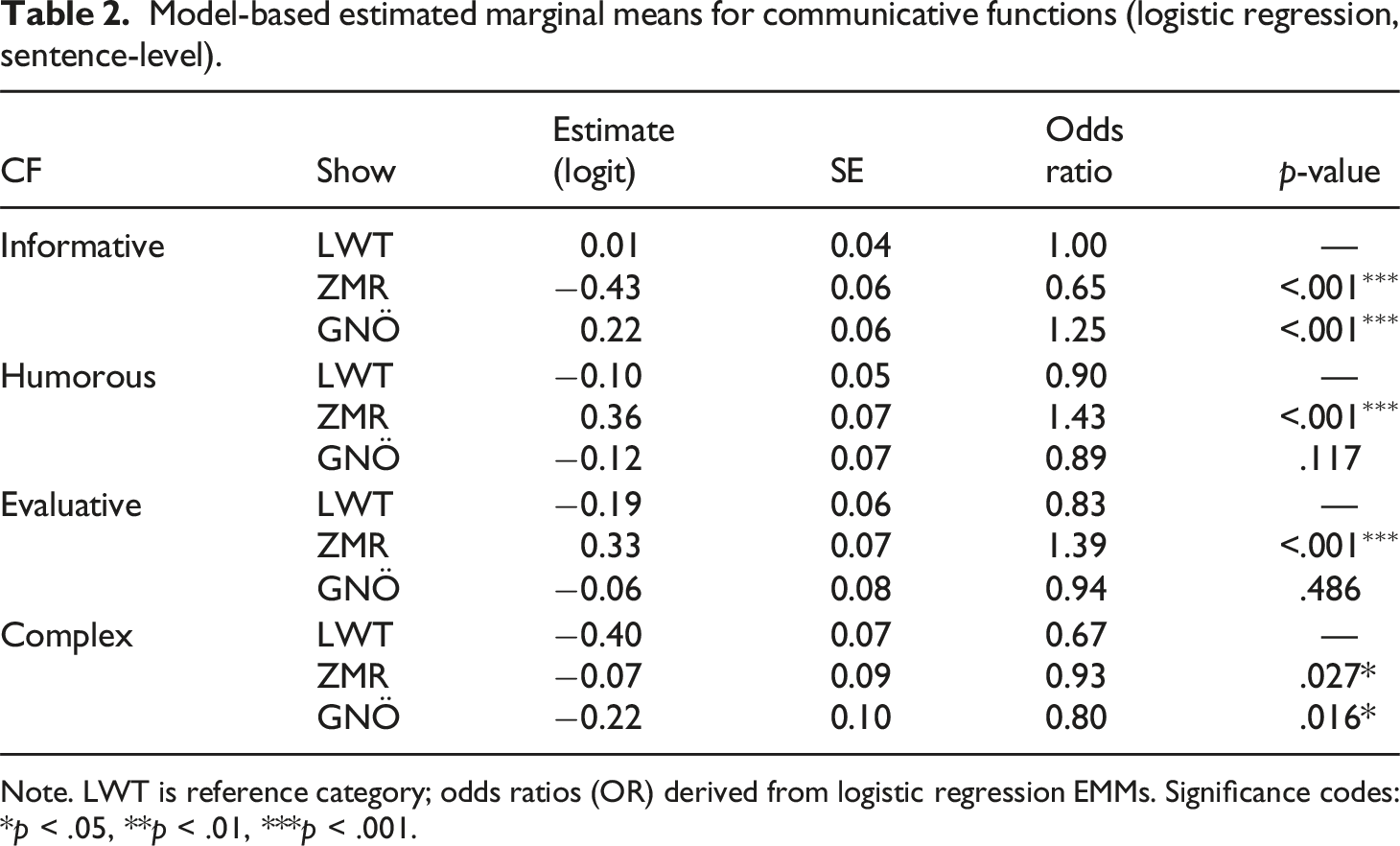
Note. LWT is reference category; odds ratios (OR) derived from logistic regression EMMs. Significance codes: *p < .05, **p < .01, ***p < .001.
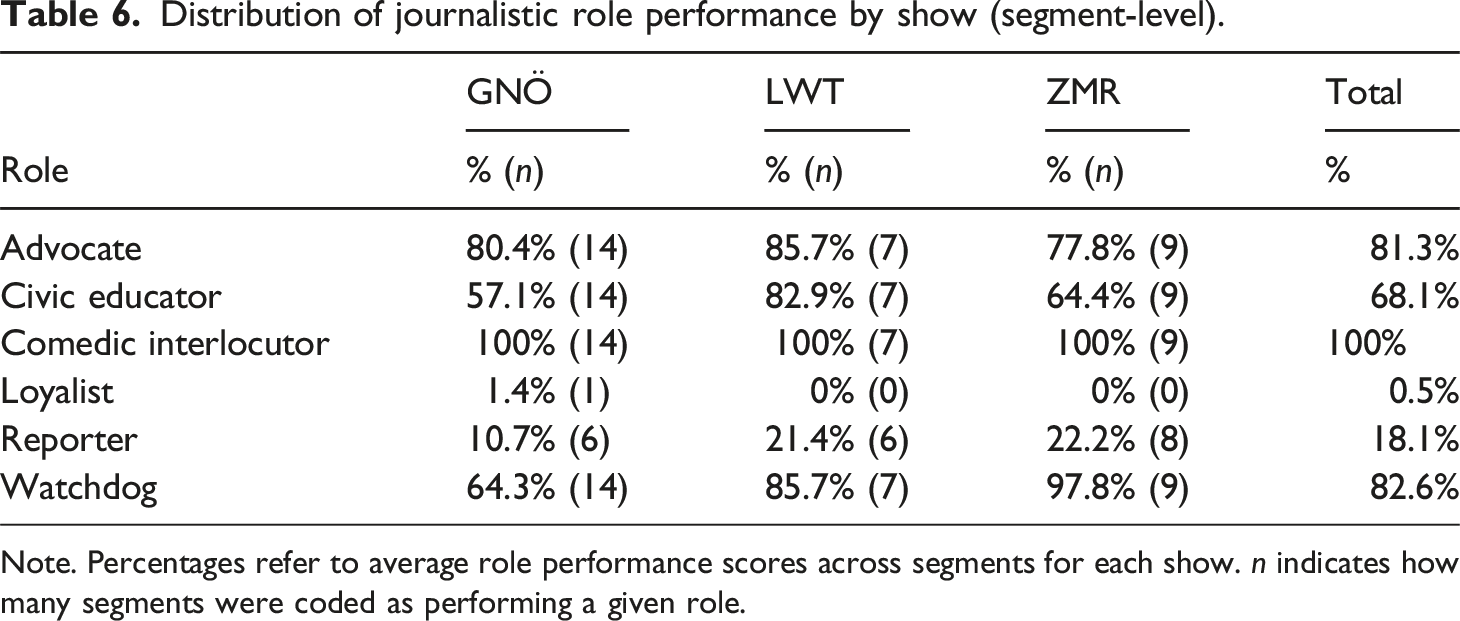
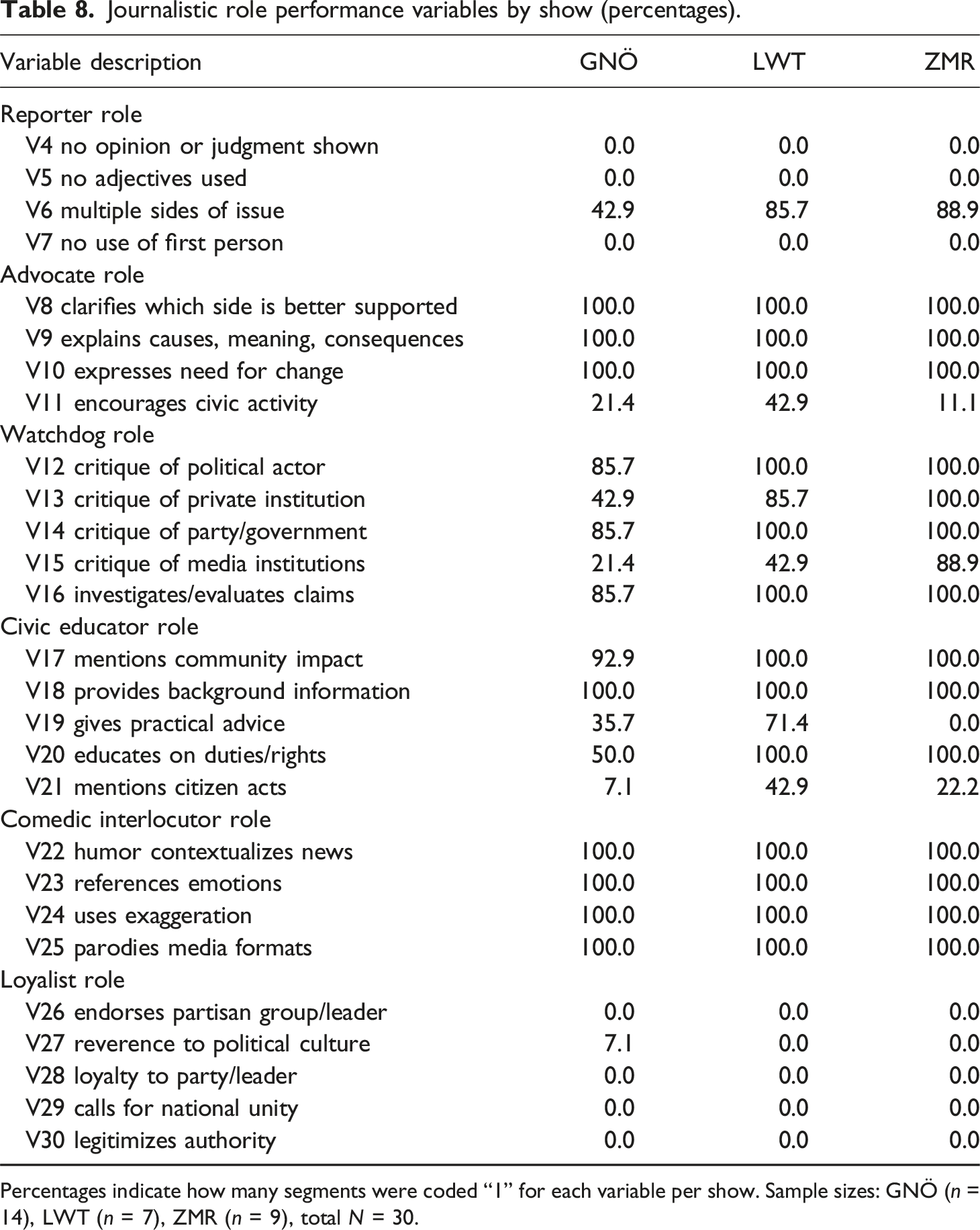
For journalistic role performance (JRP), Table 6 summarises the binary-coded role presence across shows, and Table 8 details variable-level patterns. The Comedic Interlocutor role was performed in all segments across programmes, and the Loyalist role was virtually absent. One-sided exact binomial dominance tests confirmed both H1c and H1d thresholds: Comedic Interlocutor in 100% of segments (p = .0012) and Loyalist in fewer than 20% (p = .0012).
Model-based estimated marginal means for journalistic roles (logistic regression, segment-level).

Note. LWT is reference category; Odds Ratios (OR) derived from logistic regression EMMs. Comedic interlocutor and loyalist show no variation and were excluded from regression models. Significance codes: *p < .05, **p < .01, ***p < .001.
Summary of hypotheses, tests, and outcomes.

Discussion
The cross-cultural comparative analysis revealed that, while Last Week Tonight, ZDF Magazin Royal, and Gute Nacht Österreich share a family resemblance as weekly news satire, they differ significantly in their communicative approach to fulfil their prototypical journalistic role. There are several implications of these findings both for the field of journalism studies and beyond.
First, as stipulated in H1a, the blend of communicative functions (CFs) differs significantly across cultural contexts – though all four CFs are utilized consistently, validating the conceptualization of political satire as a hybrid genre (Baym, 2005). The results herein, however, suggest that the writers and comedians behind the respective programmes come to drastically different conclusions regarding the appropriate mix of humour, information, opinion and complex speech that constitutes the final entertainment product, reflecting the “ongoing definitional negotiation” inherent to the genre, as described by Nicolaï (2023: 70). In contrast to Last Week Tonight’s (LWT) baseline, ZDF Magazin Royale’s (ZMR), blend of CFs suggests a preference for centering segments around a singular, salient piece of information (e.g. the main findings from a cooperation with investigative journalists), which is then subjected to extensive humorous commentary. Meanwhile, Gute Nacht Österreich’s (GNÖ) above-average informational content while comparatively lacking humorous speech may be a consequence of the starkly centralized structure of Austria’s public broadcaster which GNÖ is embedded in. Compared to Germany’s more pluralized public broadcaster landscape (Nitsch and Lichtenstein, 2013), this may impose stronger normative expectations regarding the editorial and rhetorical choices satirist make (Bezemek, 2011), such as privileging neutrality and comprehensiveness over adversarial or activist rhetoric (Brüggemann et al., 2014; Trappel, 2024). It is also possible that Austria’s smaller media market limits the programme’s available resources. Lowe and Nissen (2011) find that small countries often struggle to sustain resource-intensive entertainment genres like satire due to financial constraints and limited talent pools, leading to formats that are more modest in scope and heavily reliant on individual performers – both on and off camera. In Austria, this dynamic might restrict opportunities for alternative comedic voices to emerge while reducing institutional incentives to invest in innovative or risky satire programming (Coelho, 2014; Trappel, 2024). Indeed, substantial disparities in the programme’s production scale potentially account for differing CF usage: LWT employs 83 staff members, compared to ZMR’s 70, and GNÖ’s mere 37.8,9, 10
The findings regarding Journalistic Role Performance continue the trend of cross-programme differences (H1b rejected), as both European cases differ starkly both from their U.S. counterpart and from each other in this regard. Last Week Tonight’s overperformance as a Civic Educator is consistent with existing research into the programme, which repeatedly highlights LWT’s emphasis on critical civic education and its efforts to promote social activism or, at the very least, offer audiences concrete avenues for democratic participation (Barnard and Boukes, 2024; Becker, 2022a; Chattoo and Feldman, 2020; Davisson et al., 2019; Meier and Berg, 2024; Michaud-Wild, 2019; Ödmark and Nicolaï, 2024). Additionally, U.S. political satire audiences may be culturally more susceptible to a rhetoric of civic rights, protest as a legitimate and lauded form of participation, as well as the notion of individual responsibility for one’s problems (Hook and Markus, 2020; Olsen and Baden, 1974; Uhlmann and Sanchez-Burks, 2014) – all aspects reflected in the codebook’s wording of the civic educator role indicators (Ödmark and Nicolaï, 2024). In contrast, the relatively diminished presence of the civic educator role in both European programmes may be linked to cross-Atlantic differences in protest culture and civic discourse: Germany and Austria tend to favour more institutional, consensus-driven forms of political engagement (D’Amato and Schwenken, 2018). Protest movements in these countries are often less valorised and more fragmented, which may limit the rhetorical space for satire to take on an explicitly activist or civic mobilizing tone (Hadj Abdou and Rosenberger, 2019). Furthermore, Austrian political culture in particular has historically placed greater emphasis on political stability and technocratic governance than on individual civic responsibility or grassroots mobilization (Filzmaier, 2002; Zentrum Polis, 2023), especially as compared to the U.S. (Fitzgerald et al., 2021). As a result, the programmes’ relative lack of a civic educator function might not simply reflect editorial choice, but a broader mismatch between that role and the expectations and needs of its audience. Further differences in JRP between the two European programmes may stem from the aforementioned differences in their respective media systems. Analyses have found that German satire programmes such as ZDF Magazin Royale benefit from Germany’s robust public broadcasting (Nitsch and Lichtenstein, 2013), enabling satirists to extend journalistic scrutiny through comedy, supported by legal safeguards, investigative collaborations, and high-quality news content (Lichtenstein et al., 2021). In Austria, its central broadcaster (ORF) maintains a near-monopoly, fostering a consensus-oriented logic that constrains editorial risk-taking, potentially contributing to GNÖ’s under-performance in both the Watchdog and Reporter role (Brüggemann et al., 2014; Trappel, 2024). While the Austrian host’s faux access-journalism persona allows for subtle critique, it limits its potential for overtly adversarial, watchdog-style humour.
Additionally, cross-cultural differences in CFs and JRPs hint at how satirical programmes vary in their use of Gao et al., (2025)’s discourse truth construction – via authenticity, neutrality, and authority – as well as their agenda-setting capacity. All three programmes maintain authenticity through source crediting and grounding informative speech in verifiable data (Becker and Bode, 2018; Garcia-Navarro, 2024; Kraxberger and Prakken, 2025; Lichtenstein et al., 2021) but diverge in constructing authority and performing neutrality. Consistently low Reporter scores indicate a departure from traditional conceptions of neutrality, with explicitly voiced opinion enhancing the host’s authority (Gehrke, 2024; Becker, 2022a, 2022b, 2023; Kraxberger and Prakken, 2025), thus aligning satire more closely with opinion journalism (Kraxberger and Prakken, 2025). These strategies are culturally contingent: ZDF Magazin Royale leverages public broadcaster authority and comedic licence for watchdog-style critique, Gute Nacht Österreich aligns more with traditional neutrality, often repurposing news stories from its public broadcaster home, while Last Week Tonight combines information and evaluation with strong civic education. These differing approaches to news satire, in turn, may influence agenda-setting capacity (Boukes, 2019; McCombs and Shaw, 1972): LWT engages in both first- and attribute-level agenda setting (Meier and Berg, 2024; Michaud-Wild, 2019; Ödmark, 2021), ZMR focuses on attribute reframing within Germany’s information-rich context (Lichtenstein et al., 2021), and GNÖ prioritizes issue salience over framing within Austria’s consensus-oriented system. Overall, variations in truth construction and agenda setting reflect broader media system logics and audience expectations about the balance between information, interpretation and entertainment.
Overall, the results herein expand upon and validate the research of Ödmark and Nicolaï (2024), showing a similar general distribution of JRP (H1c, H1d) despite the differences in specific role performance across programmes. This strengthens the case that “satire does indeed do journalism” (Ödmark and Nicolaï, 2024: 2332), possessing informational and societal value beyond mere entertainment (Becker and Bode, 2018; Boukes et al., 2024; Boukes and Hameleers, 2020). The differences between programmes in JRP are notably more prominent in this study, throwing into question the generalizability of prior research and pointing to the relevance of future cross-cultural analysis of political satire and the potential reasons behind the observed differences in satirical JRP. Without in-depth interviews with hosts, producers or writers of these programmes and additional cross-country comparisons, however, the drivers of these differences can only remain speculative (Boukes et al., 2024).
Conclusion
The findings herein advance our understanding of political (news) satire by demonstrating how cross-cultural differences exist in both the communicative functions (CFs) and journalistic role performance (JRP) of news satire, potentially reflecting variations in media systems, democratic cultures, and audience expectations. This study contributes to journalism scholarship and humour research in three key ways.
Theoretically, the systematic cross-cultural comparison reveals that while news satire shares universal genre features – its hybridity in mixing humour, information and opinion (Baym, 2005), as well as the dominance of the comedic interlocutor role and absence of loyalist journalism (Mellado and Lagos, 2014; Ödmark and Nicolaï, 2024) – its remaining journalistic role performance is culturally contingent. The differential implications to discourse truth construction (Gao et al., 2025), agenda setting (McCombs et al., 2018), and the internal “ongoing definitional negotiation” (Nicolaï, 2023: 70) across the three programmes challenge assumptions about the universality of political satire formats and highlight how media system characteristics may shape satirical content. These findings both validate and extend existing frameworks (Baym, 2005; Ödmark and Nicolaï, 2024) by demonstrating that political satire’s hybrid nature manifests differently across cultural contexts, with implications for how we understand its role in democratic discourse and the topical focus of future studies on the topic.
Empirically, this study provides the first systematic comparison of communicative functions and journalistic role performance across U.S., German, and Austrian weekly news satirical formats. The finding that programmes balance entertainment and information differently – from ZMR’s concentrated informational cores over GNÖ’s traditional journalism alignment to LWT’s civic mobilization emphasis – suggests that news satire’s journalistic role performance varies alongside local media logics and cultural expectations. This cross-cultural variation has important implications for understanding political satire’s capacity to serve as a re-entry point for news-avoidant audiences and its potential for democratic mobilization (Skovsgaard and Andersen, 2020; Xenos and Becker, 2009).
Methodologically, the validation of the LACA approach (Chew et al., 2023) for cross-cultural political satire analysis offers a scalable solution to the resource constraints that have historically limited comparative research in this field. This contribution is particularly significant given the global proliferation of satirical news formats and the acknowledged need for systematic cross-cultural analysis in satirical journalism research (Boukes et al., 2024).
Looking forward, these findings suggest several avenues for future research to expand upon the findings herein and address some of this study’s shortcomings. First, while the addition of the complex category expands Baym’s (2005) framework to account for real-life complexities of humorous speech, future researchers should consider instead examining smaller linguistic units to better delineate between informational, humorous and evaluative functions, potentially foregoing the need for a “complex” category.
Second, the programmes analysed herein, share with the majority of political satire a progressive, left-leaning bias. This, in fact, enhanced cross-cultural comparability, as equivalent right-wing political satire formats remain as of yet absent in Germany and Austria, despite having witnessed a proliferation of self-proclaimed “anti-woke” comedians across the two countries in recent years (Langley-Hunt, 2024). It may thus only be a matter of time before similarly right-leaning political satire finds its footing in markets outside the U.S. Nonetheless, the present analysis consequently could not include the dynamics of explicitly right-wing comedy’s cross-cultural appeal, such as Fox News’ Gutfeld! (Fox, 2023). Importantly, these formats may fundamentally differ in their approach to truth construction and harbour entirely opposite conceptions of journalistic role performance, e.g. in their approach to watchdog journalism. Future scholarship should therefore address how differing ideological contexts shape political satire and its journalistic role performance.
Third, the framework established herein should be extended to non-Western contexts to test the generalizability of these patterns across different democratic traditions and media systems. Fourth, audience reception studies are needed to understand how cross-cultural differences in satirical journalism content affect viewer perceptions of entertainment versus information and civic engagement motivations. Finally, as digital platforms continue to reshape media landscapes, research should examine how platform logic interacts with the cultural and institutional factors identified here to influence news satire’s democratic functions. In an era of increasing news avoidance and democratic polarization, understanding these dynamics becomes ever more crucial for both scholars and practitioners seeking to harness news satire’s potential for democratic engagement.
Footnotes
Declaration of conflicting interests
The authors declared no potential conflicts of interest with respect to the research, authorship, and/or publication of this article.
Funding
The author received no financial support for the research, authorship, and/or publication of this article.

Notes
Appendix
. Distribution of communicative functions by show (sentence-level). Note. Percentages are the share of sentences of each communicative function within the given show. Distribution of journalistic role performance by show (segment-level). Note. Percentages refer to average role performance scores across segments for each show. n indicates how many segments were coded as performing a given role. Pairwise contrasts of communicative functions between shows (logistic regression, sentence-level; Holm-adjusted). Note. Odds ratios from binomial GLMs with show as predictor; p-values Holm-adjusted. Significance: *p < .05, **p < .01, ***p < .001. Journalistic role performance variables by show (percentages). Percentages indicate how many segments were coded “1” for each variable per show. Sample sizes: GNÖ (n = 14), LWT (n = 7), ZMR (n = 9), total N = 30. Pairwise contrasts of journalistic role performance between shows (logistic regression, segment-level; Holm-adjusted). Note. Odds ratios from binomial GLMs with show as predictor; some watchdog comparisons hit quasi/separation (—). p-values Holm-adjusted. Significance: *p < .05, **p < .01, ***p < .001. Segments included in analysis.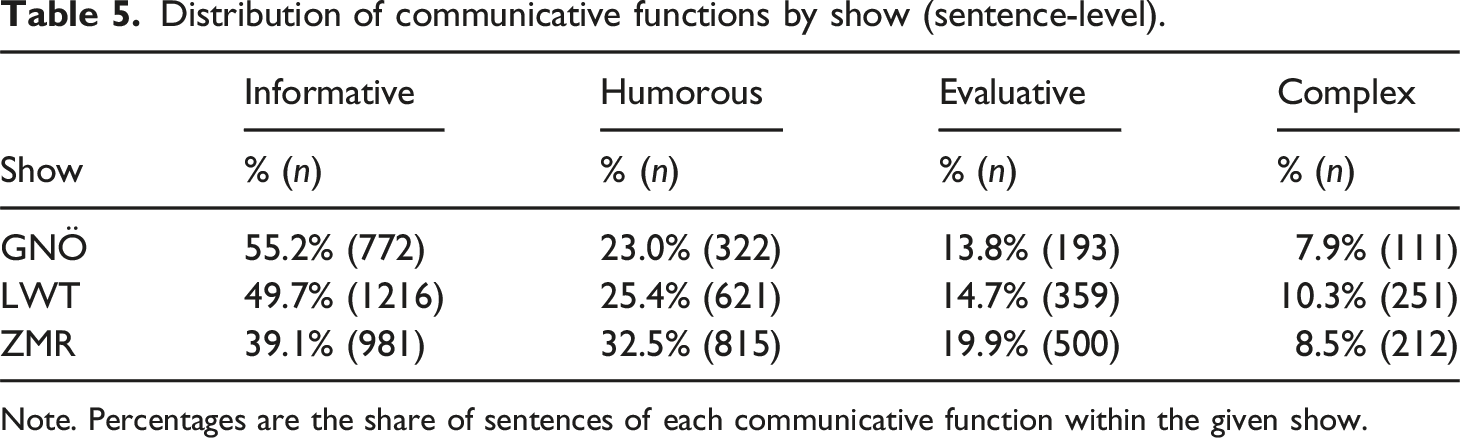
Show
Informative
Humorous
Evaluative
Complex
% (n)
% (n)
% (n)
% (n)
GNÖ
55.2% (772)
23.0% (322)
13.8% (193)
7.9% (111)
LWT
49.7% (1216)
25.4% (621)
14.7% (359)
10.3% (251)
ZMR
39.1% (981)
32.5% (815)
19.9% (500)
8.5% (212)
Role
GNÖ
LWT
ZMR
Total
% (n)
% (n)
% (n)
%
Advocate
80.4% (14)
85.7% (7)
77.8% (9)
81.3%
Civic educator
57.1% (14)
82.9% (7)
64.4% (9)
68.1%
Comedic interlocutor
100% (14)
100% (7)
100% (9)
100%
Loyalist
1.4% (1)
0% (0)
0% (0)
0.5%
Reporter
10.7% (6)
21.4% (6)
22.2% (8)
18.1%
Watchdog
64.3% (14)
85.7% (7)
97.8% (9)
82.6%
CF
Contrast
Odds ratio
SE
z
p-value
Informative
LWT/ZMR
1.540
0.179
3.690
<.001∗∗∗
Informative
LWT/GNÖ
0.801
0.088
−2.030
.043∗
Informative
ZMR/GNÖ
0.521
0.058
−5.880
<.001∗∗∗
Humorous
LWT/ZMR
0.706
0.109
−2.250
.049∗
Humorous
LWT/GNÖ
1.140
0.173
0.840
.401
Humorous
ZMR/GNÖ
1.610
0.263
2.910
.011∗
Evaluative
LWT/ZMR
0.690
0.121
−2.110
.098
Evaluative
LWT/GNÖ
1.070
0.169
0.450
.653
Evaluative
ZMR/GNÖ
1.550
0.321
2.140
.098
Complex
LWT/ZMR
1.240
0.375
0.704
1.000
Complex
LWT/GNÖ
1.330
0.452
0.825
1.000
Complex
ZMR/GNÖ
1.070
0.395
0.185
1.000
Variable description
GNÖ
LWT
ZMR
Reporter role
V4 no opinion or judgment shown
0.0
0.0
0.0
V5 no adjectives used
0.0
0.0
0.0
V6 multiple sides of issue
42.9
85.7
88.9
V7 no use of first person
0.0
0.0
0.0
Advocate role
V8 clarifies which side is better supported
100.0
100.0
100.0
V9 explains causes, meaning, consequences
100.0
100.0
100.0
V10 expresses need for change
100.0
100.0
100.0
V11 encourages civic activity
21.4
42.9
11.1
Watchdog role
V12 critique of political actor
85.7
100.0
100.0
V13 critique of private institution
42.9
85.7
100.0
V14 critique of party/government
85.7
100.0
100.0
V15 critique of media institutions
21.4
42.9
88.9
V16 investigates/evaluates claims
85.7
100.0
100.0
Civic educator role
V17 mentions community impact
92.9
100.0
100.0
V18 provides background information
100.0
100.0
100.0
V19 gives practical advice
35.7
71.4
0.0
V20 educates on duties/rights
50.0
100.0
100.0
V21 mentions citizen acts
7.1
42.9
22.2
Comedic interlocutor role
V22 humor contextualizes news
100.0
100.0
100.0
V23 references emotions
100.0
100.0
100.0
V24 uses exaggeration
100.0
100.0
100.0
V25 parodies media formats
100.0
100.0
100.0
Loyalist role
V26 endorses partisan group/leader
0.0
0.0
0.0
V27 reverence to political culture
7.1
0.0
0.0
V28 loyalty to party/leader
0.0
0.0
0.0
V29 calls for national unity
0.0
0.0
0.0
V30 legitimizes authority
0.0
0.0
0.0

Role
Contrast
Odds ratio
SE
z
p-value
Reporter
LWT/ZMR
1.710
0.716
1.290
.591
Reporter
LWT/GNÖ
1.470
0.626
0.898
.739
Reporter
ZMR/GNÖ
0.856
0.201
−0.665
.739
Advocate
LWT/ZMR
2.670
0.979
2.670
.015∗
Advocate
LWT/GNÖ
3.620
1.420
3.280
.003∗∗
Advocate
ZMR/GNÖ
1.360
0.302
1.380
.167
Watchdog
LWT/ZMR
1.000
—
—
—
Watchdog
LWT/GNÖ
0.0000000113
0.0000000112
−18.400
<.001∗∗∗
Watchdog
ZMR/GNÖ
0.0000000113
0.0000000118
−17.400
<.001∗∗∗
Civic educator
LWT/ZMR
0.955
0.241
−0.184
.854
Civic educator
LWT/GNÖ
2.270
0.919
2.030
.085
Civic educator
ZMR/GNÖ
2.380
0.914
2.260
.071
Loyalist
LWT/ZMR
0.136
0.147
−1.850
.064
Loyalist
LWT/GNÖ
3.330
1.590
2.530
.023∗
Loyalist
ZMR/GNÖ
24.400
24.400
3.200
.004∗∗
Show
Title
URL
Date
Length
GNÖ
Warum die Rettung Rettung braucht
YouTube
08.11.2024
00:09:02
GNÖ
So wird das Burgenland verstaatlicht
YouTube
15.11.2024
00:08:02
GNÖ
Warum das Smartphone aus der Schule raus muss!
YouTube
22.11.2024
00:07:56
GNÖ
So liefen die Schredderaffären!
YouTube
29.11.2024
00:09:48
GNÖ
Abzocke mit Promi-Fakes
YouTube
06.12.2024
00:08:54
GNÖ
Wie Fernwärme seine Kunden ausnimmt
YouTube
17.01.2025
00:07:40
GNÖ
Wir sind von Asiens Medikamenten abhängig
YouTube
24.02.2025
00:07:08
GNÖ
Warum Nordkorea so gern in Österreich ist
YouTube
01.02.2025
00:07:10
GNÖ
Eine Alternative für Deutschland?
YouTube
14.02.2025
00:10:00
GNÖ
So gefährlich ist Russlands Sabotage!
YouTube
21.02.2025
00:06:56
GNÖ
Wie Banken Rekordgewinne einstreifen und trotzdem den Service verschlechtern
YouTube
28.02.2025
00:07:55
GNÖ
Warum immer mehr Schüler immer weniger Deutsch sprechen
YouTube
14.03.2025
00:09:17
GNÖ
Versinkt der ÖFB in Chaos?
YouTube
28.03.2025
00:09:11
GNÖ
Schafft Trump die Demokratie ab?
YouTube
04.04.2025
00:08:01
LWT
Trump 2.0
YouTube
16.02.2025
00:34:51
LWT
Facebook & content moderation
YouTube
23.02.2025
00:29:39
LWT
Tipping
YouTube
02.03.2025
00:24:54
LWT
ICE Detention
YouTube
09.03.2025
00:24:19
LWT
Sports betting
YouTube
16.03.2025
00:32:20
LWT
Tasers and excited delirium
YouTube
30.03.2025
00:30:37
LWT
Trans athletes
YouTube
06.04.2025
00:42:21
ZMR
Was Rechte uns als Freiheit verkaufen
YouTube
07.02.2025
00:24:08
ZMR
Die problematische Ideologie hinter Shen Yun
YouTube
14.02.2025
00:22:15
ZMR
Wie soziale Medien unseren Wahlkampf beeinflussen
YouTube
21.02.2025
00:21:36
ZMR
Politik und Medien und die Stimmung im Land
YouTube
28.02.2025
00:26:00
ZMR
Gemeinsam gegen die Einsamkeit
YouTube
07.03.2025
00:21:03
ZMR
Medizinische Influencer*innen: Diagnose Selbstvermarktung
YouTube
14.03.2025
00:22:51
Show
Title
Link
Date
Length
ZMR
Wer sich Deutsche Kinder für Deutschland wünscht
YouTube
21.03.2025
00:22:38
ZMR
Afghanistan: Die zweifelhafte Rolle der Bundespolizei
YouTube
28.03.2025
00:26:08
ZMR
Rene Benko: Macht, Korruption, Milliardenpleite
YouTube
04.04.2025
00:24:55