



Abstract
Emerging adulthood is a period in the life course that consists of several developmental tasks, including occupational and relationship exploration. Consistent with the developmental tasks of this period, we tested a model of individual development. Using a sample of emerging adults in romantic relationships (N = 267), we examined the longitudinal association between conflict management and relationship satisfaction and subsequent college adjustment using two cross-lag path analyses. In the first path analyses, results indicated conflict management and social adjustment are mutually influential over time. In this second path analyses, conflict management is related to academic adjustment through relationship satisfaction. Implications for romantic relationship education for emerging adults and future research are discussed.
Keywords
Transitioning to college can be both an important and a stressful psychosocial developmental experience for emerging adults, in the United States (Arnett, 2004). Individuals encounter a variety of stressors during college such as the need to establish new social supports, acclimating to new environments, meeting higher scholastic expectation, and general coping with the daily demands of college life (Dyson & Renk, 2006). The ability to adjust to the stressors of college (i.e., college adjustment), coupled with other salient tasks of emerging adulthood (e.g., relationship and career exploration), fosters an experience that requires competence (i.e., ability to effectively execute developmental tasks) and adaptability (Arnett, 2004). Although some individuals possess the skills necessary to cope with these new stressors, others report feeling overwhelmed and struggle in their adjustment to college (Dyson & Renk, 2006; Schulenberg & Zarrett, 2005). Most emerging adults in the United States will attend college but nearly half (57%) will not obtain a degree after 5 years (Aud et al., 2011). Due to the immediate and lifetime impact of college matriculation and dropout (e.g., lower lifetime wage earnings; Baum & Ma, 2007), it is important to understand the mechanisms that contribute to college adjustment during emerging adulthood.
The failure to establish a quality romantic relationship and secure a stable career independently impact individual well-being outcomes across the life course. However, these two key domains of development among emerging adults do not develop and progress parallel to one another. In fact, among emerging adults, exploration and solidification of romantic relationship and career identities are two primary and often simultaneous tasks (Arnett, 2000, 2004; Shulman & Connolly, 2013). Therefore, in order to better understand adaptive and maladaptive development patterns, we must explore and understand how these two developmental domains interact over time. In this study, we seek to understand how aspects of college adjustment and aspects of romantic relationships among emerging adults interact over time.
Bioecological Framework
Originally created to explain the process of child development, Bronfenbrenner’s bioecological model (Bronfenbrenner, 2005) offers a conceptualization of development at a later time point (D2) as a function (f) of the interrelations among process, person, context, and time (PPCT1; Bronfenbrenner and Evans, 2000). Process (P) represents the interactions between the individual and another person, object, or symbol and is often referred to as proximal processes; person (P) is conceptualized as the characteristics of the developing person; context (C) is the distal or proximal environment in which the developing person is in contact; and time (T1) is the historical context (chronosystem), the frequency of the proximal process interactions overtime (meso-time), or the length of one specific interaction (microtime; Bronfenbrenner and Morris, 2006). For our purposes, proximal processes are the individual college student’s interactions with his or her college environment, individuals in the college environment, and the student’s romantic partner. The context is the college environment.
The “form, power, content, and direction of the proximal process effecting development” (p. 798) and proximal processes are influenced by context, person, historical time, and life course stage (Bronfenbrenner & Morris, 2006). Individuals play a dual role in the bioecological model as both an influence on proximal process and the representation of the developmental outcomes (Bronfenbrenner & Morris, 2006). According to this proposition, the interaction of PPCT1 contributes to the developmental outcomes of competence or dysfunction (Bronfenbrenner & Morris, 2006). Competence refers to an individual’s ability to demonstrate acquisition and additional development of skills that allow the individual to control and direct his or her behavior during ongoing development. Competence is present in multiple developmental domains that mutually influence each other (e.g., “spillover” effect; Bronfenbrenner and Evans, 2000). Conversely, dysfunction is defined as an individual’s difficulty with maintaining control and integration of behaviors across a variety of situations (Bronfenbrenner & Morris, 2006).
We applied Bronfenbrenner’s bioecological model broadly to understand how an individual’s competence or dysfunction in one domain of development may spillover into another domain of development within the college context within the developmental period of emerging adulthood.
Emerging Adult’s Romantic Relationships
Several studies have highlighted the importance of romantic involvement during the period of emerging adulthood (age 18–25; e.g., Collins & van Dulmen, 2006; Fincham & Cui, 2011b; Furman & Shaffer, 2003). Compared to adolescent romantic relationships, relationships among emerging adults are longer in duration and typically include greater physical and emotional intimacy (Arnett, 2004; Collins, 2003). Consequently, romantic partners during emerging adulthood have greater influence on one another and have the potential to influence development in both rewarding and harmful ways (Collins & van Dulmen, 2006; Manning, Giordano, Longmore, & Hocevar, 2009).
Relationship exploration is also common during emerging adulthood. Such exploration is considered a part of identity exploration (Erikson, 1968) and helps individuals determine (a) what type of person they desire to be in a romantic relationship, (b) what constitutes a “good” or “healthy” romantic relationship, and (c) the characteristics desired in a romantic partner (Reifman, 2011). That is, relationship exploration allows emerging adults to master the critical developmental task of “learning how to form, maintain, and gracefully end romantic and sexual relationships” (Snyder, 2006, p. 161). In general, experts consider romantic relationship exploration and involvement beneficial. For example, relationship exploration, as defined by having multiple dating partners, is related to relationship maintenance skills such as increased psychological intimacy (Montgomery, 2005; Snyder, 2006). Relationship involvement is related to identity development (Furman & Shaffer, 2003) and leads to later personal growth regardless of relationship outcomes (Lewandowski & Bizzoco, 2007). Further, involvement in romantic relationships promotes individual well-being and adjustment (Davila, 2011; Fincham & Cui, 2011a). Positive experiences in romantic relationships during emerging adulthood have been linked to decreased externalizing behavior (van Dulmen, Goncy, Haydon, & Collins, 2008), fewer anxiety symptoms in women (La Greca & Harrison, 2005), and an increase in pro-social behavior (Manning et al., 2009).
Emerging adult relationships have also been shown to promote development in academics and career goals (Manning et al., 2009) but not specifically college adjustment. Romantic relationship status among first year college students may have a negative relationship as it has also been shown to increase depressive symptoms (Davila, Steinberg, Kachadourian, Cobb, & Fincham, 2004).
Conflict Management, Relationship Satisfaction, and Individual Outcomes
Romantic relationships in emerging adulthood are not without conflict (Creasey & Hesson-McInnis, 2001). Conflict management is a critical component of promoting marital and relationship satisfaction and preventing relationship dissolution (Bradbury, Rogge, & Lawrence, 2001; Fincham & Beach, 2010). Further, many relationship problems have been attributed to poor conflict management (i.e., criticism, negative problem solving, and not taking responsibility; Halford, Hahlweg, & Dunne, 1990). Additionally, applying effective conflict management tactics in early adult relationships has been hypothesized to create stability in later romantic relationships, including marriage (Creasey & Hesson-McInnis, 2001). Therefore, conflict management should be related to both relationship satisfaction and individual development over time.
Like conflict management, relationship satisfaction is associated with individual development. For example, Larson, Whittona, Hausera, and Allenb (2007) found a positive association between educational attainment and perceived competence in close relationships (i.e., satisfaction with one’s ability to maintain a healthy relationship) among adolescents and young adults. In general, maladaptive aspects of relationship dynamics (i.e., conflict, rejection, and poor relationship quality) among adolescents and emerging adults are linked to increased depression (Harper, Dickson, & Welsh, 2006; Joyner & Udry, 2000), anxiety (La Greca & Harrison, 2005), poor occupational attainment (Furman & Shaffer, 2003), violence (Carr & VanDeusen, 2002; S. F. Lewis & Fremouw, 2001), and overall individual well-being (Grover & Nangle, 2010; Larson, Whittona, Hausera, & Allenb, 2007). Such findings demonstrate the association relationship characteristics can have on multiple domains of individual development.
College Adjustment
One of the developmental tasks associated with emerging adulthood is exploring and developing a career identity, which often includes attending college (Arnett, 2004). Aud and colleagues (2011) reported that only 57% of those who enroll for the first time at a 4-year institution graduate, and this percentage is lower for individuals who enroll in a for-profit institution (22%) but higher for individuals who enroll in a private institution (66%). The consequences of failure to matriculate from college can include reduced lifetime wage earnings compared to those who do graduate (Baum & Ma, 2007; U.S. Census Bureau, 2007). Subsequently, this lowered income has been linked to lifetime deficits in mental and physical health and general well-being (Baum & Ma, 2007). However, individuals who enroll but do not graduate may be at greater risk because they accrue debt (e.g., student loan and credit cards) without the financial means to pay for this debt. Thus, emerging adults who attend college but dropout may be worse off than those who either never attend or attend and earn a degree.
Graduation from college has been linked to graduates’ reports of college adjustment (Kuh, Kinzie, Buckley, Bridges, & Hayek, 2006). For example, adaptation to a new situation is an important correlate of later academic success among college populations (Larose, Robertson, Roy, & Legault, 1998). Several factors have been shown to contribute to college adaptation. For example, in one study, students reported a wide range of factors that contributed to their failure to graduate including personal problems, institutional alienation, financial troubles, or simply “needing a break” (Mohr, Eiche, & Sedlacek, 1998). Although a number of factors contribute to successful college adjustment, research has focused on only a few salient domains. For example, lower intellectual ability (e.g., low high school grades) contributes to dropping out of college (Larose et al., 1998; Upcraft & Gardner, 1990). Also, nonintellectual factors contribute to college success including learning beliefs, emotional reactions to testing (Larose et al., 1998), and gender roles (Dyson & Renk, 2006). Finally, social aspects of the college environment are related to the decision to drop out of college including peer relationships, living arrangements, involvement in student organizations (Magolda, 1992), social competencies, and loneliness (Wei, Russell, & Zakalik, 2005). Seemingly, both academic adjustment and social adjustment to college are considered important predictors of future success in college.
Romantic Relationship and College Adjustment
Shulman and Connolly (2013) note that emerging adults are in a transitional romantic stage, whereby they must coordinate both life plans (e.g., college) and romance (e.g., dating relationships). The resolution of these tasks culminates with a long-term commitment to a partner when individuals are confident about their life plans and partner’s support of these plans. They also suggest that future research focus on how these two domains of emerging adult development interact; this proposition is similar to the bioecological concept of spillover effect (Bronfenbrenner & Morris, 2006). From this standpoint, it is important to consider how aspects of romantic relationships may interact with college adjustment as the resolution of both tasks contributes to competencies and thus a successful transition out of emerging adulthood. This study examines how conflict management, relationship satisfaction, and two aspects of college adjustment (social and academic) are related over time and is guided by two research questions to explore the relations among the variables over time:
Method
Participants
Undergraduate student participants enrolled in a family development course at a large public Southeastern university. The class met a university liberal studies requirement in social sciences, so students potentially represent all colleges and majors on campus. We limited our sample to emerging adults (ages 18–25) who completed all three waves of the study, reported being in the same dating relationship at all three waves of the study, and did not report breaking up at any point during the semester (N = 267), which represents 30.4% of the original sample (N = 877). Data were collected at three different time points during semester (T1 = Week 1, T2 = Week 8, and T3 = Week 15). Due to attrition across waves, 12.2% of the original sample was removed. The individuals who did not complete all waves did not differ from the final sample in terms of age, relationship type, and year in school. However, dropout rates did differ in terms of race/ethnicity, and African Americans, Latino/as, Asian Americans, and those who reported as “other” had a higher percentage of attrition compared to White participants, χ2(5) = 16.97, p < .001. Also, dropout rates did differ by gender, with a larger percentage of men dropping out of the study, χ2(1) = 10.68, p = .001.
At T1, participants averaged 19.2 years old (SD = 1.62) and were primarily female (80.5%). Most (77.2%) identified as White, followed by African American (11.2%), Latino/a (8.6%), Asian American (<1%), Asian/Pacific Islander (<1%), and <1% reported as other. In terms of year in school, 39.0% reported being freshmen, followed by sophomores (27.3%), juniors (24.3%), and seniors (8.6%). We include students across all years because attrition is a longitudinal process and not a single event (Bean, 1990). Additionally, despite the smaller percentage, we retained seniors in the study because college attrition among seniors has been identified as problematic so we chose to keep them in the model to examine senior’s academic and social adjustment (Mohr et al., 1998).
At T1, a majority (91.8%) of the participants in the final sample reported dating exclusively and identified as heterosexual (98.5%). Additionally, most (89.5%) reported the same relationship type across all three waves of the study. We included individuals who reported dating nonexclusively because romantic relationships during emerging adulthood are characterized as ambiguous (Arnett, 2004) and the inclusion of both exclusive and nonexclusive romantic relationships is indicative of such ambiguity.
Procedure
Data for this study are from a larger project (Relationship U) on emerging adults and their romantic relationship experiences. The Florida State University’s Institutional Review Board approved the project. Individuals who chose to participate completed an informed consent the first week of the semester and completed a restricted access online survey at three different time points during the semester. The survey was completed in a location and at a time that was convenient to participants.
Measures
Conflict management
All three time points assessed conflict management using a subscale of the Interpersonal Competence Questionnaire which measures perceptions of conflict management (Buhrmester, Furman, Wittenberg, & Reis, 1988). Participants respond to a subscale comprised of 8 items (e.g., “Being able to admit that you might be wrong when a disagreement with a close companion …“) and responses ranged from (0) I’m poor at this to (4) I’m extremely good at this. Cronbach’s α (T1 = .86, T2 = .88, and T3 = .90) indicated acceptable reliability of the conflict management measure at all three time points. Higher averaged scores indicated greater proficiency in relationship conflict management.
Relationship satisfaction
All three time points assessed relationship satisfaction using the Couple Satisfaction Index (Funk & Rogge, 2007). Participants respond to a scale consisting of 4 items, 3 of the items (e.g., “I have a warm and wonderful relationship with my partner”) had responses that ranged from (0) not at all to (5) completely and 1 item (e.g., “… select the answer which best describes the degree of happiness, all things considered, of your relationship”) had responses that ranged from (0) extremely unhappy to (6) perfect. This item was rescaled to match the other 3 items (0–5). Cronbach’s α (T1 = .91, T2 = .88, and T3 = .91) indicated acceptable reliability of the measure at all three time points. Higher averaged scores indicated greater relationship satisfaction.
College adjustment
All three time points assessed constructs of college adjustment using two subscales of the Student Adaptation to College Questionnaire (Baker & Siryk, 1986), namely, social adjustment and academic adjustment. Ten items measured social adjustment (e.g., “I feel that I have enough social skills to get along well in the college setting”) and response ranged from (0) very poorly to (4) very closely. Cronbach’s α for social adjustment (T1 = .88, T2 = .91, and T3 = .92) indicated acceptable reliability of the measure at all three time points. Higher averaged scores indicated better social adjustment to college.
Ten items measured academic adjustment (e.g., “I am quite satisfied with my academic situation at college”) and response ranged from (0) very poorly to (4) very closely. Cronbach’s α for academic adjustment (T1 = .86, T2 = .86, and T3 = .88) indicated acceptable reliability of the measure at all three time points. Higher averaged scores indicated better academic adjustment to college.
Control Variables
In the final statistical analysis, the model included the following control variables on the outcome variables.
Relationship type
T1 assessed relationship type as a categorical variable. Individuals who reported being in a romantic relationship responded to the question, “Which statement best describes your relationship? dating exclusively (one person only—my boyfriend/girlfriend), dating, engaged, and married.” After removing participants who did not meet the criteria for this study (e.g., engaged and married), relationship type became a dichotomous variables (0 = dating exclusively and 1 = dating nonexclusively).
Relationship stability
The model included a dichotomous variable of relationship stability (0 = relationship stable and 1 = relationship fluctuation) to account for changes in relationship across the semester. For those who reported a change in relationship type (e.g., at T1 the participant reported their relationship type as nonexclusive and T2 the same participant reported the relationship type as exclusive), they were coded as relationship fluctuation. Those who reported the same relationship type for each wave were coded as relationship stable.
Year in school
At T1, participants indicated their year in school as freshman, sophomore, junior, or senior. We coded it into a dichotomous variable (0 = lower classmen [freshman and sophomore], 1 = upper classmen [junior and senior]).
Gender
We measured gender with a single dichotomous variable at T1 (0 = men, 1 = women).
Plan of Analysis
To assess the spillover effect between romantic relationship characteristics (relationship satisfaction and conflict management) and college adjustment (academic adjustment and social adjustment) we tested two cross-lag path analysis models. To determine the direction of effects between individual well-being and relationship quality, one can employ a cross-lagged panel correlation (CLPC). This analytic procedure simultaneously compares the correlation between the variables within each wave (synchronous correlation), the correlations between adjacent waves separately (autocorrelations), and correlations between the variables across waves (cross-lagged correlations). Assessing all of these relationships simultaneously helps to determine the potential causal direction of these relationships across time (Locascio, 1982; Markus, 1979; Mayer & Carroll, 1987).
For each model, we assessed whether the indirect paths were significant using bootstrapping. Bootstrapping is a statistical technique used to determine the confidence interval around a parameter by taking multiple samples of the data (e.g., draws) with replacement. The parameters created from each draw determine the confidence interval and the stability of the parameter in the given data (Efron & Tibshirani, 1993). Bootstrapping is commonly used for testing indirect paths in path analysis. Compared to other estimates, bootstrapping is preferred because of minimal parameter estimation bias and the provided distribution of each parameter (for a discussion see Hayes, 2009).
Results
Study variables met the assumptions of normality and independence necessary to run cross-lag path analysis with maximum likelihood estimation. Less than 2% of the data were missing on each variable at all three time points. Little’s test of missing completely at random indicated that data were missing completely at random, χ2(21) = 10.62, p = .97. Standardized coefficients and significance levels were computed using Full Information Maximum Likelihood in Mplus 6.0 (Muthén & Muthén, 1998–2011). Bootstrapping tested the indirect paths in the model (Hayes, 2009). We conducted the preliminary analyses in SPSS, which utilizes list-wise deletion to handle missing data. Analyses conducted in Mplus utilize full-information maximum likelihood to handle missing data. Because of these different methods for handling missing data, reported sample sizes are slightly different.
Univariate Analyses
A series of t-tests examined the relationship between each of the control variables and the outcome variables. We found no significant relationships between the control variables and the outcome variables (analyses not shown). Therefore, none of the control variables were included in the CLPC models. Next, we examined the relationship between all of the variables of interest. Correlations among relationship satisfaction, conflict management, academic adjustment, and social adjustment at all three time points are presented in Table 1.
Correlations Among Conflict Management, Relationship Satisfaction, Academic Adjustment, and Social Adjustment.
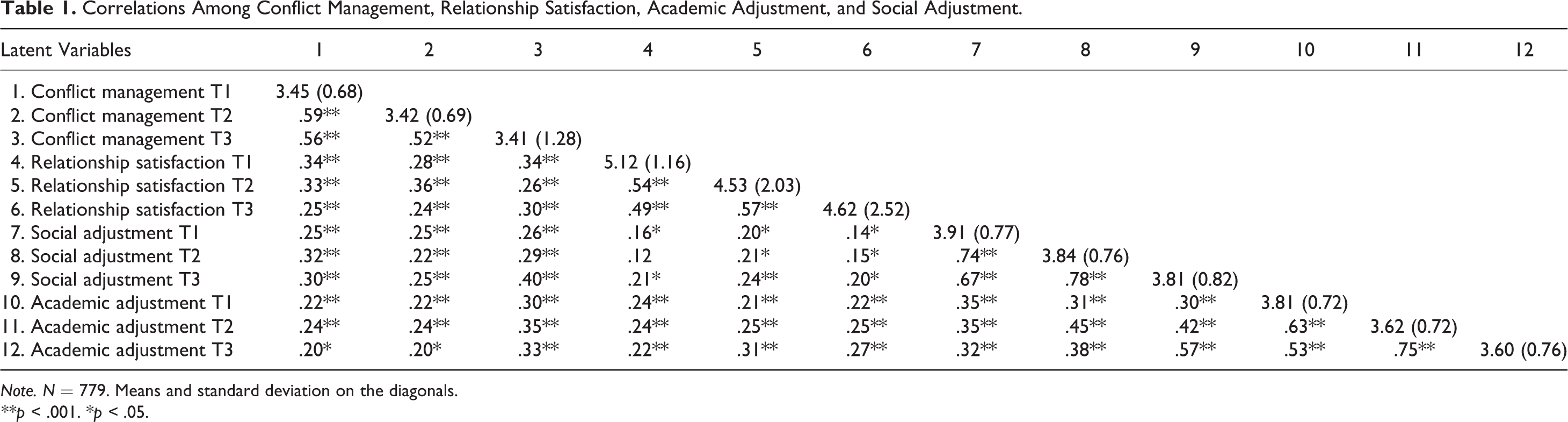
Note. N = 779. Means and standard deviation on the diagonals.
**p < .001. *p < .05.
Social Adjustment
Results of the first cross-lag path analysis are shown in Figure 1. We controlled for base levels of the T3 outcome variables (e.g., T3 conflict management was regressed onto T1 and T2 conflict management). The fit indices indicated acceptable model data fit (Kline, 2011): χ2/df (6, n = 265) = 1.77, p = .10, comparative fit index (CFI) = .99, Tucker–Lewis index (TLI) = .97, root means square error of approximation (RMSEA) = .054 (90% confidence interval [CI] = [.000, .106]), and standardized root mean square residual (SRMR) = .020.
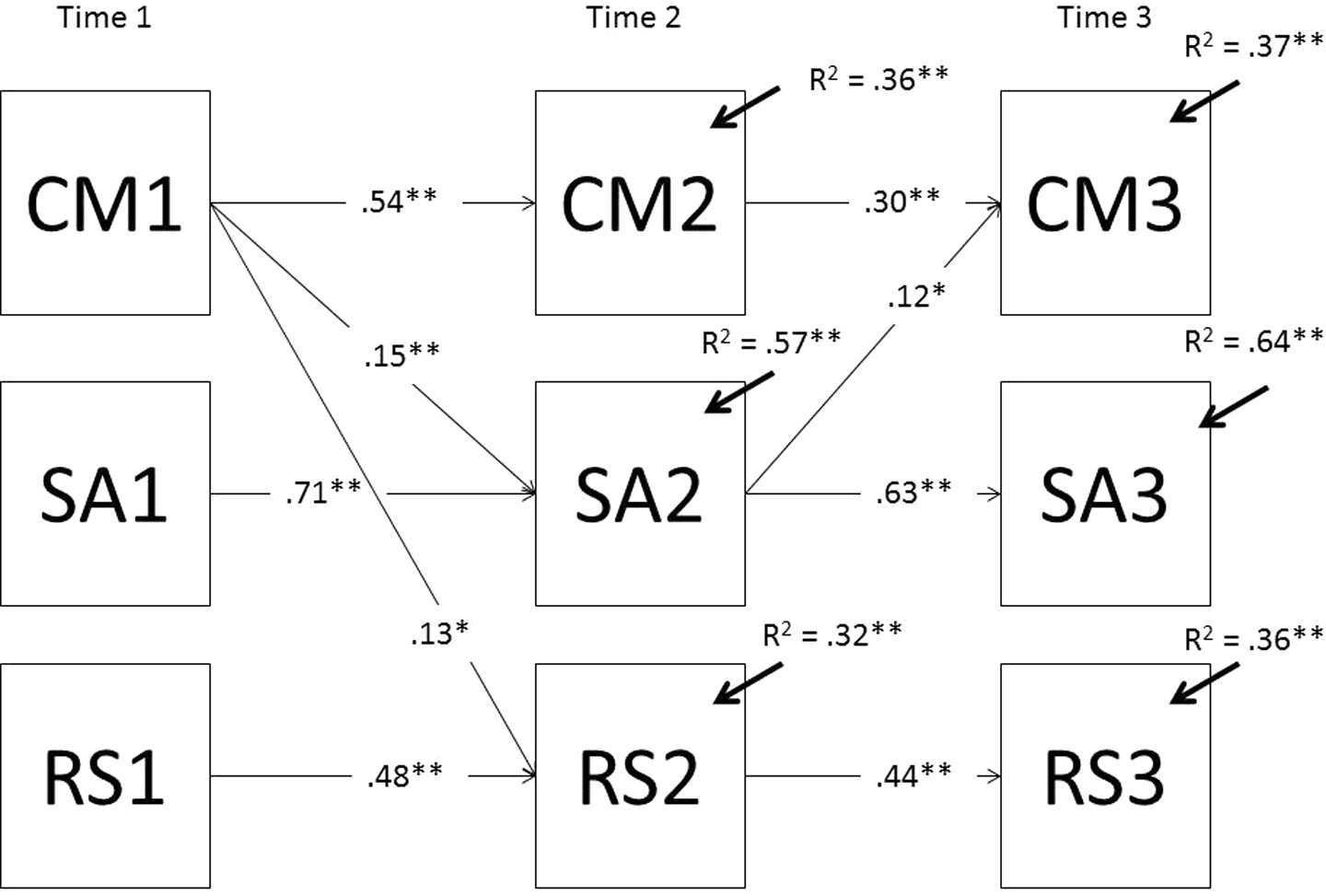
Cross-lagged path analysis with the variables social adjustment, relationship satisfaction, and conflict management measured at all three time points.
Overall, it appears that there is a spillover between relationship characteristics and social adjustment. Some of the indirect paths from the cross-lag indicated that there is mutual relationship between conflict management and social adjustment over time. To examine if the indirect paths indicated by the cross-lag analysis were significant, we ran the model using 2000 bootstraps (see Table 2). The bootstrap results indicated that conflict management at T1 was related to social adjustment at T3 through social adjustment at T2 (β = .10, p = .005) and social adjustment at T1 was related to conflict management at T3 through social adjustment at T2 (β = .08, p = .02). However, the indirect path from conflict management at T1 to social adjustment at T2 to conflict management at T3 was only marginally significant (β = .02, p = .09), though the upper and lower bounds of the parameter did not straddle zero (an indication that the parameter is not likely zero).
Bootstrapping Standardized Estimates for Indirect Paths Within the Cross-Lag Path Analysis for Social Adjustment and Academic Adjustment.
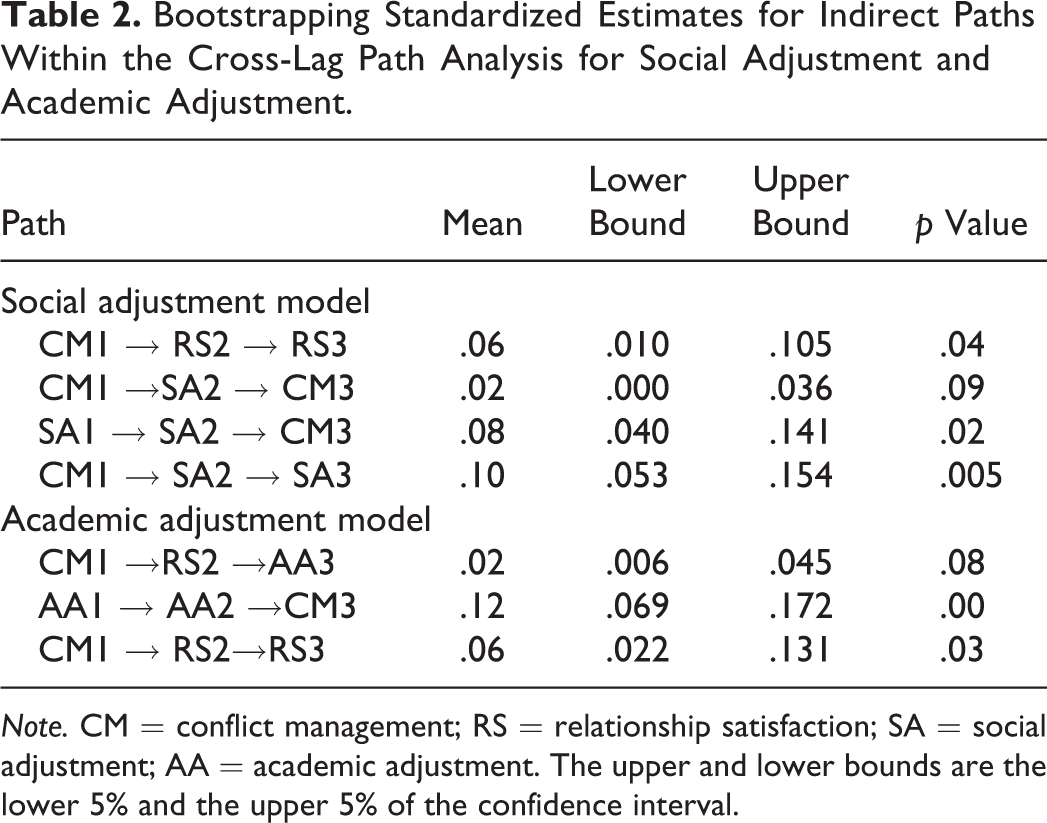
Note. CM = conflict management; RS = relationship satisfaction; SA = social adjustment; AA = academic adjustment. The upper and lower bounds are the lower 5% and the upper 5% of the confidence interval.
Academic Adjustment
Results of the second cross-lag path analysis are shown in Figure 2. None of the control variables (relationship type, relationship stability, year in school, and gender) were significant. Like the social adjustment cross-lag path analysis, we controlled for base levels of the T3 outcome variables (e.g., T3 academic adjustment was regressed onto T1 and T2 academic adjustment). The fit indices indicated acceptable model data fit (Kline, 2011): χ2/df (6, n = 265) = 1.56, p = .15, CFI = .99, TLI = .98, RMSEA = .046 (90% CI = [.000, .099]), and SRMR = .017.
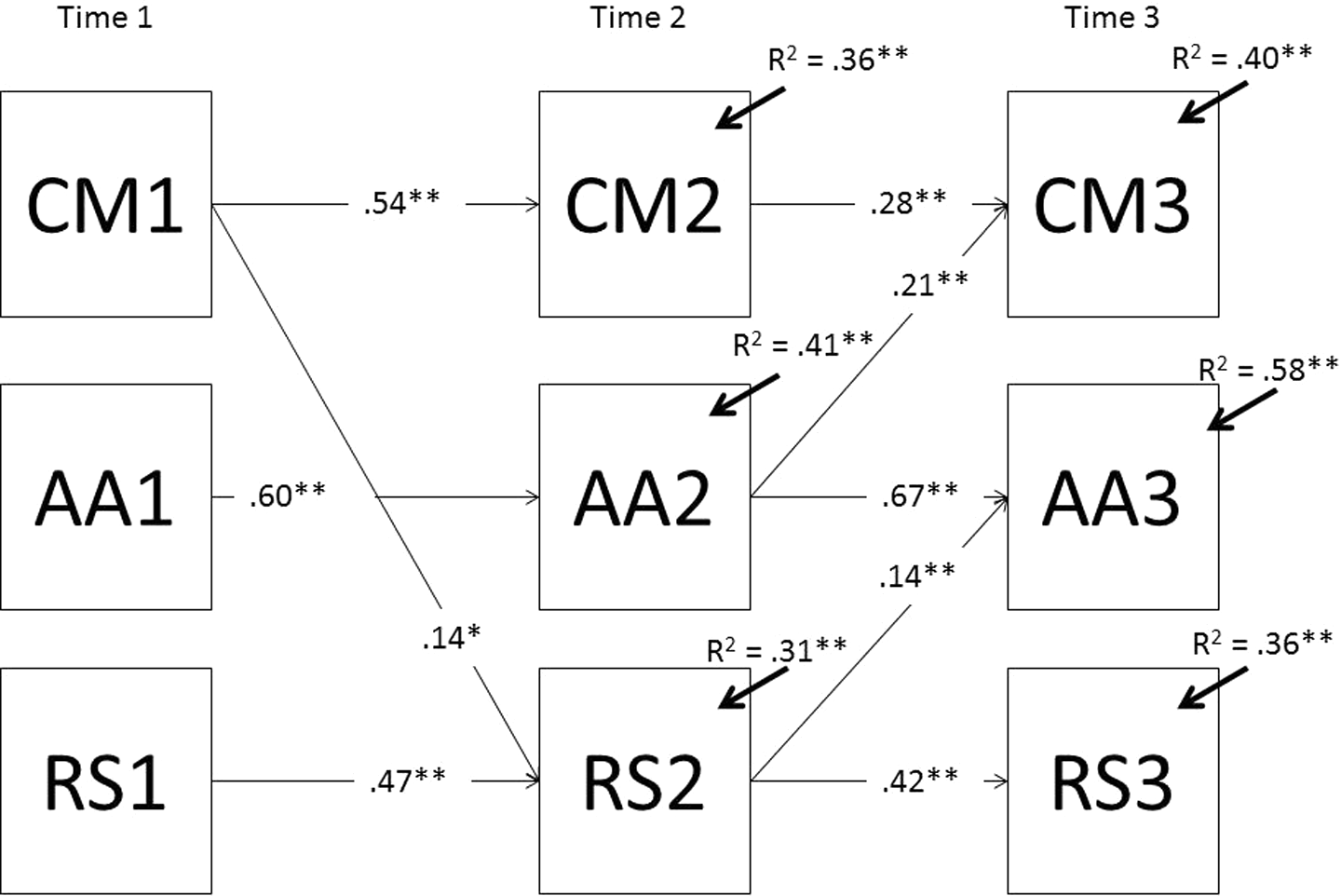
Cross-lagged path analysis with the variables academic adjustment, relationship satisfaction, and conflict management measured at all three time points.
It appears that there is a spillover between relationship characteristics and academic adjustment. Some of the indirect paths from the cross-lag analysis indicated a mutual relationship between conflict management, relationship satisfaction, and academic adjustment over time. We ran the model using 2000 bootstraps to examine if these indirect paths were significant (see Table 2). The bootstrap results indicated that conflict management at T1 was related to academic adjustment at T3 through relationship satisfaction at T2 (β = .02, p = .04) and academic adjustment at T1 was related to conflict management at T3 (β = .12, p = .001) through academic adjustment at T2.
Discussion
In this study, we examined the spillover effect between two developmental domains among emerging adults guided by the following two research questions: (a) What are the relations among characteristics of romantic relationship and social adjustment in college over the course of a semester? and (b) What are the relations among characteristics of romantic relationship and academic adjustment in college over the course of a semester? Overall, the results provided support for the view that aspects of romantic relationships and aspects of college have a transactional sequence of effect over time. This is in line with previous studies which have indicated the dual influence of intellectual and social factors on college adjustment (Dyson & Renk, 2006; Larose et al., 1998; Upcraft & Gardner, 1990; Wei et al., 2005).
First, we examined the relationship between conflict management, relationship satisfaction, and social adjustment. Our results showed that conflict management is related to an individual’s later perception of relationship satisfaction. These findings are congruent with previous research, highlighting the relationship between partner conflict and relationship satisfaction (Bradbury et al., 2001; Fincham & Beach, 2010; Halford et al., 1990). Further, this model indicated the mutual influence of conflict management and social adjustment to college over time. Previously, studies have found that functional parent–child relationships and peer relationships are related to adjustment to college (Magolda, 1992; Wei et al., 2005). Our findings extend this supposition by illustrating the relationship among effective conflict resolution in romantic relationships and social adjustment to college, and that this relationship is bidirectional.
Next, we examined the association between conflict management, relationship satisfaction, and academic adjustment. In one of the direct paths, conflict management is related to later academic adjustment through relationship satisfaction in a positive direction. That is, individuals who report more satisfied with their relationship and better conflict management skills also reported better adjustment to academic aspects of college. This finding is consistent with previous studies illustrating the association between relationship satisfaction and aspects of individual development, such as educational attainment (Larson et al., 2007). Further, informed by Shulman and Connolly’s (2013) review and Bronfenbrenner’s conceptualization of development (e.g., Bronfenbrenner & Morris, 2006), these findings suggest that characteristics of romantic relationships may be related to later academic adjustment to college due to a spillover of competence or dysfunction in multiple developmental domains. Possible modifiable intrapersonal mechanisms for this spillover include depression, loneliness, anxiety, or self-worth.
It is noteworthy that relationship satisfaction and social adjustment were not related, but relationship satisfaction and academic adjustment were related in separate models. This finding points to a possible explanation of how spillover between developmental domains may occur. Specifically, individual’s perception of how they interact with their partner (i.e., conflict management) may be more influential for social adjustment to college than their overall satisfaction with their relationship. This could be due to interpersonal behaviors in one domain of development “spilling over” more readily into other domains of development compared to intrapersonal feelings of satisfaction.
Limitations
Our findings need to be interpreted in the light of several limitations. First, our sample was limited to students in romantic relationships across all waves (30.4% of the original sample). Although necessary to address our hypotheses, this may have created a selection effect whereby the included participants only represents those in more stable, higher functioning relationships. Future studies may benefit from exploring how spillover from relationship’s instability (e.g., breakups, hookups, and cyclical relationships) affect these processes. Second, our study assessed men and women enrolled in one course from a single southeastern public university. Our findings should be replicated in future studies that use larger samples of emerging adults from multiple universities. Similarly, racial and ethnic minority groups as well as men were more likely to drop out of the study compared to Whites and women; thus, these results are not generalizable to these groups. Also, individuals in this sample predominantly self-identified as heterosexual, therefore results are not generalizable to sexual minority relationships. Future studies should focus specifically on differences between men and women as previous studies have found that romantic relationships are associated with their physical and mental health differently (Palner & Mittelmark, 2002) and may thus be related to other individual outcomes including college adjustment.
Third, we measure assessments through participant’s self-report and only one relationship partner. As a result, we were unable to explore how variables related to each other while controlling for partner effects over time. Future research should collect dyadic data and employ more advanced statistical methods such as the actor–partner interdependence models (APIMs; Kenny, Kashy, & Cook, 2006) to capture the role of partners in the process of college adjustment. Additionally, this study used a single-method design and future studies may benefit from a mixed-method design that incorporates qualitative research methods. Additionally, Cole and Preacher (2014) recently discussed concerns when using manifest variable path analysis including misestimation of path coefficients, which can ultimately change substantive conclusions. For this study, misestimation and changes in substantive findings may have been prevented because of the reliability of our measures.
Implications
Because this study was among the first to examine the role of specific emerging adult relationship characteristics vis-à-vis college adjustment, there are several research questions that should be explored based on these findings. First, it is important to consider how other social aspects of college life (e.g., social networks, extracurricular activities, financial security, and family support) and other aspects of romantic relationships (e.g., relationship ambiguity, infidelity, instability, and partner support) interact with academic and social adjustment. This study shows a bidirectional relationship between aspects of romantic relationships and academic and social adjustment to college, but there is still considerable variance to be explained in the outcome variables (see Figures 1 and 2) suggesting that other factors may be related to subsequent adjustment.
Further, alternative models may reveal a cumulative association of support from close romantic and nonromantic others or that specific individual (i.e., intelligence, coping, and personality) or contextual (i.e., social support, parental support, and living arrangements) variables may have cumulative or buffering effects on other predictors of college adjustment. As such, future studies should consider replicating these findings with other types of social relationships (e.g., friends, family, or roommate relationships) and with additional predictors of college adjustment (e.g., grade point average, persistence to graduate). It is also possible that between-group comparisons of individuals in romantic relationships and those who are not in romantic relationships may reveal differences in college adjustment not attributable to romantic relationships. Similarly, because emerging adulthood includes relationship exploration, future research may consider studying other types of relationships (e.g., friends with benefits, cyclical relationships, or long distance relationships). Future studies should also examine how the broader context of a relationship influences career development among emerging adult populations not attending college (i.e., transitioning to the workforce post high school).
Finally, future research should examine the relationships among the variables included in this study over a longer period of time and with more constraints on developmental timing. For example, our study examined the relationships during one semester of college, so adjustment beyond one semester is unknown. Also, although we controlled for year in school, we did not limit the sample to first-year students. That is, individuals who reported being in their second, third, or fourth year of college may not show the same struggle with adjustment as first-year college students. Studies exploring the association between relationship dynamics and adjustment from the onset of college could employ more sophisticated longitudinal methodologies such as growth curve modeling, likely yielding a more complete picture of influences on college adjustment, dropping out, and/or graduation.
Findings presented here are also relevant for those attempting to promote the well-being and adjustment of college students. Understanding the college adjustment process is imperative due to high rates of dropout (Aud et al., 2011) as the consequences of dropping out are directly related to a number of occupational and personal outcomes over the life span (e.g., lower lifetime wage earnings, poorer health, and fewer opportunities for future generations; Baum & Ma, 2007). Our findings suggest that conflict management in relationships and relationship satisfaction are positively associated with adjustment to college. Therefore, college administrators focusing on retention may consider implementing courses or workshops that introduce conflict management skills and relationship education in an effort to increase rates of retention. Students who take these classes may experience improved college adjustment due to the spillover of competence in multiple domains of individual development (see Fincham, Stanley, & Rhoades, 2011 for a more comprehensive review of relationship education in college). Further, for those professionals studying adjustment to college, these findings provide insight into the multidimensionality of college adjustment and the importance of understanding conflict and satisfaction in romantic relationships when predicting positive outcomes in both the academic and the social components of college adjustment.
Notwithstanding the previous implications and needs for future research, this study shows that romantic relationships among emerging adults are relevant for understanding college adjustment. The importance of advancing understanding of such relationships is emphasized not only by their potential to impact college adjustment in the short term but also because of potential long-term outcomes such as lifetime earnings.
Footnotes
Declaration of Conflicting Interests
The authors declared no potential conflicts of interest with respect to the research, authorship, and/or publication of this article.
Funding
The authors disclosed receipt of the following financial support for the research, authorship, and/or publication of this article: This study was made possible through Grant 90FE0022/01 from the Department of Health and Human Services Administration for Child and Families awarded to the last author.