



Abstract
Within the rapidly growing literature on emerging adulthood worldwide, studies examining this concept in African countries are virtually nonexistent. In an effort to continue the inclusion of other countries and cultures in the discussion of this developmental concept, there is a need to conduct research on emerging adulthood in African countries. The purpose of this study was to examine the perspectives on the markers of adulthood among emerging adults at selected universities in Ghana and Nigeria. Results reveal that the markers of adulthood among youth in Ghana and Nigeria are eclectic, with strong ties to sociocultural factors. The findings of this study make several important contributions to the literature for our understanding of the concept of emerging adulthood and serve as anchor for further research in the field of emerging adulthood in West Africa.
Emerging adulthood has been conceptualized as a developmental stage marked by exploration, increased mobility, ambivalence, and ambiguity for young people typically between the ages of 18 and 30 (Arnett, 2000, 2001, 2003). A rapidly expanding body of research examining the features of this developmental stage around the world provide compelling evidence of this distinctive stage of life which transcends socioethnic and sociogeographic groupings (Arnett, 2003; Atak & Cok, 2008; Facio, Resett, Micocci, & Mistrorigo, 2007; Seiter & Nelson, 2011). Despite the amount of work that has been done examining features of emerging adulthood in a variety of countries and cultures around the world, relatively little attention has been directed toward examining young people’s perceptions of adulthood in countries in Africa. Africa is a continent made up of 54 countries rich in traditional values, history, and culture. In addition to traditional culture, other factors such as colonization, decolonization, education, urbanization, and more recently economic, social, and cultural globalization, (and in some cases war) have led to significant social and cultural transformations throughout the continent. Consequently, young people in this part of the world are making the transition to adulthood within a very eclectic and dynamic culturalcontext. There is so much that needs to be learned about how young people between the ages of 18 and 30 in Africa, experience the transition to adulthood, but the research in this area is almost nonexistent. In fact, very little is known regarding how young people view their status as adults or what young people think is needed in order to become an adult in a rapidly globalizing Africa. Therefore, the main purpose of this study is to examine perceptions of the markers (i.e., criteria) of adulthood among emerging adults in two Anglophone countries in West Africa, Ghana and Nigeria. These countries are also the most populated countries in West Africa.
Emerging Adulthood
Based primarily on work conducted in the United States, Arnett (2000, 2004) has proposed a theory of emerging adulthood that attempts to characterize the development of young people roughly aged 18 to the mid- to late 20s. According to Arnett’s theory, the distinct features of this time period set it apart as a period of development that is unique from both adolescence and adulthood. These features include feeling in-between, identity exploration, focus on the self, instability, and age of possibilities. In describing these features of adulthood, Arnett (2011) acknowledges that both economic/demographic and cultural factors influence the existence of the features of emerging adulthood. There is now a rather expansive amount of work supporting the notion that culture plays a role in the extent to which young people feel like adults and the criteria they have for adulthood (see R. Nelson & Luster, 2016, for a review). Findings from studies so far indicate that while similar criteria or “markers” of adulthood are shared across many cultures, young people value those markers differently depending on their societal and cultural perspectives or their socioeconomic status (Arnett, 2003; Atak & Cok, 2008; Facio et al., 2007; L. J. Nelson, 2009; L. J. Nelson, Badger, & Wu, 2004; L. J. Nelson & Cheah, 2004). Research conducted in different countries such as United States (Arnett, 2003), China (L. J. Nelson et al., 2004), Romania (L. J. Nelson, 2009), India (Seiter & Nelson, 2011), Argentina (Facio et al., 2007), Turkey (Atak & Cok, 2008), and among specific subgroups within larger cultures (e.g., Canadian Aboriginals, L. J. Nelson & Cheah, 2004; young Mormons in America, L. J. Nelson, 2003) also show that culture shapes the weight given to each marker of adulthood. Unfortunately, there is little, if any, work examining the extent to which young people in West Africa feel like adults or the criteria they have for what is needed to become an adult.
Markers of Adulthood in Ghana and Nigeria
Traditionally, West African cultures have been known to have distinctive markers for developmental transitions. For example, historically in traditional societies in Ghana, the transition to adulthood was marked by marriage which usually took place immediately after puberty and marked the attainment of adulthood, particularly for girls. For boys, attaining greater economic independence, which may include more roles and responsibilities in the household, marked the transition to adulthood (Mensch, Bagah, Clark, & Binka, 1999).
Similarly, there have been rather clear paths to adulthood within the traditional Igbo society in Nigeria. Historically, Igbo traditional values have emphasized family togetherness, moral and spiritual awareness, hospitality, responsibility, procreation, hard work, and large family size (Dike, 1985). Transition to adulthood was marked by the attainment of puberty, which was celebrated with ceremonies that were focused on preparing young people for adult roles through the sharing of social expectations (Ugwueze, 2011). Such preparations were gender-specific. After the puberty ceremonies, preparations for adulthood continued, usually involving teaching women how to manage a home. The ultimate determinant of adult status was marriage and subsequent childbearing in the Igbo society.
For years, these traditional practices helped clearly demarcate the transition from childhood to adulthood in Ghana and Nigeria. Although some of the cultural and traditional markers of adulthood remain largely relevant among the Igbo of Nigeria and the Akan of Ghana, within the last century, social change has had significant impact on how the transition to adulthood is experienced in Nigeria and Ghana. For example, social change brought about by colonialization, specifically increased access to education and schooling for young girls, led to the alteration of several cultural stipulations and practices (Mensch et al., 1999) that governed the transition to adulthood for young women in traditional societies. Furthermore, both survey data and anecdotal evidence suggest that young people in Africa, like their peers in Western cultures (e.g., United States, Europe), are delaying marriage into their mid- to late 20s, hence extending the period of youthful exploration, for some, into the 30s.
Another change that is affecting young people is the rapid internationalization of national and local markets driven strongly by forces of economic globalization. This is creating a mixed economic environment for young people as the effects of economic change mark the creation of new opportunities for some (often leading to migration from urban areas to rural ones) but also economic dispossession for others (Obidoa, 2010). Also, as a result of globalization, young people are being increasingly exposed to Western ideas and popular culture that introduce new ideas that are different from beliefs and practices found in their traditional cultures (Obidoa, 2010).
Just as economic changes and greater exposure to Western culture appear to have influenced the way young people from non-Western cultures think about what it means to become an adult (e.g., Cheah & Nelson, 2004; L. J. Nelson & Chen, 2007; Seiter & Nelson, 2011), it may be that the changes occurring in West Africa are similarly influencing what young people think is needed to become adults.
In her study examining paths to adulthood among youth in Accra, Ghana, Langevang (2008) declared that although youth employ cultural ideals and social expectations of what a respectable future looks like in their navigation through life and toward adulthood, “achieving a respectable adulthood in present-day Accra is a complicated and convoluted journey” (p. 2039). Indeed, a consensus of definitive criteria for marking adulthood has not necessarily emerged to replace the traditional markers that many young people are negotiating. Hence, there is varied and inconsistent consensus on what defines entry into adulthood across groups in Ghana and Nigeria.
This study seeks to examine young people’s perceptions of the markers (i.e., criteria) of adulthood in Ghana and Nigeria, respectively, and to determine whether their perception of markers of adulthood is a function of gender differences.
Method
Participants
The results presented in this study are drawn from two study sites in two countries, Ghana and Nigeria. In Ghana, participants included 215 students (85 [39.5%] males, 130 [60.5%] females) aged 18–30 (M = 20.8 years, standard deviation [SD] = 2.1)] from the University of Ghana, Legon. The country of Ghana is made up of 75 ethnic groups, some of the largest ethnic groups are the Akan (47.5%), Mole-Dagbon (16.6%), and the Ewes (3.9%) (Ghana Statistical Service, 2010). Participants in this study reflected this ethnic diversity with 42.9% of participants being Akan. The University of Ghana (2014) is the premier university and the largest of the six public universities in the country with a current student population of about 29,754 (representing male:female ratio of about 2:1). The University of Ghana is located in the township of the Greater Accra Region, where the seat of the government and most prestigious educational institutions are located.
In Nigeria, participants included 242 students (108 males, 133 females, 1-gender missing value) ages 16–30 (M = 21.4 years, SD = 2.9) from the University of Nigeria, Nsukka (UNN). As a whole, the country is home to more than 250 different ethnic groups and more than 400 indigenous languages are spoken across these groups (Mabogunje, 2009; Onigu, 1990). The three largest ethnic groups are Hausa (21.3%), Yoruba (21.3%), and Igbo (18%; Fernandez et al., 2000). Participants in this study were predominantly Igbo because the study site (the University of Nigeria) is located in the southeastern part of Nigeria which is ethically and linguistically Igbo. The UNN is Nigeria’s first indigenous university, established in 1960. It is one of Nigeria’s premier universities, with 17 schools and colleges and over 100 academic departments (University of Nigeria, 2014). Nsukka is a township located approximately an hour north of Enugu city, the capital of Enugu state in the southeastern part of Nigeria.
Measures
Criteria for adulthood
The participants were administered a 43-item questionnaire that was developed by Arnett (1997) and has been used and validated in numerous studies around the world examining emerging adulthood in a variety of cultures (e.g., Arnett, 1998, 2003; Barry & Nelson, 2005; Cheah & Nelson, 2004; Facio & Micocci, 2003; Mayseless & Scharf, 2003; L. J. Nelson, 2003; L. J. Nelson & Barry, 2005). Specifically, in order to assess criteria for adulthood, all participants were presented with a list of possible criteria for adulthood (e.g., “finishing education,” “avoid drunk driving,” and “accept responsibility for the consequences of your actions”). Participants were asked to give their opinion on the importance of each of the following in determining whether or not a person has reached adulthood. They could rate each item on a scale of 1 (not at all important) to 4 (very important).
Translation of the questionnaire was not necessary for this cross-cultural study because English is the official language spoken in both countries; however, vocabulary and sentence structure were evaluated carefully to guarantee participant comprehension.
Adult status
To assess adult status, Nigerian emerging adults were asked the following question: “Do you think that you have reached adulthood?” Their response options included yes, no, or in some respects yes, in some respects no. This method of adult-status classification has been used elsewhere (e.g., Arnett, 1998, 2003; L. J. Nelson & Barry, 2005).
Analysis
Descriptive indices (mean and SD) were computed for each item and subscale. Percentage of participants who responded in the affirmative for each scale item was also computed (agree and strongly agree were coded as yes). Independent t test was performed to examine whether subscale means differ by gender in each country.
Results
Nigeria
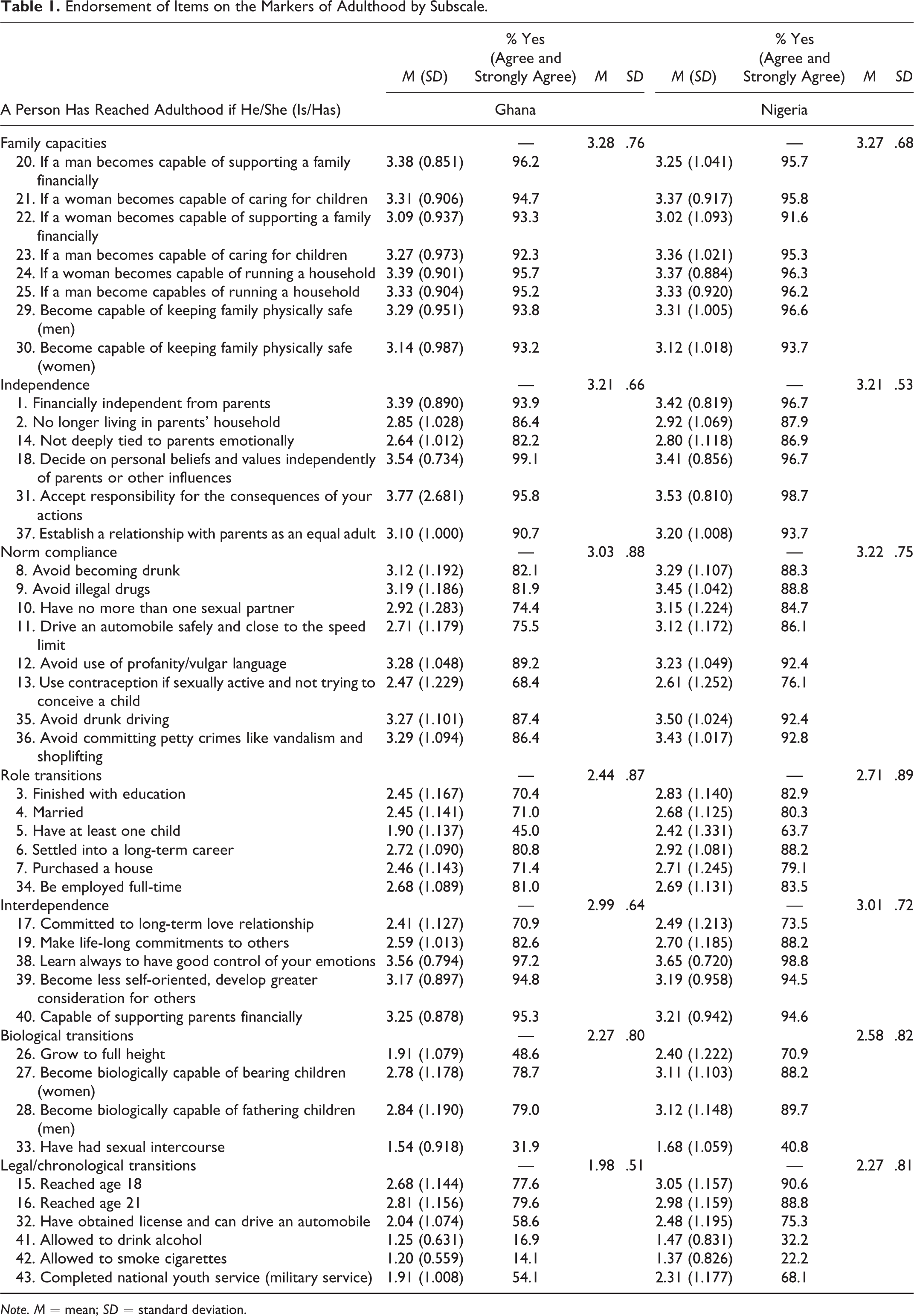
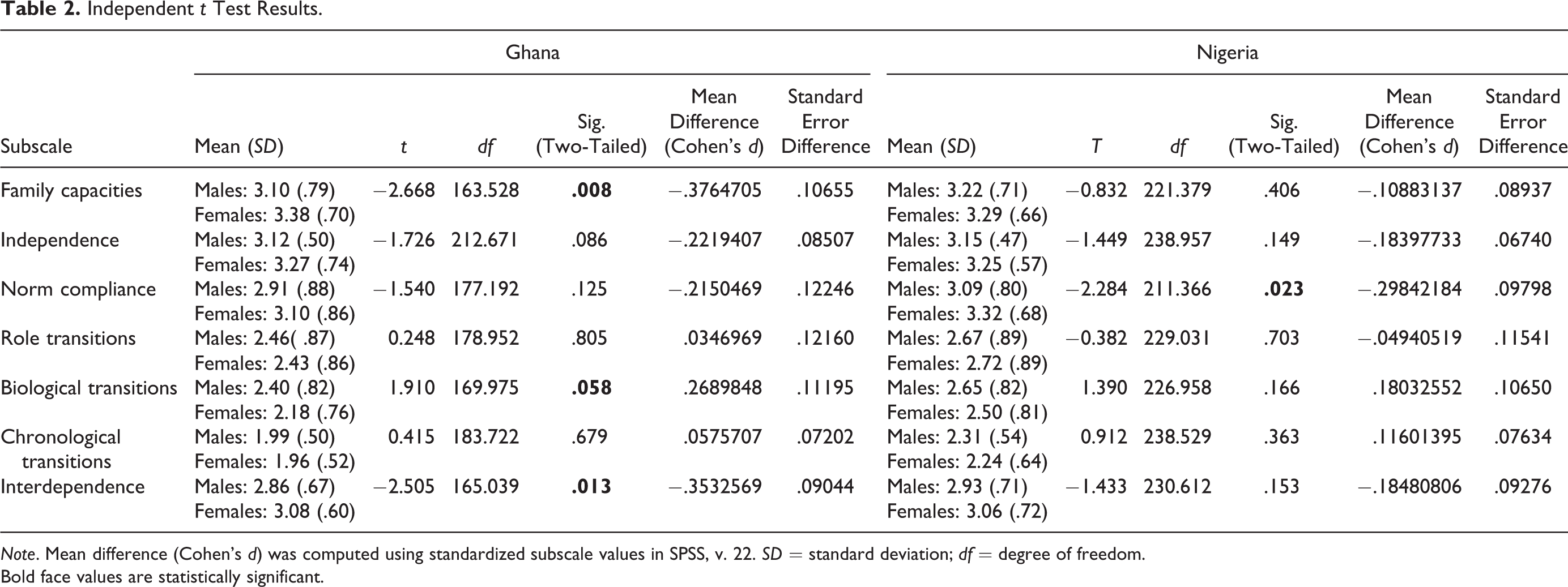
The percentage of participants who responded in the affirmative (we added the “agree” and “strongly agree” responses to get this value) for each item is presented in Table 1. The five criteria with the highest percentages are as follows: learn always to have good control of your emotions, accept responsibility for the consequences of your actions, make independent decisions, becoming financially independent, and becoming capable of keeping family physically safe. Table 1 also displays the means and SDs of subscales. Nigerian emerging adults rated family capacities as the most important criteria for achieving adult status followed by norm compliance, independence, interdependence, chronological transitions, role transitions, and finally biological/age transitions. Norm compliance differed significantly by gender (t = −2.284, p = .023). Females recorded a higher mean for this subscale. Table 2 displays the results from the t test.
Endorsement of Items on the Markers of Adulthood by Subscale.
Note. M = mean; SD = standard deviation.
Independent t Test Results.
Note. Mean difference (Cohen’s d) was computed using standardized subscale values in SPSS, v. 22. SD = standard deviation; df = degree of freedom.
Bold face values are statistically significant.
Youth perspectives on attainment of adulthood—feeling in-between
In response to the question “do you think you have reached adulthood?,” 61.4% responded “yes,” 20.7% responded “no,” and 17.8% indicated “in some respects yes, in some respects no” (not sure).
Ghana
The percentage of participants who responded in the affirmative (we added the agree and strongly agree responses to get these values) for each item is presented in Table 1. The five criteria with the highest percentages are make independent decisions, learn always to have good control of your emotions, if a man becomes capable of supporting a family financially, accept responsibility for the consequences of your actions, and if a woman becomes capable of running a household. Table 1 also displays the means and SDs of subscales. Emerging adults in Ghana rated family capacities as the most important criteria for achieving adult status followed by independence, norm compliance, interdependence, role transitions, biological/age transitions, and, finally, chronological transitions. The following subscales were significantly associated with gender: Biological Transitions (t = 1.910, p = .058), Interdependence (t = −0.2.50, p = .013), and Family Capacities (t = −2.66, p = .008). Females recorded higher means for family capacities and interdependence, while males recorded higher means for biological transitions.
Youth perspectives on attainment of adulthood—Feeling in-between
We mistakenly omitted the “not sure option” in the version of the survey administered to the Ghanaian sample for the question “do you think you are an adult,” consequently we do not have responses for that option.
Discussion
Within the last two decades, emerging research on emerging adulthood in various cultures around the world has provided evidence and more insight into the emerging adulthood period. However, very few of these studies have examined the markers of adulthood in African cultures in the 21st century. Findings from this study provide some of the first results regarding the perceptions of markers of adulthood using the Arnett scale in Ghana and Nigeria among emerging adults within the context of modern globalization.
Results from data analysis revealed some similarities and differences between the two countries. The subscales with the highest scores for what is needed to consider oneself an adult in Ghana and Nigeria were family capacities, independence, and norm compliance. The subscales with the lowest level of affirmation were biological, role, and chronological transitions. Results from this study also revealed interesting perspectives on attainment of adulthood among emerging adults in Nigeria. Sixty-one percent (61.4%) of this sample aged 16–30 years indicated that they think they have reached adulthood. Although this shows that the majority of young people felt they had reached adulthood, a sizable proportion (20.7%) of the sample indicated that they did not think that they have reached adulthood, while 17.8% identified as feeling somewhere in between adolescence and adulthood (“in some ways yes, in some ways no”).
First, these findings are noteworthy because they reveal that the proportion of Nigerian youth who feel they have reached adulthood is comparable to that of several other countries.
For example, 61.4% of young people feeling like adults is similar to what has been found in India (61%; Seiter & Nelson, 2011) and China (59%; L. J. Nelson et al., 2004).
More notable than the number of young people who felt they were adults is the fact that only a very small percentage (17.8%) reported experiencing a sense of “feeling in-between.” These findings are not comparable to those made in other studies. The majority of the studies reported a higher proportion of youth with a strong sense of “feeling in-between”. For example, 24% of young Mormons in the United States (L. J. Nelson, 2003), 59.3% of Greek undergraduate students (Petrogiannis, 2011), 50% of Romanian youth (L. J. Nelson, 2009), and 26% of Indian youth (Seiter & Nelson, 2011) all indicated they were not sure if they had reached adulthood. Few if any cultures studied to date have shown such a small number of young people responding “in some ways yes, in some ways no” when considering their status as adults.
It appears that a sizeable number of Nigerian emerging adults do not exhibit ambivalence (“sense of feeling in-between”) regarding their status as adults. The question of why that may be requires an examination of the results via the lens of cultural socialization in Nigerian communities. One possible explanation may come in examining the socialization practices common in many Nigerian communities.
Specifically, in Nigeria, raising children is a shared responsibility. Family members (nuclear and extended), family friends, neighbors, church members, and even strangers all contribute to educating and grooming youth for adulthood. It is not uncommon for youth to receive reprimands in public or at home following the exhibition of a behavior or attitude that is considered immoral or immature. A lot of times reprimands are delivered in language that depicts that the individual is “too old” to be acting in that manner and that he or she has outgrown that type of behavior or that such behavior or thinking is for children not for adults.
Constant reminders of what it means to be an adult and the incessant enforcement of attitudinal and behavioral compliance with such ideals invariably educates youth about socially accepted behavior for their age and prepares them to take on the identity as prescribed by the adults around them. This kind of verbal and sometimes nonverbal communication regarding behavior that is appropriate for adulthood starts during late adolescence and intensifies during and throughout the 20s. It is therefore not a surprise that the majority of youth in this sample consider themselves either an adult or not and not many find themselves in the state of “in betweenness.” It appears that the communication they get places them in one of the two spaces (adult or not adult). This communication is clear enough to convince them of which side they belong, which for most of them is not in the middle. The role of verbal communication and feedback in shaping emerging adulthood identity and perspectives on attainment of adulthood is worth further exploration in future research.
This cultural explanation of what might be occurring in the socialization toward becoming an adult might also explain the findings regarding perceptions of the criteria for adulthood. Specifically, older children and adolescents are often reprimanded based on whether the behavior is appropriate for one’s age (e.g., “you’re too old to be acting like that”). Hence, a view of what it means to be an adult is predominantly evaluated based on how one acts (e.g., ability to care for a family, norm compliance) rather than on an event (e.g., role transition such as marriage) or age (e.g., biological/age transitions).
Gender differences were evident for several subscales. In Ghana, females recorded higher means for family capacities and interdependence, while males recorded higher means for biological transitions. These gender differences can be explained via the lens of sociocultural values. In Ghanaian cultures, women are largely socialized to become caregivers and caretakers of the home. Their prominent role in procreation positions them to be recipients of education and training relevant for childbearing. The high value placed on children in many societies’ means that there is an expectation that every married woman will bear children and be able to raise them. The significant impact childbearing also has on one’s life with regard to the respect accorded to a parent by other members of the society elevates this marker of adulthood to a prominent place for females. The fact that females in this study scored higher on family capacities and interdependence reveals that these are the markers that are communicated to them as important at a higher level than what may be communicated to and expected of young men. Alternatively, males are socialized to take a greater responsibility in earning a living and for providing the material and monetary resources for running a home. It is not surprising to note that males had higher means for biological transitions, which include items such as “has reached full height,” “biologically capable of bearing children.” These benchmarks represent important transitions in life that usher young males into adult roles endorsed by the society.
Limitations
Although the study makes numerous contributions, it is not without limitations. We did not get an objective measure of socioeconomic status. Consequently, we are unable to assess its influence on perspectives of adulthood in the study populations. We also mistakenly omitted the “not sure option” in the version of the survey administered to the Ghanaian sample. Consequently, we do not have responses for that option. Although we do not believe that this constitutes a major problem in the interpretation of our findings in regard to Nigeria, future work needs to examine whether or not young people in Ghana are indeed like their peers in Nigeria in regard to perception of the attainment of adult status. This sample is also comprised of college students only. Results may be different for nonstudents living in urban and/or rural settings. Future work should explore the perceived experience of adulthood among young people not in school and in various settings (i.e., rural vs. urban settings).
Conclusion
This study adds to the growing body of knowledge on the emerging adulthood experience and has specifically showcased perspectives of markers of adulthood among young adults in Ghana and Nigeria. Findings from this study contribute further to our understanding of the opinions of young adults on the markers of adulthood in general and among Nigerian and Ghanaian youth specifically.
Footnotes
Author Contributions
Chinekwu A. Obidoa contributed to conception, design, acquisition, analysis, and interpretation; drafted the manuscript; critically revised the manuscript; gave final approval; and agrees to be accountable for all aspects of work ensuring integrity and accuracy. Bernice A. Dodor contributed to conception, design, acquisition, and interpretation; drafted the manuscript; critically revised the manuscript; gave final approval; and agrees to be accountable for all aspects of work ensuring integrity and accuracy. Vivian Tackie-Ofosu contributed to design, acquisition, and interpretation; critically revised the manuscript; gave final approval; and agrees to be accountable for all aspects of work ensuring integrity and accuracy. Mabel A. Obidoa contributed to design, acquisition, analysis, and interpretation; critically revised the manuscript; gave final approval; and agrees to be accountable for all aspects of work ensuring integrity and accuracy. Hilary R. Kalisch contributed to design and acquisition, drafted the manuscript, and gave final approval. Larry J. Nelson contributed to design, analysis, and interpretation; drafted the manuscript; critically revised the manuscript; gave final approval; and agrees to be accountable for all aspects of work ensuring integrity and accuracy.
Declaration of Conflicting Interests
The authors declared no potential conflicts of interest with respect to the research, authorship, and/or publication of this article.
Funding
The authors received no financial support for the research, authorship, and/or publication of this article.