




Abstract
This study investigated how emerging adults’ processes of individuation from their parents relate to their perceptions of Arnett’s defining features of emerging adulthood. It specifically examined differences in perceptions of emerging adulthood and individuation as functions of college-going versus non-college-going status, age across the full emerging adult range (18–29), and living situation (independently or with parents), as well as explored these factors’ potential moderating roles. Structural equation modeling analyses showed many of the positive dimensions of individuation (such as self-reliance and support-seeking from parents) related to the more adaptive features of emerging adulthood (such as identity exploration and sense of possibilities), though not all relations suggested developmental desirability. Perceptions of emerging adulthood differed by both college-going status and age; college-going status moderated many of the individuation-emerging adulthood relationships. The findings suggest perceptions of emerging adulthood cannot be fully understood without considering the roles of college-going, age, and individuation.
Individuation and the Defining Features of Emerging Adulthood: Relations and Differences by College-Going Status, Age, and Living Situation
Emerging adulthood (ages 18–29) is a developmental period that has been distinguished as unique in human development by its five defining features of identity exploration, sense of possibilities, instability, self-focus, and feeling in-between (Arnett, 2000; 2004; 2015). These features not only define common experiences of emerging adulthood, they may be viewed as normative indicators of developmental affordances and challenges in these formative years (Nelson, 2020). Emerging adulthood is a time during which most individuals leave the home of their parents, 1 enter college or begin a career, seek romantic relationships, gain financial independence, and make individual decisions on their own (Arnett, 2004; Barlett et al., 2020). As emerging adults become increasingly self-reliant, they continue to individuate themselves from their parents and turn to similarly-aged peers and romantic partners for support and companionship (Dykas & Siskind, 2020). The degree to and means by which individuals experience emerging adulthood through its five defining features can vary by how they gain independence from their parents during this developmental stage, and can significantly impact developmental outcomes (Kavčič & Zupančič, 2019). Thus, to better understand young people’s experiences of the five defining features of emerging adulthood—and, by extension, their positive development—it is important to consider the individuation process, along with possible conditioning factors that may affect these experiences and processes.
The Defining Features of Emerging Adulthood
The five defining features of emerging adulthood distinguish this period of life from the adolescent stage that precedes it and the adulthood stages that follow it (Arnett, 2006). Emerging adults explore their identities when seeking opportunities, sampling different careers, exploring romantic interests, and finding new hobbies (Arnett, 2015). Emerging adults’ identity is key psychosocial functioning (Noon et al., 2022), and becomes more established as they gain an understanding of who they are, and their strengths and limitations (Arnett & Mitra, 2018). Schwartz and colleagues (2005) found that identity exploration may be especially likely for emerging adults who adopt individualization tactics such as taking financial responsibility and making independent decisions. As emerging adults become more independent, they are often self-focused, attending more to their new obligations and commitments than to others, and less influenced by authority figures (Lanctot & Poulin, 2018). Emerging adults typically feel they have much to look forward to, accompanied by a sense of possibility and optimism for how their future will unfold (e.g., anticipation of a happy marriage or a successful career; see Arnett, 2015). Emerging adults often do not consider themselves adolescents or adults, but instead feel in-between (Arnett, 2015). They generally tend to gradually become psychologically independent and more accepting of responsibility for themselves through these years (Arnett et al., 2014). The normative experiences of change and transition in emerging adulthood can lead to feelings of instability and negativity (Arnett, 2004). Such experiences can be stressful, including moving out of one’s parents’ home, learning to cohabitate with a partner or roommate, new employment, and beginnings and endings of romantic partnerships and friendships (Arnett, 2015).
Individuation in Emerging Adulthood
The process of individuation 2 from one’s parents is age-normative during the emerging adult years (Scharf et al., 2004), and central to optimal development in this period (Reis & Buhl, 2008). Individuation theory (Youniss & Smollar, 1985) is one of the most widely used theories to describe the development of the parent–child relationship (Buhl, 2008) and has been conceptualized in developmental literature for decades (e.g., Mahler, 1963). Individuals’ second individuation (the first individuation occurring when an infant differentiates from their mother; Mahler, 1963) is a dyadic, co-constructed process involving parents and their children that usually begins in adolescence, extends through emerging adulthood, and is typically resolved by the time an individual reaches adulthood (Buhl, 2008; Kins et al., 2012; Youniss & Smollar, 1985). Successful individuation from parents involves redefining the parent-child relationship to become a more symmetrical adult-to-adult relationship (Smollar & Youniss, 1989). The process involves maintaining a healthy balance of connectedness, or feelings of attachment to parents, and individuality, or autonomy from parental authority (Youniss & Smollar, 1985). In the early years of emerging adulthood, adolescents’ dependence on their parents is typically replaced with self-regulated behaviors (Kins et al., 2012), which is also characteristic of the individuation process. This is particularly evident when emerging adults leave the parental home, which commonly accompanies a shift in the power balance related to young people’s decision making—this shift is characteristic of both emerging adulthood (Arnett, 2000) and successful individuation (Youniss & Smollar, 1985).
Komidar et al. (2014) drew on the content and dimensions of contemporary models of autonomy and parent– child relationships in emerging adulthood, as well as changes in emerging adulthood development as comparted to adolescents (Arnett, 2015), to advance five dimensions of individuation in emerging adulthood: support seeking, connectedness, intrusiveness, self-reliance, and fear of disappointing parents. Support seeking delineates an individual’s seeking of parental emotional support, approval, and advice in difficult or important situations. Connectedness reflects experiences of mutual understanding, respect, and trust, as well as perceptions of companionship and availability for open and sincere communication with one’s parents. Intrusiveness includes individuals’ perceptions their parents intrude on their privacy, are overly concerned, and desire to exert emotional control over them. Self-reliance reflects individuals’ belief that they can manage personal affairs, problems, and important decisions without parental assistance. The fear of disappointing parents dimension refers to an intrapersonal form of dependence on the parent, such as feelings of worry, anxiety, or guilt when one does not meet parental expectations.
Relations among the Dimensions of Individuation and Features of Emerging Adulthood
Komidar et al.’s (2014) dimensions of individuation have conceptual connections to Arnett’s (2015) features of emerging adulthood, though empirical investigations of links among these specific features and dimensions are lacking. However, previous research suggests considerable interconnectedness among similar concepts. For example, emerging adults who perceive their parents to exhibit intrusive qualities (i.e., limiting autonomy, controlling behaviors) are less likely to explore their identities and possibilities, and be self-reliant (Wider et al., 2016). Positive relationships and a sense of connectedness with parents typically contribute to positive identity exploration in emerging adulthood (Schnyders & Lane, 2018). Adolescents and young adults who feel more support from and connectedness with their parents are typically afforded more opportunities to explore possibilities in their careers and other life decisions (Guan et al., 2016), and experience lower levels of instability (Schnyders & Lane, 2018; Wider et al., 2016). Conversely, insecure attachments and negative relationships with parents can reduce the stability of emerging adults’ identity exploration process (Sager, 2015). Along these lines, when emerging adults are more conscientious and determined, they are less likely to fear disappointing their parents (Zupančič & Kavčič, 2014).
Given the common themes of autonomy and relatedness evident in the literatures on both the individuation process and defining features in emerging adulthood, we believe the relationships among them may be best understood through the theoretical lens of Kağıtçıbaşi’s (2005) autonomous-related self theory. In essence, this theory suggests adaptive self development in emerging adults entails their striking a healthy balance of distancing and boundary-setting with their parents while maintaining an appropriate degree of connectedness to them, simultaneously fostering their sense of agency as autonomous decision-makers who have a safety net of their parents’ support (instrumentally as needed and psychologically at all times). This process thus reflects emerging adults’ basic human needs for both autonomy and relatedness being met through healthy individuation from their parents (Kağıtçıbaşi, 2005).
Conditioning Factors of the Relations among the Dimensions of Individuation and Features of Emerging Adulthood
As importantly noted by (Bryant et al., 2021) our understanding of how constructs relate will only ever be partial without deeper investigation of their potential conditioning factors. Whereas there is strong conceptual and some empirical basis for interrelation among the dimensions of individuation and features of emerging adulthood, the extant literature provides little empirical basis for understanding how these relations might differ as a function of key developmental factors.
Perhaps most obvious among these prospective moderating factors is age. Though the defining features of emerging adulthood are thought to hold across the 18–29 age span, emerging adults report many of the features as becoming less defining from the beginning to the end of this developmental period (Arnett, 2015). Moreover, 18-year-olds are more likely to be living with their parent(s) than 29-year-olds—which likely impacts their individuation process (Kins & Beyers, 2010) as well as how it influences their experience of being an emerging adult (Koepke & Denissen, 2012)—suggesting living situation may be another prospective moderator. Additionally, attending college—a common but not universal experience among U.S. emerging adults—can result in a redefinition of the parent-child relationship (Lefkowitz, 2005); and the type and quality of the parental relationships and support may affect the well-being and college experience of emerging adults (Lindell et al., 2020) as well as how they experience the features of emerging adulthood (Hartman & Anderson, 2018). Whether emerging adults uniformly or differentially experience the features of emerging adulthood and the individuation process in relation to these factors, as well as what roles they may play in conditioning the relations among the dimensions of individuation and features of emerging adulthood, may have important theoretical and practical implications for the study of emerging adulthood, and real-world practices and programs impacting emerging adults.
The Role of Living Situation in Emerging Adulthood and Individuation
Emerging adults’ living situations in the U.S. are diverse; some continue live in the home of their parents, while others take steps toward residential independence and live alone, or with a partner or friend (Kins et al., 2009). Blevins et al. (2019) found that living situation was a better predictor of emerging adulthood status than college-going status, as many U.S. college-going emerging adults live at home during and after college, and experience less independence than those living in college residences or away from the parental home. Living situation may also be key to understanding individuation in emerging adulthood. For example, Mendonça and Fontaine (2013) found among Portuguese emerging adults that living situation was associated with their feelings of independence from their parents. Similarly, Kins and Beyers (2010) found that Belgian emerging adults who no longer resided in the household of their parents could be more adept at achieving individuation from their parents than individuals who continue to reside in the parental home. Although autonomy and relatedness are commonly experienced differently depending on cultural context (Keller, 2012), there is notably little cross-cultural research on the role of living situation in relation to experiences of individuation in emerging adulthood, despite normative differences in these processes when comparing collectivist and individualist cultures (e.g., Kins et al., 2012).
The Role of College-Going in Emerging Adulthood and Individuation
A key criticism of the theory of emerging adulthood is that its defining features may be experienced differently for those who are currently in or have attended college compared to those who have never attended college (Mitchell & Syed, 2015). Arnett (2016b) later revised his original position that emerging adulthood theory is equally applicable to both college-going and non-college-going emerging adults, suggesting education status should be taken into account when studying emerging adulthood. The college context is likely to introduce emerging adults to new ideas, interactions with diverse peers, activities, and opportunities for identity exploration that may alter their perceptions of the features of emerging adulthood and prompt reexamination of the value systems they learned from their parents (Hartman & Anderson, 2018). Working emerging adults who never attended college may perceive a lower sense of possibilities since they have already chosen a career path and may have given up exploring other possibilities (Crocetti et al., 2015). The opportunities that the college experience offers may allow for further exploration of identities and delay adult responsibilities, suggesting certain features of emerging adulthood may be primarily college-going phenomena (Hendry & Kloep, 2010).
Despite these findings, research studying emerging adult-aged participants has predominantly relied on college-going samples, which limits generalizability (Arnett, 2016; Schwartz, 2016). At the same time, this should not be surprising; recruiting non-college-going emerging adults is much more challenging than obtaining samples from an easy-to-access college student pool (Arnett, 2016a; Mitchell & Syed, 2015). Numerous studies have called for future research to go to greater lengths to include non-college-going emerging adults to address this important gap (Arnett, 2016a; Syed & Mitchell, 2013).
The Role of Age in Emerging Adulthood and Individuation
Emerging adulthood, originally understood to encompass the years between 18–25 (Arnett, 2000), has since been expanded to the age span of 18–29 to account for shifting demographic trends towards longer time in higher education and living in the parental home, and later ages of entering marriage and parenthood (Arnett et al., 2014). The delays in these major life events are due to historical and economic changes that have presented many young adults with greater opportunities to construct their own biographies, resulting in the identity development process being intensified and prolonged (Arnett, 2015). While 18–29 is the accepted age range of emerging adulthood in general, the specific onset and end ages for particular individuals are highly variable depending on numerous factors such as their values, demographics, and life circumstances (Arnett, 2015). Further, continuing brain development through one’s late twenties potentially renders the earlier and later emerging adult years developmentally quite different (Nelson, 2020). As such, scholars of emerging adulthood have increasingly been calling for studies that explore the development of and differences among the features of emerging adulthood within the 18–29 age span (e.g., Vosylis & Klimstra, 2020).
The Current Study
The present research examines relationships among the perceptions of the dimensions of individuation (Komidar et al., 2016) and the features of emerging adulthood (Arnett, 2004) among emerging adults in the United States. Better understanding these relations stands to shed important light on how emerging adults’ relationships with their parents might promote and/or inhibit their positive development, given the centrality—and transitional nature—of continued connectedness with and emerging autonomy from one’s parents in the transition from adolescence to adulthood (Kağıtçıbaşi, 2005). We also investigated whether emerging adults’ perceptions of these features and dimensions differ by their living situation, college-going status, and age, addressing critical gaps in the emerging adult literature. Moreover, we offer a preliminary exploration of whether these factors affect relations among the dimensions of individuation and features of emerging adulthood. The following research questions were thus posed: 1. Do emerging adults’ perceptions of the features of emerging adulthood vary as a function of their living situation, college-going status, and age? 2. Do emerging adults’ perceptions of the dimensions of individuation differ as a function of their living situation, college-going status, and age? 3. In what ways do emerging adults’ perceptions of the dimensions of individuation relate to their perceptions of the features of emerging adulthood? 4. Do emerging adults’ living situation, college-going status, and age moderate the relations among their perceptions of the dimensions of individuation and their perceptions of the features of emerging adulthood?
Regarding the first research question, we hypothesized that emerging adults’ perceptions of the features of emerging adulthood do vary with living situation. Following Mendonça and Fontaine (2013), we expected emerging adults who live outside of the parental home to experience greater levels of all five of the features of emerging adulthood; the increased independence that comes with living separately from parents may lead to greater opportunities for identity explorations, which Arnett (2004) has suggested underlies all of the other features of emerging adulthood. Emerging adults who are in college were expected to experience greater levels of the emerging adult features, in particular identity explorations and possibilities, than those who have never attended college due to the opportunities the college experience offers (Hendry & Kloep, 2010). And following Arnett and Mitra (2018), we hypothesized the salience of the features of emerging adulthood would decrease with age across the emerging adult years.
Regarding the second research question, we hypothesized differences in emerging adults’ perceptions of the dimensions of individuation as a function of college-going status (i.e., currently in college, previously attended college, or never have attended college), namely due to the increased independence and opportunities for identity exploration afforded by the college environment that can instigate the questioning of the value systems imparted by their parents (Hartman & Anderson, 2018). We also expected levels of the support seeking, connectedness, intrusiveness, and fear of disappointing parents dimensions to decline, and the self-reliance dimension to increase, over the emerging adulthood age range, due to the earlier years of emerging adulthood typically having greater reliance on parents for instrumental support (Kins et al., 2012). Given that previous studies have demonstrated mixed results regarding the ways in which emerging adults perceive the dimensions of individuation in relation to their living situation (Kins & Beyers, 2010; Kins et al., 2012), we do not offer a hypothesis regarding this aspect of the second research question.
Regarding the third research question, we hypothesized that each of emerging adults’ perceived levels of individuation would significantly relate to their perceptions of each of their levels of the emerging adulthood features. As noted earlier, numerous studies have found different aspects of the individuation process and parental relationships affect how emerging adults explore identities (Wider et al., 2016) and possibilities (Guan et al., 2016), focus on themselves (Inguglia et al., 2015), feel in-between adolescence and adulthood (Seiter & Nelson, 2011), and experience instability (Schnyders & Lane, 2018).
Regarding the fourth research question, the extant research did not offer an explicit rationale for whether or how living situation, college-going status, and age might moderate relations among emerging adults’ perceptions of the dimensions of individuation and features of emerging adulthood. However, given that these three characteristics have been shown to play a role in the ways emerging adults perceive both the features of emerging adulthood (Crocetti et al., 2015; Mendonça & Fontaine, 2013; Nelson, 2020) and their experiences of individuation (Hartman & Anderson, 2018; Kins & Beyers, 2010; Kins et al., 2012), conceptually they represent good contenders for moderation. As such, the investigation of research question four was exploratory.
Method
Sampling and Participants
Upon obtaining approval for the study from the lead authors’ home university’s institutional review board, an online survey was administered via Qualtrics survey software to 510 emerging adults aged 18–29. Participants who were outside of the ages 18–29 and participants with invalid data (e.g., straightlining, non-randomly missing more than 25% of the responses) were dropped, leaving a final sample of 429. An a priori power analysis using G*Power (power = 0.80, p < .05, two-tailed) conducted before data collection determined this sample size would be more than sufficient for running the intended analyses. Participants completed self-report measures of the defining features of emerging adulthood and dimensions of individuation (see below), as well as multiple demographic questions including gender, age, location, race/ethnicity, sexual orientation, current living situation, and college-going status. The sample was racially, socioeconomically, and sexually diverse. Participants were split roughly evenly by gender (52% female, with 1% identifying as non-binary). The mean age was 25.04 (SD = 3.10), with representation across the 18–29 span. Participants reported their current locations across the United States as follows: 14% Midwest, 44% Northeast, 27% South, and 15% West. Participants self-identified as 56% White, 25% Asian, 7% Black or African American, 6% Hispanic or Latino, and 5% in other categories. Current living situation showed that 27% lived in their parents’ home and 7% lived part of the time in and part of the time outside of their parents’ home; the remainder (66%) indicated living outside of the parental home (30% with a partner, 28% alone, and 10% in a dormitory or student apartment). Most participants were either currently enrolled in or graduates of college (78%), 60% reported having completed at least a bachelor’s or associate’s degree, 18% indicated currently being in an undergraduate program, and 22% never attended higher education.
To address important gaps in the emerging adult literature, the study intentionally recruited samples of emerging adults who never attended college in addition to the more traditionally represented group of emerging adults who are in college or have previously attended college, along with emerging adults from across the emerging adulthood age span (18–29 years). To obtain these samples, recruitment for participants was completed electronically in two ways: (a) via emails sent to college students’ university email accounts from four universities across the United States, and (b) via Amazon’s Mechanical Turk (MTurk) platform. Recruitment materials sent to college students’ university email accounts represented emerging adults currently attending undergraduate or graduate school in the United States. Recruitment materials were distributed to one mid-sized private university in the Northeast, one large public university in the South, one mid-sized public university in the West, and one large public university in the Midwest. A subset of participants recruited through MTurk were targeted using a selection criterion feature that only allowed the survey to appear to individuals who had previously indicated in the MTurk system they were within the age range of 18–29 years and have never attended college. Another subset of participants recruited through MTurk were targeted using a selection criterion feature that only allowed the survey to appear to individuals who attended college and were in the later years of emerging adulthood (25–29 years). The recruitment of this latter group was necessary to fill an expected gap of older emerging adults who were college graduates, as most of the surveys administered through college students’ university email accounts were predicted to be in the early years of emerging adulthood due to the typical 18–24 age range of college attendees (Choy, 2002).
Instrumentation
Individuation Test for Emerging Adults-Short (ITEA–S)
The ITEA–S (Komidar et al., 2016) is a 21-item self-report questionnaire developed as a shortened version of the 36-item ITEA (Komidar et al., 2014)—with a more robust internal structure and greater adaptability to other cultural and linguistic environments—that had been previously validated with U.S. samples. The instrument is designed to measure the five domains of individuation (Support Seeking, Connectedness, Intrusiveness, Self-Reliance, and Fear of Disappointing Parent) in emerging adulthood in relation to one’s mother and father (Komidar et al., 2016) using a 5-point Likert scale ranging from 1 (“completely untrue”) to 5 (“completely true”). Sample items for each subscale include: “When I am in doubt about important decisions, I turn to my parent(s)/guardian(s)” (Support Seeking), “I can talk openly to my parent(s)/guardian(s)” (Connectedness), “I think my parent(s)/guardian(s) want to know too much about my friends” (Intrusiveness), “I can make important decisions without help from my parent(s)/guardian(s)” (Self-Reliance), and “I fear that I could disappoint my parent(s)/guardian(s)” (Fear of Disappointing Parent). The ITEA–S includes separate forms for the mother and father, which are identical except for interchanging “mother” and “father” on each form. Cronbach’s alpha coefficients for the five domains of individuation for both forms have been previously reported as favorable: Support Seeking (α = .92/.90), Connectedness (α = .84/.84), Intrusiveness (α = .87/.87), Self-Reliance (α = .80/.82), and Fear of Disappointing the Parent (α = .83/.82) (Komidar et al., 2016). Since we were concerned in the present study only with the emerging adult participants’ evaluations of overall individuation from their parents, we adapted the ITEA–S by replacing references to mother and father with “parent/guardian” to encompass both roles (for which there is precedent in other parental rating scales, such as the Parental Attachment Questionnaire; Kenny, 1987).
Inventory for the Dimensions of Emerging Adulthood (IDEA)
The IDEA (Reifman et al., 2007) is a 31-item inventory that assesses self-identification with the features of emerging adulthood using six subscales, including five that map onto Arnett’s (2004) original features (dimensions)—identity exploration (sample item: “Is this period of your life a… time of finding out who you are?”), feeling “in-between” (e.g., “…time of feeling adult in some ways but not others?”), experimentation/possibilities (e.g., “…time of many possibilities?”), self-focused (e.g., “…time of independence?”), and negativity/instability (e.g., “…time of instability?”). 3 Response options are on a 4-point Likert-type scale ranging from 1 (“Strongly disagree”) to 4 (“Strongly agree”). The IDEA has showed good convergent validity (e.g., significant correlations between selected subscales and conceptually similar constructs, such as the identity exploration subscale and number of hoped-for possible selves, as well as the possibilities subscale and future orientation) and acceptable reliability (subscale Cronbach’s alphas ranging from .70 to .85, 1-month test-retest reliability correlations ranging from r = .37 to r = .76; Reifman et al., 2007), and has been used extensively in the emerging adulthood literature (e.g., Walker & Iverson, 2016).
Statistical Analyses
For analytical purposes, living situation was operationalized categorically comprising groups of living full-time with parents, living part-time or “semi-independently” with parents, and living full-time outside of the parental home (see Kins et al., 2009, 2012); and college-going status was operationalized categorically comprising groups of those who never attended college, those who currently attend college, and college graduates (Zorotovich & Johnson, 2019). The features of emerging adulthood were operationalized using Crocetti et al.’s (2015) validated, more parsimonious 15-item version of the IDEA comprising the three highest loading items per factor and excluding the “other-focused” subscale.
The first three research questions and hypotheses were analyzed using a structural equation modeling (SEM) approach with Mplus (v8.6, Muthén & Muthén, 2017). The fourth research question was analyzed using a partial least squares structural equation modeling (PLS-SEM) approach with Stata (v16.1; StataCorp, 2017); this variance-based SEM approach is more appropriate than the traditional covariance-based SEM (CB-SEM) approach for multiple reasons, as enumerated by Hair et al. (2019). First, this research question was exploratory; unlike CB-SEM that was designed for hypothesis testing, PLS-SEM was developed for exploratory analyses. Second, PLS-SEM is less likely to encounter model identification issues when run on complex models (such as in the present work, wherein one of the moderation models simultaneously explored moderations of all paths from the five ITEA dimensions to the five IDEA features for three different categories of moderator). Finally, PLS-SEM is less likely to be inhibited by sample size limitations, which were at risk with the smaller college-going subgroups.
Before testing any structural models, we ran confirmatory factor analyses to evaluate the measurement models for the reduced IDEA and ITEA
To address the first two research questions, we tested one multiple indicator, multiple cause (MIMIC) model (Jöreskog & Goldberger, 1975) including all 10 latent variables representing each of the features of emerging adulthood and dimensions of individuation as dependent variables, along with living situation (with dummy codes and living full-time with parents as the reference category), college-going status (with dummy codes and never attending college as the reference category), and age (continuous) as the independent variables. The independent variables were set to covary with each other, controlling for their potential influence on the other relationships; this was important given the natural overlap in some of these variables (e.g., those in college are likely to be younger, those living outside of the parental home are likely to be older). Additionally, potential non-linear effects for age were explored in a separate MIMIC analysis by including a quadratic age term. This approach of using MIMIC analyses to investigate group differences on latent constructs is common in the SEM framework (Hancock, 1997). The effects produced by these MIMIC analyses are beta coefficients (reported herein as standardized betas), similar to the effects produced by fixed-effects regression or ANOVA models. 5
To address the third research question, a structural equation model was run with the five latent variables comprising the dimensions of individuation construct as exogenous variables and the five latent variables comprising the features of emerging adulthood construct as endogenous variables (including covariates for the conditioning factors found to be correlated with the dimensions of individuation and/or features of emerging adulthood). As recommended by Hu and Bentler (1998), the following goodness-of-fit statistics are reported for each SEM: 1) the model chi-square (χ2) and its accompanying degrees of freedom and p-value; 2) the Root Mean Squared Error of Approximation (RMSEA) along with its 90% confidence interval; 3) the Bentler Comparative Fit Index (CFI); 4) the Tucker-Lewis Index (TLI; also known as the Non-Normed Fit Index); and 5) the Standardized Root Mean Square Residual (SRMR). The conventions regarding goodness-of-fit cut-offs outlined by Hu and Bentler (1998) are as follows: (a) RMSEAs of .06 and below represent good fit, though between .06 and .08 are thought to be acceptable; (b) CFIs and TLIs should be .95 or higher, though .90 are thought to be acceptable; and (c) SRMRs should be at or below .08.
Finally, the analyses for the fourth research question exploring potential moderation analyses were run using PLS-SEM using the product indicator method with bootstrapping (5000 samples; Chin, 2010). First, one PLS-SEM model including all five latent IDEA constructs and all ITEA–S latent constructs was run for each prospective moderator (so, three PLS-SEM models total); the prospective moderator was also included in the model, along with a latent interaction variable indicated by the products of that model’s moderator and each of the ITEA–S indicators. In each of these models, the ITEA–S variables were first mean centered; in the model exploring age as a prospective moderator, the age variable was also mean centered. Evidence of moderation was found when the latent interaction variable was statistically significant at the p < .05 level. 6 For each significant moderation result, simple slopes were run separately for each category of the living situation and college-going status variables, as well as for continuous age at one SD above and below the mean age.
A small proportion (<1%) of the data were determined to be missing at random; expectation maximization (Dempster et al., 1977) was employed to impute these missing data. All scales were tested for outliers and normality assumptions. No outliers were identified. Three of the ITEA-S subscales—support, intrusiveness, and fear of disappointing parents—exhibited significant kurtosis, and all subscales of both the IDEA and ITEA-S except for intrusiveness were significantly skewed. However, both SEM and PLS-SEM (which is a distribution-free approach) are highly robust to violations of distributional assumptions (Hsu et al., 2006).
Results
Prior to conducting analyses to address the research questions, we ran separate confirmatory factor analyses on the reduced IDEA and ITEA-S as well as measurement invariance checks across the living situation, college-going status, and age (dichotomized between 24 and 25 years old) variables. Both measures demonstrated acceptable fit (reduced IDEA: (χ2 = 160.214 (p < .001), df = 79, RMSEA = 0.045, CFI = 0.951, TLI = 0.935, SRMR = 0.042; ITEA-S: χ2 = 330.953 (p < .001), df = 160, RMSEA = 0.050, CFI = 0.963, TLI = 0.956, SRMR = 0.052) and at least partial measurement invariance after minor modifications. A more extensive reporting of these preliminary analyses can be found in the online supplementary materials.
Differences in Perceptions of the Features of Emerging Adulthood by Living Situation, College-Going Status, and Age
As noted earlier, a MIMIC analysis was used to investigate group differences as functions of the conditioning factors, including living full-time with parents (with living independently as the reference group), currently in college and college graduate (with never attended college as the reference group), and age as independent variables—all covarying with each other—and the features of emerging adulthood and dimensions of individuation as dependent variables. All interrelations among the independent variables were significant at p ≤ .005.
Living Situation Differences in Perceptions of Emerging Adulthood
For the living situation variable, the sample size for the living semi-independently subgroup (n = 31) proved to be too small to be included in the MIMIC analysis. As such, this variable was split into groups of those living full-time with parents and those living independently; those living semi-independently were removed from these analyses. Results showed no differences between those living independently and those living with their parents on any of the features of emerging adulthood.
College-Going Status Differences in Perceptions of Emerging Adulthood
Findings from the MIMIC analysis comparing latent means across the never attended college, currently in college, and college graduate groups showed that, compared to those who never attended college (the reference category), those currently in college and college graduates scored significantly higher on three features of emerging adulthood: sense of possibilities (ß = .21, p = 0.01 and ß = .18, p = 0.01, respectively), instability (ß = .16, p = 0.04 and ß = .16, p = 0.02, respectively), and self-focus (ß = .18, p = 0.03 and ß = .23, p = 0.002, respectively). Additionally, college graduates, compared to those who never attended college, scored significantly higher on feeling in-between (ß = .13, p = 0.05).
Linear and Non-linear Age Differences in Perceptions of Emerging Adulthood
Age was significantly, negatively related to possibilities (ß = −.15, p = 0.03), instability (ß = −.13, p = 0.05), identity exploration (ß = −.13, p = 0.05), and feeling in-between (ß = −.21, p = 0.002). Additionally, the follow-up MIMIC analysis including the age-squared quadratic term showed a significant non-linear, U-shaped relationship between age and possibilities (ß = .85, p = 0.018). An examination of the scatterplot and locally weighted scatterplot smoothing curve showed a linear decline from age 18 to age 24, and a flattening of the line from age 25 to age 29. When run separately by these age ranges, results showed a moderate, statistically significant downward trend in sense of possibilities from age 18 to age 24 (ß = −.31, p = 0.009), and no significant relationship between age and possibilities among those in the 25–29 age range (ß = −.01, p = 0.90).
Differences in Perceptions of the Dimensions of Individuation by Living Situation, College- Going Status, and Age
Living Situation Differences in Perceptions of Individuation
As above, those living semi-independently were removed from these analyses. Also as above, none of the dimensions of individuation differed significantly between those living full-time with their parents and those living independently.
College-Going Status Differences in Perceptions of Individuation
The MIMIC results showed that, compared to those who never attended college, scores for those currently in college differed significantly on only one dimension: intrusiveness (ß = −.18, p = 0.01). Specifically, those currently in college on average scored lower than those who had never attended college. Additionally, college graduates, compared to those who never attended college, scored significantly higher on two dimensions of individuation: parental support (ß = .18, p = 0.005) and self-reliance (ß = .13, p = 0.04).
Linear and Non-Linear Age Differences in Perceptions of Individuation
Age was significantly, negatively related to perceptions of parental support (ß = −.17, p = 0.005) and fear of disappointing parents (ß = −.21, p = 0.001). Those later in the emerging adult years were less likely to report feeling supported by and fearing disappointing their parents. Results did not show significant non-linear age effects for any of the individuation dimensions.
Relations among the Dimensions of Individuation and Features of Emerging Adulthood
Means, Standard Deviations, and Bivariate Latent Correlations among the Dimensions of Individuation and Features of Emerging Adulthood
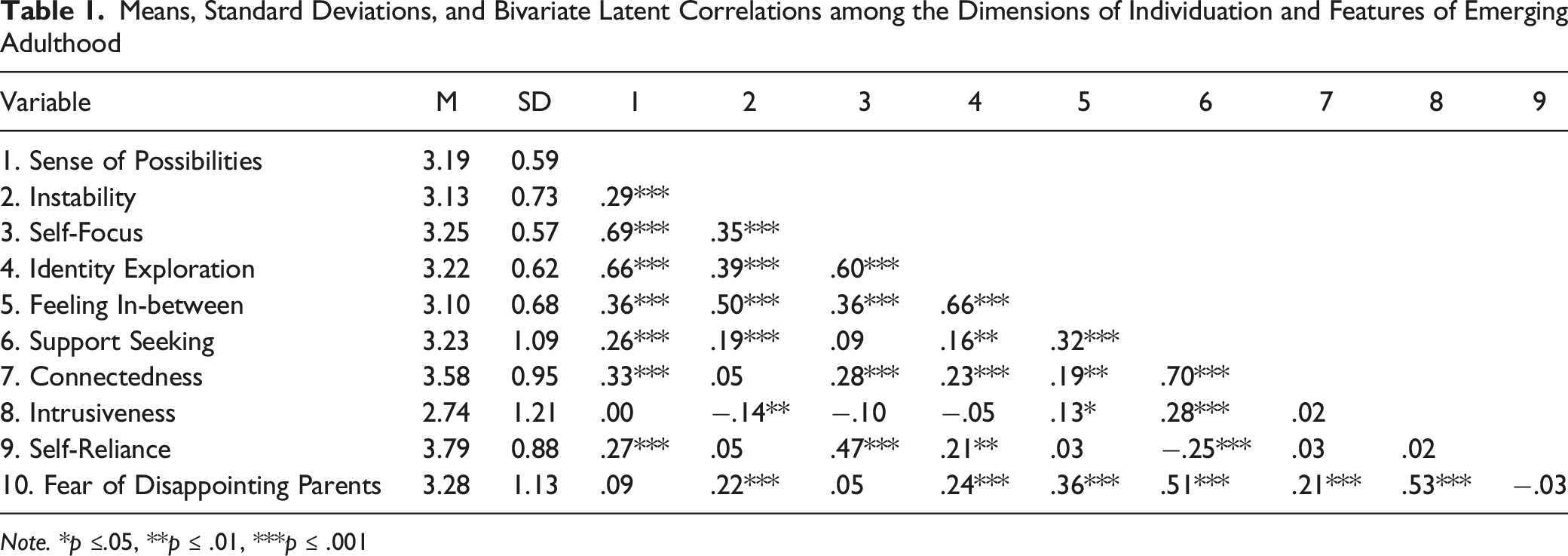
Note. *p ≤.05, **p ≤ .01, ***p ≤ .001
We then ran an unconstrainted structural model to test our conceptual model, with paths for all five dimensions of individuation (all covarying) to all five features of emerging adulthood (also all covarying), including college-going and age (which were found to be correlated with the dimensions of individuation and features of emerging adulthood) as additional covariates. The results of this SEM showed numerous paths were not statistically significant; these were successively trimmed and the model retested, until all included paths were significant. The final, trimmed SEM with standardized coefficients and fit statistics (all at least acceptable) can be found in Figure 1. Fourteen of the 25 paths were statistically significant, with small-to-medium effect sizes. The dimension of individuation with the highest number of significant paths (all positive) leading to the features of emerging adulthood—all except feeling in-between—was self-reliance. The feature of emerging adulthood that was significantly related to the highest number of dimensions of individuation (all five of them) was instability; three of these paths were positive (from parental support, self-reliance, and fear of disappointment), and two were negative (from connectedness and intrusiveness). Final Trimmed structural model of the relations between the dimensions of individuation and features of emerging adulthood. Note. For clarity of presentation, indicator variables, relations within exogenous and endogenous latent variables, covariates, and error terms not shown. 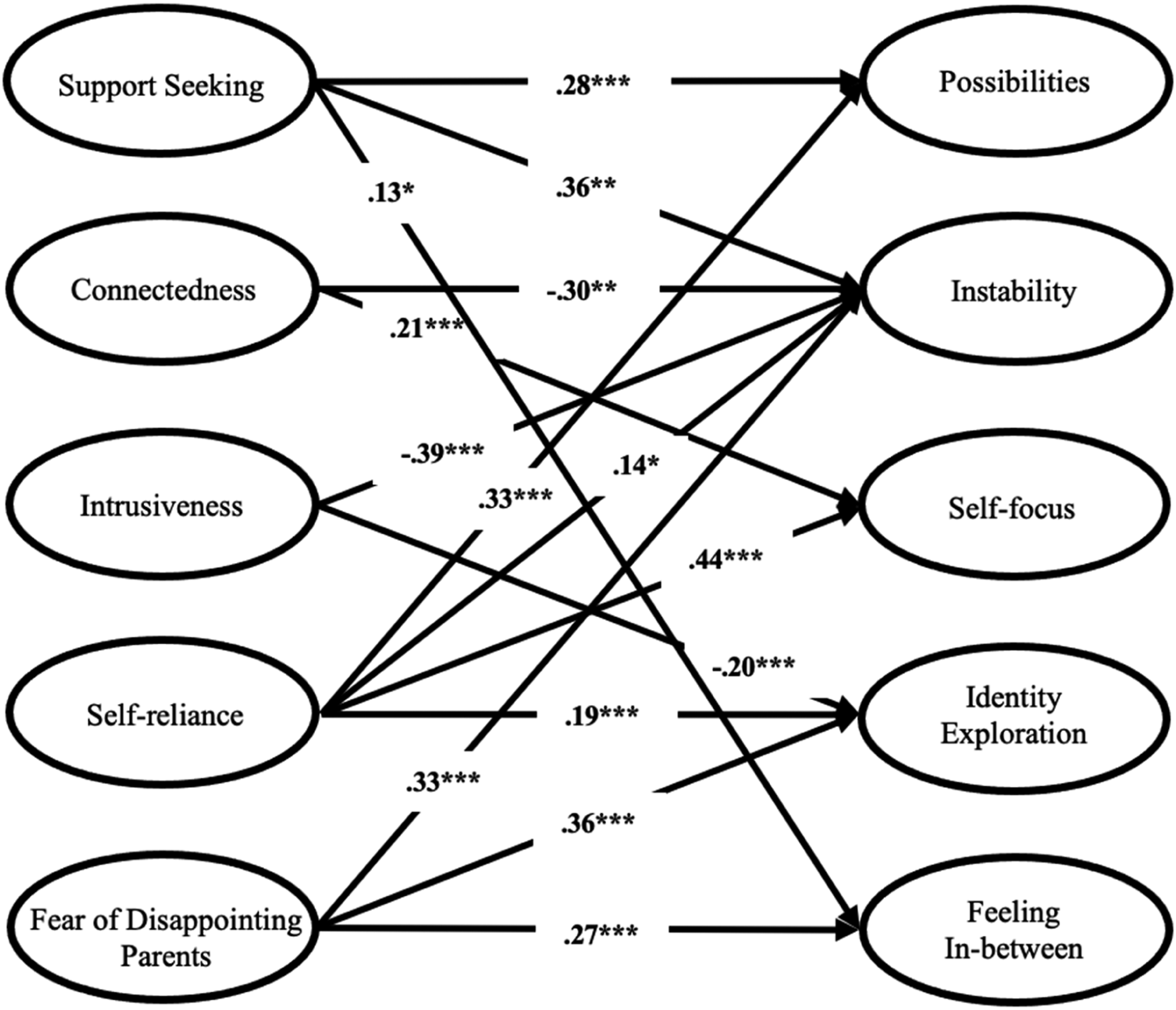
Moderation of Relations between the Dimensions of Individuation and Features of Emerging Adulthood
Living Situation as Moderator
As with the previous MIMIC analysis, for the living situation variable the sample size for the living semi-independently subgroup was again too small to be included in the moderation analyses; as such, the groups being compared were those living full-time with parents and those living independently. Of the 25 paths tested simultaneously for moderation using the PLS-SEM technique (which allowed for the detection of significant differences in the strengths of the paths from the dimensions of individuation to the features of emerging adulthood as a function of the conditioning factor), only two showed statistically significant moderation effects at the p < .05 level: the paths from intrusiveness to sense of possibilities, and self-reliance to instability. Follow-up simple slopes analyses showed that, for the intrusiveness to possibilities path, the slope for those living full-time with parents was significantly negative (ß = −.27, p = .005) and the slope for those living independently was non-significant (ß = .03, p = .66); moderation is evidenced by the significant difference between these slopes (tdiff = 2.49, pdiff = .01). For the self-reliance to instability path, the slope for those living full-time with parents was significantly positive (ß = .30, p = .001) and the slope for those living independently was non-significant (ß = .05, p = .45); moderation is evidenced in the significant difference between these slopes (tdiff = 2.28, pdiff = .02).
College-Going Status as Moderator
Summary of PLS-SEM Conditional Effects of College-Going Status on Paths between the Dimensions of Individuation and Features of Emerging Adulthood
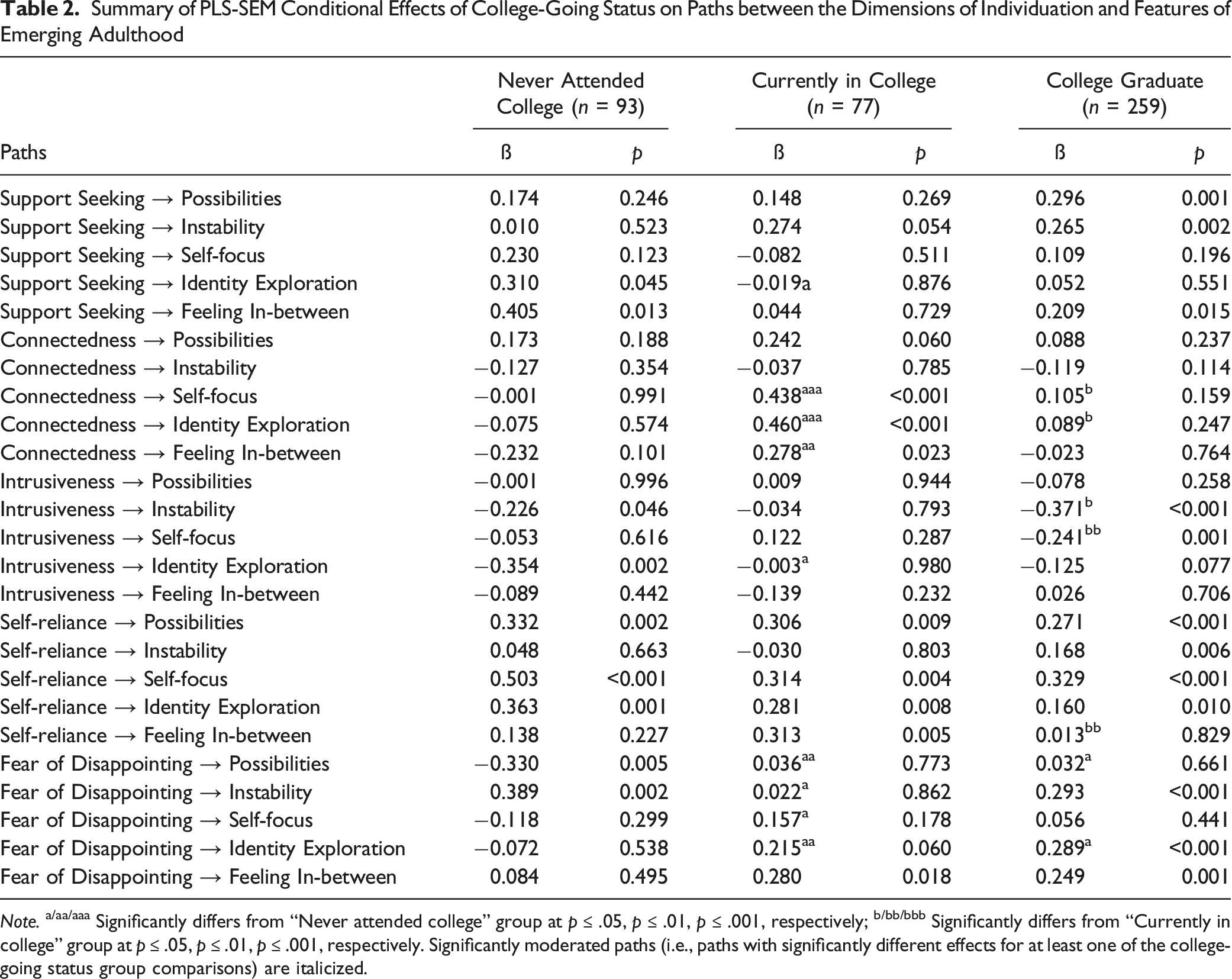
Note. a/aa/aaa Significantly differs from “Never attended college” group at p ≤ .05, p ≤ .01, p ≤ .001, respectively; b/bb/bbb Significantly differs from “Currently in college” group at p ≤ .05, p ≤ .01, p ≤ .001, respectively. Significantly moderated paths (i.e., paths with significantly different effects for at least one of the college-going status group comparisons) are italicized.
Age as Moderator
All tests for age as a moderator were run with age as a continuous variable, using the PLS-SEM product indicator approach outlined by Garson (2016). As with living situation, evidence for moderation was found for only two of the 25 paths: connection to feeling in-between (ßinteraction = −.18, p = .002) and support to feeling in-between (ß interaction = .13, p = .034). The simple slopes analyses showed that, for the support to feeling in-between path, at age 22 (roughly 1 SD below the mean age of 25) the slope was non-significant (ß = .048, p = .349); whereas at the mean age of 25 and at age 28 (roughly 1 SD above the mean age), the slopes were significantly positive (ß = .117, p = .004 and ß = .186, p < .001, respectively). For the connection to feeling in-between path, the slope at age 28 was significant and negative (ß = −.115, p = .043); the other two slopes were not significantly different from zero (at age 22: ß = .098, p = .081; at age 25: ß = −.008, p = .840).
Discussion
According to Kağıtçıbaşi’s (2005) autonomous-related self theory, adaptive self-development—viewed herein through the lens of Arnett’s (2006) defining features of emerging adulthood—is more likely to be achieved when one’s needs for autonomy and relatedness are being met. The individuation process implicitly incorporates these two notions in these years of transition from adolescent reliance on parents to the early adult years of greater self-reliance, ideally marked by a balance of a sense of independence from and continued connectedness to one’s parents. The present study thus examined relations among the defining features of emerging adulthood and the dimensions of individuation, while also considering the developmentally relevant potential conditioning factors of living situation, college-going status, and age range of emerging adulthood (the inclusion of which addresses important yet historically common limitations of emerging adulthood studies; Smith et al., 2015).
Perceptions of the Features of Emerging Adulthood
Findings regarding emerging adults’ perceptions of the features of emerging adulthood suggest no differences by living situation; however, differences were found between college-going statuses as well as by age (within the 18–29 range). The unexpected lack of evidence for differences between living situation might be due to age and college-going status functioning as covariates in the MIMIC analysis, and the differences in the participants’ perceptions of the features of emerging adulthood being more attributable to their influence. It may also be the case that other unmeasured factors related to the role of parents, such as parenting style (Williams & Ciarrochi, 2020), may play a role in ways for which simply living with or independent from one’s parents fails to account. Cultural factors may also have been at play; typical living situations in the more individualist U.S. context often differ from those in more collectivist cultures, where differences in living situation may have a more pronounced effect on one’s experience of the emerging adult years (Kins et al., 2012).
The findings regarding the role of college-going status in perceptions of emerging adulthood were more noteworthy, albeit nuanced across the five features. The finding that emerging adults who are in or have graduated from college did not differ in their perceptions of identity exploration compared with those who have never attended college is contrary to our hypothesis, but supports Arnett’s (2016b) contention that some features of emerging adulthood are experienced equally among all emerging adults, regardless of college-going status.
No differences were found for feelings of being in-between adolescence and adulthood between those who are in college and never attended college, while college graduates felt less in-between than those who never attended college. Since the MIMIC analysis accounted for the role of age, this finding suggests there is something unique about the experience of being a college graduate beyond simply being an older emerging adult that contributes to a reduced feeling of being in-between. This may be due to the unique effects of higher education on cognitive and moral development, and/or later economic and career outcomes (Mayhew et al., 2016).
Emerging adults currently in college and who have graduated from college, compared to those who never attended college, were higher in sense of possibilities, negativity/instability, and self-focus. These findings align with the notion that the college experience typically affords emerging adults opportunities for growth when developing their careers and finding new possibilities (Hendry & Kloep, 2010). College-going emerging adults likely experience more instability than non-college-going emerging adults due to the normative expectation and accompanying pressure of confronting major life choices and changes during college (e.g., choosing a major and devising a post-college plan). These results importantly highlight the ways in which access to the college experience likely changes the nature of how emerging adults experience these years, and suggest that it behooves future researchers of the features of emerging adulthood to account for this factor.
Age was found to be negatively related to all of the features of emerging adulthood except for self-focus. Reduced perceptions of possibilities, identity exploration, and feeling in-between are likely due to the major life commitments emerging adults typically make as they approach adulthood, such as careers and areas to live (Arnett, 2015). Regarding instability, early emerging adulthood is a time when many emerging adults are early in their careers or in college with less access to financial capital; as financial capital typically increases through the emerging adulthood years, the less instability emerging adults are likely to feel as they become more financially independent (Butterbaugh et al., 2020). The lack of relation between age and self-focus may be attributed to the normative delay of markers of adulthood such as marriage and parenthood that would likely lead emerging adults to feel less focused on themselves and focused more on partners or children (Arnett et al., 2014). In general, the earlier one is in the emerging adulthood years, the more likely one is to experience the features of emerging adulthood.
Perceptions of the Dimensions of Individuation
The findings suggest that overall, the individuation process in emerging adulthood is not typically affected by living situation (similarly to the abovementioned findings for living situation and the features of emerging adulthood), and only somewhat affected by college-going status and age, supporting the notion of Kağıtçıbaşi’s (2005) autonomous-related self theory that the individuation process reflects basic human needs regardless of other influences. This finding may suggest that the process emerging adults experience when redefining their relationship with their parents is likely not affected by whether they live with their parents or independently.
Regarding college-going status, emerging adults who are currently attending college feel, on average, less parental intrusiveness than those who have not attended college, but likely the same degree of support seeking, connectedness, self-reliance, and fear of disappointing their parents. College-going emerging adults perceiving their parents as less intrusive than non-college-going emerging adults may be due to the college experience granting a psychosocial moratorium (Erikson, 1968), affording them an opportunity of free role experimentation and fewer typical adult responsibilities on which to feel intruded (e.g., parenthood and finances). Emerging adults who have graduated college, compared to those who have never attended college, typically report seeking more support from their parents and are more self-reliant. Although these two results may at first seem contradictory, the findings may be explained by financial considerations. College students in the U.S. often have scarce sources of income, take on loans and debt, and as such often seek financial support from parents (Schwartz et al., 2018). U.S. college graduates who are starting off in their career field—especially if they are in lower-paying temporary or entry-level positions (or perhaps still job-seeking) while having to repay their tuition debt, which is often the case for recent college graduates—may be accustomed to seeking this support from their parents and continue to engage in such behavior after graduation. At the same time, recent college graduates are also likely to be living on their own, perhaps for the first time paying their own bills and making day-to-day choices independent of the influence of others and the structure of college life, and as a result simultaneously perceive themselves to be more self-reliant. However, this supposition regarding the role of financial considerations is speculative, and ripe for future investigation.
Age was found to be related to support seeking and fear of disappointing parents. Specifically, the older emerging adults are, the less likely they are to seek support from and fear disappointing their parents. This finding is consistent with the broader literature on emerging adult individuation that shows the older an emerging adult is, the closer to achieving adulthood one is likely to feel, and this in turn promotes greater confidence in one’s wisdom (Luyckx et al., 2013). The lack of age differences across the emerging adult age range may simply suggest that, whereas emerging adults may feel some degree of connection to, being intruded on by, and self-reliance from their parents, how each of these is experienced differently may depend on how the parental relationship has been redefined.
Relations among the Dimensions of Individuation and Features of Emerging Adulthood
Generally in line with our expectations, findings from the SEM analysis with the dimensions of individuation and the features of emerging adulthood revealed several significant connections (though importantly, as discussed below, the significant relationships uncovered in this analysis across the full sample did not always hold for each subgroup explored in the moderation and simple slopes analyses, and some of the non-significant relationships in the SEM analysis were significant for one or more of the moderator subgroups).
Self-reliant emerging adults were, on average, more likely report higher sense of possibilities, instability, self-focus, and identity exploration. Feeling independent from their parents can lead emerging adults to perceive themselves as having more opportunities to autonomously explore identities without feeling beholden to their parents’ expectations, to feel more empowered to explore new possibilities, and to feel more confident in focusing on their own self-development. Self-reliance from parents may also lead to a greater sense of instability due to emerging adults feeling more on their own while simultaneously experiencing less stable friendships (Lapierre & Poulin, 2020), job situations (Salvatore, 2018), and romantic relationships (Shulman, 2017).
Emerging adults who perceive themselves as seeking more emotional support from their parents likewise typically perceive themselves to have more possibilities and less stability, as well as an increased sense of feeling in-between. Conceptually, one might think emerging adults who seek support from their parents would not be as self-reliant, which would suggest the relations between these dimensions and both possibilities and instability would work in opposite directions rather than all be positive. However, the negative bivariate correlation between self-reliance and support seeking was relatively small, suggesting many emerging adults may perceive themselves to not overly rely on parental guidance, but feel comfortable asking for it as needed. Indeed, this may represent an optimal developmental balance of self-reliance and support-seeking, representative of Youniss and Smollar’s (1985) ideal of successful individuation and reflective of Kağıtçıbaşi’s (2005) emphasis on both autonomy and relatedness. For these such young people, believing they can count on their parents for support if and when they need it may lead them to feel more possibilities are open to them. At the same time, those more likely to seek support from their parents may experience increased feelings of instability and “in-between-ness” because the reasons they seek support stem from the feelings of stress and uncertainty that typify this feature of emerging adulthood. Future qualitative research would be well suited to explore this possibility further.
Emerging adults who fear disappointing their parents similarly perceive greater instability, on average. This may also be present due to emerging adults continuously trying to find ways to live up to their parents’ expectations during this transition (Segrin & Bowers, 2019), which may generate uncertainty and stress. Additionally, fear of disappointing parents was significantly related to identity exploration as well as feeling in-between adolescence and adulthood. The former of these is counterintuitive; we surmise it may reflect an avoidance motivation for personal goal pursuits (Elliot & Friedman, 2007), such as when a young person explores different career paths in an effort to appease one’s parents. And the latter may reflect the inner tension that results from striving to develop one’s autonomous adult self while simultaneously experiencing a more childlike fear of parental disappointment.
Parental connectedness and intrusiveness were also significantly related to instability, but in the negative direction. Connectedness to one’s parents likely entails a sense of reassurance that can dampen the stress and worry that characterize a sense of instability. The positive pathway from connectedness to self-focus may similarly suggest a sense of reassurance that the emerging adult is supported as they develop autonomy. The relation between intrusiveness and reduced instability was not expected and is not intuitive, warranting further research to better understand. It may be that perceived parental intrusiveness implies a higher level of parental involvement (Padilla-Walker et al., 2019) that some emerging adults experience as familiar to their home life as adolescents, a familiarity which in turn may lead to reduced feelings of instability (though this stability of experience from adolescence to emerging adulthood may be unwelcome). At the same time, as also evidenced in this study, parental intrusiveness is likely to restrict emerging adults’ identity exploration, inhibiting their opportunities for or inclination toward trying new things and differentiating from their parents (Bowen, 1978).
Overall, these findings suggest that—in the U.S. context in which the current study was situated, and aligning with Kağıtçıbaşi’s (2005) autonomous-related self theory—the more connected and involved parents are, the more positively their children are likely to experience most, but not all, of the features of emerging adulthood. That is, emerging adult positive development is likely to be promoted when their parents adopt an approach to parenting that hits the “sweet spot” of connectedness and involvement, without being overly intrusive.
Moderations of the Dimensions of Individuation and the Features of Emerging Adulthood
Several moderation effects were found among the paths between the dimensions of individuation and the features of emerging adulthood. Indeed, when considering the moderators’ subgroups together, 22 of the 25 total paths were significant for at least one of them. This further reinforces the overall importance of considering the individuation process toward understanding emerging adults’ experiences of the features of emerging adulthood, as well as the potential benefits of accounting for potential moderators toward a more nuanced understanding.
Given the smaller number of overall moderations by living situation and age (two for each) and their relatively small effect sizes, they should be interpreted with caution; indeed, we believe future research is necessary to establish whether (and if so, how) they in fact function as moderators. In contrast, college-going status significantly moderated a considerably greater-than-chance proportion (12 of 25) of the overall paths, affecting paths from each of the dimensions of individuation to at least one of the features of emerging adulthood and vice versa. Whereas we believe it is prudent to refrain from discussing any specific moderation results to avoid giving any one (or more) of them undue credence (we recognize the possibility of some spurious results and need for confirmatory future research given their exploratory nature and the sheer number of the analyses run), a few broad patterns are identifiable in this set of results.
Specifically, currently being in college appeared to function differently in the relations among both sense of connectedness and parental intrusiveness and the features of emerging adulthood, compared non-college-goers and college graduates. In particular, connectedness played a more prominent role in the experiences of emerging adulthood for current college goers, whereas intrusiveness played a more prominent role for those who never attended college and college graduates. Additionally, college-going status appeared to play a more prominent role in the relations among fear of disappointing one’s parents and the features of emerging adulthood. Though we highlight these patterns as tentative, the overall evidence strongly suggests, in some form, that college-going status does play a meaningful role in conditioning how the individuation process affects young people’s experiences of the features of emerging adulthood.
Limitations and Future Directions
Whereas this study addressed some often overlooked aspects of the emerging adult experience, it did not address various iterations of them. For example, it did not cover all possible living situations (e.g., college students who live with their parents during breaks and independently in a dorm during the academic year), or those who live independent from their parents alone verses with a romantic partner. While we were intentional about covering the full age range of emerging adulthood, we did not sample those immediately younger and older, which might have helped elucidate whether these phenomena are unique to the emerging adult years (see Arnett & Mitra, 2018). Additionally, the single-informant, self-report approach of the study may have inflated the relationships under investigation. Moreover, our data were not longitudinal, restricting causal or developmental inferences. We also did not assess other potentially relevant variables, such as parenting style, that may shed light on the mechanisms by which parental influence might affect the features of emerging adulthood.
Finally, and worthy of particular attention, our sample only included emerging adults from the U.S., and thus the results may not be representative of other countries (Hendry & Kloep, 2010). For example, the subgroup of those living semi-independently represented only 7% of the present sample, whereas previous studies of emerging adults’ living situations in Western Europe revealed much higher percentages (e.g., 30% in Kins & Beyers, 2010; 26% in Kins et al., 2012). Along similar lines, previous studies have shown differences in the experiences of the features of emerging adulthood in different countries. Case in point, Galanaki and Leontopoulou (2017) found that a sense of feeling in-between may be more prevalent in Western cultures.
The results of the present work suggest future investigations of emerging adulthood should continue to incorporate non-college-going participants across the full 18–29 year age range, as well as address other factors that may alter how they interact such as parenting styles and emerging adults’ values. Specifically, investigations in countries outside of the U.S. and cross-cultural studies—ideally, employing qualitative and mixed-methods—are needed to understand the broader generalizability of these results; such work might explore similarities and differences within and across countries and cultures, which may reveal uniquenesses rooted in cultural mores and/or national policies. The present results might also inform hypothesis-driven moderation analyses, and longitudinal research on the features of emerging adulthood and individuation may uncover the directionality (and possible bidirectionality) of effects.
Conclusion
This study enhances our understanding of how young people across the full age range of emerging adulthood (ages 18–29) experience Arnett’s (2004) five features of emerging adulthood, in two primary ways: (a) how these features relate to individuation from one’s parents in emerging adulthood; and (b) the influences of living situation, college-going status, and age across the emerging adult range (Reifman et al., 2007; Seiter & Nelson, 2011; Zorotovich & Johnson, 2019). The results suggest our overall understanding of young people’s experiences of the features of emerging adulthood is enhanced when considering their experiences of the individuation process, and that their college-going status as well as where they are in the emerging adult age range matter. In general, when parents are perceived as connected with but not intrusive upon their emerging adult children, those children are more likely to experience emerging adulthood with greater stability, identity exploration, and sense of possibilities; conversely, emerging adults who fear disappointing their parents are generally more likely to experience emerging adulthood negatively. The present work further suggests the overall experience of emerging adulthood cannot fully be understood without taking into account the roles of college-going status and where one is in the emerging adult age range.
Supplemental Material
Supplemental Material - The Features of Emerging Adulthood and Individuation: Relations and Differences by College-Going Status, Age, and Living Situation
Supplemental Material for The Features of Emerging Adulthood and Individuation: Relations and Differences by College-Going Status, Age, and Living Situation by Matthew L. Nice and Matthew Joseph in Emerging Adulthood
Footnotes
Declaration of Conflicting Interests
The author(s) declared no potential conflicts of interest with respect to the research, authorship, and/or publication of this article.
Funding
The author(s) disclosed receipt of the following financial support for the research, authorship, and/or publication of this article: Data collection was supported through funding from the Duncan Memorial Student Resource Award from Duquesne University’s Counselor Education & Supervision Program.

Supplemental Material
Supplemental material for this article is available online.
Notes
Author Biographies
References
Supplementary Material
Please find the following supplemental material available below.
For Open Access articles published under a Creative Commons License, all supplemental material carries the same license as the article it is associated with.
For non-Open Access articles published, all supplemental material carries a non-exclusive license, and permission requests for re-use of supplemental material or any part of supplemental material shall be sent directly to the copyright owner as specified in the copyright notice associated with the article.
