




Abstract
Intuitive decisions arise effortlessly from an unconscious, associative coherence detection process. Hereby, they guide people adaptively through everyday life decision making. When people are anxious, however, they often make poor decisions or no decision at all. Is intuition impaired in a state of anxiety? The aim of the current experiment was to examine this question in a between-subjects design. A total of 111 healthy participants were randomly assigned to an anxious, positive, or neutral multimodal mood induction after which they performed the established semantic coherence task. This task operationalizes intuition as the sudden, inexplicable detection of environmental coherence, based on automatic, unconscious processes of spreading activation. The current findings show that anxious participants showed impaired intuitive performance compared to participants of the positive and neutral mood groups. Trait anxiety did not moderate this effect. Accordingly, holistic, associative processes seem to be impaired by anxiety. Clinical implications and directions for future research are discussed.
Anxiety is a prevalent symptom in several mental disorders such as mood disorders, posttraumatic stress disorder, schizophrenia, or obsessive-compulsive disorder (Hamilton, Chen, Waugh, Joormann, & Gotlib, 2015; Owens, Miller, Lawrie, & Johnstone, 2005). In its most severe form, the effects of anxiety on behavior and cognition can contribute to the clinical manifestation of anxiety disorders. These in turn pose a substantial burden on the health care system. Epidemiological studies show that compared to people with other mental disorders, people with anxiety disorders consult general practitioners more often (Lépine, 2002). Apart from its clinical manifestation, anxiety is also prevalent in nonpsychiatric samples, causing substantial suffering and impairing the quality of life of those affected (Creed et al., 2014).
When people are anxious, they feel threatened, paralyzed, and unable to engage in an adaptive behavior pattern (Eysenck, Derakshan, Santos, & Calvo, 2007). Besides emotional and behavioral consequences, it has robustly been shown in the laboratory that a range of cognitive impairments accompany anxiety, such as attentional biases (Wegbreit, Franconeri, & Beeman, 2014), nonoptimal reasoning (Leon & Revelle, 1985), or restricted resources of working memory (Eysenck & Calvo, 1992). In the present experiment, our aim was to examine whether the cognition-impairing effects of anxiety extend to people’s ability to judge and decide based on their intuition. This idea is based on research showing that anxiety is associated with impaired decision making (Gino, Wood, & Schweitzer, 2012; Loewenstein, Weber, Hsee, & Welch, 2001), but leaving open which mode of decision making is impaired by anxiety.
What is intuition?
One way to reach a decision is by consciously weighing out the pros and cons in an analytical stepwise manner. For this comparably slow and explicit decision-making type, however, enough time and cognitive resources need to be available (Kahneman, 2011). As the latter is not always given, people often use their intuition and are well advised to do so when they have to make a decision (Gigerenzer, 2008). Although the concept of intuition is still under theoretical debate, most definitions conceive of intuition as resulting from a fast, associative, and experience-based cognitive process that leads to a “go” signal being strong enough to act on (e.g., Gigerenzer, 2008; Glöckner & Witteman, 2010; Volz & Zander, 2014). As the underlying processes operate unconsciously, intuitions are often described as knowing something without knowing how one knows (Claxton, 1998). In other words, intuitions prompt an individual toward a decision or judgment without the person knowing the reasons for it. It is notable that these hunches are not random outcomes of guessing. In contrast, they often result from complex processes of synthesis and integration of isolated elements (Kuhl, Quirin, & Koole, 2015; but see, e.g., Kahneman, Slovic, & Tversky, 1982, for instances in which intuitions may lead to systematic biases).
A widely used and acknowledged operationalization of intuition in the laboratory is the inexplicable detection of semantic coherence, measurable with the semantic coherence task developed by Bowers, Regehr, Balthazard, and Parker (1990). During this task, participants see triads of words that are either semantically related (SALT DEEP FOAM; all words are associated with SEA, coherent triad) or not (DREAM BALL BOOK, no common denominator, incoherent triad). People are generally able to discriminate above chance level and within 2 s between coherent and incoherent word triads, without being able to explicitly name the solution word (Bolte & Goschke, 2005). The processes that semantic coherence judgments rely on operate fast, associatively and unconsciously. Coherent triads are thereby processed more fluently than incoherent triads, which is accompanied by subtle positive affective cues (Topolinski & Strack, 2009a) prompting the individual to go with the “gut feeling.” Psychophysiologically, a decrease in sympathetic activation (as measured via electrodermal activity) has been recently shown to accompany the intuitive coherence detection in word triads, thereby reflecting the holistic processing mode of intuitive decision making (Zander, Fernandez Cruz, Winkelmann, & Volz, 2017).
Unsolved but correct detections of semantic coherence (i.e., above-chance differentiation between coherent and incoherent triads without being able to provide coherent triads’ solution words) have been called intuitive (Bolte & Goschke, 2005; Topolinski & Strack, 2009a, 2009b). In other words and in line with the above definition of intuition, people intuitively know that a triad is coherent without knowing why it is. In contrast, correct identifications of coherent triads for which the solution concept has been named, involve explicit processes, and are thus indicative for insight (see Bolte & Goschke, 2005; Zander, Öllinger, & Volz, 2016). Insofar, the semantic coherence task allows researchers to distinguish between intuitive judgments in which information is activated but not consciously accessible and explicit judgments in which insight is given (Bolte & Goschke, 2005; Remmers, Topolinski, Dietrich, & Michalak, 2015; Remmers, Topolinski, & Michalak, 2015; Topolinski & Strack, 2009b; Zander et al., 2016; Zander, Horr, Bolte, & Volz, 2015).
Even though intuitive decision making is advantageous in many situations (Glöckner & Betsch, 2008; Klein, 2008), there are states in which individuals are not able to use intuitive hunches. In the present article, we propose the hypothesis that state anxiety is one of these conditions under which intuition is impaired. In clinical populations, anxiety and difficulties in decision making or indecisiveness often appear concurrently. Therefore, understanding the link between intuitive decisions and anxiety in more depth may be a fruitful endeavor and does not only address an open question in basic psychological research, but may also have important implications for clinical theorizing and practice. To bolster our assumption, we show that there are several theoretical and empirical indications for the detrimental effects of anxiety on intuition in the following.
Intuition and mood
An influential line of research has convincingly demonstrated that different mood states shape the way we think, judge, and decide (Blanchette & Richards, 2010; Bower, 1981; Forgas, 2008; Schwarz & Clore, 1996). It is widely acknowledged and robustly supported by empirical evidence that positive mood fosters flexible and intuitive information processing (Fredrickson, 2001; Schwarz, 2002). It is notable that positive mood potentiates the automatically spreading activation of remote semantic associations (Isen, Daubmann, & Nowicki, 1987; Isen, Johnson, Mertz, & Robinson, 1985), a cognitive process that underlies intuitive judgments of coherence. Accordingly, it has been found that intuition is enhanced in people experiencing positive mood (Balas, Sweklej, Pochwatko, & Godlewska, 2012; Bolte, Goschke, & Kuhl, 2003; Sweklej, Balas, Pochwatko, & Godlewska, 2014, 2015).
Negative mood, in contrast, and anxiety specifically, signals that something is wrong in the environment. As a result, individuals narrow their scope of attention in negative mood states (Wegbreit et al., 2014) and employ more analytic problem-solving strategies (Bless, Bohner, Schwarz, & Strack, 1990). In contrast to top-down processes during positive mood, negative mood prompts bottom-up and data-driven processing (Clore & Storbeck, 2006) in which people tend to not “see the forest for the trees” (Gasper & Clore, 2002). Consequently, it is assumed that holistic, associative processes needed for intuition are impaired during negative mood states. This assumption has indeed been supported by Bolte and colleagues (2003), who found that negative mood lowered the ability to detect semantic coherence intuitively and by Baumann and Kuhl (2002) showing that this is especially the case for participants who have difficulties to regulate negative mood states. Moreover, a problem-solving mind-set has been shown to inhibit automatic activation spread, a process underlying intuition (Topolinski & Strack, 2008).
From a clinical psychological perspective, these findings are worth noting because negative mood, the inability to down-regulate negative mood states, and dysfunctional problem-solving mind-sets are highly characteristic in mental disorders. Converging with this, recent research from clinical psychology shows that patients who suffer from major depression show impaired intuition compared to healthy control participants (Remmers, Topolinski, Dietrich, & Michalak, 2015; Remmers, Topolinski, Buxton, Dietrich, & Michalak, 2016). This demonstrates the potentially important role that intuition may play in understanding the decision-making processes of patients with mental disorders (Remmers & Michalak, 2016).
Altogether the findings reported above have informed our understanding regarding the interplay between mood and cognition to a great extent. However, it should be considered that negative mood is not a unitary construct. Different negative mood states such as anxiety, sadness, or anger should be dissociated (Raghunathan, Pham, & Corfman, 2006) because the underlying meaning structures and implicit goals may differ. Sadness, for example, primes an implicit goal of reward replacement, whereas the underlying implicit motivation of anxiety is to reduce uncertainty. Thus, negative mood states have differential influences on decision-making processes. This has been found even when the decision itself is unrelated to the mood-inducing event (Raghunathan et al., 2006). The foregoing discussion makes clear that even though research on the mood-cognition interplay hints to the idea that intuition might be impaired in a state of anxiety, an empirical investigation of the specific relationship is still missing.
How do anxious individuals make decisions?
When looking at research that has examined decision making in anxious individuals, we find several reasons to suspect that anxiety impairs intuition. As anxiety means to be facing uncertain existential threats (Lazarus, 1991), the underlying motivation is to reduce this state of uncertainty (Raghunathan et al., 2006; Raghunathan & Pham, 1999). In line with this, anxiety, and clinical anxiety specifically, is associated with avoidance of risky decisions (Maner & Schmidt, 2006; Raghunathan & Pham, 1999) with increased pessimistic appraisals (Stoeber, 1997) and with decreases in self-confidence (Gino et al., 2012). In extreme cases, anxiety can lead to taking no decision at all (Germeijs, Verschueren, & Soenens, 2006; Lo Cascio, Guzzo, Pace, & Pace, 2013).
With regard to intuition, these findings are notable because relying on one’s intuition requires the decision maker to have confidence in an inexplicable hunch and to follow subtle emotional or bodily cues (Bechara & Damasio, 2005; Topolinski & Strack, 2009a, 2009b). Thus, to judge and decide based on one’s intuition may be seen as risky (because one knows something without explicitly knowing why) and therefore people may be less likely to rely on their intuition when they are anxious. Indeed, it has been shown that high levels of anxiety impair the performance in the Iowa Gambling Task, which requires the inclusion of subtle somatic signals into the decision making process before having explicit knowledge (Miu, Heilman, & Houser, 2008). It may thus be suspected that due to low levels of confidence, hypersensitivity, and pessimistic evaluation tendencies, anxiety interferes with letting oneself be guided by intuitive hunches.
Moreover, because intuition is a pattern completion mechanism (Sadler-Smith, 2007) in which relevant cues are integrated in an adaptive manner (Kuhl, 2000; Kuhl et al., 2015), the finding that anxious individuals tend to make inefficient use of relevant compared to irrelevant cues (Gino et al., 2012; Park, Wood, Bondi, Arco, & Moghaddam, 2016) is another hint that intuition is impaired by anxiety.
The present experiment
The foregoing discussion has shown that there are at least three lines of evidence supporting the assumption that intuition is impaired in a state of anxiety: First, negative mood states and thus presumably also a state of anxiety foster narrow, analytical information processing and deliberation. Second, research has demonstrated that in negative mood states individuals are less likely to rely on their intuitions. Third, anxiety interferes with decision making in several ways that are supposedly detrimental to an adaptive access to intuitions (ineffective use of relevant compared to irrelevant stimuli, risk avoidance; see also Park et al., 2016, for neuropsychological research on anxiety and prefrontal cortex responses playing a crucial role in intuitive coherence detection).
Despite these strong theoretical and empirical indications, the specific link between anxiety and intuition has not been established yet. Therefore, in the present experiment, we investigated whether state anxiety, that is the short-lived, unpleasant feeling of high activation, low control, and high uncertainty (Spielberger, 1985), affects participants’ intuitive decision making. We used the well-established semantic coherence task to operationalize intuition as the sudden, inexplicable detection of coherence. To induce anxiety and to compare its effect on intuition with positive and neutral mood, we used a multimodal mood-induction procedure of which the efficacy had been demonstrated in previous research (Pacheco-Unguetti, Acosta, Callejas, & Lupianez, 2010). We predicted that participants who had undergone the anxious mood induction would have a reduced ability to process information in an intuitive, holistic manner. They were therefore expected to show an impaired capacity to detect semantic coherence in the experimental intuition task compared to participants of the positive and neutral mood induction groups.
Former studies on the mood-intuition interplay did not disentangle the effects of short-lived manipulated moods (i.e., states) from participants’ general tendency to experience these mood states in daily life (i.e., trait). With regard to anxiety, however, previous work has shown that state and trait anxiety may have differential effects on cognitive functioning (Harrigan, Wilson, & Rosenthal, 2004; Pacheco-Unguetti et al., 2010). Therefore, we also measured trait anxiety, that is participants’ general susceptibility to anxious feelings (Spielberger, 1985), to examine how this personality characteristic was associated with intuition. In contrast to state anxiety, a short-lived, transient negative emotional state that is comparable in valence to other negative mood states but different in underlying implicit goals, there was no empirical or theoretical basis on how trait anxiety may be associated with intuitive semantic coherence detection. Furthermore, we planned to recruit a rather homogenous student sample in which the interindividual variance in trait anxiety was expected to be comparably low. Thus we had no specific predictions regarding the association between intuitive performance and trait anxiety and assessed the latter for exploratory reasons.
We expected that the effects of our anxiety induction on intuitive performance would be independent of participants’ verbal intelligence and active vocabulary as measured with a German vocabulary test (Schmidt & Metzler, 1992). It was assumed to be also independent of participants’ self-reported tendency to decide based on intuitions in daily life as measured with the Rational-Experiential Inventory (Epstein, Pacini, Denes-Raj, & Heier, 1996).
Method
Participants
A total of 111 students (age M = 23.69, range = 18–48 years; 72 female) from the University of Basel participated for either course credit or financial compensation. Mother tongue was (Swiss-)German. An a priori performed power analysis using the program G*Power, version 3 with three groups, an alpha error probability of .05, a power of .95, and an assumed effect size of .39 (based on Sweklej et al., 2015, mood effect on intuition in Experiment 2) revealed that a total sample size of 105 participants is sufficient to detect a possible effect in our data. Thus, we can assume that our sample has an adequate size and is not underpowered.
Materials
State and trait anxiety
State and trait anxiety were measured with the State-Trait Anxiety Inventory (STAI; Spielberger, Gorsuch, & Lushene, 1970; German version: Laux, Glanzmann, Schaffner, & Spielberger, 1981). The State scale consists of 20 items and was used to measure a current emotional state that is characterized by tension, worry, inner unrest, and fear of future events. Participants filled out the State scale at three times during the experimental session, namely prior to (t0) and after the mood induction (t1) as well as after the end of the experimental task (t2), to check whether our mood manipulation was effective and enduring. Cronbach’s alpha of the State scale in this sample was .94. The Trait scale of the STAI also consists of 20 items and was used to measure participants’ general susceptibility to anxiety and their tendency to evaluate situations/events as threatening. It was filled out immediately after participants had arrived at the laboratory. Cronbach’s alpha of the Trait scale in this sample was .84.
Mood
The Positive and Negative Affect Schedule (PANAS; Watson, Clark, & Tellegen, 1988; German version: Krohne, Egloff, Kohlmann, & Tausch, 1996) served as a measure of current (positive and negative) mood state. The PANAS consists of 20 adjectives (10 positive, e.g., interested, proud, active; 10 negative, e.g., nervous, anxious, gloomy). In the current experiment, we used the PANAS at three times during the experimental session, namely at t0, t1, and t2. Cronbach’s alpha in this sample was .92 for the Positive Affect scale and .94 for the Negative Affect scale.
Intuitive decision making
To assess intuitive decision making, a German version of the semantic coherence task (e.g., Bolte & Goschke, 2005; Bowers, et al., 1990; Remmers et al., 2016; Remmers, Topolinski, Dietrich, & Michalak, 2015; Remmers, Topolinski, & Michalak, 2015; Topolinski & Strack, 2009a, 2009b; Zander et al., 2015; Zander et al., 2016) was used. During the task, participants see triads of words (each for 1,500 ms) that are either semantically related to a common fourth denominator (SALT DEAM FOAM; coherent triad) or semantically unrelated (DREAM BALL BOOK; incoherent triad). Each triad’s constituents were presented in a stacked format. Participants were instructed to spontaneously decide whether a particular triad was semantically coherent or incoherent. Following Bolte and Goschke (2005), who investigated the specific time frames for implicit intuitive processing, participants in our experiment had 2,000 ms to perform the coherence judgment. Participants could perform the judgment only when the triad had already vanished. Participants were instructed to rely on their feeling when making the judgment. They were told that even if they did not immediately know the common associate, they could judge a triad as coherent. Regardless of the coherence judgment and stimulus type (coherent or incoherent triad), participants were given 8,000 ms after each coherence judgment to type in a word that might describe the semantic link between the presented constituents of the respective triad, that is, the remote associate. During the experimental task, a total of 36 coherent and 36 incoherent triads developed by Bolte and Goschke (2005) were presented to participants in a random order.
Self-reported tendency to decide intuitively
The Faith-in-Intuition scale of the Rational-Experiential Inventory (REI; Epstein et al., 1996; German version: Keller, Bohner, & Erb, 2000) was used to assess participants’ self-reported tendency to decide based on their gut feelings in daily life and to ensure that participants of the three groups did not differ in this characteristic. The Faith-in-Intuition scale of the REI consists of 10 items, such as “I trust my initial feelings about people.” Cronbach’s alpha in this sample was .84.
Active vocabulary and verbal intelligence
A German vocabulary test, namely the Wortschatztest (WST; Schmidt & Metzler, 1992), was administered to assess verbal intelligence and active vocabulary and to ensure that participants of the three groups did not differ in this characteristic. It consists of 42 lines of six words in each line. Participants were instructed to choose the correct German word among the wrong words (i.e., nonwords that are principally pronounceable but do not exist in German language).
Procedure
After arrival at the lab, participants were administered a demographic questionnaire, the STAI (State and Trait scales), and the first mood measure (PANAS). After this, participants were randomly assigned to one of the three mood induction groups: anxious mood (n = 37), positive mood (n = 38), or neutral mood (n = 36). Table 1 shows that demographic data and self-report measures, such as verbal intelligence and active vocabulary, as well as the self-reported tendency to decide intuitively did not differ between the three groups (all p > .13). There was no significant difference in levels of trait anxiety between the three groups, F(2,108) = 0.04, p = .96.
Demographic Data and Self-Report Measures of the Three Groups
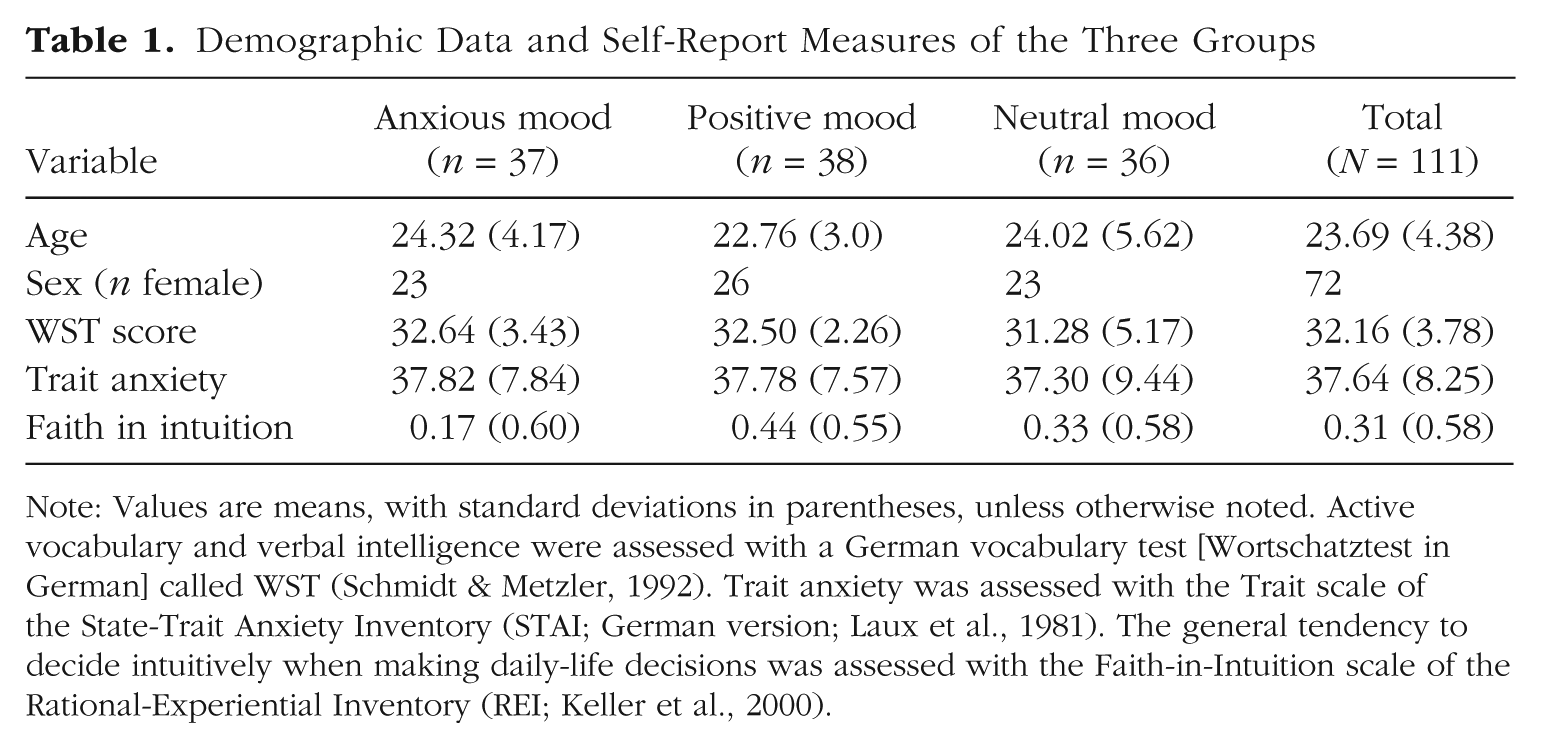
Note: Values are means, with standard deviations in parentheses, unless otherwise noted. Active vocabulary and verbal intelligence were assessed with a German vocabulary test [Wortschatztest in German] called WST (Schmidt & Metzler, 1992). Trait anxiety was assessed with the Trait scale of the State-Trait Anxiety Inventory (STAI; German version; Laux et al., 1981). The general tendency to decide intuitively when making daily-life decisions was assessed with the Faith-in-Intuition scale of the Rational-Experiential Inventory (REI; Keller et al., 2000).
Mood induction
To explore potential effects of anxiety on the intuitive performance in the semantic coherence task, we experimentally induced three mood states in a between-subjects design (anxious, positive, neutral). We adopted the same multimodal mood induction procedure as Pacheco-Unguetti and colleagues (2010). In each trial, participants were first presented a sentence with either an anxious, positive, or neutral connotation for 6,000 ms. Afterward, a picture from the International Affective Picture System (IAPS; Lang, Bradley, & Cuthbert, 2008) appeared on the computer screen for another 6,000 ms (12,000 ms in total; see Figure 1). The IAPS picture conveyed the same emotional valence as the sentence. Original sentences were received by the authors in Spanish and were translated into German.

Multimodal mood induction and intuition task. The between-subjects design consisted of three groups of randomly assigned participants: an anxious mood induction group, a positive mood induction group, and a neutral mood induction group. The procedure of the multimodal mood induction was adopted from Pacheco-Unguetti and colleagues (2010) and was multimodal. Pictures from the International Affective Picture System (IAPS) as well as emotionally corresponding sentences were used. A positive/negative mood and state anxiety manipulation check was done at three times: (a) before the mood induction (t0), (b) after the mood induction (t1), and (c) after the semantic coherence task to ensure that the induced mood state stayed stable during the experiment (t2). The semantic coherence task was performed after the second mood manipulation check. After each sixth trial of the semantic coherence task an IAPS picture as well the emotionally corresponding sentence from the same kind of mood induction (anxious, positive, or neutral) was presented again to maintain the induced mood state. (A) Example of one trial in the anxious mood induction group. (B) Example of one trial in the positive mood induction group. (C) Example of one trial in the neutral mood induction group. (D) Procedure of the semantic coherence task.
Sentences that corresponded to the pictures in the anxious mood induction focused on the lack of control over negative circumstances that may happen in life and an uncertain future (e.g., the picture of a group of men brutally intimidating a car driver was accompanied by the sentence “We cannot feel safe anymore, even in public. Ruthless people are everywhere”). Sentences that corresponded to the pictures in the positive mood induction focused on personal achievements, self-fulfillment, and the power and happiness that our social network or nature gives us (e.g., the picture of a couple in love was accompanied by the text “Love means to trust someone and to be fulfilled with happiness. Love gives us hope and courage”). Sentences that corresponded to the pictures in the neutral mood induction focused on the appearance and function of everyday objects (e.g., the picture of an umbrella was accompanied by the text “An umbrella protects us from rain. Some of them are very big”; see Figure 1).
Participants were instructed to read the sentences and to watch the pictures. They were told to experience the emotional content conveyed by the pictures and sentences as intense as possible. It is important that they were instructed to relate the emotional content as well as the depicted scene to their own person as well as to maintain the possibly evoked mood state during the following experiment. In total, 10 pictures and corresponding sentences were used in each condition. To assess the efficacy of the mood induction procedures, participants filled out the mood and state anxiety measures at three time points: before and after the mood manipulation as well as at the end of the experiment.
After the second mood and state anxiety measure, which took place right after the mood induction at t1, all participants completed the intuition task. It is important that, after each sixth word triad, to maintain the induced mood state, a random item of the respective mood induction condition (IAPS picture and corresponding sentence) was presented. Participants were again instructed to retain the conveyed emotional content. Then, the next trial of the intuition task started. At the end of the entire intuition task, participants were asked how much they trusted their intuition in this task and had to provide a rating on a 5-point Likert-type scale (1 = not at all, 5 = very much).
After the intuition task, participants of all three groups filled out questionnaires that assessed active vocabulary as well as verbal intelligence (WST) and the tendency to decide intuitively (Faith-in-Intuition scale of the REI) as well as other self-report measures not relevant for the current thrust. Subsequently, participants were thanked, rewarded, and debriefed. The entire experimental session lasted about 50 min.
The experimental tasks (i.e., the semantic coherence task and the multimodal mood induction) were programmed in E-Prime (Psychology Software Tools, Inc., Sharpsburg, PA, USA). Both tasks were presented on a standard desktop PC with Windows XP (Microsoft, Redmond, WA, USA). Questionnaires were filled out in their paper-and-pencil versions. The experiment was ethically approved by the Institutional Review Board of the Department of Psychology of the University of Basel prior to data collection. All procedures were in accordance with the ethical standards of the 1964 Helsinki Declaration and its later amendments.
Data analysis
To assess intuitive coherence judgments, we computed the intuition index that is defined as the difference between the hit rate (unsolved coherent triads that are correctly classified as coherent) and the false alarm rate (incoherent triads that are falsely classified as coherent; e.g., Bolte et al., 2003; Remmers et al., 2016; Topolinski & Strack, 2009a; Zander et al., 2015). This intuition index indicates to what extent an individual is able to discriminate between coherent and incoherent word triads intuitively, that is without explicit knowledge of the solution concept.
Coherent triads were considered as solved when participants provided either the preordained solution word or a close synonym within 8,000 ms after the coherence judgment. Two independent raters classified coherent triads as either solved or unsolved. The solution rate was calculated as the percentage of correctly produced common associates for coherent triads. 1 It should be noted that the intuition index was computed only for triads for which participants did not come up with a correct common associate, therefore solution rate and intuition index consist of different trials.
Data were analyzed using SPSS 22 for Mac OS (IBM; Armonk, NY, USA). To compare current mood at three different times during the experiment (i.e., to assess whether our mood manipulation was effective), we computed 3 one-way ANOVAs, one for the positive scale and one for the negative scale of the PANAS as well as one for the State scale of the STAI. In case of significant overall effects in the ANOVAs, we conducted (a) independent post hoc t tests with Bonferroni-correted alpha levels of .017 per test (.05/3) to compare the three groups’ mood means and state anxiety scores and (b) paired sample t tests to compare mood changes in the groups separately over time. To compare the intuition indices and solution rates between the three groups, two one-way analyses of variance (ANOVAs) with the dependent variables “intuition index” or “solution rate” and the between-subjects factor “mood induction group” were computed. To control for a possible effect of trait anxiety, we included the Trait scale of the STAI as a covariate. A p value < .05 was considered significant. Means and standard deviations are shown unless stated otherwise.
Results
Experimental mood induction
Positive mood
The three mood induction groups did not differ with regard to positive mood levels before the mood induction at t0, F(2, 110) = 1.99, p = .140, η2 = .04. As expected, there was a significant difference in positive mood between the groups after the mood induction procedure at t1, F(2, 110) = 13.25, p < .001, η2 = .20, as well as at the end of the experiment at t2, F(2, 110) = 11.47, p < .001, η2 = .18.
Paired sample t tests revealed that in the negative mood induction group, positive mood scores significantly decreased from t0 to t1, t(36) = 6.21, p < .001, d = 1.0. In the neutral mood induction group, positive mood did not change significantly from t0 to t1, t(34) = 1.70, p = .097, d = 0.21. As intended by our experimental design, positive mood scores increased significantly in participants of the positive mood induction group from t0 to t1, t(37) = −5.03, p <. 001, d = 0.56. However, there was a significant decrease in positive mood in the positive mood group from t1 to t2, t(37) = 2.27, p = .029, d = 0.37, suggesting that the induction was not strong enough and not lasting until the experiment end.
Post hoc t test with adjusted alpha levels revealed that at both t1 and t2, participants of the anxious mood induction group reported significantly less positive mood than participants of the positive mood induction group, t1: t(73) = 5.12, p < .001, d = 1.18; t2: t(73) = 4.71, p < .001, d = 1.0, and the neutral mood induction group, t1: t(70) = 2.75, p = .011, d = 0.65; t2: t(71) = 2.92, p = .006, d = 0.70. However, positive mood in the positive mood induction group did not significantly differ from the neutral mood induction (all p > .12).
Negative mood
The three mood induction groups did not differ with regard to negative mood levels before the mood induction at t0, F(2, 110) = 0.02, p = .981, η2 = .00. Yet, there was a significant difference in negative mood between the groups after the mood induction at t1, F(2, 110) = 42.92, p < .001, η2 = .44, as well as at the end of the experiment at t2, F(2, 110) = 15.46, p < .001, η2 = .23.
Paired sample t tests revealed that in the anxious mood induction group, negative mood scores significantly increased from t0 to t1, t(36) = −6.20, p < .001, d = 0.96, but decreased significantly from t1 to t2, t(36) = 3.09, p = .004, d = 0.35. A significant decrease in negative mood from t0 to t1 was observable in both the neutral mood induction group, t(35) = 3.58, p = .001, d = 0.54, as well as in the positive mood induction group, t(37) = 5.60, p < .001, d = 0.76.
Post hoc t tests with adjusted alpha levels revealed that at t1 the anxious mood induction group reported significantly higher levels of negative mood than the positive mood induction group, t(73) = −7.98, p < .001, d = 1.85, and the neutral mood induction group, t(71) = −6.81, p < .001, d = 1.50. Even though negative mood decreased from t1 to t2 in the anxious mood induction group, negative mood at t2 was still higher in this group compared to the positive mood group, t(73) = −7.98, p < .001, d = 1.03 and the neutral mood group, t(71) = −4.68, p < .001, d = 1.0, indicating the efficacy of the anxiety inducing procedure. However, regarding the efficacy of the positive mood induction procedure and as was the case for positive mood, participants from the neutral and positive mood groups did not significantly differ in negative mood, neither at t1 nor at t2 (all p = 1.00).
State anxiety
It is important that the aim of our multimodal mood induction was not only to have an effect on positive and negative mood states in general, but on individual levels of state anxiety specifically. As intended, state anxiety did not differ between the three groups before the mood induction at t0, F(2, 107) = 1.29, p = .28, η2 = 02. In contrast, state anxiety levels differed significantly between the groups after the mood induction at t1, F(2, 110) = 33.40, p < .001, η2 = .37, as well as at t2 at the end of the experiment, F(2, 7) = 11.05, p < .001, η2 = .17. Post hoc t tests with adjusted alpha levels revealed that participants of the anxious mood induction group exhibited significantly higher levels of state anxiety than participants of both the positive and the neutral mood induction groups at t1, anxious versus positive mood group: t(73) = −7.54, p < .001; anxious versus neutral mood group: t(71) = −6.09, p < .001, and at t2, anxious versus positive mood group: t(71) = −3.98, p < .001; anxious versus neutral mood group: t(68) = −3.88, p < .001. There was no significant difference between the positive and neutral groups, because state anxiety was absent in both, all p > 1.00. These results demonstrate that we induced state anxiety specifically and solely in the anxious mood induction group. Results of the mood data are shown in Table 2.
Results of the Mood Manipulation Check in Terms of Positive/Negative Mood and State Anxiety
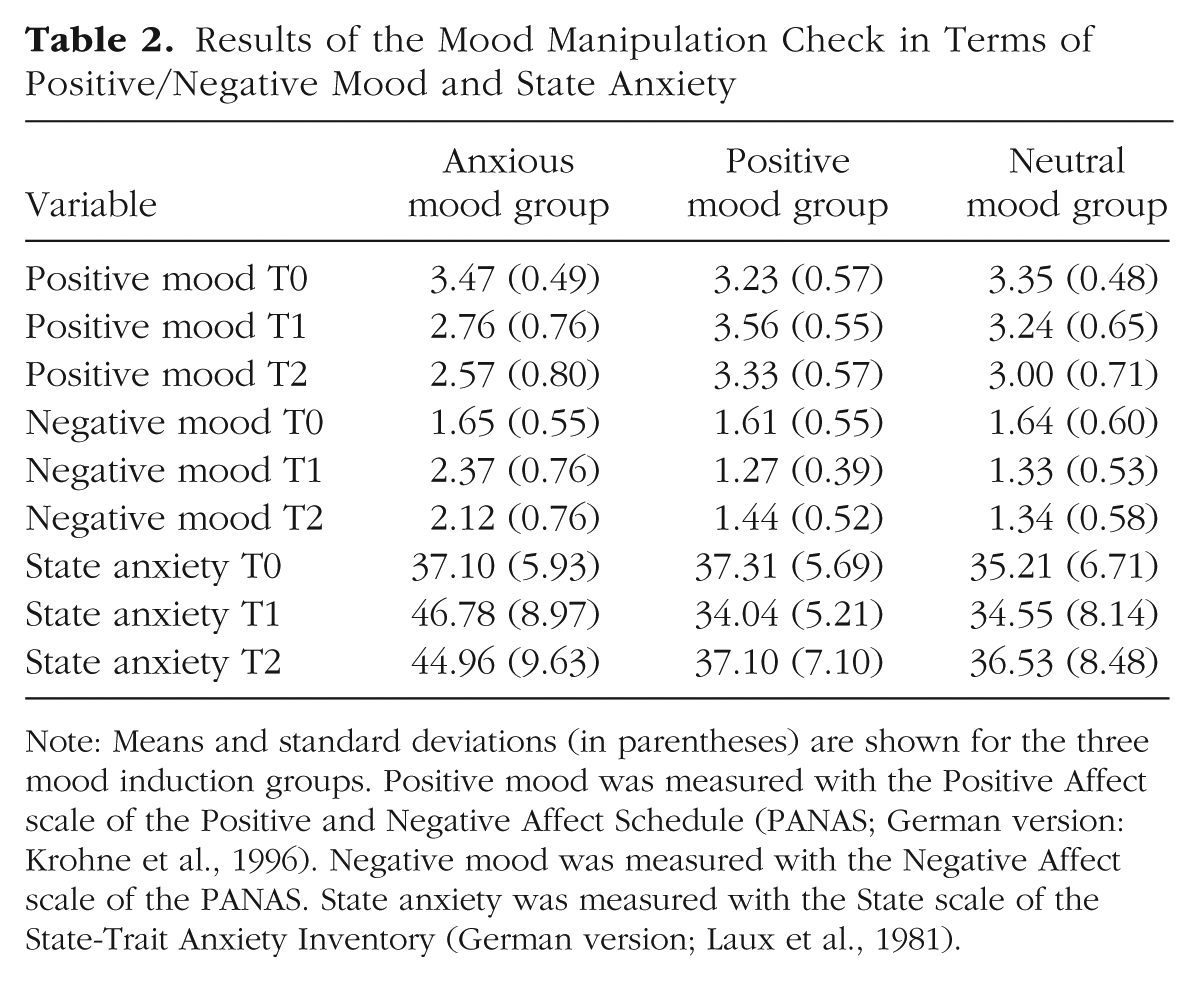
Note: Means and standard deviations (in parentheses) are shown for the three mood induction groups. Positive mood was measured with the Positive Affect scale of the Positive and Negative Affect Schedule (PANAS; German version: Krohne et al., 1996). Negative mood was measured with the Negative Affect scale of the PANAS. State anxiety was measured with the State scale of the State-Trait Anxiety Inventory (German version; Laux et al., 1981).
Intuitive performance
Intuition index
Across the whole sample, the mean intuition index was 8.41 (SD = 1.13). In line with our hypothesis, data showed significant differences between the three groups, F(2, 110) = 6.61, p = .002, η2 = .11 (see Table 3). Post hoc t tests with adjusted alpha levels showed that although there was no significant difference in intuitive coherence detection between the positive and the neutral mood groups, t(72) = 0.12, p = .908, d = 0.03, the anxious mood group showed a significantly reduced intuition index, compared to the positive group, t(73) = 3.01, p = .004, d = 0.62, and the neutral group, t(71) = 3.53, p = .001, d = 0.80. The positive and neutral mood induction groups performed reliably above the chance level of zero, neutral group: t(35) = 6.45, p < .01; positive group: t(37) = 5.12, p < .001, whereas anxious mood group did not, t(36) = 1.70, p = .09.
Intuition Index, Hit Rate, Solution Rate, A′, and Response Bias for the Three Mood Induction Groups
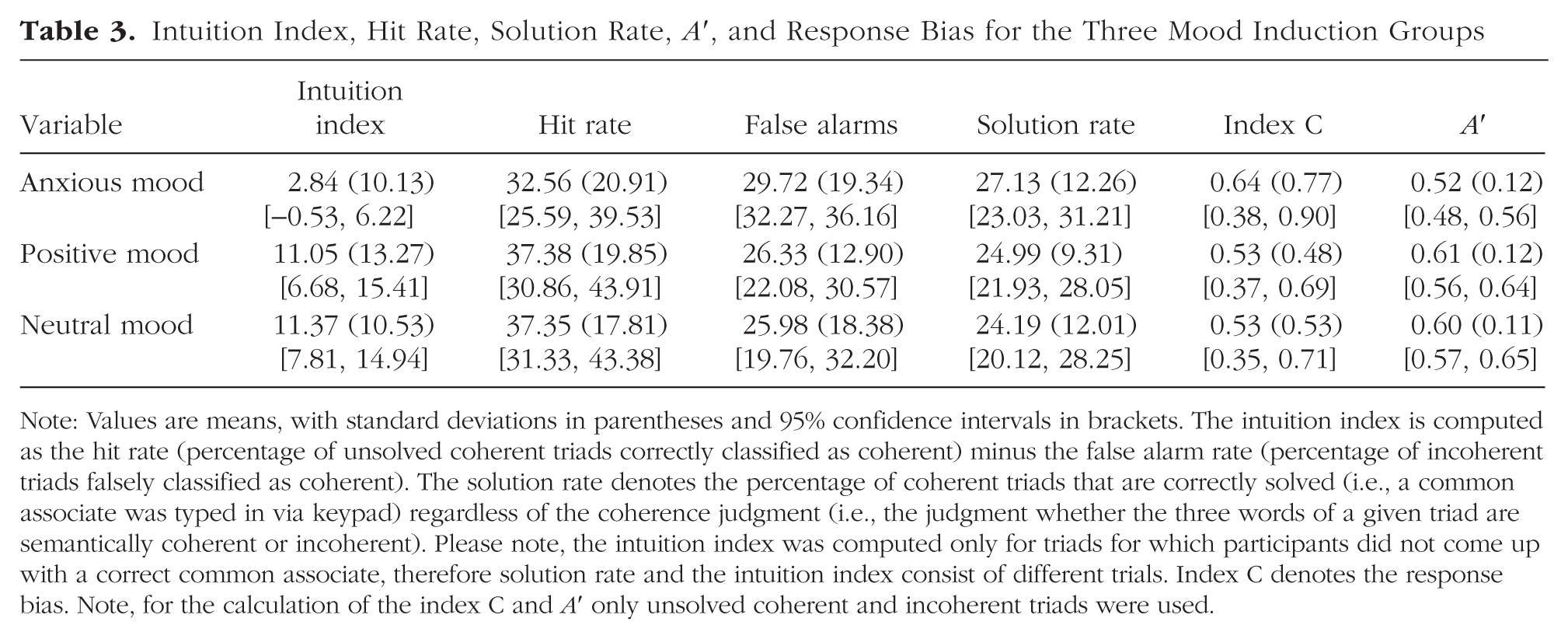
Note: Values are means, with standard deviations in parentheses and 95% confidence intervals in brackets. The intuition index is computed as the hit rate (percentage of unsolved coherent triads correctly classified as coherent) minus the false alarm rate (percentage of incoherent triads falsely classified as coherent). The solution rate denotes the percentage of coherent triads that are correctly solved (i.e., a common associate was typed in via keypad) regardless of the coherence judgment (i.e., the judgment whether the three words of a given triad are semantically coherent or incoherent). Please note, the intuition index was computed only for triads for which participants did not come up with a correct common associate, therefore solution rate and the intuition index consist of different trials. Index C denotes the response bias. Note, for the calculation of the index C and A′ only unsolved coherent and incoherent triads were used.
Hits and false alarms
Because the intuition index is calculated as the difference between hit rate and false alarm rate, we analyzed these measures separately to assess whether the lower intuition index of participants assigned to the anxious mood induction resulted from lower hit rates or from higher false alarm rates. There was no significant difference between participants of the anxiety induction group and participants of the other two groups with regard to hits and false alarms, hits: F(2, 110) = 0.72, p = .48, η2 = .01; false alarms: F(2, 110) = 0.54, p = .58, η2 = .00.
Nonparametric measure of discriminability
In addition and in line with prior research using the present intuition task, we computed the nonparametric signal detection measure of discriminability called A′ (Baumann & Kuhl, 2002; Pollack, 1970). 2 To explain, chance performance yields an A′ of 0.5, whereas perfect performance yields an A′ of 1.0. In line with findings on the intuition index, reported above, results revealed that the three groups differed significantly in A′, F(2, 110) = 5.84, p = .004, η2 = .10. Post hoc t tests with adjusted alpha levels revealed that there were only significant differences between the anxious and the neutral, t(71) = –3.12, p = .002, as well as between the anxious and the positive groups, t(73) = –2.63, p = .010, whereas A′ means of the positive and neutral groups were comparable, t(73) = –0.503, p = .617. Participants of the anxious mood induction group performed on chance level, whereas participants from the positive and neutral mood induction groups performed slightly above chance level in the task (see Table 2).
Response tendency
Following signal detection theory (Snodgrass & Corwin, 1988), we also explored the response bias of participants by calculating the index C (i.e., standardization of hits and false alarms; see Baumann & Kuhl, 2002). Thereby, a conservative response tendency is reflected by positive C values, and a liberal response tendency is reflected by negative C values. Participants of the three mood induction groups did not differ in their response tendency, F(2, 110) = 0.40, p = .664, η2 = .00 (see Table 2).
Solution rate
Overall, participants explicitly solved and 25.44% (SD = 1.06) of the coherent triads. This was independent of the mood induction (see Table 2). Thus, participants of the anxious mood induction group were as likely to verbalize solution words, as were participants of the positive and neutral mood induction groups, F(2, 110) = 0.67, p = .515, η2 = .01.
Associations between self-report measures and intuition
Trait anxiety and intuition
There was no significant association between trait anxiety and the intuition index across the sample, r = .122, p = .208. To further explore the possible role of trait anxiety, we conducted an ANCOVA with “intuition index” as dependent variable and “group” as independent variable and added “trait anxiety” as a covariate. Results revealed that trait anxiety did not act as a covariate, F(1) = 1.90, p = .170, and that the impairing effect of the anxious mood manipulation on intuition performance was still significant, when controlling for state anxiety F(2) = 5.93, p = .004, η2 = .10.
Self-reported tendency to decide intuitively, confidence in intuition, and intuitive performance
There was no significant association between the Faith-in-Intuition scale of the REI and participants’ intuitive performance across groups, r = −.022, p = .83. In addition, there was no significant correlation between participants’ self-reported confidence in intuition (gathered at the end of the semantic coherence task) and the intuition index (r = .06, p = .555) across the whole sample. Both results indicate that participants did not have conscious access to their inner processes driving intuition. This is in line with current theory (e.g., Bolte & Goschke, 2005; Bowers et al., 1990) and indicates that the semantic coherence task captured intuitive processing that people are not aware of.
Active vocabulary and verbal intelligence
Analyses revealed that the number of correct solutions significantly correlated with active vocabulary and verbal intelligence as measured with the WST, r = .42, p < .001. It is important that the intuition index did not correlate with WST levels, r = .08, p = .41. This finding indicates that the ability to intuitively detect semantic coherence is independent of the size of active vocabulary.
Discussion
In the present experiment, our aim was to investigate whether incidental anxiety would impair intuitive decision making. In a between-subjects design, we induced anxious, positive, or neutral mood states by using a multimodal mood induction. Results of a mood manipulation check confirmed the efficacy of this procedure. Participants in the anxious mood induction group reported significantly higher levels of state anxiety, higher levels of negative mood, and lower levels of positive mood than participants from the other two groups at t1 and t2. Participants of the positive and neutral mood groups, however, did not differ in levels of positive and negative mood, neither at t1 nor at t2.
We predicted that intuition would be impaired in individuals who had undergone the anxiety inducing mood manipulation. Indeed, results of the current experiment show that participants of the anxious mood induction group were significantly less able to detect semantic coherence intuitively compared to participants of the positive and the neutral mood induction groups. It is important that the different mood induction groups differed only in their intuitive performance, whereas the number of explicitly solved coherent triads was the same for all participants. This indicates that anxious participants were not generally impaired in cognitively processing the task. Instead they showed a specific impairment in intuitive decision making. Moreover, results revealed that the three mood groups did not differ with regard to conservative or liberal response tendencies and that self-report measures of trait anxiety or faith-in-intuition were not associated with intuitive performance.
The present experiment addresses an important open question, namely whether anxiety, a highly prevalent state in both healthy as well as psychiatric populations, has an impact on people’s ability to judge and decide based on smart, pattern completion and coherence building mechanisms, namely intuition. To our knowledge there is only one study, by Topolinski and Strack (2008, Experiment 2), considering the potential impairing effect of anxiety on processes relevant for intuitive decision making. However, in their priming experiment the authors did not directly tap into the effects of anxiety on intuition because response latencies in a lexical decision task indicating the activation of semantic associations were the main outcome and not intuitive coherence judgments. Thus, the current experiment takes up an issue, that has so far been only insufficiently addressed both in basic and clinical psychology.
Overall, the current findings may be embedded into previous research showing that mood serves as information (affect-as-information theory; Schwarz, 2002) and influences cognition. In line with former studies (Balas et al., 2012; Bolte et al., 2003; Hicks, Cicero, Trent, Burton, & King, 2010; Topolinski & Deutsch, 2012), our findings demonstrate that in negative mood states individuals are less likely to recur on intuitive-holistic processing. It is notable that the present results extend this line of research by showing that this is specifically the case for state anxiety and does not only pertain to negative mood states in general.
Besides the novel insights that we gain from the current experiment on the anxiety-intuition interplay, there are a number of open questions that have arisen and should be discussed. In contrast to other studies showing that positive mood fosters reliance on intuitions and broadens the activation of semantic networks (Balas et al., 2012), induced positive mood did not lead to enhanced intuitive performance compared to the neutral mood in our experiment. An explanation for this might be that our positive mood induction was not strong and enduring enough to enhance intuition of our participants. Even though there was a significant positive mood increase in the positive mood group from t0 to t1, our results also showed that (a) positive mood decreased from t1 to t2 in the positive group and (b) participants of the neutral and positive mood induction groups did not differ in positive or negative mood levels neither at t1 nor at t2.
In line with the positive mood offset effect (Diener, Kanazawa, Suh, & Oishi, 2015) positing that people generally tend to feel mild positive moods even without external triggers, it may thus be that experimentally manipulating mood in a negative direction is generally easier (indicated by the successful anxious mood induction procedure in our study) as compared to enhancing people’s mood state. Therefore, we assume that stronger positive mood inductions are needed to obtain enduring and differential effects as compared to neutral conditions.
Moreover, it should be noted here that previous research investigating the differential effects of neutral, negative, and positive mood inductions on intuitive coherence detection did not report mood differences between the neutral and the positive induction groups but referred to comparisons between the negative and positive groups only (Sweklej et al., 2015). Thus, it might be that in other studies similar problems were encountered. Based on this, we would here like to encourage researchers to report these methodological issues and potential ambiguities in findings in the future. Overall, these considerations may serve as explanation why we did not find enhanced intuition in the positive mood induction group in our experiment.
Apart from these methodological issues, the current study has limitations that will be discussed in the following along with resulting directions for upcoming research. First of all, we did not collect data on participants’ income and socioeconomic status. Therefore, these variables could not be taken into account in the results’ interpretation, which limits the generalization of the current findings. Another limitation of the current experiment refers to the operationalization of intuition. Even though the semantic coherence task is widely used in basic research on intuition, it is specific to semantic processes and represents only one of many other options to operationalize intuition. Upcoming research would do well in testing the robustness of our findings by examining other forms of intuitions such as intuitions of visual coherence (Bolte & Goschke, 2008), auditory coherence (Volz, Rübsamen, & von Cramon, 2008), or social intuitions (Ambady, 2010; Mega, Gigerenzer, & Volz, 2015) on the one hand and intuition paradigms that are associated with real-life intuitive decisions on the other hand to enhance the ecological validity of findings. Moreover, future research should test the specificity of the current findings and directly compare different negative affective states such as anger, sadness, and anxiety in their influence on intuition. Within this framework, other factors distinguishing between different negative emotional states such as underlying motivational processes (e.g., risk reduction in anxiety versus loss avoidance in sadness) should be taken into account.
It is important that the current sample consisted of healthy students and conclusions for clinical samples can thus not be drawn from the current study. However, researchers may take the current preliminary findings as a starting point to examine intuitive decision making in clinical samples (i.e., in patients with anxiety disorders). This would be an important next step to understand how clinical anxiety interferes with decision making and would directly tie up with recent research showing the detrimental effects of major depression on intuitions of semantic coherence (Remmers, Topolinski, Dietrich, & Michalak, 2015; Remmers et al., 2016; Remmers & Michalak, 2016).
Moreover, future research would do well in further disentangling the effects of trait versus state anxiety on intuition. Pacheco-Unguetti et al. (2010), for example, showed that state and trait anxiety differentially interfere with attentional capacities. Thus, even though there was no significant association between trait anxiety and intuition in our healthy student sample, upcoming research should continue to dissociate potentially differential effects of trait versus state anxiety by using tasks that assess different decision-making processes (i.e., intuitive, analytical) and by using more heterogeneous samples such as patients with anxiety disorders.
Considering that decision making often takes place in complex situations, under time pressure or restricted resources of working memory, uncertainty is often an important part of taking a decision (Paulus, 2007). Future research should therefore explore whether anxiety disorders, in which intolerance of uncertainty is a typical feature (e.g., generalized anxiety disorder), are associated with impairments in intuitive decisions. Also the reverse relationship should hereby be taken into account by examining whether intuitive decision making itself may contribute to the development of anxiety.
Another attempt of future research should be to examine how explicit processes, such as rumination in depression or worry in generalized anxiety disorder and intuitive processes interact in people with mental disorders (Paulus, 2007). If intuitive processes turn out to be impaired or biased in anxious patients or access to otherwise helpful intuitions is blocked in these populations, the question remains open whether these deficits may be compensated by explicit-analytical strategies (Beevers, 2005) or by specialized therapeutic techniques such as mindfulness or focusing (Gendlin, 1996; see Remmers & Michalak, 2016, for a discussion on therapeutic implications).
Altogether, we would like to state that even though the exploration of intuitive decisions in acutely anxious people is still in an early phase, this line of research may be important for our understanding of decision-making difficulties in psychiatric as well as healthy populations. Decision making is a process in which a lot of information as well as physiological, cognitive, and affective cues need to be integrated to achieve a homeostatic state (Paulus, 2007). Thus, unconscious, intuitive processes that operate associatively and like a pattern completion mechanism (Sadler-Smith, 2007) play an important role, and research would do well in continuing the investigation of these phenomena. Empirical insights from this line of research may in the long run help clinicians to support patients to overcome indecisiveness and to find their way through the dynamic process of coming to adaptive decisions.
Footnotes
Acknowledgements
The authors thank Juan Lupianez for kindly providing the material of the multimodal mood induction. The authors also thank Stefan Thommen for help in programming the experiment and collecting the data and Joe Case for proofreading.
Declaration of Conflicting Interests
The authors declared that they had no conflicts of interest with respect to their authorship or the publication of this article.
Funding
This project is funded by the Division of Clinical Psychology and Epidemiology (Roselind Lieb) at the Department of Psychology, University of Basel, Switzerland.
Open Practices
All data have been made publicly available at the Open Science Framework and can be accessed at https://osf.io/x9kqz/. The complete Open Practices Disclosure for this article can be found at https://journals-sagepub-com.web.bisu.edu.cn/doi/suppl/10.1177/2167702617728705. This article has received the badge for Open Data. More information about the Open Practices badges can be found at  .
.
Notes
References
Supplementary Material
Please find the following supplemental material available below.
For Open Access articles published under a Creative Commons License, all supplemental material carries the same license as the article it is associated with.
For non-Open Access articles published, all supplemental material carries a non-exclusive license, and permission requests for re-use of supplemental material or any part of supplemental material shall be sent directly to the copyright owner as specified in the copyright notice associated with the article.
