




Abstract
We examined the associations between personality pathology and daily situational experiences. College student participants (N = 180) were assessed on pathological personality traits along with six assessments of everyday situation experiences. Independent raters judged situation descriptions provided by the participants to estimate the normative and consensually shared aspect of situations. Participants’ subjective situational construals were obtained by partialing the consensual aspect out of their in situ situation ratings. Substantive and meaningful relations between personality pathology and situations were found, and they were predominantly underpinned by subjective construal of situational characteristics. By using comprehensive taxonomies of personality pathology and situations, we advanced current understanding on the day-to-day situational dynamics and experiences of individuals with pathological personality tendencies.
Individuals with personality pathology often exhibit significant impairment in intrapersonal and interpersonal functioning that compromise their psychological well-being and the welfare of significant others, as articulated in the fifth edition of the Diagnostic and Statistical Manual of Mental Disorders (DSM–5; American Psychiatric Association, 2013). However, relatively little is known about the day-to-day situations experienced by individuals with pathological personality tendencies. What are the situational experiences of these people relative to people without maladaptive trait tendencies? How do these individuals make sense of their situational encounters? Employing comprehensive personality and situation assessments, we aim to explicate the links between people’s pathological traits and their experiences in daily situations and the extent these associations are driven by situation contact as opposed to subjective construal.
The focus on the situation experience of individuals with personality pathology has been largely restricted to interpersonal situations (Wilson, Stroud, & Durbin, 2017). The neglect of other situation types (e.g., task-oriented situations) is due partly to the lack of appropriate and comprehensive measures of situations. Fortunately, recent advances in situation assessment in social-personality psychology have provided an opportunity to systematically examine the associations between personality pathology and a comprehensive taxonomy of situations (Rauthmann & Sherman, 2018). In everyday life, individuals constantly encounter a variety of situations that are ever changing in dynamic ways. Despite being psychologically important, people’s experience of situations has long been a neglected area of research. In particular, this research area has been criticized for the lack of clarity regarding the definition and nature of situations along with a lack of working taxonomy of situations and their measurement (Funder, 2016; Rauthmann et al., 2014). To address these gaps, Rauthmann et al. (2014) and Parrigon, Woo, Tay, and Wang (2017) recently proposed situation assessment tools (named DIAMONDS [
Taxonomy of Situation Characteristics
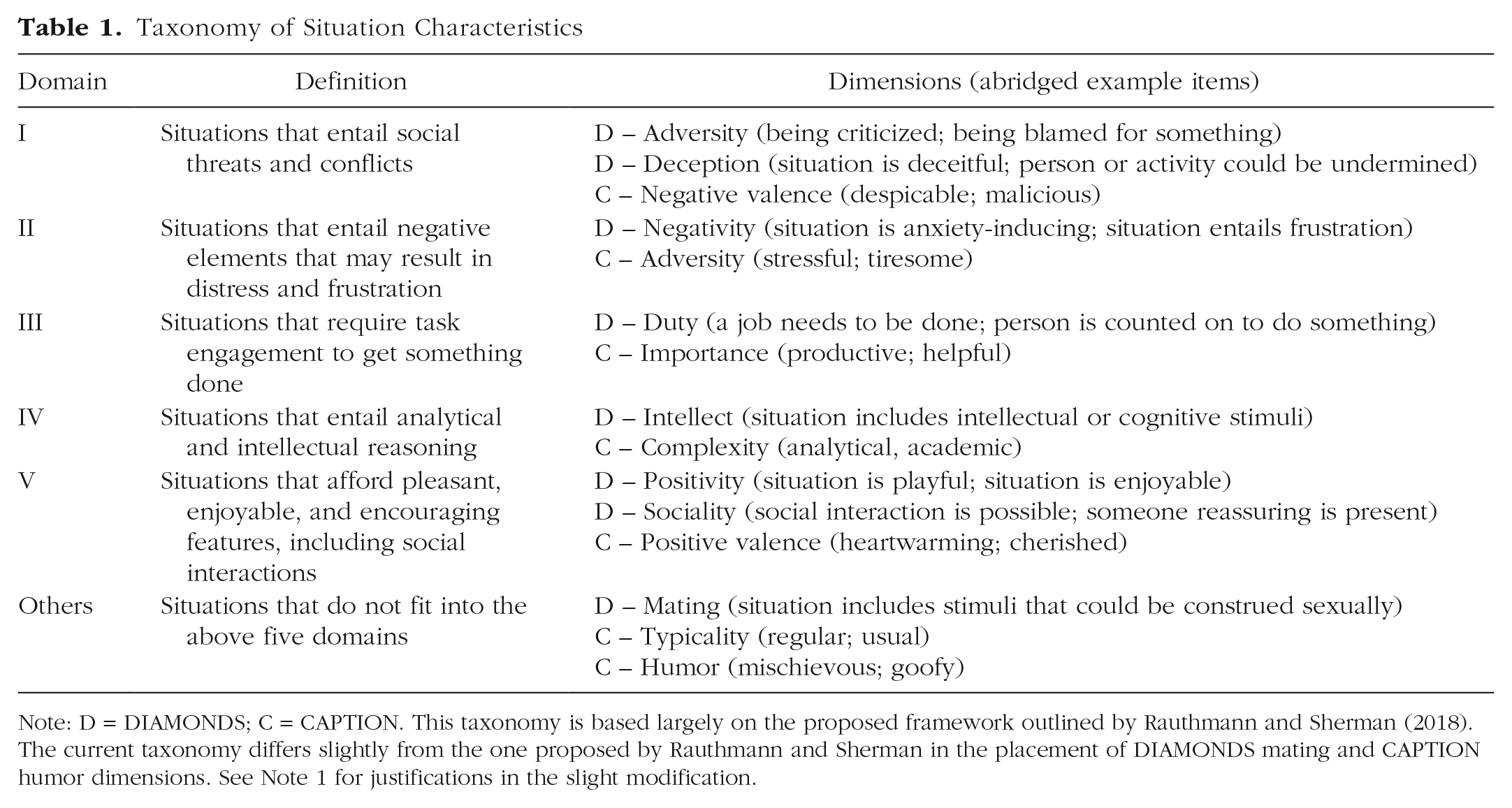
Note: D = DIAMONDS; C = CAPTION. This taxonomy is based largely on the proposed framework outlined by Rauthmann and Sherman (2018). The current taxonomy differs slightly from the one proposed by Rauthmann and Sherman in the placement of DIAMONDS mating and CAPTION humor dimensions. See Note 1 for justifications in the slight modification.
We adopted the working definition of situation characteristics proposed by Rauthmann et al. (2014): Situation characteristics are psychologically salient features that have important meanings. Situational cues (i.e., persons, places, events, and activities such as “having dinner with family members at a restaurant”) are often processed and attached with meaning by a perceiver with influence from the person’s characteristics, such as traits, knowledge, social roles, and current psychological states. This process translates to psychological situation characteristics, such as that the situation “affords positive social interactions and bonding,” “is enjoyable,” and is not likely to be “anxiety provoking.” In essence, psychological situation characteristics encapsulate psychologically important meanings in situations.
The DIAMONDS and CAPTION models share more commonalities than differences (Parrigon et al., 2017; Rauthmann & Sherman, 2018) despite differences in the way they were developed. Dimensions from the two situation models are organized into a working taxonomy, as presented in Table 1. This working taxonomy is based largely on Rauthmann and Sherman’s (2018) framework, with some slight deviations. 1 (Note that the adversity dimension in DIAMONDS differs conceptually from its namesake in CAPTION; hence, either D or C is used as a prefix to differentiate the two.) In this article, we used the working taxonomy of situations in Table 1 as our framework to organize our analyses and results.
When people create psychological meanings of situations from cues in the environment (Magnusson, 1981), the ensuing situation experience is to some extent shared with others and to some extent unique to the perceiving individual (Rauthmann et al., 2014). The shared component is referred to as the “canonico-consensual” objective (Block & Block, 1981) or “alpha-press” aspect (Murray, 1938) of situations, whereas the unique, subjective situation is the unique deviation from the canonico-consensual perspective or the beta-press aspect of situations. For example, most people would perceive taking an examination as stressful and anxiety provoking. However, some individuals may appraise this situation to be more (or less) stressful than most people. From this theoretical perspective, a particular situation that is being experienced by an individual is a conflation of the canonico-consensual aspect (i.e., what is normatively shared with others) and the unique aspect (i.e., what is distinctive to the individual). Therefore, a situation experience can be decomposed into its constituent canonico-consensual and distinctive aspects, which also represent situation “contact” and “construal,” respectively (see the paragraph after next). 2
Preliminary empirical data suggest meaningful associations between situational experiences and normal personality. For instance, in the case of DIAMONDS, deception in situations is negatively associated with agreeableness, and negativity in situations is related to neuroticism (Rauthmann, Sherman, Nave, & Funder, 2015; Sherman, Rauthmann, Brown, Serfass, & Jones, 2015). For CAPTION, humor in situations is associated with low conscientiousness, and positive valence is linked to extraversion. Although such associations are generally weak in magnitude, they nonetheless suggest that individual differences in situational experiences are meaningfully related to personality trait variation.
Given the close correspondence between normal and abnormal personality trait structure (Gore & Widiger, 2013; Wright & Simms, 2014), we reason that meaningful associations between situational experiences and personality pathology can be uncovered (e.g., negativity and C-adversity situation dimensions should be positively related to negative affectivity). Two processes proposed to underline personality–situation associations are situation selection and construal (Rauthmann et al., 2015). Selection refers to the process in which an individual with preexisting personality characteristics self-selects into objective situations. Objective situation characteristics are those that possess consensual agreement by observers (i.e., the canonico-consensual perspective). Conversely, construal implies that one’s personality characteristics influence one’s subjective interpretations of the situation (i.e., unique deviations from the canonico-consensual perspective). Both selection and construal processes (Funder, 2016) are possible in the context of personality pathology. For example, compared with patients without personality impairment, patients with borderline personality disorder have less interactions with others (i.e., selection) and tend to perceive their social interactions as being more ambivalent and conflictual (i.e., construal; Stepp, Pilkonis, Yaggi, Morse, & Feske, 2009).
Individuals with pathological traits possess extreme and maladaptive trait constellations (Costa & Widiger, 2002) that likely lead to idiosyncratic processing of social information (Eaton, South, & Krueger, 2009). Therefore, one might expect that the basis for the situational experience associated with personality pathology is primarily driven by subjective construal. This proposal is consistent with empirical data supporting the construal process in normal personality traits (Rauthmann et al., 2015; Sherman, Nave, & Funder, 2013). Hence, we expected that the situational experiences of individuals with personality pathology to be largely determined by their subjective interpretations of situations as opposed to the actual exposure to objective situations.
The primary purpose of our study was to examine the associations between daily situation experiences and personality pathology. The trait model in Section III of the Alternative Model of Personality Disorders of the DSM–5 (American Psychiatric Association, 2013) was used to operationalize personality pathology. Specifically, we expected that individuals high on negative affectivity should experience situations that were difficult, stressful, and frustrating (Domain II). Socially detached individuals should experience situations that contained less positivity, enjoyment, and social interactions (Domain V). We predicted that individuals with pathological traits (especially detachment, antagonism, and psychoticism) would likely experience situations entailing interpersonal conflicts and disagreements (Domain I) because of their problems with empathy and intimacy. The second aim was to determine whether the situational experiences of individuals with pathological trait tendencies were driven primarily by their self-selection into certain objective situations (i.e., contact) or their subjective interpretation of situational features (construal). We predicted that most of the links between pathological traits and situations were predominantly driven by construal. 3
Method
Participants
On the basis of previous research (Parrigon et al., 2017; Rauthmann et al., 2015; Sherman et al., 2015), the average effect size of theory-predicted personality–situation correlations was approximately .20 (or d = 0.41). A power analysis for fixed effects in multilevel analysis (Scherbaum & Ferreter, 2009; Snijders & Bosker, 2012) indicated that a sample size of 94 participants (with six repeated measurements per individual) was required for the study to have 90% power to detect such an effect with an α level of .05 (two-tailed test). We recruited 190 college students at a large national university in Singapore who participated in exchange for course credit or cash reimbursement. Ten participants were dropped because of incomplete data (e.g., insufficient number of situational assessments). The final sample of 180 comprised 39 men and 141 women; their mean age was 20.2 years (SD = 1.4).
Measures
Personality Inventory for DSM–5 (PID-5)
The PID-5 is a 220-item measure of 25 maladaptive personality traits, which can be organized into five higher order domains referred to as Negative Affectivity, Detachment, Antagonism, Disinhibition, and Psychoticism (Krueger, Derringer, Markon, Watson, & Skodol, 2012). Using a Likert-type scale from 0 to 3 (0 = very false or often false, 3 = very true or often true), participants rated their endorsement on statements such as “Plenty of people are out to get me” and “I don’t get emotional.” Reliabilities of the domain scales are as follows: .94 (negative affectivity), .94 (detachment), .94 (antagonism), .90 (disinhibition), and .94 (psychoticism).
Situational measures
The DIAMONDS (Rauthmann et al., 2014) and CAPTION (Parrigon et al., 2017) measures of situational experiences were used. The shortened version (32 items; 4 items per dimension) was used, and participants rated on an 8-point Likert-type scale (1 = not at all relevant, 8 = completely relevant) according to how relevant the participants thought the statements were with reference to a particular situation. Within- and between-individual coefficient α estimates (before and after the slashes in the following, respectively; Geldhof, Preacher, & Zyphur, 2014) were good for the DIAMONDS dimensions: .86/.90 (duty), .70/.88 (intellect), .72/.93 (adversity), .78/.91 (mating), .71/.68 (positivity), .89/.95 (negativity), .66/.95 (deception), and .87/.84 (sociality). The CAPTION measure (short version) comprised 28 words rated on a 5-point Likert-type scale ranging from 1 = not at all relevant to 5 = completely relevant. Within- and between-individual coefficient α estimates (before and after the slashes in the following, respectively) were .86/.86 (complexity), .89/.96 (adversity), .89/.94 (positive valence), .84/.98 (typicality), .77/.96 (importance), .84/.97 (humor), and .62/.95 (negative valence).
Procedure
After recruitment, participants were asked to complete the PID-5 on an online platform. Subsequently, participants completed a situation assessment at a stipulated time once every 2 days for 12 days (i.e., six waves of situation assessments). Prespecified times for the situation assessments were 10 a.m., 12 noon, 2 p.m., 4 p.m., 6 p.m., and 8 p.m., which captured a wide and representative sampling of participants’ daily situational experiences. E-mails were sent out at the specified times asking participants to complete the situation assessments. A reminder was sent out if the assessment was not completed within 2 hr. Participants were also told that if they were sleeping at the specified time, they were supposed to describe the situation after they had awakened. Participants were divided into six batches; each batch started its first situation assessment at a different time (e.g., first batch started at 10 a.m. and so on; second batch started at 12 noon and so on).
During each situation assessment, the participants were asked to provide a brief description of the situation at the specified time. Guiding questions were provided: Where were you? When were you there? Who was with you? What were you (and others) doing? What was happening? Participants then rated the particular situation using the DIAMONDS and CAPTION measures. These data represented in situ ratings that reflected the participants’ own situational experiences. Six participants’ situation data were dropped because they completed fewer than three (out of six) assessments.
Ex situ situation ratings reflect the consensual and normative aspects of situations. To obtain ex situ ratings, we recruited nine raters to independently rate the situations. In groups of three, the raters rated all situations from two waves (i.e., one group rated situations at 10 a.m. and 12 noon, the second group rated situations at 2 p.m. and 4 p.m., and the last group rated situations at 6 p.m. and 8 p.m.). These raters were presented with situation descriptions provided by the participants in their situation assessments and were asked to rate the situations using the DIAMONDS and CAPTION (see Rauthmann et al., 2015, for a similar procedure). They were instructed to rate the situation descriptions as how most people would normatively perceive the situations. Although the ex situ ratings were made on the basis of “thin slice” information, the agreement between in situ and ex situ ratings was good (mean r = .50; Rauthmann et al., 2014). This finding suggests that the raters were able to derive valid information about situation characteristics, likely on the basis of shared sociocultural meaning systems (Rauthmann et al., 2015). The three groups demonstrated high within-group interrater agreement; interclass correlations (Shrout & Fleiss, 1979) were all above .85. The ratings were then averaged across the three raters to derive the corresponding ex situ score per situation per participant.
Data analytic plan
Following Rauthmann et al. (2015), we first organized participants’ in situ situation ratings by the DIAMONDS or CAPTION dimensions. The same procedure was applied to the averaged ratings completed by the ex situ raters; these ratings reflected situation features that were normative to the average person (i.e., contact). By regressing each dimension of situation experience on situation contact on a single situation, situation contact was partialed out of situation experience to derive standardized residuals. These residuals represented situation construals—the purely subjective perception of the situation by the participants who had experienced the situation.
Multilevel analyses were used to examine the extent to which individual differences in personality pathology predicted within-individual variations on daily situation dimensions. We tested both bivariate (i.e., using a single PID-5 trait as a predictor) and multivariate (i.e., using all PID-5 traits simultaneously as predictors) associations of the PID-5 traits to situations. Gender was used as a covariate in these analyses because of the gender imbalance of our sample. Multilevel analyses were conducted using the HLM 7 program (Raudenbush et al., 2011). Information on the input codes of analyses conducted (e.g., multilevel model equations) is available in the Supplemental Material available online.
Results
Participants completed 1,015 situation assessments out of a possible total of 1,080 (93.9%). On the basis of a random sample (20%) of situation descriptions, the average number of words per description was 26.7 (SD = 20.3). Examples of situation descriptions are presented in Section A of the Supplemental Material.
Preliminary analyses
Table S1 in the Supplemental Material presents the descriptive statistics of the between- and within-individual variables. We estimated the amount of variability that was between as opposed to within persons in the state-based situation measures, quantified as the variance components and intraclass correlation coefficients. Overall, some degree of between-individual variability was observed for situation experiences (DIAMONDS τ00, M = 0.52, SD = 0.18; CAPTION τ00, M = 0.25, SD = 0.12), although the degree of within-individual variability appeared to be larger (DIAMONDS σ2, M = 2.26, SD = 1.35; CAPTION σ2, M = 0.90, SD = 0.42). The ICCs (DIAMONDS, M = .22, SD = .08; CAPTION, M = .24, SD = .08) suggested that the participants’ situational experience varied more within rather than across individuals. In addition, participants tended to report situational characteristics associated with duty, intellect, positivity, sociality, typicality, and importance in the situations more so than D-adversity, mating, deception, humor, and negative valence. The PID-5 norms were comparable with those obtained from a treatment-seeking community sample reported in Krueger et al. (2012; Round 2 sample), all ds < 0.20. The domains were also strongly correlated with one another (mean r = .57; range = .41–.72; see Table S2 in the Supplemental Material).
Tables S3 and S4 in the Supplemental Material present the correlations between DIAMONDS and CAPTION dimensions. These associations were in support of the organizing scheme of broad situation domains presented in Table 1. Cross-domain relations were also evident; there were substantial relations between Domains I and II and between Domains III and IV. We interpreted these cross-domain relations as reflective of the typical situations our sample of college students were likely to encounter. Because the students probably spent considerable time on academic matters (e.g., studying, working on assignments), we viewed the correlations between Domains III and IV to mean that the students considered these situations to be cognitively engaging (Domain IV) and were important tasks to be done (Domain III). (See notes on Table S4 in the Supplemental Material.)
Associations between PID-5 and situations
Table 2 (top section) presents the multilevel bivariate relations between PID-5 domains and daily situation characteristics, with gender as a covariate. Domain I situations (i.e., D-adversity, deception, and negative valence) were positively predicted by all five PID-5 dimensions. Domain II situations (i.e., negativity and C-adversity) were associated with negative affectivity, detachment, disinhibition, and psychoticism. The remaining three situation domains were generally not associated with PID-5 dimensions, although psychoticism exhibited positive relations with intellect and positivity. Mating and humor were positively associated with antagonism, disinhibition, and psychoticism. The effect size (f2) for all these significant associations were of small to moderate magnitude; mean f2 = .09, SD = .04, range = .04 to .19 (Snijders & Bosker, 2012). The top three associations with the strongest magnitude were (a) detachment and negativity (f2 = .19), (b) negative affectivity and negativity (f2 = .18), and (c) psychoticism and D-adversity (f2 = .17).
Bivariate Multilevel Relations Between PID-5 Traits and Situational Experience, Contact, and Construal
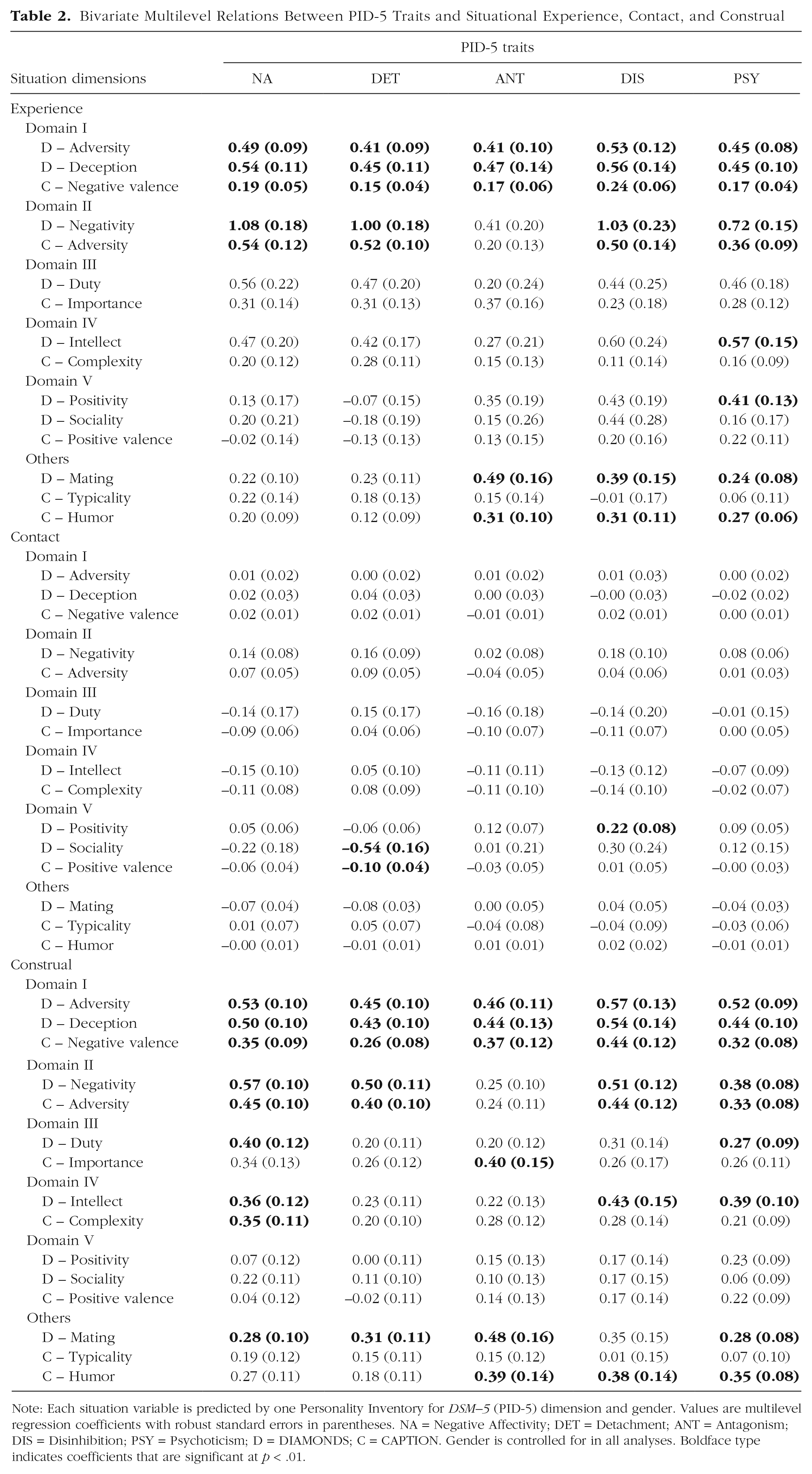
Note: Each situation variable is predicted by one Personality Inventory for DSM–5 (PID-5) dimension and gender. Values are multilevel regression coefficients with robust standard errors in parentheses. NA = Negative Affectivity; DET = Detachment; ANT = Antagonism; DIS = Disinhibition; PSY = Psychoticism; D = DIAMONDS; C = CAPTION. Gender is controlled for in all analyses. Boldface type indicates coefficients that are significant at p < .01.
We also examined the extent to which the situation characteristics reported by the participants were a function of contact as opposed to construal (psychometric properties of these scores were good; see Section B in the Supplemental Material) and whether associations with personality pathology would differ from the in situ ratings (Table 2; middle and bottom sections). In general, the PID-5 dimensions were not associated with situation contact, which suggests that individuals with personality pathology did not self-select themselves into specific situations. However, there were a few exceptions. Detached individuals were likely to find themselves in situations low on positivity and sociality (as rated by observers), whereas disinhibited individuals tended to encounter situations with positive elements. The general conclusion was that the in situ ratings were largely defined by subjective construal on the part of the participants and that the personality–situation associations were almost identical for the in situ and construal ratings (for bivariate correlations, see also Table S7 in the Supplemental Material). We thus used the in situ ratings for subsequent analyses.
Multilevel analyses were conducted with the PID-5 dimensions and gender simultaneously entered as between-individual predictors of within-individual variation on situational experience (i.e., in situ ratings). As seen in Table S8 in the Supplemental Material, detachment, antagonism, and psychoticism were the three dimensions that showed unique associations with a number of situation characteristics. Detachment, in particular, provided unique and negative predictions of Domain V characteristics of positivity, sociality, and positive valence and Domain II characteristic of C-adversity. Antagonism uniquely predicted low negativity but high mating. Psychoticism uniquely predicted D-adversity, intellect, positivity, positive valence, and humor. Negative affectivity and disinhibition did not predict any situation characteristic. The effect-size estimate (f2) for these 15 models ranged between 0 and .20, with a mean of .08 (SD = .07). Because of the strong overlap among the PID-5 dimensions, we performed additional analyses to examine whether their common variance is predictive of situations. Findings suggested that this common variance predicted 10 (out of 15) situation dimensions with a mean effect size of .09 (SD = .06, range = .02–.18; see notes on Table S8). 4
Discussion
The first key finding is that there were substantive relations between personality pathology and situational experiences. The second is that these associations were overwhelmingly driven by subjective situational construal as opposed to situation contact. We found that all five pathological trait dimensions showed significant bivariate associations with threatening, deceptive, and disagreeable social situations. Individuals high on these personality pathology dimensions (except antagonism) also tended to report experiencing stressful and negative situations. Furthermore, antagonistic, disinhibited, and eccentric individuals tended to experience situations as containing sexual/intimate and humorous features (although these relations appeared to be driven by men; see Note 4).
From a multivariate perspective in which the unique influence of a specific PID-5 trait was evaluated while controlling for the other traits, fewer associations with situation experiences were found. Detachment was uniquely and negatively related to situations that afford pleasant characteristics and social interactions. Antagonism uniquely predicted the experience of more mating situations but fewer distressing situations. Psychoticism was positively related to situations that entailed positivity, intellectual reasoning, and humor but negatively related to interpersonal adversity. Overall, these results provided a preliminary roadmap of associations between personality pathology and situations.
Because of the large number of meaningful personality–situation associations, we selected a few of them for elaboration as illustrative examples. Psychoticism was associated with both negative (e.g., interpersonal adversities) and positive (e.g., intellect and positivity) situational characteristics. Given their eccentric demeanor, persons high on psychoticism often face social rejections and have difficulties relating to others (e.g., Lim, Gwee, & Hong, 2019). The link with situations entailing intellectual endeavors could be due to psychoticism’s shared variance with the normal personality trait of openness to experience (Gore & Widiger, 2013), manifested as a tendency for apophenia (i.e., perceiving causal patterns or connections when none actually exist; see DeYoung, Grazioplene, & Peterson, 2012). Hence, in task-oriented situations (e.g., studying), eccentric individuals might overthink and find “hidden” connections among unrelated concepts. Psychoticism’s unique associations with positive and endearing situations were unexpected. We speculate that when the other PID-5 traits were controlled for, the specific aspects of psychoticism (e.g., fantasy/magical thinking) might facilitate a positivity bias in processing situational information as a form of self-protection. Another novel finding is that individuals (likely men) high on Antagonism tended to experience (and perceive) characteristics of mating in situations. They seemed to perceive opportunities for sexual intimacy more readily than others, and this perception might have negative consequences for their interactional partners. This result is consistent with research documenting individuals high on malevolent traits (e.g., psychopathy, narcissism, and Machiavellianism) are likely to adopt short-term and exploitative mating strategies (Jonason, Li, Webster, and Schmitt, 2009).
A critical finding is that associations between pathological traits and situations were predominantly driven by the process of construal, which supports the idea that individuals elevated on personality pathology may focus and distort on specific situation features (Eaton et al., 2009; Huprich & Nelson, 2015). The bivariate correlations for theoretically expected associations reported in our study (Table S7 in the Supplemental Material) appear stronger in magnitude (r ≥ .30) compared with previous research using normal personality traits (Parrigon et al., 2017; Rauthmann et al., 2014, 2015; Sherman et al., 2015). We attribute the larger effect sizes to two possibilities: (a) personality pathology as extremities of normal trait variation (Costa & Widiger, 2002) may magnify personality–situation correlations and (b) increased reliability of the situation assessments through the aggregation of six measurements resulting in higher validity coefficients with personality pathology. These moderately strong associations provide sound justifications for examining situational experiences of individuals with maladaptive personality.
Our research has important implications for clinical practice. Clinicians should seek to understand the situational contexts associated with their patients’ personality profiles. Sensitizing patients to the potential situational features they are likely to encode could help them be cognizant of the situation–behavior contingencies that could occur (Huprich & Nelson, 2015). Other than working to cognitively restructure patients’ situational encoding processes, clinicians can also advise them to actively select or avoid certain situations. Intervention effects may be more effective if holistic information is obtained about a patient’s personality profile and the situational contexts under which maladaptive behaviors manifest.
Several study limitations warrant attention. First, the main findings were based largely on self-reports, which might have resulted in inflated estimates as a result of common method variance. Future research might consider the use of other methods such as informant reports (Markon, Quilty, Bagby, & Krueger, 2013) or diagnostic assessments (Morey, 2017) of personality pathology to examine if our findings could be replicated. Using these alternative sources of personality data could also circumvent the potential lack of insight among individuals with personality pathology (Huprich, Bornstein, & Schmitt, 2011). Second, the ex situ ratings might fail to capture important aspects of situations encountered by the participants because they were dependent on how accurate and vivid the descriptions were. Prefiltering of the situation descriptions by participants was also possible.
The third limitation is the low discriminant validity among the PID-5 trait dimensions, an issue that is acknowledged by researchers (Crego, Gore, Rojas, & Widiger, 2015). Strong intercorrelations among the dimensions pose interpretive challenges when they are included as simultaneous predictors of daily situations in a multivariate context (Sleep, Lynam, Hyatt, & Miller, 2017). One possibility for the low discriminant validity could be due to the use of a student sample in which there were few exemplary cases of personality disorders. Elevation of the PID-5 domains might be due to a general tendency in negative affectivity (or neuroticism). Although we addressed this issue by showing significant associations between the overall personality pathology index and situations, future work would have to tackle the strong overlap in PID-5 dimensions and improve their discriminant validities. Finally, the use of a Singaporean student sample limits the generalizability of current findings to clinical patient and other cultural groups. Further studies should be conducted on other groups to ensure generalizability of current findings.
In using comprehensive taxonomies of personality pathology and situations, our research is the first to provide a preliminary atlas of associations between personality pathology and situations. These associations appear to be predominantly a function of subjective situation construal rather than contact. These findings represent critical advances in our understanding of how persons with personality pathology navigate their everyday situation encounters.
Supplemental Material
Hong_Open_Practices_Disclosure – Supplemental material for Pathological Personality Traits and the Experience of Daily Situations
Supplemental material, Hong_Open_Practices_Disclosure for Pathological Personality Traits and the Experience of Daily Situations by Ryan Y. Hong, Wing Yan Chan and Jacqueline Y. R. Lim in Clinical Psychological Science
Supplemental Material
Hong_Supplemental_Materials – Supplemental material for Pathological Personality Traits and the Experience of Daily Situations
Supplemental material, Hong_Supplemental_Materials for Pathological Personality Traits and the Experience of Daily Situations by Ryan Y. Hong, Wing Yan Chan and Jacqueline Y. R. Lim in Clinical Psychological Science
Footnotes
Acknowledgements
This research obtained ethics clearance from the Department Ethics Review Committee (Study name: Personality, Situational Perception, and Emotion; Approval code: 2017-July-21). A version of this manuscript was presented at the International Convention of Psychological Science, March 7–9, 2019, in Paris.
Transparency
Action Editor: Scott O. Lilienfeld
Editor: Scott O. Lilienfeld
Author Contributions
R. Y. Hong developed the study concept. All of the authors contributed in the study design, data collection, and statistical analyses. R. Y. Hong drafted the manuscript, with inputs from W. Y. Chan and J. Y. R. Lim. All of the authors approved the final manuscript for submission.

Notes
References
Supplementary Material
Please find the following supplemental material available below.
For Open Access articles published under a Creative Commons License, all supplemental material carries the same license as the article it is associated with.
For non-Open Access articles published, all supplemental material carries a non-exclusive license, and permission requests for re-use of supplemental material or any part of supplemental material shall be sent directly to the copyright owner as specified in the copyright notice associated with the article.
