



Abstract
Although dynamic risk factors are considered important in the assessment and treatment of adult male sex offenders, little is known about their interrelationships. We apply network analysis to assess their associations and to provide an analysis of their shortest pathways to sexual and violent (including sexual contact) recidivism. Analyses revealed a central position for general rejection/loneliness (in all networks), poor cognitive problem solving (in networks containing sexual or violent—including sexual contact—recidivism), and impulsive acts (only in the network including sexual recidivism). These variables represented links between clusters of dynamic risk factors composed of factors relating to sexual self-regulation, emotionally intimate relationships, antisocial traits, and self-management. Impulsive acts showed the strongest independent association with sexual and violent (including sexual contact) recidivism.
The primary goal in the treatment of sex offenders is to help them desist from committing new offenses. To reach this goal, professionals in the forensic field mostly rely on the risk-need-responsivity (RNR) model (Andrews & Bonta, 2010; Bonta & Andrews, 2017). This model involves three core principles. First, the risk principle proposes that instead of methods of risk assessment based on professional judgment, the actuarial risk-assessment instruments, which provide a probabilistic estimate of the risk of recidivism, should be used to determine treatment setting, intensity, and duration. More precisely, high-risk offenders need more intensive and extensive services, whereas low-risk offenders need minimal or no intervention to reduce recidivism risk. Second, the need principle implies that forensic treatment effectiveness increases if treatment is focused on dynamic risk factors, which are factors that are amenable to change and correlate with the risk of reoffending. Finally, the responsivity principle maintains that the effect of treatment increases if it is matched to the ability and learning style of the offender. Findings of two meta-analyses (Hanson, Bourgon, Helmus, & Hodgson, 2009; Schmucker & Lösel, 2015) showed that the application of RNR principles in sex offender treatment indeed is associated with a reduction in recidivism risk, although overall, effects tend to be modest.
The current study starts from the premise that to further improve the effectiveness of sex offender treatment programs, we need a better understanding of the role of dynamic risk factors in recidivism risk. In particular, we aim to improve the understanding of the role of dynamic risk factors by exploring the nature and strength of their interrelationships and their (direct and indirect) associations with recidivism.
Dynamic Risk Factors
Dynamic risk factors can be divided into stable dynamic and acute dynamic factors. Stable dynamic risk factors can be changed or altered over time through effortful processing, for example with the use of therapy, and include personality characteristics, skill deficits, personal predilections, and learned behaviors (e.g., impulsivity, problem-solving skills, offense supportive attitudes, deviant sexual interests). Acute dynamic risk factors can change instantaneously, often as the result of situational or interpersonal factors (e.g., victim access, substance abuse, emotional collapse, sexual preoccupation) and represent a high risk of committing an offense in the near future. Acute dynamic risk factors are often considered part of risk management instead of treatment targets (Beech, Fisher, & Thornton, 2003).
Thornton (2002, 2013) formulated the structured-risk-assessment (SRA) need framework on the basis of the findings of several meta-analyses (Hanson & Bussière, 1998; Hanson et al., 2009; Hanson & Morton-Bourgon, 2004, 2005; Helmus, Hanson, Babchishin, & Mann, 2013) and of two large-scale recidivism prediction studies (Hanson, Harris, Scott, & Helmus, 2007; Knight & Thornton, 2007). The SRA need framework distinguishes between four domains of dynamic risk factors of adult male sex offenders, sexual interests, distorted attitudes, relational style, and self-management. These domains can be further divided into a number of subdomains (e.g., sexual interest can be subdivided into sexual preoccupation and offense-related sexual interests). The most widely used dynamic risk-assessment instruments for adult male sex offenders all contain one or more dynamic risk factors from at least three of the four domains of the SRA need framework—for example, Assessment of Risk Manageability of Individuals with Developmental and Intellectual Limitations who Offend (ARMIDILO; Boer et al., 2013), Sex Offender Treatment Intervention and Progress Scale (SOTIPS; McGrath, Cumming, & Lasher, 2013), STABLE-2007 (Fernandez, Harris, Hanson, & Sparks, 2014), and Violence Risk Scale–Sexual Offender version (VRS:SO; Wong, Olver, Nicholaichuk, & Gordon, 2003). In the first meta-analysis on the predictive properties of dynamic risk-assessment instruments, we found that dynamic risk-assessment instruments have small to moderate predictive properties for sexual and other types of recidivism in adult male sex offenders (van den Berg et al., 2018). Incremental predictive validity of dynamic over static risk-assessment instruments was modest but significant. Above and beyond absolute scores, we found that change scores, which reflect changes in dynamic factors over time, significantly contributed to the prediction of sexual and other forms of recidivism (van den Berg et al., 2018).
Although there is growing interest in and support for the predictive properties of dynamic risk-assessment instruments, attempts to explain how dynamic risk factors cause offending or reoffending have been largely unsuccessful, partly because of a limited understanding of the interrelationships among these factors (Heffernan & Ward, 2017; Ward & Fortune, 2016). A promising window into the structure and nature of the interrelationships among dynamic risk factors is offered by the network approach (Borsboom, 2017; Borsboom & Cramer, 2013; van den Berg et al., 2018). Network analysis has been applied to a range of topics, including depression, anxiety, posttraumatic stress, bereavement, autism, psychosis, substance abuse, personality, the general structure of psychiatric symptomatology, and more generally to quality of life (for a review, see Fried et al., 2017). The general goal of such applications is to assess the way constituent components of disorders (i.e., “symptoms”) relate to one another in a complex network; the hope is to elucidate the causal pathways that connect these symptoms. The current study is the first to apply this approach to the construct “recidivism risk” in sex offenders. We aim to determine the network structure of stable dynamic risk factors to increase our understanding of how these factors are interrelated and associated to recidivism. We believe that insights gained from network analyses may, ultimately, improve treatment effectiveness in adult male sex offenders.
Network Analysis
Within the network approach of psychopathology, constructs such as “mental disorders” are considered to arise not from a latent syndromal structure but from the direct interaction among symptoms (Borsboom, 2017; Borsboom, Cramer, & Kalis, 2019). When causal connections between symptoms—which can involve a myriad of biological, social, and psychological mechanisms—are sufficiently strong, a self-sustaining equilibrium will occur within the network. External factors (e.g., life events such as losing a partner) can influence symptoms and thus the activity within the network, which results in a new equilibrium and—when sufficient symptoms become active—cause a mental disorder.
Estimated (sexual) offending risk arises from the accumulation of its various (risk) factors. After all, risk-assessment instruments are, fundamentally, prognostic tools, given that they serve to predict a continuous construct (i.e., the risk of recidivism; Helmus & Babchishin, 2017). From a network-analytic point of view, recidivism risk increases if more (interrelated) dynamic risk factors become activated for a sufficiently long duration to engage in feedback loops that sustain network activation. Conversely, a reduction in recidivism risk may occur when dynamic risk factors become deactivated or if the connection between them weakens or dissolves (McNally, 2016). However, interrelated risk factors consisting of observed patterns of behavior, thought, and emotion could also (in part) be manifestations of latent variables (Brouillette-Alarie, Babchishin, Hanson, & Helmus, 2016; Epskamp, Rhemtulla, & Borsboom, 2017), in which case indicators that depend on the same latent variable would be expected to form fully connected networks. Note that the statistical models used in this article identify networks of conditional dependencies between variables but cannot by themselves distinguish between various explanations for why these dependencies arise; this requires additional experimental research or, if such research is unfeasible, the assessment of plausibility on the basis of theoretical arguments.
Statistical network analysis has proven to be a useful tool to detect and visualize the interrelationships among factors or subfactors of a construct (Jones, Mair, & McNally, 2018). These analyses also provide information on which factors in a network of factors may play a central role. If the pathways in the network structure indeed represent causal and directed interactions between the network components, then dynamic risk factors causing a relatively large number of other dynamic risk factors are considered more central and should have a greater influence on other dynamic risk factors, in turn contributing to changes in the risk of recidivism. This information can be visualized graphically using nodes and edges; dynamic risk factors are represented as nodes, and edges are a function of statistical associations among risk factors. In addition, centrality metrics can be computed, which allow for the generation of hypotheses on the relative importance of nodes in the network.
Other analytical approaches (e.g., structural equation modeling, or SEM) can also accommodate reciprocal effects and provide exploratory models, although they are not often applied in this way. Most commonly, SEM is considered, used, and interpreted as a confirmatory statistical technique. The advantages of using network analyses over alternative approaches such as SEM include its ability to produce a model in a purely exploratory fashion (i.e., in a bottom-up empirical approach) without prior assumptions regarding the interrelations of the included factors. In addition, in contrast to SEM and latent variable models, networks that represent conditional dependencies (i.e., pairwise Markov random fields; Epskamp & Fried, 2017) are statistically speaking determinate; that is, no statistically equivalent network models exist that have a different structure. In contrast, a given SEM model typically has many equivalent or nearly equivalent alternative models (Epskamp et al., 2017). These are important benefits of network analyses because (a) researchers’ current insight into the interplay among dynamic risk factors may be too limited to theoretically single out a particular model from a large class of nearly equivalent models and (b) the occurrence of feedback loops is highly likely in the case of dynamic risk factors. For example, sex can be used to cope with feelings of loneliness, which may be effective in the short term but may further increase loneliness, which results in more sexual activity in an attempt to cope with this negative emotional state in the long term. Finally, network analyses allow for generating hypotheses regarding causal relationships between dynamic risk factors and the pathways to recidivism. Networks based on repeated measurements may also provide information on the direction of observed relationships and give more insight in nonstationary processes that result from changing dynamics (Bringmann et al., 2017).
Current Study
The goal of the current study was to assess how and to what degree dynamic risk factors are interrelated and which dynamic risk factors play a central role within dynamic risk factor networks in adult male sex offenders. For this purpose, we conducted three regularized network analyses (Borsboom & Cramer, 2013; Epskamp, Borsboom & Fried, 2018; van Borkulo et al., 2014). In regularized networks, edges represent the strength of the connection between two nodes that remains after controlling for all other nodes in the network (Epskamp & Fried, 2017). Our analyses focused on network construction, node centrality, and the shortest paths of dynamic risk factors to recidivism. First, we investigated the relationship among dynamic risk factors as measured by the STABLE-2007 (Fernandez et al., 2014). Second, we determined which dynamic risk factors play a central role in networks of dynamic risk factors. Third, we examined the pathways between individual risk factors and sexual and violent (including sexual contact) recidivism. 1
Method
Participants
The data, collected between January 2001 and November 2005, were taken from the Dynamic Supervision Project (DSP; Hanson, Harris, Scott, & Helmus, 2007). This project aimed to improve the quality of community supervision of sex offenders by testing the STABLE-2000, a dynamic risk-assessment instrument, and by developing a revision of this instrument, the STABLE-2007 (Hanson et al., 2007). Offenders participating in this project were adults (age 18 year or older) from any of the Canadian provinces and territories and the U.S. states of Alaska and Iowa who were starting a period of community supervision (probation or parole) for a sexual offense. The average age of the overall sample, which included a total of 805 sex offenders, was 40 years (SD = 13.5) at the time of release from custody after serving sentences for noncontact offenses (9%), extrafamilial child molesting (27%), incest (24%), rape (35%), and a mix of these offense types (5%). Of this group, 71% were serving their first sentence for a sexual offense. Most of the sexual offenses (78%) involved physical contact. In 12% of the offenses, the victim was physically injured, and in 0.5% of the cases, the victim had experienced life-threatening injuries. Approximately 10% of the offenders had been hospitalized for a psychiatric condition, and 5% had previously been diagnosed as developmentally delayed. Data of 15 sex offenders were excluded from analysis because either the offender’s gender was unknown (n = 8), 5 or more of the 13 risk factors had not been scored (n = 1), or a score was missing for the dynamic risk factor capacity for relationship stability (n = 6). In addition, the data of female sex offenders (n = 2) were excluded because different assessment procedures are recommended for women (Cortoni, Hanson, & Coache, 2010). Thus, the final sample consisted of 788 adult male sex offenders.
Recidivism data, with a median follow-up of 41 months, were available from official criminal records for 611 (76% of the total sample) of the adult male sex offenders. The rate for sexual recidivism after 5 years was 10.8%, whereas for all violent (including sexual contact) offenses, the recidivism rate was 20.4%. More detailed information about the sample can be found in the DSP research report (Hanson et al., 2007).
Assessment of dynamic risk factors
The STABLE-2007 was used to measure stable dynamic risk factors relevant to the prediction of sexual recidivism in adult male sex offenders (e.g., personality characteristics, skill deficits, and learned behaviors; Fernandez et al., 2014; Hanson et al., 2007). The STABLE-2007 constitutes a revision of the STABLE-2000. Three attitude items of the STABLE-2000 were dropped from the STABLE-2007 because they were not significantly related to sexual recidivism (Hanson et al., 2007). In addition, items about relationship stability in intimate partnerships and deviant sexual interests were revised to more clearly incorporate past behavior. Finally, the emotional identification with children item was restricted to apply only to offenders with at least one victim less than 14 years old. The STABLE-2007 has 13 items organized into five subsections (significant social influences, intimacy deficits, sexual self-regulation, general self-regulation, and cooperation with supervision). The items of the STABLE-2007 are presented in Table 1 and were scored using 3-point scales (0 = no problem, 1 = some concern/slight problem, 2 = present or definite concern). A score of 2 on any item suggests sufficient concern to be worthy of consideration in the offender’s treatment, supervision, and management plans. The information required to score the STABLE-2007 was obtained during a structured interview conducted by an officer. When available, evaluators were encouraged to use collateral information, such as police reports, previous presentencing reports, specialized testing, psychological testing, and information from family members, friends, and employers.
STABLE-2007 Dynamic Risk Factors

Scored only for sex offenders with at least one victim who was 13 years old or younger at the time of the offense.
Data were collected by a total of 156 parole and probation officers who attended a 2-day training session primarily involving descriptions of the scoring criteria combined with exercises. Most of the training sessions were conducted by the principal investigators of the DSP (Karl Hanson and Andrew Harris), although other trainers were used in some jurisdictions. Descriptive and demographic data on the supervision officers were not collected, but the officers would have included men and women with varying levels of expertise and sex crime specialization (Hanson et al., 2007).
As part of the DSP project, the interrater reliability of the STABLE-2000 was calculated on the basis of file reviews of 87 randomly selected cases (Hanson et al., 2007). The intraclass correlation coefficient (ICC) for the total score was .89 (for the individual items, range = .66–.92; Mdn = .83). Reliability calculated using this approach would tend to overestimate the interrater agreement; the second raters used case files prepared by the officer who originally scored the case. Second, the ICC of the total score of the STABLE-2000 was calculated on the basis of a structured interview with the offender and the use of collateral information for an initial score at the start of the supervision and a follow-up score after the first 6 months of the supervision period. The ICC for the initial score was .94 (n = 87), and that for the follow-up score was .93 (n = 45). The predictive properties of the STABLE-2007, as measured with the area under the curve, were .67 (95% confidence interval [CI] = [.60, .74]) for sexual recidivism and .67 (95% CI = [.62, .72]) for violent (including sexual contact) recidivism (Hanson et al., 2007).
Network analysis
Because the data set included both count and categorical data, we used mixed graphical models (mgm; Haslbeck & Waldorp, 2016) to estimate network structures. Three networks were constructed using regularized network estimation as described by van Borkulo and colleagues (2014). Regularization is used to control the Type I error rate; this technique has been shown to result in networks with high specificity and adequate sensitivity (van Borkulo et al., 2014). This means that connections present in the sample network are likely to be present in the population as well, whereas connections that are absent may either be absent in the population network or too weak to be picked up by the regularization technique. To control for spurious connections that may result from sampling error and to estimate sparser and more interpretable network models, we used extended Bayesian information criteria for L1 penalized regularization, which has become the standard in the network literature (Costantini et al., 2015; Epskamp & Fried, 2017).
To compare the networks visually, we set the maximum value (1.00) and cutoff (0.08) for possible connections at the same level for all three networks. Furthermore, we used the layout of the network with sexual recidivism as a template for the network containing violent (including sexual contact) recidivism.
In the first network, each node represents a dynamic risk factor as measured by the STABLE-2007 (Fernandez et al., 2014; n = 788). The nodes in the second and third networks were complemented with data on sexual and violent (including sexual contact) recidivism (n = 611). In all networks, green edges indicate positive statistical associations. The stronger an association, the more saturated and wider the edge.
Node centrality metrics
In a weighted network, a node high in strength centrality has a relatively high number of edges with high magnitudes (Opsahl, Agneessens, & Skvoretz, 2010). In this study, we focused on strength centrality because it reflects the likelihood that activation of a dynamic risk factor will be followed by activation of other dynamic risk factors (McNally, 2016), which may ultimately result in recidivism.
Identification clusters of dynamic risk factors
The spinglass algorithm, which is based on the principle that edges of nodes of the same community should connect and that edges of nodes belonging to different communities should not, was used to identify clusters of items in the networks (Reichardt & Bornholdt, 2008; Yang, Algesheimer, & Tessone, 2016). With this procedure, each dynamic risk factor can be part of only one community. We simulated this process 1,000 times and extracted the number of communities with the highest frequency. In addition, following Briganti, Kempenaers, Braun, Fried and Linkowski (2018), we applied the walktrap algorithm (Demetriou et al., 2017; Golino & Epskamp, 2017), which is based on the principle that adjacent nodes tend to belong to the same community (Yang et al., 2016).
Shortest paths
To analyze patterns of connectivity for particular dynamic risk factors, we used graphical representations that indicate the shortest paths from all dynamic risk factors to sexual and violent (including sexual contact) recidivism (Isvoranu et al., 2017). In our study, which involves weighted networks, shortest paths are paths with the maximum product of weights. These representations can be seen as road maps that show the shortest route between nodes. The shortest path in a partial correlation network from Node A to Node C via Node B may in addition suggest that Node B mediates the predictive relation between Nodes A and C (Langley, Wijn, Epskamp, & van Bork, 2015). However, it should be noted that mediation was not explicitly tested in our study. Furthermore, to avoid misconceptions, we note that the term shortest path—which is commonly used within the network approach—should not be interpreted as different path, which implies an incompatible route to sexual offending. By using the term shortest path, we do not refer to mutually exclusive routes to sexual offending but to the sequence of nodes through which a particular dynamic risk factor is connected with recidivism via a series of regression equations.
Network stability
To check the robustness of the estimated networks (i.e., the degree to which they are affected by sampling variation) and to examine the reliability of our inferences regarding strength centrality, we conducted a bootstrap procedure using 1,000 bootstraps for each network. To quantify stability of the estimated networks, we calculated the correlation stability coefficient (CS-coefficient). According to Epskamp et al. (2018), the CS-coefficient should be not below 0.25 and preferably above 0.5 to interpret centrality differences.
Networks were constructed and investigated using the R software environment (Version 3.5.2; R Core Team, 2018) with the R packages qgraph (Version 1.6.1; Epskamp, Cramer, Waldorp, Schmittmann, & Borsboom, 2012), mgm (Version 1.2-5; Haslbeck & Waldorp, 2016), igraph (Version 1.2.2; Csárdi, 2018), and bootnet (Version 1.2; Epskamp et al., 2018). Section C in the Supplemental Material available online contains the full R code for the network construction, node centrality, clustering, shortest paths, and network stability.
Results
Network construction and centrality of dynamic risk factors
Figure 1 presents the network structure (Fig. 1a) and the centrality plot (Fig. 1b) for the dynamic risk factors (n = 788). All associations among risk factors were positive, which suggests that our set of risk factors featured no inhibitory connections. This is an expected effect of the way the items are formulated and scored in the STABLE-2007: Higher scores on any of the items refer to higher risk. We visually identified a cluster of the dynamic risk factors sexual preoccupation, sex as coping, deviant sexual interests, and emotional identification with children (see bottom of Fig. 1a) that was mainly connected with the other dynamic risk factors through impulsive acts, general social rejection/loneliness, and capacity for relationship stability (Fig. 1a, middle). These findings were even more apparent in both the results of the spinglass algorithm (see Fig. A1 and Table A1 in the Supplemental Material) and the walktrap algorithm (see Fig. A4 and Table A4 in the Supplemental Material). These results showed sexual preoccupation, sex as coping, deviant sexual interests, and emotional identification with children to form a distinct cluster that was connected with one other cluster via impulsive acts, general social rejection/loneliness, and capacity for relationship stability (spinglass algorithm). The walktrap algorithm presented these three dynamic risk factors as a separate cluster between sexual preoccupation, sex as coping, deviant sexual interests, and emotional identification with children and a cluster of the remaining six dynamic risk factors. general social rejection/loneliness, lack of concern for others, and sex as coping had the highest estimated strength centralities in this network, whereas significant social influences was relatively weakly connected with other factors in the network.
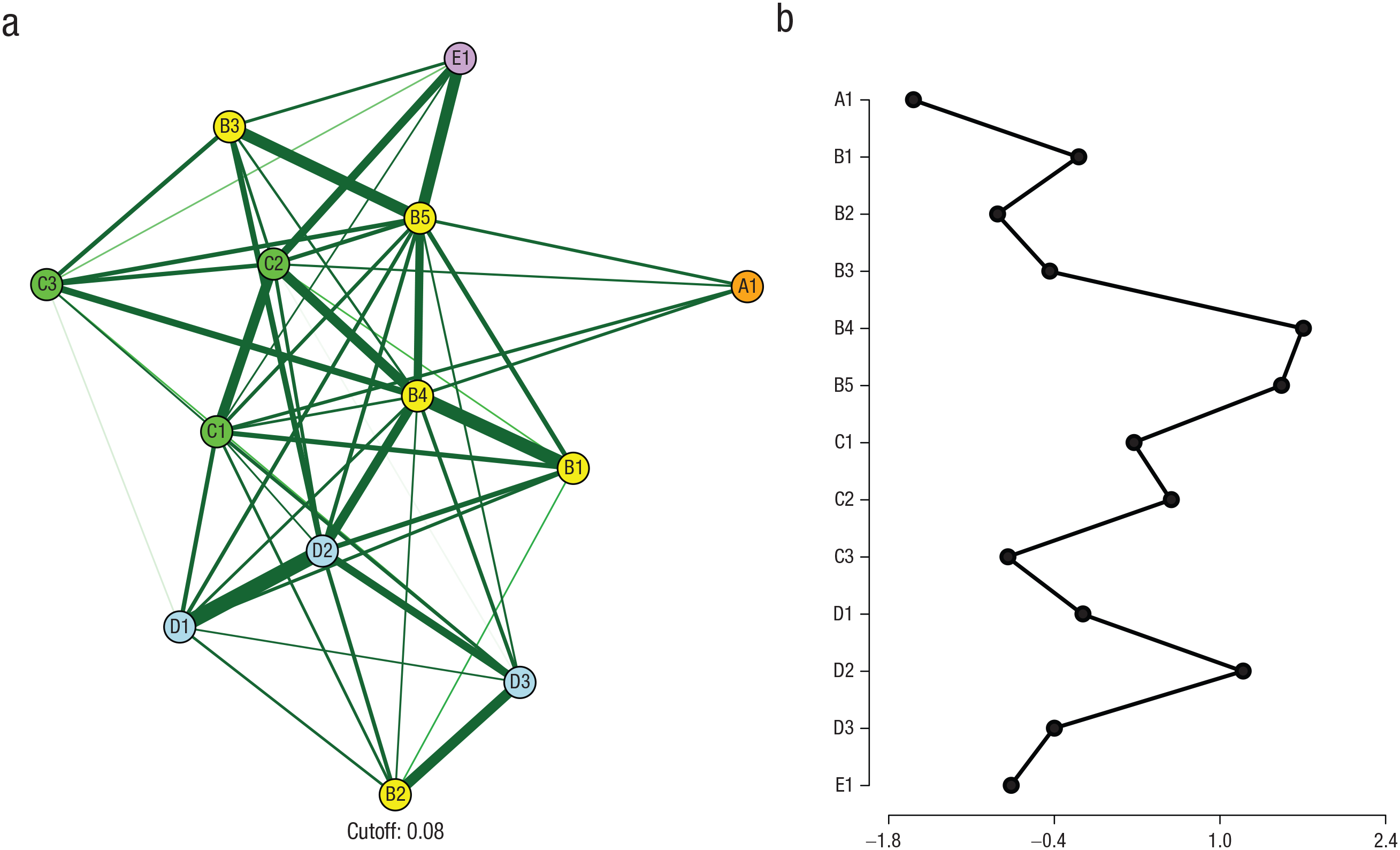
(a) Estimated network structure of 13 adult male dynamic risk factors as measured by the STABLE-2007 (n = 788; Fernandez et al., 2014). The network structure is a mixed graphical model (mgm) in which a connection between nodes represents the strength of the statistical association that remains after statistically controlling for the other nodes. (b) Strength centrality of the estimated network structure of 13 adult male dynamic risk factors as measured by the STABLE-2007 (n = 788). Strength centrality is shown as standardized z scores. The nodes are defined as follows: Significant social influences: A1 = significant social influences; intimacy deficits: B1 = capacity for relationship stability, B2 = emotional identification with children, B3 = hostility toward women, B4 = general social rejection/loneliness, B5 = lack of concern for others; general self-regulation: C1 = impulsive acts, C2 = poor cognitive problem solving, C3 = negative emotionality/hostility; sexual self-regulation: D1 = sexual preoccupation, D2 = sex as coping, D3 = deviant sexual interests; and cooperation with supervision: E1 = cooperation with supervision.
The networks of dynamic risk factors including sexual (Fig. 2a) and violent (including sexual contact; Fig. 2c) recidivism and their respective centrality plots (Figs. 2b, 2d) show considerable similarities, as evidenced by a correlation between the connection weights for both networks (including recidivism) of .97. Similar to the network that did not include recidivism, both networks featured exclusively positive connections between nodes. Again, we visually identified a cluster of the dynamic risk factors; sexual preoccupation, sex as coping, deviant sexual interests, and emotional identification with children (Figs. 2a and 2c, top) mainly connected with the other dynamic risk factors through general social rejection/loneliness (network with violent—including sexual contact—recidivism), general social rejection/loneliness, and impulsive acts (network with sexual recidivism; Figs. 2a and 2c, middle).

Estimated network structure of 13 adult male dynamic risk factors as measured by the STABLE-2007 (n = 611; Fernandez et al., 2014) including (a) sexual recidivism and (c) violent (including sexual contact) recidivism. The network structure is a mixed graphical model (mgm) in which the connection between nodes represents the strength of the statistical association that remains after statistically controlling for the other nodes. Strength centrality of the estimated network structure of 13 adult male dynamic risk factors as measured by the STABLE-2007 (n = 611) including (b) sexual recidivism and (d) violent (including sexual contact) recidivism. Strength centrality is shown as standardized z scores. The nodes are defined as follows: Significant social influences: A1 = significant social influences; intimacy deficits: B1 = capacity for relationship stability, B2 = emotional identification with children, B3 = hostility toward women, B4 = general social rejection/loneliness, B5 = lack of concern for others; general self-regulation: C1 = impulsive acts, C2 = poor cognitive problem solving, C3 = negative emotionality/hostility; sexual self-regulation: D1 = sexual preoccupation, D2 = sex as coping, D3 = deviant sexual interests; cooperation with supervision: E1 = cooperation with supervision; sexual recidivism: sxr = sexual recidivism; and violent recidivism: vir = violent recidivism.
However, the spinglass algorithm identified four distinguishable clusters in the networks including recidivism. The walktrap algorithm showed, respectively, two and three clusters in the networks including sexual and violent (including contact sexual) recidivism (see Figs. A2, A3, A5, and A6 and Tables A2, A3, A5, and A6 in the Supplemental Material). Again, both algorithms found a cluster containing sexual preoccupation, sex as coping, deviant sexual interests, and emotional identification with children in the networks containing recidivism. Community analysis conducted using the spinglass algorithm showed three other clusters: a cluster consisting of capacity of relationship stability, general social rejection/loneliness, and negative emotionality/hostility; a cluster made up of cooperation with supervision, lack of concern for others, and hostility toward women; and a cluster including significant social influences, impulsive acts, poor cognitive problem solving, and recidivism. The walktrap algorithm identified one second community containing all other dynamic risk factors in the network with sexual recidivism. Using this algorithm, the network containing violent (including sexual contact) recidivism appeared to have two other clusters, one containing capacity of relationship stability and general social rejection/loneliness and the other containing the remaining seven dynamic risk factors and recidivism.
Impulsive acts had the strongest independent association with sexual recidivism and an even stronger independent association with violent (including sexual contact) recidivism. We found the highest strength centralities in both networks that included recidivism for general social rejection/loneliness and poor cognitive problem solving. Impulsive acts had a relatively high strength centrality within the network that included sexual recidivism. In turn, significant social influences, capacity for relationship stability, and recidivism had a relatively low strength centrality in both networks.
Shortest paths
Figure 3 displays networks that depict the shortest paths from each dynamic risk factor to sexual and violent (including sexual contact) recidivism.
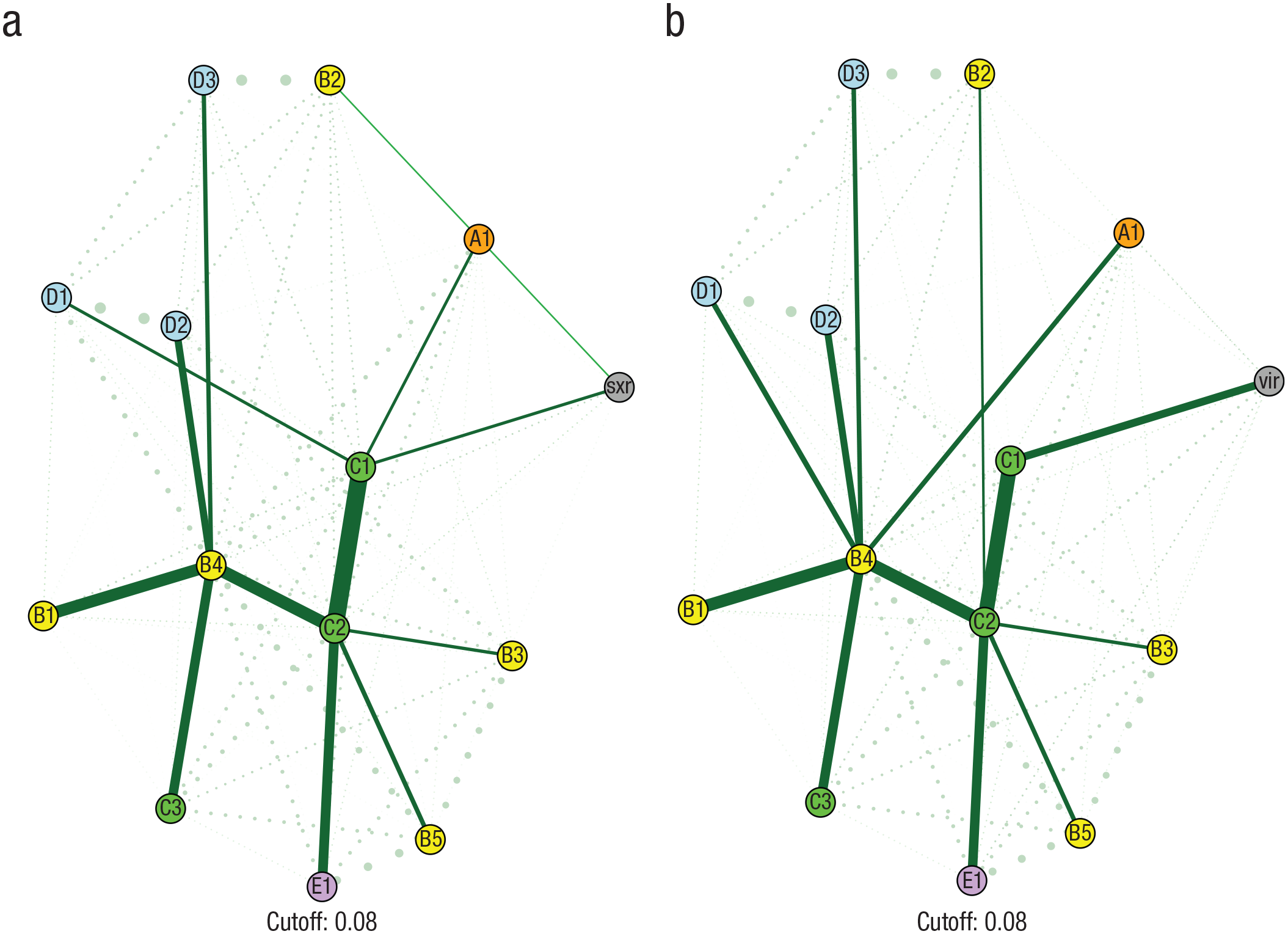
Network depicting shortest paths between each adult male dynamic risk factor and (a) sexual recidivism (n = 611) and (b) violent (including sexual contact) recidivism (n = 611). The generated graph in (a) may give the appearance of a mediated effect of significant social influences. However, the connection between emotional identification with children and sexual recidivism is direct, not mediated. Dashed lines represent background connections within the network. Solid lines represent shortest paths. The nodes are defined as follows: Significant social influences: A1 = significant social influences; intimacy deficits: B1 = capacity for relationship stability, B2 = emotional identification with children, B3 = hostility toward women, B4 = general social rejection/loneliness, B5 = lack of concern for others; general self-regulation: C1 = impulsive acts, C2 = poor cognitive problem solving, C3 = negative emotionality/hostility; sexual self-regulation: D1 = sexual preoccupation, D2 = sex as coping, D3 = deviant sexual interests; cooperation with supervision: E1 = cooperation with supervision; sexual recidivism: sxr = sexual recidivism; and violent recidivism: vir = violent recidivism.
For the shortest path analysis that included sexual recidivism, within the cluster of dynamic risk factors sexual preoccupation, sex as coping, deviant sexual interests, and emotional identification with children, only emotional identification with children was found to be directly connected to sexual recidivism. The other dynamic risk factors within this cluster were directly connected to general social rejection/loneliness (sex as coping, deviant sexual interests) or to impulsive acts (sexual preoccupation). Second, the cluster of the dynamic risk factors capacity for relationship stability, negative emotionality/hostility, and general social rejection/loneliness was directly connected to poor cognitive problem solving. poor cognitive problem solving, in turn, was connected to all three clustered dynamic risk factors: cooperation with supervision, lack of concern for others, and hostility toward women. Although the shortest path that includes violent (including sexual contact) recidivism has many similarities, no direct connection to recidivism for emotional identification with children was found. Instead, this dynamic risk factor was directly connected to poor cognitive problem solving. As a result, only impulsive acts showed a direct link to violent (including sexual contact) recidivism. In addition, sexual preoccupation and significant social influences were directly connected to general social rejection/loneliness in the shortest path to violent (including sexual contact) recidivism instead of to impulsive acts, which we found for the shortest path to sexual recidivism.
Network stability
To check the accuracy of the estimated networks (i.e., its sensitivity to sampling variation) and the stability of our inferences about the network structures (especially the centrality measures), we computed bootstrap samples for each network. Our centrality measure of interest, the CS-coefficient of strength, varied from .28 for the network including sexual recidivism to .44 for the networks without recidivism and with violent (including sexual contact) recidivism. Thus, differences between nodes with respect to strength centrality should be interpreted with caution.
Section B in the Supplemental Material contains the subset bootstrap and the CS-coefficients of the strength centrality for all three networks.
Discussion
To our knowledge, this study is the first to provide an estimation of the network structure of dynamic risk factors as assessed by the STABLE-2007 (Fernandez et al., 2014). Although we approached this task without specific hypotheses, using the spinglass and walktrap algorithm and visual inspection of the networks, we identified prominent clusters of dynamic risk factors. In particular, we identified clusters involving sexual self-regulation, emotionally intimate relationships, antisocial traits, and self-management skills. These clusters of dynamic risk factors, that most markedly emerged from the spinglass algorithm, mirror risk domains previously identified in the literature (Hanson & Morton-Bourgon, 2005; Stinson & Becker, 2013; Stinson, Becker, & McVay, 2016; Stinson, Becker, & Sales, 2008; Thornton, 2002, 2013). Within the sexual-self-regulation cluster, the relatively strong connections between sexual preoccupation and sex as coping on the one hand and deviant sexual interests and emotional identification with children on the other are of particular interest. These findings are in line with a recent factor analysis of the STABLE-2007, which found that emotional identification with children loaded on the same factor as deviant sexual interests, whereas sexual preoccupation and sex as coping formed a separate factor together (Etzler, Eher, & Rettenberger, 2020).
Given the central position of general rejection/loneliness (in all networks), poor cognitive problem solving (in networks containing sexual recidivism or violent—including sexual contact—recidivism), and impulsive acts (only in the network including sexual recidivism), these dynamic risk factors may be considered to function as a bridge between the other (clusters) of dynamic risk factors.
The risk factor that showed the strongest independent relationship with recidivism was impulsive acts (for both sexual and violent—including sexual contact—recidivism). This connection also surfaced in the shortest path analyses, in which impulsive acts was found to be the link to recidivism for all other factors except emotional identification with children, which was directly related with sexual recidivism. We interpret this latter finding to mean that emotional identification with children is more directly associated with sexual recidivism than sexual interest in children per se. It should be mentioned that, at the group level, a shortest path indicates the sequence of conditional predictions from one variable to another that, in each step, minimizes the prediction error. Thus, it shows how any dynamic risk factor is probabilistically connected to recidivism via other factors. At the individual level, however, individual offenders may deviate from these shortest paths. For example, in sex offenders with strong psychopathic traits who do not emotionally identify with children, recidivism (at a group level) apparently is more closely related to other factors, for example, their propensity for impulsive acts or hostility toward women.
The clusters of dynamic risk factors found in our study seem consistent with the findings of factor analyses of static risk factors for sex offender recidivism (e.g., Brouillette-Alarie et al., 2016). Such analyses have revealed factors referred to as a sexual factor, an impulsive/antisocial factor, and sometimes a third factor, described as “detachment” or “immaturity.” Our findings are also compatible with theoretical models distinguishing between different pathways to sexual offending. For instance, Malamuth (1986, 2003; see also Malamuth & Hald, 2016; Malamuth, Linz, Heavey, Barnes, & Acker, 1995) described two relatively independent pathways to sexual coercion against women, one relevant to sexual processes (impersonal sexual promiscuity) and one relevant to callousness and hostility toward women (hostile masculinity).
Limitations
Several limitations of our study should be acknowledged. First, although the STABLE-2007 is empirically and theoretically driven and its predictive validity has been supported in studies in North America and several European countries (Brankley, Babchishin, & Hanson, 2019; Eher, Matthes, Schilling, Haubner-MacLean, & Rettenberger, 2012; Eher et al., 2013; Smeth, 2013; Sowden, 2013), it captures a limited number of relevant dynamic risk factors. Network analysis can calculate only the interconnections of the factors measured, and adding an additional dynamic risk factor to a network analysis could affect both the networks and centrality measures. Second, our analyses are based on data obtained from a group of mostly untreated sex offenders who differ with respect to their offenses. Risk factors that are predictive for one group of offenders (e.g., emotional identification for child molesters) may be less important in other groups of offenders (e.g., rapists). Because network structures and metrics tend to differ across different samples (Borsboom et al., 2017), replications with different risk-assessment instruments and in separate samples of, for example, child molesters and rapists or in treated as opposed to untreated sex offenders, are indicated. Replication attempts should preferably also include the collection of additional demographic information given that the study from which the current data were derived lacked information on ethnicity, education, socioeconomic status, and income.
A third limitation concerns the fact that because of variations in prison sentences, the time between assessments and offenses differed among individuals. Although we were not able to control for this variable, other studies have found that STABLE-2007 scores were highly consistent for the first and 6-month follow-up during community supervision (e.g., Hanson et al., 2007). Thus, we have little reason to expect meaningful change on stable dynamic risk factors during sentencing periods. Nevertheless, future research could take sentence duration into account and describe the percentage of subjects who received sentences of long enough duration to affect the levels and number of stable dynamic risk factors. A fourth limitation of this study is that it is based on cross-sectional data. This type of data allows for the generation of undirected networks regarding relationships between dynamic risk factors and the pathways to recidivism. Using a longitudinal design, future studies could provide information on the direction of observed relationships and offer more insight in processes that result from changes in dynamic risk factors. A fifth limitation concerns the fact that the measurement of each dynamic risk factor was limited to a single item. Although all individual items were related to recidivism, it would be valuable to examine the possible added value of measuring dynamic risk factors using multiple items or scale scores. Finally, although stability coefficients for strength centrality were all above the lower limit, none of the strength centrality coefficients exceeded the cutoff of 0.5 that is required for the metric to be considered stable (Epskamp et al., 2018). As a result, the order of node strength within all three networks should be interpreted with caution. The stability coefficients for strength centrality suggest that it is unfeasible to analyze network structure, centrality, and shortest paths to recidivism separately for sex offenders with adult and child victims. We recommend further studies, preferably in larger samples, attempt to replicate our findings and differentiate between those two offender groups in their analyses.
Implications and strengths
Despite the above limitations, we believe our findings—to the extent that the estimated network structure indeed describes a pattern of mutualistic causal interactions—have several theoretical, clinical, and social implications. Because network analyses provide insight in the interrelations among risk factors and possible shortest pathways to (sexual) offending behavior, without the need for a priori assumptions, they can be used to contribute to the further development of theories on sex offending (e.g., Malamuth & Hald, 2016; Malamuth et al., 1995; Seto, 2019; Smid & Wever, 2019; Toates, Smid, & van den Berg, 2017; Ward & Beech, 2016; Ward, Polaschek, & Beech, 2006). For example, our network analyses provide support for the idea that different clusters of dynamic risk factors and pathways to recidivism exist, as was found in earlier research in adult male sex offenders (Malamuth, 1986, 2003; Malamuth & Hald, 2016; Malamuth et al., 1995). Future longitudinal research may be able to produce “directed networks” that assess not only the strength of interrelations but also their direction. Another important move forward would involve the identification of psychobiological and social mechanisms that underlie the connections among risk factors.
Our findings also have clinical implications for treatment. Accepting the possibility that conditional dependencies in our network structures indeed reflect mutualistic causal interactions between risk factors, treatment should be focused on highly central dynamic risk factors and dynamic risk factors directly related to recidivism after statistically controlling for the other dynamic risk factors. Our findings suggest that treatment efforts may benefit from a focus on inhibition of impulsive acts, improving cognitive problem solving, reducing feelings of loneliness, and stimulating reintegration in society. However, again, we acknowledge that the network estimation techniques we used are primarily hypothesis generating, so these ideas should be tested and validated more systematically in future studies.
The central role of social rejection/loneliness in all three networks suggests that this factor is important to address and monitor not only during treatment but also during reintegration efforts. Strengthening connectedness may be facilitated by the involvement of initiatives such as circles of support and accountability (COSA), which involve groups of volunteers who support the reintegration of sex offenders under professional supervision. COSA have been found to be an effective tool in the prevention of recidivism (e.g., Höing, 2015; Wilson, Cortoni, & McWhinnie, 2009; Wilson, Picheca, & Prinzo, 2005), and the findings of our network analyses raise the question of whether their impact may be attributed, in part, to reductions in the experience of social rejection and loneliness.
Supplemental Material
Van_den_Berg_Supplemental_Material – Supplemental material for The Application of Network Analysis to Dynamic Risk Factors in Adult Male Sex Offenders
Supplemental material, Van_den_Berg_Supplemental_Material for The Application of Network Analysis to Dynamic Risk Factors in Adult Male Sex Offenders by Jan Willem van den Berg, Wineke Smid, Jolanda J. Kossakowski, Daan van Beek, Denny Borsboom, Erick Janssen and Luk Gijs in Clinical Psychological Science
Footnotes
Acknowledgements
We thank Karl Hanson and Public Safety Canada for sharing the Dynamic Supervision Project data and Maaike Helmus for preparing the data set for use in our network analyses.
Transparency
Action Editor: Erin B. Tone
Editor: Scott O. Lilienfeld
Author Contributions
J. W. van den Berg developed the study concept. All of the authors contributed to the study design. Statistical analyses were conducted by J. W. van den Berg and J. J. Kossakowski, under supervision of D. Borsboom. J. W. van den Berg, W. Smid, D. van Beek, L. Gijs, and E. Janssen were all involved in the interpretation of the network analyses. J. W. van den Berg drafted the manuscript, and all of the authors provided feedback and contributed to the final manuscript. All of the authors approved the final manuscript for submission.

Notes
References
Supplementary Material
Please find the following supplemental material available below.
For Open Access articles published under a Creative Commons License, all supplemental material carries the same license as the article it is associated with.
For non-Open Access articles published, all supplemental material carries a non-exclusive license, and permission requests for re-use of supplemental material or any part of supplemental material shall be sent directly to the copyright owner as specified in the copyright notice associated with the article.
