




Abstract
Some children socially transition genders by changing their pronouns (and often names, hairstyles, and clothing) from those associated with their assigned sex at birth to those associated with their gender identity. We refer to children who have socially transitioned as transgender children. Using a prospective sample of children who socially transitioned during childhood (at or before the age of 12; age of transition: M = 6.82 years), we tested whether the parent-reported internalizing symptoms of transgender children were different before versus after they socially transitioned. The children were predominantly White (70.6% White) and girls (76.5% transgender girls, 23.5% transgender boys). Their parents tended to have high levels of education (74.5% bachelor’s degree or above) and lived in families with high household incomes (62.7% with household incomes of $75,000 or above). On average, youths showed lower levels of internalizing symptoms after socially transitioning versus before, suggesting a possible mental-health benefit of these transitions.
Social transitions describe the nonmedical process of changing one’s pronouns and often name, hairstyle, clothing, and so on to live as a different gender than the one assigned at birth (Gülgöz et al., 2019; Kuvalanka et al., 2017). Children who have made social transitions can be described as transgender children. Some authors have hypothesized that making a social transition may benefit mental health in children who express the desire to do so (Sherer, 2016; Turban & Ehrensaft, 2018). This potential benefit is difficult to test methodologically given that random assignment cannot be used to examine the outcomes of social transitions (i.e., it would not be ethical to randomly assign children to transition or not; not all gender-diverse children wish to socially transition). The next best option is to prospectively follow a group of gender-diverse children who have not, at least initially, socially transitioned and then observe levels of psychopathology over time in the youths who socially transition. In the present work, we report on the first such prospective study, in which we examined anxiety and depression symptoms in transgender youths before and after they made binary social transitions (youths who adopted the binary gendered pronouns “opposite” their assigned sex at birth) in childhood, at age 12 or younger.
There are a variety of ways that childhood social transitions could affect internalizing psychopathology. Social transitions might reduce levels of anxiety and depression because living and being regarded by others as the gender with which one identifies, in itself, may enhance well-being and reduce distress (Sherer, 2016; Turban, 2017). Another reason childhood social transitions could plausibly reduce psychopathology is that they may be a marker of, and/or a key way to confer, family support for a child’s gender identity. Family support for one’s LGBT identity has been shown to be associated with lower levels of psychopathology in samples of LGBT youths (Pariseau et al., 2019; Ryan et al., 2010) and in transgender children specifically (Durwood et al., 2021).
On the other hand, it is also possible that social transitions in childhood have no impact on internalizing symptoms or could even result in an increase in internalizing symptoms. For children who are fully supported in their gender expressions, transition-related reductions in internalizing symptoms may be unlikely. Furthermore, some children may experience new stressors after transitioning, such as bullying and/or discrimination, which could offset any benefits of the transition itself. In line with this idea, LGBT adults show elevated levels of internalizing psychopathology because of minority stress (Bockting et al., 2013; Hatzenbuehler, 2009; Pellicane & Ciesla, 2022), and some data indicate that gay men who have recently come out are more likely to have anxiety or depression diagnoses than closeted men (Pachankis et al., 2015). In addition, it is possible that any potential benefits of a social transition simply appear in domains other than anxiety and depression symptoms, such as in the realms of self-esteem, feelings of belongingness, performance at school, or life satisfaction.
Some empirical evidence is consistent with social transitions either improving or having no effect on a child’s mental health, although this work has all been cross-sectional. A handful of studies of internalizing symptoms in socially transitioned transgender youths have reported normative levels of depression and normative or only slightly elevated levels of anxiety (Durwood et al., 2017; Gibson et al., 2021; Kuvalanka et al., 2017; Olson et al., 2016). Some other studies have compared binary, socially transitioned children with gender-diverse children who have not made binary social transitions. The findings in this literature are mixed; some work has suggested fewer internalizing symptoms in gender-diverse children who have (vs. have not) socially transitioned (Kuvalanka et al., 2017), and other work has shown no differences between groups (Morandini et al., 2023; Sievert et al., 2021; Wong et al., 2019). Although comparing internalizing symptoms in gender-diverse children who have versus have not made binary social transitions lends some insight, these findings are also challenging to interpret because the two groups being compared may systematically differ in meaningful ways besides social-transition status; for example, youths who have not transitioned may differ from youths who have transitioned in terms of how they identify (whether they identify as transgender or not), aspects of their social context, and so on. Supporting this possibility, one qualitative study suggested that many gender-diverse youths who have not socially transitioned simply did not want to, according to their parents (Olson et al., 2019), and a prospective study found that gender-diverse children who later went on to socially transition showed more “cross-sex” identification and preferences than did gender-diverse youths who did not go on to transition, suggesting these are distinct groups of youths (Rae et al., 2019). This work suggests simple comparisons between children who have and have not socially transitioned in childhood are difficult to interpret because the groups might differ in many other important ways. Despite the limitations of existing work, those findings suggest that social transitions in gender-diverse children may reduce or have no effect on psychopathology.
In the present work, we report the first prospective data comparing the anxiety and depression symptoms of 51 youths before versus after making childhood social transitions.
Transparency and Openness
This study was not preregistered. Code and data are provided at https://osf.io/rjxp6/. Because of identifiability concerns, shared files do not include (a) demographic information or (b) information about which youths retransitioned. The Supplemental Material is available online. We report in this article how we determined our sample size, all data exclusions, and all measures in the study. Because this is an observational study, there were no manipulations. This work was approved by the Institutional Review Boards of the University of Washington and Princeton University and adhered to the Declaration of Helsinki’s 2008 Sixth Revision.
Method
Participants
Participants in this study are parents of gender-diverse youths who were asked to report on anxiety and depression symptoms in their children. Both the parents and their children are part of a large, national, longitudinal study of North American gender-diverse youths and their families that began in 2013. This study recruited families of gender-diverse children who had not made a binary social transition by the time of their first visit, N = 142 (if they used the binary pronouns “opposite” their assigned sex at the time of their first visit, they were recruited for a separate longitudinal study of binary transgender youths; Gülgöz et al., 2019). Parents were recruited to the study via support groups, conferences, and camps for gender-diverse youths and through clinicians, word of mouth, Internet searches, and media stories. Parents are included in the study only if their child was willing to participate in an initial study session (at some later points, parents were asked to participate without simultaneous participation by youths). Youths needed to be between the ages of 3 and 12 at their first participation for families to participate. The recruitment period for the larger longitudinal sample took place between July 2013 and February 2020. Data collection for the present analyses (i.e., our cutoff date) ended on July 1, 2021.
Of the 142 gender-diverse youths in the longitudinal study, our primary group of interest is the 51 youths who made binary social transitions at or before the age of 12 during their participation in our study. We defined binary social transitions as youths having changed their pronouns to those stereotypically associated with the binary gender “opposite” their assigned sex at birth (e.g., for assigned male children, adopting “she/her” pronouns and for assigned female children, adopting “he/him” pronouns) across contexts. If youths changed their pronouns first in certain contexts (e.g., at home) and later in other contexts (e.g., at school), we considered the later of those times the age at which they socially transitioned. Of the 51 youths who made binary social transitions, three had gone on to have another social transition (i.e., changed pronouns again, referred to hereafter as “retransitioning”; Olson et al., 2022) by our cutoff date. Because these retransition trajectories could be related to how one responds to an initial social transition, we include analyses both retaining and excluding these three retransitioners. Demographics for the central analytic sample are shown in Table 1.
Demographics of Main Sample (N = 51)

Note: Income and education were determined by the first available response.
Procedure
Parents were periodically invited to participate in the longitudinal study via an in-person visit, virtual visit, or online survey once approximately every 1 to 2 years, although not all parents participated every time they were invited. 1 Parents were compensated for each participation, between $5 and $20, depending on the duration of the participation. All parents provided consent.
The mean transition age was 6.82 years; the youngest transition was at age 3, and the oldest was at age 12 (age at first visit: range = 3–11, M = 6.18 years). Per child, the average number of visits at which internalizing symptoms were reported by a parent was 4.73 (range: 2–8). Parents of 46 children (90%) reported on their children’s mental health at three or more visits. Of the 241 total time points with mental-health data reported by parents, 78 (32%) were before the child’s social transition was completed (visits before transition: M = 1.5, range = 1–4), and 163 (68%) were after transition (visits after transition: M = 3.2, range = 1–7).
Measures
Parents reported on their child’s anxiety and depression symptoms using the National Institutes of Health Patient-Reported Outcomes Measurement Information System (PROMIS) parent-proxy scales for anxiety and depression (Anxiety Short Form 8a Version 2.0; Depressive Symptoms Short Form 6a Version 2.0; forms in English; Anxiety: A Brief Guide to the PROMIS Anxiety Instruments, 2019; Depression: A Brief Guide to the PROMIS Depression Instruments, 2019; Irwin et al., 2012; Varni et al., 2012; Varni, Thissen, et al., 2014). These scales ask parents to report on youths’ anxiety and depression symptoms in the past 7 days. Example items from the parent scales include “My child felt nervous” and “My child felt sad.” Parents selected responses from a 5-point Likert scale of responses: never, almost never, sometimes, often, and almost always. We used summed-score conversion to determine t scores; 50 represented the middle score in a reference sample (Varni, Magnus, et al., 2014; missing items, which were exceedingly rare, were replaced with the parent’s mean response on the rest of the short-form items).
However, we note that these short forms were developed for parents of children ages 5 to 17, whereas 28 of our visits included data about children ages 3 or 4 (13 children transitioned before age 5). We therefore adopted a secondary scoring approach based on a recent publication in which researchers expanded the use of the PROMIS parent-proxy measures to early childhood (ages 1–5; Cella et al., 2022; Lai et al., 2022; Sherlock et al., 2022). This process involved adapting existing parent-proxy items, such as the ones included in our measures. Of our eight anxiety items, eight very similar items are included in the new early childhood anxiety item bank (e.g., “My child felt nervous” converted into “My child seemed nervous”). Of our six depressive-symptom items, two very similar items are included in the new early childhood depressive-symptom item bank (e.g., “It was hard for my child to have fun” converted into “My child had a hard time having fun”). Although these items do not constitute existing subscales of the PROMIS early childhood measures, the PROMIS system allows for the scoring of custom short forms. We therefore used the HealthMeasures Scoring Service to determine additional age-adjusted t scores for those 28 visits according to the early childhood item banks (Cella et al., 2020). We note that the correlation between early childhood and general parent-proxy t scores is extremely high, anxiety: r(26) = .99, p < 0.01; depression: r(26) = .90, p < .01, and early childhood scoring was systematically higher than the general parent-proxy scoring, anxiety: t(27) = 24.02, p < .001; depression: t(27) = 12.297, p < .001. For maximum transparency, we report results using the age-adjusted t scores for the visits at ages 3 and 4 and results when using the full short forms.
All 51 youths had parent-reported scores for depressive symptoms from before and after their child’s transition. All but one of the youths had parent-reported scores for anxiety symptoms from both before and after their child’s transition. Youths themselves also completed a self-report for visits when they were present beginning at age 9; however, given the young age of the children in this study, there were not enough pretransition data to conduct analyses using child report. If two parents completed the PROMIS scales at a given time point (92 visits), we use the mean of those two parent reports. In these cases, the two parents reported similar levels of internalizing symptoms; raw correlations: anxiety: r(90) = .57, p < .001; depression: r(90) = .54, p < .001.
COVID-19
The onset of the global COVID-19 pandemic took place during our ongoing data collection. The COVID-19 pandemic negatively affected child mental health broadly (Racine et al., 2020), and as a result, we had concerns that including data from the COVID period could affect our primary question of interest—particularly because all data collected during COVID were posttransition. Because only a small proportion of our transitioners’ data was collected during COVID-19 (35 visits), we could not conduct a strong test of whether COVID-19 affected results among our transitioning sample. Therefore, to assess whether COVID-19 might be expected to influence our data, we examined PROMIS data collected by our lab from 178 other gender-diverse youths. We found that their mental health was negatively affected by COVID (for full details, see the Supplemental Material). Given this, we decided to conduct parallel analyses including and excluding data collected after the onset of COVID (i.e., after February 1, 2020).
Results
All analyses were conducted in R (Wickham et al., 2019), with models fit using the lme4, lmerTest, and sjPlot packages (Bates et al., 2014; Kuznetsova et al., 2017; Lüdecke et al., 2022), and significance for fixed effects was evaluated using the Satterthwaite approximation (packages knitr and parameters were also used in the process of displaying results; Lüdecke et al., 2020; Xie, 2023).
Transition-related changes in mental health
Linear mixed-effects models were used to estimate changes in anxiety and depression t scores as a function of whether the data were collected before or after transition. There are four analytic decision points in this project at which we considered multiple decisions equally reasonable. We therefore took a multiverse approach to testing whether social transition predicted significant mental-health differences (Steegen et al., 2016). This approach is considered helpful when there are multiple reasonable analytic decisions one could make. Interpretation then relies on understanding the degree to which the results are or are not contingent on any particular analytic decision; significant results that are present across different analytic decisions are thought to be more robust than those that are significant in only rare instances.
In our multiverse analyses, we include four independent analytic decisions. First, we include or exclude data gathered after the onset of the COVID-19 pandemic. Second, we include or exclude data from retransitioners (N = 3). Third, we code visits of children under age 5 according to the full short forms we used (developed for children ages 5–17) or according to closely related early childhood measures as described above.
Fourth, we have multiple options for model specification. In all models, we took a multilevel modeling approach and included a random intercept of youths to account for the nonindependent nature of within-youths measures. The decision point centers around controlling for other variables related to childhood mental health. Given the extant literature, there is reason to believe that both gender and age (Steensma et al., 2014) can be relevant to internalizing symptoms in gender-diverse youths. For age, it is further reasonable to expect either linear (e.g., children’s mental health getting worse as they get older) or quadratic (e.g., a period of relatively little change followed by a period of quicker change) effects. We therefore considered six possible models that included combinations of these effects. In Model A, our only fixed effect is that of social transition (contrast coded: pretransition = −0.5, posttransition = 0.5)—we did not control for other variables. In Model B, we included gender as a control variable (posttransition binary gender, contrast coded: girl = −0.5, boy = 0.5). In Model C, we controlled for a linear effect of age. In Model D, we controlled for both gender and linear age. In Model E, we included linear and quadratic age as control variables. In Model F, we included linear age, quadratic age, and gender as control variables. In all models including age, we used age in months as a predictor and centered it on the mean as calculated across all included visits.
Given these four decision points, there are 48 models we considered reasonable when assessing transition-related change in anxiety and depression. For interpretation, we focus on the overall pattern of social-transition effects as displayed in Figure 1 (for Ns and mean anxiety and depressive symptoms before and after transition for each analytic approach, see Table 2; for full results of each model, see the Supplemental Material). This forest plot displays the estimated t-score difference between pretransition and posttransition visits with the confidence intervals of that estimate. Negative values represent mental-health improvements, and confidence intervals that do not overlap with zero show that the estimate is statistically significant.
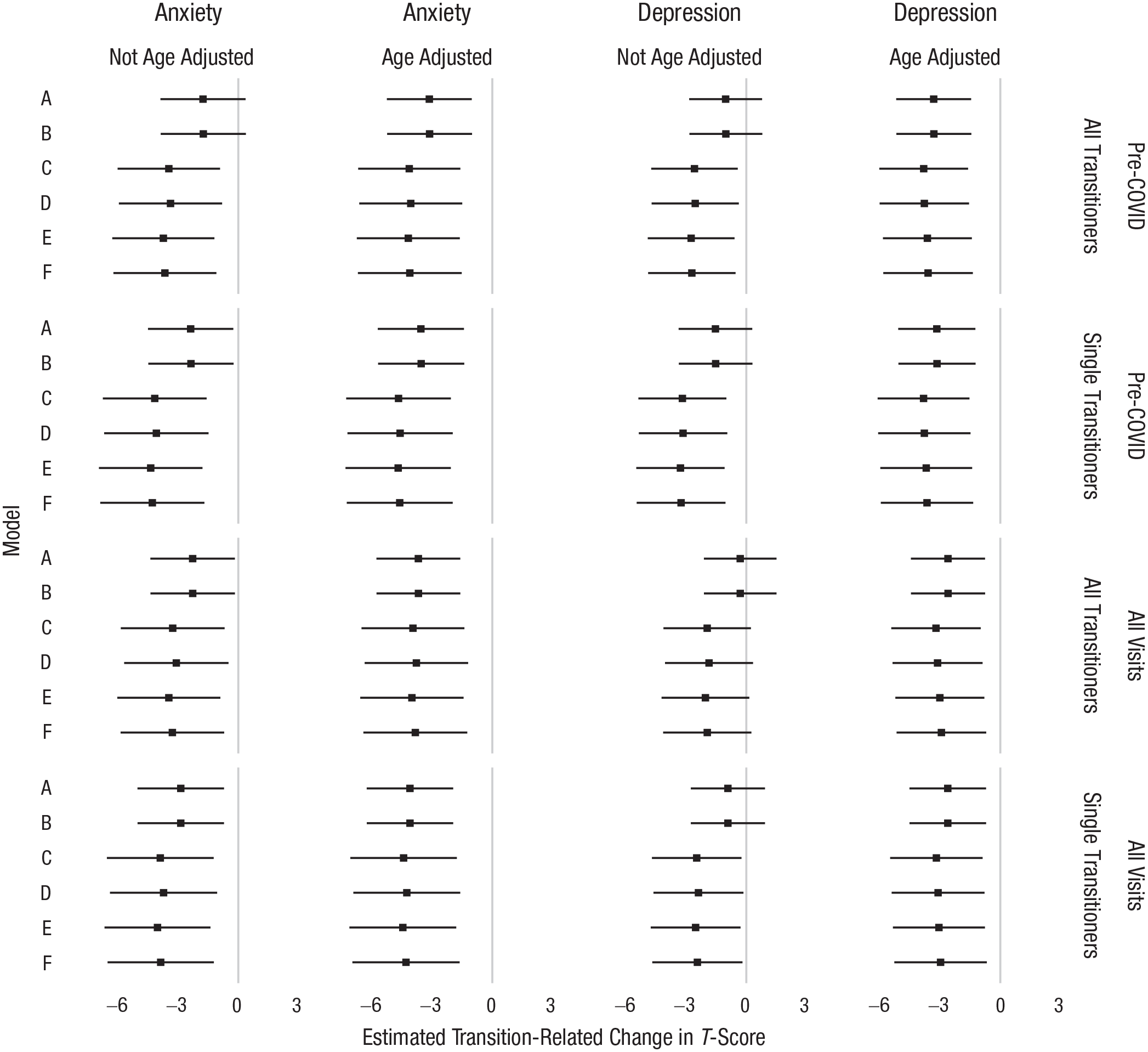
Forest plot of transition-related mental-health-change estimates. In each graph, the dot represents the point estimate of mental-health change between pretransition and posttransition visits. The error bars represent confidence intervals (calculated using the Satterthwaite method); error bars that do not overlap with zero show significant effects. Across a variety of analytic approaches, we found that anxiety and depression were improved (46 out of 48 analyses for anxiety; 36 out of 48 analyses for depression) or unchanged (two out of 48 analyses for anxiety; 12 out of 48 analyses for depression) after transition relative to before transition. We found no analytic conditions under which posttransition mental health was worse than pretransition mental health.
Mean Anxiety and Depressive Symptoms Before and After Social Transition

Note: Mean values of internalizing symptoms before and after social transition (with standard deviations in parentheses) are shown. This was done separately for each applicable multiverse definition (e.g., including or not including data gathered during COVID). In each case, participant-level mental health before and after transition was calculated as the mean t score across all visits (i.e., if participants had three posttransition visits, we defined their posttransition anxiety t score as the mean of their t scores at those three visits). We here report the means and standard deviations of those values across included participants.
We found that posttransition anxiety was significantly lower than pretransition anxiety in 46 of 48 models. We found that posttransition depressive symptoms were significantly lower than pretransition depressive symptoms in 36 of 48 models. All analytic approaches showed either transition-related improvement in mental health or no significant transition-related change—no analyses showed transition-related decrements in mental health. As a demonstrative visual, we include Figure 2, which shows each youth’s level of anxiety and depression before and after social transition. Figure 2 includes data from all visits and uses age-adjusted t scores for visits at which children were age 3 or 4.
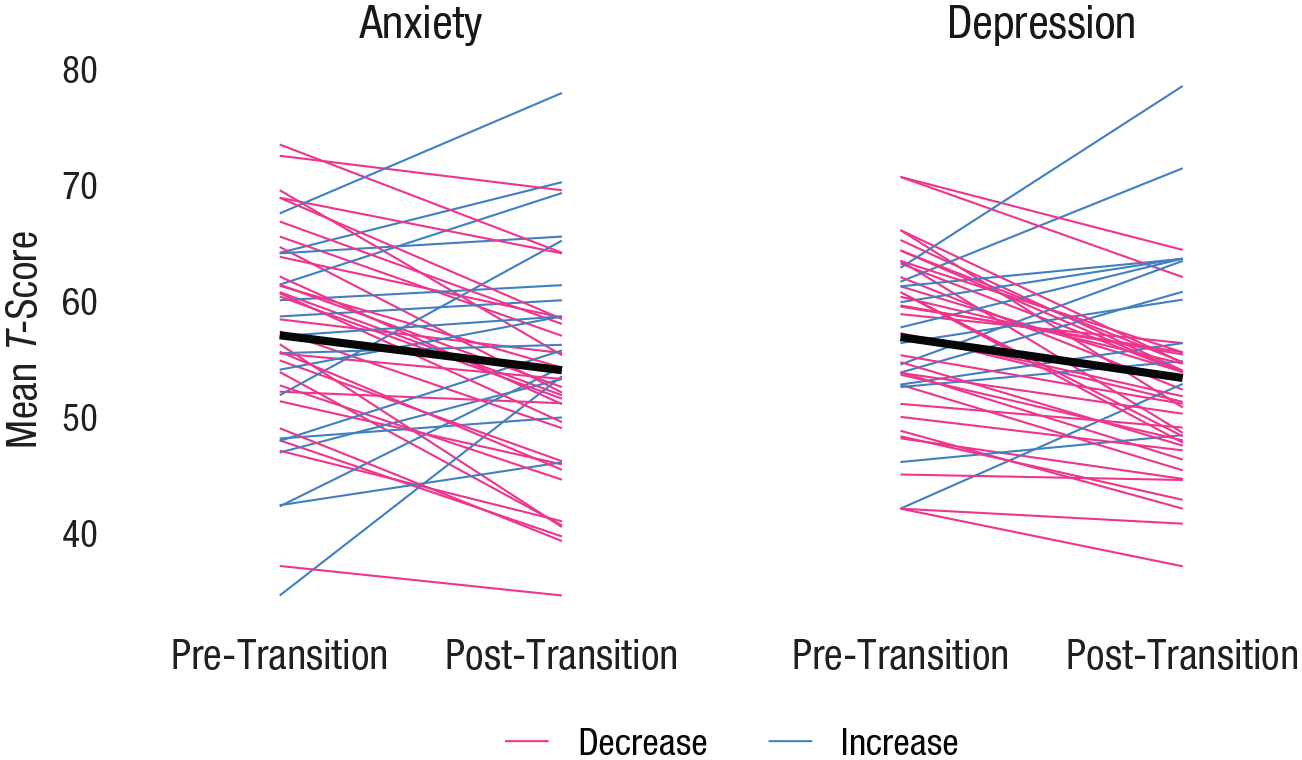
Anxiety and depression t scores before and after transition. Across a variety of individual trajectories, most youths had lower anxiety and depression after transition. These visualizations show participants’ mean pretransition and posttransition internalizing symptoms (all data, age adjusted t scores for 3-year-olds and 4-year-olds). The black line shows the across-subjects mean.
Comparison with nontransitioning gender-diverse youths
Much research studying the mental health of gender-diverse youths has focused on comparison, looking at the relative mental health of transgender youths (e.g., Olson et al., 2016). In this project, we were instead able to measure within-persons mental-health changes related to social transition. On the suggestion of reviewers, we additionally explored a comparison between our 51 transitioning youths and their counterparts who did not transition. We note that these samples differ in many potential ways (e.g., they may differ in a desire to transition, Olson et al., 2019; degree of gender nonconformity, Rae et al., 2019; parents’ tolerance of social transition; or other as yet unknown ways), and therefore, direct comparison of these groups should not be interpreted as a difference merely in whether they socially transitioned. Of the original 142 youths, we included 87 in our nontransitioning sample (three youths socially transitioned after the age of 12, so they are not included in either our main sample or this comparison sample; one youth did not transition, but this youth’s parents have not reported any internalizing data; the other 51 are in the transitioning group).
This comparison sample includes 29 children who were assigned female at birth and 58 who were assigned male at birth; this ratio is not significantly different from our main sample, χ2(df = 1) = 1.048, p = .31. These youths were older than the transitioning group when their parents first provided PROMIS data (age of transitioners: M = 79.61 months, SD = 26.93; age of nontransitioners: M = 93.00 months, SD = 28.69), t(110.27) = 2.751, p = .007. These youths also have fewer visits with PROMIS data in this time period (transitioners: M = 4.73 visits, SD = 1.58; nontransitioners: M = 3.39 visits, SD = 1.57) t(104.69) = −4.806, p < .001. For additional demographics about this sample, see Table 3.
Demographics of Nontransitioning Comparison Sample (N = 87)
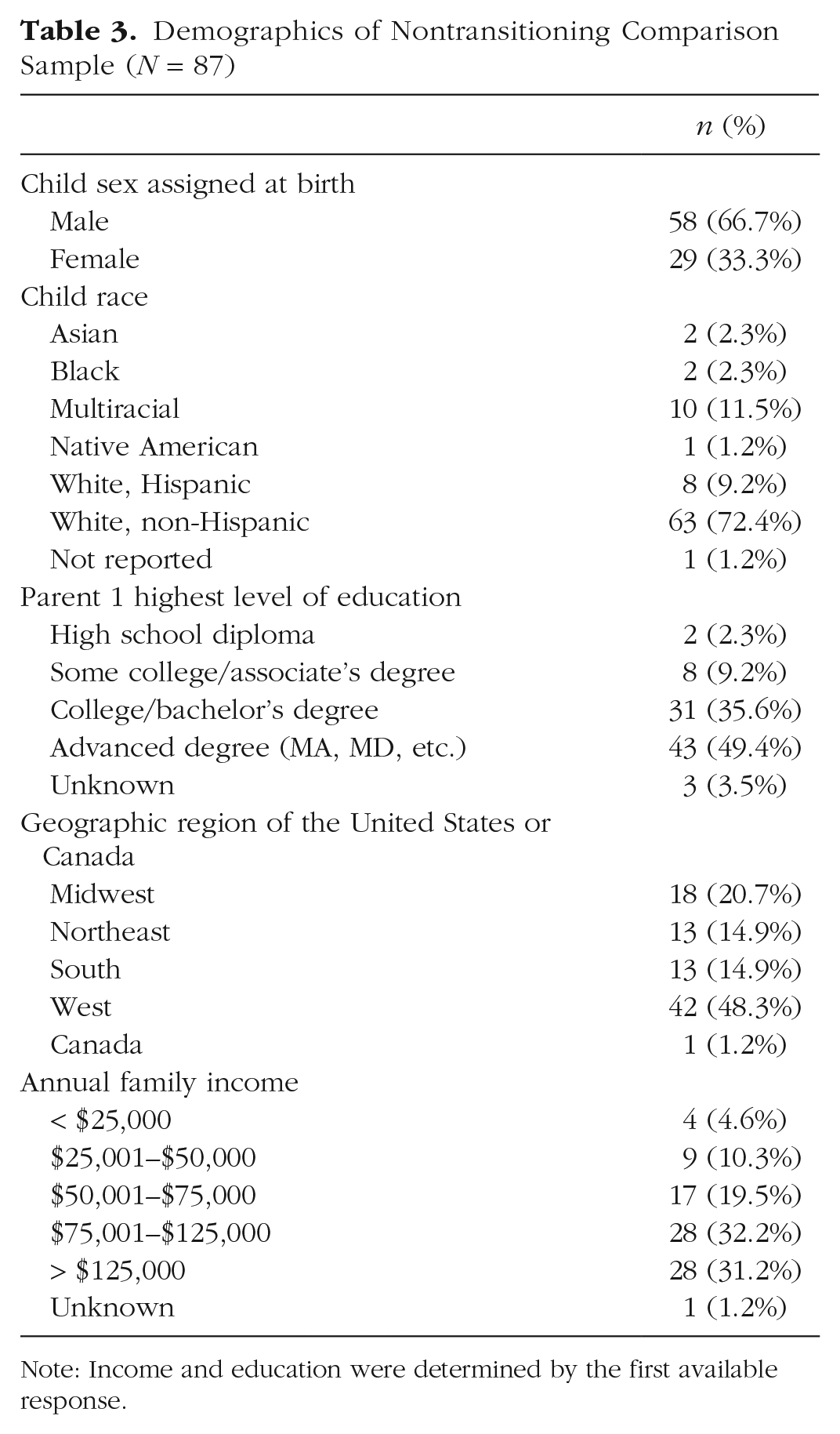
Note: Income and education were determined by the first available response.
We could not directly compare the effect of social transition between the two groups because the comparison group had not undergone social transition. Instead, we looked at whether transition status at a particular visit (nontransitioner, pretransition transitioner, posttransition transitioner) predicts mental health. As with our central analyses, we took a multiverse approach to this analysis with respect to inclusion of COVID data, inclusion of multiple transitioners in the transitioning sample, and scoring of visits in which the child was age 3 or 4. In all cases, we used the same linear-multilevel model predicting internalizing scores (anxiety or depressive symptoms). Our fixed effect of interest is transition status; visits from nontransitioners were used as the reference. We additionally included a random intercept for youths to account for within-youths dependency and a fixed effect of age (in months, centered across the data set) to control for between-groups differences in age.
We focus on the overall pattern of visit-type effects as displayed in Figure 3 (for full model results, see the Supplemental Material). This forest plot displays the estimated t-score difference between (a) pretransition transitioners and nontransitioners and (b) posttransition transitioners and nontransitioners. Positive values mean that the transitioners had elevated (i.e., worse) anxiety or depressive symptoms relative to the nontransitioners, whereas negative values mean that the transitioners had reduced (i.e., better) anxiety or depressive symptoms relative to the nontransitioners. Figure 3 displays point estimates and confidence intervals. In 15 of 16 cases, we found no significant difference between pretransition transitioners and nontransitioners. In all cases, we found no significant difference between posttransition transitioners and nontransitioners. Visual inspection of Figure 3 indicates that the youths who transitioned had scores that were (nonsignificantly) worse than the nontransitioners before transitioning and scores that were (nonsignificantly) better than the nontransitioners after. Although the transitioners showed significant differences based on transition status, the nontransitioners’ average scores fell in between, and transitioner-nontransitioner differences were nonsignificant.

Forest plot of visit-type mental-health-difference estimates. Each graph shows two effects: one comparing pretransition transitioners with nontransitioners and one comparing posttransition transitioners with nontransitioners. Each point estimate is shown with confidence intervals (calculated using the Satterthwaite method); error bars that do not overlap with zero show statistically significant effects. Positive values indicate that the transitioners had mental-health decrements relative to the nontransitioners, and negative values indicate that the transitioners had mental-health benefits relative to the nontransitioners. All effects are from analyses controlling for age to account for age differences between groups. In 31 of 32 cases, the transitioners did not differ significantly from the nontransitioners (regardless of transition status). We additionally note that the consistent pattern in which pretransition estimates are negative and posttransition estimates are positive is consistent with our main finding that social transition is associated with mental-health improvements.
Discussion
The question of whether childhood social transitions affect psychopathology is exceedingly hard to test methodologically given that using random assignment would be both unethical and implausible (Drescher & Byne, 2012; Green, 2017; Olson-Kennedy et al., 2016; Turban & Ehrensaft, 2018; Zucker, 2020). Using the next best option, a prospective design, we found that youths generally showed decreases in anxiety and depression after transitioning relative to before. The results were especially consistent for anxiety, although the depression results were fairly robust as well. For both types of internalizing symptoms, differences were especially strong when we used age-adjusted subscale scoring for parent reports about children under age 5, when we excluded data gathered during the onset of the COVID-19 pandemic, and when we controlled for any effects of age; however, these effects were significant in most models, regardless. These findings suggest that childhood social transitions on average reduce internalizing symptoms in youths who identify as the binary gender other than the one assigned to them at birth. These findings contribute to a long-standing discussion around childhood social transitions and whether they can be beneficial (Sherer, 2016; Steensma & Cohen-Kettenis, 2011), and broadly, they provide support for childhood social transitions. Critically, we do not interpret these results to mean that all gender-diverse youths would benefit from social transitions (e.g., we might not expect male children who like to wear stereotypically feminine clothing but do not identify as girls to benefit from a transition), especially because past work has suggested that many gender-nonconforming youths who have not transitioned simply do not want to transition (Olson et al., 2019).
Our finding that youths who did not transition did not differ in their mental health from youths who did is consistent with some past cross-group comparisons (Morandini et al., 2023; Sievert et al., 2021; Wong et al., 2019). However, because these studies focused on cross-sectional data, they were unable to address the key question here: whether youths who socially transition show an improvement in mental health across this transition. Our results comparing internalizing symptoms before and after transitions suggest that social transitions in childhood may, in fact, reduce internalizing psychopathology for many transgender youths, at least in the short to medium term (final visits in the data set were M = 3.55 years since the child’s social transition, SD = 1.3 years; range = 1–6 years); whether this improvement holds in the long term is unknown. We expect that our findings apply specifically to youths who identify as the binary gender other than the one assigned to them at birth, who wish to live as that gender, who have parental support for that decision, and who live in environments in which it is safe to transition.
These findings do not illuminate the mechanism by which this improvement in internalizing symptoms across transitions occurred. It is possible that living and being seen by others as the gender with which a child identifies in itself enhances that child’s well-being. It also tends to be the case that children who make binary socially transitions (as these children did—that is, they live as boys or girls rather than nonbinary) were often perceived by others as being gender nonconforming before socially transitioning (e.g., being perceived by others as a boy who wears dresses and plays with dolls) and gender conforming after socially transitioning (e.g., being perceived by others as a girl who wears dresses and plays with dolls). Thus, it is possible that some children actually experienced less victimization after transitioning than before, and this could also explain, in part or in full, the reduction in symptoms. These and other potential mechanisms should be explored in future work. In addition, in the present study, we did not capture the specific reason(s) that each child transitioned. It is possible that some children transition because they, their parents, or a clinician believe their mental health will improve after doing so and that others may transition for other reasons. It would be interesting in future work to investigate whether certain reasons for transitioning are linked with a greater benefit of transition than others.
As with all findings, strong conclusions must be tempered by the limitations of the study itself. First, although the primary analyses are within-youths—and therefore statistical power is greater compared with between-subjects designs—a sample size of 51 still is not large. Replication in a second, ideally larger and independent sample would lend greater confidence to the findings. These prospective studies are challenging to conduct, however, because researchers cannot know how many initially recruited gender-nonconforming children will ultimately transition, and therefore, a very large sample is needed to capture even a small number of youths who will later transition. Second, as discussed in the Results section, in this study, we used a measure for parents of youths age 5 and above with some parents of youths ages 3 and 4. Given that the results held and were stronger when using age-adjusted measures, we think this concern is minimized. Nonetheless, we encourage future researchers to use the version of the measure that now exists for younger children in this age group. Third, this sample is predominantly White and high income with high levels of parental education. It is possible that the impact of social transitions would be different for families who experience more prejudice and discrimination on other dimensions of identity and/or who have fewer financial resources. Additional work with more demographically representative samples is needed. Fourth, our sample included predominantly parents of youths assigned male at birth rather than parents of youths who were assigned female at birth. This ratio is in line with other studies of gender-diverse children (Gibson et al., 2021; Kuvalanka et al., 2017; Steensma et al., 2014), but it is not in line with many recent samples of gender-diverse adolescents, many of which include more youths who are assigned female at birth (Arnoldussen et al., 2020; Chen et al., 2023). More work in older samples and with different gender breakdowns is needed to assess the generalizability of the current findings.
Another limitation of this study is that it used parent report. Children may have different views of their mental health than do their parents; parents could either under- or overestimate their child’s anxiety and depression symptoms compared with children’s own perceptions. Past work with a separate sample of transgender youths, however, showed that parents and youths reported similar levels of internalizing symptoms, with parents reporting slightly higher levels of anxiety than do children (Durwood et al., 2017). Given that young children below around 8 years of age are too young to complete many validated self-report scales of psychopathology and/or the same scales are not validated for use from ages 3 to 12 (Ebesutani et al., 2011; Varni et al., 2012), gauging child-reported anxiety and depression both before and after a social transition in early childhood presents a challenge. Nonetheless, readers should keep in mind that youths could have different views of their mental health than do their parents.
One final limitation is that we treated social transitions as a single moment in time based on the time point at which a child had changed pronouns across social contexts (e.g., at school, at home, with strangers). In reality, social transitions often take place over extended periods of time, during which children might make certain changes (e.g., wearing different clothing, changing pronouns) in some contexts but not others (Kuper et al., 2019). Qualitative work following youths as they go through the process of transition can provide important nuance on the process of transitioning that these categorical, quantitative data cannot.
Note that, as with all life experiences, the impact of social transitions found here was not identical for everyone. As shown in Figure 2, some youths’ symptoms decreased, whereas others’ increased after transition relative to before. There are a variety of possible explanations for this. Some youths could have experienced higher levels of gender-related social rejection and/or bullying after transitioning compared with before, which could have led to mental-health decrements. Some youths may have experienced other stressors completely unrelated to gender (e.g., their family had a change in socioeconomic status) that could have influenced their well-being. It is also possible that social transitions are simply not beneficial for all youths who undertake them. We found that the models generally showed larger effects of transition when the three children who later retransitioned were excluded; although it is hard to draw conclusions based on three individuals, this may suggest that for these children, social transitions were not helpful and may have worsened their mental health (note that other work has shown that children can retransition without distress, and thus, if a social transition does not seem to benefit a child, the child can retransition; Durwood et al., 2022). An interesting future topic of research would be to examine for whom transitioning may be more or less helpful or what other factors may co-occur with transitioning (e.g., an increase in bullying, a change in one’s ability to participate on sports teams) that could offset positive impacts of transitioning for some youths. A key point to note here is that although it is instructive to learn about whether social transitions affect mental health, as we have done here, a mental-health benefit is not necessary to justify an individual’s decision to transition. People may wish to transition simply because they wish to be viewed and treated by others in a way that is consistent with how they identify—just as many lesbian, gay, or bisexual people likely decide to come out without the expressed purpose of improving their levels of anxiety and depression (although, of course, some may show such an improvement). Thus, although these data happened to show that many children’s mental health improved with socially transitioning, we do not mean to imply that such a benefit is necessary to justify such a transition or that the lack of such an improvement would suggest someone should not transition.
Conclusion
Using a prospective sample of gender-diverse children who made binary social transitions, we found, on average, a significant decrease in anxiety and depression symptoms across transitions. These are the first quantitative data to test the impact of childhood social transitions on internalizing symptoms in gender-diverse youths.
Supplemental Material
sj-docx-1-cpx-10.1177_21677026231208086 – Supplemental material for A Study of Parent-Reported Internalizing Symptoms in Transgender Youths Before and After Childhood Social Transitions
Supplemental material, sj-docx-1-cpx-10.1177_21677026231208086 for A Study of Parent-Reported Internalizing Symptoms in Transgender Youths Before and After Childhood Social Transitions by Lily Durwood, Natalie M. Gallagher, Robin Sifre and Kristina R. Olson in Clinical Psychological Science
Footnotes
Acknowledgements
We thank the Whiteley Center for hosting us for discussions and protected writing time that ultimately led to this article. The content is solely the responsibility of the authors and does not necessarily represent the official views of the funders.
Transparency
Action Editor: Jennifer Lau
Editor: Jennifer L. Tackett
Author Contribution(s)
L. Durwood and N. M. Gallagher share first-authorship credit for this work.

Notes
References
Supplementary Material
Please find the following supplemental material available below.
For Open Access articles published under a Creative Commons License, all supplemental material carries the same license as the article it is associated with.
For non-Open Access articles published, all supplemental material carries a non-exclusive license, and permission requests for re-use of supplemental material or any part of supplemental material shall be sent directly to the copyright owner as specified in the copyright notice associated with the article.
