




Abstract
Sustainability is clearly an issue of global significance. In recent years, stakeholders have emphasized the importance of re-evaluating the conceptual framework for “space sustainability.” As part of World Space Week 2022, with the theme of “Space and Sustainability,” LIFE-To & Beyond Foundation®, in collaboration with its partners, organized the “Space & Sustainability Fest,” which included a panel discussion on “Youth Perspectives in the Space Sector,” among others. The panel was designed to stimulate discourse on the question: How can institutions effectively harness the collective potential of youth to promote a sustainable future in space? In addition, the discussion encompassed topics such as investment trends in the space sector and the establishment of private or nongovernmental space ventures led by young professionals. The multidisciplinary and multinational composition of the panelists enabled a comprehensive and globally informed dialogue on this vital issue.
INTRODUCTION
The notion of space sustainability has gained substantial prominence in dialogues pertinent to modern space missions and their respective applications. Nevertheless, within major organizations such as the National Aeronautics and Space Administration, the terminology is often construed primarily through financial, programmatic, and commercial perspectives. 1 Although these factors are significant, they fail to encapsulate the extensive ramifications of sustainable practices within the space industry. Consequently, there exists an escalating necessity to formulate a more holistic and functional definition of space sustainability, one that incorporates ecological, educational, social, and technological dimensions. 2 Thus, to enrich this developing discourse, the World Space Week Association embraced the theme “Space and Sustainability” for its global celebrations in 2022. 3 In alignment with this initiative, LIFE-To & Beyond Foundation®, in partnership with its collaborators, orchestrated the Space and Sustainability Fest, which featured a panel discussion titled “Perspectives of Youth in the Space Sector.” The six panelists invited to this session were young professionals and early-career researchers who have made noticeable contributions to the space sector in terms of outreach, knowledge-sharing, and research. This article elucidates the perspectives articulated during the event, with a specific emphasis on how the space sector may enhance its engagement with youth in the endeavor for a sustainable future in space.
YOUTH IN SPACE: AGENTS OF INNOVATION AND INCLUSION
Youth, defined by the United Nations Organization as individuals within the age group of 15–24, 4 comprise a significant portion of the global workforce and are crucial to national and international development. Investing in youth is thus essential not only for economic progress but also for fostering innovation and social cohesion. 5 Whereas young professionals are defined as ones between the ages of 25 and 31 with at least a bachelor’s degree. 6
During the panel discussion, speakers underscored the essential contribution that youth can make toward the sustainability of space endeavors when questioned about the role of youth in the space sector. Ryan Kirby asserted that “creativity and innovation are driven by the youth,” positing that young individuals possess the capacity to transform space science through novel ideas and flexible thinking. Ruchira Huchgol remarked that the protracted nature of space missions requires intergenerational coherence, wherein the conceptualization by experienced scientists must be in harmony with the vision and competencies of the executing younger generation to mitigate knowledge and ideological discrepancies. 7 She also articulated the necessity to dismantle obstacles to creativity, particularly the apprehension or insufficient comprehension of mathematics, which she aptly referred to as “the language of the universe.”8,9 Concurrently, Subhrajit Barua characterized space as a cohesive platform for global humanity, reinforcing the notion that within the context of space, “we are Earthlings first.” This viewpoint resonates with previous scholarly work that emphasizes the function of space in advancing global unity and peace.10–12
HARNESSING COLLECTIVE YOUTH ENERGY
The rapid evolution of the space industry has opened new avenues for innovation and entrepreneurship.13,14 However, institutional mechanisms to channel the enthusiasm and creativity of youth remain underdeveloped. 15 Youth enthusiasm for space is global, and the numbers are huge, yet institutional curricula that can effectively mold this creativity into long-term professional and policy engagement remain uneven and underdeveloped. Organizations such as the United Nations Office for Outer Space Affairs have repeatedly highlighted the need to strengthen youth inclusion in space science, technology, and governance frameworks, noting persistent gaps in capacity building and access to decision making.16,17 Similarly, the Space Generation Advisory Council, which is a youth body of space enthusiasts and young professionals within the age group of 18–32, identifies limitations such as insufficient funding, unequal geographic participation, and a lack of structured pathways linking youth initiatives with governmental or industry programs. 18 The panel explored how institutions could better leverage this demographic’s energy and motivation to promote sustainable practices in the space sector. The summarized responses of the panelists are presented in Table 1 (for the panelists, refer to Supplementary Data S1), which outlines actionable recommendations for institutions.
Panel Recommendations for Institutional Engagement of Youth in Space Sustainability
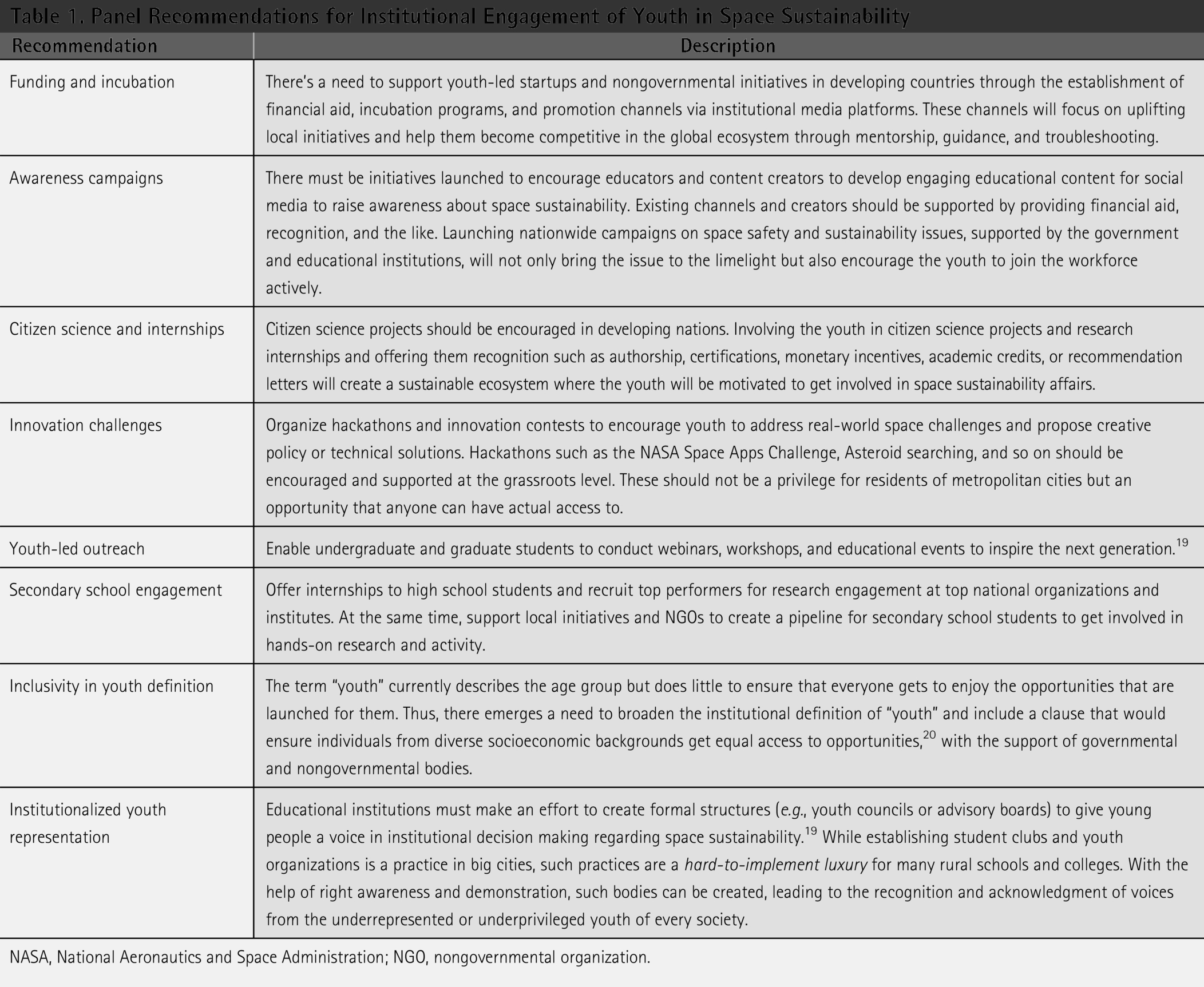
NASA, National Aeronautics and Space Administration; NGO, nongovernmental organization.
The authors have previously put forth similar recommendations in their earlier publications on space medicine education.
21
Moreover, in prior work, they have argued that reimagining sustainable futures may be most effectively achieved through space education—positioned as a new social contract for education. Such an approach, they contend, can empower the youth workforce and advance the vision of “Space for All” by:
22
Ensuring lifelong, quality space education as a human right, Appraising the sense of Space programs being a collective public endeavor, Raising voice to ensure consideration of outer space as a global common,
23
making it a globally shared resource to address our shared challenges on planet Earth.
INVESTMENT IN SPACE: RATIONALE AND CHALLENGES
A persistent challenge acknowledged by the panelists was the reluctance of investors to endorse space-related enterprises, particularly those spearheaded by younger professionals. To confront this issue, the panel deliberated on the pressing question: Why should investments be directed towards space when there exist urgent challenges to address on Earth?
Ryan Kirby responded by referencing Dr. Ernst Stuhlinger’s correspondence from 1970 to a Zambian nun, who had questioned the ethicality of allocating resources to space exploration in the face of ongoing poverty on Earth. Dr. Stuhlinger’s response recounted the narrative of a European noble who financed a young inventor, which ultimately culminated in the development of the microscope, a breakthrough that revolutionized health care. The underlying message is that investments in science and exploration frequently yield advantages that transcend their immediate objectives. Panelists also highlighted how space technology contributes directly to the resolution of terrestrial issues: satellites enhance agricultural planning, facilitate disaster management, and bolster global communication networks. 24 Furthermore, space exploration galvanizes a generation of scientists and engineers to confront challenges across diverse fields, including health, environmental sustainability, and energy. The panel concluded that investment in space should not be perceived as a distraction from terrestrial problems but rather as an indispensable instrument for addressing them.
MOTIVATIONS AND BARRIERS TO YOUTH-LED SPACE INITIATIVES
The exponential expansion of the space sector is predicated upon inclusive and synergistic collaborations. International missions exemplify the significance of transnational cooperation, which fosters not only scientific progress but also economic and societal advancement.
Panelist Chris Yi Yuan recounted the skepticism encountered by his team upon the initiation of a youth-led astronaut training program, when questioned on his motivation to work in the space industry or set up private space endeavors. He says that “individuals expressed doubt regarding our capabilities due to our lack of established credentials, but we possessed a vision, and we persisted” he stated. Their social enterprise allocates profits derived from training and travel initiatives back into research and development, thereby enabling them to maintain autonomy and independence from external funding cycles. Notably, panelists Chris Yi Yuan and Tomas Ducai also stressed that while aerospace engineering or astrophysics degrees may be required to participate in the space sector, expertise from other fields, such as art, education, and business, could find relevance in space-related applications, making it possible for people with a variety of backgrounds to engage. Private and nongovernmental initiatives offered more open platforms for cross-sectoral participation. Ruchira and Sibsankar pointed out that they feel motivated by the need to educate and inspire the public about space and saw outreach as both a civic duty and an important part of building a culture of space appreciation and innovation.
CONCLUSION
The space sector is experiencing unprecedented accessibility, driven by the rise of private players and the emergence of new technologies. Today’s youth, characterized by adaptability, curiosity, and a willingness to explore, are well positioned to shape the future of this industry. However, the full potential of this demographic remains underutilized. By strategically investing in youth-led initiatives, providing inclusive platforms, and cultivating interdisciplinary opportunities, institutions can catalyze transformative change in space sustainability. 25 Such efforts not only promise advancements in space science but also contribute meaningfully to addressing some of the most pressing challenges here on Earth.
AUTHOR’S CONTRIBUTIONS
S.H.: Project administration, writing—original draft, writing—review and editing, and conceptualization. S.P. and S.B.: Writing—original draft and writing—review and editing.
Footnotes
ACKNOWLEDGMENTS
The authors would like to acknowledge the efforts of all the panelists (Ryan Kirby, Chris Yi Yuan, Ruchira Huchgol, Tomas Ducai, and Niharika Rath), who joined the event and gave us their valuable inputs, and Ms. Dhanusshya Raghu (Ethiraj College for Women, Chennai, Tamil Nadu, India) for her efforts in compiling the transcript of the meeting.
AUTHOR DISCLOSURE STATEMENT
The authors declare that there was no commercial or financial interest involved in bringing out the article that could potentially be construed as a conflict of interest.
FUNDING INFORMATION
The authors did not receive any funding for the work.
Supplemental Material
References
Supplementary Material
Please find the following supplemental material available below.
For Open Access articles published under a Creative Commons License, all supplemental material carries the same license as the article it is associated with.
For non-Open Access articles published, all supplemental material carries a non-exclusive license, and permission requests for re-use of supplemental material or any part of supplemental material shall be sent directly to the copyright owner as specified in the copyright notice associated with the article.
