




Abstract
The ability to consider other people's perspectives is an important competence in societies. The competence to extend this perspective to unknown individuals or even to abstracted, generalized people has been neglected in developmental research. For the latter aspect, we propose the term Concept of Generalized Other Minds (CoGOM). Two developmental models are conceivable: (a) a sequential model in which a CoGOM develops additively from increasing complexity in a person's Theory of Mind (ToM) and (b) a Y model with a diverging developmental pathway, starting from basic ToM competencies as a common root. In three studies are presented, in which several tasks measured five- to ten-year-old children's abilities to consider generalized others’ perspectives. ToM and perspective-taking were correlated across studies, but ToM and a linguistic indicator of CoGOM (pronoun) were not. These findings may offer preliminary evidence that the development of a CoGOM follows the Y model.
A person's individual development involves more than just the unfolding of inherent possibilities or the acquisition of the specific skills that are required in each environment. Rather, it always involves socialization (Rogoff, 2003; Valsiner, 2000, 2012), as we must navigate our way through the society we are born into, learn its rules, and learn how to deal with many people, many of whom we may never meet but who may nevertheless be important for our lives. This process requires us to understand that we indeed live in a society, that we have to acknowledge and, in many respects, obey its explicit and tacit rules, and that we are well advised to meet many of its expectations. To date, developmental psychology has largely neglected this facet of socialization. Even in textbooks that are explicitly dedicated to social development, both moral development and the development of a ToM are discussed in detail, but the perspective of a society and thus of a generalized “person” is not touched upon (cf. e.g., Durkin, 1995; Schaffer, 1996). Actually, little research has been done on how humans develop an understanding of the complex societies in which they live (Kölbl, 2014): How and when are children able to grasp the complexity of social dynamics and expectations beyond personal interactions? At best, this has been examined with respect to domain-specific aspects of society (e.g., game rules or violations of standards; Schmidt & Rakoczy, 2023); cross-domain aspects, in particular a general understanding of society, are often only mentioned (Preiser, 2014). However, in order to develop an understanding of society, it is necessary to be able to take society's perspective. When do children realize that it can be useful to ask what society “wants” (even though it literally does not truly want anything)? When do children understand that social expectations can be binding, even though some members of this society (and other societies) demand otherwise (Sandhagen & Greve, 2014)?
From Individual Theory of Mind Toward a Perspective of a Generalized Other
If individuals strive to understand social communities and to fit into them, they need various social skills (e.g., helpfulness and fairness) which are essential even for dealing with a manageable social group (Kachel et al., 2021; Tomasello & Vaish, 2013; Warneken & Hepach, 2018). A central prerequisite for all these social skills is the ability to recognize and consider the perspectives of others (Stålne, 2025). A key task for human ontogenesis in general (Tomasello, 2019) is to develop a general understanding of the fact that other people have their own perceptions and assumptions, which may differ from our own but which guide their behavior—that is, that we should try to grasp others’ perceptions and assumptions to predict their behavior instead of just using our own perspective (Rakoczy, 2017, 2022). In the first social contexts we experience as young children, we must learn that our direct interaction partners (e.g., parents, siblings) have their own perspectives. Developmental psychology research on perspective-taking has been systematically investigating this point (Brooks & Meltzoff, 2002; Carey, 2009; Moll, 2023). The term Theory of Mind (ToM) has been established for the emergence of the insight that the world is represented heterogeneously in individual minds.
Expanding on preliminary considerations (Premack & Woodruff, 1978) and the pioneering work by Wimmer and Perner (1983), various lines of research have investigated the development of ToM. The beginnings of ToM occur around the fourth year of life (Sodian & Thoermer, 2006; Wellman et al., 2001; Wimmer & Perner, 1983), that is in what Piaget (1954) calls the preoperational phase, which is characterized by a tendency to engage in perspective-centrism, or more precisely, egocentrism (Baillargeon et al., 2010). After four decades of research, ToM encompasses a broad field of methods and assumptions (for overviews, see Rakoczy, 2017; Rakoczy, 2022; Sodian & Thoermer, 2006). Studies have explored the acquisition of more complex ideas of mental states of others (Rakoczy, 2017) and the importance of executive functioning, language development, and social cooperation experiences (e.g., with older siblings) for the development of ToM (Carr et al., 2018; Derksen et al., 2018; Kloo et al., 2022; Rakoczy, 2017). More recent work has examined precursor abilities (e.g., Henning et al., 2009; Träuble et al., 2010) and further ToM development among primary school children (e.g., Happé, 1994; Wellman & Liu, 2004), increasingly complex ToM (Rakoczy, 2017), and facets of an advanced Theory of Mind (Osterhaus et al., 2016). In addition, researchers have debated whether ToM really decreases in older people or whether motivational effects are decisive (Wimmer and Perner, 1983; for a detailed overview, see Rakoczy, 2017; Wellman et al., 2001).
Two approaches in particular have become established with respect to the development of ToM (Rakoczy, 2017; Wellman, 2014). The “theory theory” assumes that children develop a subjective theory about the world and the mental states of other people and themselves (Gopnik & Wellman, 1994; Wellman et al., 2001), whereas the “simulation theory” assumes that children use their own thoughts to simulate the perspective of another person and their reactions (Gordon, 1986). More recent research approaches have adopted a combination of the two assumptions, as the theories cannot be clearly separated in studies (Rakoczy, 2017). In addition, Moll (2023) proposed that two systems are in play in the development of ToM (Apperly & Butterfill, 2009; Butterfill & Apperly, 2013; Musholt, 2018; Perner & Roessler, 2010, 2012). Moll et al. (2022) suggested that children first develop a practical understanding of beliefs and then gradually develop a theoretical and reflective understanding.
However, for competent social behavior to succeed in modern societies in which not all members are personally known (most of them will never meet), an understanding beyond this ToM concept is required. For some social actions (e.g., in the areas of law and politics; see, e.g., Kölbl, 2012), we need not only an accurate idea of the perspective of a single individual or a countable few concrete counterparts (e.g., “my family”), but rather the ability to make an assessment of general views and expectations, which requires the idea of a generalized other (“what is the generally requested and expected behavior in “these” situations?”). Successful cooperation requires an understanding not only that different people can have different wishes but also that shared wishes can be based on different intentions, thus requiring the development of shared intentionality (Higgins, 2016; Kern & Moll, 2017; Tomasello, 2019). But even if these skills are a necessary condition for social competencies and relationships (e.g., successful cooperation), successful social coexistence will also require an understanding of social norms independent of one's own perspective and independent of the perspective of a specific other (individual or group). To make general assessments (“What constitutes fair cooperation”), detachment from a concrete (imagined) counterpart is therefore a necessary condition.
For example, understanding the concept of “news” requires the ability to understand the perspective of a generalized other: In order to decide whether a certain piece of information actually is “news,” we have to judge whether this information is of general interest: “everyone should know that …” (Sandhagen, 2021). It is a demanding cognitive step to understand that “everyone” is not to be understood as literally all members of a given society, but rather anyone, a generalized member of it. This generalized person does not need to exist (likewise, an “averaged” member of the society is not necessarily a real individual). Rather it entails the idea of an “idealized” person, a generalized person that represents the quasi-individual norms, expectations, beliefs etc. of this very society. In contrast to a prototypical person (Rosch, 1975), which, as a rule, is an existing token or type of a category, the generalized “other” is a construct. For this insight, we propose the term “Concept of Generalized Other Minds” (CoGOM).
Concept of Generalized Other Minds: Abstraction Beyond Adding up Other Individuals
In order to find their way in(to) society, not only must children free themselves from egocentrism, understand that their interaction partners (parents, friends) can have other perspectives, and understand that they must recognize the perspectives of others, but they must also expand these abilities conceptually. This general perspective is important or even constitutive for several social contexts; shared ideas are fundamental for many possibilities for development (e.g., the development of societies; Tomasello, 2014). For instance, if the idea that the very notion of morality implies detachment not only from one's own perspective but from any individual perspective is correct (Tomasello, 2019), then this cognitive developmental step is indispensable for thriving coexistence. Beyond the adoption of a perspective different from one's own, an additional abstraction is required if a concept of a generalized other is to be developed. We argue that it is probably a conceptually separate step to extend this insight beyond concrete others. However, even though a great deal of research has found that children's abilities to solve increasingly complex ToM tasks continue to increase into adolescence, little attention has been paid to the fact that these tasks have still essentially referred to specific (involved) people.
This abstraction represents an important difference from concept development for objects (e.g., “apple”). Beyond a prototypical apple (whose prototypicality already requires a degree of abstraction that an exemplary apple does not require; Rosch, 1975), a complete understanding of the concept “apple” would also require characteristics that cannot ever be realized simultaneously in any single apple (e.g., an apple is red or green or rotten). Analogously, the understanding of the concept of “society” already goes beyond the idea of a collection of individual (even many) concrete members (one can think and talk about “society” without having to think of concrete members or groups). However, “society” is not only thought of as analogous to a generalized apple, but also understood as a quasi-singular actor (society wants, believes, needs …). This aspect of the intentionality of collectives is missing in abstract object categories (“the” apple does not taste sweet – not even a prototypical one).
However, the core of CoGOM proposed here goes one step further: the idea of a “mind” of a “generalized other” implies adopting the perspective of a merely imagined, abstracted person (as if it were a real person). In other words, it is not only about the abstraction of the considered concept (society is not a concrete, countable group, but an abstract construction), but also of the attributes (“mind“) of that construct: assumptions (“thoughts“), evaluations (“values“), and tendencies (“motives“) to act can be attributed to society as if it were a person.
Actually, the concept of generalized other minds goes beyond the concept of a concrete and limited group of others (and their minds) in two respects. First, it refers to groups of considerable, actually indeterminate size (“the society,” “the voters”). This alone is a cognitively demanding abstraction. Even more important is the abstraction from specific individuals, even many of them. At least with regard to some aspects of what “society” thinks or wants or should know, it makes sense or is necessary to detach oneself from the idea of what any specific person thinks. “The population in Germany is unsettled,” “Voters in Holland want greater economic stability.” – such attributions may be accurate regardless of whether they are currently explicitly thought (in exactly this form) by some – or even the majority – of the individuals addressed. Rather, it is more accurate to think of a generalized other person who acts like a single person (even if this person does not exist). Hence, generalization is conceptually different from empirical estimation. Certainly, the idea of an “averaged“ person, who represents its society statistically, as it were, and the idea of a generalized person, who represents its society contentwise, are closely connected (in many cases they will be coextensive). The idea of a generalized person, however, is less dependent from situational variations of current compositions (or tendencies: states) of the particular society. For instance, there are times when the German “Angst” might be less pronounced (on average, as it were), but it still remains an attribute of the generalized German.
So, CoGOM is more than the conceived empirical average of a group. As a consequence, it is no longer about predicting as fittingly as possible what another person thinks (and does). Rather, it is about putting oneself “in the shoes” of a generalized other, an abstract person. Thus, the idea that a perspective or a belief could be “general” is a qualitatively different concept than the concrete-individual-focused ToM. The thesis we want to put forward is that children do not “add up“ more and more individuals in a task, but rather, they learn to imagine an abstracted person: a generalized other. Analogous to Mead's (Mead, 1934/2015) assumption that “the individual takes the attitude of the generalized other towards himself “ (p.155) it is our assumption that people have to (learn to) understand that a generalized other may have a perspective that includes expectations and intentions. To be sure, collectives, real or abstract, do not “believe,” or “expect” something in the same sense as people do; still, as an “acting collective,” they have functional equivalent “tendencies” that might be appropriately characterized in a similar fashion to individual motives. It is perhaps worth pointing out that this CoGOM could nevertheless be empirically inaccurate in concrete cases: One can be wrong in assuming what “the others” want or what a certain “society” expects. In this way a generalized other functions like a generalized individuum. In ToM-tasks a child thinks about what a concrete individuum thinks or wants. In CoGOM-tasks a child thinks about what a generalized other thinks or wants as if this generalized other were an individuum, too.
Development of CoGOM: Conditions and Possible Sequences
It is reasonable to assume that the development of CoGOM is linked to the development of ToM. However, even though a close connection between the developments of CoGOM and ToM is obvious, the question of whether the CoGOM is a continuation of the increasing complexity of a ToM or develops (partially) independently of it remains unanswered. If the availability of ToM is a developmental precondition for CoGOM, then CoGOM should arise in the stage at which a person has a sufficiently developed ToM that is cognitively represented by the person and can also be metacognitively reflected on (we hereby choose to leave the current discussion about a possibly earlier recognizable “implicit” ToM untouched here; for an overview, see Kulke et al., 2018; Rakoczy, 2022).
The ability of ToM refers to a specific other person, a direct other person. At a more advanced stage of development, this is extended to the insight that every other person has their own perspective, which may also differ significantly from each other in some circumstances (for an overview, see Osterhaus & Bosacki, 2022; Rakoczy, 2022). The first step toward developing generalized perspectives is the understanding that several people can share a perspective (“Our whole family is looking forward to the next vacation”). Even if these are still specific groups, which are usually made up of individuals who are also known individually (family, school class, team), the possibility of generalization (beyond the sum of the individuals) is inherent: One understands that one can aptly say that the class is looking forward to the trip, even though one knows that one child cannot participate because he or she is ill. Plausibly, extending the intermediate step of thinking of concrete groups (familiy, team), CoGOM entails the solution from any concrete person: Speaking of society (“one should know that …”) is possible without conceiving real indivduals. For a CoGOM, the anticipated position “from anywhere” is characteristic which can be conceived as if it were the perspective of a (human) person.
However, even if the conceptual outlines of the mind of a generalized other were sufficiently clear and agreed upon, and even if it were undisputed that the basic ability of ToM is a necessary developmental condition for (the development of) CoGOM, the developmental pathway of CoGOM is not yet understood. In order to explore a possible developmental sequence two alternative pathways are to be discussed. On the one hand, it would be plausible to assume that CoGOM develops from (i.e., after) an increasingly complex ToM. Comparable to Moll et al.'s (2022) proposal that the understanding of beliefs develops from a more practical understanding (i.e., adequate action) into a reflected understanding, it would be conceivable that CoGOM continues to develop as one reflects upon and develops a deeper and increasingly abstract understanding of ToM. This progression would suggest a sequential development model. Alternatively, it could be assumed that ToM and CoGOM are based on the general insight of ToM (there are other minds and, hence, perspectives) and the ability to change perspectives, but that both concepts develop comparatively early on in two qualitatively different pathways, that is, before or simultaneously with the emergence of advanced forms of ToM (“Y model”), which we propose. We illustrate this claim with initial exemplary data.
If CoGOM were to be just another complex developmental stage of ToM, it could evolve in parallel or subordinate to other extensions of ToM (synchronously to a second-order or higher ToM). In such a sequential developmental model for CoGOM, it could be assumed that children can first solve increasingly complex ToM tasks, which then lead to an even more complex CoGOM. This process would be conceivable, for example, in parallel with Selman's phases of perspective taking: Selman and Byrne (1974) proposed that children are initially only able to adopt their own perspective before they are able to view their own perspective and that of another person “from the outside,” as it were. If the mutual adoption of perspectives does not lead to understanding, the consequence for Selman is that social conventions are necessary in a society. In this phase, Selman extends his view from the individual via the dyad to society (Selman, 1981). The child first understands that their perspective is their own and differs from other perspectives. They then understand that their own perspective and another perspective can be considered simultaneously. The process culminates in the realization that “there is a general integrated social viewpoint that transcends individual perspectives and involves a mutual understanding of deeper psychic processes within and between persons” (Selman, 1981, p. 406). It is somewhat about an average, but not about an abstracted or generalized other.
However, if the CoGOM were to develop (partially) independently of the further differentiations of a ToM (Y model; a “basic” ToM that is available in principle is certainly a necessary condition), it would be more likely for a qualitatively different cognitive development that is distinguishable from ToM to emerge. In such a model, children could possibly adopt the CoGOM even before the development of the Advanced ToM as the idea of generalized other people from adults, comparable to Rakoczy and Schmidt's (2013) assumption that children as young as two to three years of age pick up the rules of the game from competent role models and grasp social norms at an early age or in the sense of Moll et al.'s (2022) practical approach to a situation. A sequential model would be in the tradition of Piaget and Selman (for a comparison, see Stålne, 2025). The sequential model of perspective taking starts from concrete perception and becomes increasingly abstract in relation to the content addressed. At the highest level, a person can imagine another imagined person who is capable of thinking about abstract ideas and beyond. CoGOM, on the other hand, does not refer to the abstraction of content, but rather to the extension of a generalized person to a representative idea of what a (non-concrete, numerically indeterminate) group knows, values, or desires. Here, abstraction refers to the “thinkers” and “thinking” (e.g., attitudes toward a news item or legislation). The question of what speaks for an additive (sequential) model and what speaks for an abstracting (Y) model can be explained by using the example of some studies on the CoGOM.
Practically, in order to express the idea of a CoGOM, languages have developed a variety of forms. This pervasiveness could be seen both as an indication of the complexity of the concept and of cultural differences (e.g., how binding is a normative specification?). A linguistically fitting term for “the” others is not easy to find. In German, (beyond answers that indicate that something concerns “everyone”) the indefinite pronoun “man” (meaning “one”, in the sense of “one should not behave that way”) is often used for this purpose. This pronoun is complex and can be used with different meanings. Especially in normative contexts, “one should do this” is not about a specific individual person to whom this normative demand applies, but the addressed individuals are interchangeable: anyone, indeed everyone should do so. It can be assumed that the CoGOM is the same across many cultures, even if the indefinite pronoun “man” in German is mapped differently in other languages (for instance, it parallels in many, but not all connotations to the English “one” or the generic “you”; Orvell et al., 2017). The Dutch “men” is used only in written language (Zifonun, 2001, p. 71). In some languages, such as Japanese, there are distancing forms that can express politeness and social status in an extensive system (Zifonun, 2001).
Methods of Assessment
Several operationalizations have been established to capture ToM. Among the most widely tested approaches are false belief tasks, in which the subject is asked to answer questions about another person's perspective and must take into account different levels of information (Maxi and the chocolate, Sally Ann task; Rakoczy, 2017; Wellman et al., 2001; Wimmer & Perner, 1983). ToM scales also include sarcasm tasks (Henning et al., 2012; Kristen et al., 2006; Little & Nettle, 2006; Wimmer & Perner, 1983). More complex and therefore more difficult tasks are characterized by more cognitive recursion. However, second and higher order perspective integrations (“I think that you think that he thinks …”) are still linked to the perspectives of, and on, concrete individuals; the switch to abstracted perspectives has not yet been investigated (to the best of our knowledge).
Accordingly, there are as yet no validated instruments for the assessment of the CoGOM. Linguistically, the CoGOM (in German) is most likely to be reflected in the pronoun “man.” In addition, more explicit descriptions (“Everyone must know this”) are also possible. In various contexts (and depending on the person's level of linguistic development), paraphrases could also be indicators (“In our society, this is a central value”). A suitable context in which the CoGOM is needed is, understanding the concept of “news.” Although it can be thought of and used in a personalized way (“It is an important to let Maria know that her dog is injured”), understanding the general concept requires precisely the abstracted and generalized perspective (the injury of Maria's dog is not news for everyone, unlike the fed's last rate of interest decision). Therefore, the concept of news was used in initial pilot studies to develop an appropriate assessment of an individual CoGOM.
Studies: Framework of Assessment
The framework of the task was a schematic representation of a blank newspaper page. Experts who work as news editors assessed 16 topics according to whether they were news or not. This newspaper topic task was then tested with elementary school children. The topics ranged from “Tina eats a jam sandwich” (ranking: clearly not news) to “The national soccer team becomes world champion” (ranking: clearly news). From the 16 randomized topics, 5 topics were to be selected. The participants (e.g., primary school children) were asked to justify their decision for all topics (selected and non-selected). It was not the choice of topic that was decisive but the children's reasoning, which served as an indicator of the children's abilities to consider the perspective of a generalized other. The perspective of the justification was evaluated: It could relate to the person making the judgment (egocentric perspective; EGO), to specific others (e.g., family, peers: other minds perspective; OM), or to generalized others (generalized other perspective; GO). Typical example responses for choosing the topic “The national soccer team becomes world champions” are “Because I play soccer” (EGO), “Because all my friends want to know” (OM), and “Because people are interested” (GO). The children's reasons were classified into five categories: egocentric perspective (e.g., me), oneself and another person named (e.g., me and my friend), countable number of others (my school class), uncountable number of others (e.g., the whole city), and (as a separate category) “everyone.” Due to the small number of cases, the categories were combined into 0 = no perspective considered, 1 = own perspective considered, and 2 = perspectives of several people considered (e.g., specific other perspectives as well als generalized other perspective). In addition, the use of the pronoun „man“ has been counted as an sole indicator of generalized other perspective. Each child can thus achieve a score between 0 and 32 points for all 16 topics. The more often the perspective of several people is used, the higher the total score. The codes were assigned by two raters for the longitudinal study. Due to many missing values, the inter-rater reliabilities are low.
As expected, the results of an initial study showed that older children on average adopted a generalized other perspective more often than younger children did (Sandhagen, 2009). As expected, the point in time at which both EGO and GO appear for the first time varies between children. In younger children (around the age of six), the two forms sometimes occur in parallel. For example, a girl (6 years 7 months) responded to the rejection of the topic “Parents are building a climbing frame in kindergarten” with “Because I'm not in kindergarten anymore” (EGO) and to the rejection of the topic “It's snowing so hard that the trains can't run” with “Then you can't go on the trains, that's bad, someone wants to go on the trains and then you can't” (GO). Thus, the child used both forms at one point in time. The development of the ability to consider different perspectives is therefore not necessarily sequential, but parallel. Over time—age and grade level—the GO form increases. This suggests that children can adopt both perspectives—the egocentric and the generalized other. At the same time, however, it seems that as children get older and move up through the grades, they increasingly choose the generalized other perspective when asked to explain why a topic is newsworthy. The examples suggests that understanding news is a context in which even primary school children can consider the perspectives of many other people. In the explanatory notes, the newspaper topic task offers the opportunity to capture the CoGOM via the perspectives that the children used.
Preliminary Empirical Evidence with Respect to the Ontogeny of CoGOM
What assumptions do children have about what is important for groups in terms of a generalized other? What connections are there between ToM and CoGOM? Initial empirical data on the development of a CoGOM were collected in three studies. We discuss the findings using individual results from the newspaper topic task. The inquiries were conducted at elementary schools in the form of individual interviews. The interviewer read the tasks aloud and recorded the answers on a record sheet in addition to the recording. In addition, age, class level, and first language were recorded. 1
For the question about the development of the CoGOM, the aim was to capture ToM with ToM tasks and to capture CoGOM with the newspaper topic task. The tasks were presented with picture cards and puppets. This procedure has been well tested with ToM tasks (Wimmer & Perner, 1983). We describe the exact tasks for each study in the following.
A call for participation was distributed to parents via elementary schools. The selection of participating children was therefore self-selective. Children whose parents gave their written consent took part. All elementary schools were small to medium-sized schools in villages and towns. Only a few children grow up speaking more than one language.
We report the results from two cross-sectional studies first, followed by the results from a longitudinal study with three measurement points. 2
Study 1
Method
The newspaper topic task was identical to the one described above. The ToM task was replaced because the Maxi and chocolate tasks in the initial study (Sandhagen, 2009) were solved by almost all the children. In Study 1, the birthday present task was chosen (Sullivan et al., 1994, p. 402). This task is a complex change-of-location task on false beliefs. It comprises five comprehension questions (control questions) and three test questions.
Sample
N = 50 children aged five to ten years (i.e., from Kindergarten to fourth grade) participated in Study 1. Gender was equally distributed: Nf = 25 (Mage = 7.0 years, SDage = 1.5 years) and Nm = 25 (Mage = 7.1 years, SDage = 1.4 years).
Results
As expected, age predicted the consideration of perspective in a univariate analysis of variance (ANOVA). The older the children were, the more often they used a GO perspective (F(5, 44) = 4,215; p = .003). Accordingly, grade level also significantly predicted the use of the GO perspective in a univariate ANOVA (F(4, 45) = 4,683; p = .003). For the ToM task, the difference between the age groups was significant in a single-factor ANOVA (F(5, 44) = 4,956, p = .001). ToM was significantly strongly correlated with the perspective that was used (r = .471, p = .001), whereas the use of the pronoun “man” did not meet the significance threshold for the relatively small sample (r = .238, p = .096).
Discussion
The results differentiate between the ToM task and the newspaper topic task for both age and grade level. The older the children are, the more they consider the perspectives of others. In addition, children in higher grade levels consider the perspectives of others to a greater extent. The aim of Study 2 is to examine the grade levels in more detail.
Study 2
Method
The study included the newspaper topic task as well as the ToM tasks “Maxi and the chocolate” (Wimmer & Perner, 1983), the birthday present task (Sullivan et al., 1994), and a task on irony from the ToM scale (Henning et al., 2012).
Sample
Both Sandhagen (2009) and Study 1 suggested systematic differences between first-graders and third/fourth-graders. Study 2 focused on these groups. The sample of N = 42 children comprised 16 girls and 26 boys. The sample was divided into two subsamples. Subsample 1 comprised Na = 17 first-graders (Mage = 6.41 years). Sample 2 comprised a total of Nb = 25 third- and fourth-graders: 19 third-graders (Mage = 8.21 years) and 6 fourth-graders (Mage = 10.0 years).
Results
As expected, the third/fourth graders used the GO perspective more often than the first graders did. The groups differ significantly in their use of perspective (ANOVA F(2, 38) = 10,074, p = .00). The first and third/fourth graders also differed significantly in the number of ToM tasks they solved (F(2, 39) = 4,040, p = .025). ToM was strongly significantly correlated with the perspective that was used (r = .398, p = .010) but not with the use of the (German) pronoun “man” (r = .111, p = .490).
Discussion
The data are consistent with the results of Study 1. Grade level predicts how often children use the perspective of others (and the number of ToM tasks solved). The pronoun “man” as a possible indicator for CoGOM, on the other hand, does not correlate with the number of ToM tasks solved. This could be an indication that ToM and the competent use of “one” are based on different processes.
Study 3
Method
“Maxi and chocolate” and an extended “Sally-Ann” task were used as ToM tasks (Wimmer & Perner, 1983). In the extended ToM task, the protagonist observes an object changing locations. With regard to the CoGOM, the newspaper topic task is evaluated. The longitudinal study comprised three measurement occasions, each about five months apart.
Sample
The sample at Time 1 (T1) comprised N1 = 73 children (Nf = 34 girls and Nm = 39 boys). Due to 4 dropouts, the sample size was reduced to N3 = 69 children (N3w = 31 girls). At T1, 36 children were first-graders, 34 were second-graders, and 3 were third-graders. The sample was recruited by ads in schools and written consent from parents was obligatory. The children's mean ages were 7 years, 5 months, 8 days at T1; 7 years, 9 months, 26 days at T2; and 8 years 2 months, 7 days at T3
Analysis
In the newspaper topic task, it was not the choice of topic that was decisive but the children's reasoning, which served as an indicator of the children's abilities to consider the perspective of a generalized other. The reasons were assigned points: 0 points = no perspective (example: no answer), 1 point = egocentric perspective (example answer: “because I like this”), 2 points = generalized perspective taken into account (example answer: “because all people need to know this”). A feature of the CoGOM is the pronoun “man,” which was considered separately. In both ToM tasks, 1 point was awarded for a correctly answered test question (e.g., “Where will Maxi look for the chocolate?”) and for a correctly answered control question (e.g., “Where is the chocolate really?”).
Results
The extents to which the children considered the perspectives of others increased significantly across the three measurement points. A single-factor repeated-measures ANOVA showed a significant increase in perspective at the .05 percent level (F(2, 144) = 13,712).
In the ToM tasks, more than 90% of the children (N1,2 = 73, N3 = 69) solved the Maxi and chocolate tasks correctly. The extended ToM task differentiated somewhat between the primary school children. The results of the ToM tasks at T1 predicted the GO perspective at T2 in a regression analysis (p < .001). The number of times the (German) pronoun “man” was used increased across the three measurement points, but the increase was not significant. There was no significant correlation between ToM and “man.”
Discussion
The number of correctly answered Theory of Mind tasks at the first measurement point predicts how strongly the perspectives of other people are taken into account at the second measurement point. The data of the longitudinal study indicate that there is a correlation between ToM and consideration of the perspectives of others, but no correlation with the competent use of the pronoun “one.” This could be a further indication that ToM and CoGOM have a common basis but nevertheless follow different developmental paths.
Summary of Results Across Studies 1 to 3
In summary, the data showed several trends. As expected, the children in higher grades were better at solving the ToM tasks than the children in first grade. An ANOVA (across all three studies) showed significant differences between first- and third-graders (F(4, 160) = 23,046, p = .018). ToM was not significantly correlated with the use of the (German) pronoun “man” (r = .033, n.s.).
This finding is consistent with theories of ToM and our assumptions about the CoGOM. If the assumption that children develop ToM and CoGOM along different paths is correct, then ToM and the use of the (German) pronoun “man” as an indicator of CoGOM should not be related. Indeed, we found that a positive correlation for CoGOM and “man”, but none for ToM and “man”.
Differences between the number of perspectives, the number of times the pronoun “man” was used, and the number of correctly solved ToM tasks were described in Studies 1 and 2, in which the ToM tasks differentiated between older and younger children better than in Study 3. The data are summarized for younger children (kindergarten, grades 1 and 2) and older children (grades 3 and 4). The number of ToM tasks solved was positively correlated with the level of perspective used (r = .386, p < .001) and positively correlated with grade level (r = .462, p < .001) but not with the number of times the pronoun “man” was used (r = −.012, p = .909). Children who took the GO perspective into account to a high degree achieved high scores on the ToM tasks. The reverse was not true, as shown in Figures 1 and 2.
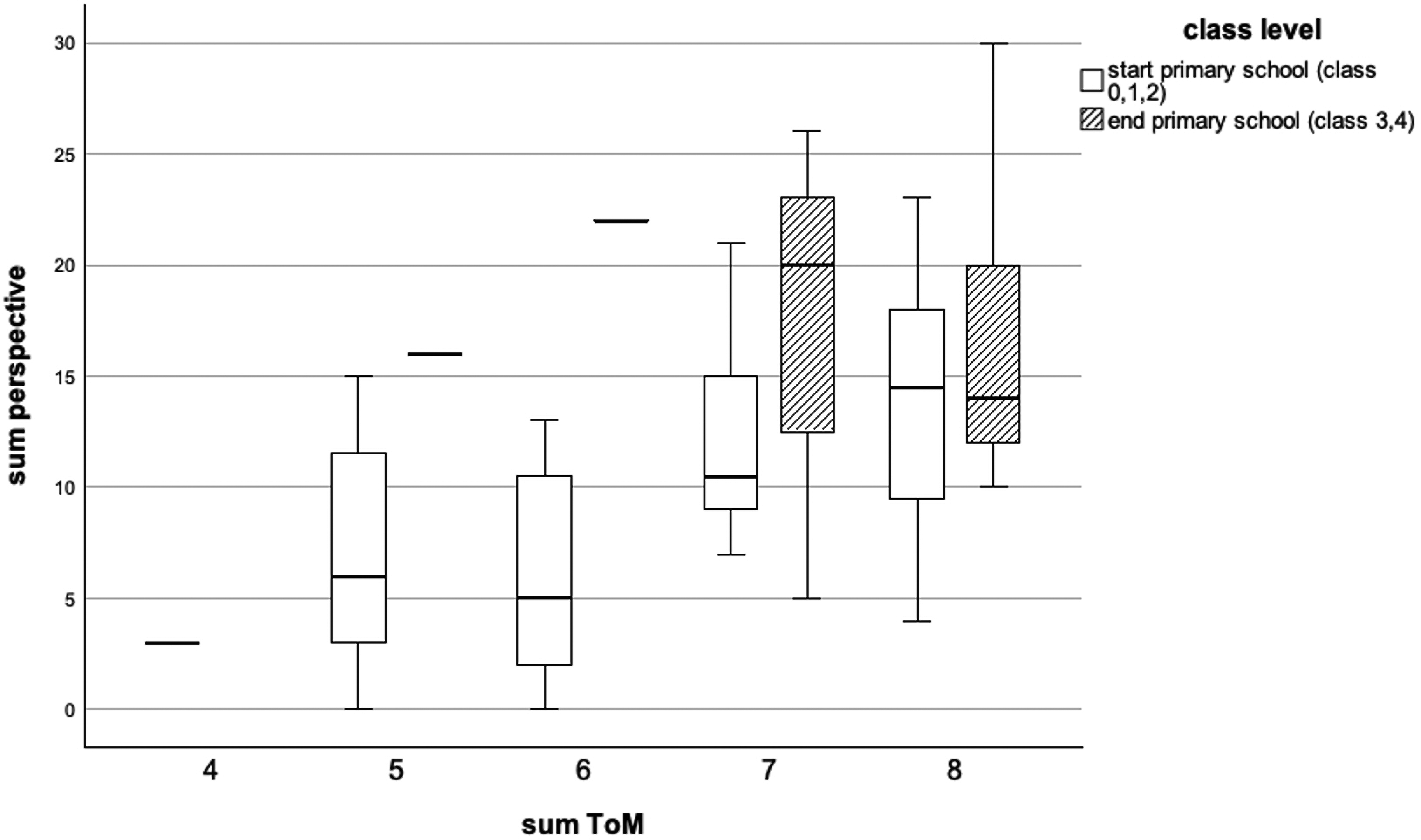
The figure shows the sum of correctly answered ToM test questions and the sum of the perspectives used (the higher the value, the more the perspective of others was taken into account) by grade level from Study 1.

The figure shows the sum of correctly answered ToM test questions and the sum of the perspective used (the higher the value, the more the perspective of others was taken into account) by grade level from Study 2.
There were children who solved the ToM task correctly but paid little attention to the perspectives of others. The groups differed most strongly by grade level rather than age. The class and thus the social contexts appeared to be an important difference. This finding suggests that ToM is a necessary but not a sufficient condition for considering the perspectives of many people. No systematic pattern emerged for the pronoun “man,” even when separated by class. It should be noted again that the indefinite pronoun “man” is complex in German (Zifonun, 2000). “Man” in German can stand for the first person singular (e.g., “Darf man fragen?” (“May one ask?”) for “Darf ich fragen?” (“May I ask?”) or to a generalized other (e.g., “You introduce yourself when you're new” for “Everyone who goes somewhere new introduces themselves”; Dudenredaktion, 1998). These nuances confront children with challenges in their linguistic development. If a child masters this challenge and uses the complex pronoun “one” in a way that appropriately indicates a generalized other perspective, it can be assumed that linguistic complexity and complexity in thinking are related (Ross, 2008). If a child uses the pronoun “man” in the sense of a generalized other, this can be considered an indication of the CoGOM. The reverse is not automatically true. If a child does not use the pronoun “man,” it does not necessarily mean that they do not yet have the underlying concept of a generalized other but can also be attributed to linguistic development. In the newspaper topic task, the pronoun “man” is therefore only an indicator of the perspective of a generalized other. Other descriptions can be “everyone needs to know.” All these variants indicate the consideration of the perspective of a generalized other. The two variables “perspective” and “man” were positively correlated as expected (r = .320, p = .002).
Discussion
The ability to consider the perspectives of others is an important skill in societies (Tomasello, 2019). This ability includes unknown people or an abstracted, generalized person, that is: the perspective of the entire society the person lives in (and other societies as well). We propose the term Concept of Generalized Other Minds (CoGOM) for this aspect. Two conceivable different development paths are a sequential model or a Y model. In the sequential model, the CoGOM develops step by step from (and therefore: according to) increasingly complex Theories of Mind(s). The Y model assumes a differentiation between perspectives of concrete people (i.e., ToM) and abstracted perspectives (i.e., CoGOM).
The common basis for both models should be a fundamental ability to adopt a perspective beyond one's own. In addition to the empirical questions of timing (under what conditions and at what age children understand changes of perspective -ToM?), an important theoretical debate concerns the question of what it means to explain the behavior of (other) people with recourse to mental concepts (beliefs, desires, etc.; Tomasello, 2019). We argue that, assuming that ToM is a meaningful developmental psychological question at all, i.e., an empirically and theoretically productive focus of research, one facet of the associated change in perspective has received little attention to date: the perspective of an abstract, generalized, and therefore “impersonal” perspective.
The pilot studies outlined here provide initial indications that speak in favor of the Y model. The basic development of ToM should be a necessary but not a sufficient condition for the development of a CoGOM. In three studies with five- to ten-year-old children, measures of the consideration of the perspective of others (“perspective”), the number of times the German pronoun “man” (meaning “one”) was used, and measures of ToM in ToM tasks were collected in a newspaper topic task. It makes sense to assess separately whether the perspective of others is taken into account or whether the pronoun “man” is used. The perspective of others can be thought of as additive (e.g., Tim takes into account the perspectives of Tina, Chris, and Tobias) and should correlate with the similarly structured theory of mind. In its broadest sense, the pronoun “man” can refer to an abstraction (it applies to an abstractly conceived person) and should show a qualitative difference from the Theory of Mind and therefore ist not expected to correlate substantially with it. Children in higher grades took the perspective of others into account more often, solved more ToM tasks, and used “man” more often. Across the studies, ToM and the level of perspective were correlated, but ToM and “man” were not. If the pronoun “man” were merely the highest level at which children considered the perspective of a generalized other, there differences in the correlations between “man” and ToM on the one hand and “man” and perspective on the other is puzzling. This, in turn, supports the assumption that a more fundamental conceptual difference is touched here. Of course, this remains to be tested more systematically.
In the longitudinal study, egocentric and generalized other perspectives occurred in parallel, even if the generalized other perspective predominates with increasing age and in particular at higher grade levels. The results showed that children who took the generalized other perspective into account to a greater degree achieved high scores on the ToM tasks. The reverse was not true. Children who achieved high scores on ToM tasks could also have low scores on perspective (Figure 2). This pattern could indicate that although ToM is important for the CoGOM, the development then proceeds separately in the Y model. ToM skills develop continuously, whereas CoGOM skills—in our studies— changed qualitatively at around the age of seven. This age (six to seven years) has been referred to in other studies as the period for conceptual changes (Moll, 2023; Tomasello, 2019). Grade level could have an influence on the development of the CoGOM (Figure 1). Seven-year-olds in the first/second grade used the generalized other perspective less often in their reasoning than seven-year-olds in the third grade.
Taken together, these considerations provide initial evidence that the development of the CoGOM follows the Y model. In terms of content, this assumption was supported by the finding that the CoGOM is not the developmental peak of ToM and does not replace it, but rather, people need each one independently of the other in everyday life. For direct interaction and cooperation, it is important to understand and apply ToM. The CoGOM is a crucial competence for social coexistence in general.
Limitations
One of the limitations of the presented pilot studies is that the ToM tasks in the longitudinal study differentiated between children only slightly. In previous studies, tasks on hidden emotions and irony from the Theory of Mind Scale (Henning et al., 2012) have proven to be more suitable. This finding is important because the lack of variance limits or excludes a (diachronic) prediction. None of the three later studies were representative (e.g., schoolwise recruitment, selection by parental consent, small samples). This lack of representativeness means that we cannot rule out the possibility that the families of the participating children were particularly interested in the study or were open-minded to science or that they shared other characteristics that were not measured. A longitudinal study with more children and a heterogeneous group of participants would be desirable.
The use of pronoun “man” in the sense of a generalized other can be considered an indication of the CoGOM only in german language. If a language has not the pronoun “man” or a child does not use the pronoun “man,” it does not necessarily mean that they do not yet have the underlying concept of a generalized other. Further research on instruments for the assessment of CoGOM will help to further clarify the role of certain pronouns (in various languages).
Further Research
The differences between individualistic and collectivistic cultures have merely been mentioned so far, but at present we lack data on cultural and linguistic differences. In addition, the (German) indefinite pronoun “man” presents challenges for its linguistic acquisition that do not necessarily allow the conclusion that the cognitive concept is not yet present; further data on this aspect would be useful.
The role of experience with the media has not yet been discussed. Media consumption might generate an understanding of news in a practical application, but media consumption is not expected play a role in abstracting and theoretical understanding. Children could learn which topics typically appear in the news but could still have not yet developed a CoGOM. A first inspection of some information on media use in studies 1 to 3 do not support a connection between perspective and engagement in parents’ newspaper reading, but this requires further studies as well.
So far, there are no empirical results on the role of empathy available. Empathy is often divided into affective and cognitive components. ToM is sometimes treated similarly to cognitive empathy (Baron-Cohen et al., 2001; Harari et al., 2010). However, empathy is unlikely to have any influence on CoGOM, as CoGOM is about abstraction and not about empathizing with a concrete perspective. Further studies would have to be designed to explore this topic. The approach of considering the abstracted perspective of a generalized other in addition to empathy for a concrete counterpart could pave the way to look at theories of moral development. The approach is also suitable for using news not only as an example but also as the beginning of a psychology of news.
Conclusion
Understanding society as a social community and fitting into it is a goal of human development. The CoGOM could be an important competence for this, as it means being able to imagine what a generalized other, or society wants “one” to think. Understanding that another person has a different perspective from oneself could be an important foundation for both CoGOM and ToM. The development of ToM has already been studied in many ways. In the relationship between ToM and CoGOM, it is important to clarify whether CoGOM is a further sequential development of ToM or whether the development proceeds independently in a Y model. The initial studies presented in this paper speak in favor of the Y model. If this model were correct, then CoGOM is not a special case of the ToM. Instead, the emergence of CoGOM is the beginning of a different competence in which there is not one counterpart, but rather, all people in a group (e.g., a society) form the counterpart in the form of a generalized other. In the near future, however, it may be possible not only to imagine this generalized person but also to communicate with this generalized person in a certain way. Perhaps, artificial intelligence offers an opportunity to ask questions to a generalized other person directly, as it were.
Footnotes
Acknowledgements
Our special thanks go to the children who took part in the study.

Ethics Approval and Informed Consent Statements
The authors have no ethical conflicts to disclose. APA ethical standards were followed in the conduct of the study, ensuring adherence to ethical principles outlined in the Declaration of Helsinki. Written informed consent was obtained from participants and their parents.
Author Contributions
Study 1 to 3 were conceptualized and realized by P.S.. P.S. and W.G. contributed equally to writing the present paper.
Funding
The authors received no financial support for the research, authorship, and/or publication of this article.
Declaration of Conflicting Interests
The authors declared no potential conflicts of interest with respect to the research, authorship, and/or publication of this article.
Data Availability Statement
The analyses of the data from study 1 to 3 is still ongoing. Data will be sent upon direct request to the corresponding author.