



Abstract
In this article I analyze double-layered power struggles from a power transition perspective. This study compares the case of global power transition between the US and China linked to a case of regional power transition between China and Japan. US–China relations in the global order have been more cooperative than China–Japan relations in the regional order since the beginning of this century. The question is about how the two cases interact with respect to each other.
The first scenario shows that stability in the global order deters instability in the regional order. The US–China partnership stabilizes China–Japan conflictual relations. In this situation the US, China and Japan maintain status quo policies and regional order is stabilized. The second scenario is one in which instability in the regional order overwhelms stability in the global order. In this situation China and Japan accelerate their hegemonic struggles in Northeast Asia, and the US serves to mediate between China and Japan. The US should be making a decision as to what kind of diplomatic stance it will take to minimize the tension between China and Japan. The US must also make its own world strategy. China is more likely to be a status quo power in the global order, but a challenger in breaking down the status quo in Northeast Asia. However, the US role is critical in making this power transition stable or unstable.
A hegemonic struggle between the US and China characterizes today’s global political system. Not too long ago, at the end of 20th century, the world order was unipolar with the US as a hegemon within a multipolar structure with great powers such as the US, China and Russia in the security domain, and the US, Germany and Japan in the economy domain. It looked like a period of Pax America. The current world order, in contrast, could be described as a G2 structure within a G20 structure, which includes the G8 and regional powers. It can be regarded as a new bipolar structure – the US and China – within a multipolar structure.
The regional order in Northeast Asia is characterized by bilateral hegemonic competition between China and Japan under a cold war-like structure setting a northern triangle (the Soviet Union, China and North Korea) against a southern triangle (the US, Japan and South Korea). Power competition between China and Japan is accelerating under a loose hegemonic structure between the US and Russia. In short, two bilateral hegemonic competitions are simultaneously progressing involving the US and China in the global order and between China and Japan in the regional order.
Will China become a threat to the United States and Japan? The main concern of the US is its hegemonic status in world politics, and the sense of distance from the Chinese political and ideological value system. China and Japan still have not created a framework to resolve their territorial and diplomatic disputes. Moreover, the Chinese government is annoyed by a variety of ‘China threat’ arguments. China has conducted its diplomacy as follows: China has avoided direct confrontations with the US and has shown its intention to maintain the status quo in world politics. In stark contrast, in the regional order, the Chinese government cannot afford to tolerate Japanese provocation, and tries to utilize a carrot-and-stick strategy.
In this article I analyze double-layered power struggles from a power transition perspective. This study compares the case of global power transition between the US and China linked to a case of regional power transition between China and Japan. US–China relations in the global order have been more cooperative than China–Japan relations in the regional order since the beginning of this century. The question is about how the two cases interact with respect to each other.
Two possible scenarios follow: one scenario is that the global order dominates the regional order and a stable regional order emerges; the other scenario is that the regional order dominates the global order and an unstable global order prevails. I regard the US as a dominant power and China as a challenger with satisfaction in the global order in terms of the power transition theory. In the regional context of Northeast Asia, Japan is the hegemon and China is the challenger with dissatisfaction to become a new hegemon in the regional order. We need to think about the potential strategic roles the US could play to mediate the China–Japan power transition. The region is under the influence of the US military system, and the US serves as a balancer trying to stabilize the region.
Power transition cases in terms of ‘capabilities’ and ‘intentions’
Power transition theory was introduced by A. F. K. Organski in his textbook, World Politics (Organski, 1958), and it was refined by Organski and Jack Kugler in their book, The War Ledger (Organski and Kugler, 1980). The theory is based on three main arguments: 1. International structure is hierarchical with a pyramid of dominant powers, great powers, middle powers and small powers; 2. Stability is most likely to occur when power preponderance by dominant powers prevails over great powers as potential challengers; 3. Instability is most likely to occur when a dissatisfied great power reaches power parity with the dominant power. To Organski and his school, it is not just the inequality of capabilities among states that leads to war, it is changes in state capabilities that lead to war. War occurs when an unsatisfied challenger begins to attain the same level of capabilities as the hegemon. The challenger will launch a war to gain its hegemonic position. War can be explained by a challenger approaching the power of the dominant hegemon.
Power transition can be explained in terms of national power indicating capability and system satisfaction representing intention. We can use gross domestic product (GDP) and GDP growth rate as indicators of economic power, and military expenditures and military spending ratio out of GDP as indicators of military power to measure national power as a nation’s capability. On the other hand, it is not easy to evaluate the intention of a nation showing a degree of satisfaction to the current global or regional system. An alternative proxy indicator is to utilize survey research results in assessing global or individual attitudes with respect to other nations.
In the global order, the deepening economic interdependence between the US and China has resulted in the changes of their mutual attitudes towards each other. The US is still a key currency country in the world monetary system, and the dollar is an integral instrument of international settlement and value preservation. Their interdependent reciprocity moderates the relations between the US and China (K. Kim, 2009). China is still far behind the US in national power. It hasn’t shown any dissatisfaction to the current global system. Thus, a power transition from the US to China is not probable in the near future (T. Kim, 2009; Chan, 2005; W. Kim, 2000; W. Kim, 1991; Park, 2008). On the other hand, in the regional order, a power transition from Japan to China may be possible in the near future. Military and economic data show China exceeds Japan. China has expressed dissatisfaction with the current regional system initiated and controlled by Japan (Kang, 2008; S. Kim, 2013).
In this research I measure national power including economic power and military power by using the WDI (World Development Indicators) database (World Bank, 2014) and SIPRI (Stockholm International Peace Research Institute) database (Stockholm International Peace Research Institute, 2014). And I measure system satisfaction using Views of Different Countries’ Influence Data by the BBC World Service & Globe Scan (2013), the Global Indicators Database by Pew Research (2013), and content analysis results based on the Chosun Ilbo (2013) newspaper, a top Korean newspaper. I would like to consider Global & Bilateral Recognition to the US (China/Japan) Global Influence, and Bilateral Recognitions and trends of relations between the US and China and between Japan and China.
Capability: national power
Hans J. Morgenthau explains national power as several indicators including geography, natural resources, industrial capacity, military expenditures, population, quality of diplomacy, quality of government, morale, and national traits (Morgenthau, 1948). Organski classifies the components of national power into natural components such as geographical factors, natural resources and population, and social components such as economic development, political structure and national morale (Organski, 1958). John J. Mearsheimer features latent power and military power as components of national power. He explains latent power as socio-economic factors to support military power, and emphasizes military power as being composed of two interrelated powers (Mearsheimer, 2001). Joseph Nye classifies national power into hard power and soft power like culture, political value and foreign policy, etc. He introduces the concept of smart power which combines hard power and soft power (Nye, 2004). In brief, national power can be defined as a nation’s ability to influence the changing of other nations’ behavior. Its components are categorized as economic power and military power.
In terms of hard power, including economic power and military power, as shown in Table 1, the US is the strongest in the world, and China is second, but it has only half the GDP of the US. China is one of the worst of the G20 in terms of the number of internet users per 100 in the population. Its 7.8% GDP growth rate is noteworthy. In economic terms, China recently caught up with Japan and Germany, and is chasing the US. In contrast, military power indices show that China is one of the greatest countries with regard to military expenditure, but it is far behind the US. It is rapidly chasing the US in terms of world rank and occupation ratio of military spending. However, China has a moderate level of military spending with respect to GDP. As Table 1 indicates, China is the second strongest in terms of hard power including economic and military powers, and its influence is rapidly expanding.
Hard power of the US, China and the G20.
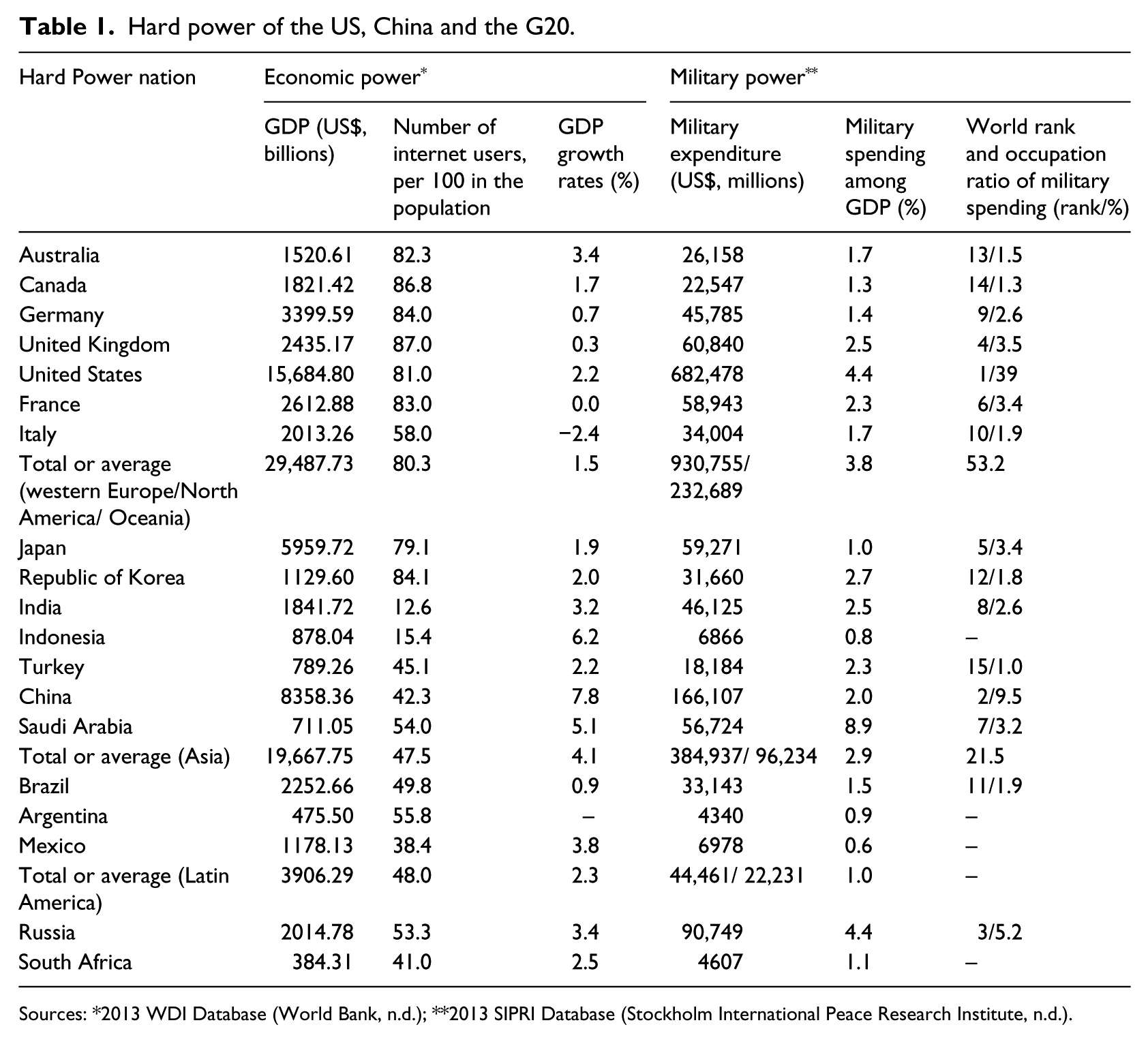
Sources: *2013 WDI Database (World Bank, n.d.); **2013 SIPRI Database (Stockholm International Peace Research Institute, n.d.).
According to Table 1, China is the second strongest in the world, and Japan is the third in terms of GDP. Japan (79.1) is superior to China (42.3) in terms of number of internet users, per 100 in the population. China’s 7.8% of GDP growth rate is far greater than Japan’s 1.9%. In economic terms, China has already caught up with Japan. Moreover, military power indices show that China is the second greatest with regard to military expenditure. Chinese military expenditure is three times as large as Japanese military expenditure. The difference between them is increasing. Table 1 shows that China is the second strongest in terms of hard power, and its influence is rapidly exceeding that of Japan.
Intention: satisfaction
It is not easy to measure a nation’s degree of satisfaction with the international system. As indicated in Table 1, the US is a dominant power and China a challenger in the global order in terms of power transition theory. And Japan is a hegemon and China a challenger that is soon to become a new hegemon in the regional order. I assume that China will try to maintain the status quo in the global order, but will work to break down the status quo in the regional order.
There are several ways of measuring the degree of system satisfaction. Woosang Kim (1991) explains it in terms of alliance similarity. Lemke and Reed (1996) use regime type similarity to grasp a nation’s satisfaction. According to these perspectives, China can be seen as a challenger wanting to break down the status quo of the global and regional orders. However, in my view, China is an actor working to maintain the status quo of the global order because the US and China are highly interdependent, but it wants to destroy the status quo of the regional order because China and Japan are conflictual in security issues and competitive in economic issues.
This study uses the 2013 Views of Different Countries’ Influence as a proxy indicator to explain the level of satisfaction. The Views of Different Countries’ Influence deals with global and bilateral recognitions of a nation in a BBC World Service survey of 26,000 people from 25 countries. It shows an individual nation’s global influence or image in statistics. This research extracts survey data concerned with the US, China and Japan from the 2013 Views of Different Countries’ Influence. These results help explain bilateral recognitions between the US and China and between China and Japan with three-way recognitions of the US, China and Japan. However, it has some limitations in grasping bilateral diplomatic relations from bilateral people’s recognitions.
If we try to understand China’s global system satisfaction in terms of bilateral recognition between the US and China, stability in the global order depends upon mutual recognition – mainly positive or negative – of the US and China. Are these improving or worsening? According to Figure 1 and Figure 2, 20% of Americans feel mainly positive toward China and 57% of them feel mainly negative against China. Most Americans are hostile to China, ranking it 22nd out of 24 nations in terms of favorable impression. In contrast, 23% of Chinese people feel mainly positive toward the US and 67% of them feel mainly negative towards the US. Most Chinese are hostile to the US, ranking it 20th out of 24 nations in favorable impression. Thus, bilateral relations between the US and China are mutually negative. It means that China is more likely to be a dissatisfied challenger in the global order.
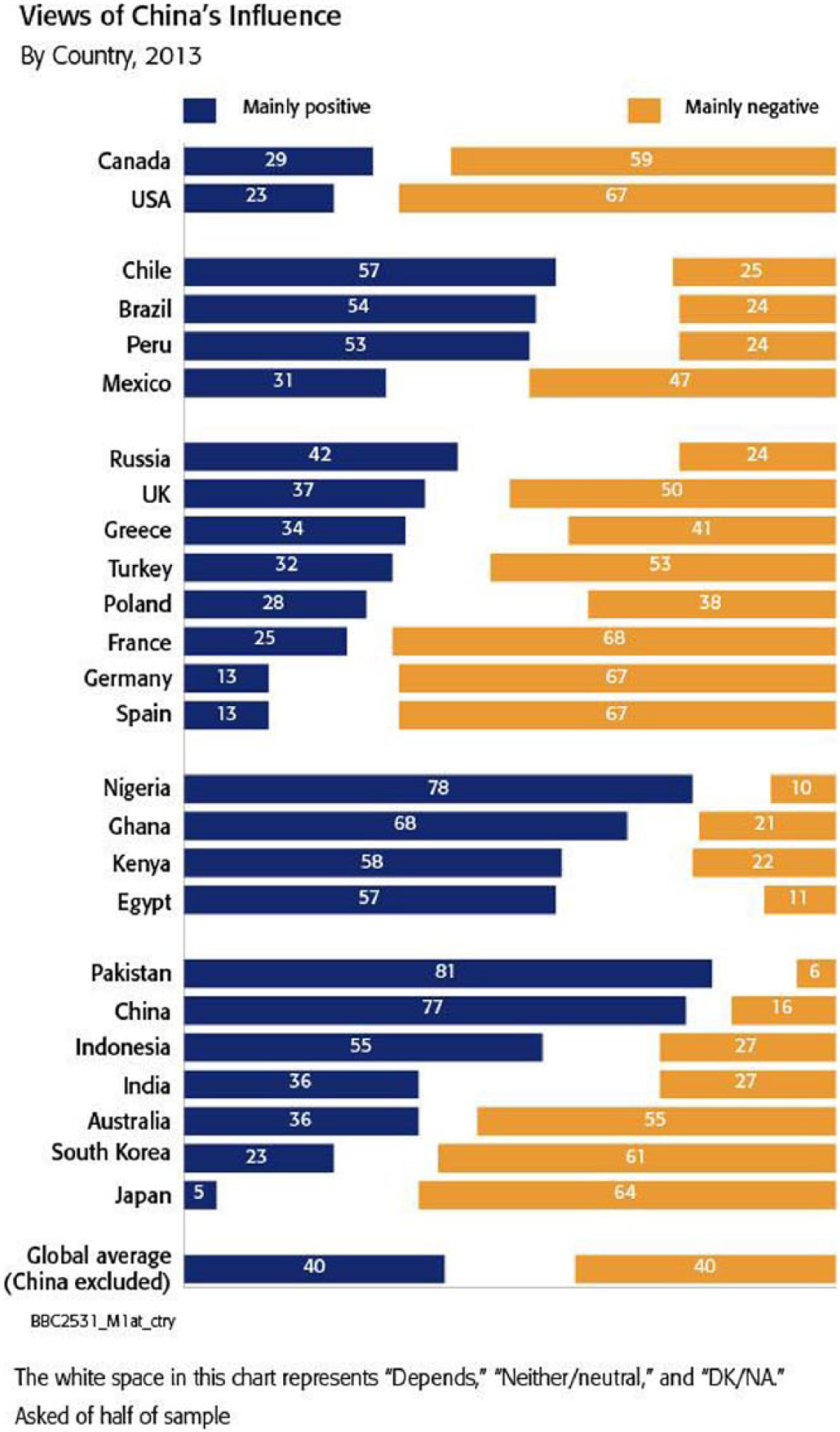
Global recognition to Chinese global influence.
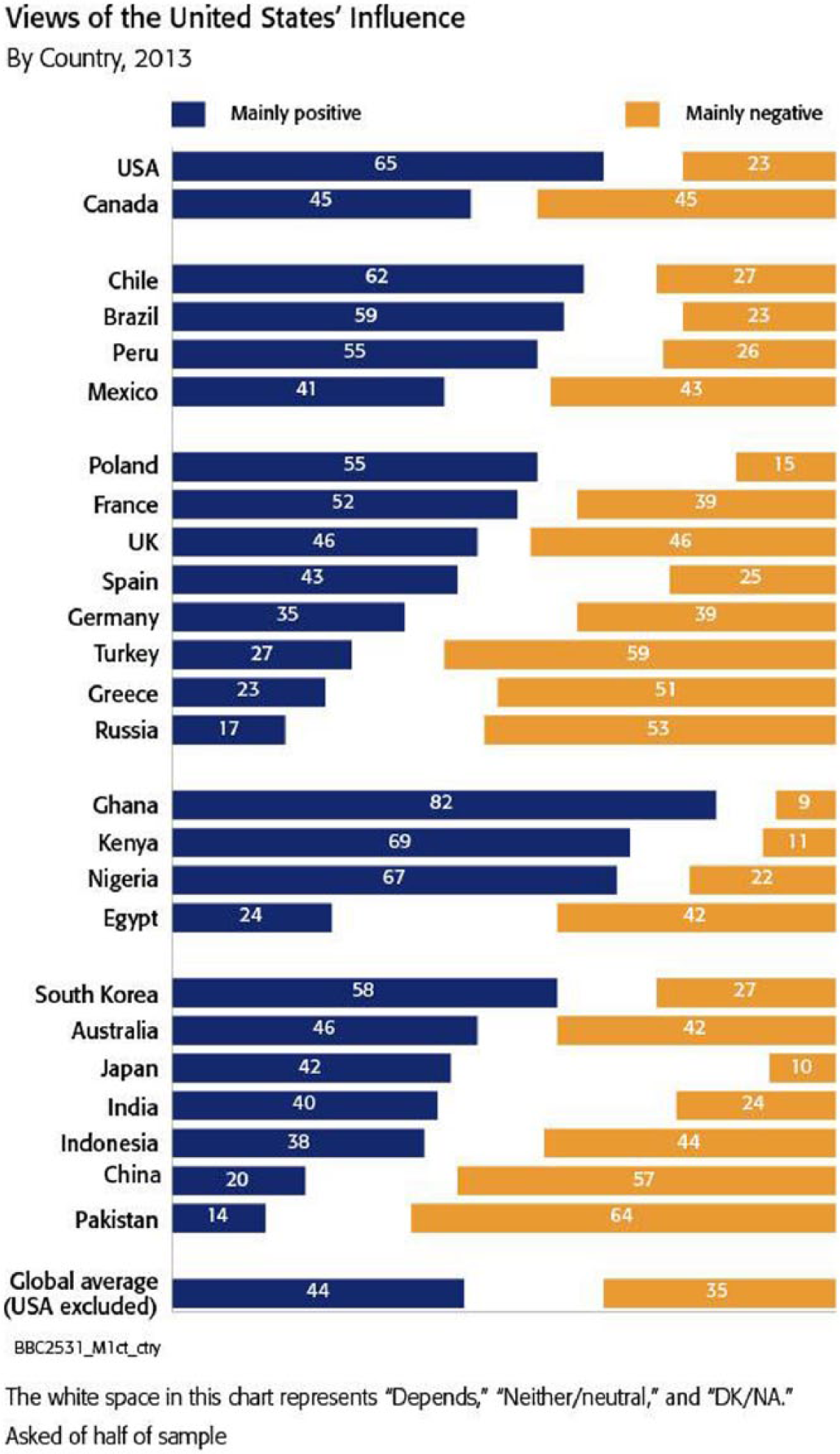
Global recognition to US global influence.
If we try to understand China’s regional system satisfaction in terms of bilateral recognitions between China and Japan, stability in the regional order depends upon mutual recognitions – mainly positive or negative – of China and Japan. Are those improving or worsening? According to Figure 1 and Figure 3, 17% of Japanese feel mainly positive toward China and 74% of them feel mainly negative against China. Most Japanese people are hostile to China, ranking it 24th out of 24 nations in favorable impression. On the other hand, 5% of Chinese people feel mainly positive toward Japan and 64% of them feel mainly negative against Japan. Most Chinese people are hostile to Japan, ranking it 24th out of 24 nations in favorable impression. Thus, bilateral relations between China and Japan are extremely negative. It means that China must be a dissatisfied challenger in the regional order.
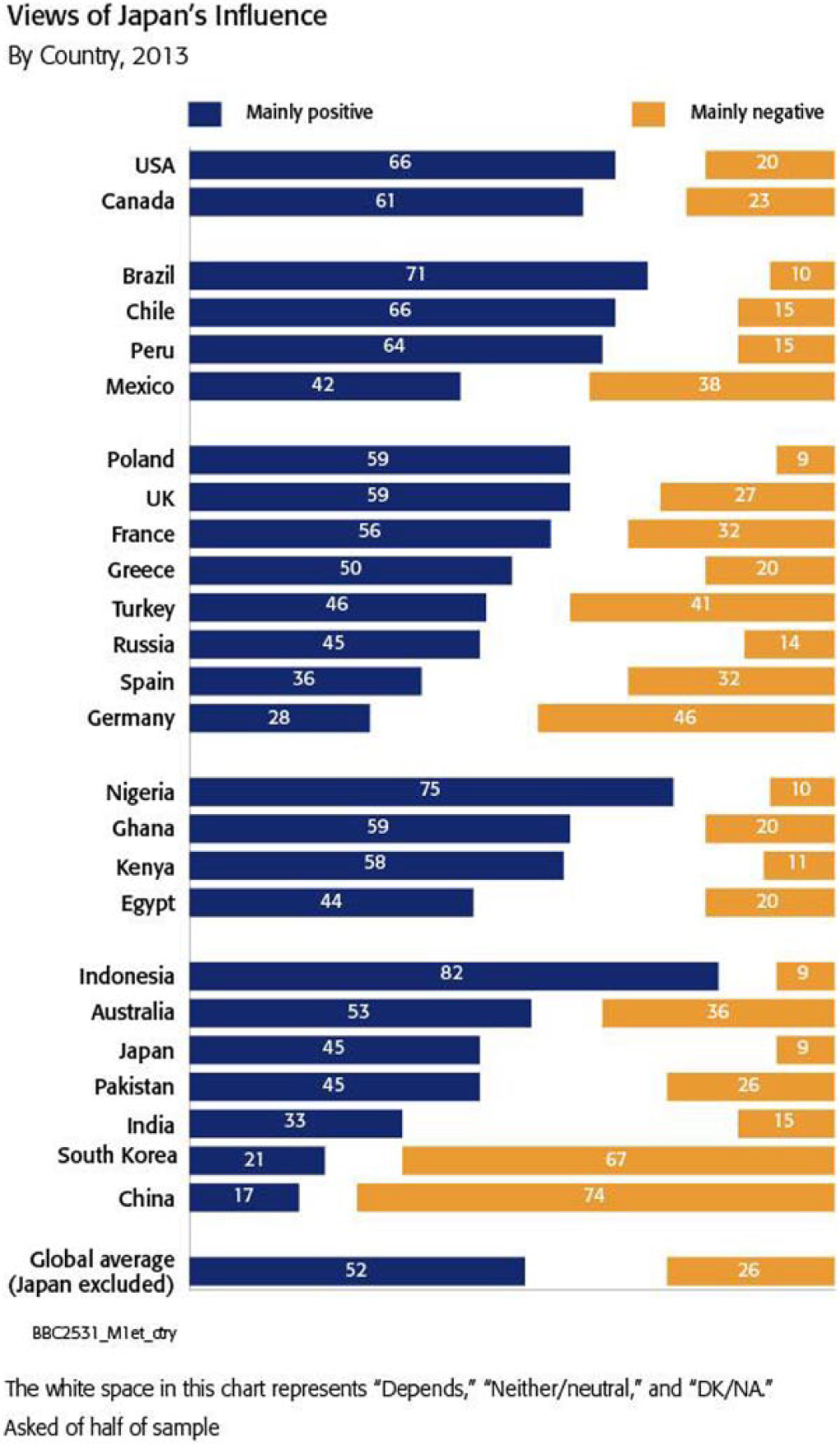
Global recognition to Japanese global influence.
Hegemonic struggles in global and regional orders
It is not easy to explain empirically the concept of a hegemon. One of the key questions is what does a hegemonic nation have to control to be able to maintain its dominant status. And how can we distinguish a global hegemon from a regional hegemon? This study assumes that a multilateral concept of hegemony can be applied to bilateral situations. A hegemonic nation can be defined as a nation with the capability and intentions to establish system rules and regulations and implement them.
The US is a hegemonic nation in the world order, but China can be called a potent challenger rather than another hegemonic nation in terms of Organski’s view. In the global order, is China a satisfied country or a dissatisfied country? I maintain that China pursues hegemonic power in world politics, but is more likely to pretend to be a satisfied nation.
In Northeast Asia, Japan has been in a relatively dominant position with the US–Japan security alliance and remarkable economic growth since World War II. However, China has rapidly risen up since the 1990s and threatens Japan’s superior position. China exceeds Japan militarily and economically. This study presupposes Japan as a hegemon and China as a challenger pursuing its new hegemonic position. Like the analysis of the global order, the regional order is examined from the perspectives of capability and intention as argued by Organski. Ultimately, this analysis tries to explain how the global and regional orders interact with each other.
Capability and intention, and double-layered structure
A stable structure of US–China relations (global order: power preponderance by the US/China as a satisfied challenger)
The US and China are G2 members, and China is chasing the US in military and economic capabilities. China, as a potent challenger, is the second strongest country in the world, and reduces the differences with the US in military and economic powers.
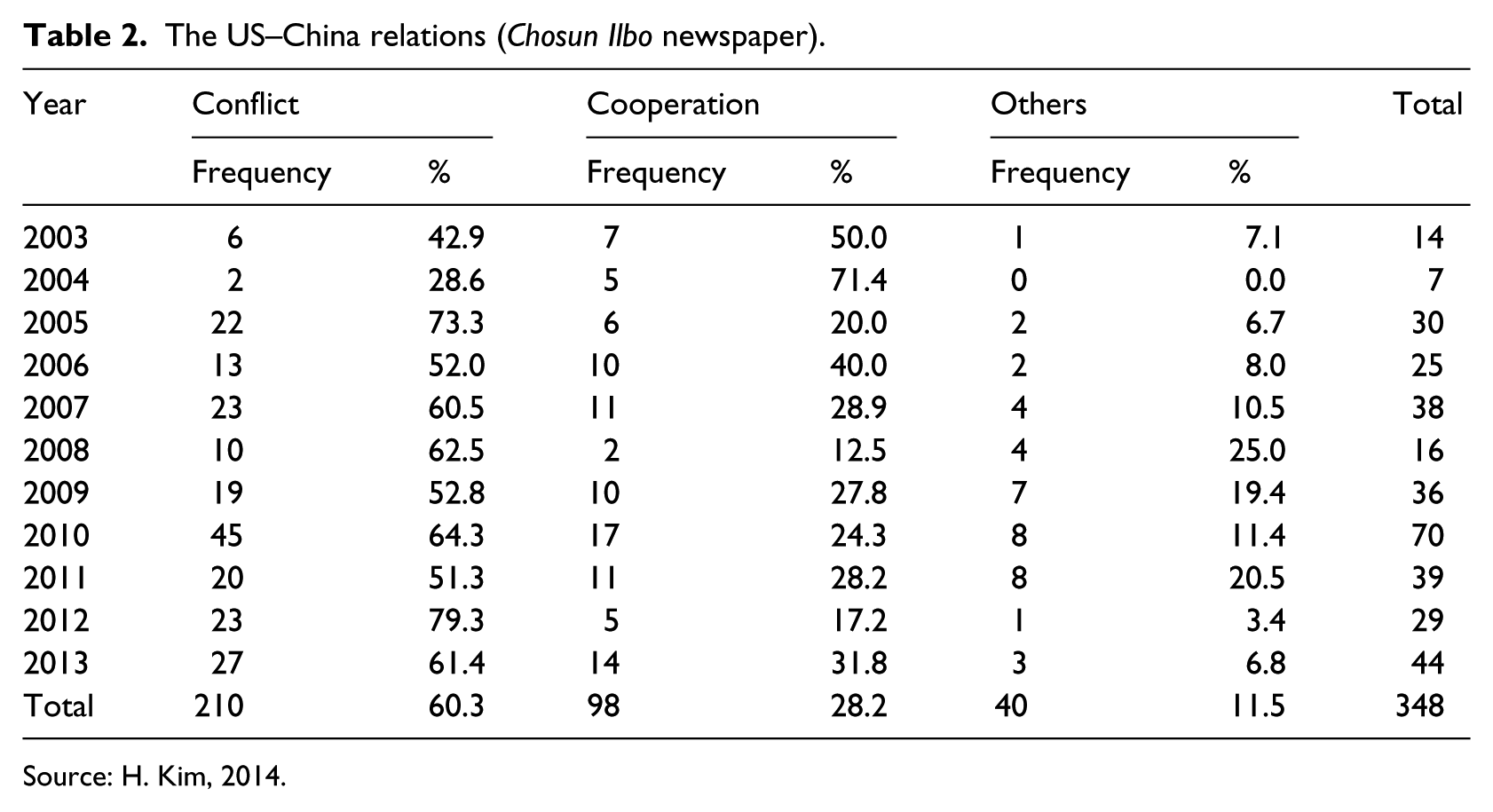
When we predict future relations between the US and China, we need to consider the Chinese degree of satisfaction with the global system. System satisfaction can be understood in terms of bilateral recognitions between the US and China. Table 2 shows the results of content analysis of articles appearing in Chosun Ilbo (a prominent Korean newspaper) published in the period 2003 to 2013 (H. Kim, 2014). They are based on the research method searching keywords including the US and China in order to understand their relations. A total of 348 articles were drawn from the newspaper and classified into conflict (210 cases), cooperation (98 cases) and others (40 cases).
The US–China relations (Chosun Ilbo newspaper).
Source: H. Kim, 2014.
In 2010 the highest number of annual cases (70) occurred as bilateral confrontations between the US and China frequently occurred concerning the Korean peninsula and Taiwan. There are twice as many conflict cases as cooperation cases for the period. Economic issues they faced relate to exchange rates, trade conflict, energy, etc. Exchange rate problems concerned currency revaluation, where the US was more offensive and China more defensive. They often reproached each other but avoided catastrophe. And as the US trade deficit resulting from Chinese import penetration expands, bilateral economic relations have been more conflictual, even if they are well managed by both governments. Recently the US and China have been competing with each other in the securing of energy resources all over the world. They have negotiated those issues and done crisis management through US–China strategic dialogue.
The main issues featuring US–China security relations are related to North Korea, military training, territorial disputes, etc. The US has held a different view than China in how to deal with North Korean nuclear tests and missile launches. In addition, there have been several conflicts concerned with military training of US allies and territorial disputes in East Asia. Nevertheless, the two countries have narrowed the differences between their views.
According to bilateral recognitions data conducted by Pew Research, there have been ups and downs in both the US recognitions to China and Chinese recognitions to the US as Figure 4 and Figure 5 show, which periodically represent conflict and cooperation together. The whole trends of bilateral relations are not so conflictual in the period.
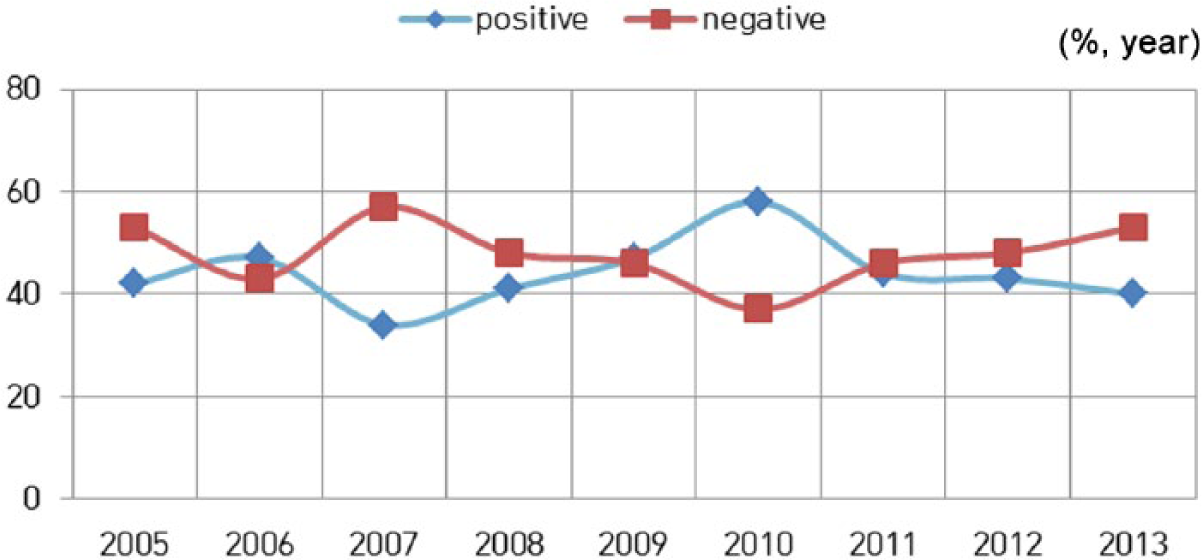
China’s recognition to the US (Pew Research).
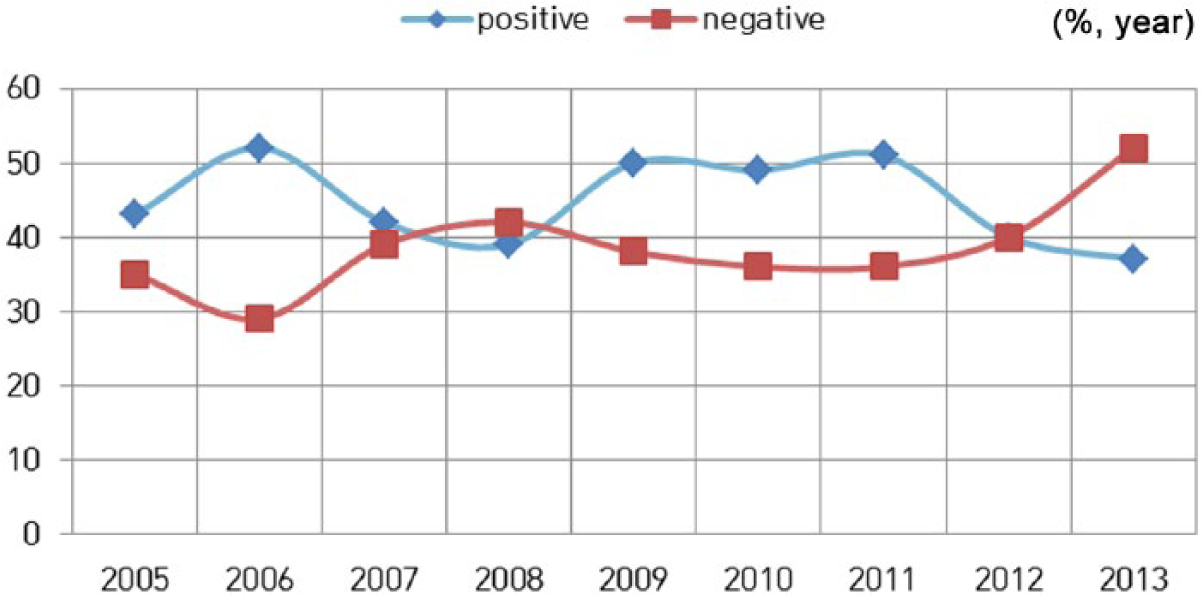
The US recognition to China (Pew Research).
The content analysis and Pew Research Global Indicators Databases show that US–China relations can be evaluated as generally cooperative for the period. China cannot be categorized as a dissatisfied great power willing to challenge the US as a hegemon in the terms described by power transition theory.
An unstable structure of China–Japan relations (regional order: power parity between China and Japan/China as a dissatisfied challenger)
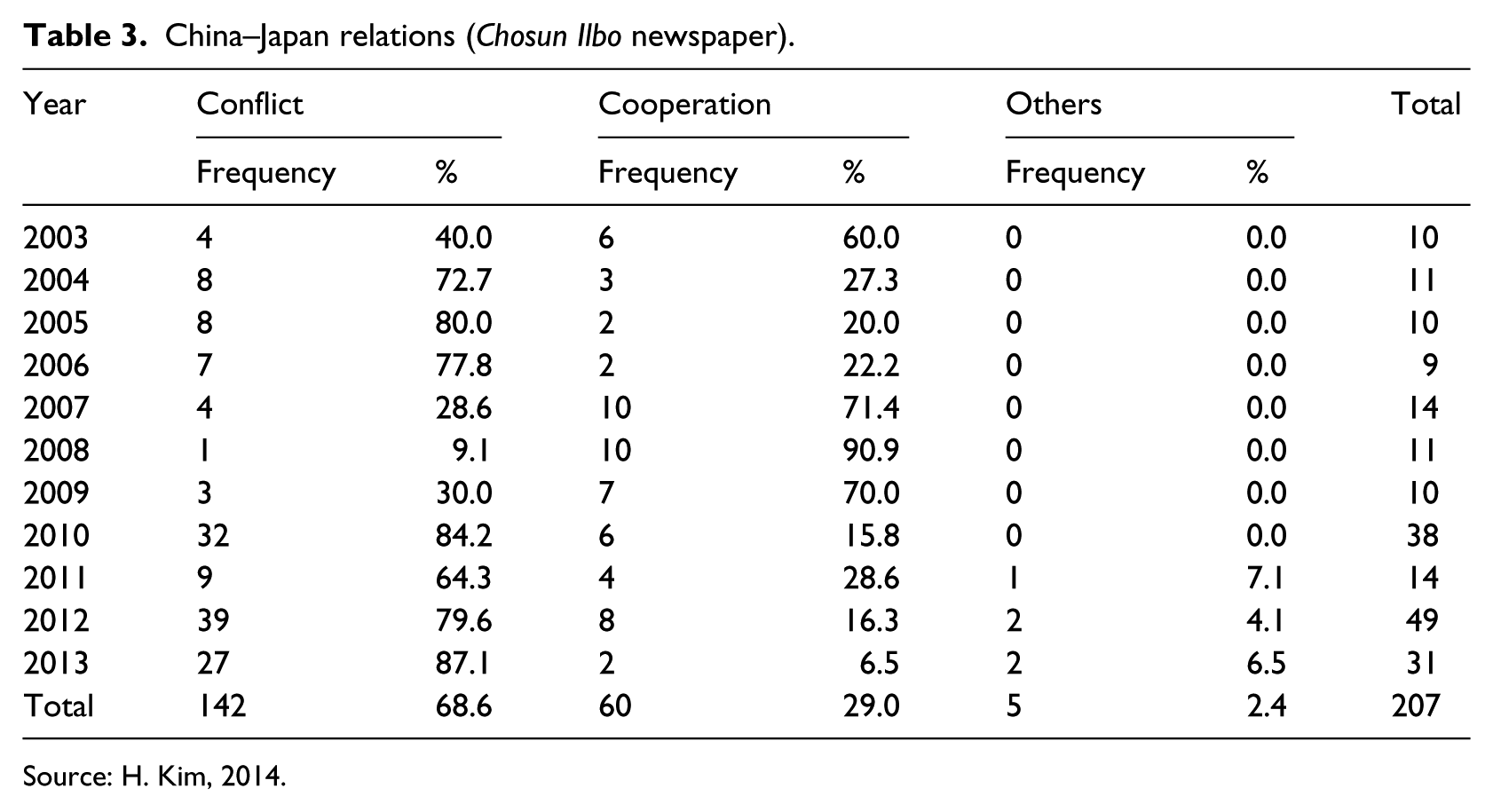
China and Japan are competing with each other for hegemony in Northeast Asia. China is ahead of Japan in military and economic capabilities. Power transition from Japan to China is ongoing in Northeast Asia. When we foresee future relations between China and Japan, we need to consider the Chinese degree of satisfaction to the current regional system. System satisfaction can be understood by bilateral recognitions between China and Japan. This research is based on content analysis results from Chosun Ilbo (H. Kim, 2014). Table 3 shows the results of content analysis on articles that Chosun Ilbo published in the period 2003 to 2013. The results are based on the keywords search method using China and Japan in order to explain their relations. A total of 207 articles were drawn from the newspaper and classified into conflict (142 cases), cooperation (60 cases) and others (five cases).
China–Japan relations (Chosun Ilbo newspaper).
Source: H. Kim, 2014.
Since 2010 the number of articles concerned with China–Japan relations has increased because bilateral confrontations between China and Japan frequently occurred concerning bilateral territorial disputes and Japanese historical distortion. The number of conflict cases is far greater than that of cooperation cases for the period. Economic issues they have faced are categorized into three such as natural resources, historical distortion and territorial disputes. They often blamed each other but avoided excessive catastrophe. And bilateral economic relations have been more conflictual even if they are well managed by both governments. Recently China and Japan have been competing with each other in the territorial security of Northeast Asia. They have negotiated those issues and showed a big difference in views.
The main issues regarding China–Japan security relations relate to North Korea and territorial disputes, etc. China has held different views than Japan in dealing with North Korean nuclear test and missile launching. They also experienced several conflicts concerning East China Sea Gas development.
According to bilateral recognitions data conducted by Chosun Ilbo, there have been ups and downs in both Chinese recognitions to Japan and Japanese recognitions to China as Figure 6, Figure 7 and Figure 8 show, which periodically represent conflict and cooperation together. The whole trends of bilateral relations are so conflictual in the period. Thus, the content analysis shows China–Japan relations can be evaluated as a conflictual case for the period. China can be described as a dissatisfied great power willing to challenge Japan as a hegemon in terms of power transition theory.
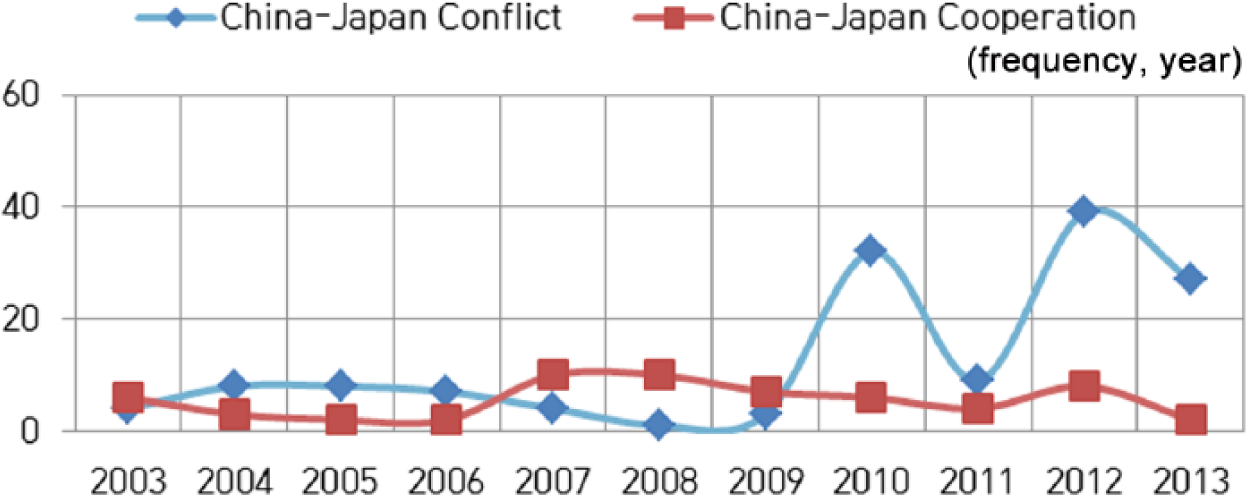
China–Japan relations (Chosun Ilbo newspaper).
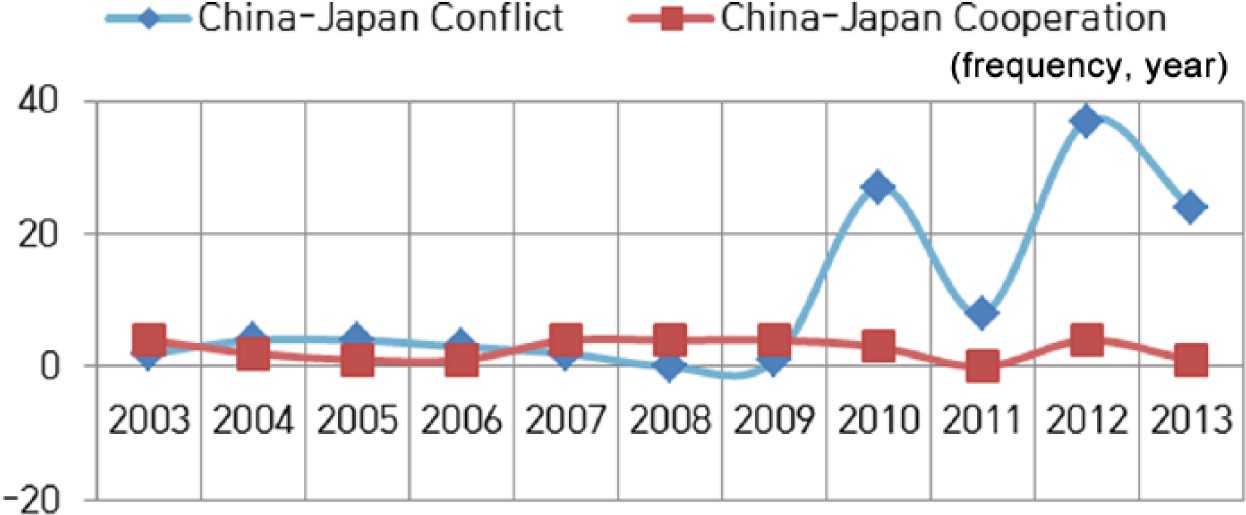
China–Japan security relations (Chosun Ilbo newspaper).
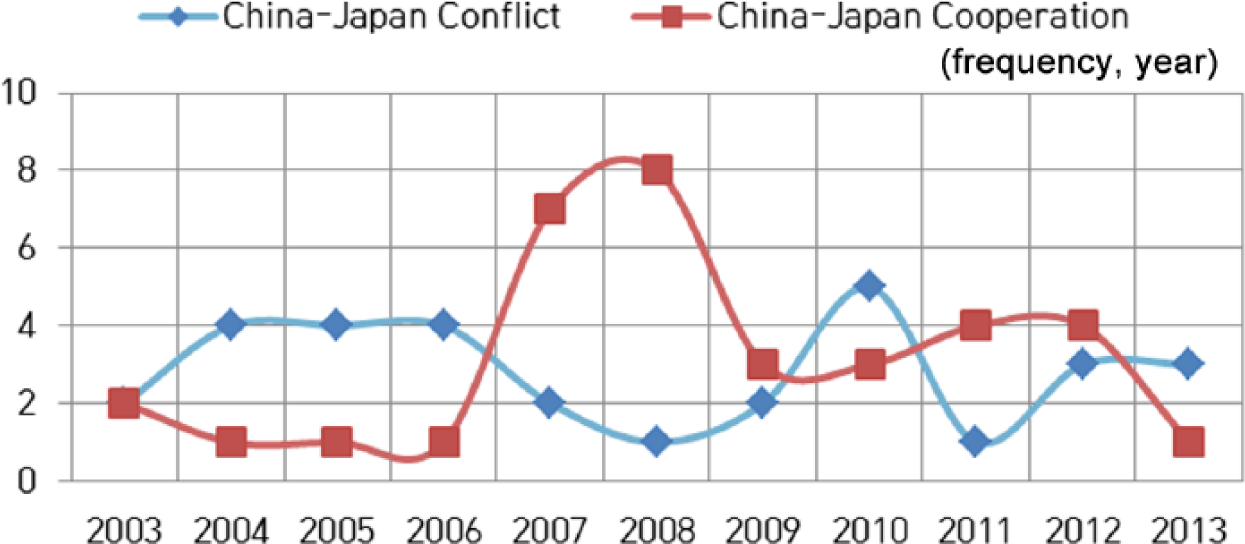
China–Japan economic relations (Chosun Ilbo newspaper).
Future prospects for world order and stability around the Korean peninsula
China cannot be evaluated yet as a challenger threatening the hegemonic status of the US in the global order. It accepts the current system as an axis of the G2 at this time. China doesn’t look like a dissatisfied challenger pressing for a power transition. On the contrary, China focuses much more attention towards its relative rise with respect to Japan in the regional order, and is pursuing a status of regional hegemon. We can imagine the worst scenario predicted by power transition theory. In short, the US–China power transition situation is totally different from the China–Japan power transition situation.
The first scenario shows that stability in the global order deters instability in the regional order. The US–China partnership stabilizes China–Japan conflictual relations. In this situation the US, China and Japan maintain status quo policies and regional order is stabilized. The second scenario is one in which instability in the regional order overwhelms stability in the global order. In this situation China and Japan accelerate their hegemonic struggles in Northeast Asia, and the US serves to mediate between China and Japan. The US should be making a decision as to what kind of diplomatic stance it will take to minimize the tension between China and Japan. The US must also make its own world strategy. China is more likely to be a status quo power in the global order, but a challenger to break down the status quo in Northeast Asia. However, the US role is critical in making this power transition stable or unstable (Lee, 2015).
What about the future of the Northeast Asian regional order? The former of two scenarios predicts a positive outcome in the regional order and optimistic inter-Korean relations. The latter scenario foresees a negative consequence for the regional order and pessimistic inter-Korean relations. The future of the Northeast Asian regional order, global order and Korean reunification depends upon the directions of the US counter-measures to China which takes a status quo policy in the global order and a revisionist policy in the regional order.
Footnotes
Funding
This research was supported by NRF Joint Research Program through the National Research Foundation of Korea (NRF) funded by the Ministry of Education (Grant Number: 20142208001).