



Abstract
Using newly developed Korean immigration data, we empirically test the networks effects prediction. The main contribution of this article is to go one step further in finding empirical evidence to support heterogeneity in networks effects. Using their visa type, we separate immigrants into two groups—skilled immigrants and unskilled immigrants—and find that only skilled immigrants increase Korean imports from their home countries.
Introduction
Traditionally South Korea (Korea) was a labor-abundant country. In her early stages of industrialization, Korea used her abundant labor force to produce and export labor-intensive goods to the rest of the world. The domestic labor supply was more than domestic labor demand. There was, therefore, no room for foreign workers in the Korean domestic labor market.
With two decades of rapid economic growth from the early 1970s to the early 1990s, the Korean domestic labor market changed dramatically. With a rapidly aging population and a low birth rate, Korea experienced shortages in the domestic market in the early 1990s. In addition, there was a growing aversion to menial, low wage jobs, which generated a huge shortage of unskilled labor in the Korean domestic labor market.
To fill this excess demand, the Korean government brought in foreign workers on a temporary, but legal, basis in 1993. In 2010, according to the Korea Immigration Service, Ministry of Justice, there are more than 1.2 million resident aliens in Korea and about 600,000 foreign workers, including both legal and illegal in Korea. About 92 per cent of these foreign workers are classified as “unskilled labor” and about 48,000 workers are classified as “skilled labor.” 1 Figure 1 shows the number of resident aliens from 2006 to 2010.
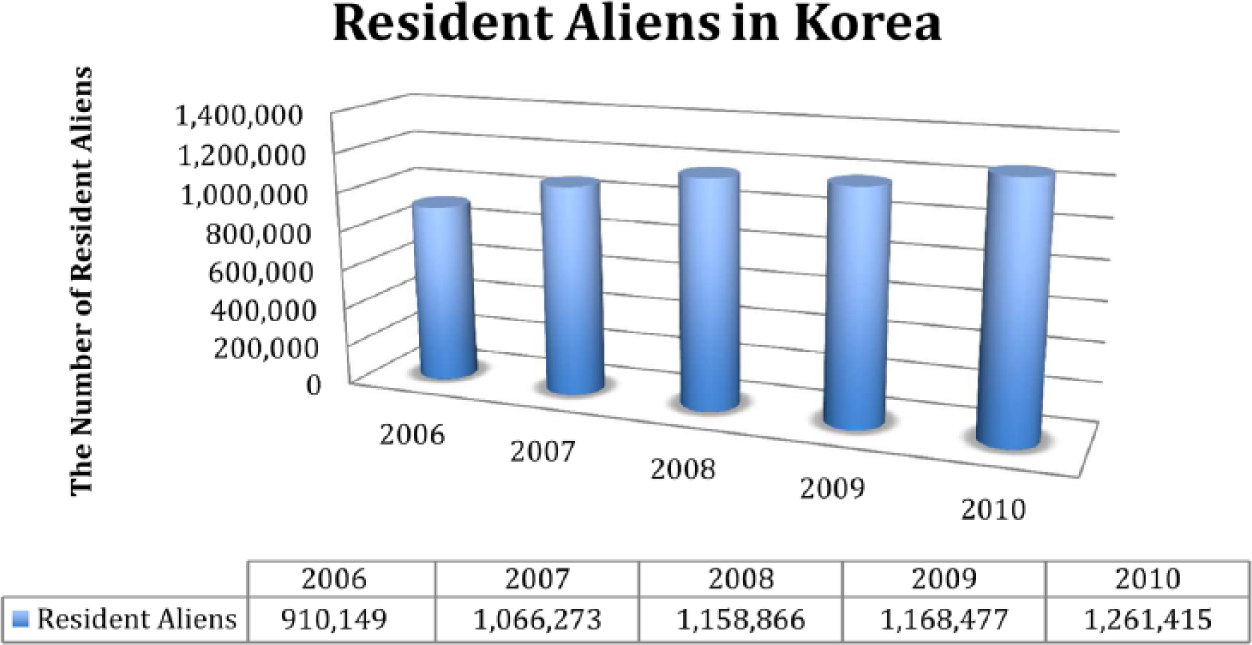
The number of resident aliens in Korea.
Leaving behind a long history of labor exporting, Korea is now a labor importing country. This dramatic change in the Korean labor market gives us new opportunities to test many economic theories empirically. In this article we choose to focus on the impact of these new immigrants on Korean exports and imports. This is very interesting topic to investigate, because it has been only 20 years since foreign workers started to participate in the Korean domestic labor market. Previous studies are based on countries with a long history of immigration, and therefore what they found was the cumulative effects of immigration on all previous generations, not the contemporary effects of immigration on other major international variables such as exports and imports. This new Korean experience, as far as we are aware, is a very unique opportunity to study the contemporary networks effects of immigration on international trade.
In this article, using these newly developed Korean data, we empirically test the networks effects prediction. Based on previous empirical research efforts such as Girma and Yu (2000), Rauch and Trindade (2002), and Dunlevy (2004), we modify the standard gravity model specification so that we can empirically test the network effects prediction with the new Korean data set.
The main contribution of this article is to go one step further in finding empirical evidence to support heterogeneity in networks effects. Using their visa type, we separate immigrants into two groups—skilled immigrants and unskilled immigrants—and find that only skilled immigrants increase Korean imports from their home countries.
This article is organized as follows. The next section summarizes previous studies on the networks effects. We then introduce our empirical model and data, after which we present our empirical results. The final section concludes.
Literature review
According to the traditional international trade theories such as the Heckscher-Ohlin theorem, it is predicted that factors of production and products move in opposite directions. For example, a capital abundant country should export capital-intensive goods to the rest of the world and should import labor-intensive goods from the rest of the world. Similarly, if there is an international labor movement from one country to another, then the home country relatively becomes a capital abundant country exporting more capital-intensive goods and the host country relatively becomes a labor-abundant country exporting more labor-intensive goods.
Since the United States accepts a million new immigrants every year on average, according to the Heckscher-Ohlin theorem, the United States should export relatively more labor-intensive goods and transfer her capital to countries with low marginal product of capital. 2 These theoretical predictions, however, have not been fully supported by empirical data analyses. Often, researchers find that both capital and labor move simultaneously into the United States.
Since Leontief’s paradox, there have been many academic research efforts to explain the gap between theoretical predictions and empirical findings. For example, in his 1990 article, Lucas utilizes human capital hypotheses and political risk to explain the discordance between theoretical predictions and empirical findings. The idea of networks effects began with the same discordance between classical international theories and modern empirical findings. According to networks effects prediction, immigrants have a good understanding of the business and political system, religion, unique cultural behavior, and language of their home countries. Their personal and social networks allow immigrants to have a comparative advantage to open business connections with their home countries and it promotes more international transactions between their home and host countries. Therefore, in contrast to classical prediction, a factor of production such as labor, and products such as goods and services, can move internationally in the same direction.
According to Dunlevy (2004), immigrants can build two types of bridges between their home and host countries. The first one is an information bridge. Since immigrants know both their home and host countries’ business information, they can transfer their knowledge between these countries. Therefore, both home and host countries accumulate more information on each other, which may generate more international transactions such as international trade and foreign direct investment (FDI) between the two countries. The second one is cultural bridge. Since the host country can learn about the unique cultural and social behavior of foreign countries through immigrants, the host country can use this information to improve international transactions with the immigrants’ home countries. In short, immigrants transfer new information between their home and host countries, and these countries use this new information to strengthen their business connections.
Empirically, there have been many research efforts to test this networks effects prediction. Min (1990) finds a strong positive business link between Korean immigrants to the United States and Korean exports to the US domestic market.
Gould (1994) shows a statistically significant connection between immigrants to the United States and US international trade with their home countries. Using Canadian data, Head and Ries (1998) also find a similar business link between Canada and her trading partners, and Girma and Yu (2000) empirically show how new information generates new international business connections using British data. More recently, Herander and Saavedra (2005) and Dunlevy (2006) show that immigration has a positive impact on international transactions.
The size of the impact on international transactions depends on how much information new immigrants bring in from their home countries. Therefore, each individual’s contribution to international transactions should be different among immigrants. Mundra (2009) uses immigrants’ occupation to make a distinction between immigrants. Using the US trade data, he finds that executives, managerial and professional immigrants significantly improve US trade with their home countries. More recently, Kim and Lim (2011) used the average years of schooling to evaluate immigrants’ personal attributes and showed that skilled immigrants into the United States increased US exports to their home countries while unskilled immigrants did not.
In this article, we separate immigrants based on their visa type. Using newly developed Korean immigration data, we empirically test not only the networks effects prediction but also heterogeneity in networks effects.
Empirical model and data
Gravity model specification
Since Tinbergen (1962) and Pöyhönen (1963) introduced the gravity model of international trade, many researchers have used the model to study the causes of international trade. Based on Newton’s law of universal gravitation, the standard gravity model suggests that the volume of trade between countries depends on the economic mass of the countries, the distance between them, and the gravitational constant. Since every country has its own share of world demand and supply, each country produces and exports its own products to the rest of the world and consumes foreign goods and services as well as its own domestic products. Therefore, economically big countries tend to export and import more goods and services than small countries do. The distance between countries gives rise to feasible barriers to international trade, including transportation costs. Thus the standard gravity model can be written as:

where Vij is the volume of the trade between countries i and j; Yi is the economic mass of country i; Yj is the economic mass of country j; Dij represents the distance between countries i and j; g is the gravitational constant.
Since the pioneering work of Tinbergen (1962), there have been many academic efforts to improve this gravity model. For example, Linnemann (1966) added population to the model and developed the new model into what we now call the augmented gravity model. 3 More recent gravity models now include historical and cultural variables as well as traditional economic variables. Generally speaking, researchers put a different set of variables in the gravity model to test their own hypotheses. The main purpose of this article is to find heterogeneity among different immigration groups, so we employ the following gravity models to test our own hypothesis.



where
VOLUMEit denotes the constant dollar value of trade volume between Korea and country i in period t;
EXPORTit denotes the constant dollar value of exports from Korea to country i in period t;
IMPORTit denotes the constant dollar value of imports from country i to Korea in period t;
GDPt and GDPit denote, respectively, gross domestic product of Korea and gross domestic product of country i in period t;
POPt and POPit denote, respectively, population of Korea and population of country i in period t;
DISTANCEi denotes the great-circle distance between the capital cities of Korea and country i;
IMMIGRANTSit denotes the number of immigrants from country i to Korea in period t;
OPENNESSit denotes the openness of country i in period t;
YEARi denotes calendar years from 1999 to 2010;
uit is a Gaussian white noise error term. 4
To use ordinary least squares (OLS), we take natural logs on both sides of equations (2), (3), and (4), which provide the following linear estimation equations



Data
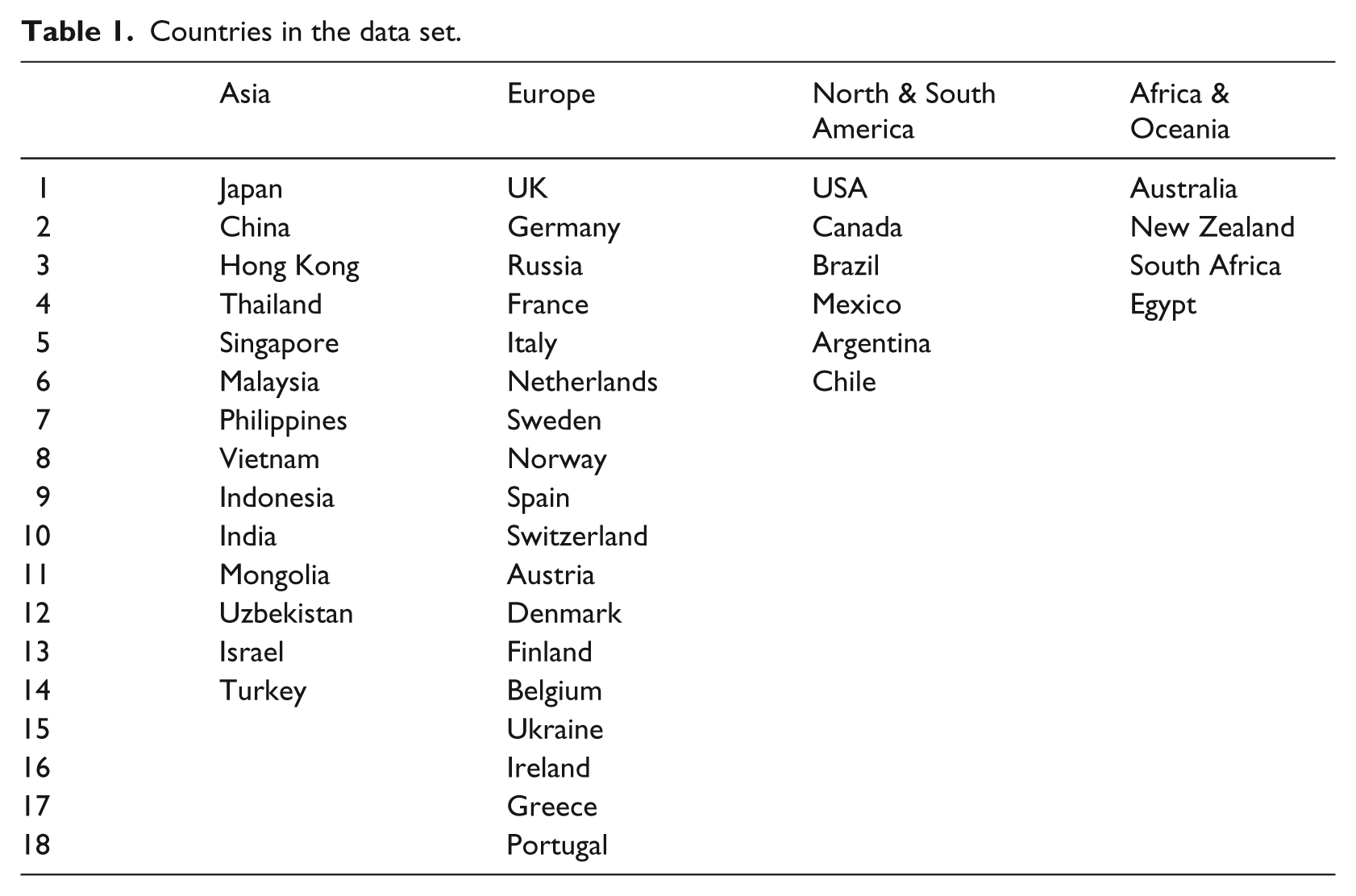
Our data set contains 42 Korean trading partners over 12 years from 1999 to 2010. During our data period, each of these 42 countries has sent a positive number of immigrants to Korea. The name of each country is given in Table 1.
Countries in the data set.
The data set is unbalanced and descriptive statistics for the data set are presented in Table 2. The VOLUMEit variable is in thousands of constant 2010 dollars of total Korean trade volume including exports and imports. The EXPORTit and IMPORTit variables are in thousands of constant 2010 dollars of Korean exports to each trading partner and imports from each trading partner. These data are available from the Korea Customs Service. The GDPt variable represents Korean gross domestic product and the GDPit variable accounts for gross domestic product of each trading partner. These variables are measured in constant 2010 dollars. These variables come from the World Bank database. Before we take the natural logs of the VOLUMEit, EXPORTit and IMPORTit variables, we multiply these variables by 1000 in order to be in the same unit as the GDPt and GDPit variables.
Descriptive statistics.
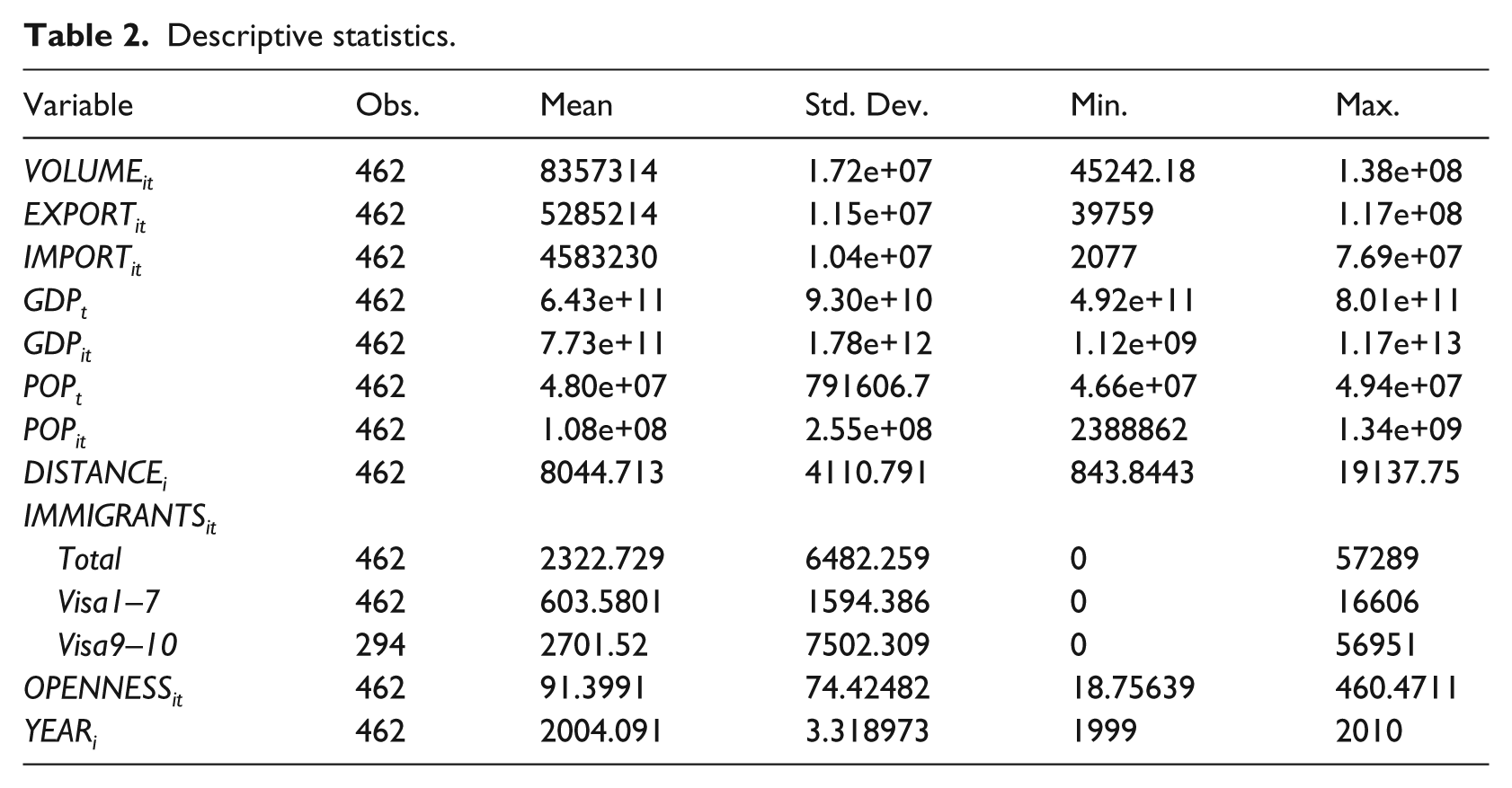
The VOLUMEit variable is in thousands of constant 2010 dollars of total Korean trade volume including exports and imports. The EXPORTit and IMPORTit variables are in thousands of constant 2010 dollars of Korean exports to each trading partner and imports from each trading partner. These data are available from the Korea Customs Service. The GDPt variable represents Korean gross domestic product and the GDPit variable accounts for gross domestic product of each trading partner. These variables are measured in constant 2010 dollars. These variables come from the World Bank database. Before we take the natural logs of the VOLUMEit, EXPORTit and IMPORTit variables, we multiply these variables by 1000 in order to be in the same unit as the GDPt and GDPit variables.
POPt is the total population of Korea and POPit is the total population of each Korean trading partner. These variables are available from the World Bank database. DISTANCEi is the great-circle distance in kilometers between Seoul and the capital cities of the 42 Korean trading partners. This data set comes from the GeoDist database (Mayer, 2011).
The main purpose of this study is to empirically test the existence of heterogeneity in networks effects. To test this main hypothesis, we separate total immigrants by their visa type. Compared to the methods used in previous literatures, separating immigrants by their visa type gives us more accurate estimates on the occupational background of immigrants. As shown in Table 3, each visa type represents a specific occupational group. Therefore, we do not need to estimate the occupations of immigrants based on other variables such as their educational background.
The types of employment visa.
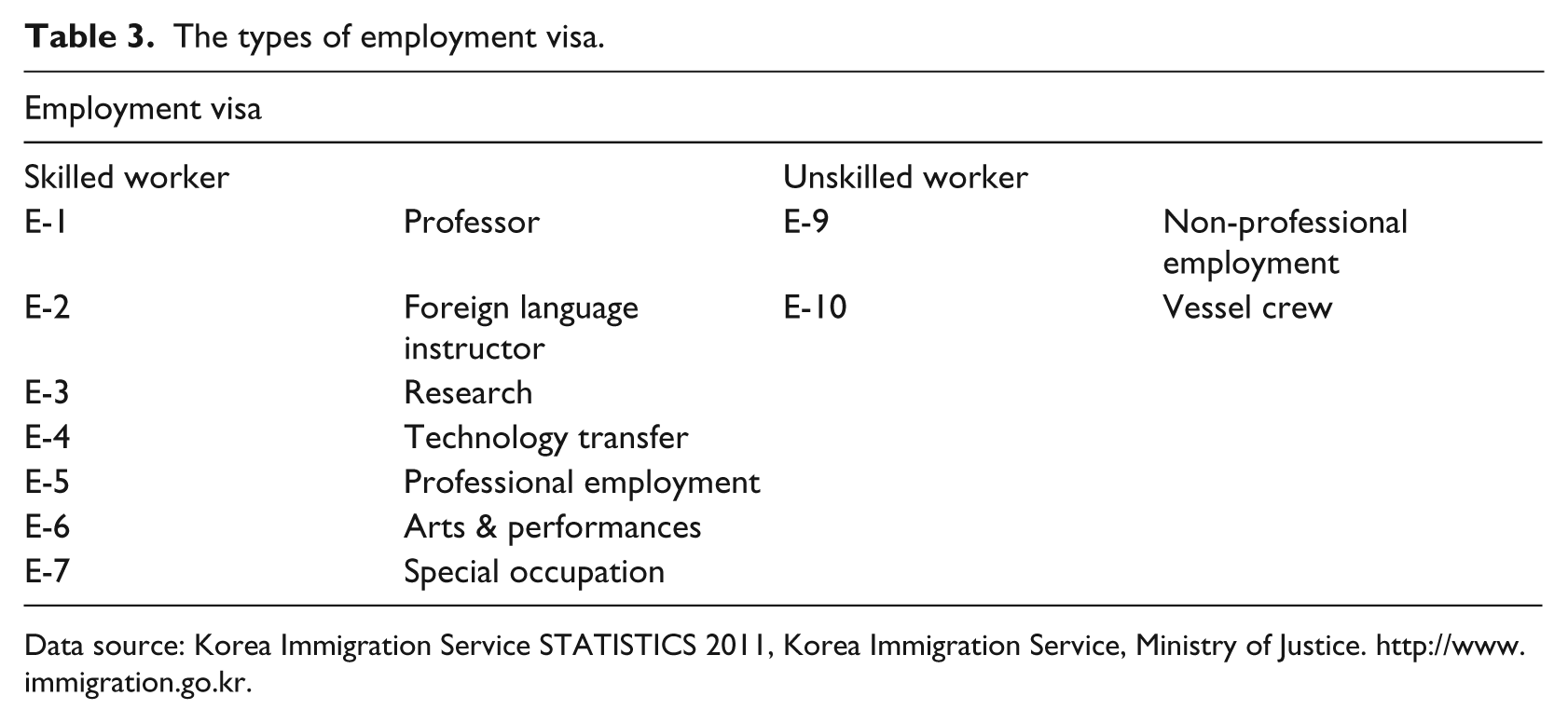
Data source: Korea Immigration Service STATISTICS 2011, Korea Immigration Service, Ministry of Justice. http://www.immigration.go.kr.
The IMMIGRANTSit variable has three different values. First, Total represents the total number of immigrants holding any type of employment visa. Second, Visa1–7 represents the number of immigrants who are holding any skilled worker type of employment visa. Third, Visa9–10 represents the number of immigrants holding any unskilled worker type of employment visa. This data set comes from the Korea Immigration Service, Ministry of Justice. Table 3 above summarizes the types of Korean employment visa.
The OPENNESSit variable stands for the openness of each Korean trading partner. It is represented by percentage points. The YEARi is the calendar year from 1999 to 2010.
Empirical results
Regression on the total trade volume
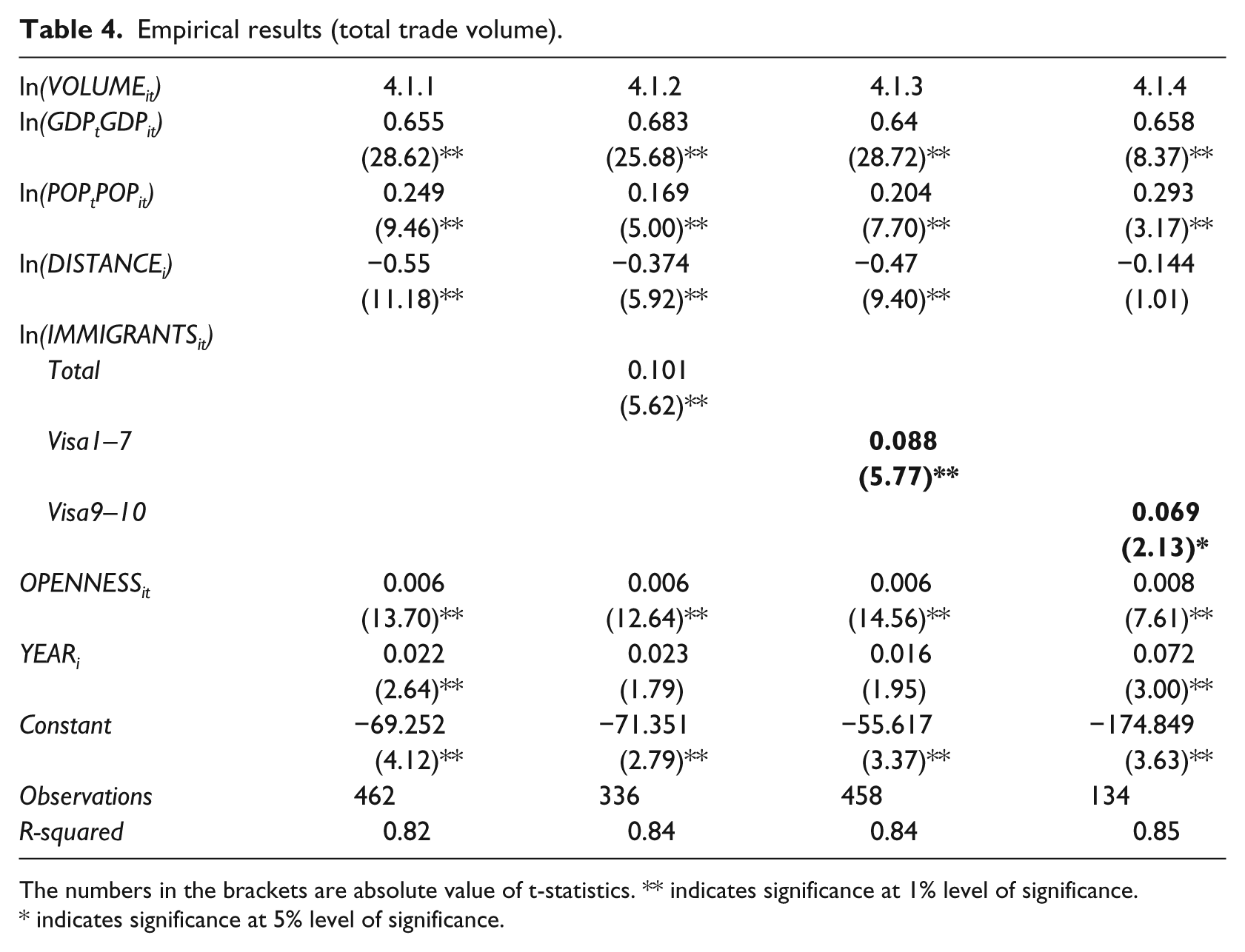
Based on equation (5), we first run regressions on the total trade volume. The prediction of our gravity model with networks effects accords with our data set. Table 4 summarizes our first empirical results. Regression 4.1.1 represents the standard gravity model without the networks effects component and regression 4.1.2 includes the total number of immigrants as a regressor in addition to the standard gravity model regressors. Similarly, regression 4.1.3 uses the number of skilled immigrants as a networks effects variable, while regression 4.1.4 adds the number of unskilled immigrants as its networks effects variable in addition to the standard gravity model regressors.
Empirical results (total trade volume).
The numbers in the brackets are absolute value of t-statistics. ** indicates significance at 1% level of significance. * indicates significance at 5% level of significance.
All coefficients on the logarithms of the product of Korean GDP and foreign countries’ GDP are statistically significant and positive. In addition, all coefficients on the logarithms of the product of the Korean population and her trading partners’ population are also statistically significant and positive. In the case of the logarithms of the DISTANCE variable, all coefficients are significant and negative. In short, all coefficients on the three major regressors of the standard gravity model accord with their theoretical predictions and are similar to previous empirical findings.
The coefficients on the logarithms of the IMMIGRANTS variables support well the networks effects prediction. All three coefficients are statistically significant and positive. Both skilled immigrants and unskilled immigrants have positive effects on the total trade volume between Korea and their home countries.
Regression on the exports
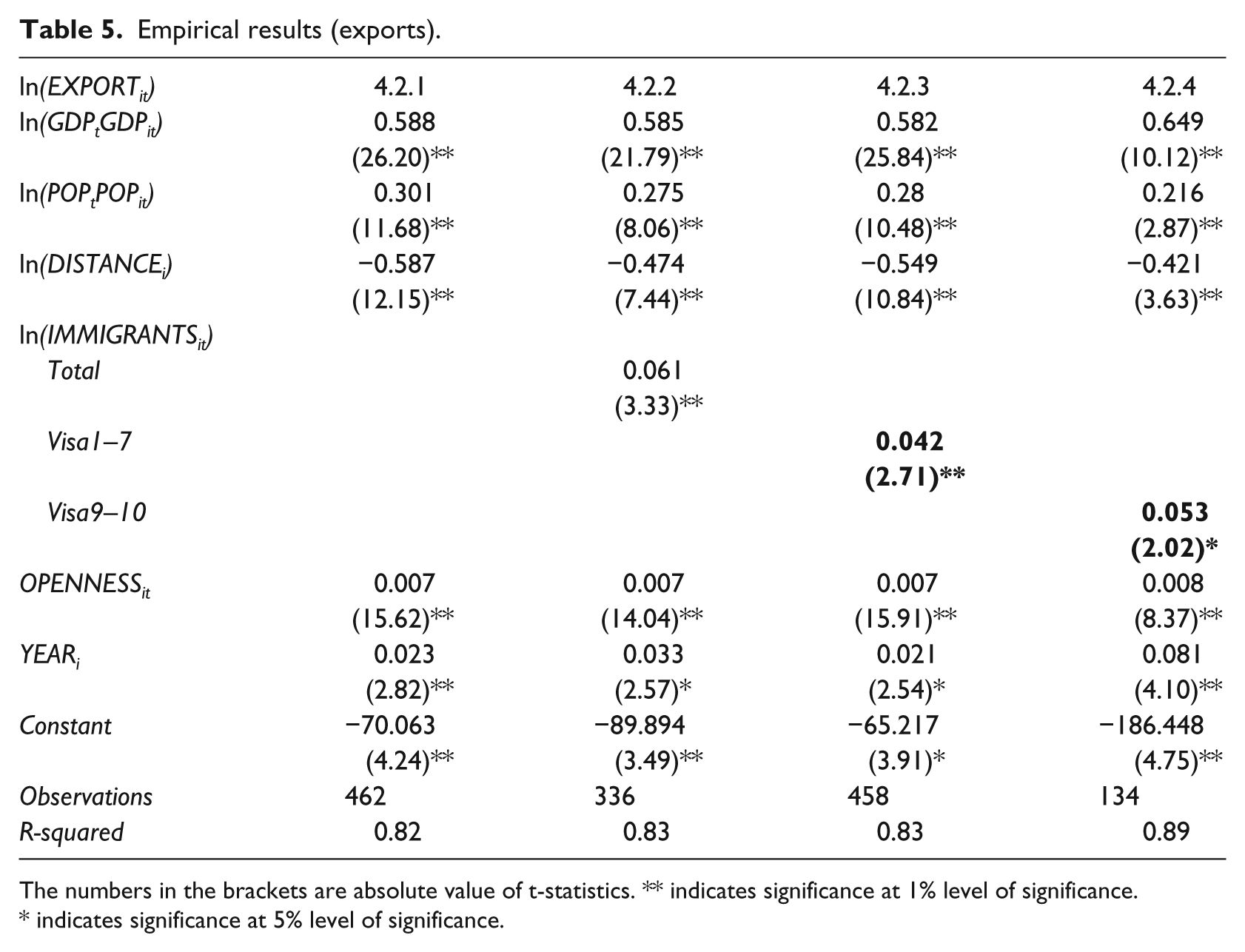
In this section, we empirically test the networks effects hypothesis on Korean exports. Using equation (6), we find that both skilled and unskilled immigrants increase Korean exports to their home countries. Table 5 shows our empirical findings.
Empirical results (exports).
The numbers in the brackets are absolute value of t-statistics. ** indicates significance at 1% level of significance. * indicates significance at 5% level of significance.
All coefficients on the basic gravity model variables, such as the logarithms of the product of Korean GDP and foreign countries’ GDP, the logarithms of the product of the Korean population and immigrants’ home countries population, and the logarithms of the distance between capital cities, satisfy the standard gravity model prediction. The OPENNESS variable and the time trend variable also support the standard theoretical prediction.
The coefficients on our networks effects variables are all statistically significant and positive. It means that statistically foreign workers in Korea promote Korean exports to their home countries and it suggests that immigrants generate positive networks effects on the Korean exporting market.
Regression on the imports
In this section we are testing the networks effects hypothesis on Korean imports. Based on equation (7), we empirically test whether immigrants increase imports from their home countries to Korea. This is the most important test of our study, because the sign of coefficient on the logarithms of the IMMIGRANTS variable decides the validity of the networks effects prediction. For example, a positive sign means that a factor of production, which is labor, and products, which are goods and services, are internationally moving in the same direction. Hence it supports the networks effects prediction. Similarly, if the sign is negative, then it supports the traditional trade theories, such as the Heckscher-Ohlin theorem, which predicts that factors of production and products should move in opposite directions.
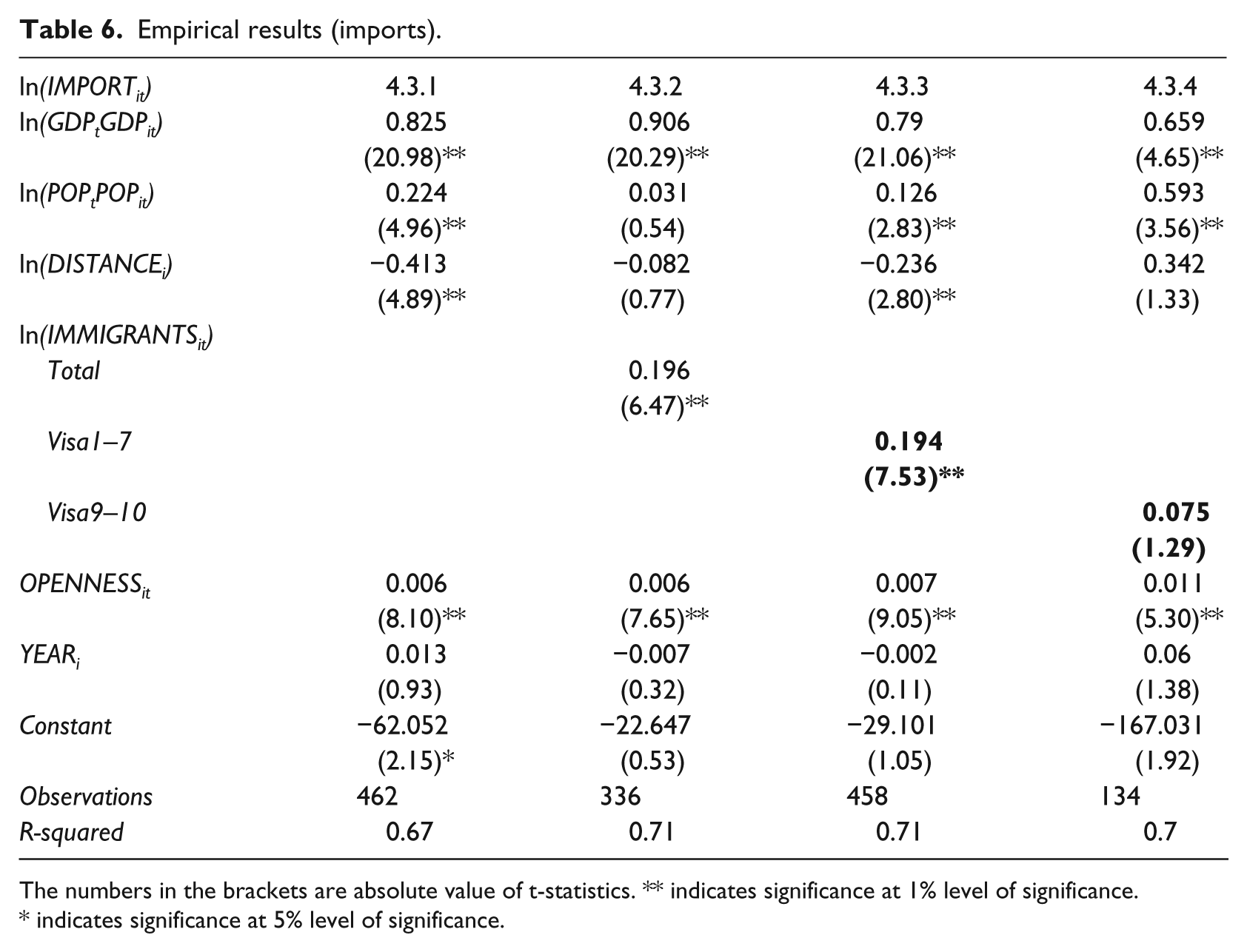
First, regression 4.3.1 represents the standard gravity model without networks effects variable. All coefficients on traditional gravity model variables accord with their theoretical prediction. The coefficient on the OPENNESS variable also shows the right positive sign, which is statistically significant. Table 6 presents the empirical results.
Empirical results (imports).
The numbers in the brackets are absolute value of t-statistics. ** indicates significance at 1% level of significance. * indicates significance at 5% level of significance.
Second, regression 4.3.2 includes the logarithms of the total number of immigrants as a networks effects variable, and the coefficient on this variable turns out to be positive and statistically significant. Therefore, this empirical result suggests that immigrants into Korea positively affect Korean imports from their home countries, which supports networks effects prediction.
Third, to check the heterogeneity in networks effects, we use the logarithms of the total number of skilled immigrants in regression 4.3.3 and use the logarithms of the total number of unskilled immigrants in regression 4.3.4 as a networks effects variable. In the case of skilled immigrants, the coefficient is positive and statistically highly significant. Since our regression follows a double-log specification, the coefficient of 0.194 represents the elasticity between immigrants and imports. Therefore, increasing skilled immigrants by 1 percentage point promotes imports from their home countries by 0.194 percentage points. On average, therefore, one new skilled immigrant statistically increases Korean imports from their home country by $1.48 million, which is economically significant.
On the other hand, however, the coefficient on the logarithms of the total number of unskilled immigrants shows no statistical significance. Even though the coefficient is positive, 0.075, it is statistically insignificant. Therefore, there is no empirical evidence that unskilled immigrants increase Korean imports from their home countries, which means that the networks effects prediction is not supported by unskilled immigrants.
As it was emphasized many times in previous studies, the effectiveness of the information bridge depends on immigrants’ personal and social attributes. Since immigrants add new information on their home country and its products to the host country, skilled immigrants who have or know more information should affect international trade more than unskilled immigrants do. Similar to Mundra (2009), our empirical findings show the importance of skilled immigrants on increasing exports from their home country.
Based on the empirical results from regression 4.3.3 and 4.3.4, we conclude that first, skilled immigrants play an important role in creating networks between home and host countries. Second, there is no statistical evidence that unskilled immigrants generate networks effects in the Korean imports market. Therefore, third, heterogeneity exists in networks effects.
Conclusion
Using a recently developed Korean immigration data set, we study the impact of immigrants on the Korean trade market. In this article we try to test the networks effects prediction empirically. In addition, we also investigate the possibility of heterogeneity in networks effects.
The main findings are that first, the networks effects prediction is generally supported by Korean immigration data. Second, in the case of Korean imports, skilled immigrants increase Korean imports from their home countries while unskilled immigrants do not, which suggests the existence of heterogeneity in networks effects.
Footnotes
Acknowledgements
We thank seminar participants at the 88th Annual Conference of WEAI for their helpful comments and suggestions.
Funding
This work was supported by Hankuk University of Foreign Studies Research Fund. We gratefully acknowledge this. We are responsible for errors, if any.