




Abstract
Identity is the basis of North Korea’s regime legitimacy. As a divided country, North Korea’s legitimacy is forged in the inter-Korean comparison. This paper starts with the question of what factors influence whether North Korea chooses to implement risky or cooperative policies toward South Korea, as well as what role domestic politics and ideology play in The Democratic People’s Republic of Korea’s (DPRK) formation and enactment of foreign policy.
This paper confirmed that the Pyongyang leadership’s policy priority has mostly depended on identity need. Also, we infer that Pyongyang tends to take a hostile stance whenever the South government is willing to infringe Pyongyang’s legitimacy and dignity regardless of the South’s economic assistance. This research attempts to explain how historical and cultural contexts play in the DPRK’s formation of its policy toward the Republic of Korea, and also examines Rodong Sinmun, the official newspaper of the Pyongyang regime, through the lens of content analysis in order to determine the DPRK’s perception and policy preferences toward the The Republic of Korea (ROK).
Introduction
North Korea finds the basis of its regime legitimacy in identity. As a divided country, North Korea’s legitimacy is forged in the inter-Korean comparison. North Korean foreign policy, particularly in clashes with its southern neighbor, has centered on the establishment of regime legitimacy. From this point of view, the Korean War of 1950–1953 can be understood as an attempt by the North to settle the legitimacy issue.
Historical context deeply contributes to an understanding of how each Korean political system was formed. The Democratic People’s Republic of Korea is considered by some to be a fossilized “guerrilla state” or “partisan state.” Its founding myths and national identity were forged in the 1930s through armed resistances to a brutal Japanese colonial government and further hardened in the bitter contest of the Korean War in the early 1950s. These national identities have been maintained since by isolationism and tension of a half century of unresolved conflict with South Korea and its allies (McCormack, 2004: 1).
Each of the two Koreas has repeatedly asserted that it is superior to the other. As a result, each citizenry has established norms and beliefs supporting some degree of mutual antagonism. Though the overarching Cold War security structure has vanished, the Cold War-influenced legitimacy and security contest continues in inter-Korean relations.
One can observe that Pyongyang’s foreign policy behaviors have vacillated between confrontation and engagement as opposed to a consistent pattern of brinkmanship. However, we can reduce its uncertainty and lack of prediction in Pyongyang’s foreign policy through increasing understanding of its leaders’ perceptions and preferences as well as historical contexts. Why does North Korea repeatedly meander between cooperation and confrontation toward South Korea? This question defines the contribution of this paper, which seeks to explain when North Korea chooses a hardline foreign policy and when it chooses to engage with South Korea.
Theoretical framework
Dominant priorities on North Korea’s foreign policy
The theoretical framework of this research draws from a combination of realism, liberalism, and constructivism to identify and examine possible variables that affect North Korea’s foreign policy behaviors. As realism focuses on military power, allies, the international systems’ structure, and security concerns, it provides a powerful explanation of most foreign policy choices for the Cold War politics. This is because realists tend to see a state’s foreign policy through the logic of power-relationships evident during the bipolar competition of post-World War II relations. That is, it sees states as “satisficers,” willing to enact foreign policy in so far as it meets their minimum-security needs, but no further. In contrast, liberals prefer the logic of “procedural legitimacy” because they are most interested in psychological prosperity or pragmatic values, and constructivists tend to use the logic of acceptability because they are most concerned with the values of community (Chittick, 2006: 14). In order to analyze DPRK’s foreign policy, liberal and constructivist interpretations of domestic and ideational factors are more appropriate to understand certain foreign policy priorities of North Korea, especially, in the post-Cold War era.
In this paper, we attempt to examine the hypothesis of this study that North Korea’s foreign policy toward South Korea is determined by legitimacy competition. The paper will address this hypothesis again through the use of a historical process-tracing method as well as content analysis.
This focus on domestic politics implies that while Pyongyang’s foreign policy may appear to be a response to changes in other powerful states’ foreign policy, in fact it reflects the domestic environment in a number of areas. If one fails to consider how a leader and his/her prevailing ideas or ideologies shape its foreign relations, one may draw out an inadequate analysis that perpetuates misunderstandings and misperceptions (Kim, 2011).
In this vein, the state behavior and outcome in world politics are determined by the configuration of interdependent state preferences. 1 In North Korea, decision-makers have sought to negotiate foreign policies relatively based on their preferences (i.e. regime survival, economic benefits), rather than by structural determinants such as balance of power and national interests.
Moreover, North Korea’s foreign policy analysis tends to rely on domestic policy determinants. Herbert Simon argues that one needs to know where preferences originate (Simon, 1985). In this research, domestic priorities of foreign policies are based on three basic human motives (power, achievement, and social affiliation), determine what individuals know about foreign policy, and should also shape how they make decisions. In foreign policy, these three motivations are transposable as security, identity, and prosperity Chittick (2006: 17). 2 Therefore, this paper shows that North Korean foreign policy goals are motivated by three domestic priorities or preferences: security, identity, and prosperity. In North Korea, first and foremost, the regime wishes to ensure its own survival. Once survival is assured, then, it is expected to pursue a regime identity. Furthermore, North Korea seeks prosperity on the basis of the establishment of survival and identity (Hong, 2014).
This research assumes that this perceived threat to North Korean national identity is the primary force in shaping The Democratic People’s Republic of Korea’s (DPRK) policies toward the Republic of Korea. Based on the theoretical reasoning above, a testable hypothesis can be derived that the DPRK’s foreign policy toward the The Republic of Korea (ROK) is determined by the goal of maintaining “national identity.”
Historical explanation and content analysis on Rodong Sinmun
In order to test these hypotheses, this study uses the “process-tracing” method. 3 In this way, it may complement the historical method such as a genetic or sequential explanation that shows in detail how one event leads to another (George and Bennett, 2005). Therefore, the purpose of applying the process-tracing method to this study is to discover how the variations of North Korea’s domestic policy preferences, colored as they are by North Korea’s perceptions of the outside world, have influenced its policy toward South Korea.
This paper also examines Rodong Sinmun, the official newspaper of the Pyongyang regime, through the lens of content analysis in order to determine the DPRK’s perception and policy preferences toward the ROK. This method provides a systematic and rigorous use of verbal symbols in mass or official communications (or even in interviews), employing an explicit conceptual scheme for assembling, typologizing, and measuring the content of communication. 4 This article features a content analysis of Rodong Sinmun articles in which the frequency of key words is counted. In North Korea, media is strictly controlled by the Korean Workers’ Party (KWP). 5 Therefore, what the Pyongyang media reports is a straightforward reflection of Pyongyang’s policy behavior and position.
History and culture of inter-Korea relations
The DPRK’s regime legitimacy is founded upon Juche, an ideology that is known to be in effect an all-encompassing doctrine. In general terms of foreign policy, North Korea seeks economic self-sufficiency, political sovereignty, and military self-reliance. As North Koreans have focused on these goals, Juche has become a source of political legitimacy and national pride to them. One can assume that Pyongyang’s primary policy goal is to fulfill the edicts of Juche, fortifying its identity in relation to South Korea.
A better understanding of belief systems might assist in explaining the behaviors of a political system and policy objective. First of all, a nation’s unique historical experiences constitute its political culture and ideologies which contribute to policy preferences. Historically, inter-Korean relations have been characterized by constituting rivalry toward political legitimacy. At first, the two Koreas’ confrontation and division originated owing to a historical experience of hostile confrontation since the devastating Korean War of 1950–1953. Despite the 1953 armistice agreement, the two Koreas continued to engage in a series of intense military skirmishes and significant political confrontation.
As a result, the two regimes adopted quite different political systems and paths. The South, led by Rhee Syngman, evolved toward the institutionalization of Western democracy supported by the US with a strong “anti-communism” orientation, whereas the North, led by Kim Il-Sung, formed a communist system with a unique form of “nationalism” oriented by the Juche ideology against the South. Pyongyang has taunted the South Korean regime as a puppet government of the United States until now. In 1956, the KWP Congress in North Korea, in light of the emerging Sino-Soviet split, began to combine elements such as “strong defensive nationalism, xenophobia, and neo-Confucian traditions” to form an orthodox socialism (Frank, 2010: 9).
Until 1960, North Korea eagerly tried to unify the Korean peninsula by military force and overthrow the South government. In the 1970s, North Korea strongly proposed the conclusion of a peace agreement with the United States and encouraged the withdrawal of US forces from the South (Michishita, 2009). Even though both political leaders, Kim Il-Sung and Park Chung-Hee, signed the “June 4 Joint Statement” during an interval of inter-Korean dialogue in 1972, unfortunately, the inauguration of the Reagan administration in 1980 and the return of Cold-War tensions across Northeast Asia eventually strained inter-Korean relations (Moon, 2011). North Korea mostly maintained an aggressive policy to the South until the mid-1980s.
Due to the collapse of the USSR and global communism in the 1990s, North Korea felt its national security threatened by adversarial countries. Moreover, this period saw the beginning of the South’s economic boom with the Seoul Olympic Games in 1988, and the North Korean regime gradually adopted a defensive policy toward South Korea. To make matters worse, in the 1990s, Pyongyang saw severe economic difficulties result from the cessation of Soviet subsidies and lesser aid from China. For instance, in 1993, Pyongyang announced that the third seven-year plan had failed to produce expected results, blaming the failures on the collapse of the socialist world market and the continued “imperialist offensive against socialism” (Rodong Sinmun, December 9, 1993). During the plan’s implementation, the growth rate was readjusted and the size of the economy reduced, with emphasis given to the self-sufficiency of the national economy. In the early 1990s, North Korea’s policy toward the South had maintained a relatively defensive orientation focused on the regime and economic survival.
During the 1990s, the ROK and DPRK developed significant positive relations. In 1991, the South and North managed to sign the Basic Agreement on Reconciliation, Nonaggression, and Exchanges and Cooperation between South and North Korea, and the Joint Declaration on the Denuclearization of the Korean peninsula. In 1998, the Kim Dae-Jung government of South Korea adopted an economic engagement policy called the “sunshine policy” toward North Korea. This new approach pursued the improvement of economic cooperation and the achievement of peaceful coexistence with human interactions between Seoul and Pyongyang. Since 1998, the Kim Jong-Il regime was consolidated with a new constitution focused on military-first politics, and positively accepted Seoul’s sunshine policy. Pyongyang’s design was to obtain economic assistance and to tide over economic difficulties with the help from the South Korean government. The most essential feature of the DPRK’s foreign policy was its “equidistance” policy at that time. The equidistance policy was created as the Cold War ended and traditionally friendly countries were no longer as reliable (Michishita, 2009). As a result, the June 15 summit talks between South Korean President Kim Dae-Jung and Chairman of the Defense Committee Kim Jung-Il were held in Pyongyang. This cooperative economic relationship between the South and North continues under Roh Moo-Hyun. In this stream, the second summit talks between Roh Moo-Hyun and Kim Jong-Il produced the October 4 Joint Summit Declaration in 2007. However, even with the effectiveness of the “Sunshine Policy (economic engagement policy),” military tensions and conflicts along in the West Sea and the Demilitarized Zone (DMZ) continued.
Beginning with the Lee Myung-Bak government in office since February 2008, the South Korean policy toward North Korea has become much more conservative, criticizing the Sunshine policy and any progressive stance toward the North. The new Lee administration believed the economic engagement policy not only failed to change the North through “reform and opening,” but also resulted in strengthening the North’s nuclear weapons capability and reinforcing its “military-first” politics. The Lee government also condemned the engagement policy as one that spoiled North Korea by giving unilaterally (peojugie) without a corresponding reciprocity principle (Moon, 2011: 2–3). Along with “Denuclearization, Open, 3000” (Bihaek Gaebang 3000) pledges to assist North Korea in achieving a $3000 per capita income within 10 years in exchange for denuclearization, the Lee government of South Korea adopted a mostly hostile position toward Pyongyang regarded by many in North Korea as a humiliating behavior.
During the Lee government’s tenure, Pyongyang also, however, maintained a tough stance toward South Korea and continued to make gestures displaying its animosity. Indeed, North Korea closed the border-crossing and the liaison office, froze South Korean assets at Mt. Kumgang, and engaged in provocations such as the Cheonan warship incident and the shelling of Yeonpyeong Island.
North Korea’s policy priorities toward South Korea
North Korea’s security and economic policy toward the ROK
Following the collapse of the Cold War architecture, each country has tried to cooperate diplomatically and economically for national survival and interests. Nevertheless, uncertainty still lingers on the Korean Peninsula. As previously discussed, North Korea undertook a unilateral attempt to nullify the existing armistice agreement, a truce mechanism guaranteeing peace on the Korean peninsula since 1953.
In terms of military actions, North Korea’s policy objectives have changed significantly over time, from ambitious, aggressive, and hostile ones in the 1960s to more defensive ones in the 1990s onwards (Michishita, 2010). In terms of politics, after the Korean War ended in 1953 to 1960, North Korea wrestled with domestic power struggles and the rehabilitation of its war-torn economy. Following Kim Il-Sung’s nationalism with Juche ideology in 1961, Pyongyang began to push a revolutionary agenda vis-à-vis the South, and prepare military capability build-up against the powerful US–ROK alliance. In addition, when Kim Jong-Il secured his position in the KWP in the early 1980s, North Korea attempted to carry out provocative actions (Michishita, 2010: 1–7). In 1960, Pyongyang carried out assaults along the DMZ to provoke the US–ROK military. In the 1970s, North Korea operated naval and air activities to diminish the South’s efforts to fortify the offshore islands in the West Sea.
In order to overthrow the South government, Pyongyang conducted two significant assassination attempts on Seoul’s president. On 21 January 1968, a 31-man assault team from the North Korea’s 124th Army Unit, a special operations unit created in 1967, attempted to mount a raid on the South Korean presidential residence (the Blue House) to assassinate Park Chung-Hee. Another operation, in June 1970, involved three North Korean agents infiltrating Seoul to install a remote-controlled bomb at the gate of the National Cemetery three days before President Park was appointed to make a speech there. Both assassination attempts failed (Michishita, 2010). In addition, in 1968, the DPRK not only captured the US intelligence-gathering ship Pueblo, but also tried to capsize the South’s government during the Rangoon Incident in 1983. 6
However, since the 1990s, Pyongyang has depended on security assurances and the acquisition of economic assistance to establish a foundation for regime survival. Since the mid-1980s, the world has begun to experience Copernican changes: a thaw of a Cold War glacier has brought about the collapse of socialism in East European countries. In this new international frame, Pyongyang’s security environment was sharply aggravated by the end of the Cold War. Only, the military power of the North and the South had maintained a relative balance. But, even in the post-Cold War era, the US–ROK alliance has remained robust in the Korean peninsula. Furthermore, Pyongyang was unable to invest in building conventional weapons and engaging in an arms race against the South. Table 1 shows that Pyongyang needed an effective instrument to sustain the inter-Korean military balance instead of competing in a conventional arms race due to the shortage of the North’s military budget. During the 1990s, the North Korean military suffered from a budgetary shortage that limited their ability to build even effective military capabilities.
DPRK and ROK military budget (unit: billion dollar).

Source: The Bank of Korea.
Note: These estimated budgets are applied to each year exchange rates from the Statistics Korea of ROK (http://kosis.kr/bukhan/).
In 1991, North Korea signed the South–North Basic Agreement of 1991, which is an agreement on mutual recognition, mutual non-aggression, and an increase of cooperation and exchange. It emphasized the importance of social and cultural exchange for increasing mutual trust. Also, North Korea sought to normalize diplomatic relations with the US and Japan. Despite the military threats in the post-Cold War era atmosphere, Pyongyang’s military policy maintained a defensive posture during the 1990s.
However, although Pyongyang leadership made a progressive gesture toward the South to reduce the mutual distrust and military tension with the South Korean government, North Korea simultaneously prepared to inflict horrible damage on Seoul and punish any transgressions from their neighbor state. North Korea built and deployed a large number of long-range artillery and multiple-rocket launchers along the DMZ and the western front near Seoul. According to ROK’s Defense White Paper (Ministry of National Defense, 1998: 67), “North Korea reinforced its artillery capabilities in the border areas from 1993, first in the central and western front, and then in the eastern front.” By forward-deploying a total of 12,000 long-range artilleries and rockets, North Korea made it possible to fire 500,000 rounds per hour against the South by 2001 (Michishita, 2010: 106).
North Korea also began to engage in provocative acts in various forms in 1996. In early April 1996, it staged armed demonstrations three times at the truce village of Panmunjom by committing heavily armed troops. On 17 September 1996, a North Korean Sang-o-class special-purpose midget submarine ran aground the east coast of South Korea while approaching the coast to recover infiltrators: 24 crew members were killed and one captured (Michishita, 2010: 15).
Moreover, since 1999, Pyongyang has claimed to nullify the Northern Limit Line (NLL). In June 1999, the DPRK embarked on a military offensive incident to nullify the NLL. The first “Battle of Yeonpyeong” broke out on 15 June 1999. In another military incident in the West Sea, on 29 June 2002, two North Korean patrol boats separately crossed the NLL. As a result of the second “Battle of Yeonpyeong,” one South Korean vessel was sunk, six crew were killed, and 18 were injured. On the North side, it was estimated that one patrol boat was damaged and about 30 crew were killed or wounded (Michishita, 2010: 150).
Since the inauguration of South Korean President Lee Myung-Bak in 2008, in terms of military policy toward the South, North Korea has increasingly maintained a hardline approach. The first military tension in inter-Korean relations was initiated by the shooting dead of a South Korean female tourist at the Mt. Kumgang tourist resort by a North Korean soldier in July 2008. The Lee government demanded a joint investigation of the incident, an apology, and an official pledge to prevent the recurrence of similar incidents, but the North fell short of complying with these demands. Seoul firmly, in turn, banned further South Korean tourist visits to Mt. Kumgang and the project came to a complete halt.
Subsequently, North Korea launched a Taepodong-2 missile on 5 April and carried out its second underground nuclear test on 25 May 2009. The South Korean government supported international sanctions against the North, including the implementation of the UNSC Resolution 1874, and the tit-for-tat continued (Moon, 2011). On 10 November 2009, the two Koreas were embroiled in another naval conflict in the West. One North Korean patrol vessel crossed the NLL into the South. The situation worsened when, on 26 March 2010, the ROK Navy ship Cheonan was torpedoed by the North and sunk in the vicinity of Baekryeong Island. Forty sailors were killed and six went missing. The international community eventually responded with the United Nations Security Council Presidential Statement condemning North Korea for the sinking of the navy corvette Cheonan. It also led to the de facto end of previous attempts to get North Korea back to the Six-Party Talks without preconditions (Moon, 2011: 8). After the Cheonan incident, the South government proclaimed the “May 24 Measures” which emboldened the South’s military defense and shut down all inter-Korean exchange and cooperation, with the Kaesong Industrial Complex (KIC) as the sole exception.
On 23 November 2010, North Korea opened fire toward the South. The South Korean marines stationed on Yeonpyeong Island prepared for a shelling exercise directed at the southwestern part of the NLL, which is deemed a part of South Korean territorial waters, even after North Korean warnings. The North Korean shelling killed four South Koreans, two marines and two civilians, and demolished civilian areas. It was a tremendous disaster, as well as being the first shelling fired onto the South Korean territory by the North since the 1953 armistice agreement. Therefore, these NLL region disputes reflect on the competition of two regimes’ sovereignty.
In terms of North Korea’s economic policy toward South Korea, Pyongyang has had severe natural disasters that exacerbated the effects of economic isolation due to the communist economic system’s collapse and economic blockade from Western countries in the early 1990s. Therefore, Pyongyang leadership attempted to adopt a recovery plan for its dire economic situation which was urgent for its regime’s survival since the Cold War era. Although the DPRK under Kim Jong-Il was primarily characterized by the Juche ideology of Kim Il-Sung’s legacy, Pyongyang adopted a pragmatic policy in a sticky wicket of post-Cold War framing. The notion of silli (literally, pragmatism) was formed to rationalize Kim’s economic reforms. 7 Silli is presented as a code of conduct of economic activities in the Kim Jong-Il regime and concerns itself with economic efficiency and profit (Lim, 2000: 165).
As a result of this omnidirectional foreign policy, North Korea has developed a more cooperative relation with the South. Most of Kim Jong-Il’s tenure (1994–2011) pursued a framework of peaceful coexistence and economic cooperation with South Korea. The first inter-Korean summit with South Korean President Kim Dae-Jung and North Korean leader Kim Jong-Il (Chairman of the National Defense Commission) took place in Pyongyang from 13 to 15 June 2000. Finally, the two Korean leaders agreed to sign the June 15 Joint Declaration.
On 2 October 2007, President Roh Moo-Hyun and Chairman Kim Jong-Il conducted the second inter-Korean Summit in Pyongyang, which lasted two days. This inter-Korean summit ended in the “Declaration on the Advancement of South-North Korean Relations, Peace and Prosperity October 4, 2007.” This agreement upheld “the spirit of the June 15 Joint Declaration” and discussed issues related to “realizing the advancement of South-North relations, peace on the Korean Peninsula, common prosperity of the Korean people and unification of Korea” (United States Institute of Peace, 2007: 10). The 2007 inter-Korean summit continued to maintain an engagement policy from the Kim Dae-Jung government. The result of the second inter-Korean summit was a rush to more concessions and economic cooperation toward the North, which agreed to work on the Kaesong-Sinuiju railroad, shipbuilding in Anbyeon and Nampo, joint fishing zones in Haeju and vicinity, and continued development of the KIC (United States Institute of Peace, 2007: 10).
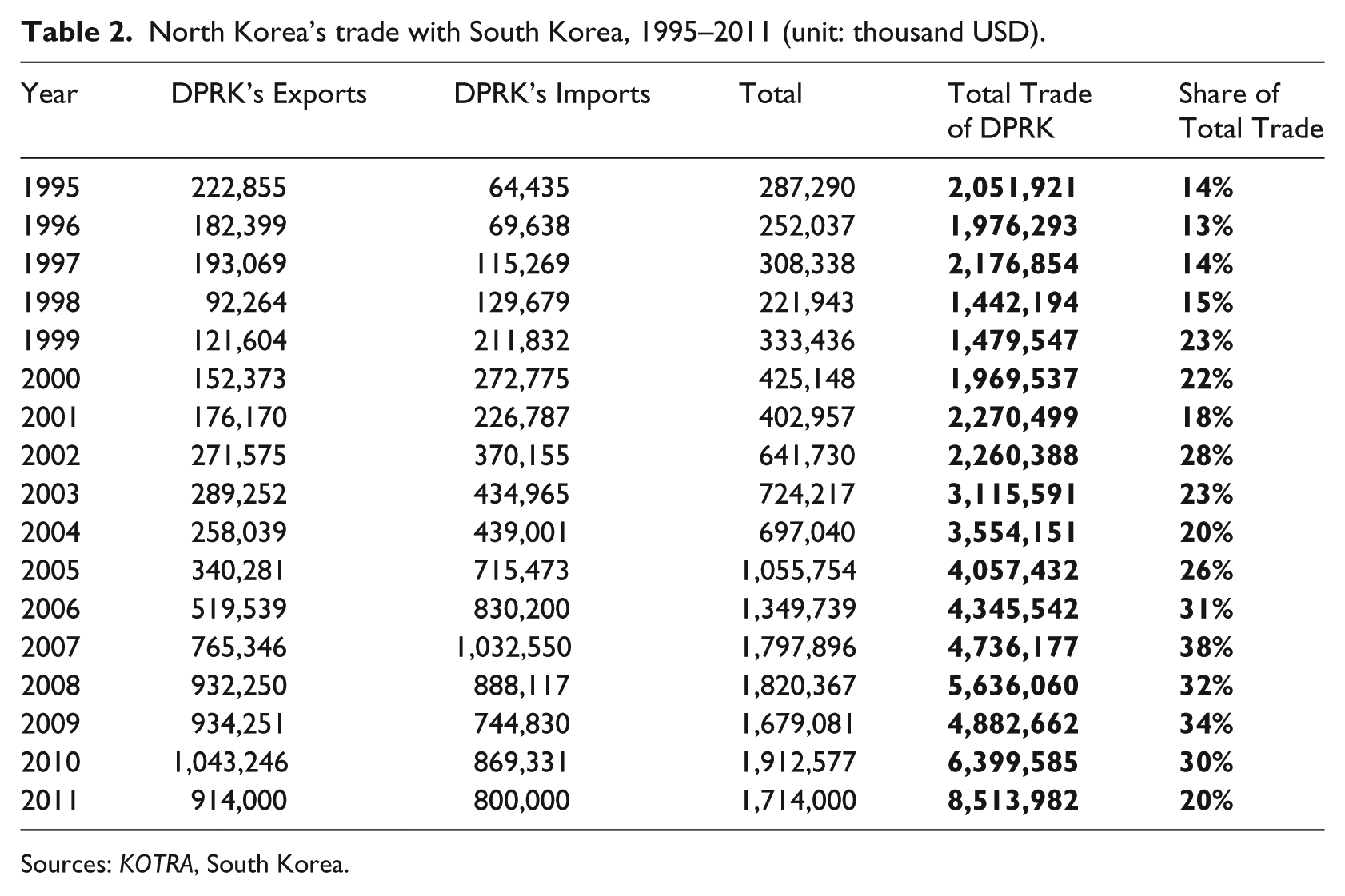
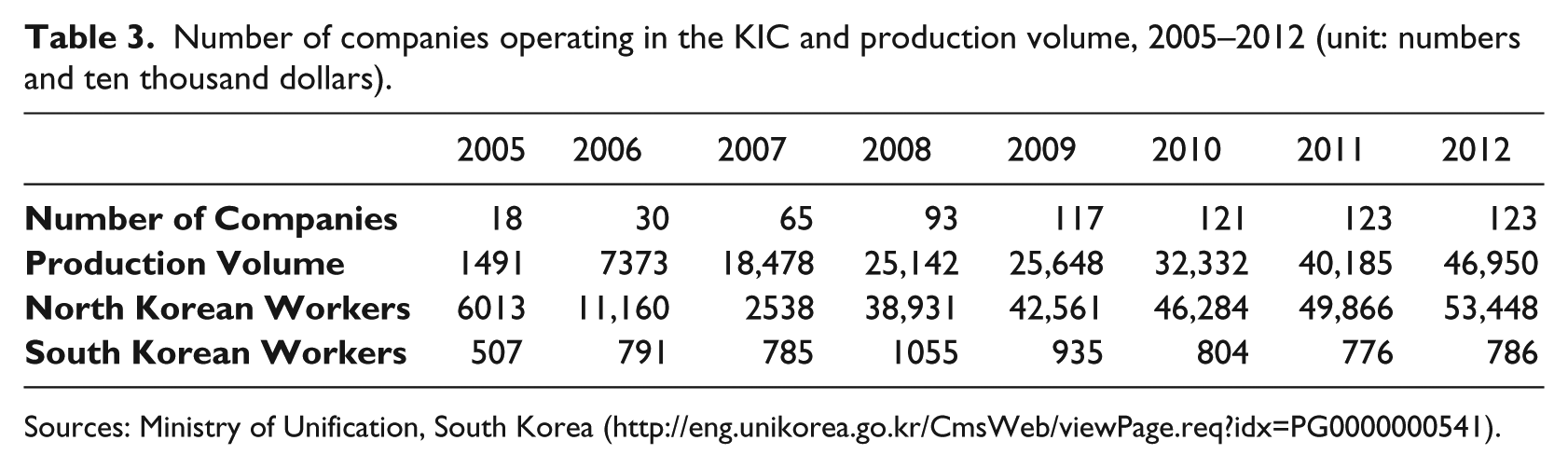
As a result, inter-Korean economic activities increased dramatically. As shown in Table 2, in the Roh Moo-Hyun government of the South, the trade volume between the South and the North amounted to 1.8 billion US dollars in 2007, which comprised about 38% of the entire DPRK trade volume. Moreover, the two Koreas developed various economic cooperation projects, including the Mt. Kumgang tourist complex and the KIC, through both government and private channels. As shown, Table 3 indicates that even under “May 24 Measures (blockade for the North)” of Lee Myung-Bak government in 2010, KIC had operated and steadily increased in annual production.
North Korea’s trade with South Korea, 1995–2011 (unit: thousand USD).
Sources: KOTRA, South Korea.
Number of companies operating in the KIC and production volume, 2005–2012 (unit: numbers and ten thousand dollars).
Sources: Ministry of Unification, South Korea (http://eng.unikorea.go.kr/CmsWeb/viewPage.req?idx=PG0000000541).
Along with the growth in inter-Korean trade, South Korea also provided large-scale humanitarian assistance on a nearly regular basis. For instance, the South government provided 300,000–500,000 tonnes of food and fertilizer to the DPRK every year in the early and mid-2000s and organized domestic non-governmental organizations (NGOs) by providing aid in order become more active in humanitarian aid projects (Lee, 2012: 7). The South government sent $227.4m as official aid to the North in 2006, and in 2007, $304.61m was provided to the North by means of both government and private assistance in humanitarian projects for Pyongyang. As a result, Seoul’s humanitarian assistance toward Pyongyang hit a definite high point during Roh’s tenure.
As shown Figure 1, talks between the two Koreas had been more focused on “economic relations” and bilateral dialogue (2002–2007). However, the Lee Myung-Bak government was reluctant to cooperate with Pyongyang led by Kim’s goals by pursuing a policy of “denuclearization, opening, and 3,000” (Blue House [BH], 2009). Complicating matters, after the Cheonan incident in March 2010, the South government decided unilaterally to proceed with the “May 24 Measures,” which closed all inter-Korean exchange and cooperation except the KIC.
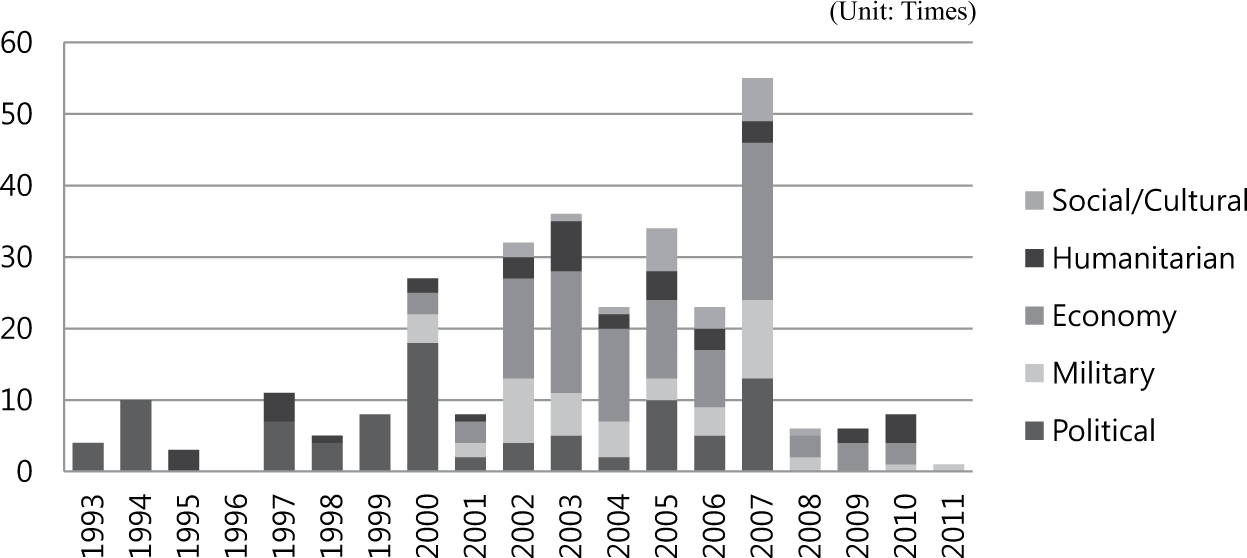
Number of inter-Korean talks, 1993–2011.
Through the South’s “Sunshine Policy” and “Peace and Prosperity” from 1998 to 2007, Pyongyang has adopted the principle of the separation of the economic and the political. This North Korean policy of separating economy from security and political affairs has derived economic benefits and built mutual trust between Pyongyang and Seoul. In this sense, North Korea has responded with a two-way strategy, minimizing the negative influence of the South’s engagement policy (such as the potential spread of Western capitalist culture) that may harm its own system, while maximizing economic cooperation and co-existence without radical political confrontations with the South.
The DPRK’s legitimacy competition with the ROK
North Korean policy toward South Korea has been guided by efforts to establish regime legitimacy against the South. One of the prime purposes of North Korea’s policy to South Korea is its own regime survival and stability. Based on this purpose, Pyongyang has maintained its own system, namely “Korean-style socialist system (urisiksahoejui)” with the “Juche (self-reliance)” ideology against the South. Therefore, one must analyze the tactics and policy consequences of selecting a particular national identity.
Based on these assumptions, North Korea has developed strong nationalism and the “military-first” politics designed by Kim Il-Sung and his son, Kim Jong-Il. Even though North Korea has been plagued by enormous economic difficulties and natural disasters, external political impasses resulting from the demise of the socialist bloc, and economic sanctions by Western capitalist countries and their allies (the US and Japan), Pyongyang has not given up its own system. According to Rodong Sinmun (Korean Central News Agency [KCNA], 3 March 2008), Pyongyang insists the Songun politics is “the noblest patriotic politics as it helps reliably protect the dignity and sovereignty of the country and nation and achieve their prosperity; it is thanks to ‘Songun’ that the Korean nation is demonstrating its dignity as a strong nation with a tremendous military deterrent whom no formidable enemy dares attack; it serves as a motivating force instilling true patriotism into the members of the nation and encouraging them to fully display it.” Therefore, the Songun politics is effective as a core policy strategy of the KWP, particularly as it relates to the South.
Also, in terms of Pyongyang’s national identity orientation, North Korea adopted Jaju (national independence) originated by nationalism for the North’s policy strategy toward the South government. The principle of national independence is deeply related to the policy strategy of independent national unification. 8 In Rodong Sinmun (KCNA, 11 February 2008), National independence (Jaju) as Kim Jong-Il’s idea “serves as an immortal torchlight as it clearly indicates the way of firmly defending the sovereignty and dignity of the Korean nation and achieving national reunification and the prosperity of the nation.”
In addition, the North Korean regime justifies inter-national cooperation through the shared national history of the two Koreas (Yang, 2009). North Korea holds that unification of the two Koreas is an inevitable result because the two Koreas share one bloodline, language, and cultural ideology. North Korea calls for inter-Korean cooperation as a necessary orientation for unifying the South and North. Kim Jong-Il stated that “our country’s unification problem is a problem of ending outside power’s control over and interference in the South and extending nationalistic independence to entire country to reconnect the severed national bloodline and nationalistically unite as one race” (Kim, 2000).
For the June 15 Joint Declaration in 2000, North Korea stressed that Article 1 includes the idea of “Uri Minjeok Kiri” (by our nation itself) as the heritage of national independence consistent in Pyongyang’s strategy for the South (Yang, 2009). In the interest of regime survival, North Korea has tried to nullify the 1953 armistice agreement with the US, and also pushed for the withdrawal of US military power in South Korea since the 1990s. Pyongyang exemplifies the June 15 Joint Declaration, “an attitude and stand which calls for firmly maintaining independence in the overall movement for reunification and settling all issues with overriding importance attached to the will and interest of the nation” (Rodong Sinmun, 11 January 2008).
Through the South’s “Sunshine policy” implemented by Kim Dae-Jung and Roh Moo-Hyun administrations, South Korea expected Pyongyang to be willing to take off its own socialist system based on “Juche” and intense nationalism against Western capitalism and the South followed by comprehensive inter-Korean economic cooperation and exchange between the two Koreas. However, even with the South’s efforts, military confrontations along the NLL and DMZ have continued. Moreover, since the Lee Myung-Bak government from 2008, through strengthening the US–ROK joint military exercise, the South’s hostile policy toward Pyongyang has brought about more severe military tensions such as the “Cheonan incident” and “Yeonpyeong Island shelling” in 2010.
In North Korea’s policy priority to South Korea, we can observe that inter-Korean relations were a zero-sum game. Even after the inauguration of the Kim Dae-Jung government in 1998, inter-Korean economic relations progressed amazingly, but the North’s military provocation of the South continued as seen in North Korean trade vessel’s intrusion into a territorial water line (NLL) in June 2001 and the Yellow Sea battle in June 2002. The dispute over the NLL is a contentious and competitive issue for both sides. Both regimes have not only security and economic interests at stake in the dispute, but also sovereignty issues. North Korea believes that the NLL is illegitimate, as it was drawn up by the United Nation Command after the Korean War, and violates its sovereign, territorial waters (Roehrig, 2011).
In this sense, Pyongyang insisted the NLL dispute be considered an essential sovereignty issue. The tragic naval battles between both Koreas show that the legitimacy competition is still intact even after the growth of inter-Korean economic relations. Rather, Table 4 illustrates that the frequency of North Korean military provocation had increased during Kim and Roh governments’ terms in the 2000s. Moreover, the North’s testing of a nuclear bomb may threaten Korean peninsula’s security as well as inter-Korean relations. In terms of North Korea’s reciprocal activities, the Sunshine Policy failed to encourage any real fundamental opening up or reform from North Korea during the previous Kim Dae-Jung and Roh Moo-Hyun governments.
North Korea’s military provocation (number of times).

Sources: Ministry of National Defense, Defense White Paper (2012), South Korea.
At the June 15 summit talks in 2000, Pyongyang was likely sought to gain economic advantages from the South while also increasing their relative legitimacy. First, Pyongyang asserted the format of which North Korean leader Kim Jong-Il responded to the South Korean president’s request; second, the DPRK insisted that the summit should not be held in Seoul, but in Pyongyang as the only locus of a unification of Korea; third, Pyongyang initially refused to name Kim Jong-Il as Kim Dae-Jung’s counterpart, and intended to place Kim Yong-Nam, nominal head of state, as the South president’s partner (Park, 2002: 126). From 2003 to 2007, the Roh government had pursued reconciliation and cooperation with North Korea as the essential means for tension reduction and the main pivot for denuclearization. Even though the Roh government tried to fulfill the highest level talks in economics and the most humanitarian aid than any previous governments, North Korea’s response to such economic engagement seemed to fall short of the South’s expectations. In the South’s engagement policy, North Korea responded in kind by “firmly rebuffing” all attempts by the Roh’s government to raise the nuclear issue through inter-Korean dialogue and maintained its posture of addressing their nuclear issue bilaterally with the United States (Snyder, 2005: 97).
In this vein, North Korea has continued to pursue its aggressive military-first policy, which was clearly shown during Kim Dae-Jung and Roh Moo-Hyun’s presidencies. Throughout the period of the Sunshine policy of ROK, the US suspected that through the South’s economic assistances for North Korea, Pyongyang was able to prepare the equipment to start their highly enriched uranium nuclear program that started the second nuclear crisis. 9 After the Cheonan incident (the North denies its involvement in the attack on the Cheonan warship), in accordance with the Lee government’s “hardline policy” toward the North, the South has been strengthening US–ROK military exercises and engaging in an economic blockade for Pyongyang. In corresponding with Seoul’s hawkish attitude, whatever the cost, Pyongyang has retaliated militarily such as in the Yeonpyeong shelling in the NLL.
Indeed, what are Pyongyang’s orientation in policy behavior and policy preference toward Seoul? In terms of the legitimacy competition with the South, the foreign policy aim of the DPRK is to guide the inter-Korean relationship in accordance with its domestic priority and the character of the ruling elite. In terms of legitimacy, North Korea endeavors to propose talks to alleviate tension whenever a progressive party assumes power in the South, while increasing the level of criticism against the ruling party and its North Korea policy whenever a conservative party is in power (Han, 2011: 47). Whenever power shifts in Seoul, Pyongyang eased its hostile attitude and opened up possibilities for talks to shape a favorable environment.
During the run up to the 14th South Korean presidential election in 1992, Pyongyang infrequently criticized candidate Kim Young-Sam as a “fascist.” The reason why the North regime restrained its criticism of the candidate from the conservative ruling party was because of the defensive stance they had adopted after the collapse of the socialist bloc, the trend set by the Inter-Korean Basic Agreement, and the fact that, five years previously, as a member of the opposition party, Kim Young-Sam had urged his party to select a single candidate (Han, 2011: 46). Additionally, in April 1996, the Kim Young-Sam government changed its North Korea policy from dovish to hawkish and then rejected any food aid request from Pyongyang. One week before the general election on 11 April 1996, North Korean heavy armored troops violated the armistice treaty to enter in the DMZ (Kim, 2011: 179).
In 2002, during the Kim Dae-Jung administration, Pyongyang attempted to conciliate with the South by sending a letter on 25 July expressing apologies for the West Sea battle which had occurred on 29 June and promising that this dispute would not occur again (Han 2011: 47–48). Before the 16th presidential election in 2002, North Korea drew attention to itself by resuming nuclear programs and missile exports. 10 Lee Hoi-Chang, the Grand National Party’s candidate for the presidential election, used the North Korea’s threat issue regarding the resumption of the nuclear program to criticize Roh Moo-Hyun’s progressive position on inter-Koreans relations and unification. In 2007, North Korea condemned “South Korean Grand National Party (GNP)” and its president candidate, Lee Myung-Bak as “national traitors” since GNP criticized the previous government’s Sunshine policy and had pessimistic perspectives toward inter-Korean exchange and cooperation. Pyongyang (KCNA, 7 March 2007) asserted that “the GNP is throwing snags in the way of peace and reunification of the nation, revealing its true colors as one fed on the residues of the era of division, they noted, adding: The fellow countrymen will never forgive it.”
As suggested earlier, a content analysis, particularly a word frequency method, is employed as an effective way to examine Pyongyang’s perception and policy priority toward South Korea. Figure 2 indicates sharp increases in North Korea’s criticisms and slanderous gestures toward the conservative ruling party and the Blue House of South Korea (Grand National Party and Lee Myung-Bak government inaugurated in 2008). This picture represents that the pattern of North Korean regime’s criticisms toward the South has presented a fairly different perception between the progressive Roh Moo-Hyun government (2002–2007) and the conservative Lee Myung-Bak government (2008–2012). In the North’s foreign policy, there is an interrelation between verbal expresses and actual policy behavior of Pyongyang leadership toward Seoul.
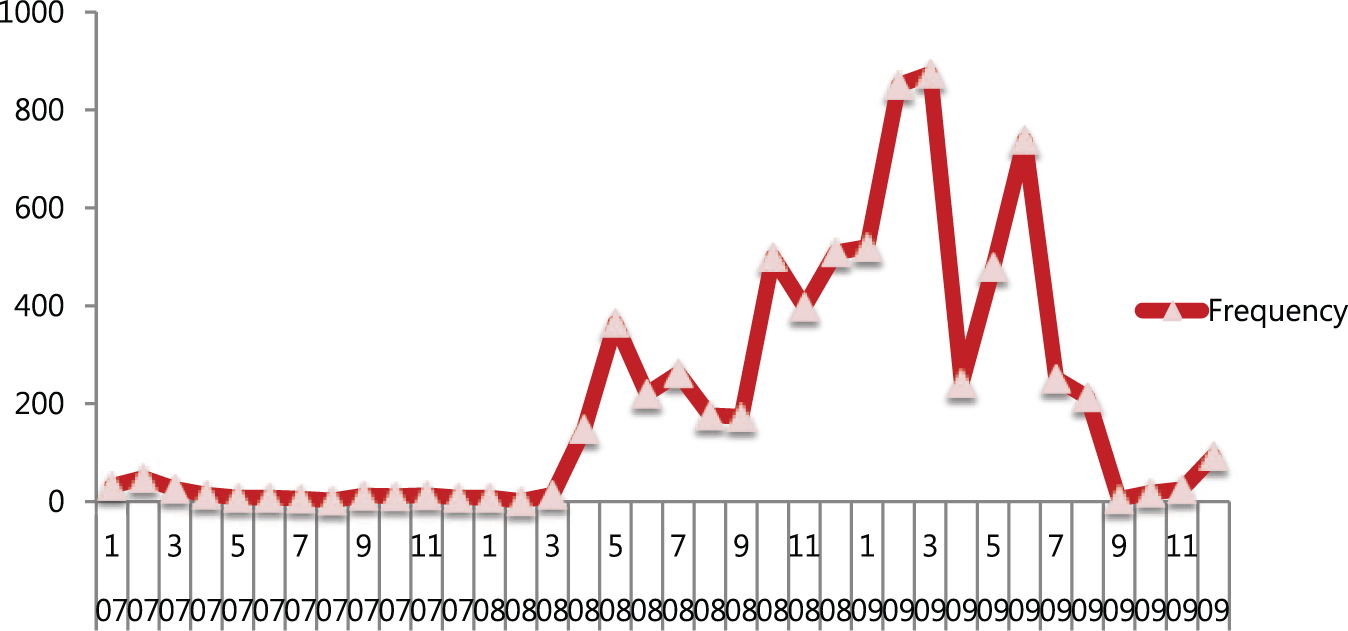
North Korea’s criticisms for South Korea, 2007–2009.
Since the early 1990s, North Korea has adopted “Uri Minjeok Kiri” as an alternative expression of national independence (Jaju). The principle of national independence is endorsed as the policy strategy of independent national unification of North Korea without the United States or other powers. Also, national independence is derived from Juche ideology, that is, “national identity” of North Korea. According to “content analysis” in Rodong Sinmun mapped as Table 5, Pyongyang strongly insisted that “Jaju” is the most essential policy toward Seoul, in which Jaju represented its own assertions of legitimacy vis-à-vis the South.
The selected word’s frequency for the DPRK’s policy preference to the ROK, 2007–2009 (unit: frequency).
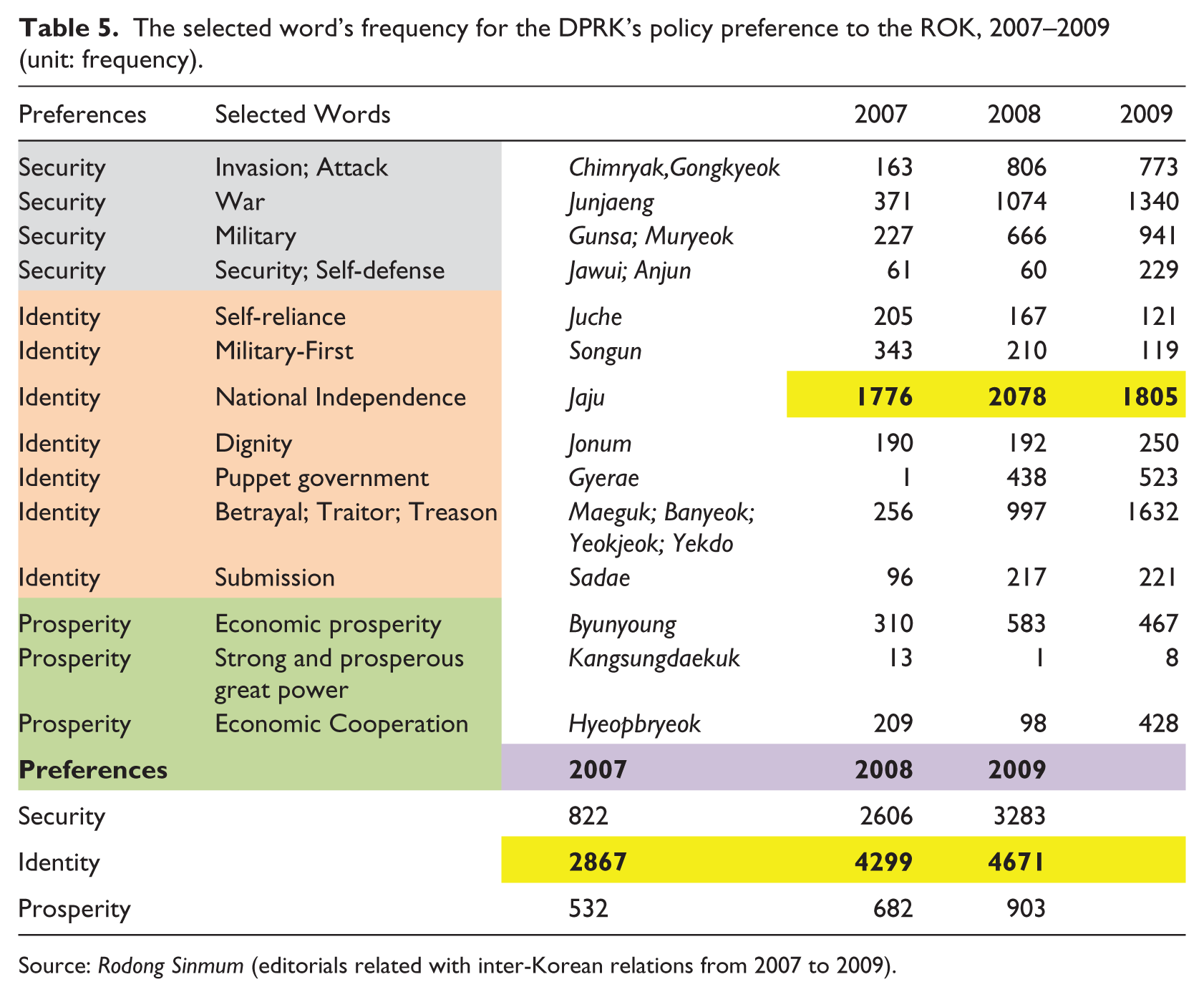
Source: Rodong Sinmum (editorials related with inter-Korean relations from 2007 to 2009).
As shown above, North Korean leaders have depended on rejection of South Korean values as the basis of regime legitimacy (Park, 2002). In terms of establishing national identity in the course of inter-Korean relations, North Korea depends on the legitimacy competition, which explains the fundamental orientation and policy priority toward South Korea. As shown in Figure 3, Pyongyang felt security threats from the South in each March of 2007, 2008, 2009, since these seasons used to bring the Joint US–ROK military exercises in the disputed territorial areas. On this point, Pyongyang sees the Joint US–ROK military exercises as a great security threat. It illustrates that for the DPRK, the US–ROK military alliance is one of the primary threat to its regime safety. Therefore, North Korea condemned the Joint US–ROK military exercises as “to all intents and purposes, maneuvers for a nuclear war” and “to seize the DPRK by force of arms,” and claimed that the training “threatens the sovereignty of the DPRK and take necessary countermeasures including those to further bolster up all its deterrent forces” (a spokesman for the DPRK Foreign Ministry, KCNA, March 3, 2008). During the Joint US–ROK military exercise (“Key Resolve”), just before North Korea tested a long-range missile (North Korea declared it is a “satellite”), Pyongyang asserted maximally “security” needs toward Seoul from 2006 to 2009. Indeed, after the second nuclear test, the Lee administration in South Korea pushed for support on the United Nations Security Council (UNSC) Resolution 1874 and the UNSC Presidential Statement (Ministry of Foreign Affairs and Trade [MOFAT], 2010). Under UNSC Resolution 1874 in June 2009, Pyongyang sharply expressed its regime legitimacy preference toward the South. In this relationship, the North Korean leadership tends to promote its national identity and legitimacy of Pyongyang regime toward the South Korean government in regards to justifying its nuclear armament.
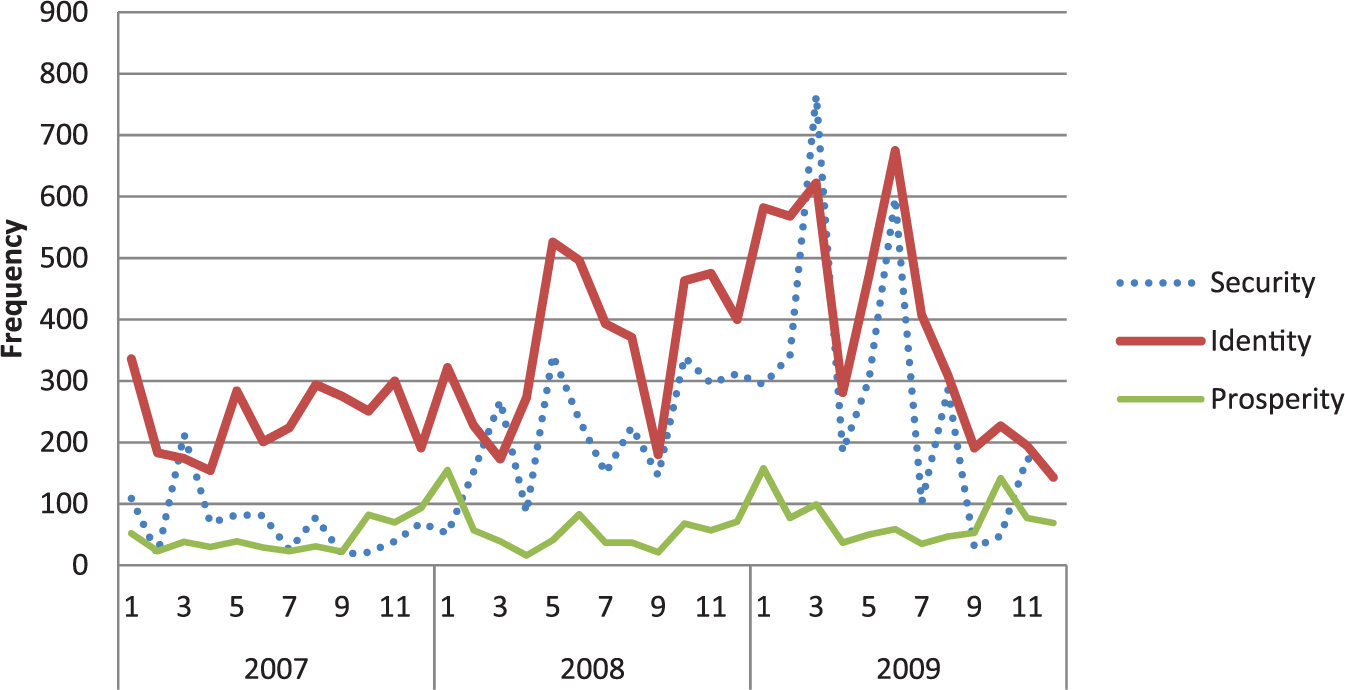
North Korea’s policy priorities toward South Korea, 2007–2009.
In sum, under the Lee Myung-Bak government’s hardline policy toward the North and continued economic sanctions from Western countries, Pyongyang leadership’s policy toward South Korea has significantly relied on the policy orientation of establishing “national identity” more than the Roh government’s policy preference of economic engagement. Also, we can observe that the “security” need of Pyongyang’s policy increased sharply in the Joint US–ROK military drill period. In doing so, even though Pyongyang has somewhat felt security threats from Seoul, the North Korean policy to South Korea has been mostly determined by “national identity.” However, most of Pyongyang’s policy priorities toward the South are determined by “identity” need (see the Figure 3).
Overall, this article observed that the legitimacy competition between two Koreas has never stopped since the separation of two political systems at the end of World War II. Historically, South Korea’s “Sunshine” policy of engagement with the economically reclusive North Korean government differs from previous policies of engagement in that it separated economic and political issues. Thus, as political conflict continued, North Korea has shown a willingness to cooperate economically and has favored openness. Since the election of South Korean President Lee Myung-bak in 2008, military tensions between the two states have increased. Even though the Lee administration has proposed to offer economic assistance to North Korea in exchange for its promise to abandon its nuclear program and continue its path towards openness (Lee, 2008), 13 North Korea has chosen a hardline policy toward South Korea. As a result, politically, North Korea has continued to compete with the South.
In sum, through the process-tracing method, it should be emphasized that Pyongyang attempts to stand on a hostile position whenever the South government pursues infringement of Pyongyang’s identity and dignity. Also, historically, when South Korea denounces North Korea’s legitimacy or North Korea senses inferiority in the legitimacy competition with South Korea, North Korea executes provocations whatever the cost – even if it heightens inter-Korean military tensions or incurs economic losses (the suspension of the KIC in 2013, the West Sea battle in 1999, 2002, and 2009, the shelling of Yeonpyeong island in 2010, the sinking of ROKS Cheonan in 2010).
Conclusion
This article began with the question of what factors influence whether North Korea chooses to implement risky or cooperative policies toward South Korea, as well as what role domestic politics and ideology play in the DPRK’s formation and enactment of foreign policy. This study also seeks to explain why North Korea chooses a hardline foreign policy and when it chooses to engage with the surrounding states.
Basically, the theoretical framework of this research is drawn from a combination of realism, liberalism, and constructivism to identify and examine possible variables that affect North Korea’s foreign policy behavior. To find answers to these questions, the domestic priorities behind foreign policies are analyzed within the framework of human motives. In this theory, North Korea is not abnormal or atypical, that is, the foreign policy goals of North Korea are not drastically different from any other country. North Korean foreign policy goals are motivated by three domestic priorities or preferences: security, identity, and prosperity.
The DPRK’s foreign policy is determined primarily by the demands of “identity need” relative to South Korea. In order to analyze the policy behaviors of North Korea, this paper uses the “process-tracing” method, and also observes Rodong Sinmun, the official newspaper of Pyongyang regime, through content analysis in order to determine the DPRK’s perception and policy preference toward South Korea.
North Korea’s preference for South Korea is defined by the desire for “national identity.” In historical context, the legacy of the Korean War shaped the strong nationalism under Juche and emotional perception of the legitimacy competition with the South’s democratic capitalism. In order to win a war over legitimacy against the South, the Pyongyang regime has maintained its “Korean-style socialist system (urisiksahoejui)” with “Juche (self-reliance)” ideology against Seoul. Both Juche and Songun ideology are tied into Pyongyang’s policy strategy toward Seoul.
In this sense, in terms of Pyongyang’s national identity orientation, North Korea adopted “Jaju (national independence)” for its policy strategy toward the South government. Pyongyang demands the withdrawal of US forces in the South and tries to stir anti-American sentiment in South Korean society. With the success of the Seoul Olympic Games in 1988, South Korea’s economy rapidly developed and surpassed the North, creating the perception of an economic threat from the South. The Pyongyang regime adopted a pragmatic policy (silli) as a new strategy for dealing with the South Korean government after the establishment of the Kim Jong-Il regime in 1998. South Korea’s engagement policy (Sunshine Policy) toward North Korea is a strategy designed to mitigate military tensions on the Korean Peninsula and to democratize the North through commercial exchanges and cooperation.
From this economic openness policy, North Korea has derived certain benefits for regime survival, such as economic aid and some relief from Western sanctions. This engagement policy itself will not be enough to bring about a resolution of military tensions between the two Koreas. North Korea has continued to pursue its aggressive “military first” policy, resulting in numerous armed conflicts illustrating that the legitimacy competition is intact. North Korea proposes talks to alleviate tensions whenever a progressive party assumes power in the South, but increases the level of criticism against the ruling party whenever a conservation party is in power.
In this vein, we infer that Pyongyang tends to stand on a hostile position whenever the South government is willing to infringe Pyongyang’s legitimacy and dignity regardless of the South’s economic assistance. North Korea also gets intimidated militarily by the US–ROK joint military exercises. During the US–ROK military exercises, Pyongyang pursues security rather than legitimacy relative to Seoul’s policy. However, this paper confirmed that the Pyongyang leadership’s policy priority has mostly depended on “identity need” in context of history.
Even South Korea’s policy of “the trust-building process” has thus far failed to bring about any effective results. In reality, the Kim Jong-Un’s regime carried out the fourth and fifth nuclear test in 2016 and would try to be promoted in the process of trilateral strategic dialogue related with the peace treaty and approval of North Korean systems toward Seoul and Washington. Ultimately, a positive negotiation between the ROK and DPRK will be impossible to achieve unless both systems’ competition is resolved. It is unlikely that Kim Jong-Un will negotiate on North Korea’s nuclear program as long as Pyongyang is under security and economic blockade from Seoul and Washington as a result of North Korean leadership and political orientation led by Kim Jong-Un and his power elites. Therefore, there are no significant changes to the North Korea’s policy orientation toward the Republic of Korea compared to the past. However, North Korea’s denuclearization should be ultimately achieved through dialogue with South Korea. Simultaneously, Seoul would adopt a two-track approach relying on dialogue and sanctions in order to achieve North Korea’s denuclearization as well as peace and stability on the Korean Peninsula.
This paper reveals a few issues which may require future research. This study has some methodological limitations. In the process of content analysis of Rodong Sinmun (the North Korean official newspaper), the validity of this study may be undermined by the distorted interpretations of external events communicated by the regime in Pyongyang. There is simply no direct measurement which sufficiently explains the regime’s intentions. Moreover, this content analysis focused on limited years, which could limit the generalizability of the findings. Future research may extend the number of years open to analysis, developing a more reliable database for evaluating Pyongyang’s policy priorities.
Footnotes
Funding
This research received no specific grant from any funding agency in the public, commercial, or not-for-profit sectors.