




Abstract
Given the current redistributions in the global balance of power, power transition theory (PTT) has once again become an important intellectual factor. Many observers employing PTT are anxious about China’s ascendance and expect serious conflicts between Washington and Beijing in the coming years. Such skepticism, however, is problematic for three reasons. First, it is false theoretically; PTT does not claim that all rising powers will resort to war or that all power transitions will result in war. Second, it is false empirically; not all power transitions in history have resulted in Great Power wars. Third, it leads to flawed policy advice; if rising powers are not always dissatisfied and do not always challenge the status quo, then policies meant to oppose them might breed dangerous dissatisfaction in the first place.
This article amends PTT by adding a variable, the “will to power” (WTP), that captures the willingness of rising powers to commit themselves to changing the status quo. Furthermore, it scrutinizes two historical power transition constellations (United Kingdom–United States and United Kingdom–Imperial Germany). In both cases the new variable is consistent with the outcome and particularly in the United Kingdom–United States case the WTP variable broadens our understanding by making it possible to see this relationship as “missed” or “eschewed” instead of as a peaceful power transition. Doing so extends the power transition dichotomy to a much more complex and realistic typology of power transition constellations.
Keywords
Power transition theory (PTT) lay dormant after the end of the Cold War, but has in recent years reemerged as an important intellectual factor, most probably due to the extraordinary rise of China, the emergence of other important powers, and major redistributions in the global balance of power (see, for example, Kang and Kugler, 2015; Kim, 2015; Kim and Gates, 2015; Lee, 2015; Norrlof and Reich, 2015). 1
Observers such as former United States official Susan Shirk and political scientist Christopher Layne are highly skeptical of these developments and expect serious conflicts specifically between the United States and China in the coming years. Grounding their expectations in some form or another of PTT Shirk (2007: 4) claims in her book about China that “history teaches us that rising powers are likely to provoke war,” while Layne (2008: 16) echoes this by saying, “throughout the history of the modern international state system, ascending powers have always challenged the position of the dominant (hegemonic) power in the international system—and these challenges have usually culminated in war.” Roughly speaking, the underlying message and fear is: power transitions (typically) lead to conflict or even war. This message is problematic for three reasons. First, it is false theoretically; PTT does not claim that all rising powers will resort to war or that all power transitions will result in war. PTT indeed highlights the inherent dangers of power transitions; however, it explicitly allows for peaceful power transitions as well as power transition war. Second, it is false empirically; many but not all power transitions in history have resulted in Great Power wars. Third, it may lead to unsound policy advice; if the simple message “power transitions are always dangerous and rising powers are always aggressive” were true, then it makes sense to attempt to contain or oppose them respectively. If, however, rising powers are not always dissatisfied and do not always challenge the status quo, then policies meant to oppose them might breed dangerous dissatisfaction in the first place.
I argue that the spectrum of power transitions or better power transition constellations is even broader than the dichotomy of war and peace. This article first amends PTT by adding a variable that captures the willingness of rising powers to commit themselves to changing the status quo. This addition increases the potential types of power transitions from the two traditional ones (peaceful power transition and power transition war) to four (adding what I call missed and eschewed power transitions). After introducing this conceptual argument, the article scrutinizes two historical power transition constellations between the rising powers of Imperial Germany and the United States and the dominant power, the United Kingdom. It shows that in both cases the new variable, “will to power” (WTP), is consistent with the outcome and that in the United Kingdom–United States case particularly, the WTP variable broadens our understanding as it makes it possible to see this relationship as “missed” or “eschewed” instead of as a peaceful power transition.
In the conclusion, the main findings are tied together and in looking at the outlook for the future, the article maintains that in further research it will also be necessary to discuss the peculiar role of the dominant power within the PTT framework. Doing so extends the erstwhile non-peaceful/peaceful power transition dichotomy to a much more complex and realistic typology of power transition constellations that should be employed when the prospects of current power shifts are being assessed.
PTT: The theory in a nutshell
PTT was originally established by AFK Organski and Jacek Kugler. 2
While the theory is often regarded as being closely related to international relations (IR) realism, it in fact differs from realist (and many other) IR approaches regarding the organization of the international order. Many IR theories assume that the ordering principle of the international system is anarchy (Waltz, 1979). In the view of PTT, however, international politics do not resemble the (realist) billiard ball model but rather a pyramid structure overseen by the respective dominant, that is, the most powerful power. The international order is, thus, a hierarchal rather than an anarchical system. The dominant power not only sits at the top of this hierarchy but is also expected to have created and designed the international order according to its convictions, wishes, and interests and subsequently guarantees and defends this order (Siverson and Miller, 1996: 59).
Accordingly, PTT expects that the goods and profits 3 which the international order produces often benefit mainly the dominant power and its allies. States that remain outside this inner circle receive none (or, at least in their perception, not enough) of these goods and therefore “consider the international system to be unfair, corrupt, biased, skewed, and dominated by hostile forces” (Tammen et al., 2000: 9). Therefore, dissatisfied rising powers typically wish to change the existing status quo or even establish an entirely new international order. This leads to conflict—according to PTT—as those who profit from the old order rarely agree to such a restructuring (which would almost certainly diminish their share of benefits) and thus the new dominant power enforces or at least tries to enforce such changes violently. 4 In these cases, power transition wars are common. However, such wars typically do not happen before the challenging power has at least reached parity with the declining dominant power. Attacking before this state has been achieved would be futile. PTT usually understands a power relation as entering into a period of parity when the weaker (rising) power has reached 80 percent of the power resources of the stronger (declining) power. Parity ends when the former dominant power falls to under 80 percent of the power resources of the new dominant power (Organski and Kugler, 1980). 5
The actual power development or distribution, however, merely provides an opportunity; PTT does not assume that such an opportunity is always or automatically realized (Lemke and Kugler, 1996: 12). For a rising power (whom most variants of PTT regard as the aggressor in a power transition conflict) to realize this opportunity, PTT also requires some measure of willingness that is commonly understood in terms of satisfaction with the status quo of the international order or—more precisely—a lack thereof. A rising power that is overtaking the declining dominant power or is finding itself in a prolonged period of parity with that power will initiate a war only when it is dissatisfied with this status quo.
Adding the WTP 6
What the two factors of traditional PTT (power development and satisfaction) cannot explain, however, is the possibility of an actor that denies or even transcends a possible power transition—for example, a rising power that increasingly accumulates power but at the same time either intentionally or unintentionally refuses to take on the role of a contender/challenger and subsequently the role of the dominant power. As has been noted by Benjamin Fordham it cannot be presupposed that all powers have a high foreign ambition:
We should be cautious with accounts of foreign policy ambition that assume enhanced international power and influence are intrinsically appealing. In the last two centuries, potentially powerful states have not mobilized their national resources to the extent one would have expected if this were the case (Fordham, 2011: 601).
Indeed, without a corresponding power development, a power transition is simply not possible. The point at which a power development has been reached can be disputed: is this only after an overtaking has taken place, or as soon as parity has been achieved, or even earlier when the rising challenger is rapidly approaching the dominant power? However, we can agree that without such a development, no power transition can ever occur.
At the same time, neither a rapidly rising power nor even power parity or overtaking in itself is enough to ensure a power transition. A power transition is not a physical event that emerges solely from a change in raw power. Moreover, it is necessary to actively bring about a power transition.
A power that deliberately isolates itself from its environment—a power that explicitly denies taking advantage of its power resources—will never cause a power transition despite its increase in capabilities. If such a power somehow ends up at the top of the international power pyramid (i.e. if it has accumulated more power resources than all potential competitors), then a power transition has occurred only arithmetically, not substantially. We can call this a power transition in the broader sense. The term power transition in the narrower sense should be reserved for overtakings that do result in a rising power taking over (or at least trying to take over) the mantle of the dominant power. Only in such a case of a power transition in the narrower sense does the question emerge regarding whether or not it will be a peaceful power transition—a question answered by the satisfaction variable.
PTT thus needs a variable/factor that can capture the will of an actor to utilize its (potential) power to either sustain or challenge the status quo of the international order in the case of a power transition constellation. 7
To do so, this article proposes adding the WTP factor to the theoretical framework of PTT as a third independent factor besides power and satisfaction. WTP can be defined as a conscious desire to play an active and even leading role in the international order and to shape this order if the circumstances so allow. 8 WTP is probably not strictly dichotomous but on an ordinal scale ranging from very low to very high, with a tipping point located somewhere on it, with states below this point eschewing and those above it embracing the possibility of realizing a potential power transition. WTP, just as general foreign policy ambition, should further be understood as contingent upon time and place (Fordham, 2011: 602). 9
This general concept of WTP can be broken down into at least three dimensions for the purpose of operationalization: The first dimension concerns the degree of activity an actor shows in the international order. Does it prefer to interact 10 with others or does it simply want to be left alone? The ends of this spectrum would be extreme isolationism and lack of interest in anything that happens abroad on the one hand and aspiration to global dominance on the other.
Closely related, but not totally overlapping, is the second dimension which concerns an actor’s own idea of international or world order that it wishes to promote and further in the international arena. This is a sort of activist counterpart of the satisfaction variable. While in the case of the latter the rising power is regarded as the addressee of the international order, with which it can be satisfied or dissatisfied, in this second dimension the rising power becomes the addresser that actively promotes its own ideas of order (or not). Actors with a high ideological charge (democracies, for example, that wish to promote democracy all over the world, or communist countries that aimed for world revolution) would be ranked high in this dimension, while actors that do not have such projects or focus on domestic politics would be ranked low.
The third dimension addresses the means that an actor prefers or at least accepts in order to further its ends. Actors willing to interact with their peers or pushing their projects by all means necessary, including by violent and military action, thus show a greater WTP than actors that only act peacefully and rely on the military solely for self-defense. The more an actor accepts or even embraces the use of force, the more it will be ready to make a potential power transition a reality. The more an actor rejects the actual use of military means, the more likely it will not enforce a potential power transition. It is important to note that what is of interest here is not the possession of impressive military forces, but the willingness to utilize them for political gains. An actor that is highly armed but only uses its forces for self-defense is endowed with less WTP than an actor with a smaller military that is regularly deployed.
It is to be expected that these dimensions show a certain degree of interdependence (an actor that has a stated aim of world order is likely to also be ready to use all means at its disposal to further this aim), while at the same time they do not totally overlap (for example, an actor that is totally integrated into the world order, but as a civilian power, shows little interest in using its military).
It should also be noted that WTP is in fact less novel for PTT than it may seem at first glance. Proponents of the theory have always pointed out that it combines aspects of opportunity with aspects of willingness (Houweling and Siccama, 1996: 115; Kim, 2002: 655; Lemke and Werner, 1996: 237; Werner and Kugler, 1996: 191–192).
Opportunity, as explained above, is captured by the power variable. Willingness, however, has hitherto not been introduced as a distinctive factor in the framework of PTT, but was rather mixed up with or subsumed by the satisfaction variable. However, satisfaction is generally more about what an actor dislikes about the status quo of the international order and less about the intensity with which actors pursue changes.
When an established theory is tinkered with, there is always the danger of (whether intentionally or not) immunizing that theory against criticism in the process. However, adding the WTP does not decrease the falsifiability of PTT. 11 While it can solve certain anomalies, it creates potential new ones at the same time. For example, a seemingly peaceful power transition by a dissatisfied actor would be at odds with traditional PTT, but acceptable if the actor has only a little WTP; a power transition war waged by a dissatisfied power, on the other hand, would be in accordance with traditional PTT but at odds with my approach if this actor had a low WTP.
The power transition typology
The three elements of PTT that we have established (power development, WTP, and satisfaction with the status quo of the international order) now allow us to move beyond the traditional dichotomy of power transition war/peaceful power transition. Instead we can assemble a typology of power transitions (see Figure 1). This typology entails a total of eight combinations for our three elements. Of these eight combinations only one points toward a peaceful power transition, and only one points toward a power transition war (power transitions in the narrower sense). Of the remaining six combinations, four do not meet our criteria for a power transition at all, while the final two can count as power transitions in the broader sense.
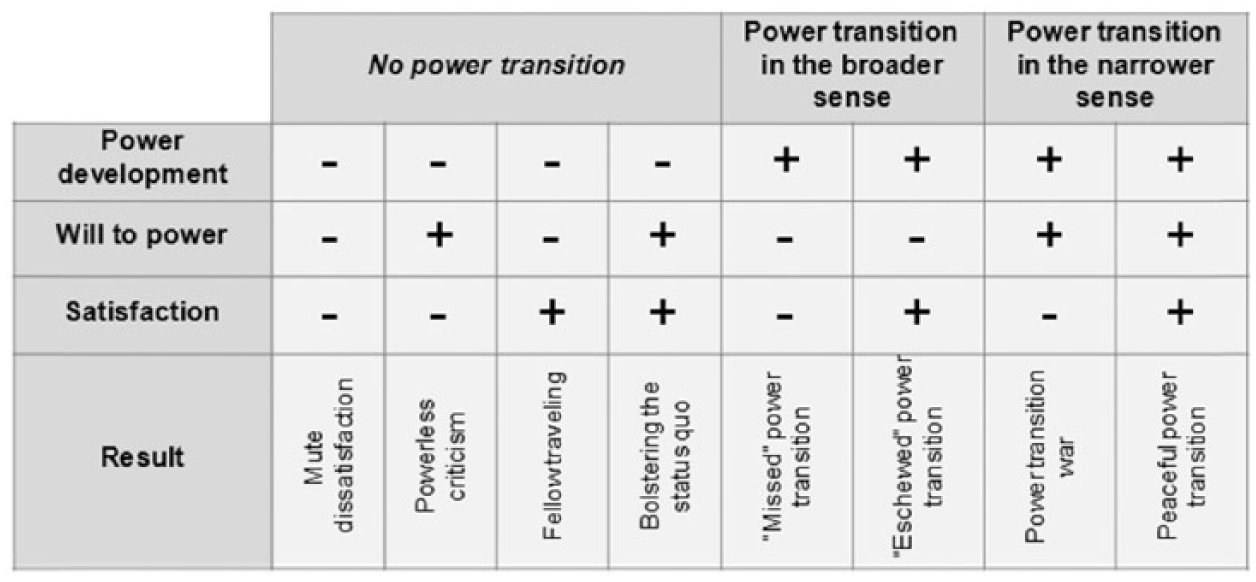
Combining the three elements of PTT 12 .
The pairing of power development and WTP explains whether a given historical point in time is ripe for a power transition in the international system—in other words, whether a power transition in the narrower sense will take place. If so, both factors must be present. They do not tell us, however, whether or not this power transition will be peaceful. Every power transition in the narrower sense is hallmarked by a corresponding power development and WTP; thus, these variables cannot give us any further information. At this point, satisfaction comes into play.
If the necessary power development is present but a WTP is missing, then we are dealing with a power transition in the broader sense and could talk about an “eschewed” or a “missed” power transition. In eschewed power transitions the rising power is satisfied with the current order and is not willing to become the new dominant power. In a missed power transition the rising power is indeed dissatisfied with the international order and has a motive to change it, but the necessary willingness, embodied in the WTP variable, is absent. The remaining categories are not proper power transitions at all. 13 Thus, instead of the former dichotomy we now have (by combining the central factors of PTT) eight categories in which we can sort potential power transition constellations.
Situating two historical cases within the power transition typology
To demonstrate the usefulness and the added value of the power transition typology, I consider two historical cases in this section of the article: the rise of the United States in the 19th century and the rise of Imperial Germany in the late 19th and early 20th centuries. Both figure prominently in PTT literature as typical cases of a peaceful power transition and a power transition war respectively. In fact, the point can be made that the United Kingdom–United States case is not only the most prominent but the sole instance of a peaceful power transition on a global scale in modern times. While peaceful power transitions are a distinct possibility in the PTT framework, this category is only rarely filled in history. 14
In both cases the United Kingdom can be regarded as the relevant dominant power. In both cases the emergence and rise of the United States and Germany as Great Powers endangered the Pax Britannica (Pugh, 1999: 83–90; Thackeray and Findling, 2002: 57–74) and challenged the leading position of the United Kingdom within the international order (Von Fiebig Hase, 1997: 135). To prove its worth, our typology should first be consistent with the historical record (i.e. it would be a poor tool if it predicated a power transition war in a case that we know was resolved peacefully). Second, it should offer some excess value (i.e. it should tell us more about the cases than traditional PTT would).
Regarding only constellations that allow for a power transition in the broader or the narrower sense we can make the following predictions for traditional PTT.
Prediction 1a: If a dissatisfied rising power reaches a power transition constellation (parity or overtaking) a power transition war is likely.
Prediction 1b: If a satisfied rising power reaches a power transition constellation a peaceful power transition is likely.
PTT amended by WTP offers the following partly varying predictions.
Prediction 2a: If a dissatisfied rising power with a high WTP reaches a power transition constellation a power transition war is likely (≙ Prediction 1a).
Prediction 2b: If a satisfied rising power with a high WTP reaches a power transition constellation a peaceful power transition is likely (≙ Prediction 1b).
Prediction 2c: If a dissatisfied rising power with a low WTP reaches a power transition constellation a missed power transition is likely.
Prediction 2d: If a satisfied rising power with a low WTP reaches a power transition constellation an eschewed power transition is likely.
Thus, when the rising power has a high WTP, the predictions concur with traditional PTT; only when WTP is low are the predictions altered.
I will show in the following sections that only by engaging the respective WTP can these cases be embraced in their full potential. While the one case (the power transition war) is captured by PTT correctly even if the new factors are not considered, we have to rethink our judgment concerning the second case (the alleged peaceful power transition). Taking into account the typology developed in the previous parts of this article, it is not surprising that the power transition did not lead to war, but it did not do so for reasons other than those recognized by previous research. It is, as I argue below, a case of a power transition in the broader sense, where the rising power was lacking in the necessary WTP, and it was thus rather an eschewed or a missed power transition than a paradigmatic case of a peaceful power transition.
In order to situate both cases on the power transition typology I consider each variable (power development, satisfaction, and WTP) in turn by making use of the accounts of well-established historians in addition to primary data.
Rise and decline: The power development
In the first step, I scrutinize whether the ascendancy of the respective rising power was spectacular enough to evoke PTT at all. Following the PTT mainstream I use GDP and the Composite Index of National Capability (CINC) from the Correlates of War (COW) project as principal power indicators.
After Napoleon Bonaparte lost his quest to establish French hegemony over Europe and to humble the British Empire, the United Kingdom was for quite a long time the undisputed strongest (and, in the sense of PTT, dominant) power in Europe and, due to its large colonial empire, in the world. One colony, however, was lost even before the Napoleonic Wars and took its destiny into its own hands: the United States.
While the United States was able to hold its own against the United Kingdom during the War of Independence when its sheer existence was at stake, without doubt it lost a second war against the same opponent in 1812. Following independence, the United States was thus far from being on par with the United Kingdom or the other European powers (Feng, 2006: 96). However, the United States surprisingly quickly expanded its territory and replaced the dominance of the plantation economy of the South with a northern-based industry that was competitively viable worldwide. It also benefited from its large single market that was shielded by protective tariffs. Especially after the Civil War, the economy grew swiftly and United States territory continued to expand.
In 1865 the total output of United States industry still lay decidedly below that of the United Kingdom and also below that of France and the combined German states (Dippel, 1996: 69). After the Civil War, however, an enormous growth took place. Such a phase of economic growth (for more than 50 years the growth in the United States was more than 4 percent per year) was unprecedented in previous history (Dippel, 1996: 70).
This is underlined by GDP as well as CINC data (see Figures 2 and 3), even though these numbers do not unambiguously allow us to decide when the actual overtaking took place (see Figure 4). According to GDP data, the United States achieved parity with the United Kingdom in 1858 and became the most powerful nation in 1869. 15 According to CINC data the entire process started a little bit later; the United States reached parity in 1888 and overtook Britain in 1892. 16 In any case, the United States was in the lead in the early years of the 20th century at the latest according to both indicators.

Power relation between the United Kingdom and the United States, 1850–1900 (based on GDP). 17

Power relation between the United Kingdom and the United States, 1850–1900 (based on CINC index). 18

Power ratio between the United Kingdom and the United States, 1820–1920 (based on GDP and CINC index). 19
Already, shortly after its founding in 1871, the German Empire came into a position of semi-hegemony on the European continent due to its size, economic prowess, and its military capabilities that it had impressively demonstrated in the war against France (Ullrich, 1997: 74). However, the United Kingdom still remained more powerful in the following decades. But, until the outbreak of the First World War in 1914, power shifted considerably. Paul Kennedy (1984) offers a detailed analysis of the strengths and weaknesses of the contemporary Great Powers 20 in his article “The First World War and the International Power System.” In order to do so, he uses a whole series of indicators based on economic and military data. His result is impressive: In all relevant indicators, the United Kingdom was ahead of the German Empire in 1890 (the year his statistics began); in 1914, however, the relation had been turned upside down and Germany was leading in most of the indicators. 21 According to this account, the actual overtaking happened sometime between 1910 and 1914, but even before that, there was a longer period of parity.
Again, this broad overview is underlined by a look at the empirical data (see Figures 5 and 6). According to these power indicators and as Figure 7 shows, the United Kingdom stayed firmly in the lead until shortly before the turn of the century. But Germany reached parity according to GDP in 1895 (CINC data 1902) and even overtook the United Kingdom in 1908 (CINC data 1905).
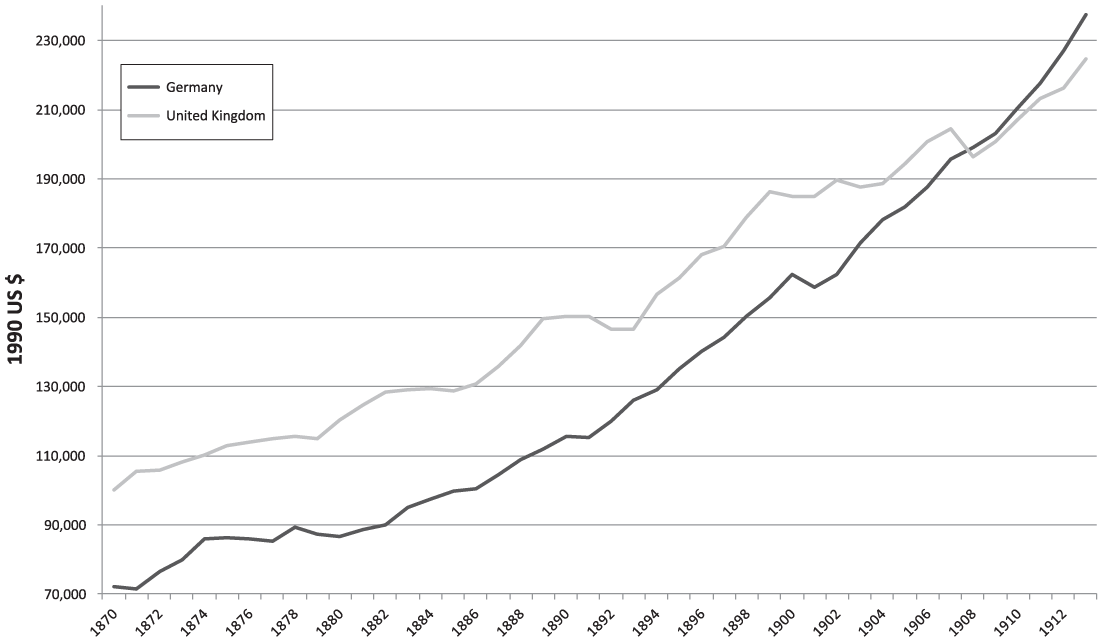
Power relation between the United Kingdom and Germany, 1870–1914 (based on GDP). 22
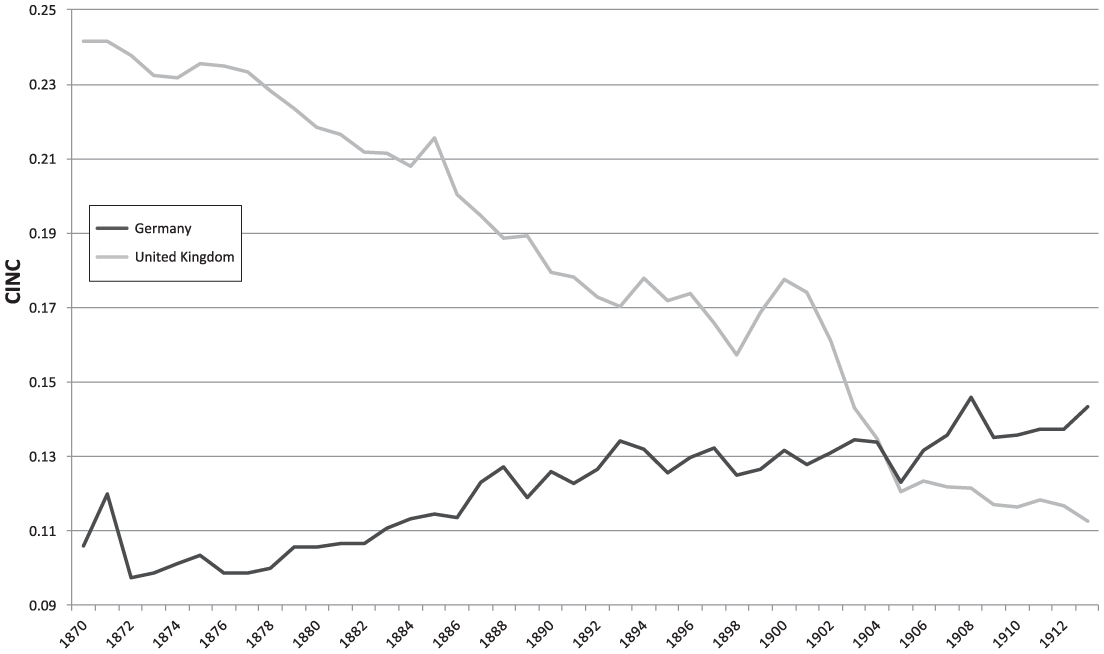
Power relation between the United Kingdom and Germany, 1870–1914 (based on CINC index). 23

Power ratio between the United Kingdom and Germany, 1870–1913 (based on GDP and CINC index). 24
According to both broad qualitative overviews and statistical data based on historical economic data and a widely used power index, the United States as well as Imperial Germany can thus be regarded as rising powers that managed to achieve parity and even overtake the dominant power. 25
Satisfaction with the status quo of the international order
The next logical step in a PTT-driven analysis is thus to check for the satisfaction of the rising powers with the status quo of the international order. As we already know how the constellations developed, we should expect to find dissatisfaction in the German case (which ended in a war between Germany and the United Kingdom) and satisfaction in the case of the United States (which did not end in a war between the United States and the United Kingdom).
Unfortunately, satisfaction, while central for PTT’s reasoning, is difficult to measure and conceptualize. Previous attempts to use quantifiable indicators based on military build-ups (e.g. Lemke and Werner, 1996) or alliance patterns (e.g. Sweeney, 2003) have been found lacking. 26 Even worse is the tendency in some PTT articles to only pay lip service to the importance of satisfaction and at the same time largely omit it from the empirical analysis. Unless any consensual indicator is found, I would thus suggest to refrain from the quantitative temptation and to consider each case independently. In doing so, the researcher should pay close attention to how the state in question perceives and interacts (a) with the prevailing international order and (b) with the respective dominant power that PTT regards as the creator and caretaker of this order.
PTT’s conventional wisdom is that the United States was a satisfied rising power, which ultimately led to a peaceful power transition between itself and the United Kingdom (Organski, 1968: 363–377). Steve Chan (2008) challenges this wisdom. He finds it odd to call the United States (and the United Kingdom) satisfied and status quo oriented during a time (after the Vienna Congress, which for Chan constitutes the modern international system) when both achieved large territorial gains and were involved in wars and militarized interstate disputes more often than many other powers (Chan, 2008: 27–31). 27
These doubts about the status of the United States as a satisfied status quo power are underlined by several mutual hostilities between it and the United Kingdom in the first half of the 19th century, not least the War of 1812. Indeed, this war marked the climax of a long and virulent conflict period between the United States and the United Kingdom and in the decades that followed relations only improved gradually. 28 The relationship between the two countries remained a fragile dyad that was still a long way from the special relationship that Winston Churchill postulated after the Second World War. And it is not only the War of 1812 that the satisfaction hypothesis has to deal with but a whole series of other disputes, for example: the Mackenzie Rebellion of 1837; violent incidents between lumberjacks at the border between Maine and New Brunswick in 1839; disputes between American slavers and the British Navy on the West African coast in 1840; and the refusal of the British to turn in a group of Africans that were to be sold as slaves but became mutinous, took control of the American ship that was carrying them and escaped to the British Bahamas. These were all in the period up until 1871 when the Washington Treaty was signed. 29
However, it was the Venezuela Crisis in 1895 that is generally regarded as the “watershed event” that put the relations between both powers on a new basis (Kupchan, 2001: 22). This crisis started as a border conflict between Venezuela and the United Kingdom, in which the United States supported Venezuela, invoking the Monroe Doctrine and indicating a dissatisfaction with the mingling of European powers in the Western hemisphere, which the United Kingdom deemed unacceptable (Khong, 2001: 44–45). For the last time, the United States and the United Kingdom seriously contemplated using force against each other (Layne, 1994: 22–28). Ultimately, however, the United Kingdom backed down and both countries agreed to accept the ruling of an arbitral court, which indeed they did (Feng, 2006: 97; Sautter, 1998: 313). From that time on, the United Kingdom and the United States were dedicated to peaceful conflict resolution (Kupchan, 2001: 22–23). It certainly helped that the disputes and conflicts between them were mainly concerned with tangible conflicting interests of limited range and could thus be resolved by a willingness to compromise on the side of one or the other (Feng, 2006: 105). It also helped that the hegemon was willing to accommodate the United States, thus mitigating the dissatisfaction of the latter.
Thus, while the United States was certainly not the archetypical dissatisfied power in the 19th century, it was not unambiguously satisfied either, at least not before 1895. Recall that according to GDP data the United States entered into a phase of parity with the United Kingdom as early as 1858, which would put a power that was clearly not satisfied in a parity position for almost three decades. Furthermore, according to the CINC index, the United States reached parity in 1888 and overtook the United Kingdom in 1892, seven and five years respectively before the Venezuela Crisis. Thus, whichever indicator one relies on, the technical power transition, that is the overtaking between the United States and the United Kingdom, occurred during a time when the United States was much less satisfied as is commonly acknowledged. This could be a serious problem for PTT: just as a power transition war is only compatible with traditional PTT if the aggressor state is dissatisfied with the status quo, so too is a peaceful power transition only compatible with PTT if both powers are satisfied (Rauch and Wurm, 2013: 56). Regarding the satisfaction factor the United Kingdom–United States case might thus not be unequivocally supportive of PTT but rather somewhat puzzling.
Regarding the German Empire, wherever its satisfaction development was headed, it was at least not always dissatisfied. Quite to the contrary, it could be said that it was “born” satisfied with the sentiment of having accomplished German unity. Accordingly, Chancellor Bismarck again and again pointed out that Germany was a saturated power: 30 “We do not have any belligerent needs […] we are one of what the old Count Metternich called saturated states, we have no wants that we could carve out by sword” (cited in Ullrich, 1997: 102, translation CR). Bismarck’s goal was to make clear to the other European powers that feared the central and strong position of the newly united Germany that it was indeed satisfied with the status quo and harbored no lust for aggression or expansion. 31 In order to underline these claims and to further dissipate the suspicions of the neighboring powers, Bismarck undertook a policy that was based on European accommodation and reconciliation. The pinnacle of this strategy was the Berlin Conference in 1878 during which Bismarck presented himself as an honest broker who was able to avert the severe danger of a general European war (Ullrich, 1997: 83–88).
However, this relatively high level of satisfaction began to decline after Bismarck resigned from his office. His successors and the young Emperor Wilhelm II were not content to enjoy and secure what had been reached (the unified German nation-state). They wanted more—more power, influence, and standing in Europe and in the world. They asserted a claim to world power status (Martin, 1989: 13). However, not only the elite, but important parts of the popular opinion too, demanded that Bismarckian status quo policies be left behind. A typical example can be found in an 1886 issue of the newspaper Kölnische Volkszeitung:
If Germany was to confine herself to this humble role [that Bismarck envisioned] […] then the German people could just as well have been spared the rivers of blood and tears, that were part of the foundation of the German Empire (cited in Ullrich, 1997: 107, translation CR).
This claim to be regarded as a world power was based on the sentiment that the contemporary international order was not a just order and prevented Germany from taking its rightful place among the Great Powers. Former Chancellor Bernhard von Bülow at least claims as much in hindsight. In a letter he wrote after the First World War, he maintained that his “Weltpolitik” was necessary as the Germans did have the right to equal status with the other “great nations” (Schöllgen, 1989: 83). However, achieving such equal status with the United Kingdom—which was not seen as some kind of symbolic action—was not possible without a radical restructuring of the Great Power system (Ullrich, 1997: 195). Bülow knew this quite well, as he wrote the following in the above-mentioned letter:
I am still of the conviction […] that our people, due to its competence, its culture […] and its past would have a right to the position that I once called the place in the sun, that is a right to equal status with the other great nations (cited in Schöllgen, 1989: 83, translation CR).
In hindsight, while the German equal-status-obsession (Hildebrand, 1999: 207) often seems to have been excessive, this does not change the fact that it contributed greatly to German dissatisfaction. When exactly Germany stopped being satisfied and started being dissatisfied is disputed among experts. Many of them, however, name the year 1897, in which Bismarck’s direct successor as Chancellor, Leo von Caprivi, who was still heavily influenced by Bismarck, resigned (Hildebrand, 1999: 189, 215).
As the analyses have showed, signs of dissatisfaction are visible in both cases; Germany, however, seems to be (as expected) clearly more dissatisfied than the United States. While it would indeed be an overstatement to call the United States a satisfied power (as proponents of PTT have often done in the past), its dissatisfaction was of a different degree and kind as compared with the German dissatisfaction. This is underlined by the failure of the United States to build a large navy that might have been able to challenge British dominance on the seas. Furthermore, in general, military spending in the United States at that time was well below the average, which is at least uncommon for dissatisfied rising powers (Feng, 2006: 99). 32
In short, the Americans aimed for an evolutionary development of the international order (according to their interests, of course) while the Germans wanted to revolutionize the international order ( Jordan et al., 2009: 29; Von Fiebig Hase, 1997: 134). Germany’s satisfaction status is thus fully compatible even with traditional PTT. The same can be said of the United States only with reservations.
The rising power’s WTP
Looking at current world politics it seems odd to question the WTP of the United States. Critics of American foreign policy especially, will rather find too much of it than too little. In the 19th century, however, other traditions—for example a general aversion against foreign policy as such—were more relevant (Krauthammer, 2004: 1).
In his study on the American way to world power Fareed Zakaria finds that for a long time the foreign policy of the United States was characterized by a sustained refusal to enter into international engagement and entanglement: “The period 1865–1908, particularly before 1890, presents us with many instances in which the country’s central decision-makers noticed and considered clear opportunities to expand American influence abroad and rejected them” (Zakaria, 2004: 5). The lack of interest the United States had in the international system is also apparent in the number of staff employed in its foreign ministry—fewer than 60 in 1885 (Sautter, 1998: 311). Accordingly, many of the European powers regarded the United States as a negligible quantity and refrained from even sending ambassadors to Washington. Feng (2006: 107) underlines this point: “At the time [turn of the century], the United States rarely participated in international meetings, and had never participated in policymaking among large nations, while being treated as a second-grade country in the international system.” What caused this lack of interest in all things foreign? Some experts point to the phenomenon of isolationism (Art, 2003: 172–173; Kollman, 1963: 347; Krauthammer, 2004: 3). This was already apparent in George Washington’s farewell address, in which he called for general restraint in foreign policy and warned his successors not to enter any alliances with foreign powers:
The great rule of conduct for us in regard to foreign nations, is in extending our commercial relations, to have with them as little political connection as possible[…] Europe has a set of primary interests which to us have none; or a very remote relation. Hence, she must be engaged in frequent controversies, the causes of which are essentially foreign to our concerns. Hence, therefore, it must be unwise in us to implicate ourselves by artificial ties in the ordinary vicissitudes of her politics, or the ordinary combinations and collisions of her friendships or enmities (Washington, 1796).
The Monroe Doctrine of 1823
33
tied in smoothly with this attitude. It heralded staunch American resistance against any European interference in the Western hemisphere, while at the same time the United States promised not to touch on existing European possessions and colonies and not to interfere in the internal politics of the European powers (Herring, 2008: 153–155). Monroe’s Secretary of State, John Quincy Adams, himself a later United States president, explained this strategy:
America, in the assembly of nations, since her admission among them, has invariably, though often fruitlessly, held forth to them the hand of honest friendship, of equal freedom, of generous reciprocity. […] Wherever the standard of freedom and Independence has been or shall be unfurled, there will her heart, her benedictions and her prayers be. But she goes not abroad, in search of monsters to destroy. She is the well-wisher to the freedom and independence of all. She is the champion and vindicator only of her own. She will commend the general cause by the countenance of her voice, and the benignant sympathy of her example. […] [America’s] glory is not dominion, but liberty. Her march is the march of the mind. She has a spear and a shield: but the motto upon her shield is, Freedom, Independence, Peace. This has been her Declaration: this has been, as far as her necessary intercourse with the rest of mankind would permit, her practice (Adams, 1821, italics added).
Indeed, it was not until the Spanish–American War of 1898 that the United States intervened militarily outside of North America. Moreover, it did not join its first durable military alliance since the alliance treaty with France from the time of the War of Independence and the first alliance whatsoever to be entered into in times of peace (NATO), until 1949 (Schöllgen, 2005: 211).
This hesitance was not for the lack of opportunities. Particularly after the First World War, the world positively longed for American leadership. President Wilson’s famous Fourteen Points offered hope and inspiration for many that were disillusioned and frustrated with European power politics and dominance. But, instead of seizing this opportunity and participating in the new world order that Wilson had envisaged, the United States retreated from the big stage of world politics and let the traditional European powers (the United Kingdom and France) handle the leadership in the new order (Dippel, 1996: 85–86).
Of course, isolationism has been neither the only American approach to foreign policy nor always the most dominant one. 34 However American participation in conflicts is judged—the two world wars, the Korean War, the Vietnam War, the Iraq Wars 1990–1991 and 2003, the Kosovo War, Afghanistan and the other 32 military operations that the United States has undertaken on a moral basis since the turn of the last century until 2003—it does not lead us to believe that isolationism was always dominant (Schley and Busse, 2003). Most of these operations, however, happened after the Second World War, which might lead us to believe that the “American approach to national security” (Jordan et al., 2009: 33) has changed somewhat over time. As has been pointed out above, WTP does not need to be a timeless constant, but subject to a (slow) change.
Even in the 19th century the lack of WTP was not absolute. To say this would mean ignoring American expansionism (Cox, 2004: 599). After all, United States territory expanded enormously from a large coastal strip on the east coast of the continent in 1789 right over to the west coast to eventually include the entire North American continent apart from Mexico and Canada. This was connected to the belief in manifest destiny, that is the conviction that divine providence mandated the United States to expand into the undeveloped regions of North America (Stephanson, 1995). Manifest destiny was steeped in exceptionalism, and messianic ideas; it never called for worldwide expansion or domination, however, but confined itself to the Western hemisphere. Once it had occupied the North American continent and was dominant in its home region, it was expected to act—according to this idea—as a role model, being the proverbial city upon a hill in the biblical sense, “a beacon for all to see and emulate” (Jordan et al., 2009: 29).
The final verdict on WTP in the United States in the 19th century thus depends on the region in mind. In the Western hemisphere the United States expanded, dominated, and was not shy to use military force. In the international order, however, the arena that Germany desperately wanted to be a deciding part of, the United States restrained itself (Feng, 2006: 107). It either had no WTP regarding this international order or it successfully held it in check.
While the case of Germany is already compatible with traditional PTT, it is nonetheless advisable to also check for WTP here. Doing otherwise would be cherry-picking: if the WTP is an important factor in PTT it should always be considered and if it is missing then the case in question would weaken PTT not strengthen it, even if power development and degree of satisfaction were pointing in the right direction.
However, a German WTP can easily be surmised (Kennedy, 1984; Schöllgen, 1989; Winzen, 1977). Berlin was always ready—in principle—to employ military means to achieve its political aims. Indeed, a military campaign that spanned three wars was the foundation of the German Empire which was established after the last war against France in 1871. 35 The second of these wars, the so-called German War, can even be regarded as a micro-power transition war concerning the intra-German state system. This German War of 1866 confirms PTT, as it involves all the elements that the theory regards as important (Rauch, 2014: 141–143). Some observers note that this German WTP included a defensive moment that embraced power politics in order to sustain the German position which was seen as threatened by the other powers (Hillgruber, 1980: 21; Schöllgen, 2005: 54). However, whether defensive or offensive, WTP was definitely present.
Conclusion
The results of the case studies are depicted in Figure 8. Two observations are worth mentioning. First, the addition of the WTP and the expectation it generates is consistent with the historical record. In the case of the United States it is compatible with the outcome (no war), and in the German case the eventual outcome (war) is theoretically underpinned even more strongly, with both WTP and satisfaction pointing in this direction. Second, while both cases are consistent with the historical record, the case of the United States even yields new insights. We can now say that the power transition constellation in the case of the United States did in fact not lead (for the moment) to a peaceful power transition, as traditional PTT claims. Rather, the fact that the United States lacked WTP ensured that the situation would not become a power transition in the narrower sense at all, thus remaining a power transition in the broader sense. Depending on the satisfaction status of the United States (which is far less unambiguous than previous research claims) we can call it either a missed or an eschewed power transition. Only much later, in the wake of the Second World War, was this power transition realized. 36
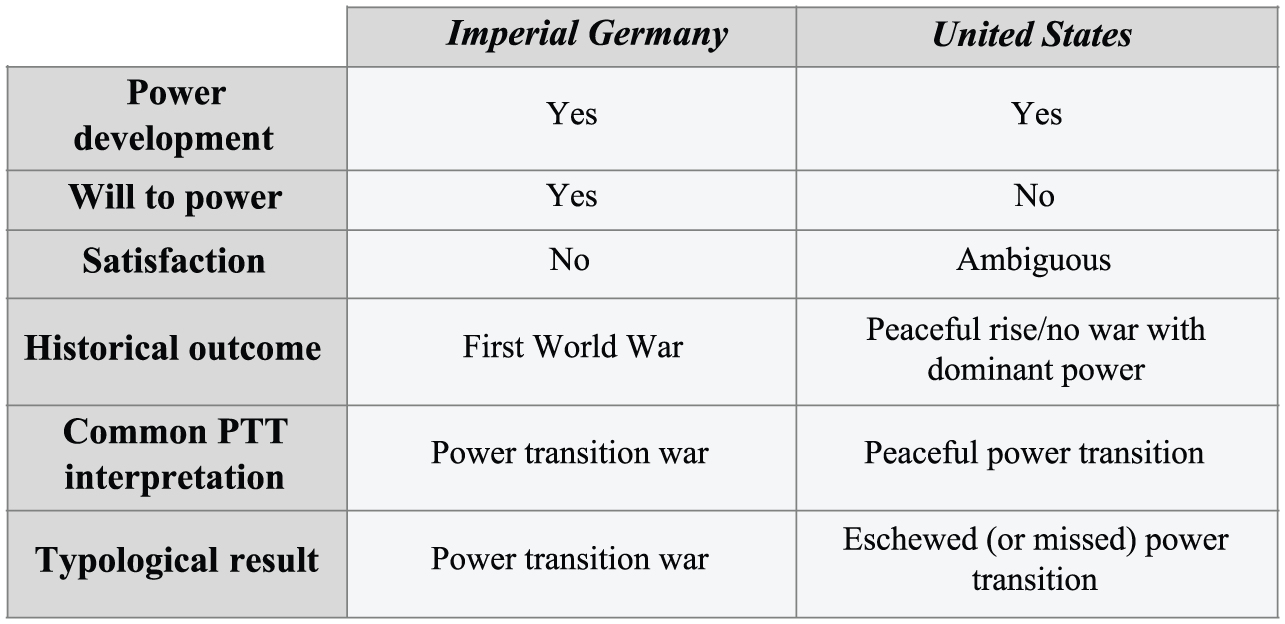
Results of the case studies.
At this point I would like to address two points that might interfere with my conclusions. Was peace between the United States and the United Kingdom perhaps overdetermined? And does not the complex power constellation in the 19th century have an impact on my results?
First, regarding a potential overdetermination of peaceful relations between the United States and the United Kingdom, it is true that both powers shared a unique bond that was based on cultural amity, a similar religion, a joined democratic system of governance, and membership (at least concerning the elites) of the same Anglo-Saxon nationality. However, while all of these factors did contribute to amicable relations after 1895 they didn’t prevent either the War of 1812 or sincere conflicts of interest fueling United States dissatisfaction in the 19th century. That is, even against the backdrop of factors overdetermining good relations, the United States was not satisfied for at least a large part of the 19th century. While not interfering with my general results, with regard to future power transition constellations, in the absence of these factors, between for example the United States and China, this might mean that much more hard work will be required to reach a stage of mutual satisfaction.
Second, regarding the power constellation, the 19th century was indeed more complex than standard PTT expects. 37 The United Kingdom was not just facing one but at least two rising powers in the United States and Germany, and also had significant tensions with a number of other Great Powers. It thus had to choose how to deal with these different rising powers. While the United Kingdom was neither absolutely hostile toward Germany nor absolutely friendly toward the United States (Rauch, 2014: 148–151), it makes total sense, within my framework, that it chose to rather accommodate the one rising power (the United States) that was showing relatively less dissatisfaction and much less WTP. Today, the power constellation is also more complex than traditional PTT would expect, but in a different way: among a number of rising powers, China—which is expected to overtake the United States in GDP terms by the end of the next decade—is clearly the prime contender. However, the United States has built a dense web of alliances involving the most powerful actors in the world (except Russia), while China’s only lasting alliance is with North Korea. 38 We should thus measure parity not in terms of China vs. the United States but rather in terms of China (+allies) vs. the United States (+allies), which means that there will probably be a little more time until the power transition constellation materializes.
Common wisdom’s treatment of PTT often cuts it down to statements such as “power transitions often lead to war” or “rising powers will challenge the dominant power for leadership in the international system.” In fact, as has been argued, even traditional PTT has never been this narrow. Besides the possibilities of a power transition war, the theory has always included the potential of peaceful power transitions.
Broadening PTT by including the factor of WTP, which enables the detection of power transitions in the narrower sense (in contrast to formal overtakings that can be called power transitions in the broader sense) widens the spectrum of power transition constellations. Besides peaceful power transition and power transition wars, we now can identify missed power transitions and eschewed power transitions. Going one step further and taking into account the possibility that the dominant power’s satisfaction with the status quo and its WTP not only matters but may also vary, we find that the number of potential power transition constellations can increase even further (Rauch, 2015: 10–12).
For the future of world politics and future power transition constellations this tells us that war and conflict are not inevitable! There is more than one way to skin a cat and there is more than one way a power transition constellation may be resolved.
The declining dominant power and rising powers can make policy choices that decrease the risk of power transition war, mainly by boosting each other’s satisfaction with the status quo of the international order. Doing so, while also taking into account the interacting partner’s WTP, is the best way to prevent a disastrous power transition war. Keeping a power transition constellation peaceful is demanding but possible, and discerning this possibility is the first step toward putting it into effect.
Footnotes
Acknowledgements
I thank Marco Fey, Harald Müller, Annika-Elena Poppe, and Elvira Rosert for their helpful comments on previous drafts of this article. I am further thankful for the constructive critique and feedback of the editors and anonymous reviewers at International Area Studies Review.
Declaration of Conflicting Interest
The author(s) received no financial support for the research, authorship, and/or publication of this article.
Funding
This research received no specific grant from any funding agency in the public, commercial, or not-for-profit sectors.