



Abstract
Coronavirus disease 2019 claimed more than three million lives worldwide in 2020, giving national governments the most urgent task for 2021 to achieve high vaccination rates to save lives. The World Health Organization declared that “vaccines are the most critical tool to end the pandemic and save lives.” In this context, South Korea (hereafter, Korea) achieved a remarkable milestone by outperforming the United Kingdom and the United States in vaccinations rate, where the world's earliest vaccination programs started. Thanks to its high vaccination rate, Korea recorded less than 100 deaths per million populations in 2021 compared to more than 1000 in the United Kingdom and the United States. Why Korea leaped ahead of the United Kingdom and the United States in rapid vaccinations that saved many lives? To answer this question, I first conceptualize contemporary Korea as a developmental state which retained its institutional capacity despite its transition from authoritarianism to liberal democracy, distinguishing it from the UK and the US's neoliberal regulatory states, where reforms hallowed out state capacity. I then advance two core claims. First, Korea surpassed the United Kingdom and the United States in vaccine rollout because of its developmental state-type goal-oriented autonomous policymaking and strong institutional capacity, manifested as Korea's central agency deployed a command and control vaccination program led by a coherent health bureaucracy. Second, the Korean state's strategic intervention in the market and its capacity to foster public–private partnerships to realize national goals boosted its vaccinations. Finally, the paper suggests how neoliberal regulatory states in the global north can learn lessons from the Korean experience in rebuilding state capacity to deal with the future global pandemic.
Keywords
Introduction
Coronavirus disease 2019 (COVID-19) pandemic claimed more than three million lives worldwide in 2020. This tragic situation gave national governments the most urgent task for 2021 to achieve high vaccination rates to save lives. The World Health Organization (WHO) declared that “vaccines are the most critical tool to end the pandemic and save lives and livelihoods (WHO, 2021).” Against that background, the national governments began rolling out vaccines and trying hard to vaccinate most of its populations to reach herd immunity soon. However, there were significant differences in vaccination rates in 2021 among peer-group countries. Indeed, differences were not just between high-income and low-income countries but also among advanced liberal democracies. After witnessing COVID-19 chaos in 2020, The United Kingdom and the United States, advanced liberal countries in the global north, began to roll out the earliest vaccination programs in the world in December 2020. On the other hand, South Korea (hereafter, Korea), an advanced liberal democracy in East Asia, began to roll out its vaccination program three months later than the United Kingdom and United States. Despite its late start, Korea outperformed the global north's two states in vaccination rates and saved many lives in 2021.
Figure 1 demonstrates a marked difference in COVID-19 vaccination rates between the United Kingdom, the United States, and Korea. Despite their early start of vaccine rollout in December 2020, the United Kingdom and the United States failed to vaccinate their majority populations in one year, as the share of people fully vaccinated by November 2021 accounted for 68% and 60%, respectively. By contrast, despite its late start on February 26, 2021, Korea achieved remarkable success and outplaced the United Kingdom and The United States by fully vaccinating 80% of its population by November 2021. This divergent vaccination rate resulted in the divergence in COVID-19 deaths: In 2021, while the United Kingdom and The United States recorded 1123 and 1433 COVID-19 deaths per million populations, Korea reported just 90 deaths per million populations due to its high vaccination rate. Consequently, while the United Kingdom and the United States witnessed a dark milestone in their history by recording 150,000 and 825,000 COVID-19 deaths by the end of 2021, Korea recorded just 5600 deaths, one of the lowest deaths globally (Our World in Data, 2021). One study found that COVID-19 vaccines saved an estimated 20 million lives across the globe during the first year after vaccination campaigns were initiated (The Economist, 2022). That suggests that the number of lives lost would have been significantly lower in the United States and the United Kingdom in 2021 if the majority populations were vaccinated rapidly. This raises intriguing questions: Why Korea leaped ahead of the United Kingdom and the United States in rapid vaccinations that saved many lives? Furthermore, how did Korea vaccinate its majority population in just nine months while the United Kingdom and the United States failed to do so?
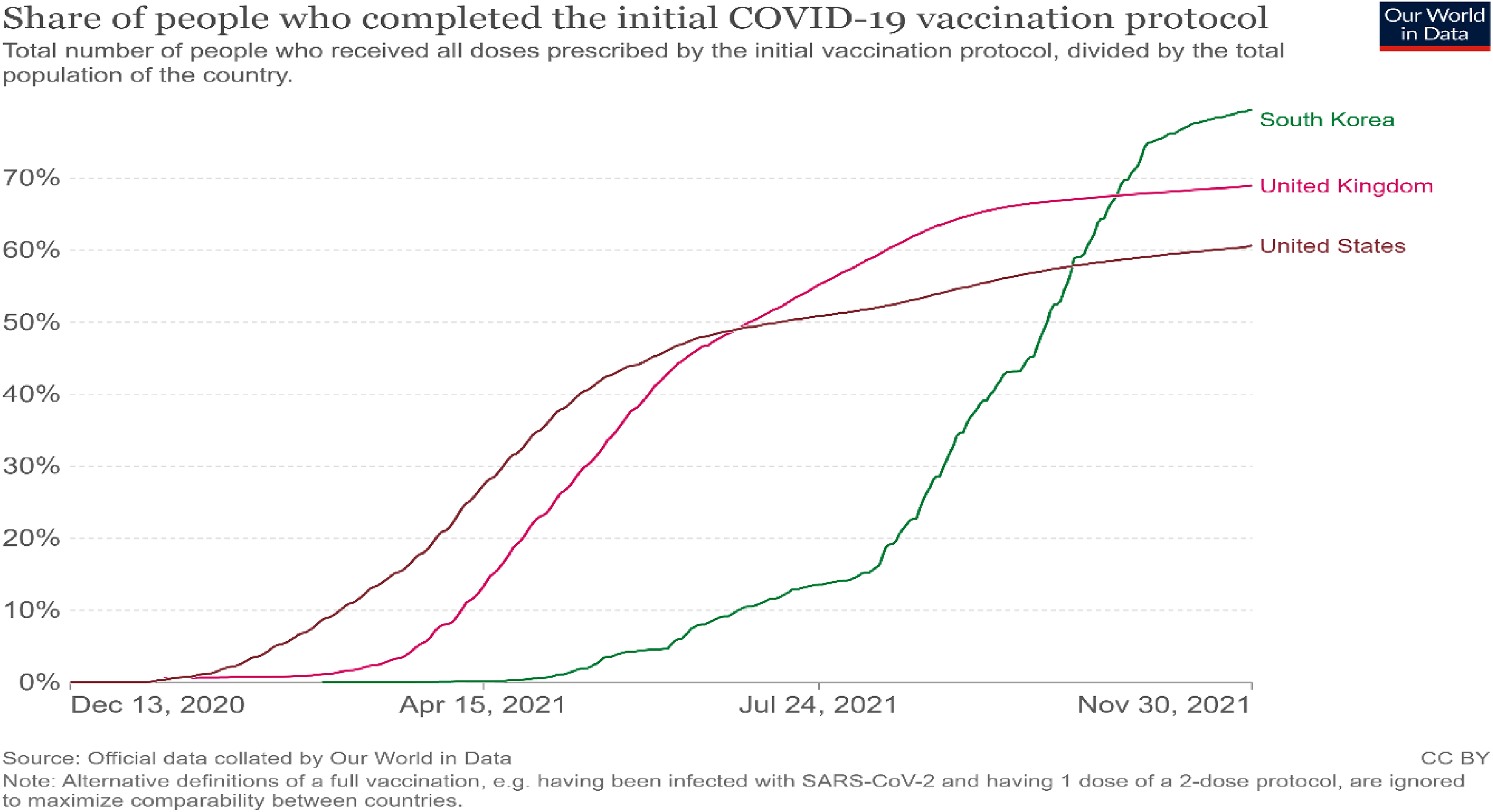
Share of the population fully vaccinated against coronavirus disease 2019 (COVID-19) in The United Kingdom, The United States, and Korea by November 2021. Source: Our World in Data (2021).
To answer these questions, I first conceptualize contemporary Korea as a developmental state which retained its institutional capacity despite its transition from authoritarianism to liberal democracy, distinguishing it from the UK and the US's neoliberal regulatory states, where reforms hallowed out state capacity. Then, I advance two core claims about why Korea outperformed the United Kingdom and the United States in vaccination rates in 2021. First, Korea surpassed the global north's two neoliberal regulatory states because of its developmental state-type “goal-oriented” policymaking and strong institutional capacity. Korean policymakers set a specific goal autonomously to vaccinate most of its population in just 9 months, stick to the target despite various challenges, and mobilize people behind this national goal. Then, to fulfill their goals, policymakers employed the key institutional feature of the developmental state by deploying a centralized, autonomous, command-and-control system led by a coherent health bureaucracy, the Korea Disease Control and Prevention Agency (KDCA). 1 Following the developmental state practices, policymakers in Korea drastically enhanced the power and authority of the KDCA vis-à-vis local government and society, which was crucial to implementing a rapid vaccine rollout. Second, the Korean state's developmental state-originated strategic intervention to foster public–private partnerships to realize national goals boosted its vaccinations. During Korea's rapid vaccination programs, various policy-related success stories emerged based on government-business collaboration. Korea's central authorities played critical roles in fostering public–private partnerships to realize national goals, including taking timely policy initiative; planning and coordination between public and private agencies; providing funds, technology, and workforce to private sectors.
In doing so, this empirically-grounded analysis contributes to a new emerging literature that examines Korea, the US, and the UK's policy responses to the pandemic in a comparative perspective and argues that the institutional capacity is critical to understanding the management of the first wave of COVID-19 (Kumar, 2021; Jones and Hameiri, 2022). This article is structured as follows: After this introduction, I will first discuss the analytical framework of this study. Then, the following two sections will provide empirical illustrations. Finally, I summarize contributions, limitations, areas of future research, and lessons learned from this study's findings to manage global health crises.
Analytical framework
The paper builds on the developmental state literature to explain why Korea leaped ahead of the United Kingdom and the United States in rapid vaccinations that saved many lives. Let me first explain the origin and evolution of the developmental state concept. Emphasizing state-type matters, Johnson (1982) was the first scholar to conceptualize the developmental state by distinguishing it from the regulatory state. His main goal was to provide an empirically grounded explanation for why the developmental state can outperform the regulatory state on the same benchmark if a widely agreed-upon set of overarching goals exists for society (Johnson, 1982: 22). Drawing on Johnson's seminal work, Amsden (1989), Wade (1990), and Evans (1995) further elaborated on Korea as a developmental state and explained why this concept is significant to understanding Korea's success in realizing its “national goal” in the late twentieth century, that was industrial transformation. However, some key domestic and international changes—such as Korea's democratization, rise of left-leaning progressive governments, the growth of the neoliberal regulatory ideas in the post-Cold War era, and the 1997 Asian economic crisis—led to the rise of the “declinist school” (Jayasuriya, 2001, 2005; Pirie, 2008). This declinist school claimed the demise of the Korean developmental state and the rise of the global north-type neoliberal regulatory state in Korea, where the state no longer plays an active role in realizing its goals. However, some recent emerging literature on the Korean developmental state has challenged the “declinist school” propositions and found path dependence regarding the Korean developmental state. Based on this new literature, I demonstrate below that contemporary Korea cannot be conceptualized as a neoliberal regulatory state. Instead, it is still a developmental state critical to understanding why Korea outperformed the global north's neoliberal regulatory states, the United Kingdom and the United States in vaccinations.
Conceptualizing the contemporary Korean state and distinguishing it from the neoliberal regulatory state
What is the nature of the contemporary Korean state? How is it different from other advanced liberal democracies, especially neoliberal regulatory states? Based on classic and emerging scholarship, I found the durability of two key characteristics of the developmental state in today's Korea that distinguish it from the contemporary neoliberal regulatory states in the global north.
(1) The durability of goal-oriented policymaking and a centralized response system led by coherent bureaucracy
Classic literature on the developmental state distinguishes the Korean developmental state from the regulatory state because of its goal-oriented policymaking and centralized command and control system led by coherent bureaucracy. This developmental state-type policy approach has two set-ups that show strong state capacity. First is the ideational foundation: The Korean developmental state was best understood in terms of goal-oriented policymaking, which stands in contrast to the procedure-oriented policymaking of the regulatory state. The second is the institutional foundation: The Korean developmental state was best conceptualized in terms of a centralized response led by coherent bureaucracy to realize policy goals, which stands in contrast to the decentralized execution of the policy of the regulatory state. The contemporary Korean state has retained both core set-ups of the developmental state. How?
Korea is conceptualized as an archetypal developmental state, primarily because of its ideational level state capacity to set its policy goals. Johnson (1982: 19–20), categorically highlighted the most crucial feature of the developmental state as policymakers’ capacity to set substantive social and economic goals, which is in marked contrast to a regulatory state which concerns itself with the forms and procedures. Thurbon (2016) highlighted that Johnson's ideational level differences between the developmental state and the regulatory state are indeed significant to understanding the contemporary nature of the Korean state, which retains the classic attribute of the developmental state. Indeed, contrary to advanced democracies in the global north, which marched toward a more regulatory state in the era of globalization where rules and procedures became more critical (Majone, 1994, 1997), the Korean state retained its ideational level state capacity to set its policy goals. Ample research supports this argument. Thurbon’s (2016, 2020) agent-centered analysis and Kim (2012) and Dent’s (2018) works on the evolution of the Korean developmental state in the post-Asian economic crisis era challenge the declinist school. They suggest that contemporary Korea is still an archetypal developmental state, primarily because policy elites’ mindset is still goal-oriented, and they are dedicated to executing long-term strategies. Therefore, the existence of the “goal-driven agents” is critical to explaining the divergent national responses to the COVID pandemic, as also highlighted by Weiss and Thrubon (2022) latest work on the pandemic.
Besides ideational foundations, institutional foundations, such as a centralized response system and deployment of an empowered centralized pilot agency led by powerful bureaucrats, are also central to distinguishing the Korean developmental state from a regulatory state (Johnson, 1982; Thurbon, 2016). The contemporary Korea retains these institutional foundations for policy implementations despite its transition from authoritarianism to advanced liberal democracy. This development distinguishes it from the global north's regulatory states, where regulatory reforms, decentralization, and a gradual shift from government to governance hallowed out the state's institutional capacity (Chodor and Hameiri, 2022; Jayasuriya, 2001; Jones and Hameiri, 2022). Indeed, Korea, despite becoming an advanced liberal democracy, maintains its tradition of empowering centralized pilot agencies under the leadership of bureaucrats to execute various national tasks. Chu (2021) and Kim (2019) argue that there is a high level of path dependence regarding Korea's institutional evolution of creating and empowering the centralized pilot agency led by autonomous bureaucracy to implement specific takes for the nation. Positive feedback effects played a role in continuing this core institutional feature of the Korean developmental state. As Kim and Thurbon (2015) highlighted, the continuation of empowering centralized pilot agencies results from Korean policymakers’ mindset that a powerful centralized agency is essential to achieve desirable results. Lee and Kim’s (2018) works show how Korea has retained the primacy of the bureaucracy-led policy implementation system despite its democratization. The left-leaning progressive government led by Moon Jae-in, who tried to break away from the developmental state practices, also heavily relied on the traditional developmental state's institutional foundations and utilized them to control the first wave of the COVID-19 crisis in 2020. This policy approach led Kumar (2021) to contend that Korea succeeded in 2020 due to the Moon administration's utilization of developmental state practices. As he highlighted, the Moon administration built state capacity by empowering a centralized pilot agency, the KCDC, which was autonomous with regard to policy making.
(2) The continuity of the state's strategic intervention to foster public–private partnerships to realize national goals
The founders of the developmental state concept also distinguish the Korean developmental state from the neoliberal regulatory state because of the state's active strategic intervention in the market and its capacity to foster effective public–private partnerships to realize national goals. According to Johnson (1982: 19), the developmental state is markedly different from the neoliberal regulatory state in actively promoting government-business partnerships. Building on Johnson's work, both Amsden (1989) and Wade (1990) demonstrated why East Asian developmental states’ intervention in the market differs from neoliberal regulatory states and why these differences were vital to understanding their success in realizing their policy goals in the twentieth century. Amsden's (1989) empirically grounded work on the Korean developmental state demonstrated how the state was responsible for the private sector's success as it played various roles in fostering public–private partnerships to achieve national goals. In the East Asian developmental state, the state also did a “coordination function” to alter the behavior of private players to take risk (Amsden, 1989, Wade, 1990: 29).
The current Korean state retains these developmental functions regarding fostering government-business collaboration to realize national goals; hence, many emerging pieces of literature challenge the declinist school's claims that the developmental state is dead in Korea. Thurbon's (2016) recent classical work on the revival of the developmental state in Korea is a noteworthy example. She distinguished the contemporary Korean developmental state from the neoliberal regulatory state while highlighting that if there is a “high level of consensus amongst policymaking elite around the primacy of goal,” the state provides various supports to the private sector to realize its goal. Similarly, drawing upon the logic of “Governed Interdependence,” Thurbon joined her frequent co-author Weiss to distinguish the current Korean state's economic statecraft from those of the US's neoliberal regulatory state. They suggest close public–private partnerships still took place in Korea toward desired outcomes for the country (Thurbon and Weiss, 2021; Weiss and Thurbon, 2021). Haggard (2018) and Wade (2018) also argued that it is premature to say the Korean developmental state is dead. Klingler-Vidra and Pacheco-Pardo (2019, 2020) show that the Korean state is still an archetypal developmental state that monitors and coordinates private sector activities and even fosters collaboration among Government-SMEs-Chaebols to realize policy goals. Above all, as some studies show, the Moon government's strategic intervention and public–private partnerships were critical for Korea's success in the timely and sufficient production and export of test kits in 2020 (Kumar, 2021; Park and Chung, 2020). In sum, the practice of fostering government-business collaboration to realize national goals remained intact in Korea, despite various domestic and international changes in recent decades.
Hence, one can argue that the developmental state is alive in contemporary Korea. The persistence of the Korean developmental state—which is significantly different from the global north's neoliberal regulatory states in terms of its ideational and institutional foundations of policy implementations and organizing public–private partnerships—is vital to explaining why Korea outperformed the United Kingdom and the United States in rapid vaccine rollout that saved many lives.
Empirical illustrations part 1: Ideational and institutional foundations of rapid vaccine rollout
This section will provide empirical illustrations of how Korea's developmental state-oriented ideational and institutional foundations paved the way for Korea to leap ahead of the United Kingdom and the United States in vaccination rates. It will delve into the ideas and institutions that facilitated the swift implementation of Korea's vaccination program. It will also compare this efficient rollout to the slower ones in the UK and US. Moreover, this section will present a comprehensive case study analyzing how diverse institutional abilities have resulted in distinct policy strategies for executing vaccine passports in Korea, the UK, and the US.
Ideational foundation: The Moon administration's goal-oriented policymaking
As Johnson (1982) and Thurbon (2016) pointed out, goal-oriented policymaking is the most significant feature of the developmental state that distinguishes it from the neoliberal regulatory state. This developmental state approach is vital to explaining Korea's policymaking concerning the COVID-19 vaccination. Indeed, one of the significant characteristics of Korea's vaccination policy was that policymakers were goal-oriented rather than procedure-oriented from the beginning. Policymakers in Korea designed vaccination policy autonomously and set a specific target to vaccinate the people before consulting with society, which in turn demonstrated the Korean state's strong capacity. To illustrate, when the majority of Korean were reluctant to take the vaccine in February 2021, 2 policymakers launched a goal-oriented herd immunity policy, widely known in Korea as “Jipttan Myonyok” (집단면역). Under this herd immunity policy, policymakers set a target to vaccinate more than 70% of people by November 2021 despite Korea's delayed start to vaccinations compared to the United Kingdom and the United States. Prime Minister Chung asserted that Korea will achieve its target as it is a master of speed and that the government will persuade people to realize this policy goal (Bicker, 2021). Since then, “To achieve herd immunity by November” became the most crucial rhetoric of Korean policymakers and health officials as they began to mobilize people behind the national goal. 3
To illustrate, President Moon repeatedly highlighted the government's commitment to realizing the herd immunity goal in every briefing at the high-level meeting regarding the COVID-19 response (see Table 1). The MOHW and the KDCA also frequently released official statements that Korea would achieve its target by November (see, e.g., MOHW, 2021a; KDCA, 2021a). More importantly, Korean policymakers remained committed to attaining their goals throughout the vaccination drive, despite various domestic and international challenges. Indeed, whenever an atmosphere of doubt arose, the President and other officials spoke with one voice that the government would achieve its set goal in any case. For example, when there was growing public concern about realizing the “herd immunity” goal due to the vaccine supply shortage in July–August 2021, President Moon and his officials insisted that the government would accomplish its goal within the stipulated time (see, e.g., KPB, 2021a, 2021b). Throughout this goal-oriented policy approach, policymakers and officials were as transparent as possible to build a national consensus to attain their policy goals. For example, Korean health officials regularly briefed the people on the COVID-19 situation transparently, which was not the case in many regulatory states where politicians influenced health officials’ briefing through political pressure (Kumar, 2021: 9). To build national consensus, Jung Eun-kyeong, the head of KDCA, often briefed people about the vaccination programs and systematically responded to people questions raised at the Blue House online petition system (known in Korea as CheongWaDae Gungminchongwon, 청와대 국민청원). 4 Consequently, this approach yielded positive results as people responded with significant enthusiasm to achieve national goals regarding vaccinations. 5
Illustration of policymakers’ developmental state-style goal-oriented approach to realize policy goals concerning vaccination.
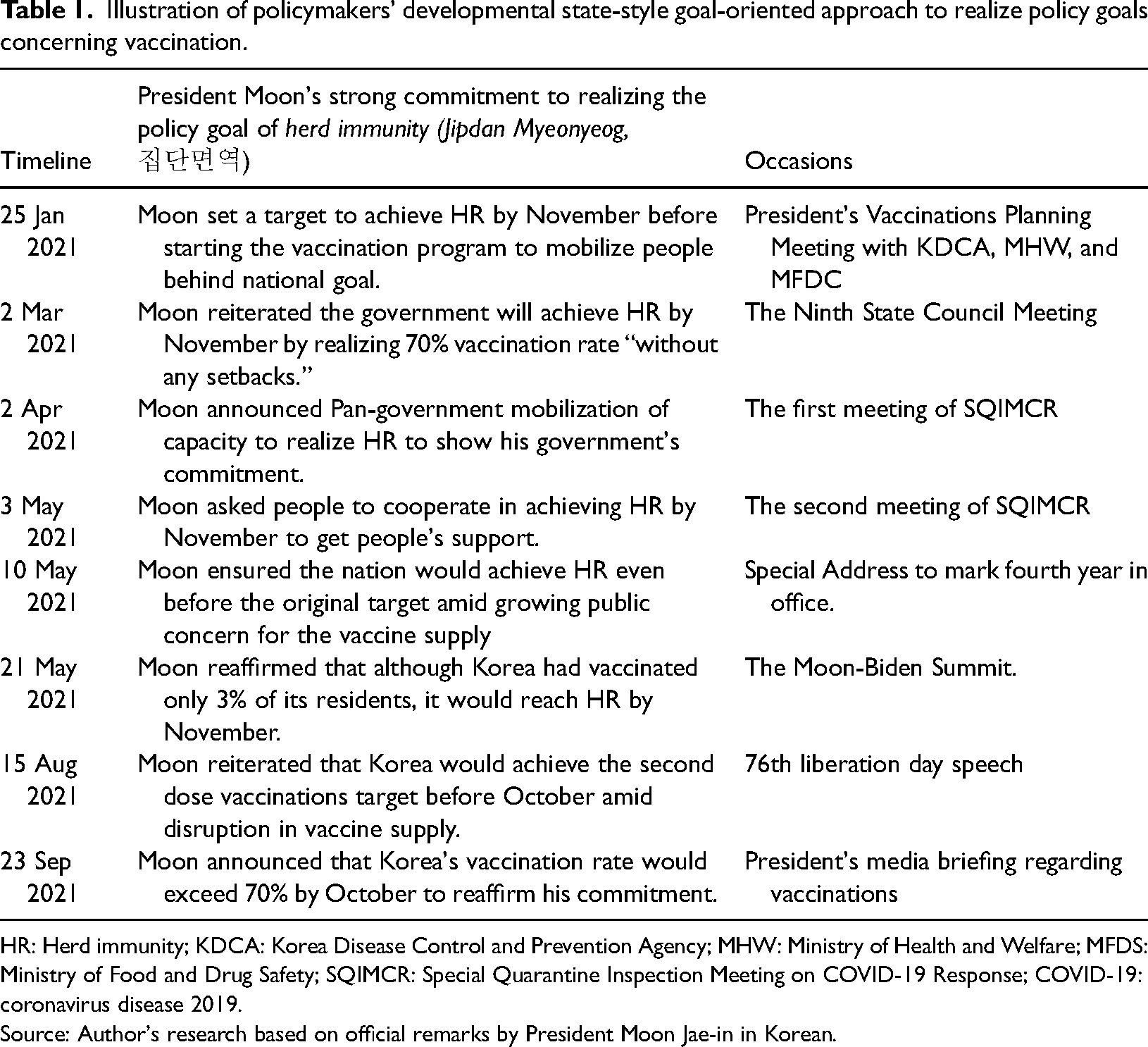
HR: Herd immunity; KDCA: Korea Disease Control and Prevention Agency; MHW: Ministry of Health and Welfare; MFDS: Ministry of Food and Drug Safety; SQIMCR: Special Quarantine Inspection Meeting on COVID-19 Response; COVID-19: coronavirus disease 2019.
Source: Author's research based on official remarks by President Moon Jae-in in Korean.
This goal-oriented herd immunity policy was critical to understand Korea's rapid vaccinations from a comparative perspective. On the one hand, as discussed above, Korean policymakers were goal-oriented and committed to realizing their policy goal; hence, they built a national consensus on vaccinations. However, policymakers frequently changed the vaccination targets in neoliberal regulatory states due to various political and procedure-oriented calculations. Weiss and Thurbon (2022: 12) highlighted the “goalless action” of UK Prime Minister Johnson. Prime Minister Johnson announced in February 2021 to vaccinate all UK adults in the next five months and then abandoned his plan in July 2021 by publicizing to end all COVID restrictions despite scientists’ warnings and a relatively low vaccination rate. In the United States also, policymakers were not committed to a specific goal: For example, in June 2021, the White House admitted that the United States would miss President Biden's original goal and that the nation needed a few extra weeks (Villarreal, 2021). Policymakers in other neoliberal regulatory states were also aimless about vaccination targets as they often revised or even dropped their initial vaccination targets and plans, stemming from a lack of state capacity to achieve the task (Chodor and Hameiri, 2022, 15–20). Some observers explained that policymakers’ such actions as “to abandon vaccination goals is to abandon the mantle of leadership” (Gahan and Olsen, 2021). Equally significant, unlike Korea, policymakers in neoliberal regulatory states did not pay much attention to building a national consensus on vaccinations. That, in turn, contributed to a slow vaccine rollout. According to one study, low trust in the government affected vaccinations in the United Kingdom (University of Oxford, 2021). In the United States too, as Fukuyama (2020) highlighted, leaders’ incompetent actions spread political and social polarizations that divided society over vaccinations. The point here is that the Moon administration's vaccination policy was goal-oriented and remarkably consistent with developmental state practices that, in turn, laid the solid foundations of Korea's vaccination programs.
Institutional foundations: Deploying a centralized command and control system led by a coherent health bureaucracy
After setting the specific target, Korean policymakers employed the key institutional feature of the developmental state to fulfill their predetermined goals regarding vaccinations. That institution feature includes deploying a centralized command and control response system led by a coherent health bureaucracy. Indeed, Korea's vaccination program differed from the neoliberal regulatory states. For example, some studies pointed out that the United Kingdom and the United States employed a decentralized, fragmented response system to deal with the first wave of the COVID-19 crisis that exposed massive failure in 2020. As Jones and Hameiri (2022: 11) highlighted, no one was authoritatively in charge of neoliberal regulatory states’ pandemic response policy. Neoliberal regulatory states’ approaches regarding vaccine rollout remained the same: Decentralized, fragmented, and overreliance on regional and local administrations (see, Chodor and Hameiri, 2022; DHSC, 2021; Pullano, 2021). By contrast, Korean policymakers adopted a centralized command and control vaccination program led by a coherent health bureaucracy consistent with the developmental state practices. Before starting the country's vaccination program, President Moon, on 15 January 2021, announced the KDCA-led centralized vaccination program under the leadership of health official Jung Eun-kyeong. This announcement categorically mentioned that the KDCA would act like a “control tower” and have “full authority” to lead the country's five-stage vaccination program, from vaccine approval, transport, storage, and distribution to vaccination preparation and rollout. In addition, various ministries and local governments were deployed as supporting and implementing agencies (see Figure 2). Above all, the fact that all decision-making powers regarding implementing the vaccine pass were vested in the KDCA illustrates that Korea had a powerful central agency led by a health professional. This made a big difference, as discussed below in the case study.
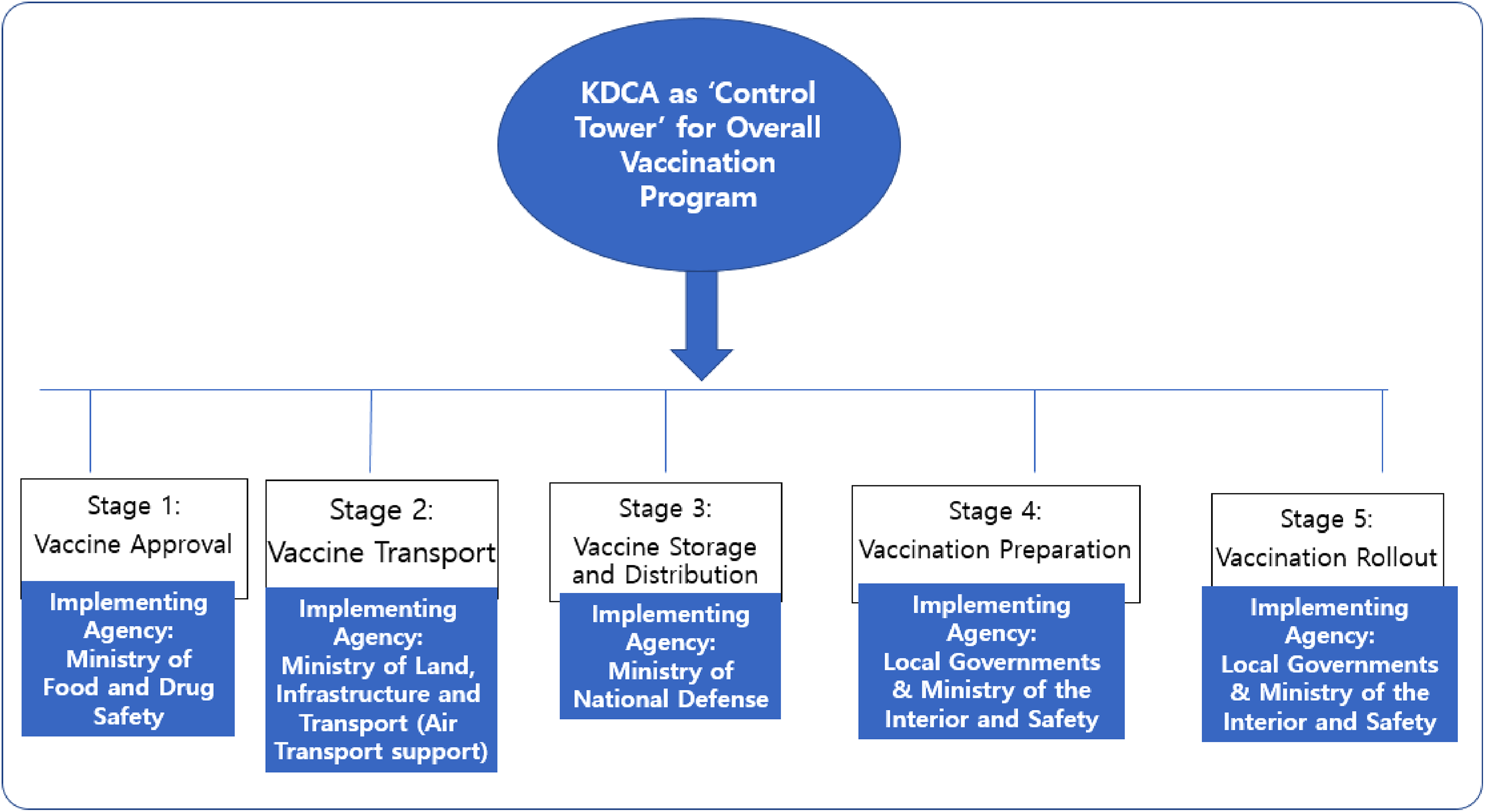
Korea's KDCA-led centralized vaccination program. Source: Author's analysis based on KPB (2021c) and interviews with officials at local governments of Gangwon, Gyeonggi, North Chungcheong, South Jeolla provinces.
Enhancing the capacity of the central health authority also holds the key to understanding the speedy realization of national tasks regarding vaccination. As Jones and Hameiri (2022) explained, the neoliberal regulatory states avoided any additional capacity commitments to the central agency and health officials to deal with the first wave of the crisis. The UK parliament passed the Coronavirus Act in 2020 to give some authority to health officials but also immediately demonstrated its willingness to dissolve it, which was interpreted as a regulatory state approach (Jones and Hameiri, 2022: 16). This was also true during the vaccination drive. During the vaccination rollout, the UK lawmakers were less interested in enhancing the capacity of health authorities vis-à-vis society and more interested in abolishing the Coronavirus Act. Thanks to lawmakers’ demand, Health Secretary Matt Hancock announced the removal of 12 provisions of the act in March 2021 (BBC, 2021a). The United States also did not provide any additional power to the central agency to implement rapid vaccination. In fact, during the COVID pandemic, US lawmakers were busy passing laws since 2020 that limit officials’ public health powers. As one report suggests, “over half of states have rolled back public health powers in the COVID pandemic” (Weber and Achenbach, 2023). In contrast, Korean policymakers drastically enhanced the capacity of the KDCA and made it an autonomous powerful pilot agency. This move was remarkably in agreement with the key idea of the developmental state practices, in which policymakers enhance a central agency and its officials’ capacity to achieve their desired goal.
How did a health bureaucrat-led KDCA become an autonomous powerful pilot agency in an advanced liberal democracy like Korea? Korea's three pandemic-related national assembly acts, amended and enforced by policymakers, are essential to discuss here. First is the Infectious Disease Control and Prevention (IDCP) Act. After the Middle East Respiratory Syndrome (MERS) outbreak in Korea in 2015, Korea amended the IDCP Act. As such, they made the KDCA's former avatar, the KCDC, a powerful and autonomous agency. Moreover, Policymakers amended the IDCP Act 8 times from February 2020 to December 2021 to provide necessary powers and authorities to the KDCA vis-à-vis society to contain the coronavirus and implement rapid vaccination (see KLIC, 2021a). Second, after the positive feedback on the KDCA's role in containing the first wave of COVID-19, President Moon elevated the KDCA to an “independent agency” in September 2021 by approving “KCDC and its Affiliated Organizations” Act (KLIC, 2020). Indeed, this Act strengthened the KDCA's “command-and-control” power vis-à-vis central ministries and local governments. 6 The Act also enhanced KDCA's capacity regarding human resources, financial power, and pan-Korea reach, which was critical for the rapid implementation of a centralized vaccination program (KLIC, 2020). Third, Korean policymakers also established “the COVID-19 Vaccination Response Promotion Team” under the KDCA's leadership and gave health officials more power. Through this Act, policymakers empowered the KDCA to play a lead role in all vaccine-related issues, including securing and supplying all necessary equipment for COVID-19 vaccination (KLIC, 2021b), which was critical to fostering public–private partnerships in Korea, as discussed in detail below.
To sum up, the Korean development state's institutional capacity during the vaccination was far more coherent than those of the global north's neoliberal regulatory states like the United Kingdom and the United States. That was a significant reason why Korea surpassed the UK and US vaccination rates. The following case study reinforces this claim.
Cast study: Verities of institutional capacity and divergent policy responses to vaccine pass implementation
The United States and United Kingdom witnessed substantial regional differences in vaccination rates, which was a significant reason for their overall low vaccination rate. In the case of the United States, significant regional differences in vaccination rates were seen between Northeastern states and Sothern states, which was a major reason why vaccine rollout in the country was slowed down during the first half of 2021 (Horton, 2021). Similarly, the United Kingdom also witnessed a substantial regional difference in vaccination rates, given that while Wales was leading, Northern Ireland was lagging (BBC, 2021b). In contrast to the United States and the United Kingdom, Korea's vaccination story differed. Every province in Korea recorded a similar vaccination rate during the whole vaccination program in Korea. Why? This case study will briefly show how verities of institutional capacity gave rise to the divergent policy responses to vaccine pass implementation, which in turn was responsible for differences in vaccination rates.
To realize its policy goals, Korea implemented the world's earliest systematic COVID-19 vaccine pass, commonly known in Korea as “Bangyok Paesse” (방역패스), in April 2021. Conversely, policymakers in the United Kingdom and the United States were reluctant to implement vaccine passes despite their low vaccination rate following the growing public opposition. Moreover, Korea's vaccine pass implementation method differs from the global north's regulatory states. As Table 2 demonstrates, the KDCA imposed a developmental state-type centralized vaccine pass for the whole country of Korea. In contrast, in the United Kingdom and the United States, it was implemented in a decentralized manner in which regional governments had the authority to decide whether to enforce the pass or delay it. Also, a bureaucrat-led KDCA acted as an autonomous agency with complete control regarding the vaccine pass compared to the United Kingdom and the United States, where politicians took vaccine pass decisions. The UK Politician Sajid Javid's abandoning of the vaccine pass plan in September 2021 is a case in point. 7 A marked difference in electronic vaccination apps and personal data collection is also noted. In Korea, As the IDCP act empowered the KDCA, it carried out a nationwide centralized vaccination App. A unified electronic certificate was issued to vaccinated people all over Korea, including personal information, name, and age. The central authority collected the personal information of vaccinated people from local governments and centrally preserved them. Provincial governments needed to submit the date to the central authority. The authority also centrally monitored the unvaccinated people; those who were unvaccinated often got messages and phone calls from the KDCA to get vaccinated soon. 8 That centralized approach was missing in the United Kingdom and United States (see Table 2).
A comparative table of centralized authority's institutional capacity regarding vaccine pass.
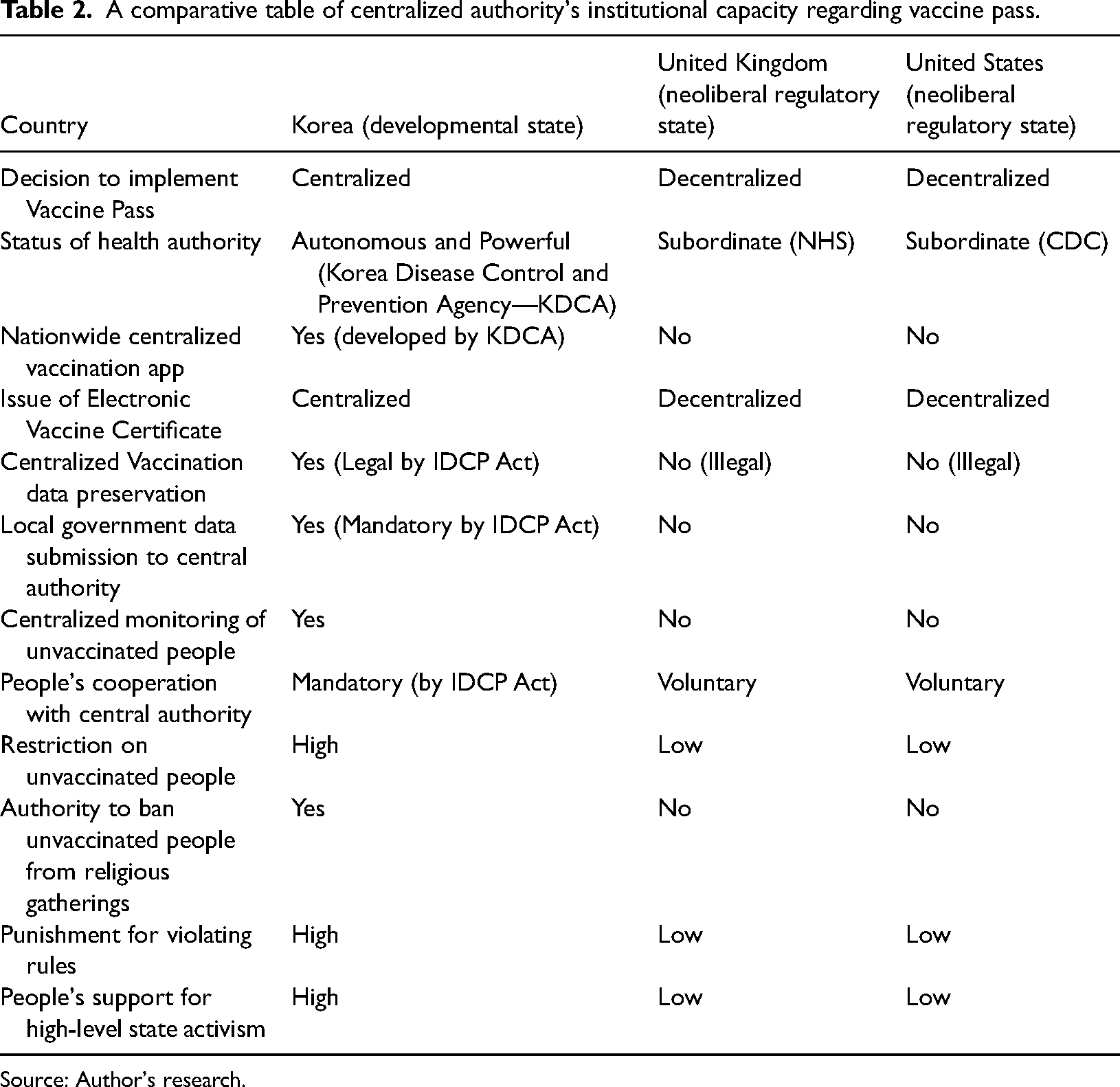
Source: Author's research.
There was also a significant difference in the central health authority's institutional capacity vis-à-vis society in the two systems during the vaccine pass implementations (see Table 2). Korean health authority's institutional capacity vis-à-vis society was much higher than neoliberal regulatory states, given that the IDPC Act made people’ Mandatory’ to cooperate with the central administration during the vaccination. The KDCA created an environment restricting unvaccinated people's moves to achieve the vaccine target. Utilizing the IDCP Act, the KDCA adopted a vaccine incentive policy in 2021: On the one hand, it allowed vaccinated people to move freely; on the other hand, it made unvaccinated people's life hard by restricting them from entering restaurants and cafes to banning the use of public facilities such as museums and libraries, to putting unvaccinated people in forced quarantine if they came from abroad. It also restricted unvaccinated people's activities for religious and festival gatherings, such as the Chuseok festival in September 2021. 9 In the United Kingdom and the United States, the authority could not put Korea-type restrictions on unvaccinated people due to weak institutional capacity and public opposition. Moreover, as the IDCP Act provided power to the KDCA regarding financial punishment to those individuals or businesses who violate vaccine-pass-related regulations, the authority utilized this power to enhance vaccination. Above all, people's support for high-level state activism was also critical for Korea's fast vaccinations. Unlike the global north, which witnessed widespread anti-vaccination protests, the Korean people supported the central authority's proactive action for rapid vaccination. That conformed to Weiss and Thurbon's (2021) conceptual characterization of state-society relations in the contemporary Korean developmental state, where people willingly accept the state's institutional supremacy in pursuing national goals.
Empirical illustrations part 2: The state's strategic intervention and the effective implementation of public–private partnerships to realize vaccination goal
This section will provide empirical illustrations of how the state's strategic intervention to foster public–private partnerships to realize national goals played a crucial role in rapid vaccinations in Korea. It will first describe an effective implementation of Korea's public–private partnerships in Korea, contrasting this with the experience of the UK and the US and then explain this outcome based on the developmental state framework. Additionally, this section will offer a detailed case study that examines how Korea surpassed neoliberal regulatory states in the production of vaccine-related medical equipment and increased its vaccination rate.
Describing effective implementation of Korea's public–private partnerships in comparative perspective
Recent scholarly works and policy reports identified the neoliberal regulatory state's massive reliance on public–private partnerships and private sector outsourcing as the primary reasons for the COVID-19 mismanagement. For example, Jones and Hameiri (2022) and the British Medical Association's report (BMA, 2020) provided a detailed analysis of how public–private partnerships collapsed in the United Kingdom, a significant reason for this country's failure to manage the pandemic. A people's inquiry also found that the “UK government's reliance on private sector contracts is a key reason for the country's high pandemic death rate (BMA, 2021).” Equally remarkable, the United States also witnessed an enormous shortage of medical equipment as the domestic private player could not produce them. Consequently, it relied heavily on imports (FRBSL, 2020). Furthermore, as described below in the case study, the United States and other neoliberal regulatory states’ vaccination program was also hampered due to critical medical equipment shortages, such as low dead space (LDS), stemming from ineffective public–private partnerships.
In contrast, a close analysis of Korea's pandemic management policy suggests that Korea's rapid vaccine rollout is mainly due to the success of several public–private partnerships. I will focus on four such stories (Table 3). First, the KDCA quickly developed the world's first blockchain-based vaccination electronic certification system, the COOV App, through collaboration with an SME, Blockchain Labs. Consequently, Korea launched this App nationwide as early as April 2021. According to the KDCA, around 14 million people downloaded the electronic certificate through this App by October 2021, which helped health authorities implement a nationwide vaccine pass system that boosted vaccination rates (KDCA, 2021b). Second, the KDCA developed an effective vaccine reservation system through collaboration with another SME, Bespin Global. This system enabled simultaneous access for 12 million people in 10 min. According to the KDCA and MSICT, this system significantly boosted vaccination rates from July to September 2021, when there was a great rush to book the vaccination slots. Third, the KDCA implemented the “residual vaccine” policy (Janyo Baekssin, 잔여 백신) in May 2021 in collaboration with Korean internet giant, Kakao. This innovative scheme allowed non-priority groups of 30 or older to make real-time reservations to get the jab with unused residual vaccines at neighborhood clinics and hospitals. Finally, Korean authorities effectively boosted vaccination rates through the timely production of LDS syringes through a practical collaboration with a private player, PoongLim.
State's strategic intervention and success of Public-Private Partnerships (PPPs) in Korea
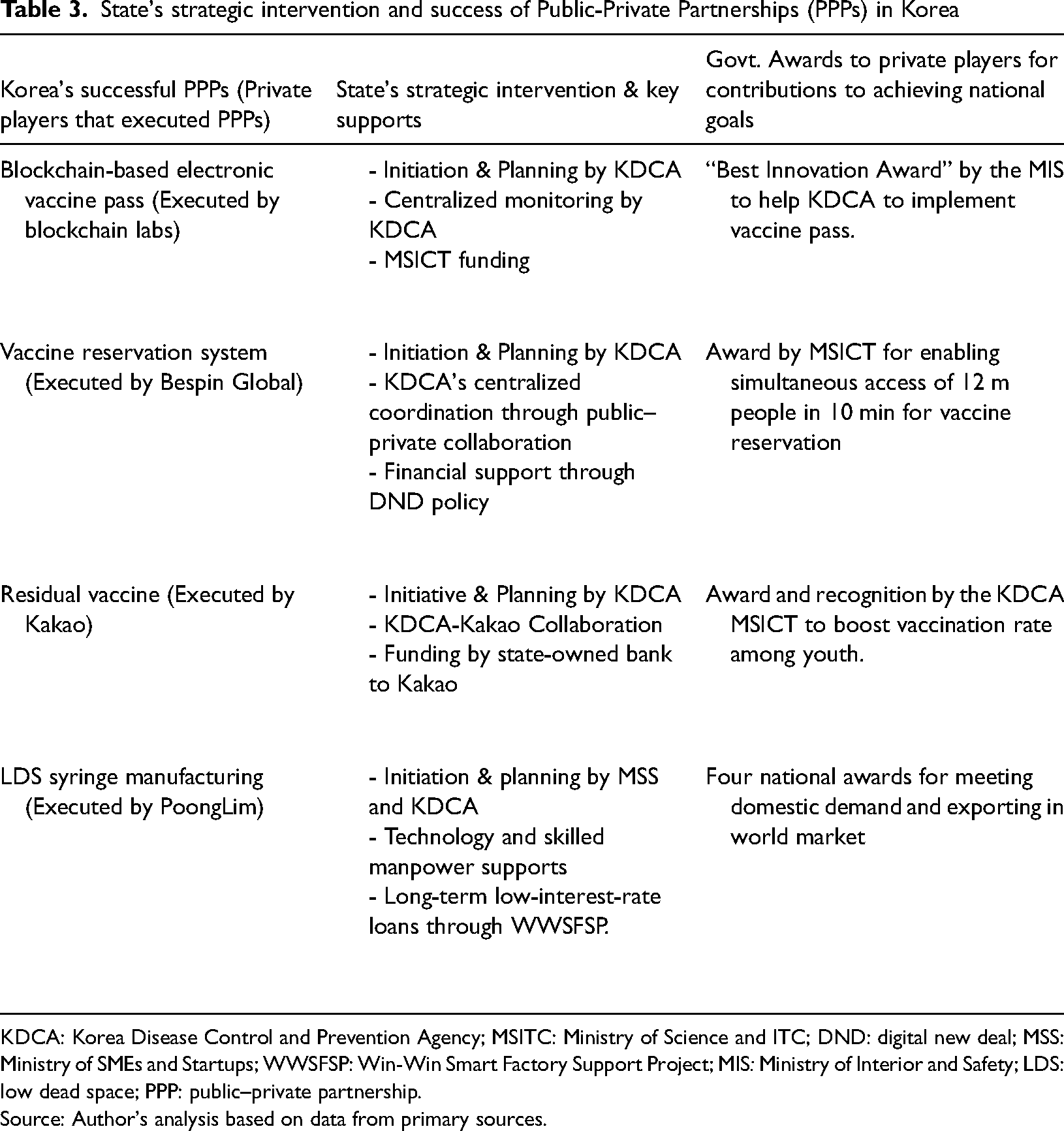
KDCA: Korea Disease Control and Prevention Agency; MSITC: Ministry of Science and ITC; DND: digital new deal; MSS: Ministry of SMEs and Startups; WWSFSP: Win-Win Smart Factory Support Project; MIS: Ministry of Interior and Safety; LDS: low dead space; PPP: public–private partnership.
Source: Author's analysis based on data from primary sources.
Explaining the effectiveness of public–private partnerships: The developmental state at work
What explained the effective implementation of public–private partnerships in Korea? It can be directly attributed to the state's strategic intervention to foster public–private partnerships to realize national goals. I will briefly explain three policy successes here and then take a detailed case study on the LDS syringe. First, the success of Korea's blockchain-based electronic vaccine pass system is a consequence of the Korean state's developmental state practices, first by playing the role of initiator and then providing practical support for the public–private partnership. Indeed, the KDCA officials first devised an electronic vaccine pass and then went to identify a potential private player that could deliver this task. 10 In the process, the official selected Blockchain Labs, an SME, based on a developmental state approach, which promotes the idea of giving a specific task to a specific company to realize a national goal. Moreover, the state closely monitored and provided massive funding for this project. 11 Equally significant, the state also played a crucial role in effectively implementing the vaccine reservation system. To illustrate, the KDCA developed a vaccine reservation system (ncvr.kcda.go.kr) through a public–private partnership. However, when the reservation was suspended due to a system error and private players declared their inability to fix this system soon, the KDCA did not leave this issue to be resolved by market forces. 12 Instead, it immediately came to play a leading role in sorting out this problem to meet the vaccination target. It immediately established a public–private joint task force, gave specific tasks to capable agencies, and resolved this issue in two weeks, which might have taken months if the KDCA would not intervene (see Figure 3). 13 The KDCA also initiated and actively collaborated with Kakao to execute the residual vaccine policy effectively to meet the national goal. 14
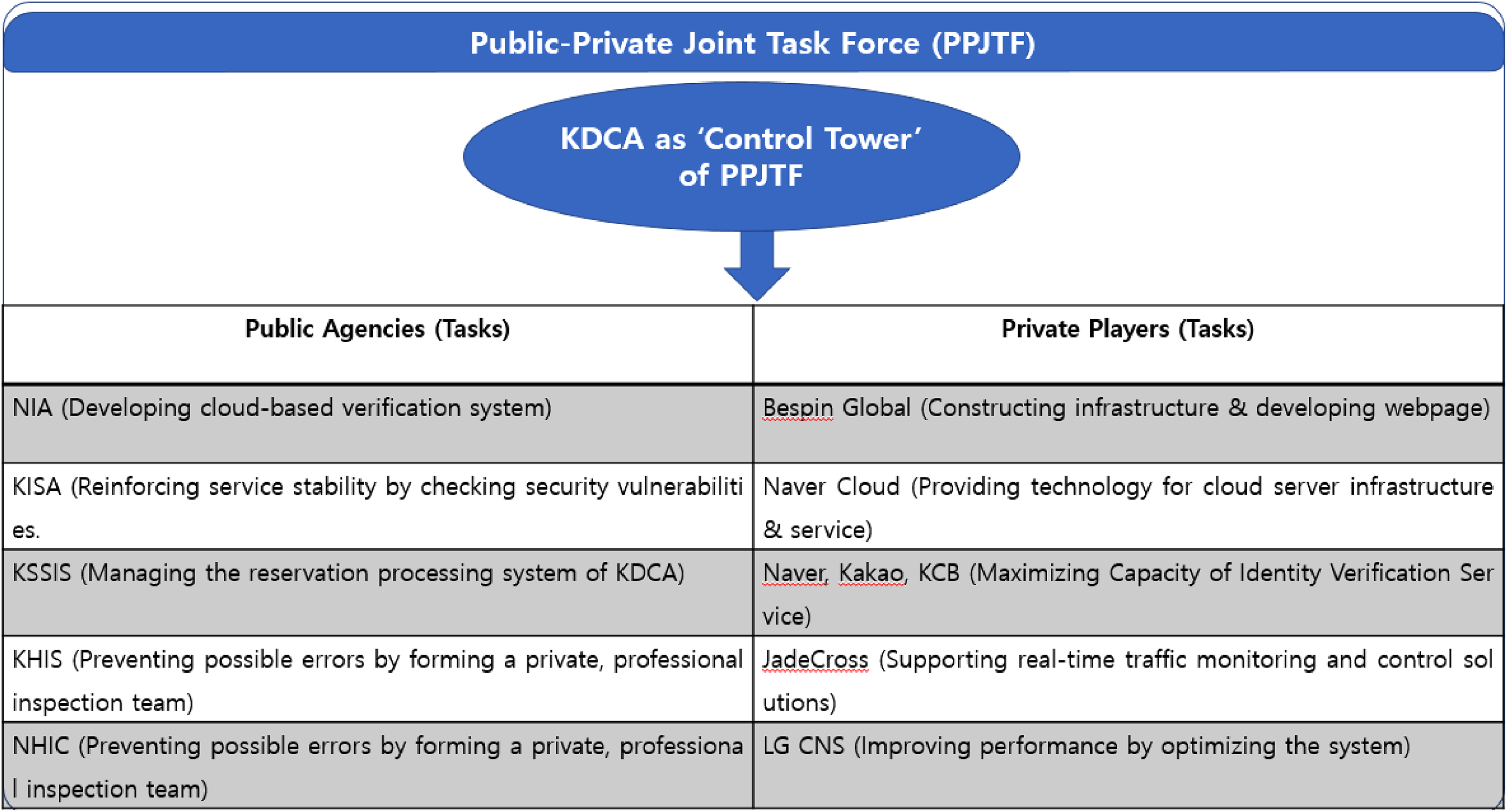
The KDCA's leading role in resolving reservation system problems through public–private partnerships. NIA: National Information Society Agency; KISA: Korea Internet & Security Agency; KSSIS: Korea Social Security Information Service; KHIS: Korea Health Information Service; NHIS: National Health Insurance Service. Source: Author analysis based on MSIT (2021) and interviews with public agencies and private players in Seoul.
Case study : How Korea outperformed neoliberal regulatory states in LDS syringe production and boosted its vaccinations
In 2021, the rapid COVID-19 vaccine rollout depended on the sufficient production of vaccine-related medical equipment, especially LDS syringes, which can automatically boost vaccine volume by 20% by extracting extra doses. Before vaccinations began globally in December 2020, experts asked for sufficient LDS syringe production in advance as this device's shortage could hamper vaccine rollouts even in advanced countries, including the United States (Glenza, 2020). The Biden administration also knew this fact, given that there was an official plan to address the smooth supply of LDS syringes. According to the US's “National Strategy for the COVID-19 Response and Pandemic Preparedness,” LDS Syringe was critical to the pandemic response. On January 21, 2021, President Biden even announced that the United States would use “full power” to accelerate the manufacturing and delivery of the LDS Syringe (White House, 2021: 71). Despite that, the United States faced critical shortages as one health official called the situation a “national shortage” that hampered vaccination programs in the country (Court and Edney, 2021). In Europe, too, the vaccination program was hampered due to insufficient production of the LDS syringe. The syringe shortage was so rampant that the European Commission had to press vaccine suppliers to deliver more low-dead-space needles to extract the extra dose (Blamont and Copley, 2021). The LDS syringe shortage in many advanced countries in the global north could be attributed to their neoliberal regulatory approach, as the government did not actively foster effective public–private partnerships. For example, in the United States, there was no effective collaboration between the government and the private player, as highlighted by one producer of syringes (O'Donnell, 2021). Observers also underscored that the United States, United Kingdom, and Europe governments also needed to sufficiently invest in expanding the private sector's manufacturing for LDS syringes (Singh, 2021).
By contrast, Korea witnessed remarkable achievements concerning LDS syringe production and export, which can be explained in many ways. First, Korea's small company, PoongLim, produced sufficient LDS syringes quickly and even built the world's largest LDS syringe factory by massively enhancing its production capacity from around 4 million LDS syringes per month in December 2021 to 30 million a month by April 2022. Consequently, while medical staff in many advanced countries in the global north outcry over syringes shortage, this equipment was widely available to Korea's medical staff throughout all vaccination centers, that in turn boosted its vaccinations. According to the KDCA, around 135 million LDS syringes were centrally supplied throughout the country, effectively inoculating about 7 million more people compared to general syringes (KDCA, 2021c). Second, Korea's private sector met not only domestic demand but also massively exported LDS syringes worldwide, including advanced countries in the global north, such as the United States and North European countries. To meet the high global demand for syringes, the company expanded from one production unit in January 2021 to four in January 2022.
What explained PoongLim's remarkable success? How it became capable in a short time of producing mass syringes and exporting worldwide? To answer these questions, one needs to analyze how the Korean state deployed the archetypal developmental state practices to foster an effective public–private partnership. As Figure 4 shows, the success of PoongLim was a direct consequence of the central authorities’ proactive roles in building a constructive public–private partnership for the mass production and export of syringes, a policy that was the heart of the classic developmental state model (Amsden, 1989: 79–84). More specially, in collaboration with Samsung, the state authority selected PoongLim to perform the national task. When PoonLim was reluctant to invest in LDS syringes production, the government induced it to take the market risk by assuring all-out support during production and export. In doing so, the government did what Wade (1990: 29) suggests “altering the behavior of private players to take the risk.” Like the classic developmental state era, the Korean state acted as an investor by providing “low-interest-rate loans” at the initial stage so that the company could multiply production. It also supported PoongLim through the WWSFCP, designed by the Moon Administration to promote Government-Chaebol-SMEs collaboration to realize national goals concerning manufacturing. The authority also promoted collaboration between PoongLim and Samsung and provided high-skilled workforce support for quality control and rapid production.
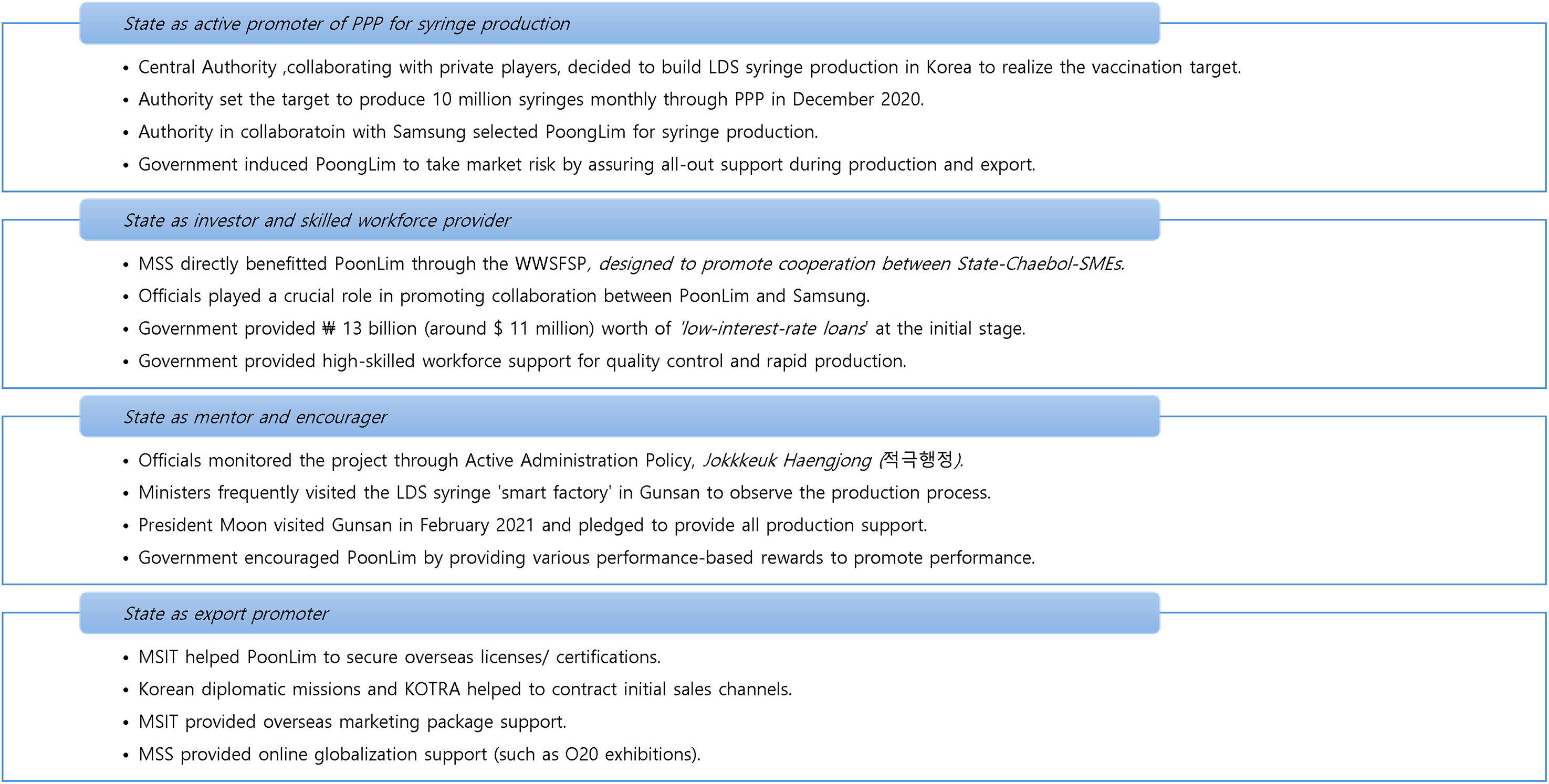
The Korean State’s archetypal developmental state practices to boost domestic LDS syringe production and export. LDS: low dead space; PPP: public–private partnerships; MMS: Ministry of SMEs and Startups; WWSFCP: Win-Win Smart Factory Construction Project; SMEs: Small and Medium-Sized Enterprises; MSIT: Ministry of Science and ICT; KOTRA: Korea Trade-Investment Promotion Agency; O2O: Online-to-Offline. Source: Author's analysis based on government documents, including KPB (2021d), KPB (2021e), KPB (2021f), MSS (2021), and personal interviews.
What is more, following the developmental state practices, the state officials and ministers actively monitored and mentored the whole production process of syringes by making several visits to the manufacturing facility (KPB, 2021e). Amid global shortages of syringes, President Moon also visited PoongLim's Gunsan plant in February 2021 and pledged to provide all support to boost the efficiency of the syringe production process (KPB, 2021f). As such, Korean politicians and officials promoted a selected private company to meet the national task. This act was hardly seen in neoliberal regulatory states during the COVID-19 emergency, where the authority generally avoids promoting a particular company to meet national tasks and sticks with the rules and regulations (Kumar, 2021). The Moon administration also gave several performance-based rewards to PoongLim to encourage performance, a vital policy to promote efficiency in the classic developmental state era (Amsden, 1989). Above all, the government also provided several crucial supports to PoongLim to become a top global export of syringes worldwide. In sum, implementing developmental state practices made Korea a self-reliant county in LDS syringes production boosting its vaccinations, and a leading exporter of this critical medical device worldwide.
Implications and lessons learned for neoliberal regulatory states in the Global North
This concluding section will discuss theoretical contributions, limitations, areas of future research, and lessons learned from this study's findings to manage future global health crises.
This empirically grounded analysis seeks to enrich literature in three ways. First, this article highlights the significance of the developmental state in Korea, which has a robust institutional capacity to implement its policy objectives, in comparison to the UK and the US, which have weak institutional capacity due to being neoliberal regulatory states. Understanding this is crucial in explaining why Korea was able to outperform the UK and the US in quickly rolling out vaccines. In doing so, this study enriches the previous research that found the Korean developmental state's strong institutional capacity played a critical role in effectively managing the first wave of the COVID-19 pandemic. In contrast, the weak institutional capacity of regulatory states in the global north was found to be a significant factor in explaining the mismanagement of the pandemic. (Kumar, 2021; Chodor and Hameiri, 2022; Jones and Hameiri, 2022). Second, this study's finding contradicts critical political economy scholarships’ claim that the state's reliance on public–private partnerships is ineffective in dealing with the global health crisis and that governments should look beyond an alternative form of governance (Sparke and Williams, 2022; Williams et al., 2021). Instead, it contends that public–private partnerships during the national crisis can do a miracle if the state provides practical support to these partnerships based on the developmental state logic. Finally, this study contributes to a key question in political economy literature whether the developmental state is dead or alive (Haggard, 2018; Kumar, 2021; Wade, 2018; Thurbon, 2016). This study found that the Korean developmental state is alive, and it is premature to say the developmental state is dead in Korea, as claimed by the declinist school.
Let me now turn to the limitation of this study and areas of future research. A signal article cannot include all factors that explain our main research question: Why Korea leaped ahead of the United Kingdom and the United States in rapid vaccinations that saved many lives? For example, since this is a “state-centric” systematic study to provide an empirically-grounded analysis of Korea's COVID-19 vaccination program from comparative perspective, it may not include all social factors in analysis. Accordingly, future research may explore alternative hypotheses utilizing social factors. Equally significant, future studies may also apply this study's funding to understand the success and failure of other neoliberal regulatory states’ vaccination programs in the global north (such as European states) by comparing them with the Korean case.
What are some key lessons neoliberal regulatory states in the global north can learn from the Korean experience? Advanced liberal democracies in the global north do not need to worry that their future is at risk since the authoritarian states have done better during this pandemic, a point highlighted by many (Kleinfeld, 2020; Fukuyama, 2020). Instead, they need to learn from the Korean experience carefully and rebuild state capacity to deal with the future global pandemic. Korea's liberal democracy performed consistently better throughout the pandemic, from effectively managing the pandemic in 2020 to implementing one of the fastest vaccinations in 2021. A few specific points are worth emphasizing what others can learn. First, governments in liberal democracies should be goal-oriented; they should set policy goals and targets, be consistent with the target, and mobilize people behind these goals with transparency. After witnessing a chaotic 2020, the state of affairs of United Kingdom and the United States remained the same in 2021, thanks to the absence of goal-oriented policymaking and the state's inability to mobilize people behind national goals. Neoliberal regulatory states need to change these practices. Second, a Korean state-type centralized, autonomous pilot agency led by a professional health bureaucrat (not politicians) is required for effective pandemic management. Policymakers should empower their centralized pilot agency and health authority according to their needs. However, lawmakers in neoliberal regulatory states, like the United States, were busy limiting public health officials’ power. This could be counterproductive in the future. Finally, liberal democracies do not have to abandon their reliance on public–private partnerships; instead, they need to change their mindset toward the current state-minus public–private partnership projects. As highlighted by this study, the state's strategic intervention based on the developmental state logic is required for the success of public–private partnerships in times of crisis. This is because the private sector alone cannot produce the desired outcomes for the nation, especially during a global health emergency.
Footnotes
Declaration of conflicting interests
The author(s) declared no potential conflicts of interest with respect to the research, authorship, and/or publication of this article.
Funding
The author disclosed receipt of the following financial support for the research, authorship, and/or publication of this article: This work was supported by the National Research Foundation of Korea (grant number NRF-2017S1A6A3A02079749).
