



Abstract
This study examines how international publics’ evaluations of US Presidents affect the favorability of their views of the US. More specifically, it investigates the impact of the US Presidents George W. Bush, Barak Obama and Donald Trump on attitudes toward the US in 32 nations. It analyzes the data from Pew Research Center’s Global Indicators Database on opinions of the US and confidence in the US President from 2002 to 2018. The analysis reveals a significant relationship between confidence in the US Presidents and favorable attitudes toward the US among foreign publics. The paper further discusses the implications of global evaluations of US Presidents for US public diplomacy.
Keywords
Introduction
In this multicultural, globalized age, the importance of international public opinion cannot be overestimated. Indeed, global public opinion has become an important topic not only in academic research but also in practice. In particular, since the 9/11 terrorist attacks, the US government has invested heavily in mitigating anti-Americanism. US public diplomacy efforts initially focused on wining the “hearts and minds” of Arab and Muslim populations as a means of promoting “soft power” in the fight against terrorism (Nye, 2008). The US has also implemented public diplomacy activities designed to apply soft power throughout the world and reach a global audience. According to the 2019 Comprehensive Annual Report on Public Diplomacy and International Broadcasting, public-diplomacy spending by the US in 2018 was widely distributed throughout Europe (23.3%), the Near East (20.7%), the East Asian Pacific (17.4%), South and Central Asia (16.3%), Africa (11.5%) and the Western Hemisphere (10.6%) (US Advisory Commission on Public Diplomacy, 2019).
At the same time, extensive media coverage of international issues including trade conflicts, wars and peacebuilding initiatives has familiarized most international publics with US Presidents. Indeed, it is difficult to overstate the influence of the US Presidents—as a source of the US image among foreign publics—in the country’s efforts to wield soft power. Examining the influence of foreign public opinion of the US on public diplomacy, Schatz and Levine (2010) conducted a survey experiment in two Central Asia countries, Kyrgyzstan and Tajikistan, asking participants to read a quotation about religious tolerance and pluralism in the US, manipulating the sources of the quotation. The participants who read the quotation attributed to President George Bush expressed more negative opinions of the US. The researchers, therefore, concluded that the negative reputation of President Bush affected American credibility, limiting the effectiveness of US public diplomacy during the Bush administration.
Contrary to the unpopularity of the Bush administration and its neglect for public diplomacy, the “Obama effect” refers to the global popularity of President Obama and the positive impacts it had on US public diplomacy (Hayden, 2011). Dragojlovic (2011) investigated the Obama effect among Canadian publics using a survey experiment with the source attribution manipulation. The survey respondents, who were asked an unrelated question in which then President Obama was mentioned, evaluated the US more positively than a control group. The assimilation was stronger with Obama than Bush, indicating that US Presidents function as a source cue in shaping positive or negative foreign public opinion. This study shows presidential priming on foreign publics’ evaluations of the US. A subsequent study demonstrated similar impact on Canadian participants when issue statements attributed to French and German political leaders were presented to them (Dragojlovic, 2013).
Golan and Yang (2013) examined how confidence in the then-US President Obama’s leadership influenced favorable attitudes toward the US, Americans and the US-led war on terror in Pakistan in 2009. Using an ordinary least square (OLS)-based hierarchical regression, they found that confidence in President Obama’s leadership significantly increased Pakistanis’ positive feelings toward all three dependent variables. These results indicate that Pakistan publics’ approval of President Obama’s foreign policies resulted in a significant increase in their positive sentiment toward the US. Moreover, Pakistanis’ confidence in President Obama’s leadership and approval of the Obama administration’s foreign policy significantly increased positive sentiment toward Americans. In addition, President Obama’s international policies contributed more than any other factor to increasing positive sentiment toward the US-led war on terror, followed by improvements in US–Pakistan relations and confidence in President Obama’s leadership. This research directed us to set up a hypothesis of presidential confidence as a cause of the favorability toward the country, not the other way around.
Goldsmith and Horiuchi (2009) argued that the credibility of US leaders in the eyes of foreign publics is critical in shaping attitudes toward US foreign policy. Using a credibility scenario, a controversy scenario and a non-credibility scenario, they investigated the impact of high-level visits on foreign publics’ attitudes on US foreign policy between 2001 and 2006 in 63 countries or regions. They utilized OLS regressions with country fixed effects and divided the post-9/11 years into three periods. In Period 1 (from 2001 until the invasion of Iraq in 2003), high-level visits by US leaders served as effective tools of public diplomacy, proving that US foreign policy was perceived as highly credible in the period immediately following 9/11. In Period 2 (March 2003–April 2004), some pro-US public diplomacy remained. The researchers argued that as US foreign policy became more controversial around the world, its potential influence declined. Finally, in Period 3 (April 2004–December 2006), a precipitous decline in US influence was evident, showing that US foreign policy had completely lost credibility.
In another article, Goldsmith and Horiuchi (2012) investigated the relationship between opinions about US foreign policy and three international events in 2003—the deployment of troops to Iraq, the enactment of the Bilateral Immunity Agreement (BIA) and the United Nations (UN) voting with the US 58 countries. Using probit regression and OLS regression, they controlled for security and economic factors as well as variables for political, cultural and historical relationships with the US. They found that the results varied based on the control variables. First of all, without control variables, the opinion regarding US foreign policy were positive and significant on the first two dependent variables (deployment of troops to Iraq and the enactment of the BIA in 2003) but negative and insignificant on the other dependent variable (UN voting with US). In addition, with control variables, the opinions of non-US publics regarding US foreign policy had significantly positive impact on all three dependent variables. The study concluded that non-US public opinion, in fact, impacts the outcomes of US foreign policy.
In the Trump era, the US leadership and public diplomacy outcomes have often been challenged by the current president’s low international approval ratings. Even before Trump’s inauguration, most of the foreign publics in European and Asian countries expressed little or no confidence in his ability to handle global affairs (Wike et al., 2016). According to a survey conducted by the Pew Research Center, 92% of Swedish, 89% of German, 85% of both the French and British, and 82% of Japanese respondents expressed they have no confidence in Trump. After Trump’s inauguration, his median unpopularity remained at 74%, according to the results of a survey conducted in 37 countries (Wike et al., 2017). In 2019, after two years of the Trump administration, Trump’s global ratings had increased, but still remained low. A median of 64% of foreign publics in 32 countries expressed no confidence in Trump (Wike et al., 2020).
Agadjanian and Horiuchi (2020) demonstrated that President Trump fosters negative perceptions of the US by examining Japanese public opinion. However, the study argues that the policy content (cooperative v. uncooperative) had a larger impact on shaping opinion of the US than the source cue (Trump attribution). According to this study, foreign citizens rely more on policy content when forming transnational opinions. However, this study was limited to Japanese individuals; determining global tendencies will require consideration of a more diverse range of foreign publics.
Existing studies of the relationship between the relative popularity of the US Presidents and evaluations of the country among foreign publics have been limited to specific countries, years, or events. However, no study has yet examined how foreign public opinion regarding US Presidents has affected favorable attitudes toward the country across more than three US presidents; accomplishing this requires an extended period of time. More specifically, this study aims to understand how foreign publics’ confidence that US Presidents would do the right thing in world affairs affects the favorability toward the country, with data for 32 countries (see the next section for the list of the countries) in a 17-year period (2002–2018).
Data, hypotheses, methods
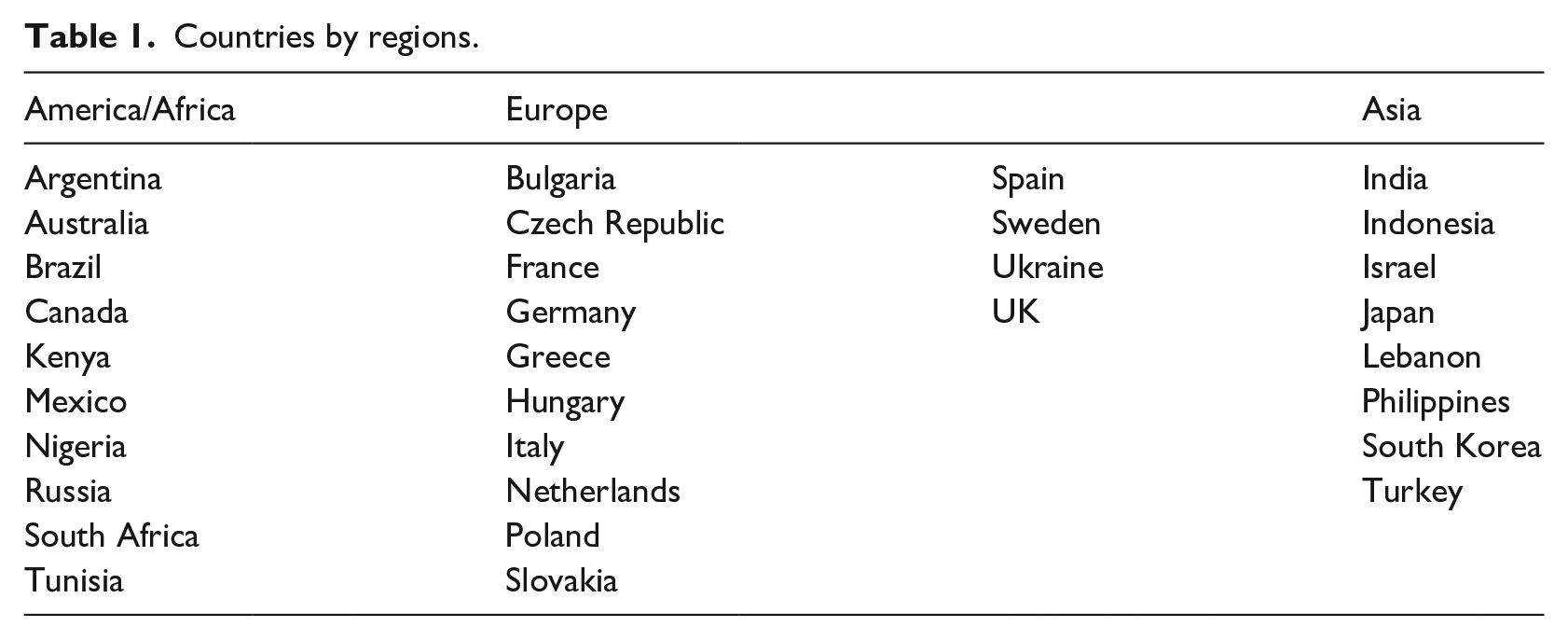
The 32 countries used in this study are listed in Table 1, all of which are from the Pew Research Center’s latest report at the time of this research, released in January 2020. The 32 countries were classified by region according to the list of geographic regions used by the Statistics Division of the UN (United Nations, n.d.) .
Countries by regions.
With this panel data, this study examines the influences of evaluations of the US Presidents on favorable attitudes toward the US. The dependent variable is favorability toward the US, which measures the percentage of foreign publics who respond that they have favorable opinions of the US. The data for the dependent variable were collected from the Pew Research Center’s Global Indicators Database for survey years 2002–2018 (Pew Research Center, 2019a)Favorability about the US was measured using a single item on a four-point scale. The full survey question reads as follows: “Please tell me if you have a very favorable, somewhat favorable, somewhat unfavorable or very unfavorable opinion of the United States”. This study integrated responses of “very favorable” and “somewhat favorable” to compute the percentage for favorability to make the variable continuous.
As a main independent variable, this study uses confidence in the US President, also obtained from the Pew Research Center’s Global Indicators Database for survey years 2003–2018, excluding 2014, due to data availability (Pew Research Center, 2019b). Confidence in the US President was measured using a single item on a four-point scale. The survey question for confidence in the US President reads as follows: “Now I’m going to read a list of political leaders. For each, tell me how much confidence you have in each leader to do the right thing regarding world affairs—a lot of confidence, some confidence, not too much confidence, or no confidence at all.” The list of political leaders included the three US Presidents who held power across the study period: George W. Bush (2002–2008), Barack Obama (2009–2016) and Donald Trump (2017–present). This study combined the “a lot of confidence” and “some confidence” responses to compute a total percentage for the confidence exhibited by foreign publics. Like the dependent variable, this will allow us to convert the original discrete variables into continuous ones.
This variable will be used to test a hypothesis that attitudes towards the US are more favorable in countries with higher confidence in the US presidents. A concern for the reverse causality can naturally arise where people with favorable views toward the US would tend to have a confidence in its political leader. This issue can be technically tackled by using the lagged variable for confidence as well as adopting an instrumental variable, which will be discussed in the result section. In addition, Golan and Yang’s (2013) study that examines the impact of President Obama’s leadership on Pakistan’s favorability toward the US can be a good reference of assuming the presidential confidence as a cause of the favorability toward the country, not the other way around. As was mentioned in the previous section, this study examined how confidence in President Obama’s leadership influenced favorable attitudes in Pakistani public toward the US and found that confidence in President Obama’s leadership significantly increased Pakistanis’ positive feeling toward the US.
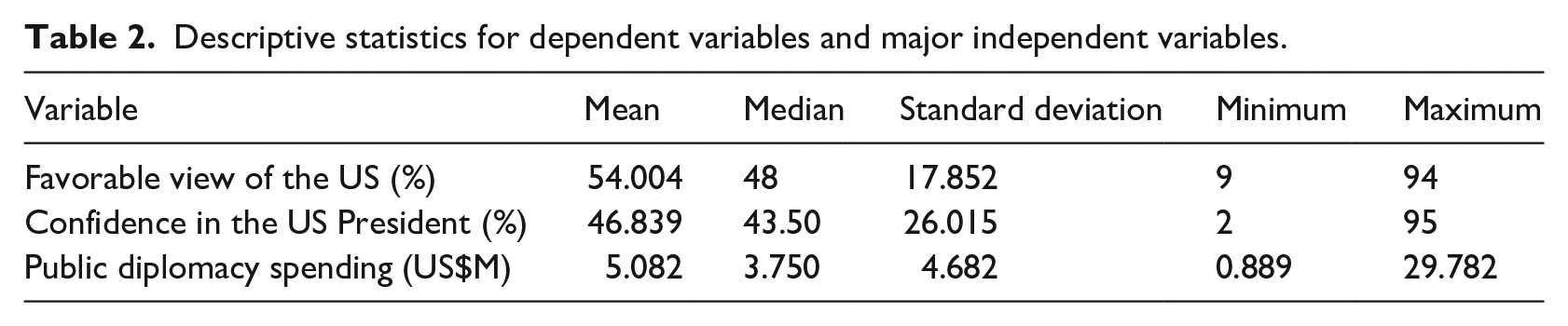
Another independent variable is the US public diplomacy spending for each country, obtained from the Comprehensive Annual Reports on Public Diplomacy and International Broadcasting conducted by the US Advisory Commission on Public Diplomacy. A natural hypothesis can be made where more spending on the public diplomacy from the US explains increased favorability toward the country. With this, the expected sign for this variable would be positive. This variable has been standardized by dividing the actual amount allocated to each country each year by the population of the country in the year. It is also log-transformed to minimize the skewness. 1 Descriptive statistics for these variables are provided in Table 2. These variables are log-transformed in empirical analyses.
Descriptive statistics for dependent variables and major independent variables.
To control for potentially nuanced changes in public opinion in confidence in the US President, the study adopts four economic variables (gross domestic product (GDP), GDP per capita, trade with US, Official Development Assistance (ODA hereafter) commitment from the US to each recipient country) and one political variable (Democracy score). Data for GDP and GDP per capita were obtained from the World Bank’s World Development Indicators (World Bank, n.d.). Bilateral trade volume and ODA flows between the US and the partner countries were collected from the IMF’s Direction of Trade Statistics and OECD’s Qwery Wizard for International Development Statistics (OECD, n.d.). In addition, democracy scores were obtained from the Freedom House (n.d.) . These variables are log-transformed.
The remaining variables are dummies and indicators of economic, political, cultural and historical relationships with the US. Muslim population is the ratio of Muslims in the total population, collected from the CIA World Factbook (CIA, 2021). The regional dummies—Europe and Asia—are utilized to determine differences in public opinion by region. Europe is a binary dummy variable for European countries (coded 1 if it is a European country, and 0 otherwise). This study included five Eastern European countries (Czech Republic, Hungary, Poland, Slovakia, Ukraine), four Western European countries (Bulgaria, France, Germany, Netherlands), three Southern European countries (Greece, Italy, Spain), and two Northern European countries (Sweden, UK). Asia is another binary dummy for Eastern, Southeastern, Southern and Western Asian countries (Japan, Republic of Korea, Indonesia, Philippines, India, Israel, Lebanon, Turkey), coded 1 for an Asian country and 0 otherwise.
These control variables are selected based on the existing studies. As mentioned in the previous section, Goldsmith and Horiuchi (2009, 2012) used a number of variables, including GDP per capita, UN Voting Index, Polity score, the number of soldiers killed, alliance portfolio, NATO-dummy, aid, trade, etc., some of which are brought in this study. A Variance Inflation Factor (VIF) test indicates that these variables do not show high multi-collinearity.
This study basically adopts the fixed effect analyses, as they are robust to endogeneity issues. However, random effect has been also applied when it comes to time-invariant variables (e.g. regional dummies). This study also tries two-stage-least squares and use lagged variables to effectively deal with reverse causality problem.
Results
Table 3 provides estimated results based on the fixed effect and random effects. The first two models included the basic variables and the third included the dummy variables—Muslim population (ratio of Muslims to total population), Europe (coded 1 for European countries and 0 otherwise) and Asia (coded 1 for Asian countries and 0 otherwise). The independent variable (confidence in the US Presidents) was significantly positive in all models, implying that a 1% point increase in confidence explains 0.26–0.3% point increase in favorability toward the US. In the fixed effect analysis (the first column), GDP and per capita GDP showed negative and positive coefficients, respectively, all at highly significant levels. This suggests that competition between the US and countries with larger overall economies may negatively affect US favorability in those countries, while countries with higher per capita income levels tend to maintain more favorable attitudes toward the US. The latter may be a product of appreciation for American values such as independence, competition and work ethic in these countries—a conjecture supported by their significantly positive democracy coefficients. The results look contradictory in other columns, but they are insignificant statistically. Trade also lacks significance although its effect seems to be positive. Arguably, trade follows the rules of supply and demand instead of influencing a country’s favorability. ODA is significantly positive, which is as expected. The Hausman Test reveals that coefficients between the two models are systematically different, which allows us to give more weights on the fixed effect model.
Estimated results (2002–2018).
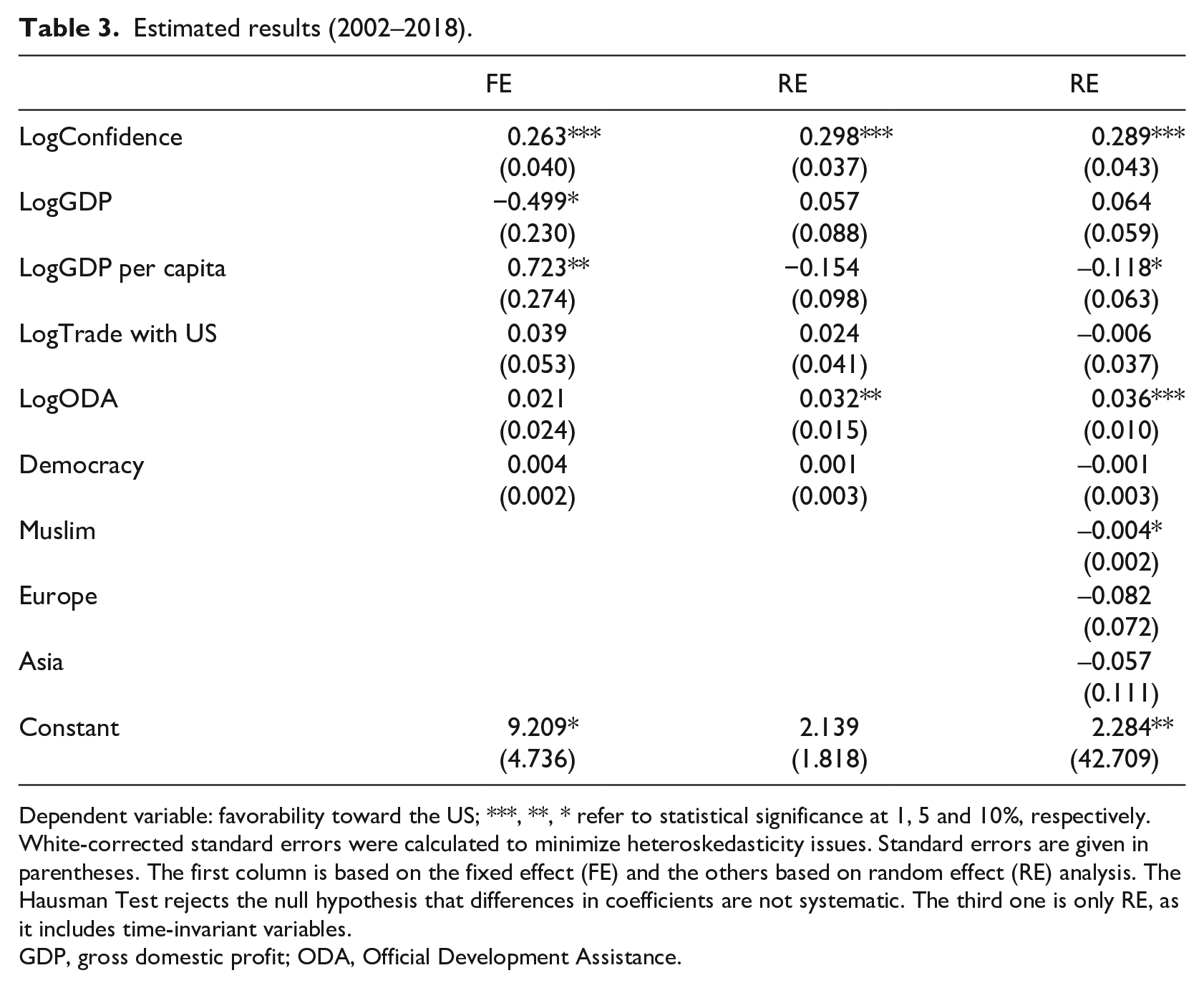
Dependent variable: favorability toward the US; ***, **, * refer to statistical significance at 1, 5 and 10%, respectively. White-corrected standard errors were calculated to minimize heteroskedasticity issues. Standard errors are given in parentheses. The first column is based on the fixed effect (FE) and the others based on random effect (RE) analysis. The Hausman Test rejects the null hypothesis that differences in coefficients are not systematic. The third one is only RE, as it includes time-invariant variables.
GDP, gross domestic profit; ODA, Official Development Assistance.
The last column is based on the random effect analysis, as it contains time invariant dummy variables, which can be included in the random-effect models, not in the fixed-effect models. As expected, the coefficient for Muslim population was significantly negative, confirming the prevalence of anti-American sentiment among Muslims. Europe and Asia failed to provide significant results.
Table 4 also shows the estimated results based on the fixed effects and the random effects but for different time periods. The first two columns used the basic variables, and the third one added public diplomacy spending as another independent variable. Confidence was significantly positive in all the cases, confirming its positive impact on the favorability; depending on time periods and political regimes, a 1% point increase in confidence explains a minimum 0.268% point (2010–2018) and a maximum 0.552% point (Obama Regime) increase in favorable attitudes toward the US. In the fixed effect analyses, GDP and GDP per capita again showed negative and positive coefficients, respectively, with statistical significance. Meanwhile, trade appeared to have a positive impact, but it seems to have faded away in the 2010s. On the other hand, ODA seems to have significantly positive impact on shaping favorable attitudes toward the US.
Estimated results with different time periods.
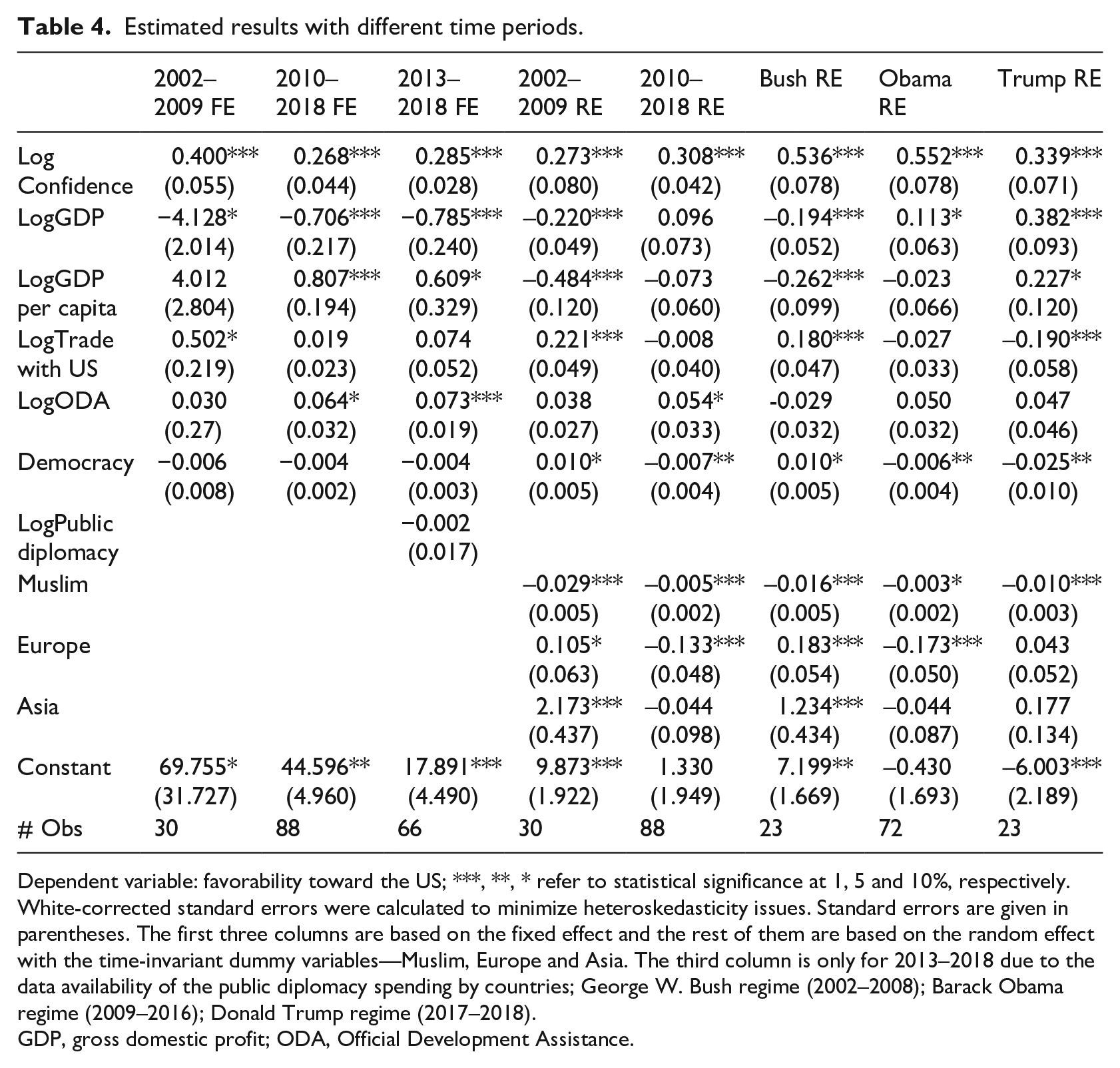
Dependent variable: favorability toward the US; ***, **, * refer to statistical significance at 1, 5 and 10%, respectively. White-corrected standard errors were calculated to minimize heteroskedasticity issues. Standard errors are given in parentheses. The first three columns are based on the fixed effect and the rest of them are based on the random effect with the time-invariant dummy variables—Muslim, Europe and Asia. The third column is only for 2013–2018 due to the data availability of the public diplomacy spending by countries; George W. Bush regime (2002–2008); Barack Obama regime (2009–2016); Donald Trump regime (2017–2018).
GDP, gross domestic profit; ODA, Official Development Assistance.
This is worth noting in the third column, in particular, where public diplomacy shows unexpectedly negative coefficient, although it is insignificant. Based on this result, public diplomacy spending seems to be less effective than ODA disbursement in increasing the favorability toward the US. Although this should be interpreted with caution due to the limited available data, the ineffectiveness of the public diplomacy spending could be associated with its nature. Sun (2008) mentioned that the governmental public diplomacy spending would have long-term effects on the country’s both hard power and soft power but not short term. In the same direction, Hall and Smith (2013) found difficulty of measuring the impact of the public diplomacy spending by mentioning that the influence of public diplomacy spending may not be felt for months, years, or even decades, as short, medium and long-term efforts and objectives are all mixed. In another direction, Hall and Smith (2013) argue that some types of public diplomacy target affecting political or cultural elites more that the general public, failing to capture the long-term impacts. 2
In the random effect analyses with region dummies, the Muslim coefficient remained negative and highly significant in all the models and the coefficient was the largest during the Bush administration, followed by the Trump regime. This can be explained by President Bush’s anti-Muslim rhetoric in the awake of 9/11 and President Trump’s anti-Muslim policies such as the prohibition on immigration from certain Muslim-majority countries in 2017. This result should be interpreted with caution, as this study uses only two-year periods (2017–2018) for the Trump government.
Europe and Asia dummies show positive relations in the 2000s (and during the Bush regime) but turned into negative in the 2010s (and during the Obama regime), although the negative impact is not as significant as the positive impact. The result for the Trump administration is insignificant probably due to the limited data availability.
Last but not the least, this study revisited, with technical advancement, the analyses summarized in Table 3 to check the robustness. Models 1–3 used one-year lagged values for confidence, trade and ODA and models 4–6 used population as an instrumental variable for GDP, all of which addressed endogeneity issues. In particular, lagged variable for confidence may effectively tackle the concerns regarding reverse causality where people who have more favorable views toward the US would tend to have a confidence in its political leader. In fact, as mentioned in the Introduction of this paper, Golan and Yang (2013) examined the impact of President Obama’s leadership on Pakistan’s favorability toward the US, which can be grounds for presidential confidence as a cause of the favorability toward the country, not the other way around.
As shown in Table 5, the coefficients were not substantially different from the previous tables, confirming the consistency and robustness of the initial findings. Confidence is still highly positive and significant and, in fixed effect, GDP and per capital GDP are still negative and positive, respectively. The results for the dummies were also consistent, as well.
Sensitivity test and robustness check (lagged variables and instrumental variables).
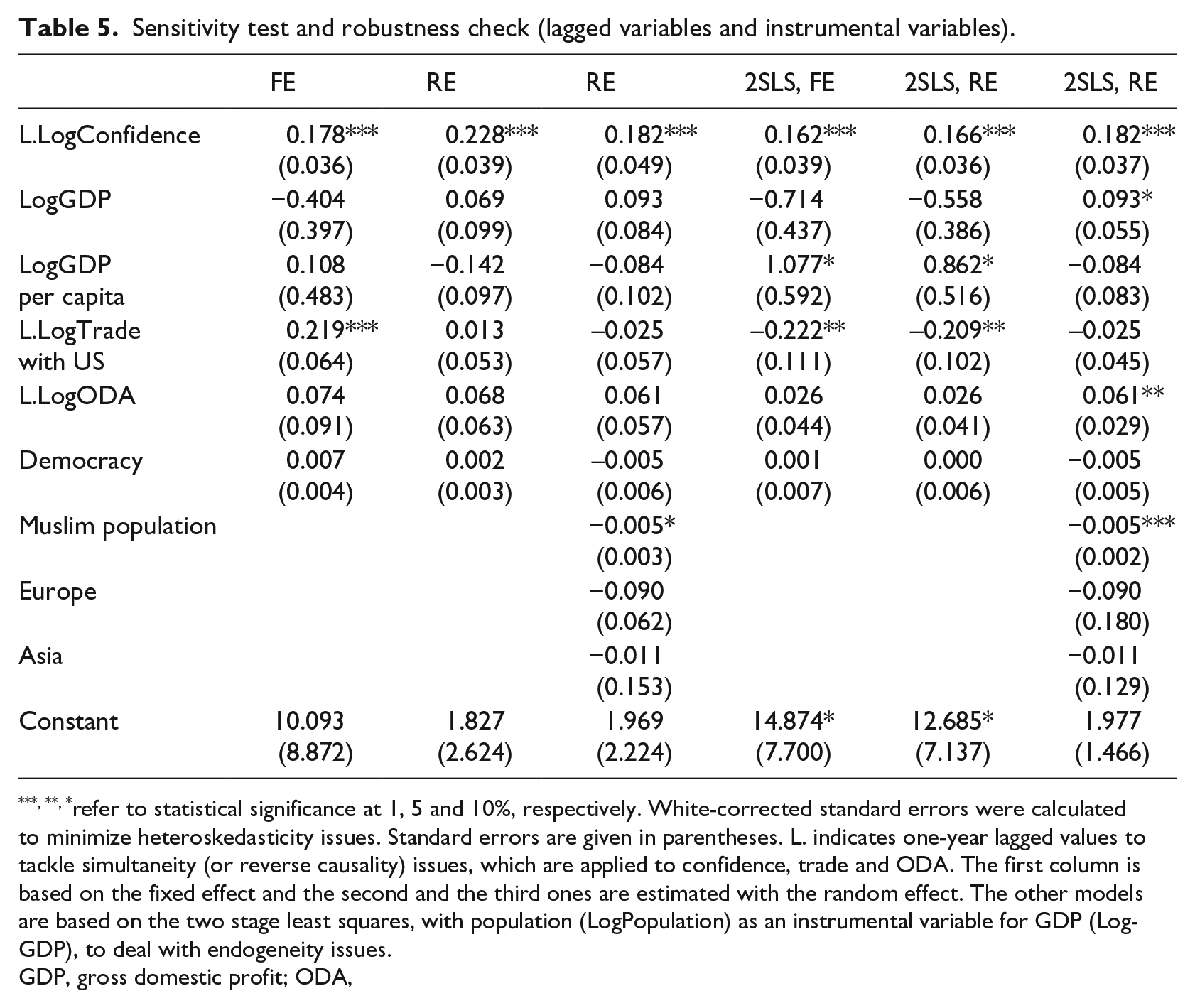
refer to statistical significance at 1, 5 and 10%, respectively. White-corrected standard errors were calculated to minimize heteroskedasticity issues. Standard errors are given in parentheses. L. indicates one-year lagged values to tackle simultaneity (or reverse causality) issues, which are applied to confidence, trade and ODA. The first column is based on the fixed effect and the second and the third ones are estimated with the random effect. The other models are based on the two stage least squares, with population (LogPopulation) as an instrumental variable for GDP (LogGDP), to deal with endogeneity issues.
GDP, gross domestic profit; ODA,
Conclusion
The results of this study indicate that confidence in the US Presidents significantly bolsters positive sentiment toward the US among foreign publics. The president effect followed a different pattern in the 2000s than in the 2010s. Its impact was highest from 2002 to 2009, followed by the 2013–2018 period.
Countries with larger economies tend to harbor unfavorable attitudes toward the US while countries with higher income levels tend to view the US more favorably. In addition to Muslim populations, international publics in European and Asian countries held unfavorable views of the US from 2002 to 2018. However, global publics in Europe and Asia exhibited favorable attitudes toward the US during the Bush administration (2002–2008) and the Trump administration (2017–2018). On the other hand, the Muslim population variable had the most negative relations in the 2000s, followed by the years of the Obama administration (2009–2016). Improvements in relations between each country and the US, economic competition with the US, socio-political differences with the US, and US foreign policies or presidential rhetoric against Muslims are possible explanations for unfavorable global attitudes toward the US. Meanwhile, the varying results can be explained by the fact that this study examined imbalanced time periods for each administration.
The current study indicates that evaluations of US Presidents play a significant role in the attitudes of international publics toward the US. To maximize public diplomacy outcomes, US Presidents need to instill confidence in worldwide audiences that they are conducting world affairs in a righteous manner.
A major caveat of this study is the limited data availability. The US public diplomacy spending by country is available only for six years (2013-8), which could be a reason to produce an insignificant result. The insignificant results during the Trump regime may also be associated with the insufficient dataset, which should be re-examined for full presidential term when a complete dataset is available. 3 More countries could be included in the follow-up analyses. All of these will be reserved for further studies.
