




Abstract

Eugene H. Stanley
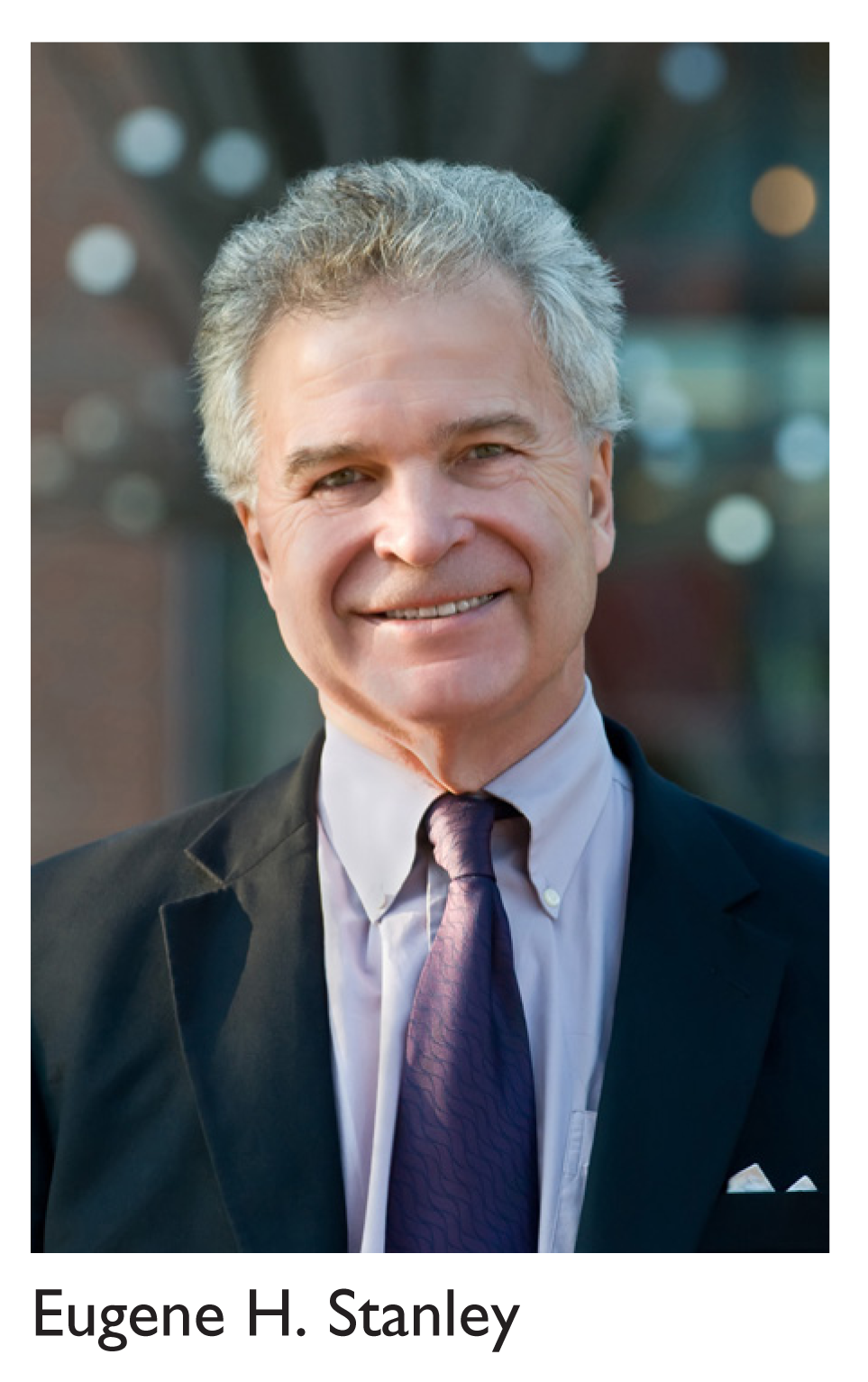
Dr Eugene H. Stanley (1941–) is one of the most influencing figures in the discipline of Econophysics. He was born in Oklahoma City, US, and was awarded the PhD in physics at Harvard University. 1 In 1976 he joined Boston University as Professor of Physics, and was promoted to Professor of Physiology and University Professor, in 1978 and 1979, respectively. In 2007 he was offered joint appointments with the Chemistry and Biomedical Engineering Departments, and in 2011 he was made William Fairfield Warren Distinguished Professor.
Dr Stanley holds concurrent positions of ‘Honorary Professor’ at East China University of Science and Technology, Shanghai University Institute for Advanced Studies, University of Pavia, and at Eotvos Lorand University, Budapest. He has received nine Doctorates Honoris Causa from Northwestern University, Messina University, Bar-Ilan University, Eotvos Lorand University, University of Liege, University of Dortmund, University of Wroclaw, IMT Lucca and Universidad Federal de Ceara (Fortaleza, Brazil). He has been appointed the 2013 Lorentz Professor of Theoretical Physics at University of Leiden, which is a rare honour. He has been elected to the US National Academy of Sciences (NAS) and the Brazilian Academy of Sciences, and has been selected as an Honorary Member of the Hungarian Physical Society.
Prof. Stanley works in collaboration with students and colleagues attempting to understand puzzles of interdisciplinary science. In fact, he has acted as thesis advisor for 112 PhD candidates at MIT and Boston University, and has worked with 146 research associates. In addition to his principal focus of understanding the anomalous behaviour of liquid water in bulk, nanoconfined, and biological environments, he has also worked on a range of other topics in complex systems, such as quantifying correlations among the constituents of the Alzheimer brain, and quantifying fluctuations in noncoding and coding DNA sequences, interbeat intervals of the healthy and diseased heart. His publications have received an enormous 66,089 citations, so far.
Dr Stanley is Co-Editor-in-Chief (with Dawson, Indekeu, Parisi, and Tsallis) for the prestigious journal of Physica A, from 1988 till date. He is the Chief Editor for the series Graduate Texts in Physics published by Springer-Verlag. As far as his present or past association with various journals are concerned, a long list follows: New Journal of Physics, Quantitative Finance, Granular Matter, Fractals, International Journal of Molecular Sciences (IJMS), Heterogeneous Chemical Reviews, Phys. Chem. Comm., International Journal of Theoretical & Applied Finance, Fluctuation and Noise Letters: An Interdisciplinary Scientific Journal on Random Processes in Physical, Biological, and Technological Systems, COMPLEXUS: Modelling and Understanding Functional Interactions in Life Sciences; Nonlinear Dynamics, Psychology, and Life Sciences; International Journal of Portfolio Analysis & Management (IJPAM).
For his interdisciplinary contributions to physics, chemistry, and biology, Stanley received the 2004 Boltzmann Medal, awarded by IUPAP (International Union of Pure and Applied Physics), the 2008 Julius Edgar Lilienfeld Prize awarded by the American Physical Society, and the Teresiana Medal in Complex Systems Research given by the University of Pavia. He also received the ‘Distinguished Teaching Scholar’ Director’s Award from the National Science Foundation, the Nicholson Medal for Human Outreach from the American Physical Society, a Guggenheim Memorial Fellowship, the David Turnbull Prize from the Materials Research Society, a BP Venture Research Award (with J. Teixeira), the Floyd K. Richtmyer Memorial Lectureship Award, the Memory Ride Award for Alzheimer Research (with B. T. Hyman) and Zenith Fellowship Award, both for Alzheimer research, and the Massachusetts Professor of the Year awarded by the Council for Advancement and Support of Education. He has delivered the Ramanujan Memorial Lecture, Calcutta, John G. Kirkwood Memorial Lecture, Kanpur, Platinum Jubilee Lectures, Indian Academy of Sciences, Karlheinz Schmidt Memorial Lecture, Chiemsee, Germany, Sigma Xi National Lecturer, Centennial Lecturer, American Physical Society, Thirtieth Saha Memorial Lecture, Calcutta, and the Fourth Bose Memorial Lecture, Calcutta.
With Nicole Ostrowsky, Stanley co-founded a series of NATO Advanced Study Institutes in interdisciplinary physics in Cargese (in 1985, 1988, and 1990). With Francesco Mallamace, he co-directed the 1996, 2003, and 2010 Enrico Fermi Schools of Physics, also on interdisciplinary physics. Stanley chaired the 1998 Gordon Conference on Water and the 1986 IUPAP International Conference on Statistical Mechanics, STATPHYS16. Stanley has served since 2002 on the International Jury for the 500,000 euro ‘Women in Science’ L’Oreal-UNESCO Prize.
He was elected chair of the 2008 NAS/Keck Futures Initiative on Complexity, and is an active member of the NAS CommitteeForefronts of Science at the Interface of Physical and Life Sciences, charged with finding ways for fostering useful collaborations between physicists and life scientists. He also serves on three NAS committees concerned with threat networks and threatened networks.
One of the guest editors, Kausik Gangopadhyay, interviewed Prof. Stanley on 16 May 2013. An edited transcript 2 follows.
The word tries, as anyone would guess, to coin something that reflects the fact that Econophysics is a little like Biophysics or Geophysics or Astrophysics which tells you that people involved in these fields are interested in Biology or Geology or Astronomy, which they connect from a physics point of view. And those first three spheres are not much different, because Scientists are Scientists—they are all empirical. Sometimes all they are doing is that they are introducing a new piece of equipment or something of that sort.
But in Economics, it is different…shall we say, a different culture, meaning a physicist’s culture and a typical economist’s culture, are really quite different. I mention this because you’ll understand the backdrop of my personal journey better.
The personal journey was very simple. My students in Boston University, some of them wanted to study economics and when I would go to Economics Department (which means even if I managed to get this far), I would just ask people, ‘Are you going to give a PhD in physics to this person?’ To which they replied, ‘Of course not, it would be in economics.’
But then in Economics Department, you have to start with undergraduate Economics and by the time you are able to do something, already quite a lot of time are gone. Most importantly, what you do under the guidance of an economist will not be as revolutionary (from a physics perspective) like what you might do with a background of physics.
So, I decided to give a name to the synergism, like a revolutionary country has to have a name, you know! You need to have some name and this was a nice name, I thought. The other attempts which were made to give name to this subject never really stuck. I am very happy with this word because it makes clear that we are really physicists who are addressing the questions that economists, some economists, care about and some don’t.
Probably the first meeting in my life on this field that I went to was this meeting. In that sense Kolkata is—you can say—the nest from which the chicken was born and Bikas gets, deservingly so, a lot of credit for that because it takes a lot of work to have a meeting on a field that does not really exist, so to say! After all who is going to come? If you have a meeting on standard fields like super conductivity there are many people who were happy to come to India to attend that meeting, but econophysics was something different. So he should get a lot of credit for this.
It is a fact however, that pure economics journal, such as Econometrica, as also the other top journals, almost never published a paper from physicists. My group has one paper 3 in one of the top four economics journals called the Quarterly journal of Economics. But we have a co-author who is a very accomplished economist. He wrote the paper in the language that’s expected in the economics journals. This means a much more mathematical language making very clear what the assumptions are and making very organized definition of each thing, very precise just like mathematicians do. Physicists are much more empirical and they say, you know, the question is how you are going to answer some questions by looking at the data and come out with the findings. But often without a definite ex-ante theory or anything of this sort.
So a typical experience is that author (and this applies also to economists by the way) submits some piece of work to a good journal but journal returns it, sometimes not even with a referee report, saying since you don’t have a theory yet, you first have a theory and then resubmit it, which we would be happy to consider.
But as you know econophysics is a little like a regular physics discipline in the sense that there is simply no theory of many things; for that matter a lot many things in physics have no theory what so ever. One of the most dramatic discoveries in physics, which happened about 25 years ago, that is high temperature super-conductivity, was made empirically. People who discovered even won Nobel prizes. However no one ever knows why this works. And the same for regular super conductivity which was discovered here in Netherlands at the beginning of the last century and it was not until roughly 50 years later that there was a theory of regular superconductivity.
So we don’t have that rule that you cannot publish what seems to be true until you have a theory and that should hold particularly true in economics as well because it is not clear to me (or anyone else) if there is a correct theory of anything that goes on in economics. Something that fits all the day and not just, you know, the central part of a distribution or something of that sort.
So I think, our biggest success story is that we are focussing primarily on asking the question of what are the data telling us and we don’t look at the subset of the data, we look at every piece of data you can get, which in the last 10 years or so has really grown immensely. In economics there was always a lot of data but economists did not want to look at the whole dataset for whatever reasons.
In physics, however, we closely look at the data if we are trying to explain something. In fact, it looks almost like a crime not to look at the data. Anyway it’s sitting there, free. All you need to do is look at it and of course you need someone who knows how to programme and not all economists are expert (programmers) on computers—who are keen to handle terabytes of data—whereas physicists generally tend to be so. So you need someone willing to really analyze the data in ways that are not highly original but at least they do require a lot of work and that’s the real success story.
I think another way of success [of econophysicists] is that by looking at data we then covered laws which economists like to call stylized facts. We even covered stylized facts that were not suspected previously—even now some economists have not accepted them because they are not tested with the most rigorous statistical models. But there is no question that they are true. Even economists agree they are true but they don’t want to take them too seriously because of whatever reasons.
I think our success story is focusing on data; three words ‘focusing on data’, just as we do in physics. Physics, as I have said already, is an empirical subject. Of course, there are a few examples where theory came first, but in majority of examples data came first. This is even true for (Sir) Isaac Newton with the apple falling on his head, or the laws of electricity which began with making animals twitch by putting some current through them all of which reinforce this idea. I mean all of these things start with the experiment and then sometimes very slowly and sometimes not so slowly emerges some law like Newton’s law or the laws of electricity. They all emerge from an effort to describe the data and from my point of view, this is what we probably need in economics; we need to find laws which describe the economic data and that’s exactly what we have tried.
Although it is different story that some accuse us of cheating because we are not even making a theory. We are just looking at data and coming up with things and if we did have to make a theory we would all know the answer because we know the data! It is just like if you take a course of math and you look at the back of the book for the solution manual before you know the problem, then of course you are much more likely to get the problem solved because you know what the answer is.
So the difference primarily arises simply because most economists like yourself are trained in mathematics. So this is what they like to do and this is how they, let us say, compete with each other: your theory is more elegant or something than mine, you would get the prize, and not me. Whereas, in physics, it doesn’t matter whose theory is more elegant. If your theory does not describe the data so well as mine, then I’ll get the prize. And that’s quite a different thing. So the whole reward system, everything is different between economics and physics.
However, the reason they are not discovered or sometimes they are discovered but they are not correct is that amount of data that was available till recently was not so huge. If you are doing statistics and you have fat tails then events in the fat tail don’t show up unless you have a lot of data. For example, when we study things with the order of a giga (109) worth of real economic numbers, we can find laws that describe data and are as rare as one part in 108, because there is some information available even for those rare events in that data. On the other hand, if you only have say 1,000 data, even more 10,000 data, you are unlikely to track the rare events because the rare events are one part in 108. In fact it cribs you that you have never even seen them—one just sparked up.
It’s a little like earthquakes you experience every day. If you look at 1,000 earthquakes, you would say that there are two kinds of earthquakes. The big ones, the ones we read about, and then the everyday ones that we don’t read about because they are too minor. However we know they exist because (if you are educated) you would know that the seismic stations pick up the very tiny weak trembles. Though we would just say there are two kinds of earthquakes when earthquake scientists study them, they find that all the earthquakes, big and small, obey the identical law which tell them that, they only have to find one explanation for earthquakes, not two explanations. They don’t have one explanation for the little ones and then another for the big ones. It is catastrophic if we have to invoke the theory of rare events which is something that the mathematicians like to do.
In the same way, in economics the big crashes obey the exact same laws as the little slight jerks that nobody cares about. So, we believe what econophysics has contributed is the recognition that these fluctuations are quantifiable; you can really assign law to them and not only that but once you have this law, it can be useful in planning.
This brings us to business decision-making. The issue here is, just to take account of the everyday events because that’s what the business would probably see. When something really bad happens you just go bankrupt. You might say, ‘So what! It is not the worst thing in the world.’ But this is not wise; especially if an entire country like Cyprus or Iceland or Greece, something at this hour, goes bankrupt it’s a very serious business!
So we think that every piece of data matters. We cannot just sit around waiting for the rare ones. If you don’t know much about the rare ones, because there are not that many of them; then you could make big mistakes.
In economics it is often conventional to not even respect such things as laws because they are just so called stylized facts. We think that businesses have to recognize the fact that these stylized facts are really facts. They are as much a fact as it is that the sun will come up tomorrow, except they are statistical. If we are talking about the sun, then it will be like: Will I see the sun at all? Someday you just see the sun, someday you just see clouds. There are fluctuations, but the main thing is that they really are laws of economics, that are made of lower scale. So businesses have to learn to account for the same. In some ways every little thing matters because if the country goes bankrupt then your business is going to be in trouble.
Everybody cares about returns on an investment— 2 per cent or 20 per cent or something in between. But the return on an investment is not one and only one thing that is studied; other things are also studied, things such as the volatility which matters a lot because if the return fluctuates heavily between 2 per cent and 20 per cent, then it is quite different from what would be if it were steady. And other things like the turnover volume of given stocks. In fact, all the parameters of stock markets, in principle, should be related somehow to one another and so I think that’s a very useful future direction to try to figure out.
Right here in Leiden, a person got his PhD in Physics but was interested in Economics so the focus of his thesis was economics and then went on to win a Nobel prize in economics, quite a few years later. His last name is Tinbergen.
What I am trying to say is that there is no magic 17 years or any other magic time and finally the most important thing to understand is that solving one problem in 17 years like the structure of DNA does not mean you have understood biology. I mean people are not saying—Crick Watson solved the problem, so now, we would go back to whatever we want to do. But the fact is, just the opposite—biology is growing faster and faster. So I think this question is not an ideal one unless you say that two big mountains are 17 km apart. But anyone who knows about mountains, knows that is totally wrong because for every tall mountain there is quite a few more or little bit less tall and there is no magic number about 17 km; it could be a 100 km or whatever.
My advice to young researchers is to pick new fields where lots and lots of people have not already tried to work. Econophysics is one of them and of course there are many other new fields. I think the same is the case for social problems and one of the things that makes it very optimistic is this phrase called Big Data. Big Data just means large quantities of data and in social science for example, until recently, a typical database would be only order for 1,000 or 2,000 simply because that is as many interviews a person can do. For PhD, you do 1,000 interviews, and that’s it. But now there are other things, other ways to learn what’s going on which are using things like Facebook analysis, twitter analysis, Google analysis, where you can, with computers of course, sample not 1,000–2,000, but one or two million and you get more likely the right answer.
My advice to them is to pay great attention to the new data that becomes available and you can take it very seriously and try to figure out what things you can learn from this data. Usually, in history the more data, the more you know, because science is about data. My advice is just to ask questions like what can I do that is not already done and if you pick a hard problem like understanding high temperature superconductivity the chance that you succeed is not so big because hundreds of others, very smart people, are already worked on that problem. If you pick a new problem, chances are more that you succeed (still not 100 per cent! There is no way one can guarantee success, of course). It is a question of where to put your energy. My advice to the young people is that pick up new problems, definitely not old problems. They must remember they are competing with the best minds in the world who already know all the things that do work and all the things that do not work.