



Abstract
The present study aims to investigate the mediating role of job crafting, namely the set of proactive behaviors aimed at shaping the job role according to one’s preferences, in the relationship between psychological capital (PsyCap) and career success. This latter was operationalized as both a worker’s subjective perception (i.e., job satisfaction) and an objective attainment (i.e., change of hierarchical level, namely promotion). A two-wave study on 349 employees from a large service organization, working as middle managers, was conducted matching participants’ self-reported data (i.e., PsyCap, job crafting, and job satisfaction) with their hierarchical level, provided by the HR department. The results from the longitudinal structural equation model supported the posited links among variables and thus confirmed the positive influence of PsyCap on crafting behaviors, which in turn positively affected both job satisfaction and promotions over time. Moreover, job crafting reciprocally and positively influenced PsyCap. Finally, job crafting fully mediated the effect of PsyCap on job satisfaction, as well as those on promotions, pointing to the key role of agentic behaviors in translating one’s psychological resources in subjective and objective career success. Future research directions and practical implications for organizations are discussed.
Introduction
Career success refers to “the positive psychological or work-related outcomes or achievements one accumulates as a result of work experiences” (Seibert, Crant, & Kraimer, 1999, p. 417). It entails both an objective (e.g., pay or ascendancy) and a subjective component (Abele, Spurk, & Volmer, 2011; Judge, Cable, Boudreau, & Bretz, 1995; Judge, Higgins, Thoresen, & Barrick, 1999; Ng, Eby, Sorensen, & Feldman, 2005). Objective career success is usually identified with reference to financial indicators, such as salary or salary growth, or promotions, defined as changes in employees’ hierarchical status during their career (e.g., Abele & Spurk, 2009). In comparison, subjective career success typically reflects an individual’s feeling of being satisfied with his or her own career or also his or her job satisfaction (Abele & Spurk, 2009; Judge et al., 1995, 1999). Although job satisfaction specifically concerns the positive affective evaluation of one’s current job, Judge et al. (1999) consider this subjective component as the most relevant, because it is particularly salient in influencing the personal perceptions of one’s overall career (Judge et al., 1999). Subjective and objective career success are associated with different predictors (Abele et al., 2011), and are only moderately correlated empirically (r < .30; Ng et al., 2005). Most important, both are considered prominent to fully understand the broader construct of career success within organizations (Heslin, 2005). For this reason, in our article, we operationalized career success while considering both job satisfaction and promotions, as specific and distinct indicators that reflect its subjective and objective aspects, respectively.
The benefits of career success for the worker in terms of prestige and happiness have been well-documented (Gattiker & Larwood, 1990; Judge et al., 1995). Moreover, employees’ career success is also beneficial for the organization: individuals who are more satisfied with their careers, are more willing to invest in their work (McElroy, Morrow, & Mullen, 1996), appear more affectively committed (Kondratuk, Hausdorf, Korabik, & Rosin, 2004), and offer a greater contribution to organizational performance (Harter, Schmidt, & Hayes, 2002; Judge et al., 1999; Peluchette, 1993). The above considerations have naturally lead researchers to investigate the antecedents of career success.
In this study, drawing from the conservation of resources (COR) theory (Hobfoll, 1989, 2011), we propose an overarching conceptual model (Figure 1) examining two theoretically meaningful antecedents of career success, namely: psychological capital (PsyCap; Luthans & Youssef, 2004) and job crafting (Wrzesniewski & Dutton, 2001). We begin from the assumption that as individuals strive to obtain, retain, and protect their personal, social, and material resources, they create social structures that necessarily support this primary motivation (Hobfoll, 2011). Accordingly, personal, social, and material resources are not possessed piecemeal, but rather they are developed and associated in aggregate (Hobfoll, 1989, 1998). Loosely speaking, the COR theory maintains that people have to invest resources (e.g., personal resources and energy resources) in order to avoid resource loss and acquire additional resources. Resource possession is thus the gatekeeper to resource acquisition (Hobfoll, 2011). Indeed, “those with greater resources are less vulnerable to resource loss and more capable of orchestrating resource gain” (Hobfoll, 2011, p. 117), whereas “those with fewer resources are more vulnerable to resource loss and less capable of resource gain” (Hobfoll, 2011, p. 117). Within this perspective, the more personal resources employees have and invest, the more they are capable of shaping their context, and to suit favorable work circumstances to obtain their own benefits. This means that initial investment of resources has the potential to activate a gain cycle in which they obtain new resources and use these new resources to fuel this positive process of development.
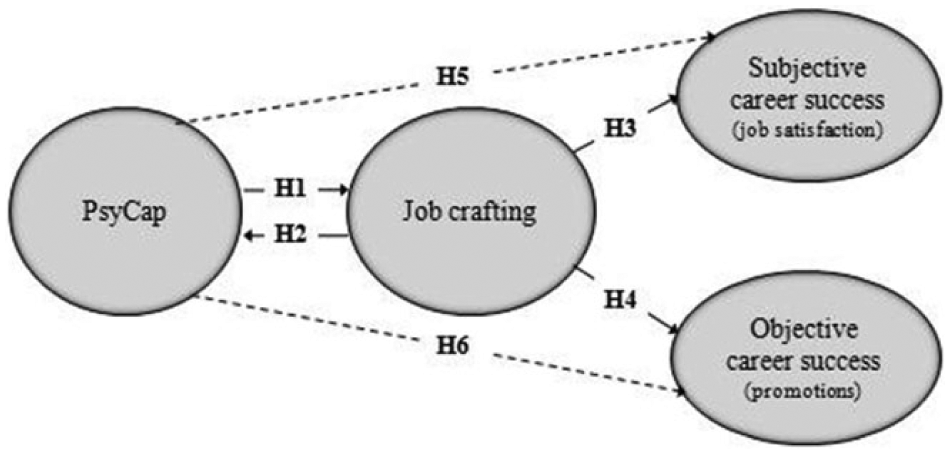
The overarching conceptual model.
Following the above theoretical reasoning, we believe that individuals possessing higher PsyCap are naturally better equipped (in terms of personal resources) to modify their work environment in ways that suit their personality and abilities. More formally, we hypothesize a direct link between PsyCap, defined as an individual’s positive state of development encompassing four components (i.e., self-efficacy, optimism, resiliency, and hope; Luthans & Youssef, 2004) and job crafting. Indeed, job crafting is defined as “the physical and cognitive changes individuals make in the task or relational boundaries of their work” (Wrzesniewski & Dutton, 2001, p. 179) to creatively adapt their job to their needs, goals, and preferences (Wrzesniewski & Dutton, 2001). More specifically, according to Tims, Bakker, and Derks (2012), these agentic behaviors alter the level of both job demands and job resources in order to promote person–job fit, and thus the achievement of personal goals (Hobfoll, 1988). Therefore, this initial resource investment (job crafting) is likely to return to individuals in objective and subjective forms of career success, and thus to mediate the relationship between PsyCap and career success. All in all, in our proposal, PsyCap is expected to act as a psychological resource that may foster the employee’s ability to shape or “craft” his or her work environment, thereby creating the conditions to succeed at work. Until now, however, no previous study has investigated the role of individuals’ proactive behaviors in translating one’s PsyCap in subjective and objective career success. Moreover, no previous studies have addressed the relationship between job crafting and objective career success, whereas the link between PsyCap and job crafting has been explored in a recent study (Vogt, Hakanen, Brauchli, Jenny, & Bauer, 2016), in which only the reverse effect of job crafting on PsyCap has been found. More specifically, Vogt et al. (2016) explored the existence of reciprocal relations among job crafting, PsyCap, and work engagement. Their results suggested that job crafting was a significant predictor of both PsyCap and work engagement, while PsyCap did not predict job crafting. In the following paragraphs, we outline the rationale underlying our theoretical model.
In particular, the aims of the present study were (a) to test the relationship between PsyCap and job crafting, (b) to analyze the relationships between job crafting and both job satisfaction and promotions, and (3) to investigate the mediating role of job crafting in the relationships between PsyCap and both job satisfaction and promotions. We used two-wave longitudinal data gathered on a relatively large sample of middle managers from an Italian service organization, in order to capture the dynamic relationships among PsyCap, job crafting, and objective and subjective career success, and to examine the hypothesized direction of relationships between these variables.
From Psychological Capital to Job Crafting (and the Reciprocal Influence)
According to Luthans, Youssef, and Avolio (2007b), PsyCap is defined as an individual’s positive psychological state of development that is characterized by (a) having confidence (efficacy) to take on and put in the necessary effort to succeed at challenging tasks; (b) persevering towards goals and, when necessary, redirecting paths to goals (hope) in order to succeed; (c) making a positive attribution (optimism) about succeeding now and in the future; and (d) when beset by problems and adversity, sustaining and bouncing back and even beyond (resilience) to attain success. (p. 3)
Overall, these four positive dimensions depict an agentic state of mind that, according to the COR theory, represents an aggregate of an individual’s psychological resources (Hobfoll, 1989, 1998). In turn, this set of resources tends to be invested and expressed through concrete actions and behaviors, which lead an employee to construct the necessary environmental conditions to achieve his or her goals (Hobfoll, 2011; Luthans & Youssef, 2004). This suggests a possible role for PsyCap as a predictor of job crafting, representing employees’ proactive strategies by which they, as mentioned above, shape their job according to their preferences (Tims et al., 2012).
As regards the impact of employees’ self-efficacy on behavior, workers with robust confidence in their own competences set more difficult standards and goals for themselves, seek opportunities to prove their ability, and tend to focus more on contextual opportunities for development rather than difficulties (Borgogni, Dello Russo, Petitta, & Vecchione, 2010; Mohammed & Billings, 2002). Thus, they are more inclined to actively redesign their work (Tims & Bakker, 2010), as attested by several studies reporting a positive association between self-efficacy and job crafting (Kanten, 2014; Tims, Bakker, & Derks, 2014).
Second, hope captures the perceived capability to generate multiple pathways and the willpower to use those pathways in order to achieve one’s goals (Luthans, Youssef, et al., 2007; Snyder, Rand, & Sigmon, 2002). Hope’s agentic nature may facilitate the intentional taking charge of one’s professional role (Chen, 2013), so that we would expect employees with increased hope to be more motivated to proactively manage and develop their job. Moreover, since hope encompasses the ability to generate multiple ways in order to achieve the same goals, we argue that this positive state could lead workers to improve their usable set of behaviors and to perform their job activities using diverse strategies that mobilize alternative cognitive and social resources, remolding one’s task and job environment (i.e., job crafting).
Third, optimism designates a positive attributional and explanatory style that allows individuals to emphasize favorable events and to distance themselves from unfavorable life happenstances (Luthans & Youssef, 2004; Seligman, 1998). Different from self-efficacy and hope, the sources of an optimist’s positive expectancies entail not only the self but also other people and external factors (Luthans & Youssef, 2007). Thus, optimistic workers may be more ready to change, because they consider variations in their professional role (e.g., improving the number of relationships with others or integrating new challenging tasks) more positively than pessimistic workers. The readiness to change characterizing optimistic individuals, in turn, makes them more inclined to actively transform the different aspects of their work activity and to face related risks, facilitating job crafting behaviors (Lyons, 2008).
Finally, resiliency is defined as “the capacity to rebound or bounce back from adversity, conflict, failure, or even positive events, progress, and increased responsibility” (Luthans, 2002, p. 702). Empirical studies have demonstrated that resilient employees tend to benefit from contextual resources, and are more likely than other workers to undertake behaviors aimed at integrating different and potentially conflicting aspects of their work-related activities (Luthans, 2002; Luthans & Church, 2002; Luthans & Youssef, 2007). From the above perspective, resilient employees might be more inclined than others to enact crafting behaviors, because they are more able to cope with the increased responsibility and workload generated by job crafting.
All in all, the above four components share a common denominator, that is represented by a core dimension of internalized agency (Avey, Luthans, & Youssef, 2010), consisting in the “positive appraisal of circumstances and probability for success based on motivated effort and perseverance” (Luthans, Avolio, Avey, & Norman, 2007a, p. 550). This second-order factor, namely PsyCap, represents the shared variance of efficacy, hope, optimism, and resiliency, and is more consistently related to the individual and organizational outcomes than each of its four components individually (e.g., Luthans et al., 2007a). Consequently, we expect that the more employees are high in PsyCap, the more they will be inclined over time to actively undertake and successfully perform actions that develop their job, making it more congenial and challenging, and improving its diverse aspects. More formally, we formulated the following hypothesis:
However, given the developable nature of employees’ PsyCap, we do not exclude the possibility that its relationship with job crafting may be reciprocal, so that job crafting also influences PsyCap over time, as reported by Vogt et al. (2016). In fact, proving one’s capacities in new activities and developing relationships in one’s work environment could influence self-efficacy through its main sources (i.e., mastery experiences, vicarious experiences, and social persuasion; Bandura, 1997). Likewise, job enrichment may stimulate the learning of new behavioral strategies, improving employees’ perceived ability to identify and engage in alternative pathways to reach their goals, and subsequently fostering their hope. Moreover, working in a more congenial environment may promote increased perception of availability of resources that can be used to face difficulties, improving one’s resilience. Finally, the more fulfilling work conditions gained by the job crafter might sustain a more positive evaluation and explanation of events occurring at work, strengthening one’s optimism. All in all, it is likely that behavioral investments of one’s psychological resources could activate a “gain cycle” (Hobfoll, 2011) in which these resources are, in turn, boosted. As such, we formulated the following hypothesis:
From Job Crafting to Career Success
Hobfoll (1988) argued that individuals’ self-initiated actions by which they shape the contextual conditions in a congenial way for themselves can facilitate the achievement of their goals. In the organizational context, these actions can be well represented in terms of job crafting (Tims & Bakker, 2010), consisting in behaviors intended to improve job resources (structural and social) and fuel challenging job demands (Bakker, Tims, & Derks, 2012; Tims et al., 2012). Moreover, several studies highlighted the role of proactive and intentional actions in positively constructing one’s career (e.g., Abele & Spurk, 2009; Chen, 2013) and subsequently in promoting career success. As aforementioned, career success involves the perceived or actual achievement employees’ have accumulated as a result of their work experiences, and entails an intrinsic component, related to an employee’s subjective reactions to his (or her) career, and an extrinsic aspect, concerning more objective and observable outcomes, such as ascendancy or salary (Judge et al., 1995). Nevertheless, studies on the relationship between job crafting and career success have, until now, been limited to considering only a subjective operationalization of the construct: In particular, these studies have reported significant positive associations between job crafting and job satisfaction (Leana, Appelbaum, & Shevchuk, 2009; Nielsen & Abildgaard, 2012).
According to Wrzesniewski and Dutton (2001), job crafting behaviors help people positively construct their relationship with their job. Indeed, employees that shape their job characteristics are able to align these features with their own preferences (Tims & Bakker, 2010), creating a job that is more responsive to important individual needs, such as competence, autonomy, and relatedness (Tims, Derks, & Bakker, 2016). The perception that one’s work fulfills important individual needs, in turn, improves its positive affective evaluation, captured by the concept of job satisfaction (Brief, 1998). At the same time, the alignment between the characteristics of one’s job and the individual’s personal characteristics fosters the person–job fit (Tims & Bakker, 2010; Tims et al., 2016), and consequently enables an employee to express his (or her) values and beliefs (Kira & Balkin, 2014). For example, employees could craft their job to better align it with their view of what their job should be. As a result, their work becomes more meaningful (Tims et al., 2016), and subsequently it is perceived as more satisfying (Steger, Dik, & Duffy, 2012; Tims & Bakker, 2010). Accordingly, we expected that:
Moreover, the concrete actions previously performed by employees are considered as important determinants of future objective career progression (Carmeli, Shalom, & Weisberg, 2007). Thus, we argue that job crafting might facilitate employees’ advancement in terms of hierarchical level by ensuring them positive evaluations by supervisors. At first, job crafting facilitates effectiveness at work, modifying job characteristics, and creating a more resourceful and challenging work environment as well as improving one’s work motivation and engagement (Tims et al., 2012). Improvements in these latter, in turn, are expected to boost job performance (Bakker et al., 2012; Tims, Bakker, & Derks, 2015). Since job crafter employees are also likely to be better performers than others, we expect them to be evaluated more positively during promotional decisions. Second, according to Wrzesniewski and Dutton (2001), some crafting behaviors (e.g., undertaking new projects or seeking feedback from clients) are similar to contextual performance, a wide term that captures a set of discretionary behaviors that go beyond the formal requirements of a job task (Motowidlo & Van Scotter, 1994), such as organizational citizenship behaviors (OCB; Organ, 1988) and dedication over time (Carmeli et al., 2007). Contextual performance consists of behaviors that support the organizational, social, and psychological context, such as generating new ideas, helping others, and cooperating. While the intent of these “OCB” is to promote the good of others and of the organization, the aim of crafting behaviors is to pursue a better level of work meaning and identity. Nevertheless, crafting behaviors are often perceived and described as OCB (Wrzesniewski & Dutton, 2001). Moreover, fostering work motivation and engagement through crafting behaviors can promote various forms of actions, different from job crafting and directly aimed at contributing to organizational functioning (e.g., Demerouti & Cropanzano, 2010), such as helping others with their work and providing information to colleagues (Demerouti, Bakker, & Gevers, 2015; Williams & Anderson, 1991). In this regard, a recent study found a positive relationship between job crafting and contextual performance (Demerouti et al., 2015), that in turn has been shown to be consistently related to promotion prospects (Carmeli et al., 2007). Accordingly, we expect that job crafter employees are also likely to be promoted because of their valuable behaviors, aimed at developing their relationships and work activities. In light of this twofold possible link between job crafting and career advancement, through both job performance and contextual performance, we formulated our fourth hypothesis:
From Psychological Capital to Career Success: The Mediating Role of Job Crafting
In the past decade, researchers have produced a large amount of evidence linking PsyCap to job satisfaction, sales revenue, and other positive outcomes such as job performance, organizational commitment, and various indicators of psychological well-being (e.g., Avey, Reichard, Luthans, & Mhatre, 2011; Avey, Wernsing, & Luthans, 2008; Luthans et al., 2007a; Peterson, Luthans, Avolio, Walumbwa, & Zhang, 2011). However, the mechanisms linking PsyCap to career success are still unclear.
In general terms, PsyCap represents a basic resource (see Luthans et al., 2007a) that needs mediating mechanisms to translate its benefits into successful outcomes. In this regard, we believe that “job crafting” represents a construct that is able to explain the relationship between PsyCap and career success. Indeed, the COR theory suggests that people better equipped in terms of personal resources, invest them in concrete behavioral strategies to develop these resources and achieve their goals (Hobfoll, 2011). Essentially, according to Chen (2013), it is likely that PsyCap facilitates a positive career evolution by promoting agentic interactions between individuals and their work environment. Under this perspective, PsyCap acquires the status of psychological determinant of behaviors aimed to exert an influence on contextual conditions (Chen, 2013). As conceptualized above, we suggest that this behavioral proclivity, captured by the construct of job crafting, is what may actually facilitate both subjective and objective career success.
First off, let’s consider subjective career success that we operationalized in terms of job satisfaction. In light of the agentic nature of PsyCap (Chen, 2013; Luthans et al., 2007a), it is likely that employees high in PsyCap may be more satisfied than others because they actively concur with and engage themselves in “crafting” their work environment according to their own standards and preferences (e.g., undertaking new projects consistent with their beliefs of efficacy, Tims & Bakker, 2010). Therefore, we posited our fifth hypothesis:
With respect to objective career success, namely promotions, Stumpf and Tymon (2012) suggested that career progression should be considered a consequence of the dynamic process in which individuals achieve goals and resources over time. Thus, attaining job promotions should depend on employees’ ability to strengthen and improve their effectiveness in terms of both job and contextual performance. Accordingly, we expect that the more successful employees are in using concrete behaviors (i.e., job crafting; Tims & Bakker, 2010) to create better work conditions and develop their competencies, and the more they take advantage of their PsyCap in order to positively invest in their work, the more likely it is that employees will be promoted. Indeed, workers expressing their psychological resources (i.e., PsyCap) through positive organizational behaviors are more likely to improve their job performance over time (e.g., Peterson et al., 2011) and, at the same time, are more likely to foster their own contextual performance, as reported by several studies that have supported the link between PsyCap and OCB (e.g., Avey et al., 2011; Norman, Avey, Nimnicht, & Pigeon, 2010; Pradhan, Jena, & Bhattacharya, 2016). These valuable behaviors enacted by employees with strong PsyCap maximize the possibility of a career advancement and, as discussed above, are enhanced by job crafting. Hence, we formulated our last hypothesis:
Method
Sample
The sample consisted of 349 employees from one of the largest service organizations in Italy, who participated in both waves of the research project. All participants worked as middle managers in the line functions in the headquarters of the company located in Rome and were tracked over a 2-year period. In terms of demographics, there were more males (59%) than females, with a mean age of 46.83 (SD = 7.63) years, and an average job tenure of 17.25 (SD = 9.99) years. Years of completed education ranged from 8 to 18; 55% earned a university degree, 45% completed high school, and 1% completed junior high school.
Procedure
Information regarding hierarchical level 1 was provided for each year by the human resource (HR) department. Self-reported data on the study variables (i.e., PsyCap, job crafting, and job satisfaction) were gathered via two online questionnaires in the spring of two succeeding years. Participation in the study was voluntary and the research team guaranteed confidentiality to all respondents. In order to match the answers provided by each individual with his or her hierarchical level at the two waves, the HR department assigned a code to each participant. The code was used to log in and respond to the online questionnaires. In this way, the HR department knew the name of the employee, his or her code, and the hierarchical level, but did not know the answers to the questionnaires, whereas the research team knew the code, the answers to the questionnaires, the objective information provided by the company, but not the name of the employee.
Measures
Psychological Capital
PsyCap was measured by the Italian version (Alessandri, Borgogni, Consiglio, & Mitidieri, 2015) of the 24-item Psychological Capital Questionnaire (Luthans et al., 2007a) composed of four subdimensions: self-efficacy (Cronbach’s alphas were .83 at Wave 1 and .91 at Wave 2), hope (alphas were .73 at Wave 1 and .81 at Wave 2), optimism (alphas were .62 at Wave 1 and .80 at Wave 2), and resiliency (alphas were .65 at Wave 1 and .81 at Wave 2). Each subscale included six statements (e.g., “I feel confident to represent my work area in meetings with management” for self-efficacy, “If I should find myself in a jam at work, I could think of many ways to get out of it” for hope, “I always look at the bright side of things regarding my job” for optimism, and “I usually take stressful things at work in stride” for resiliency). The statements were measured on a 7-point scale ranging from 1 = strongly disagree to 7 = strongly agree.
Job Crafting
Job crafting was measured by the Italian version of the Job Crafting Scale (Cenciotti et al., in press) introduced by Bakker et al. (2012), which entails three subdimensions. The first, named increasing structural job resources (e.g., “I try to develop myself professionally”), includes four items (Cronbach’s alphas were .78 at Wave 1 and .82 at Wave 2). The second, named increasing social job resources (e.g., “I ask others for feedback on my job performance”), is composed of four items (alphas were .71 at Wave 1 and .69 at Wave 2). The third, named increasing challenging job demands (e.g., “When an interesting project comes along, I offer myself proactively as project coworker”), includes five items (alphas were .70 at Wave 1 and .75 at Wave 2). Items were answered using a 7-point frequency scale, ranging from 1 = never to 7 = always.
Job Satisfaction
Consistent with previous research, showing that a single-item measure is valid to capture overall satisfaction (Berson, Oreg, & Dvir, 2008; Lee, Gerhart, Weller, & Trevor, 2008; Wanous, Reichers, & Hudy, 1997), job satisfaction was measured by the following statement: “Overall, I’m satisfied with my job”. This item was answered using a 7-point scale ranging from 1 = strongly disagree to 7 = strongly agree.
Hierarchical Level
Workers involved in the study occupied one of the following levels: senior manager AA (i.e., workers with high autonomy, specialization, and direct responsibility in the achievement of organizational goals that administer financial and human resources in complex structures or manage sales structures within wide geographical areas supporting the development of organizational policies) and junior manager A (i.e., workers with high autonomy, specialization, and direct responsibility in the achievement of organizational goals that administer financial and human resources or manage sales structures supporting the fulfillment of high standards of quality). Workers belonging to these two levels differ in the degree of responsibility, influence on other roles, and on salary. Promotion was measured as the change in the individual hierarchical level within the organization during the study period. The level AA is considered higher than the level A. Thus, we assigned a number to both levels (i.e., 0 for A and 1 for AA) for purposes of statistical analyses. 2
Control Variables
Given the significant role played by demographic variables in the achievement of career success (Ng et al., 2005), gender, age, educational level, and organizational tenure were included as control variables. Gender was coded 1 for male and 2 for female, while educational level was converted to “the number of years of instruction” (more years = higher level of education); finally, age and organizational tenure were measured in years. Demographic information were provided by the HR department along with participants’ hierarchical level.
Modeling Strategies
Following the suggestions by Cole and Maxwell (2003; Maxwell & Cole, 2007), we tested our theoretical model using a two-wave mediational design. Two-wave mediational models are superior to cross-sectional designs in that they (a) allow one to better investigate (although not to prove) the likely direction of causal influence among variables, (b) lessen biases in testing mediation, and (c) allow for more stringent testing of alternative models (Cole & Maxwell, 2003; Maxwell & Cole, 2007). Under the assumption that the structure of the relationships among variables is the same over time (i.e., stationarity), mediational processes may be investigated with two waves of data (Cole & Maxwell, 2003), as is the case in the present investigation.
In this model, job crafting, posited as a mediator, was predicted over time by PsyCap, posited as the predictor (Cole & Maxwell, 2003). Moreover, autoregressive paths were included so that each cross-time cross-lagged path takes into account the stability of the variables. It is important to note that, after the inclusion of the autoregressive path from T1, the observed score at T2 represents a “change score,” or the observed change from T1 to T2: thus, the T2 observed score of the variable “hierarchical level” operationalizes the dynamic concept of “promotion.” In our case, the hypothesized stream is represented by (a) the cross-time cross-lagged path from PsyCap at T1 to job crafting at T2, (b) the cross-time cross-lagged path from job crafting at T1 to job satisfaction at T2, (c) the cross-time cross-lagged path from job crafting at T1 to promotions at T2, and (d) the cross-time cross-lagged path from job crafting at T1 to PsyCap at T2. Under this model, the product between the coefficients associated to (a) the link of T1 PsyCap with T2 job crafting and to (b) the relationship of T1 job crafting with T2 job satisfaction provides an estimate of the partial regression coefficient associated with the mediated effect from PsyCap to job satisfaction. Likewise, the product between the coefficients associated to (a) the link of T1 PsyCap with T2 job crafting and to (b) the relationship of T1 job crafting with T2 promotions provides an estimate of the partial regression coefficient associated with the mediated effect from PsyCap to promotions. Control variables (i.e., gender, age, educational level, and tenure) were included in relation to all latent variables and retained if they were significant (p < .05).
Structural Equations Analysis
We tested the hypothesized relationships among the variables using the covariance structure program Mplus 7 (Muthén & Muthén, 2012), with the weighted least squares with mean and variance adjustment algorithm. The weighted least squares with mean and variance adjustment uses a variance-weighted approach specially suited for models including categorical variables, variables with largely unequal variances, and whose variables measured on different scales (Muthén & Muthén, 2012). The following criteria were employed to evaluate the goodness of fit: χ2 likelihood ratio statistic, Tucker–Lewis index (TLI), comparative fit index (CFI), the root mean square error of approximation (RMSEA) with associated confidence intervals, and the weighted root mean square residual (WRMR). The significance value of chi-square is sensitive to large sample sizes and easily produces a statistically significant result (Bollen, 1989). We accepted TLI and CFI values greater than 0.90, RMSEA values lower than 0.08 (Bentler, 1990), and WRMR values around 1.00 (Yu, 2002). A corrected chi-square difference test (SB-Δχ2) was used to compare the fit of nested models (Satorra & Bentler, 2010).
PsyCap and job crafting were posited as latent variables loaded by their first-order dimensions (i.e., the four subscales of hope, efficacy, resiliency, and optimism for PsyCap and the subscales of increasing structural job resources, increasing social job resources, and increasing challenging job demands for job crafting). Job satisfaction and hierarchical level were included as observed variables. In testing mediation, we followed MacKinnon, Lockwood, Hoffman, West, and Sheets (2002) who recommended the asymmetric confidence interval method to formally test the significance of longitudinal indirect effects (MacKinnon, Lockwood, & Williams, 2004). Accordingly, the critical values for the upper and lower confidence limits (95% CI) for the above indirect effect were calculated using the program PRODCLIN2 (Fritz & MacKinnon, 2007; MacKinnon, Fritz, Williams, & Lockwood, 2007).
Results
Relations Among Variables
Table 1 contains the zero-order correlations among PsyCap, job crafting, job satisfaction, and hierarchical level at both time points. High correlations across time attest to the stability of all variables. As expected, PsyCap was significantly correlated with job crafting and job satisfaction over time, and more weakly with hierarchical level. Moreover, job crafting was correlated with job satisfaction and hierarchical level across time. Finally, job satisfaction and hierarchical level were weakly correlated (and sometimes unrelated) to each other.
Zero-Order Correlations and Descriptive Statistics.

Note. PsyCap = psychological capital. Variables are indexed by Wave (i.e., 1 = Wave 1, 2 = Wave 2). Gender was coded using 1 as male and 2 as female. Educational level was reported as the number of years of instruction. Hierarchical level was coded using 0 for junior manager and 1 for senior manager.
p < .05. **p < .01.
Test of Mediation Over Time
The hypothesized model, represented in Figure 2, fit the data well: χ2(180) = 300.377, p < .001, CFI = 0.940, TLI = 0.925, RMSEA = 0.044 (0.035-0.052), WRMR = 1.027. Following standard procedures, we constrained, one at a time, the loadings of the corresponding indicators of PsyCap and job crafting at T1, to be equal to the loading of the same indicator at T2. The final constrained model also fit the data well: χ2(185) = 305.244, p < .001, CFI = 0.940, TLI = 0.927, RMSEA = 0.043 (0.034-0.052), WRMR = 1.043, and was not statistically distinguishable from the unconstrained model, SB-Δχ2(5) = 6.054, p = .30. As hypothesized, PsyCap at T1 predicted job crafting (Hypothesis 1) at T2, and job crafting at T1 predicted both job satisfaction (Hypothesis 3) and promotions (Hypothesis 4) at T2. Likewise, job crafting at T1 predicted PsyCap at T2 (Hypothesis 2). Accordingly, we found some evidence for the hypothesized (see our presentation of Hypothesis 2) reciprocal effect of job crafting on PsyCap (although two waves of data are not sufficient to prove reciprocal effects).

Results from structural equation analyses.
Overall, the observed pattern of longitudinal predictions corroborated our theoretical model and assigned a pivotal role to job crafting as the mediator of the contribution of PsyCap to job satisfaction (Hypothesis 5) and to promotions (Hypothesis 6). Indeed, the estimated unstandardized longitudinal indirect effect from PsyCap to job satisfaction through job crafting was significant (Β = .11; 95% CI [.040, .194]). Moreover, the estimated unstandardized longitudinal indirect effect from PsyCap to promotions through job crafting was significant (Β = .07; 95% CI [.013, .145]). Finally, the model accounted for a consistent proportion of variability for all variables (see Figure 2).
Covariates
Among covariates, educational level was significantly associated with hierarchical level (β = .31, t = 4.74) and job crafting (β = .15, t = 2.01) at T1, but it was unrelated to PsyCap and job satisfaction. Hierarchical level at T1 was also predicted positively by age (β = .39, t = 3.83) and negatively by job tenure (β = −.39, t = −3.72), that in turn, were not associated with PsyCap, job crafting, and job satisfaction. Finally, gender was not significantly associated with PsyCap, job crafting, job satisfaction, or hierarchical level. There were no significant relations among covariates and variables at T2.
Alternative Models
To further corroborate our results, we tested several alternative models and compared their fit with that of the hypothesized model tested above. In the first alternative model, we investigated the eventuality that the mediation of the influence of PsyCap on job satisfaction by job crafting was partial. To this aim, we included a direct longitudinal path from T1 PsyCap to T2 job satisfaction. The inclusion of the aforementioned direct path did not significantly improve the fit of the model, SB-Δχ2(1) = 3.13, p = .08. Likewise, we tested whether the mediation of the influence of PsyCap on promotions by job crafting was partial, by exploring the significance of a direct link between T1 PsyCap to T2 promotions. This additional direct path did not significantly improve the fit of the model, SB-Δχ2(1) = 1.54, p = .22, providing support for full mediation. Finally, we tested the statistical significance of six remaining plausible reverse longitudinal paths: (a) from job satisfaction at T1 to PsyCap at T2, SB-Δχ2(1) = 3.66, p = .16; (b) from job satisfaction at T1 to job crafting at T2, SB-Δχ2(1) = 1.79, p = .18; (c) from job satisfaction at T1 to promotions at T2, SB-Δχ2(1) = 1.08, p = .30; (d) from hierarchical level at T1 to PsyCap at T2, SB-Δχ2(1) = 0.01, p = .94; (e) from hierarchical level at T1 to job crafting at T2, SB-Δχ2(1) = 1.38, p = .24; (f) from hierarchical level at T1 to job satisfaction at T2, SB-Δχ2(1) = 0.23, p = .63. None of these reverse effects were significant. Overall, these results provided further support for the hypothesized theoretical model.
Discussion
Recently, a number of studies have supported the significant role of PsyCap as a determinant of various forms of professional achievement. The purpose of the present work was to investigate the role of agentic behaviors, captured by the construct of “job crafting”, in translating PsyCap into career success. More specifically, we posited a model in which job crafting mediated the relationship among PsyCap, on the one hand, and both subjective (i.e., job satisfaction) and objective (i.e., promotions) career success, on the other hand.
First, findings suggest that PsyCap is a significant predictor of job crafting over time (Hypothesis 1). In our model, we conceptualize PsyCap as an aggregate of psychological resources similar to the COR concept. According to Hobfoll (1989, 1998), resources tend to appear and evolve in associate ways. People with more resources are more likely to invest them in concrete actions to acquire new resources and achieve their goals than individuals with less resources (Halbesleben, Neveu, Paustian-Underdahl, & Westman, 2014; Hobfoll, 1988). In accordance with these theoretical assumptions, our model revealed that an individual’s initial level of personal resources (i.e., PsyCap) predicted their tendency to invest them in enacting proactive behaviors finalized at shaping their work environment (i.e., job crafting).
Second, in line with Vogt et al. (2016), we found a positive and reciprocal longitudinal prediction of PsyCap by job crafting (Hypothesis 2). This link suggests that the relation between resources (i.e., PsyCap) and investments (i.e., job crafting behaviors) is dynamic. Thus, it is evocative of the existence of a “gain cycle” (e.g., Halbesleben et al., 2014; Hobfoll, 2011): part of people’s psychological resources invested in agentic behaviors came back to restore or improve their level of PsyCap. This happens because job crafting behaviors help employees create positive work conditions, in terms of learning opportunities, social support, and challenging activities, that in turn, protects and enriches the employees’ personal resources through “caravan passageways” (Hobfoll, 2011).
Another finding from our study pertains to the relationships among job crafting and both subjective and objective career success. This latter relationship (i.e., between job crafting and objective career success) has never been investigated in previous studies. Results corroborated the role of job crafting in facilitating employees’ job satisfaction (Hypothesis 3), considered as an indicator of subjective career success, as well as objective career success, in terms of promotions (Hypothesis 4). People are motivated not only to conserve their resources but also to acquire new valued ones through strategic behavior (Halbesleben et al., 2014; Hobfoll, 1988). In this regard, our data highlight that crafting behaviors constitute an effective strategy that aids individuals in attaining positive career outcomes.
In sum, by supporting the mediating role of job crafting in the relationship between both PsyCap and job satisfaction (Hypothesis 5) and between PsyCap and promotions (Hypothesis 6), our results contribute to explain the behavioral process that turns PsyCap into the achievement of different forms of career success. Given that this overall process of development originates from and is driven by PsyCap, findings emphasize the importance for employees to have an initially good level of positive psychological resources. According to the COR theory, people with an inadequate level of PsyCap (i.e., low psychological resources) are more likely motivated to avoid loss of resources. To this aim, they might use conservative strategies in managing their work role, rather than craft their environment in order to develop themselves and achieve challenging goals. Conversely, people holding a higher level of PsyCap (i.e., increased psychological resources) are more likely to activate different behaviors (i.e., increasing structural job resources, increasing social job resources, and increasing challenging job demands), namely job crafting (Tims & Bakker, 2010), that in turn lead to career success. However, according to our results, job crafting plays a full mediator role in the relationships between PsyCap and both subjective and objective outcomes. Loosely speaking, having an elevated level of PsyCap may not be sufficient to becoming more satisfied and to gain promotions, if the employee is not allowed to undertake initiatives and to manage his or her own job role in an autonomous way, adapting its features to fit with his or her preferences.
Finally, with regard to demographic variables, the effects of gender, age, job tenure, and educational level substantially aligned with previous literature (Alessandri et al., 2015; Leana et al., 2009; Ng et al., 2005). Of importance, all of the significant effects of the covariates involved the main variables of the model only at T1. This means that the psychological and behavioral antecedents that we considered in our model are, with respect to covariates, stronger predictors of changes in PsyCap, job crafting, and career success. Thus, our results seem to be consistent with Luthans and Youssef (2004) assertion that the importance of PsyCap as an activator of an employee’s gain cycle (Hobfoll, 2011) is superior to that of human capital.
Limitations and Implications
A first limitation of this study pertains to the generalizability of our results to other samples. Indeed, our sample included managers from the same organization: this means that the degree of autonomy of these workers was high and, thus, their crafting behaviors were generally facilitated. Future research is needed to replicate the posited model using other samples, involving people from different organizational and cultural contexts, and considering more heterogeneous professional groups. More specifically, considering the degree of job autonomy as a moderating variable in future studies can help us better understand the relationship between PsyCap and job crafting. Indeed, translating employees’ psychological resources in crafting behaviors may be facilitated by a high degree of autonomy or, in contrast, could be hampered by the lack of this job resource. At the same time, previous research on PsyCap has recognized the role of organizational climate in promoting employees’ organizational behaviors, such as job performance (e.g., Luthans, Norman, Avolio, & Avey, 2008) and contextual performance (e.g., Shaheen, Bukhari, & Adil, 2016). According to this literature, PsyCap emerged as a mediator in the relationship between supportive organizational climate and job performance (Luthans et al., 2008) and as a moderator of the relationship between perceived organizational support and OCB (Shaheen et al., 2016). Therefore, including variables related to organizational culture, such as organizational climate or perceived support, can provide a more accurate contextualization of the role of PsyCap in generating crafting behaviors and thus in promoting career success. Similarly, when examining the construct of objective career success, taking into account cultural aspects such as organizational justice or organizational politics in future studies would also be interesting, in order to better understand the relationships between individual variables (i.e., psychological resources and agentic behaviors) and promotions. Indeed, our model only predicts the change of hierarchical level due to individual differences, but did not consider the real opportunities for promotion. Moreover, the above concern for agentic behaviors and career success also suggests the importance of using heterogeneous samples with respect to employees’ age, in order to more accurately investigate the existence of generational differences. For example, millennial workers may have greater expectations of an organizational context providing autonomy and supporting empowerment. Conversely, employees involved in this study have a mean age of approximately 47 years, with a standard deviation of nearly 8 years.
A second potential concern regards the measures we used, that in three cases (i.e., PsyCap, job crafting, and job satisfaction) were self-report. This could increase common method variance (Podsakoff, MacKenzie, & Podsakoff, 2012) among the three variables, although the fourth measure was conversely assessed by using an external measure (i.e., the employee’s hierarchical level provided by the HR department). In this regard, future studies should also use external sources for data concerning psychological variables: for example, an employee’s job crafting could be measured by asking supervisors for frequencies regarding their subordinates crafting behaviors.
Third, although a two-wave model may support causal inferences, we cannot definitively conclude that PsyCap causes job crafting, and that job crafting causes subjective and objective career success. For this purpose, experimental designs have to be implemented.
Overall, we believe that our study offers an interesting theoretical and empirical contribution to the literature regarding positive antecedents of career success. Some practical implications can be derived from the findings of our research. First, results point to the role of employees’ PsyCap in promoting both professional and personal development, in terms of both job crafting and career success. This finding should encourage organizations to consider the level of PsyCap in their personnel selection, and to support workers in maintaining and strengthening their PsyCap (e.g., through goal setting and coaching). Moreover, given the key role of job crafting in mediating the influence of PsyCap on subjective and objective career success and in promoting the strengthening of employees’ level of PsyCap, organizations may benefit from interventions (e.g., providing task autonomy or involving employees in strategic conversations) aimed at facilitating crafting behaviors. Indeed, the more workers are allowed to remold their job role and to develop their social relationships within the organization, the more they are likely to create the optimal conditions to develop their personal resources and professional roles.
Footnotes
Declaration of Conflicting Interests
The author(s) declared no potential conflicts of interest with respect to the research, authorship, and/or publication of this article.
Funding
The author(s) received no financial support for the research, authorship, and/or publication of this article.