



Abstract
One of the most widespread types of digital technology is the Internet which more than 5 billion people or 63.1% of the world’s population use as of April 2022. Previous studies have established that the relationship between digital technologies, such as the Internet, and labour market participation is worth investigating. While it is widely accepted that digital technologies help in women’s social and economic inclusion, the female labour participation force observed across countries remains slow and varied. There remains a limited investigation into the influence of internet penetration on the changes in the labour market outcomes for women. There is also scope for research on how the Internet affects women’s economic participation from a social and gender perspective. Prior research shows that social capital has been linked to labour allocation. Studies also show that variations in ideas on gender roles are significant for women’s decisions to find employment. We, therefore, investigate how widespread penetration of the Internet has influenced the economic participation of women in this study. We also investigate how social capital and gender equality play a role in the above relationship across countries. Our study uses archival data to conduct a panel analysis of 66 countries from 2014 to 2021. The study’s results show that the penetration of internet and the economic participation of women are positively associated. This study also found that the link between the penetration of internet and the economic participation of women is mediated by social capital. Gender equality was also found to moderate the above relationship, such that social capital had a stronger mediation influence on the association between internet penetration and women’s economic engagement in nations with comparatively lower levels of gender equality.
Keywords
Introduction
Information and communication technologies, abbreviated as ICT, have a significant influence on the creation of new jobs, revenue streams, business models and lower access costs to public services, making them essential to growth and development (Appiah-Otoo & Song 2021; Franzen, 2003; Kurniawati, 2022) The Internet is one of the most common and widespread examples of digital technology. As of April 2022, over 5 billion individuals, or 63.1% of the global population, were online using the Internet (Statista, 2022b). The Internet allows people to connect, transact, share and collaborate without any geographical constraints (Franzen, 2003). This feature was particularly useful as the world faced the COVID-19 pandemic in 2020, which restricted the physical mobility of people (Beldad, 2021). The increased availability of digital technologies, such as the Internet, gives the large majority of individuals more possibilities and increased flexibility (Valberg, 2020). A significant result of the increased spread of digital technologies is the effect on the labour market made by the emergence of new employment opportunities and more adaptive, diverse and open labour markets (Nikulin, 2017). It is expected that the labour market will be affected by digital technologies as a result of increased information, decreased transaction costs and the creation of new employment opportunities. This is especially advantageous because time and transportation issues have restricted women for long from entering the workforce (Valberg, 2020). Digital technologies also enable women to overcome previously existing social and cultural constraints (Riquelme et al., 2018) that have traditionally kept them out of the workforce. While it is argued that digital technologies aid the inclusion of women who have traditionally not actively been part of the economy, it is intriguing to investigate the connection between digital technologies and women’s involvement in the workforce because the proportion of women in the labour force fluctuates among nations due to disparities in economic growth, social conventions, education and income and fertility rates (Nikulin, 2017; Parthiban et al., 2022; Raja et al., 2013). There is also greater diversity in the involvement of women in the labour force than men (Verick, 2014). For example, while the proportion of women in the labour force in Iraq and Jordan is less than 20%, women constitute more than half of the labour force in New Zealand and Zimbabwe (International Labour Organization [ILO], 2021). Women comprise almost half of the adults globally and, by extension, the workforce; therefore, their presence in the workforce is crucial to economic progress and growth (Nkoumou Ngoa & Song, 2021) to increase the overall economic productivity of countries (Boserup, 2007). When women participate in the workforce, they become more economically productive contributors to society, which directly contributes to an improvement in the national economy that benefits everyone, including women (Bhandari, 2019). Over the years, women’s economic engagement, specifically the participation of women in the labour force, has slowly but steadily increased. In reality, however, despite legislative support, women’s labour participation remains low post-pandemic, especially in developing countries like India (Kumar, 2021; Sharma, 2022). The talent and skill pool is diminished when women are underrepresented in the workforce, which can lead to inefficient resource allocation and slower economic growth (Cuberes & Teignier, 2015). Further, raising the economic participation of women can directly boost economic development in countries with a declining workforce (Steinberg & Nakane, 2017).
The Internet has had a profound impression on the labour market—both by fostering the emergence of new occupations and by making existing ones more inclusive, inventive, adaptable and accessible—is among their most important impacts (Dettling, 2017; Tuure et al., 2019). Additionally, having an adequate connection to the Internet allows women to have a more flexible work-life balance by enabling them to work remotely (Suhaida et al., 2013; Young et al., 2022). The following study specifically focusses on the Internet and its influence on women’s economic participation. The Internet has changed a vast array of economic activities in the modern era due to its quick, low-cost access and fast speed. These attributes of the Internet were especially critical throughout the recent COVID-19 outbreak when the world witnessed lockdowns and restrictive movement policies in many countries. People depend on the Internet for employment, education, information access, social interaction and even enjoyment (De’ et al., 2020). However, little investigation has been conducted into changes in the labour market outcomes for women by the Internet (Dettling, 2017). Previous research between digital technologies and women’s economic participation has considered ICT such as mobile access, fixed broadband access and mobile broadband subscriptions as an aggregate (Abubakar et al., 2017; Hafeez et al., 2020; Hendriks, 2019; Nikulin, 2017; Nkoumou Ngoa & Song, 2021; Suhaida et al., 2013; Williams & Artzberger, 2019). In this study, however, we specifically examine internet technology and its effect on women’s economic participation. There are only a handful of studies that have studied internet technology, specifically in relation to women’s economic participation. However, they have been contextual and limited to specific geographic regions only (Alam & Mamun, 2017; Bahia et al., 2021). Further, despite significant regional variations, internet penetration is rising worldwide. For instance, although Bostwana and Ecuador have only about 64% internet penetration, countries such as Norway and Denmark have nearly 100% internet coverage (World Bank, 2022). The rate of women’s involvement in the workforce also varies substantially around the world. Women make up 52.6% of the workforce globally as a whole. However, there are disparities in geographical female workforce engagement rates. For instance, in the Caribbean and Latin America, only 21% of women work, compared to approximately 69% in Sub-Saharan Africa. It is interesting to see that male involvement is significantly higher than female participation in all locations, averaging around 80%. When nations are categorized according to income, high income nations have higher participation rates of women. Lower-middle income nations have the biggest gender disparity in labour force participation of all income groups (World Bank, 2022). Thus, motivated by the diversity of women’s labour force participation and internet penetration between countries, the study’s purpose is to analyse their interrelationships at the macro or cross-country level and to give a comprehensive global dynamic of the phenomena.
In addition, the majority of the research on women’s choices in the labour market is based on conventional economics concepts (Contreras & Plaza, 2010). Hence, there is a scope for research from a social and gender perspective. For instance, Contreras and Plaza (2010) emphasize the cultural aspects of Chilean women’s economic participation. They find that machismo and traditional cultural norms are one of the aspects that affect women’s economic participation. Similarly, Atasoy (2017) finds that in Turkey, traditionalism is a noteworthy factor in determining women’s involvement labour force. There has been a rise in the relevance of social capital over the years in both economics and sociology, especially among international institutions that are interested in development projects. While, in literature, social capital has been linked to labour allocation (Aguilera, 2002), there are only a handful of studies that apply the concept to labour, especially the participation of women in the labour force (Puga & Soto, 2018; Shui et al., 2021). Social capital can be viewed as a system of trust, authority and normative relationships between people (Coleman, 1988). In this study, we consider aggregated social capital at a country level that ‘measures the strength of personal and social relationships, institutional trust, social norms, and civic participation in a country’ (Legatum Institute, 2021). Further, studies also show that cultural variations in ideas on gender roles are significant for women’s decisions to find employment (Farré & Vella, 2013; Fortin, 2015; Wang, 2019). In this study, therefore, we examine how internet penetration affects women’s economic participation. We examine the influence of social capital in the above relationship across countries at a global scale. We also investigate the impact of gender equality on these associations at the national level. Hence the research questions are as follows:
RQ1: What is the relationship between internet penetration, social capital, and women’s economic participation in a country? RQ2: What is the role of gender equality in influencing the relationships between internet penetration, social capital, and the economic participation of women in a country?
For the purpose of investigating the aforementioned research questions, we make use of publicly accessible data from 66 countries for the years 2014–2021. Our study offers multiple contributions. We contribute first to the information technology and gender literature by examining internet penetration and women’s economic participation. Second, we examine the influence of gender equality in the nexus between internet penetration, social capital, and women’s economic participation. Third, this study adopts a robust econometric methodology to examine the above relationships. The article is organized as follows: The subsequent section describes the background and development of the hypotheses. The research method and empirical results are then explained. Finally, we summarize the importance of this study by discussing the results and their implications.
Background Discussion and Hypotheses Development
Internet and the Economic Participation of Women
ICT have been linked to the economic participation of women through improved connectivity, digital transformation of businesses and globalization (Rekha et al., 2021; Sefyrin, 2019). In this study, we focus on internet penetration because the Internet has the ability to connect people worldwide at an enormous scale, allowing people to share information and content and interact with each other. Here, internet penetration refers to internet users in a country. For instance, in 2021, monthly user engagement from Meta platforms alone was 3.6 billion people (Brown et al., 2022). In addition, the United Nations has acknowledged the Internet’s distinctive and transformational capabilities that support societal progress and development (Human Rights Council, 2011). The Internet is a primary driver of increasing connectivity, which leads to better access to employment possibilities and a better opportunity for companies to find competent job candidates as well, thus making the labour market more inclusive and flexible. The Internet also enables the digitization of businesses by allowing people to work together virtually from across the globe (Raja et al., 2013). Female internet users have better access to online platforms and employment exchanges, and they also have more opportunities to find work through online contracting. Additionally, the Internet may help women overcome the social and cultural barriers that have traditionally prevented them from entering the workforce. Further, by permitting women to work remotely and by assisting them in overcoming physical and temporal constraints, good internet connection access gives them more flexibility in their work and personal lives (Nkoumou Ngoa & Song, 2021; Suhaida et al., 2013).
The empirical literature is indicative of a favourable link between internet usage and the economic participation of women. For example, Nikulin (2017) looked at 60 developing nations and discovered a significant connection between internet usage and females over 15 years of age who were employed in the labour force between 2000–2014. In a similar vein, Nkoumou Ngoa and Song (2021) also found, through their investigation of 48 African nations between 2001 and 2017, that use of internet improved the proportion of women in the workforce. Additionally, Watson et al. (2018) too obtained a favourable link between the usage of the Internet and workforce participation rates for females in the Indo-Pacific region between 2000 and 2016. These outcomes are in line with those from Efobi et al. (2018) who also found a favourable link between the use of the Internet and workforce participation of women in 48 nations in Sub-Saharan Africa between 1990 and 2014. Further, according to Dettling (2017), high-speed internet helped American married women improve their economic participation by 4.1% between 2000 and 2009. The author further found that the Internet can promote teleworking, helping women balance work and family. These results are consistent with earlier research by Goyal (2011), who contended that women’s access to the Internet had the potential to improve economic equity and productivity since it gives women the flexibility of working remotely, learning online and advancing their competencies required for employment opportunities. Internet technology may also improve job search and home production, boosting women’s workforce involvement (El-Mallakh, 2020). Therefore, we submit that increased internet penetration will be positively related to the economic participation of women in a country. Thus, we hypothesize:
H1: Internet penetration in a country has a positive impact on the economic participation of women.
Social Capital, Internet Penetration and the Economic Participation of Women
The network of personal connections is the source of social capital (Salehan et al., 2018). It is vital to recognize social capital as an integral aspect of society due to its impact on interpersonal interactions (Lin, 2001; Salehan et al., 2018). Coleman (1988) proposed that the system of trust, authority and normative relationships between people constitutes social capital. The fundamental idea behind social capital is that one’s connections form an essential and useful asset (Neves, 2013). It should be noted that there are various categories of social capital, such as ‘bridging social capital’, ‘bonding social capital’ and ‘linking social capital’ (Papadimitri et al., 2021; Woolcock, 2001). In contrast to bridging social capital, which relates to acquaintances, colleagues and co-workers, bonding social capital alludes to family and close friends. Linking social capital involves forming alliances with sympathetic people in authority and using formal institutions to use resources, concepts and knowledge beyond the community. In this study, however, we consider aggregated social capital at a country level. As a result, in this study, social capital ‘measures the strength of personal and social relationships, institutional trust, social norms, and civic participation in a country’ (Legatum Institute, 2021). This includes the three types of ‘bridging, bonding, and linking social capital’ discussed above. The level of social capital is found to differ markedly across countries. For instance, according to Legatum Prosperity Index (LPI) 2021, Denmark and Norway have the highest country-level social capital, whereas Lebanon, Syria and Afghanistan have the weakest country-level social capital. Therefore, motivated by these variations, we investigate the effect of social capital at country level in the link between internet penetration and women’s economic participation.
The Internet has changed the process of generating social capital, its use and sustenance by facilitating constant social connectedness and fostering the growth of both individual relationships and institutional networks (Wellman, 2001). The Internet can help build social capital through increasing social interaction with one’s personal social circle irrespective of geographical boundaries (Haythornthwaite, 2005; Wellman et al., 2006). The Internet is frequently used by people for social networking, amusement, knowledge and online transactions due to advancements in affordable mobile devices that allow easy access to the Internet (Cheng et al., 2020). Considered to be among the Internet’s most widespread applications are social networking sites (Statista, 2022c). In 2022, nearly 2 million people used Facebook every day (Statista, 2022a). Thus, we can see that the Internet is often and regularly used in our daily lives. Throughout the global COVID-19 pandemic, the Internet played a key role in sustaining social capital when physical contact was drastically reduced by social distancing measures (Beldad, 2021). These are common instances of how social capital is preserved as a result of internet use (Koeze & Popper, 2020; Wong, 2020).
A favourable association involving the use of internet and social capital has been found in past research (Barbosa Neves et al., 2018; Kharisma, 2022; Neves, 2013; Reisdorf et al., 2022; Williams, 2019). The Internet’s easy accessibility, high speed and affordable nature provide opportunities and social affordances that show promise for the generation and consolidation of social capital (Wellman et al., 2006). The Internet encourages ongoing societal interaction, enables the growth of close relationships that transcend geographic boundaries, and facilitates communication. The Internet can also help build social capital through increasing contact with personal social circles irrespective of their geographical location (Pénard & Poussing, 2010; Wellman, 2001). Consequently, people can expand their social networks by forming fresh connections and rekindling old ones (Haythornthwaite, 2005). It was found that the Internet increases the social capital of senior citizens as well (Yang et al., 2022). According to Lin (2001), social capital has grown since the 1990s due to cybernetworks. In a similar vein, Bauernschuster et al. (2014) showed that being able to access the Internet from one’s own residence and social capital are positively correlated. Internet usage is also associated with having bigger and more varied social networks (Hampton, 2011). We, therefore, submit that the Internet can be a practical and effective tool for building new and preserving existing social capital.
H2: Internet penetration in a country will have a positive impact on its social capital.
Through the years, international agencies such as the United Nations and the World Bank have emphasized the pertinency of social capital and networks as an instrument for growth that is rooted in the local community (Puga & Soto, 2018). Additionally, past research has emphasized the worth of social capital for finding employment and advancing in one’s career. Jobseekers may benefit from utilizing their social capital in terms of networks that might inform them about opportunities that are available. Quiet early on, Granovetter (1973) claimed that networks swiftly propagated details about available job positions, and Burt (2001) subsequently added that people with strong connections were more visible and had more negotiating power, which attracted job opportunities. Studies have emphasized the significance of these relationships from the viewpoint of trust in that they enable the combining of the labour force and financial resources to support small enterprises (Sanders & Nee, 1996), particularly those owned by women (Barış & Aşkın, 2016). Social capital and the value of the resulting employment have also been studied extensively, as have their respective relationships to the social standing of the jobseeker (Behtoui, 2007; Lin, 2001; Lin & Dumin, 1986), especially for women (Johnson Jr. et al., 1999). Social capital also significantly affects female entrepreneurship, thereby playing a key role in expanding women’s job opportunities (Barış & Aşkın, 2016). Studies have also shown that social capital can help women in terms of providing chances for employment retention and/or career advancement (Choi, 2019; Hezlett & Gibson, 2007; Seibert et al., 2001). Thus, we hypothesize that social capital positively influences the economic participation of women.
H3: Social capital in a country will have a positive impact on the economic participation of women.
As argued previously, internet penetration is a significant factor in promoting women’s economic participation. However, increased internet penetration by itself may not lead to a direct increase in women’s economic participation. A gendered critique of social capital theory by Riddel et al. (2001) reveals that women have traditionally borne a major share of the responsibility of maintaining social capital in a society which has resulted in being one of the reasons for their non-participation in the economic labour force. However, today, the Internet has revolutionized social capital building and use through many social media technologies, as seen from the above arguments. Communication and participation in virtual social spaces have become easy for anyone with internet access or mobile connectivity. For example, internet access allows women greater job flexibility, social connectedness and access to a variety of professional and personal networks while simultaneously allowing them to continue in social capital building and maintenance activities. Thus, it is no longer an ‘either-or’ situation for women between social capital activities and full-time economic participation. Therefore, we submit that internet access allows women to use and contribute to social capital while simultaneously being employed. Taken together, we hypothesize:
H4: Social capital in a country will mediate the relationship between internet penetration and the economic participation of women.
Gender Equality, Internet Penetration, Social Capital, and the Economic Participation of Women
We argued earlier that internet penetration positively impacts social capital through its ability to connect people globally, share information and create networks. However, this relationship will vary based on women’s social status and gender norms (Lopez-Sintas et al., 2020). Furthermore, women’s access to the Internet may differ from that of men’s based on the social standing they hold in a given nation (Anandhita & Ariansyah, 2018; Organization for Economic Cooperation and Development, 2018). There are various obstacles preventing women from using the Internet, including knowledge, cost, digital literacy, online safety and the lack of meaningful content, among other social, economic and cultural barriers (Acilar & Sæbø, 2021; Anandhita & Ariansyah, 2018). Consequently, women miss out on the advantages offered by internet use, such as finding employment or being self-employed, building networks and remaining socially connected (David & Phillips, 2022). Therefore, consistent with this line of reasoning, we submit that a country’s gender equality, which acts as a societal constraint, will moderate the relationship between internet penetration and social capital.
H5: The effect of internet penetration on social capital will be moderated by gender equality in a country.
The effect of social capital on a country’s workforce is influenced by the social and welfare amenities existing in that country. For instance, women’s social status and gender norms may affect the way social capital influences economic participation. Hence, women are more likely to have the skills and experiences essential for full economic involvement in countries with relatively higher values of gender equality. Women are expected to care for children through gendered social structures and roles; therefore, employment comes with significant opportunity costs for them. Thus, conservative views may affect women’s labour market entry, either directly or indirectly reinforcing earlier effects (Puga & Soto, 2018). Statistics show that women continue to trail males in job development, salary and social status, even though the strength of women joining the workforce has improved, and efforts have been made to reduce gender pay inequality. According to the research, social capital is a significant asset and source of the information, opportunities, and connections necessary for professional advancement and maturity, but access to it is often restricted, especially for women (Lutter, 2015; Timberlake, 2005). Thus, increasing women’s economic involvement necessitates the assistance of social capital in local settings (Asteria et al., 2018). Therefore, consistent with this line of reasoning, we submit that a country’s gender equality which acts as a societal constraint, will moderate the association between social capital and economic participation of women.
H6: The influence of social capital on the economic participation of women will be moderated by gender equality in a country.
Combining the above arguments of H5 and H6 together, we logically posit that gender equality moderates the overall mediating relationship of social capital between internet penetration and women’s economic participation.
H7: Gender equality in a country will moderate the indirect relationship between internet penetration and women’s economic participation through social capital.
Taken together, we propose a research model (as shown in Figure 1) to examine the relationships between internet penetration, social capital, women’s economic participation and gender equality.

Research Method
Data
We tested the hypotheses using secondary data from several trustworthy institutions such as the International Telecommunications Union (ITU), ILO, Economist Intelligence Unit (EIU) and World Bank. Archival data was used because of the following reasons. First, since this is research spanning multiple nations, gathering primary data was time and labour-intensive (Frankfort-Nachmias & Nachmias, 2008). Second, using secondary data had a number of additional benefits, including straightforward replication and validation as well as resilience to the problem of common method bias (Calantone & Vickery, 2009; Woszczynski & Whitman, 2004). Since we gathered data from multiple distinct sources, it was required to match countries across all databases. We combined the matching datasets for 66 countries, which was enough (minimum 50 data points) to prevent efficiency and problems of degrees of freedom (Hair et al., 2006). The time period considered was from 2014 to 2021 to maintain a balance between the need for recent data and available data.
Variables and Measures
The variables used in the study are shown in Table 1. The study’s dependent variable ‘women’s labour force participation rate’ denoted by the percentage of women above 15 years of age participating in the workforce. This is measured by the ILO and has been frequently used in past studies (Atasoy et al., 2021; Hiramatsu, 2022; Omotoso & Obembe, 2016; Samargandi et al., 2019).
Data Description.
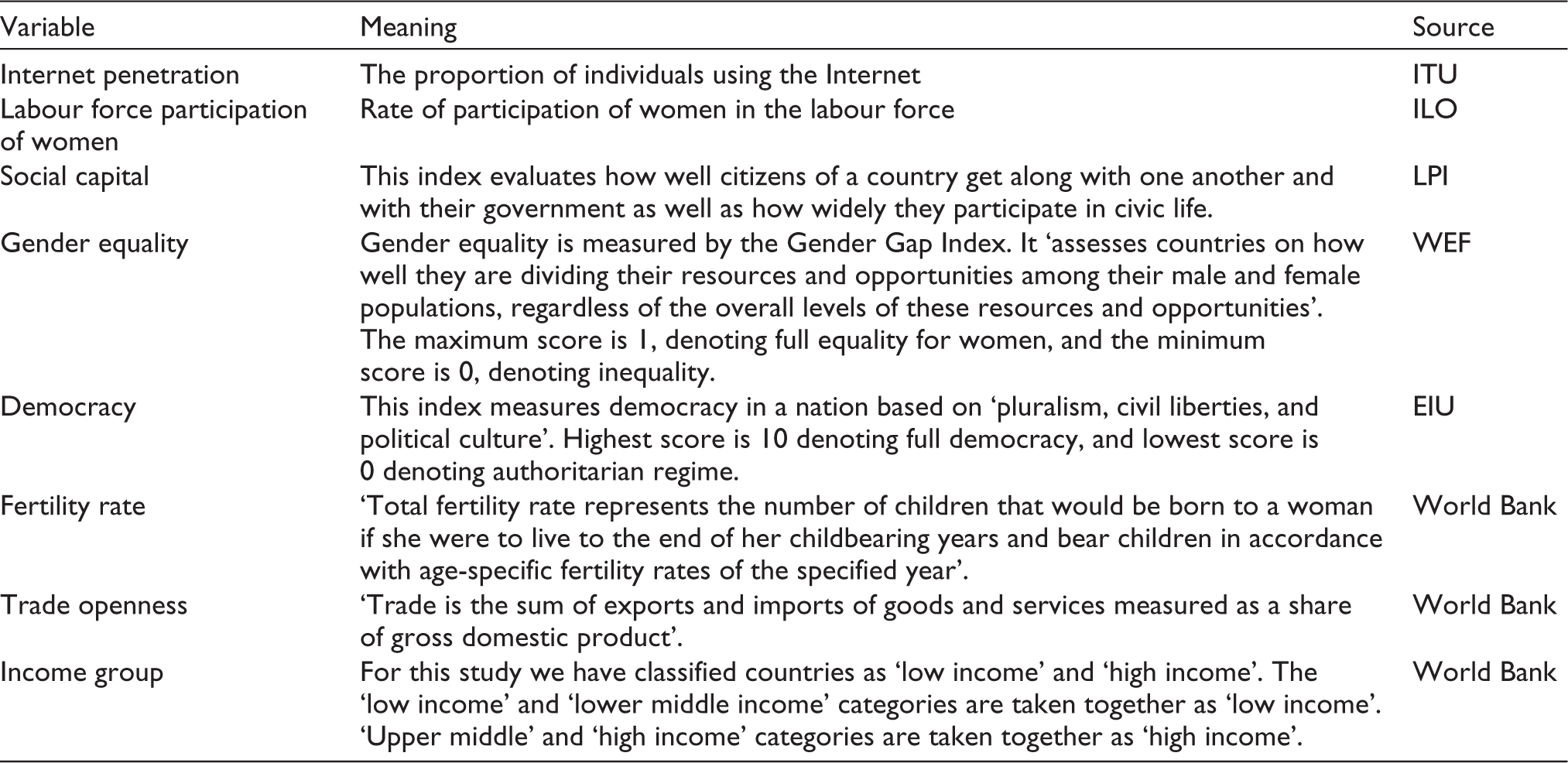
The independent variable in the study is internet penetration, determined by the proportion of people using the Internet. The data for this variable is collected by the ITU and has frequently been utilized in prior studies as well (Asongu et al., 2021; Hafeez et al., 2020; Lee et al., 2017).
The mediating variable in the study is social capital. This variable is taken from the social capital index which is part of the LPI. This index evaluates the social and interpersonal ties, institutional trust, societal norms and civic engagement of a nation. Many past studies have also used this index to measure social capital (Di Martino et al., 2022; Doh, 2014; Papadimitri et al., 2021; Pasiouras & Samet, 2022). This is a composite index from the Legatum Institute. The indicators used by the Legatum Institute are based on survey questions from Gallup Daily in terms of personal, family and community relationships, community standards, trust and participation, and people’s political and civic involvement. When all these elements are considered together, an aggregate value of social capital is formed that is representative of the total strength of a country’s personal and social ties, institutional trustworthiness, social conventions and civic engagement.
The moderating variable in the study is gender equality which is represented by the ‘Gender Gap Index’. The ‘Gender Gap Index’ is an indicator of progress from the World Economic Forum (WEF) towards gender parity. It ‘assesses countries on how well they are dividing their resources and opportunities among their male and female populations, regardless of the overall levels of these resources and opportunities’. The highest possible score is 1 or 100%, denoting full equality for women, and the minimum score is 0, denoting inequality. Many past studies have also used this index to measure gender equality (Barns & Preston, 2010; Chen & He, 2020; Šestić et al., 2020).
The control variables used in the study are democracy, fertility rate, trade openness and country income group. Democracy has been associated with influencing women’s economic participation (Bayanpourtehrani & Sylwester, 2013) and is represented by the democracy index of the EIU, which gauges the democracy in a country based on ‘pluralism, civil liberties, and political culture’. The maximum score is 10, denoting complete democracy, and the minimum score is 0, denoting authoritarian regimes (Adams & Akobeng, 2021; Bourguignon & Verdier, 2000; Njangang et al., 2022). The World Bank’s measure of fertility is the count of children a woman could have if she were to live through her reproductive years and have children at the average fertility rate for women of her age in that year. Fertility has been linked in literature with women’s economic participation (Altuzarra et al., 2019; Klasen, 2019; Mishra & Smyth, 2010; Nikulin, 2017). Trade openness is calculated by the World Bank as a country’s level of trade openness by looking at the percentage of its GDP attributable to exports and imports of goods and services. Trade openness may result in greater job opportunities as a result of globalization and has thus been linked to women’s participation in the workforce (Altuzarra et al., 2019; Fatima & Khan, 2019; Sangha & Riegler, 2020). The World Bank distributes nations into four income groups which are ‘low income’, ‘lower-middle income’, ‘upper-middle income’ and ‘high income’ (Cheng et al., 2021; Lechman & Kaur, 2015; Yu et al., 2020). For this study, we have classified countries as ‘low’ and ‘high’ income groups. The ‘low income’ and ‘lower middle income’ categories are taken together as ‘low income’. The ‘upper middle’ and ‘high income’ groups are taken together as ‘high income’. These variables have been chosen as control variables based on earlier studies.
Reliability and Validity
As mentioned earlier, the primary data sources for our investigation were ILO, ITU, WEF, LPI and World Bank. It is worth noting that all these organizations followed stringent protocols to guarantee that the data gathered was reliable and valid. For example, the ILO modelled estimations often rely on a method known as cross-validation, which is used to develop models that reduce the estimation’s predicted error and variance. One of the ITU’s tasks as a United Nations body is to identify, define and generate official international statistics for the telecommunications/ICT sector. ITU checks and harmonizes the data received from nations. The WEF collected gender gap data through the Executive Opinion Survey by gathering information on diverse outcomes depending on gender, ethnic and/or racial origin, income level and handicap. The report seeks to cover as many economies as possible to guarantee a complete picture of the gender gap on a worldwide scale. The LPI is constructed following evaluation by over 100 academics and professionals. Finally, the World Development Indicators compiled by World Bank provides useful and high-quality data across a wide range of indicators, including fertility rate, trade openness, and income distribution, for the purpose of global comparison.
Estimation Technique
The purpose of our investigation is to understand how social capital mediates the influences of internet penetration on the economic participation of women while analysing the moderation of gender equality in the above mediation. To accomplish this, we employ the method described by Hayes (2015) for moderated mediation. We apply this method to a country-level panel dataset of 66 countries from the years 2014 to 2021. The generalized method of moments (GMM) estimation approach has been used to obtain the results. GMM approach is suitable for this study for the following reasons. First, the necessary condition of more countries (N) than years (T) is met because N (66) > T (8). Second, GMM can handle endogeneity by adjusting for simultaneity and time-invariant omitted variables (with the instrumentation process). Lastly, the format of our panel data is aligned with the GMM technique, implying that cross-country variations are considered in the study. The study by Roodman (2009), an expansion of Arellano and Bover (1995), has been shown to account for cross-sectional dependence and to limit instrument generation, which is the basis for this specification (Baltagi, 2012). We have chosen a two-step process to control for heteroscedasticity. The following equations summarize the GMM estimation process for our study.



In the above equations, for country i and year t, WLFP represents women’s labour force participation, internet represents internet penetration, SC represents social capital, GE represents gender equality, and X represents control variables, μ represents the unobservable country-specific effect for the equations, and ε represents the error terms for equations.
It is intriguing to note that while our study posits that internet penetration affects women’s labour force participation, the reverse relationship may also be possible. In essence, it shows that these variables are both causing and being caused by each other. This brings up the endogeneity problem, which is almost always present in econometric models (Tchamyou et al., 2019). That is to say, the dependent variable, women’s labour force participation, may be influenced by its prior manifestations. Theoretically, as social changes take time to materialize, it makes sense that a nation’s women labour force participation is influenced by itself in years past. In order to adjust for both known and unknown social and historical factors that affect the existing level of women participating in the labour force, the inclusion of lagged women’s labour force participation as an independent variable becomes important. Similarly, it can be reasoned that the explanatory factors are not entirely exogenous and are linked with previous values of the error term (Roodman, 2009). The dynamic panel model considers unobservable, time-invariant national effects that can impact the current state of women participating in the labour force and allows for such endogeneity of explanatory variables.
Analyses and Results
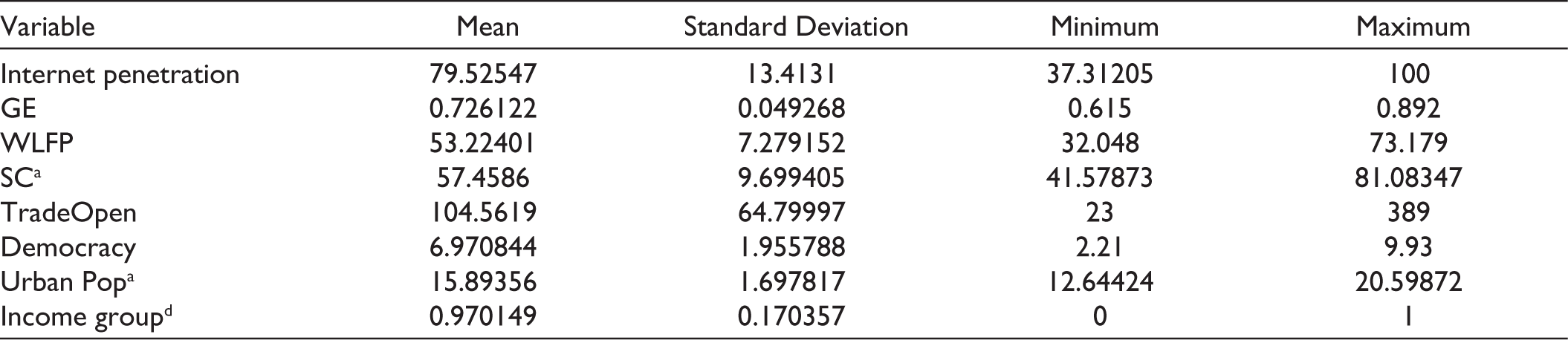
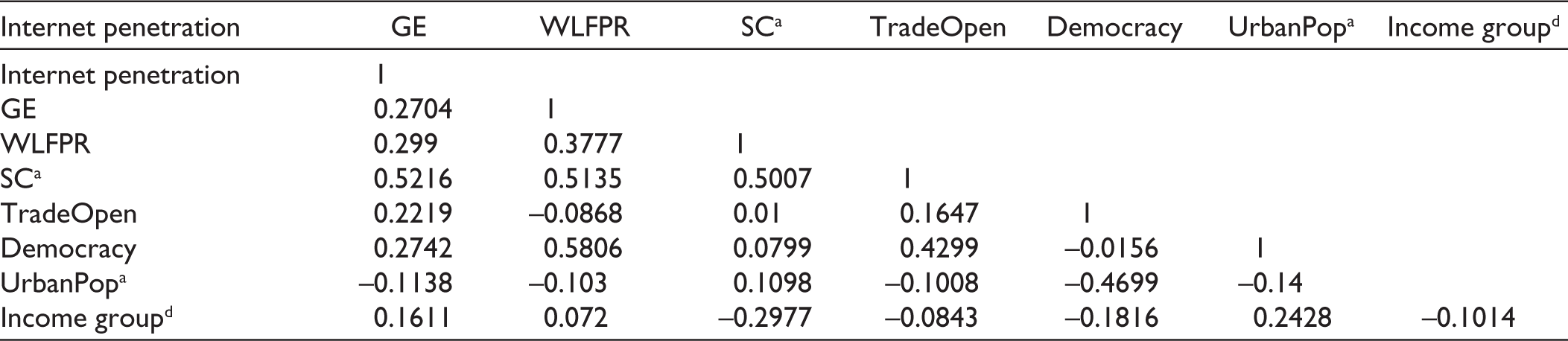
Table 2 displays descriptive statistics and Table 3 displays the correlation matrix. The findings of the hypotheses testing are displayed in Table 4. The direct impact of internet penetration on women’s participation in the labour force (WLFP) was first tested, as shown in Model 1. The results showed a positive relationship between internet penetration and WLFP lending support for H1. Then we tested for moderated mediation model from H2 to H7. The results showed that internet penetration was positively associated with social capital lending support to H2. Social capital, in turn, was found to be positively associated with WLFP lending support for H3. The overall mediation was also supported as internet penetration became insignificant in the presence of social capital in Model 3, lending support for H4.
Descriptive Statistics.
Correlation Matrix.
Results of Hypothesis Testing.
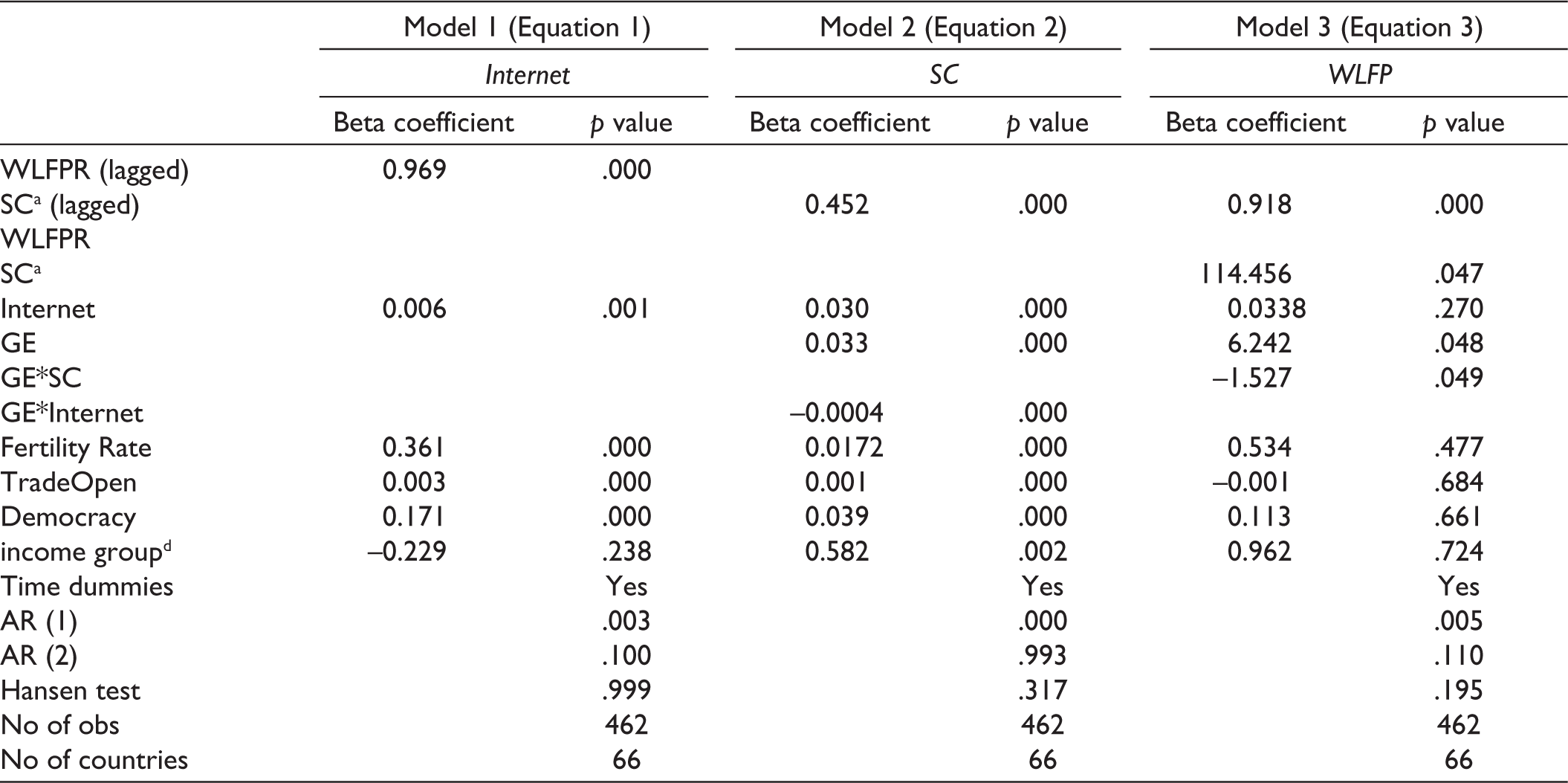
It was found that gender equality negatively moderated the relationship between internet penetration and social capital. Gender equality also negatively moderated the link between social capital and WLFP. Table 5 summarizes the conditional indirect influence of internet penetration on WLFP through social capital. The findings show that the conditional indirect impact of internet penetration on WLFP was significant when gender equality was low but insignificant when gender equality was high. Therefore, mediation by social capital between internet penetration and WLFP was stronger when gender equality was lower. Thus H5, H6 and H7 are not supported.
Conditional Indirect Effect.

The model appeared to be adequate based on the goodness of fit parameter values. AR (1) was evaluated for the occurrence of first-order serial correlation in the residuals, and its p values indicated that no first-order serial correlation was seen, thereby rejecting the null hypothesis. The second-order serial correlation test, AR (2), showed that no second-order serial correlation existed. Further, the Hansen Test for over-identification demonstrated the use of an adequate set of instruments. The two-step technique GMM is used since our panel data is made up of many nations (N = 66) and a small number of time periods (T = 8).
Discussion
There were two main goals of this research. We first sought to understand the relationship between internet penetration, social capital and the economic participation of women across countries. Second, we sought to comprehend the influence of gender equality in the above nexus. According to the results, social capital mediates the association between internet penetration and women’s economic participation. Gender equality also moderated the above relationship but in the opposite direction from our prediction.
More specifically, we found support for H1–H4 from our results. However, we did not find support for H5–H7 in the direction that we had predicted. We hypothesized that the gender equality level of a country would positively moderate the mediation relationships between internet penetration, social capital and women’s economic participation. While we did find a significant moderation of gender equality, it was in the reverse direction. In other words, according to the results, gender equality negatively moderates the relationships between H2, H3 and H4. This may be because women’s equality, social capital and economic participation are complex issues. According to research, there is a trade-off between time allocated by women to market work and time allocated to social capital-enhancing activities, and these two components of time allocation have different effects on intra-household bargaining power (Alpaslan & Burchell, 2022; Riddel et al., 2001) as such internet penetration will have a greater impact in countries having relatively lower gender equality levels where women can better utilize the benefits of the Internet to manage work and home responsibilities simultaneously. For example, it was reported that the COVID-19 outbreak had raised the proportion of women internet users in Bangladesh who became reliant on the Internet for work, education, social connectedness and health information during the pandemic (GSMA, 2021). Thus, nations with comparatively lower levels of gender equality may be more affected by the consequences of internet penetration on women’s economic participation through social capital than countries with relatively higher levels of gender equality.
Theoretical Implications
First, responding to the longstanding call by Walsham (2017), we add to the existing body of work on ICT and gender using dynamic panel analysis for cross-country investigation. This study enriches the current body of work by showing that social capital is a noteworthy component in shaping the impact of the widespread penetration of the Internet on women’s economic participation in the workforce. Second, we investigate the role of gender equality in the above nexus. Our findings add to the body of prior research by enhancing our understanding of the role gender equality plays in shaping internet penetration and its impact on women’s economic participation through social capital. Finally, only a small number of studies have done socio-political country-level analysis to study the impact of internet penetration on the economic involvement of women. Thus, we contribute to the existing body of literature by empirically examining, at a macro cross-country scale, the impact of internet penetration on the economic participation of women through social capital moderated by gender equality.
Implications for Practice
First, we provide broad cross-country empirical evidence on the influence of internet penetration on women’s economic participation via social capital. Conclusions drawn from the data suggest that social capital can be an important determinant of women’s economic participation. Hence policymakers are suggested to encourage internet access for women, perhaps by subsiding internet tariffs so that they can utilize the Internet to manage and maintain their social capital while participating in the economy. At a business level, we recommend that managers and employers allow women the flexibility to manage social capital through internet use to encourage their workforce participation. Second, our study provides evidence for the significant role gender equality plays in the nexus between internet penetration, social capital and women’s economic participation. According to our results, internet penetration can better affect social capital and women’s economic participation in countries where gender equality levels are relatively lower. Hence policymakers are suggested to leverage the Internet in managing social capital towards improving women’s economic participation, especially for countries with comparatively lower gender equality levels. At a business level, managers and employers may incentivize women through internet access flexibility so that they can utilize it to manage work and home and continue in the workforce.
Limitations and Future Research Direction
It is imperative to keep in mind the following limitations while analysing the results of this study. First, all data has been gathered from secondary sources across all countries. Since all data is not available for all countries, only those countries have been used whose data is publicly available. In total, we have collected panel data for 66 countries from 2014 to 2021. Second, like most cross-country studies, we have collected data from secondary agencies. These agencies include highly reputed agencies such as World Bank, ITU, EIU and so on. Given that these renowned organizations are competent and follow stringent protocols while conducting worldwide surveys, it is reasonable to trust these information sources because they have been used in past macro-level investigations. Third, we have considered only one mediating factor, namely social capital, which may intervene in the link between internet penetration and women’s economic participation. We acknowledge the possibility of other factors that may affect this relationship.
There are several potential avenues for future study. First, future research may examine various types of social capital that might affect men and women differently. When compared to others, some types of social capital are more useful at supporting women than other forms. For example, structural social capital is more helpful to women than cognitive social capital (Karhina et al., 2019). Second, this study focussed on social capital as a mediator. Future studies may uncover other intervening variables that influence the association between internet penetration and the participation of women in the economy. Third, this is a macro-level study, and the function of different aspects that are unique to each country in influencing the relationships between internet penetration, social capital and women’s economic participation could not be assessed. This is more likely to be clarified by a micro-level investigation using a qualitative research design such as netnography or interviews, concentrating on a particular nation or area. We think that such efforts will produce insightful information that has consequences for practice and policy.
Concluding Remarks
Women comprise almost half of the adults globally and, by extension, the workforce, and therefore, their presence in the workforce is crucial to economic progress and growth. While we acknowledge the contributions of prior research, there continues to exist scope for research from a social and gender perspective on the influence of internet penetration on the economic participation of women. This study explores how internet penetration affects women’s economic participation through social capital and how this relationship differs between nations with various degrees of gender equality. The study’s findings indicate that there is a positive association between internet penetration and the economic participation of women. Social capital was found to be a mediator in this study between internet penetration and women’s economic participation. Gender equality was also found to moderate the above relationship such that social capital’s mediation on the relationship between internet penetration and the economic participation of women was stronger for countries with comparatively lower levels of gender equality. In conclusion, this study underscores internet penetration’s impact on women’s economic participation through social capital. In addition, the purpose of this research is to understand the role of gender equality in the above nexus. We believe that this study identifies an intriguing phenomenon whose academic explanations and empirical confirmations are anticipated to contribute to the literature and stimulate additional investigation.
Footnotes
Declaration of Conflicting Interests
The authors declared no potential conflicts of interest with respect to the research, authorship and/or publication of this article.
Funding
The authors received no financial support for the research, authorship and/or publication of this article.
Appendix
List of countries used in the data analysis process.