



Abstract
This essay examines the changing nature of farm wage labour in the context of the extensive redistributive land reform since 2000. Using field research from two districts in Zimbabwe with contrasting agro-ecology and socio-economic patterns, it shows that agrarian wage labour is not the preserve of large-scale capitalist farms (LSCFs), which it is usually associated with. The new agrarian structure dominated by the peasantry not only employs an expanded base of unpaid family labourers, but also employs ‘informal’ wage labour whose character and conditions of employment are qualitatively different from the full and part-time labour of the past. Yet, there is continuation of the super-exploitation of agrarian wage labourers that is reflected by the payment of poor wages and differing degrees of the institution of the residential labour tenancy in both the old and new farm compounds. Landlessness and/or land shortage continues to be a key characteristic of farm wage labourers as in the past suggesting the persistence of the labour reserve dynamic.
Introduction
This essay examines the changing nature of farm wage labour in the context of the extensive redistributive land reform since 2000. Despite being largely associated with large-scale capitalist farms (LSCFs) in sub- Saharan Africa (Barrett, Besfuneh, Clay, & Thomas, 2005; Sender & Johnston, 2004), this research argues that farm labour markets did not collapse as a result of reallocation of land compulsorily acquired from the LSCFs to mostly peasants who have been characterized as a class that does not hire wage labour. Existing alongside an expanded farm self-employment base (Chambati, 2011; Chambati & Moyo, 2004), the diverse forms of farm wage labour that emerged from the new agrarian structure tend to differ in their nature and character to those found in LSCFs.
The literature on agrarian labour relations since the Fast Track Land Reform Programme (FTLRP) which began in 2000 has tended to argue that agrarian labour markets in Zimbabwe, particularly their importance as the major source of formal wage employment, have been reduced by the redistribution of land to peasants. 1 Various studies sought to quantify the numbers of formal farm jobs lost through retrenchments on the redistributed LSCFs lands (FCTZ, 2002; Hellum & Derman, 2004; Magaramombe, 2003; NRC, 2003; Rutherford, 2004; Sachikonye, 2003), erroneously claiming that all LSCF farm workers had been retrenched (e.g., NRC, 2003). Indeed, many studies based their analyses on overstating numbers of the pre-existing LSCF farm workers, with one study suggesting that over .600,000 workers had been employed (JAG/RAU, 2008), as opposed to the 350,000 farmworkers reported in various official records (CSO, 1999, 2000).
The post-FTLRP literature on the emerging agrarian labour regime and relations also continued to be silent about the changing nature of wage and family labour among the peasantry, with the implicit suggestion that farm-wage labour as a whole had declined (Chambati & Moyo, 2004). Meanwhile, the few studies on wage labour considered the new jobs created by resettled farmers (whether as new commercial farmers or peasants) as being limited, both, in scale (in terms of numbers) and in terms of their financial value (Hartnack, 2015; Magaramombe, 2003; Sachikonye, 2003). The presumed lack of capital and requisite skills among new black farmers, compared to the LSCFs, was considered to reflect an inherent lack of capacity to hire both new and former farm workers who were retrenched from their jobs. The slow recovery of agriculture since 2000 was generally seen as limiting the agricultural development (productivity, exports, etc.) given the pessimistic view about small-scale farming (The World Bank, 2006) and by implication the prospects of formal farm-wage wage labour and beneficial family labour were considered bleak.
Notwithstanding this narrative, a few existing studies on the post-FTLRP agrarian labour relations have broadly noted the increasing trends in ‘hiring in’ wage labour and ‘hiring out’ of family labour among the new land beneficiaries, alongside the expansion of the scale of family labour applied on their farms. The number of permanent, casual and family workers used in the agricultural production units has risen as has the share of peasant households and small capitalist farms utilizing these forms of labour (Chambati, 2009, 2011; Moyo et al., 2009; Scoones, 2015; Scoones et al., 2010). However, such studies have failed to examine in detail the variations in forms and quality of agrarian labour in the newly resettled areas. Moreover, the extremely limited and exclusive definition of farm ‘work’ conceived as ‘wage work’ that is often used, obscures the scale of ‘paid work’ that includes both cash wages and in-kind payments (Ibid.) that obtains. Altogether, the focus on LSCF-based forms of formal wage labour has obscured the diverse labour relations which have emerged and limited the assessment of agrarian labour relations in the new labour markets, and the differing relations found between various classes of farmers (Chambati, 2011, 2013; Moyo et al., 2009).
Knowledge gaps also exist on the labour management practices that contribute to the overall quality of employment, such as the nature of contracts for full- and part-time workers, segmentation of labour by gender, skills and commodities produced, and methods of supervision of farm labour. Quite crucially, such research has not assessed the changing nature of the residential labour tenancy system as it operates among both the new and former farm workers and its implications on farm labour supplies to the new many smaller-scale employers.
The underlying problem with the post-2000 literature on agrarian labour was that it overlooked the fact that a new more complex and diverse agrarian structure had emerged, reconfiguring agricultural production, market relations and labour (Moyo, 2011a, 2013). Thus, the new farmers were established under the two settlement models (A1 and A2 schemes) promoted by the FTLRP were assumed to be homogenous forms of organizations in terms of their labour relations, while the A2 farmers were often characterized as ‘poor employers’ (Masiiwa & Chipungu, 2004; Mutangi, 2010; Sachikonye, 2003). The suggestion that all of the new farmers had similar production capabilities related to poor wage labour relations obscured the fact that the new and diverse forms of agrarian labour were emerging.
The current tri-modal agrarian structure is characterized by three modes of the social organization of production, namely, the peasantry, middle-to-large capitalist farms and agro-industrial estates. These three were found to be highly differentiated in their agricultural practices, production market integration and labour utilization patterns. This change reflected a substantially reconfigured agrarian labour market (Moyo, 2004; Moyo & Yeros, 2005, 2011a, 2011b). This increased differentiation of landholdings, production patterns and access to markets was increasing the social differentiation between farms, with critical implications for a complex web of agrarian labour relations (Moyo, 2011a, 2011b, 2011c, 2013). Different classes of farmers constituted the new and diverse labour markets. Sources of wage labour came from a wider rural and urban population as well as from the former farm workers, whereas the new peasantry and the persistent land short and/or landless people from Communal areas (Chambati 2009, 2013; Chambati & Moyo, 2004).
The absence of systematic empirical work on agrarian labour at the farm level, focusing on the differentiated landholdings and land use patterns and agricultural production in the redistributed and Communal areas, and, consequently, on the evolving differentiation of labour utilization and remuneration patterns, obscures our understanding of the specific nature of Zimbabwe agrarian labour regime/relations and its implications for wider social reproduction.
This study utilizes micro-level survey data of farms allocated land under the A1 and A2 schemes, (which are also referred to here as new farm households). The data were collected in Goromonzi and Kwekwe districts by the African Institute for Agrarian Studies (AIAS) in 2006 and again 2014 to outline the changing forms of wage labour since 2000. 2 A farm labour survey conducted by the author in the same districts provided further insights into the new agrarian labour markets. These two districts provide an opportunity to examine the differentiated outcomes of redistributive land reform, which are characterized by contrasting socio-economic and agro-ecological patterns. Goromonzi district is located in a high potential agro-ecological zone, which is near to major agricultural markets in the capital city, Harare and endowed with high per capita public infrastructures, which influences the agricultural production patterns and labour relations. In contrast, Kwekwe district is located further away from Harare in a dry and low potential agroecological zone, with gold mining, a key feature of the district’s economy.
After this introduction, the next section discusses the context of wage labour in the LSCFs prior to the FTLRP in order to provide a basis upon which to evaluate the changes and continuities in agrarian labour markets. This is followed by an examination of the differentiated sources of farm (wage) employment that have arisen in the two districts studied since 2000. The next two sections expose the character of permanent and casual labour that is utilized by the landholders and how the labour is recruited and mobilized to work in the farm units. The conclusion summarizes the main findings.
Wage Labour in Large-scale Capitalist Farms Before the FTLRP
The agrarian labour regime that evolved from settler colonization onwards largely remained unaltered due to limited land redistribution until 2000. It consisted of landless and/or land short permanent and casual wageworkers employed in the 4,500 LSCFs that occupied 11.2 million hectares of prime land and mostly self-employed family labour on 16.4 million hectares of Communal area land held by 1 million peasant households (Moyo, 2011a). Few peasants also hired wage labour in their farm units (Adams, 1991; CSO, 1998). Wage labour lived on small portions of the LSCFs in farm compounds providing permanent labour and, in some cases, with access to land for minor production for own sustenance, and accommodated casual workers from surrounding Communal and other areas. These workers, which were stabilized as permanent labourers and full-time residents on LSCFs’ compounds, had insecure agricultural and residential tenure rights that were linked to employment on the farm, constituting a form of ‘residential labour tenancy’ (Moyo, 2011a). The dependency relations generated by latter weakened the bargaining power of farm labourers and was deployed to entrench the control over them by LSCFs in both work and off-work relations (Amanor-Wilks, 1995, 2000).
Initially, labour force comprised of foreign migrant labour from Nyasaland, Northern Rhodesia and Mozambique. But as land dispossession took its toll from the 1960s onwards, the composition of the labour force on the LSCF began to be tilted towards domestic migrants. (Arrighi, 1970; Palmer, 1977). By 2000, the share of foreign farm workers was down to 10 per cent (FCTZ, 2000; General Agriculture and Plantation Workers’ Union of Zimbabwe [GAPWUZ], 2002) from about 60 per cent in 1956 (Clarke, 1977).
The same LSCF employed permanent or full-time labourers continuously. Different variants casual or part-time labour included seasonal and contract labourers. Seasonal labourers were employed for a fixed time period ranging between 3 and 8 months in any period of the 12 months. Most workers initially gained employment as seasonal workers prior to being ‘promoted’ to the stable permanent employment by guaranteeing access to labour from their families (Gibbon, 2011; Rutherford, 2001). Contract work was the most informal type of wage labour ranging from a few hours to a few days. This comprised of piecework, which entailed performing a certain magnitude of work (e.g., weeding 0.5 hectares of a maize field in exchange for an agreed wage) and time-rated work, which involved labour being hired for a specific number of hours, which is rewarded with a daily wage. Its extent in the LSCFs was not clear since it has been neither documented nor captured the official statistics (Adams, 1991).
Many permanent workers were semi-proletariats who combined wage labour with independent agricultural production in the Communal areas (Moyo & Yeros, 2005; Moyo, Rutherford, & Amanor-Wilks, 2000; Yeros, 2002). One study estimated that 40.5 per cent of the male permanent workers had access to Communal areas, where they also farmed (Vhurumuku, McGuire, & Hill, 1998). Nonetheless, labour immobility characterized permanent work, as many of the workers and their families spent their lifetimes working on a single LSCF.
Around 2000, the total LSCF labour force numbered 313,879 workers, split between 167,459 permanent workers and 146,420 casual workers (CSO, 2001). While permanent workers accounted for 76 per cent of the LSCF labour force in 1983, it had dropped to 53 per cent in 2000 (CSO, 2001, 1997, 1984). There was structural change in the agrarian labour market from a previously large permanent force to the casualization of farm labour after the 1990s. This trend was driven by the new Economic Structural Adjustment Programme (ESAP), the introduction of flexible labour laws, and by the growth of capital intensive horticultural production systems and extensive wildlife land uses (Moyo, 2000). These processes were a result of the decline in the production of labour intensive grain crops in the LSCFs that began in the 1970s and intensified in the 1980s (Loewenson, 1992). Women were mostly employed as marginal and seasonal workers, constituting 65 per cent of the casual labour force and only 10 per cent of the permanent workers in 2000 (CSO, 2001). Agricultural labour was unevenly distributed with LSCFs in wetter Mashonaland provinces employing on average between 75 and 174, while the employment levels were between 17.5 and 42 workers in the Midlands and Matebeleland provinces (Commercial Farmers Union, n.d.).
The 1980s were characterized by rising real wages in the agricultural and mining sectors on account of state intervention in the labour markets (Amanor-Wilks, 1995). The ESAP reversed these gains and real wages in LSCFs declined by more than 1.6 times between 1990 and 1997 (Kanyenze, 2001). Government in terms of the Minimum Wages Act of 1980 set post-independence wages, but ESAP introduced collective bargaining where employers and employees negotiate wages through their respective unions (GoZ, 1993). Since the farm workers trade union was weak, LSCFs dominated the determination of wages and ensured that they remained very low (Loewenson, 1992). Minimum wages from the collective bargaining exercise protect permanent and seasonal workers only, and exclude pieceworkers. 3
The wages paid to permanent and seasonal workers were based on a skill grading system defined through collective bargaining. 4 By the year 2000, most of the permanent farm workers (82%) were classified as unskilled workers (CSO, 2001). The skills also informed the hierarchical organization of workers on LSCFs. These consisted of clerical staff, foreman, supervisors and gang leaders that mediated work relations between the general workforce and the owners/managers. Farm labourers were also segmented according to commodities produced on a single LSCF especially in the Mashonaland Provinces, which had diversified commodity production (Gibbon, 2011). The employers at the farm level determined remuneration for contract workers.
In comparison, the farm workers were the lowest paid within all formal employees and never had enough to meet subsistence requirements, even by the Poverty Datum Line (PDL) standard. In 1997, about 70 per cent of farm workers were below the PDL, while average monthly wages were about 51 per cent of the PDL (Kanyenze, 2001). Female labourers received substantially lower wages than males. Wage subsidies provided by LSCFs including food rations and other non-farm income generating activities did not reverse their precarious living conditions of farm labourers (McIvor, 1995). Even the free accommodation in the farm compounds was of poor quality, lacking ancillary social services and featured by overcrowding that exposed residents to respiratory diseases (Magaramombe, 2001; Tandon, 2001).
Although cases of labour abuse declined substantially after 1980, physical violence, racism and long working hours beyond the regulated time for the same pay were documented in the literature up to 2000 (Amanor-Wilks, 1995, 2001; Tandon, 2001). Remnants of the master-servant type relationships endured in some LSCFs (Loewenson, 1992) and frequently reported in the media. Farm workers were however not passive victims of exploitation in LSCFs but resisted in various ways including strikes, absconding from work, thefts and voting with the feet (Rutherford, 2001; Tandon, 2001).
New Agrarian Labour Markets at the Local Level
The increased number of farm households and/or potential employers since 2000 transformed the farm labour markets. Access to more and better quality land also expanded the possibilities of families to utilize their own labour for independent agricultural production. The few LSCFs were redistributed to mostly new peasant households and small-to-medium scale capitalist farms whose relative distribution differs from district to district depending on the local dynamics of land reform.
In Goromonzi, the FTLRP enlarged the number of farm households from 20,253 in 2000 to 23,626 in 2014 (MLRR, 2014). The majority of the new farm households were 1,673 A1 land beneficiaries that added to the existing peasantry composed of 19,976 households in the Communal areas. The A2 land beneficiaries joined the ranks of the small to medium-and large-capitalist farms, 778 and 89, respectively. About 16 agro-estates are part of the new agrarian structure in the district. The new peasantry in the A1 farms, own an average of 19.39 hectares (combining grazing and arable land) compared to 3.72 hectares for the old peasantry in the Communal areas. Land sizes in the small-to-medium capitalist farms were almost three times those of the new A1 peasantry. With an average land size of 493.8 hectares, the new LSCFs are 20 per cent smaller than those in this category in 2000. The agro-estates had the most expansive land sizes (in excess of 1,400 hectares) among the farming classes. Overall, the land controlled by the LSCFs was downsized from 61.8 per cent to 29 per cent. In contrast, the peasantry increased their share of land from 31.7 per cent to 44.87 per cent during the same period. Compared to the national situation and experience in other districts (including Kwekwe; Chambati, 2013; Moyo, 2011a), the peasantry in Goromonzi got a smaller share of the land distributed due to high demand for the larger sized A2 plots in this peri-urban district. Agro-estates in Goromonzi, which include private agribusiness companies, state farms, mining companies and church and trust institutions control about 8 per cent of the land area.
The FTLRP in Kwekwe created 3,586 and 266 new A1 and A2 farm households, respectively, on 308,495.6 hectares of land formerly belonging to mainly white LSCFs (MLRR, 2014). The A1 scheme had increased the number of peasant households from 29,066 in 2000 to over 33,801 by 2014 accounting for 98.6 per cent of the farm units in the district (Ibid.). The share of the land area controlled by them increased dramatically from 52.5 per cent to 71.2 per cent between 2000 and 2014. The first phase of land redistribution in the early 1980s in Kwekwe had already increased the shares of land held by peasants by 10.1 per cent. Peasant households from Communal areas own an average of 13.7 hectares of land (combining both arable land and shared grazing land rights). Those in old resettlement and new A1 farms access more arable and grazing land averaging 63.1 hectares and 48.4 hectares, respectively.
Between 2000 and 2014, the new A2 farms joined the category of medium capitalist farms that were composed of small-scale commercial farms (SSCFs). This slightly increased the share of the medium-sized capitalist farms in the total number of farm households in the district from 0.4 per cent to 0.76 per cent. In relation to the total land area, the medium-sized capitalist farms also increased their share from 1.4 per cent to 4.11 per cent. The medium capitalist farms, which now include the old SSCFs and small-to-medium A2 farms owning on average 145.2 hectares, are defined by their reliance on hired in their agricultural production units. The large capitalist farms (now including remaining black and white LSCFs and the large A2 farms) now account for 0.6 per cent of the farm households and 16 per cent of the total land area controlled (Ibid.). The new large capitalist farms in the A2 scheme on average own relatively less land (537.2 hectares) compared to the remaining LSCFs (937.9 hectares; Ibid.). The agro-estates in Kwekwe are largely not of the agro-industrial type that are vertically integrated into the global market chains and highly capitalized. Rather they include wildlife conservancies and both public and private farms (MLRR, 2014). The agro-estates now control 7.6 per cent of the land area, came down from 17.2 per cent in 2000. Agro-estates in Kwekwe like others nationally control large swathes of land averaging over 3,000 hectares per unit but employ less wage labour than the others (Chambati & Moyo, 2004).
Agricultural Production Patterns
Most of the main 15 agricultural commodities produced in the country including food, oilseeds, export and horticultural crops, as well as livestock are found in Goromonzi (Moyo, 2013; The World Bank, 2012). Food crops (maize and small grains) are the common in A1 and Communal area households (AGRITEX, 2015). Wheat is predominantly produced by A2 and LSCFs that have access to irrigation (Ibid.). A2 farmers dominate Soybean production, while farmers in the Communal areas mostly grew sunflower (Ibid.). Specialized crops, such as seed maize, seed soybeans and barley, are the preserve of LSCFs. All the classes of agricultural producers grow tobacco, but A1 form bulk of its grower base. Few peasants are linked to export horticulture, but they do dominate domestic horticulture (AGRITEX, 2015). Livestock production activities include beef, dairy, pigs, goats and poultry production. Large beef herds are found in the A2 and LSCFs, while A1 and Communal areas keep few cattle mainly for draught power.
Although agriculture is the main employer in Kwekwe, it competes for labour with alluvial gold mining (Zibagwe Rural District Council, n.d.). The agricultural commodities produced in Kwekwe are less diverse than those of Goromonzi. The A1 farmers produce maize, groundnuts, sunflower, while edible beans, soya beans, wheat and potatoes are dominated by A2 farmers. Dairy farming is still undertaken by the remaining LSCFs. A2 and LSCFs dominate large beef herds in Kwekwe. Maize production is pervasive in the Communal areas, alongside cotton, groundnuts, rapoko, millet and sorghum (AGRITEX, 2013).
Changing Agrarian Labour Force
Nationally, self-employed labour (84.1%) has remained the largest share of agricultural workers while permanent and casual workers accounted for 7.4 and 4.5 per cent, respectively (ZIMSTAT, 2013). Yet, the character of hired labour has changed since the FTLRP. On account of the larger land sizes and better agro-ecological conditions, the demand for farm labour could be expected to higher in the new peasant households in the A1 scheme than the old peasantry in the Communal areas. While the A2 scheme expanded the potential number of farm wage employers in the category of existing capitalist farms.
The allocation of the hired and family labour was different across the A1 and A2 farm units in both districts examined. Hired workers were the major source of labour in the A2 farms, which in addition to producing food crops were also more integrated into the production of cash and/or export crops than the A1 farms. Approximately, 73 per cent and 57 per cent of the labour for key tasks on the farm, including cultivating, weeding, harvesting, fertilizer application and, pest disease control was supplied by hired labour in Goromonzi and Kwekwe districts, respectively (AIAS, 2014). The reverse was true for the A1 where unpaid family labour supplied the majority of the labour for the key farm tasks, 70.8 per cent and 84.6 per cent in Goromonzi and Kwekwe, respectively (Ibid.).
Differentiation was also apparent in the forms of labour employed by the A1 and A2 farm units. In Goromonzi, about 86.8 per cent of the surveyed A2 households hired permanent workers compared to 31.7 per cent of the A1 households (Ibid.). Only 8.0 per cent of the households in the Communal areas employed permanent labour. An average of 5.5 permanent workers were hired in the A2 farms as compared with to 0.9 and 0.2 per cent workers in the A1 and Communal areas, respectively (Ibid.). Casual labour hiring was more pronounced in the A1 (60%) and Communal area (38.2%) than permanent labour hiring. Similar patterns of labour use were also deduced from the new farm households in Kwekwe district, where over 81.2 per cent of the surveyed A2 households hired permanent labour compared to 21.8 per cent in the A1farms (AIAS, 2014). The average 2.7 permanent workers per farm in the A2 farms were at least four times of those hired in the A1 and Communal area. Again casual labour was also the most common form of hired labour employed across the different farming classes in Kwekwe district. These average employment levels in the new farm units in Kwekwe were however lower than those found in Goromonzi farm households, which is characterized by more intensive land uses.
The majority of the total number of permanent workers are employed by the surveyed farm households in the A2 capitalist farms (51%), and the remaining LSCFs (11%) in Goromonzi (ZIMSTAT, 2015). The Communal areas and A1 farms there employed 17 per cent and 21 per cent of the permanent labourers, respectively. Most of the casual labourers (87%) were employed in the A1 scheme. Whereas in Kwekwe, the A1 farms employed the majority of the total number of permanent workers (55%) are employed on A1 farms, the A2 and LSCFs account for 12 per cent and 3.0 per cent, respectively. Communal areas in Kwekwe hired 25 per cent of the permanent labour force. The majority of total number of casual labourers (71.8%) are employed in the A2 farms.
As in the past, women’s representation in the permanent workforce (17%) remains well below that of men and they constitute majority of casual labour across both districts. Females were 17 per cent of the permanent labourers in Goromonzi, but were the majority of the casual labourers (56.3%). In Kwekwe, women were the majority of farm labourers (62.3%) hired by all classes of farms, and yet, they were only 6.1 per cent of the permanent workforce. Discrimination of women in the farm labour markets, as elaborated later, continues to characterize the new agrarian labour markets.
Another feature of the new labour markets is that some landholders (23.1%), especially those within the peasantry also hire out their labour to other farm households (AIAS, 2014). This implies that access to land is not only factor that influences the participation of households in farm labour markets. Since land reform in Zimbabwe provided limited post-settlement support to the new farm households, some enter farm labour markets to mobilize finance to acquire inputs for their household production as outlined later.
By expanding the number of farm units, the FTLRP has enlarged the opportunities of wage employment especially in the A2 farms, while access to smaller land sizes by the peasantry has also added to the total number of family labourers. The majority of the new employment opportunities generated are however in the casual forms of farm labour. In Kwekwe, a total of 26,995 workers were employed in the entire farm units and 85.5 per cent of them were casual labourers (ZIMSTAT, 2015). These employment levels in the A1 and A2 farm units represent an increase from the 1,100 and 800 full-and part-time workers employed in Kwekwe LSCFs around 1999 (Interview, District Extension Officer, 24 March 2015). For Goromonzi district, the estimated 4,665 permanent and 16,619 casual workers that are now employed in the new agrarian structure (ZIMSTAT, 2015) represent an increase from the approximately 3,900 and 6950 permanent and casual labourers in the old LSCFs around 2000, respectively. 5 However, due to the reduced farm sizes, the average numbers of labour employed per farm unit are relatively lower than those found in the LSCFs nationally—36 and 32 permanent and casual workers per farm before the FTLRP, respectively (CSO, 2000). Overall the differentiated patterns of land redistribution during the FTRLP at district level influenced the new local agrarian structures generated and subsequently the agrarian labour relations. In Kwekwe, the FTLRP emphasized the allocation of land to smaller-sized A1 farm units compared to the larger sized A2 farm units. At the district level, this promoted the more the growth of family labour than hired labour, which is predominantly deployed in the smaller scale A1 farm units. A2 farm units, which are reliant on hired labour, got the larger share of land redistributed in Goromonzi than the A1 farms. The labour use patterns are influenced by the land use potential across the different agro-ecological regions that characterize the district studied. Goromonzi, which has diversified land uses than Kwekwe districts, tends to employ more hired labourers per farm unit. Whereas food production is now the dominant land use, the A2 farm units which are more integrated to the cash and export production (Moyo et al., 2009; The World Bank, 2012) dominate the employment of hired and also maintain more permanent employees than the A1 farms. In what follows, the essay uncovers the precise character of permanent and casual labour hired in the new agrarian structure.
Forms of Agrarian Wage Labour
New farm households still hire in the broad categories of labour that were found in the old LSCFs. Yet, both the permanent and casual wage labour today is qualitatively different from before 2000 in terms of the degree of formality, types of contracts offered and how are they organized to perform work in the new farm units. Segmentation of labour according to the enterprises and skills—a prominent feature of diversified LSCFs—is no longer as elaborate. Women’s accommodation in the more full-time forms of works still retains the character of the past. Moreover, the composition of the labour force in terms of history of working in the LSCFs and its age dimensions has also been changed following the FTLRP.
Permanent Labour Hired In
The same employer continuously employed permanent or full-time farm workers. They included former farm workers and new farm workers. The former farm workers accounted for 23 per cent and 24.3 per cent of the labourers surveyed in Goromonzi and Kwekwe districts, respectively. Many new entrants (30.3%) into the farm labour markets were unemployed prior to their current jobs. Others were transitioning from self-employment in the agriculture sector (10.3%), non-agricultural sector (4.5%), urban employment (12.9%), mining jobs (5.8%) and from school (21.3%) to farming. Nonetheless, among the new farm workers, 15.0 per cent had entered farm labour markets earlier as permanent (8.4%) and casual labourers (6.5%) in the Communal areas.
Today, the permanent workers are relatively younger than those found in the LSCFs, with an average age of 34 years. Former permanent workers were on average 15 years older than new permanent farm workers in both districts. The older former permanent workers are the ones who started as part-time workers, before being employed permanently. New permanent workers were also more educated compared to the former farm workers. 6 In Goromonzi, 43.5 per cent of the former farm workers had completed only part of the primary education compared to only 7.8 per cent among the new permanent workers. Most of new permanent farm workers (37.7%) completed secondary education. In Kwekwe, 20 per cent of the former farm workers did not attend any school and 32 per cent completed part of primary education, whereas among the new permanent workers, 38.6 per cent attended secondary school but did not complete and 28.2 per cent completed this curriculum. These findings are reflective of the poor access to educational facilities in the former LSCFs (McIvor, 1995; Nyagura & Mupawaenda, 1994; Waeterloos & Rutherford, 2004) and also indicate the capacity of new permanent workers to assimilate agricultural skills.
Most of the permanent workers surveyed (78.9%) had oral employment contracts. In Kwekwe district, the incidence of oral agreements was over 87 per cent of the workers in A1 and A2 farm units. Differentiated patterns were observed in Goromonzi, as 46.8 per cent of those employed on A2 farms had written contracts compared to 18.4 per cent in the A1 farms. It is important to note that an earlier Collective Bargaining Agreement spelt out in Statutory Instrument 323 of 1992 recognized oral contracts for permanent and seasonal workers, but the new Statutory Instrument 116 of 2014 which replaced it now explicitly requires written employment contracts. Many employers were therefore in conflict with the law and less than 45 per cent provided statutory benefits such annual leave for instance.
Women accounted for 8 per cent and 5.8 per cent of the permanent workers in Goromonzi and Kwekwe. Data provided by the FTLRP land beneficiaries also showed women were 10.3 per cent of the permanent employees (AIAS, 2014). There was however differentiation in the recruitment between the districts and within the different settlement models. In the A2 farm households in Kwekwe, 7.8 per cent of the permanent workers were women. While among the small-scale A1 producers, there were 20 women out of the 31 permanent workers in the same district. The A1 farms of Goromonzi employed only two women for every 16 men in the permanent workforce. Representation of women was however relatively higher in the A2 farms where they accounted for 28.6 per cent of the 495 workers. Hence, the marginalization of women in the (farm) labour markets that is also common elsewhere (Maertens & Swinnen, 2009; Sender, Oya, & Christopher Cramer, 2006; Yaro, Awetori, & Bawakyillenuo, 2016) was not reversed by land reform and the feminization of part-time labour persists. Patriarchal structures, which sideline women from active involvement in the full-time sections of the farm labour force it could be argued, have been resilient even in the context of land reform and women’s position in the labour markets therefore remains peripheral. Furthermore, women still remain burdened with the attending to their reproductive roles that might conflict with full-time farm labour employment (Naidu & Ossome, 2016; Tsikata, 2016).
New farm employers deployed permanent workers in variegated positions, ranging from general hands to other specialized skills such as tractor driving. The majority of them were employed as general hands. The A2 farms in Goromonzi district were an exception as they had a wider spread of permanent employees engaged in skilled work activities and leadership roles (e.g., supervisors and foremen). At least 75.5 per cent of the permanent workers in the A1 scheme in both Goromonzi and Kwekwe were employed as general hands. Again, patriarchal discrimination was apparent, as the majority of the women were located in the lower rung of permanent work as general hands, 75 per cent and 83.4 per cent in Goromonzi and Kwekwe, respectively.
The fragmentation of labour into different enterprise sections commonly found in the (former) LSCFs (Gibbon & Riisgaard, 2014; Loewenson, 1992; Selwyn, 2015) was reported by only 29.1 per cent of the permanent workers interviewed. These labourers were clustered into field crops, horticulture, livestock, engineering and transport and irrigation sections on the farms. This practice was more noticeable in A2 farms were an equivalent 40.4 per cent of the permanent workers in both districts were attached to specific enterprises. Only 24.5 per cent and 9.4 per cent of the permanent workers on in the A1 farms in Goromonzi and Kwekwe, respectively, reported such practices. Limited enterprise diversification in new farms also conditioned the labour segmentation along commodity lines. The crop diversification index averaged on 0.36 among the A1 and A2 farm households in the two districts (AIAS, 2014). 7
Furthermore, the management structures are not as elaborate as in the past, particularly in the A1 farms. The LSCFs had different layers of management headed by an overall farm manager. Below the manager were administrative and clerical staff, section foremen for the different enterprises, supervisors and team leaders of labour groups and so forth. Less than 23 per cent of the workers on A1 farms in Goromonzi had managers or supervisors at their workplaces. Even fewer percentages of permanent employees in A1 farms in Kwekwe reported existence of managers. Consequently, the employers were also the managers in the A1 farms. Daily task allocation, for instance, that was previously carried out by foremen is now largely performed by the A1 employers as indicated by 71.7 per cent and 79.2 per cent of the permanent workers in Goromonzi and Kwekwe, respectively.
Divergent patterns were however exposed in the A2 farms where 57.4 per cent and 34 per cent of the workers in Goromonzi and Kwekwe had a manager at their place of employment, respectively. Other managerial functions were also relatively more common in these farms than they were on the A1 farms. In the A2 farms, the managers had oversight over all the operations on the units, including supervising the different layers of management beneath them. Other managerial functions they performed included land use planning, preparation of farm budgets, marketing plans and development and allocation of work schedules, whereas in the A1 farms, allocation of labour tasks was the predominant managerial function, the other functions performed by some managers in A2 farms were not institutionalized. Nonetheless, the managers were not qualified as those in former LSCFs since 39.3 per cent of them in Goromonzi’s A2 farms had no formal agricultural qualification, while certificates and diplomas were possessed by 37.8 per cent and 20.7 per cent, correspondingly. The few managers in the A2 farms of Kwekwe had certificates (41%) and diplomas (25%) and the remaining 12.5 per cent had no formal training in agriculture.
As such, the allocation of daily tasks in A2 farms in Goromonzi was not only the responsibility of the employers (34%), but also involved managers (31.9%), supervisors (23.4%) and foreman (10.6%). While in Kwekwe, employers perform this responsibility (53.3%) and are assisted by managers (26.7%) and foremen (15.6%). The mugwazo system (31.3%) or designated daily working hours (68.7%) were used to assign tasks to workers.
Up to 57.3 per cent of the permanent farm labourers had a working day that went beyond the maximum legislated eight hours. In both Goromonzi and Kwekwe districts, a larger share of permanent workers in the A2 farms reported more working hours, 46.8 per cent and 80.9 per cent, than those employed in the A1 farm households, 34.7 per cent and 69.8 per cent, respectively. Less than half of those characterized by 8 hour plus working day received either overtime pay or additional off duty days. Many new farm employers were thus extracting unpaid labour contributions through extended working hours.
About 16.6 per cent of the permanent farm workers also performed part-time farm wage jobs for other employers while holding a permanent job on one farm. Such a practice termed as ‘moonlighting’ showed differential trends in both these districts., with Goromonzi having a higher share of permanent workers involved (29.3%) compared to Kwekwe (4%) in moonlighting. Limited farm job opportunities curtailed this practice in Kwekwe. There was no significant difference in the share of multiple-job holding permanent workers in A1 and A2 farms. Moonlight permanent workers indicated that they performed part-time jobs for other employers during their off-days (77.1%), after knocking off from their regular job (11.4%) and some even absconded work (11.4%). Both male (50%) and female (27.5%) workers were involved in this practice in Goromonzi. In Kwekwe, 7.2 per cent and 16.7 per cent of the male and female workers practiced moonlighting. Since males are ascribed as the ‘primary’ income earners for the household by the intra-household patriarchal institutions (O’Laughlin, 1998; Potts, 2000, 2012; Tsikata, 2009), they tend to dominate moonlighting. While female involvement points to the increasing pressure on them to also contribute to the rising demand for income after subsidies for social services, such as health and education, were withdrawn at the onset of neoliberalism (Bryceson, 1980; Yaro et al., 2016).
Yet, these processes are neither new nor unique to the redistributed LSCFs (Rutherford, 2001). The scale of the practice in terms of numbers of permanent farm workers involved in the practice of ‘moonlighting’ this prior to 2000 has not been adequately documented. But, the history of labour control in the former LSCFs, especially through the farm compound institution (Loewenson, 1992; Tandon, 2001) suggests that it was not pervasive. For instance, some former farm workers in Goromonzi district noted that LSCFs adopted strategies that discouraged workers from leaving the farm during their off days, including farm compound bars and stores that provided credit, as well as soccer fields. Farm labour could thus be easily summoned to attend to emergencies, such as fire outbreaks during their rest days.
The length of employment with the current employer was at least 1 year for all the interviewed permanent workers. On average, each of the workers had been employed for a period of 5 years at their place of employment. 8 Over 27 per cent had spent more than 5 years in their current job. When the length of employment was compared with the year, the workers started providing wage labour in the redistributed LSCFs, the survey data reveal that the majority of the workers (56.4%) had not switched their first jobs. These data suggest the stabilization of permanent workforces by the new range of producers, partly due to the continued deployment of residential labour tenancy as discussed below.
Other peripheral strategies reminiscent of the practices in the old LSCFs which tie labour to the farms include the provision of cash loans and credit purchases of agricultural produce deductible on wages (Loewenson, 1992). About 10.6 per cent of the permanent workers had received loans from their employers, which were deducted from their wages over a couple of months. Close to 20 per cent regularly bought agricultural produce from their employers on credit. This was significantly associated with workers from Goromonzi (46.8%) than those in Kwekwe (12.2%). Credit was also available through on-farm shops operated by a few of the employers, which 4 per cent of the labourers received credit from.
Farm wages were paid either as cash or a combination of cash and kind for both permanent and casual labourers. Rather than collective bargaining, the wages received were an outcome of the individual negotiations between the worker and the employer. The collective voice of workers was therefore fragmented and wage determination was tilted in favour of the employers. Between 2012 and 2014, monthly wages for the surveyed permanent workers increased from US$56 to US$79. Against the Statutory Instrument 116 of 2014, which stipulated the minimum wages for farm labour, a substantial number of them were being paid below the statutory minimum wages, 40.5 per cent, 38.5 per cent and 46.5 per cent in 2012, 2013 and 2014, respectively. The patterns were not significantly different across the districts. Nevertheless, the A2 farm units had relatively lower proportions of those earning below the minimum wage (30%) compared to A1 farm units (53%) during the same period. On a positive note, the evidence does not suggest the existence of gender discrimination in the payment of wages.
Not only were monetary wages low, permanent and casual labourers (30.5%) also faced challenges in receiving them. Permanent workers in A2 farms experienced delayed wage payments (48%), irregularity in the payment of wages (40%) and not receiving wages in full at once (12%). During the survey, 19.1 per cent of the permanent workers were actually owed part of their wages. Responses to these poor working conditions include theft of farm produce and absenteeism at work to perform maricho 9 elsewhere. Agrarian capital has thus sought to limit disruptions to accumulation processes by introducing work attendance and production bonuses, which were received by 10.1 per cent and 12.6 per cent of the permanent workers in Goromonzi and Kwekwe, respectively.
Diverse benefits akin to a ‘social wage’ for workers were also observed in the field. The provision of accommodation was most common and received by 91 per cent of the permanent workers. Despite the exploitative tendencies of the residential labour tenancy, farm employers are enjoined by law to provide housing to permanent and season labourers or pay an allowance of US$35 per month (GoZ, 2012). Some permanent farm labourers also received monthly food rations, including maize grain and cooking oil, 56.1 per cent and 35.4 per cent in Goromonzi and Kwekwe districts. To limit delays during work breaks as workers prepared their own meals, food was also provided to 34.2 per cent of the permanent workers during working hours. Beyond these, other benefits such as land for food production and electricity covered less than 30 per cent of the workers.
Casual Labour Hired In
Casual or part-time labour indicates employment ranging from a few hours to couple of months. The former is commonly referred to as contract work, which is differentiated into piecework/maricho and time-rated work. At law those employed for a continuous period ranging between 3 and 8 months are officially designated as seasonal labourers (GoZ, 1993).
Roughly, the distribution of female workers rose four fold in the casual labour compared to the levels observed in the permanent labour category. Their representation levels were 46.8 per cent in Goromonzi and 44.6 per cent in Kwekwe among the pieceworkers. Among the seasonal labourers, it was 45 per cent and 19.4 per cent, respectively.
Again new entrants dominated the casual labour force, accounting for least 77 per cent of workers employed as both seasonal and pieceworkers in both districts. Most of the part-time workers in Goromonzi (39.1%) were unemployed prior to their farm jobs. About 14.4 per cent of them were previously employed as farm wage labour in the Communal and other rural areas. The remaining group consisted of unpaid family farm labourers, school leavers (23.2%) and an equal share of 7.2 per cent of those retrenched from urban employment and transitioning from self-employment in the non-agricultural sector. Similar patterns existed in Kwekwe, except for an additional group of retrenched mineworkers (15%).
New part-time workers also had attained a superior level of education compared to former farm workers. Only 16.7 per cent and 4.0 per cent had completed secondary education among former farm workers in Goromonzi and Kwekwe. In contrast, among new part-time farm workers, 34.8 per cent and 20.3 per cent had completed part of the secondary education and completed the same, respectively. The average age patterns were also comparable to those observed among permanent workers, with former workers being 12 and 15 years older in Goromonzi and Kwekwe, respectively.
Farm households mainly hired part-time labour for two tasks in the production process, namely, weeding (80%) and harvesting (58.2%), which according to them need to be performed timeously (AIAS, 2014). The other farm tasks, including land clearing, marketing, and pest and disease control were cited by less than 22 per cent of the households. Some piecework tasks were also segmented by gender, such as the preference of women for maize threshing and winnowing, and male dominance in transporting harvest from the fields.
Verbal employment contracts were also dominant among casual labourers, involving 86 per cent of them. Seasonal labourers in Goromonzi commanded the largest share (26.3%) that had written employment contracts. Also in Kwekwe, seasonal labourers were more likely to possess written contracts (12.9%) compared to pieceworkers (7%).
Contract work is the dominant form of part-time labour in the new farms. Seasonal labourers, which represented half the share of the LSCF labour force, are now confined to the new and old LSCFs. Contract work is further differentiated into time-rated and task-rated work/piecework. For time-rated work, workers are employed for an agreed number of hours per day and receive a daily wage. This was equivalent to supplying on average 8 hours of work in exchange for a daily wage of US$4. In contrast, task-rated/piecework or mugwazo entails the delivery of a certain task irrespective of the amount of time spent on the work and the wages are pegged depending on the type of task. For instance, wages for weeding are pegged per hectare of area weeded, whereas for harvesting it can be set by the number of bags harvested. Seventy percentage of the casual labourers indicated that land clearing, weeding and harvesting were undertaken on the basis of mugwazo, while the other tasks, such as maize threshing and packaging outputs for the market, were time rated.
Close to two-fifths of the pieceworkers could not accomplish their mugwazo as individuals. Workers from Kwekwe more commonly reported work overload (45.9%) than those from Goromonzi (30.8%). Most of them (70.6%) had to summon the help of family members in order to receive the requisite wage for the task. For the remainder, the piecework spilled into the second day. The latter is reminiscent of the ticket system in the colonial LSCFs, where most workers worked for 45 days in order to receive a monthly wage (Rubert, 1997). In the former case, employers not only exploit the labour of the pieceworkers but also are able to indirectly able to exercise control over the labour of the family of the workers hired for the wages of one person. There is a continuum between paid and unpaid labour in the performance of piecework. What is termed piecework, therefore, sometimes includes both paid and unpaid labour contributions. Their combination enables the delivery of piecework in shortest possible time that would otherwise take a single person more time and thus limit the aggregate wages that could be earned over a given period of time. Yet, this also implies that the farm employers for the wage of an individual exploit more people and the existing piece wage rates are much lower when spread over the number of people who actually contribute to the delivery of the task.
Pieceworkers are either hired individually or as part of a group. The hiring of group labour occurs in two dimensions. First, employers rely on an individual labourer to mobilize other workers. Though working as a group, all members of the group are paid individually and accountable to the employer. Second, are self-organized groups that provide specialized labour services, such as tobacco curing and grading, involving mostly male workers (Chambati, 2011; Chambati & Moyo, 2004). Senior former farm workers normally led these groups and negotiated contracts with employers. A single wage is paid for the work performed and leaders share the payment among group members. Nearly, 26.6 per cent and 19.7 per cent of the pieceworkers in Goromonzi and Kwekwe sometimes participated in these groups.
Many workers surveyed (51.8%), spent relatively short period of time between 1 to 7 days on a job before moving on to the next employer. By its very nature, part-time work, especially piecework and time-rated work involves working for many farm employers per season. Moreover, 75 per cent of pieceworkers changed employers on a seasonal basis. Like in the former LSCFs, seasonal labourers had relatively stable employment since over 63 per cent of them in both Goromonzi and Kwekwe worked for the same employers every season. The average distances travelled to the nearest and furthest employer for pieceworkers in Goromonzi were 0.74 kilometres and 3.72 kilometres, respectively. Pieceworkers in Kwekwe travelled relatively longer distances to their nearest and furthest employers, 1.51 and 6.14 kilometres correspondingly.
The wage rate received by pieceworkers for most of the tasks averaged US$4 in both districts and did not vary by the settlement type. However, further investigations exposed the differentiation of the daily wage payments by the type of the tasks and the commodities. For instance, in maize production, arduous tasks such as weeding and digging holes for planting commanded a wage of US$5 compared to US$3 received for fertilizer application and planting. The wage rate for weeding in maize was US$5 per 0.25 hectares, while in tobacco it was US$5 per 0.06 hectares (Interview with extension worker, Goromonzi, 7 July 2012). It was also observed that beyond weeding, tasks in cash/export crops, such as tobacco and soybeans, attracted higher wages (US$5) for similar tasks than in food crops, such as maize (US$3). There was no significant difference in the piecework monthly income during the peak seasonal period realized by male and female part-time workers in both districts. During peak periods, there is intense competition for casual labour and offering food is deployed as an incentive to attract labour. Indeed, 72.4 per cent and 51 per cent of the pieceworkers received meals during their contract period in Goromonzi on top of the cash wages.
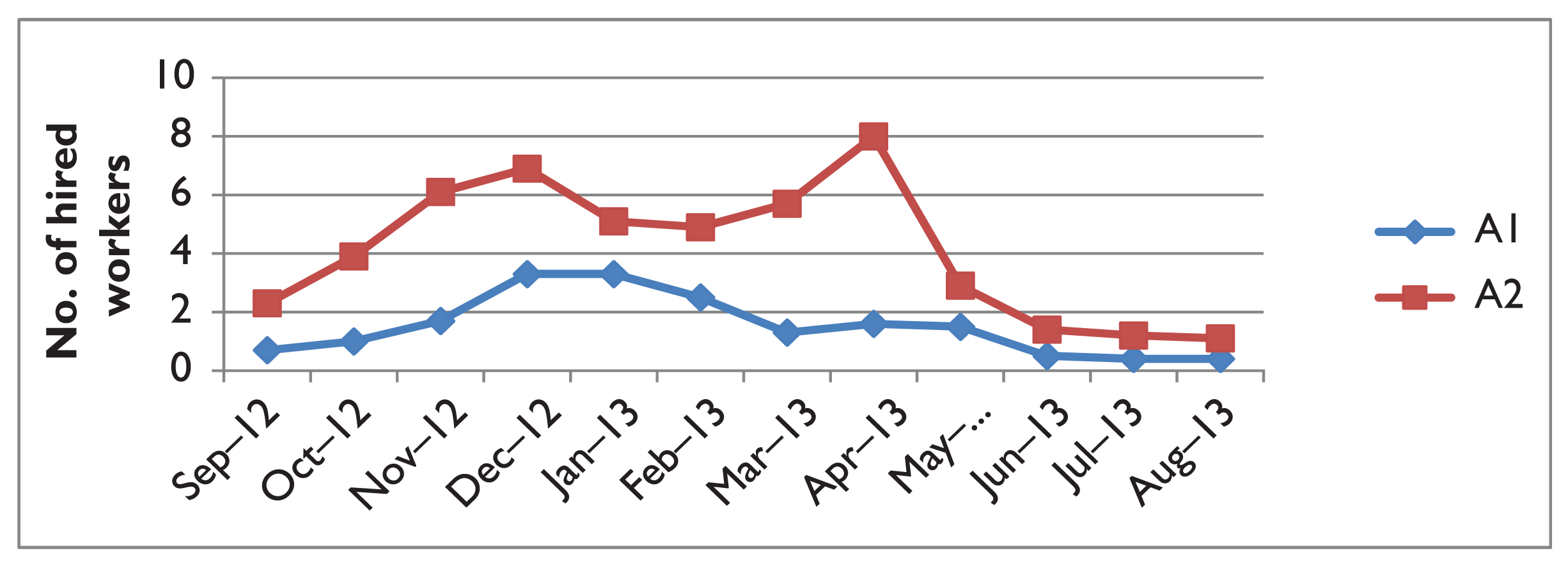
Given that less than 20 per cent of the farm households were endowed with functional irrigation infrastructure across both districts, rain-fed agricultural production predominates (AIAS, 2014). The demand for part-time wage labour is therefore seasonal, peaking at the onset of the rainy season in October and reaching a plateau in December (Figure 1). Thereafter, it declines partially, before it begins to rise again during the harvesting season around April. Most part-time farm labourers therefore experience slack time between June and September after the harvesting season. The average number of days worked by pieceworkers and time-rated workers in Kwekwe was relatively lower than those in Goromonzi district.
The slack time provides flexibility not only for part-time labourers, but also for family labour to allocate some of their labour to non-farm rural income earning opportunities during the dry season. The proliferation of multiplex non-farm labour activities that have been argued to signify the decreasing importance of farm labour by some analysts (Bernstein, 2014; Bryceson, 2000; Rigg, 2006), could in fact be considered to be inevitable due to the seasonality of agriculture (Moyo, 2016).
At least 30 per cent of the farm workers were also involved in other non-farm income earning activity. Encompassing more pieceworkers than permanent and seasonal workers, the activities included trading in natural resources. The nationalization of land tenures on redistributed LSCFs opened access to natural resources previously enclosed in freehold properties and protected by trespass laws (Mkodzongi, 2013). The activities were also structured by the resource availability in the different locales. In Goromonzi, the commonly reported activities were trading in river sand and thatching grass, both used in the construction of houses, cited by 20 per cent of the farm workers. Widespread gold deposits in Kwekwe meant that alluvial panning attracted 44.2 per cent of farm labourers.
In sum, the new permanent and casual labourers found in the A1 and A2 farm units are distinguishable from those found in the old LSCFs in terms of the degree of formality and working conditions. Yet, the differences across the new farm units have seen the A2 farms to some extent mirroring the pre-2000 forms of labour. The focus now shifts to how the labour is recruited and mobilized is the new farm units.
Recruitment and Mobilization of Agrarian Wage Labour
This section provides evidence, which shows that the recruitment of individuals and/or households into agrarian labour markets, as before 2000, continues to be influenced by access to land. However, land access alone is not the only determinant that compels people into farm labour markets as some peasants who received land during the FTLRP also sell their labour to other farm units, alongside their own household agricultural production. The sources of farm labour are now diversified than before involving migration beyond the nearby Communal areas to include other rural locations further away and urban areas.
Access to Land and Sources of Farm Labour Supply
Less than 10 per cent of the peasantry received land allocations during the FTLRP (Moyo, 2011a, 2013). This means that there are some rural people who are still either land short or landless and these constitute the labour reservoir for the new capitalist farms. Land reform experiences elsewhere also show that landlessness is not totally eradicated (Borras, 2005; Bush, 2002; De Janvry, 1981) and inequalities in land access alongside other factors continue to drive farm labour markets (Cousins, 2009).
The farm labour is being mobilized from the Communal areas within and outside the districts, as well as from the local A1 farmers and the former farm workers. Most of these labourers are either separated from or have inadequate the means of production for their social reproduction. Access to land was mentioned by most farm workers as one of the main challenges they were facing in their social reproduction (63.1%), outside of the low wages reported by 95.3 per cent. Many farm workers aspire to own their independent piece of land in the future for the social reproduction (42.8%) rather than a better paying job (16.7%). Overall, 33.4 per cent of the farm labourers interviewed did not have access to any land to grow crops across all rural areas. Landlessness was relatively higher among those in permanent employment (36.9%) than casual labourers (29.9%). Both male and female farm workers faced challenges of landlessness, 34.4 per cent and 30.3 per cent, respectively.
The land sizes owned by farm workers were also small, with 21.1 per cent controlling less than 0.5 hectares of arable land. Another 23.3 per cent of the farm workers possessed less than two hectares of the land. Besides those who formally own FTLRP (9.1%) and Communal areas (31.9%), land, tenure insecurity characterizes land accessed through ‘self-provisioning’ in the FTLRP areas (1.2%; Moyo, 1995), leased from land beneficiaries (16.3%) and small plots of land in the peripheries of the old farm compounds (20%). Amidst labour shortages, A1 landholders sometimes restrict the production of cash crops such as tobacco in old compounds to prevent labour from being autonomous in their social reproduction and thus continue to supply them labour (Chambati, 2013).
Informal leasing from FTLRP beneficiaries also tends to be based on dynamic short-term seasonal agreements, whose renewal is not obvious. In fact, about 9.4 per cent of the farm workers in Goromonzi who had been allocated land to grow their own crops by land beneficiaries, no longer had access to such land. However, in Kwekwe district, all of the farm workers who had access to informal land allocations for beneficiaries still maintained this access at the time of the survey. Indeed, informal land leasing by farm workers is under threat as land beneficiaries are increasingly seeking to enter the recently state sanctioned joint ventures with various resource rich agrarian capital.
Nonetheless, the proletarianization of rural labour is not only contingent upon landlessness and/or land shortages (Moyo & Yeros, 2005; O’Laughlin, 2002). The A1 farmers entered farm labour markets to mobilize resources for their own farms. Semi-proletarianization of rural labour therefore continues, albeit with more autonomy derived from land ownership (Chambati, 2013; Moyo & Yeros, 2005). Farm labourers are therefore fragmented by the ownership of means of production (especially land), with those having access to land more likely to be partially integrated into the labour markets.
Continuities and Changes in Residential Labour Tenancy System/Labour Stabilization
The long established strategy of stabilizing labour force on LSCFs through the provision of on-farm residency in farm compounds linked to employment (Magaramombe, 2001; Sachikonye & Zishiri, 1999; Tandon, 2001; Visser & Ferrer, 2015) is being replicated in differing degrees in the new A1 and A2 farm units. Residency for farm workers, observed in the surveyed farms, included the old farm compounds on farms resettled under A1 and A2 schemes, new labour compounds constructed by the landowners, homesteads of landowners, own A1 plots and neighbouring Communal areas. Such a labour tenancy arrangement mostly affects those farm workers who do not live in their own independent accommodation.
Close to 63 per cent of the farm workers surveyed indicating that their accommodation was tied to their employment of the farms. Eighty-three percentage and 92.2 per cent of the permanent workers in Goromonzi and Kwekwe, respectively, lived in such type of accommodation. Seasonal labourers were the second-most affected, 50 per cent and 58.1 per cent in the two districts. Less than 33 per cent of the pieceworkers had this kind of relationship and the majority’s employment was delinked from their residency.
The old farm compounds on A1 farms had the least share of farm workers (40.9%) who reported residential and employment linkages, yet this encompassed over 75 per cent of those in old A2 compounds, new farm compounds and the homestead of landowners. The farm compounds in A1 farms belong to the state and landholders have limited power to control labour resident there. Moreover, in the old A1 farm compounds, the power to enforce the residential labour tenancy is also dispersed among the many beneficiaries that reside in any given farm. In contrast in the A2 farms, the farm compound falls under the control of the landowner in whose subdivision it lies. The fewer beneficiaries in A2 farm offers relatively more latitude, including using the law to evict ‘truant labourers’. In general, the public land tenures offered to the new landowners do not enable them to totally enforce the residential labour tenancy (Chambati, 2011; Moyo, 2011a) and thus sometimes face stiff resistance from the farm labourers.
Contract workers resident in the old farm compounds sometimes face pressure from the landowners in the farms they stay to provide labour services to them, especially during peak periods. Over 31 per cent of the contract workers in Goromonzi had received eviction threats from their residency, mainly for not providing labour to the new farm units (54.1%). Only 3.1 per cent of the pieceworkers faced eviction threats in Kwekwe. None of the permanent workers had received eviction threats from their residency since 2000 in the same district, while it was recorded from 7.2 per cent of the permanent labour in Goromonzi. Some A1 and A2 land owners in Goromonzi also conducted ‘employment audits’ in the old farm compounds to identify the residents who are not supplying them labour (Chambati, 2013). Those who are found not be supplying labour are evicted as happened at Maruva farm in 2014. 10
The new compounds on the other hand are an effort to re-establish the control of labour under a single owner, in order to provide possibilities to enforce the tenancy relationship. Due to reduced demand for wage labour per unit among smaller-scale landowners, the new compounds tend to have fewer housing units (not more than 10 in farms surveyed) compared to the massive compounds that sometimes housed over 100 families in the Mashonaland provinces. An estimated 24.3 per cent of the landowners had constructed new farm compounds for their permanent workers and families (AIAS, 2014). These new compounds in Goromonzi were only found in A2 capitalist farms (38.5%). While in Kwekwe, 11.5 per cent and 19.4 per cent of the A1 and A2 farms had them, respectively (AIAS, 2014). Beyond the permanent workers, the new farm compounds also guarantee access to labour of their families who were also employed as pieceworkers during peak seasonal periods.
A new dynamic entails the housing of permanent employees within the homestead of the landowners, which was practiced by 43.9 per cent and 54.2 per cent of the landowners in Goromonzi and Kwekwe, respectively. This scenario was more prominent in the A1 farms where 82.4 per cent in Goromonzi and 80.8 per cent in Kwekwe reported it (AIAS, 2014).
Conclusion
This essay has shown that the nature of agrarian capitalism as reflected by the extent of the reliance of hired labour in agricultural production units has been changed by land reform. The diversified agrarian structure that is dominated by the peasantry has resulted in the increase in number of wage labour opportunities. This expanded agrarian labour market exists alongside the growing use of family labour, especially in peasant households. Yet, most of the wage labour opportunities generated across the different farm units are part-time in nature and thereby extending casualization of labour trends noticed in the LSCFs throughout the post-independence period. Rather than being mobilized in large batches per farm unit, as was the case in the LSCFs, the new downsized farms recruit relatively lower averages of workers per farm unit.
Both the permanent and casual forms are qualitatively different from those found in LSCFs especially regarding the degree of formality of the work. Indeed, the more formal types of employment are mostly found in the new small-to-medium and large capitalist farms. Furthermore, the skills base is also diffused containing a mix of new entrants into the farm labour markets and those previously employed in the LSCFs prior to the FTLRP. The dominance of the peasantry both in terms of the land controlled and the number of agricultural production units in the redistributed lands have also meant that family labour was the dominant source of employment.
Landlessness and/or land shortage continues to be a key characteristic of farm wage labourers as in the past suggesting the persistence of the labour reserve dynamic. Enlarged land access in the context of limited agrarian financing has meant that even some land beneficiaries participate in the agrarian labour markets, thereby perpetuating the process of semi-proletarianization but with greater autonomy provided by land ownership in comparison with those who are landless (Chambati, 2013; Moyo, 2013). Indeed, access to land provides a choice in the social reproduction strategies for those who have it and they can deploy it to bargain for better wages. Unlike the landless, they have the option of disengaging from the labour markets and survive by farming their lands. Moreover, land can be utilized to mobilize resources for their own farming by renting out their land to farm workers and others, as field data revealed (Moyo et al., 2009), as well as commodifying some of the natural resources found on their lands.
There is continuation of the super-exploitation of agrarian wage labourers that is reflected by the payment of poor wages and the institution of the residential labour tenancy in the old farm compounds and through the construction of new compounds to guarantee labour supplies. Women continue to be relegated to the irregular part-time labour, although their share has slightly improved in the full-time labour at least in the districts studied. The majority of the farm labourers in the new labour markets resist exploitation through enhanced labour mobility and the ‘freedoms’, which have been expanded by the new land tenure and which offers less power to the new landholders to control labour as the LSCFs could do.
Beyond the farming classes, agrarian labour markets are also differentiated across districts. As shown in this essay, the FTLRP did not reverse the uneven development of agrarian labour markets. The areas in higher potential agro-ecological regions and thus diverse production continue to have more pronounced labour markets than those in the lower potential agro-ecological zones. Therefore, the manifestation of agrarian capitalism is driven with various factors and chief among them is the land use patterns, which are also occasioned by the agro-ecological potential of the district. Farm units in Goromonzi, which were involved in the production of diversified labour intensive commodities, dominate the use of hired labour compared to the extensive livestock-oriented production in the drier district of Kwekwe. Whereas the differentiation within and across A1 and A2 farm sectors are propped not only by land sizes, but also by access to other agrarian resources, such as finance, which affect the land use and mix of commodities produced and in turn the use of hired and family labour, as well as the quantities applied.