



Abstract
Sustainable development implies development that meets the need of the present generation without compromising the ability of future generations to meet their own needs. As a result of the global upsurge of interest in sustainable development, the sustainability reporting system has emerged. Sustainability reporting enables the creation of long-term value for organizations. It is forward-looking and includes quantitative and qualitative reporting measures. It is a key platform for communicating the organization’s economic, social, environmental and governance performance, reflecting positive and negative impacts. It can be undertaken by all types, sizes and sectors of organizations. Through the Global Reporting Initiative (GRI) Sustainability Reporting Framework, the GRI works to increase the transparency and exchange of sustainability-related information. The present study conceptually reviews sustainability reporting and its benefits for the entities. Here, an attempt has been made to examine the development in the Indian regulatory environment for sustainability reporting along with finding out trend, application level and status of the sustainability reporting practice of Indian entities as per the GRI reporting framework. The findings reveal that the development of the corporate governance standard is maturing in India. Amendments in laws and changes in the regulatory mechanism are creating pressure on entities to respond to and communicate for their sustainability concerns. With globalization, Indian companies are increasingly realizing that they have much to lose by not following sustainability reporting. In fact, many respected companies already get their sustainability reports audited by a third party to ensure its credibility. Sustainability reporting is therefore a vital step of managing change towards a sustainable global economy—one that combines long-term profitability with environmental care and social justice.
Keywords
Introduction
Business must make money and staying in business and prospering is a fundamental value of any for-profit organization, but for long, the industry has pursued a one-dimensional model of economic wealth creation without considering issues related with sustainability and the consequent impacts on future generations. The key challenge today, both globally and in India, is to focus on inclusive growth by ensuring economic well-being across all sections of the society while at the same time protecting our environment and eco-systems. It is in this context that corporate social responsibility (CSR) assumes a significant role. CSR is underpinned by the idea that companies can no longer act as isolated economic entities in detachment from broader society.
In recent decades, organizations increasingly find that their profit and loss statements are influenced by parameters that do not feature on the balance sheet. These external factors are ‘sustainability issues’ that could be economic, environmental or social in nature. With the line between public responsibility and private initiative blurring, the popular opinion is putting pressure on companies to become more sustainable (Elkington, 1994). Sustainable development implies development that meets the need of the present generation without compromising the ability of future generations to meet their own needs. As a result of global upsurge of interest in sustainable development, sustainability reporting system has emerged.
Objectives of the Study
The present study conceptually reviews sustainability reporting, its benefits for the entities along with the GRI reporting framework. The main objectives of this research are stated below:
To analyze the development in the Indian regulatory environment for sustainability reporting. To examine the applicability of the concept of sustainability reporting with special reference to the GRI status of Indian entities. To make a comparative study of Indian corporates (year-wise as well as size-wise), submitting their reports to GRI from 2009 to 2013. To investigate the application level and status of audit of the companies who submitted their reports to GRI.
What is Sustainability Reporting?
A sustainability report is an entities report that gives information about its economic, social, environmental and governance performance (Kolk, 2004).
GRI defines sustainability reporting as ‘The practice of measuring, disclosing and being accountable to internal and external stakeholders for organizational performance towards the goal of sustainable development.’
According to the World Business Council for Sustainable Development, sustainable reports are ‘Public reports by companies to provide internal and external stakeholders with a picture of corporate position on activities on economic, environmental and social dimensions’.
Thus, it can be said that sustainability reporting is a process that assists organizations in setting goals, measuring performance and managing changes towards a sustainable global economy. It is a key platform for communicating the organization’s economic, social, environmental and governance performance, reflecting positive and negative impacts.
Benefits of Sustainability Reporting
No one can question the need for sustainability reporting. There are a variety of reasons that companies choose to produce these reports, but at their core they are intended to be ‘vessels of transparency and accountability’. Often, they also intend to improve internal processes, engage stakeholders and persuade investors. Stakeholders expect environmentally and socially responsible behaviour from companies, particularly from large companies that have huge resources under their control. There is considerable evidence that sustainable development contributes to shareholders value in variety of ways.
Embracing sustainability in reporting can enhance business performance, including: reducing operating costs and improving efficiency, developing new products and services for access to new markets, recruiting and retaining excellent people and improving brand value through product differentiation and integrity management (Venning & Higgins, 2001).
According to GRI, sustainability reporting benefits organizations in the following ways:
Emphasizes the link between financial and non-financial performance. Influences long-term management strategy and business plans. Increases understanding of risk and opportunities. Mitigates or reverses negative environmental and social impacts. Compares performance internally and between organizations and sectors. Benchmarks and assesses sustainability performance with respect to laws, norms, codes and voluntary disclosures. Enables stakeholders to understand the company’s true value. Demonstrates how the organization influences and is influenced by expectations about sustainable development. Improves reputation and brand loyalty.
Currently, there are only two recognized professional standards for carrying out sustainability reporting assurance. These are:
AA 1000 Assurance Standard—developed by the Institute for Social and Ethical Accountability. International Standard on Assurance Engagements (ISAE) 3000 Assurance Standard—provided by the International Audit and Assurance Standard Board.
The International Organization for Standardization (ISO) has recognized the need for guidance on sustainability, through the recent publication of ISO 26000 on social reporting.
Major providers of sustainability reporting guidance include:
The GRI Organisation for Economic Co-operation and Development (OECD) The United Nations (UN) Global Compact ISO (26000, International Standard for Social Responsibility).
At present, the content of sustainability reports tend to appear in forms and units that are not readily convertible into financial terms, but rapid advances in areas such as environmental management accounting, human resource and social accounting, valuation of intangible assets and value-based reporting promise to make sustainability information useful to the financial community.
About GRI
GRI is a non-profit organization that works towards a sustainable global economy by providing sustainability reporting guidance. It was formed by the USA-based non-profit Coalition for Environmentally Responsible Economies (CERES) and Tellus Institute, with the support of the United Nations Environment Programme (UNEP) in 1997. It is a network-based organization of some 30,000 people, many of them sustainability experts, which contributes to its work. GRI’s governance bodies and secretariat coordinate the activities of its network partners. It produces one of the world’s most prevalent standards for sustainability reporting also known as triple bottom line reporting, CSR reporting, ecological footprint reporting or environmental and social governance reporting. The framework enables organizations to measure and report their environmental, social, economical and governance performance—the four areas that are seen to be key to sustainability.
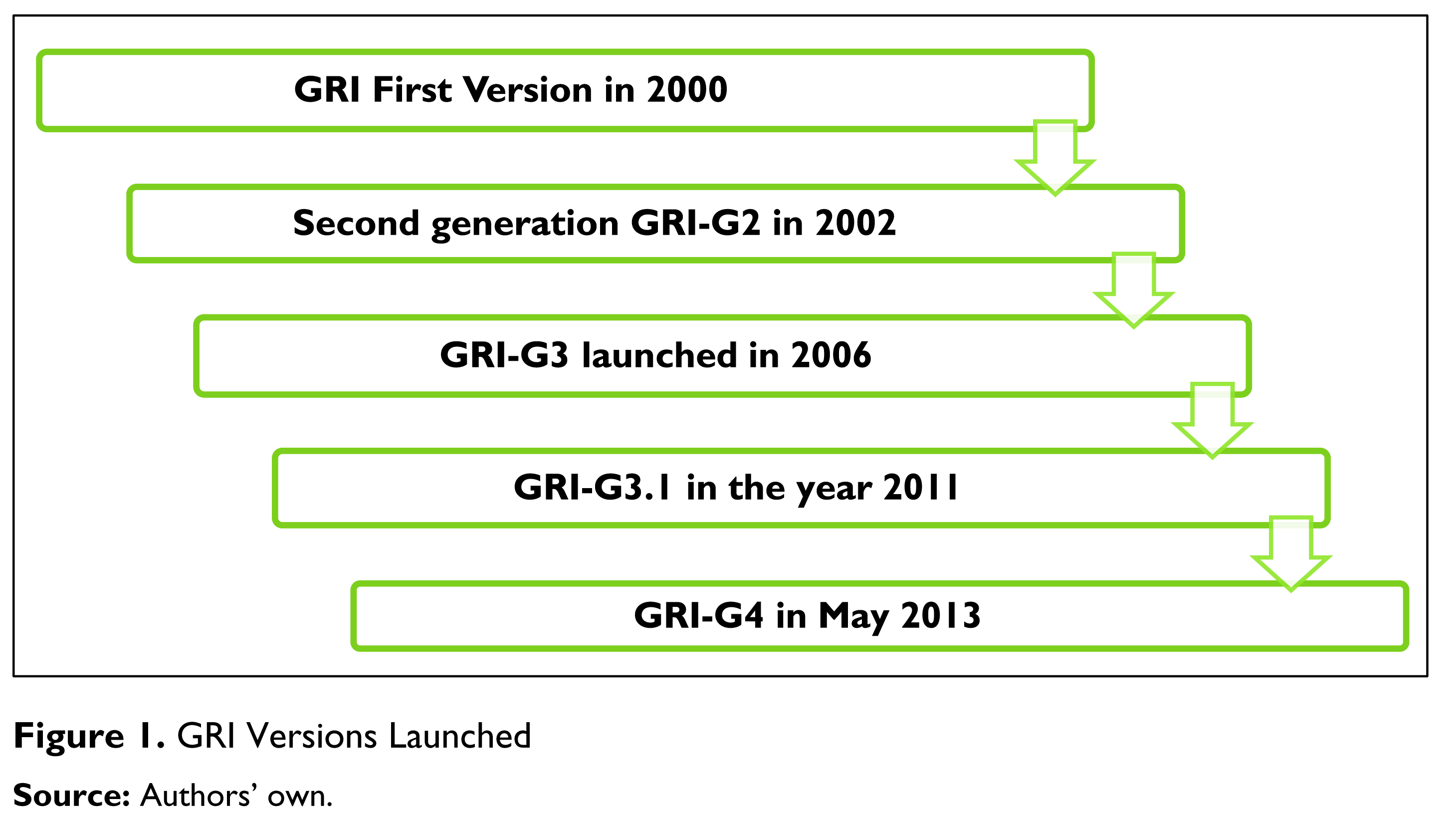
The first version of GRI guidelines was issued in the year 2000. G2 or the second generation of guidelines was released in 2002. Indian companies have started reporting according to the GRI framework in 2001(Tata—first company) as per the G2 framework. The third generation G3 and G3.1 are currently available, while the fourth generation has recently been launched (see Figure 1).
The GRI works closely with international bodies such as the UN Global Compact, the UN Environmental Programme, OECD and the International Finance Corporation of the World Bank Group. GRI guidelines are applicable to all types, sizes and sectors of organizations whether they are corporate businesses, public sector undertakings, smaller entities, NGOs, industry groups and others.
Organizations from approximately 60 countries use the GRI guidelines to produce their sustainability reports. By reporting transparently and with accountability, organizations can increase the trust that stakeholders have in them, and in the global economy. Total reports registered with GRI up to 15 February 2014 are presented in Table 1a.
Number of Reports Registered with GRI

Number of Organizations Releasing Sustainability Reports—By Regions

Table 1a shows that in 2013, 1759 organizations registered their sustainability reports with GRI. European organizations are playing the leading role in submitting sustainability reports with more than 40 per cent reports. Three hundred forty-seven organizations from Asia region (second rank for regional reports) reported to GRI with their sustainability reports. Table 1b indicates that Oceania and African organizations’ percentage of reports contributes less than 10 per cent of the total reports with GRI. If we compare Asian organizations as per the guidelines (G3 or G3.1) followed by them (I) in the year 2012, 163 reports have been prepared as per G3 guidelines while 328 reports have been prepared as of 2013 as per G3.1 guidelines. (II) For the year 2013 (up to 16 February 2014), G3 guidelines have been followed in preparing 69 reports while 278 reports have been prepared as per G3.1 guidelines.
India’s Scorecard
Sustainability reporting is not a mandatory requirement in India for all companies (Reddy, 2007). Except for some high-performing visible companies, many organizations have not started using the GRI reporting framework effectively. Empirical research shows that there is temptation among managers to disclose positive contribution and to suppress negative contribution. Therefore, government and market regulators should play a multifaceted role in promoting sustainability reporting because they do not just regulate private sector but are also expected to put an example regarding their own transparency on financial as well as non-financial performance. Around the world, an increasing number of government and market regulators are adopting policies and regulations for sustainability reporting. The Institute of Chartered Accountants of India-Accounting Research Foundation (ICAI-ARF) has undertaken a special project to suggest a suitable framework for sustainability reporting for Indian companies. India’s development for sustainability reporting is shown in Figure 2.
A third-party assurance of corporate responsibility reports has been accepted by a large number of sustainability reporters in India. It is also observed that a majority of the reports that are assured use the ISAE 3000 standard. Companies in India have just begun to adopt the AA 1000 Assurance Standard for sustainability reporting.
GRI Focal Point India
The Focal Point India was established in January 2010, and is hosted by the BSI Group India. The Focal Point India consists of a director and a coordinator. Dr Aditi Haldar is director and Ms Rubina Sen is the coordinator of Focal Point India. Focal India provides Indian corporations a chance to shape GRI’s continuously developing sustainability reporting framework as well as standards and the emerging regulatory landscape for sustainability reporting in India. The Focal Point India has strategic collaboration with: the Indian Institute of Corporate Affairs (IICA) through the IICA-Deutsche Gesellschaft für Internationale Zusammenarbeit (GIZ) CSR initiative; the South Asian Federation of Accountants (SAFA); the Chartered Institute of Marketing (CIM) Sri Lanka; and CSR Centre for Bangladesh.
GRI Status of Indian Companies from 2009 to 2013
Table 2 reveals the reports registered with GRI as per the size of the organization. There are only a handful of organizations in India that leverage CSR to business objectives. Most companies have separate departments for environmental concerns but social initiatives are still restricted to philanthropic concerns of the organization. Table 2 reveals that small and medium-sized enterprise (SME) reports are very few. Out of total 169 reports registered with GRI in last five years, only five reports are of SMEs. Similarly, Indian multinational enterprise (MNEs) share is less than 10 per cent of the total reports for all the years under the study. Large-scale companies are keen on submitting reports as per GRI and their number has an increasing trend.
Figure 3 shows that in the year 2009 only 24 companies released their sustainability reports as per GRI framework. As the G3 framework came into existence in 2011, all the reports prepared as per G2 framework. There was a slight increase in sustainability reporting in 2010, that is, 29 reports registered. In 2011, 33 companies prepared their reports as per G3 while 11 companies published as per the G3.1 framework of GRI reporting. In 2012, the number of reports published as per GRI 3 and GRI 3.1 are 13 and 33, respectively. As reporting years of many companies end on 31 December and this compilation is done up to 16 February 2014, only 26 reports (8 as per GRI 3 and 18 as per GRI 3.1) have been registered so far.

Indian Reports Registered with GRI (as per Size of the Organization)


Table 3 shows that out of the 13 reports registered in 2012 as per G3 guidelines, nine reports belong to the application level A+, two to level A and remaining two adopted application level B. If we analyze according to sector-wise representation, Table 3 reveals that out of these 13 companies, two belong to the constructions sector, two to the automotive, two are energy utilities, two conglomerates and remaining each belong to agriculture, mining and metal, chemicals and commercial sectors. The status of these reports is as follows: six reports are checked by GRI, two reports are checked by a third party while the status of the remaining five reports is self-declared.
It is clear from Table 4 that out of the total 33 reports prepared as per the G3.1 guidelines, 27 reports have application level of A+, four reports of A level, one belongs to the c level, while only one report has undeclared status. These reports are checked by GRI, a third party or may be self-declared. Sector-wise analysis shows that more than 30 per cent of the companies belong to mining, metal and construction sectors, three reports to energy sector companies, three to the chemical sector, three to the commercial and financial sector. Tourism, health care, technology (hardware and software) and aviation sector companies have also released the importance of sustainability reporting as per GRI. Table 3 also indicates that 14 companies got their reports checked by GRI, 7 submitted as per third-party checked status and the remaining 11 declared their status as self-declared.
Table 5 indicates that in the year 2013, G3 guidelines were applied by eight companies. Out of these: five were prepared as per the A+ level, one report belonged to level A and the remaining two were prepared as per the B+ level. It also indicates that five reports have been audited by GRI, 1 by a third party and the remaining two had status of self-declared report.
List of Companies (Checked in 2012) that Applied GRI G3 Guidelines for Sustainability Reporting

List of Companies (Checked in 2012) those Applied GRI G3.1 Guidelines for Sustainability Reporting

List of Companies (Checked in 2013) that Applied GRI G3 Guidelines for Sustainability Reporting

Table 6 shows that 18 Indian companies submitted their sustainability reports as per G3.1 in 2013. Out of the companies declaring the GRI application level, it has been observed that almost all companies declare the A/A+ level. Table 6 shows that 15 companies prepared their reports as per the A+ level, 1 as per the C+ level while two companies did not declare their application level for sustainability reporting. Energy sector companies are playing the leading role in reporting as per GRI. Other sectors of which GRI reports are prepared are chemical, mining and metal, computer and communication service, etc. Out of these 18 reports, seven are audited by GRI, eight by the third party, 1 report has a status of self-declared report, while two companies have not declared their status also.
List of Companies (Checked in 2013) that for Applied GRI G3.1 Guidelines for Sustainability Reporting

Concluding Observations
Sustainability reporting is expected to be integral to business today. It has also become the password to not only overcome competition but also ensure sustainable growth.
Though the government and regulators in India had drawn the attention of the entities to their role in CSR by making provisions, critical policy interventions and issuing guidelines, there is an urgent need to set out clear and meaningful principles of reporting and regulate sustainability reporting by companies.
There has been a rapid increase in practising sustainability reporting as per the GRI framework since 2000 in a number of countries such as the USA, Europe, Japan and Australia. The applicability of GRI reporting in India is yet at a nascent stage. The cement, mining and metal sectors are the most compliant among the companies reporting to GRI with banking and financial services and the health care and pharmaceuticals sectors being the least compliant.
Sustainability reporting is now becoming a standard practice for global companies and if Indian companies want to be competitive with their global counterparts they need to adopt the GRI-based sustainability reporting practice positively.