




Abstract
This case highlights Indian Tobacco Corporation (ITC)’s journey from being a pure leaf tobacco selling company to a reputed conglomerate with popular brands in diversified areas. ITC’s corporate social responsibility (CSR) and sustainability activities taking a turning point with the company taking an immense interest in integrating societal problems in its company’s policies and strategies. These transformations can be seen in almost all the business divisions of ITC. Mangaldeep division, an incense stick division is not an exception to this change. However, the authors are trying to analyze the activities of ITC–Mangaldeep Business unit from different perspectives such as CSR, sustainability and shared value initiatives. Considering the resource constraint and the demand to meet the societal needs, it will be quite interesting to know how both these two challenges are met by a conglomerate like ITC simultaneously in the days to come. The case uses both primary and secondary sources of information to develop this teaching case.
Introduction
Despite a century of economic progress, the inequities today are far more pronounced than ever (ITC’s sustainability report, 2012). 1 Recent OECD studies reiterate that income inequalities have actually widened in last 30 years in a majority of advanced nations as well as emerging economies. According to the UN Human Development Report, nearly 2 billion people in the world still live in multi-dimensional poverty. With one-third of the world’s poor living in India, the challenges are equally daunting’ (ITC’s Sustainability Report, 2012).
Y. C. Deveshwar, the Chairman of Indian Tobacco Corporation (ITC), was busy with business deals as ITC was signing a Memorandum of Understanding (MoU) with three state governments of India—Assam, Orissa and Tripura. The MoU was signed for easy sourcing of raw materials such as bamboo for the Mangaldeep division of ITC’s agarbatti (incense sticks) business. Termed by industry experts as a strategic move that could raise the market share of the Division and a potential corporate social responsibility (CSR) programme. Expectation was that approximately 3,000 rural women could be benefitted by this initiative. With previous working experience with farmers, ITC’s management body was searching ways to benefit the underprivileged women while generating company profit. The question that was to be answered was—How could ITC use their previous experience and expertise of working with grass root level organizations in the case of the agarbatti production system through CSR, sustainability and shared value initiatives?
Globally acclaimed for its CSR initiatives in different regions of India, ITC bagged the World Business and Development Award in the year 2012 for its rural, social and farm forestry initiatives (ITC’s sustainability report, 2015).
ITC is known for its strong value propositions and contribution towards creation of sustainable livelihood through its projects (e-Choupal, social and farm forestry and watershed development projects) (ITC’s sustainability report, 2015).
Armed with expertise and experience from previous successes, it was time for tackling the challenges of the agarbatti industry, as the industry was paralyzed with problems like unorganized, unskilled or semi-skilled workers. Further, as the industry was forest-based, the varying forest policy of states added confusion to operational challenges of this unsophisticated sector, threatened badly by competitors from China and Thailand.
About ITC
Indian Tobacco Corporation (ITC), a 100-year-old conglomerate took birth on 24 August 1910 in Kolkata, India. It is a conglomerate with different portfolios of businesses (Fast-Moving Consumer Goods, Hotels, Agriculture related businesses, Paperboard and Information Technology).
In the 1960s, the company started with cigarettes and leaf tobacco selling business, and initially diversified into different sectors such as the hotel and paperboards business in the 1970s. In 1996, with Deveshwar as the Chairman, ITC started strategic diversification into new and unconventional businesses. Diversification was the need of the hour in the face of stiff competition to achieve competitive advantage.
In line with harnessing economic growth, the company was looking for avenues for sustainability and CSR initiatives. It became the first Indian company to publish its ‘Sustainability Report’ adhering to the Global Reporting Initiative guidelines. In 2010, the Boston Consulting Group ranked ITC as the world’s sixth largest ‘sustainable value creator’ from amongst 4,000 companies of the global consumer goods industry.
Indian Tobacco Corporation’s market capitalization of US$42 billion was a 35-fold increase since 1996 with a turnover of US$7 billion in 2012. The company also had a 25.7 per cent compound annual growth rate in the period 1996–2012 that signifies the growing hold of the company.
But ITC’s journey to success was not that smooth. The company came through hard times in the 1990s. During that period, its paper manufacturing unit in Bhadrachalam struggled and was on the verge of defaulting in the year 1995–1996. Moreover, few other issues such as reduced productivity of agriculture, dependence on unpredictable weather and weak supply chain, crippled the company and the industries. Deveshwar understood the fact that the company required a change in its overall corporate strategy. The company restructured its core and existing businesses accordingly. The new strategy was to ‘catalyse and channelize investments towards upgrading of human capital, expansion and modernization of infrastructure and productivity enhancement in the agri-sector’ (ITC’s Annual Report, 2014–15).
As an integral part of the company policy, the shared value concept was adopted in terms of ‘a commitment beyond the market’ with a commitment to achieve the dual goals of a company-simultaneous national and societal development.
The Challenges Ahead
Operating in an economy crippled with high inflation, and fiscal deficit, ITC still managed to record milestones in terms of its gross income of INR 48,176 crores and an increase in net profit by 18.4 per cent to INR 8,785 crores and a significant portion (59 per cent) of net segment revenue that was earned from businesses other than cigarettes during the period from 2006 to 2014 (Table A1) (ITC, 2014).
As the multinational companies gradually included societal challenges into their CSR/sustainability initiatives, ITC was also not an exception. In fact, ITC had a pioneering role in creating sustainable supply chains. It was not easy to pick up a societal challenge amidst many (poverty, unemployment, malnutrition among children). A country, challenged with many societal problems and raising number of youngsters (approximately 12 million) joining the job market every year, the problem of job creation was apparent. To solve this problem to some extent, ITC focused on sustainable livelihood creation through its business value chains (ITC’s Enduring Value, 2014).
Journey from CSR to Shared Value
The ITC followed the popular 3BL approach that emphasizes on economic, social and environmental capital creation while serving national priorities. To enhance both shareholder and societal value, ITC aligned its CSR/sustainability/shared value programmes with its different value chains. They were designed in manner to support sustainable livelihood sources in order to empower stakeholder communities and those living in the vicinity of factories. During these operations, rural people were mostly integrated into the projects. Collaboration with the local communities and grass-root level institutions/social systems was a learning method for the company as it helped to understand the actual problems that were hindering the system. Creation of sustainable business models based on the realities of society helped more than 6 million people in different regions of India (ITC’s Annual Report, 2012).
The CSR programmes were designed specially to serve both the rural agriculture-dependent families residing in the neighbouring villages of the operating plant of ITC. More than 67 projects out of total projects were operated in the areas of Agri Businesses and focused on providing livelihood alternatives and creating social capital. ITC’s e-Choupal networks not only served the farmers but also their children.
The projects played the role of catalysts in transforming villages into successful economic units.
It was reported that ‘over 4.37 lakh households from about 8,710 villages and spread across 60 districts in the states of Andhra Pradesh, Bihar, Karnataka, Kerala, Madhya Pradesh, Maharashtra, Rajasthan, Tamil Nadu, Uttar Pradesh and West Bengal, are covered in these projects’ (ITC’s sustainability report, 2012). Few social forestry initiatives were designed as per the Forest Management Certification (FSC-FM) audit and biodiversity conservation project. These projects benefitted the farmers with increased productivity of the land that ultimately generated sustainable livelihoods (ITC’s sustainability report, 2015).
Assistance in Social Habilitation through Agarbatti (ASHA) was an initiative that provided training on rolling and preparing incense sticks with a provision of stipend and guaranteed buyers and payments. This programme covered approximately 16,000 women. Moreover, ITC helped to provide free access of primary education to the children and raised the standard of education by providing infrastructural support to the government schools. Health and sanitation was another case of ITC’s CSR initiatives in the operating areas such as the Bhadrachalam, Kovai and Chirala units. 2 With the theme of ‘Transforming Lives and Landscapes’, ITC ensured to work on sustainable future through its primary and secondary activities. As a part of this initiative, ‘Operation Harvest’ was designed to segregate and select a few bamboo growing regions with lack of infrastructure and poverty. The forest departments in south and north-east India were partners in such sourcing programmes (KPMG, 2015).
Organizing for Shared Value
Shared value evolved from the earlier thought of contribution of the business to the society. Initially, companies focused on philanthropy and charity works, which gradually took the shape of CSR and sustainability programmes to meet societal and business obligations. Shared value progressed from CSR and sustainability initiatives. Shared value is a concept to find solution to societal problems through normal business courses. Although the private sector companies are rich in resources, they need the assistance of non-governmental organizations (NGOs) and governments to address any societal issue. Of late, the NGO community and governments understood the need of aligning their activities with private companies to deliver shared value to the society.
Sustainability and effectiveness of the social initiatives of the company depends on participation of the stakeholders and community members (farmer, artisans and local governing bodies). The ability to operate independently gave the members a sense of empowerment, which was the goal of the initiatives.
Role of Non-government Organizations and Self-help Groups
‘The core principle of ITC’s business model for agarbatti division was production outsource of the production activities to households and to micro and small businesses’ (Harper, 2010). These production activities could be categorized into multiple stages (Appendix B). The tribal people of the bamboo growing regions harvested bamboo poles to supply it to the village self-help groups (SHGs). After receiving the poles and raw materials, the women members started preparing raw agarbatti sticks. In the second stage, once the raw sticks were prepared, the SHGs sold them to the small scale suppliers, nominated by the company. At the third stage, suppliers did the perfuming and packaging activities that were required to produce the final products. Finally, the incense sticks were marketed under the brand name Mangaldeep.
The ITC boasts of a strong network with local NGOs and SHGs in regional pockets of India, whereas few of them receive funds under government schemes (e.g., Swarnajayanti Gram Swarozgar Yojna) (Ibid.). Few NGOs had prior experience of working in areas like agarbatti rolling which eased the system. All these factors helped both ITC and the SHGs regarding operational matter of the units. At the end stage of production, ITC supplied the required technical inputs in areas such as selecting the perfume, quality control, training to the artisans and packaging methods and finally the products were readied to sell. However, ITC kept a watch over all the stages, especially during the chemicals application to the incense sticks and followed the ‘International Fragrance Research Association’ recommendations of using safer chemicals, raw materials selection and price fixing of the product at each value chain stage (Figures A1 and A2).
Rajasekharan the Chief Executive Officer (CEO) of the incense stick division mentioned that the business model basically leveraged on the core strength areas of ITC whether it was distribution or packaging. The MoU signing was considered as a strategic action. The company adopted the ‘comprehensive vendor development programme’ to further manage the quality. The Khadi and Village Industries Commission, Art of Living, and Trust for Village Self Governance (Ibid.) were some valued members of ITC’s network.
Women from poor households, who previously worked as agricultural labour, specially benefitted from the project and earned around INR 80–100 per day for about 300 days in a year, and became a regular income source as compared to working in the agricultural fields (Ibid.).
Constraints and Future Paths
India is home to millions of people with limited resources (2.4 per cent of the global land mass, 4 per cent of world’s freshwater resources and only 1 per cent of global forest resources). In a country with such complexities, a concern for strategies to bring sustainability and growth was deep and apparent. The ITC took a step ahead to bring transformational changes to the society by using innovative business models that synthesized both societal and economic goals. Perhaps, an approach for sustainable livelihoods generation, preservation of natural capital along with shareholder value could be enhanced simultaneously (Porter & Kramer, 2011). Armed with consumer insights, excellent business processes, strong marketing and distribution network and investments in modern Research and Development (R&D), ITC competed fiercely in the domestic and global incense stick markets.
Although the agarbatti business created a societal value for the poor rural women as part of its CSR and sustainability programmes, few possible approaches could be pursued by the company as well. These are:
Approach 1: Company could simply follow the legal compliance of the state by paying legal taxes and following ethical rules and guidelines. Approach 2: Performing CSR activities through philanthropic activities and donating to social or moral causes. Approach 3: This could be a phase whereby an organization went beyond philanthropic/charity activities to solve the social problem by using time, effort, managerial skills and technical capabilities of the company. Approach 4: In this approach, companies focused not only on CSR or sustainability programmes, but also ensured sustainability of the programmes by gathering in-depth knowledge about grass-root problems that need to be solved.
Creation of sustainable value chains by engaging local community people asserts that a combination of professional and traditional knowledge accumulation can foster wellness to all the stakeholders.
Selection of the issue to be addressed through business is important for creating shared value. The ITC management thought about the possibilities of creating shared value in the Mangaldeep division. But a question that still needs further attention of the management was—whether it was feasible to explore a model based on shared values or a normal profit-oriented business model or simply continuing with the CSR model and what capabilities would be needed to rise to the next level?
Footnotes
Appendix
ITC Financial Highlights 1996–2014
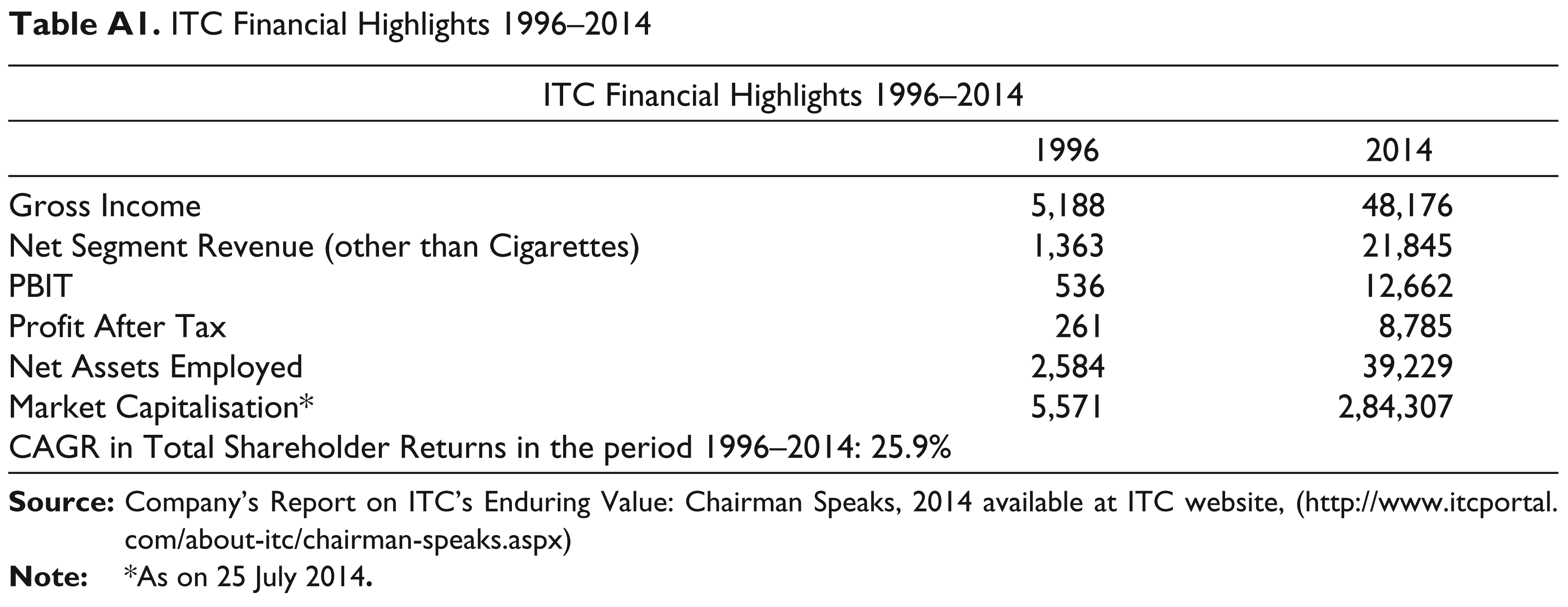
| ITC Financial Highlights 1996–2014 |
||
| 1996 | 2014 | |
| Gross Income | 5,188 | 48,176 |
| Net Segment Revenue (other than Cigarettes) | 1,363 | 21,845 |
| PBIT | 536 | 12,662 |
| Profit After Tax | 261 | 8,785 |
| Net Assets Employed | 2,584 | 39,229 |
| Market Capitalisation* | 5,571 | 2,84,307 |
| CAGR in Total Shareholder Returns in the period 1996–2014: 25.9% | ||
Acknowledgements
The authors wish to thank the management of ITC Ltd for their support to develop this case and their permission to publish this paper in the South Asian Journal of Business and Management Cases.