




Abstract
In many literature on innovation, it has been proven that the success of innovation is highly influenced by interorganizational collaboration. The purpose of this case is to provide a complete case study on how academic-business-community-government (ABCG) plus bank partnership can be nurtured to create innovation. To develop successful innovation that could provide hallo economy impact, a systematic strategy development is needed with the support of strong partnership between ABCG and banks. This study uses qualitative approach (direct observation) by taking a case study of Technology Advanced Metropolitan Area (TAMA) in Japan who has successfully developed Greater Tokyo Initiative (GTI). Result of this study shows that to develop a successful cluster, there is a need of systematic cluster strategy with the help of ABCG and bank partnership. This strategy should include cultivation of key persons for local industrial vitalization, analysis for new industries, any kind of supports for planning industrial vitalization plan, supports for collaboration with other areas and also overseas marketing. TAMA is a comprehensive example of ABCG collaboration that not only develop regional network so that some projects can run smoothly but also create collaboration with other cluster in Japan and in the world to contribute to global innovations to strengthen their network.
Keywords
Introduction
Many small and medium-sized enterprises (SMEs) in Japan, as well as in other countries, are struggling with developing their businesses due to the limits of resources, capabilities and network/linkage. In order to assist such companies in Western Metropolitan Tokyo, an association named Greater Tokyo Initiative (GTI) is established with help from Kanto Bureau of Ministry of Economy, Trade and Industry (Kanto METI.) The association is also known as Technology Advanced Metropolitan Area (TAMA) association. TAMA is generally reflected to the western region of Tokyo. The purpose of the establishment was to provide varieties of integrated support in the areas of research and development (R&D), human resources and international business development using Academic-Business-Community-Government (ABCG) partnership approach. This case aims to provide a compressive understanding of GTI in implementing ABCG partnership. Background and strategic support contents of the GTI will be introduced and discussed.
Background of the GTI
GTI is a public benefit association, located at Hachioji City, Tokyo, Japan, and was established in 1998 with a mission to vitalize industries in TAMA by innovating collaborations among industries, universities, governments and financial institutions. Geographically, it covers western parts of the Greater Tokyo Metropolis, including prefectures of Tokyo, Kanagawa and Saitama.
GTI is a cluster that consists of 602 affiliates including 41 universities, 20 local governments, 36 chambers of commerce and group of industries, financial institutions and industrial companies as of August 2014. Approximately 300 members of the affiliates are companies focusing on innovations using advanced technologies.
To serve its role as a supporting association, GTI promotes innovations and collaborations throughout a network of ABCG plus banks. Their unique aim is not only developed regional network so that some projects can run smoothly supported by ABCG but also create collaboration with other cluster in Japan and in the world to contribute to global innovations to strengthen their network. This is inline with Eckert (2017) study who enlighten the importance of of collaboration in developing innovation. This aim and the number of GTI networks is illustrated in Figure 1.

Figure 2 indicates that main function of TAMA is not only nurturing collaboration but also to generate network and expand business. It is interesting to note that due to this strong linkage many SMEs in Japan are able to expand their business abroad and eventually became multinational companies all over the world (see Box 1), a case study of Japanese company in China).
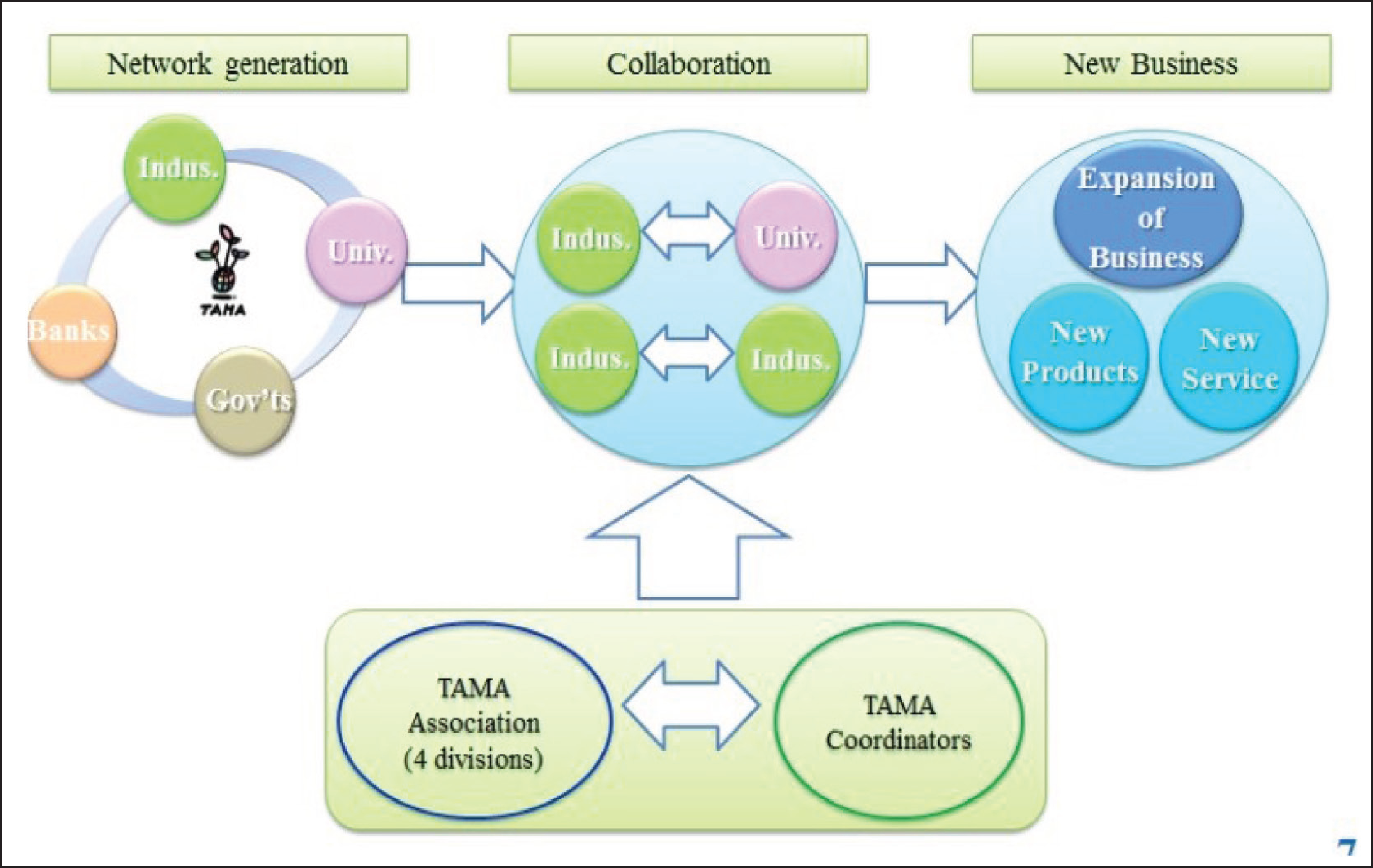
The network generation from industry, university, government and bank provide a strong valuable linkage for any kind of collaboration and development of new business. As mentioned by Douglas and Wolf (2008), when collaborations work, they are synergistic in that they produce more than they cost. More specifically, like any asset, collaboration across organizational boundaries requires an investment by boundary spanners and their organizations; both organizations must be willing to engage in some risk taking and invest some human, social and financial capital. Maturing the asset requires patience, goodwill and time. Yet even with these investments, the collaboration asset will not form in the absence of boundary spanners with reticules skills. They are the primary active ingredient that pulls people together; they instigate, manage and grow the collaboration asset. For this reason, the principal boundary spanners of any collaboration must trust each other and be trusted by their respective organizations if the collaboration asset is to survive the process of cross-organizational learning.
Financial Resources
Since its establishment in 1998, GTI has received a large financial support from the Kanto METI. During the early stage of its operation, the association’s supporting programmes were mainly financed by grand-aids from the Kanto METI, in addition to its membership fees.
Followed by the growth of its members and service menus, GTI needs more grant-aids to provide integrated support for its member companies. Besides funds from the METI, grant-aids have also been obtained from both national and local authorities such as the Ministry of Education, Culture, Sports, Science and Technology (MEXT), the Ministry of Internal Affairs and Communications (MIC), the Small and Medium Enterprise Agency, Tokyo Metropolitan Governments and other local governments.
Five-year Action Plans
A series of action plans have been carefully designed to accomplish its objects as well as assist its member companies. Those action plans have been divided into four stages namely networking, new R&D projects and business, eco-friendly manufacturing and eco-clustering.
The first 5-year action plan in the period of 1998–2002 focused on ‘networking’. When GTI was just established, it did not possess enough solid fundamentals in terms of technologies, infrastructure and partnership. In recognition of its insufficiency, GTI’s first 5-year action plan began with infrastructure development and network construction. Several activities that support to construct network infrastructure are development of information network, meeting between academics and industry, exhibitions of TAMA technology, development of search engines for academic and industry integration, business fair and development of virtual laboratory.
After constructing the network, GTI concentrated on creating new R&D projects by promoting academic and business partnership in the second 5-year action plan (2003–2007). At this stage, collaboration between academic and business has been focused on inventing new technology and developing product that meet to market needs.
After bankruptcy of Lehman Brothers, an economic stimulus package of Japanese government was released that included tax breaks for fuel-efficient and environment-friendly cars. Thus, GTI has focused on being environmental compliance. In its third 5-year action plan (2008–2012), it emphasized on ‘Eco-friendly manufacturing’ by creating a global brand called ‘manufacturing cluster’ during its third 5-year action plan (see Figure 3).
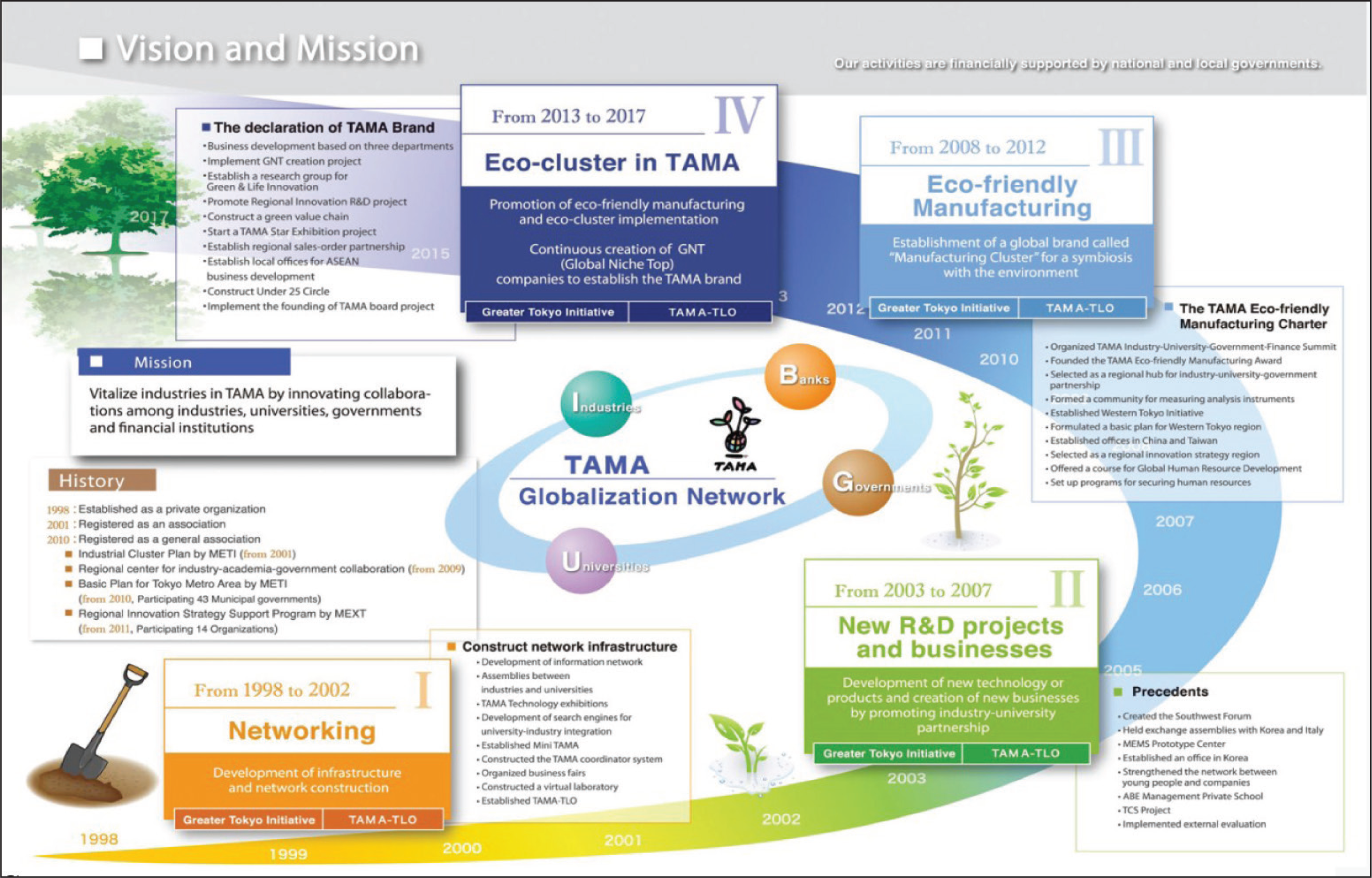
GTI, in under the fourth 5-year action plan (2013–2017), focused on ‘Eco-cluster in TAMA’. Besides continuing to develop the previous 5-year action plans, it intends to create 10 Global Niche Top (GNT) companies, possessing high market shares in global niche markets, to promote TAMA area to the world.
To realize the aforementioned 5 years plans, TAMA developed an integrated strategy which is shown in Figure 4. First, national government sets policies for industrial supports. Second, according to the policies, grant aids and supports from clustering policies are set for focused areas. This can be ‘high octane gas’ for companies in the focused area. Third, the cooperation among local supporting agencies, such as local governments, chambers of commerce, Kanto METI and TAMA, offer supports to the target industries. Fourth, such support and policies vitalize the industry by accumulation of other industries and networking. Fifth, industry vitalization leads to increase in employment and tax revenue. Sixth, since tax revenue increases, government can increase the amount of grant aids. Repeating this cycle works like engines for industrial vitalizations.
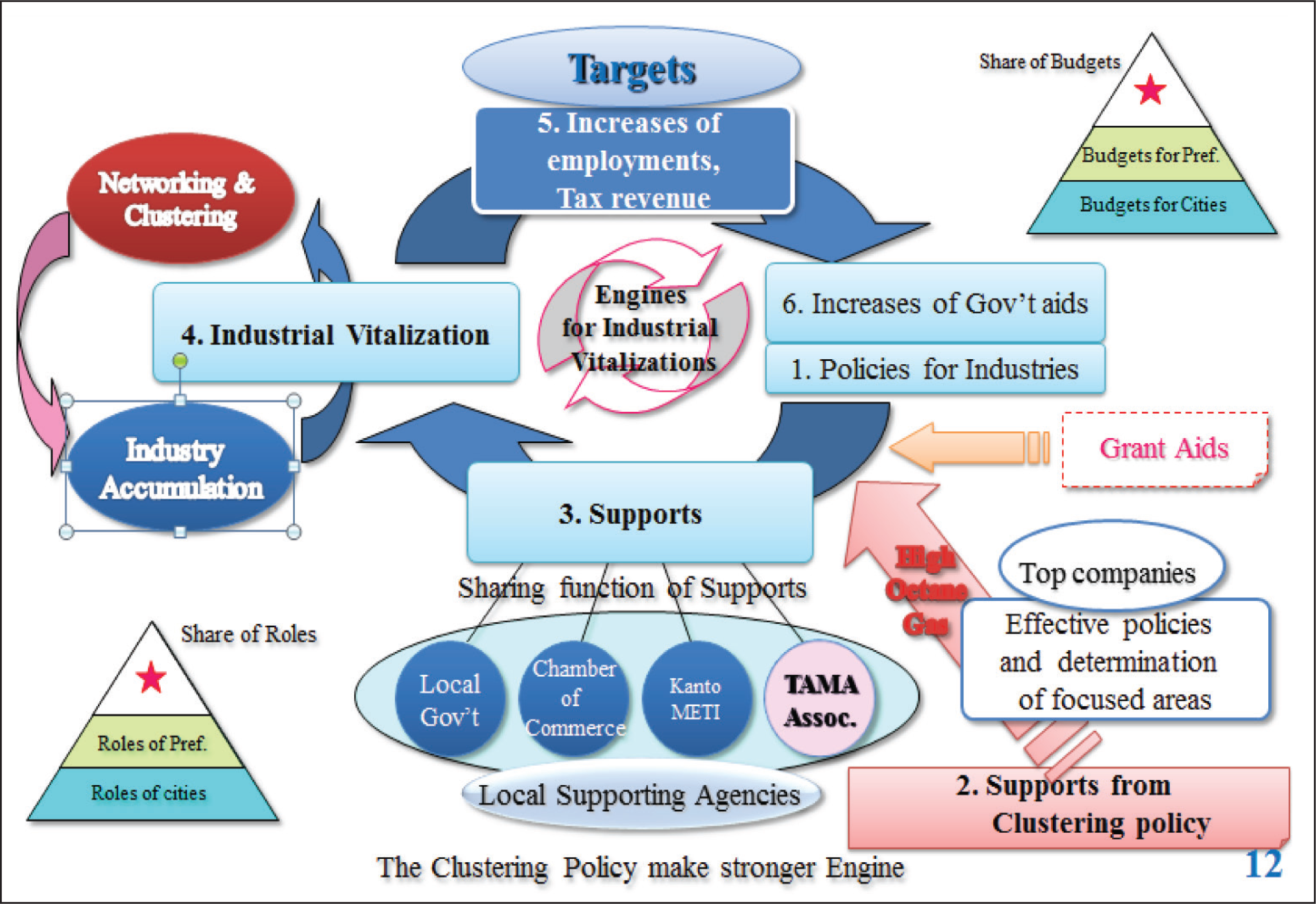
Figure 5 describes steps for business developments from early stage to later stages, and supports for each step by TAMA. In each stage, TAMA provides a variety of support menu from R&D by collaboration between industries and universities, to marketing by business fair or investments (TAMA funds), and also, human resource and training.
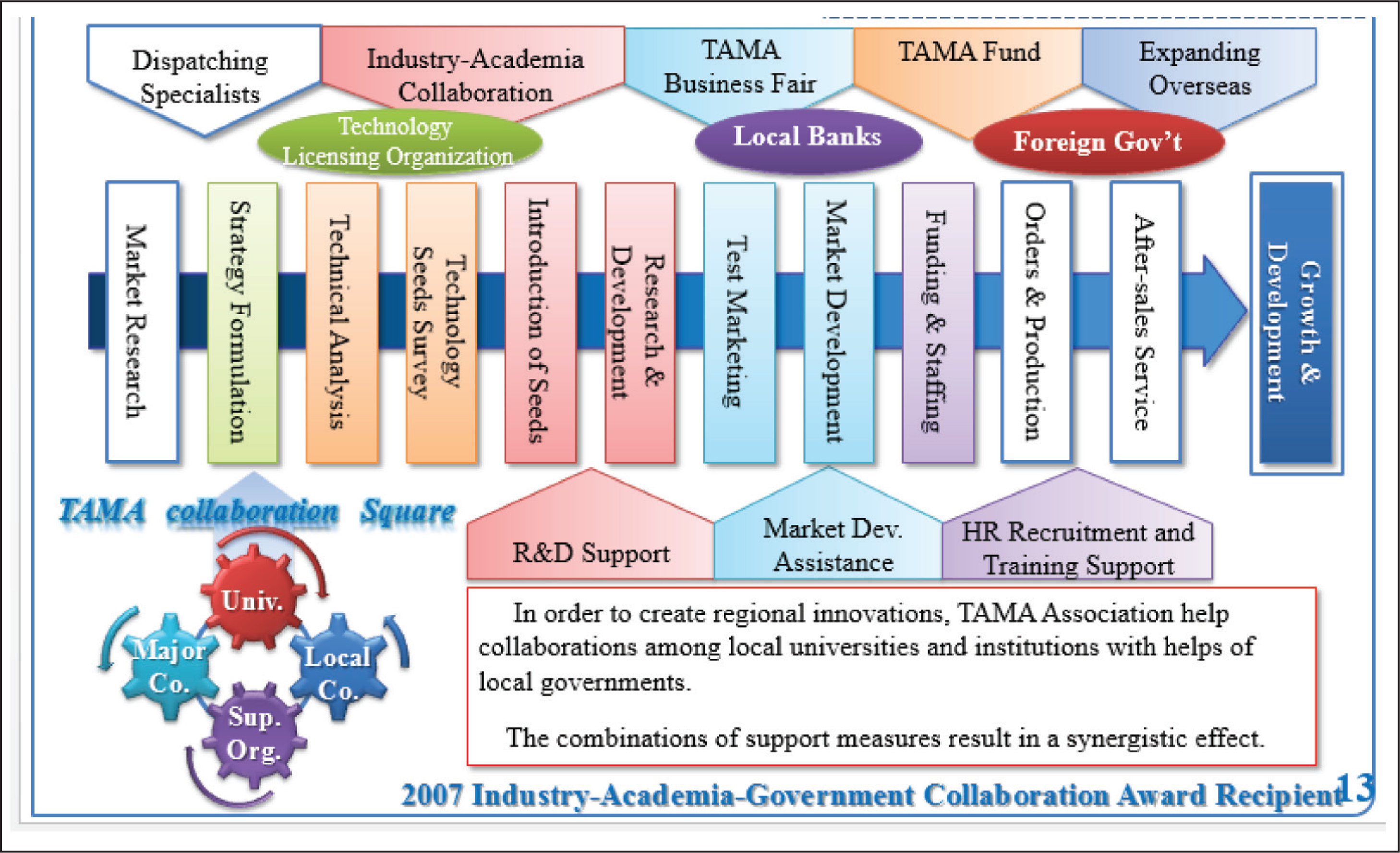
For example, while implementing the aforementioned grand strategy, TAMA provides the following support:
Cultivation of key persons for local industrial vitalization. Supporting strategy formation and analysis for new industries. Supports for planning industrial vitalization. Projects for solving social issues in the region. Supports for collaboration with other areas. Supports for marketing in Greater Tokyo area. Supports for overseas marketing.
The Objectives of the GTI
Regional network, global network and global innovations: GTI promotes innovations by collaborating with member companies, universities, local governments and other organizations. These collaborations are made with other clusters in Japan and in the world to contribute to global innovations by strengthening networks.
First, GTI creates regional network to solve regional issues through solutions obtained from cooperation among the TAMA networks. Second, after the construction of regional network, it creates global networks to solve issues in Japan, as well as around the world through cooperation between TAMA and the global networks. Finally, its intention of developing globally acceptable products and/or technologies can be accomplished based on the mechanism.
Creation of new GNT companies: After the construction of global networks and global innovations, GTI plans to grow 10 GNT companies as mentioned in the fourth 5-year action plan. These GNT (which can be seen as small companies to enhance their wing internationally) not only need to provide their own products or state-of-the-art technologies but also require skilled human resources to correspond to the international needs.
Support menu for creating new GNT companies: three types of support: GTI, after many years of working with SMEs, has found out that SMEs possess great products/technologies but have difficulties to expand the markets globally themselves. To assist the SMEs with promising products/technologies to become a new GNT company, GTI provides three types of support. Those are supports for R&D, marketing and international business and human resource.
Support for research and development (R&D): R&D support is for the development of unique products and state-of-the-art technologies which accommodate to market needs. To provide solutions for such need, GTI promotes industry–academic and industry–industry partnerships. It is focusing especially on providing solutions to issues in urban areas and developing technologies to encourage creations of inexpensive solutions to improve quality of life.
In the urban area, such as Tokyo Metropolitan, over-population and ageing issues are serious matters, which lead to an increase in welfare and medical expenses, a shortage in nursing homes and concerns in social issues. Besides, high level of CO2 emission is another serious issue in this area, as a result of energy consumption causing the heat island phenomenon, air pollution and water purity issues due to industrial activities. Thus, the aim for R&D is to solve those issues and strengthen competitiveness by matching between seeds and needs from universities and SMEs.
Projects for the environmental and elderly issues have been launched to promote regional innovations with the support of MEXT, METI and MAFF (Ministry of Agriculture, Forestry and Fisheries of Japan). Those projects offer four working group activities and consist of academic researchers, company representatives and local governments. In the working groups, discussions with different standpoints are held to trigger new innovations.
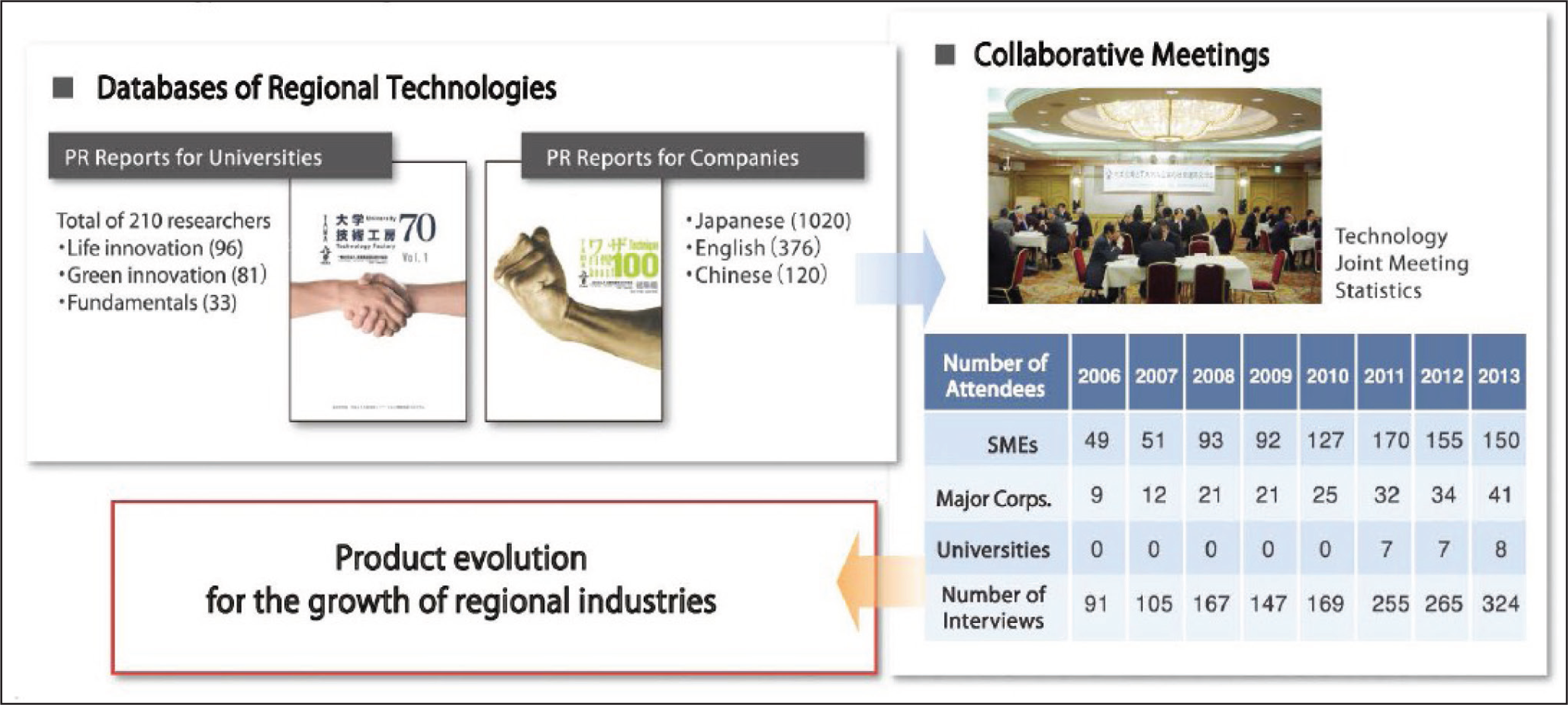
Result of collaboration between a company and university’s unique technology is published every year in a one page document called public relations (PR) report to present new seeds and technologies to boost the cooperation (Figure 6). The PR report is distributed to members and major corporations for nominations of prospective counterparts. Several collaborative meetings among universities and companies, such as Technology Joint Meeting held in every October, are scheduled to accelerate collaborations based on reviewing of the PR reports. The number of attendees for the Technology Joint Meeting is growing and 324 interviews between companies and universities were achieved in 2013. Those continual activities vitalize the cooperation among universities, companies and governments for the growth of regional industries and the intention to create the GNT companies.
Support for human resource: GTI provides two types of programmes to support the SMEs in terms of human resource: nurturing global leaders and securing human resource. These programmes, currently funded by METI, are optimized to the needs of students each year by running a survey in advance.
Programme of nurturing global leaders
In this programme, two types of courses, basic and advanced, are offered. The basic course provides knowledge in marketing, data analysis and accounting for candidates of the executives who need to know more about their own companies. The advanced course teaches about presentation and communication skills and global markets which are required for conducting global business.
In addition to the knowledge taught by the presenters of each course, students have also opportunities to alliance with the course-mates. Teamwork activities of people with different backgrounds and viewpoints help to obtain new perspectives and develop personal network. By completing those courses, students and/or leader candidates not only gain basic ideas and skills to survive in the global markets but also have potentials to obtain partners for innovations, which cannot be done in their companies alone.
Programme of securing human resource
Securing human resource is one of the programmes that emphasizes on making connections with SME and students at the universities. SMEs are in general not as well-known as those major corporations by students due to the nature of its business scope and lack of attractive employee value proposition (EVP ). However, there are many benefits of working for the SMEs which are not aware of the college graduates. For this reason, increase in awareness and attractiveness of SMEs is promoted for the students as the first priority among other things in the programme of securing human resource.
As far as the efforts to complete the task, GTI encourages colleges to design courses including case studies of the SMEs’ issues. Also, short-, mid- and long-term internship are offered in conjunction with the programme. Hence, there are three activities to build connections with SME and students include finding and spreading attractive companies, coordination for short- to long-term internships, as well as coordination for project based learning.
Finally, job fairs are offered to help students looking for positions in SMEs. This programme attempts to match job qualifications needed by SME and capability of graduated students. In other words, supply and demand of labour might be fulfilled to solve unemployment problems. The job fairs are held several times in a year by GTI alone or co-hosting with universities to find proper jobs in SMEs. By continuing the SMEs case-study courses and job fairs, GTI creates a win–win situation for its member companies in securing employees and its member universities in helping graduates finding careers.
Support for marketing and international business: One of the major differences between GTI and other supporting organizations is that it provides marketing and international business support as part of its integrated service for SMEs. This is very important since marketing and engage in international business are the most difficult shortcomings faced by SME. In Japan, approximately 30 per cent of SMEs have motivations to pursue international business. When getting into the international business, many companies look for assistance from the Japan External Trade Organization (JETRO) which provides varieties of foreign market information and consulting service. However, simply knowing the economic facts of a foreign market is still insufficient for many SMEs. Many SMEs, with intentions to go global in mind, do not know if they should start international business, neither do they know how to start it.
GTI appraises the possibilities of success in international business by evaluating a company’s technologies and/or products, which is a key factor in the international business. Afterward, international business missions are suggested to those optimistic SMEs with promising technologies and/or products.
International business missions
In recent years, more than five international business missions are scheduled by GTI every year. In 2014, there are missions of taking at least 5 to 10 member SMEs each to visit Taiwan, Thailand, Singapore, Vietnam and the USA. These SMEs attend exhibitions and/or business meetings with local companies to survey the local needs or markets and find local business opportunities as well as partners.
GTI cooperates with foreign local agencies, such as boards of investments and chambers of commerce, to achieve the best results of business meetings. Besides, support from local organizations are arranged to locate local business partners in response to unique needs of the overseas missions’ attendees. GTI in each targeting country assigns experienced coordinators to bridge the gap between the missions’ attendees and foreign local agencies which have less knowledge regarding to the Japanese companies.
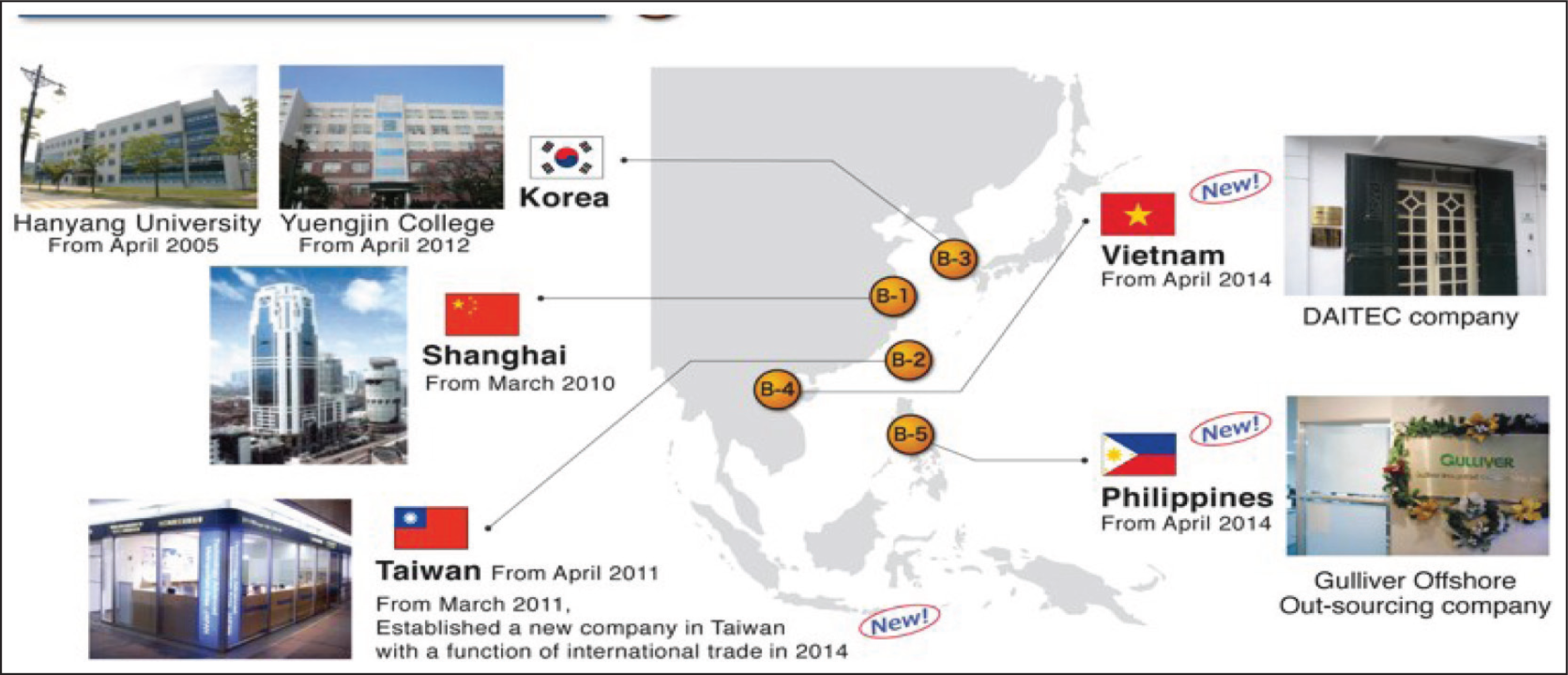
GTI provides support in foreign countries by setting up offices in Taiwan, Shanghai, Korea, Philippine and Vietnam (see Figure 7). These offices assist mission attendees to follow-up after the missions, in addition to their basic services, such as, rooms for product displays, translation service, and so on. With assistance of those overseas offices, the overseas missions’ attendees reduce risks and difficulties of constructing business with foreign companies.
Transformation of GTI’s overseas office
In 2014, GTI’s Taiwan office has expanded to become a company with independent business functionality. Prior to the establishment, Taiwan office offered only business support to its member SMEs. The new company was established as needs of increasing anticipations of member companies seeking business opportunities in Taiwan. With helps from the new company in Taiwan, it becomes easier to start international business for its member companies. Since Taiwan and the mainland China are the same Chinese descent, success in the Taiwanese market can also lead to success in the Chinese market.
Five Keys for Conducting Business in the International Markets
To achieve success in international business, GTI implement five key strategy for starting business in foreign markets.
Introduce successful products to the world: Selling a product to overseas is certainly much difficult than selling it domestically due to the international business which, by its nature, involves differences in trade barriers, consumers’ taste and preference. More precisely, the range of problems confronted in an international business is wider and the problems more complex than those in a domestic business (Hill, 2013). In general, products or technologies which are hard to sell in a domestic market are also difficult to sell in foreign markets. Therefore, GTI recommends that products or technologies aiming for international markets had better to be successful in Japan first.
Listen to local needs: Needs for products and technologies are affected by factors such as economical standard, culture, regulation and so on. Products need to be modified to best fit local needs in order to succeed in the local market. For example, automobiles with many attractive functions manufactured in Japan may not fit into some foreign markets which consider price as the first priority. In order to sell the car in such market, cost-down by reducing some functions is necessary. Therefore, it is essential to adjust products and technologies according to the local needs.
Support from experienced companies and organizations: It is not easy to know the local needs without network in the target countries. GTI recommends asking for help from companies or organizations which have experiences and/or knowledge of the target countries. These companies or organizations can provide information regarding to business custom, culture and contacting persons in the target countries. Such information is very useful to speed-up business decisions and to avoid wrong decisions in the target markets.
Scenario marketing (strategies for the target countries): After gathering the needs and information regarding to the local markets, it is recommended to plan strategies/scenarios for marketing the products or technologies in advance. When visiting foreign country for a business meeting, it is often required to make decisions in a short period of time. Without proper scenario, the risk of rushing into a wrong decision is increased.
Be an equal partner with local companies: Another key factor to be successful in the international markets is to treat the foreign local companies equally and respectfully. In spite of roles of the foreign local companies, SMEs need to rely on them to deal with local matters, business customs, laws and government procedures. Therefore, the SMEs and foreign local companies should be in an equal position and build good business partnerships to maximize success in international markets.
The aforementioned strategies are coherent with international business research conducted by Wahyuni (2013), Wahyuni, Ghauri, and Karsten (2007) and Connell and Voola (2013). Most of these studies suggest that local country knowledge and expertise and the ability to communicate with foreigners are vital before a successful business partnership develops. Local country knowledge refers primarily to tacit knowledge—which as Nonaka (1994) noted has a personal quality to it and is hard to codify or communicate. This means that for companies looking to outsource, for example, in China, they would need the expertise of individuals who can serve as a technically competent cultural bridge between them and their Chinese counterpart.
Case: Developing Fire Extinguisher for the Chinese Market
A company with 25 employees, tentatively named as ‘K’, was providing service of metal-surface treatment in Tokyo. Since many of their customers have moved factories overseas, orders for surface treatment were decreased, so as sales were dropped continually. To survive, the company has decided to reform their business and furnish their own product, fire extinguisher. A fire extinguisher utilizes the technology of handling high pressure gas, the same technology company ‘K’ used to clean metal surface previously.
Company ‘K’ and its counterparties have successfully designed a fire extinguisher especially for automobiles in 2009. Other than its original function as putting out the fire, the fire extinguisher possesses crucial functions when a car accident occurs. One, as a hammer to break open car-windows when car doors are stocked or car is sunk under water. Another function is the ability to cut off seat belt when it is locked because of tilt of a car.
Conclusion
Based on the above analysis, we may conclude that a strong partnership between ABCG has been able to develop TAMA become internationally competitive and find some external source of funding to materialized their dream. They have invested significant time and resources in finding new ways to facilitate innovation-producing collaboration among global workforce, develop network generation, collaboration and expansion of business, both domestically and overseas. Their collaborative approach is remarkably effective in building consensus, increasing levels of motivation and participation, pulling teams together and coaching more junior members. It provides a fertile ground for experimentation, resulting in more innovative results.
These days, many universities have offices to build networks for academic-business cooperation, and many companies offer job recruiting services to secure human resource for SMEs. Many companies and organizations in Japan offer international business support to SMEs as GTI does. However, the major difference between GTI and others is that GTI offers a series of integrated and comprehensive support to SMEs. When a SME tries to go global, only support for internal business apparently is not sufficient in most cases. Usually, SMEs need to prepare human resources and unique products before getting ready for the global business. Thus, GTI provides comprehensive support with low cost using government grant-aids. Due to the rapid changing of the environtment, GTI constantly adjusts their service menus according to the economical and regional situations to provide the best support for SMEs. As a result, those SMEs have been able to improve their capability to expand overseas, create international partnerships and become more competitive.
Footnotes
Declaration of conflicting interests
The authors declared no potential conflicts of interest with respect to the research, authorship and/or publication of this case.
Funding
The authors received no financial support for the research, authorship and/or publication of this case.