



Abstract
Research question:
With the help of an instrumental research case on a social enterprise in India that provides a solution to those with none or limited access to fresh drinking water, this study aims to explore how trust helps create social value.
Links to theory:
At the theoretical level, the study draws upon ‘trust’ and ‘social value’ literature to examine how a social entrepreneur utilized trust as an enabler to creating social value.
Phenomenon studied:
The case developed deeper understanding of the phenomena of ‘trust helps creating social value’.
Type of the case:
It is an instrumental research case study that helps explore the phenomenon and draws connections between trust and social value creation if any.
Case context:
The case context is making affordable drinking water available to all, especially the community of people who are deprived of it.
Findings:
Conducting a series of in-depth interviews with the founder, we developed a better understanding of how the social entrepreneur used trust as a resource to create social value in the context of affordable drinking water. The findings showed how the protagonist (founder) worked on gaining trust of his beneficiaries and stakeholders to create social value. Findings also revealed the enablers and deterrents of trust in social value creation.
Discussions:
Our study shows how trust as a resource creates social value. In the context of our study, it contributes on how a social entrepreneur is creating social value not only by making affordable drinking water accessible to all but also deliver other social value creation benefits. The study brings out legitimacy, technology and social network as its enablers. The study also intends to fill the knowledge gap on how firms create social value by building trust with stakeholders and beneficiaries. Since little is known about trust even at the level of beneficiaries and stakeholders, our study aims to develop a better understanding of the phenomenon.
Introduction
Social entrepreneurship (SE) creates social value. Austin et al. (2006) define SE as an innovative activity that creates social value and occurs within or across the sectors. Social enterprises are created to fulfil the social needs of their beneficiaries (André & Pache, 2016). Though grappling with both market and social logics (Sengupta et al., 2020), social value creation (SVC) remains at the heart of SE (Chell et al., 2016). SEs create social value with the help of different resources at their disposal such as funds, social capital and social network. All such resources together determine success of an SE initiative (Tack et al., 2017). Mair and Marti (2006) opine that trust forms an important part of social capital, embedded in social relationships and interactions between individuals and communities. Trust helps build social capital, which helps create social value. Entrepreneurship though acknowledges the significance of social capital but has not deliberated much on the analysis of trust and how trust helps create social value (Curtis et al., 2010). Trust fosters cooperation and helps people to bond with each other, which, in turn, supports SE efforts (Rousseau et al., 1998). Using trust as a resource, the study aims to understand how SE creates social value and thereby carries out successful entrepreneurship. We wish to draw connections between different components of trust and the different ways a social enterprise creates social value. By doing so, the study wishes to contribute to the knowledge gap of how firms create social value by building trust with its beneficiaries and other stakeholders, which has so far been underexplored (Crane, 2020; Pirson et al., 2017). By using a unique case of a social enterprise—JanaJal—as an instrument to demonstrate its SE efforts, this article aims to contribute knowledge on the role of trust in creating social value in SE.
Theoretical Background
There have been few studies on how SEs brought about an increase in participation of individuals by taking SE initiatives based on trust. (Scheiber, 2014). However, even such studies have focused little on trust per se in SE literature (Tack et al., 2017). We outline, here, the theoretical support that we borrow to lend a more informed perspective to the phenomenon.
As stated by Butler and Cantrell (1984) in their model on trust, trust is dyadic and multidimensional in nature, with its five components being integrity, competence, consistency, loyalty and openness. According to them, integrity means to be honest and truthful; competence means having technical knowledge and the requisite skills to do their job; consistency means to be reliable and have a good sense of judgement; loyalty is to be benevolent and kind and to be supportive of others, while openness means being transparent, accessible and willing to exchange information and ideas. They investigated trust in superiors and trust in subordinates using behavioural decision theory and further reaffirmed the reciprocity of trust in relationships. In their study, they found that integrity, competence and consistency were considered more important than loyalty and openness in determining trust in one’s superiors and subordinates. However, in another study on college students, they found that college students and managers differed on relationship expectations in an organization. Based on the Butler and Cantrell (1984) model, Schindler and Thomas (1993) focused on interpersonal trust in organizations between all the three parties—the superiors, the subordinates and the peers. Contrary to their expectations, they found that the order of importance of each of the components was the same for all three dyads—integrity >competence >loyalty >consistency >openness. However, consistency and openness were found to be more important for trust in peers than in supervisors or subordinates. In another study, researchers used the model to demonstrate decision-making and how trust emerges in a transaction between two parties (Mayer et al., 1995). Trust builds social capital and mutual relationships between stakeholders laying the foundation for social interactions (Jabłoński & Jabłoński, 2019). Trust is, thus, considered a valuable resource for interpersonal relationships. Crane (2020) firmly states that in a complex ecosystem of interconnected stakeholder relationships, trust acts as a lubricant for fruitful relationships between the firm and its stakeholders. Such relationships based on trust create social value.
SVC is fundamental to a social enterprise because it creates social value and solves problems of the society and brings about social change. Beneficiaries are considered to be the primary stakeholders as social enterprises engage with them to create social value (Lorenzo et al., 2020) and activities and actions of the SE are centred on what beneficiaries need. Very few studies have explored trust dynamics in an SE (Curtis et al., 2010).
Borrowing the concept of SVC as taken up by Singh (2016), SVC can be looked at from two perspectives—the SE and the stakeholder. Singh (2016) observes that SVC may take different forms. It could be empowering women, changing the processes, people’s behaviour, perception and attitude. It may also include social value in providing benefits to beneficiaries by changing norms and thereby creating a positive social change. Singh (2016) mentions that for beneficiaries, SVC could be benefits and facilities, desired impact, developing new skills, increased confidence, empowerment, self-reliance, more awareness, hike in income, greater self-respect and dignity.
In our study, we wish to explore how trust creates social value based on the Butler and Cantrell’s (1984) model of trust and types of SVC (Singh, 2016) that result from such relationships.
Methodology
Using a qualitative approach, we have taken up JanaJal, a social enterprise, as an instrumental case to deep dive into the phenomena of trust and social value. Such cases inform us better on a phenomenon being studied (Harling, 2012). Here, it is being used to understand how trust creates social value. The case demonstrates how the social enterprise used trust as a resource to create social value for its beneficiaries and stakeholders. The research was based on primary data, collected by conducting a series of semi-structured interviews with the SE. The analysis was carried out using thematic analysis, and the findings are shown in the coming sections. We have come up with a framework that maps different components of trust with the different social values it created for its beneficiaries. In order to carry out a rigorous and methodical qualitative research, we chose thematic analysis. Choosing this method helped us demonstrate preciseness, consistency and credibility, and trustworthiness of data. We carried out an exhaustive process of recording and systematizing data (Nowell et al., 2017).
The Social Entrepreneur and the Social Enterprise
Dr Parag Agarwal, born and brought up in Pune, had entrepreneurship proverbially running in his genes from a very early age. Having been an entrepreneur for more than 33 years, he says ‘It seems this is how I have always been’. He joined his family business at an early age of 15 years. After completing his formal education, he moved on to become a successful commercial entrepreneur, taking up large turnkey projects in water management, including the one for Pune Municipal Corporation’s 24/7 water supply project. At one point in time, his venture was working collaboratively with clients in 22 countries in the world. This exposure revealed his biggest strength of being an executioner with an innate ability to understand the dynamics, the demographics and the geo-sociopolitical aspects of India. This gave him a cutting edge over other competitors. With over 11 years of experience and a pulse of the sector, he realized that a big gap between demand and supply of pure drinking water existed, and that the minimum of ₹20 for 1 L of drinking water was exorbitant. He considered that this was an opportunity; he could make a difference in the social space. Pursing the opportunity, he decided to shift his base to Delhi about 7 years ago with the main objective of establishing ‘JanaJal’.
The social entrepreneur was clear about the fundamental issue and the possible differentiator ‘JanaJal’ could become. He found that a single water treatment technology was applied in all parts of the country, irrespective of the changing composition of water every few kilometers. This approach he found was working against the basic intent of providing clean water for all. He related ‘how could one solution be applied to every area-specific water problem?’ This firmed up his decision to set up his own water treatment plant. The purpose was providing clean, drinkable and affordable water.
Analysis
We carried out multiple in-depth interviews with single participant—the protagonist of the case and the founder of the social enterprise. During our semi-structured interviews, it was found that there were some pillars on which the social enterprise rested upon and that all of its actions and decisions were based on trust as their foundation. Following themes came out to be the driving force behind establishing JanaJal as a conscientious and trustworthy social enterprise in the water sector. A deeper analysis of the data gathered led us to the following codes initially, which later emerged as themes to reveal how trust was used as a resource to create social value. Based on codes, the themes that covered the five components of trust were as follows:
Thematic Analysis for Enablers and Disabler of Trust in JanaJal
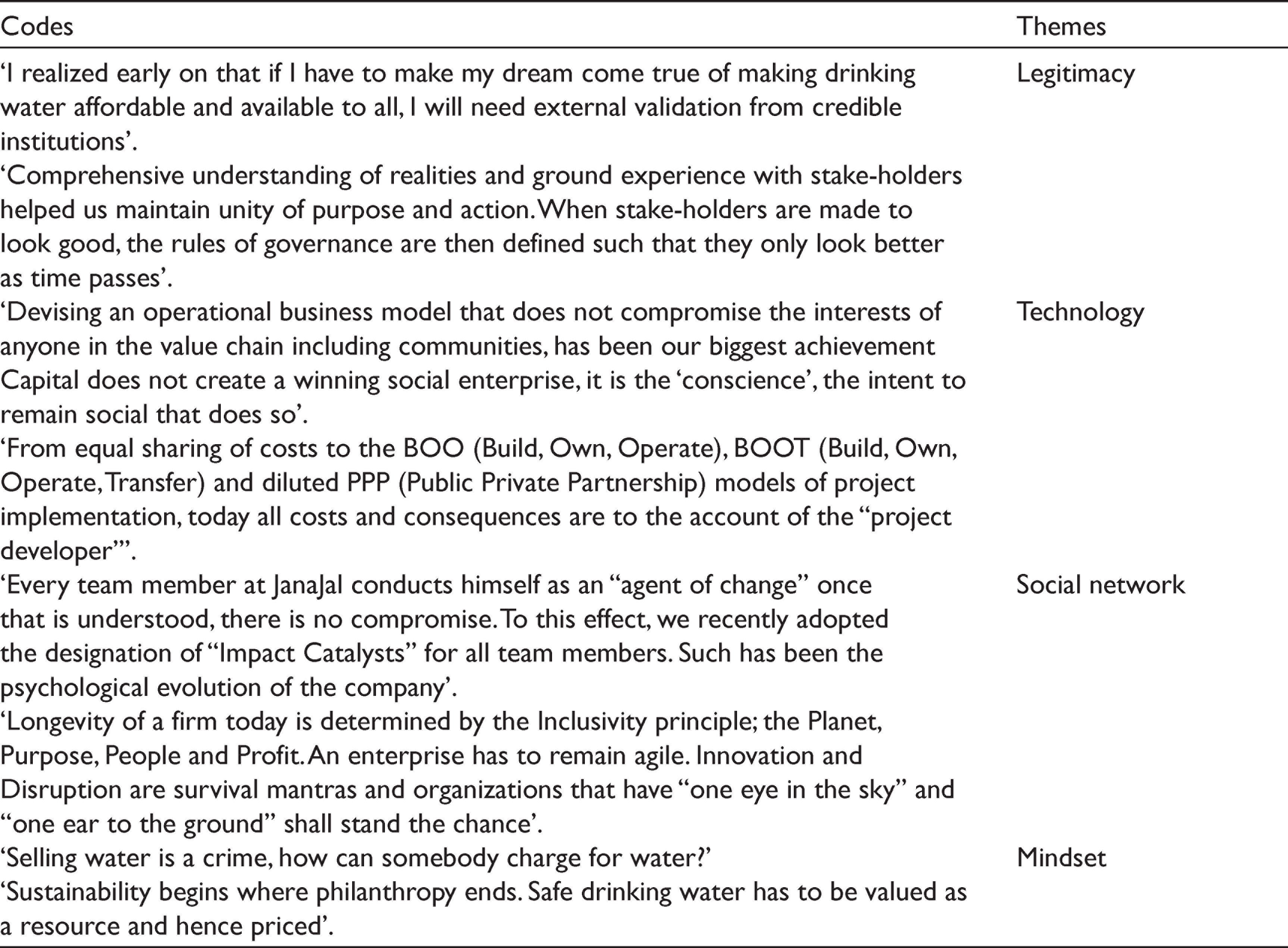
Legitimacy as an Enabler
Legitimacy means being allowed by law or done according to the rules of an organization or activity. In the context of our case, it denotes getting approved by the government and becoming a legitimate enterprise. Legitimacy increases acceptability among people. The founder shared that in order to create social value and contribute more meaningfully to society, the enterprise would require external validation in the form of support of government authorities and other institutional bodies. Towards that, JanaJal contacted various regulatory bodies and made consistent efforts to make its voice heard. The social entrepreneur also needed employees who could talk to the government officials and convince them about the social value that the enterprise was creating in the lives of people and for which it need their support. Towards this, he identified and trained its manpower to develop communication and people skills. Mr Parag observes,
It was important to send the right people for the right job, one who could do the job at hand, one who had an understanding of what was required of him. In due course of time, the social enterprise was able to gain support from Indian Railways, Indian Railway Catering and Tourism Corporation, New Delhi Municipal Council, Ghaziabad Municipal Council, Ghaziabad Development Authority, etc. This legitimacy acted as an enabler for the social enterprise as it lent more acceptability of its social value creation efforts. It also made the enterprise more credible and trustworthy. Legitimacy covered the consistent and openness component of trust as their activities bore the stamp of govt. approval. The enterprise was looked upon as more reliable and transparent in terms of its value creating activities and willingness to exchange information. As an example, in collaboration with Lucknow Metro Rail Corporation, JanaJal installed water ATMs at all metro stations in Lucknow. Recently, ‘JanaJal Water on Wheels’ has been selected by Govt. of India for implementation of $50bn drinking water scheme by 2024 under Jal Jeevan Mission. And very recently, Bajaj Auto will be supporting the water on wheels JanaJal initiative that aligns with its vision and mission of nation building.
Technology as an Enabler
His first observation about the organizations in the water sector was that organizations were mindlessly applying technology, irrespective of the nature of water and the treatment accordingly required. Mr Parag Agarwal states ‘Destroying water to deliver water was never an option for us’. The technology agnostic approach was adopted due to this in-depth understanding of problems associated with water and its present condition in India. JanaJal built in technology into its water treatment plants in such a way that it could handle different levels of impurities in the water. They used Block Chain Technology integrated on JJSUITE, an artificial intelligence–based technology. The agile open architecture of JJSUITE’s and its data management capability enabled access to business intelligence, pre-emptive maintenance schedules and specific consumer procurement–related insights using Internet of Things, artificial intelligence, augmented reality and machine learning. Such use of technology provided absolute transparency of transactions to stakeholders and highlighted their technical competence and know-how. In short, it meant that they knew their job. It also meant that the social enterprise had deep knowledge of technology and were deemed capable. JanaJal calls it SMART technology—sustainable, measurable, agnostic, resilient and timely technology of JanaJal.
Sustainable
The JanaJal hybrid water ATMs increase efficiency by utilizing solar energy and electricity, hence minimizing the downtime due to power outages. Consumers carry their own bottles to collect water, thereby reducing use of hazardous plastic.
Measurable
JanaJal adopts real-time monitoring models for supervision of water ATMs. Based on the cloud, it is monitored through central control for surveillance and revenue collection. However, systems are equipped with on-site support and trained operators.
Agnostic
As Mr Agarwal says, ‘the country’s eastern parts have more of arsenic, Rajasthan’s has fluoride, and northeastern more of Iron. This means that one solution cannot work in all cases. So while we employed the Reverse Osmosis technology in some cases, for others it was Ultraviolet or Ultrafiltration or Carbon filters or a combination of all’.
Resilient
JanaJal built water ATMs that have a 10-year-long lifespan. The dispensing capacity is up to 15,000 L per day per system and can be upgraded as per the requirement. JanaJal WOW, a unique mobile water ATM is custom built with a deep tech-enabled battery operated vehicle. It delivers water at people’s doorstep.
Timely
JanaJal makes the best use of technology and offers JanaJal prepaid water ATM cards, or even coins/cash at the touchscreen-enabled water ATMs.
Technology became an enabler to trust because it made them look more capable and competent.
Social Network as an Enabler
Taking a collaborative approach, he brought together multiple stakeholders pooling in their unique capabilities. The purpose was to connect the right people with the right expertise and needed resources. They started fostering and building networks and relationships. This social network became an enabler as it helped them build their own social capital. It made them more trustworthy, honest and benevolent. It helped them build trust and credibility and a social enterprise with good intentions. Gradually, with consistent efforts, he formed ‘Blue Sky’, a consortium of its own kind. It comprised Italian and Indian companies supported by the Government of Veneto region. It included organizations like Coca-Cola, REGIONE de VENETO, Essar, Gianesin Canepari, Ladurner, Thetis, Indian Railways, UP Industrial Consultants Limited, Hindustan Zinc and The Hans Foundation, to name a few. As a result, following are some of the mega projects that got implemented:
Indian Railway Catering and Tourism Corporation and JanaJal installed 101 water ATMs on railway stations in Mumbai and across Maharashtra, catering to 7.5 million commuters every day. Konkan Railways and JanaJal installed 61 water ATMs, serving 7 million daily commuters from Maharashtra to Goa and Karnataka. New Delhi Municipal Council and JanaJal installed 50 water ATMs in the region, under the Smart City initiative.
The Mindset as a Disabler
During the interviews, he shared how and what challenges came his way and how he went about overcoming them, including a mindset that thought of selling water as profane. This came from the Indian ideology that water is sacred in India, and selling it would be a crime. He decided that he will have to tread the path carefully, treating all with consideration and keeping all social norms in place. He also decided to employ pricing as a counterstrategy to challenge the mindset, firmly believing that anything offered free holds no value.
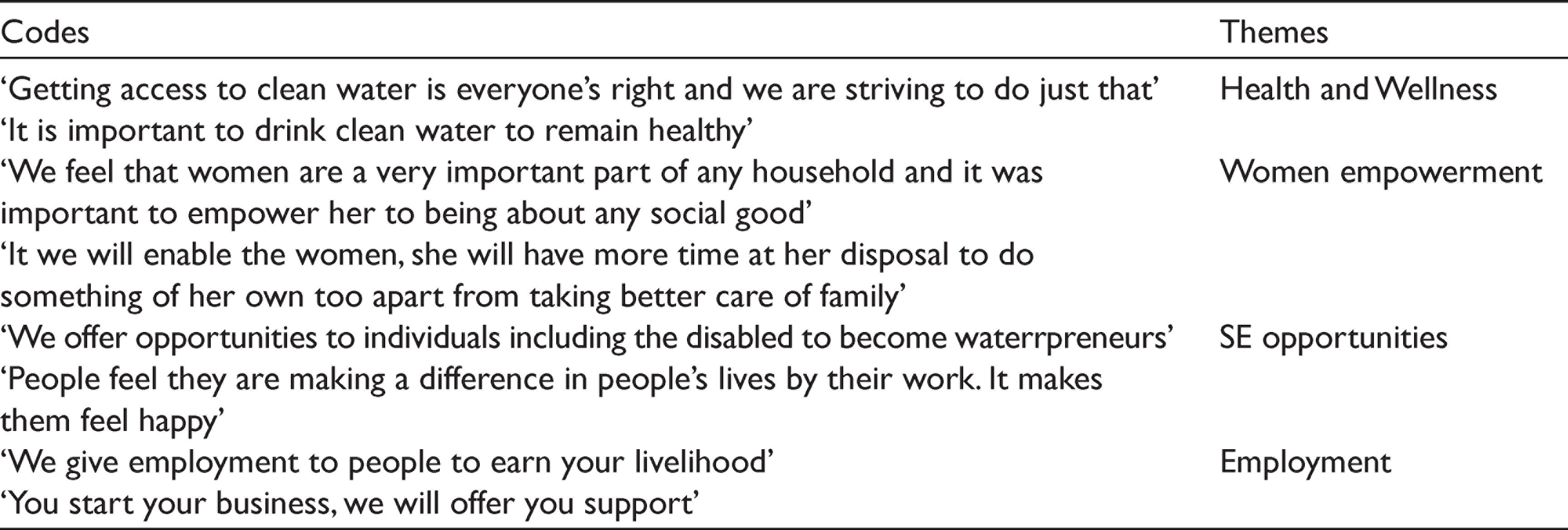
We carried out a similar analysis to code the data for the type of social value created based on trust and the themes as presented in Table 2 came out to be
Thematic Analysis for Social Value Creation in JanaJal
Health and Wellness
Since clean water is a necessity for all the people and non-access to it can result in poor health and diseases, using trust as a resource to getting affordable drinking water available to all, especially the marginalized section of society, resulted in the SVC. It not only improved their health and well-being but also brought them some relief from waterborne diseases. When families got access to clean water, they became healthier and more energetic, and children could now go to school and fall less sick.
Women Empowerment
Since it was the women in the family who had to walk long distances to fetch water from far-away wells and water tanks selectively available, JanaJal gave them relief. It saved them time as it was now available at their doorstep with Water on Wheels. They saved on their energies too and put it to more constructive use, and, in some cases, they started something small of their own. It increased their productivity and work output and thus created social value.
Social Entrepreneurship Opportunities
Being in the water business feels like a sacred activity for some as bringing water in the lives of people holds a special value in the Indian household. JanaJal gave opportunities to individuals to become waterpreneurs and have their own water ATMS. They could also have their own water on wheels vehicle. Also by doing work, which was social in nature, made people feel like they were adding meaning in their own lives and lives of others.
Employment
JanaJal provided employment to people in various capacities, especially the challenged. It created social value in the lives of such people who were disqualified for doing regular jobs. They also helped people start their own business and become operating partners with JanaJal or own a franchise.
Discussion
As brought out in the analysis, we found that trust was being used as a resource to create social value. To be able to do so and help the entrepreneur fulfil the purpose, he used legitimacy, technology and social network as enablers of trust. The literature showed that the 5 components of trust, namely loyalty, integrity, competence, openness and consistency, were reflected in the actions that the entrepreneur took in order to create social value and also establish its enterprise as a trustworthy enterprise. The various ways in which the enterprise created social value were health and wellness, women empowerment, SE opportunities and employment. These SVCs were a result of combining trust components together. The openness with which the social entrepreneur approached various institutional bodies and the transparency that he showed in his actions and operations gained him trust from government and other regulatory authorities. Since he believed that any SVC can be carried out by not an individual but collective effort, he invested in social relationships building social capital and thereby showing loyalty and integrity. With thorough in-depth knowledge and understanding of the technology and the water sector, he used technology as a differentiator and added competitive advantage. This reflected competence factor of trust. Together, these components helped him create social value by empowering women by extending full support to establish their own JanaJal franchise of water ATM. they also created social value by improving health and wellness. For example, they installed water ATMs at the Mumbai station, which helped the daily commuters to have clean and affordable water as buying packaged water everyday was costly for them. Access to clean drinking water improved health and well-being of people. They have created social value by giving employment opportunities to people by offering them an opportunity to become their operational partners. For SE opportunities, they extend opportunities to become waterpreneurs. Thus by using trust as a resource, the social entrepreneur created social value in the lives of the people. Since trust is reciprocal in nature, this relationship between trust and social value is a constant and dynamic process, where one is reinforcing the other. There is also an element of mistrust reflected through the fourth theme of mindset of people and society at large, where they feel that it is not right to earn profit from selling water. If at all, one must do it, one must sell it for free. This theme worked counter to the other themes, and it was challenging for the social entrepreneur to overcome this hurdle. However, he knew that it was important to break this mindset and change the mentality of people who believed that selling water will no longer be a sacred activity if priced. The entrepreneur held on to his conviction that anything that is available for free soon loses its value. And to bring out water as a valuable resource, he continued to fight against this mindset at all levels—individuals, partners and organizations. He eventually succeeded in doing so and successfully established the social enterprise. The three enablers helped him fight the cause.
To trust is to relying on the exchange partner and have belief in his integrity. It also means that the partner will not bring any harm. Trust supports taking action and extending cooperation. Trust could be between two individuals, groups, organizations or institutions. The study brings about trust as relational in nature for exploring the phenomenon because creation of social values is a relational process based on social relationships (Stern & Coleman, 2015). The study explores how the social entrepreneur and his social enterprise used trust as resource with relational interactions between him and the beneficiaries to create social value. Trust also lends legitimacy to organizations as could be seen in the study. Trust enables a firm to have strong relationships with its stakeholders. Very few studies have been conducted, on how firms create social value, based on trust and relationship with its stakeholders (Crane, 2020). We have attempted to fill in that gap in knowledge. Moreover, few studies has been carried out on trust at the level of beneficiaries and stakeholders (Pirson et al., 2017). Our study contributes on how social enterprise creates social value for its beneficiaries and stakeholders using trust as resource supported by legitimacy, technology and social network.
Conclusion
Trust-based relationship studies are gaining increasing significance. Trust is an essential component of inter-organizational interactions (Mayer et al., 1995). A higher level of trust inspires better performance. As an insight based on the data and analysis carried out, scholars may look at ‘responsible leadership’ as a future research avenue in the context of trust creates social values within the larger context of making drinking water affordable for a deprived section of the society. Very few empirical studies have been carried out to find out factors that affect trust in relationships (Jin & Ling, 2005). Lander et al. (2004) states that different organizational contexts and projects shall be useful in understanding trust mechanisms. Stakeholders are an essential and integral part of any project. We found that model incorporated all our themes mentioned earlier in the findings, and, furthermore, we take the help of narratives cited verbatim to convey the sentiments of the entrepreneur. Harrison et al. (2015) states that if stakeholders are treated well, they tend to be more cooperative and have positive attitude and behaviour towards the organization. If the enterprise and the entrepreneur are able to gain trust of the stakeholders and have congenial relationships with them, the stakeholders, in turn, tend to be more open and supportive. ‘Stakeholder trust’ is a nascent emerging phenomenon (Pirson et al., 2017), and future research needs to explore looking at trust from the stakeholder’s perspective in SE. By obtaining affective and cognitive trust of its stakeholders, the social enterprise does not only benefit during its venture creation process but also can hope for long-term sustainability developing lasting relationships. A secular organizational culture that encourages flexibility in decision-making at all levels fosters an inclusive and participative approach. A flat hierarchical structure is what works for a social enterprise is what the founder has to say. Embodying same values, culture and ethos to work for the true intent of making every Indian happy by delivering safe drinking water is what has made them stick together through their thick and thin in JanaJal. Dr Parag Agarwal has been awarded with an Honorary Doctorate for Social Work and Impact, the Global Corporate Sustainability Award and contribution to Sustainable Development Goals (SDG-6) an Agent of World Benefit, 2019. Being a proud part of Government of India’s Swachh Bharat Abhiyan, JanaJal has now become India’s first social enterprise delivering safe water.
Footnotes
Declaration of Conflicting Interests
The authors declared no potential conflicts of interest with respect to the research, authorship and/or publication of this article.
Funding
The authors received no financial support for the research, authorship and/or publication of this article.