



Abstract
The nature of work has immensely changed in the last few years and so are the workforce expectations. Employees are steadily reassessing why and where they work. Even amidst workplace upheavals, they are in dire search for a sense of purpose to align themselves with that of their firms, whereas organizations still feel that employees sense transaction rather than appreciation. Thereby working with two opposite thoughts and feelings, companies have overlooked the essentials of employee well-being. Here, the role of positive outlook/perspectives of a firm emerge as a vital facet that can help to sustain authentic and motivating experiences at work. Thus positive sustainability at workplace can satiate the employees’ want for social cohesion, trust and purpose. The present work is a multi-case study on four construction firms of West Bengal who were eager to design moments that reflected sustenance of positive aspects amidst all odds. The study revealed five crucial elements of positive sustainability (going beyond the pursuit of perfection, fostering learning agility and grit, mindful gratitude, managing energy rather than time, trust is crucial) which the firms have restored over time. Such aspects have brought about unique transformation at work and lead to resourcefulness.
Introduction
Today the organizations are witnessing rapid transformation with the inflow of Generation Z and millennial workers (Guerrero et al., 2021). Organization structures are becoming short lived. There has been a radical shift in its operations (Biswas & Chakraborty, 2022; Verhoef et al., 2021). Companies are redesigning to move faster and to adapt quickly (Cloutier & Robert-Huot, 2021). Firms that were primarily designed for efficiency have now become siloed organization. Then again cognitive overload is dramatically reducing the productivity level of employees (Bolisani et al., 2018). The perfunctory sayings of the workforce ‘I’m managing’, ‘I’ll get along’ and ‘I’m fine’ now emerges as ‘I’m burned out’, ‘I don’t know how long can I continue’ ‘I’ve lost my sense of optimism’. Brie Weiler Reynolds from Flexjobs partnered with Mental Health America to conduct a survey since 2020 on how employees are faring in their workplaces in this time of complexities, competitiveness and change. It revealed 75% of employees in United States have reported symptoms of energy depletion, cynical feelings and reduced performance efficacy. The Economic Times survey reflected that 51% of Indian employees feel unwanted and cannot bring their authentic selves at work. Moreover, it says 76% of Indian employees have experienced significant level of strain at work that affected their mental well-being and productivity. In the face of globalization, digitization, automation and analytics, people somehow have forgotten to live their purpose at work (Chakraborty & Biswas, 2021; Savvides & Stavrou, 2021). Firms, on the other hand, view wellness programmes as just ‘another corporate initiative’. Strong relationship networks are now hard to find in organizations. Employers are unable to reconnect those (significant) previously lapsed connections (Jungst & Blumberg, 2016). The joy of developing inclusive tailored solutions is missing somewhere. Instead, the ‘fear’ of missing out has ingrained among employees. Diverse voices are often drowned out (Christian, 2022). Listening efforts on the part of employers have declined. Rather, listening has become more of surveillance. Moreover, as organization views its people as interchangeable and replaceable, it lessens their sustained commitment. Thus, we find employees with inconsistency, haughtiness, reduced sense of engagement and loyalty (Lee et al., 2022).
A frequent question that often torments employees today—‘Do I feel valued by my company?’—is significantly escalating the attrition rate. A more desirable environment is what we need to create at work (Yoshikawa & Kogi, 2019). Unfortunately, we are still stuck in an industrial revolution mindset. It is a high time for companies to truly transform and define meaning beyond money, explore and address mindsets and share the responsibility to change (Engida et al., 2022). This would bring in a positive force and effect at work life. As organizations’ go along with its process, they deeply now understand the power of positive emotions at work (Paakkanen et al., 2021). Firms’ must now adopt new ways of leading their people. It has become essential to provide opportunities for employees to demonstrate sustainability in their actions. Firms must prioritize sustainability in their work and behaviour and set aspirations and goals (Harrach et al., 2020). It can happen through a positive outlook—focusing on progress than perfection, celebrating small wins, cultivating positive thoughts, focusing on ways to combat self-doubts. This positive sustainability shall enable people at work to proclaim ‘I can handle it’.
In recent years (that also include the devastating pandemic phase), a painful picture is observed that reflects that the well-being of employees is in jeopardy (Caligiuri et al., 2020; Jaiswal et al., 2022). The workforce is facing as well as handling complicated challenges without being able to adjust and cope emotionally (Bardoel, 2020). Work relationships are irrevocably disrupted yet they are striving to meet deadlines. The team engagement has been eroded in this hybrid setting, yet employees are being delegated to make strategic decisions. Companies are striving hard without realizing that their employees are unable to live their purpose at work. All these have led to impulsive, uncoordinated and ineffective responses from people at work (Kong & Belkin, 2021). An organization needs to be more open instead of running and hiding from it. It would then build a richer dynamic to make the workplace better. Simply focusing on getting the work done will no more fetch desired results. Companies need to dig deep to understand its people’s thoughts and inner feelings as it often includes doubt, fear and criticism (Lee & Raschke, 2016). Organizations’ must face the reality with staunchness and fix them with positive affirmations. Thus in this period of vast uncertainty, positive sustainability seems to be the rock that a firm must hold on to. With it, employee well-being need to be restructured that would help a firm to compete over the longer hauls (Järlström et al., 2023; Lämsä & Keränen, 2020).
Based on the scenario and the discussion, the following research question need to be delved deep into: What are the significant drivers of positive sustainability that can help employees to integrate and rebound despite variation, stress, competition and uncertainty within the construction firms of West Bengal? We aim to get insight into how the varied aspects of positive sustainability are tailored to handle critical employee circumstances in this industrial sector and equally nurture employee well-being.
Theoretical Linkage
Positive sustainability as has been focused in this study is based on positive organizational scholarship (POS) theory. The theory focuses on positive practices and locates this notion of positivity at action in a continuum (Cameron, 2003). Most organizational theories have emphasized growth, enrichment and potentialities (Lopez-Cabarcos et al., 2022). POS on the other hand focused on stability (Cameron et al., 2011). The essence of POS is nurturing the human potential to the highest extent (Lee et al., 2003). POS primarily focuses on—What must an organization do to make its people feel they are thriving? Finding out the positive states, positive processes and also positive relationships that are ignored and need to be catered to achieve sustainability at work; understanding the integration of positive and negative conditions and how to minimize the uncertainties by embracing resilience and compassion; how to rebuild employees’ sense of worth and dignity and ingrain in them the sustaining quality that would reinforce a firm’s social fabric.
Positive sustainability includes the facets of positive organizational scholarship. Organization must understand the emotional needs of employees’; instil meaning and discuss purpose that how they can act in their respective works setting (Cameron, 2008). Positive sustainability at work revolves round the dynamics of vitality and energy in organizations, connections, creativity and coordination (Cameron, 2013). It generates episodes where thriving at work denotes an enriched experience of learning, appreciation, working on positive rebounds and contribution towards sustenance of organizational virtues (Cameron, 2014). This helps to bring the best in people and in the work system. Embedding positive sustainability includes empowering employees to engage proactively and strategically to create a measurable impact. As firm marches onwards, it faces cognitive, strategic, political and ideological challenges (Green et al., 2016). Construction firms too face such challenges and even shockingly turbulent circumstances. As it hopes to stay firm in a topsy-turvy business world, a company must harness its people’s individual resources. This would support the positive changes which the aspiring employees struggle to mobilize. It is a high time where a company needs to move beyond throwing money at a problem and bring in sustainability with a systematic change (Tenney et al., 2016). Here comes the vital role of positive sustainability. By gaining a better understanding of the limitations of its people, recognizing how their capabilities can be transformed to an asset, taking care of their psychological health, not to be always on the evaluative mode, developing the connective tissue that links their actions to the shared vision would bring in a tidal wave of positive sustainability; a new sense of connection to their work (Cameron, 2021; Cameron & Plews, 2012). Thus a fundamental reframing is required to generate this positive sustainability.
Context of Study
As we find the scenario in West Bengal, construction firms are locked in contracts and have some contractual commitments. The execution of work in such firms with labour woes, employee poaching, increased competition and shrinking profit margins have witnessed a lack of productivity improvement (Selvam, 2017). Moreover, managing multiple work sites together with struggling to invest and implement new technologies is a core part of a construction firm (Ansari & Karthik, 2022). Thereafter, handling the trade union issues (which have been since long in Bengal) and safety gears seems to be a never-ending agenda for the firms. Insufficient controlled supervision has added a sense of exhaustion (Sundar, 2020). Working in such a situation with equal pressure and precision has weakened the employee retention rates. Then again skilled manpower has always been a matter of concern for the construction firms of Bengal. Surprisingly, no provisions for learning and development are ever fostered in such organizations. Most of the construction enterprises of Bengal primarily focus on turbo charging productivity (through fear) and try to keep their client at ease in every case. There is hardly any fair exchange of value. Thus the construction houses that follow the rules which only steer towards making gain and benefits cannot sustain for long. Many employees of such firms of Bengal are either tired or are grieving. They want to take meaningful action and make better interactions (Chakraborty & Biswas, 2021; Jha, 2021).
The present case study is of four construction enterprises of Bengal who have gone a long way through, suffered upheavals in business and yet can nurture their employees to a greater extent. The first construction company (Firm A) primarily deals with concreting works including site preparation that involves big budget projects and high-end clients. Such a work entails daily wage labours (both male and female). Labor union has been a pressing factor in such firms. Moreover, prioritizing the changing demands of clients has left employees confused. They had tended to lose much of their energy and effort and had become ignorant. The second construction firm (Firm B) primarily caters engineering design services & structural glazing focusing on laminated glass flooring, decoration of wall panels, canopies, interior glass walls and storefronts and its construction. The firm has a group of professionals in engineering design and development. Apart from them, there are graduate engineers, diploma engineers, ITI professionals. Often clashes existed among them due to difference in perspectives. Moreover, employees of lower cadre had a belief of biased attitude of management towards the core project employees. The third company (Firm C) works for water utility project construction including detailed engineering, design and procurement. This construction involves intensive work and supervision as the project may be vulnerable to conflicts and issues. The company faced lack of coordination, communication and assumptions among employees at sites due to stringent involvement of clients and micromanagement of senior project managers. The last company of our study (Firm D) is builders of commercial places (grocery and retail stores, restaurants, office building and athletic structures). This construction firm deals with designing, building and renovating of structures. Employees in this firm faced challenges with unrealistic expectation of efficiency and creativity with no scope for adaptation of new learning skills.
Firms A, B, C and D faced a common problem with their workforce. Over the years, a cynical feeling has developed within them and the positive aspects of workforce relationship seemed to lessen. Eventually, the workforce could not derive inspiration from their assignments. Lack of trust and connection evolved to make situations worse. The essentials of well-being seemed to be far reached. Firm A primarily differed from the other three construction firms on the aspect of client dealing. The firm has to work with high-end clients and often the owners of the firm abide by all of the requirements of their clients even at the cost of employee welfare. This makes a strenuous working condition for the workers. More often the conflicts remain unresolved and the next vital project comes up. The workforce hardly gets a space to vent out their inner feelings and work without fear. Firms B and D have a similar issue of undermining of employees’ perspectives. The firms have provided no scope for nurturing their creative aspects of employees (at execution level) which is essentially required in these workplaces. This leads to lack of interest and dearth of skills which eventually develops grudge, revolt and a feeling of being unwanted.
Methodology
The primary data comprise of 16 expert interviews with HR professionals individually from four construction firms of West Bengal. The study aimed to understand how organizations can revive the workforce well-being by renewing the positive facets of sustainability amidst all odds and uncertainties in the present scenario. A multi-case theory building approach—The Eisenhardt method—has been used in this study. The process starts with addressing the research question. While analysing the current grave industrial scenario in West Bengal having no meaningful action for its people and delving deep into the literature that seeks to understand the essence of positive sustainability at work to rebuild and rebound employees have led us to focus on the research question—What are the crucial drivers of positive sustainability that can help employees thrive, embrace resilience and nurture their potentialities despite bleak conditions, instability and fear. Keeping the research question in mind, we forwarded to the next step of identifying the cases. Careful case selection (i.e., theoretical sampling) must be done so that the likeliness and dissimilarities across cases can advance theory building and intensify generalization. Four construction firms facing different issues with their employees (as discussed in the case context) were chosen for the study. The intensity of such issues in the second and third construction firms were extremely high compared to the first and fourth construction firms. The third step is the data collection. Though in Eisenhardt method both quantitative and qualitative data collection is permitted, the researchers have focused on qualitative data in this study to understand the underlying theory.
In-depth structured interviews were conducted with categorized thematic issues, including positivity, sustainability and workforce well-being. The authors formulated the questionnaire in a structured manner. Most of the interviews were conducted at the work site where the interviewee and the researcher had observed the employees and discussed the topics. Verbal and non-verbal communication between the interviewee and the researchers has further helped to shape and reframe the data collected (Silverman, 2001). In this exploratory study, observational procedure was attempted. As the preliminary interview took place, the researchers took a note of the behaviour (how they are responding to the questions, what are the questions they are eager to answer and are adding on to it, their reactions when asked about their employees; their movements which showed their concern/ intensity/avoidance) of the 24 HR professionals at sites (while dealing immediately with their employees) as well at their offices. Based on the initial interview (Phase I) and observation method, 16 adept HR professionals were finally interviewed [Phase II (Interview schedule attached)]. Thus, the data incorporated observations of situations and nuances from the work sites and the varied processes undergone.
Qualitative content analysis is an appropriate method for analysing the textual data as it can be used both in an inductive and deductive way (Berg, 2001). Manifest analysis was chosen as the researchers described what the interviewee said and stayed close to the text. Longitudinal qualitative research has been followed as it adhered to quality, ensuring meaningful qualitative findings by understanding the transitions and behavioural changes well (Tuthil et al., 2020; Calman et al., 2013). Data have been collected from the interviews and observations recorded in two different periods of time for each organization. It was then transcribed in a detailed form and thereafter analysed. The data went through de-contextualization, re-contextualization, categorization and compilation before final conceptualization for effective theory building.
To ensure validity of the current qualitative study, the two researchers conducted investigation separately and then discussed the results. The process is a form of triangulation (Rolfe, 2006). Both the researchers have extensively studied the transcribed text to understand the entire scenario before it is splintered into meaning units (Downe-Wambolt, 1992). The coding process started with labelling each identified unit with a code (Bengtsson, 2016). A total of 47 units have been drawn that helped to identify and understand the concepts. The codes have been generated deductively. The coding process has been conducted repeatedly for each page of the text so that the coding list so derived can be reliable (Morse & Richards, 2002). The extended smaller meaning units have then been condensed. It has been reduced to 28 meaning excerpts. Five broader categories which are rooted in the text are then derived to extract the sense of the data based on the actual content area (i.e., positive sustainability and workforce well-being). The 28 meaning units are moved in between the five broader categories so that the final outcome can be reached with a sensible explanation. Both the researchers discussed the results thereafter and derived considerable similarities. To strengthen the validity of the present study, the original text and the results were provided to a colleague (not involved in the study) to assess whether it was reasonable or not. This process also fetched similar results. The interviewed persons are identified as P1, P2, P3, P4, P5, P6, P7, P8, P9, P10, P11, P12, P13, P14, P15 and P16. The quotations in italics mark their direct speech.
Following the Eisenhardt method, the fourth step emphasized theoretical arguments that uphold why the relationship between the constructs is likely to hold based on data and prior research to ensure logical consistency in theory building (Eisenhardt, 2021). Authors have discussed it in the findings in the context of the prior literature and the representative direct quotation (data). Finally, constant comparison between theory and data is emphasized to create a close fit between the two and explore the significant phenomena. Table 1 describes the interview framework and Table 2 discusses about dimensions of themes.
The Interview Framework.

Data Supporting the Themes.

Findings—The Drivers
Based on the research questions which were interviewed with 16 HR managers across four construction firms of West Bengal on the facets that were playing a vital role in keeping their workforce on a positive note with optimal functionality, certain significant aspects were explored. While delving deep into the dimensions it was found that these aspects can be stated as drivers that were instilling positive sustainability. Eventually through the prolonged interviews and series of discussions the impact of positive sustainability emerged as a crucial element in driving employees amidst detrimental effects with zeal, clarity of purpose, connection and compassion.
Going Beyond the Pursuit of Perfection
On the basis of the responses derived, a pronounced facet has come up which states that every person at work is full of expectations, judgments, doubts and attachments. Thus, setting high standards at work with overly critical self-evaluations might make employees materialistic, individualistic and socially antagonistic (Rozental, 2020). Sustainability remains undermined in such a case. As one of the participant mentions ‘…in the long run…being exact at your work standards is unattainable’ (P5).
Another participant with a similar approach stated ‘for the young people…it’s just the beginning to recognize their potential…adhering to strict standards always might breed a lot of anxiety, fear, feeling of insecurity and unwanted comparisons’ (P7).
Asking for help and questioning the effectiveness of your ways is also something that participants stated to be important. For instance, a former participant said ‘…it’s fine to come up and ask for help rather than to freeze up in the journey of being exact’ (P11). While later another participant reflected on the fact that one should ask ‘Am I using my time wisely?’ or ‘Am I being productive or just being a perfectionist?…because if they’re just being exact they’re missing the big picture’ (P8).
Further one participant made a significantly insightful statement ‘…perfection at work is a kind of…rather a more of a state of awareness…this notion need to be infused’ (P3). This has been evident in the work of Dimaggio et al. (2018).
Another participant added—‘working within a specified measure in order to reach…I mean…to achieve a goal often prevents us from doing something good…joy is always better than a flash of exhilaration’ (P14).
This view was upheld by P16 that ‘psychological distance’ triggers when a firm drive towards amorphous goal of precision and finesse. While other participant highlighted that perfectionism often leads to a propensity to ruminate that creates an unhealthy work ambience (P10).
One of the participant has come up with an insightful view that states ‘…maximize the impact of your work…that’s all you need to do…abiding the imposed standards blindly would never fetch great deals’ (P6). A sustainability flow can be restored if an organization provides its people the solid ground and the creative energy to move on (Antony & Swinson, 1998).
P5, when interviewed, said with a genuine smile, ‘…think about the successes you’ve had before and the failure you have combated…this will re-channel your strength…get comfortable with imperfection’.
Further one participant emphasized the notion of ‘psychological distance’ while stating the ‘being exact’ impact (P16). Finally, the aspect of positive sustainability has been well delineated in the words of P6 ‘…people must have this notion of doing something meaningful…and to do it….they need to see themselves…their progress chart…not perfection chart…plus…a shift in their way of thinking…’. It has been found in the study of Beheshtifar et al. (2011) that if a firm tries to restore perfectionism, the people at work respond harshly in terms of emotion. They often experience more guilt and shame. Thus it is important to recognize that there are more things to give to work than just trying being perfect. This would sustain positivity at work (Stoeber, 2017).
Fostering Learning Agility and Grit
As the question was placed—‘How to sustain in this sweeping transformation in a positive note?’, a participant mentioned ‘…generating and celebrating learning moments triggers creative thinking’ (P5). Creating a culture that ensures learning generates perseverance to move forward to achieve the strategic goal of a firm (Pereira et al., 2021). The way an organization facilitates individual learning and designs its programmes accordingly at work generates a positive employee experience (Malik & Garg, 2017). On this note, a participant stated ‘…encouraging peer learning sessions digs the skills gaps…people recognize the need for skilling at scale…it keeps the flow of work sustaining’ (P11). It inculcates in an employee a vision, tolerance for ambiguity and good people skills (Li, 2022).
Helping people at work to learn, adapt, unlearn and relearn is one of the significant processes that a firm can indulge their employees into (Torgaloz et al., 2022). While interviewing a participant, has stated his own way of looking at this aspect ‘…as People officer, I see through…observe…whether my people are getting the climate where they’re comfortable in sharing ideas?’…Once the answer is yes, I know they’ll embrace new perspectives and also new skills’ (P8). A specific note has been put in this respect— ‘as my company cultivates a growth mindset…my people get to learn more…develop new competencies; and this contributes to their happiness too…They become mature in all directions’ (P2).
Two participants (P3 and P4) focused on a common point that specifying that every employee needs to get out of their silo, build networks and spend time in learning from others. A participant here has mentioned ‘…the workforce here get loads of information…they take pride in solving problems at work and helping each other…people are not complacent here…rather you get to see a finer version of them everyday…I call that a sustainability with positive exclamation’ (P9).
When interviewed later, a participant has stated with staunchness ‘…infuse a spirit of endurance among your people…cultivate employees’ sense of hope to stretch and try new things’ (P14). This has been supported by a participant while saying ‘…this would ensure sustained energy to rebuild their capacity’ (P15). Two participants (P11 and P4) coincided with the same reasoning that they have given two months before the current interview. When a participant was asked about her views on the same theme two months later, she replied ‘…we try to inculcate an indomitable spirit in our people to embrace learning in order to boost confidence amidst shocks and shifts’ (P8).
Mindful Gratitude
A third remarkable aspect that has come up while asked how positive sustainability can be moved from the edge into the mainstream emerged a common notion among the HR professionals—‘gratitude’. As we moved with the interview session with a participant, he stated that one of the ignorant areas in organizational life is giving a ‘thanks’ (P5). A similar view has been shared by two participants who reflected on the fact that by focusing on what we have and not on what’s missing helps to maintain balance even in the rough waters (P4 and P12). The sense of fear and insecurity would then dissolve (Waters et al., 2022).
Another participant rightly came up with a notion ‘…acknowledging goodness at work actually shows you’re consciously involved in the task’ (P15). Above every difference in opinion and ideas, employees need a meaningful interpersonal connection and community. Fostering a gratitude culture, improves psychological health of employees (Swickert, 2020; Zhan et al., 2021). It adds a unique value to one’s work.
A participant said that their company maintains an ‘Appreciation Wall’ to put forth genuine note of thanks for its employees. The participant further added ‘…this practice eventually cultivated tenacity, compassion and courage among our people’ (P7). Gratitude seems to be the ultimate substance at work to uncover happiness and paves a path for resilience (Locklear et al., 2022). A participant firmly believed while he stated ‘…An act of gratitude shown builds an employee’s inner strength…it delivers an opportunity to enjoy and live their work’ (P3). On a same note a participant rightly pointed out that when an organization upholds a culture of gratitude, it actually prioritizes relationships and wellness (P13). Thus, even amidst tough times, the employees never lose focus or their stability (Zhu et al., 2022).
Participant 9 thoughtfully mentioned that appreciation is ‘social glue’ that nurtures strong relationships. A participant strongly declared ‘…a thoughtful and obliging gesture acts as a booster shot…it can weather difficult phases at work and deepen resilience’ (P14). When a participant was interviewed a month later, he declared ‘…if you can see good revealed in multiple ways within your people…you can devoid them of both fear and anger’ (P4).
Another participant has stuck on his version as he believed a piece of ‘fresh’ thank you can bind people and give them a spirit to breathe (P9). Similarly, a participant feels the same as that of earlier and finds that being grateful awakens the workforce and unshackles them from toxic emotion to work with greatest fortitude (P7).
Managing Energy Rather than Time
How employees can sustain and soar amidst trying situations rests on how much of positivity they own at work. As we see businesses are shuttering down or else surviving on the edge, it has become essential to revitalize its employees with ceaseless light-hearted engagements (Horváthová et al., 2019). While interviewing, a participant stated that fixing of stringent deadlines often leads to self-defeating efforts of employees in managing their time (P5). Such a project ignites fear, frustration and anger and cripples their performance.
While a participant mentioned on this aspect ‘…if you give them (employees’) something meaningful to do, it would help them to connect more with the work and the concerned people…they would be able to direct their energies in the right path with an absolute feeling of competence, joy and accomplishment’ (P13). Listening to employees’ concerns, ideas and goals often brings out focused and fulfilling work (Palm et al., 2020). Respecting an employee’s perspective, plunging in with their challenges and assignments, recognizing their aspirations can make the workspace full of zest and zeal (Schippers & Hogenes, 2011).
A participant clearly states ‘…help your people discover their area of strength and you’ll find they’re effortlessly absorbed at work’ (P6). A participant pointed an interesting fact as he said ‘we’re more interested…anxious getting their monthly reports rather than discussing their accomplishments…it’s dispiriting’ (P15). On this note a participant rightly puts in ‘…despite getting more from your people, invest in them…regardless of the outcome…see how they can grow…it would pour in sustained vim and vigour’ (P8).
When a participant was interviewed two months later, he had the same notion as he said ‘…we observe that when our people get to work on assignments they love…they derive a purpose in it…the work is done at its best’ (P7). On a different note, two participant stated that mastering the art of time is essential to schedule more projects ahead. Moreover it proves one’s skills (P2 and P10).
Trust Is Crucial
As the researchers further delved deep into the discussion with the HR professionals, trust emerged as a vital factor in ingraining positive sustainability. A participant had put a prompt response ‘…you need to listen to your people and work on their feedbacks…it’s as simple as that’ (P8). A participant puts up as ‘micromanage hurts…they’re spending eight long hours in the firm…give them their space’ (P3). In such a case employees’ feel comfortable to share their views (Gara & La Porte, 2020). It unlocks their potential to the highest (Bulińska-Stangrecka & Bagieńska, 2019).
A participant noticed to share a significant aspect ‘…People must feel secure, accepted and supported…make them psychologically safe’ (P14). Whereas another participant declared that mistrust breeds fear (P15). He affirmed ‘…this unbelieving can never lead to breakthroughs…thus find common grounds to connect’ (P15). Two participants have agreed on a common point that a culture of inclusivity should be at the forefront (P4 and P2). Another participant has drawn a same conclusion and stated ‘…I often ask whether my firm is allowing employees to bring their whole selves to work?’ (P11).
A participant further added ‘…we have to be thoughtful about the opportunities we provide to our people’ (P1). This would close the skill gap and prepare employees for challenging tasks (Kahkonen et al., 2021). Above all, employees shall feel connected. It would also give employees’ a voice and reinforce the firm as a safe work front (Yuan et al., 2018).
Furthermore, two participants find that it is equally important to be consistent with the treatment of employees (P5 & P6). The employers’ too need to be consistent and clear with their expectations from their employees. This reflects a notion of care, fosters transparency and employees feel empowered. Alongside, it improves organizational alignment that triggers the positive facets of employees.
Two participants have reacted similarly as that of their earlier versions (P15 and P11). A participant mentions on his second interview a month later that ‘…much of supervision…over involvement have hampered the credibility and sincerity of my people…thus we believe a certain level of ownership must be retained with them…eventually a deep faith get restored’ (P3).
So, from the above findings we have found the various themes and the aggregate dimensions presented in Figure 1. Table 2 has discussed the themes more precisely where the convergence and divergence of themes have been shown.
Extraction of Themes.
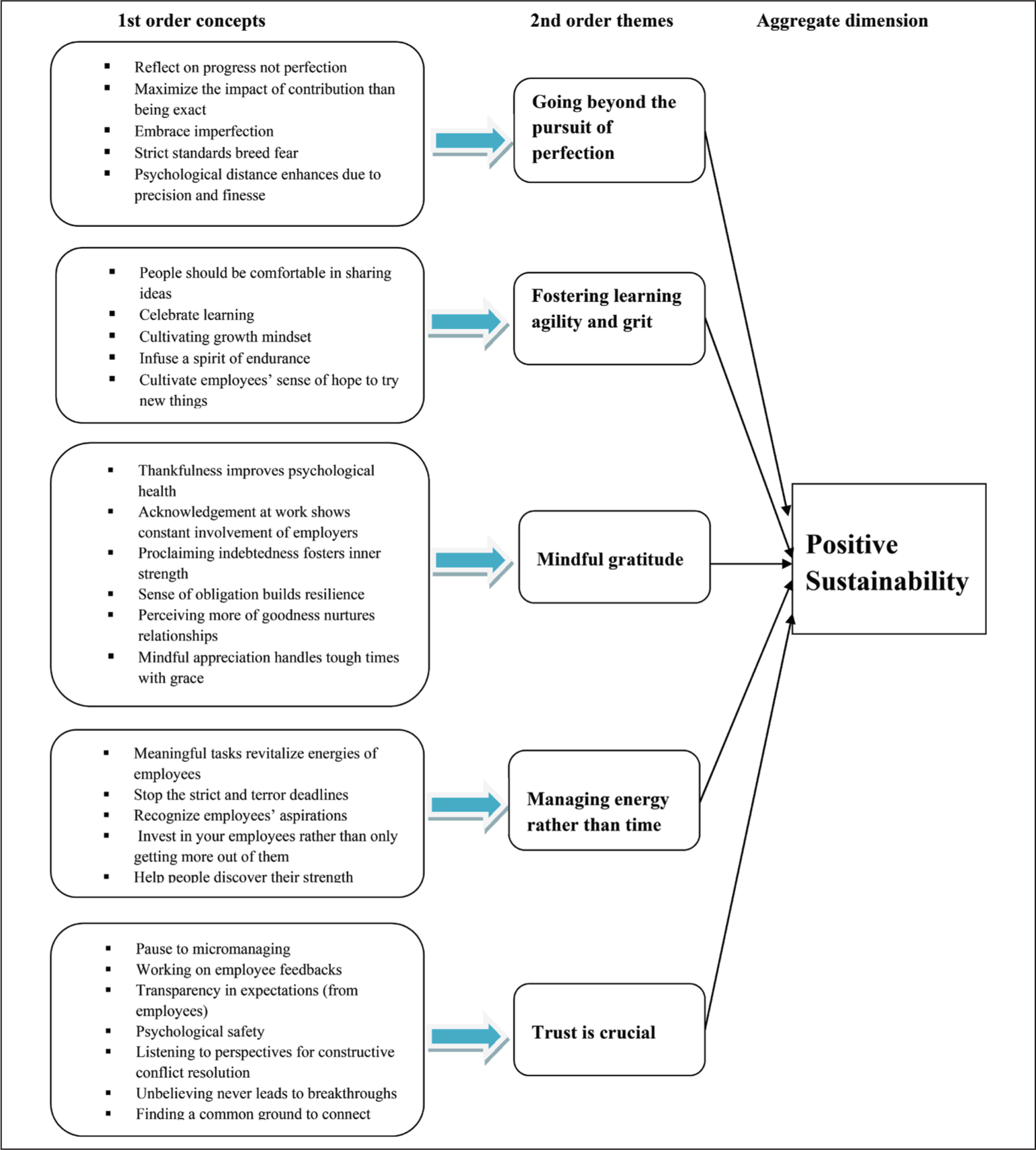
Firms B, C and D had a similar view that highlighted that an organization should move beyond perfection in their system. Firms B and D are into a creative work that requires employees to think more. In order to let the employees nurture their creative ideas and expressions, the owners feel this aspect to be essential. As the employees of Firm B have to work under intense supervision, somehow it let them feel as if they are micromanaged. Thus allowing them to move beyond perfection would give them a space to breathe, be practical and work with fecund creativity.
All of the construction firms (A, B, C and D) have eventually developed a notion of helping their people adapt new skills to reach the organisation’s strategic goal. The firms experienced a gap over the years that seemed to enhance both their skills and their communication. The firms found it essential to foster learning agility and grit in order to ensure spirit of endurance, trying something new and improving their responsiveness in solving their own problems.
A unified approach has been found in the views and opinions of HR officials of all the four construction firms in instilling gratitude at work. All the four construction firms have to heavily depend on clients. Accordingly, employees need to understand the subtle requirements of such client equally. Understanding such clients genuinely and working with them simultaneously requires tenacity and courage. Employees thus need an inner strength so that they never lose focus and boost their competence even amidst instabilities. Thus a piece of ‘thank you’ or appreciation can help them move hundred miles with compassion and prowess.
Firms B and D have a common notion while stating that managing of energy of employees seems essential. The two firms believe that in order to make progress towards a long-term goal and make one’s state of mind harmoniously ordered, managing energy and effort is vital. The firms believe that by managing time one can only set priorities, schedules and deadlines that can reduce initial tension at work but performance cannot thrive.
A similar proposition has been found in the statements of HR officials of all the construction firms regarding the essence of trust at work. As employees have to work in such firms under strenuous conditions as well put added hours to reach deadlines, they need to be backed by security and support. Transparency in expectations, open communication, working on their needs seemed essential to help them overcome all kinds of fear and insecurity. Such a climate would ensure an overwhelming response from the employees.
Discussion
The above study conducted in four firms has brought forward five distinct aspects that accelerated positive sustainability and fostered employee well-being. The HR professionals interviewed have rightly identified these facets and have reaped its benefit in the form of cohesiveness, accountability and generating positive emotions. As the organizations were inching towards positive sustainability by incorporating these aspects, it infused a forward-looking approach amidst the workforce.
With countless changes and uncertainties, the companies realized that the practice of ‘going beyond the pursuit of perfection’ has helped to leverage employee skills to drive unique competitive advantage. Employees in success firms now express fewer mainstream thoughts and can stretch their imagination and unleash their creative facets in their work. They are now able to display curiosity and focus on solutions. This is in line with the positive organizational scholarship theory that upholds unleashing creative aspects of employees rather than bestowing timelines (Cameron, 2014). By ‘fostering learning agility’ at work, the organizations have observed that their employees’ remain comfortable even in uncomfortable circumstances. This happens as people celebrate mistakes as learning opportunities. The above companies have allowed the workforce to learn, grow, adapt and evolve to changing systems and processes. Enrolling employees to certain practical training programmes and assignments generates a high tolerance for ambiguity, where experimentation becomes exciting and not fearful. Helping the workforce to embark on new learning experiences inspires and emboldens them to pull the disparate bits of information. Eventually they move with a systematical, logical and rational approach even in wild and unchartered waters. By creating ‘fail fast and learn fast’ motto, the companies have helped employees to rise exponentially and sustain with a positive experience. As the above companies have focused on gratitude exercise, a low level of resentment has been observed. This invigorated the teams to persevere in challenging tasks. Bridging the gratitude gap has built psychological safety at work with an increased sense of social worth. The companies have focused on people and not performance. This has fetched unique contributions from employees with more generous choices. The practice of gratitude in the firms has helped to sustain among its people a greater sense of confidence in the mission (Zhu et al., 2022). It has driven sustainable actions and eventually fostered authenticity at work. The companies also have equally realized that ‘trust is crucial’ part of their work. The power of trust has the ability to build right level of readiness for the employees with unwavering commitment. In spite of enduring challenges, trust at workplace has reinforced the workforce to adopt positive change behaviour. HR professionals have rightly analysed that building trust among employees’ can withhold their talents, passion and energy. The discussion with HR professionals has brought about the essence of thriving at work than surviving by ‘managing energy’ of their employees. The companies have focused on clarifying the priorities of its people. This has improved their level of concentration and made them remain realistically optimistic. They now find more time to be creative. The HR professionals have been quite aware of the distraction that drains the energy of its people. Thus, driving up the participation and engagement of employees in varied projects of their passion and competence has bolstered the emotional bond (Schippers & Hogenes, 2011). Managing of energy too includes managing of emotions. Companies have played a significant role in channelling the intense negative emotions at workplaces. It infuses a sense of vitality and employees remain clear and confident. Team reflexivity has equally sparked their level of verve and ensured a positive outlook.
Contribution
The practices the firms have upheld have designed a positive sustainability culture. These aspects can considerably create a healthy workplace making decent work and inclusivity as prime coordinates (Roffey, 2016). By embracing such factors, a company can stimulate the process of self-attunement and harmonization. It would then build a sustainable social milieu enhancing positive orientation. The factors precisely discussed above can develop connectedness among colleagues and energize sustainable structures at work. As companies help its people bring their authentic selves to work, their adaptive levels of control seem to enhance. It enables well-being and work fulfilment. It has been well observed that sustainability of self-determination can be endured if employees derive positivity in the form of coherence, direction and meaningful work (Junça-Silva et al., 2022). Thereby, the case reflects that advancing this new process of well-being has harnessed the energy and insights of employees’ providing them an opportunity to feel valued and visible. Eventually, the people have adapted positive sustainable approaches to best serve their organization. The case also reflected how to sustain growth by putting the sense of purpose at the core and instilling intense priorities. The case contributed to understanding the need for deeper appreciation of employees’ endeavour and their needs, which form the true base for a company’s efficiency. The study helped us to shift our mindsets beyond trade-offs. Thus, the initiatives (drivers) stand as sustainable solutions.
Limitations and Further Scope of Study
The study poses certain limitations as 16 interviews were derived from companies based on one particular state of India. Interviews with other HR professionals from construction firms of different states of the country could fetch better insights. Case comparisons could further be done if the dataset is large. This would improve the generalizability of the results. Moreover research can be extended by developing a cognitive behavioural conceptualization that would help assess and treat the impact of perfectionism at work. Further studies can be conducted on the impact of organizational grit in building resilience among employees and a comparative study can be conducted on other industrial sectors on this specific aspect. Researchers can further develop the concept of positive sustainability by delving deep into new parameters and empirically assessing its impact on other sectors. Scholars can also use trust as a mediating factor in generating a new model with positive organizational scholarship and examining its effect.
Footnotes
Declaration of Conflicting Interests
The authors declared no potential conflicts of interest with respect to the research, authorship and/or publication of this article.
Funding
The authors received no financial support for the research, authorship and/or publication of this article.