




Abstract
In an era dominated by social media, the power of Instagram influencers on consumer purchase intentions is undeniable and profound. This study explores the complex dynamics between parasocial interactions, influencer credibility, product–influencer congruence, attitude, and consumer purchase intentions in the context of Instagram beauty influencers. Employing a quantitative research approach, an online survey was conducted among 326 female Instagram users who follow beauty influencers. The findings underscore the pivotal role of influencer credibility and product–influencer congruence in shaping consumers’ attitudes and purchase intentions. Furthermore, results reveal that parasocial interactions cultivate feelings of trust and positivity toward influencers, thereby enhancing consumers’ purchasing intentions. A novel contribution of this research lies in the identification of influencer credibility and product–influencer congruence as significant mediators in the relationship between parasocial interactions and purchase intentions. Although the research focuses primarily on beauty influencers on Instagram, the insights gleaned offer critical practical implications for broader influencer marketing strategies, emphasizing the need for influencer authenticity, alignment with endorsed products, and strong parasocial interactions. While limited to Instagram beauty influencers and reliant on self-reported measures, the study suggests a need for further exploration into variables like trust and perceived value.
Keywords
Introduction
In recent years, the landscape of communication, connection, and commerce has been reshaped by the ascendance of social media. These platforms are not mere stages for social interaction; they are powerful conduits for cultural and commercial exchange. Particularly in India, the rapid digital adoption has led to a remarkable growth in internet usage, with over 692 million active internet users and around 448 million regular social media users as of February 2023 (DataReportal, 2023; We Are Social & Hootsuite, 2023). This digital expansion has paved the way for the burgeoning field of influencer marketing, a domain where individuals with significant online followings, often regarded as opinion leaders, play a transformative role as brand ambassadors or spokespeople. However, this rapid growth has precipitated a critical challenge within the influencer marketing landscape. While influencers have demonstrated the capacity to significantly impact consumer behavior and preferences, there arises a fundamental issue of credibility and authenticity in their endorsements. The surge in influencer-driven marketing campaigns, which contributed to the Indian influencer marketing industry’s valuation of over ₹12 billion in 2022 (Exchange4media & GroupM, 2022a), brings into focus the need for a deeper understanding of the dynamics between influencer credibility, consumer trust, and purchasing decisions. As projected by industry experts, with an expected market value of approximately ₹28 billion by 2026, the pressing concern lies in ensuring that the influencer–consumer relationship is grounded in authenticity and reliability. The problem, therefore, centers on navigating the complexities of influencer credibility in a rapidly expanding digital marketplace and understanding its impact on consumer purchase intentions, particularly in the context of the Indian market.
The significance of this challenge is multidimensional in the context of India’s emerging digital economy. In an era where consumer decisions are increasingly shaped by digital content, the authenticity of influencer endorsements becomes a cornerstone of effective marketing. The integrity of these influencer–consumer interactions directly impacts the trust consumers place in online marketing content, which in turn influences their purchasing decisions. This issue takes on added importance considering the projected expansion of the Indian influencer marketing industry, where the potential for misaligned or inauthentic influencer partnerships poses a significant risk to the effectiveness of digital marketing campaigns and, more broadly, to the perception of brands in the eyes of consumers. Addressing this problem offers substantial benefits, ranging from enhanced marketing effectiveness and brand loyalty to greater consumer satisfaction and informed decision-making, thereby underscoring its paramount importance in the realm of modern marketing practices.
In India, Instagram is one of the most widely used social networking platforms. According to an inquiry into the most active social media influencer marketing platform in India in 2021, the most number of respondents maintained a high level of engagement on Instagram, followed by Facebook at 60 percent and YouTube at 3 percent throughout the survey time (Influencer, 2021). Today, businesses often partner with influencers to offer their products and services to a targeted audience. Consumers place a higher reliance on influencers than on other internet sources; traditional internet commercials such as pop-ups, posters, and so on are seen as bothersome by consumers, but influencer marketing is viewed as nonintrusive and much more intriguing. Advertisers traditionally relied heavily on celebrity endorsements to market their businesses and offerings. However, recent research discovered that volunteers identify more often with influencers than celebs, believe themselves to be more similar to influencers, and have a higher level of confidence in influencers than celebrities. As a result, businesses are increasingly turning away from conventional celebrity endorsers in favor of Instafamous individuals in their marketing efforts (Schouten et al., 2019).
The beauty industry, particularly the personal care vertical, has been at the forefront of influencer marketing in India, commanding the largest market share at 25 percent as of 2022 (Exchange4media & GroupM, 2022b). This dominance in the influencer marketing space is not just a reflection of market expenditure but also indicative of the influential role that beauty influencers play in shaping consumer preferences and trends. Instagram, known for its aesthetic appeal and visual content, serves as an ideal platform for beauty influencers to showcase products, share tutorials, and foster a sense of community around personal care routines. This environment not only enhances the authenticity of digital marketing efforts but also amplifies the effectiveness of influencer marketing strategies. It provides an interactive space where beauty influencers can engage with users more intimately, thus cultivating a community of trust and influence. Given this backdrop, the study’s focus on Instagram’s beauty influencers offers a pertinent lens through which to examine the dynamics of influencer credibility and its impact on consumer behavior. This particular niche of influencer marketing epitomizes the intersection of personal care trends, digital interaction, and consumer engagement, making it an ideal case for exploring the broader implications of influencer credibility in the digital age.
Building on the context set by the focus on beauty influencers on Instagram, it is important to delve into the current debates surrounding influencer marketing, particularly those related to credibility and authenticity. One of the central debates in this domain is the authenticity of influencer endorsements versus their commercial interests. For instance, a particular study highlighted the delicate balance influencers must maintain between being perceived as genuine and the commercial nature of their endorsements (De Veirman et al., 2017). This debate is exemplified by incidents such as the controversy surrounding a well-known beauty influencer, whose overly enthusiastic promotion of a skincare product was later revealed to be a paid partnership, leading to a backlash from followers who felt deceived (John, 2017). Such incidents spark discussions on transparency in influencer marketing and the ethical responsibility of influencers to disclose paid partnerships. Another significant discussion revolves around the impact of algorithm changes on social media platforms like Instagram. These changes can affect how influencer content is viewed and engaged with by audiences. An example of this is Instagram’s shift to an algorithm-driven feed, which led to a decrease in organic reach for many influencers, prompting a discussion on the sustainability of influencer marketing as a reliable strategy (Musiyiwa & Jacobson, 2023).
Furthermore, the rise of micro-influencers has opened another avenue of debate. While major influencers with vast followings were traditionally the most sought-after for brand collaborations, there is a growing trend of brands partnering with micro-influencers, who, despite smaller followings, often boast higher engagement rates and are perceived as more relatable and trustworthy by their audiences (Kay et al., 2020). For example, a beauty brand that collaborates with a micro-influencer specializing in organic skincare can leverage this partnership to target niche audiences more effectively. These debates underscore the dynamic and complex nature of influencer marketing, where issues of trust, authenticity, and the evolving digital landscape continuously reshape the strategies and approaches of brands and influencers alike. In light of these debates, our study’s exploration into the dynamics of influencer credibility and consumer behavior in the context of Instagram’s beauty influencers offers timely and relevant insights, contributing to a deeper understanding of these ongoing discussions.
In light of the present scenario, this study seeks to fill a notable research gap, while existing literature extensively discusses the influence of influencers on consumer behavior, there is a scarcity of research focusing on how the perceived authenticity and credibility of influencers, especially in the beauty industry, impact consumer purchasing decisions in the Indian context. This gap is significant given the cultural and economic uniqueness of the Indian market, where digital marketing strategies may yield different consumer responses compared to Western markets. To address this gap, our research poses the following questions:
How does influencer credibility, as perceived by Indian consumers, influence their online purchase intentions on Instagram?
What role does content authenticity play in moderating the relationship between influencer credibility and purchase intentions?
How does the perceived similarity between influencers and their followers affect the followers’ trust and, consequently, their purchase behavior?
How does compensated communication impact the perception of an influencer’s credibility among Indian consumers on Instagram?
What is the effect of parasocial interactions on the purchase intentions of Indian consumers, and how does this interaction shape their attitudes toward influencers?
These questions aim to dissect the nuanced dynamics of influencer authenticity and its impact on consumer behaviors, thereby offering valuable insights for both the scholarly understanding of influencer marketing and its strategic implementation in the ever-evolving digital marketplace.
Literature Review
Over the past few years, the utilization of influencer marketing has become increasingly prevalent as a prominent approach for brands to interact with their target audience and advertise their merchandise. This section provides an overview of the theoretical foundations and relevant literature and highlights key findings that establish the foundation for the hypotheses in this study.
Theoretical Foundations and Linking Theory to Phenomenon
Several theoretical frameworks that elucidate the complexities of online consumer behavior highlight the expanding field of influencer marketing. This research draws upon the Theory of Reasoned Action (TRA) (Fishbein & Ajzen, 1975), the Concept of Social Proof (Cialdini, 1984), Trust and Credibility Theory (Hovland et al., 1953), and the Information Adoption Model (IAM) (Sussman & Siegal, 2003) to understand the mechanics behind consumer’s online purchase intentions influenced by social media figures.
TRA posits that individual behavior is driven by behavioral intentions where subjective norms and attitudes play a pivotal role. In the digital scape, where influencers are perceived as peer figures or experts, their endorsements serve as a form of subjective norm and attitude formation that can influence purchase intentions (Ajzen, 1991; Smith & Vogt, 1995). However, a critical examination of the application of TRA in the domain of influencer marketing reveals a gap; the theory does not fully encompass the nuanced ways in which influencer credibility and authenticity impact consumer intentions. This shortcoming signals a need for an expanded application of TRA in influencer marketing, accounting for the complex dimensions of digital influence, beyond traditional notions of norms and attitudes.
Social proof, as established by Cialdini, is paramount in an environment where consumers are bombarded with choices. The validation of a product by an influencer acts as social proof, potentially reducing consumer uncertainty (Cheung et al., 2015). Yet, literature is scant on how different types of social proof from influencers such as expertise versus popularity affect consumer behaviors (Lim et al., 2017). This gap in the literature presents a compelling opportunity for future studies to explore the differential impacts of various forms of social proof in influencer marketing.
Trust and Credibility Theory, integral to the persuasive communication process, holds that trust is conferred upon and credibility is attributed to influencers based on perceived expertise, sincerity, and charisma (Hovland et al., 1953). Trust and credibility are particularly salient in influencer marketing due to the parasocial relationships that influencers cultivate with their followers. Critically speaking, the concept of credibility in influencer marketing transcends the traditional markers of expertise and trustworthiness. In the digital age, authenticity and the alignment of an influencer’s promoted content with their known values and lifestyle become pivotal in sustaining credibility. The literature often overlooks the multifaceted nature of credibility in the digital context, presenting a gap that this research aims to bridge by dissecting the dimensions of influencer credibility and their direct influence on consumer trust and purchase intentions.
In the influencer marketing realm, the IAM, originally posited by Sussman and Siegal (2003), plays a crucial role. This model, focusing on information usefulness and credibility, influences how consumers perceive and adopt information from influencers, impacting their purchasing decisions. IAM suggests that the effectiveness of influencer marketing hinges on both the intrinsic value of the content and the trustworthiness of the influencer. However, IAM’s traditional focus on rational and systematic information processing encounters challenges in the emotionally driven and impulsive environment of social media. The model requires an expansion to embrace the affective elements intrinsic to influencer–follower relationships, often transcending straightforward assessments of content credibility and utility.
Identification of Literature Gaps
In synthesizing the existing literature on influencer marketing through the lenses of established theories such as TRA, Social Proof, Trust and Credibility Theory, and IAM, several critical gaps emerge. Table 1 provides a comprehensive overview of the current state of research, the gaps within this body of literature, and the specific ways this study aims to address these gaps, thereby contributing new insights and understandings to the field.
Existing Literature, Literature Gap, and Research Contributions.

Conceptual Model
The conceptual model for this research encapsulates the interplay of several key factors that influence consumer behavior in the realm of influencer marketing (see Figure 1). At its core, the model posits that “Intentions to Purchase” is the culmination of a multistep process that begins with the consumer’s “Parasocial Interactions” with an influencer and is mediated by perceptions of “Product–Influencer Congruence,” “Influencer Credibility,” and “Attitudes Towards Influencer.” Central to this model is the understanding that “Parasocial Interactions,” which represent the one-sided relationships consumers feel with influencers, have a direct effect on “Product–Influencer Congruence”—the perceived alignment between the influencer’s persona and the product they endorse. This perceived congruence, in turn, is hypothesized to strengthen “Influencer Credibility,” as consumers tend to ascribe more trust to influencers who appear authentically connected to the products they promote. Both “Parasocial Interactions” and “Product–Influencer Congruence” directly influence the “Attitudes Towards Influencer,” which encapsulates the overall evaluative judgment consumers make about an influencer.
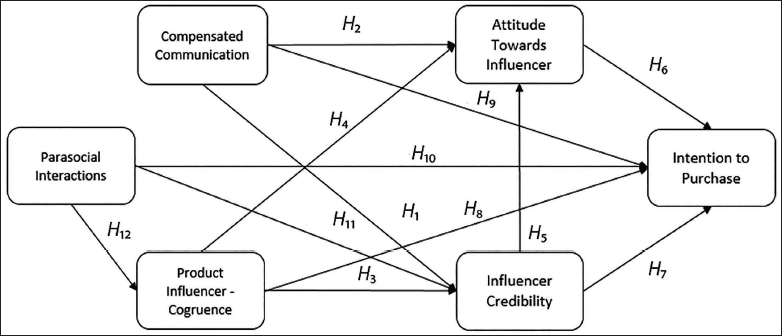
“Compensated Communication,” which reflects the extent to which communications are perceived as monetarily influenced, is expected to negatively impact “Influencer Credibility” and “Attitudes Towards Influencer.” The model reflects concerns from the literature that compensation might taint perceptions of sincerity and bias the content, thereby reducing trust and potential engagement. The “Attitudes Towards Influencer” serves as a pivotal mediator in this model, bridging the gap between the underlying perceptions formed through interactions, congruence, and credibility, and leading to the final consumer behaviors of “Intentions to Purchase.” This intention is the ultimate dependent variable in the model, representing the final step in the consumer decision-making process as influenced by the preceding factors.
This conceptual model is justified based on the theoretical foundations outlined in the literature review, drawing from the TRA, Social Influence Theory, and Trust and Credibility Theory, which emphasize the roles of subjective norms, trust, and attitude in predicting behaviors. The IAM also supports the inclusion of “Influencer Credibility” as a critical mediating factor between information processing and behaviors intention. The conceptual model addresses the literature gaps by operationalizing “Influencer Credibility” and “Product–Influencer Congruence” within the unique context of influencer marketing and examining the long-term effects of “Parasocial Interactions” on consumer purchase behaviors. It also accounts for the cultural nuances in the perception of authenticity and trust, especially pertinent to non-Western contexts. Through this model, the research aims to empirically test the interconnectedness of these constructs and provide a comprehensive understanding of the variables that drive consumer behaviors in the context of influencer marketing.
Hypotheses Development
By establishing links between the observed phenomena in influencer marketing and the relationships proposed in the conceptual model, the hypotheses of this study are formulated in a systematic manner. Each hypothesis is grounded in the literature, reflecting the insights garnered from empirical findings and theoretical discourse.
Influencer’s Credibility, Compensated Communication, and Attitudes Toward Influencer
The importance of collaborations between influencers and brands lies in the capacity to leverage the trust and credibility that influencers have established with their audience. When a message is transmitted by another consumer, it is viewed as more legitimate and believable, in comparison to when it would have been proposed by an advertiser (Kaikati & Kaikati, 2004). Credibility is the process through which a person evaluates if a claim is truthful, accurate, or impartial. Along with reliability and goodwill, the other primary variables in determining credibility are an individual’s competence, knowledge, and experience in a certain area (McCroskey & Teven, 1999). Credibility of influencers is critical for developing favorable opinions about them, which could lead to intention to purchase what is recommended by them (Belanche et al., 2021). Previous research has demonstrated the effect of paid communication on influencer credibility. For instance, it was discovered that when influencers are perceived as being compensated for promoting products, their credibility may be compromised, resulting in a decline in followers’ trust and engagement (Sesar et al., 2022). Inadequate consistency within a source leads to a decrease in its credibility as a whole, which is commonly referred to as source derogation. In situations where the source is perceived as biased, individuals may exhibit a tendency to criticize the source in question. Individuals may have an inclination to criticize the source at issue when it is seen as biased. This could be a result of the unpleasant feelings that are stirred up, such as irritation or discontent. As a consequence, they could discount their knowledge and expertise (Zhang & Zhou, 2023). Sponsored content, pay-per-click, product sales, and more are all ways Instagram influencers may make money on the social media platform. The influencer’s reputation may be tarnished if the followers perceive that the given information is tainted since the influencer has been compensated for promoting the product (Djafarova & Bowes, 2021).
Based on the ongoing discussion, the following hypotheses were postulated:
H1: Compensated Communication (CC) negatively affects Influencer Credibility (IC).
H2: CC negatively affects Attitudes Towards Influencer (ATI).
Product–Influencer Congruence
There must be a fit between the product and the influencer; previous research found that congruence between influencers and products has an effect on product attitude and advertising awareness (Kim & Kim, 2021). When there is perceived congruence between the influencer and the marketed product, a positive attitude toward the influencer is more probable (Du et al., 2023). Instagram users strive to be like their favorite influencers, so when an influencer endorses a product that they feel is a good fit for their ideal self, their followers are more likely to believe the same about the product (Campbell & Farrell, 2020). Therefore, we argue that consumer product fit is a driving force behind consumers’ attitudes and the influencer’s credibility:
H3: Product–Influencer Congruence (PIC) positively affects IC.
H4: PIC positively affects ATI.
Attitudes Toward Influencers
Understanding the attitudes of consumers is also critical for predicting their future behavior. According to the concept of Theory of Planned Behavior (TPB), attitude is the primary antecedent of behavioral intentions (Ajzen, 1991). The credibility of influencers has been recognized as a crucial element in shaping individuals’ attitudes and intentions to purchase. It has been found that influencer credibility is critical in establishing positive perceptions and purchase intentions among followers (Ooi et al., 2023). Therefore, the following hypotheses were put forward:
H5: IC positively affects ATI.
H6: ATI positively affects Intentions to Purchase (ITP).
Intentions to Purchase
The term Intention to Purchase holds significant importance in understanding consumer behavior within the context of influencer marketing. The impression of trustworthiness and credibility in influencers by their followers is positively associated with a heightened intention to purchase the products that are endorsed by them (Ao et al., 2023). Followers are more inclined to follow the recommendations of their favorite influencers if they have a positive impression of that person. The presence of a perceived congruence between the influencer and the endorsed merchandise tends to positively influence the followers’ purchase intention (Tseng & Wang, 2023). Conversely, scholarly investigations have revealed that the utilization of compensated communication has an adverse impact on the intention to purchase. (Chen et al., 2021; Van Reijmersdal et al., 2023). When followers believe influencers’ recommendations to be skewed or motivated by financial incentives, it might impair their purchase intent. Based on the ongoing discussion, the following hypotheses were proposed:
H7: IC positively affects ITP.
H8: PIC positively affects ITP.
H9: CC negatively affects ITP.
Parasocial Interactions
The term “Parasocial Interactions” refers to the nonverbal psychological connections between social media influencers and their followers. As a spectator, one develops an emotional connection with the influencer based on the handpicked material they share with online viewers. Any connection between two individuals involves an exchange of mutual values, such as caring and support, interest in one another, and so forth. In parasocial interactions, the viewer receives amusement, while the influencer receives monetized attention. As a result, people who are more honest and reputable might attract more attention and so earn more money from product promotion. These interactions have a substantial impact on customer perceptions and purchasing intentions. When followers form a parasocial connection with an influencer, they experience a feeling of intimacy and identification, which might translate into a stronger propensity to buy the influencer’s advocated items. A recent study discovered that parasocial ties influenced followers’ purchase and electronic word of mouth (eWOM) intentions favorably (Hwang & Zhang, 2018). The perception of a natural fit between an influencer and a promoted product is enhanced when followers experience a sense of similarity and connection with the influencer, leading to an increased intention to purchase. The idea of parasocial interactions can help people understand how digital celebrities and their followers interact with each other and why they have so much power over their followers. Thus, the subsequent hypotheses were postulated:
H10: Parasocial Interactions (PSI) positively affects ITP.
H11: PSI positively affects IC.
H12: PSI positively affects PIC.
Mediation Effects in the Relationship Between PSI and ITP
Studies in the past have demonstrated that PSI, or the one-sided ties people establish with media characters, has a major influence on consumer behavior (Fu & Hsu, 2023; Sokolova & Kefi, 2020). However, the fundamental mechanism through which PSI modulates ITP is unknown. The present research postulates that IC serves as a mediator in the aforementioned association. In particular, the act of consumers participating in parasocial interactions with influencers and perceiving them as credible contributes to the strengthening of their trust and confidence in the influencer’s endorsements. As a result, the heightened credibility has a favorable impact on the consumer’s inclination to buy the products that have been endorsed. The objective of this study is to gain a deeper understanding of the psychological mechanism that connects PSI and ITP in the context of influencer marketing, by analyzing the mediating impact of IC. Therefore, the current investigation posits the subsequent hypothesis:
H13: Relationship between PSI and ITP is positively mediated by IC.
The alignment of an influencer and the recommended product is critical in influencing customer impressions and purchase intentions (Lee et al., 2021). In the area of influencer marketing, the establishment of parasocial interactions between consumers and influencers, coupled with a perceived congruence between the influencer and the endorsed product, has been found to positively impact consumers’ attitudes and purchase intentions. The present research proposes that the relationship between PSI and ITP is mediated by PIC. Simply put, if followers perceive a significant level of consistency between the influencer and the endorsed product, it reinforces their parasocial bonds and subsequently amplifies their inclination to procure the recommended merchandise. As a result, the current research presents the following hypothesis:
H14: Relationship between PSI and ITP is positively mediated by PIC.
Research Methodology
Quantitative data were acquired to test the hypotheses of this investigation. To gather data from the participants, a questionnaire with two sections was devised and sent out. The questionnaire’s first component included demographic information on respondents’ characteristics such as age, gender, educational attainment, yearly household income, and weekly web browsing hours. This section also included questions on the beauty influencers they follow and whether they have previously bought products recommended by them. In the second section, 35 items were used to measure the 6 constructs presented in the research model (Figure 1), which are: CC, IC, PIC, ATI, PSI, and ITP. Eight respondents were asked to provide verbal input on the survey, which was pilot tested among a sample. The poll was developed utilizing Google Forms and then distributed using Instagram direct message (DM) and stories. The prerequisites for taking the survey were that they are millennials who have an Instagram account and follow at least one of the top five beauty influencers on there. Another criterion was that the participants be female millennials between the ages of 18 and 29 years old. A total of 326 participants were ultimately included in the study, providing a substantial sample size (N = 326) for robust analysis. The sample size also allowed for a reasonable assessment of the model’s fit and the hypothesized relationships.
Due to their well-known Instagram user experience and their ability to analyze an influencer’s profile on the platform, the millennial generation was determined to be the best age group for this research (Becker, 2012). Purposive sampling, also known as selective sampling, a form of nonprobability sampling was chosen as the sampling technique for this investigation since the authors had specific requirements when choosing members of the population to participate in their survey. To ensure a sample that adequately represents this population, the following measures were taken. We strategically used purposive sampling, focusing on female millennial Instagram users who actively follow top beauty influencers, a demographic identified as significantly engaged with such social media figures. Criteria for inclusion demanded that respondents have meaningful engagement with beauty influencer content, including purchasing products based on endorsements, to accurately reflect consumers impacted by influencer marketing. The survey, distributed via Instagram’s DMs and stories, targeted a diverse participant pool, enhancing the sample’s representativeness. A pilot test with eight respondents preceded the main data collection, refining the survey’s relevance and clarity. Structural equation modeling (SEM) with Amos was employed for data analysis, with a robust sample size of 326, surpassing the threshold for SEM analysis and ensuring statistical rigor (IBM, n.d.). Ethical standards, including informed consent and commitment to participant privacy and anonymity, were stringently upheld throughout the research, ensuring the study’s integrity. This meticulous approach to sampling and data analysis ensured the findings’ validity and reliability, particularly in exploring millennial women’s engagement with beauty influencers on Instagram.
Measurement Validation
Considering that the data we obtained originated from a singular source via self-assessments, there existed a potential susceptibility to common method variance (CMV), encompassing priming effects, evaluation apprehension, and socially desirable responses (Podsakoff et al., 2003). In order to address this particular concern, we performed a factor analysis by consolidating all items from the six constructs into a unified factor. Nevertheless, the outcomes of the one-factor model exhibited a substandard fit (χ2 = 4311/df = 405 yielded 10.65, comparative match index (CFI) = 0.47, Tucker–Lewis index (TLI) = 0.43, root mean square residual (RMR) = 0.109, root mean square error of approximation (RMSEA) = 0.165), suggesting that the presence of CMV was not prevalent in our dataset.
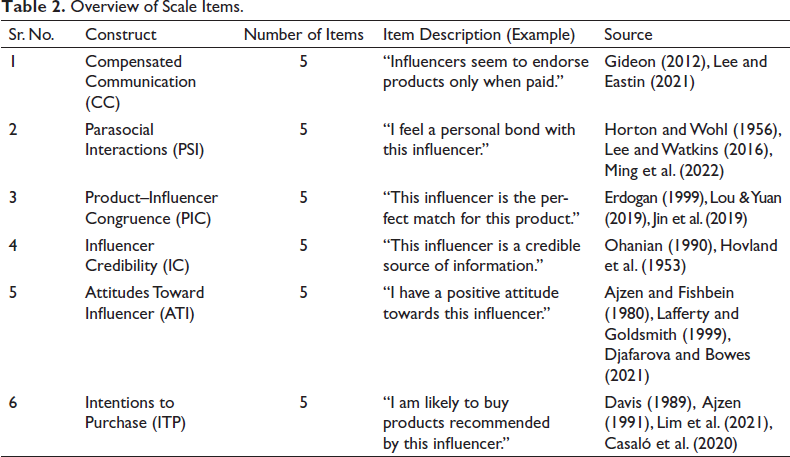
Given that the scale items for measuring the constructs of CC, IC, PIC, ATI, PSI, and ITP were adapted from existing validated scales, we initially performed confirmatory factor analysis (CFA) to ascertain the items’ fit with the hypothesized structure of our model. Table 2 provides a detailed overview on the measurement instruments and their theoretical origins.
Overview of Scale Items.
Confirmatory Factor Analysis (CFA) Model Fit Results.
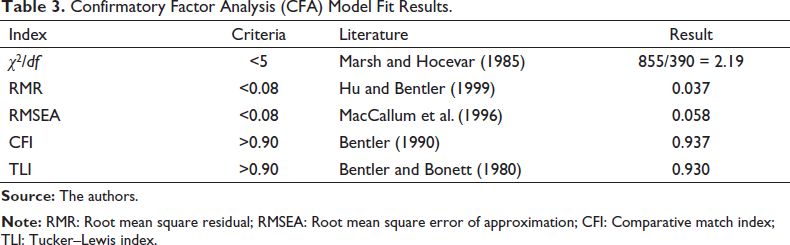
CFA is a statistical methodology employed to evaluate the dimensionality of scales or measures within a research investigation. The study employed CFA using AMOS version 24 to assess the extent to which the observed data from the study sample aligns with the hypothesized factor structure of the scales. The model’s fit was assessed using various fit indices. In particular, the χ2 statistic (2 = 855) with degrees of freedom (df = 390) produced an acceptable result of 2.19 (Table 3). A satisfactory match between the measurement model and the observed data was also demonstrated by additional fit indices, including the CFI (=0.94), TLI (=0.93), RMR (=0.034), and RMSEA (=0.058). It is important to note that even while the majority of fit indices satisfied the standards for a good fit, the TLI fell just short of the suggested cutoff. Despite this, the model’s overall fit was deemed adequate. Given that our scale items were derived from existing literature, an exploratory factor analysis (EFA) was not deemed necessary. However, we acknowledge that EFA could have been beneficial if we were developing a new scale or substantially modifying existing scales without prior theoretical support. In our case, the application of CFA was justified as it directly tested the hypothesized relationships posited in our conceptual framework, thereby providing a robust analysis suited to our research objectives.
The choice between covariance-based SEM (CB-SEM) and partial least squares SEM (PLS-SEM) was informed by the nature of our research questions and the data distribution. We opted for CB-SEM due to our focus on theory testing rather than prediction and the assumption of multivariate normality within our data. CB-SEM is preferable when the research goal is to confirm an existing theory, as it allows for a comprehensive assessment of model fit and the testing of complex relationships between latent constructs.
Overall, the fit indices as seen in Table 1 suggest that the proposed model for the study, based on the CFA, demonstrates a strong alignment with the gathered data. This indicates that the measurement items used in the survey effectively represent the underlying factors being studied. According to the findings presented in Table 4, the factor loadings (FL) for most of the items exceeded the established criteria for very good (>0.63) as proposed by Comrey and Lee (1992). However, one item approached the criteria for good (>0.55) as defined by the same authors. These results provide a solid foundation for establishing the reliability of our measures or model, as indicated by Hair et al. (2017).
Reliability and Validity.
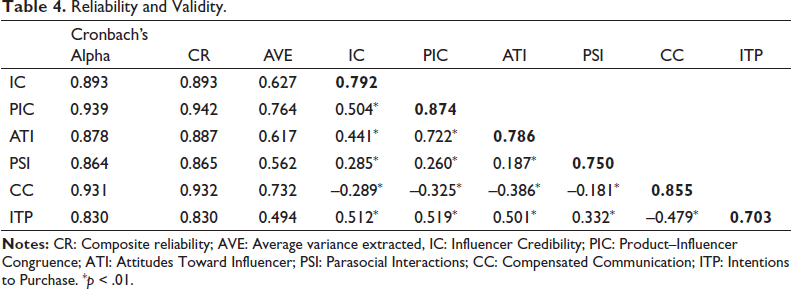
The estimation of true reliability of a scale is frequently performed using Cronbach’s alpha (α), composite reliability (CR), and average variance extracted (AVE). According to the findings presented in Table 2, our six-factor model demonstrated satisfactory levels of Cronbach’s alpha and CR, exceeding the threshold of 0.7, which is considered acceptable for structural confirmatory purposes (Hair et al., 2017). The agreement between several measurements of the same construct taken using various methods is referred to as convergent validity. The AVE has to be higher than 0.5 for convergent validity. All of our model’s measurements had AVE values that approximately met the requirements listed in Table 2. AVE is also used to assess the discriminant validity (Fornell & Larcker, 1981). To compare with interitem correlations of the components or scales, the square-root value of AVE is employed. As shown in Table 4, all of the scales’ square root values of AVE (diagonal and bold) were higher than their interconstruct correlations, demonstrating the discriminant validity of our model.
In summary, the measurement validation process was carefully crafted to ensure the reliability and validity of the constructs within our study. By conducting CFA (see Figure 2), we established a strong alignment with the data, thus laying a solid foundation for the subsequent hypothesis testing phase of our research.
Confirmatory Factor Analysis (CFA) Graphic Model.

Analysis
By analyzing the pairwise interactions between the variables, bivariate correlations provide preliminary insights into the links between them. SEM allows for the simultaneous investigation of numerous associations and the evaluation of the general fit of the proposed theoretical model, which distinguishes it from bivariate correlations. By examining the correlation coefficients the interrelationships between the variables in this research were ascertained. By capturing both the intensity and the direction of the correlations, these coefficients provide a thorough understanding of the interactions between each pair of variables. The interdependencies between each variable in the model are taken into consideration by SEM, which gives a more thorough knowledge of how the variables interact together to support the underlying theoretical framework. Therefore, SEM enables a more thorough investigation of the whole model and its fit with the data, while bivariate correlations just offer a preliminary knowledge of the individual associations.
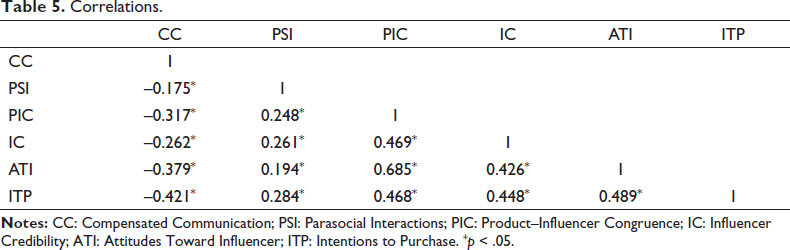
Table 5 presents the correlation coefficients among the variables incorporated in the study. Correlation coefficients are statistical measures that quantify the magnitude and direction of the linear association between two variables. An important finding was that there is a weak negative correlation (–0.175*) between “CC” and “PSI.” This observation implies that as compensated communication increases, parasocial interactions tend to decrease. Additionally, there is a moderate negative correlation (–0.262*) between “CC” and “IC” suggesting that paid communication has a detrimental impact on how credible influencers are seen. The slightly negative association between “CC” and “ATI” (–0.379*) indicates that attitudes toward influencers tend to decline as compensated communication grows. A moderate negative correlation between CC and PIC is seen (–0.317*). This suggests that as compensated communication increases, the perceived congruence between products and influencers tends to decrease. Therefore, the observed correlations demonstrate the existence of associations between the variables and lend support to the research hypotheses.
Correlations.
The investigation proceeded to examine the hypotheses by employing SEM using AMOS version 24. SEM is a statistical methodology that integrates factor analysis and regression analysis to examine intricate associations among variables. This methodology allows researchers to analyze the direct and indirect relationships between variables and evaluate the overall adequacy of the proposed model in relation to the collected data. To evaluate the impact of predictor variables on outcome variables, we utilized bootstrap technique to estimate 95 percent confidence intervals for the lower and upper levels (LLCI and ULCI) of the regression. These intervals are utilized to ascertain the range in which the actual population values of the regression coefficients are expected to lie. Table 6 displays the outcomes of the bootstrap analysis, illustrating the estimated regression coefficients (b) for each predictor variable and their respective p values. The p values provide an indication of the statistical significance of the impact of each predictor variable on the outcome variable. The indication of the significance of each path is provided by the “Status” column.
Direct Effect Hypotheses.
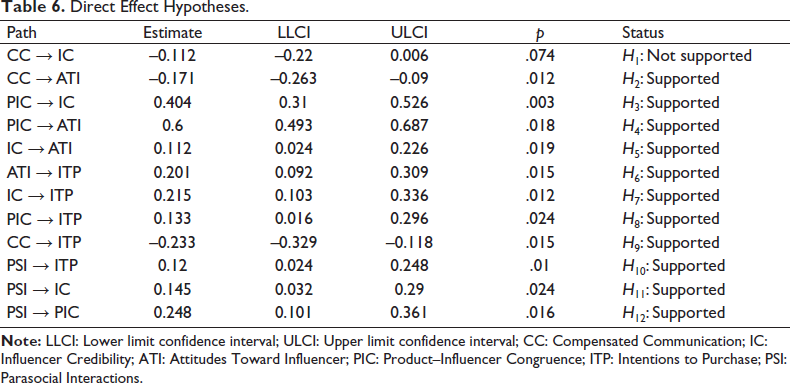
The analysis revealed that nearly all of our direct effect hypotheses were supported, with the exception of Hypothesis 1. The estimated regression coefficient for Hypothesis 1 was –0.112; however, the corresponding p value (.074) did not attain statistical significance at the conventional threshold of p < .05. Nevertheless, it is important to acknowledge that the regression coefficient exhibited the anticipated negative association between the predictor and the dependent variable. Hypothesis 2 is supported by the significant negative relationship (p = .012) indicated by the estimate of –0.171 for the path from CC to ATI. There is consistent evidence supporting Hypotheses 3 and 4, as the observed relationships between PIC and IC (estimate = 0.404, p = .003) and between PIC and ATI (estimate = 0.6, p = .018) are both statistically significant and positive. Hypothesis 5, which posits a positive correlation between IC and ATI, is further substantiated by an estimated coefficient of 0.112 and a statistically significant p value of .019. Additionally, the hypotheses numbered 6, 7, 8, 9, and 10, which pertain to the relationships between ATI, IC, PSI, PIC, and ITP, are all substantiated by the presence of statistically significant estimates and p values. Hypothesis 11 postulates a positive correlation between PSI and IC, a proposition that is substantiated by the estimated coefficient of 0.145 and the statistically significant p value of .024. Finally, Hypothesis 12 examines the relationship between PSI and PIC and is supported by the estimate of 0.248 and the p value of 0.016, indicating a positive effect. The aforementioned results underscore the existence of substantial correlations among the variables and offer validation for the anticipated pathways within the theoretical framework.
Mediating Effect of PSI and ITP (Testing of Hypotheses 13 and 14)
The findings of the mediation analysis performed in the present investigation are presented in Table 7 for Hypotheses 13 and 14. The analysis examined two mediation models, namely the pathway from PSI to IC to ITP, and the pathway from PSI to PIC to ITP. The results of the analysis, conducted in accordance with the procedures outlined by Baron and Kenny (1986) and complemented by bootstrap confidence intervals, revealed partial mediation in both cases.
Mediation Analysis.
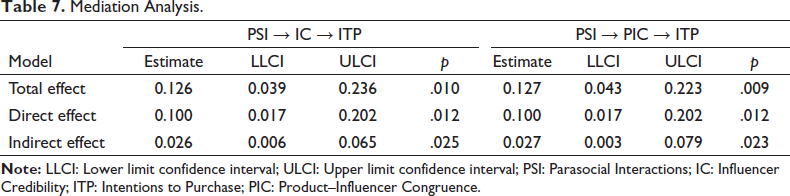
Table 7 revealed that IC partially mediates the relationship between PSI and ITP. The bias-corrected bootstrap confidence intervals for the indirect effect did not contain zero, with lower and upper limits of 0.006 and 0.065, respectively, and a p value of .025. This supports the presence of partial mediation as per the criteria outlined by Baron and Kenny (1986). Additionally, the Sobel test provided further confirmation of this significant indirect effect with a test statistic of z = 2.44 and a p value of .011, thus supporting Hypothesis 13. These findings resonate with the work of Jin and Phua (2014), who posited that the credibility of influencers amplifies the effect of parasocial relationships on consumer behaviors. Our results extend this line of research by quantifying the mediating role of credibility within the context of social media marketing.
Similarly, for Hypothesis 14, the mediation analysis indicated that PIC serves as a partial mediator in the relationship between PSI and ITP. The confidence intervals obtained from the bias-corrected bootstrap method were above zero, ranging from 0.003 to 0.079, with the p value being .023. This also meets the criteria for partial mediation according to Baron and Kenny (1986). The Sobel test corroborated the significance of the indirect effect, with a test statistic of z = 2.02 and a p value of .014, lending support to Hypothesis 14. This supports Lou and Yuan’s (2019) assertion that product–influencer fit significantly affects consumer responses to influencer marketing. Our findings contribute empirical evidence to this theoretical proposition, underscoring the importance of congruence in influencer marketing strategies.
The partial mediation observed suggests that while direct effects are present, the relationships are nuanced and involve intermediary processes that significantly influence consumer behavior. The results underscore the importance of not only the direct persuasive appeal of influencers but also the trust and alignment they establish with their audience.
Discussion
Companies are increasingly relying on digital communication to sell their goods and brands, and social media and influencer marketing have become inescapable when developing marketing plans. The findings of the research substantiate multiple hypotheses and offer significant insights into the interconnections among various variables. The first hypothesis posits that there is a negative relationship between CC and IC. Nevertheless, the findings of our study failed to provide evidence in favor of this hypothesis contrary to the prevailing notions in the literature (e.g., Djafarova & Rushworth, 2017), as the relationship between CC and IC did not reach statistical significance. There exist multiple potential factors contributing to this lack of support. One plausible explanation is that consumers have increasingly adjusted to the phenomenon of influencers partaking in compensated communication, leading to the development of a degree of acceptance or comprehension regarding its prevalence within the industry. Consequently, individuals may not perceive compensated communication as exerting a detrimental effect on the influencer credibility (Evans et al., 2017; Leite et al., 2022). Moreover, it is important to acknowledge that there may exist additional variables that were not taken into account in the present study, which could have potentially impacted the perceived credibility of influencers. For instance, the perceived credibility of an influencer may be influenced to a greater extent by factors such as the quality of their content, consistency in their messaging, authenticity in their interactions, and level of expertise, rather than solely relying on the presence of compensated communication. The context and type of the compensated message should also be taken into account. Any harm to the influencer’s reputation may be lessened if they are transparent with their audience and open about their connections.
As the level of CC rises, it was seen that there was a tendency for consumers’ perceptions of influencers to become less favorable. Consumers might view communication as a type of commercialization or an advertising approach employed by influencers to promote items. This commercial component may damage influencers’ authenticity and credibility in the perspective of customers. As a consequence, consumers may acquire more dubious or unfavorable views toward sponsored communication influencers. The outcomes of the third, fourth, and eighth hypotheses, which examine the variable of PIC as a shared characteristic, demonstrate a significant correlation between the level of consistency between the endorsed product and the influencer’s persona, and consumers’ purchasing intentions. This discovery aligns with prior research which have shown congruence between influencers and products has an effect on product attitude and advertising recognition (Kim & Kim, 2021; Schouten et al., 2019). Consumers are inclined to develop favorable opinions regarding influencers when they perceive a significant alignment between the influencer’s personal brand and the endorsed beauty product. This underscores the significance of a meticulous selection process for influencers who exhibit strong compatibility with the endorsed product. Such alignment not only enhances the credibility of the influencer but also cultivates positive attitudes toward them, ultimately leading to an increase in consumers’ intentions to make a purchase. Findings in our study reaffirm the match-up hypothesis (Kamins, 1990); the results suggest that congruence goes beyond matching physical attributes and encompasses a broader alignment of values and lifestyles between the influencer and the endorsed product, which is a reflection of the contemporary marketing narratives that emphasize authenticity and consumer–influencer alignment (Choi & Rifon, 2012; Thomson, 2006). This extends the match-up hypothesis by highlighting the importance of a holistic alignment in the digital age.
Credibility of the influencer has an impact on followers’ attitudes toward the influencer and purchase intentions, meaning that unless the influencer is seen as an unbiased opinion leader, followers are unlikely to purchase the recommended beauty product. The findings of this study also indicate that influencer credibility holds significant importance as a crucial determinant in shaping consumers’ attitudes, purchase intentions and perceptions of congruence. The trustworthiness of influencers is critical in influencing customers to have positive attitudes about making a purchase. Similar studies were found consistent with the results (Ashraf et al., 2023; Bi & Zhang, 2022; Lou & Yuan, 2019; Shoukat et al., 2023). Therefore, it can be inferred that the selection of credible influencers who are perceived as trustworthy and authentic by the target audience holds significant importance.
Social interaction is a form of bilateral communication that distinguishes itself from the interaction observed between individuals comprising an audience and social media personas. Parasocial interaction refers to a form of interaction wherein the audience maintains control and the interaction itself is unidirectional. This study provides evidence for the concept that parasocial interactions foster a feeling of connection and identification with influencers, resulting in heightened trust and favorable attitudes toward their endorsements. Consequently, this positively influences individuals’ intentions to make purchases. The continued exposure to content produced by influencers, the perceived genuineness they convey, and the establishment of a parasocial bond all contribute to the bolstering of influencer credibility in the perspective of consumers. Previous studies have also demonstrated similar findings (Conde & Casais, 2023; Lou & Kim, 2019; Yılmazdoğan et al., 2021). Therefore, it can be argued that the cultivation of PSI between consumers and influencers, with the aim of fostering trust, credibility, and congruence, has the potential to positively influence consumers’ intentions to make purchases.
Finally, the results provide evidence for the mediating role of influencer credibility and product–influencer congruence in the relationship between parasocial interactions and intentions to purchase. The significant mediation effects of influencer credibility Hypothesis 13 and product–influencer congruence Hypothesis 14 emphasize the importance of these factors in understanding the impact of parasocial interactions on consumers’ intentions to purchase. These findings suggest that consumers’ perceptions of influencer credibility and the perceived fit between the influencer and the promoted products play key roles in mediating the relationship between parasocial interactions and purchase intentions. Marketers may capitalize on these findings by emphasizing influencer trustworthiness and improving product–influencer congruence to optimize the persuasive effect of parasocial interactions on customer behavior.
When comparing our findings with the existing literature, we observe that while many studies highlight the importance of influencers in affecting consumer behavior, our research provides a more granular understanding of this dynamic. For instance, while Djafarova and Rushworth (2017) explored the persuasive power of influencers, our study extends this by quantitatively measuring the impact of ATI on ITP. The study’s results make a valuable contribution to the current academic discourse on influencer marketing by presenting empirical evidence that establishes the connections between crucial variables and consumers’ purchase intentions. Through a thorough analysis of both direct and indirect impacts, this research provides a more holistic comprehension of the mechanisms that drive consumers’ reactions to influencer marketing tactics. These insights have the potential to provide valuable guidance to marketers in the development of influencer campaigns that are more effective, enabling them to better harness the influence of influencers in influencing consumer behaviors.
Implications for Theory and Practice
The consequences of the study’s findings hold significant relevance for both theoretical and practical aspects within the realm of influencer marketing. From a theoretical perspective, this study extends the TPB by Ajzen (1991) within the context of influencer marketing. While TPB has been widely applied to understand consumer behaviors, our research refines this theory by integrating parasocial interactions and examining their influence on purchase intentions through the mediating roles of influencer credibility and product–influencer congruence. We empirically validate and extend the theory by demonstrating that the impact of parasocial interactions on consumer intentions is not only direct but also operates through these nuanced mediating constructs. This study also refines the understanding of source credibility (Ohanian, 1990) by showcasing how influencer credibility can enhance or dampen the influence of parasocial interactions on consumer behavior. In addition, the concept of product–influencer congruence borrows from the match-up hypothesis (Kamins, 1990), and our findings refine this theory by providing empirical evidence that congruence plays a critical mediating role in the digital era of influencer marketing. By adopting SEM, this research captures the intricate dynamics of these relationships, offering a more comprehensive understanding of the mediating processes, which have been less explored in the existing TPB and parasocial interaction literature.
From a practical standpoint, the findings offer valuable insights for marketers and influencers in designing effective influencer marketing strategies. Marketers should prioritize strategies that enhance the perceived credibility of influencers, such as fostering transparency, expertise, and authenticity. Influencer marketing strategies should never look forced or out of step with the influencer’s ideals or aesthetic; ideally, the influencer should incorporate the beauty product into their established, personal narrative. The study also emphasizes the importance of product–influencer congruence in influencing consumer behavior. Therefore, in light of this, sponsored beauty products should be marketed in a manner that corresponds to or replicates the influencer’s typical content. To maximize the persuasive impact of parasocial interactions, marketers must carefully choose influencers who correspond with the brand’s image, values, and target audience. The connection between media influencers and their audiences is evolving due to the rise of social media. As recently as a few decades ago, this kind of engagement was not interactive. Companies need to be aware of this shift, as social media has transformed this one-way connection into a more engaging and collaborative one. By utilizing these insights, practitioners can create more targeted and effective influencer marketing campaigns that resonate with consumers and elicit positive consumer responses, ultimately resulting in increased purchase intent and brand engagement.
Conclusions
In recent years, there has been a notable rise in the prevalence of partnerships established between influencers and brands. The current research provides valuable insights into the relationships between parasocial interactions, influencer credibility, product–influencer congruence, and consumer purchase intentions in the context of Instagram beauty influencers. The results emphasize the significance of influencer credibility and product–influencer congruence in impacting customer sentiments and purchase intentions. According to the survey, marketers should target techniques that increase influencer reputation, such as openness, knowledge, and authenticity. Furthermore, it is critical to link the endorsed product with the influencer’s own brand and content in order to cultivate good customer perceptions. The study emphasizes the importance of parasocial interactions in developing trust and good sentiments toward influencers, which in turn influences customer purchase intentions. These results have practical significance for marketers and influencers in terms of developing successful influencer marketing programs that connect with customers and generate favorable consumer reactions. Marketers can enhance their tactics and use the power of influencers to boost brand engagement and buy intent by understanding the principles that drive customer behavior in influencer marketing.
Limitation and Future Research Directions
Despite the contributions and insights provided by this investigation, it is important to recognize its limitations. Firstly, the research was limited to Instagram beauty influencers, limiting the applicability of the findings to other industries or social media platforms. Secondly, the data were gathered using self-reported measures, which may be susceptible to biases and social desirability effects. In addition, the study relied on cross-sectional data, making it difficult to establish causality. For future research, it would be worthwhile to investigate the influence of other variables, such as trust and perceived value, on the relationships investigated in this study. Longitudinal research may provide stronger evidence of causal relationships. In addition, investigating the efficacy of various influencer marketing strategies and the impact of influencer characteristics, such as follower count and engagement levels, would contribute to a deeper understanding of influencer marketing dynamics. In conclusion, an examination of the role of culture and context in influencer marketing could shed light on how these relationships vary across cultural settings.
Footnotes
Declaration of Conflicting Interests
The authors declared no potential conflicts of interest with respect to the research, authorship and/or publication of this article.
Funding
The authors received no financial support for the research, authorship and/or publication of this article.
