



Abstract
The use of single-item (SI) measures to operationalise a construct has endured extensive methodological critique, and its practical advantages over multiple-item (MI) measures pale in comparisons to the theoretical advantages of MI measures. Among constructs that have been operationalised with a single item, job satisfaction remains one of the favourites, although empirical knowledge about its validity is limited to data derived from management, marketing and human resources fields. Little is known about its validity among human service professionals. Using two cross-sectional surveys, the present article describes validity of SI versus MI measures of job satisfaction in predicting life satisfaction and turnover intention among social workers across organisations and professional specialisations, including supervisors, managers and administrators. Results in both studies suggested that SI measure of job satisfaction was methodologically and analytically suitable for examining job-related outcomes. It established convergent validity with MI job satisfaction measures and discriminant validity with job dissatisfaction measures. It demonstrated comparable demographic outcomes, association and predictive relationship with life satisfaction and turnover intention in the same magnitude as MI job satisfaction. It accounted for comparable variance in life satisfaction and turnover intention and generated bivariate, multivariate and mediation model outcomes that are systematically similar to those of MI job satisfaction measures. The article stipulates conditions for the use of SI job satisfaction measures, offers suggestions about how to resolve methodological impasse in choosing between SI and MI measures, and concludes with recommendations that include criteria for choosing between SI and MI measures for research.
Keywords
Introduction
Methodological critique of single-item (SI) measures for operationalising a construct has endured for decades, and myriad views supporting and opposing their use in empirical research are pervasive. Various methodological and analytical approaches have been used to support and oppose the use of SI measures (see Nunnally & Bernstein, 1994; Wanous & Reichers, 1996; Wanous et al., 1997), although some studies focused on a single study rather than multiple studies, students rather than workers, employees in a specific organisation rather than participants from a range of backgrounds and organisations, and simulations rather than real data in reaching conclusions about the validity of SI measures. Many single items have been developed for many constructs (Sauro, 2018) and job satisfaction remains one of the major constructs that have witnessed considerable use of SI measures. Nevertheless, little is known about the validity of SI versus multiple-item (MI) job satisfaction measures among practitioners in human service professions, as the current knowledge about their comparative validity is derived from professionals in management, marketing and human resources fields. Using two studies, the present article describes the validity of SI versus MI measures of job satisfaction in predicting life satisfaction and turnover intention among social work practitioners from various fields, organisations and agencies.
Endorsement of SI Versus MI Measures of Job Satisfaction
Seashore and Taber (1975) declared decades ago that ‘no instrument exists for job satisfaction measurement that has, as yet, all of the properties and points of flexibility… that may be deemed… achievable and desirable’ (p. 344, emphasis added) and the European Foundation for the Improvement of Living and Working Conditions (2007) reiterated a similar conclusion slightly more than a decade ago that ‘there is no consensus about the best or standard way to measure job satisfaction’ (p. 8). Although a recent systematic review identified 62 MI measures of job satisfaction in 42 countries (Hora et al., 2018), Wanous et al. (1997) concluded from a meta-analysis of job satisfaction measures that ‘single-item measures are more robust than the scale measures of overall job satisfaction’ (p. 250). Some authors endorsed SI measures of job satisfaction over MI measures (Castillo & Cano, 2004; Dolbier et al., 2005; Saari & Judge, 2004; Scarpello & Campbell, 1983; Wanous & Reichers, 1996) and some studies have utilised SI measures to operationalise job satisfaction (Bozeman & Gaughan, 2011; Castillo & Cano, 2004; Dolbier et al., 2005; Edwards et al., 2008; Loo, 2002; Nagy, 2002; Schneider & Riffle, 2010). Arguments in favour of SI measures abound in the literature, suggesting that they could be as valid as MI measures (Bergkvist & Rossiter, 2007, 2009; Cook & Perri, 2004; Cunny & Perri, 1991; Dollinger & Malmquist, 2009; Loo, 2002; Nagy, 2002; Van Doorn et al., 2010; Wanous & Hudy, 2001). In fact, SI measures have been used to operationalise other variables (e.g. depression, quality of life, life satisfaction) in empirical research (Hyland & Sodergren, 1996; Ittner & Larcker, 1998; Korpela & Kinnunen, 2010; Kwon & Trail, 2005; Larsen et al., 2009; Luhmann & Eid, 2009; Mckenzle & Marks, 1999; Rocke & Lachman, 2008).
Comparisons Between SI and MI Measures
Many favour the use of MI measures and question the validity of SI measures of job satisfaction (Churchill, 1979; Nunnally & Bernstein, 1994) because of their propensity ‘to paint a rosier picture of job satisfaction than the impression conveyed from the multiple-item measure would justify’ (Oshagbemi, 1999, p. 388). SI measures ‘don’t capture the construct (low content validity), have fewer points of discrimination (sensitivity), and lack a measure of internal consistency reliability (reliability)’ (Sauro, 2018, n. p.). Because MI measures increase variability, which consequently leads to higher correlations with a criterion variable (Bergkvist & Rossiter, 2007), they tend to have a higher criterion validity than do SI measures (Sarstedt & Wilczynski, 2009). As a result, it is expected that SI job satisfaction measures would generate higher mean responses than MI job satisfaction measures and that the variance in dependent variables accounted for would be consistently higher in SI measures than in MI measures. However, while SI measures of job satisfaction might be susceptible to socially desirable responses among workers in a specific organisation, their susceptibility to similar bias is limited when used among workers from a range of settings, organisations and locations.
MI measures are relatively favoured in operationalising constructs in research in light of notable challenges with SI measures. MI measures reduce measurement error, enhance validity and minimise bias or social desirable responses that are common with SI measures. For example, in endorsing the use of MI measures, Nunnally and Bernstein (1994) contended that ‘measurement error averages out when individual scores are summed to obtain a total score’ (p. 67). While psychometric analysis can be conducted on MI measures and internal consistency estimates can be generated, the same cannot be said of SI measures, which are susceptible only to test–retest reliability (Loo, 2002). However, test–retest reliability is a ‘poor substitute for internal consistency because an appropriate magnitude of retest reliability is difficult to specify a priori. This is because it depends on the basic nature of the construct being measured’ (Wanous & Reichers, 1996, p. 631). Internal consistency estimates (Cronbach’s alpha) provide reliability information of MI measures, as well as critical psychometric details necessary for judging plausible range of values (confidence interval) outside which the null hypothesis comparison can be rejected (Iacobucci & Duhachek, 2003). Many constructs are multidimensional and require many items to capture their complexities, a constellation of realities that SI measures cannot match. Although SI measures can be determined from face validity, they lack empirical or theoretical assessment of content validity.
A cursory look at comparisons between SI and MI measures presented by Sarstedt and Wilczynski (2009) suggests that MI measures have theoretical advantages over SI measures, whereas SI measures have practical advantages over MI measures. In theoretical terms of ‘reliability, validity, segmentation tasks, missing values, and appreciation in academic research’, MI measures trump SI measures (Sarstedt & Wilczynski, 2009, p. 216). However, in theoretical terms of ‘response behavior’ and practical terms of ‘costs, nonresponse, scale development, mental fatigue, and flexibility’, SI measures are preferable to MI measures (Sarstedt & Wilczynski, 2009, p. 216). Despite the theoretical advantages of MI measures, some limitations are obvious. MI measures are plenty and many do not capture the range of conditions underlying the constructs of interest; some are so time consuming to complete that they create unnecessary respondent burden. In fact, some items are so synonymous and repetitive that incremental information that is generated is minimal, despite the fact that the items ‘aggravate respondent behavior, inflating across-item error term correlation and undermining respondent reliability’ (Drolet & Morrison, 2001, p. 196).
Conditions for the Use of SI Versus MI Measures
In comparing SI measures of the ‘ad’ with that of MI measures, Bergkvist and Rossiter (2007) did not find any difference in the predictive validity of both measures. In a follow-up to their study, they concluded that ‘multiple-item scales are unnecessary for validly measuring basic constructs’ (p. 607). Some authors have offered conditions and guidelines for the use of SI measures. For example, Cheah et al. (2018) concluded that SI measures produced better convergent validity when the sample size was small, whereas MI measures were favoured when the sample size was large, although the identified differences were marginal. In fact, Diamantopoulos et al. (2012) recently reiterated this view by suggesting that SI measures are as predictive as MI measures when the sample size is small (Diamantopoulos et al., 2012). Loo (2002) endorsed the use of SI measures only ‘when the underlying constructs are homogenous’ (p. 68) and Boyd et al. (2005) acknowledged that SI measures are frequently used as control or mediator variables. Diamantopoulos et al. (2012) suggested that ‘the relative performance of SI measures is context and construct specific’ (p. 437). Regrettably, MI measures suffer the same validity challenges as SI measures when composite scores of MI measures are utilised rather than when individual facets are utilised in the analysis, since the composite scores of MI measures of job satisfaction may result in similar empirical neglect of the causes or correlates of job satisfaction as those seen in the use of SI measures. As a result, ‘overall job satisfaction may be a more inclusive measure of overall job satisfaction than summation of many facet responses’ (Scarpello & Campbell, 1983, p. 577).
Decisions about MI measures sometimes pose significant challenges to researchers, given the realisation that MI measures of a specific construct are usually many but are not readily accessible. Some items in MI measures do not apply across individuals, organisations and conditions and some researchers opt for SI measures, given the lack of validity information or relatively inconsistent validity information for some MI measures across studies. SI measures of job satisfaction may be considered when examining associations with relatively stable attitudinal, personality, cognitive and behavioural variables (e.g. organisational commitment, perceived organisational support, employee engagement and turnover intention) compared to relatively unstable, affective and mood-related variables (e.g. sadness and happiness) that change over time. However, SI measures may be preferred due to ‘budget constraints, difficulties in recruiting respondents, limited population size or the need to collect dyadic data’ (Fuchs & Diamantopoulos, 2009 as cited in Diamantopoulos et al., 2012, p. 444). In addition, most proponents of MI measures recognise occasions and instances in which SI measures are appropriate and others in which they are not (Grapentine, 2001; Sauro, 2018). For example, SI measures are appropriate for narrow, clear, straightforward, concrete, subjective, unambiguous and simple complex psychological constructs (Diamantopoulos et al., 2012; Fuchs & Diamantopoulos, 2009; Sauro, 2018).
Associations Among Job Satisfaction, Life Satisfaction and Turnover Intention
Regardless of what SI or MI measures of job satisfaction utilised, many studies that have examined job satisfaction have established its association with several work- and life-related constructs. Results from old and new studies indicate that job satisfaction and life satisfaction are moderately correlated (Keser et al., 2019; Lambert et al., 2018; Udayar et al., 2020; Zhang et al., 2020). Some studies extend findings from associations to a reciprocal predictive relationship between the two (Alghamdi, 2015; Bialowolski & Weziak-Bialowolska, 2020; Chen et al., 2017; Judge & Watanabe, 1993; Saari & Judge, 2004; Unanue et al., 2017) in validation of spillover, compensation and segmentation hypotheses (Judge & Watanabe, 1994). It is not surprising that life satisfaction is strongly related to job satisfaction when one considers life satisfaction’s predictive effects on job performance (Jones, 2006) and its negative association with job stress (Lambert et al., 2018; Udayar et al., 2020). If SI measures were as valid as MI measure of job satisfaction, SI measures should not only be significantly associated with life satisfaction but also be significantly reciprocally predictive of job satisfaction in the same way as MI measure of job satisfaction: The reciprocal predictive relationship should be equally valid for SI and MI measures of job satisfaction.
Job satisfaction is not only associated with life satisfaction, it has also been associated with turnover intention (Blaauw et al., 2013; Mahdi et al., 2012; O’Connor, 2018; Scanlan & Still, 2019; Skelton et al., 2020; Tett & Meyer, 1993; Zito et al., 2018). A recent meta-analysis validated this relationship (Kim & Kao, 2014). When the relationship between job satisfaction and life satisfaction and turnover intention is further examined, their associations appear to extend beyond work- and life-related constructs to the demographic characteristics of the participants in the studies. Kemunto et al. (2018) found that those who were married were more likely to be satisfied with their jobs than those who were not married (Kemunto et al., 2018). Results from global research suggested that women were more likely than men to be satisfied with their lives (Joshanloo & Jovanović, 2020) and married women were more likely than men to be satisfied with their lives (Botha & Booysen, 2013). Similarly, income was found to be associated with job satisfaction (Takei et al., 2009; Yang et al., 2008) and turnover intention (Fakunmoju et al., 2010) and to influence turnover intention indirectly through effects on job satisfaction (Hardianto et al., 2019). A recent study found income to be associated with turnover intention and concluded that job satisfaction decreased the effects of job stress on turnover intentions (Liu et al., 2019). In addition to income, age has been found to have some effects on turnover intention (Liu et al., 2019), especially as indicated by a recent meta-analysis (Kim & Kao, 2014). It is possible that turnover intention increases with age, since increase in age comes with increases in personal responsibilities, which consequently leads to increases in desire for better-paying jobs.
In summary, methodological similarities between SI and MI measure of job satisfaction are reasonably expected. If SI job satisfaction measures were not as methodologically relevant as MI job satisfaction measures, SI job satisfaction measures would (a) indicate lack of convergent validity with MI job satisfaction measures, (b) demonstrate lack of discriminant validity with job dissatisfaction measures, (c) consistently generate incomparable similarities and differences in demographic characteristics related to MI job satisfaction measures, (d) fail to be associated with the same constructs as MI job satisfaction measure, (e) fail to be as predictive as MI job satisfaction measures, (f) consistently account for more or less variance in dependent or outcome variables than MI job satisfaction measures and (g) systematically generate bivariate, multivariate and mediation model outcomes that are incomparable with MI job satisfaction measures.
STUDY 1
Research Questions
The present study describes the validity of SI and MI job satisfaction measures and determines their relevance to life satisfaction. Based on the above review, the following research questions examined the validity of SI versus MI job satisfaction measures to arrive at meaningful conclusions and make suitable recommendations for research and practice.
Is there evidence of convergent validity between SI and MI job satisfaction measures?
Is there evidence of discriminant validity between SI job satisfaction measure and job dissatisfaction measures?
Are demographic differences in SI job satisfaction measure systematically different from demographic differences in MI job satisfaction measures?
When examined separately, are SI and MI job satisfaction measures associated with the same construct (i.e., life satisfaction)?
Does SI job satisfaction measure systematically account for more or less variance in other constructs (e.g. life satisfaction and turnover intention) than do MI job satisfaction measure?
Materials and Method
Participants
The sample (N = 143) consisted mostly of married (living together; n = 104, 72.7%) full- time employed (n = 126, 88.1%) male (n = 69, 48.3%) and female (n = 74, 51.7%) Caucasian (White; n = 136, 95.1%) social workers (Table 1). More than one third (n = 53, 37.1%) identified mental health as their field of practice. The mean age was 51.66 years (SD = 10.41) and the mean years of experience was 20.35 (SD = 11.72). Close to three quarters (n = 103, 73.1%) earned between $40,000 and $79,999.
Demographic Characteristics of Respondents: Study 1

a Single and never married, married and currently separated, living together in a committed relationship, divorced or widowed.
b American Indian or Alaska native, Asian, Black or African American (Non-Hispanic), Hispanic/Latino, or Biracial/Multiracial.
c Two respondents did not report income.
Procedure
The data for this article were derived from a tailored design method (Dillman et al., 2008) and mail survey of disproportionate stratified (by gender) sample of 497 social work practitioners from a sampling frame of 2,873 (male = 504, female = 2,369) from the National Association of Social Workers (NASW) Massachusetts chapters in the northeast, southeast, central and western Massachusetts regions. The sample comprised 249 female social workers (approximately 11% of 2,369 female social workers) and 248 male social workers (49% of 504 male social workers). Altogether, 233 social workers completed the survey, resulting in a 47% response rate. The Institutional Review Board (IRB) of Westfield State University, Massachusetts, USA approved the study. Additional information about the study can be obtained from Fakunmoju (2018).
Measures
In addition to demographic information, questions regarding SI and MI measures of job satisfaction were included in the survey.
Data Analysis
Descriptive, correlational and hierarchical multiple regression analyses were conducted to describe the data and address the research questions. Descriptive analysis was performed to describe demographic characteristics of the study participants. Pearson’s correlation analysis was conducted to examine relationships among SI and MI measures of job satisfaction, demographic characteristics and life satisfaction. Spearman’s rho correlations were performed to evaluate convergent and discriminant validity of the relationships between job satisfaction as measured by SI measure and as measured by MI measures. Hierarchical multiple regression analyses were conducted to examine predictive validity of SI and MI job satisfaction measures and to determine the variance in the dependent variable (i.e. life satisfaction) accounted for. Separate analysis was conducted for SI and MI job satisfaction to facilitate the description of findings for each measure of job satisfaction and determine whether findings would have been different if researchers had collected only single or multiple-item measure of job satisfaction. From a completed survey of 233 cases, 76 cases of practitioners in private practice were removed because the majority of questions in the MI measure of job satisfaction did not apply to them. Also, 14 cases were removed because respondents were self-employed (6), unemployed (3) or retired (5). The remaining 143 cases pertained to analysis in this article. Analyses were performed using SPSS 25 (IBM Corp., 2017).
Results
Correlation
Life satisfaction, SI and MI job satisfaction measures correlated with each other. Life satisfaction (M = 5.57, SD 0.96) was significantly and positively correlated with SI job satisfaction (r = 0.55, p < 0.0005) and MI job satisfaction (r = 0.42, p < 0.0005): monetary reward and fringe benefits (r = 0.28, p = 0.001) and person-job fit/perceived difficulty of job (r = 0.48, p < 0.0005). SI job satisfaction significantly positively correlated with monetary reward and fringe benefits (r = 0.37, p < 0.0005), person-job fit/perceived difficulty of job (r = 0.69, p < 0.0005), and coworker/supervisory support (r = 0.30, p = 0.001). Similarly, years of social work experience significantly positively correlated with SI job satisfaction (r = 0.25, p = 0.003) and income (r = 0.32, p < 0.0005). Income significantly positively correlated MI job satisfaction (r = 0.19, p = 0.026). SI job satisfaction (M = 3.84, SD 0.84) had slightly higher mean than MI job satisfaction (M = 3.69, SD 0.51).
Convergent and Discriminant Validity
Convergent validity was computed using Spearman’s rank-order correlation coefficients to evaluate the relationship between concurrent assessments of SI job satisfaction and MI job satisfaction. A statistically significant correlation (ρ = 0.56, p < 0.0005) was found, suggesting that the measures converged in terms of measurement of job satisfaction (Research Question 1). Discriminant validity of SI job satisfaction was examined using three items (i.e. ‘I am most likely to leave my employer if I find another position’, ‘I find my job responsibilities to be boring’ and ‘My job is more difficult than I expected or can handle’) from MI job satisfaction that were believed to be negatively related to job satisfaction (job dissatisfaction) prior to reverse coding. Statistically significant negative correlations of three items with SI job satisfaction were identified: ‘I am most likely to leave my employer if I find another position’ (ρ = −0.38, p < 0.0005), ‘I find my job responsibilities to be boring’ (ρ = −0.31, p < 0.0005) and ‘My job is more difficult than I expected or can handle’ (ρ = −0.37, p < 0.0005; Research Question 2).
Gender Differences in SI and MI Job Satisfaction
Results of the independent-samples t test to determine whether SI and MI job satisfaction differed by gender suggested that women did not significantly differ from men in mean responses to SI and MI job satisfaction (table not shown, Research Question 3). Similarly, results of the independent-samples t test to determine whether SI and MI job satisfaction differed by marital status suggested that those who were single did not significantly differ from those who were married, divorced or widowed in mean responses to SI and MI job satisfaction.
Association Between SI and MI Job Satisfaction and Life Satisfaction
The final model describing the predictors of life satisfaction for SI job satisfaction was significant (F(4, 136) = 18.72, p < 0.0005) and accounted for 35.5% (adjusted R2 = 0.336) of the variance in life satisfaction (Model 1, Table 2). Results indicated that being married (and living together; β = 0.187, p = 0.008) and SI job satisfaction (β = 0.545, p < 0.0005) were associated with life satisfaction (Research Question 4). Similarly, the final model describing the predictors of life satisfaction for MI job satisfaction was significant (F(4, 135) = 11.04, p < 0.0005) and accounted for 24.7% (adjusted R2 = 0.224) of the variance in life satisfaction (Model 2, Table 2). Results indicated that being married (and living together; β = 0.208, p = 0.007) and MI job satisfaction (β = 0.417, p < 0.0005) were associated with life satisfaction (Research Question 4). SI job satisfaction accounted for 28.1% of the variance in life satisfaction, whereas MI job satisfaction accounted for 17.3% of the variance in life satisfaction (Research Question 5).
Multiple Regression Analysis of Predictors of Life Satisfaction

a Female = 1, male = 0.
b Married (living together) = 1, single and others = 0 (single and never married, married and currently separated, living together in a committed relationship, divorced or widowed).
STUDY 2
In Study 2, the same Research Questions 1 to 4 as in Study 1 were examined to arrive at meaningful conclusions about the validity of SI and MI job satisfaction measures and Research Question 5 was raised to examine the validity of both measures in parallel multiple mediation model. The research questions were as follows:
Is there evidence of convergent validity between SI and MI job satisfaction measures? Is there evidence of discriminant validity between SI job satisfaction measure and job dissatisfaction measures? Are demographic differences in SI job satisfaction measure systematically different from demographic differences in MI job satisfaction measure? Are SI and MI job satisfaction measures associated with the same constructs (e.g. life satisfaction and turnover intention)? Does SI job satisfaction measure perform well as a mediator variable as it does as an independent variable and is the performance comparable to MI job satisfaction measure?
Materials and Methods
Participants
The sample (N = 741) comprised mostly female (n = 664, 89.6%) married (and other; n = 472, 63.7%) social workers (Table 3). The clear majority were Caucasian (n = 604, 81.5%) between 18 and 35 years old (n = 459, 62.0%). The majority reported being employed on a full-time basis (n = 593, 80.0%) with an average of 6.69 years (SD = 6.91) of social work experience, although approximately two thirds (n = 541, 74%) reported having worked from 1 to 5 years at their current organisation. Slightly more than one third worked in mental health/addiction services (n = 258, 35.3%) and child welfare/families services (n = 225, 30.8%). Close to two thirds reported MSW/MA/PhD as educational background (n = 548, 74.0%) and the highest earnings category was $40,000 to $59,999 (n = 307, 42.0%).
Demographic Characteristics of Respondents: Study 2
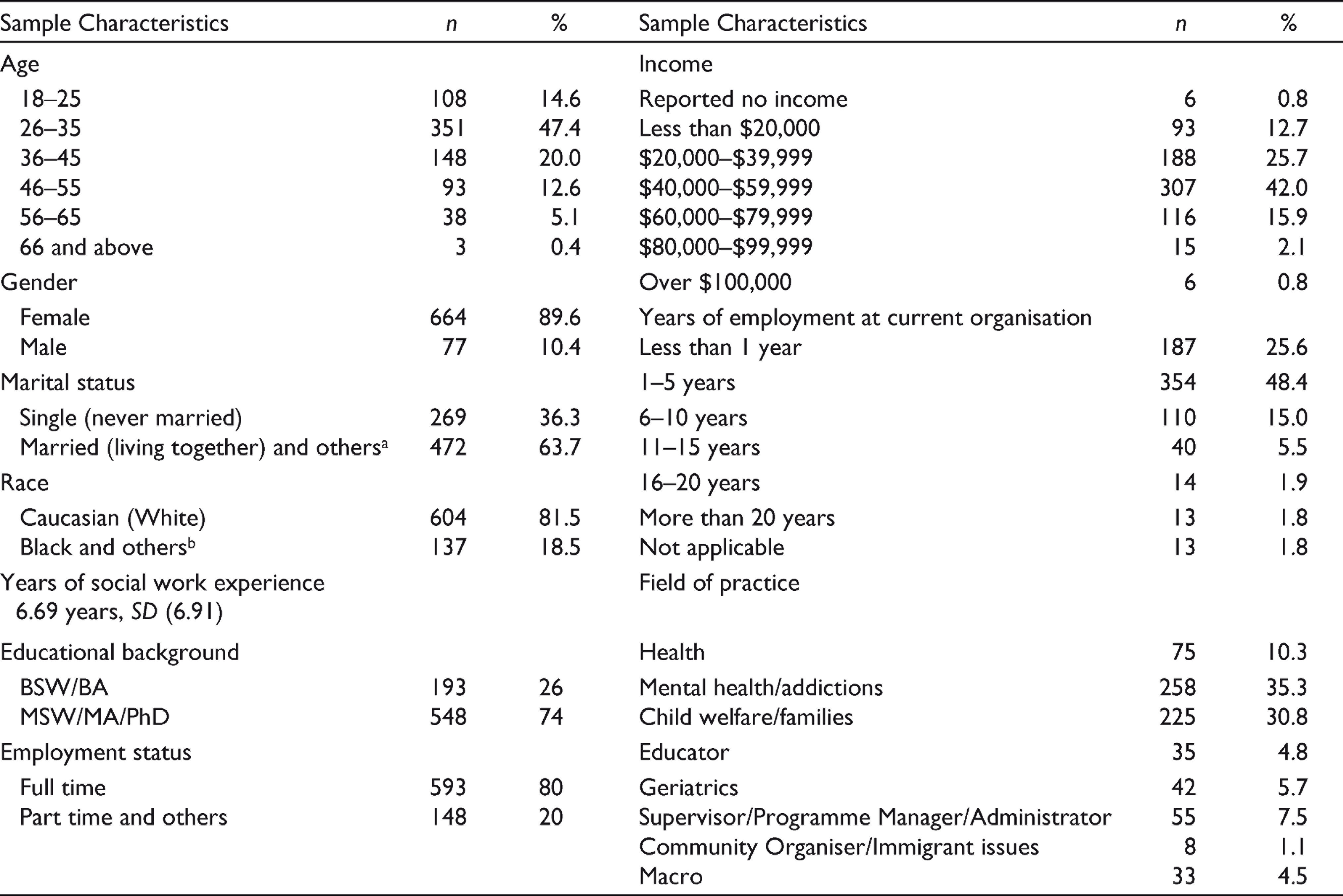
a Married and currently separated, living together in a committed relationship, divorced or widowed.
b Black or African American (Non-Hispanic), Hispanic/Latino, American Indian or Alaska native, Asian, or Biracial/Multiracial.
Procedure
The Massachusetts Chapter of NASW conducted an online survey, using Survey Monkey, during its legislative push for implementation of the Student Loan Forgiveness Program (SLFP) in the state. The survey and its link were advertised in the association’s monthly newsletter and shared with social work education programmes. The survey collected data that included sociodemographic characteristics (e.g. age, gender, race and marital status), job satisfaction and turnover prevention. A total of 1,077 social workers responded to the survey. The IRB of Westfield State University, Massachusetts, USA approved the study. Additional information about the study was reported in Fakunmoju and Kersting (2016).
Data Analysis
Similar to Study 1, descriptive, correlations and hierarchical multiple regression analyses were conducted to describe the data and address the research questions. Descriptive analysis was performed to describe demographic characteristics of study participants. Pearson’s correlation analysis was conducted to examine relationships between SI and MI measures of job satisfaction, demographic characteristics and turnover intention. Spearman’s rho correlations were performed to evaluate convergent and discriminant validity of the relationships between SI job satisfaction measures and MI job satisfaction measures. Respondents who were unemployed, retired and self-employed, including those that did not respond to questions on SI and MI job satisfaction, were deleted. Ipsative mean imputation procedure was performed on MI job satisfaction measures that were missing no more than 25% of the total items (Schafer & Graham, 2002). Thereafter, list-wise deletion was applied to remaining cases and demographic data that did not contain any response. Analyses were performed using SPSS 25 (IBM Corp., 2017).
Estimating the Mediation Model
The SPSS macros of contemporary data analysis approach, PROCES (Hayes, 2012, 2018), were used to examine parallel multiple mediation model (Model 4) comprising the indirect effect of income on turnover intention through SI and MI job satisfaction. The multiple mediation model allows two simultaneous parallel mediators (SI and MI job satisfaction) that did not affect each other to be considered. To estimate the paths or direct and indirect effects in a simple mediation model, PROCESS utilises multiple or logistic regression analytic approach and provides detailed information about model path estimates (i.e. regression coefficients, standard error, t, and p-value for each coefficient), model summary (e.g. R, R2, F), total effect, direct and indirect effects of independent on dependent variable, and an indirect effect key that captures each path through which the indirect effect of independent variable on dependent variables passes (Hayes, 2012). Bootstrapping, a nonparametric resampling procedure, was used to estimate the indirect effect of independent variable on the dependent variable through the mediating variable (Hayes, 2009; Preacher & Hayes, 2008). In estimating the indirect effect, the percentage of the confidence interval must be specified, which was set at the 95% level in this analysis. The bias-corrected and percentile bootstrapped confidence interval was used to obtain the interval estimates; the number of bootstrap samples was 1,000. For the indirect effect to be significant, the specified percent of confidence interval must not include zero from the lower (LLCI) to upper (ULCI) confidence intervals. The macros for PROCESS can be opened as a syntax file for SPSS and SAS. (Additional information on using PROCESS macros, as well as bootstrap samples, to obtain interval estimates for the mediation model can be obtained from Hayes, 2012, 2018.) The syntax file for SPSS was used in this analysis.
Results
Correlation
Turnover intention, income, SI and MI job satisfaction correlated with each other. Turnover intention (M = 3.66, SD = 1.59) was significantly negatively correlated with income (r = −0.169, p < 0.0005), SI job satisfaction (r = −0.598, p < 0.0005) and MI job satisfaction (r = −0.651, p < 0.0005). Income significantly positively correlated with SI job satisfaction (r = 0.141, p < 0.0005) and MI job satisfaction (r = 0.109, p = 0.003). Among items for MI job satisfaction, SI job satisfaction mostly correlated significantly positively with ‘All in all, I am satisfied with my job’ (r = 0.706, p < 0.0005), followed by ‘In general, I like working here (i.e. at my job)’ (r = 0.660, p < 0.0005). In general, SI job satisfaction (M = 3.39, SD 1.00) had lower mean than MI job satisfaction (M = 3.88, SD 0.85).
Convergent and Discriminant Validity
Convergent validity was computed using Spearman’s rank-order correlation coefficients to evaluate the relationship between concurrent assessments of SI job satisfaction and MI job satisfaction. A statistically significant correlation (ρ = 0.700, p < 0.0005) was found, suggesting that the measures converge in terms of measurement of job satisfaction (Research Question 1). A similar convergent validity was established by using another item (i.e. ‘If I may choose again, I will choose to work for my current organisation’) from the 3-item Michigan Organizational Assessment Questionnaire Turnover Intention Subscale (Cammann et al., 1979), which demonstrated a statistically significant Spearman’s correlation coefficient (ρ = 0.473, p < 0.0005).
Discriminant validity of SI job satisfaction was examined using one item (i.e. ‘In general, I don’t like my job’) from the 3-item Michigan Organizational Assessment Questionnaire Job Satisfaction Subscale (Cammann et al., 1979), believed to be negatively related to job satisfaction (job dissatisfaction) prior to reverse coding. The one item demonstrated a statistically significant negative Spearman’s correlation coefficient with SI job satisfaction (ρ = −0.563, p < 0.0005; Research Question 2).
Gender Differences in SI and MI Job Satisfaction
Results of the independent-samples t test to determine whether SI and MI job satisfaction differed by gender suggested that women did not significantly differ from men in mean responses to SI and MI job satisfaction (table not shown; Research Question 3). Similarly, results of the independent-samples t test to determine whether SI and MI job satisfaction differed by race suggested that those who were Caucasian (White) did not differ significantly from those who were Black (and other racial backgrounds) in mean responses to SI and MI job satisfaction. However, results of the independent-samples t test to determine whether SI and MI job satisfaction differed by marital status suggested that those who were married, divorced or widowed (M = 3.47, SD = 0.98) were more likely than those who were single (M = 3.26, SD = 1.04) to report SI job satisfaction (Research Question 3). Similarly, those who were married, divorced or widowed (M = 3.96, SD = 0.79) were more likely than those who were single (M = 3.73, SD = 0.92) to report MI job satisfaction.
Indirect Effects of SI and MI Job Satisfaction on the Relationship Between Income and Turnover Intention
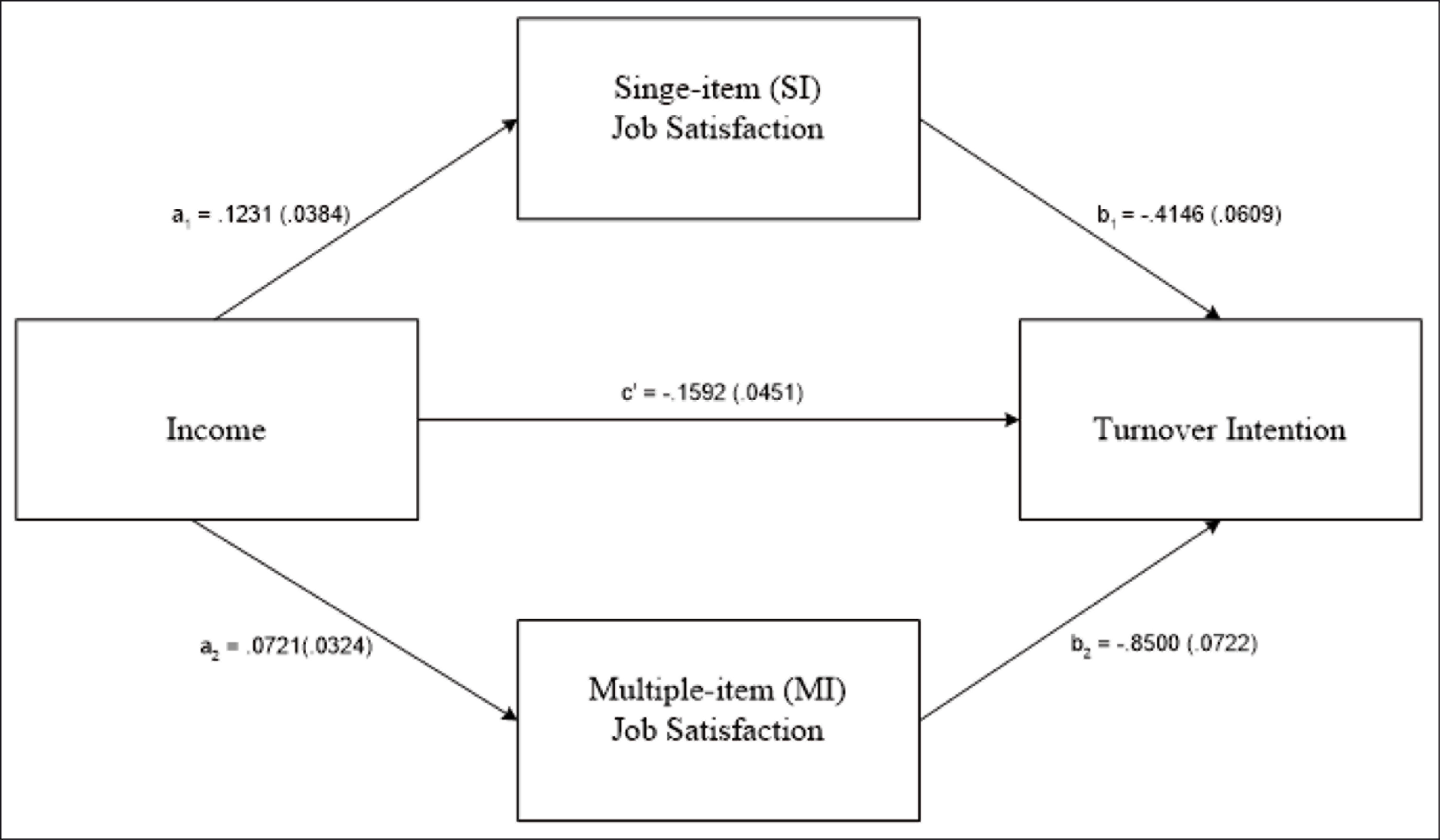
The statistical results of parallel multiple mediation model describing the indirect influence of income on turnover intention through its effects on SI and MI job satisfaction are reported in Figure 1 and Table 4. The parallel multiple mediation model (Model 4) was significant (F(6, 722) = 106.05, p < 0.0005) and accounted for approximately 47% of the variance in turnover intention. SI and MI job satisfaction were associated with turnover intention (Research Question 4). A closer look at the specific indirect effects reveals a 95% bias-corrected bootstrap confidence interval that did not contain zero for SI job satisfaction (−0.0923 to −0.0217) or MI job satisfaction (−0.1217 to −0.0008), indicating that both SI and MI job satisfaction significantly mediated (in parallel) the effects of income on turnover intention (Research Question 5). This suggests that higher income leads to higher job satisfaction, which in turn leads to lower turnover intention. In addition, higher age (being older) was associated with turnover intention.
Indirect Effects of Income on Turnover Intention Through Parallel Multiple Mediation of Single-item (SI) and Multi-item (MI) Job Satisfaction Measures
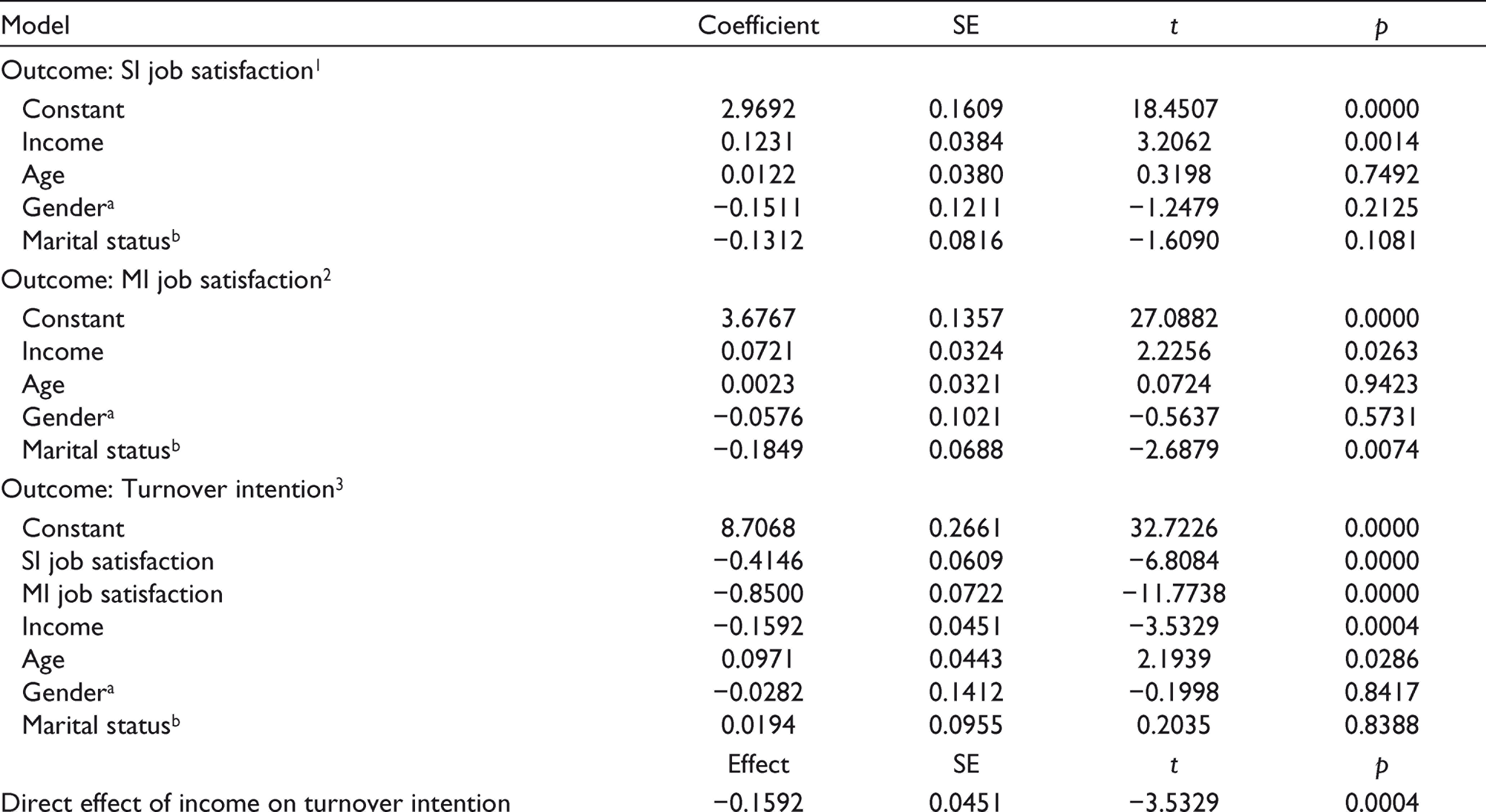

Number of bootstrap samples for bias-corrected bootstrap confidence intervals = 1,000. Level of confidence for all confidence intervals in output = 95.
a Male = 1, female = 0. bSingle (never married) = 1, married (living together) and others (married and currently separated, living together in a committed relationship, divorced or widowed) = 0.
Discussion
This article describes the validity of SI versus MI job satisfaction in predicting life satisfaction and turnover intention among social workers in two studies. Findings indicate that SI job satisfaction performed reasonably as well as MI job satisfaction. In the two studies, moderate convergent validity between SI and MI job satisfaction and small discriminant validity between SI job satisfaction and job dissatisfaction measures were identified. In both studies, demographic differences (i.e. gender, marital status and race) in SI job satisfaction were not systematically different from demographic differences in MI job satisfaction, and SI and MI job satisfaction accounted for comparable variance in life satisfaction and turnover intention.
Validity of SI Versus MI Job Satisfaction
Discriminant validity of SI job satisfaction is clearly established by its negative correlation with job dissatisfaction measures and its convergent validity is clearly demonstrated by its positive correlation with MI job satisfaction measures. A convergent validity demonstrated by a statistically significant correlation between SI and MI job satisfaction in Study 1 (0.61) and Study 2 (0.70) is consistent with meta-analytic findings (0.67) by Wanous et al. (1997). SI job satisfaction demonstrates a comparable association with life satisfaction, a finding that is consistent with previous studies (Keser et al., 2019; Lambert et al., 2018; Udayar et al., 2020; see previous study on the association between MI job satisfaction and life satisfaction; Fakunmoju, 2018). A reciprocal predictive relationship between job and life satisfaction is consistent with spillover, compensation and segmentation hypotheses (Judge & Watanabe, 1994). SI job satisfaction also established predictive validity for turnover intention, thereby solidifying its suitability for examining associations with attitudinal variables.
The validity of SI job satisfaction extends beyond its association with same and similar constructs (i.e. MI job satisfaction, life satisfaction and turnover intention) to its comparable mean in demographic characteristics. The realisation that SI job satisfaction demographic differences did not systematically differ from demographic differences in MI job satisfaction limits the concerns about its susceptibility to social desirability response bias. This lack of systematic differences is further demonstrated by the comparable variance accounted for in the regression models, thereby minimising concerns about systematic inflation of variance. The realisation that both SI and MI job satisfaction measures demonstrated consistency in association with life satisfaction and turnover intention and consistently mediated the indirect effects of income on turnover intention minimises concerns about potential susceptibility of SI job satisfaction to socially desirable response bias. From all indications, SI measure of job satisfaction is as effective as MI measures of job satisfaction and consistently performed reasonably well as MI measures of job satisfaction.
Results in Study 1 and Study 2 addressed the impression that SI job satisfaction measures tend to paint a rosier picture of job satisfaction (Oshagbemi, 1999) since results by SI job satisfaction consistently matched the results by MI job satisfaction. While SI job satisfaction had higher mean responses than MI job satisfaction in Study 1, it had lower mean responses than MI job satisfaction in Study 2. The mean differences were not major enough to result in considerable differences in findings. The lack of systematic differences in variance accounted for in all of the analyses also minimises concerns about the tendency of SI job satisfaction measure to paint a rosier picture of job satisfaction. In fact, the collection of data from practitioners from different organisations in different locations might have helped to minimise the susceptibility of SI job satisfaction measure to socially desirable responses and reduce the effects of prevailing conditions in a specific organisation from having major effects on participants’ responses.
Associations Among Demographic Characteristics, Job Satisfaction, Life Satisfaction and Turnover Intention
Beyond validity analyses, the associations between demographic characteristics and life satisfaction and turnover intention are consistent with previous findings. Being married was associated with life satisfaction (see previous findings, Fakunmoju, 2018), a finding that is consistent with a recent study that found women to be more likely than men to be satisfied with their lives (Joshanloo & Jovanović, 2020) and married women to be more likely than men to be satisfied with their lives (Botha & Booysen, 2013). A similar finding that those who were married were more likely to be satisfied with their jobs than those who were single is consistent with a previous study that found being married to be associated with job satisfaction (Kemunto et al., 2018). Interestingly, marital satisfaction has greater effects on life satisfaction (Kasapoğlu & Yabanigül, 2018; Ng et al., 2009) and a previous study suggests that the effects were greater for women than for men (Ng et al., 2009). Although being unmarried provides some degree of independence, marriage has beneficial effects on relationship, as it helps to expand one’s social network and support system and increases the level of financial and emotional support available, which in turn has a spillover effect on job and life satisfaction. It is not surprising that those who were married were more likely than those who were single to be satisfied with their job and life. In fact, a recent study suggests that beliefs about marriage play significant roles in life satisfaction such that ‘belief in the advantages of marriage was generally associated with less life satisfaction for those who were unmarried, regardless of gender’ (Moss & Willoughby, 2018, p. 274).
The indirect effect of income on turnover intention through job satisfaction highlighted the importance of job satisfaction to turnover intention, as indicated by the significance of both SI and MI job satisfaction in mediating the effects of income on turnover intention. The effect of income on job satisfaction was consistent with previous studies that found a similar effect (Takei et al., 2009; Yang et al., 2008), and the effects of income on turnover intention were also consistent with findings in previous studies (Fakunmoju et al., 2010; Liu et al., 2019). In fact, findings from the parallel multiple mediation model are consistent with a recent finding suggesting that reward indirectly influenced turnover intention through its effects on job satisfaction (Hardianto et al., 2019): ‘There is a direct negative effect of rewards on turnover intention, and there is a direct negative effect of job satisfaction on turnover intention and lastly there is a direct positive effect of reward on job satisfaction’ (p. 128). Financial incentives appear to be a good motivation for job performance, which has implications for increasing employees’ satisfaction about their jobs and reduces their propensity to leave their jobs.
Similar to income, age was associated with turnover intention, a finding that is consistent with a recent meta-analysis that found a similar impact of age on turnover intention (Kim & Kao, 2014). In fact, a recent study found age and income to be associated with turnover intention and job satisfaction to decrease the effects of job stress on turnover intentions (Liu et al., 2019). Although several factors (e.g. job stress, lack of supervisory support, low income) may be attributed to workers’ intent to leave their job, the impact of higher age on turnover intention suggests that increases in personal responsibilities (e.g. increase in family size, increase in financial obligations) and job experience that come with increase in age may be attributed to workers’ intention to leave their jobs to secure better-paying jobs. They may also intend to leave their jobs due to low income, personal or family reasons, moving and relocation, poor job fit, or poor working conditions (e.g. poor working hours and job insecurity). However, intending to leave a job does not necessarily mean leaving the job for another one; it may mean leaving the job for retirement. The reasons for turnover intention for older workers may differ from reasons for turnover intention for younger workers. Being close to retirement age provides a plausible explanation, as much as being dissatisfied with the job. Older workers may intend to leave their jobs due to retirement, self-employment or a desire to start a private practice.
Strengths and Limitations
Both studies have strengths and limitations that have implications for findings in this article. The primary strength relates to the ability to demonstrate validity and comparative utility of SI job satisfaction from data derived from social work professionals from different specialisations working with different organisations, which enhances the generalizability of findings, rather than data collected from employees of a specific organisation. Some articles rely on single study or respondents from the same organisation to reach conclusions about the validity and utility of SI versus MI measures. Regrettably, crisis, challenges or conditions within an organisation might contaminate perception and, ultimately, conclusions reached about the validity of examined measures. The use of two studies and two measures of MI job satisfaction and subsequent comparable findings enhances the validity and relevance of the SI measure of job satisfaction.
Despite the above strengths, the studies have some limitations. The primary limitation relates to the cross-sectional nature of the studies and the realisation that the data were drawn from social work professionals in one state, Massachusetts. As a result, findings are not generalisable to practitioners in other regions of the country. Similarly, given the cross-sectional nature of both studies, it was not possible to capture the effects of changes in job satisfaction over time on the validity of SI versus MI measures of job satisfaction, thereby making it challenging to reach conclusions about the appropriateness of SI job satisfaction in ways comparable to MI job satisfaction. Longitudinal designs would help in understanding the differential ability of SI and MI measures of job satisfaction to capture changes in determinants and correlates of job satisfaction. They may also help to capture differential effects of changes in job satisfaction on SI and MI measures of job satisfaction. Finally, due to the studies being cross-sectional and the fact that different MI job satisfaction measures were utilised in Study 1 and Study 2, the reliability of SI job satisfaction could not be estimated, as reported by Wanous and Reichers (1996).
Implications, Suggestions and Recommendations
Findings from the two studies have implications for empirical use of SI job satisfaction measures for research and practice. SI measure of job satisfaction is worthy of considerations for use when feasible, as its methodological relevance and findings are comparable to those of MI measures of job satisfaction. Based on an extensive review of the literature (e.g. Diamantopoulos et al., 2012; Fuchs & Diamantopoulos, 2009; Sarstedt & Wilczynski, 2009) and findings in the present study, Table 5 describes some methodological factors to consider when choosing between SI and MI measures. These include objectives of the research, participants, available resources, existing measure, nature of comparative measure, design of the study, reliability of existing measures, analysis and dissemination of findings. The methodological considerations are not to be considered in isolation, as their combinations are critical to choosing the appropriate SI versus MI measure. The ability to meet at least one condition in each criterion will facilitate a better judgement of using SI versus MI measures. For example, if the objective is to gain a general view of a less abstract construct that has no precise existing measure, cross-sectional data will be collected from diverse participants from different organisations, the construct of interest will be used as a control or moderator variable in the analysis, and findings are intended for general audience, using an SI measure would be appropriate, cost-effective and reasonable. Organisations that are constrained by time and money and researchers concerned about respondent burden may also consider use of an SI measure, following testing of other criteria.
Choosing Between Single-item and Multiple-item Measures


Although some items or subconstructs in MI measures do not apply to workers in all occupations and organisations, thereby limiting the likelihood of their use with respondents across occupations and organisations, the susceptibility to social desirability responses or response bias from using SI measures supports the need for careful considerations of methodological factors highlighted in Table 5. The need to use the composite score of all facets of multidimensional measure of job satisfaction, rather than the composite score for each facet or dimension in the analysis, makes the appropriateness of SI measures of job satisfaction attractive. Similarly, the proliferation of MI measures of job satisfaction containing few items without facets or subconstructs makes the use of SI measures of job satisfaction more attractive, especially if the response choices of the SI measure range from 7 to 10 to enhance discriminant validity instead of 5 or fewer response choices. It is therefore not surprising that ‘overall job satisfaction may be a more inclusive measure of overall job satisfaction than summation of many facet responses’ (Scarpello & Campbell, 1983, p. 577).
Given the lack of empirically based guidelines for selecting SI measures over MI measures (Diamantopoulos et al., 2012), a combination of the above conditions and guidelines may be considered in exercising judgement about the use and type of SI measure of job satisfaction. For example, analysis of an SI measure’s association with attitudinal constructs using a small sample size of respondents from different organisations is more likely to generate comparable findings than will analysis of the SI measure’s association with mood-related constructs using a large sample size of respondents from the same organisation. Although it is simple to use, time and cost-effective, minimises respondent burden, is suitable for studies in which respondents work in different occupations and organisations, and generates comparable findings across time, settings and regions, the use of a single item to measure overall job satisfaction may prevent one from determining whether satisfaction or dissatisfaction may be attributed to coworker or supervisory support, monetary reward and fringe benefits, promotion or advancement opportunities, person-job fit/perceived difficulty of job and so on, information that is critical to providing necessary intervention in a specific organisation. The SI measure of job satisfaction thus deprives management the opportunity to address the underlying factors behind job satisfaction or dissatisfaction.
Diamantopoulos et al. (2012) provided guidelines for choosing between SI and MI measures. SI measures may be considered when the ‘sample size’ is small (less than 50), when the expected ‘effect size’ is weak (i.e. when cross-item correlations are less than 0.30), when items are ‘highly homogenous’ (i.e. inter-item correlations are greater than 0.80 and Cronbach’s alpha greater than 0.90), and when items are ‘semantically redundant’ (p. 447). Combining these methodological considerations with decisions regarding research protocol and logistics (e.g. budget constraints, participant recruitment challenges, inadequate population size; see Fuchs & Diamantopoulos, 2009) will facilitate better decisions about choosing an SI measure of job satisfaction. These analytical guidelines clarify previously elucidated criteria for choosing SI measures, namely, ‘(1) the nature of the construct, (2) the nature of existing instruments, (3) the research objectives, and (4) sampling considerations’ (Fuchs & Diamantopoulos, 2009, p. 203).
Considerations for empirically established factors associated with job satisfaction may help to ease the challenges that come with choosing an SI measure of job satisfaction. Bowling and Hammond (2008) provided a list of correlates (e.g. life satisfaction, job tension, satisfaction with pay, organisational commitment, satisfaction with coworkers and satisfaction with supervision) and causes (e.g. role ambiguity, role conflict, role overload, job complexity, organisational constraints, work–family conflict, supervisor support, coworker support and perceived organisational support) of job satisfaction that may be considered in decision-making. Relatively stable attitudinal and job-related variables, rather than mood-related variables, may be considerations in the decision-making process.
Conclusion
The present findings in no way suggest the superiority of SI measures of job satisfaction over MI measures of job satisfaction; rather, they describe methodological relevance and validity, while shedding light on conditions and guidelines for use. When properly considered and utilised, an SI measure of job satisfaction is as valid as an MI measure of job satisfaction. When methodological and logistic considerations are critically examined, using an SI measure of job satisfaction may provide occupational and organisational clarity in ways that are comparable to empirically validated MI measures of job satisfaction. In the case of methodological impasse due to considerations about theoretical and practical aspects of measures, utilising both SI and MI measures of job satisfaction becomes a feasible alternative.
Footnotes
Acknowledgements
The author would like to thank Massachusetts Chapter of NASW for permission to use the data for Study 2 in this article. However, the views and opinions expressed in the article do not necessarily represent the views or positions of the Massachusetts Chapter of NASW.
Declaration of Conflicting Interests
The author declared no potential conflicts of interest with respect to the research, authorship and/or publication of this article.
Funding
The author received no financial support for the research, authorship and/or publication of this article.