



Abstract
In today’s era, business is Internet-driven that embarked on the evolution of the digital era. We are in the digital age with complete technology-driven activities facilitated by the Internet. This has certainly opened many new options for businesses to plug themselves. A gamut of studies has reported a positive influence of print media marketing on business. However, this study examines the effectiveness of print media marketing in today’s highly competitive digital era for the Indian telecommunication industry. A model was proposed to gauge the effectiveness of print media on customer retention for the telecom industry. The study was conducted with 200 customers from various telecom service providers, using a survey questionnaire which was administered to them. Research findings indicate that the migration to online sources is inevitable although print media has not become obsolete. It is also revealed that the print media alone is not effective and hence is unable to retain the consumers. The integration of print media marketing with digital and social media marketing is the recommendation of this study. This bundle is often effectively utilized to reinforce awareness and retention. The study also presents implications, limitations and future research direction within the context.
Keywords
Introduction
The role of media is to educate, inform, guide and make society aware of the issues. India is the largest democracy in the world, so is the role of media to educate the people about their rights enshrined in the constitution. Today, the existing values of media, governed by electronic and digital technology, pose a big challenge to print media, especially the newspaper (Nic et al., 2018). The study is very helpful to understand how the print media is an important means to make the consumer associate and aware of the services provided by the telecommunication industry in the fast and growing digital age. Print media has reached the consumer to the remotest place where digital technology is still a dream. Print media also reaches all corners of the globe and is still one of the powerful tools today in this growing age of digitization.
This study aims to investigate the effectiveness of print media in digital age on customer retention through components of brand equity. The first research objective is to check and validate the relationships between print medium and components of brand equity. Second objective of this research is to acknowledge the effectiveness of print media in digital age with reference to their impact on customer retention through components of brand equity. The various components of brand equity (i.e., brand association, brand awareness, perceived quality and brand loyalty) are tested with respect to print media and a positive relationship is established with the components. This study will help us to clearly understand how much impact the print media has on customer retention. Although print media does not directly impact the awareness among the customers, it plays a vital role in creating associations.
As per Digital Advertising in India 2020 (Dentsu Aegis Network, 2020), the Indian advertising industry has grown at a rate of 9.4% during 2018 to reach ₹6,84,750 million by the end of 2019 and was expected to grow by 10.9% to ₹7,59,520 million by the end of 2020. The digital advertising industry stands at ₹1,36,830 million up at a rate of 26% from ₹1,08,590 million in 2018. Print has seen a slower growth with its media spends share declining from 31% in 2018 to 29% in 2019. Print is expected to grow at a rate of 3% to reach the media spends share of 27% in 2020. English newspapers have faced stiff competition from the digital platforms, which has led to a drop in readership. Regional print publications have, on the other hand, witnessed growth in ads spends, offsetting the growth for the overall media.
This organic growth shall be achieved from the print loyalists, viz. auto, retail, media, entertainment and government. advertisements. With increasing adoption of Internet and growing popularity of smartphones, there has been a shift in advertising spends from traditional to digital media.
This study aims to know the effect of print media in digital age in retaining the customers for Indian telecom service providers. This study supports the importance of print media in creating association and brand loyal new customers but simultaneously proves that print media has the least role to play in customer retention. The results of the study are believed to place significant contribution to practice and literature since media are often defined as a platform for building relationships with customers and forming positive image of the brands in their eyes. While this is true for each non-traditional tool of selling communication, print media is eagerly explored and utilized by the businesses. The results of this study show that print media has not become absolute, and it should be effectively used alongside digital and social media for advantageous campaigns.
Literature Review
Print media has been an essential tool for mass communications, for spreading knowledge and awareness (Pandey & Kumar, n.d.). For many decades print media has emerged as the most appropriated media to connect to the mass and has not lost its relevance. The origins of modern printing in India can be credited to the Spanish Coadjutor, Brother John De Bustamante from Goa in 1550. The primary newspaper was printed in Kolkata in 1766 by William Bolts. During the latter half of the nineteenth century, Anglo-Indian Press was established in India. Since then, the press in Indian languages grew rapidly. Consistent with Indian Readership Survey, the media grew to 10,51,063 (Universe Size (‘000), 12 +years) despite the growth of Internet (Indian Readership Survey 2019 Q4, 2020). The print media remains the world’s largest advertising media with a 40% share. India has emerged as the second largest newspaper market in the world by buying 99 million newspapers daily, according to World Association of Newspapers (WANs) figures released at the 61st World Newspaper Congress and 15th World Editors Forum in Göteborg, Sweden. China leads the pack with the highest (107 million) number of dailies sold every day. From the 1990s, India has experienced growth in electronic media and online new services.
Theoretical Framework and Hypothesis Development
Print Media
The print media is a media of mass communication that are physically printed on papers such as newspapers, magazines, journals, flyers, newsletters, etc. Newspapers have been the major source of disseminating information from time memorial. Nyamamu (2014), in his study, concluded that digital advertising will have an enormous impact on the performance of the print media companies in the next 5 years. However, Dash and Belgaonkar (2012) in their research compared the effectiveness of radio, print and web advertising and suggested that one or more media are often combined for better results. Bruhn et al. (2012) showed that both traditional communications and social media communications have a big impact on brand equity. Thurman (2014), in his study, reveals that the newspaper has suffered decreases in terms of the most up-to-date times. Biloš and Kelić (2014) showed that offline channels contributed more to absolute numbers, while online channels were significantly more cost-effective. Moving further, Odun and Utulu (2016) observed that while the new media has, indeed, gained much acceptance and patronage, it is still an extension of the normal and not a replacement for traditional media. A gamut of studies found that print media advertising is trustworthy, although it does not influence the buying decision (Krajčovič & Čábyová, 2017). Hassan et al. (2018) discussed the various methods of selecting better strategies for the continual survival of print newspapers within the digital age of communication. On the basis of the above-mentioned arguments, this article hypothesized that
Brand Awareness
Brand awareness refers to the extent to which customers are ready to recall or recognize a brand. A study by Yoo et al. (2000) explained that frequent price promotion has low reference to brand equity, whereas high advertising and promotion have high reference towards brand equity. Huang and Sarigöllü (2012) revealed that positive user experience has a positive impact on brand awareness and marketing mix. Odhiambo’s (2012) study highlighted that social media is very effective as against traditional media in creating brand awareness. Bhat and Chakraborty (2018), in their study, revealed that online reviews have a significant impact on brand awareness and perceived value. ElAydi (2018), in his study, recommended that marketers and managers should efficiently use social media marketing activity on Facebook to extend its brand awareness. Hence, we hypothesize that
Perceived Quality
Perceived quality is often defined as the customers’ perception of the general quality or superiority of a product or services regarding its intended purpose and relative to alternatives. Cristobal et al. (2007) developed a scale for measuring e-service quality and its influence of perceived quality for satisfaction of consumers, and satisfaction successively influences on consumer loyalty. Wang et al. (2009) have examined the degree of consumer expectation for perceived quality measurement framework with reference to the opposite expectations utilized in marketing. Eshghi (2008) attempted to spot factors for the Indian mobile telecommunication market, which influence customer satisfaction, repurchase intention and customer’s propensity to recommend services to others. A study by Gautam (2015) showed that service quality perception of consumers is a vital component in mobile telecommunication services marketing. Nambiar et al. (2019), in their study, showed that service quality has a positive impact on retention of services. Ali (2017) has shown that in the commission industry, customer service quality plays an important role in attracting and retaining customers. Mohammed Ahmad Alsaggaf (2018) investigated the consequences of customer perception of service quality on electronic word-of-mouth communication (eWOM) and switching intention through cognitive and emotional responses. Demir (2019) evaluated each Global System for Mobile Communications (GSM) service operator from various aspects of service quality, which are very crucial for telecom service providers. Based on the above-mentioned argument, this article proposed that
Brand Association
Brand association is anything that is deep-seated in the customer’s mind about the brand. Brand associations are the attributes of brand name, which inherit consumers’ mind when the brand is talked about. James (2005) has identified the association between the respondents’ need to the brand alone as well as once they combine them in an alliance. Doostar et al. (2012), in their study, indicated that dimensions of brand name equity have an immediate impact on purchase decisions, whom they think are familiar and associated. Spais et al. (2019), in their study, stated that a strong relationship is required between customers and the firms to create a value chain. A study performed by Akhtar et al. (2016) showed that brand association has less impact on brand equity than brand loyalty. While the study performed by Sinha and Verma (2018) revealed that the utilitarian advantage of the advertisement has the most impact on brand loyalty, while the hedonic advantage of the advertisement has the most impact on brand association. Mudanganyi et al. (2019) revealed that to succeed and survive, the service providers need to build brand equity because it ensures customer retention, repeat purchase and association. Therefore, this article proposed that
Brand Loyalty
Brand loyalty is the tendency of consumers to continuously purchase one brand’s products over a competitor brand. A study performed by Yim and Kannan (1999) stated that behavioural brand loyalty, which has always considered loyalty as a notion of the consumer, will depend upon the composition of a brand’s clique loyal and on the factors that motivate to repeat purchase. Furthermore, the study by Curtis et al. (2011) demonstrated the positive relationship between customer loyalty and satisfaction. Loyalty is positively linked to repurchase and satisfaction. Erdogmus (2012), in this study, showed that the brand loyalty of consumers is positively affected by the campaign, relevant offers and popular content and appearance on various platforms on social media. ElAydi (2018) has studied the impact of social media marketing on brand loyalty. Al-Msallam (2015), in his study, stated that customer satisfaction, image and price significantly affect brand loyalty. Sujata et al. (2016), in their study, have identified the importance of Online Brand Communities (OBC) commitment in building and enhancing loyalty among telecom subscribers. Izogo (2018), in his study, examined how firms can influence customer loyalty through customer commitment by leveraging service quality. Singh (2017), in his study, reviewed the antecedents and consequences of customer loyalty and suggested a conceptual model. Yassin et al. (2018) suggested that each one component of brand name equity possesses a positive effect on brand equity and emphasized that brand loyalty must be maintained. Jamshed and Pathak (2019), in their study, identified the effect and significance of brand name association dimensions on brand loyalty for young consumers of the telecom industry. Yew and Rahman (2019) showed that perceived quality and satisfaction influenced loyalty, whereby perceived quality also influenced satisfaction. Mullatahiri and Ukaj (2019) showed a positive effect of e-Marketing in brand loyalty and acted as key to building image, satisfaction, commitment and loyalty towards the brand of mobile operators. As aforementioned, this article proposed that
Customer Retention
Customer retention refers to the power of a corporation or product to retain its customers over some specified period (Kuo & Yen, 2009). Ahmed et al. (2010) postulated that each one dimension of service quality has a positive relationship with satisfaction. The results of the study reveal a positive and significant relationship among customer satisfaction and customer service, price fairness, advertisement, coverage, signal strength and promotion. Nambiar et al. (2019), in their study, showed that customer value has positive impact of customer retention. A gamut studies emphasized to seek out the connection between Electronic Customer Relationship Management’s (e-CRM's) effective factors, loyalty and customer retention (Khan & Shahzad, 2012; Abdolhosseini Khaligh et al., 2012). Sandes and Urdan (2013), in their study, also verify eWOM’s effects on consumer behaviour and its impact on brand image but has a negligible impact on the purchase intention of the consumer. Sujata et al. (2016) within their study stated that while formulating their CRM strategy, they ought to also manage customer experience management and strategy for customer retention. A study by Akhtar et al. (2016) showed that brand awareness has less impact on brand equity, while brand loyalty was the important and key factor that would change the intention to get by the consumers.
Hence, we hypothesized that:
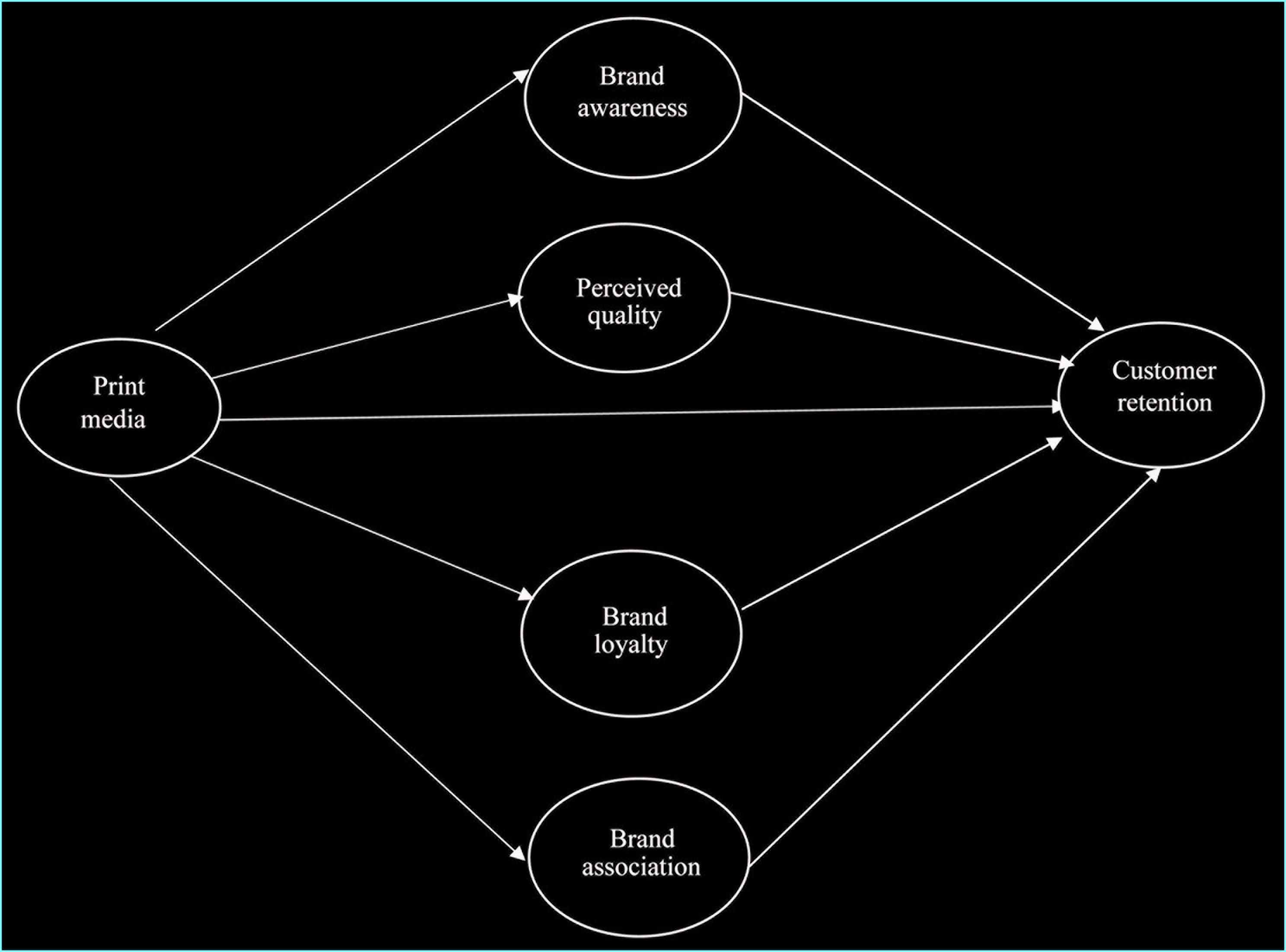
To accomplish the objectives of the study, the variables, and relationships between them have been represented as the theoretical model in the form of pictorial illustration, including independent, dependent and mediating variables as shown in Figure 1. Print media is the independent variable, customer retention is the dependent variable and components of brand equity is the mediating variable.
Research Methodology
The data were collected from 200 Indian respondents through a convenience sampling method. The data were analysed by using partial least squares (PLS)-based structure equation modelling. This study was conducted to review the effectiveness of print media in the digital age on the retention of consumers for telecom service providers. To check the research assumptions, we have developed a questionnaire for the field survey, which also contains the section of demographic information. With the assistance of the questionnaire, we collected the specified data and therefore the details are as follows:
Measures
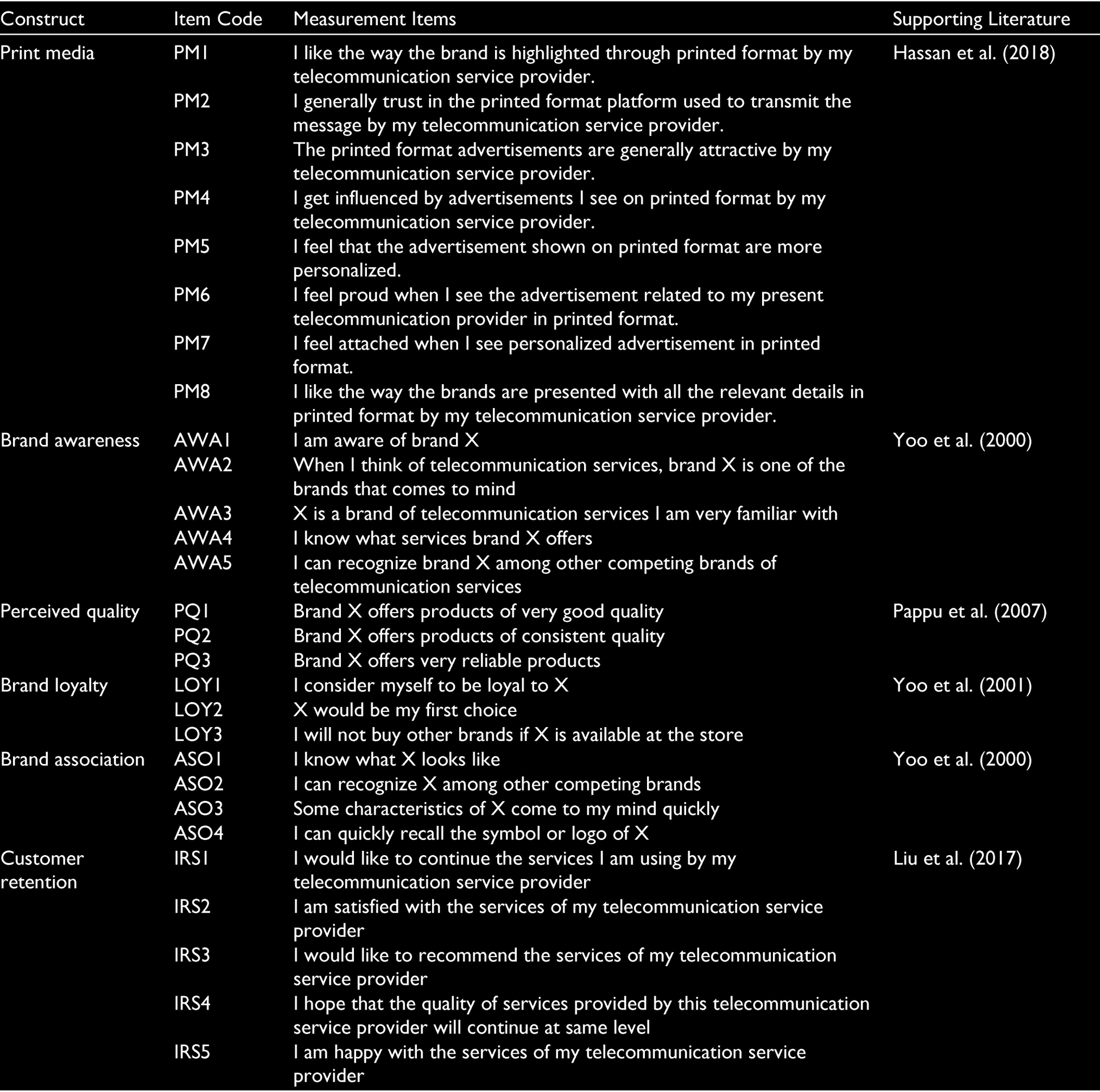
The survey instrument was developed from the past studies, conducted by various authors, consistent with the research objectives and research publications. The research model includes experimental variables (i.e., print media), variable (i.e., customer retention) with mediating variables of brand name equity (i.e., brand awareness, brand association, perceived quality and brand loyalty). All scales are measured using a 5-point Likert Scale (1 for Strongly Disagree and 5 for Strongly Agree). The measure of variables of brand name equity is adopted from Yoo et al. (2000), Pappu et al. (2007) and Yoo et al. (2000). Eight items that measured the media are adopted from Hassan et al. (2018), Al-Dmour et al. (2013), Dayton (2016) and Yassin et al. (2018). Similarly, four items each that measured brand awareness and brand association are adopted from Yoo et al. (2000). Three items that measured brand loyalty and perceived quality are adopted from Yoo et al. (2000) and Pappu et al. (2007). Five items that measured customer retention are adopted from Dubey and Srivastava (2016) and Liu et al. (2017). The latent variables and their construct are presented in Table 1.
Scale Development
Sample Design and Data Collection
A total of 200 questionnaires were collected through Google Form circulated to varied email groups, WhatsApp groups and text responses were received/collected. Completed 200 responses were received, out of which 184 responses were found to be accurately filled, and therefore the rest 16 responses were discarded due to incomplete information provided in the form, presented in the Table 2:
Demographic Description
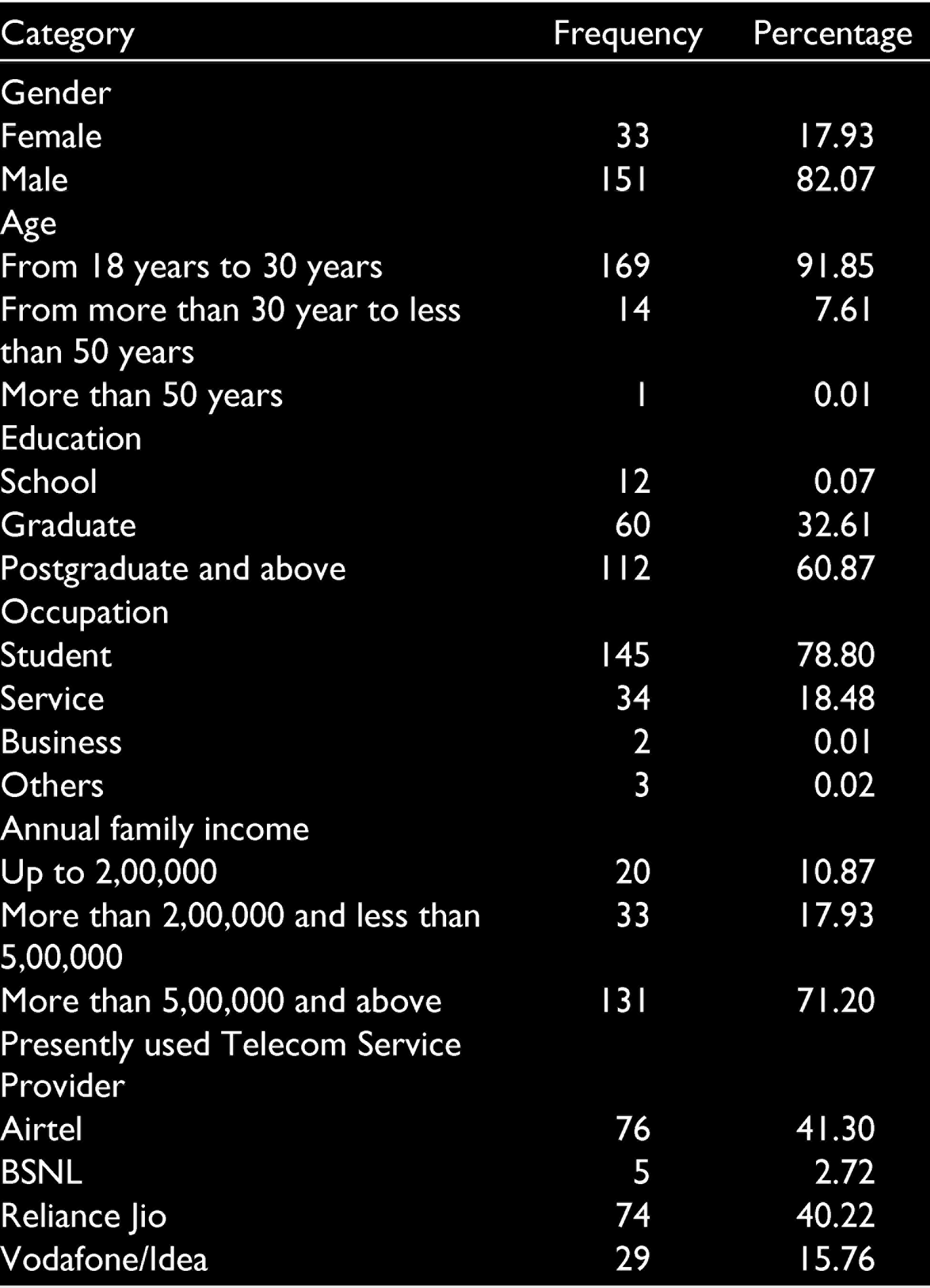
After removing the unfilled data, the 184 responses were used for analysis. Approximately 18% were females, and 82% were males. Most of the respondents, that is, 169 (91.85%) were between 18 years and30 years, followed by 14 (7.61%) who more than 30 years but less than 50 years and 1 (0.01%) was more than 50 years of age. Most of the respondents—112 (60.87%)—had completed postgraduation or beyond, followed by 60 (32.61%) who were graduates and 12 (0.07%) were undergraduates. In terms of occupation, majority of the respondents, 145 (78.80%) were students, followed by 34 (18.48%) who were in service, 2 (0.01%) were in business and 3 (0.02%) had other occupations. Regarding the income, most of the respondents, that is, 131 (71.20%) had an income above ₹5,00,000 and more, 33 (17.93%) had more than ₹2,00,000 but less than ₹5,00,000 and 20 (10.87%) had income less than ₹2,00,000. With respect to presently used telecom service provider, 76 (41.30%) were presently using Airtel, followed by 74 (40.22%) who were using Reliance Jio, 29 (15.76%) who were using Vodafone/Idea and 5 (2.72%) were using BSNL services.
Measurement Model
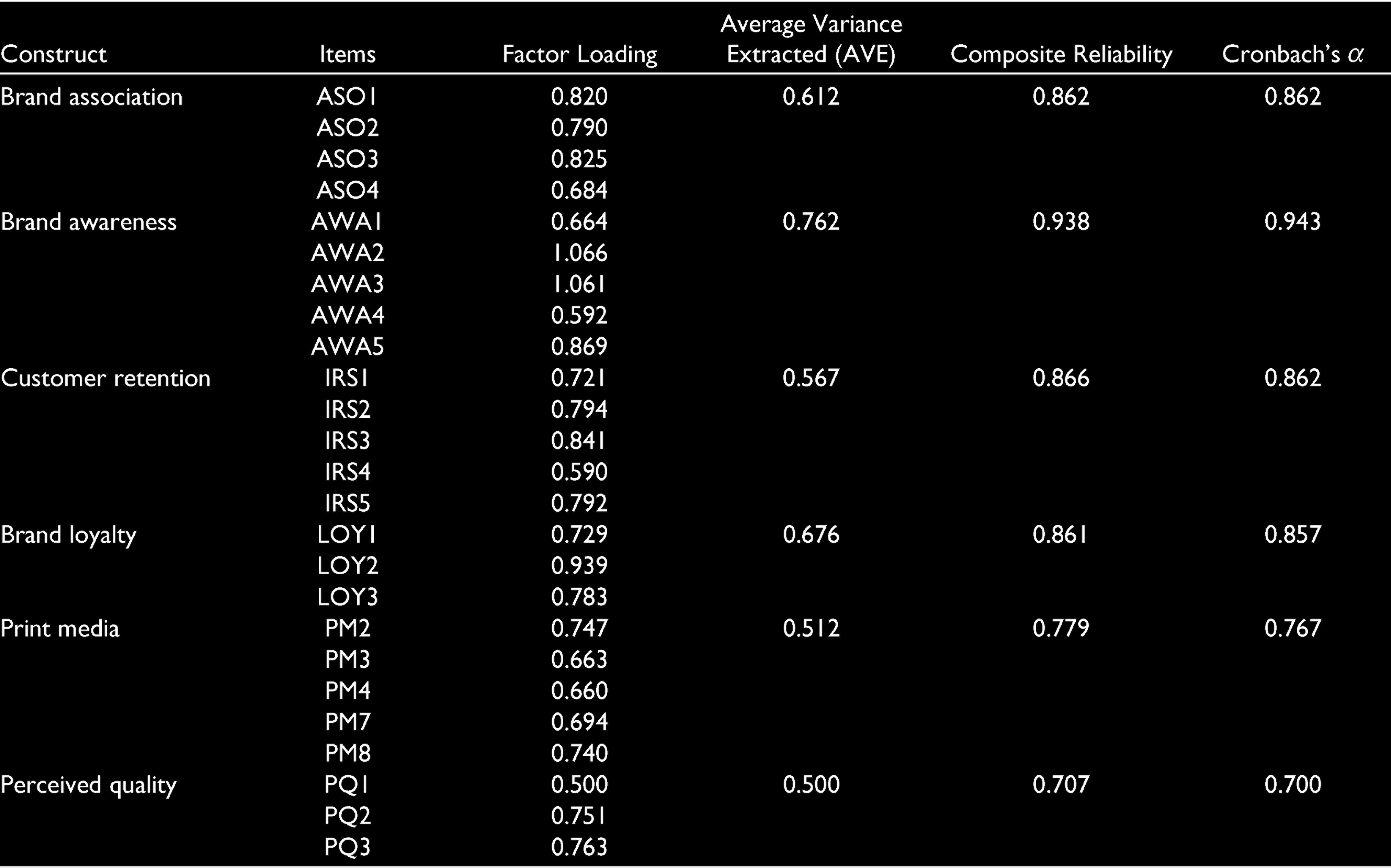
Confirmatory factor analysis (CFA) was conducted using Smart PLS-MGA for the model of six constructs to address the issue of convergent and discriminant validity (Anderson & Gerbing, 1998). Items having standardized loading below 0.50 were deleted. The CFA model was tested, using the maximum likelihood estimation procedure, as suggested by Bentler (1990).
To test the reliability and validity of measures, individual item reliability, internal consistency reliability, convergent validity and discriminant validity were evaluated as in Tables 3a and 3b. First, individual item reliabilities were evaluated by examining the outer loadings of each construct’s measure. Confirmatory factor analysis was conducted to address the issue of convergent and discriminant validity for the proposed model. The measurement of ‘brand association’ had standardized loadings in the range from 0.684 to 0.825, ‘brand awareness’ in the range from 0.664 to 1.066, ‘customer retention’ in the range from 0.590 to 0.841, ‘brand loyalty’ in the range from 0.729 to 0.939, ‘print media’ in the range from 0.660 to 0.747 and ‘perceived quality’ in the range from 0.500 to 0.763. The standardized loadings of all the items surpass the threshold limit of 0.50, hence showing sufficient individual item reliabilities. Second, the internal consistency was examined by means of composite reliability coefficient. The recommended value for each latent construct should exceed 0.70. Table 3a shows the composite reliability coefficients, which were in the range from 0.707 to 0.938, demonstrating adequate internal consistency reliability; as recommended each construct was above 0.70. Third, to ascertain the convergent validity, the average variance extracted (AVE) for each latent construct was examined. Normally, the AVE for each latent construct should be more than 0.50. As in Table 3a, the AVE for latent construct has surpassed the threshold value of 0.50, and hence signifying the satisfactory convergent validity. Finally, the Fornell–Larcker criterion was utilized to establish the discriminant validity as shown in Table 3b. The internal consistency of constructs can be measured for all scales through Cronbach’s α; Cronbach’s α ranges from 0.700 to 0.943, which implies secured reliability (Nunnally, 1978). The measurement of reliability and validity is presented in Tables 3a and 3b.
Measurement Model Summary for Mediation Effect
Discriminant Validity of Latent Constructs (Fornell–Larcker Criterion)

Structural Model
After establishing the reliability and validity of the measurement model, several steps were taken to evaluate the structural model. Based on the assessment criteria recommended by Henseler et al. (2009), as well as Hair et al. (2014), three logical metrics were used to judge the structural model, namely the significance of path coefficients, the coefficient of determination (R2) and the cross-validated redundancy (Q2).
Hypothesis Testing
The structural equation model is estimated using Smart PLS 3. The relation between print media and components of brand equity with the customer retention is presented in Figures 2 and 3. Print Media is considered as exogenous variable and the four components of brand equity (i.e., brand awareness, brand association, brand loyalty and perceived quality) are specified as four endogenous variables. As discussed in the previous section about the acceptance criterion and presented a structural equation model that qualifies the criterion. The results of the structural equation model are presented in Table 4, showing the value of the standardized path coefficient (β). The path coefficient is significant, if the t-value is greater than 1.96, at the 5% level of significance, using a two-tailed test.

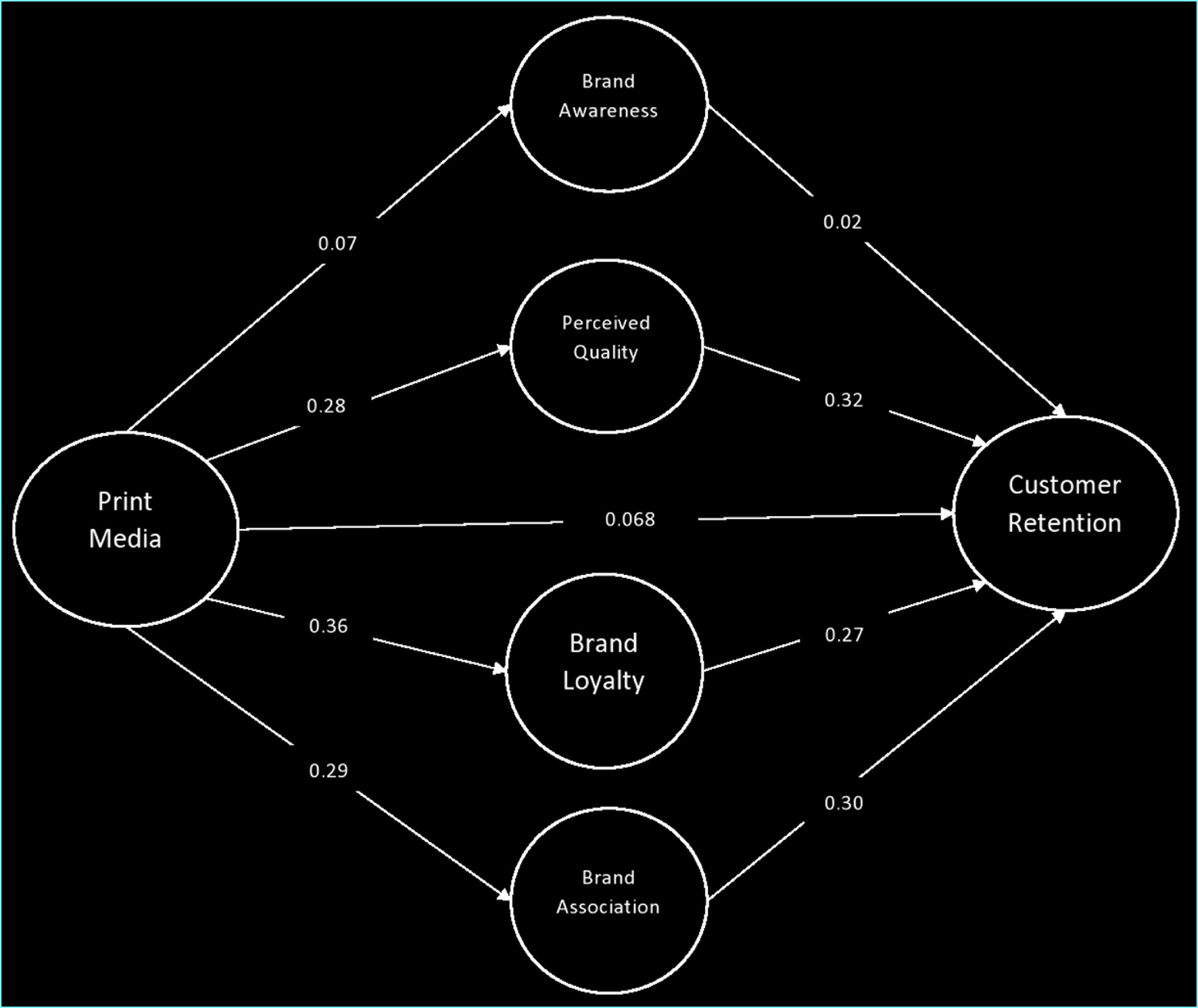
Hence, there is both direct effect and indirect effect of print media on customer retention through components of brand equity (i.e., brand awareness, brand association, brand loyalty and perceived quality). The hypothesis H3, H4, H5, H7, H8 and H9 are accepted, whereas H1, H2 and H6 are rejected. The results depict that print media has no effect on customer retention, and also print media does not affect brand awareness, similarly brand awareness does not affect customer retention. Print media does not have a significant effect on the customer retention for telecom service providers through brand awareness, whereas brand loyalty, brand association and perceived quality have a significant effect on the customer retention for telecom service providers; thus, we can say that print media has not lost its significance in this digital world.
Result and Discussion
The results of the structural equation model are presented in Table 4, showing the value of the standardized path coefficient (β), t-value. The path coefficient is significant, if the t-value is greater than 1.96, at the 5% level of significance, using a two-tailed test. On evaluation of the structural model in Table 4, the following is inferred the relation of print media on brand association with path coefficient (β) of 0.291, P-value of 0.00 and coefficient of determination (R2) of 0.452; hence, the hypothesis is accepted, suggesting that print media has a positive impact on brand association for telecom services providers. Print media on brand awareness with path coefficient (β) of 0.073, p-value of 0.461 and coefficient of determination (R2) of 0.244; hence, the hypothesis is rejected, suggesting that print media has no impact in creating brand awareness among the telecom service providers. Print media on brand loyalty with path coefficient (β) of 0.364, P-value of 0.00 and coefficient of determination (R2) of 0.500; hence, the hypothesis is accepted, which suggests that print media creates brand loyal customers for the telecom service providers. Print media on customer retention with path coefficient (β) of 0.068, P-value of 0.288 and coefficient of determination (R2) of 0.484; hence, the proposed hypothesis is rejected, which implies that print media does not have an impact on customer retention for the telecom service providers. Print media on perceived quality with path coefficient (β) of 0.288, P-value of 0.00 and coefficient of determination (R2) of 0.428; hence, the proposed hypothesis is accepted, which implies that print media has a positive effect on the perceived quality.
Structural Model Estimates
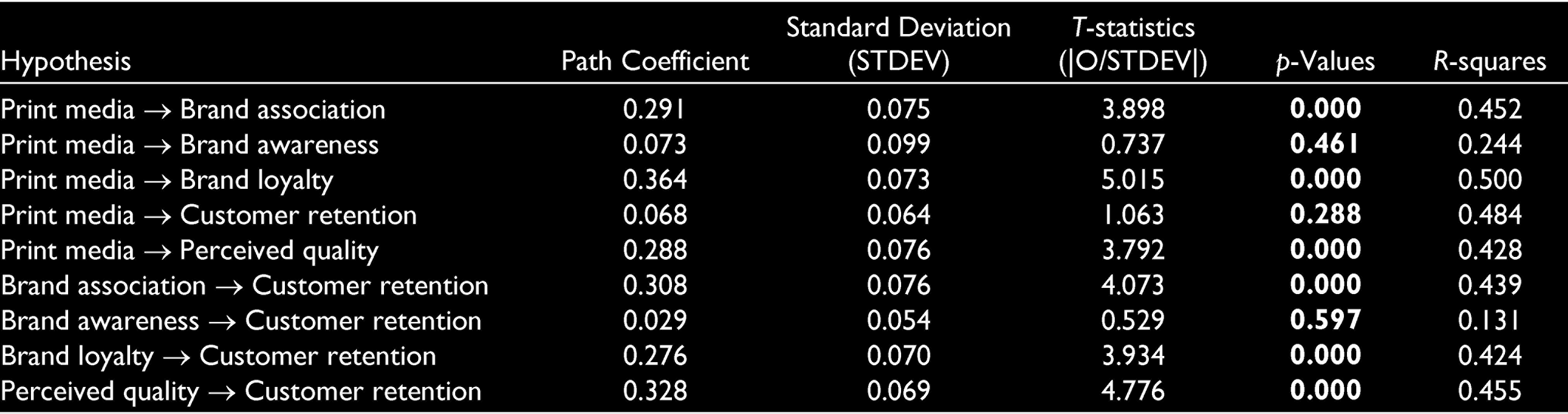
Brand association on customer retention with path coefficient (β) of 0.308, P-value of 0.00 and coefficient of determination (R2) of 0.439; hence, the hypothesis is accepted, which also implies that brand association has a positive effect on customer retention; brand awareness on customer retention with path coefficient (β) of 0.029, P-value of 0.597 and coefficient of determination (R2) of 0.131; hence, the proposed hypothesis is rejected, which implies that the brand awareness has very less or no impact in customer retention for the Indian telecom service providers; brand loyalty on customer retention with path coefficient (β) of 0.276, P-value 0.00 and coefficient of determination (R2) of 0.425; hence, the hypothesis is accepted, which implies that brand loyalty helps in the customer retention and creating loyal customers play a vital role to increase the customer base for companies; and perceived quality on customer retention with path coefficient (β) of 0.328, P-value of 0.00 and coefficient of determination (R2) of 0.455; hence, the proposed hypothesis is accepted, which also implies that perceived quality matters in customer retention for telecom service providers.
Concerning the print media on brand awareness, brand association, perceived quality and brand loyalty, results obtained from the structural equation modelling confirms that two research hypothesis and two proposed hypotheses were rejected. Regression weights of the four structural relations are print media–brand association (β = 0.291), print media–brand awareness (β = 0.073), print media–brand loyalty (β = 0.364) and print media–perceived quality (β = 0.288). Here, we can see that the print media has a maximum impact on brand loyalty, followed by brand association and perceived quality. It had the least impact on brand awareness and hence is rejected. This means that print media was more effective to create brand loyalty, association and know about quality but was not able to impact on the intent of the customers to retain the services. The structural relation of perceived quality with the intension to retain services (β = 0.328), brand association with customer retention (β = 0.308) and brand loyalty with the customer retention (β = 0.276) confirms that consumers mind gets influenced by print media. (Table 4).
As the literature review carried out also shows that the results are similar to the previous studies; however, with the growing technological advances, the print media has lost its importance but is not yet obsolete (Odun & Utulu, 2016). The studies conducted earlier also suggested that the new means of communication is not a replacement but when combined together with new media can enhance the results to many folds.
Conclusion
This study aimed to know the effect of print media in digital age in retaining the purchasers. This study supports the importance of print media in creating association, brand loyal new customer but simultaneously proves that print media has least role to play in customer retention. The results of the study are believed to place significant contribution to practice and literature since media are often defined as a platform for building relationships with customers and forming positive image of the brands in their eyes. As true for each non-traditional tool of selling communication, print media is eagerly explored and utilized by the businesses. Therefore, research is timely needed to provide some direction is this quest. The results of this study show that media has not become absolute, and it is often effectively used alongside digital and social media for advantageous campaigns, followed by relevancy of the content, popularity of the content among friends and appearing on different social media platforms and providing applications.
Managerial Implications and Future Scope of Research
Academic and Research Implications
Finding suggests that owing to the utilization of digital and social media, the effectiveness of print media is decreasing day by day, but not yet completely out. The relevance for print media remains very high as sizable number of customers still use print media as important source of information, in the rural areas where digitalization is difficult. The study also suggests that media has very less impact on customer retention by telecom customers.
Today, companies are expected to continually communicate with current and potential customers. Although online advertising methods are a relatively new concept compared to the established traditional ways of advertising, integrated marketing communication consists of messages sent to consumers using a set of various marketing instruments. The results of our research have shown that the users of telecommunication services pay more attention to the marketing messages sent over the online media. Social networks are the marketing communication mediums preferred by most of the telecom users, followed by television, billboards, text messages, company web page, web advertisements, newspapers, e-mail and the radio.
There is a statistically significant difference in the preferences, but looking at the mean values from the perspective of marketing managers, the difference is not big enough to abandon the traditional media. Marketing managers should conduct market segmentation and based on the obtained data differ between addressing to various audiences and using the principles of integrated marketing communication. According to the conducted research, the media most preferred by today’s telecom users are social media channels. The scientific contribution of this article reflects in the accumulation of knowledge about customer behaviour and facilitates companies in choosing the type of marketing media with specific target group.
Practical Implications
Even though research was conducted with appropriate planning, there is a possibility of some error crawling in during the research. First, this research was cross-sectional in nature, and, hence, the dynamic qualities linked with media have not been covered fully. Future research should focus on the longitudinal studies of print media and online media. Future studies can undertake comparison of two or more categories and check the validity of the model. Social influence tends to play a major role in influencing individuals’ choice of products. Future studies must examine the impact of shoppers’ social association, if any.
This study is very useful for telecommunication service providers by stabilizing the importance of print media. This study suggests that by using print media platform alongside digital and social media by the service providers will immensely help to retain their customers.
Limitations and Future Scope
The study has certain limitations that need to be taken into account while considering its contributions. The results of the study relied on fewer number of responses, which may affect the generalizability of the result. Future studies may consider more responses, differentiating between the rural and urban populations, which may have a significant effect on the relationship between the effectiveness of print media and customer retention. The study also did not consider the effects of other demographic factors like gender and age on the usability of print media in the digital age, for example, older people may prefer print media as compared to digital media for collecting information, and the female population may have more inclination towards print media rather than using the digital platform (Kara, 2020; Theberge, 1991). This study was cross-sectional in nature, and, hence, the dynamic qualities linked with developments in media over time have not been studied. Focusing on the longitudinal studies of print media and online media can be carried out in future. Future studies can undertake a comparison of two or more media platforms like print versus online versus electronic media and check the validity of the model in terms of brand image and customer retention. Social influence tends to play a major role in influencing individuals’ choice of products. Future studies must examine the impact of customers’ social association as a moderation factor between the effectiveness of print media and customer retention.
Footnotes
Declaration of Conflicting Interests
The authors declared no potential conflicts of interest with respect to the research, authorship and/or publication of this article.
Funding
The authors received no financial support for the research, authorship and/or publication of this article.