



Abstract
Information and communication technologies have empowered the consumers with ease of access to information about products and services in form of electronic word of mouth (eWOM). eWOM plays a critical role in consumer purchase decisions in the form of online reviews. The study uses the S-O-R framework to examine the impact of online reviews on online hotel booking. The data were collected using purposive sampling through an online self-administered questionnaire and analyzed using the PLS-SEM technique. The results of the study show that review valence significantly impacts review credibility whereas review length does not. Furthermore, credible reviews lead to high purchase intention. The positive impact of purchase intention on purchase in online hotel booking context is a novel finding. We suggest managers to include more positive valanced reviews to develop trust and credibility while take proper measures to reduce risk.
Introduction
A traveler should possess appropriate knowledge for enjoying travel, and the presence of online consumer reviews is a reliable source of this information. Online consumer reviews, also known as electronic word of mouth (eWOM) have gained importance in the life of travelers for making important decisions such as accommodation search/booking, destination identification and ticket booking (Amaro & Duarte, 2015). Travel reviews impact the consumer decision to book a hotel online as the consumer books hotel before reaching the destination (Ye et al., 2009).
Consumers usually book accommodation first (62%), followed by mode of travel and the rest (BCG & Google, 2017). While traveling, the accommodations act as temporary homes; therefore, much effort goes into searching and booking hotel (Litvin et al., 2008), and the consumer ratings influence these hotel bookings (Ye et al., 2009).
While considering online reviews, the consumer looks for the length of review and the valence (positive vs negative). Review valence is a widely studied variable in the eWOM literature followed by consumer behavior and review credibility (Donthu et al., 2021). Credible reviews build trust among consumers (Verma & Dewani, 2020). Whereas, review credibility is influenced by review valence and length (Chevalier & Mayzlin, 2006; Lee & Koo, 2012; Verma & Dewani, 2020). Prior research has mixed results about the impact of review valence. Few studies find review valence as a significant predictor of sales (Chevalier & Mayzlin, 2006), and some studies found no impact (Davis & Khazanchi, 2008). However, review length plays a vital role in developing message credibility in online reviews (Lee & Koo, 2012). A credible review leads to eWOM adoption and purchase intention (Daowd et al., 2021). In the case of online hotel booking, a credible review strongly influences consumers’ intention to book a hotel online (Cheung & Thadani, 2012).
Online reviews help Gen Y in booking luxury hotels (Lee et al., 2021). However, there are multiple risks involved in online hotel bookings such as financial risk and privacy risk. Consumers use images in consumer reviews for minimizing the risk (Zinko et al., 2021). In the context of website quality, perceived risk was found to completely mediate the effect of the website quality (stimuli) on online purchase intention (response); however, it was not tested in the context of consumer reviews.
While purchasing online, trust is an important factor. Trust significantly impacts perceived website quality (Ganguly et al., 2010; Indiani et al., 2015), and its impact on consumer reviews needs to be ascertained. Intentions to purchase and actual behavior are significantly related to each other (Davis, 1989), but this relationship has not been examined in the context of online hotel booking (Amaro & Duarte, 2015). Therefore, the research aims at fulfilling following objectives:
Therefore, the study analyzes the role of consumer reviews expressed on online travel websites in influencing consumers’ decisions for booking hotels online. We use the stimulus-organism-response (S-O-R) model for modeling the consumers’ behavior of online booking of hotels. The results are analyzed, and the implications of the study are discussed along with the limitations in upcoming sections.
Theoretical Foundation and Research Hypotheses
Word of mouth (WOM) is an important area for consumer behavior researchers (Mishra et al., 2021a). WOM proves to be more influential in consumer decision-making than any other marketer-controlled source of information (Berger, 2014; King et al., 2014; Ladhari & Michaud, 2015). WOM is defined as a form of informal communication among consumers (Westbrook, 1987). WOM was once considered to be a powerful tool for spreading news, but is now being taken over by eWOM with the disruption of the internet (Mishra et al., 2018).
eWOM is defined as any statement made by the customer which is traceable by other customers using the internet (Hennig-Thurau et al., 2004). eWOM plays a vital role in product sales (Chevalier & Mayzlin, 2006) as customers use eWOM for the reduction of the potential risk during decision-making (Hussain et al., 2017; Mishra & Satish, 2016). eWOM valence (Gopinath et al., 2014) and volume (Kim et al., 2018) are positively associated with product sales.
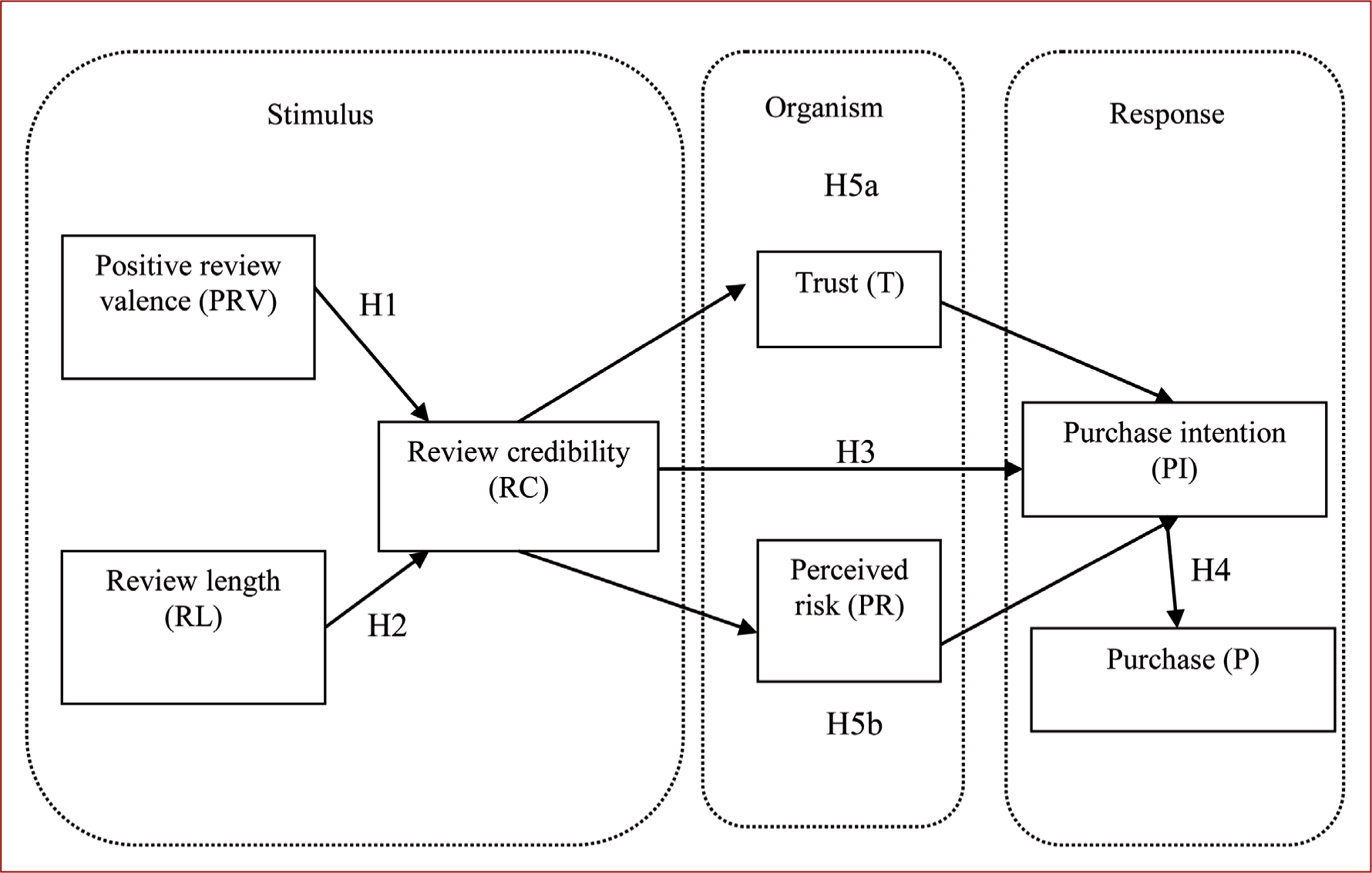
To test the above relationships, we propose a conceptual model (Figure 1) based on the S-O-R model to understand the consumer behavior of online hotel booking. The model states that the response of the consumer is based on the stimuli. But this triggered response can be influenced by the process of consumer’s internal evaluation. The S-O-R model has been used in understanding smart consumers for value co-creation (Roy et al., 2019), consumption of social media (Aljukhadar et al., 2020) and evaluating the impact of website characteristics on the purchase behavior of the consumer (Mummalaneni, 2005).
Positive Review Valence and Review Credibility
The valence of review represents the negativity or positivity contained in any message (Buttle, 1998). Favorable opinions are considered as positive eWOM whereas negative opinions are considered as negative eWOM (King et al., 2014). Review valence (positive vs. negative message) is a widely studied topic, but results are fragmented. In this study, we include positive online reviews. Valence and sales may have a positive relationship (Chevalier & Mayzlin, 2006; Ye et al., 2011) or even negative (Purnawirawan, 2015). Valence leads to the recommendation—that is, whether it is positively framed (e.g., a praise message) or negatively framed (e.g., a complaint message). Positively framed eWOM emphasizes a product/service’s strengths, while negatively framed eWOM stresses a product’s weaknesses or problems (Cheung et al., 2009). Consumers trust positive valence reviews more in the context of interpersonal service (Kats, 2019; Sparks & Browning, 2011). Hao et al. (2010) concluded that for search goods, the valence of review does not matter but in the case of experience goods, the WOM effect of negative reviews is greater than that of positive reviews. Therefore, we consider positive review valence will increase the credibility of reviews.
Review Length and Review Credibility
Review length is defined as the number of words or length of the online review. Review length affects review credibility, as very short review may not considered authentic (Chevalier & Mayzlin, 2006). Users perceive a longer review contains detailed information about the product or service (Mudambi & Schuff, 2010). Prior research has mixed results on the effect of review length on credibility. For example, Racherla and Friske (2012) concluded that long reviews are as credible as short reviews. Whereas, Chevalier and Mayzlin (2006) found that longer reviews significantly increase the credibility of reviews. The results are contradictory and inconclusive. However, a majority of research favors the positive impact of long reviews on credibility. Hence, it is hypothesized as follows:
Credibility and Purchase intention
The credibility of eWOM is defined as the extent to which one perceives a review as believable, true or factual (Cheung et al., 2009). Consumers believe internet information to be as credible as that obtained from television, radio and magazines (Flanagin & Metzger, 2000). The decision of booking a hotel is made before reaching the destination (Senecal & Nantel, 2004), and therefore, the consumer looks for opinions of their fellow travelers online (Lewis & Chamber, 2000).
Purchase intention is defined as the intention to buy the reviewed object (Amaro & Duarte, 2015). It is reflected in the academic literature under the names like behavioral intention (Davis, 1989) and booking intention (Purnawirawan et al., 2015). Credible consumer reviews lead to making purchase decisions (Cheung & Thadani, 2012; Chih et al., 2013). Many studies have proposed review credibility as an important determinant in consumer reviews, yet only a few have tested its impact on purchase intention (Thomas et al., 2019).
According to social learning theory (SLT) (Bandura & Walters, 1977), consumer performs new behavior by observing others. Also, review credibility leads to customer satisfaction (Filieri et al., 2020). Therefore, we argue that the credibility of eWOM should have a similar positive impact on consumer’s purchase intentions (King et al., 2014) and propose as follows:
Intention to Purchase Online and Purchase
Purchase intention can be defined as the intention to buy the reviewed object. It is tested in the literature under the names like behavioral intention, purchase intention, booking intention and buying intention (Purnawirawan, 2015). Intention to purchase impacts actual purchase, (Ajzen, 2011) and it is believed that intentions can very well predict behavior (Davis, 1989; Venkatesh et al., 2003).
Attitude, purchase intention, purchase and eWOM adoption are the four most investigated response variables in eWOM communication, and still, the results are vast and fragmented (Zhang et al., 2010). These relationships are also supported by the theory of reasoned action and the theory of planned behavior, however have not been tested in context of online hotel booking (Amaro & Duarte, 2015). Here, we propose that if consumer’s intention to book hotel online will lead to actual purchase. Therefore, it is hypothesized as follows:
Mediating Role of Trust and Perceived Risk
Consumers receive information through information and communication technology either from fellow travelers or from marketers (Jalilvand et al., 2017; Shukla & Mishra, 2021). Consumers trust peer consumers more than they trust marketers (Litvin et al., 2008; Sen & Lerman, 2007; Verma & Dewani, 2020). Consumers evaluate the intentions of peers in sending consumer reviews. One of the key highlights of eWOM is that a traveler can express positive or negative feedback online which might reduce trust in reviews (King et al., 2014). In the case of online shopping, the consumer may or may not trust the motivations of the sender (King et al., 2014) and avoid online purchases due to lack of trust (Ladhari & Michaud, 2015). As a large number of travelers rely on consumer reviews, fake reviews have also come into play which reduces trust in reviews (Thomas & Mathew, 2018). If a consumer perceives the review to be fake, they will not trust the reviews (Mishra Perceived trust could impact purchase intention (Filieri et al., 2018). Thus, if a consumer perceives a review to be credible, they develop trust in it. Furthermore, the trust in the review pushes the consumer towards positive purchase intention (Wang et al., 2014). Hence, review credibility increases trust in consumer reviews and the purchase intention depends on trust. Trust has been tested as an independent variable in the travel literature but its role as a mediator needs to be tested.
Perceived risk in online hotel booking is very much expected. The reason could vary from lack of trust on the website, fear of online payment, failure of payment or the quality of services (Zhao et al., 2015). Even the consumers’ perception of risk varies as per the intention (goal) to purchase (Schlosser et al., 2006). A consumer faces different types of risk while considering an online purchase, such as financial risk, time risk, privacy and performance risk (Park & Tussyadiah, 2017). Customers use eWOM to reduce risk (Hussain et al., 2017). Since consumer trusts peer information more than marketer-provided information, the credibility in online reviews will reduce the perceived risk. Furthermore, perceived risk will negatively impact purchase intention.
Perceived risk was found to completely mediate the effect of the website quality (stimuli) on online purchase intention (response) (Ganguly et al., 2010; Indiani et al., 2015). If consumers believe a review to be credible and they develop positive intention to book a hotel online; however, the perceived risk may refrain them from purchasing online. Therefore, we propose that risk mediates the relationship between review credibility and purchase intention. Hence, it is hypothesized as follows:
Research Methodology
We measured seven constructs by adapting measurement items from prior research to fit the context of the study (Table 3). Items were measured on a 5-point Likert scale (5 = strongly agree; 1 = strongly disagree) except PI3 which was measured from very high (5) to very low (1). Purchase was measured using two items (P1: 5 = almost always to 1 = never; P2: 5 = more than six times, 4 = 4–6 times, 3 = 2–3 times, 2 = once, 1 = not at all). We did a pilot study with a small sample of students (N = 30) to refine the questionnaire before the final phase of data collection. Furthermore, the questionnaire was validated by academic and industry experts for establishing nomological validity.
Sample and Data Collection
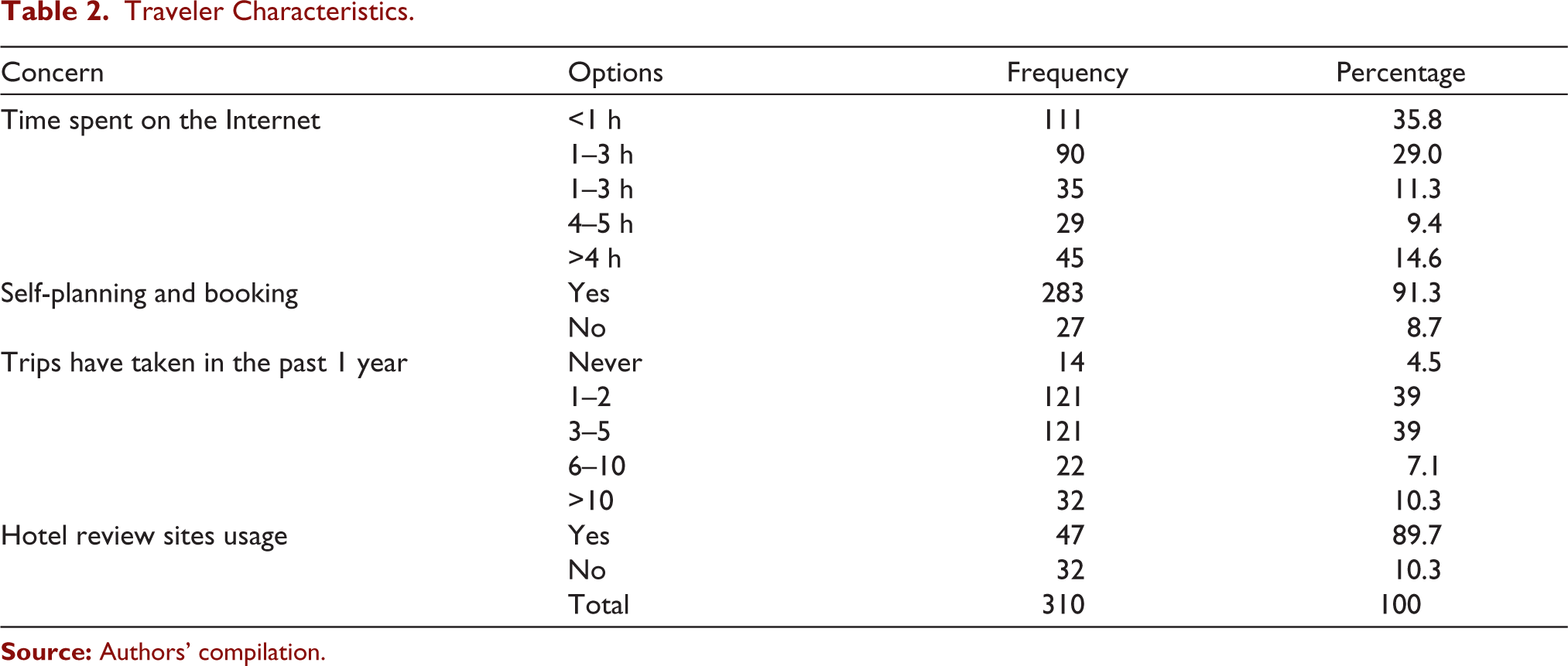
The participants of the study were above 18 years of age from India. India has the largest young population worldwide (Anubha & Shome, 2020) and is an emerging attractive tourist destination (IBEF, 2021). An online questionnaire was created, and the link was sent through Facebook messenger to the users who follow the Facebook pages of popular travel-related websites like Goibibo, MakeMyTrip, Yatra and TripAdvisor (Chakraborty, 2019). Facebook was chosen as it is the most popular social media platform with over 2.7 billion users worldwide (Qin, 2020; Statista, 2020). A total of 334 responses were received. Multiple responses from the same respondent were restricted using software to limit one response per email id. Incomplete responses were deleted leading to 310 valid responses (Table 1). The highest number of respondents were in the age group 18–29 (55%), male (56%) and post-graduate (50%). More than half of the respondents were from North India (68%). Furthermore, some descriptive questions were asked to evaluate the fit of the respondents (Table 2). More than 90% of consumers have taken the trip in the past and booked their travel online.
Sample Characteristics

Traveler Characteristics
Measurement of intention and actual behavior was done at a gap of 3 months to avoid bias (Ajzen, 1985; Straub et al., 1995) and issues of common-method variance resulting from measuring both self-reported usage (actual purchase) and its determinants (purchase intention) on a single questionnaire (Venkatesh, 2000).
Model Estimation and Results
Data was analyzed using PLS structural equation modeling due to following reasons. First, PLS-SEM is better at handling complex relationships (Hair et al., 2014). Second, PLS-SEM is best suited for theory development, which was the aim of this research (Roy et al., 2019). PLS analysis was conducted using SmartPLS 3.2.4 software with bootstrapping sample of 5,000. Since PLS can handle non-normal data, normality assumption was not tested.
Assessment of the Measurement Model
The measurement model was assessed using internal consistency, convergent validity and discriminant validity. The Cronbach’s alpha value was more than 0.7, and composite reliability values lie between 0.79 and 0.89 (Table 3). Thus, items were internally consistent (Hair et al., 2014). All the constructs have outer loadings more than the recommended values of 0.7. The average variance extracted values were above the minimum acceptable limit of 0.5 (Table 3, Bagozzi & Yi, 1988). Thus, convergent validity was established.
Measurement Model

Discriminant validity was accessed using Fornell–Larcker and HTMT. The square root of average variance for each construct was higher than the correlations of these constructs with other latent variables in the path model which satisfies requirements as per Fornell and Larcker (1981) criteria (Table 4). The HTMT ratio was less than the recommended value of 0.85 (Table 5, Henseler et al., 2014). Thus, discriminant validity for the constructs was established.
Fornell–Larcker Criterion

HTMT Criterion

Assessment of the Structural Model
The structural model was estimated using the BCa (bias-corrected and accelerated) bootstrapping method with 5,000 subsamples (Efron, 1987).
The results suggest that positive review valence (H1, β = 0.405, t = 7.862, p = 0.000) (Table 6) has positive relationship with review credibility. The second hypothesis proposed that long reviews positively impact review credibility was not supported (H2, β = 0.044, t = 0.753, p = 0.451). Review credibility positively impacts purchase intention (H3, β = 0.240, t =3.350, p = 0.000). Thus, hypotheses H1 and H3 are supported but not H2. Purchase intention positively impacts purchase, thus H4 was supported (β = 0.574, t = 14.794, p = 0.000).
Testing of Hypotheses

The R-square values were above 0.2 (purchase intention = 0.291, 0.284; purchase = 0.329, 0.327). Thus, the model has predictive relevance for purchase intention and purchase as R-square values of 0.20 are considered to be high in consumer behavior studies (Hair et al., 2014).
Mediation Analysis
Mediation happens when an independent variable impacts the dependent variable and at the same time independent variable influences mediator which impacts the dependent variable (Hair et al., 2014). The indirect effect of perceived risk was not significant (β = 0.025, t = 1.503, p = 0.133) whereas indirect effect of trust was significant (β = 0.153, t =3.682, p = 0.000) (Table 7).
Mediation Analysis

Discussion
Previous studies have considered students as a sample representative (Flanagin & Metzger, 2000; Hao et al., 2010; Lee & Koo, 2012; Park & Kim, 2008), whereas the current study analyzes actual travelers. We proposed positive review valence and review length impacts review credibility. The results of the study conclude that positive reviews were considered credible by travelers whereas review length did not impact the credibility of reviews. This implies that consumers look for positive valanced reviews and recommendations in the reviews as found in similar studies (e.g., Ventre & Kolbe, 2020). Findings suggest that consumer is not much influenced by the length of review. The reason could be consumer decides by reading the first few lines of the review, if they find the reviews mapping the features of the product, they will continue or exit (Dash et al., 2021). The results suggest that review credibility positively impacted purchase intention. The results were found to be similar in other contexts (Cheung & Thadani, 2012; Chih et al., 2013). Consumers perceive the reviews to be written by fellow travelers; therefore, if the consumer believes the review to be credible, they will develop a positive intention to book a hotel online.
Intention to book a hotel online positively impacted the actual purchase behavior in continuation to previous studies (Davis, 1989). This was a novel finding as this relationship has not been considered in the travel and online hotel booking context (Amaro & Duarte, 2015). Therefore, a positive intention will drive travelers to book a hotel online in near future.
Booking hotel online is perceived as risky whereas consumer reviews can help in developing trust. We proposed that risk and trust mediate the relationship between review credibility and purchase intention. The results support mediating effect of trust but the mediating effect for perceived risk was not supported. The probable reason could be that many hotels give an option of ‘Book now, Pay later’ (Economic Times, 2020) which reduces risk and ensures consumer trust in the process.
While booking hotel online, trust is an important factor. Credible reviews build trust among consumers (Verma & Dewani, 2020). Trust was found to significantly mediate the relationship of credibility and purchase intention as confirmed in prior studies (Chang et al., 2013; Ganguly et al., 2010).
Theoretical Implications
This study makes the following contributions to the literature in the field of online travel. First, the study evaluated the impact of review valence and review length on review credibility. The findings suggest that positive valence reviews significantly increase the review credibility and hence the purchase intention. The impact of review length was not significant on review credibility; hence, we conclude that traveler is not much impacted by the length of review, but the meaningfulness of review.
Second, the review credibility was found to positively impact the purchase intention. This is a novel finding as the impact of credibility on purchase intention has not been tested much in literature (Thomas et al., 2019). The results are a continuation of SLT (Bandura & Walters, 1977).
Third, the mediation effects of risk and trust were analyzed. Although the consumer may believe the review to be credible, still may not develop a positive intention to book a hotel if they do not trust the review. The perceived risk did not mediate the relationship between review credibility and purchase intention. The results are similar to earlier finding that trusting belief are much stronger when a consumer’s goal is to purchase even though the risk is involved (Schlosser et al., 2006). However, trust significantly mediated the relationship between review credibility and purchase intention.
The results of the study will lead to the advancement of theory related to the online travel context. The relationship between purchase intention and purchase was never examined in the travel context earlier. Therefore, these interesting results can help in building the theory of consumers’ choice of online hotel booking.
Practical Implications
eWOM and purchase intention are widely emphasized areas (Filieri et al., 2018). Consumers perceive positive reviews as more credible. Hence, the marketer may prioritize the display of reviews in terms of valence on the website. Marketers can incorporate multisensory technologies as they lead to higher visual appeal (Mishra & Shukla, 2020).
Since review credibility positively impacts purchase intention, managers can use this information to increase hotel sales. As discussed in the previous section, managers can focus on improving the quality of reviews on their websites to make them more credible. Marketers can also filter or selectively rank the reviews in descending order as per the underlying valence of the review. This will attract the consumers’ attention to the positive valence reviews first, thereby increasing the possibility of sales. Managers can also add the source profiles to add credibility in reviews (Kim et al., 2020).
The consumer does not perceive online hotel booking to be risky but will avoid booking hotels if they lack trust. Since trust mediates the relationship between review credibility and purchase intention, marketers can build upon the consumers’ idea of trust. The trust can be strengthened by verifying the source of information or giving a level of contribution (platinum/gold/silver) to the review writer.
The marketers can verify the source (of review writer) by linking it to their online social media profiles thereby authenticating and building consumer trust on reviews. The marketers can take the input of consumers’ details at the time of searching for information and then filter out the options and selectively display them based on age, gender or qualification.
Limitations and Areas for Future Research
The study has certain limitations. A consumer can book a hotel via mobile app or websites. Mobile apps significantly impact consumer purchase intention (Shukla & Sharma, 2018) and travel intentions (BCG & Google, 2017). Therefore, future research could compare the travel booking intentions across mobile applications, website, and emerging technologies (Mishra et al., 2021b). The online travel industry follows dynamic pricing and consumers’ travel decisions are influenced by price (El-Said, 2020). Future studies may expand the model by examining the impact of dynamic pricing. Hotel industry executives provide incentives for writing fake reviews which may impact the review credibility (Filieri, 2015; Hu & Kim, 2018; Wu et al., 2020). Future studies may evaluate the review credibility concerning fake reviews (Mishra & Samu, 2021). The data was collected pre-covid-19, hence the model must be tested post-covid-19 to understand the change in consumption of eWOM in travel behavior. Since the online consumer reviews present two-dimensional information, it would be interesting so see how consumer evaluates the experiential advancements in the field using AR/VR technologies.
Footnotes
Declaration of Conflicting Interests
The authors declared no potential conflicts of interest with respect to the research, authorship and/or publication of this article.
Funding
The authors received no financial support for the research, authorship and/or publication of this article.