



Abstract
Emotional branding is a powerful branding strategy that has a significant influence on consumers final purchasing decisions, and marketers have used it extensively. The purpose of this research is to create a multifactor instrument for measuring emotional branding, to show that it can predict consumer behaviour and to investigate the mediating role of celebrity endorsement (CE) in this relationship. The study is divided into three sections. A multistage scale development and validation process was the initial step. Exploratory factor analysis determines the emotional branding scale’s (EBS’s) components in the second stage. Third, confirmatory factor analysis (CFA) validated the scale. Study 1 shows scale development and zero- and first-order CFA. Study 2 shows how does CE mediate the relationship between emotional branding and purchase intention (PI). The findings indicate that each of the four structures contains 32 elements from the EBS. The study reveals that the EBS has four components (i.e., sensory appeal, brand attachment appeal, communication appeal and patriotism appeal). Emotional branding affects PI directly and statistically. CE partially mediates emotional branding and purchase intention.
Introduction
The concept of emotional branding has been gaining ground across the world and the marketers have been using it aggressively for influencing the customers. Consumers relate to and respond to emotional advertisements more than textual advertisements. As humans, we can process and retain a limited amount of textual information from the advertising that bombards us on a daily basis. Human emotions are the most powerful feelings that anyone may feel. As a result, when this textual information is presented in advertising, stories, songs and documentaries and mingled with human emotions, the content becomes more engaging, relatable and remembered. Brands can connect with and pique the interest of their target audience by using fresh content and scripts to simulate an experience that the target audience will want to relive. Emotional branding is a branding approach that uses basic human emotions such as happiness, fear and wrath to elicit a stronger response from customers. Creative and heartfelt ads have the ability to elicit emotions such as happiness, rage, guilt, pride, sobbing, sadness, fear and so on. They can also persuade people to buy products and so impact their purchasing decisions. The most astonishing truth, according to Conejo (2014), author of ‘Unconscious Branding: How Neuroscience Can Empower (and Inspire) Marketing’, is that we don’t even reason our way to logical solutions. We rationalize our emotions. Emotions act as the substrate, or the basic layer of neural circuitry that underpins logical decision-making. They serve as the foundation upon which decisions are made. According to Khanna (2019), emotional responses to commercials have a higher influence on a person’s propensity to buy than the substance of the advertisement. Bou Saada et al. (2022) demonstrated that a positive outlook on emotional marketing leads to positive brand actions, which in turn are mediated by positive brand emotions (even in times of crisis). Marketers are beginning to recognize the value of strong emotional content and its ability to sway purchasers. The need of the hour is to create heartfelt, moving, inspiring and engaging content. A branding strategy that will assist brands in connecting intimately with consumers, triggering their emotions, influencing their buying decisions, increasing engagement, decreasing switching rate, building brand loyalty and increasing brand value. A strategy that can assist brands in surviving in today’s hyper-competitive market, where goods and services alone are no longer sufficient to attract or retain customers. Engaging consumers on an emotional level may be the only differentiating factor for a brand’s success. Brands must become more human. They must present themselves as humans and associate with customers. Emotional branding is one such phenomenon. Understanding the influence of emotions embedded in marketing strategy has been a significant challenge due to human beings’ culture-specific complex behaviour. As a result, this research could help us understand the impact of emotional branding on purchase intent.
Need for Scale Development on Emotional Branding
Despite the increased interest in emotional branding as a study and practise area, a valid assessment scale is needed. However, very few researchers have attempted to develop a standardized tool for its measurement, according to Singla and Gupta (2019). The literature on the determinants and results of emotional branding, according to Akgün et al. (2013) is less reported thus emotional attachment research is essential (Ho, 2017). Extensive empirical evidence does not support emotional branding. To advance in marketing, one must grasp how emotional branding may help firms endure competition. The purpose of this paper is to uncover emotional branding components. The following research questions were stated in order to carry out this study: (a) What are the components that make up emotional branding? Does emotional branding have an effect on purchase intention? (b) Is celebrity endorsement (CE) a mediating factor between emotional branding and purchase intention (PI)? The study’s specific purpose is to investigate the answers to these questions. For this study, we used toothpaste as a fast-moving consumer product to construct an emotional branding scale (EBS). The study’s toothpaste was chosen for a variety of reasons. Because of poor eating habits, rising dental disease concerns and increased knowledge of oral health issues, people are advised to use toothpaste on a regular basis. As a result, toothpaste is in tremendous demand. Second, the toothpaste market has been highly competitive. Third, big marketing expenses. Finally, the market provides numerous options. Businesses have been attempting to establish effective marketing tactics in order to attract customers. This research may aid in increasing the possibility of buyers purchasing a brand by generating emotional appeal (emotional branding). Indian fast moving consumer-goods (FMCG) businesses, such as Patanjali and Dabur, have actively promoted emotional or patriotic feelings, as well as ayurvedic and herbal elements, in their marketing campaigns. In India, Colgate Vedshakti emphasizes ayurvedic campaigns. This study may be innovative for the Indian market and provide new insights into emotional branding. This study demonstrates the importance of CE in influencing consumers’ PIs through emotional branding. The study contributes to the current literature by identifying emotional branding components that marketers can utilize to influence consumer purchase decisions.
Theoretical Background and Construct Identification
Emotional branding is a marketing method that focuses on developing a company’s emotional bond with its target audience. It requires harnessing emotions like joy, passion, trust and empathy to create a strong and long-lasting link between the firm and its customers. Upadhyaya (2012) found that the most important personality traits of deu brands are excitement and being unique. When people think about or interact with a brand, emotional branding attempts to evoke a specific emotional response from them, which can lead to increased loyalty and advocacy. To build an emotional connection with customers, brands commonly use storytelling, visual and aural cues, and experiences that generate positive feelings. A brand may use a heart-warming film or a tragic storey in its advertising to evoke empathy and connection with its customers. Brands that tell compelling stories about their history, mission and values can emotionally connect with their customers. The goal of emotional branding is to create a strong emotional bond between a firm and its customers, which can help increase customer loyalty and drive sales. A customer who has a strong emotional attachment to a brand is more likely to favour that brand over competitors, even if it means paying a greater price. Emotional branding is highly useful in firms where the product or service is similar to competitors’ products or services, and emotional linkages can help differentiate a brand from its competitors. There are numerous examples of Indian enterprises that have effectively and emotionally bonded with their customers. Bournvita, for example, ‘shows the strong bond relation between a mother and a child’ ‘He won’t get used to winning when I let him win, but only when he defeats me’, Cadbury Dairy milk as ‘let’s have something sweet’ as we Indians are more into festivals, cultures and relationships, ‘every friend is important: Airtel’, Tata Salt with branding as ‘Country’s salt’, Idea campaigning as ‘connecting people regardless of language barrier’, Kajaria as ‘Tiles made of the soil of the land, make the country’, Hero Honda as ‘Country beat’, Patanjali as Indian Herbal and Ayurvedic items, Nescafe’ is known to ‘promote improvement and constant effort’ because it motivates people to work more. The Coca-Cola advertising campaign ‘taste the feeling’ conjures up thoughts of people bonding and participating with one another. These have developed an emotional tie with the consumer, resulting in brand memory and long-term connection, involving emotional experiences like happiness, trust, the essence of childhood, involvement and loyalty. Emotional branding can have a big impact on purchase intent. When consumers establish an emotional connection to a brand, they are more inclined to prefer that brand over competitors. This is because emotions play an important role in decision-making, and emotions linked with a brand can influence a consumer’s attitude towards it, leading to a higher buy intention. When a brand employs emotional branding, it can develop a distinct brand personality that resonates with its target audience. This, in turn, can result in a favourable emotional experience for the consumer, leading to enhanced brand loyalty and a higher possibility of repeat purchases. Emotional branding can also help a brand differentiate itself from its competitors, as consumers may choose a brand that makes them feel a specific way over a similar brand that does not have the same emotional connection. Brands that provide great emotional experiences for their customers are more likely to be remembered, recommended and purchased again in the future.
Emotional Branding Constructs
SA is a marketing approach that seeks to engage customers’ senses in order to develop an emotional connection with a product or brand. It entails using multiple sensory signals including as sight, sound, touch, taste and smell to create a desirable experience linked with the brand or product. The goal is to elicit a positive emotional response that leads to improved consumer loyalty and sales. SA can be employed in a variety of ways, depending on the product or brand. A food or beverage company, for example, might emphasize the taste and fragrance of their product, whereas a garment brand might emphasize the feel and texture of the fabric. A brand may also employ colour and visual clues in its marketing to elicit a specific mood or emotional response from its audience. SA may be an effective marketing approach because it engages customers on a deeper level than simply presenting information about a product or brand. SA may help a business stand out from its competition and build a distinct identity that is memorable and enticing to buyers. The research suggested that SA, which includes taste, scent, texture and appearance, is important in influencing customer behaviour (Krishna, 2012). When a product or brand provides a favourable sensory experience for customers, it can stimulate the senses and leave a lasting impression, which can impact future purchase decisions. Babin and Attaway (2000) discovered that SA influences customers’ PIs positively. Wang et al. (2015) investigated the relationship between SA and PI and discovered that SA had a favourable impact on customers’ purchasing intentions. Aside from food and cosmetics, the effect of SA on PI has been researched in other product categories such as beverages and apparel (Pantano & Viassone, 2015).
Brand attachment is an emotional connection that customers form with a brand. Nagar and Kour (2018) found that when consumers have a strong love for a brand, they also have a strong desire to purchase the brand and a positive attitude towards it. The attachment is formed over time as a result of customers’ emotional encounters with the brand. It is distinguished by a sense of loyalty, trust and affiliation with the brand that extends beyond functional or rational benefits. Customers that have a strong brand attachment have a personal connection to the brand and are more inclined to prefer it over competitors, even if it means paying a higher price. They are also more willing to suggest the brand to others and to forgive the brand for minor blunders or errors. There are several levels of brand attachment, ranging from cognitive attachment to affective attachment. Cognitive attachment is focused on functional benefits such as quality and dependability, whereas affective attachment is based on subjective responses such as excitement, happiness and so on. Brands may separate themselves from competition and develop a unique identity that resonates with customers on a deeper level by forging strong emotional connections with customers. Park et al. (2010) discovered that customers’ emotional attachment to a brand was the most important element influencing their brand loyalty. Similarly, Thomson et al. (2005) discovered that consumers who were emotionally linked to a brand were more inclined to pay a greater price for the brand than those who were not emotionally attached. Another study (Batra et al., 2012) discovered that consumers who were emotionally attached to a brand were more likely to engage in positive word-of-mouth activity about the brand. Huang and Sarigöllü (2012) discovered that brand attachment was a more important predictor of PI than other characteristics such as perceived quality and brand image. In addition to these studies, several others have been conducted on luxury brands (Chevaler & Mazzalovo, 2012), sports brands (Lee & Trail, 2012), fashion brands (Kim & Ko, 2010), car brands (Hirschman & Holbrook, 1982) and fast-food restaurants (Kim & Ham, 2016). These studies have consistently indicated that brand attachment has a large beneficial impact on customer behaviour, such as brand loyalty, readiness to pay a premium price and word-of-mouth activity.
A CA is a marketing approach that uses emotions to encourage clients to perform a specific action, such as purchasing a product or service. It entails developing a compelling and relevant message for the target audience and reaching out to them through various communication channels. Brands can separate themselves from competitors and leave a lasting impression in the minds of customers by developing an appealing and relevant message and communicating with them through numerous channels. Kalyanaraman and Sundar (2006) discovered that emotional appeals had a greater impact on consumers’ opinions about advertisements and buying intent than rational appeals. Luo et al. (2013) discovered that using emotional appeals in social media advertising increased customers’ purchasing intent. Zhang and Kim (2013) discovered that humour appeals influenced customers’ sentiments towards the commercial and the goods, as well as their buying intention. Several other research studies have investigated the impact of communicative appeal in other circumstances, such as green advertising (Mo et al., 2018), social media advertising (Chang et al., 2019) and luxury products. This research indicated that CA has a substantial influence on customers’ perceptions regarding the advertisement and the product, as well as their buying intention. By influencing the consumer’s impression of the product or service being given, communicational appeal can influence PI. For example, if an advertisement portrays a product as high quality, inventive or socially responsible while also instilling emotional responses in the consumer’s head, it might generate a good picture in the consumer’s mind, leading to a higher PI.
Patriotism is defined by the Cambridge Dictionary as ‘the feeling of loving your nation more than any other and being proud of it’. Similarly, Wikipedia defines patriotism as ‘the feeling of love, dedication, and connection to one’s nation’. Patriotism is the love, devotion, pride and attachment to one’s nation. People’s feelings serve as a tether that holds them together. The feelings have been observed in terms of domestic production and consumption of products and services. Such feelings have grown stronger in the aftermath of Covid-19. Patriotism is becoming more prevalent around the world. For example, Made in America and Buy American Goods; Made in Canada and Buy Canadian Goods; Made in the United Kingdom and Buy British Goods; Made in Malaysia and Buy Malaysian Goods; Made in Indonesia and Buy Indonesian Goods; Made in China and Buy Chinese Goods; Made in India and Buy Indian Goods, and so on are well-known successful campaigns that demonstrate how patriotic feelings are embedded in the marketing strategy to invoke the purchasing intention of own country’s goods (Adorno et al., 1950; Sharma et al., 1994) argued for patriotism as an expression of love for one’s homeland. Consumer PI was found to be positively related to patriotism, attitude and subjective norms (Wel et al., 2015). Patriotism emphasizes national identity, providing domestic corporations with a major economic edge (Puncheva-Michelotti et al., 2014; Yoo & Lee, 2020) investigated the impacts of patriotism on customers’ purchasing intentions towards local versus foreign items in South Korea and discovered that consumers with a higher level of patriotism had a higher PI for domestic products versus foreign products. Another study (Tsai, 2010) investigated the impact of patriotism on Taiwanese consumers’ PIs towards domestic versus foreign automobiles and discovered that consumers with a higher level of patriotism had a higher PI towards domestic automobiles compared to foreign automobiles. In addition to these studies, several others have investigated the relationship between patriotism and PI in various circumstances, including smartphones (Yoo et al., 2014), wine and apparel (Grisaffe & Nguyen, 2011; Zhang & Kim, 2013). These studies clearly demonstrate that patriotism has a beneficial impact on customers’ PIs for home products. People who are patriotic tend to be more favourable to domestic items (Carvalho et al., 2019). These consumers are driven to aid their country and consider it their responsibility to support both their country’s economy and indigenous companies (Daser & Meric, 1987). Han and Terpstra (1988) stated that nationalistic consumers are willing to pick indigenous brands over imported ones because they believe imported commodities will harm their country’s economy. Patanjali, a leading Indian brand, likewise emphasizes Indian Ayurveda and claims that foreign brands damage Indian business. Similarly, in the realm of consumption, Chinese national feelings have been stated in terms of their love, concern, pride and anxiety for their country. Nik-Mat et al. (2015) discovered that patriotism is a direct cause of real purchase behaviour. Park and Avery (2016) studied the impact of patriotism and CE on the success of military advertising and discovered that patriotism influences advertising effectiveness. These studies, which were conducted in many regions of the world, show that patriotism has emerged as one of the major influencers of PI and inspires consumers to buy things from their own nation.
PI is one of the most important components of consumer cognitive behaviour since it indicates how an individual plans to purchase a specific brand or product. The author claims that emotions play an important role in purchasing decisions and that emotions are the driving force behind our shopping decisions (Sharma & Singh, 2012). Customers’ emotions influence their purchasing decisions, according to Consoli (2009) and they are no longer looking for products and services that satisfy both their needs and logical processes, but rather for objects that serve as a conduit for mental and cultural metaphors and a source of feelings, interaction and emotions. Bandyopadhyay et al. (2022) demonstrated that using mixed emotional appeals in an advertisement for a luxury brand (such as happiness and sadness as opposed to happiness alone) could increase consumers’ intentions to make a purchase. As a result of this, the following proposition has emerged: H1: Emotional branding has an impact on PI.
When compared to non-celebrity endorsers, celebrity endorsers were found to encourage more positive views about advertising as well as higher PIs (Atkin & Block, 1983). Celebrities are regularly sought after by advertisers to lend their personality to a product or brand they are endorsing. Celebrities are increasingly being used because they can elicit more favourable opinions and emotional responses than a non-CE. Arora et al. (2022) promoted the idea that using celebrities to promote products is a tried and true method of attracting customers’ attention to brands. The CE is vital to have credibility to be an effective CE in order to draw attention, raise public awareness of the authorized product and have an impact on the purchasing choice of the targeted demographic. Several studies have found that advertising with celebrities evokes much higher levels of attraction, attention, recall rate and possibly purchase than commercials without celebrities. As a result, the following hypothesis has been developed: H2: CE serves as a bridge between emotional branding and purchase intent.
The above-mentioned literature serves as a foundation for comprehending and applying the expanding concept and practice of Emotional branding. Emotional branding is more specifically concerned with the relationship between a customer and a brand, the consumer’s faith in a certain brand, and how a brand influences the consumer’s lifestyle. This research shows that emotional branding includes four components: SA, BA, CA and PA (Figure 1). When they collaborate, they can connect with customers on an emotional level.
Proposed Measurement Model.

Research Design and Methodology
The article aims to create a scale for measuring emotional branding (Study 1) and investigate how these factors influence consumers’ PIs, as well as to evaluate the role of CE as a mediating variable between emotional branding and PI (Study 2). In total, 430 responses were collected for the current study using convenience sampling. In Study 1 and Study 2, different participants have been considered. The respondents in this study hail from Delhi/NCR and come from varied backgrounds, including different age groups, income levels, occupations and gender. As a cosmopolitan city, Delhi is home to people from diverse cultures and places, who can potentially represent a broad section of society. Since this study is related to developing a new scale, delving into the diverse categories of respondents may prove valuable for comprehending their PIs. As per Hair et al. (2019), an initial sample of 100 or more can be subject to exploratory factor analysis (EFA) to aid in refining the results further. For confirmatory factor analysis (CFA), multiple samples are necessary, especially when the measurement model features new scales. Accordingly, we used 120 respondents for EFA and an additional 280 participants for CFA, along with 30 respondents for the pilot study. We utilized Churchill’s 1979 guidelines as steps for the formative measure of scale development and validation approach of EBS. ‘Specifying the domain of EBS construct, generating sample items, collecting data, refining and purification of EBS measures, data gathering, assessing reliability, scale validity and scale application’ are the phases. First and foremost, the measurement model has been rigorously tested for reliability and validity. An EFA was performed to identify the factors that influence emotional branding. Second, structural equation modeling (SEM) was used to investigate the association between these parameters and purchase decisions, as well as to investigate the role of the mediating variable.
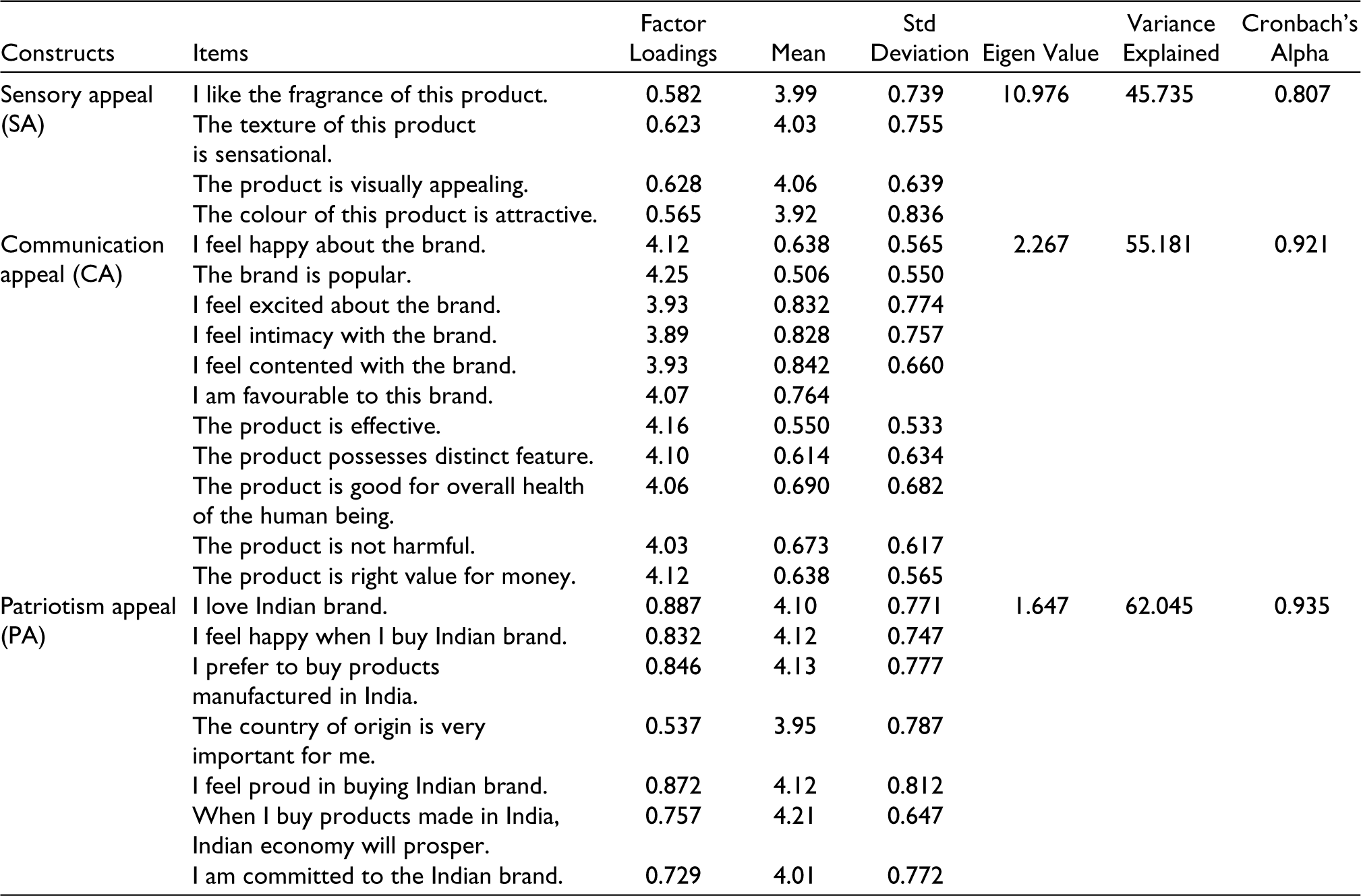
We followed the instructions from as phases for the formative measure of scale development and EBS validation approach to build a representative scale of emotional branding. To achieve this purpose, the elements of the EBS were finalized based on a literature study. Table 1 shows the results that were generated. The preliminary research includes a pilot test for the initial questionnaire, which was built on the theoretical foundations of the literature on emotional branding. The instrument had 31 items that had been culturally modified in light of past studies and expert inputs to assure the instrument’s content validity. Following many rounds of discussions with academicians, industry professionals and consumers, as well as the EFA results, seven statements were picked for the new concept, named the patriotism appeal. The items below were drawn from Thomson et al. 2005’s brand attachment appeal. The pilot test had 30 participants. Cronbach’s alpha for each construct was 0.807, 0.921 and 0.935, which is regarded excellent because the values are greater than 0.7. To test hypotheses, each object and construct must first be proven to be reliable and valid. At this point, the valuable items were recognized, and the ineffective elements were removed. In this section, the Cronbach alpha value for each construct has been confirmed. Table 1 shows that Cronbach’s alpha for all constructs is more than 0.70, indicating strong internal consistency and adequate for research purposes. The scales used in this study exhibit sufficient internal consistency, as evaluated by Cronbach’s alpha, indicating that they are accurate scales to use in future research, as indicated in Table 1. In terms of composite dependability statistics, satisfactory results should have scored higher than 0.70. As a consequence, 31 items were chosen for further investigation in the study. We also looked at item correlation, and any item with a correlation value less than 0.5 was evaluated for deletion. In this study, however, all of the items exhibited correlations greater than 0.5. As a result, none of the items were eliminated from the questionnaire. Then, based on the replies of 120 participants in the second stage, an EFA was done on 24 components of emotional branding. According to the findings, the EBS construction, which comprised of 22 phrases, could be categorized into the following three categories: SA, CA and PA. Because the items for factor brand attachment were adapted from Thompson et al. (2006), they were not included in EFA but were included directly in CFA. The factors with eigenvalues greater than one were taken into account. Cronbach’s alpha was used to assess reliability. For 22 items, Cronbach’s alpha was 0.948. The questionnaire was delivered to the second group of respondents at the third and final step to ensure its reliability. ‘An initial sample can be analysed with EFA and the results used for subsequent purification’, according to Hair et al. (2019). CFA necessitates the use of many samples, especially when the measurement model incorporates additional scales. As a result, an additional 280 responses were collected, and the validity of the results was assessed using zero-order and first-order CFA. The last step of the process also included BA and PI.
Reliability Analysis for Emotional Branding Scale.
Sample Description: The respondents’ ages varied from 21 to 30 years (70.4%), 31 to 40 years (12.1%), 41 to 50 years (10%), 51 to 60 years (6.4%) and over 60 years (11%). In total, 57.5% of the population was male, while 42.5% was female. In terms of other demographics, the majority of participants (70.4%) were unmarried, had a postgraduate degree (33.9%), 14.6% were graduates and 13.9% had professional degrees—the majority had an annual salary of up to $250,000 (52.5%). The detailed description is shown in Table 2. Colgate was the most often used toothpaste brand (40%), followed by Dant Kanti (25.4%), Close Up (9.6%), Sensodyne (7.5%), Dabur Promise (6.1%), Vicco (1.8%) and Others (9.6%).
Sample Profile of the Respondents Considered for Scale Development.

Validity assessment (content, construct: convergent and discriminant): Authors describe content validity as the extent to which the constructs or instruments cover the meanings of the concept being researched for a specific study. The goal of content validity is to define the extent of a concept (e.g., EBS) and decide if the measure adequately reflects the domain of the idea. Solid theoretical definition of constructs, as well as a thorough literature assessment, are required to assure content validity. An in-depth conversation with professors, industry professionals and customers established the content’s legitimacy. The factor loadings will be examined to determine convergent validity. The objects have high loadings (Table 1). We must additionally consider two additional measures: average variance extracted (AVE) and composite reliability (CR). ‘CR > 0.70, CR > AVE and AVE > 0.5’ are the criterion for ensuring convergent validity. To indicate acceptable convergence or internal consistency, CR statistics scores greater than 0.70 are recommended. Table 4 shows that the CR and AVE values for all constructs are substantial, confirming the convergent validity. The findings reveal that all constructs satisfy convergent validity. The degree to which construct measurements (i.e., SA, BA, CA and PA) are relatively distinct is referred to as discriminant validity. The values of average variance extracted (AVE), average shared variance (ASV) and maximum shared variance (MSV) of all four constructs are compared for discriminant validity. Because the value of AVE for all constructs is greater than the values of ASV and MSV, all constructs have demonstrated discriminant validity. The study’s measuring model yields valid results for discriminant validity (Table 3). The results demonstrated that the measuring model, such as content, convergent and discriminant validity, was adequate.
Discriminant Validity.

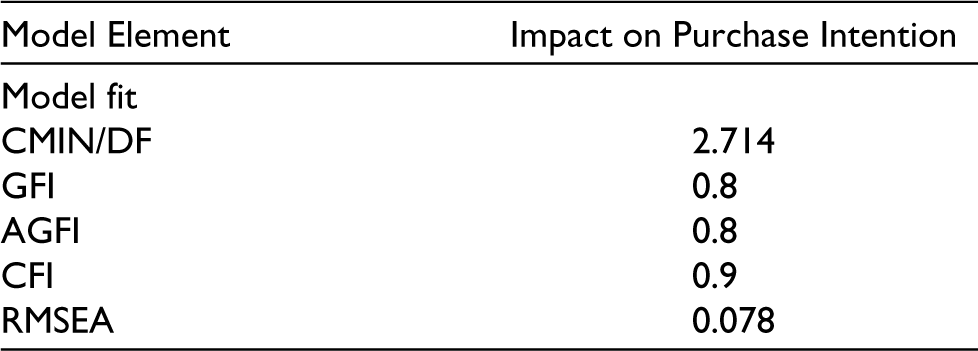
Confirming the dimensional structure of the EBS: We used CFA to determine the relationship between the scale items and the EBS construct. We want to make sure the scale is accurate at this point. The model’s inventory contains 32 items. This model conceptualizes four factors (SA, BA, CA and PA) as determinants of emotional branding. The results of the CFA analysis show that each path is beneficial and statistically significant. This implies that each concept contributes positively to the EBS. CFA (32 items) was verified with a degree of freedom (dof) of 2.405, a comparative fit index (CFI) of .898 and a root mean square error of approximation (RMSEA) of .071. ‘A value of 2.0 or below is considered to be good’, according to Hair et al. (2019). The EBS, as proven by this study, contains four characteristics that can be utilized to evaluate emotional branding: SA, BA, CA and PA.
Measurement evaluation: Structural equation modelling was performed using AMOS 21. The graphical diagram is depicted in Figure 2, where SA stands for sensory appeal, BA stands for brand attachment appeal, CA stands for communication appeal and PA stands for patriotism appeal. The fit indicators demonstrate that EBS has been conceptualized and validated.
Emotional Branding Measurement Model.

In order to analyse the role of CE, we need to first analyse the influence of emotional branding variables and PI. This study was designed to examine the influence of emotional branding on PI (H1). For doing so, we used structural equational modelling. This part of the study has the following sub-hypotheses: H1.1: SA positively influences PI, H1.2: BA positively influences PI, H1.3: CA positively influences PI, and H1.4: PA positively influences PI (Figure 3).
Mediating Role of Celebrity Endorsement (CE) between Emotional Branding (EB) and Purchase Intention (PI).

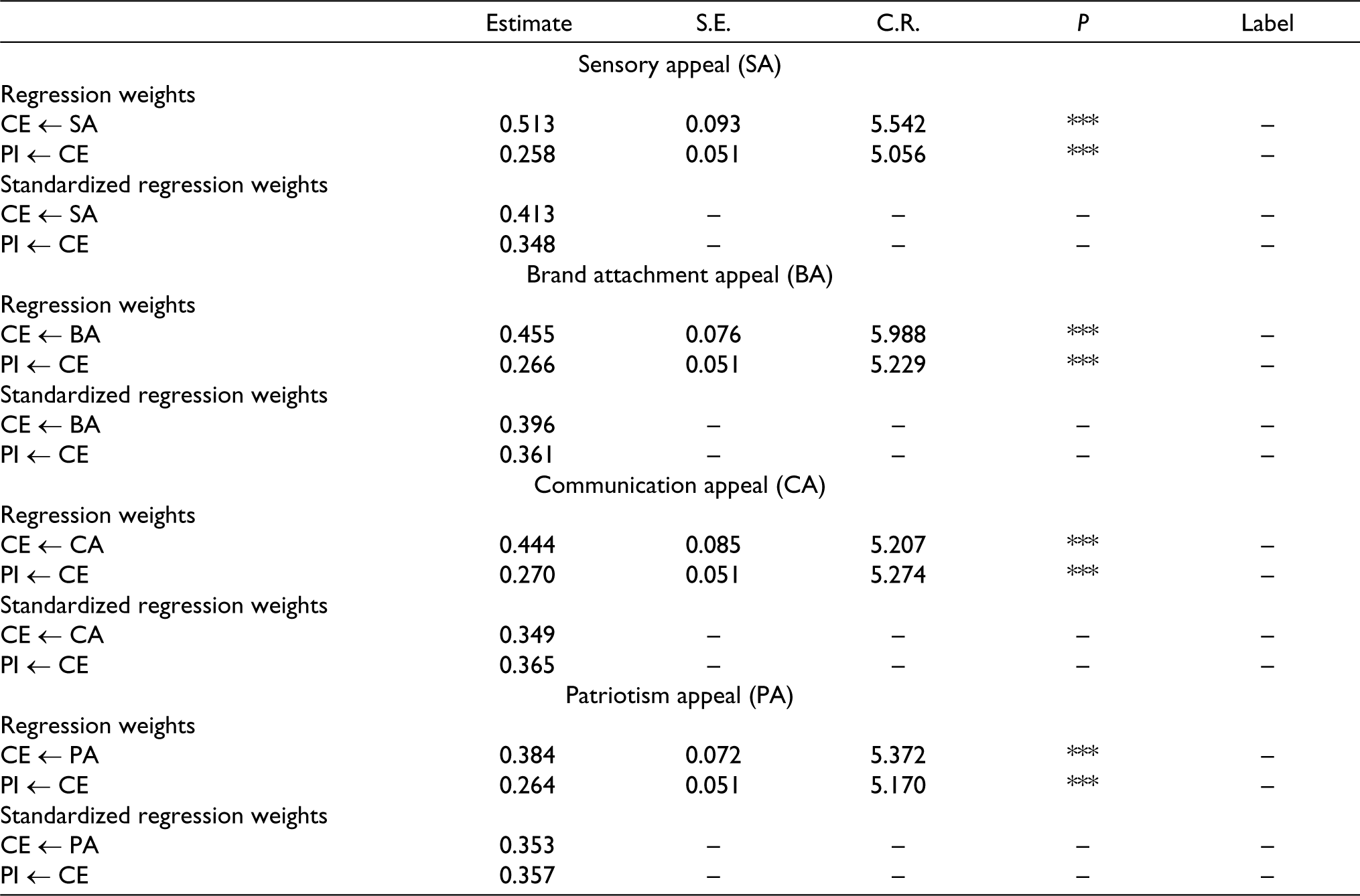
Regression analysis is used to investigate the impact of various emotional branding components on PI. The prerequisites for regression analysis are met. The results show that in the case of SA and PI (Sig. value = 0.000 that is less than 0.05, standardized regression weights = 0.460) (Table 4), BA and PI (Sig. value = 0.000 that is less than 0.05, standardized regression weights = 0.632) (Table 4), CA and PI (Sig. value = 0.000 that is less than 0.05, standardized regression weights = 0.844) (Table 4), PA and PI (Table 4). The findings show that emotional branding characteristics such as SA, BA, CA and PA are relevant in predicting PI. As a result, it demonstrates that emotional branding has a major impact on consumers’ PIs (Table 4). As a result, hypothesis 1 is supported. At a 95% confidence level, the P-value is significant (Table 4). The various fit indices for the model used to estimate the impact of emotional branding on PI are shown in Table 6. Hypotheses H1, H2, H3 and H4 are so supported. Another consideration is the role of CE as a moderating variable between emotional branding and PI (H2). This was accomplished through the use of structural equation modelling. The following hypotheses were examined for mediation analysis: H2.1: CE mediates between emotional branding (SA) and PI, H2.2: CE mediates between emotional branding (BA) and PI, H2.3: CE mediates between emotional branding (CA) and PI, H2.4: CE mediates between emotional branding (PA) and PI.
Depicts Regression Result for (I) Regression Weights for Sensory Appeal (SA), Brand Attachment Appeal (BA), Communication Appeal (CA) and Patriotism Appeal (PA) on Purchase Intention (PI), (II) Represents Regression Weights for Emotional Branding (EB) on Purchase Intention (PI) and (III) Shows Standardized Regression Weights for Sensory Appeal (SA), Brand Attachment Appeal (BA), Communication Appeal (CA) and Patriotism Appeal (PA) on Purchase Intention (PI).

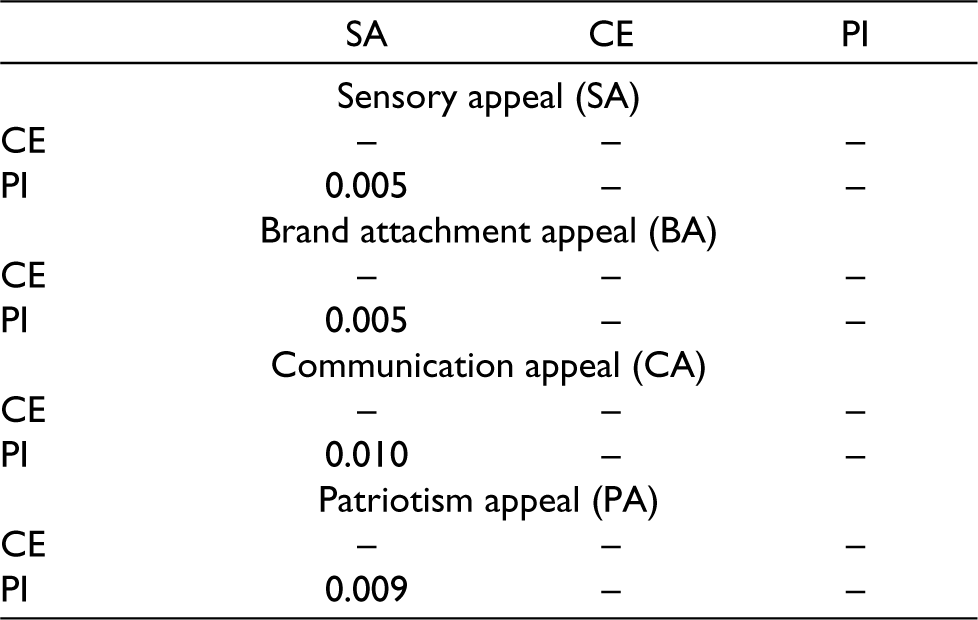
First condition-direct effect with no mediation: initially, the direct impact of emotional branding on purchase intent was noticed. The investigation was initially conducted in the absence of the mediator. In the absence of a mediator, emotional branding was found to have a direct and significant impact on PI, showing a causal relationship. According to the findings, emotional branding has a positive effect on purchase intent. The second condition: Emotional branding on PI through a mediating variable CE: A mediating variable (CE) is included in this stage to examine the influence of emotional branding on PI. Case 1: The direct influence and significance of emotional branding (SA) on PI are demonstrated in Table 5, in the presence of CE. Using the Baron and Kenny (1986) method, it is possible to determine that there is partial mediation. Case 2: Effect of emotional branding (BA) on PI via varied CE. Using the Baron and Kenny (1986) method, it is possible to determine that there is partial mediation (Table 7). Case 3: The effect of emotional branding (CA) on PI via mediating variable CE is shown in Table 5. Table 5 demonstrates the direct effect and significance of emotional branding (CA) on PI when CE is present. Using the Baron and Kenny (1986) and Rosha and Kaur (2017) methods, it is possible to establish that partial mediation exists (Table 7). Case 4: Effect of emotional branding (PA) on PI through mediating variable CE is shown in Table 5. Table 5 shows the direct effect and significance of emotional branding (PA) on PI when CE is present. It is possible to conclude that there is partial mediation using the Barron and Kenny approach (Table 7). Using the Barron and Kenny approach from Table 8, emotional branding on PI through CE is partially mediating. All of the hypotheses given under H2 are supported in part.
Discussions
Theoretical Contribution
A new emotional branding measurement approach was proposed in this study. Emotional branding is measured by it. Results demonstrated that the proposed emotional branding model was sufficiently illustrative. According to results, SA, BA, CA and PA are major antecedents of emotional branding. Empirical support for the EBS scale fills a gap in the emotional branding literature. This study developed and validated the EBS. The scale can be generalized despite the study’s limitations because the data were collected in three phases. Emotional branding captures the brand’s emotional connection with consumers, according to the study. The EBS has a four-factor model, according to exploratory and empirical research.It indicates that all four constructs—SA, BA, CA and PA—should be included while measuring EBS (Figure 2). Emotional branding components’ impact on PI was also examined. Regression analysis examined the link between independent variables (emotional branding) and dependent variables (PI). SA, BA, CA and patriotic appeal were major emotional branding elements in predicting PI, supporting H1, H1.1, H1.2, H1.3 and H1.4. The 95% confidence level P-value was significant. Thus, emotional branding has a major impact on customers’ PI, as shown by Hosein (2012), Sharma and Singh (2012) and Consoli (2009). CE mediated emotional branding and PI in the third section of the study (Tables 4 and 6). Consumers buy celebrity-endorsed things to feel connected to them. Producers and marketers should take advantage of the celebrity’s charm to promote their items. CE partially mediates consumer intentions, according to this study. To attract the target audience to the endorsed brand, celebrities must be considered and managed effectively. When examining present and potential endorsement deals, corporations and celebrities should be cautious to avoid conflicts of interest. When a celebrity supports a product or service, celebrity favourability is crucial. Celebrity favourability is usually used to boost brand sales. According to the findings, CE partially mediates the association between emotional branding and PI. The more popular the CE, the more likely buyers are to buy. CE partially impacts SA, BA, CA, PA and PI, supporting H2, H2.1, H2.2, H2.3 and H2.4. CE impacts emotional branding and PI (Tables 5, 7 and 8). This study found that emotional branding and CE can influence consumers’ purchasing intentions, making them powerful tools for firms. Businesses may prosper, grow and get a market advantage from this. Companies must find celebrities with personalities that match their brand, target market, cost, popularity, credibility and previous endorsements.
Regression Weights and Standardized Regression Weights for Sensory Appeal (SA), Brand Attachment Appeal (BA), Communication Appeal (CA), Patriotism Appeal (PA) and Purchase Intention (PI).
Indicates the Results of Model Fit.
Represents Standardized Indirect Effects—Two-Tailed Significance for Sensory Appeal (SA), Brand Attachment Appeal (BA), Communication Appeal (CA) and Patriotism Appeal (PA).
Mediation Results Summary.

Managerial Implications
This study provides a sound framework for creating a new scale to measure emotional impulses and build strong consumer relationships. Thus, the study may offer marketers valuable insights into creating an emotional connection in their efforts to touch people’s hearts. SA, BA, CA and PA increase PI. Taste, texture, smell and appearance affect consumers’ purchase decisions. SA generates a positive emotional experience that promotes future purchases, and increases PI and sales. Brands may stand out from the competition by engaging customers’ senses and delivering a memorable experience. Emotional communication has the potential to be an extremely effective tool for developing customer loyalty to a brand and increasing sales. As a result, the marketing team may choose to incorporate emotional communication into their overall communication strategy. Brand attachment affects consumers’ premium pricing willingness, word-of-mouth communication and brand loyalty. Marketers may get good insights for applying the above factors of emotional branding in influencing customers and enhancing brand image to increase brand attachment. Brand attachment enhances PI, promotes repeat purchases, and word-of-mouth communication, increases sales and boosts brand loyalty. Emotionally linked consumers are more likely to buy and pay more for a brand. Marketers may also use patriotism as an emotional strategy to invoke the feelings of their own county’s product by highlighting emotional attachment as well as protecting the industry and employment of their own country.
Limitations and Future Research
SA, brand attachment, CA and PA were validated as determinants of EBS and the mediating role of CE between emotional branding and PI. The future study may include other variables like brand jealousy, trust, etc. This study of EBS can help in conceptualization and development of other branding scales. Researchers can improve the EBS by adding several relevant factors. The study solely examined toothpaste in the fast-moving consumer goods market. Thus, the EBS may be tested in various segments and brands to determine its generalizability and validity across product categories. Brand trust or Brand love may be included as a mediator in future studies. Researchers may uncover the most important emotional branding variables and improve commercial branding strategies by studying various mediators. The study is limited to Delhi/NCR. Future research may be carried out across the country.
Footnotes
Declaration of Conflicting Interests
The authors declared no potential conflicts of interest with respect to the research, authorship and/or publication of this article.
Funding
The authors received no financial support for the research, authorship and/or publication of this article.