



Abstract
The present study aims to develop a reliable and valid scale that measures the multidimensionality of celebrity images and is generalizable across diverse celebrity professions. A survey has been conducted using a sample of 484 respondents to gather data relating to the dimensions of celebrity images of four selected celebrities from two celebrity profession categories, namely, movie stars and sport stars. EFA, CFA and SEM have been used for developing a reliable and valid scale of celebrity images. The scale encompasses seven dimensions of celebrity image: social and ethical responsibility, life and style, professional capabilities, perspective towards celebrity’s profession, orientation towards fans, attractive physique and public image. Marketers can use the scale to identify the dimensions of celebrity images to select appropriate celebrities for their product endorsement. They can also use the identified dimensions of celebrity images to better differentiate, position and extend their brands while designing their marketing strategies related to product positioning, celebrity endorsements and celebrity brand extensions. It would enable researchers and practitioners to bring standardization to celebrity image research in the field of brand endorsements.
Introduction
Choi and Rifon (2007) confer that celebrities are well-recognized individuals who enjoy huge popularity, distinctive virtues and glitzy images as they appear frequently on various media platforms and the consumers have pre-defined knowledge and attitude towards them even before they are viewed in an advertisement. Capitalizing on these consumer images, celebrities appear in advertisements to differentiate (Liu & Liu, 2019), to build and to reposition the brand (Knoll & Matthes, 2017; Winterich et al., 2018). These celebrity images developed in the minds of the consumers can impact the relationship of the consumer with the celebrity endorser and consumer’s attitude towards an advertisement and the products being advertised (Alperstein, 1991; Kumar & Tripathi, 2019; Singh & Banerjee, 2018b). Choi and Rifon (2007) state that consumers may accept only those celebrity endorsements in which they perceive a celebrity to signify and communicate images, which are in line with their perceived images residing in the minds of the consumers. Favourable celebrity images positively impact consumers’ behaviours, as they emulate celebrity’s style and behaviour. However, in case of unfavourable images, it negatively impacts consumers’ decisions and behaviours and leads to loss of trust and confidence (Nelson, 2012). Consequently, celebrity image and consumer behaviour are inextricably correlated with each other in the process of celebrity endorsement, thereby making it significant for the academicians and the brand managers to measure celebrity images residing in the minds of the consumers for the selection of appropriate celebrity as is also reiterated by Paul and Bhakar (2018).
Seno and Lukas (2007) define celebrity image as the consumers’ perception about an individual who enjoys massive popularity among the masses, which is revealed by the celebrity associations existing in the consumers’ minds. Keller (1998) describes the celebrity images as the function of the inferences, which a consumer draws on the basis of her knowledge about a celebrity. Meyers (2009) adds that the celebrity image is not only restricted to the professional image of the celebrity but also includes some additional information available in the public domain about such celebrity. Therefore, a celebrity is considered an inter-textual symbol whose information is reported by manifold sources in multiple ways.
Albert et al. (2017) state that the marketers can bring into play various tools to construct and maintain associations for a brand, where the celebrity endorser represents one such way of transferring the meanings to the brand. McCracken (1989) also confers that a celebrity brings a variety of meanings to the endorsement process when the celebrity endorses a brand. In fact, celebrities transfer their symbolic meanings to the brands they endorse and instil these meanings in brands (Abimbola et al., 2010; Dwivedi et al., 2015). These meanings must also match with the image of the brand for effective communication. For example, Roger Federer, who has been very effective for other brands, seemed to have little impact on consumer when he featured in an advertisement for pasta brand, Barilla. Therefore, the success of a celebrity endorsement depends upon the celebrity images residing in the consumers’ memory.
It is well documented in academic research (Arai et al., 2014; Braunstein & Zhang, 2005; Choi & Rifon, 2007; Jain & Roy, 2016; Kim et al., 2015; Ohanian, 1990; Roy & Moorthi, 2012; Singh & Banerjee, 2018a) that there are a number of dimensions of celebrity images residing in the consumer memory. However, the extensive literature review also shows that Ohanian (1990) is the most widely followed scale for measuring celebrity endorser characteristics. The major limitation of this scale is that it covers only three dimensions of celebrity credibility, namely expertise, trustworthiness and attractiveness. Moreover, credibility as a whole is only a part of the celebrity image as is also suggested by Choi and Rifon (2007). The other researchers who have developed celebrity images scale, such as Choi and Rifon (2007) and Arai et al. (2014), have studied celebrity images, but these suffer from certain limitations. The main shortcoming of these celebrity image scales is that it has not been found to be robust for different celebrity categories. Additionally, the existing studies using celebrity images have not been consistent with their construction techniques. Further, none of these studies has exhaustively identified the celebrity associations using both qualitative and quantitative techniques.
In the past decade, with the growth of social media, the consumers’ knowledge about celebrities has increased manifold. Consumers are now much more aware about different aspects of the celebrity lives, both professional as well as personal. This awareness has further increased the amount and complexity of knowledge that the consumers store in their minds about the celebrities. Despite the significance of celebrity images for the endorsement process, as highlighted by the works of McCracken (1989), Langmeyer and Walker (1991), and Bergkvist (2017), only a few researches have addressed the issue of factors comprising celebrity images. Therefore, there is a need for measuring comprehensive celebrity image dimensions.
The true path to commercial success may be in the clever formation of brands images, and it has become a primary job of advertising to infuse meaning into products, converting them into lifestyles (Salzer–Mörling & Stran-negård, 2004). For this to happen, it is essential that there should be congruence between the celebrity images and the product attributes. Previous literature has shown that there is lack of a comprehensive celebrity image scale, which is generalizable across diverse celebrity professions. Therefore, the current research aims to develop a celebrity image scale, which can be used by both the academicians and the marketing practitioners. Academicians need the scale in order to widen the horizon of their theoretical knowledge, as there is a dire need to move towards a more holistic view of celebrity image. The scale is equally important for the marketing professionals, so that they can easily compare celebrities and select the most appropriate celebrity for their brands. Marketers also need a detailed understanding of how a consumer views a celebrity and how they can use the celebrity associations to differentiate and position their brands in the consumer minds to create a positive attitude towards the brand. Marketers can only build congruence between the celebrity endorser and the brand if they are able to accurately measure celebrity image dimensions residing in the minds of the consumers.
The present research comprises of seven sections. The first section of introduction (as discussed above) presents the backdrop of the research problem and the need for the study. The second section critically reviews the literature and explains the theoretical framework of the research. The third section of the study gives the details of scale development procedure adopted for the study. The fourth section consists of the data analysis, whereas the fifth section discusses the results and present conclusion of the research. The sixth section discusses the academic and managerial implications of the study. Lastly, the article concludes with the seventh section, which highlights the limitations and directions for future research.
Review of Literature
American Heritage Dictionary of the English Language defines Image as ‘the concept of someone or something that is held or projected by the public’. In the celebrity/brand management literature, there are various image definitions; however, these are mainly in the context of brands. Dobni and Zinkhan (1990) define brand image as ‘the reasoned or emotional consumer perceptions relating to celebrities’. Keller (1993) states that brand image comprises of consumer perception of a brand as revealed by the brand associations residing in the minds of the consumers. Brand associations are the informational nodes encompassing knowledge pertaining to the different facets of a brand. Taking these brand image definitions as the base, the researchers have defined images for celebrities, sometimes also called celebrity brand image (Arai et al., 2014). Seno and Lukas (2007) define celebrity image as the consumers’ perception of the celebrity depicted by the celebrity associations existing in the consumers’ minds. According to Arai et al. (2014), athlete’s brand image is ‘a consumers’ perception about the athlete brand attributes’. In summary, celebrity image may be defined as the consumers’ perception of the celebrity based on the various celebrity associations existing in the consumers’ minds. In this regard, this research aims to uncover and measure the varied celebrity associations forming the celebrity image.
With the ascent of the social media, some individuals consider this period as the social age of celebrity (Gullov-Singh, 2011). The visibility of celebrities has increased more than ever, owing to their virtual existence on various social media platforms such as Facebook, Twitter or Instagram (Pounders et al., 2016). These networking websites are commonly used as they help in publicizing information rapidly and more efficiently as compared to traditional mediums such as, TV or print medium (Agnihotri & Bhattacharya, 2018; Mangold & Faulds, 2009). When celebrities function from a Twitter account, they are actively developing their own brand. Khamis et al. (2017) define self-branding, also known as personal branding, as ‘individuals developing a distinguishing public image for commercial gain and/or cultural capital’. Celebrities use self-branding practices by providing unique insights in their work life, beliefs and personal life details to achieve their fullest potential and attain personal objectives (Kerrigan et al., 2011). These practices facilitate them to construct a targeted and strategic public image and hence, enhance their market value (Hearn & Schoenhoff, 2016) and profitably endorse brands (Khamis et al., 2017). Considering the significance of celebrity self-branding practices, the existing studies call for investigation of celebrities as personal brands rather than just as individuals and for measuring their different image dimensions. Thus, the scope of our current research goes beyond the physical existence of a celebrity to the movement and measurement of the celebrity brand image.
Ghuman et al. (2019) confer that the notion of celebrities as human brands is a major constituent of branding philosophy, as they have associations and characteristics of a brand, which is also reiterated by Thomson (2006). These associations are created, owing to the exhaustive information supplied by the mass media platforms (Choi & Rifon, 2007). Celebrity associations are the informational nodes connected to the celebrity node in the consumer’s memory and consist of the meaning of the celebrity for the consumers (Keller, 1993). Table 1 shows the details of the studies pertaining to celebrity associations.
The literature review, as given in Table 1, suggests that there have been various studies that focus on the measurement of the celebrity associations. The table shows that the studies deal with the conceptualization of the different aspects of celebrity images that are important to the marketers. These associations range from the professional associations to the personal characteristics of the celebrities. However, the table also shows that there are only two studies (Arai et al., 2014; Choi & Rifon, 2007), which primarily deal with the conceptualization and measurement of celebrity images, whereas the rest of the studies (Braunstein & Zhang, 2005; Jain & Roy, 2016; Kim et al., 2015; Ohanian, 1990; Roy & Moorthi, 2012; Singh & Banerjee, 2018a) deal with capturing specific elements (celebrity credibility, athlete star power, celebrity reputation, celebrity personality and celebrity meanings) of celebrity associations. Additionally, Table 1 shows the existing studies though measure some aspect of celebrity associations, but the findings are not comparable, as the focus of these studies (except Arai et al., 2014; Choi & Rifon, 2007) is not on the construction and measurement of the celebrity image.
Braunstein and Zhang (2005) have developed a scale for measuring the athlete star power, but they have not evaluated reliability of the constructs and considered only athletes for their study. Roy and Moorthi (2012) have found the dimensions of Aaker (1997) brand personality scale to be valid for celebrity endorsers; however, celebrities are human brands, whose image dimensions may extend beyond their personalities. Further, this study uses only one celebrity endorser for the validation of the scale, which may limit the generalizability of the study. Kim et al. (2015) use the dimensions of celebrity reputation for measuring celebrity associations to study the parasocial relationships with celebrities. The context of parasocial relationship may allow researchers to leave out a few significant constructs from the study, which may have otherwise been influential elements of celebrity image. Jain and Roy (2016) unearth celebrity associations, which may be residing in the consumers’ minds, but they have not developed any scale for its measurement. Singh and Banerjee (2018a) develop a scale for measuring credibility of celebrity endorsers in the Indian setting. The major limitation of the scale is that they have not identified an exhaustive list of celebrity credibility dimensions in the exploratory phase, as they added 8 more items to the other 27 items borrowed from Ohanian (1990). Therefore, there is a need to develop a comprehensive scale, which measures the broad dimensions of celebrity image.
Literature Survey Relating to Celebrity Images and Related Constructs
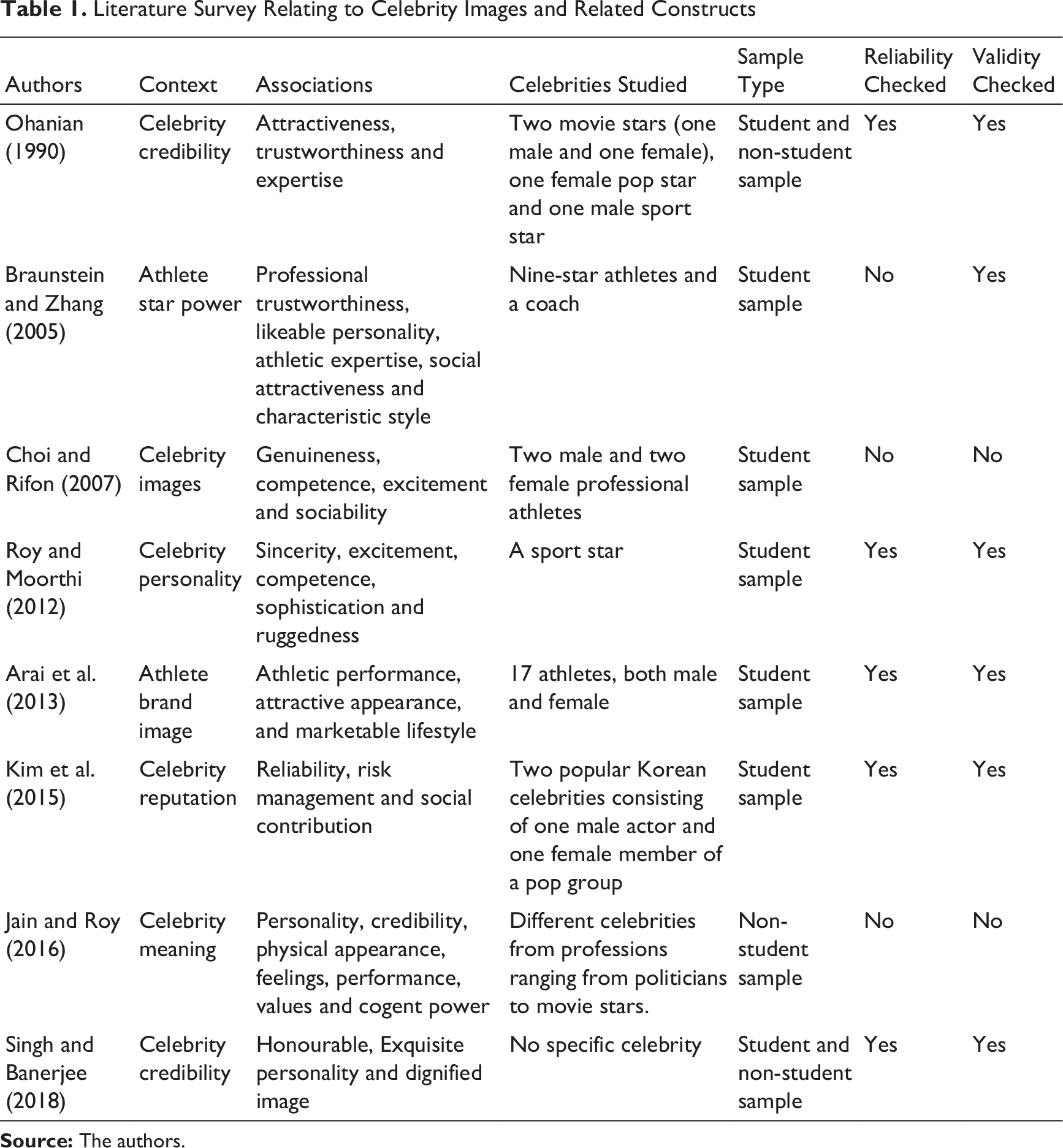
The literature review also shows that the scales developed by Choi and Rifon (2007) and Arai et al. (2014) pertaining to celebrity images are not found to be robust in their development stages. Choi and Rifon (2007) state the scale is not compatible for other professional athletes and cite reasons of boredom and fatigue on the part of the respondents and call for a qualitative research for understanding the dimension of celebrity images. The reliability and validity of the scale has also not been verified. Arai et al. (2014), in their research, find that there is a lack of validation consensus for the dimensions of athlete brand image identified. The results reveal that there is low factor loading between attractive appearance and athlete brand image and they also call for revalidation of some dimensions. Therefore, there is the need for a scale, which is robust and summarizes all the dimensions of celebrity images through qualitative exploration and quantitative testing.
The above discussion also shows that, over a period of time, there has been an increase in the identification and measurement of the celebrity associations, which leads to the formation of celebrity image. McCracken (1989) state that the celebrity meaning arises from the performances of the celebrities in different mediums. The celebrity association of skilfulness and physical attractiveness leads to the development of celebrity meanings (Roy et al., 2013). These meanings lead to the formation of credibility of on-screen positive characters, thereby adding dimensions of trust to the existing dimension of expertise and attractiveness. Further, with more personal information available about the celebrity, the celebrity credibility dimensions blend individual qualities and lifestyle dimensions to form the celebrity personality dimension. These on-screen traits and personal traits add to celebrity ethical and social responsible behaviour to form celebrity reputation as also is highlighted by Balmer (1998). Further, the celebrity reputation earned through high economic and social returns encourages the consumer to form a relationship with the celebrities, which leads to the evolution of celebrity star power. Furthermore, the star power leads to construction of the celebrity image comprising of the consumers’ perception of the celebrities professional and personal behaviour and their relationship with the celebrities is highlighted through various social media platforms (Arai et al., 2014).
The literature review shows that there has been a similarity in the dimensions identified for the movie stars and sport stars. It illustrates that the dimensions of athlete professional trustworthiness (Braunstein & Zhang, 2005) is similar to movie star’s dimension of trustworthiness (Ohanian, 1990). The dimension of athlete genuineness (Choi & Rifon, 2007) is in congruence with a movie star’s social contribution (Kim et al., 2015). The dimensions of athletic expertise (Braunstein & Zhang, 2005), athletic performance (Arai et al., 2014) and competence (Choi & Rifon, 2007) are similar to movie star’s dimension of expertise (Ohanian, 1990) and performance (Jain & Roy, 2016). The dimensions of athlete sociability (Choi & Rifon, 2007), likeable personality and characteristic style (Braunstein & Zhang, 2005) are consistent with the movie star’s dimension of exquisite personality (Singh & Banerjee, 2018a). The dimension of athlete’s excitement, sincerity, competence, sophistication and ruggedness (Roy & Moorthi, 2012) has the same essence as the movie star’s dimension of personality (Jain & Roy, 2016). The dimensions of athlete attractive appearance (Arai et al., 2014) and social attractiveness (Braunstein & Zhang, 2005) matches with movie star’s dimension of attractiveness (Ohanian, 1990). The dimension of athlete marketable lifestyle (Arai et al., 2014) is similar to movie star’s dimension of values, cogent power (Jain & Roy, 2016) and honourable (Singh & Banerjee, 2018a). It demonstrates that the consumer role expectations of the celebrity image as brand endorsers are quite similar from both the sport stars and the movie stars. Therefore, the study aims to measure celebrity image dimensions for both the movie stars and the sport stars.
The existing studies, as given in Table 1, show that the celebrities from varied professions have been used as stimuli for the construction of scales relating to celebrity associations. It reveals that apart from the work of Ohanian (1990), who uses both movie stars and sport stars, celebrity associations have been measured using either sport stars only (Arai et al., 2014; Braunstein & Zhang, 2005; Choi & Rifon, 2007; Roy & Moorthi, 2012) or movie stars only (Kim et al., 2015). Further, as already discussed, the major shortcoming of the celebrity credibility scale (Ohanian, 1990) is that it does not encompass all elements of celebrity image. Thus, there is a need for a celebrity image scale, which includes all the dimensions of celebrity images and is tested empirically for both the sport stars and the movie stars to enhance the universality of the scale.
Objective of the Study
Building on the theoretical foundations of the existing studies, the prime objective of the study is to develop a reliable and valid scale that measures the complete dimensionality of celebrity images and is generalizable across diverse celebrity professions. In this context, the study also attempts to test the appropriateness as well as applicability of the scale for both movie stars and sport stars.
Methodology for Scale Development
The scale development procedure consists of four phases: (a) item generation, pre-testing and item refinement; (b) data collection; (c) scale purification using exploratory factor analysis (EFA) and confirmatory factor analysis (CFA); and (d) reliability and validity tests. For scale development, an initial pool of 140 items has been derived from the relevant literature and a qualitative study (Ghuman et al., 2019) was conducted to identify the celebrity associations residing in the consumers mind.
Principal component matrix with varimax rotation using SPSS version 25 has been applied on the combined data to reduce the data sets and determine the factor scores. All the factors with Eigen value greater than 1 have been retained in the factor solution. Only those variables in a factor have been retained, which have factor loading greater than 0.50. Varimax rotation has been applied to guarantee that each factor is independent of the other factors. Cronbach’s alpha (α) has been used to determine the internal consistency of the factors. Following Nunnally (1967), Cronbach’s alpha (α) values greater than 0.70 have been considered acceptable for factors and coefficients.
CFA has been applied using AMOS version 25 to confirm the factor solution (Mann & Ghuman, 2014) and to explicitly examine the one-dimensionality of the constructs (Gerbing & Anderson, 1988) across celebrities from different professions. Kumara and Canhua (2010) also state that CFA is applied to refine and validate the measurement items. Further, the scale has been validated using content, convergent, discriminant and nomological validity of the factors for celebrities from different professions. Furthermore, measurement equivalency, using constrained and unconstrained models, is also checked for the combined data across all celebrities.
Celebrity Selection Procedure
Following the methodology adopted by Choi and Rifon (2007), three criteria have been used to select the celebrities. First, the celebrities must be well known to the general public. Second, they must reflect a range of images and represent both genders. Third, they must be chosen from different fields in order to encompass different dimensions of celebrity images. In order to fulfil these criteria, two most popular and well-recognized professions, movies and sports, were used for the purpose of the study. Previous research also shows that celebrities emerging from the field of sports (Choi & Rifon, 2007; Dwivedi et al., 2015; Farrell et al., 2000) and movies (Chan et al., 2013; Hsu & McDonald, 2002; Money et al., 2006; Roy et al., 2013) are among the most preferred celebrity types for product endorsement.
Further, a survey was conducted to identify two most popular movie stars and two most popular sport stars, one male and one female in each category. Thirty postgraduate students were asked ‘Name any five Indian male movie stars, five Indian female movie stars that you commonly identify with the endorsement process’ and ‘Name any five Indian male sport stars and five Indian female sport stars that you commonly identify with the endorsement process’. The most frequently mentioned male movie star was Shahrukh Khan (25 times) and female movie star was Deepika Padukone (22 times), whereas, the most frequently mentioned male sport star was Virat Kohli (27 times) and the female sport star was Saina Nehwal (19 times). Thus, the three criteria were duly met for the purpose of the study.
Item Generation and Selection
In the initial phase of item generation, a pool of 140 items was derived from the existing literature and a free thought listing survey. The free thought listing study was planned to be conducted on the MBA students, as they have been frequently used in celebrity endorsement studies (DeSarbo & Harshman, 1985; Kamins, 1990; Tinghchi Liu et al., 2007). Following Runyan et al. (2009), the student sample of MBA students were chosen for the survey, as they were found to be highly interested in and knowledgeable about celebrities and are target of celebrity endorsements. Each of the 58 respondents was given names of the five selected celebrities and was asked ‘Write the celebrity associations that come to your mind when you think of (selected celebrity name)’. The survey resulted in 50 associations, which could be used for all the selected celebrities. The 50 items generated through free thought listing survey were complimented with 90 items derived from the literature.
Content validity of the selected items is determined, as it helps to ascertain the level to which a set of items reflect a content domain (DeVillis, 1991). Content validity for items generated was ascertained following a collective discussion with two professors from the marketing stream. It resulted in deletion of five items, as they were considered to be too celebrity specific and thus, inappropriate. This procedure led to generation of 135 items for measuring celebrity image as given in Table 2.
Celebrity Associations Considered in the Pre-test

Data Collection
Four different versions of the questionnaire were developed for each of the selected celebrity using the selected 135 items relating to different aspects of celebrity images on a 5-point Likert scale ranging from 5 for strongly agree, 4 for agree, 3 for neutral, 2 for disagree and 1 for strongly disagree. In the exploratory phase of scale development, self-administered questionnaires were pretested using 177 responses. Thus, for each celebrity, data were collected from approximately 44 students for each celebrity. Principal component analysis was run and the items with factor loading less than 0.50 were deleted, one by one, for further study. In this process, 58 items got deleted, thus leading to retention of 77 items for the final stage of scale development.
In the final stage, data were collected from 531 respondents from the five major cities of a northern province of India. Quota cum Judgemental sampling methods were used to ensure that the sample was representative of population census data. Following Gatti et al. (2012), in order to ensure randomness of sample selection, the questionnaire was administered to respondents belonging to different socio-economic segments in 10 different supermarkets. These supermarkets were chosen by the researchers as they had distinct market positioning strategy, which was identified on the basis of their product price, product quality and service quality. The randomness of the sample was enhanced by randomly choosing the day of the week and time for data collection as is also highlighted by Simintiras et al. (1997). Descriptive statistics comprising of frequency and percentages were used for analysing demographic profile of the respondents. The sample consisted of 256 (52.9%) males and 228 (47.1%) females, which are in accordance with population data of the province. The age profile of the respondents ranged from 21–45 years and equal number of respondents were selected from each of the five major cities of the province.
Following Mann and Ghuman (2014), only one celebrity was assigned to each respondent so that there are no comparative biases in the responses. Approximately 120 respondents were examined for each celebrity. Out of 531 questionnaires, only 484 questionnaires were found to be complete and usable for the purpose of the study. The final survey resulted in: 121 responses for Shahrukh Khan, 120 responses for Deepika Padukone, 123 responses for Virat Kohli and 120 responses for Saina Nehwal.
Before the respondents were asked to answer the questions of the study, a manipulation check was also conducted to investigate the degree of familiarity of the respondents with celebrities mentioned in the questionnaires. The respondents were asked ‘How familiar are you with the celebrity name?’, on a range of 1 for extremely unfamiliar to 5 for extremely familiar. The results (M = 4.23) revealed the respondents were highly familiar with the selected celebrities.
The respondents were asked to evaluate one selected celebrity for each of the 77 items of celebrity image on a 5-point Likert scale ranging from 5 for strongly agree, 4 for agree, 3 for neutral, 2 for disagree and 1 for strongly disagree. The scores for each negative item were reversed by subtracting each scale position from the number of scale steps plus 1 (Nunnally, 1967). SPSS version 25 was used to conduct EFA and AMOS version 25 was used for applying CFA for the measurement model and SEM for determining the nomological validity.
Findings and Analysis
Scale Purification Using Exploratory Factor Analysis and Confirmatory Factor Analysis
Measuring Celebrity Image Using Exploratory Factor Analysis and Its Internal Consistency
For the combined data set of responses, the initial 77 items were factor analysed using principal component analysis and varimax rotation. EFA is applied to reduce the data set into a smaller set of new factors to define fundamental constructs that are assumed to be underlying in the original variables (Hair et al., 2009). The initial factor solution with factor loadings equal to or greater than 0.3 resulted in 14 factors with Eigen value greater than 1 and it accounted for 65.79 per cent of the total variance. The factor solution was repeatedly run with limits of factor loadings of less than 0.35, 0.40, 0.45 and 0.50, consecutively. It led to the generation of 7 factors based on 45 items.
The 7-factor solution with 45 items explained 66.42 per cent of the total variance and was found to be the most meaningful factor structure (KMO = 0.95, Bartlett’s test of sphericity: chi-square = 15948.85, df = 990, p < 0.001). Twelve items loaded on factor 1, nine items on factor 2, seven items on factor 3, six items on factor 4, four items on factor 5, three items on factor 6 and four items on factor 7. The reliability of the factors was examined using Cronbach’s alpha (α) and it was found to be above 0.7 for all the factors and thus within the acceptable limits (Carmine & Zeller, 1979; Peterson, 1994).
Measuring Celebrity Image Using Confirmatory Factor Analysis
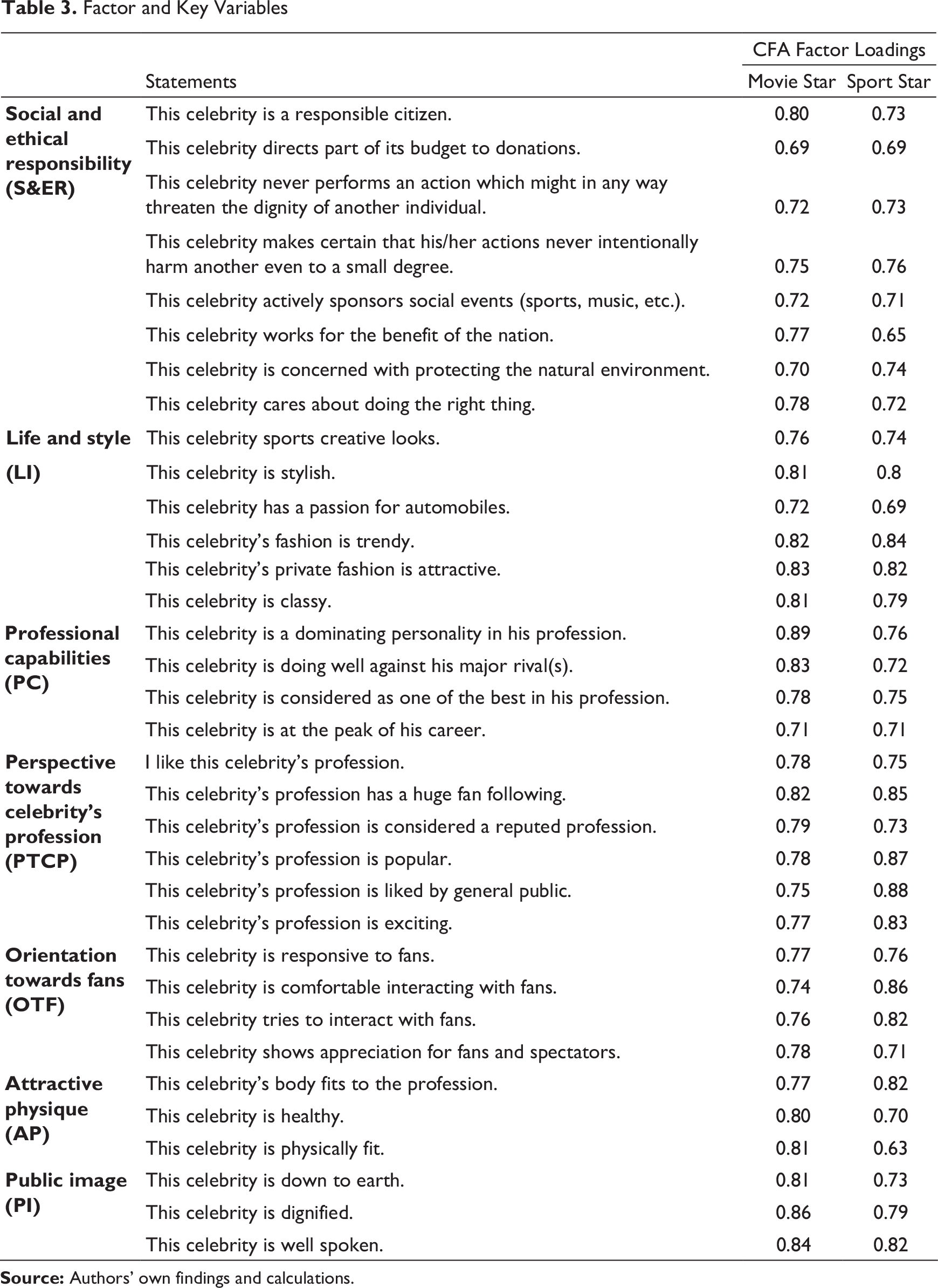
CFA was applied to examine the latent constructs, which became evident from applying EFA (Kim & Johnson, 2015). CFA is a statistical technique, which is conducted to specify models describing the extent of measured variables reflecting certain latent variables (Thompson, 2004). AMOS version 25 was used to apply confirmatory factor analysis (CFA) on the data set of 45 items, which have been derived from results of EFA. CFA was run separately for Movie stars and Sport stars. Initially, 45 items were included in the factor model, but 11 items had CFA loadings that did not meet the minimum requirement. Hence, 11 items were deleted and a modified CFA model with 7 constructs and 34 items was finalized. This model was found to be acceptable for Movie stars and Sport stars. Factor loadings of items obtained in CFA are given in Table 3, for the Movie stars and the Sport stars. Table 4 depicts the fit indices for the two CFA models run for the two types of celebrities.
Factor and Key Variables
CFA Fit Indices in the Two Categories of Celebrities

All the CFA factor loadings are greater than 0.60. The values of fit indices are within acceptable limits. Root mean square error of approximation (RMSEA) is less than 0.08 and CFI, IFI and NNFI are greater than 0.90 in all the cases while NFI is equal to or greater than 0.80 for the two types of celebrities.
On the basis of the items contained in the seven factors, the factors are named as social and ethical responsibility, life and style, professional capabilities, perspective towards celebrity’s profession, orientation towards fans, attractive physique and public Image. Factor 1, Social and ethical responsibility, explains the philanthropic and ethical side of the celebrity. It measures the extent to which a celebrity is considered to be working for the society and acts in a morally acceptable manner. Factor 2, Life and style, represents the image aspects, explaining how a celebrity leads his/her personal life and also explains his/her taste for enjoying pleasures of luxury. Factor 3, Professional capabilities, uncovers the professional expertise aspect of a celebrity. It determines the extent to which a celebrity has been successful in his/her profession. Factor 4, Perspective towards celebrity’s profession, represents the aspects related to public perception about the celebrity’s profession. It uncovers the dimensions related to the public’s likability and respectfulness towards the celebrity’s profession. Factor 5, Orientation towards fans, represents the extent to which a celebrity makes effort to be communicative with fans using some form of communication media. Factor 6, Attractive physique, explains the aspects related to the bodily fitness and healthiness of the celebrity. It also determines how physically fit a celebrity is for his/her profession. Factor 7, Public Image, represents how the general public views the behaviour of the celebrity. It determines the extent to which a celebrity interacts with and treats people at large. These seven factors consisting of the personal, public and professional aspects of a celebrity adequately explain the various dimensions associated with the celebrity image.
Reliability and Validity Tests
Reliability Measures
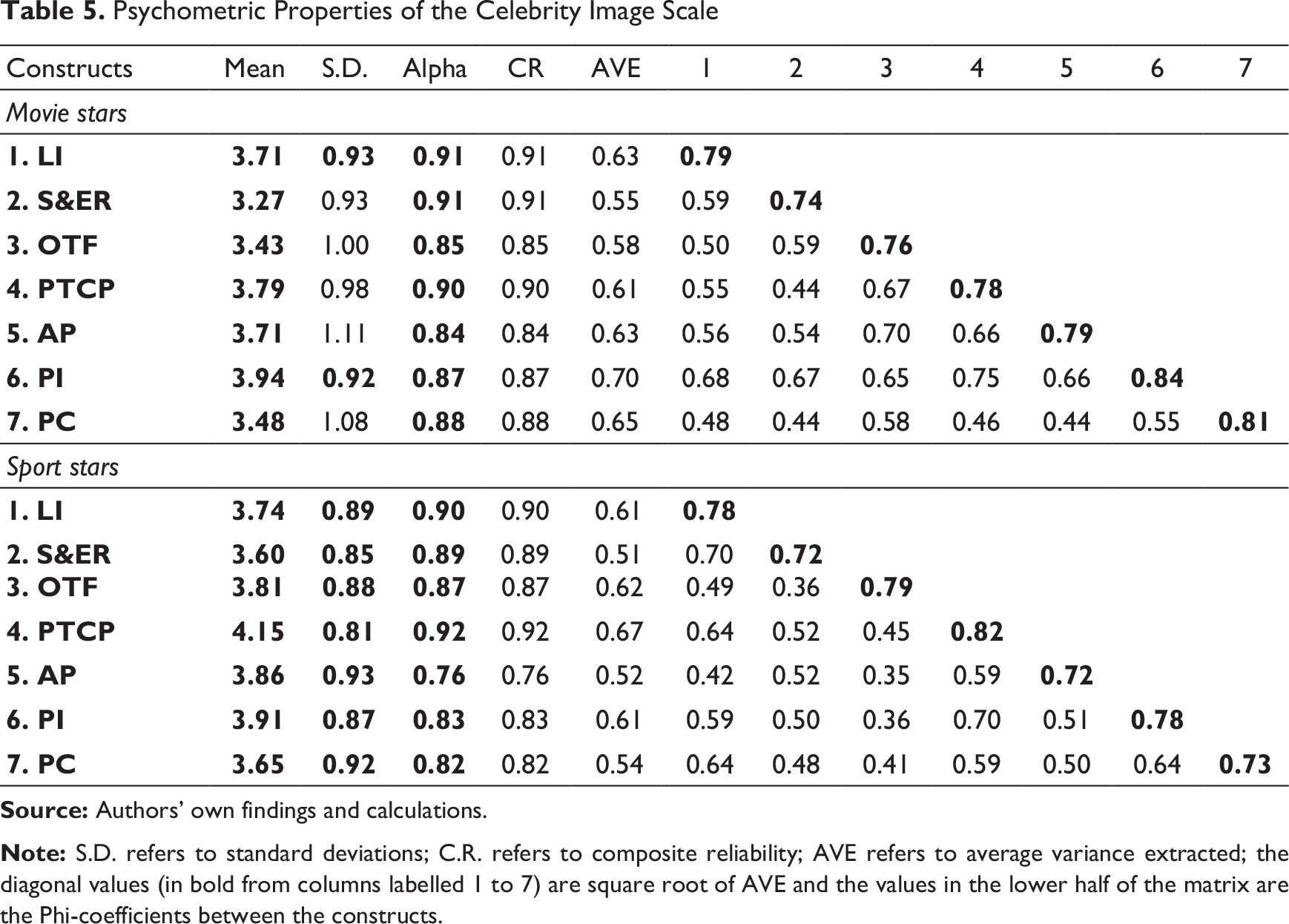
Reliability can be defined as the correlation between a measure and itself (Peter, 1981). It is also defined as proportion of true variance in a test, which is equal to unity minus the proportion of error variance (Edris & Meidan, 1989). The reliability of the seven factors was tested using coefficient alpha, composite reliability (CR) and average variance extracted (AVE), the values of which are given in Table 5. The values of coefficient alpha, CR and AVE have been found to be above the threshold limits of 0.70, 0.70 and 0.50, respectively, and thus, the reliability of the scale is ascertained.
Psychometric Properties of the Celebrity Image Scale
Validity Measures
Construct validity refers to the vertical association between a construct at a conceptual level and the operational level. It is the extent to which a measure assesses the construct that it is supposed to assess. Construct validity of a measure assesses the magnitude and the direction of a representative sample of the construct’s characteristics and the extent to which that measure does not include element from the domain of other constructs (Peter, 1981). We have assessed four types of validities, namely content, convergent, discriminant and nomological validity. Content validity has been assessed at the time of item generation, whereas convergent, discriminant and nomological validity are discussed below.
Convergent Validity
Convergent validity is based on the correlation between responses obtained by using different methods for measuring the same construct (Peter, 1981). EFA and CFA were used to determine convergent validity. In EFA, an Eigen value of 1 and factor loading of 0.5 were taken as criterion for determining items in a factor. Next, convergent validity was established using CFA by including those items, which had factor loadings of value greater than or equal to 0.60, which are shown in Table 3. Thus, convergent validity was established. Bentler–Bonett coefficients were also used to determine convergent validity, as also used by Mann and Ghuman (2014). The NFI values shown in Table 4 are greater than 0.80 for both the types of celebrities, thus, establishing convergent validity.
Discriminant Validity
Discriminant validity is determined by the extent to which a measure is different from another measure from which it is supposed to differ (Campbell, 1960). Following Fornell and Larcker (1981) method, the square root of AVE was compared with the correlation coefficient (Phi coefficient) between constructs. Table 5 shows the value of square root of AVE (highlighted in bold) and in the lower half, correlation coefficient (phi coefficient) are given. For each type of celebrity, the value of square root of AVE is greater than value of Phi coefficient, thereby establishing discriminant validity.
Nomological Validity
Nomological validity examines the relationship between the scores of a scale and how these scores relate to the measure of other construct or behaviour (Peter, 1981). We assessed the impact of the seven dimensions of celebrity images on purchase intentions. Since a celebrity is not appropriate for endorsing all products and services, so we conducted a survey on a sample of 60 postgraduate students to examine the products that the consumers deemed fit with image of the celebrities selected for scale development. The results of the survey led to the selection of soft drink for Shahrukh Khan (male movie star); bathing soap for Deepika Padukone (female movie star); milk nutrition drink for Virat Kohli (male sport star) and pain relief balm for Saina Nehwal (female sport star). Using Low and Lamb (2000), and Till and Busler (2000) methodology, we used fictitious brand names to reduce the impact of brand familiarity. The brand name used for all the products was ‘Epitome’. The question started with lines: ‘Imagine you are viewing an advertisement for (name of the product). The advertisement also features (name of the selected celebrity endorser) as a brand endorser for the brand “Epitome”’. Considering this scenario, the respondents was asked the question ‘Evaluate your purchase intentions towards Epitome brand’ to determine consumer purchase intention towards Epitome brand. The purchase intention was measured using a five-item scale adapted from Dodds et al. (1991) and Zeithaml et al. (1996) on a 5-point Likert scale ranging from ‘5’ for strongly agree to ‘1’ for strongly disagree as given in Appendix A. The results revealed that all the dimensions, except perspective towards celebrity’s profession, were found to have a direct and positive significant impact on purchase intentions (p < 0.005). The results of the SEM model with purchase intentions as dependent variable (CMIN/df = 1.98 (1335.79/674) at p < 0.001, NFI = 0.89, GFI = 0.88, AGFI = 0.86, CFI = 0.94, IFI = 0.94, NNFI = 0.94 and RMSEA = 0.05) suggested that the model reasonably fit the data. Thus, the nomological validity of the scale was established.
Measurement Equivalency Across the Two Categories of Celebrities
After examining the reliability and validity of the scale, we examined measurement equivalency across the celebrities from different professions. Measurement invariance refers to ‘whether or not, under different conditions of observing and studying phenomena, measurement operations yield measures of the same attribute’ (Horn & McArdle, 1992). In this study, measurement invariance was limited to the metric invariance, which suggests that the respondents answering questions with respect to different types of celebrities interpret and answer measures in the same manner (Bagozzi & Yi, 1988; Steenkamp & Baumgartner, 1998). Two separate analyses using constrained and unconstrained model were conducted. In unconstrained model, factor loadings of the models for the two celebrity professions were not equal, while in case of the constrained model, it was constrained to be equal. The fit statistics of both the constrained and unconstrained models with their differences are given in Table 6.
Results of Multigroup Analysis: Testing Factor Structure for the Two Categories of Celebrities
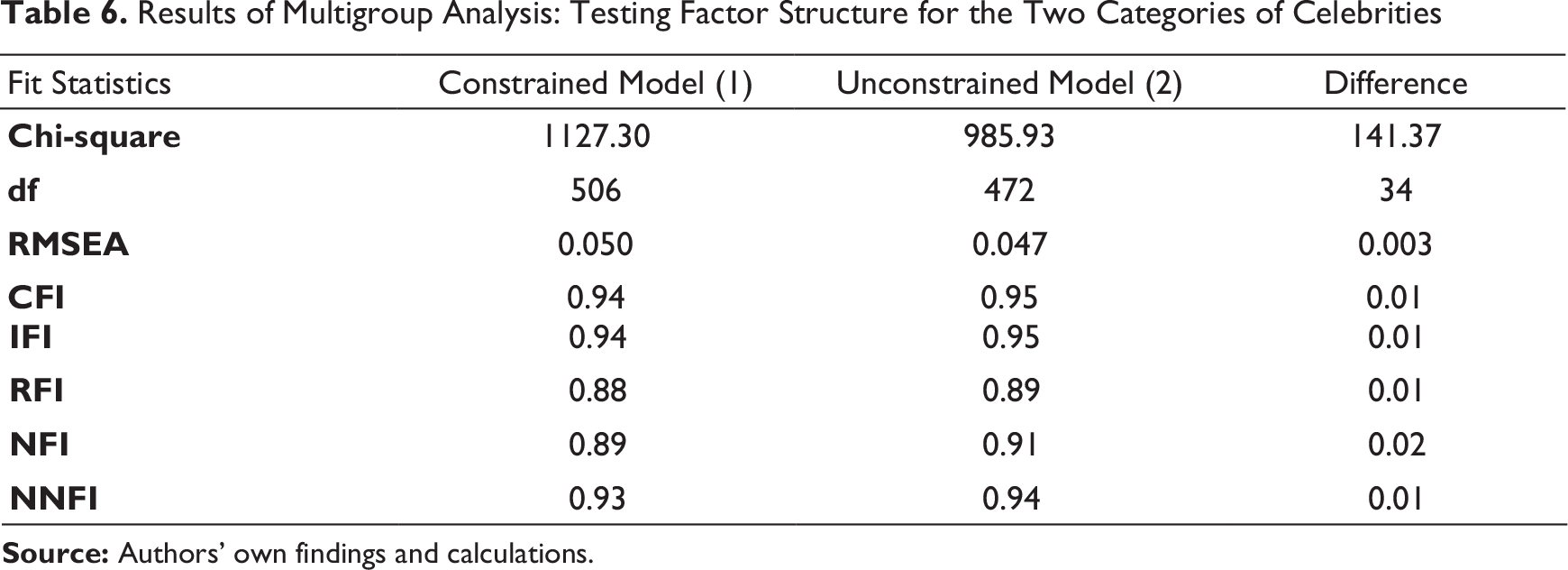
The data from Table 6 shows that the increase in chi-square (141.37) is significant (p < 0.001) for the model. The other fit indices show that the decrease in fit from the constrained model to the unconstrained model is significant at 0.05 levels. Hence, the results show a high level of measurement equivalency across the different celebrity professions.
Discussion and Conclusion
In this study, we have developed and validated a celebrity image scale from the consumer perspective that could be used by both the market practitioners and the academicians. Psychometrically, a 34-item Likert scale has been found to be reliable and valid for the two categories of celebrities comprising of the Movie stars and the Sport stars. The scale encompasses seven dimensions of celebrity image: social and ethical responsibility, life and style, professional capabilities, perspective towards celebrity’s profession, orientation towards fans, attractive physique and public image. These dimensions have been often talked about in the existing literature (either directly or indirectly), but this study contributes to the existing literature by incorporating these into a reliable and valid scale. Each dimension of the scale reveals a certain characteristic associated with a celebrity. These associations reflect both their professional and personal aspects. The results of the seven dimensions of the celebrity image are consistent with the work of McCracken (1989), who states that celebrity credibility alone cannot describe the impact of celebrity endorsers. These findings support the work of Keller (1998), who refers to the perception of a celebrity (brand) by consumers as celebrity knowledge comprising of celebrity awareness and celebrity image. These findings broaden the conceptualization and measurement of celebrity associations and thereby, signify the existence of different dimensions of celebrity image residing in the consumer memory. The findings from the current study also support the Keller (1998) theoretical framework, which states that the celebrity (brand) image is embedded in the consumer’s cognitive psychology and concentrates on the cognitive process of a consumer. Thus, our study confirms the multidimensional nature of celebrity images as is also highlighted in the works of Keller (1998) and Choi and Rifon (2007).
The results reveal the work of Singh and Banerjee (2018a) as important factor comprising of celebrity credibility. Owing to detailed information about celebrities on social media platforms, consumers are now much more aware about celebrity actions and anticipate them to be more socially and ethically responsible in their behaviour. In context of celebrity profession, Erdogan (1999) cites that celebrities derive their association from their profession in television, film, military or others. These associations are attached to the celebrities because the celebrities have formed them by powerful and recurring performances in their profession. Erdogan et al. (2001) also find celebrity profession to be an important factor from the practitioner’s perspective. Therefore, these dimensions signify that consumers’ thoughts about a celebrity profession and celebrity’s ethical and social role in a society are being keenly followed by the consumers.
The results of the study reveal that there are other five dimensions of celebrity image, namely, life and style, professional capabilities, orientation towards fans, attractive physique and public image, which may have been indirectly considered in the previous studies. The dimension of celebrity life and style is consistent with the work of Erdogan (1999) and Arai et al. (2014), who discusses the celebrity attractiveness as reflected by a celebrity’s personal style and his style depicted through his possessions (such as automobiles). Celebrity’s professional capabilities has been highlighted in the work of Erdogan (1999), Braunstein and Zhang (2005), Chuang and Ding (2013) and Arai et al. (2014), suggesting that a celebrity at the peak of his career is considered an expert endorser. The dimension of orientation towards fans has been consistent with the work of Braunstein and Zhang (2005) and Arai et al. (2014), who have examined celebrities’ effort to maintain relationship with fans. The dimension of attractive physique has also been discussed in the work of Arai et al. (2014) and Braunstein and Zhang (2005), who have found similar dimension of athletes’ physical appearance as an important construct for their brand image. Celebrities’ public image has been highlighted in the work of Braunstein and Zhang (2005) and Aaker (1997), who have discussed consumer perception about celebrity personalities.
The current research differs from the previous researches in two ways. First, it identifies the dimensions of celebrity images by using associations from existing literature and also extracting celebrity associations residing in the minds of the consumer using qualitative techniques. Second, it investigates measurement invariance among the celebrities across different professions to establish generalizability of the scale. Thus, the present study has defined the realm of celebrity image construct and developed a reliable and valid scale for its comprehensive measurement.
In sum, celebrity image scale would go a long way in advancing the knowledge of academic researchers in the field of celebrity endorsements and celebrity brand extensions. It can also be used as an effective weapon by marketers to adjust their communication strategies by determining appropriate celebrity associations for their brands.
Academic and Managerial Implications
To deepen the understanding about the celebrity endorsers, this research examines the multidimensionality of celebrity images and offers a reliable and valid scale to measure the celebrity image dimensions on the basis of consumer knowledge. A 34-item scale, with stable psychometric properties, encapsulates the seven dimensions of celebrity image. The scale illustrates that the various social media platforms play an important role in uncovering the different dimensions of celebrity image. These image dimensions help in the construction of mental maps of the celebrity in the consumer memory and thereby, leading to reinforcement of the most favourable celebrity images. The scale also highlights the image dimensions, which the celebrity can use through social media platforms to enhance the concept of self-branding.
From an academic point of view, this study adds a new element to the existing body of knowledge by designing a reliable and valid scale about celebrity image for movie stars and sport stars. The current academic proposals vis-à-vis the celebrity image construct have been conceptualized at a theoretical level while only a few studies have empirically examined the consumer perceptions. The existing studies on celebrity endorsement have developed a rich theoretical underpinning. However, these have not been successfully applied to study the celebrity image due to a fundamental discrepancy in the research questions of each research. Arai et al. (2014) state that the primary concern of the celebrity endorsement studies has been about ‘How to utilize a celebrity for endorsing the brands?’ while the celebrity agents have been trying to unearth an answer to the question ‘How to develop a strong celebrity brand?’ However, this primary concern cannot be addressed until the celebrity images residing in the minds of the consumers has been wholly identified and measured by academicians. The current research applies the academic and procedural approaches to address the problem of scientific research procedures. Further, as an extension of the previous researches on celebrity image, this study examines the nomological validity of the scale and presents a step forward in understanding the role of celebrity images in affecting consumer purchase behaviours.
Marketing practitioners can effectively use this generalizable celebrity image scale for measuring image dimensions of both the movie stars and the sport stars given that celebrity images are key strategic concern for the advertisers. The marketing practitioners can use this scale to identify favourable images of a celebrity and which can further lead to selection of an appropriate celebrity for the endorsement process. Consumers prefer brand images to be authentic rather than manufactured or fake (Arai et al., 2014), thereby creating identification of authentic celebrity images as a significant task for marketers. The marketing practitioners can create advertising themes and promotional materials, which match with the authentic image of the celebrities and the brands to enhance the believability of the advertisements.
Marketing practitioners can use these seven image dimensions for achieving different branding related objectives. They can utilize the consumer liking for a celebrity profession for framing the promotional materials to enhance the consumer recognition and recall. Managers can also adopt the marketing strategies, such as, co-branding and celebrity brand extension by using the glamorous celebrity lifestyle and attractive physique for related products. These scale dimensions may also help the marketers to differentiate, position and extend their brands. Practitioners can use the exceptional professional capabilities of a celebrity for highlighting the brand credibility and strengthening its image. Brand managers can use celebrity orientation towards fans to develop consumer-brand relationship on social media platforms. In this regard, the marketers can use these relationships to reposition their brand in the eyes of the consumers (Knoll & Matthes, 2017). Further, some of the celebrities themselves are also known for supporting social causes (Santos et al., 2019). The brand managers can use the celebrity’s socially responsible and ethical behaviour, and good public image to promote their corporate image if the company/brand gets involved in an uncalled for controversy. They may also have periodic checks on the dimensions of social and ethical responsibility and public image to evaluate the level of impact on brand at the occurrence of negative information pertaining to a celebrity.
Celebrity management companies may use this scale to identify strengths or weaknesses of a celebrity as a brand and advise celebrities to use the scale to improve upon their negative dimensions to enhance celebrity images. When celebrities develop their social media pages, they may also concentrate on these seven dimensions, which may make the consumers associated with the celebrities and improve the celebrity equity. Thus, the celebrity image scale provides strategic insights for evaluation of a celebrity and also helps in better preparation and communication of the marketing strategy of a brand vis-à-vis the celebrity endorsing the brand.
Limitations of the Study
There are few limitations of the study. First, the study was conducted using data from Indian consumers only. Future studies may validate this scale in cross-cultural settings and examine if there exist any differences. Second, this research uses two celebrity professions for developing this scale. The generalizability of the scale may be tested for other celebrity professions who have similar role expectations, such as singers, chefs etc. Also, it would be worthwhile to study the dimensionality of the celebrities like politicians or businessmen, whose role expectations widely vary from sport stars and movie stars. Third, the future studies can also validate this celebrity image scale by making comparisons across the celebrities based on their demographics like age, gender and nationality. Lastly, this article focuses only on traditional celebrities, but future research may test the generalizability of this scale for this new kind of celebrities known as social media influencers.
Footnotes
Acknowledgement
The authors are grateful to the anonymous referees of the journal for their extremely useful suggestions to improve the quality of the article. Usual disclaimers apply.
Declaration of Conflicting Interests
The authors declared no potential conflicts of interest with respect to the research, authorship and/or publication of this article.
Funding
The authors received no financial support for the research, authorship and/or publication of this article.

Appendix A
Items for measurement of purchase intentions
I would definitely purchase epitome. I would consider buying epitome. I would advise my friend to choose epitome. There is a high probability that I would purchase epitome. I do not intend to purchase epitome.*