



Abstract
Today’s competitive business environment has made organizational innovation (OI) a central strategy for most firms. Not only does OI lead to obtaining new customers and market segments but it also enables firms to develop a reputation for being innovative. To ensure a sustained level of OI, firms need to enhance their customer knowledge management (CKM) as well as their dynamic marketing capabilities (DMCs). This study focuses on investigating the mediating effect of DMCs on the relationship between CKM and OI. To this end, a set of hypotheses were developed to analyse these relationships employing structural equation modelling. The data were collected from a total of 242 top management of firms in the pharmaceutical and healthcare industries in Jordan. The findings showed that knowledge for customer and knowledge about customer had strong and positive effects on the OI levels of the firms considered in this study. It was also revealed that knowledge from customer has no significant effect on OI. Moreover, the results indicated that DMCs have a mediating effect on the relationship between CKM and OI.
Introduction
Since Schumpeter introduced the innovation essence and its economic contribution in the early 1940s, the innovation research field has thrived. Innovation ensures firms’ long-term survival by attributing to sustained growth and competitive advantage development. Many studies have examined the factors driving innovation with a focus on varied aspects such as knowledge management (KM) (Durmuş-Özdemir & Abdukhoshimov, 2018; Horvat et al., 2016), dynamic capabilities and resources (Teece et al., 1997). However, the literature still consists of only limited research and discussion on the attributes and sources of organizational innovation (OI) (Lin et al., 2020). OI provides many opportunities for firms not only to take the highest advantage of every new business venture and achieve higher revenues but also to improve their current business performance (Arshad et al., 2018).
According to the theory of knowledge-based view (KBV), which is an extension of the resource-based view theory (RBVT), knowledge is the most strategic resource of a firm. This theory indicates that as knowledge has heterogeneous bases and capabilities and cannot be easily imitated, it has the potential to generate sustained competitive advantage and superior corporate performance (Nickerson & Zenger, 2004). KBV suggests firms to strengthen their KM capabilities since they can greatly aid them in creating, preserving, combining and utilizing organizational knowledge as the key source of competitive advantage (Kaur, 2019, 2023). This means that firms need to make their resources (e.g., customer knowledge) stronger at the management level (Falasca et al., 2017).
Today, customers boast a lot of information and knowledge for both products and services, which serves as a competitive tool in the current market (Taghizadeh et al., 2018). In this regard, Ngo and O’cass (2013) maintained that customer knowledge management (CKM) is an important aspect of engaging customers and applying their knowledge and ideas to innovation.
According to the dynamic capabilities theory, which is in fact an extension of RBVT from a dynamic perspective, firms require the reviewing, updating and rearranging of their existing resources and capabilities so that they could attain new capabilities to survive in such a rapidly changing market (Miles, 2012).
Kaur (2019) defined dynamic capabilities (DCs) as the capability of a company to use its idiosyncratic combinations of resources and also to carry out some measures for the modification, integration and renewal of the existing stock of organizational resources, capacities and assets. This should be performed to match the changes in the market, enhance the effectiveness of the company and sustain competitive advantage.
Indeed, DCs have both long-term and temporary competitive advantages; this way, they significantly affect innovation enhancement. As a result, building of dynamic marketing capabilities (DMCs) mainly aims to allocate existing resources with a higher efficiency. This can be performed particularly by managing the customer knowledge resources and improving the competency of the company in giving effective responses to changes occurring in the market in a way to make customer values using OI (Fang & Zou, 2009).
In the Jordanian industry context, the pharmaceutical industry plays a leading role that has been significantly developed during the last decades. Following the phosphate industry, it ranks as the second largest one in regard to exports (Yousef, 2020). In this regard, the Jordanian pharmaceutical industry has progressively grown at an international level, and to keep expanding and preserve the present position, pharmaceutical companies are expected to do the following practices: reinforcing and developing their capabilities to innovate, learn, adapt and transform themselves (Harrim, 2010). Nowadays, the pharmaceutical industry experiences a highly competitive state, and the environment is dynamic, continuously changing and uncertain. Such conditions have caused the pharmaceutical and healthcare firms of Jordan to adopt more efficient, unique and innovative strategies so that they can enhance their performance quality and achieve a greater portion of the global market (Obeidat et al., 2017).
This study focuses on investigating the state of OI in the Jordanian pharmaceutical and healthcare industry as well as its antecedent factors (i.e., CKM and DMCs). This industry has obtained a unique distinction because of its distinctive features as a high-tech industry and its need for innovation. However, little is known about the factors that have impact on innovation (Ritala et al., 2013). Moreover, studies on how innovative and non-innovative companies differ in effort have frequently led to inconsistent results (Joshi et al., 2015). In this regard, few studies have investigated the effects of knowledge-based resources on innovation and competitiveness in firms in emerging markets (such as Jordan; Davila et al., 2019). Darroch and McNaughton (2002) maintained that from the 16 KM practices, only seven were related to any innovation type, though one of them showed a negative effect on innovation.
The literature suffers from a limited understanding of the ways DMCs can be properly created in both foreign and domestic markets (Xu et al., 2018). In addition, little is known about the antecedents of dynamic capability (Volberda et al., 2010).
Some studies conducted in the context of China showed that DMCs have a mediating effect on the relationships between CKM and innovation (Falasca et al., 2017). However, to generalize these findings to other countries, there is a need for studying such relationships in other emergent markets such as Jordan. In addition, in a knowledge-based economy, although KM (i.e., knowledge sharing) and DCs are catalysts to the enhancement of innovation amongst cluster enterprises, their relationship has not been completely clarified yet (Han, 2019).
As a result, this study attempts to fill the above-mentioned gap in the literature.
Literature Review
Customer Knowledge Management
Numerous studies have focused on KM (Gulati et al., 2014; Horvat et al., 2016; Murali & Kumar, 2014). Wu et al. (2013) argued that in a turbulent business environment, companies often highly value external knowledge existing outside the company. When it comes to innovation, customer knowledge plays a critical role as it is known as the key issue in all customer value. As a result, for any enterprise to succeed in a competitive market, it is important to effectively manage customer knowledge (Zhou, 2022). CKM is used to more effectively deal with customer knowledge; this has made it a prominent tool, particularly in the recent two decades (Gebert et al., 2003). CKM essentially aims to develop firms with a concentration on effective management of knowledge and creating long-run, stable interactions with customers in a way to make the customers active business partners.
As such, the CKM process is considered by a number of scholars as enabling innovation performance.Furthermore, CKM is the collection of dynamic skills and organizational practices concerning the creating, conserving and transferring of knowledge about customers (Castagna et al., 2020).
However, companies that collect, manage and distribute customer knowledge across the departments have more chances to obtain competitive advantages (Kargaran et al., 2017). CKM helps companies not only gain new customers but also keep their existing customers, which, in turn, enables them to perform more significantly and efficiently in market competitions. The challenge all marketers face is how to enhance customer retention and loyalty (Alrubaiee & Al-Nazer, 2010). As a result, to have an effective interaction with customers, firms need to design special systems for satisfying the customers’ needs. Moreover, these firms need to prepare a suitable environment through which knowledge can be more accessible, their customers’ ideas can be heard easily, and knowledge can be applied in an innovation process (Sanaz et al., 2017). Consequently, the establishment of a platform for sharing knowledge can help to develop an interactive environment. Such a platform could help the organization perform effectively its business and establish a condition suitable for exchanging knowledge between the firm and its customers. In this sense, CKM generally involves three knowledge flows: for, from and about (Zhan et al., 2019).
Dynamic Marketing Capabilities
The DC framework is recognized as a novel standard in the strategic management field; this is because of its increased significance in explaining strategic advantages(Kaur & Mehta, 2017). The concept of ‘dynamics’ refers to change that occurs to the environment and requires to be responded strategically, and ‘capability’ refers to the role strategic management plays when addressing the changes needed through an internal organizational adaptation (Kaur & Mehta, 2017).
Recently, scholars have attempted to incorporate DCs and marketing (Brodie et al., 2017; Bruni & Verona, 2009). In this regard, marketing capabilities have a high significance in the framework of DC, and this is because of the role they play in the knowledge generating in regard to customers’ requirements, competing services and/or products and distribution channels (Barrales-Molina et al., 2014) as well as the contribution of these capabilities to organizational performance (Cacciolatti & Lee, 2016). Consequently, the term DMCs came to exist in the literature pointing to a subset of DCs with emphasizing the value of customers (Fang & Zou, 2009). According to Bruni and Verona (2009), DMCs definitely aim to develop, release and integrate the market knowledge. In another study, Li (2015) defined DMCs as those integrated organizational processes that are necessary for establishing, linking and configuring the market resources in a way to determine, build and supply the customer value.
DMC is deemed as the main strategic ability needed by a company to improve since they are highly necessary in supplying products in an effective way, satisfying the consumers’ requirements and supporting the leverage of other benefits via customer linking and market sensing (Krasnikov & Jayachandran, 2008). In the same direction, DMCs differ from ordinary marketing capabilities: DMCs allow companies to change their fundamental capability and develop new products (Bruni & Verona, 2009). They could be distinguished from other dynamic capabilities, as they are primarily focused upon gathering and absorbing the market knowledge, and then they attempt to incorporate the knowledge to other parts of the company (Roach et al., 2018).
Organizational Innovation
In the global economy, OI is now recognized as a base of development and competitiveness, and it is a broad topic that has been the subject of numerous studies (Gallego et al., 2013; Sareen & Pandey, 2022). Every organization that struggles to be flexible and survive in a complex economic condition seriously needs to have a high degree of creativity and innovation (Tomizawa et al., 2020). Innovation is known as a collective learning process for developing innovative solutions to the problems that arise in the business environment (García-Cruz et al., 2018). OI refers to adopting a new behaviour or idea by an organization, involving all of the dimensions of organizational activities, e.g., a novel service or product, an innovative technology applied to the process of production, a novel administrative system or structure, and a novel plan or programme (Sareen & Pandey, 2022). Consequently, both entrepreneurs and policymakers have focused on the ways they can boost their innovation (Haneda & Ito, 2018). The importance of OI is that it contributes to improved company performance, adds new organizational processes and methods to the company activities, or innovation activities of companies and thus will affect the nature and outcomes of innovation (Chen et al., 2020). Accordingly, OI has been thought of widely as an important factor in the achievement of sustained success and economic growth of an organization (Jia et al., 2018).
Scholars indicated that OI comprises three kinds of innovation: process, product and administrative innovation (Nasution et al., 2011). Product innovation refers to implementing a novel or meaningfully enhanced product and/or service. The success of new products could boost a firm’s performance. Therefore, it is a key to a firm’s growth and survival (Ma & Jin, 2019). As a result, product innovation plays two important roles simultaneously: helping companies introduce innovative products and challenging them to renew their technological capability (Wang & Chen, 2018).
Process innovation refers to new process technologies that help the production procedure of physical goods to be done more efficiently and effectively (Gil-Gomez et al., 2020). Therefore, it influences the process of production, from the transformation of raw materials to the end product, as well as other relevant activities done for supporting this procedure (Nasution et al., 2011). On the other hand, administrative innovation consists of management elements and their relation to the social system of a company (Parast et al., 2019). Furthermore, it deals with changes in the approaches to how a business operates; it causes more effective implementation of changes to organizational structures, policies, work methods and any process for producing, financing, or marketing certain services or products (Millet, 2020).
Theoretical Framework and Hypothesis
CKM and OI
Indeed, KM significantly impacts the company’s knowledge processes, particularly innovation (Massaro et al., 2016). In the same direction, knowledge plays an outstanding role in fostering innovation (Alani et al., 2019). Even so, some scholars have argued that existing knowledge of a company cannot be a competitive advantage source; rather, it helps a firm to effectively use the existent knowledge to create new one. Therefore, organizational knowledge and managing this knowledge are closely connected to learning and innovation. Moreover, KM has been added to the long list of possible antecedents of innovation (Rahman & Mohd Shariff, 2020). Essentially, the simple possession of common capabilities and resources does not necessarily lead to innovation. To this end, companies need to be capable of mobilizing their own capabilities and resources in a way to make them dynamically in line with the opportunities that may arise in a changing environment. It can be said that innovation and knowledge are two interlinked constructs (Xu et al., 2010). Additionally, innovation may refer to the application of knowledge to the production of new knowledge; they also play a vital role in KM for the process of innovation (Pawlowsky & Schmid, 2012).
Some theorists have put a great emphasis on the significant role that the knowledge-creation process plays in innovative business firms. In addition, the existing knowledge can influence innovation activities in different ways (Nieves et al., 2016). For example, Alrubaiee et al. (2015) found that the KM process positively affects OI. Yu-Pei et al. (2016) believe that the customer knowledge process is a significant factor in determining the product innovation of a company. Similarly, if customers’ knowledge is managed effectively, it can improve the innovation process and R&D activities and also affect the future of OI (Rollins & Halinen, 2005). In this sense, implementing CKM can make customers get involved in the company and use ideas and knowledge for the creation the innovation (Taherparvar et al., 2014). Based on the literature reviewed above, the following research hypothesis is proposed:
CKM and DMCs
KM and DCs are in fact two standards used when discussing how to lead firms toward success in a dynamic environment (Easterby-Smith & Prieto, 2008). In recent years, the two fields have started to acknowledge the significance of each other (Kaur, 2019). For example, Kaur and Mehta (2016) argued that KM capabilities have a dynamicity in their nature, whereas DCs are naturally based on knowledge. In addition, researchers who are interested in both fields have attempted to make a robust link between them by the concept of ‘knowledge-based dynamic capabilities‘ (Kaur, 2019, 2023).
Many scholars have confirmed the significance of KM‘s role in the development of DMCs. For instance, they have explained how DMCs can be generated by a strong connection between KM and other marketing resources like customer relationship management (CRM). This is because the integration of both skills makes the practitioners capable of absorbing the market knowledge (through CRM) and disseminating it to the rest of the company (Xu et al., 2020). Similarly, Fang and Zou (2009), when defining DMC, took into account more specifically the knowledge transfer that takes place between the marketing area and the rest of the company. To establish their definition, they described numerous inter-functional processes sharing market knowledge. Accordingly, the importance of knowledge resources in developing DCs has been confirmed (Nieves et al., 2016). To this end, several scholars have indicated that knowledge resources positively and directly affect DCs (Falasca et al., 2017). Therefore, the following is the research hypothesis proposed in this study:
DMCs and OI
Fang and Zou (2009) and Xu et al. (2018) found that DMCs are crucial since they lead the innovation processes towards satisfying effectively the customers‘ need. However, to maintain a sustained level of innovation, companies need to develop their DCs, which helps them to create, absorb and integrate knowledge simultaneously and continuously.
One of the main characteristics of adaptive marketing capabilities is the provision of immediate feedback on changes in the market. By engaging in vigilant marketing experiments and market learning, enterprises can identify signs of potential threats and opportunities (no matter how weak). Accordingly, enterprises can hone their sustainable innovation by proactively following these signals to take advantage of potential market resources (Ma et al., 2009). In this regard, Shen et al. (2020) proposed that operation capabilities such as marketing capabilities should be permitted to drive sustainable innovation.
Furthermore, empirical studies show significant relationships between DCs and innovation performance (Bastanchury-López et al., 2020). Similarly, Hsu and Sabherwal (2012) identified the positive effects of DC on innovation. In another study, Nieves et al. (2016) argued that product innovation can be improved through developing DCs (sensing and learning capabilities).
DMCs play a significant part in the development of innovative products and services (Walugembe et al., 2017). Companies attempt to enhance their DMCs to reconfigure marketing tools in response to changing market conditions. To keep offering innovative products and services, companies should consider developing their DMCs as this approach takes advantage of the speed and market success of corporate innovation (Mitręga, 2019). Thus, this study hypothesized that:
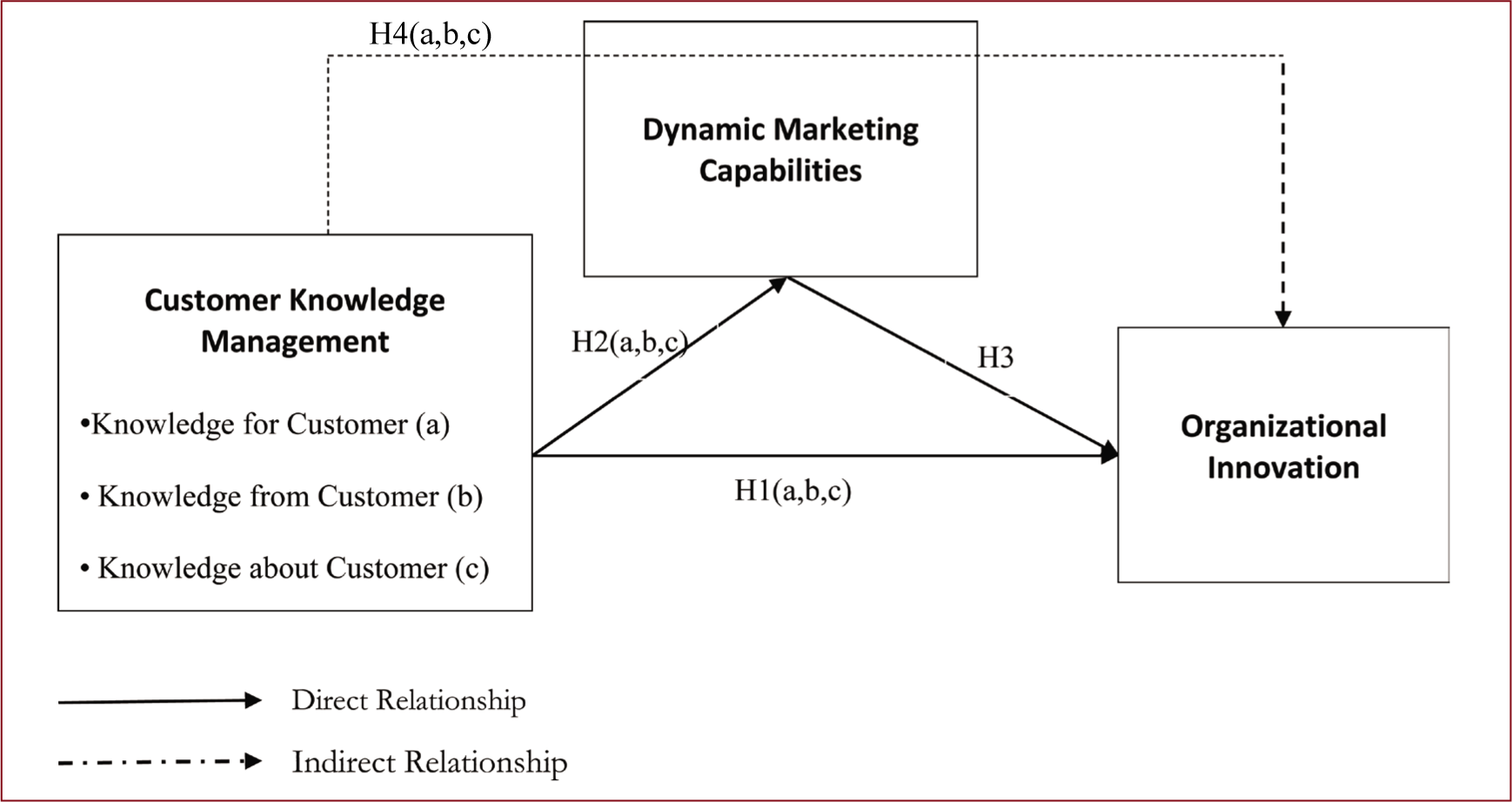
Proposed Conceptual Model of the Study.
The Mediating Effect of DMCs on the Relationship Between CKM and OI
Recently, scholars have gradually combined KM, DCs and innovation performance (Estrada et al., 2016). According to Xu et al. (2018), DMCs present significant capabilities in translating innovation and ideas to new products and services that meet the market demand and, subsequently, improve innovation performance. The impact of DMCs on superior innovation performance requires instant and high-quality information and knowledge inputs. In this process, the information and knowledge conveyed from inter-organizational relationships are critical (Hoppner et al., 2015).
KM alone is insufficient to improve innovation (Han, 2019). Zollo and Winter (2002) argued that KM processes could help to develop, evolve and use these capabilities. As DC creation involves accumulating, articulating and coding knowledge, KM and DCs could be known as two strongly inter-related concepts. KM processes can be reinforced using DCs; in this way, firms could make changes in order to prevent them from becoming stagnant (Easterby-Smith & Prieto, 2008). Sulistyo and Wuryanti (2020) maintained that to support new product innovation, it is important to understand both DMC and CKM. In this regard, Najmi et al. (2018) found that DCs had a mediation effect on the relationship between KM and the performance of hospitals considered in their study. Accordingly, DMCs have a mediating effect on the relationships between CKM and innovation (Falasca et al., 2017). Thus:
Research Methodology
This study focuses on empirically investigating the direct and indirect effects of CKM (for, from and about) on OI through DMCs (as mediator) in Jordanian pharmaceutical and healthcare firms.
Study Sample and Participants Demographics
The population in this study covers all 436 Jordanian pharmaceutical and healthcare firms registered in the Amman Chamber of Industry in 2019. The sample of the study included top managers (their titles included CEOs, chairman of the board of directors or general managers) as they are the most informed individuals about the firms’ overall operational activities (Saeed & Ziaulhaq, 2019; Shah et al., 2021). Due to the homogeneity of the population in this study (the pharmaceutical and healthcare industry is uniquely homogeneous and has special characteristics that make it distinctive from other industries), the researchers believed that obtaining responses from only one individual within each organization would be more accurate and sufficient to prevent the possible variance among managers’ perceptions within the same organization. Thus, data were collected from one respondent within each firm surveyed from October 2019 to the end of February 2020. In this study, a simple random sampling technique was applied. In total, 270 questionnaires were distributed and 250 were returned. After eliminating incomplete or useless questionnaires (n = 8), 242 responses were valid and, thus, used for further analysis. A pilot test on 30 respondents before launching the final survey was conducted and regarding the research questionnaire items and wording appropriate results were obtained. It should be noted that the researchers personally distributed and re-collected the questionnaire among the companies. The data analysis was done by SPPS and SmartPLS v.3.2.9.
Most of the participants (49.6%) are CEOs; moreover, 35% of the participants have 5–10 years of job experience. 37.6% are managing 21–100 employees in their respective companies. The participants are working in different relevant fields such as medicine, health care supplies, cosmetics, medical supplies and detergents.
Measurements
The survey instrument was used to collect managers’ responses on CKM, DMCs and OI. All measurement items for the variables mentioned are described in the Appendix. A 5-point Likert-type scale ranging from ‘1’ (strongly disagree) to ‘5’ (strongly agree) was adopted.
Measurement of CKM
This research adopted the work of Taherparvar et al. (2014), which was a developed version of the studies conducted by García-Murillo and Annabi (2002), Gebert et al. (2003) and Gibbert et al. (2002). There are three dimensions in CKM: knowledge of customer (four statements), knowledge from customer (four statements) and knowledge about customer (seven statements).
Measurement of DMCs
The scale developed by Falasca et al. (2017), which included nine statements, was used in this study to measure DMCs.
Measurement of OI
OI was assessed using the method suggested by Nasution et al. (2011), which was a method developed based on the studies of (Hurley & Hult, 1998; Zahra, 1996). There are 15 statements for OI construct, including three dimensions: process, product and administrative innovation.
Conducting Research and Results
The partial least squares (PLS) were used to test the model because the goal of PLS-structural equation modelling (SEM) is to predict key target constructs or identify key driver constructs. As the objective of this study is to explore new relationships among variables and predict key target constructs, the SmartPLS software was used to achieve the research goal. First, the measurement model was examined to assess its reliability and validity before testing the different structural models.
In this study, all constructs were modeled as reflective; the study also contains reflective–reflective model of higher-order constructs. In this model, the lower-order (first-order) constructs are reflectively measured constructs themselves that can be distinguished from each other but are correlated (Becker et al., 2012). To operationalize the higher-order (second-order) factors under investigation, the repeated indicators approach was used (Sarstedt et al., 2019).
It should be noted that since a single source of data was used, the data were tested for the common method bias using the Harman’s single factor test (Podsakoff, 2003). The results of Harman’s single factor indicate the percentage of variance accumulated in the first component, which is 33.636%. This value is well below the threshold value of 50%, which shows that the study did not have a serious problem with the common method variance.
Measurement Validation
All first- and second-order factors in the proposed model are reflective; thus, their measurement quality was assessed based on their construct reliability, convergent validity, reliability and discriminant validity. As indicated in Table 1, the factor loadings of all the items exceeded the recommended levels of acceptance (i.e., for standardized loading, 0.50). However, ‘DMC3 and DMC5’ values seemed problematic and values of an item for standardized loading and reliability were below the accepted cut-off point. Based on the recommendation of Chin (1998), who suggested that a value of 0.5 or 0.6 is acceptable. All composite reliabilities (CR) and Cronbach’s alpha values were above 0.70, which supports the reliability of the multi-item scales. For all the constructs, convergent validity, which was evaluated by the average variance extracted (AVE), met the criterion of 0.50 suggested by Fornell and Larcker (1981).
Reliability and Validity Statistics.
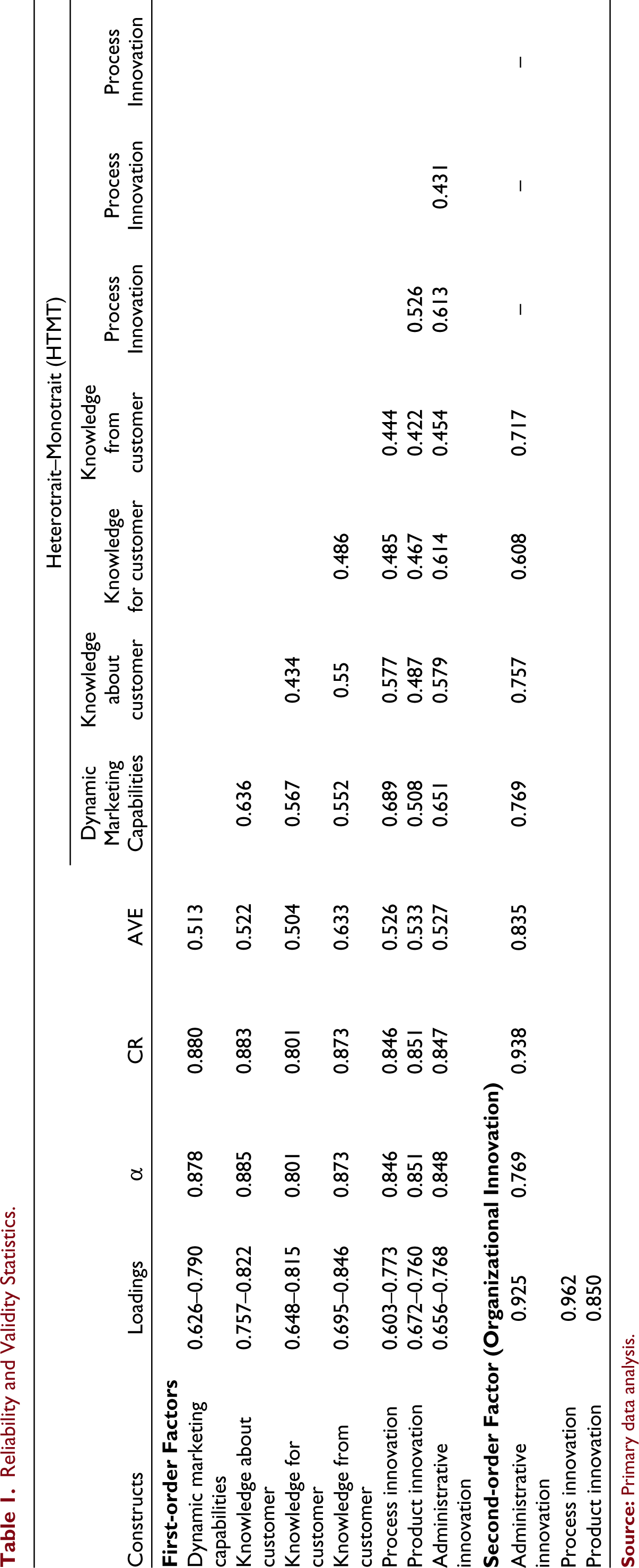
The Heterotrait–Monotrait (HTMT) ratio was used in this paper to assess the discriminant validity. The HTMT ratio value of a set of two constructs should be less than 0.85 (the conservative value) or 0.90 (the liberal value for two constructs that are related theoretically) (Henseler et al., 2015). Table 1 shows that the HTMT ratio for each set of constructs is below 0.85, which means the discriminant validity is established.
In this study, OI was treated as a second-order construct with three dimensions (i.e., administrative, process and product innovation) serving as the first-order constructs. The validity of the second-order constructs for OI was manually tested following the steps recommended by Sarstedt et al. (2019), i.e., by checking the outer measure loadings, Cronbach’s alpha, CR, AVE and HTMT.
Table 1 shows that all loadings of dimensions of OI are greater than 0.5; in addition, the AVE (0.835), CR (0.938) and Cronbach’s alpha (0.769) are greater than their respective cut-off values, hence confirming construct validity. As shown in Table 1, the discriminant validity for the second-order factor is established since all HTMT criteria are below 0.85. Consequently, the second-order constructs for this study are all validated.
Evaluation of Structural Model and Hypotheses Testing
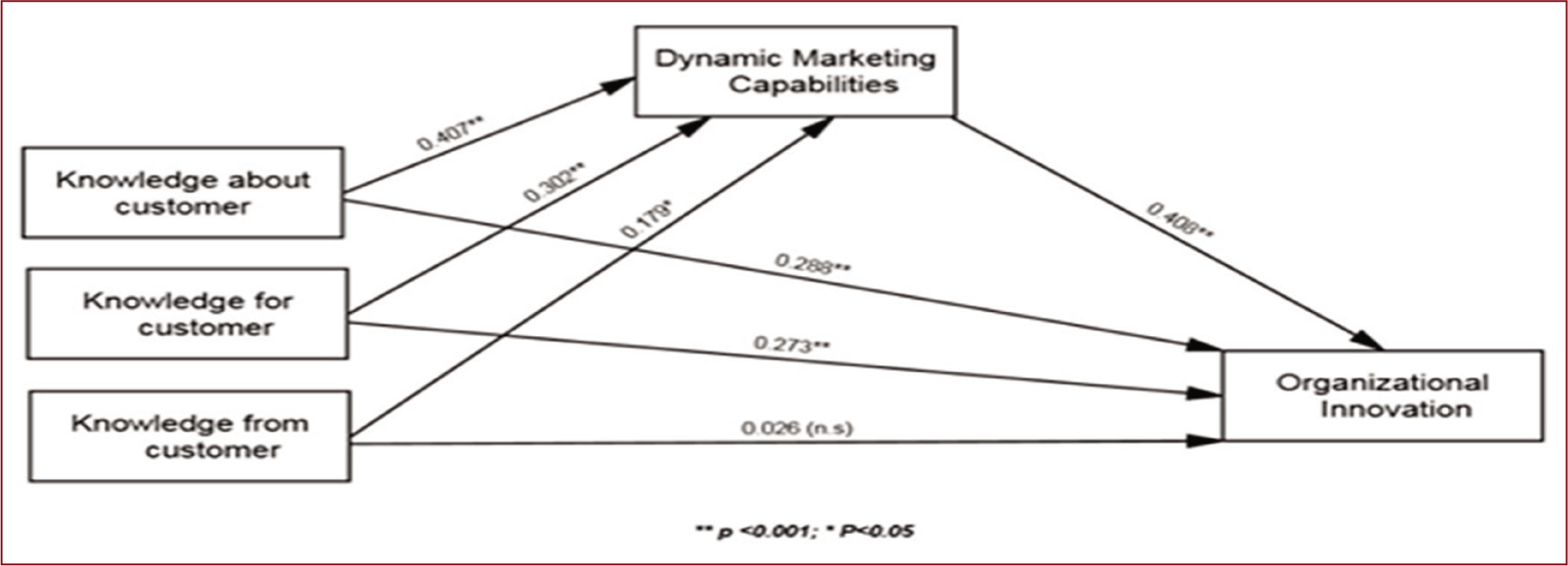
After assessing the validity of the measurement model, the researchers proceeded with path analysis to test the proposed hypotheses. Bootstrapping with 5,000 samples was performed. To begin the structural equation analysis, the structural model was first examined. According to Chin (1998), the structural model evaluation involves the following steps: the assessment of the structural relationship in the model for multicollinearity assessment (VIF), coefficient of determination (R²), effect size (f2) and Q2 predictive relevance; then, the estimation of path coefficients. Figure 2 illustrates the present research structural model. Table 2 shows the results of the evaluation of the structural model and the tests of the hypotheses.
Hypothesis Status (Direct Effects).
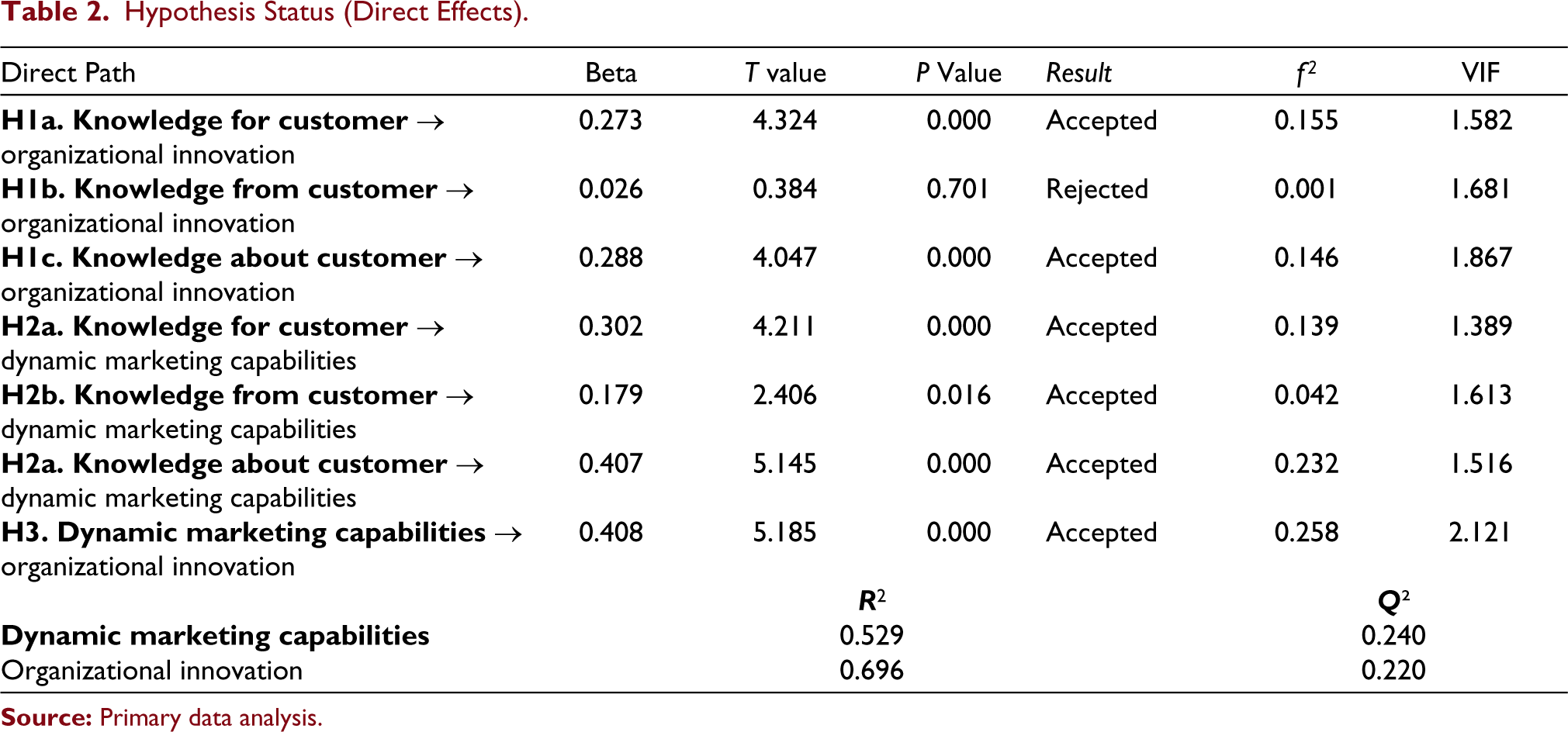
According to Hair et al. (2012), the coefficient of determination (R²) is the primary criterion applied to the structural model assessment, which indicates the amount of explained variance of each endogenous latent variable. As shown in Table 2, the R2 value of DMCs is 0.529, which suggests that 52.9% of the variance in DMCs can be described by knowledge about, for and from customers. Similarly, 69.6% of OI depended on the knowledge about, for and from customers and DMCs. Following the guidelines outlined by Cohen (1988), the R2 values of 0.02, 0.13 and 0.26 point to weak, moderate and substantial levels, respectively. Therefore, the R2 values for both variables (DMCs and OI) are substantial. Next, Table 2 represents the blindfolding result of the cross-validated redundancy (Q2) of the latent endogenous variable of the direct relationships model of this study. The cross-validated redundancy (Q2) values of DMCs (0.240) and OI (0.220), which are considerably above the threshold value of zero, clearly indicate that the model is applicable to predicting that factor (Chin, 1998). Moreover, 0.35, 0.15 and 0.02 are the threshold values of the f2 effect size for large, medium and small effect sizes, respectively (Hair et al., 2012). The f2 effect sizes for knowledge about customer for DMCs is 0.232 and for OI is 0.146, while knowledge for customer for DMCs is 0.139 and for OI is 0.159. In contrast, knowledge from customer is a statistically significant predictor of DMCs and not a statistically significant predictor of OI. The effect size of DMCs (0.258) represents a medium effect size. Finally, to perform the multicollinearity assessment, an examination of the variance inflation factor (VIF) values was done as recommended by Hair et al. (2011) who suggested the threshold value to be less than 5.0. Table 2 indicates that all exogenous constructs have VIF values less than 5.0. As shown in this table, the values of VIF ranged from 2.073 to 1.389, which indicates no multicollinearity issue in the structural model.
Results of Direct Effects
The results of the structural model showed that knowledge for customer had a significant direct effect on OI (β= 0.273, t = 4.324 and p = 0.00), which supports H1a. In contrast, H1b, which indicates the positive effect of knowledge from customer on OI, is rejected (β = 0.026, t = 0.384 and p = 701). In this regard, knowledge about customer had a significant direct effect on OI (β = 0.288, t = 4.047 and p = 0.00), which supports H1c.
The results presented in Table 2 also indicate that knowledge for customer, knowledge from customer and knowledge about customer had a significant direct effect on DMCs, which supports H2a, H2b and H2c. Additionally, DMCs have a significant direct effect on OI (β = 0.408, t = 5.185 and p = 0.00), which supports H3.
Results of Indirect (Mediation) Effects
To examine the mediating effect of DMCs on the relationship between CKM and IO, the causal-steps test proposed by Baron and Kenny (1986) was adopted in this study. This test is recognized as one of the most prevalent methods in mediation analysis, which uses a regression framework. As shown in Table 3, DMCs partially mediate the relationship between knowledge for customer and OI (β = 0.123, t = 3.311 and p = 0.01), which supports H4a.
Hypothesis Status (Indirect Effects).
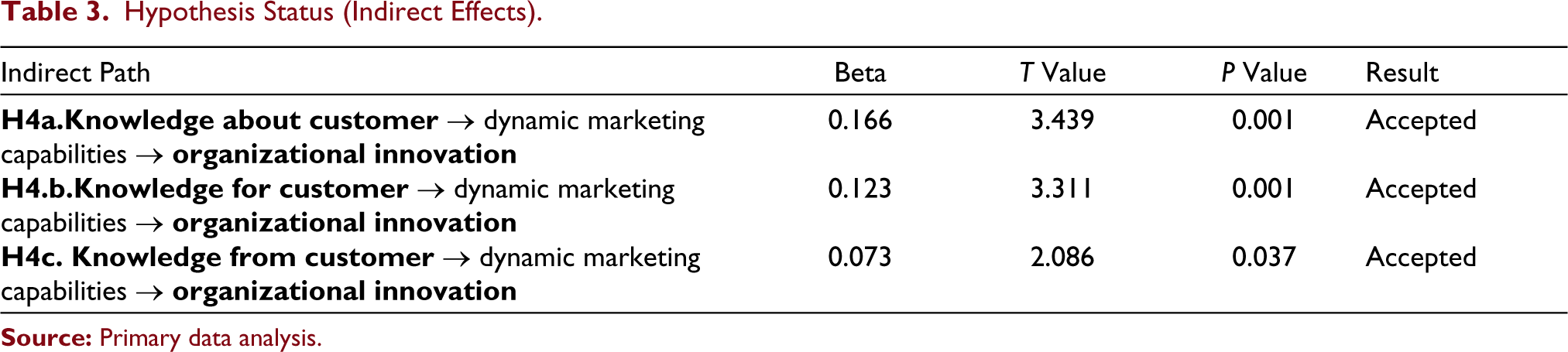
Moreover, the results (H4b: β = 0.073, t = 2.086 and p = 0.037) indicated that DMCs mediate the relationship between knowledge from customer and OI. Since the direct effects of knowledge from customer on OI was insignificant, DMCs fully mediates the relationship between knowledge from customer and OI.
Finally, DMCs partially mediate the relationship between knowledge about customer and OI (β = 0.166, t = 3.439 and p = 0.01), which supports H4c.
Discussion
This study attempts to explore how the three dimensions of CKM influence OI. It also uses SEM to examine whether DMCs mediate the relationship between CKM and OI within the context of Jordanian firms working in the pharmaceutical and healthcare industry. Empirical evidence obtained from the SEM analysis on a sample of 242 pharmaceutical and healthcare firms indicates that out of three dimensions of CKM, knowledge for and knowledge about customers positively influence OI. These relationships have been supported by several empirical findings previously reported in the literature (Taghizadeh et al., 2018; Taherparvar et al., 2014; Wu et al., 2013).
The literature indicates that innovation depends on knowledge (Ritter-Hayashi et al., 2020). Furthermore, Costa and Monteiro (2016) stated that creating and applying knowledge are two main processes that influence innovation. Moreover, KM supports continuous innovation in an organization. Such results were obtained on the basis of a systematic review of the literature over 45 articles from two scientific article databases (Kurniawati et al., 2019). New knowledge is required for OI, and strategic KM indicates the infrastructure and process of organizations utilized to create, acquire, apply and share knowledge in order to formulate certain strategies and make strategic decisions (Cabrilo & Dahms, 2018).
In this regard, knowledge for customer is mainly focused on how pharmaceutical companies can provide relevant information to their customers. Similarly, knowledge about customer could help improve customers’ experience and satisfaction and also helps them make better purchase decisions. This is because it could guide firms to obtain a deep understanding of customers’ needs and provide customized products/services accordingly. However, the direct effects of knowledge from customer on OI did not appear significant in this analysis. We can conclude from these findings that pharmaceutical and healthcare companies appear to have two ways of making interactions with their clients. First, they include clients in the market process, which is also necessary for the operation of pharmaceutical and healthcare companies. Second, they tend to conduct dialogues with their customers as a way to share information on new products. This practice helps to add value to both parties. Thus, both knowledge for customer and knowledge about customer significantly impact OI.
The findings of this study also show that CKM (for, from and about) positively affects DMCs. The empirical findings in the present study are in line with those achieved formerly in the literature (Zhang & Lu, 2012) indicating that customer knowledge represents the important organization resources for determining opportunities in the marketplace, developing competitive advantage, seeking for innovation and controlling dynamic marketing environments. In other words, although an effective KM is adopted by a firm, its positive impact depends on the existence and management of dynamic capabilities in the firm (Villar et al., 2014). In this sense, Kim and Boo (2010) maintained that KM is a key component of dynamic capabilities. According to empirical research conducted on Chinese equipment manufacturing organizations, Zhang et al. (2008) indicated that CKM positively affects their marketing ability.
The indirect effects are significant and suggest that DMCs fully mediate the relationship between knowledge from customer and OI. Since the generating of dynamic capabilities requires the accumulation of knowledge, dynamic capabilities and KM are the concepts strongly related to each other. This is because the processes of KM drive the development, evolution and use of such capabilities (Villar et al., 2014; Zollo & Winter, 2002). Recently, a number of studies have integrated dynamic capabilities, KM (i.e., knowledge sharing) and innovation performance (Estrada et al., 2016; Falasca et al., 2017). For example, Han (2019) proved that dynamic capabilities mediate the relationships between knowledge sharing and innovation performance in cluster organizations. Xu et al. (2018) argued that since DMCs are considered as a fundamental capacity for the transmission of innovation inputs into innovative services and products (which meet new market needs), they will develop the innovation performance of a firm. The impact of DMCs on higher innovation performance needs knowledge inputs and high-quality information. The knowledge and information transmitted from inter-organizational relationships play highly important roles in this sense (Hoppner et al., 2015).
Academic and Managerial Implications
This study’s findings have several important academic and managerial implications. From an academic perspective, this study indicates that by managing the customers’ knowledge, pharmaceutical and healthcare companies can perform better and gain more competitive advantages. The pharmaceutical and healthcare industry is considered knowledge-intensive and is known as an abundant source of intellectual capital. Therefore, to generate new ideas and create knowledge, these companies need to take their customers into account as external resources of high importance. A firm that enjoys KM capabilities can make use of the available resources more effectively, hence offering more innovation and performing more effectively. The capacity of a company for the development of high-quality, innovative services and products is affected by its relationship with its customers. According to Taghizadeh et al. (2018), throughout the innovation process, from the first step to the development and then the assessment of the performance, the customers’ requirements must be well considered.
Moreover, this study answers calls for the exploration of the antecedents of DMCs (Tan & Sousa, 2015). CKM (for, from and about) is an antecedent for the elements that shape DMCs, which, in turn, allow the reconfiguration of firm resources to produce a competitive advantage in the form of OI. The findings presented in this study also indicate that knowledge is an antecedent to the processes that constitute dynamic capabilities that, in turn, enable the reconfiguration of firm resources to create OI. DMCs could transform a firm’s knowledge to redeploy resources, which, in turn, could create capabilities in response to market needs. DCs can also bring sustainable competitive advantage as they are time-sensitive processes, industry-specific and non-replicable. However, DMCs are not sufficient for achieving a competitive advantage. Even though the processes and decision-making capabilities can be a source of competitive advantage, they are drawn from the firm’s customer knowledge resource base to create customer-responsive solutions. DMCs play a key role in transforming the firm’s knowledge resources to redeploy resources. They also create new configurations in response to market needs, especially in the pharmaceutical and healthcare industry, which is greatly innovative, research-intensive, perfectly balanced in terms of implementing human intervention technologies, and highly regulated at a universal level.
Findings from the Managerial Implications
Firms with DMCs are distinguished by their high responsiveness to customers’ needs by communicating effectively with the target customers. Therefore, DMCs ensure efficiency in resource redeployment through the fast introduction of innovations into the market. Managers in firms with DMCs, at different levels, are given the authority to make decisions; therefore, they could deploy resources in a way to fit with the changes in the environment through collaboration among different departments. This could form an efficient coordination of marketing strategy implementations and ensure interface interoperability (e.g., flexible decision-making and coordination functions). According to Weerawardena et al. (2015), the adoption of DMCs by firms allows their managers to become the primary decision-makers in building and maintaining competitive advantages.
In addition, if a manager wants to improve OI (process, product and administration), more CKM (i.e., for and about) and DMCs should be devoted, for example, to learning about competitive moves and customer needs and sharing the information about competitors within the organization.
Accordingly, KM in an organization supports continuous innovation. Thus, innovation is considered the ultimate outcome of KM, which, in turn, enhances the competitive advantage and improves the organizational performance (Shujahat et al., 2019). As a result, CKM helps companies to keep their current customers and gain new customers and enables them to perform more effectively in market competition. Several scholars have indicated that all innovation components such as OI, innovation capacity and innovation performance can be affected by KM (Durmuş-Özdemir & Abdukhoshimov, 2018). Knowledge about customer involves customers’ preferences, past transactions and future desires, and the analysis of the customers’ current requirements and their changing tastes and trends (Peng, 2020). On the other hand, knowledge for customers involves all the information a company tends to deliver to its customers to help them meet their knowledge requirements and improve their knowledge levels. It helps customers to make effective decisions and makes them capable of understanding the company and its innovative services and products.
Finally, consistent with Santamaría et al. (2021) and Han (2019), it is worth noting that KM alone is not enough for the improvement of innovation, specifically in knowledge-intensive and greatly innovative industries such as pharmaceutical and healthcare. It is a must to transform the available resources into outputs by means of transformational capabilities. As the resources allow this process, DMCs are factors that can mediate the relationships between the innovation drivers and different innovation implementations in the firm. DMCs refer to the integrated organizational processes required for configuring, establishing and linking the market resources for determination, building and supplying of the customer value. Firms enjoying DMCs can have effective responses to market requirements in case of rapid changes in the business environment and under uncertain situations. In addition, a company can adjust the configuration of internal resources using DMCs to match the market demands and the marketing management process after receiving clear signals of market changes. In addition, DMCs assist firms in recognizing key market signals, evaluating new processes and giving suitable responses to the change in the market. Thus, the organizations which have DMCs can generate stable competitive advantages. In this regard, the companies that desire to achieve competitive advantages in the industry in which they work need to have DMCs, which is in agreement with the findings of Stadler et al. (2013) and Day (1994).
This study identified four major limitations, which present future research opportunities to improve the relevant literature. First, this paper did not address deeply and comprehensively the lack of interaction and insignificant relationship between knowledge from customer and OI. Second, the study only involved Jordanian firms in healthcare and pharmaceuticals. Thus, future studies could involve other contexts in either emergent or developed markets.
Another limitation is the use of structured questionnaires to collect the data. As mentioned by Yasmeen et al. (2019), it is difficult to generalize the measurement items when close-ended questions are used. Therefore, future studies could collect qualitative data with open-ended questions.
The last limitation is that the data are solely based on the views of top management; this study did not take into account the views of employees or other parties. Therefore, one possible area for further study might be to address the same problem by considering the opinions of other parties as well.
Footnotes
Declaration of Conflicting Interests
The authors declared no potential conflicts of interest with respect to the research, authorship and/or publication of this article.
Funding
The authors received no financial support for the research, authorship and/or publication of this article.