



Abstract
Abstract
This paper explores the relation between lobbying and bribery by constructing a theoretical model. It asks whether ease of lobbying reduces bribery. The answer as it appears is ambiguous. It derives the condition for which lobbying and bribery are substitutes and complements of each other. It also shows that under certain conditions, ease of lobbying may reduce social welfare.
Introduction
Bribery is a well-known façade of corruption in government departments through which favour is exchanged between government official and perpetrator of an illegal activity. In lobbying, on the other hand, favour is bestowed on policy makers for a desired change in policy. Lobbying may not necessarily be an act of corruption. In fact, in many developed countries lobbying is legal and they have a legal framework through which certain industrial or non-governmental organization can lobby for certain policies. 1
For example, in Australia the government maintains a register of the lobbyists both at federal and state level, who are the only people allowed to contact the government legislatures for lobbying activities. The same registration system exists in the USA. It has brought a Lobbying Disclosure Act in 1995 which made it mandatory to publicly disclose all the expenses met for the lobbying activity by each firm. European Union has also allowed legal lobbying to the point that they have put a ceiling on the amount of contributions a member of European parliament can accept (Rasmussen, 2011).
In India allegation of lobbying dates back to almost 60 years ago when a Member of Parliament, H. G. Mudgal, was accused of taking cash from Mumbai Bullions Association and was expelled from the parliament. But only recently the issue of lobbying, has entered the public domain as the allegations of taking money for bestowing favours to industries, coming into light more frequently. First of the many such cases is the Nira Radia Tape controversy that rose in 2010. Nira Radia, an influence peddler used her acquaintance with the then Telecom Minister of India, A. Raza to gain private access for the big telecom companies of India and is currently undergoing trial for the same. The absence of proper channel through which legal lobbying can be done, has led to many corporate espionage cases. The most recent is the one where the finance minister of India’s budget speeches was leaked through the employees working at the ministry. Information from the defence ministry was also leaked as a housekeeper stole important documents from the minister’s office. Many high level corporate executives from the top firms were involved in the espionage case and were charged for the same (Kalra & Sanyal, 2013).
India ranks at the 81st position out of the 180 countries that are covered under this index for the year 2017. China ranks at the 88th position (Transparency International, 2018) .
There is a literature in economics, surveyed in (Bardhan, 1997), which argues corruption may either ‘grease’ the wheel of development through speed-money or may ‘sand’ the wheel by raising the cost. However, the focus of the present paper is different from this stream of literature. Here we try to look at the relation between ease of lobbying and bribery with only a tangential indirect link to development.
The model presented in the paper takes up the case of lobbying done by an industry association for reduction in fine rate related to environmental pollution. As it is non-excludable and non-rival in its consumption the outcome of the successful lobbying comes as a public good for all the firms in the industry. The lobbying cost is shared by the members of the association. 5
Lobbying by an individual firm is rare unless it is a monopoly (or trying to create a monopoly) as it is not possible for an individual firm in an industry to appropriate all the benefits generated through lobbying, but the cost is concentrated to the firm only.
Becker (1983) was one of the pioneering papers to discuss lobbying games. However, the present paper concerns itself not with lobbying games as such, it discusses the effect of factors that eases lobbying on incidence of bribery. For this it extends the framework of Mookherjee and Png (1995) by introducing possibility of lobbying. It is not that the relationship between lobbying and bribery has not intrigued academics in the past. The paper by Giovannoni and Campos (2006) elicits that lobbying and corruption has a substitutable relation. They show with data from 25 countries that the firms who take membership of any lobbying group consider themselves more able to influence policy makers through lobbying in comparison to more direct means of influence that is through bribery. However, the problem with their argument is the following: it is neither that lobbying and bribery are practiced at the same level of a government nor they affect a firm’s profit in similar way. First, while lobbying is usually targeted to the legislators for change of laws, bribery is targeted towards the bureaucrats for escaping violation of a law; second, while the benefits of lobbying are like a public good to a firm, the benefits of bribery are private. So there is no reason why lobbying and bribery cannot be complements of each other. In another paper Damania, Fredriksson, and Rani (2003) on the other hand have shown that bribery and lobbying have a complementary relation with each other. In their paper, similar to the present one, lobbying and bribery are targeted to different levels of government. Lobbying targeted to weaken judiciary or to create political instability facilitates bribery at the lower level of the bureaucracy for private benefit. In cross-country data they show that there exists a positive association between weak judiciary/weak democracy and bribery. But the limitation of their framework is that they do not endogenize the behaviour of the bribe-takers and the complete theoretical link between lobbying and bribery remains unexplored. We address this gap in the present paper. In another related paper Harstad and Svensson (2011) have shown that while bribery is more prevalent at the low-income countries, lobbying is more prevalent in the high-income countries. They argue that this happens due to the existence of hold-up problem in corrupt economies: the hold-up problem affects investment in lobbying. The effect of lobbying has been studied extensively by Richter, Samphantharak, and Timmons (2008) on effective taxes. They showed that the extensive practice of lobbying activities leads to decrease in the amount of effective taxes and disruptive development activities through corruption. Cotton and Dellis(2016) have shown that lobbying leads to detrimental effect for the economy as it might lead to poor policy choices due to information asymmetry. But they emphasize on the informational lobbying and how it crowds out information collection by the policy makers. Grossman and Helpman (1992) studies the structure of protection and inefficient trade policies that are adopted when interest groups lobby to the politicians and politicians maximise their own welfare depending on the contributions they receive from the lobby groups.
In the theoretical model presented in this paper we endogenize behaviour of both bribe takers and bribe givers through a bribery game and link it up to ease of lobbying. Unlike the aforementioned surveyed literature, we show that in economies with prevalent corruption under different set of conditions one might expect the substitute and complementary relations between lobbying and corruption. Though none of the previous papers looked at the welfare issue, here, we derive the sufficient conditions under which the ease of lobbying reduces the welfare of a corrupt economy. The incidence of bribery (and therefore the corruption level) might go up when lobbying is eased up depending upon the reactions of the corruptible inspectors. On the one hand, the decrease in the fine rate reduces the amount of bribe they expect from the firm which leads to reduction in their effort towards discovery of the actual waste level of the firm. On the other hand, decrease in the fine rate leads to increase in the amount of waste. Therefore, it becomes easier for an inspector to investigate and discover the possible waste production. This raises the possibility of getting a bribe and the incidence of bribery. If the later effect dominates the former and the social harm created by the waste is sufficiently high the social welfare falls following easier lobbying opportunities in the economy.
In the next section, we present the theoretical model and derive the results. The final section concludes the paper.
The Model
Consider the case of a representative firm in an industry that while producing a good, releases untreated waste w into the environment. The cost of legally disposing the waste through proper treatment is c(w). Therefore, being a profit maximizer the benefit of the firm is the unrealized cost of treating the waste, that is, c(w). We assume
In case of an over reporting the inspector will have to provide a proof of his reported amount in the court of law as a firm will be able to challenge their penalty for pollution often with the help of industry association.
In this paper, we consider two strategies for the firm in managing this: (a) by reducing the penalty rate f which requires industry level lobbying with the legislatures; (b) by bribing the inspector to report
Because of the public good nature of the benefit from reduction of f, the lobbying for this best done at the industry level through industry association. We assume that the industry association lobbies to the legislatures to keep the fine rate f low such that its members benefit from the reduced burden of penalty. The share of lobbying cost for the representative firm is
The firm offers a bribe to the inspector only if she discovers the true pollution level of the firm. As mentioned earlier in this article this event occurs with probability
As one of the referees pointed out the probability at which the bribery gets detected could depend on the extent of underreporting as well. As we check for this possibility it turns out that the calculations get complicated without changing the results of the model.
We model both the firm and the inspector as risk neutral agents. Therefore, the expected pay-off of the firm is given by the concave function,

Similarly, the expected pay-off of the inspector is given by the concave function,

Equations (1) and (2) show interdependence between the strategies of the firm and the inspector. The sequence of decisions is specified as follows:
Notice that firm decides about lobbying effort and bribe amount in sequence. The sequence is shown in the time-line in the following (Figure 1):
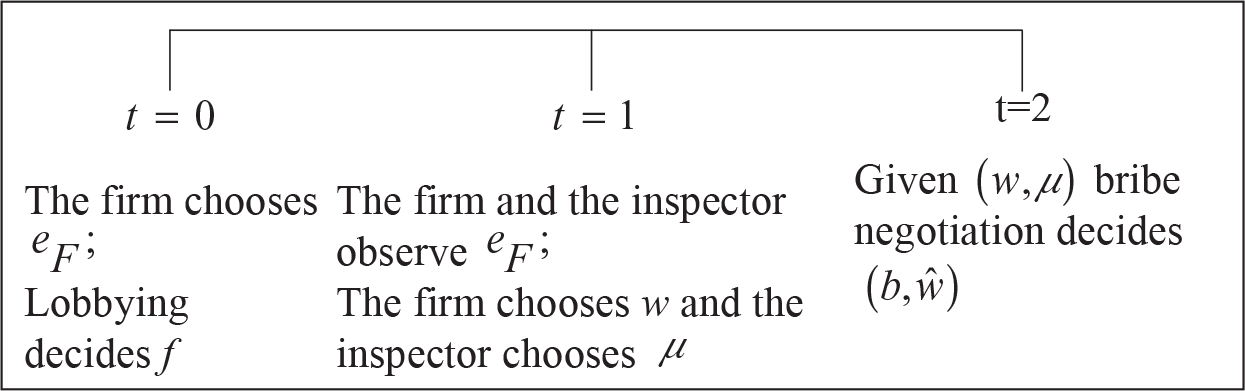
In this paper, we propose to study the effect of changes in
t = 2: bribery
While the firm expects to gain

If inequality in Equation (3) holds, they first agree about

Substituting the values of


The firm and the inspector simultaneously choose


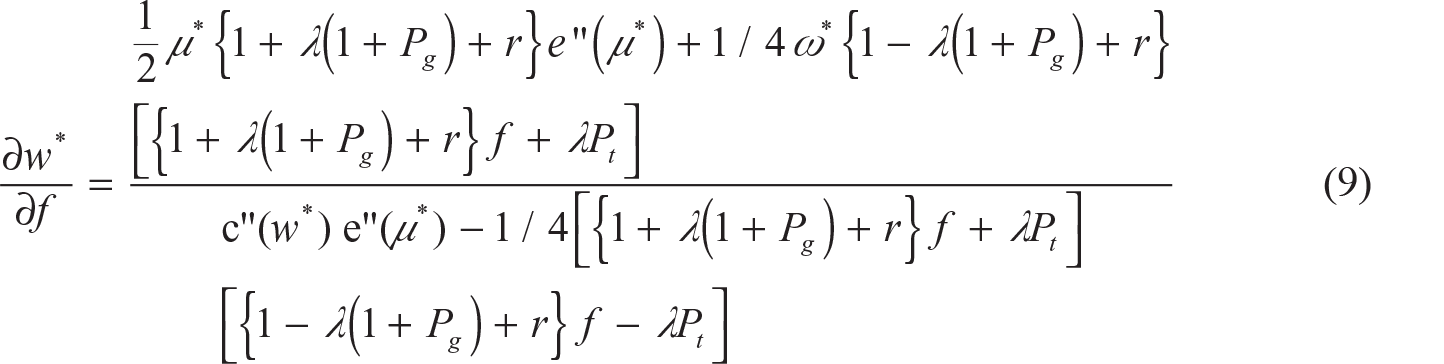
Since
Lemma 1 implies that when the fine rate falls, the firm chooses to produce more waste. This happens because the expected cost of producing waste falls as
The introduction of lobbying affects the fine rate and the optimum level of waste produced by the firms. This indirectly affects the intensity with which the inspector is expected to put in effort to discover the actual level of waste. Since bribery occurs if and only if the inspector finds out the actual level of waste produced by the firm, the effect of lobbying on the intensity of effort of the inspector determines the frequency of bribery in presence of lobbying.
Differentiating b* with respect to f:
The first term in the R.H.S. is positive from Equation (3) but as
The amount of bribe an inspector receives from a firm depends on the amount of bribable surplus which in turn depends both on the fine rate and the amount of waste that the firm produces. A decrease in fine rate directly lowers the amount of bribable surplus. But as the fine rate falls it follows from Lemma 1 that the waste production by the firm rises. So the bribable surplus also rises. If the direct effect dominates the indirect effect the bribe rate falls with lowering of the fine rate. Otherwise, it rises.


The denominator of R.H.S. of (10) is identical with the denominator of the R.H.S. in Equation (9) and has been proved to be negative. The first term of the numerator is negative from
Intuitively, when the fine rate falls, it affects the effort supplied by inspector in two different ways. If the bribe rate falls it adversely affects the effort of the inspector. But as the amount of waste production rises, the inspector gets incentive to put higher effort.
Next, we check the effect of decline in fine rate on social welfare. Let us define the welfare of the economy as

where

As by assumption
Lemma 4 intuitively states that for the case where the benefit from untreated waste is lower than the harm caused to the society and the intensity of bribery rises or remains unchanged due to fall in the fine rate (which raises the cost to the society as the inspector chooses to supply higher effort) the social welfare decreases as the fine rate falls. 8
In absence of lobbying and bribery the socially optimum waste level
But notice Lemma 4 defines only sufficient condition for having
t = 0 : Lobbying
Substituting the values of


At this stage of the game the firm decides its lobbying effort for reduction in f. From Equation (13), using Equation (7) we obtain the following:

Notice that the reduction in f affects the firm’s expected profit at the margin in three different ways; first the bribe rate may rise reducing the expected profit of the firm; second the inspector may put more effort increasing the chance of detection that reduces the firm’s expected profit; third lower fine rate is achieved only through higher lobbying effort that reduces expected profit of the firm. Let us identify the marginal benefit of the firm from the reduction of f as

is satisfied. We assume
Ease of Lobbying
The variable
This follows intuitively as well. When lobbying by the firms is facilitated in the economy, it is expected that the fine rate falls.
The decreasing marginal cost affects the frequency of bribery
If lobbying is introduced in a country or facilitated through a proper framework, the fine rate of an environmental harm will fall as it becomes easier for the industry associations to lobby and influence the policy makers. The fall in the fine rate
Therefore,
If lobbying is made legal and easier in a country, it leads to fall in the fine rate for environmental harm caused by the waste. The decrease in the fine rate leads to an increase in the amount of waste produced by every firm.
The statement of the proposition follows from Lemma 2 and Lemma 5.
Note that the effect of ease of lobbying on the bribe rate remains ambiguous as well. The effect of decrease in fine rate on the bribe rate is ambiguous. A decrease in the fine rate increases optimal waste but decreases the bribe rate. Ease of lobbying indirectly affects the bribe through the changes in fine rate. Therefore, the effect remains ambiguous also in this case.
We can see from Propositions 2 and 3 that ease of lobbying increases the waste level of an industry but the effect of it on bribery is ambiguous. The incidence of bribery (and therefore the corruption level) might go up when lobbying is eased up depending upon the reactions of the corruptible inspectors. On one hand, the decrease in the fine rate reduces the amount of bribe they expect from the firm which leads to reduction in their effort towards discovery of the actual waste level of the firm. On the other hand, decrease in the fine rate leads to increase in the amount of waste. Therefore, it becomes easier for an inspector to investigate and discover the possible waste production. This raises the possibility of getting a bribe and the incidence of bribery. If the later effect dominates the former and the social harm created by the waste is sufficiently high the social welfare falls following easier lobbying opportunities in the economy.
Conclusion
This paper tries to derive the relationship between lobbying and bribery in a game theoretic framework. In the proposed model a firm produces a good along with an environmentally harmful by-product. There exists a fine rate for producing harmful goods. The firm at the same time may lobby the legislature through industry association for reduction of the fine rate and may bribe an inspector to persuade her to report less amount of waste so that it can escape the payment of existing fine. The effect of ease of lobbying is ambiguous on the incidence of bribery. It can rise or fall depending upon the reaction of the inspector who engages herself in bribery. It also shows that the waste level definitely increases if lobbying is eased in an economy with prevalent corruption. It also derives the condition for which ease of lobbying definitely reduces welfare of such economies.
The existing literature on the issue of lobbying and bribery predicts either a relation of substitution or of complement between the two, but they do not study how the incentives of the bribe-givers and bribe-takers change due to lobbying. Once this is endogenized this paper shows that the substitutability or complementarity between lobbying and bribery essentially depends on the reaction of the inspectors in a corrupt economy. This paper also checks the impact of ease of lobbying on welfare of such economies and derives the conditions under which it falls. So, at the policy level, the paper sounds a caution before easing lobbying process in a corrupt economy: It may neither reduce corruption nor improve welfare of the economy.
The predictions of the model possibly can be checked empirically as well depending on availability of data. The strength of lobbying of an industry association varies from one industry to another. It depends on some parameters of the association as suggested by Olson (1965) like the number and size of firms involved in the association on which data can be collected. On the other hand, the data on the amount of bribe each firm pays for persuading the inspectors to underreport can be collected through primary surveys and it can be checked how the amount of bribe its member pays depends on the strength of the industry association. The effect of inclusion of civil society or non- governmental organizations in the lobbying game also can be checked in an extended framework. One can also analyse the strategic behaviour of a government in regulating corruption and lobbying in such an economy by extending the present model.
Declaration of Conflicting Interests
The authors declared no potential conflicts of interest with respect to the research, authorship and/or publication of this paper.
Funding
The authors received no financial support for the research, authorship and/or publication of this paper.