



Abstract
Abstract
How do human beings make decisions when, as the evidence indicates, the assumptions of the Bayesian rationality approach in economics do not hold? Do human beings optimize, or can they? Several decades of research have shown that people possess a toolkit of heuristics to make decisions under certainty, risk, subjective uncertainty, and true uncertainty (or Knightian uncertainty). We outline recent advances in knowledge about the use of heuristics and departures from Bayesian rationality, with particular emphasis on growing formalization of those departures, which add necessary precision. We also explore the relationship between bounded rationality and libertarian paternalism, or nudges, and show that some recent objections, founded on psychological work on the usefulness of certain heuristics, are based on serious misunderstandings.
Keywords
Introduction
How do human beings make decisions under certainty, risk, subjective uncertainty, and true uncertainty? 1
We believe that most readers will have heard of these terms. In any case, these are defined in the section ‘A Simple Taxonomy of Situations’. For the moment, we clarify that true uncertainty, a term used by Frank Knight, refers to a situation where one cannot define or even imagine the set of all possible states and their associated probabilities.
Aiming to clarify debates about both rationality and public policy, we have three goals here. The first is to offer a disciplined, contemporary overview of departures from BRA in human behaviour, with special emphasis on the role of heuristics. As we shall show, recent advances have allowed far more precision and formalization. The second is to demonstrate that although many advances have been made, and far more remains to be learned, the fundamental claims of the original work on heuristics, undertaken by Daniel Kahneman and Amos Tversky in the 1970’s, remain largely intact. Many objections to that work are rooted in fundamental misunderstandings of its purposes and also its central claims. The third is to demonstrate that for purposes of law and policy, libertarian paternalism, or nudging, does not depend on controversial psychological claims. A GPS device is helpful to human beings—no matter how we think about heuristics, and even if we agree that heuristics generally work well, in the sense they are helpful in the contexts in which most people use them.
Our starting point is that for many years the BRA was almost an article of faith in economics. It was the dominant approach taught in most economics departments, with relatively little discussion of the empirical validity of the assumptions that lie behind it or, indeed, any discussions of an alternative. Even now, most of the leading textbooks in microeconomics and game theory, which lay the foundation for the subject, continue to offer little or no empirical motivation for the theoretical models they use.
The behavioural economics revolution in economics has made significant progress in incorporating a more accurate understanding of human behaviour (Dhami, 2016; Gintis, 2009; Kahneman & Tversky, 2000; Thaler, 2015). To an increasing degree, economics courses give attention to behavioural models and findings. It is important to see that much (not all) of behavioural economics still uses the optimization framework, but relaxes almost everything else. What if individuals do not optimize, or are simply not able to optimize? In this case, behavioural economics draws upon the influential work of Tversky and Kahneman (1971, 1974) to illustrate a range of simple rules of thumb (heuristics) that are fast and frugal (in terms of the time and information required) to solve economic problems (Dhami, 2016, Part 7; Kahneman, 2011; Kahneman, Slovic, & Tversky, 1982).
The work of Kahneman, Tversky, and other researchers (abbreviated as KT&O) on heuristics shows persuasively that the behaviour of people is biased relative to the BRA; hence the name, heuristics and biases. That work has demonstrated that the BRA in economics is not tenable, not even in an ‘as if’ sense. Consistent with our first goal, we aim to show that the heuristics used in the KT&O programme are not merely labels. Attempting to go beyond the first decades of work, we explain that most heuristics can be given precise mathematical definitions and are consistent with the bulk of the evidence (see the section ‘The KT&O Approach’). 2
In this paper, we formally define some of the main heuristics. For a full set of definitions, see Dhami, al-Nowaihi, & Sunstein (2018).
We consider a range of other objections to the KT&O programme, as it is best understood, and find that the criticisms are overstated or simply do not stand up to a fuller scrutiny. This includes the nature of probability and subject errors; the ‘we cannot be that dumb’ critique (see the section “We Cannot Be that Dumb” Critique’); lack of specification of empirical counterparts of the proposed heuristics (‘Empirical Counterparts to the Heuristics’ section); the use of the recognition heuristic to explain an event (the gambler's fallacy) and its negation (the hot hands fallacy) (see the section ‘How Can Heuristics Explain Events A and Not A?’); and the question of an appropriate statistical norm (see the section ‘The Criticism of Appropriate Statistical Norms’). In the ‘Systems 1 and 2’ section, we briefly outline the System 1 and System 2 distinction proposed by Kahneman (2011) and suggest that it is useful in understanding the nature of heuristics used by humans.
The work of Gerd Gigerenzer and others (abbreviated as G&O) on fast and frugal heuristics draws from and overlaps with the KT&O programme, especially insofar as it shows that heuristics generally work well, as Kahneman and Tversky repeatedly emphasized. It claims to find its motivation in the original work of Herbert Simon (1955) that stressed the procedural rationality of solutions to problems (see the section ‘The G&O Programme’). The stated domain of the G&O programme is large worlds (or true uncertainty), although in some cases, notably the priority heuristic, it can also deal with small worlds (or risk and subjective uncertainty). We consider the foundational elements of the G&O programme in the section ‘The G&O Programme’.
G&O begin with the plausible idea, also found in KT&O, that people may have an adaptive toolbox of heuristics from which they draw heuristics depending on the context and frame of the problem (see the section ‘Ecological Rationality’). In principle, this is eminently plausible, and consistent with the stated objectives of procedural rationality. But theories cannot be judged on plausibility. We attempt to shed more light on the points of disagreement with the KT&O approach, which has come to be known as the great rationality debate in psychology (Dhami, 2016, Section 19.15; Stanovich & West, 2000).
The analysis of the problem of decision-making under true uncertainty is arguably more challenging than under any of the other cases (certainty, risk, subjective uncertainty). We believe, based on the evidence, that the G&O programme has not yet given us a persuasive account of decision-making under true uncertainty. Economics has no optimization benchmark to offer in the case of true uncertainty, which makes it difficult to evaluate the performance of any candidate heuristic (see the section ‘What Is the Benchmark for Comparison Under Risk and Uncertainty’); Gigerenzer (2008) is aware of this issue. The G&O programme has compared the performance of its proposed heuristics against benchmarks claimed to be optimization benchmarks, typically logistic regression or weighted tallying. However, none of these benchmarks under true uncertainty is persuasive, and certainly not recommended by any optimization theory in economics. We also consider the pros and cons of training people in the use of statistics (see the section ‘Training People in Using Statistics’).
The section on ‘On Distinct Domains of Choices in KT&O and G&O’ argues that the domains of choice in the KT&O and the G&O programms are often non-overlapping. KT&O largely considered situations of certainty, risk, and uncertainty (sometimes called the small worlds situation) to which the BRA applies; their aim was to test the BRA. On the other hand, G&O are typically interested in the large worlds situation (true uncertainty), where one cannot list or even imagine the possible outcomes and/or objective/subjective probabilities. 3
The distinction between small worlds and large worlds is captured in the colourful, but factually correct, remark attributed to Donald Rumsfeld in a 2002 US Department of Defence news briefing, and his distinction between known unknowns and unknown unknowns. In full, the remark attributed to him is:
Reports that say that something hasn’t happened are always interesting to me, because as we know, there are known knowns; there are things we know we know. We also know there are known unknowns; that is to say we know there are some things we do not know. But there are also unknown unknowns – the ones we don’t know we don’t know. And if one looks throughout the history of our country and other free countries, it is the latter category that tend to be the difficult ones
Some of the G&O heuristics apply to the domain of risk and subjective uncertainty (e.g., the priority heuristic).
The G&O programme often differentiates itself from the KT&O programme on the following grounds in common and in published discourse (Gigerenzer, 2008, 2014; Gigerenzer, Todd, & the ABC Group 1999) that we paraphrase as follows: (1) The KT&O programme suggests that people are fallible, hardwired with defective mental software; and prone to errors; that heuristics are bad; and that the appropriate normative norm of human behaviour is BRA (Gigerenzer, 1996, 2014; Gigerenzer et al., 1999). (2) By contrast, the G&O programme is designed to show that heuristics are good, and do better than optimization methods once ecological rationality is taken into account.
This distinction is unhelpful and inaccurate. KT&O meant to establish the importance of heuristics, not to say that they are good or bad. To the extent that they addressed that topic, it was to say that the heuristics they identified generally worked well, but also led to severe and systematic errors (which is demonstrably true). Their main goal was to test if human behaviour was consistent with the BRA; and they found it was not. But they went further by identifying various classes of heuristics that explain human behaviour in different contexts and frames. The following two passages from Kahneman (2000, p. 682) show just how close the two sides in the debate really are on core issues: (1) ‘Contrary to a common perception, researchers working in the heuristics and biases (HB) mode are less interested in demonstrating human irrationality than in understanding the psychology of intuitive judgement and choice.’ (2) ‘All heuristics make us smart, more often than not...’
We also offer some claims about law and public policy. Welfare economics often assumes that people follow the BRA and make informed choices that are in their best interests; such preferences are termed as normative preferences. However, the evidence from behavioural economics suggests that individuals sometimes do not make choices that are in their best interests (Dhami, 2016; Dhami & al-Nowaihi, 2018; Thaler & Sunstein, 2009). This may be the case when individuals lack information, have limited attention, misperceive risks, or face self-control problems arising from various forms of present-biased preferences (and have imperfect awareness of such problems). Thus, individuals might undersave for retirement; not enroll in pension plans; consume various goods (such as cigarettes) that harm the quality of their life; make decisions in an emotional hot state that they regret later; and procrastinate in making choices.
Libertarian paternalism (LP), or more simply ‘nudging’, has been an effort to help human beings to avoid errors while also preserving freedom of choice. A GPS device is an example. It allows people to go their own way, but helps them to arrive at their preferred destination. Most broadly, LP is an effort to increase navigability. It can be useful when people use heuristics that produce errors. When they are working well, policies that are consistent with LP do not distort the choices of those who follow the BRA (or do so minimally), but significantly improve the welfare of those who do not. Consider warnings and reminders, which may overcome the problem of limited attention. Use of default options, an example of an LP policy, has been extremely effective in a large number of domains, and can be more cost-effective than traditional tax/subsidy and direct regulation methods advocated in classical welfare economics (Dhami, 2016, Part 8; Sunstein, 2016, 2017; Thaler, 2015; Thaler & Sunstein, 2009).
As we shall show, endorsement of LP does not depend on a commitment to psychological claims that may be controversial. Most puzzlingly, the perceived adversarial position between the KT&O and G&O approaches, described above, has nonetheless given rise to a critique of the LP approach (Gigerenzer, 2015). The section on ‘Nudges and Nudging’ considers three main elements of this critique. (1) Choice architects (those who enact the LP policy) may not be benevolent; rather, they may be self-interested or malicious. (2) The rationale for nudges lies in people's alleged irrationality. (3) Nudges ignore other policy interventions that might help. None of these criticisms has merit.
The ‘lack of a benevolent policymaker’ criticism applies to any economic policy, not just nudges; this is analyzed in political economy, a well-established field in economics. If policymakers are not be benevolent, the strongest objections should be to mandates and bans, not against nudges, which maintain freedom of choice (in part because of an insistence that policymakers may err). A primary reason for nudging, as opposed to mandates and bans, is precisely the possibility that policymakers may not be benevolent (or adequately informed).
Those who embrace nudges do not speak of irrationality. The rationale for many successful nudges lies in a lack of information, in limited attention, and in self-control problems (and imperfect awareness of such problems). None of these should be controversial, certainly not in the abstract. Objections to LP, based on psychological claims, do not grapple with what LP means in practice (Halpern, 2015; Sunstein, 2013)–that is, with the particular policies that advocates or practitioners of LP have embraced in actual policymaking roles.
The final section concludes.
In this section, we give a simple taxonomy of situations that have played an important part in the debate on the appropriate heuristics to use. 5
For a more formal treatment, see Dhami, al-Nowaihi, & Sunstein (2018).
Let an individual take some action Under certainty, the individual makes choices among
outcomes that are certain to occur in the future. For instance, the
returns on bonds (rather than stocks) are fixed and certain. Which of a
set of bonds should the decision maker choose? Under risk, the individual makes choices between
different actions, say, actions Here we use the word ‘objectively known’ in the typical sense
used in economics (Dhami, 2016, Part 1;
Mas-Colell, Whinston, & Green, 1995).
Under subjective uncertainty (or just uncertainty) the situation is as under risk, except for one vital difference. The probabilities of the outcomes are not objectively known. However, it could be that the individual can assign subjective probabilities to the outcomes (these should obey the Kolgomorov axioms), in which case the analysis is straightforward. One then applies an analogue of expected utility theory known as subjective expected utility (SEU) to make choices among competing actions; see Dhami (2016, Section 1.3).
Under ambiguity, the decision maker makes a choice under subjective uncertainty, but violates the Kolgomorov axioms. In this case, neither risk, nor uncertainty, nor the theories used to describe choices in those cases (e.g., expected utility theory and subjective expected utility theory) are of any use. Indeed, in this case, the individual behaves as if his preferences were influenced by the source of uncertainty; see Example 1 below. In the case of ambiguity, economic theory offers clear and testable predictions. Some of the most interesting applied predictions are based on correlating measures of ambiguity aversion with a range of human market and financial choices (Dimmock, Kouwenberg, Mitchell, & Peijnenburg, 2016; Dimmock, Kouwenberg, & Wakker, 2016).
There is fifth class of extremely important situations on which economic theory has
little to offer by way of models or predictions. 5. True uncertainty: A situation of true
uncertainty (or Knightian uncertainty)
arises when the outcomes and probabilities are unknown or unimaginable
and objective/subjective estimates of these outcomes and probabilities
are not available. In terms of the Ellsberg paradox in Example 1, true
uncertainty would arise, if one does not know how many colours/balls are
present in Urn U. The human eye can distinguish between 10 million
colours and the number of balls can be very large. So, if you are an
economic theorist who believes that this situation can be accommodated
within classical subjective uncertainty, then try to imagine the
possible colours and the Cartesian product of colours and the number of
balls over which you must form a subjective distribution. It is far
fetched to imagine that humans could do this sort of thing, even if in
principle we could allow for this possibility and the use of subjective
uncertainty. As a practical matter, it is better to classify such a
situation as one of true uncertainty. There is some overlap between
ambiguity and true uncertainty, but true uncertainty is a much broader
class.
Example 2 illustrates situations that are potentially consistent with true uncertainty. 7
These examples may also be formally consistent with subjective uncertainty if people can foresee the entire path of all possible events in the future and can assign subjective probabilities to them, which is unlikely.
We have drawn all these quotations from an article by Robert J. Szczerba in Forbes, 5 January, 2015, titled ‘15 Worst Tech Predictions of All Time’. See also a nice list of such situations in Gigerenzer (2014, pp. 41–42).
‘I think there is a world market for maybe five computers.’ (Thomas Watson, 1943, President of IBM)
‘Fooling around with alternating current (AC) is just a waste of time. Nobody will use it, ever.’ (Thomas Edison, 1889)
”Television won't be able to hold on to any market it captures after the first six months. People will soon get tired of staring at a plywood box every night.’ (Darryl Zanuck, 1946, 20th Century Fox).
”Nuclear powered vacuum cleaners will probably be a reality within 10 years.’ (Alex Lewyt, 1955, President of the Lewyt Vacuum Cleaner Company).
‘There is practically no chance communications space satellites will be used to provide better telephone, telegraph, television or radio service inside the United States.’ T.A.M. Craven, 1961, Federal Communications Commission (FCC) commissioner.
‘Remote shopping, while entirely feasible, will flop.’ (Time Magazine, 1966).
‘There's just not that many videos I want to watch.’ (Steve Chen, 2005 CTO and co-founder of YouTube expressing concerns about his company's long-term viability).
In Example 2, Thomas Watson might have, in 1943, foreseen everything possible related to the computer industry in the future (e.g., all possible innovations, supplies, demands, tastes, and prices) for all future time periods and assigned subjective probabilities to all these events. He might have then have used expected utility to make a considered prediction. Some social scientists might be perturbed and amused to note that this would be the standard approach taken in mainstream economics. However, we are very doubtful of this possibility. It is more likely that Thomas Watson faced true uncertainty and chose his best guess. Arguably, some of the most important problems that decision makers face belong to the domain of true uncertainty. Economics does not have clear predictions to offer in these cases. Yet, people often do make decisions in such cases. How do people make these decisions? Indeed, heuristics may offer the most critical insights in dealing with these problems.
The KT&O Approach
When economists deal with situations 1-4 above, they typically use the BRA; see our opening remarks. Is the behaviour of people consistent with the BRA? Even if people do not literally follow the BRA, do they behave ‘as if’ their behaviour is consistent with the BRA? The second question is motivated by Milton Friedman's suggestion to evaluate economic theories by the accuracy of their predictions, not the realism of their assumptions. Consistency of human behaviour with the BRA is taught and accepted as an article of faith in most leading economics programmes in the world, an approach that has been followed in some other social sciences and in management programmes.
Tversky and Kahneman (1971, 1974) squarely address these questions in what is now known as the heuristics and biases research programme (we abbreviate this programme by KT&O to also acknowledge the important role of many ‘others’ who have made important contribution).The KT&O programme is one of the most significant achievements in all of social science. 9
Kahneman et al. (1982) is a classic introduction to the subject. There are several comprehensive treatments of the KT&O approach available that incorporate the more recent literature and significant modifications and advances, both empirical and theoretical (Dhami, 2016, Part 7; Kahneman, 2011).
The most enduring and important contribution of the KT&O programme has been to show that people do not act ‘as if’ they use the BRA. On mathematical optimization in the BRA, in particular, the Nobel laureate Herbert Simon (1978) notes: ‘But there are no direct observations that individuals or firms do actually equate marginal costs and revenues.’ Another Nobel laureate, Reinhard Selten, has argued on many occasions that economic problems are NP-Complete, a term that is borrowed from the computer science literature. The solution to such problems is hard/impossible to obtain; while no analytical solution may obtain, numerical solutions may be possible with high powered computers and sophisticated algorithms. Yet, in the BRA, the person on the street is assumed to solve such problems in his head, in an instant. Despite the enormous significance of the KT&O programme for the BRA, it is hardly taught in economics degrees.
In recent decades, the KT&O approach has been massively influential, particularly in finance and public policy. But it has come under intense criticism from another school within bounded rationality. The work of Gerd Gigerenzer and others, which we abbreviate as the G&O approach, identifies Herbert Simon's bounded rationality approach as its intellectual fountainhead. 10
We avoid the term SG&O that prefixes Herbert Simon’s influence on this approach because we believe that the KT&O programme has also been influenced by it. Indeed, Herbert Simon was appreciative of the work of KT&O (Gigernzer, 2008, p. 86).
The debate between KT&O and G&O has come to be known as the great rationality debate in psychology (Dhami, 2016, Section 19.5; Stanovich and West, 2000). We believe that several aspects of this debate appear to rely on confusions and misunderstanding of the relevant subject matter. We try to clarify several aspects of this debate below. 11
We offer limited comments on the relevant mental or neural processes that are to be implicated in the use of heuristics, or the appropriate normative benchmark models to be employed.The interested reader can pick up these aspects of the debate in Stanovich and West (2000) and Stanovich (2012).
On Shoddy Mental Software and Misconceptions
Gigerenzer and Brighton
(2009), reprinted as Gigerenzer and Brighton (2011) by way
of introduction to the edited volume by Gigerenzer, Hertwig, and Pachur (2011),
describe the KT&O programme as follows. By the end of the 20th century, the use of heuristics became associated
with shoddy mental software, generating three widespread
misconceptions. S1 Heuristics are always second-best. S2 We use heuristics only because of our cognitive limitations. S3 More information, more computation, and more time would always be
better.
However, in the BRA, under certainty, risk, uncertainty, and ambiguity, S1, S2, S3 are not misconceptions. The optimization solution can, by definition, not be improved upon (so S1 is true). Second, if the optimal solution is not used and some other, suboptimal, solution is used, then cognitive limitations are a possible contributing factor. For instance, individuals might just not be able to satisfy the heroic assumptions behind BRA and, hence, may be unable to compute the optimal solution (so S2 may be correct). If we ignored information, or engaged in suboptimal computation and arrived at a suboptimal solution, we can always use better information and computation to be better off at the optimal solution (so S3 is correct).
Indeed, within the BRA we are in the world of an accuracy-effort trade off (Gigerenzer & Brighton, 2011). In this canonical case studied in economics, it is never the case that ‘less (information, computation time, or attention) is more’. Gigerenzer and Brighton (2011, p. 5) write: ‘Even when information and computation are entirely free, there is typically a point where less is more.’ In the BRA, under certainty, risk, uncertainty, and ambiguity, this is never the case.
Under what conditions might S1, S2, and S3 fail? If we relax the conditions of the BRA (e.g., the objective function of the decision maker may be mis-specified), then these conditions might fail. However, the most obvious reason for the failure of S1, S2, and S3 is that we might be dealing with true uncertainty, which falls outside the remit of the BRA.
Ecological Rationality
Why might some heuristics that use less information do better than more complex strategies? The G&O view is that the heuristics are better adapted to the environment, as captured in the often stated view: ‘The rationality of heuristics is ecological, not rational.’ Herbert Simon famously characterized bounded rationality as the blades of a scissor. One of the blades is the mind, and the second is the environment. This implies that cognitive strategies cannot be looked at independently of their environment.
How we do operationalize ecological rationality? After all, no precise definition is given. In behavioural economics, this is typically addressed by stressing that human decisions (including heuristics) are context, culture, history, time and frame dependent (Dhami, 2016; Gintis, 2017). By way of analogy, social norms are often adapted to the social context in which they are situated. Insofar as they use limited information, they are similar to heuristics. Consider the following heuristic: If you do not know what position to take on a complicated issue of policy, follow the views of an official whom you trust, and with whom you largely agree. On plausible assumptions, that heuristic has ecological rationality.
An alternative formalization of this view, the less is more effect, is considered in the section ‘Evaluation of the “Less Is More” Effect’. Gigerenzer and Brighton (2009) also require heuristics to take account of the less is more effect or the bias-variance dilemma (see the section ‘Evaluation of the “Less Is More” Effect’, below) in satisfying the requirement of ecological rationality. We do not believe this to be an essential requirement for ecological rationality for the reasons that we specify in the section ‘Evaluation of the “Less Is More” Effect’ below. By ecological rationality, we mean to refer to the context and frame dependence of preferences, decisions, and beliefs. In this sense, we believe that the KT&O programme satisfies ecological rationality.
Another sense in which issues of ecological rationality arise is that lab experiments might have low external validity, a view that has been increasingly rebutted (Camerer, 2015 Dhami, 2016, Section 3). Further support for the ecological rationality of the KT&O heuristics comes from the behaviour of experts (see the section ‘Experts and the KT&O Heuristics’ below).
The KT&O Programme with Definitions and Labels
A major criticism of KT&O by G&O is that the relevant heuristics are not stated formally, so it is not clear what they mean, and anything goes (Gigerenzer, 1991, 1996; Gigerenzer & Gaissmaier, 2011). For instance, talking of representativeness and availability, Gigerenzer (1991, p. 102) writes that these are ‘largely undefined concepts and can be post hoc used to explain almost everything.’
G&O have also criticized KT&O for not providing precise labels for the heuristics that they use (Gigerenzer & Brighton, 2009). The term labels appears to us to mean two things: (a) precise definitions of the heuristics and (b) specification of the exact models in which these heuristics are situated. In this section, we consider the first of these meanings, while the section ‘The Criticism of Appropriate Statistical Norms’ deals with the second.
It is reasonable, of course, to ask for precise definitions of heuristics. One of the hallmarks of the use of heuristics within behavioural economics has been an increasingly formal approach that relies on clear definitions of the underlying phenomena. However, this appears not to be widely recognized outside behavioural economics. Detailed treatments are now available that give formal definitions for most of the heuristics; see Dhami, al-Nowaihi, & Sunstein (2018) and Dhami (2016, Part 7). In this section we give a largely verbal description of how these labels may be given, but a technically equipped reader may benefit from the rigorous treatment given in Dhami, al-Nowaihi, & Sunstein (2018).
The representative Heuristic
The representativeness heuristic is one of the most versatile and useful heuristics (Kahneman & Tversky, 1984). The representativeness heuristic has been increasingly defined and formalized (Dhami, 2016, Section 19.2; Rabin, 2002). In statistics, some of the most important applications require the weak law of large numbers (Hogg, McKean, & Craig, 2005). Roughly, this requires the sample mean to converge to the population mean, as the sample size increases (for a precise statement, see Dhami, al-Nowaihi, & Sunstein [2018]).
The main import of the representativeness heuristic is that people who use it believe that the sample proportions mimic the population proportions for a finite sample size. This definition suffices in most cases. The formal model of small numbers due to Rabin (2002) also uses Definition 1 to study representativeness in a particular context; see Dhami (2016, Section 19.2.3).
One implication of the law of small numbers is that many people are unable to
generate a truly random sequence of events. For instance, when asked to write
down a random sequence of coin tosses, subjects produce too much negative
autocorreation, that is, alternate too much between heads (
The hot hands fallacy is the statistical opposite of the gambler's fallacy.
The hot hands fallacy has been documented in many contexts. In a basketball game, a player might be particularly successful in a sequence of consecutive shots; such success might however arise from pure luck. Data from betting behaviour indicates that, in this case, observers assign too high a probability that such a player will be successful in making the next shot too. In contrast, the underlying data has been found not to reveal a hot hands effect. Several early studies showed that the observed sequence of successful basketball shots was statistically a random sequence. Recent research has raised the possibility of actual hot streaks in basketball and baseball. However, a statistical demonstration of the hot hands phenomena, a non-trivial statistical task, does not imply that individuals are able to also see through and discover the hot hands effect. 12
For the relevant references to all the claims in this section, see Dhami, al-Nowaihi, & Sunstein (2018).
Some of the clearest and most persuasive evidence for the hot hands fallacy comes from a novel field experiment by Guryan and Kearney (2008). They find that sales at lotto stores that have sold a winning ticket soar in the immediate weeks following the lotto win. The effect lasts for an impressive 40 weeks following the win, even after controlling for the greater salience of buying lottery tickets in the surrounding areas, following the win.
Anchoring
Suppose that a problem, call it Problem A, which has a unique optimization
solution
Stage 1: The decision maker is given an ‘anchor’
Stage 2: The decision maker is asked to solve Stage 2 (e.g., how many African countries are members of the UN?).
Note that nothing in Problem A requires the anchor
The anchoring phenomenon is remarkably robust across a wide range of domains, contexts and frames. These include estimates of price, the probability of a nuclear war, the evaluations of lotteries and gambles, issues of legal judgment, and first offers in price negotiation. Anchoring also has the potential to explain a range of other phenomena. These include the hindsight bias, preference reversals and non-linear probability weighting. 13
The interested reader can pursue the details and the relevant references for all the claims in this paragraph in Dhami (2016, Section 19.6.3).
The Availability Heuristic
Suppose that at time
Evidence for the availability heuristic comes from many sources. The typical experiments show that direct experience of a particular event increases the probability that one assigns to related events. Following on from the work of Lichtenstein, Slovic, Fischhoff, Layman, & Combs (1978), Pachur, Hertwig, & Steinmann (2012) showed that there is a significant positive correlation between one's estimate of the annual mortality rate from various forms of cancer and the availability of information on cases of cancer from one's social network.
The Conjunction Fallacy
The conjunction fallacy is defined as follows.
The original experiments were conducted by Tversky and Kahneman (1983) using the well-known Linda problem. Hertwig and Gigerenzer (1999) argued that the Linda problem is exhibited by only 15 per cent of their subjects when the problem is presented in a frequency format, as compared to a probability format. A prominent criticism of the KT&O approach has been that presenting information in a frequency format relative to a probability format makes decision making more compliant with the prescriptions of classical statistics (see the section ‘Frequency Versus Probability Format and the KT&O Programme’ below for a critical analysis). However, in their lesser known work in a frequency format, using the Linda problem, Kahneman and Tversky (1996) used a between-subjects design to show that the conjunction fallacy still holds. Indeed, while some of the recent literature shows that the conjunction fallacy may be reduced by using incentives and group decision making, the weight of the evidence suggests that, at least with the student population, the conjunction fallacy survives; for the relevant references see Dhami, al-Nowaihi, & Sunstein (2018).
An Evaluation of the Criticisms of the KT&O Programme
In this section, we consider the criticisms of the KT&O programme, mainly levelled by the G&O programme. Many of these criticisms are discussed in Kahneman and Tversky (1996) and Gigerenzer (1996). Although the original exchange remains worth reading, the literature has greatly progressed over the years. One of our aims is to offer an up to date evaluation of this debate, with the benefit of recent research and findings.
Some of the arguments against KT&O can be dealt with relatively easily and we simply refer the reader to the discussion in Dhami, al-Nowaihi, & Sunstein (2018). These include inferences from single event probabilities; the charge that Kahneman–Tversky ignore ecological rationality; and that subjects may simply be making errors, could be inattentive, or may be suffering from temporary lapses of judgement. We consider the other criticisms below.
‘We Cannot Be That Dumb’ Critique
Gilovich, Griffin, and Kahneman (2002) refer to the ‘we cannot be that dumb critique,’ which argues that stellar human achievements, for example, discovering the structure of DNA and space flights, are not consistent with the idea that people might be using simple judgement heuristics. This is a misunderstanding about the nature/process of scientific discoveries and the methodology of science.
Scientists are likely to use simple heuristics to build initial intuitions about their problems (indeed, so do social scientists). This is typical of the nature/process of scientific discoveries. However, the methodology in science and the sociology of science are entirely different. Scientific methodology relies on refutability of theories, stringent empirical testing of theories, replication of the evidence, and transparency of the data. The sociology of science ensures, to a much greater degree as compared to economics, that the gatekeepers of science journals, the editors and the referees, publish only peer reviewed research that conforms to the scientific method. This has been a remarkably successful combination in producing great progress in science. Hence, there is no essential contradiction between scientific progress in science and the use of judgement heuristics by scientists.
Frequency Versus Probability Format and the KT&O Programme
Several critics of the KT&O approach have argued that the biases created by heuristics in the KT&O programme are eliminated or substantially reduced when data is presented in frequency format rather than probability format (Gigerenzer, 1991, 1996, 2008; Gigerenzer, Hell, & Blank, 1988). Our own reading of the evidence is as follows:
1. An entire class of heuristics in the KT&O programme is unaffected by the distinction between frequency and probability formats. This includes the representativeness heuristic (including the gambler's fallacy and the hot hands fallacy), anchoring, availability, hindsight-bias, regression to the mean, confirmation-bias, and the affect heuristic.
2. The frequency format might reduce biases in the case of some heuristics, particularly in the case of the conjunction fallacy and in applications of Bayes's law. However, significant bias remains in applications of Bayes’ law. After reviewing the relevant evidence, Kahneman and Tversky (1996, p. 585) cautiously noted: ‘Contrary to Gigerenzer's unqualified claim, the replacement of subjective probability judgements by estimates of relative frequency and the introduction of sequential random sampling do not provide a panacea against base-rate neglect.’ The conjunction bias is found to be sufficiently high in a between-subjects treatment (Kahneman & Tversky, 1996). The anchoring heuristic was also found when the information was presented in a frequency format (Tversky & Kahneman, 1973, 1974).
Percentage of responses consistent with Bayes, rule in different empirical studies.
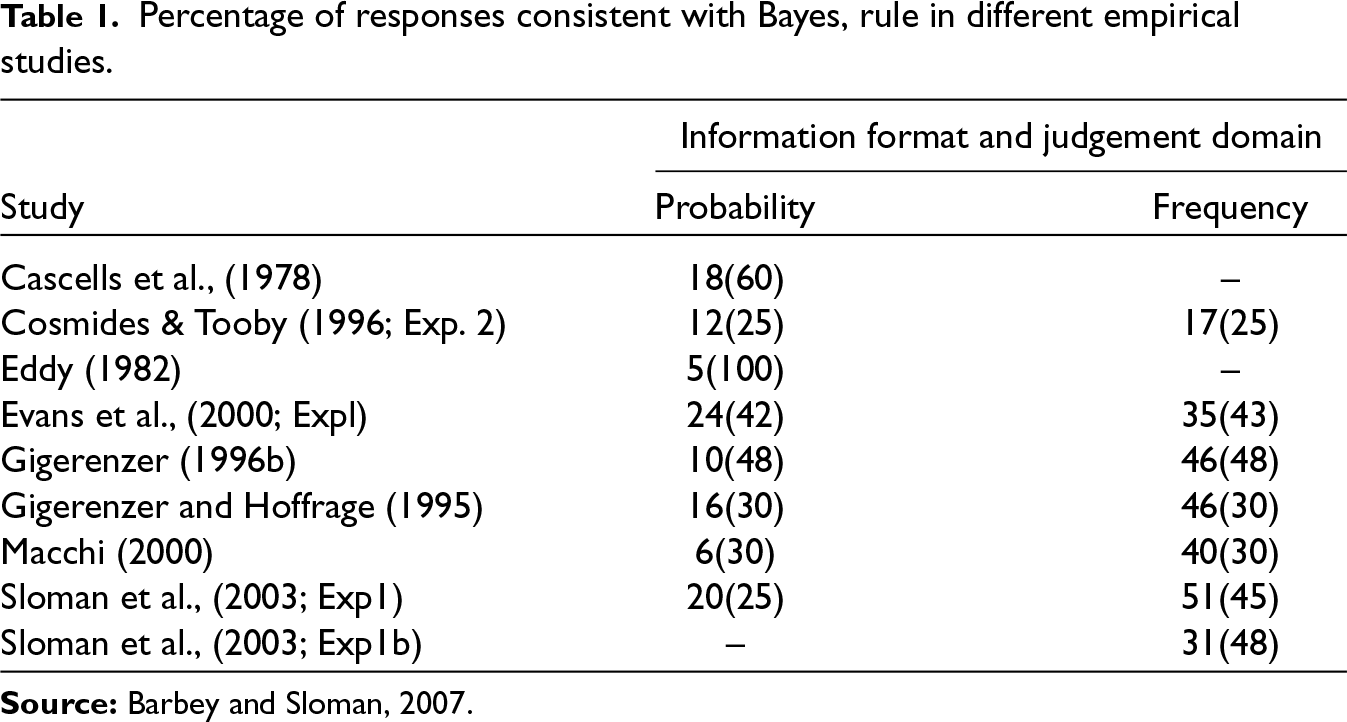
Table 1, which uses information from Barbey and Sloman (2007), shows the percentage of responses that are consistent with Bayes’ rule in a probability format (second column) and a frequency format (third column). There is greater conformity with Bayes’ rule when the information is presented in a frequency format. 14
The Cosmides and Tooby (1996) result is an outlier that Sloman et al. (2003) and Evans, Handley, Perham, Over, & Thompson (2000) could not replicate.
3. It is possible that humans might have evolved to understand natural frequencies relatively better than percentages (Cosmides & Tooby, 1996; Pinker, 1997). However, most real world economic data is presented in percentage terms (e.g., interest rates on mortgage borrowing). Thus, as a practical matter, one needs to understand human judgement and decision-making when information is presented in a probability format.
4. When conformity with Bayes’ rule under a frequency format is claimed to be truly spectacular, it appears confounded, at least in some cases, by framing effects that favour the outcomes in a frequency format; see the discussion in Dhami, al-Nowaihi, & Sunstein (2018) on the use of Bayes's law in the frequency format in Gigerenzer (2008).
Empirical Counterparts to the Heuristics
G&O criticize the availability heuristic for not specifying the corresponding empirical proxy. As Gigerenzer and Brighton (2011, p.18) put it: ‘Consider the ‘availability heuristic,’...this label encompassed several meanings, such as the number of instances that come to mind...the ease with which the first instance comes to mind...the recency, salience, vividness, memorability, among others...’
There are several examples in economics, where the exact empirical counterpart of
a variable in an economic model is not fully specified. This arises because
economic theories are necessarily a parsimonious description of complex reality.
We give two examples from Nobel Prize winning work. Lucas
(1988) showed that human capital is an important
determinant of economic growth, but did not specify the precise
measure of human capital (primary/secondary school education?
university education? vocational training?). It was left to the
empirical work to discover which measures of human capital were the
most useful (Barro & Sala-i-Martin, 2003). Kahneman and Tversky (1979) introduced the concept of
reference dependence into economics. They did
not specify the exact empirical proxy for reference points. However,
they did opine that the status quo is a strong candidate for a
reference point, and that other plausible candidates include a fair
outcome, expected outcome, or entitlements based on norms (see Dhami,
2016, Section 2.4.4). It was again left to empirical work to
discover the most suitable and appropriate reference point depending
on the application and context.
For these reasons, we do not view this as an important criticism; in most cases, empirical work guides us to the appropriate proxies.
How Can Heuristics Explain Events A and Not A?
It has been claimed that the gambler's fallacy (negative autocorrelation) and the hot hands fallacy (positive autocorrelation), given in Definition 2 and Definition 3, can be explained in terms of the representativeness heuristic. Gigerenzer and Brighton (2011, p. 18) criticize the representativeness heuristic thus: ‘No model of similarity can explain a phenomenon and its contrary; otherwise it would not exclude any behaviour.’ They go on to write: ‘As it [representativeness heuristic] remains undefined, it can account even for A and non-A (Ayton & Fisher, 2004).’ However, not only have we defined representativeness above, Dhami, al-Nowaihi, & Sunstein (2018) argue that the distinction lies in different inference problems being solved for inanimate processes (e.g., toss of a coin where the 50–50 chance is well known) and animate processes (e.g., basketball shots by a professional player whose underlying success rate depends on unobserved/unknown factors such as match practice, fitness, mental state). Empirical evidence indicates that a hot hands fallacy is more likely for arise for animate processes and a gambler's fallacy is more likely for inanimate processes (Ayton & Fisher, 2004). Indeed, Dhami, al-Nowaihi, & Sunstein (2018) show that the hot hands and the gambler's fallacies can both be explained by the representativeness heuristic by a recognition of the appropriate inference process.
The Criticism of Appropriate Statistical Norms
Gigerenzer (1996)
questions the appropriate ‘statistical norms’ that apply to the problems in the
experiments in KT. His argument is that the underlying model is not fully
specified, which leaves unclear the appropriate statistical prediction (Gigerenzer & Brighton,
2011, Section 3). This criticism potentially covers several points
that we address as follows: Normative standards of behaviour: KT&O did not advocate, nor
defend, the existing, and well established, normative standard of
behaviour in economics, which is BRA. Their aim was to test it. To
test the BRA, it is correct scientific methodology to either (a)
test the individual assumptions in BRA directly, as in tests of the
independence axiom for expected utility theory
(Dhami,
2016, Section 1.5.1) or a test of the
stationarity axiom for exponential discounted
utility (Dhami,
2016, Chapter 9), or (b) test a model that uses these
assumptions plus other auxiliary assumptions. KT&O typically
employed the first method, and showed that BRA was violated. This is
perfectly valid in science (e.g., testing the airframe of a proposed
new airplane in a wind tunnel, without adding on all the other
components in the airplane). Ecological rationality: Implicit in the criticism on the grounds of
statistical norms is the view that the KT&O programme does not
take account of ecological rationality. Interpreting ecological
rationality as context and frame dependence of preferences, we have
argued above that this criticism does not hold.
Systems 1 and 2
Both sides in the great rationality debate also differ about the appropriate models of the brain that may lead to the use of heuristics. This is not the focus of our paper and the interested reader may consult Stanovich and West (2000) and Stanovich (2012). But we offer some brief remarks on this issue because it has a bearing on some of the criticism of the KT&O programme.
Kahneman (2011) devotes the first one-third of his book to developing a two systems model of the brain, Systems 1 and 2, that facilitates a deeper understanding of heuristics and biases. To be sure, there is no universal agreement among psychologists about the appropriate models of the brain in this context (Stanovich & West, 2000). Kahneman (2011) fully recognizes that System 1 and System 2 are useful pedagogical concepts, not meant to correspond to specific brain areas (p. 29), but they aid us in developing a better understanding of heuristics. 15
Atoms and genes were first hypothesized as useful concepts long before their material counterparts were discovered.
On a widespread view, the quick, reactive, and automatic System 1 is responsible
for many errors relative to the statistical benchmark (of, say, BRA in
economics). System 2 has been likened to a lazy controller in
Kahneman (2011)
and when it is called upon to intervene in an unusual situation, the agenda
(e.g., affective emotions, recalled memory, associations) is chosen by System 1.
System 1 tries to make sense of a situation even when the events may have been
generated purely randomly. Kahneman (2011, pp. 204–205) puts it as follows: The sense-making machinery of System 1 makes us see the world as more
tidy, simple, predictable and coherent than it really is. The illusion
that one has understood the past feeds the further illusion that one can
predict and control the future. These illusions are comforting.
This provides an altogether different view of the existence of heuristics that is not rooted in the bias-variance dilemma (see the section ‘A Critique of the Bias-variance Tradeoff’).
Experts and the KT&O Heuristics
There is now widespread evidence that many experts do exhibit biases (Dhami, 2016, Section 19.18); this contributes towards supporting the ecological rationality of heuristics in the KT&O programme. The evidence comes from multiple domains. When making predictions of political events, experts were only slightly more accurate than chance. However, they were better able to generate explanations for their predictions (Tetlock, 2002, 2006). Experts are typically more overconfident than lay people who lack similar experience and more experienced experts are more overconfident (Glaser, Langer, & Weber, 2007; Heath & Tversky, 1991; Kirchler & Maciejovsky, 2002). The realized returns on stocks are within the 80 per cent confidence intervals of the returns predicted by senior finance professionals in only 36 per cent of the cases (Ben-David, Graham, & Harvey 2013). 16
See also Chapter 5 in Gigerenzer (2014) for more discussion on simple rules of thumb followed by experts in the financial markets that prevent good stock market predictions.
Mathematical psychologists exhibit the law of small numbers (Tversky & Kahneman, 1973). The perceived riskiness of various hazardous substances by toxicology experts is consistent with the affect heuristic (Slovic, MacGregor, Malmfors, & Purchase 1999). Clinical psychologists underweight base rates relative to a Bayesian calculation (Meehl & Rosen, 1955). A meta study establishes that decision makers who have the relevant expertise in the field suffer from the hindsight bias (Guilbault, Bryant, Brockway, & Posavac 2004). Professional traders in a large investment bank were found to be hindsight-biased (Biais & Weber, 2009).
Evidence supports the important role of anchoring on a given list price by estate agents (Northcraft & Neale, 1987). Evidence of anchoring is also found in legal judgment (Chapman & Bornstein, 1996; Englich & Mussweiler, 2001; Englich, Mussweiler, & Strack, 2006). Judges exhibit the false consensus effect (Solan, Rosenblatt, & Osherson, 2008). Finance professionals also exhibit a false consensus effect and they impute to others their own risk preferences (Roth & Voskort, 2014).
Experts, such as physicians and World Bank staff, exhibit framing effects, often of a similar magnitude to that observed with student populations (Kahneman & Tversky, 1984; McNeil, Pauker, Sox, & Tversky, 1982; World Bank Development Report, 2015). Wholesale car market dealers exhibit limited attention (Lacetera, Pope, & Sydnor 2012). The World Bank Development Report (2015) documents several kinds of biases among its professional staff. These include confirmation-bias, susceptibility to sunk costs, and the influence of framing. It is candid in its assessment of expert-bias (p. 18): ‘This finding suggests that development professionals may assume that poor individuals may be less autonomous, less responsible, less hopeful, and less knowledgeable than they in fact are.’ The World Bank Development Report also suggests potential solutions to the problem of expert-bias. These include dogfooding (experts signing up and playing their own programmes for real) and red teaming (having an adversarial outside team that tests the proposals).
In sum, the evidence shows that many experts do use heuristics and exhibit biases relative to the BRA and that this is not always eliminated by market experience.
The G&O programme
Herbert Simon (1955) distinguished between substantive rationality (maximizing an objective function under constraints as in the typical optimization problem in economics), and procedural rationality (the process/quality of decision making). Simon's insight was that human beings may lack the information and cognitive abilities to solve problems that are typically posed in the BRA. But people do make decisions. Hence, he was interested in the cognitive processes that give rise to such decisions, i.e., procedural rather than substantive rationality. Simon proposed the satisficing heuristic to operationalize procedural rationality, in which individuals set goals or targets, called aspiration levels. The individual then searches for alternatives that give rise to different payoffs. Once an alternative attains the aspiration level, it is deemed as satisfactory, and further search is terminated. The word ‘satisficing’ is a neologism that alludes to the fact that such decision procedures are satisfactory and they suffice. Empirical evidence is supportive of the theory (Caplin, Dean, & Martin 2011).
The G&O programme focuses on procedural rationality by employing heuristics that are fast and frugal (economize on time and information). The KT&O programme also focusses on fast and frugal heuristics and also uses procedural rationality, although in a different way from the G&O programme. For instance, searching through the available information (availability heuristic); being influenced by prior information (anchoring); being influenced by the law of small numbers in making decisions (representativeness heuristic); and being unduly influenced by one's own prior beliefs (hindsight-bias and confirmation-bias).
In the G&O programme, procedural rationality is introduced by using cues to make decisions; ranking cues according to their ecological validity; deciding on the basis of the first discriminatory cue, or some weighted average of the cue values. 17
In contrast to these methods, some of the most persuasive examples of simple rules of thumb come in the form of checklists, such as hospital checklists to reduce infections, and other such simple algorithms that do appear to work well (Gigerenzer, 2014, especially Chapter 3).
The take-the-best cue (TTB) then proceeds in the following manner.
Search rule: The cues are examined in decreasing order
of ecological validity. Stopping rule: Terminate search when one encounters the
first cue that can discriminate between the cities. Decision rule: Conclude that the city which the cue has
discriminated in favour of, is the larger of the cities.
Determining which of two foods has more cholestrol

In other contexts, Borges, Goldstein, Ortmann, and Gigerenzer (1999) applied the recognition heuristic to stock market choices, for example, among two candidate stocks, pick the one that is recognized. The authors find that it outperformed several other methods of stock market investment such as mutual funds, market indices, and chance investment (or dartboard portfolios). Czerlinski, Goldstein, and Gigerenzer (1999) also find support for the TTB heuristic against other alternatives such as regression analysis. Subjects had to guess high school dropout rates in 57 Chicago public high schools. The cues, many with high ecological validities, included percentage of low income students, and average SAT scores.
The TTB heuristic at Time 1 is used. The cue with the highest ecological validity cannot discriminate (cake ? pie), so the next cue, calories, which successfully discriminates in favour of cake (cake > pie) predicts that a cake is chosen. Patricia's confidence in her judgement equals the ecological validity of the first discriminatory cue, so the confidence is 70 per cent.
Having made the Time 1 choice, Patricia makes the same choice at a future time, Time 3. For whatever reason, she might have imperfect recall of her choice and the choice procedure at Time 1. It is now assumed by the authors that ‘...the cue values are not verdically remembered but show systematic shift towards feedback.’ We are dubious about the suitability of this inference and the reasoning preceding this inference; it appears to assume hindsight-bias, the very phenomenon that the authors wish to explain. The authors use this assumption to construct the information in Column 3 of Table 1. Proceeding as above, cake is chosen with 80 per cent confidence. This, the authors claim, explains hindsight-bias.
Example 4 highlights some of the important features of the G&O approach. The method is fast and frugal (limited number of cues) using a well-specified procedure for choice (procedural rationality). However, the assumptions bear examination. The information on cues and their ecological validity is experimenter-provided. This is unrealistic. Subjects are likely to differ in their beliefs about the reference class of foods that might be relevant for comparison, hence, disagree on ecological validity and also the relevant cues or their number. Thus, if subjects had to search for the relevant reference classes and the cues, there will be a separate prediction for each subject which makes testing of the theory difficult. Furthermore, in an actual search problem, there is likely to be the well known infinite regress problem in search costs (Dhami, 2016, p. 1411). Despite the stated objective of the G&O programme supporting procedural rationality, limited progress has been made in this direction. Some human actions simply involve motor skills acquired during human evolution, for example, the gaze heuristic that is much cited in the G&O programme (Dhami, 2016, Example 19.6). But how are heuristics used to solve cognitive, social, economic, and cultural problems? The G&O programme is evaluated on these issues in the section ‘A Critique of the G&O Programme’.
Furthermore, we only observe Patricia's choices in Example 4, but not the mental process that she engages in. Any number of theories/mental processes can be consistent with her choice. Thus, despite the claim to the contrary, this class of theories are strictly ‘as if’ theories. Finally, using ecological validities to infer confidence in choices needs empirical confirmation.
A range of other heuristics such as LEX and LEXSEMI have been used to examine risky choices (Payne, Bettman, & Johnson, 1993). Unlike the TTB heuristic, the LEX heuristic does not order cues by ecological validity, but by some other measure of importance. The LEXSEMI heuristic imposes a slightly more stringent requirement for cues to discriminate between choices by requiring that the difference between cue values exceeds a certain threshold. The elimination by aspects combines the LEX method with Herbert Simon's satisficing strategy.
Heuristics have also been used to make choices among objects with several attributes (Payne, Bettman, & Johnson, 1993). Edwards and Tversky (1967) suggested the weighted adding strategy (WADD) in which the multiple attributes of objects, subjectively weighted, are added and the object with the highest such score is chosen. But the subjective weights also make WADD difficult to test. One may simply add all attributes (equal weighing strategy, EQW). In both cases, the choice of attributes matters; adding or deselecting unobserved mental attributes of people changes the rankings. Insofar as these attributes are subjective, and privately observed by the subjects, elicitation and predictions of such heuristics are vexed issues on which the G&O approach throws very little light.
A Critique of the G&O programme
In this section we critically evaluate the G&O approach.
What Is the Benchmark For Comparison Under Risk and Uncertainty
The comparison between regression analysis and heuristics is often used in G&O to demonstrate the superiority of heuristics over optimization for human decisions (Gigerenzer & Brighton, 2011, p. 6). Yet regression analysis is typically not used to make choices in theoretical models in economics or in behavioural economics and is never considered to be an optimization benchmark (Dhami, 2016; Mas-Colell, Whinston, & Green, 1995); its only use in theoretical economics has been in models of learning.
The general statistical point made in G&O is that regressions may overfit the data relative to tallying (unweighted addition of cue values) and other heuristics such as TTB, hence, its performance in out-of-sample predictions may be inferior. This is well recognized in econometrics (see the less is more effect in the section ‘Evaluation of the “Less Is More” Effect’) and is not problematic for economists.
Empirical Testing of Heuristics in the G&O Programme
The G&O programme does not predict the following essential elements in a heuristics-guided choice: the choice of an appropriate heuristic from the adaptive toolbox (see the section ‘Does the G&O Programme Tell Us Which Heuristic To Use?), the actual selection of cues by individuals, and the reference class in which the ecological validity is to be determined. Furthermore, empirical tests have not been too successful in answering these questions.
The TTB heuristic is possibly the most tested heuristic in the G&O programme.
There are two methods of testing it, both of which illustrate the enormous
difficulties and pitfalls in testing; for more examples using this method, see
Dhami, al-Nowaihi, &
Sunstein (2018). Inferences from givens: Most empirical studies in
the G&O programme use the inferences from
givens approach. Here, the experimenter directly
provides cues and the ecological validities, thereby also choosing
the reference class over which ecological validity is defined. This
enhances experimental control, but it is unsatisfactory on two
grounds. (i) It may lead subjects to the very decisions that the experimenter
wishes to obtain by appropriate selection of cues and reference
classes. (ii) It sidesteps the critical problem of how people search for cues.
As noted above, in this case, the G&O programme may not be able
to make unique testable predictions. Inferences from memory task: This method is closer
in spirit to the suggestion of Gigerenzer et al. (1999),
namely, that cues should be drawn from memory but this has strictly
never been implemented. One potential method, albeit an imperfect
one, is to have two treatments, as in Bröder and Schiffer (2003).
(a) In Treatment 1, subjects see the same information on a screen
with all the relevant cues and their ecological validities. (b) In
Treatment 2, subjects are narrated the relevant information,
pictorially or verbally, and then they have to retrieve the relevant
information from their memory. This method solves the problem of
cue-recall from identical information, but not the question of
cue-search in the real world. Further, the experimenter only
observes data on choices, so the problem of inferring the use of the
TTB heuristic remain.
In both methods described above (inferences from givens, and inferences from
memory) conformity with the TTB heuristic is relatively low. We summarize some
of these results next; for the details and references, see Bröder (2011). The prediction that all subjects use the TTB heuristic all the time
is rejected–only 5 out of 130 participants used it all the time.
This is arguably a stringent test of the theory but also points out
that the relevant theory is inadequate on its own. When the percentage of subjects whose behaviour best fitted with the
TTB heuristic was used in a comparison with two other rules, Dawes
rule and Franklin's rule,
18
Dawes’ rule or tallying prescribes the following. In choosing
between options A and B, consider the entire set of cues and
tally the cue values in favour of each of the options. Then
pick the option that has a higher number of cues in its
favour. Franklin’s rule prescribes a weighted combination of
the cues to choose between the options.
When the cost of acquiring cues (which were known and identical for all subjects) was added, and as cues became more costly to acquire, conformity with the TTB increased. Clearly if cues are expensive to acquire, subjects are more likely to make their decisions based on the first cue they encounter. However, in the real world, unless all the cues have already been searched for first, the individual cannot compare their costs.
When the performance of the TTB with costly cue values is compared with compensatory strategies (e.g., Franklin's rule), more people use the latter.
When inferences from memory task are used, the predictions of 47 per cent of the subjects are consistent with TTB in the verbal condition and 21 per cent in the pictorial condition. However, as Bröder (2011), himself one of the authors of this study, notes (p. 375): ‘The results reported can also be accounted for by assuming people used a weighted additive strategy (e.g., Franklin's rule) that mimics TTB performance when the cue weights are noncompensatory...’ We have already noted some of the other limitations of this study, above.
Clearly if these results are taken as direct evidence for TTB, it is a dubious victory.
Do subjects learn the ecological validity of cues, if given a chance? In a careful study, Newell and Shanks (2003) give the answer in the negative. Newell, Weston, & Shanks (2002) report that a majority of their participants used some variant of frugal strategies (in terms of the extent of information used). Using the criterion that subjects conform to all the features of the TTB heuristic at least 90 per cent of the time, they find that the behaviour of only 33 per cent of the subjects conforms to the criterion. In their commentary on these results on page 381, the editors, Gigerenzer, Hertwig, and Pachur (2011), object to the high figure of 90 per cent used. The editors also criticize the methodology of testing single theories. They argue (p. 381) in favour of running a horse race between models. However, when such competitive tests are run to show that TTB does better, the candidates in the horse race are not necessarily persuasive. For instance, Bergert and Nosofsky (2007) show that TTB does better than RAT (a weighted additive model). In order to get a unique prediction, this method requires common agreement about the reference class from which cues are drawn, the validity of cues, and a common set of cues across the subjects. We are not aware of mechanisms that would satisfy such stringent conditions.
Training People in Using Statistics
Gigerenzer (2008, pp. 16–18) has advocated better training for people in
statistical inference. Indeed, he has personally engaged in training medical
doctors in the use of Bayes’ rule in a frequency format; the results are
reported to be positive. Building on this idea, some people have argued in
favour of ‘boosts,’ understood as efforts to enable people to exercise their own
agency. While one would expect human beings to get better in statistical
inference, the more they are trained, there are several concerns. Training people in statistics is costly. By not comparing the costs
and benefits of a programme of statistical training of people
against other alternatives, it is difficult to judge its
efficacy. Programs for imparting statistical training to doctors teach them to
compute conditional probabilities such as The notation means the probability of event
A conditional on the event
B. The notation P(A|B,C,D,E,...) means the
probability of an event A conditional
jointly on the events B,C,D,E,...
The actual computation of
Arguably, of far greater importance is the issue of what doctors do
with the number
Does the G&O Programme Tell us Which Heuristic to Use?
In the G&O programme, people draw upon an adaptive toolbox of heuristics and pick a heuristic that is appropriate to the environment (Gigerenzer & Selten, 2001; Gigerenzer, Todd, & The ABC Group, 1999). Which heuristic will be employed from the adaptive toolbox of heuristics, for a given problem? Gigerenzer (2008, pp. 38, 39) and Gigerenzer and Brighton (2011) give identical answers. Both refer to a single paper by Rieskamp and Otto (2006). However, this paper provides a limited and unsatisfactory framework to answer one of the most fundamental questions in this literature. For that reason, in our view, this remains an open question.
Rieskamp and Otto use a model of reinforcement learning in which people learn to use only one of two models. A TTB model and a WADD model (see the section ‘The G&O Programme’ for a description). The set of cues and their ecological validities is provided to the subjects; we have already noted the criticisms of experimenter provided cues and validities. Since the reinforcement learning model is an adaptive model, no other strategy than the ones initially considered can ever emerge from the model. The question that subjects have to answer is: Which of two companies is more creditworthy? The cues include financial flexibility, efficiency, capital structure, and own financial resources.
No underlying model is provided that explains how these factors translate into greater creditworthiness—certainly economics does not provide such a model. Thus, the particular sample of companies that is used has its own particular ecological validity of cues, and one cannot rule out the role of other cues/factors in determining creditworthiness.
Within this setup, TTB proves to be superior to WADD and gets better as more feedback is provided. It is now well known that the reinforcement learning model is dominated by a range of learning models and it provides misleading results on the speed of learning (Dhami, 2016, Part 5). For instance, Chmura, Goerg, and Selten (2012) show that the reinforcement learning model gives the worst performance among the set of learning models that they consider. 21
Incidentally, Rienhard Selten, one of the authors of the idea that heuristics are drawn from the adaptive toolbox is a co-author on this study.
In a nutshell, we currently know very little about how heuristics are drawn from the adaptive toolbox. This is a serious shortcoming of the entire G&O research programme.
Evaluation of the ‘Less Is More’ Effect
Gigerenzer (2008) writes: ‘That simple heuristics can be more accurate than complex procedures is one of the major discoveries of the last decades.’ This is also often described as the less is more effect. The source of this finding is that in prediction tasks, there is a tradeoff between unbiasedness and variance minimization, a well-known result in statistics (Gigerenzer, 2008; Gigerenzer & Brighton, 2011).
For a formal statement and derivation of the less is more effect result, see Dhami
(2019, Chapter 4). In the work of G&O, the less is more effect is often stated
informally as follows
where the noise term is a mean zero and constant variance noise term.
Consider the following simple example that illustrates the less is more effect. Suppose that we have a set of data points, and we wish to fit a polynomial through these points. The estimated polynomial is the relevant estimator of some true underlying function. The higher is the degree of the fitted polynomial, the better is the in-sample fit, that is, more unbiased is the estimator within the sample. However, the sample dispersion is partly determined by random noise. Fitting the in-sample noise-inclusive data too closely by a higher order polynomial, reduces the ability to fit out-of-sample data in a prediction task; such polynomials will exhibit higher variance in fitting data out-of-sample. In other words, while higher degree polynomials will have lower bias, they might have significantly higher variance; on net, the RHS of (9.1) may turn out to be higher for higher degree polynomials, beyond a certain degree. In this case, a lower degree polynomial that has higher bias in-sample but lower variance out-of-sample could make lower prediction errors; this is the essence of the less is more effect. The less is more effect lies at the heart of the less is more critique of G&O. The bias-variance tradeoff is statistically sound, but the relevant issue is whether it is useful to study human cognition. Gigerenzer and Brighton (2011, p. 12) write: ‘Our cognitive systems are confronted with the bias-variance dilemma whenever they attempt to make inferences about the world.’ However, we are not aware of any direct incontrovertible evidence in support of this assertion. 22
The two sources cited in the previous quote as supporting evidence, Griffiths and Tenebaum (2006) and Oaksford and Chater (1998) offer no direct evidence that the cognitive system considers the tradeoff between bias and variance.
A Critique of the Bias-variance Tradeoff
We now examine other objections to the use of the bias-variance dilemma. Loss aversion and the objective function: The objective function used
in deriving the less is more effect gives equal weights to positive
and negative forecast errors of the same magnitude. By contrast,
loss aversion is now well established as an empirical phenomenon,
not just in the domain of choice under certainty, risky, and
uncertainty, but also in the domain of temporal choice where losses
are discounted less than gains (Dhami, 2016, Parts 1 and
3). Thus, it is plausible to conjecture that when engaging in
prediction tasks, people will give different weights to negative and
positive prediction errors; one would expect negative forecast
errors to be more salient. In this case, there is no presumption
that the specific form of the less is more effect will hold. Suitability of the error structure: The error structure underlying
the derivation of the the less is more effect requires the noise
term to be of mean zero and constant variance. In contrast, we now
know from a great deal of evidence from behavioural economics, and
in many applications in behavioural finance, that people make
systematic prediction forecasting errors, not random ones. For an
extended period of time, such forecast errors can cumulate in the
same direction which leads to systematic divergence of stock market
prices from the fundamental values. Mental models: In actual practice, there might be a range of other
objectives than simple minimization of prediction errors that is
reflected in the less is more effect. There is a growing literature
on how people form mental models to understand
complex reality in a manner that is unlikely to be the outcome of a
bias-variance tradeoff. For instance, women in areas of India were
found to give less water to children with diarrhoea, based on the
mistaken analogy of a leaky bucket (World Bank Development Report,
2015). This mental model, a heuristic in the fast and frugal
category, has disastrous consequences; the problem is easily treated
with a low cost solution of salt and sugar. For other examples of
mental models and models of coarse categorization that illustrate
the general point made above, see Dhami (2016, Sections 19.12,
19.13). Non-stationary environments and behavioural factors: Unlike the
assumption made in the less is more effect of a stationary (though
stochastic) underlying environment, the real world environment is
not stationary. In many cases, people do not know the true
underlying model, but they try to form inferences about the
correctness of competing models by examining the data. For instance,
does stock market data come from a financial model that is
mean-reverting, or one that is a trending model? What if investors
believe that the world switches between these two models depending
on some underlying Markov transition process? Barberis, Shleifer, and Vishny
(1998) consider investor inference in such a scenario.
This can explain stock market underreaction and overreaction
relative to the BRA benchmark. In other words, economic models
require individuals to form beliefs of the relevant economic model
and then, update their beliefs by using observed data. It is
possible they never learn the true model and keep updating in the
wrong direction (Dhami, 2016, Section 15.9). Furthermore,
confirmation-bias, hindsight-bias, and overconfidence may furnish
other powerful reasons why they cannot successfully learn the
underlying models; see Dhami (2016, Section 19.8) for a formal
model. However, all these critical and important considerations are
missing from a purely statistical and mechanical exercise of
minimizing prediction errors in (9.1). Most of the tasks that economists are interested in are not
prediction tasks; rather, these are
decision tasks that require an appropriate
decision theory, such as prospect theory for
choices under risk, uncertainty, and ambiguity, or hyperbolic
discounting for temporal choices. For instance, how much should a
tax evader evade, given the probabilities of detection and fines?
How much should one invest in a risky asset relative to a safe
asset, given that the distribution of returns of the risky asset is
known objectively/subjectively? How many hours should a taxi driver
work, conditional on a given wage? Should one buy a gym membership
on a pay-as-you-go basis or on a fixed-fee basis? Should I introduce
a new product before my competitor firm, given that I have access to
reliable data on demand and prices? For concrete and empirically
supported answers to these questions from a behavioural economics
perspective that is independent of the bias-variance dilemma, see
Dhami
(2016).
Implications of the Less Is More Effect for the KT&O Programme
An important criticism of KT&O by G&O is that they do not take account of the second term on the RHS of (9.1), that is, variance, so a demonstration of biased inference in KT&O gives an incomplete/misleading picture. However, there are several weaknesses with this argument.
KT&O were interested in potential biases that decision makers may exhibit relative to the predictions of the BRA framework. These biases are not necessarily statistical biases in the sense that they are used in (9.1). For instance, a demonstration of non-transitivity (transitivity is required in BRA), as in Lichtenstein and Slovic (1971), is a bias relative to the BRA, but not in a statistical sense.
The following heuristics in the KT&O programme have strong empirical support and do not use the bias-variance tradeoff as their justification. Confirmation-bias and hindsight-bias are not about predictive judgements but postdictive judgements, so they are backward looking. Anchoring is about a previously given anchor; availability is about predicting on the basis of available information from memory; the representativeness heuristics is about inferring how likely a small population is to have come from some parent population (this includes the gambler's fallacy and the hot hands fallacy); not recognizing regression to the mean and the conjunction fallacy are also not about minimizing predictive error either. Thus, the existence of an entire body of empirically successful, fast and frugal, ecologically rational, heuristics that does not rely on the bias-variance dilemma, suggests that this criticism of KT&O is overemphasized in the G&O programme.
On Mathematical Optimization and ‘As If’ Theories
G&O have criticized economic theories, particularly prospect theory, on the
grounds that theories based on optimization are ‘as if’ theories that ignore
procedural rationality (Gigerenzer, 2008). Gigerenzer (2016, p. 38) write: Although behavioural economists started out with the promise of greater
psychological realism, most have surrendered to the as–if methodology.
Cumulative prospect theory, inequity-aversion theory, hyperbolic discounting
are all as–if theories. They retain the expected utility framework and
merely add free parameters with psychological labels... which is like adding
more Ptolemaic epicycles in astronomy. The resulting theories are more
unrealistic than the expected utility theories they are intended to improve
on. Behavioral economics has largely become a repair programme for expected
utility maximization.
Optimization is simply a tool used both by neoclassical economics and behavioural economics. But behavioural economics and its approach, methodology, results, and conclusions are very different from the canonical approach taken in neoclassical economics. 23
Here is an extreme analogy: Just like the classical Greeks recognized the smallest indivisible unit of matter that we now call atoms, so does modern science. This should not be taken to mean that modern science and classical Greek approaches to understanding the physical world have any fundamental similarity or that one is a repair programme for the other; after all the Greek approach was not an experimental science at all, whereas this is the hallmark of all modern science.
It is entirely appropriate to criticize as–if optimization based models if their predictions are inconsistent with the evidence. Behavioural economics has shown, conclusively, we believe, that theories that are central to optimization-based models in economics, such as expected utility, exponential discounted utility, self-regarding preferences and several refinements of Nash equilibrium, are inconsistent with the evidence (Dhami, 2016).
Behavioural economics has never been a rescue project for expected utility; it has generated conclusive evidence to show that expected utility is untenable. Prospect theory is an ‘as if’ theory but overall, one that does best in situations of risk/uncertainty/ambiguity, as understood in economics (Dhami, 2016, Part 1). It is a leading example of a tenable ‘as if’ theory in behavioural economics. There are models of heuristics, such as the priority heuristic, that can explain some of the puzzles that prospect theory explains (Brandstätter, Gigerenzer, & Hertwig 2006). However, its predictions do not hold outside the dataset used in the paper and questions have been raised about the statistical techniques used (Birnbaum, 2008). The range of phenomena explained by prospect theory is too vast to be accounted by any other theory, heuristics or otherwise. 24
For instance, it is not immediately clear how any current heuristic can account for some of the following behaviours that are easily explained under prospect theory (Dhami, 2016, Part 1): What explains the equity premium puzzle? Why do drivers quite too early on a rainy day in New York? Why are incentive contracts low powered? Why do firms exist? What accounts for the endowment effect? Why is human behaviour so sensitive to goals? Why is skewness in returns to assets priced? What explains the Ellsberg paradox?
Recent theoretical work also suggests that there is a link between heuristics based approaches in time discounting and optimization models (Dhami, 2016, Section 10.4, p. 627). The relevant heuristics in this case are non-compensatory and lexicographic. 25
Compensatory heuristics are those that give equal weight to the cues. Non-compensatory heuristics allow for unequal weights to the heuristics.
G&O have also expressed strong reservation to optimization based theories on the grounds that they have free parameters (see quote above). But there are statistical tests that enable us to determine whether these parameters add enough in the way of explanatory power that justifies their use or not (e.g., Akaike information criteria and Bayesian information criteria). G&O require that the parameters so estimated in these models should be held fixed in every context and frame in order to make predictions. 26
I am grateful to Gerd Gigerenzer for highlighting this point in conversation.
On Distinct Domains of Choices in KT&O and G&O
As noted above, economics makes no predictions under true uncertainty, but individuals do make choices under true uncertainty. 27
For readers steeped in the modern literature on ambiguity we note again that ambiguity is a special case of true uncertainty; the latter is much more general.
1. Overconfidence: Even under true uncertainty, overconfident individuals may believe, incorrectly, that they can see through all the possibilities and assign subjective probabilities to all these possibilities. One can then use any of the standard decision making models such as prospect theory (where special cases include expected utility and rank dependent utility), or some heuristics based model based on the insights of, say, the priority heuristic.
2. Conservation of cognitive effort: Under true uncertainty, individuals may not believe that they can see through all the possible outcomes and probabilities. However, exerting cognitive and search costs to explore possible unknowns and their probabilities, may be too costly. Individuals may then simply assign a vanishingly low probability to the ‘unknown unknowns’ and focus on the ‘known unknowns’ only. In this case, they can employ any of the standard decision making models. For an analogue of such models under risk, where people simply ignore events of very low probabilities and optimize over the rest, see Dhami (2016, Section 2.11).
3. Norms: A tantalizing possibility is that individual behaviour under true uncertainty might be determined by social norms or personal norms. Consider, for instance, marriage, arguably a problem in the domain of true uncertainty. One may decide to have a trial live-in relationship, and make the marriage decision based on an evaluation of the live-in period. This is a norm in some societies but not others.
4. Heuristics: Individuals may realize that they just do not have enough data to make any optimization based decisions at all, so they may resort to simple heuristics to make the choice.
There is no presumption that our four speculative categories are non-intersecting. For instance, heuristics may themselves be determined by social norms, which might in turn have been optimized to conserve cognitive effort in order, partly, to prevent overconfident individuals from making choices that are suboptimal. When we speak of true uncertainty, below, we only consider the very last potential explanation of behaviour, that is, a heuristic-driven account of true uncertainty, as if it were a stand-alone explanation.
Our main claim in this section is that the domain of decisions in the KT&O and the G&O accounts of heuristics is, in many cases, non-intersecting. However, in some cases, the domains intersect, as in the use of the priority heuristic to deal with risk, and the efficacy of the frequency format relative to the probability format in reducing biases relative to the BRA. We have already dealt with these issues elsewhere in this essay. For this reason, here, we focus exclusively on the difference in domains between the two approaches.
The KT&O demonstration of heuristics and biases mainly considers the domains of risk and uncertainty alone. In several of their most important demonstration of biases, they explicitly provide data on outcomes and probabilities to subjects. In other cases, data on probabilities and outcomes is not needed. This includes their demonstration of the law of small numbers (which includes the gambler's fallacy and hot hands fallacy); base rate neglect and violation of Bayes’ law; conservatism or underweighting of the likelihood of a sample; hindsight-bias; confirmation-bias; regression to the mean; false-consensus effect; conjunction fallacy; and confusion between necessary and sufficient conditions.
In other cases used in KT&O, the distinction between risk/uncertainty and true uncertainty is less clear; this includes the affect heuristic and the anchoring heuristic. But even here, empirical evidence shows that these heuristics continue to hold when the environment is unquestionably in the domain of risk and uncertainty, even when the subjects are experts in the area (Dhami, al-Nowaihi, & Sunstein, 2018).
One can, therefore, safely conclude that the relevant domain that KT&O used to demonstrate their biases was either certainty, risk,or subjective uncertainty but not true uncertainty. We argue below that the domain of problems that G&O deal with typically lies within the domain of true uncertainty, which they describe as large worlds. This observation on the G&O programme is important not only because we really need to understand human decision making in such environments, but also to note that many of the contributions of G&O and KT&O lie in non-intersecting domains. In light of this, the characterization of their positions as adversarial, as has been the case in the great rationality debate, can be misguided and misleading.
The research agenda in G&O speaks directly to problems of true uncertainty. They
distinguish between small worlds and large worlds,
drawing on terminology originally introduced by Savage (1954). Small worlds corresponds to
our use of the terms ‘risk’ and ‘subjective uncertainty’ (that KT&O were mainly
interested in) and large worlds corresponds to our use of the term ‘true
uncertainty.’ In introducing their research agenda, and summarizing their approach
Gigerenzer et al. (2011, p. xviii) write: How should we make decisions in the large world–that is, when Bayesian theory
or similar optimization methods are out of reach?...In sum, the
accuracy-effort trade-off indeed exists in a small world. In a large world,
however, where there is no general accuracy-effort tradeoff, heuristics can
be more accurate than methods that use more information and computation,
including optimization methods.
In this quote the greater accuracy of heuristics relative to other methods that rely on more computation/information is predicated on the less is more effect that we have already analyzed above.
A good example of this approach for economists is in financial market investment. It is probably impossible to predict or perhaps even know the set of all possible outcomes and probabilities in stock markets, so it is, arguably, a problem in true uncertainty. The standard assumption in financial economics is to treat this as a problem in risk and uncertainty, yet even in this case there may be no unique prediction (see Example 6). Candidate optimization benchmarks that are typically used in the G&O programme, to evaluate their heuristics against, such as logistic regression, require information that is simply not available under true uncertainty. But people do invest in the stock market. We draw on two examples that are frequently cited in the G&O programme as examples of successful heuristics (Gigerenzer et al., 2011).
This work is reprinted as Chapter 34 in Gigerenzer et al. (2011).
We offer three main comments on this work. (a) No evidence is given that
people (as distinct from investment firms) do indeed use any of the optimal
investment strategies described in the paper. (b) The
As our final point in this section, it is a tantalizing possibility that people may employ the heuristics in the KT&O programme when dealing with true uncertainty, although these heuristics were not designed for this purpose. Suppose one faces a problem in true uncertainty. Then one may actually be influenced by an externally provided anchor or suggestion (anchoring heuristic); or by the availability of apparently similar information in the past (availability heuristic); or by the emotional tags association with the given information (affect heuristic). It might also be the case that Herbert Simon's aspiration adaptation theory may be used in such cases. We believe that it is worth exploring this possibility in future research. This would provide a different account of decision making under true uncertainty, as compared to the G&O programme.
Nudges and Nudging
In neoclassical economics, observed choices reflect the underlying preferences of individuals. In this standard view, people's choices are assumed to promote their welfare. The reason is that such choices represent sufficiently careful and considered judgements about the welfare effects of actions; the preferences underlying these choices are sometimes termed as normative preferences. At the same time, individuals in neoclassical economics are assumed to be self-regarding, which gives rise to a role for public policy to internalize the externalities caused by self-regarding actions. Examples of relevant policy interventions include Pigouvian taxes to regulate the emission of pollution by firms, subsidies to consumers to buy electric cars, and tax-exempt charitable contributions. Regulation (such as fuel economy standards) might also be used to internalize externalities, though it is a crude response.
Do individuals really know what is in their best (including the long-term) interests all the time? Are they able to make choices that are in their long term interests? Consider the following empirically documented examples, F1–F6, of human behaviour that by no means exhaust the scope of our argument.
F1. Individuals may overconsume some goods (sugar, saturated fat, alcohol, tobacco) and suffer ill health, a shorter lifespan, and a lower quality of life.
F2. Individuals may procrastinate too much, fail to complete their projects in time, fail to consolidate their finances in a timely manner that might be more conducive to their long term interests, not enroll in suitable pension plans, and take up annual gym memberships when a pay-as-you go membership could have saved them money.
F3. Individuals might under-save for their retirement; the data indicates a sharp drop in consumption at retirement (Bernheim, Skinner., Skinner, & Weinberg, 1997). Individuals may also retire too soon.
F4. Individuals might make marriage and divorce decisions too hastily. They might also make purchase decisions on impulse, in a hot state, and regret it afterwards.
F5. Individuals might be misled by manipulative or deceptive, but not untruthful, advertising by firms that cleverly frames the options (Akerlof & Shiller, 2015).
F6. Individuals might not purchase fuel-efficient vehicles or energy-efficient appliances. Focussing on the short-term, they save money in the present but lose money over a period of years, and with any reasonable discount rate, they are likely to be making an unjustifiable choice.
Under normative preferences, we should not observe the phenomena in F1-F6. For example, in the BRA framework individuals rationally choose to consume excessively unhealthy foods; never procrastinate; perfectly smooth consumption over their lifetime; choose to marry, divorce, and make their purchases rationally; and make frame-invariant choices, provided the frames are informationally equivalent.
We do not deny that in cases that appear to show mistakes (as in F1–F6), it is possible that some people, or most people, are doing exactly what they should do. We agree that third parties, including public officials, should hesitate before concluding that people have erred. But in many cases, the decisions of some or many people are not in their interests. In actual practice, public policy and self-imposed control mechanisms might be used to remedy the problems described in F1–F6, above. For example, such remedies may take the form of: (a) Corrective taxes to respond to ‘internalities’ (public policy), individual use of private organizations (such as Alcoholic's Anonymous), or voluntary decisions to check into rehab at a substantial financial cost (self-control mechanisms). (b) Internally or externally imposed deadlines to undertake the appropriate action such as to fill one's tax forms, and submit an assignment by a due date. (c) SMarT (save more tomorrow) savings plan that commits individuals to save a fraction of future increases in their incomes (Benartzi & Thaler, 2004). (d) Cooling-off periods for divorce and a 21 day return policy for impulse purchases. (e) Regulation requiring financial firms to state the annual percentage interest rates (APR) on their financial products, and clear, colour-coded declaration of the key nutritional facts of food products, such as calories, saturated fats and salt content. (f) Clear labels, so that people can see, and appreciate, the potential economic and social benefits of fuel-efficient automobiles and energy-efficient appliances.
F1–F6 are easily explained within a behavioural economics framework. These and
several other problems can arise from a range of judgement heuristics and biases
(Dhami, 2016; Thaler & Sunstein,
2009). Many individuals report that they would prefer to save more, or
prefer the median portfolio to their own, and others pay to kick a bad habit,
indicating that they recognize their choices to be suboptimal (Sunstein & Thaler, 2003; p. 1169).
Many individuals exhibit self-control problems as a result of present-biased
preferences; this typically leads to temporally suboptimal outcomes
such as inadequate savings for retirement, obesity, procrastination, and drug use
(Dhami, 2016, Part
3). US data shows that many individuals do not utilize the full limits of their
401(k) pension plans. People also diversify their portfolios inadequately, and often
use the
Individuals may suffer from limited attention (the BRA assumes unlimited attention); thus, they react more to salient taxes, and in the used car market there are discontinuous drops in the prices of used cars at 10K thresholds (Dhami, 2016, Section 19.17). Emotions play an important role in individual economic decisions, such as buying consumer durables. Sometimes these decisions are taken in a hot state and regretted in a cold state (Dhami, 2016, Part 6); admittedly, the normative issues are especially complicated in some of these cases. Individuals might also be heavily influenced by the framing of the same problem in informationally equivalent ways. Indeed, framing plays an important role in the advertising industry, which spends more than 500 billion per year. The frame and context dependence of preferences has been actively studied in behavioural economics (Dhami, 2016; Kahneman & Tversky, 2000).
In light of these departures from the assumptions of neoclassical economics, what welfare or normative significance should one attach to individual choices, and how must we modify classical welfare analysis? 29
Camerer et al. (2003) view the relaxation of normative preferences in welfare economics as a natural progression of the relaxation of other restrictive assumptions in economics, such as perfect competition, perfect information, certainty etc.
Issues of paternalism in behavioural economics are often captured under the umbrella term of soft paternalism. This term includes libertarian paternalism (Sunstein & Thaler, 2003; Thaler & Sunstein, 2003, 2009), asymmetric paternalism (Camerer, Issacharoff, Loewenstein, O'Donoghue, & Rabin 2003), and light paternalism (Loewenstein & Haisley, 2008). Such approaches tend to share two important features: (a) they allow people to go their own way, that is, to reject the direction suggested by the paternalist; and (b) they reflect a form of means paternalism, rather than ends paternalism, in the sense that they are respectful of the chooser's view of the ultimate destination. It is for this reason that a GPS device is a defining example of libertarian paternalism.
In the relevant cases, the policy is introduced by a planner or a choice architect (who may work in the private or public sector). The objective is to enlist policies that do not distort (or distort minimally) the choices of fully rational individuals, but at the same time nudge others in a direction that is in their considered best interests (as judged by themselves). By considered best interests is meant the decisions that would be made by individuals if they had complete information, unlimited cognitive abilities, and no lack of self-control. In other words, individuals are enabled to make choices that make them better off, again as judged by themselves (Thaler & Sunstein, 2009, Chapter 5).
Admittedly, it can be challenging to know whether this criterion is met (Sunstein, 2017). If so, it may be best to insist on a particular form of choice architecture: active choosing (Sunstein, 2017). But in some contexts, it is difficult or perhaps impossible to avoid some kind of steering of individual choices. Any website has to have some kind of layout. Any form has to have some questions first and some questions last. Individuals are given choices and information by firms, other individuals, and the government. These are necessarily framed in a particular manner and already embed a certain choice architecture. Many examples can be given (Thaler & Sunstein, 2009) from doctors who advise patients on the choice of a treatment to architects who advise clients about house designs, to interior decorators who advise people on alternative interior designs.
Of great interest to behavioural economics are cases, traced above, that arise from self-control problems. These problems are often a product of present-biased preferences and imperfect awareness of such preferences in conjunction with a model of multiple selves; this is shown rigorously in Dhami (2016, Part 3). Since this appears to be such a common and repeated source of misunderstanding of the rationale for nudges, we summarize a basic result; for the full details, see Dhami (2016, Parts 3, 8).
Critics have objected to several features of libertarian paternalism. Sugden (2008, 2013) has used the contractarian approach in which appeals are directly made to individuals, stressing the personal advantage to each individual from taking a particular action. The interested reader can get acquainted with some of the features of alternative proposals in Dhami (2016, Chapter 22)
Political Economy of Nudging
Many people have raised the possibility that nudging might be carried out by choice architects who are not benevolent entities. We agree that choice architects may not be benevolent. We would add that they may also not have important or necessary information. This concern applies far more strongly to mandates and bans than to nudges, which preserve freedom of choice. Of course it applies to any government regulation in which regulatory capture, say, by lobbyists, is a possibility, whether it can be classified as a nudge or not. Economists have long been aware of the political economy of regulation and it is an established field in economics (Laffont & Tirole, 1993).
Alert to the risk of government error, Gigerenzer (2015) offers the following example. Letters sent out to women for mammography screening (a form of nudge) state that early detection reduces breast cancer mortality by 20 per cent. However, in absolute terms it reduces mortality from 5 to 4 for every 1000 women after 10 years. Gigerenzer (2015, p. 363) views the information in a percentage form as a misleading nudge to benefit the mammography industry (political economy considerations) and prefers education to nudging so that people can make a more informed decision. On page 364, he writes: ‘...democratic governments should invest less in nudging and more in educating people to become risk savvy.’ We are not sure that in thinking about appropriate tools, it is the best approach to contrast a misleading nudge with a perfect, and evidently hypothetical, educational approach (perfect by stipulation). Some nudges do educate people to become ‘risk savvy.’ Many nudges, such as calorie labels, are educative. No one should favour misleading nudging. Nor is there any contradiction between nudging people and educating them to be more risk savvy. Such efforts can go in parallel, which might be even more efficacious. In addition, the same safeguards that would need to be applied to prevent potentially ‘misleading education’ may also be used to prevent potentially ‘misleading nudges’. Choice architecture is inevitable in both cases.
The Rationale for Nudges
Gigerenzer appears to believe that the rationale for nudges lies in arguments for
a lack of rationality, which he calls ‘latent irrationality’ (p. 361). In his
view, those who believe in LP think that human beings are ‘hardly educable’ (p.
361). They ‘prefer nudging to educating people.’ He adopts a definition of
nudging, which he calls ‘its original meaning,’ though it has been used only by
its critics: ‘a set of interventions aimed at overcoming people's stable
cognitive biases by exploiting them The interest in nudging as opposed to education should be understood
against the specific political background in which it emerged. In the
US, the public education system is largely considered a failure, and the
government tries hard to find ways to steer large sections of the public
who can barely read and write. Yet this situation does not apply
everywhere.
We have several comments.
(1) A GPS device is useful for human beings, even if we do not have a dismal picture of human nature. It helps people to get where they want to go. Many nudges have that characteristic; consider reminders, disclosures and warnings (Sunstein, 2013).
(2) Though people can define terms, however, they wish, the stated definition of nudges has not been embraced by any public official who has engaged in nudging, and it is inconsistent with its original meaning. Recall that many nudges are explicitly educative (Sunstein, 2016), which makes it difficult to understand the claim that those who embrace nudging prefer nudging to educating people’ (With respect to noneducative nudges: Is a double-sided setting for office printers a way of ‘infantilizing the public’? Is a single-sided default setting less ‘infantilizing’?)
(3) Nudges, actually adopted by governments or under serious consideration, do not depend on controversial psychological research. Whatever their force, the objections to KT&O are irrelevant to most nudges; return to reminders, disclosure and warnings. Default rules are a prominent kind of nudge, and they are usually (not always) powerful. That claim does not depend on a ‘dismal picture of human nature’.
(4) One of us (Sunstein) worked in the US government for an extended period of time, and he did not try hard, or at all, or ever, ‘to steer large sections of the public who can barely read and write.’ On the contrary, many of the nudges in which he was involved were explicitly educative; they involved disclosure of information, which requires a capacity to read (Sunstein, 2013). Some of those nudges involved default rules, as in the case of automatically enrolling poor children in free school meals programmes (to which they were legally entitled) (ibid.). We are not aware of any US official who has tried ‘to steer large sections of the public who can barely read and write’ (for a catalogue of nudges, see Halpern, 2015). In fact we cannot think of a single example of a nudge that falls within that category.
(5) Nations all over the world—including the United Kingdom, Canada, Ireland and Japan, Australia, the United States and the Netherlands, to name just a few—have created behavioural insights teams, or nudge units, to help solve policy problem (Halpern, 2015). The resulting initiatives have rarely, if ever, depended on controversial psychological research.
(6) People do use fast and frugal heuristics and they often work well. However, even when we account for ecological rationality (i.e., there is a clear context and frame in which the decision is situated), heuristics create biases relative to the BRA benchmark. We have already covered this in our discussion above. Correction of those biases, through educative nudging (or efforts to teach statistical literacy), may be a good idea.
(7) Many of the problems that nudges have successfully tackled in actual practice come from self-control problems due to present-biased preferences. 30
In his criticism of nudges, Gigerenzer (2015, p. 371) does not discuss present-bias adequately but gives a prominent role to overconfidence, and discounts most of the existing evidence on overconfidence. Although there are difficulties in measuring overconfidence, behavioural economics has documented impressive evidence on overconfidence, using novel methods, not cited in Gigerenzer (2015); see for instance, the surveys in Malmendier and Taylor (2015), and Malmendier and Tate (2015). This evidence indicates that overconfidence may harm people’s self-interest (Dhami, 2016, Part 7).
Other Remedies for the Same Problems
Gigerenzer (2015, p. 367) writes: There are multiple other reasons for harmful behaviour, including the
fast food and tobacco industry's multi-billion-dollar advertisement
campaigns to seduce people into unhealthy lifestyles and the failure of
educational systems worldwide to teach children statistical thinking.
Libertarian paternalists, like the behavioural economists they draw
upon, make a case against the human mind and thereby turn a blind eye to
flaws in human institutions.
Nothing could be further from the truth. Some libertarian paternalists have spent most of their working lives on flaws in human institutions; that has been their principal focus. The remit of libertarian paternalism is to provide an additional tool for public policy that imposes no restrictions on individual liberty. It does not deny the role of other regulations that might achieve a similar purpose. It adds to the menu of policy choices for policymakers. For instance, in order to reduce smoking, the government can use prohibitions and fines (ban smoking/penalize manufacturers) or use a nudge (appropriate warning on cigarette packages). More choices may sometimes be worse than fewer, but libertarian paternalism can hardly be blamed for adding to the menu of choices.
We have mentioned that some people argue for ‘boosts’, such as an increase in statistical literacy, on the theory they improve people's capacity for agency or their ability to influence their own life (Hertwig, 2017). On one view, boosts are an alternative to nudges, and in some ways better. We cannot fully address that view in this space, and we agree that boosts can be a good idea, so we restrict ourselves to five points. First, some nudges are meant to improve people's capacity for agency, and belong to the same family as boosts; consider information (about caloric content, for example); warnings (about the consequences of paying late, for example); and reminders (that a doctor's appointment is coming up, for example). Second, some nudges make life simpler, and so allow people to put their focus and attention where they wish (consider a GPS device or a default rule). In that sense, they promote agency.
Third, nudges have an established track record (Halpern, 2015), with impressive cost-effectiveness (Benartzi et al., 2017); the empirical evidence for boosts is less robust, certainly for the most important public policy issues. Fourth, it is not easy to identify boosts that could provide significant help in addressing the principal problems faced by the world's governments (though we agree that statistical literacy would be a step forward). If one is advising the Prime Minister of the United Kingdom or the President of the United States, what boosts would successfully address (for example) highway safety, opioid addiction, obesity, greenhouse gas emissions, or immigration? Fifth, boosts and nudges can be complements, not alternatives.
Conclusions
The heuristics and biases approach, begun by Daniel Kahneman and Amos Tversky, is one of the most important research programmes in the social sciences and certainly one of its stellar achievements; we call it the KT&O programme. It showed, incontrovertibly, that the empirical evidence is not consistent with the BRA in economics. There has been increased formalization of the KT&O programme. It has been intensely scrutinized and criticized, which we believe has benefitted it. We have given several examples of a formalized version of the various heuristics in the KT&O programme, evaluated the criticisms of the approach, and described how these criticisms can be answered, and existing understanding improved by a fuller consideration of the evidence and the emerging models.
The BRA approach deals with situations of certainty, risk, subjective uncertainty, and ambiguity. In contrast to these situations, many interesting and important real life problems belong to the domain of true uncertainty. Furthermore, many real world problems are NP complete, that is, the time required to solve them grows too fast as the problem becomes more complicated. In fact, problems like this, such as the travelling salesman problem, cannot be solved in polynomial time. How do people solve such problems?
Decision making under true uncertainty is a vexed problem. Despite progress, we believe that the G&O programme has not yet been able to provide a persuasive account of decision making under true uncertainty. It is not clear what benchmark to use to assess the performance of the heuristics in the G&O programme; in contrast the benchmark is clear in the KT&O programme. There remain severe problems in stringently testing the heuristics proposed in the G&O programme because they rely on unobserved mental processes; we give several examples.
Finally, we consider an application to an approach in behavioural welfare economics, libertarian paternalism or nudging. This has recently been criticized in the G&O programme. We show that libertarian paternalism does not depend on controversial psychological claims and the criticisms do not always take account of the role of self-control problems and imperfect awareness of such problems.
We offer one final note. The neglect of true uncertainty in economics is truly astonishing. The other social sciences do not provide a coherent framework in this regard either. More research is needed on how people make decisions in this case. We also need to have a basic agreement on what constitutes a benchmark in these situations against which proposed alternatives can be evaluated. Should, for instance, this benchmark take an ex-ante perspective (prior to the resolution of true uncertainty) or an ex-post perspective (after the resolution of true uncertainty)? Heuristics in the KT&O programme that were designed for evaluating the BRA may, in our view, be also potentially interesting candidates to think about decision making under true uncertainty. Or it could be that mental models and social norms might have evolved to deal with such cases. It is staggering that the black box of true uncertainty remains so impenetrably black.
Footnotes
Declaration of Conflicting Interests
The authors declared no potential conflicts of interest with respect to the research, authorship and/or publication of this article.
Funding
The authors received no financial support for the research, authorship and/or publication of this article.