



Abstract
Energy-saving technical change makes it possible to substitute energy inputs for non-energy inputs, thereby determining the effectiveness of sustainable development policies. Total factor productivity (TFP) is enhanced when technical change coordinates with input mix. The present study analyzes the direction of technical change, its coordination with input mix and its association with energy efficiency at the global level and for different income groups of economies from 1993 to 2013. Malmquist productivity index and data envelopment analysis have been used to compute the direction of technical change and energy efficiency, respectively. The empirical results confirm that the direction of technical change coordinated with the input mix for all sample of economies in the short-run. This is also observed in the long-run, except for low-income economies. With respect to both labour and capital, energy-saving technical change positively associated with energy-efficiency improvements. For certain countries, the mismatch between technical change and input mix resulted in lower energy efficiency and TFP. Hence, it is necessary that the direction of technical change be consistent with input mix of an economy.
Keywords
Introduction
Since the energy crisis of the 1970s, energy efficiency has gained prominence at the national and the global levels. Improving the efficiency of energy use—using less energy to produce the same level of output and service—may be realized through innovation by optimizing the use of energy through technology development or by optimizing the configuration of input factors in the production process (Berndt, 1990; Lin & Fei, 2015; Makridou et al., 2016; Schmookler, 1966). In the former case, utilization of innovative technologies acts as a key element in reducing emissions efficiently and effectively, while the latter form of innovation is induced by changes in the relative prices of inputs (Hicks, 1932, 1939). Because growth in world energy demand mainly comes from emerging economies, energy efficiency becomes a high priority in such economies and may contribute to decouple economic growth from resource and energy use. Economic growth may be sustainable in the long-run only when energy-saving technical change dominates the other kinds of technical changes such as neutral technical change or labour/capital-using technical change, where the latter kinds tend to harm the environment through increased pollution (Brock & Taylor, 2005; Jaffe et al., 2003; Lopez, 1994).
Technical change affects the factor shares since it entails different biases in the use of various inputs (Hicks, 1932). A certain factor is preferred to be used in the production process if technological change is biased to that factor. Hence, the impact of technical change is intensified when it is coordinated with the input mix. Inclusion of energy as a factor of production and the examination of the direction of technological change may help determine if the production process is energy-saving or not and, correspondingly, help in framing the appropriate energy policy guidelines for the economy as a whole. Technical change, in general, and technical change with energy-saving bias, in particular, makes it possible to substitute energy for non-energy inputs and thereby determine the effectiveness of policies to attain sustainable development. The existing literature on the direction of technical change and its association with energy efficiency is scanty even though it is one of the core issues in the domain of energy economics and policy-making. In that direction, the present work adds to the literature by undertaking a rigorous analysis of the direction of technical change, its coordination with input mix and its association with energy efficiency for 149 economies at the global level with different level of per-capita income. This study differs from the previous literature in the following aspects. First, in the literature, the bias in the direction of technical change has been estimated mostly using the input substitution method. The Malmquist productivity index (MALM) approach is adopted in our present study since this approach has an added advantage of analysing not only the bias in the direction of technical change but also its coordination with input mix. Second, the previous studies pertaining to energy efficiency have used the crude measure of energy intensity. The present study employs the data envelopment analysis (DEA)-based directional distance function (DDF) model under the by-production approach put forth by Ray et al. (2018) to estimate the energy efficiency, on the lines of Rakshit and Mandal (2020). In order to ascertain the robustness of the energy efficiency results, the original DDF model propounded by Chambers et al. (1996) has also been used. The second and third sections describe the literature review and methodology adopted in the current work. The fourth section gives descriptions of the data. The fifth section highlights the results emanating from the database, and the sixth section presents the conclusions of the paper.
Review of Literature
In the conventional production economics literature, the bias in the direction of technical change results using two-factor models suggest that overall technical change tends to be capital-using and labour-saving (Binswanger, 1974; Sato, 1970). Due to the growing significance of environmental problems and energy security issues, energy is now considered a vital input in the production process (Zha & Zhou, 2014) that enables us to attain additional insight to examine if the technical progress has been capital-using and energy-saving or labour-using and energy-saving (Chen & Yu, 2014; Hitoshi, 2013; Jin & Jorgenson, 2010; Otto et al., 2007; Shao et al., 2016; Wang et al., 2014; Zha et al., 2017).
A significant amount of scholarly attempts have been made to develop an advanced methodology to estimate energy efficiency by overcoming the limitations of energy intensity as a measure of efficiency. The frontier approach consisting of DEA and stochastic frontier approach (SFA) have been the most prominent methodology to estimate energy efficiency in the existing literature (see Azadeh et al., 2007; Dogan & Tugcu, 2015; Filippini & Hunt, 2011; Filippini et al., 2014; Jebali et al., 2017; Llorca & Jamasb, 2017; Makridou et al. 2015, 2016; Rakshit & Mandal, 2020; Zhang et al., 2011; Zhou et al., 2012; ). Since DEA can accommodate multiple good and bad outputs, it is considered to be a better approach than SFA. Moreover, comprehensive characterization of the production process is possible using the DEA method (Zhou & Ang, 2008). Developed by Charnes et al. (1978), in the DEA approach, a particular decision-making unit’s (DMU) efficiency is measured by the distance of the DMU from the best practice frontier that is constructed by the best performing DMUs within the group. Except for some studies related to energy efficiency, most of the existing studies have ignored undesirable outputs in the production process while estimating energy efficiency except a few like Riccardi et al. (2012), Vlontzos et al. (2014), Apergis et al. (2015) and de Castro Camioto et al. (2016).
Following Rakshit and Mandal (2020), there are various ways by which bad output can be incorporated in the process of production. Good and bad outputs can be considered as joint products indicating that the bad output can be eliminated only when there is no production of the desirable output (Färe et al., 1989, 1993, 2005). In the recent strand of the production economics literature, bad output has been considered a by-product while producing good output (Førsund, 2009; Lozano, 2015; Murty et al., 2012). In such a case, the bad output can be reduced by reducing the quantity of polluting input. However, this reduces the good output as well unless input substitution is carried out between the polluting input (energy) and the non-polluting neutral inputs (capital and labour) (Rakshit & Mandal, 2020). According to Murty et al. (2012) and Lozano (2015), good output is technologically separable from the bad output. Extending this approach, joint disposability of the bad output and the polluting input is also assumed in Ray et al. (2018).
To the best of our knowledge, only the following papers consider the association between direction of technical change and energy efficiency. Harvey and Marshall (1991) found that in the UK, there was existence of energy-using bias in some sectors while not so in others, which influenced energy demand. Sanstad et al. (2006) found substantial heterogeneity in energy efficiency results in India, South Korea and the USA due to the different energy-using/saving characteristics of different industries. During the period 1995–2004, China’s energy intensity increased due to the increased use of energy-intensive technology (Ma et al., 2008). Okushima and Tamura (2010) showed that from 1970 to 1985, technological change was important in Japan in the context of the changes in both energy use and CO2 emissions. Karanfil and Yeddir-Tamsamani (2010) argued that there is mixed existence of energy bias in different sectors of the French economy due to changes in energy price from 1978 to 2000, and this had a corresponding bearing on energy demand.
Methodology
In the current work, the output-oriented DEA has been used to calculate the MALM, and the two DEA models under the by-production and joint-production approaches have been utilized to estimate energy efficiency. Thus, the focus of the MALM is on output growth while energy efficiency models encompass energy conservation (Mukherjee, 2010). There are differences among these three models with respect to the objective of the producer. In sum, the MALM describes the productivity growth and its sources. The efficiency model under the by-production approach assumes that the production of the bad output is a ‘collateral damage’ and this is caused due to application of polluting input in the process of producing the desirable output (Ray et al., 2018). Hence, the production of undesirable output can be lowered only when the amount of polluting input is decreased. The joint-production approach, in contrast, assumes that the undesirable and desirable outputs are jointly produced. It implies that reduction of bad output entails decreasing the amount of good output.
Direction of Technical Change: The Malmquist Index and Its Decomposition
Since the pioneering work of Solow (1957), economists have attempted to examine the productivity growth sources over a period of time and the differences in productivity among countries and regions (see Chang & Luh, 1999; Costello, 1993; Färe et al., 1994, 2006; Grosskopf & Self, 2006; Henderson & Russell, 2005; Kaüger et al., 2000; Kumar & Russell, 2002; Margaritis et al., 2007; Raab & Feroz, 2007; Young, 1995). When multiple inputs and outputs are considered, Total factor productivity (TFP) can be defined as the ratio of output index to input index. Broadly, there are two approaches by which TFP growth can be measured: growth accounting method and MALAM. The Malmquist index takes into consideration the technical change and efficiency change components of productivity (Färe et al., 2010). By further categorization of the technical change component into input bias, output bias and magnitude index terms, the hypothesis of neutral technology is relaxed (Färe et al., 2001).
The DEA-based Malmquist index originated from microeconomic research (Färe et al., 1992) and was first employed in a macroeconomic context by Färe et al. (1994). Subsequent notable works in the macroeconomic context include Ray and Desli (1997), Färe et al. (2001), Adesokan (2008), Mahmood and Afza (2008), Ezcurra et al. (2009), Álvarez-Ayuso et al. (2011), Ahmed and Krishnasamy (2013), Chen and Yu (2014) and Misra et al. (2015). All these studies considered capital and labour as inputs and GDP as output. Moreover, these studies focussed on the TFP index by decomposing into efficiency change and technical change components only. Chen and Yu (2014) is the only macroeconomic study that attempted to determine TFP index of 99 nations by decomposing it into an efficiency change and a technical change component along with the directions of technical change bias (BCT) and bias effects considering three inputs: capital, labour and energy. Such reconnoitring that is considered in the current analysis at the global level as well as for different groups of economies would provide insight especially into the association between energy efficiency and technical innovation.
Defining the output distance function as

EC will be greater than one if there is an increase in efficiency. There is technological progress (regress) if the value of TC is greater (less) than unity. In practice, technological change is non-neutral in the input-output space at the various input mix points (Margaritis et al., 2007). Hence, technical change can be broken down into BTC and magnitude of technical change (MTC). The bias term can be further decomposed into output-biased technical change (OBTC) and input-biased technical change (IBTC) (Barros & Weber, 2009; Chen & Yu, 2014; Färe & Grosskopf, 1997). That is,
TC= [MTC] × [BTC]
= [MTC] × [OBTC] × [IBTC]
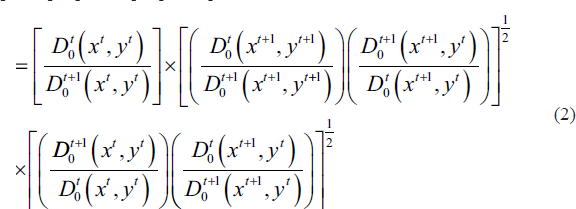
MTC denotes Hicks-neutral technical change. From Equation (2), if OBTC and IBTC are equal to one, then technical change is Hicks neutral. Conversely, if values of OBTC (or IBTC) are greater than unity, then technical change with bias amplifies growth in TFP, and is the reverse if values of OBTC (or IBTC) are less than one. Since we are interested in looking at the using/saving characteristics of inputs, in this study, TFP has been computed considering single output. This implies that OBTC = 1. Therefore, TC = [MTC] × [IBTC]. 1
Re-dating the variables and reference technology, six output distance functions in Equation (2) can be computed using the DEA technique under CRS for each country/DMU (k’) as follows:

subject to
where
There is evidence of neutral or non-neutral technology. While considering the shift in inward or outward technological frontier (as seen previously), the direction in the technical bias moves also becomes important because it helps to interpret whether the input mix of DMU coordinates with that of technical change, which subsequently would affect output and productivity. In this study, IBTC has been considered by utilizing the input distance function, which helps view the idea of bias direction by isoquants in a better way (Chen & Yu, 2014). The input function is a reciprocal of the output function under CRS and, thus, IBTC can be written as follows:
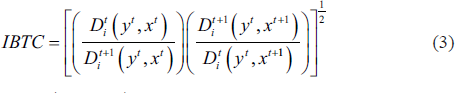
where
Input Biased Technical Change.
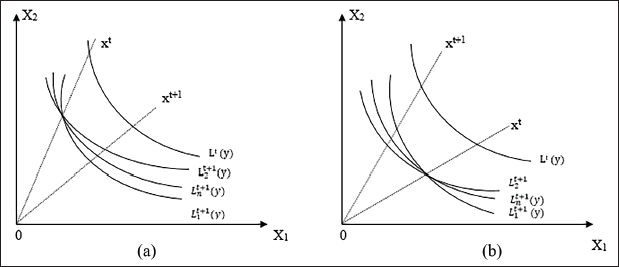
Assuming that technical progress occurs from period t to period t+1, the four input sets in Figure 1 (
Borrowing from Färe et al. (1994), it can be shown that different input mix (maybe due to difference in relative factor prices or some development strategy considerations) in two time periods along with the different IBTC values can yield varied direction of BTC results. This is depicted in Table 1 for inputs
Direction of Input Biased Technical Change.
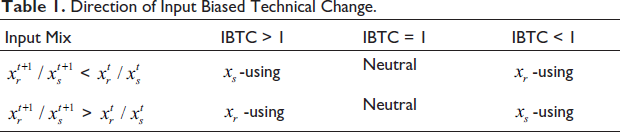
If there is mismatch between direction of technical progress and input mix, a negative bias effect on productivity is realized since cost of resource use would be higher (Chen & Yu, 2014).
Energy Efficiency—DEA Approach
By considering a DMU/country economy
By-Production Approach
Under this approach, energy efficiency estimates have been obtained using the output-oriented directional inefficiency (Ray et al., 2018) as was also computed by Rakshit and Mandal (2020). Following Murty et al. (2012) and Ray et al. (2018), the production possibility set is as follows:

For a given input bundle
Model R






DMU’s technical inefficiency is indicated by
Joint-Production Approach
Based on the benefit function (Luenberger, 1992) that was propounded by Chambers et al. (1996), good outputs are expanded and bad outputs are simultaneously reduced to the largest extent possible under the DDF following the joint-production approach without increasing energy and non-energy inputs (Rakshit & Mandal, 2020).
The technology set,
Model C





Following Rakshit and Mandal (2020), the value of
Since in Model C the energy input is not scaled down by a factor of
Data Descriptions
In the present study, the sample data comprises of 149 economies that have been further grouped into low-income, middle-income and high-income economies 2 over the time period 1993–2013. The aggregate measures of output used in the analysis are gross domestic output (GDP) in million US$ in 2011 PPP and carbon dioxide emissions (CO2) in million tonnes. Labour (in millions), capital (million 2011 US$) and energy (million metric tonnes of oil equivalent [Mtoe]) have been regarded as inputs in the analysis. Following along the lines of Rakshit and Mandal (2020), energy has been considered in the form of primary energy. 3 This takes into account coal, petroleum, dry natural gas excluding supplemental gaseous fuels, nuclear energy, conventional hydroelectricity, geothermal energy, solar energy, wind energy, wood and wood-derived fuels, biomass waste, fuel ethanol and biodiesel, respectively. Data on GDP, labour and capital have been extracted from Penn World Table (PWT 9.0), 4 energy from the U.S. Energy Information Administration and CO2 from World Development Indicators. Since the data are at the country level, CRS technology is assumed (Ray et al., 2018). Table 2 depicts the descriptive statistics of the data. It can be discerned that there is substantial variation in variables across countries and time (Rakshit & Mandal, 2020).
Descriptive Statistics of the Data Variables (1993–2013).

The correlation matrix of the inputs and outputs is presented in Table 3. Significantly positive correlation coefficients imply that output values also go up when inputs are increased. This makes energy efficiency analysis feasible (Zhang & Choi, 2013).
Correlation Matrices for Inputs and Outputs (1993–2013).

*Significance at the 5% level.
Results and Discussion
Total Factor Productivity and Its Decomposition
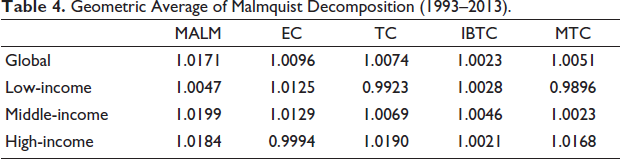
Using the approach described in Section 3, we first compute the MALM and its decompositions for economies at the global level as well as for low-, middle- and high-income economies in every adjacent pair of years and then calculate the geometric average of the same. The results are reported in Table 4. TFP had shown an improvement in the case of all the sample observations. It can be observed that from 1993 to 2013, TFP increased by 1.71% at the global level. It increased by 0.47%, 1.99% and 1.84% for low-, middle- and high-income economies, respectively. At the global level, this improvement has been contributed by both TE change (0.96%) and technical change (0.74%). In low-income economies, the increase in TFP was due to progress in TE (value of 1.0125). However, technical change experienced regress (value of 0.9923) in low-income economies. Middle-income economies witnessed an improvement in TFP (1.99%) due to progress in TE (1.29%) as well as in technical change (0.69%). TFP increased in high-income economies by 1.84%. This improvement in productivity can be attributed to progress in technical change (value of 1.0190). But there was TE regress (value of 0.9994) from 1993 to 2013 in high-income economies. Table 4 also shows that the average IBTC index equals 1.0023, 1.0028, 1.0046 and 1.0021 for the global, low-, middle- and high-income economies. The value of the IBTC index being very close to one reflects that there have been relatively smaller biased technical changes. In addition, except for low-income economies, other groups of economies have displayed neutral technology progress over the period, as observed from the MTC values.
Geometric Average of Malmquist Decomposition (1993–2013).
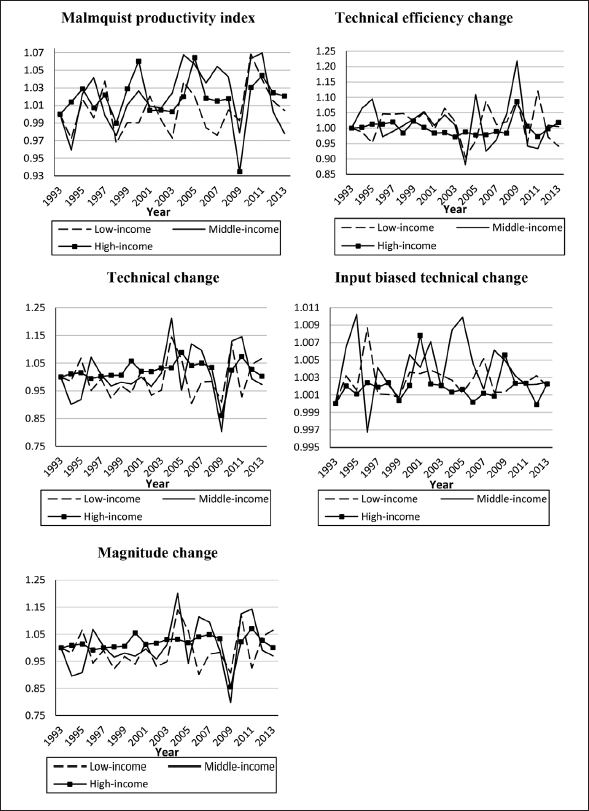
The variations in productivity among different income groups of economies have been further examined. The evolution of change in TFP and its decompositions for low-, middle- and high-income economies during the study period are presented in Figure 2. The three groups of economies seem to display an increasing, albeit fluctuating, trend in TFP change over the years. This fluctuation in TFP change is more pronounced for high-income economies, followed by middle-income economies and then by low-income economies. It implies that the rise and fall of productivity in high-income economies have been relatively more distinct compared to in middle and low-income economies over the years. The trend of technical change follows the trend of productivity change for all the economies, suggesting that the progress and regress in technical change is reflected in the corresponding increase and decrease in TFP. This implies that technical innovation is crucial for improving TFP for all the economies. The TE change, in contrast, exhibits a trend opposite of that seen under TFP change for all the economies. It can be inferred that more efficient production is necessary to complement the growth in productivity.
Productivity and Its Decomposition for Different Income Groups of Economies.
Total Factor Productivity, Technical Change and Energy Efficiency at the Global Level
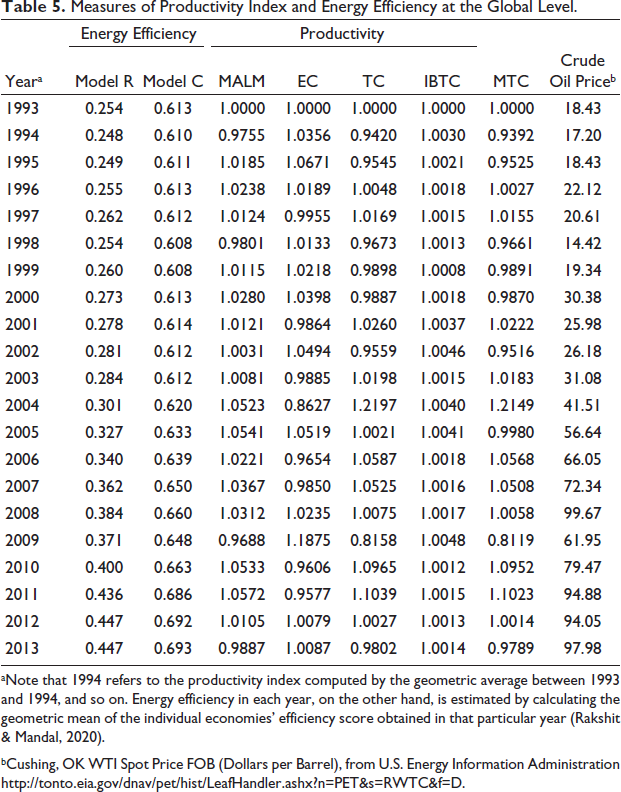
Table 5 reports the annual index of both models of energy efficiency scores as well as productivity index and its decompositions. The average energy efficiency based on the DDF model considering the reduction in polluting input (energy) and undesirable output and the proportionate increase in the desirable output (Model R) is found to be substantially lower than that obtained from the model considering only the contraction in undesirable output along with simultaneous expansion in the desirable output (Model C). This is because Model R involves an added restriction and therefore leads to a lower value of the objective function in the maximization problem. The Wilcoxon Rank-Sum test has been employed 5 to verify whether adding the restriction in the efficiency model results in significantly different estimates of energy efficiency. Since the value of two-tailed ‘p’ statistic is found to be less than 0.0005, the null hypothesis can be rejected at 1% level, implying that the additional constraint considered in Model R results in significantly different energy efficiency estimates. As also observed by Rakshit and Mandal (2020), over the time period 1993–2013, there was improvement in energy efficiency, except in 1994, 1998 and 2009 when it witnessed a marginal dip that coincided with the Mexican peso crisis, the Asian financial crisis and the 2008 recession, respectively. In these years, oil prices also fell. 6 Overall, there has been efficient usage of energy when there has been rise in oil prices. This demonstrates that induced innovation hypothesis has been important at the global level in the short run.
Measures of Productivity Index and Energy Efficiency at the Global Level.
aNote that 1994 refers to the productivity index computed by the geometric average between 1993 and 1994, and so on. Energy efficiency in each year, on the other hand, is estimated by calculating the geometric mean of the individual economies’ efficiency score obtained in that particular year (Rakshit & Mandal, 2020).
bCushing, OK WTI Spot Price FOB (Dollars per Barrel), from U.S. Energy Information Administration
A similar increase in trend was also be observed in the MALM. This can be discerned by the fact that the values of MALM are all greater than one except in 1994, 1998, 2009 and 2013. By observing the trends in the components of MALM over the years, it appears that both technical change and TE change have been important in driving TFP growth. Hence, innovation advancement as well as increase in the efficiency in production activities have played an important role in raising the TFP at the global level. As mentioned earlier, there has been neutral technical progress over the years. Further, the IBTC values being near one reflects the fact that there is almost consistency with Hicks neutrality on an average over the sample period.
Direction of Technical Change and Energy Efficiency in the Short-Run
At the global level, countries have experienced a great level of technical bias, as observed in Figure 3. Hence, it becomes imperative to determine the input bias index and direction of technical change for each country. For this purpose, Table 6 summarizes the number of countries having a bias in using relative inputs along with classifying countries on the basis of three IBTC values, namely, >1, <1 and =1, at the global level. In most of the years (16 out of 20), the direction of technology bias matched with the input mix used, denoted by IBTC > 1, at the global level. This has aided in magnifying TFP growth and, subsequently, the GDP of these countries over the years. There are also countries where IBTC < 1, implying that adoption of technology has not coordinated with their input mix (factor markets). There are very few economies that have experienced neutral technical change.
Maximum and Minimum of IBTC Values at the Global Level.
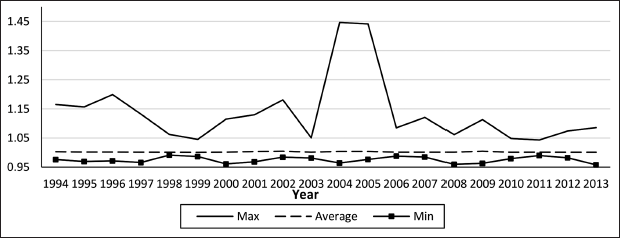
Distributions of Annual Input Biased Technological Change at the Global Level.
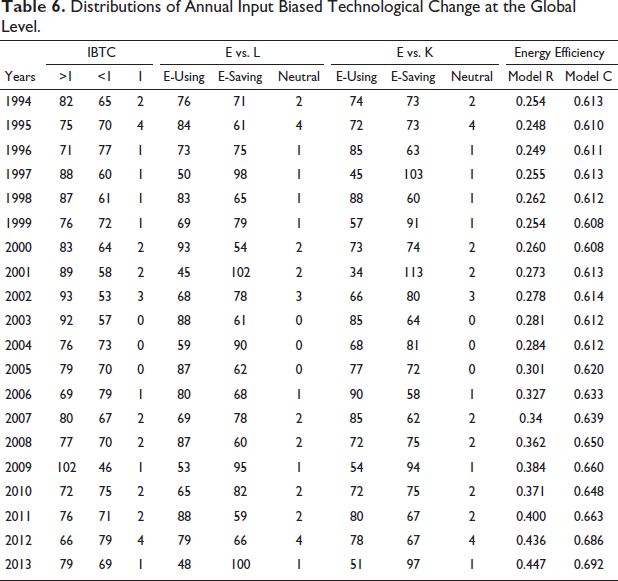
With three inputs, capital (K), labour (L) and energy use (E), two situations have been examined in this study to identify the direction of technological bias: E vs. L and E vs. K, presented in Table 5. Looking at the pairs of E vs. L and E vs. K, in almost half of the time period under consideration, the economies had E-saving (or L- and K-using) bias. It can be observed that during the years of the economic downturn (1999 and 2009–2010), when there was also a fall in energy efficiency, the economies went for E-saving (or L- and K-using) bias. It meant that energy-saving technology was adopted in these years to fuel the economic growth to keep the momentum of energy-efficiency improvement in place. This may be explained by the fact that during periods of economic instability, economies prefer to use domestic inputs rather than heavily rely on imported energy resulting in biased technical change (Binswanger, 1974). However, energy may still be consumed in using other inputs in the production process (embodied energy), leading to a marginal fall in energy efficiency.
Direction of Technical Change and Energy Efficiency in the Long-Run
Table 7 displays the distribution of IBTC and change in energy efficiency over the period 1993–2013 at the global level. The difference between Table 6 and Table 7 is that earlier the MALM for a given unit was compared at two different years by constructing a chain-link of adjacent productivity indexes cumulatively. However, there is also a need to determine the MALM and its components over the entire period as well as for each country since the chain version for panel data is not transitive (Barros & Weber, 2009; Chen & Yu, 2014). Through such a procedure, we can check whether, similar to short-run results, countries underwent neutral technical change in the long-run as well or not. Table 7 shows that in none of the situations (E vs. L and E vs. K), neutral technical change was experienced in the long run. These findings show that the extent of the bias is more visible over a longer period where its direction matched the input mix and technological advancement occurred due to series of dynamic evolutions. Most of the economies (68.46% countries of the total global sample) had IBTC > 1, implying that biased technical change magnified TFP growth over time. The bias is more towards E-using/L-saving in E vs. L situations (44.97% countries). These economies, in essence, went for energy-using technology and used relatively less labour than energy, leading to a relatively lesser increase in energy efficiency (2.50% and 0.52% under Model R and Model C, respectively) as compared to when economies went for energy-saving technology (3.20% and 0.90% under Model R and Model C respectively). Under the case of E vs. K, 51.68% of the economies at the global level had a technological bias towards E-saving/K-using technology. The use of relatively more energy than that of capital under E vs. K meant that the energy-efficiency improvement was more pronounced (3.05% under Model R and 0.76% under Model C) than when the economies used comparatively less energy vis-à-vis capital (1.73% under Model R and 0.33% under Model C).
Distribution of Input Biased Technical Change and Change in Energy Efficiency (%) at the Global Level: 1993–2013.
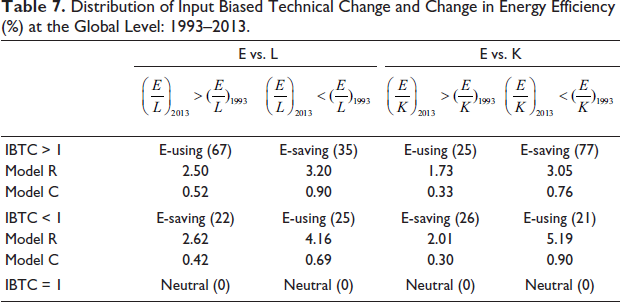
Focussing on the technology bias results of countries with IBTC < 1 from Table 7, it is observed that 16.78% of the economies showed E-using/L-saving bias (when E vs. L) in 1993–2013. These economies took up E-using technology but used comparatively less energy, experiencing an improvement of energy efficiency (4.16% and 0.69% under Model R and Model C, respectively) on the one hand but shrinking of TFP growth (since IBTC < 1) on the other hand. In E vs. K situations, most of the economies (17.45% countries of the global sample) went for E-saving/K-using technology but used relatively more energy than capital, leading to dampening of energy-efficiency improvement accompanied by the fall in TFP growth. This may be expounded by the fact that these economies might have a relatively abundant endowment of labour, and such a technological innovation would make them more productive. But in this process, the wages of these skilled workers start going up, making the producers to use relatively more energy than labour leading to a reduction in energy-efficiency improvement and increase in unemployment in these economies.
To better understand the direction of technical change, its coordination with input mix and its association with energy efficiency at the global level, this study further investigates these dynamics for each income group of economies.
Total Factor Productivity, Technical Change and Energy Efficiency for Low, Middle and High-Income Economies
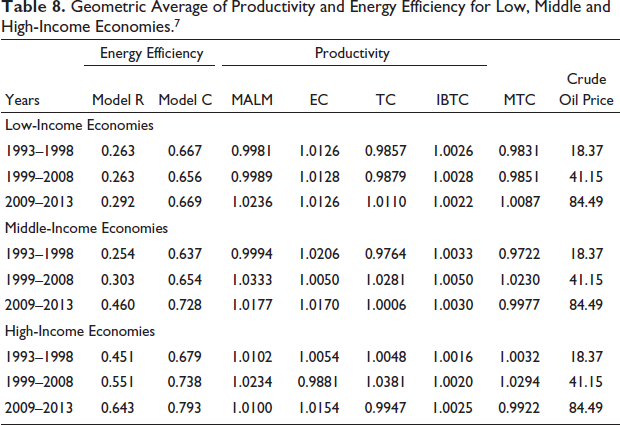
Table 8 exhibits the annual index of both models of energy-efficiency scores as well as productivity index and its decompositions for the low-, middle- and high-income economies in different sub-periods. Similar to the findings at the global level, the average energy efficiency under Model R is substantially lower than that obtained under Model C. From the Wilcoxon Rank-Sum test, it can be observed that the added restriction in Model R results in significantly different energy efficiency estimates. The energy efficiency in low-income economies have been low and have fluctuated over the years (Rakshit & Mandal, 2020). It is because these economies may not be utilizing the most advanced technologies in their energy-intensive sectors that comprise basic metals, non-metallic minerals, paper and paper products, coke, petroleum refining and so on. Their lower energy efficiencies can also be attributed to their dependence on low-quality fuels. 50%–80% of total primary energy use is constituted by traditional biomass in 75% of low-income economies comprising least developed countries (LDCs) as of 2014. In the remaining LDCs, oil products contribute a major share in total primary energy use. However, there is utilization of natural gas, coal and renewable energy (hydroelectricity in Malawi and Mozambique) in few LDCs (UNCTAD, 2017). Since relatively fewer low-income economies use oil hence, it can be observed from Table 9 that the trend in energy efficiency does not entirely correspond with the trend in oil prices. Thus, it may be inferred that change in oil prices may not have much bearing on low-income economies’ energy efficiency.
Geometric Average of Productivity and Energy Efficiency for Low, Middle and High-Income Economies. 7
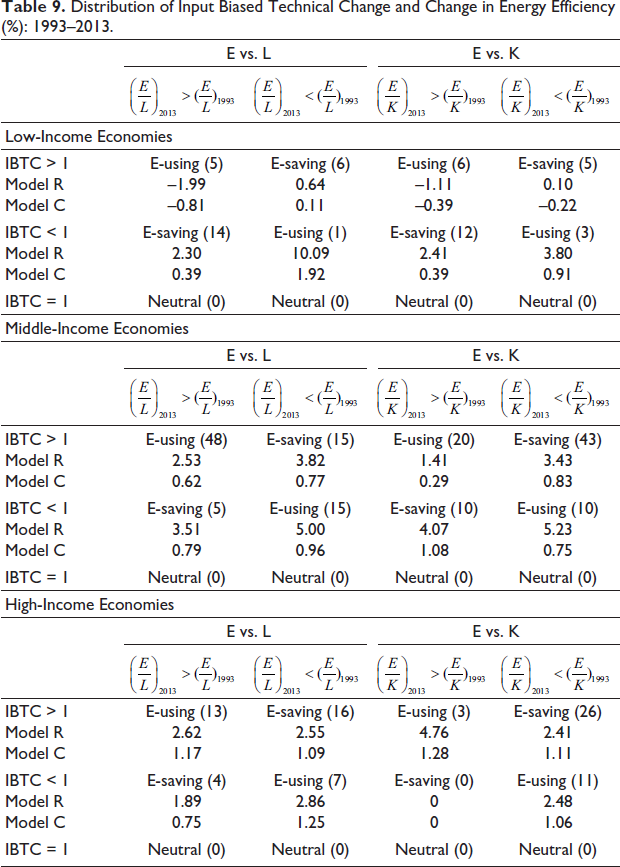
Distribution of Input Biased Technical Change and Change in Energy Efficiency (%): 1993–2013.
As also observed at the global level, middle-income economies’ energy efficiency trend follows a similar pattern. It improved over the period 1993–2013, except in 1994, 1998 and 2009, coinciding with the Mexican peso crisis, the Asian financial crisis and the 2008 recession, respectively. Since the turn of the century, there has been an improvement in energy-efficiency levels in the middle-income economies that can be contributed to energy-efficiency advancements in the industrial sector, especially after 2010 (Rakshit & Mandal, 2020). 39% of the global savings in the upper-middle-income economies were due to industrial energy-intensity improvement during 2010–2015. In the same time period, lower-middle-income economies also experienced improvement in industrial energy intensity (International Energy Agency et al., 2018). During the years of economic downturn, the oil prices had also gone down. For instance, in the later quarter of 2008, the slowdown in economic activity led to fall in oil prices from US$ 99.67/barrel to US$ 61.95/barrel in 2009, rendering the use of energy less efficient. However, the rise in oil prices contributed to efficient usage of energy, highlighting the important role played by induced innovation hypothesis in middle-income economies (Rakshit & Mandal, 2020).
There has been improvement in energy efficiency in high-income economies over the period 1993–2013, except in 2009 when it experienced a drastic decline and coincided with the 2008 recession (Rakshit & Mandal, 2020). The development of renewable energy power generation capacity and a consistent decline in energy demand after 2008–2009 have contributed to improvements in energy efficiency in high-income economies.
Similar to energy efficiency, the fluctuating trend was also observed in the MALM in low-income economies. By observing the trends in the components of MALM over the years, it appears that the TE change has been more important in driving TFP growth than the technical change. Hence, policies in low-income economies may be directed towards advancements in innovation in order to spur TFP growth. In addition, there has been neutral technical progress over the years. Further, the IBTC values being near 1 reflects the fact that there is almost consistency with Hicks neutrality on an average over the sample period. An increase in trend was observed in the MALM in middle-income economies. Moreover, the increase in the efficiency in production activities has played an important role in raising the TFP for middle-income economies. The IBTC values being near 1 for most of the years reflects the fact that there is almost consistency with Hicks neutrality on an average over the sample period. The trend in the MALM of high-income economies reveals that there has been productivity growth in all the years except 1998 and 2009. By observing the trends in the components of MALM over the years, it appears that technical change was vital in facilitating TFP growth. Hence, an increase in the technological innovation have played an important role in raising the TFP for high-income economies.
Tables 9 displays the distribution of IBTC and change in energy efficiency over the period 1993–2013 for the low-, middle- and high-income economies. Table 9 shows that in none of the situations (E vs. L and E vs. K), neutral technical change was experienced. Most of the low-income economies (15 out of 26) had IBTC < 1, implying that biased technical change hindered TFP growth over time. This finding is contrary to what was observed in the short run when the direction of technology bias matched with the input mix used in most of the years. In the long run, the technological bias is more towards E-saving (or L- and K-using) in E vs. L (53.84% of the countries from the low-income economies’ sample) and E vs. K (46.15% countries) situations. In essence, these economies went for energy-saving technology and used relatively less labour and capital than energy. This implies that low-income economies have not fully utilized their resource endowments to the maximum potential. This is because of the mismatch between factor endowment and the technologies available in these economies. This has led to energy efficiency improving at a slower rate. This can be discerned from Table 9 when the change in energy efficiency for economies that underwent E-saving technical bias under Model R and Model C has been 2.30% and 0.39% in E vs. L case and 2.41% and 0.39% in E vs. K case, respectively. Focussing on the technology bias results of countries with IBTC > 1 from Table 9, it is observed that 23.08% of the low-income economies showed E-saving/L-using bias (when E vs. L) in 1993–2013. These economies took up E-saving technology and utilized relatively more labour than energy, resulting in energy-efficiency improvements over time. However, when the economies took up E-using technology, there was a decline in energy-efficiency improvement. In the E vs. K situation, most of the economies went for E-using/K-saving technology (23.08% of the countries from the sample of low-income economies) and used relatively more energy than capital. However, these economies witnessed dampening in energy-efficiency improvement as represented by the negative energy efficiency change seen in Table 9.
Most of the middle-income economies (63 out of 83) had IBTC > 1, implying that biased technical change augmented TFP growth over time. In the long run, the technological bias is more towards E-using/L-saving when E vs. L situation (57.83% countries from the sample of middle-income economies) is considered. This brings out the importance of energy as a critical input in the production processes in middle-income economies. However, the utilization of relatively less labour than energy resulted in unemployment in these economies. Looking at the combination of E vs. K, it is observed that 51.81% of economies had a bias towards E-saving/K-using technology in the short- and long-run. Their corresponding energy-efficiency improvement has been 3.43% and 0.83% under Model R and Model C, respectively. The technology bias results of countries with IBTC < 1 from Table 9 also reveals that most of the economies (18.07% countries from the middle-income economies’ sample) showed E-using/L-saving bias (when E vs. L) in 1993–2013 and experienced increase in energy efficiency (5.00% and 0.96% under Model R and Model C, respectively). However, when the economies took up E-saving technology but utilized relatively more energy than labour, energy efficiency increased by only 3.51% and 0.79% under Model R and Model C, respectively, from 1993 to 2013. As under the E vs. L situation, similar observations can also be noticed for the E vs. K pair.
Like the middle-income economies, most of the high-income economies (29 out of 40) had IBTC > 1. In the long run; the technological bias is more towards E-saving (or L- and K-using) when E vs. L (40% countries from the sample of high-income economies), and E vs. K (65% countries from the high-income economies’ sample) situations are considered. Under the outcomes of both E-using and E-saving technical change, high-income economies have had positive energy efficiency advancements over the years. However, from Table 9, it can be observed that economies that went for E-using technology had higher energy-efficiency improvements than those economies that went for E-saving technology. This may be explained by the fact that high-income economies are technology innovators and can develop technologies appropriate for their factor endowment. The technology bias results of countries with IBTC < 1 reveals that most of the economies showed E-using (or L- and K-saving) bias (when E vs. L and E vs. K) in 1993–2013 accompanied by greater increase in energy efficiency. However, when the economies took up E-saving technology but utilized relatively more energy than labour, energy efficiency increased only by 1.89% and 0.75% under Model R and Model C, respectively, from 1993 to 2013.
Conclusion
This paper examines the direction of technical change, its coordination with input mix and its association with energy efficiency at the global level as well as for different income groups of economies (low, middle and high) over the period 1993–2013 using DEA-based MALM and energy efficiency models. The findings reveal that, in most of the years, the bias in the direction of technical change coordinated with the input mix for all the groups of economies in the short-run thereby magnifying TFP growth. This is also observed in the long-run, with the exception of many low-income economies where the direction of technical change did not coordinate with the input mix. This implies that although low-income economies introduce the technology that adapts to their factor markets, these economies are unable to promote the provision of inputs that can make use of the technology they adopt (Chen & Yu, 2014). Since unskilled labour is abundant in these economies, appropriate policies should be formulated to enhance human capital formation and developing their skill so that they adopt to advanced technologies (UNCTAD, 2014).
With respect to labour and capital, except for low-income economies, the rest of the sample of economies’ energy-saving technical change has a positive association with energy-efficiency improvements implying that energy-saving innovation is consistent with achieving higher energy efficiency over time. This reinforces the fact that in low-income economies, the labour as an input in the production processes may not be possessing the required skill and knowledge of the latest technology to carry out improvements in energy efficiency optimally. In middle-income economies, energy-efficiency improvement occurred at the cost of using other inputs, leading to the displacement of labour and unemployment. This can be overcome by efficiently utilizing available resources through the provision of employment opportunities and fostering capital accumulation in different sectors of the economy. The results of this study also suggest that there is substitution of input use between capital, labour and energy and change in technical bias direction due to change in oil prices in different groups of economies.
In this study, it was also observed that there are a considerable number of countries in each group of economies that have a mismatch of technical bias direction, input mix and corresponding advancements in energy efficiency, indicating the need to adjust the direction of research in technologies or to provide an environment in factor market appropriate for these countries in accordance with the structural characteristics of the individual economy. This will aid in improving their productivities as well as energy efficiency.
One important limitation of this analysis is that it does not consider undesirable output, which may lead to biased results in estimating technical change and its direction. A possible area of research in this regard may be to compute BTC by considering both desirable and undesirable outputs. Another possible area of research may be to explore detailed linkages between technology, energy efficiency and productivity by considering different energy inputs at micro and macro levels.
Footnotes
Declaration of Conflicting Interests
The authors declared no potential conflicts of interest with respect to the research, authorship and/or publication of this article.
Funding
The authors received no financial support for the research, authorship and/or publication of this article.
