



Abstract
The study examines how agricultural land grabbing has affected rural migrant women in Ghana. This has been done through the use of the convergent parallel mixed method of case study design, with emphasis on two land grabbed communities—Kobre in Brong Ahafo region and Agogo in Ashanti region of Ghana. The results showed that the manifestations of land grabbing have led to: (a) Strong experiences of land alienation and thwarted re-connection of rural migrant women to alternative lands; and (b) coerced participation of rural migrant women in low-value economic fields and changes in their geographical positions. These outcomes have affected the livelihood conditions of the migrant women negatively. The study, therefore, recommends the State and other key stakeholders to develop comprehensive guidelines that specifically protect rural migrant women in their access to and use of land and related resources in the phase of land-based investments.
What Birthed the Study? Land, Women and Land Grabbing Manifestations
Access to and utilisation of land resources are essential bedrocks to sustainable rural livelihood (Basset & Crummy, 2003; Berry, 2009), with positive multiplier implications on the fight against poverty and hunger (Sustainable Development Goals [SDGs] 1 and 2). This makes land governance and management a critical issue of concern. Several proposals and reforms have been made as an attempt to enhance land tenure security, especially for the poor and women who seem to be the marginalised (Meinzen-Dick et al., 2010). Till date, however, evidence on how recent efforts have improved women’s access to land and tenure security as well as how these have influenced their livelihoods still remain rare. In many developing countries, including Ghana, traditional ownership structure and management systems on lands are mainly treated as ‘all men’s affairs’ and this has become stereotypical among many rural members (Kaunza-Nu-Dem et al., 2016). Being aware of the inequality between men and women in land access and use in Ghana, we decided to focus on how agricultural land grabbing has affected migrant women’s access to land resources, their displacements and mobility patterns, and the subsequent implications on their livelihoods. The focus on migrant women is deemed appropriate in this context because of:
Their intense vulnerability vis-à-vis indigenous women and other rural members such as migrant men; and Our attempt to draw attention to the peculiar problems facing specific group of women in the agricultural sector (rural migrant women) to whom policy actions have been very faint.
This is very critical as the pace and scale at which foreign investors are invading the agricultural sector of many developing countries (including Ghana) is increasingly alarming (White et al., 2013). Land takeovers through grabbing are therefore commensurately growing as we can all attest to how past grabbing experiences have fuelled competition over land and the dispossession of rural communities (Cotula, 2009), women not exempted in that. This has been described by Lunstrum (2016) as a ‘reincarnation of the colonial land expropriation’. Whilst often advocated by investors, economists and some developing countries as a new pathway towards agricultural development (Deininger & Byerlee, 2011), the controversies surrounding large scale land investments have aroused misgivings among policy makers and development activists as to whether these land deals will result in win-win situation as perceived by proponents or simply provide a leveraging ground for foreign countries to rob developing countries of their rich resources (Von Braun & Meinzen-Dic, 2009). For instance, the hullabaloo on land investments allowing corporate investors to grab lands was once brought to the global spotlight after the media sparked debate over the famous land deal between the Government of Madagascar and a Korean investor, Daewoo. This grabbing deal was based on a 99-year land lease of nearly half of the arable land for maize and palm oil production in Madagascar (Meinzen-Dick et al., 2010; Vinciguerra, 2013). The media outlet has commonly been used as a focal point for campaigns and advocacy works by voluntary environmental and human rights defenders as well as renewing academic interest on the development implications of land struggles (Cotula, 2009; World Bank, 2010).
Since the inception of the controversies around land grabbing and the implications thereof, the plight of women cannot be muted (Arthur, 2012). The widespread disregard of women voices in resource-based decision-making has put women a bit further in the disadvantage spot—thus, aside been denied of their basic human rights, they are left with little or no other option than to bear the brunt of these land deals (FAO, 2013; World Bank, 2010). In Guatemala for instance, women are often put in a weaker position in access to land and its valuable resources. A typical case in that context was the snow pea production contract where women were entitled to only 3% of snow pea production contracts despite contributing more than one-third to field labour and virtually all processing labour (World Bank, 2010). The same experiences were identified in South Africa where women have land-access and utilisation restrictions, and that despite been the key players in a sugar cane farming contract project (labour of 60%–70%), held less than half (30%) of the contract (Schneider & Gugerty, 2010). Even in cases where women are allowed some farming space with or without land-based investments, agricultural services and facilities are skewed towards men than women. Thus, they receive less extension training, limited access to loans for farm development as well as marketing support (Peterman et al., 2014). For example, in the Dominica Republic, only 4 out of over 150 greenhouses that were distributed by development actors actually went to women (World Bank, 2010). This, among others, underpins the perspective of the World Bank that rural women in developing countries constitute the most resource poor and neglected socio-economic group; migrant women seem the poorest and highly rejected. Such unfair treatments are with at odds with the increasingly central role played by women in the agricultural labour force, estimated at 43%–80% (World Bank, 2010).
In the midst of the constraints and challenges emanates the fact that placing women at the centre of land-related issues and advancing their control over land have positive spillover implications on the fight against poverty and hunger, child health and nutrition, and increase allocations towards education (Quisumbing, 2003). As the World Bank (2010) has reiterated, women account for at least 43% of the global agricultural labour force, and if granted the same access to productive resources as men, farm yields as a whole could rise by 20%–30% thereby delivering 100–150 million people out of hunger. According to Smith et al. (2003), equalising women’s status will lower child malnutrition by 13% in South Asia and by 3% in Sub-Saharan Africa. Increasing resources controlled by women promotes agricultural productivity and contributes significantly to poverty reduction (World Bank, 2010). The above narrative offers some level of insights into the risks that land grabbing is imposing on women, and the need for governments of the developing world to enter into fair land deals with corporate investments. To this effect, Behrman et al. (2012) have argued that land-related investments that are promoted in the name of ‘rural development and transformation’ will miss the mark unless they address the needs of rural women, especially migrant women. However in the developing world, especially in Africa where there is limited state capacity and the existence of legal pluralism, it will be nearly impossible for land-related investments to advance rural development (Deininger & Byerlee, 2011), and to impact positively on migrant women as well as other rural members. In all the issues affecting women, rural migrant women tend to be the worst off. Unfortunately, studies that tacitly place them at the centre have been very rare. Most often, due to their difficulties in getting land for farming, migrant women limit themselves to other agricultural-related activities such as collection of shea nuts, firewood, wild fruits and medicinal herbs which they sell out for living. But in the event of investment, these activities are thwarted (Behrman et al., 2012; Tsikata & Yaro, 2011), and this pushes them to deeper vulnerability and poverty.
Our study, therefore, becomes very necessary to better visualise and greatly intensify discourses around rural migrant women and agricultural land grabbing in the developing world. As Welch (2013), and Li (2011) have argued, poverty itself offers opportunities for corporate investors in terms of inexpensive land and cheap and abundant labour. Thus, vulnerable communities will continuously be the preferred destinations for investors; and this will mean that poor migrant women in such communities will be worst off if appropriate measures incited by rich empirical studies are not implemented. We have picked two case communities to showcase the multifaceted development consequences of agricultural land grabbing on rural migrant women. With this section excepted, the remaining parts of the study consider the materials and methods used for the study, findings and discussions, and conclusion. The findings of the study provide useful lessons to inform agri-investments and their sensitivity to rural migrant women, who are unfairly mix up with other rural women and members in land grabbing discussions worldwide.
Description of Case Communities
Case Community 1: Kobre
Kobre is located in the Pru East District in the Brong Ahafo region of Ghana (see Figure 1). The community is along the road linking Atebubu, the district capital of Atebubu-Amantin Municipality to Yeji, the district capital of Pru East District. Kobre is a migrant community, with a population of not more than 1,000 people (Pru East District Assembly, 2014). The migrants are mainly composed of northerners such as the Dagomba, Komkomba, Sissala, Dagaaba and Gonja; all these are ethnic groups based in the Upper West, Upper East and the Northern regions of Ghana. The community was affected by land grabbing during 2006–2008 period when the Canadian Kimminic Estate Limited acquired 13,000 hectares of land for Jatropha, which came along with several development consequences affecting various categories of rural members, especially migrant women. The land acquisition was done through the paramount chief of Konkoma, an indigenous group living in Yeji with the aid of a broker from the national capital, Accra (Antwi-Bediako, 2018). The lease agreement in terms of number of years for the use of the land remains unknown, but the acquisition led to conflict between the Konkoma Traditional group and the Kojobofour Traditional group, as each group claimed ownership of the land.

Case Community 2: Agogo
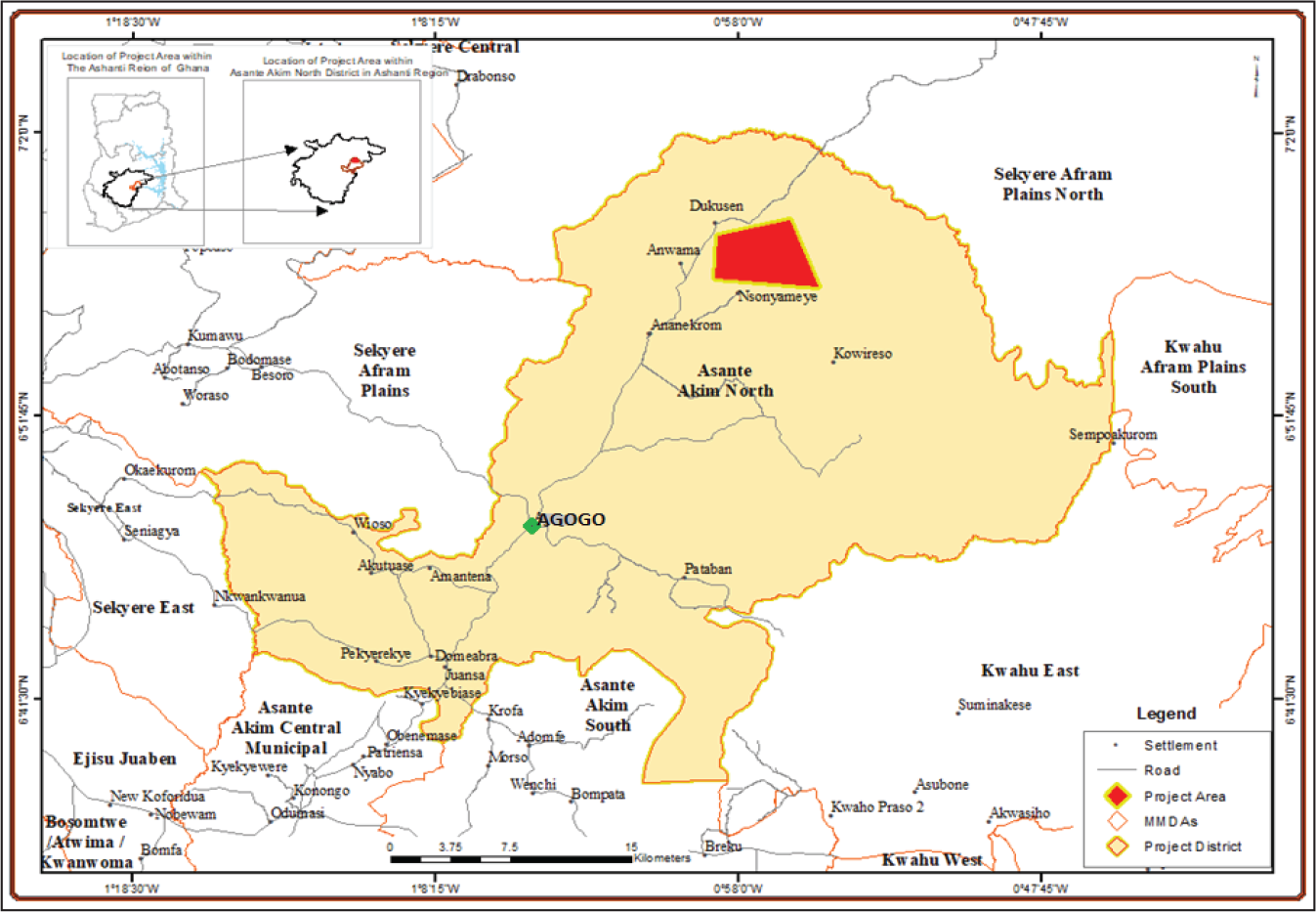
Agogo is located in the Asante Akim North District, a rural district in the Ashanti region of Ghana (refer to Figure 2). The community serves as the district capital, and it is an agrarian niche. Agogo is a cosmopolitan area made up of various ethnic groups including the Asantes who are the indigenes and the dominant migrant group, the mole-Dagbons, made up of the Dagombas, the Gonjas, Mamprusis and other northern groups; the Ewes from the Volta region of Ghana; the Gas; and the Nzemas from Greater Accra region and the Western region, respectively. The community became a host to the Norwegian ScanFarm (formerly ScanFuel) in the 2004–2006 till now, when the company acquired 19,000 hectares of land for Jatropha which has now been transformed to food crops including maize, soya beans, and cassava. The land was acquired from the Agogo Traditional Council for a period of 50 years subject to a 25-year renewal (Boamah, 2014), and it is located in between Dukusen and Nsonyameye, two suburbs of Agogo. The land acquisitions altered local socio-economic and ecological situations that negatively affected the local members.
Materials and Methods
We selected two communities that have intense experiences of agricultural land grabbing in Ghana. The selection of these communities is justified by the following reasons:
The two cases are agrarian communities with land grabbing experiences, and have the potentials to attract more corporate investors due to the government’s adoption of neo-liberal development approach in the agricultural sector (Ghana Shared Growth and Development Agenda II (2014–2017; Ministry of Food and Agriculture, 2015). They are among the top 35% communities in Ghana with large number of migrants in proportion to the indigenes. Kobre is seen as a migrant community since it has over 90% migrants whilst Agogo has about 30% of its population as migrants (Asante Akim North District Assembly, 2014; Ghana Statistical Service, 2014; Pru East District Assembly, 2014); and In reference to the migrants’ population, women outnumber men—Kobre has 53% migrant women compare to 22% men (Pru East District Assembly, 2014) whilst Agogo has 46% migrant women compare to 29% men (Asante Akim North District Assembly, 2014). The remaining are composed of children (14 years and below) and the elderly (65 years and above).
1
The convergent parallel mixed method of case study design was used for the study. The method allows for comprehensive data collection through several sources including interviews and focus group discussions. According to Morse (2003), the use of convergent parallel mixed method gives room for researchers to have a more detailed understanding of issues under investigation through comparison of revelations ascertained from qualitative and quantitative data. The method was also deemed very legitimate in our context as it helps in appreciating the inputs of the marginalised group (such as migrant women in our case) and incorporating and emphasising on them in research (as argued by Hollahan & Barry, 2014). As opined by Creswell (2014), and Wittink et al. (2006), the convergent parallel method can be used in a study by designing both qualitative and quantitative strands of research and analysing them in a concurrent manner. This has been considered through community-level focus, but as suggested by Hollahan and Barry (2014), emphasis can be placed on qualitative data as a deliberate attempt to accentuate on the personal revelations of the respondents. Case study methodologies in themselves allow for the acquisition of detailed information for in-depth analysis of the issue to be examined to inform policy action (Yin, 2003).
We picked secondary information from relevant studies and reports from national archives of institutions such as Ministry of Food and Agriculture and District Agricultural Development Unit (DADU) of both Pru East District Assembly and Asante Akim North District Assembly. The data obtained were made up of the land acquisition process, the manner of institutional engagement, social intervention programmes and livelihood support systems for rural members promised by the investors. These data were purely descriptive. Based on the secondary data, a detailed literature was done to help in the discussions of the research findings. The lacuna in the secondary data was filled with primary data collected with the help of five field assistants recruited from the Kwame Nkrumah University of Science and Technology, Ghana. The field assistants were led by the lead author, who guided them in the entire data collection exercise. The data were collected through questionnaire administration, and focus group discussions. The respondents engaged were officials working with the local government institutions, the Assembly members, the chiefs and elders, opinion leaders, investors, small holder farmers, and migrant women. All questions asked were geared towards assessing the implications of the agricultural land grabbing on the rural migrant women. In order to obtain data from the respondents at the community level, an initial contact was made with either the Assembly member or any opinion leader who gave us a list of individuals who were engaged on the subject matter. Based on the engagement with the community members, we were able to subsequently connect with some additional community respondents. This was done using the snowballing approach. In terms of state officials, we purposively selected them because of their involvement in the land acquisition process and the knowledge they have about the investments.
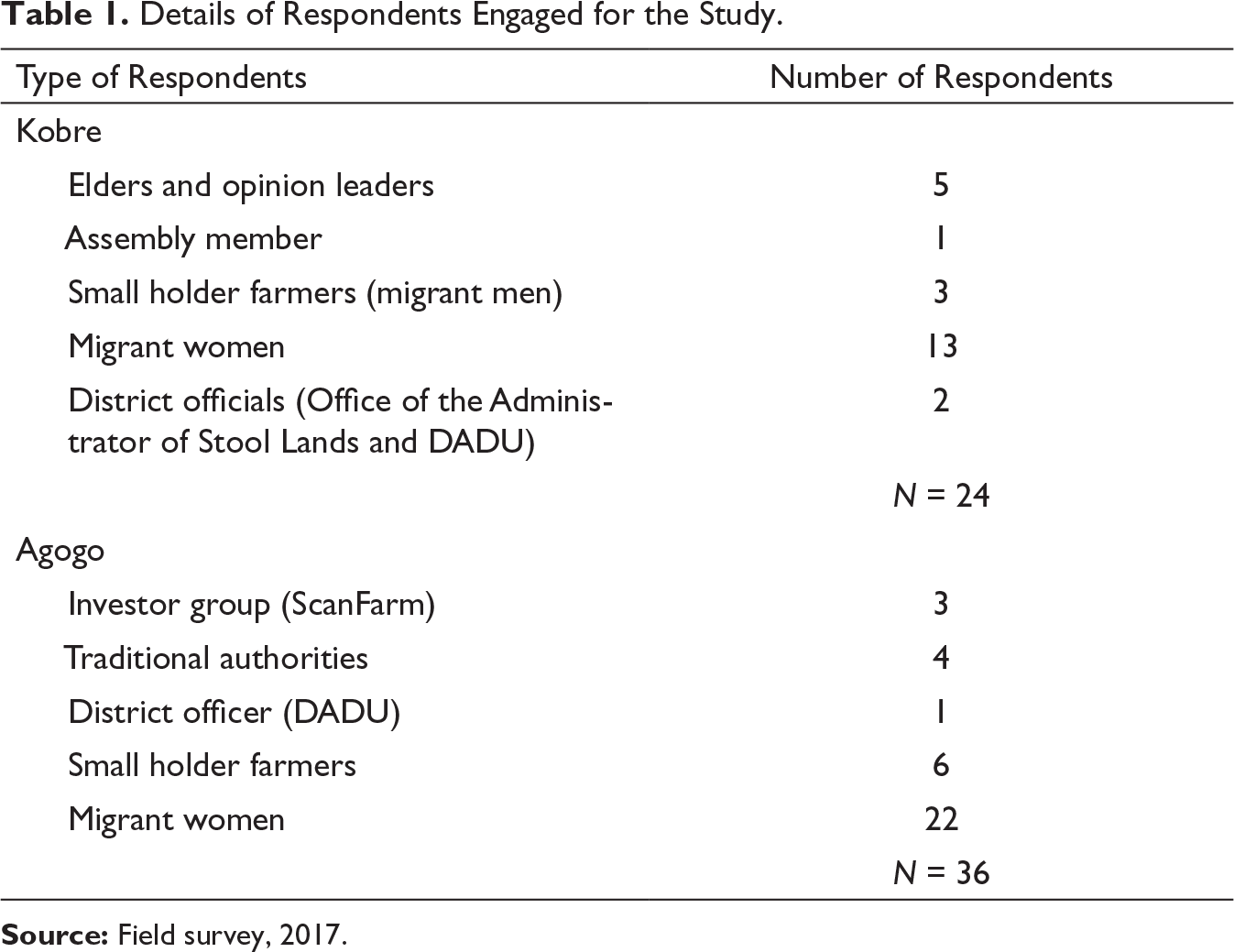
In Kobre, we were able to engage 22 community members and two state officials making 24 respondents whereas in Agogo, we solicited the perspectives of 32 community members, one state official, two workers of the investor, and one top-level official of the investment company. This totalled as 36 respondents. In all, we were able to obtain primary data from 60 respondents for the research (refer to Table 1 for breakdown of respondents). Data analysis was done through extensive use of descriptive approach which was solidified with some quantitative information. We drew inferences from our data through a discussion of the findings in the mix of other related studies.
The Findings of the Study
Case Community 1: Kobre
Details of Respondents Engaged for the Study.
As a migrant community, the acquisition of the 13,000 hectares serving as a farming space for migrants was leased out to the Canadian’s Kimminic Estate Limited by the Konkoma Traditional Council. The lease of the land itself was done in secrecy, through the support of an indigenous elite broker, who resides in Accra, the national capital of Ghana (Antwi-Bediako, 2018). Thus, there was no community consultation, engagement and participation. The land leased to the corporate investor was contested by two traditional councils—Konkoma Traditional Council and the Kojobofour Traditional Council. Historically, the Konkoma group is composed of the Guans from coastal Ghana and the Gonjas from Northern Ghana who moved to Yeji, the district capital of Pru East, and integrated through inter-marriages to become one concrete group. They live in a suburb known as ‘Konkoma’ in Yeji which defines them as indigenous group, with ownership entitlements to some hectares of lands in the Brong Ahafo region officially documented and recognised in Ghana. On the other hand, the Kojobofour group is made up of Akans from southern Ghana who also moved to settle in Yeji, and now live in a defined suburb called ‘Kojobofour’. This gives them an identity status and differentiates them from any other group in Yeji. The group also has official entitlements to lands, which are usually given out to migrant farmers from Northern Ghana usually through payment of annual ground rent for land use (Antwi-Bediako & Abubakari, 2017). The Kobre land also followed the same approach, where the Kojobofour traditional group gave out the land to the migrants including women, though at a minimal number. Both the Kojobofour and the Konkoma traditional groups did not have any formal state recognition to land ownership in Kobre. Before the investment, the Kojobofour traditional group has already given out the land to the small holder migrant farmers (including women) as a mere indication by the group to establish supremacy over the land, and to claim ownership to it. In fact, land is a great asset in Ghana, and shows how powerful a traditional group is (Berry, 2009; Tsikata & Yaro, 2011). These small-holder farmers have been farming on the land for over a decade, and pay rents to the Kojobofour traditional council, who gave them the user right to the land. It was in 2006 that negotiation started between the Konkoma traditional council and the Canadian’s Kimminic Estate Limited through an elite broker for the use of the land for large scale Jatropha investment.
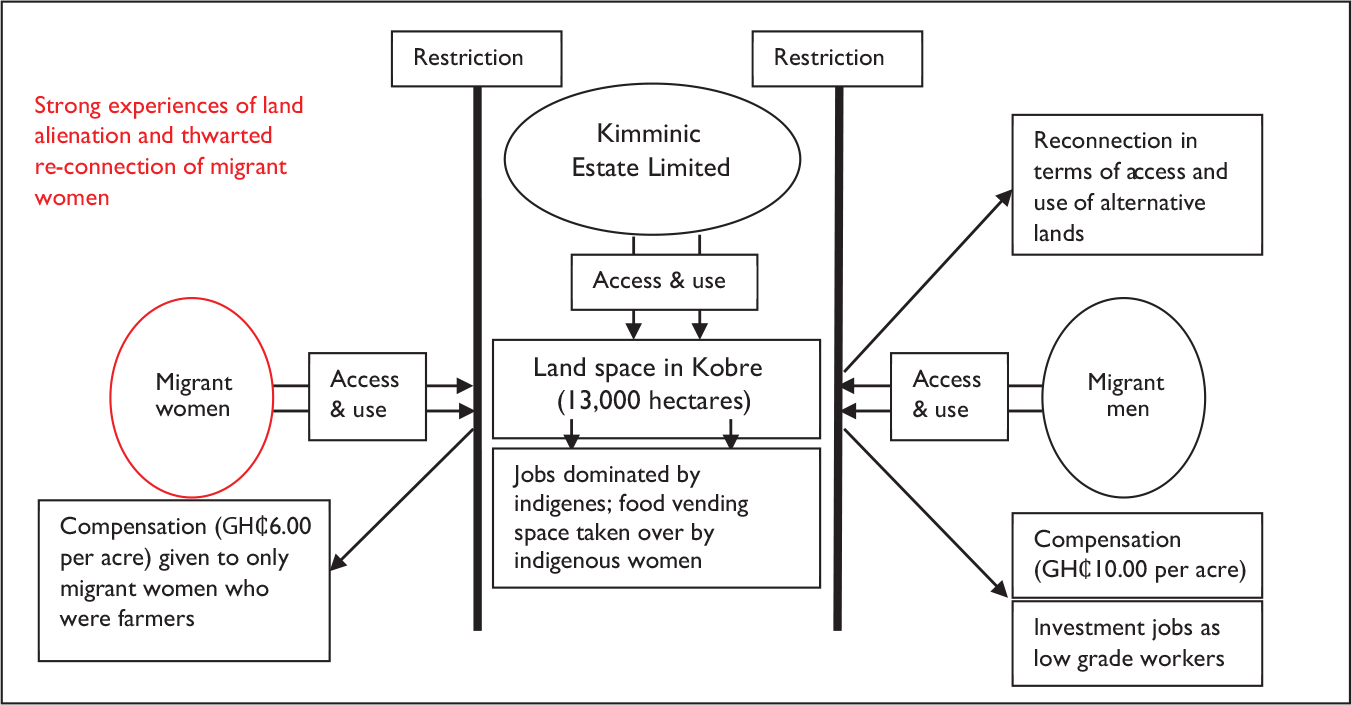
Investment started in 2008, and this meant that small holder farmers were to be evicted from the lands. This incited conflict between the Kojobofour group (supporting migrants on one side) and the Konkoma group and the corporate investor on the other side. But as an attempt to have operational peace, the investor compensated the Kojobofour traditional council and affected migrant farmers. Migrant women engaged in the collection of firewood, wild fruits and medicinal herbs, which they sell for living were not compensated. The activities were seen as fragile by both the investor and the Kojobofour traditional council (that needed to support them) and hence, not commensurate for compensation. As a result, those engaged in these activities were impeded; a revelation similarly identified and attested by Behrman et al. (2012), and Tsikata and Yaro (2011). Even in terms of migrant farmers who were compensated, migrant men received compensation of almost twice that of migrant women. During focus group discussion with nine smallholder migrant farmers (men) concerning the amount taken as compensation, they revealed:
...we were paid GH ₵ 10.00 per acre of land used; and the chief relocated us to new land areas, but this is very far for us...
On the other hand, a focus group discussion with six migrant smallholder farmers (women) identified the following indications by the group:
[i] …when the investor was making payment, we were first informed to bring our husbands to take the money. Thus, those of us with husbands have their support to take our monies, and this was GH₵ 10.00 per acre. Those without husbands were given GH₵ 6.00 per acre.
[ii] During the re-negotiation with the chief and elders of Kojobofour, we told them we are still interested in farming so we will be happy to get alternative lands to continue farming. But they insisted giving out lands to our men first, before they can consider us...For now, most of us are no longer farming.
During an engagement with one migrant woman who used to engage in farming to support her husband, she confirmed:
Yeah!!. I remember this, which still pains me. That, during the payment of compensation, my husband took mine on my behalf, and decided to give me 20%. He took the rest saying that he is the head of the household.
In some instances, though on rare cases, some migrant women (smallholder farmers) who were not affected by the land grabbing had their lands taken from them and given out to migrant men believed to have the physical strength to farm on large acres of land, where payment of yearly ground rent will be higher, and could also be accompanied with some bags of food crops to the Kojobofour traditional council. Most migrant women in Kobre faced strong negative experiences with land alienation, but could not re-connect to alternative lands to continue their farming businesses. The women, who depended on land-based resources such as herbs and firewood, were mostly the married ones, and since they could not obtain any other alternative jobs, decided to offer their support to their husbands who were farmers. Others stayed behind, taking care of their children and engaging in house-keeping downgrading them to private sphere of live.
Also, in terms of job access through the manifestation of the investment, migrant women were deliberately ignored. Their men were rather given jobs, but these were often the low-grade positions such as field labourers. Salaries for low-grade workers ranged between GH₵ 80.00–GH₵ 100.00 (US$ 15.40–US$ 19.20), an amount below the income of only migrant women (GH₵ 200–GH₵ 250.00 [US$ 38.50–US$ 48.15]) 2 who used to farm on two acres to five acres of land before the investment. The operations of the investor also triggered the need for food vendors and the sales of other complementary products that could be demanded by the workers. This economic space was, however, taken over by indigenous women from the two competing traditional councils. As a result, the operations of the investor generally affected the livelihood conditions of migrants negatively, but the outcome was more intense on migrant women than men. Even after the halt of Jatropha investment, livelihood opportunities for migrant women are still thwarted. This is because, the land is still being contested by the two traditional groups, and this is yet to be resolved in the formal court. Refer to Figure 3 for a diagrammatic display of the dynamics of grabbing consequences on rural members with key attention on migrant women in Kobre.
Case Community 2: Agogo
Agogo has over 30% of its population as migrants, predominantly from Northern Ghana. At the centre of the community is a suburb known as ‘Zongo’ 3 composed of large number of migrants. Moving a bid further from the centre of Agogo, one could come across many suburbs such as Ananekrom, Nso-Nyame- Ye and Dukusen which are all along the road linking Agogo and Kumawu, the district capital of the neighbouring Sekeyere Kumawu District. These communities are also composed of migrants, but this is a mixed bag of individuals from both Northern and Southern Ghana. Specifically, one could trace ethnic groups such as the Dagombas, Gonjas and Mamprusis from Northern Ghana; and the Krobos; the Bono and Ahafo people; and Ewes from Southern Ghana. In as much as other ethnic groups have moved to settle in Agogo and its peripheries, the indigenes known as the Asantes still dominant, and have some form of hegemonic control and power to decide and tilt access to and use of local resources especially land and other land-dependent resources through the Agogo traditional council (Antwi-Bediako & Otsuki, 2018). Among the migrants’ population, women occupy approximately 46%, children 4 about 25% and men are composed of the remaining 29% (Ghana Statistical Service, 2014). The major economic activity of migrants is farming, and this is dominated by the men, occupying about 75%. An estimated 25% of migrant women were identified to be engaged in farming but majority used to be engaged in off-farm activities such as trading and marketing of the outputs of the migrant men. These migrant women purchased the harvested crops from the migrant men at an agreed price and sell them out in wholesale and retail prices at the market centres in Agogo (District capital of Asante Akim north District), Kumawu (District capital of Sekyere Kumawu District) and Konongo (District capital of Asante Akim Central Municipality). This according to the migrant women was very profitable as they could raise enough income on daily basis to cater for themselves and to support their households and families.
In a focus group discussion held in Agogo-Dukusen, the migrant women reiterated that:
We could obtain a daily profit of GH₵ 30.00–GH₵ 40.00 [US$ 5.75–US$ 7.66], and during market days in Agogo, Kumawu and Konongo, we could sometimes make a daily income twice what we usually make during ordinary days.
For migrant women engaged in farming, the common crops were tomatoes, plantains, maize and cassava, and this was usually farmed on a small piece of land usually two acres to eight acres of land. The migrant women were not restricted in search of farming lands, but many indigenous land owners preferred men to women, and will usually give out lands to migrant men if both are competing for the same piece of land. Giving out land was predominantly characterised by payment of yearly rent (usually GH₵ 10.00 [US$ 1.92]) and an agreed crop sharing ratio if migrants were to utilise 10 or more acres of land. The crop sharing ratio differs, but in most cases, it was 5:1 (for every six bags produced, farmers take five bags whilst land owners take one bag). Once this condition is agreed by migrants, landowners were ready to give out land irrespective of gender or sex of the migrants. Utilising over 10 acres of land was a bit of challenge for many migrant women, and thus, those who farmed, were mostly utilising a maximum of 8 acres, and this required payment of only annual ground rent but at a higher rate of GH₵ 12.00 (US$ 2.30). These conditions were what exactly existed, and migrants especially women were incrementally attracted to live and work in Agogo, especially in communities such as Dukusen and Nso-Nyame-ye where they were granted access to farming lands.
In 2004–2006, a total land area of 19,000 hectares was leased to the Norwegian ScanFarm for large-scale land investment for Jatropha. The land deal was spearheaded by the allodial title holder, the Agogo paramount chief (Boamah, 2014), through an elite broker who served as the intermediary between the investor and the paramountcy (Antwi-Bediako, 2018). This land area comprised over 80% of lands given out to the migrants through some economic conditions to be utilised for their farming and to earn a living out of their activities. The manifestation of the grabbing was never communicated to the migrants to help them prepare for changes in livelihood sources, and this severely affected the migrant women vis-à-vis migrant men and other local members such as indigenes. The investor started its operations in 2007–2008, engaging in the cultivation of Jatropha on a large scale. The investment meant that migrants’ access and use of any resources on the acquired land were thwarted. The indigenes (the land owners) who gave out land to migrants were compensated by the investor for land takeover, but migrants (both women and men) were never compensated. This was deemed appropriate because in the Asantes’ traditions, access to and use of land and related resources are distinct from land ownership, and they do not account for compensation in case of alienation (Amanor, 2007; Knudsen & Fold, 2011).
Due to the land grabbing, productive lands became very limited and competitive, and their access and use were defined by higher economic conditions in which migrant women could not meet. Majority of the migrant men were somewhat able to get access to alternative lands since they could meet and cope with the new economic criteria for land access and use—payment of annual ground rent of GH₵ 20.00 (US$ 2.30) and crop sharing ratio of 2:1 where for every three bags of crop, farmers take two bags whilst land owners take one bag. The new crop sharing arrangement allowed indigenous women (especially wives of landowners and those who were from landowning families which gave lands to migrant men) to dominate the marketing and trading of agricultural commodities of the migrant men. This was because, the new arrangement allowed the indigenous women to obtain many outputs directly from the migrant men, which they then sold them out at wholesale and retail prices at the major market centres in Agogo, Kumawu and Konongo. The majority of the migrant women who were engaged in crop marketing forcibly pulled out since they could only obtain the harvested crops from migrant men 5 at very high rate. This meant that they have to sell such produce at higher prices in order to earn profit. However, already, the indigenous women were selling similar products at a moderate price since they are able to obtain such produce at virtually no cost from migrant men who were using their families’ or husbands’ lands for farming purposes through the new crop sharing arrangement for use of lands for farming purposes.
The investor’s operation has also led to job creations (in terms of field workers, machine operators and repairs, security and supervisors), but these were dominated by indigenes easily recruited due to their local citizenship status (Antwi-Bediako & Otsuki, 2018), and migrant men preferred as the low grade workers for the company. The unfavourable economic conditions have forced some migrant women into low value economic fields such as petty trading and hawking in the mobile market along the main road linking Konongo and Kumasi (the regional capital of the Ashanti region) where traffic flow is very intense. Daily income from the hawking activities ranges from GH₵ 5.00 to GH₵ 15.00 (US$ 0.96 to US$ 2.87), far lower than the amount originally received before the land grabbing. This, coupled with travel cost from Agogo to Konongo to engage in such economic activities has served as disincentive to many migrant women. Hence, many have moved back to their home communities, whilst others have moved to other neighbouring rural communities in search of agricultural-based economic activities such as farming and food processing. There has therefore been a displacement of migrant women through divergent mobility patterns and change in geographical positions, and this has affected livelihood conditions of the women. Refer to Figure 4 for a diagrammatic display of the dynamics of grabbing consequences on rural members with key attention on migrant women in Agogo.

Discussion and Departure Point for the Study
In the current dispensation of ‘leaving no one behind’ in the development space, advocacy campaigns and calls for women empowerment have been overly abundant all in the quest to achieve the commensurate SDGs. International organisations, Civil Society Groups, human rights defenders, and governments across the globe have acknowledged the relevance of women empowerment in all economic spheres and its multiplier positive implications on development (ActionAid International, 2018; Chigbu et al., 2018; Organisation for Economic Cooperation and Development, 2010; World Bank, Food and Agriculture Organisation of the United Nations and International Fund for Agricultural Development, 2009). Women’s access to, use of, and control over land and other agricultural productive resources have been identified as the key ingredients in ensuring that women are able to cater for themselves and contribute enormously to global food security and sustainable economic development (FAO, 2002; United Nations, 2013). Over the years, efforts have been made to enhance women’s land and tenure security (Chigbu et al., 2018), but there are critical puzzles that surround women’s land rights that seem unresolved. This is perhaps, caused by the over-simplification of who women are and what kind of rights they have to economic resources. Resultantly, impacts of efforts on all groups of women have been paralysed, disjointed and genuinely shortchanged. In fact, we are unable to make profound impacts on women’s land rights and access to productive resources such as land because of our failure to categorise women and provide context-based interventions that meet the divergent needs of differing women’s group (Chigbu et al., 2019). Therefore, in the quest of empowering women, strengthening their land tenure security and protection, migrant women per se, have received very fragile or to some extent no gains from the several interventions put forth. These women have unfairly been mixed up with other categories of women such as the indigenes and the elite ones, and so, interventions have failed to reach them as expected in our bid to empower women in the agricultural space. Policy interventions have, therefore, failed to address the reality that exists in women’s land tenure experiences. To this effect, Paradza (2011) has revealed that women should be seen as heterogeneous group, and that their differences should inform policy formulation, implementation and evaluation that will have the expected impacts on each group of women. This is also critical to gender studies and concerted efforts because land in itself underpins the economic, social and political lives of majority of people (Moyo, 1995).
As ascertained in this study and in commensurate with the perspectives of studies conducted by Chigbu et al. (2019) and Paradza (2011), migrant women’s experiences and extent of vulnerability in the phase of agricultural land grabbing have been intense. Dragging this group of women out of vulnerability and ‘inferiorisation’ will therefore require specific interventions geared towards them in addition to dealing with the complex net that surround the ‘cultural space’ they find themselves in (Chigbu, 2015). In Ghana, local citizenship identity has been used as a source of hegemonic and customary power to undermine migrants in the phase of agri-investments (Antwi Bediako & Otsuki, 2018), with migrant women been the ones overly suppressed than their men. In such situations, the struggle for alternative lands becomes critical (Berry, 2009), and so, the indigenes and their chiefs create unfavourable conditions that undermine most migrant women and further push them into poverty. For instance, as ascertained in our article, indigenous women have been able to take advantage of new unfavourable economic criteria for land access and use by migrants to dominate the economic space of selling previously occupied by migrant women. Neumann (2005) argued that the social construction of identity has in most cases, provided emblematic connotations to supremacy of indigenes over migrants in access to economic resources, especially during the manifestations of large-scale land investments. However, when interventions come in to protect women in such situation, indigenous women are unfairly mix up with the migrants and receive similar interventional mechanisms to advance their conditions. This is due to our failure to delve deeper into the peculiar problems various groups of rural members faced (see Chigbu et al., 2018, 2019). Specific interventions will therefore be needed to help alleviate the harsh implications of land grabbing/land-based investments on rural migrant women in Ghana (and perhaps, other developing countries with intensity of land grabbing). We, therefore, call on policy makers and other concerned stakeholders to rethink about interventions to safeguard vulnerable rural communities in the phase of large-scale agri-investments, and particularly in the direction of women and land tenure security, differentiation in policy responses is needed to specifically respond to the women’s divergent problems. For migrant women to be well-protected from the shocks of land grabbing, the development of comprehensive guidelines that specifically address their access to and use of land and related resources will be needed. This will ensure that we will not ‘leave them behind’ in advancing economic growth and development and in the attainment of the SDGs in Ghana (and other developing countries).
Footnotes
Declaration of Conflicting Interests
Funding
The authors disclosed receipt of the following financial support for the research, authorship and/or publication of this article: The researchers received no funding for this research.